Western media ‘coverage’ of Russia is incredibly dangerous, and it’s getting worse
By Glenn Diesen | RT | March 20, 2024
Western media coverage of every Russian election is bad. But this time it was even worse than usual.
Instead of lashing out at the incompetence on display, it’s more constructive to explore why rational discussions about the country continue to appear impossible.
Not to mention the dire consequences of the ongoing self-delusion.
Reason versus conformity to the group
One of the first things we learn in sociology is that humans are in a constant battle between instincts and reason. Over tens of thousands of years, we have developed the instinct to organise in groups as a source of security. This is the result of evolutionary biology as survival demands that we organise into “us” versus “them”. In-group loyalty is augmented by assigning contrasting identities of the virtuous “us” versus the evil “other”, which helps stop an individual from straying too far from the pack.
Yet, human beings are also equipped with reason and thus the ability to assess objective reality independent of their immediate circle. In international relations, it’s imperative to place yourself in the shoes of the opponent. The rationality required to see the world through the perspective of the “other” is vital for reaching mutual understanding, reducing tensions, and pursuing a workable peace.
Every successful peace process and reconciliation in history – from Northern Ireland to negotiations to end apartheid in South Africa – has been based on this.
We expect journalists to be objective in their reporting of reality, which is especially important during war. But this seems to be almost impossible, especially during conflicts. When human beings experience external threats, their herd instincts are triggered as society demands group loyalty and we punish those who deviate. The political obedience demanded during war time usually results in the weakening of freedom of speech, the role of journalism, and democracy.
Why did Russians vote for Putin?
So, how can we understand the reasons for President Vladimir Putin’s immense popularity in Russia and his landslide victory?
If we use our reason and resist our tribal instincts, it should not be difficult to understand the popularity of Putin. While the 1990s was a golden period for the West, it was a nightmare for Russians. The economy collapsed and society disintegrated with truly horrific consequences.
The country’s security also collapsed, as NATO expansion meant there was no chance to agree an inclusive European security architecture. This had been outlined in the Charter of Paris for a New Europe in 1990 and the OSCE founding documents.
A weakened Russia meant that its interests could be ignored, and NATO was able to invade Moscow’s ally Yugoslavia, in violation of international law.
When Putin took over the presidency on 31 December 1999, it was commonplace in the West to predict that Russia would share the fate of the Soviet Union. That is eventual collapse.
However, Russia has instead become the largest economy in Europe (by PPP), its society has healed from the disastrous 1990s, its military might has been restored, and new international partners have been found in the East and Global South, as evidenced by the growing role of BRICS.
Furthermore, most Russians believe it’s not a good idea to have major disruptions to leadership in the middle of a NATO-Russia proxy war in Ukraine that is deemed an existential threat. Don’t change horses in midstream as the American proverb, often attributed to Abraham Lincoln, advises.
Speaking of the US, the late Mikhail Gorbachev – who was immensely popular there – did not shy away from criticising Putin, when he was still with us. However, he nevertheless argued that Putin “saved Russia from the beginning of a collapse”.
Today, any Western journalist repeating this would be immediately branded as a “Putinist” – implying a betrayal of the “us”. Western journalists cannot acknowledge the immense achievements of Russia since 1999 as it could be interpreted as lending legitimacy and signalling support for the “bad” side.
The price of self-delusion
Arguments are not judged by the extent they reflect an objective reality, rather they are assessed by how they are seen to express support or condemnation of Russia. Conformity to a narrative signals in-group loyalty, and the desire to deprive opponents of legitimacy limits what is allowed to be discussed.
Acknowledging Putin’s achievements over the past 25 years is treated as expressing support for him, which is tantamount to treason.
Meanwhile, journalists hardly ever discuss Moscow’s security concerns and the extent to which our competing interests can be harmonised. Instead, Russian policies are conveyed by referring to derogatory descriptions of Putin’s character.
As in our other wars, conflicts are explained by the presence of a bad man and if we could just make him go away, then the natural order of peace would be restored. Putin, the narrative contends, is our most recent reincarnation of Hitler and we constantly live in the 1940s where an adversary must be defeated and not appeased.
How can journalists then explain to their audience Putin’s popularity and the reasons for his huge personal vote when it is not allowed to say anything positive about the Russian president? Unable to live in reality and unable to place ourselves in the shoes of the opponent – how are we supposed to have sensible analysis and policies? As I always warned my students of international relations: Do not hate your rivals, it produces poor and dangerous analysis!
Making self-delusion virtuous comes at a high price. How can the West pursue diplomacy and work with Putin when he is presented as the embodiment of evil and an illegitimate leader? Even explaining Russian policies is condemned as legitimising Russian policies, which is deemed to be propaganda that must not be given a platform. People conform to the good versus evil mantra as it feels virtuous and patriotic to signal that they support the in-group and loathe the out-group. But how can we pursue our interests when we have committed ourselves to self-delusion and have banned reality from our analysis?
I have attempted to explain for two years why the anti-Russian sanctions were doomed to fail and why Russia will win the war, only to be told that it is Russian propaganda to undermine support for sanctions and to challenge the narrative of a pending Ukrainian victory. Reality be damned! Ignoring reality results in a distorted picture of Russia which predictably leads to miscalculations. How could Russia as a “gas station masquerading as a country” defeat the most draconian Western sanctions and see its economy not only survive, but by some measures even thrive? Why would Russians unite under an existential threat when we cannot acknowledge the role played by NATO in that regard?
Sigmund Freud explored the extent to which instinctive group psychology could diminish the rationality of the individual. Freud’s ideas were further developed by his nephew, Edward Bernays, who became the father of modern political propaganda. Over a century ago, Walter Lippman cautioned group psychology, managed with propaganda, as it came with a heavy price. Yielding to the instinct of viewing conflict as a struggle between the virtuous “us” versus the evil “other” implies that peace requires defeating the adversary, while a workable solution becomes tantamount to appeasement.
What better explains the current failure of rational analysis and the resulting collapse of diplomacy?
Glenn Diesen is a Professor at the University of South-Eastern Norway and an editor at the Russia in Global Affairs journal.
Israel deploys army of bots to spread anti-UNRWA propaganda: Report
The Cradle | March 19, 2024
Israel is executing an online influence campaign using hundreds of fake social media accounts to advance “Israeli interests” among progressive western audiences, including US lawmakers, Haaretz reported on 19 March, citing an investigation by Israeli media watchdog group Fake Reporter.
The campaign is focused specifically on amplifying reports claiming the involvement of UNRWA workers in the 7 October attack on Israel. As The Cradle has reported previously, Israel provided no evidence for its claims, which were part of a campaign to compel western nations to cut funding to the agency. UNRWA plays a crucial role in delivering aid to Palestinians amid Israel’s campaign to impose famine in Gaza.
Researchers at Fake Reporter pinpointed three fake ‘news sites’ specifically created for the operation. The sites amplified reports copied from other real news outlets, such as CNN, The Wall Street Journal, The Guardian, The Jerusalem Post, and The Times of Israel, which promoted Israel’s narrative about the war.
Hundreds of fake social media accounts then intensively promoted the “reports” from the specially-created websites and other news outlets.
The three websites at the center of the campaign were established before the war in Gaza but became active only after it began.
The fake social media accounts seemed to be ‘cyborgs,’ meaning they operate using a combination of artificial intelligence and real people with fake online personalities. The avatars claimed to portray average US citizens, including white, Jewish, and African–American ones.
The avatars were all created on the same date, used the same profile photos and naming conventions, and shared other characteristics that indicate they are all part of the same network, Fake Reporter found.
Over 500 fake accounts were opened for the campaign on Facebook, Instagram, and X.
Their avatars began to post messages about a wide array of topics, including the alleged lack of safety for Jewish Americans on college campuses, discrimination against Jewish students, and false allegations Hamas committed mass rape on 7 October.
At the end of January, after acquiring tens of thousands of followers, the fake accounts pivoted toward spreading Israel’s false allegations about UNRWA employees participating in the 7 October attack.
The avatars worked to inorganically amplify the ‘shocking’ and ‘disturbing’ allegations about UNRWA.
They responded to social media posts by US lawmakers, influencers, and prominent news outlets.
The campaign’s avatars targeted posts by African–American Democratic lawmakers, including Ritchie Torres, Cori Bush, and Jamal Bowman, who received the most such comments.
Haaretz noted that targeting Democratic African–American lawmakers seemed to be an attempt to counter the wave of support they have given to Palestinians amid Israel’s ongoing campaign of Genocide in Gaza.
The EU adopts a ‘Media Freedom’ law, where ‘freedom’ doesn’t mean what you think it does
By Rachel Marsden | RT | March 16, 2024
The EU’s new Media Freedom Act has now been voted into law, with 464 votes for, 92 against, and 65 abstentions.
There are some news outlets whose coverage of the vote I’d like to see. Like RT’s, where you’re reading this right now. But anyone who’s viewing this from inside the European Union’s bastion of democracy and freedom is likely doing so via a VPN connection routed through somewhere outside the bloc, to circumvent its press censorship.
Nothing in this new law suggests that this will change, or that there will be increased access to information and analysis for the average person. Such improved freedoms might lead to people making up their own minds rather than having various flavors of a similar narrative served up for mass consumption. As has become par for the course in so-called Western democracies, inconvenient facts and analysis will still be dismissed as “disinformation” and criticism of the establishment still qualified as an effort to sow division – as though dissent itself wasn’t supposed to be proof of a healthy and vibrant democracy.
So, now that we’ve gotten out of the way any hope of lifting the EU’s top-down censorship in the absence of due process, exactly what kind of lip service does this new law pay to the lofty notion of media freedom?
No spying on journalists or pressing them to disclose their sources. Well, unless you’re one of the countries that lobbied to be able to keep doing this – like France, Italy, Malta, Greece, Cyprus, Sweden, and Finland – so basically, a quarter of EU countries. Oh, but they have to invoke national-security concerns in order to do so. Which, as we know, they’re very discerning about. Like, they didn’t at all implement a virtual police state and extend its powers under the guise of fighting a virus with which French President Emmanuel Macron kept saying they were “at war.” Nor did Amnesty International point out the sweeping “Orwellian” trend across Europe, at least as far back as 2017, of exploiting domestic terrorist attacks to permanently embed what were supposed to be extraordinary powers into criminal law, via measures like “overly broad definitions of terrorism.” So, no doubt they’ll be equally reasonable when slapping the “national security threat” label on a journalist whose work they want to peek at.
At least now, under this new law, they do have to fully inform any targeted journalist of the steps being taken against them.
Another thing that changes is that there’s to be a centralized database into which “all news and current affairs outlets regardless of their size will have to publish information about their owners,” according to an EU press release. May we propose a first candidate for that? The NGO Reporters Without Borders has praised this new law as a “major step forward for the right to information within the European Union.” The same NGO also just launched a “Svoboda” (Russian for “freedom”) satellite package eventually consisting “of up to 25 independent Russian language radio and television channels” aimed at Russia, Ukraine, and the Baltics. The launch took place at the EU parliament, in the presence of EU “values and transparency” commissioner (yes, that’s a real title), Vera Jourova, who has said in support of the new media law that “it is a threat to those who want to use the power of the state, also the financial one, to make the media dependent on them.” But she has also said about this new Russia-targeting initiative that the EU state needs to “use all possible means to ensure that their work, that facts and information can reach Russian-speaking people.” This is the same person who advocated in favor of banning Russia-linked media outlets in the EU.
Anyway, you first, guys. Show everyone else how it’s done. Also, does this mean that all financial interests in the form of advertising spending will also have to be declared by corporate media? Because state-backed media platforms are already transparent; it’s the much more discretionary interests underpinning the more commercial platforms that tend to be much less obvious to audiences. Audiences may not know or understand, for example, why a particular corporate media outlet might focus on a particular nation state with softball interviews, travel pieces, and fluffy documentaries, and treating it with kid gloves in news coverage, when in reality the same country is pumping a ton of ad revenues into the place.
In any case, Queen Ursula von der Leyen’s battalion of bureaucratic desk jockeys is set to grow in ranks now with a new “European Board for Media Services” coming online as a result of the new law. Because freedom isn’t going to police itself, pal.
The name itself Media Freedom Act really is the first clue that it’s probably not all that much about freedom. Kind of like how the “European Peace Facility” fund is used to buy weapons, or the “election” of the handpicked EU Commissioner is really just what any normal country would call a confirmation vote.
It’s a pretty safe bet that whenever the EU kicks the virtue-signaling into overdrive, using feel-good language to sell it, the reality is probably the opposite of what’s advertised.
Rachel Marsden is a columnist, political strategist, and host of independently produced talk-shows in French and English.
The more thoroughly exposed the CIA’s true face, the better
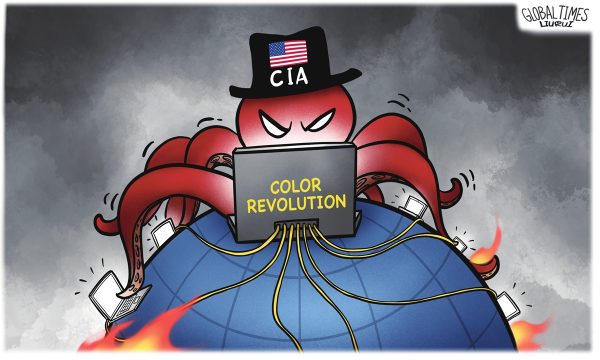
Mother of all disorder Illustration: Liu Rui/GT
Global Times | March 15, 2024
Reuters exclusively reported on Thursday that, according to a former US official with direct knowledge of highly confidential operations, then-US president Donald Trump authorized the Central Intelligence Agency (CIA) to launch secret operations on Chinese social media aimed at “turning public opinion in China against its government.” Many people don’t find this information surprising or even consider it “news.” The US is a habitual offender, using various covert means to foment “peaceful evolution” and “color revolutions” in other countries, with the CIA being the main force employed to this end. For other countries, the US’ pervasive influence is everywhere, visible and tangible, so there is no need for exposés.
We are still unclear what the specific purpose of the “former US official” was in leaking the information to Reuters. A CIA spokesperson declined to comment on the existence of the program, its goals or impact. A spokesperson for the Biden administration’s National Security Council also declined to comment, which means it was neither confirmed nor denied. The US intelligence community often uses a mixture of false and true information to create confusion, a tactic that was used on Edward Snowden. The Reuters report is valuable, but needs to be further processed to filter out the true and useful parts.
Firstly, this report carries a strong defense of US penetration into China. It portrays the proactive offensive of the US’ cognitive warfare against China as a passive counterattack against “cyber attacks” on the US from China and Russia. In reality, portraying themselves as the weak or victimized party and labeling their hegemonic actions as “justice” is a part of the US’ cognitive warfare against foreign countries.
One US official interviewed by Reuters even said it felt like China was attacking the US with “steel baseball bats,” while the US could only fight back with “wooden ones,” showing his exaggerated and clumsy acting skills. The US has never used a “wooden stick.” Over the past few decades, the CIA has overthrown or attempted to overthrow at least 50 legitimate international governments. There are also statistics showing that from 1946 to 2000, the US attempted to influence elections in 45 countries 81 times to achieve regime change. As a habitual offender of manipulating public opinions, the US has long established a series of tactics in its targeted propaganda, information dissemination, event creation, rumor fabrication, incitement of public opinion, and media manipulation. It constantly creates new tactics and uses new technologies according to changing circumstances. This is an open secret. The US dressing itself up as a “little lamb” only has a comedic effect, not a propaganda effect.
Next, as the US’ intervention and infiltration in other countries are covert operations, this disclosure provides an opportunity for the outside world to glimpse into the specific methods used by the US. For example, the whistleblower admitted that the CIA had formed a small team of operatives, using bogus online identities to spread damaging stories about the Chinese government while simultaneously disseminating defamatory content to overseas news agencies. This corroborates with previous statements by CIA Director William Burns, indicating increased resources being allocated for intelligence activities against China, once again confirming the existence of the US “1450” (internet water army) team targeting China.
The whistleblower admitted that the CIA has targeted public opinion in Southeast Asia, Africa, and the South Pacific region, spreading negative narratives about the Belt and Road Initiative. This indicates that in the US-instigated propaganda war against China, the global public opinion arena, especially in “Global South” countries, is their main strategic target. Various “China threat” theories circulating in third-party countries, as consistently pointed out by China, are all being operated by the US intelligence agencies behind the scenes.
The US has never concealed its hegemonic aims, nor does it regard encroachment on other countries’ sovereignty as something to be ashamed of, which is even more infuriating than the hegemonic behavior itself. American economist Jeffrey Sachs criticized the CIA’s blatant violation of international law in his commentary last month, stating that it is “devastating to global stability and the US rule of law,” leading to “an escalating regional war, hundreds of thousands of deaths, and millions of displaced people.” He also criticized the mainstream American media for failing to question or investigate the CIA. In fact, far from acting as watchdogs, mainstream American media has served as an accomplice. How many rumors manufactured by the CIA have been spread through the mouths of mainstream American media? When did they reflect and correct themselves?
We also see that the intentions of the US intelligence agencies are even more sinister. As admitted in the revelations, they aim to force China to spend valuable resources in defending against “cognitive warfare,” keeping us busy with “chasing ghosts,” and disrupting our development pace. First of all, we appreciate their reminder. At the same time, we will not allow external factors to interfere with our strategic determination to manage our own affairs well. For China and the world, the more fully, clearly, and thoroughly the CIA exposes itself, the deeper people will understand its true nature, and the stronger their ability to discern the truth will become. Keeping the CIA busy to no end or failing in their attempts is the best preventive effect.
Culture Warriors Spread Disinfo on ‘Haitian Cannibals’
By Patrick Macfarlane | The Libertarian Institute | March 14, 2024
In the first few years of the 2020s, the world witnessed a revolution in the dissemination of atrocity propaganda. Thanks to the proliferation of social media, smartphone ownership, and artificial intelligence, atrocity claims can now be manufactured, disseminated, and, thankfully, debunked in real time.
Although technology may be evolving, lies do not change much.
During World War I, the British claimed Germans boiled the corpses of their war dead to make fat and glycerin for munitions. More recently, we’ve seen accusations of industrial organ harvesting in Xinjiang, China and claims that Hamas “beheaded babies” in Israel. A key element of these atrocity stories, and many like them, is their over-the-top cartoonization of violence.
Amidst violent political upheaval in Haiti, a narrative has emerged that Haitian society is devolving into widespread cannibalism. A video even emerged purporting to show popular opposition figure, Jimmy “Barbeque” Cherizier, cutting the flesh off a burning corpse and eating it.
This propagandistic narrative comes at a crucial juncture where Western powers have for three years failed to drum up yet another foreign military intervention in this ill-fated nation.
After the assassination of Haitian President Jovenel Moise in 2021, Haiti was ruled by U.S.-installed President Ariel Henry. Many Haitians viewed Henry as an American puppet leader. Because Henry was unable to stabilize the country, the United States pushed the United Nations to deploy a peace keeping force to his nation.
Two weeks ago, Henry left Haiti for Kenya, attempting to secure Joe Biden’s long-desired UN security deployment. In his absence, Haiti’s organized opposition united under the leadership of Jimmy “Barbeque” Cherizier. The united opposition launched an armed revolution that dragged Haiti further into discord, albeit with the goal of creating a truly independent and prosperous country. Unable to safely return to Port-au-Prince, Henry resigned on Tuesday.
Last Saturday, reports began to circulate that Haiti was under siege by cannibal gangs. However, the claims were not reported by mainstream outlets. Instead, they were made on X (formerly Twitter) by popular culture war influencers. These influencers used these reports to sow fear that the unrest will spread to the United States through immigration. With 10.4 million views as of this writing, Malaysian national Ian Miles Cheong circulated the first and most viewed Haiti cannibalism report. The report was furthered, among others, by Dom Lucre, Jake Shields, Tim Pool, and Libs of Tiktok.
Given his position as the wealthiest man in the world and the owner of X, Elon Musk has an effect, intended or not, of legitimizing the information he interacts with on the platform. As is the case with Cheong’s cannibalism report, the information might not be reliable. Nevertheless, Musk drove a number of his 176.3 million followers to Cheong’s post by replying to it.
So, just what was the problem with Cheong’s report? He doesn’t have a source.
On Tuesday, Cheong posted a screenshot of an email he ostensibly received from NBC Reporter David Ingram asking where he got his information.
In the email, Ingram asks Cheong if his cannibalism claim originates from the “unnamed source” referred to by a Daily Express U.S. article. Cheong ridiculed the question, saying, “I just received a request for comment from NBC News asking me to prove cannibalism exists in Haiti. I wish I was making this up.”
Despite Cheong’s mockery, Ingram’s question was legitimate. Cheong made a specific claim in his post. He did not claim “cannibalism exists in Haiti.” He claimed “cannibal gangs are besieging the national palace in Port-au-Prince.”
While Ingram did not link to the article in his email, he was likely referring to this March 5 piece, which states:
… a journalist on the ground told Daily Express US that cannibalism has been witnessed on the streets as the violence reaches “unprecedented” levels… Speaking anonymously, they said: “Haiti is living in a total chaotic situation right now. It is total chaos everywhere, especially in the capital where I am right now”… Following the interview, the journalist said via message: “Cannibalism is not widespread, but definitely an indication of the worsening situation. It definitely happens on a few occasions.”
If Cheong did indeed source his report from the Daily Express U.S. piece, the original claim is dubious. The source is hearsay; the anonymous reporter was told by alleged witnesses that they observed cannibalism. The reporter then told the Daily Express U.S. that cannibalism “definitely happens on a few occasions.” He did not say that he had personally witnessed cannibalism, neither did he allege a specific incident where cannibalism took place.
Furthermore, Cheong mischaracterized the Daily Express report. Cheong’s initial tweet claimed “Cannibal gangs are besieging the national palace in Port-au-Prince.” Cheong transformed the report from “cannibalism definitely happens on a few occasions,” to “cannibal gangs are besieging the national palace[.]”
Another popular culture war influencer, Dom Lucore, subsequently circulated a video of a Haitian gangster eating burnt flesh from a charred human corpse. Lucore claimed the man in the video was opposition leader Jimmy “Barbeque” Cherizier.
Despite being corrected by Dan Cohen, a journalist who personally filmed a documentary featuring Cherizier, Lucore doubled down on the claim.
Although the video probably does depict a Haitian gangster eating human flesh, it is clearly not Jimmy Cherizier. Further, the video is several years old and not connected in any way to what is occurring on the ground in Haiti right now. There is no evidence to suggest that Hatians are eating each other en masse or that criminal gangs are using cannibalism as a weapon of terror.
Does cannibalism exist in Haiti? Apparently, in isolated incidents, yes. But cannibalism has existed there for hundreds of years.
Americans are understandably concerned about illegal immigration. However, they fail to appreciate that this false story supports the case for U.S.-led intervention in Haiti, something the Biden administration has desired for years. A foreign invasion of Haiti would further traumatize the Haitian people and certainly increase the amount of refugees seeking asylum in the United States. As with our prior interventions in Haiti, American taxpayers would be forced to foot the bill.
The CIA Admits Its Long-Time Presence in Ukraine
By Brad Pearce | The Libertarian Institute | March 13, 2024
On February 25, The New York Times published an article titled “The Spy War: How the CIA Secretly Helps Ukraine Fight Putin.” This report was not the result of any leak, but was clearly authorized from the highest level: the CIA brought reporters in to tell the story. Though many spoke on the condition of anonymity to “discuss intelligence matters and sensitive diplomacy,” they do not even create the pretense that this is a story that the CIA doesn’t want the public to know. The clear purpose, stated almost explicitly near the end of the article, is to guilt the Republicans in Congress into supporting Ukraine aid, with the argument that we are “in too deep” and cannot abandon them like our erstwhile allies in Afghanistan. The impact of the article was muted and it was barely discussed outside of those critical of Ukraine aid, because neither the CIA nor the Times seem to have realized the implications of these admissions: it shows that the post-Maidan government of Ukraine pro-actively made itself the base of a hostile conspiracy against Russia.
The short summary of what The New York Times presents is that after the U.S.-backed “Maidan Revolution” in Ukraine in 2014, the newly appointed spymaster went to the intelligence headquarters to find that all of the files had been destroyed when the previous government left. He immediately called the CIA and MI6 to form an alliance to counter Russia. They created a specialized anti-Russia division, staffed exclusively by people born after the fall of the USSR (at that time, no older than 23) and began training them in spying on and sabotaging Russia. The Ukrainian intelligence agents were anti-Russia zealots who expressed a hatred of all Russian speakers, not simply opposition to Putin’s regime or Russian imperialism. The CIA were unable to control their proteges, who carried out violent missions against Russia and the allied “People’s Republics.” This is described as an American “beachhead” against Russia in Ukraine. Since the February 2022 invasion, the CIA has been involved in acts of war against Russia from a network of U.S.-funded bases across Ukraine.
We haven’t heard any of the normal pontificating about “operational security” and “sources and methods” since this was released. The CIA wants us to read this investigation, and the government isn’t pretending otherwise. Besides the transparent purpose—that it should guilt people into funding Ukraine—there are a few other theories as to why this was released. The first would be that it is a “limited hangout,” meaning they are admitting this much in the hopes people don’t look further into it. The next is that it is what some call “pre-bunking,” which is to say that they know a scandalous story is coming out and this is to get ahead of it. But it takes at least a few weeks to produce a story of this size, if not a couple of months, so it would be really risky to release this hoping it would come out before other information that they could not control the release of; the Times claims to have conducted over 200 interviews with only two authors. The other possibility is that it signifies a coming break up between the CIA and Ukrainian intelligence, which is possible, given that The New York Times published another article titled, “Mutual Frustrations Arise in US-Ukraine Alliance,” which described the relationship in terms clearly meant to invoke a troubled marriage. However, the most likely answer is the simplest: they are proud of what they have done, and think by telling the world it will encourage more funding.
By publishing this in The New York Times, the idea that the CIA was highly active in an anti-Russian conspiracy operating in Ukraine is another thing that has moved from the realm of “conspiracy theory” to “of course it’s true, and here’s why that’s a good thing.” But for all of this, there has been very little discourse about the story, and most of that has been from skeptics of arming Ukraine. It did not have the impact that they wanted, but it seems to have not had impact at all. The supporters of Ukraine throughout the media do not have anything to say about this specific Times article, despite that publication being the gate-keeper of respectable discourse and usually once it prints something it can be discussed everywhere. If this was a ploy to get more funding, it doesn’t seem to have worked.
What both the CIA and The New York Times failed to understand about their story is that it reinforces many of Russia’s key points. The most important of which is that we have constantly been told that Russia presents a threat to all of its neighbors and that Finland and Poland need to be afraid (though they certainly don’t act like it) and that if Russia isn’t stopped in Ukraine they will roll their tanks into Brussels. It doesn’t seem anyone actually believes this, but they say it. The Times exposed a different story, which shows that, as Russia has said, Ukraine was a unique situation for a variety of reasons. Per the Times, it is true that an anti-Russia spy conspiracy was centered in Ukraine, by people who hate all Russian speakers. It’s obvious to a reader that these are drastically irresponsible people driven by ethnic hatred-—towards the people who inhabit a region they want us to help them reconquer and rule. It is a different question if any of what we learn in this article “justifies” a large military invasion which has caused enormous human suffering on both sides, but the CIA has chosen to admit that post-Maidan Ukraine went to great efforts to pose a threat to Russia. This shows that there is no reason to believe Russia poses a threat to any neighbors who would choose to pursue a policy of peace and good relations. I suppose it is no surprise that they would admit everything we are meant to believe about the war is a lie, but expect us to support their war anyway.
US Intel Debunks Biden, Admits Russia ‘Doesn’t Want Direct Military Conflict’ With NATO
By Ilya Tsukanov – Sputnik – 12.03.2024
US and NATO officials have spent months claiming that Russia has plans to attack bloc countries and calling on the West to prepare for a costly, decades-long confrontation with Moscow. President Putin squashed these allegations in December, calling them “complete nonsense.”
Russia “almost certainly” doesn’t want to go to war with the US or NATO. That’s the view of the Office of the Director of National Intelligence in its Annual Threat Assessment of the US Intelligence Community report.
“Russia almost certainly does not want a direct military conflict with US and NATO forces and will continue asymmetric activity below what it calculates to be the threshold of military conflict globally. President Vladimir Putin probably believes that Russia has blunted Ukrainian efforts to retake significant territory, that his approach to winning the war is paying off, and that Western and US support to Ukraine is finite, particularly in light of the Israel-HAMAS war,” the assessment, presented to US officials in early February but released publicly only on Monday, indicated.
The ODNI listed off all its usual claims about the tools the US expects Russia to use to advance its global interests, ranging “from using energy to try to coerce cooperation and weaken Western unity on Ukraine” (it’s worth recalling here that it was the US, not Russia, which blew up the Nord Stream pipeline network) “to military and security intimidation, malign influence, cyber operations, espionage, and subterfuge,” tools Washington itself has used repeatedly throughout its unipolar moment since 1991.
The report admitted that despite “enormous damage at home and abroad” resulting from the proxy war with NATO in Ukraine, Russia “remains a resilient and capable adversary across a wide range of domains and seeks to project and defend its interests globally and to undermine the United States and the West.”
Kissinger’s Nightmare
The report highlighted deep US concerns about the prospects of enhanced Russian-Chinese cooperation – an eventuality which gurus of US foreign policy like Henry Kissinger and Zbigniew Brzezinski spent their careers warning about and seeking to avoid by dividing the Eurasian mega powers.
“Moscow’s deep economic engagement with Beijing provides Russia with a major market for its energy and commodities, greater protection from future sanctions, and a stronger partner in opposing the United States. China is by far Russia’s most important trading partner with bilateral trade reaching more than $220 billion in 2023, already surpassing their total 2022 volume by 15 percent,” the document indicated.
On the economic front, the ODNI expects Russia’s GDP to record “modest growth” this year (the IMF expects a 2.6 percent bump in Russia’s GDP – up from 1.5 percent projected last fall), and says the country’s economic ties with non-Western countries will continue to strengthen.
“Moscow has successfully diverted most of its seaborne oil exports and probably is selling significant volumes above the G7-led crude oil and refined product price caps, which came into effect in December 2022 and February 2023, respectively – in part because Russia is increasing its use of non-Western options to facilitate diversion of most of its seaborne oil exports and because global oil prices increased last year,” the report said.
On top of that, US intelligence expects Moscow to maintain “significant energy leverage,” even in Europe, where it remained the second-largest supplier of liquefied natural gas through the first half of 2023 despite Brussels’ self-defeating restrictions.
Assuring that the NATO proxy war in Ukraine has “incurred major, lasting costs for Russia,” the ODNI nonetheless admitted that the defensive strategy Moscow took in the face of Kiev’s summer counteroffensive “plays to Russia’s strategic military advantages and is increasingly shifting the momentum in Moscow’s favor.” Russia’s defense sector is engaged in “significantly ramping up production of a panoply of long-range strike weapons, artillery munitions, and other capabilities that will allow it to sustain a long high-intensity war if necessary. Meanwhile, Moscow has made continual incremental battlefield gains since late 2023, and is benefitting from uncertainties about the future of Western military assistance,” the report said.
Russia, China, Iran and North Korea are listed as the four major state actors “engaging in competitive behavior that directly threatens US national security,” with China specifically listed as a power which “vies to surpass the United States in comprehensive national power and secure deference to its preferences from its neighbors and from countries around the world, while Russia directly threatens the United States in an attempt to assert leverage regionally and globally.”
Iran is listed as a threat to “US interests, allies, and influence in the Middle East” and a nation which “intends to entrench its emergent status as a regional power while minimizing threats… and the risk of direct military conflict.” As for the DPRK, the ODNI expects North Korean leader Kim Jong Un to “continue to pursue nuclear and conventional military capabilities that threaten the United States and its allies,” with strengthening economic, diplomatic and defense ties with China and Russia expected to help Pyongyang achieve “international acceptance” of the DPRK’s status as a nuclear power.
The ODNI report’s section on Russia, and specifically the passage admitting Moscow’s lack of desire to wage a shooting war against US and NATO runs contrary to months of claims by officials ranging from President Biden to NATO chief Jens Stoltenberg to a host of US and European media that if Russia is “allowed to win in Ukraine,” its next target will be bloc countries.
“We can’t let Putin win,” Biden warned in December 2023, while urging Congress to approve his $61 billion in proposed new aid for Ukraine. “If Putin takes Ukraine, he won’t stop there… He’s going to keep going. He’s made that pretty clear. If Putin attacks a NATO ally – well, we’ve committed as a NATO member that we’d defend every inch of NATO territory. Then we’ll have something that we don’t seek and that we don’t have today: American troops fighting Russian troops,” Biden claimed.
“It’s complete nonsense – and I think that President Biden understands that,” Putin retorted. “Russia has no reason, no interest – no geopolitical interest, neither economic, political nor military – to fight with NATO countries,” he said.
But even after the ODNI assessment was published for internal use in February, US and NATO officials continued with the “aggressive Russia” narrative.
Last month, NATO chief Jens Stoltenberg urged the West to “prepare ourselves for a confrontation that could last decades,” and claimed that “if Putin wins in Ukraine, there is no guarantee that Russian aggression will not spread to other countries.”
In his interview with Tucker Carlson last month, Putin said it was “absolutely out of the question” for Russia to attack NATO members unless they began aggression first. “We have no interest in Poland, Latvia or anywhere else. Why would we do that? We simply don’t have any interest,” Putin said.
The ODNI report finally admits what Russia has been saying all along. The question is: why now?
The hunger killing Gaza’s children has a clear cause that few are willing to name out loud
By Eva Bartlett | RT | March 10, 2024
Following the February 29 Israeli slaughter of at least 115 starving Palestinians lined up for food aid, there was little or no outrage by the same Western media which would have howled if the perpetrator were Russia or Syria.
According to the Gaza Health Ministry, early morning on Thursday, February 29, Israeli forces opened fire on unarmed Palestinians waiting just southwest of Gaza City for desperately needed food aid. As a result, 115 civilians were killed and over 750 wounded.
Popular US commenter Judge Andrew Napolitano said in a recent interview with award-winning analyst Professor Jeffery Sachs, “Innocent Gaza civilians were lined up to receive flour and water from an aid truck, and more than 100 were slaughtered, mowed down, by Israeli troops. This has got to be one of the most reprehensible and public slaughterings that they’ve engaged in.”
The official Israeli version of events, unsurprisingly, puts the blame on the Palestinians themselves. The deaths and injuries were supposedly caused by a stampede, and the Israeli soldiers only fired when they felt they were endangered by the crowd. The BBC even cited one army lieutenant as saying that troops had “cautiously [tried] to disperse the mob with a few warning shots.” Mark Regev, a special adviser to the Israeli prime minister, went as far as to tell CNN that Israeli troops had not been involved directly in any way and that the gunfire had come from “Palestinian armed groups.”
Testimonies from survivors and doctors tell a different story, though, saying the majority of those treated after the incident had been shot by Israeli forces. Legacy media reports, however, use characteristically neutral wording when evidence starts to stack up against Israel. “112 dead in chaotic scenes as Israeli troops open fire near aid trucks, say Gaza officials,” a Guardian headline reads. Palestinians always seem to just “die,” not get killed, and Israeli troops seem to have just “opened fire” nearby. The skewed wording conventions persist even despite the attribution to Palestinian officials present in that same headline – officials like the Palestinian Foreign Ministry, which was quite clear in accusing Israel of perpetrating a ”massacre” as part of a “genocidal war.”
The article does eventually cite the acting Director of al-Awda hospital as saying most of the 161 casualties treated appeared to have been shot. The confusing headline was likely intentional, counting on most people not bothering to read the article in full.
In a report published on March 3, Euro-Med stated members of its field team were present at the time of the incident and “documented Israeli tanks firing heavily towards Palestinian civilians while trying to receive humanitarian aid.” The report goes on to cite Dr Jadallah Al-Shafi’i, head of nursing at Shifa, Gaza’s main hospital, saying, “paramedics and rescue workers were among the victims,” and that at Shifa “they observed dozens of dead and injured, hit by Israeli gunfire.”
The report also cites Dr Amjad Aliwa, an emergency specialist at Shifa who was also on site when Israel opened fire. According to Aliwa, the Israeli fire began, “as soon as the trucks arrived on Thursday at 4 am”
But the February 29 massacre, tragic as it is, is only a part of the current stage of Israel’s war on Gaza: the deliberate starvation of Palestinians. And like the massacre itself, the whole issue is being subjected to the hands-off wording treatment by establishment media.
On February 29, the New York Times published an article whose headline, “Starvation Is Stalking Gaza’s Children,” suggests starvation is a mysterious malicious force with a will of its own, skirting the mention of the Israeli siege as its obvious cause.
Again, as with the Guardian article, a few paragraphs in, the NYT piece does state that the “hunger is a man-made catastrophe,” describing how Israeli forces prevent food delivery and how Israeli bombardments make aid distribution dangerous.
As Professor Sachs stated, ”… Israel has deliberately starved the people of Gaza. Starved! I’m not using an exaggeration, I’m talking literally starving a population. Israel is a criminal, is in non-stop, war crime, status now. I believe in genocidal status.”
Anyone who’s been paying attention knows that the February 29 massacre was not the first such incident, and likely not the last. A thread on Twitter/X outlines this, noting, ”Before yesterday’s “Flour Massacre”, the IDF has been shooting indiscriminately for WEEKS at starved Gazans awaiting aid trucks at the exact same spot, virtually every single day!”
The thread (warning: graphic images!), compiled by Gazan analyst and Euro-Med chief of communications Muhammad Shehada, gives examples of Israeli soldiers firing on Palestinians every single day in the week prior to February 29.
You can bet that, were these Syrian or Russian soldiers firing on starving civilians, the outrage would be front page, 24/7, for weeks. Scratch that, they wouldn’t even have to do it – just a hint of an accusation would have been enough to get the presses going.
Starvation in Syria was another matter
The NYT article mentioned above notes that “Reports of death by starvation are difficult to verify from a distance.” But ‘verifying from a distance’ is precisely what the NYT and other Western media did repeatedly in Syria over the years.
In areas occupied by (then) al-Nusra, Jaysh al-Islam, and the other extremist terrorist gangs which the West and corporate media dubbed “rebels,” food aid was always taken by the respective terrorists and withheld from the civilian population, causing starvation in some districts. Madaya, to the west of Damascus, eastern Aleppo, and later eastern Ghouta were districts most loudly campaigned over in legacy media, providing covering fire for the broader US-led campaign to overthrow the Syrian government.
Backing the claims that the government was starving civilians were mostly “unnamed activists” or activists whose allegiance to Nusra, or even ISIS, was very overt.
As I would see and hear whenever one of these regions was liberated, ample food and medicine had been sent in, but civilians never saw it. Time and again, in eastern Aleppo, Madaya, al-Waer, eastern Ghouta, to name key areas, civilians complained that terrorist factions hoarded food and medicine, and if they sold it to the population, it was at extortionist prices people couldn’t afford.
In the old city of Homs in 2014, back then dubbed by legacy media as the “capital of the revolution,” starved residents I met told me the West’s precious “rebels” had stolen every morsel of food from them, stealing anything of value as well.
Yet, media headlines about these regions screamed about starvation, outright blaming the Syrian government, and were accompanied by disturbing images of emaciated civilians (some of which were not even from Syria) meant to evoke strong emotions among readers and viewers. The same media largely opts not to show you gaunt, starving, Palestinians in Gaza.
Tellingly, Syrian towns surrounded by terrorist forces, besieged, bombed, sniped and starved, got virtually no media coverage. It didn’t fit NATO’s narrative of “rebels”=good, Assad=bad.
But in Gaza the world watches in real time as Palestinians die from the ongoing, preventable, starvation.
Some days ago, the CEO of Medical aid for Palestinians, Melanie Ward, in an interview with CNN, named Israel as the cause of starvation in Gaza.
“It’s very simple: it’s because the Israeli military won’t let it in. We could end this starvation tomorrow very simply if they would just let us have access to people there. But it’s not being allowed. This is what they said [on October 9], ‘Nothing will go in’,” Ward said.
She described the starvation as “the fastest decline in a population’s nutrition status ever recorded. What that means is that children are being starved at the fastest rate the world has ever seen. And we could finish it tomorrow, we could save them all. But we’re not being able to.”
This is echoed by UNICEF. The press-release for its February 2024 report notes that 15.6 % (one in six children) under two years of age are “acutely malnourished” in Gaza’s north. “Of these, almost 3% suffer from severe wasting, the most life-threatening form of malnutrition, which puts young children at highest risk of medical complications and death unless they receive urgent treatment,” UNICEF notes.
Even worse, “since the data were collected in January, the situation is likely to be even graver today,” UNICEF warns, likewise noting the rapid increase of malnutrition is “dangerous and entirely preventable.”
Professor Sachs made an important point: “This will stop when the United States stops providing the munitions to Israel. It will not stop by any self control in Israel, there is none… They believe in ethnic cleansing or worse. And it is the United States which is the sole support… that is not stopping this slaughter.”
Air-dropping paltry amounts of food aid into Gaza is not the answer. It both legitimizes Israel’s deliberate starvation of Gaza and also makes those Palestinians who run toward the aid sitting ducks for the Israeli army to maim or kill. The only solution is to immediately open the borders and allow in the hundreds of aid trucks parked in Egypt. And end the Israeli bombardment of Gaza.
Eva Bartlett is a Canadian independent journalist. She has spent years on the ground covering conflict zones in the Middle East, especially in Syria and Palestine (where she lived for nearly four years).
What the Western Press Didn’t Say About the Leaked Luftwaffe Conversation
By Eduardo Vasco | Strategic Culture Foundation | March 8, 2024
On March 1, the editor-in-chief of the Rossiya Segodnya group, journalist Margarita Simonyan, revealed, on her Telegram channel, a 38-minute audio in which officers from the German Air Force (Luftwaffe) discussed the possibility of sending missiles long-range Taurus to Ukraine and whether they would be able to reach the Crimean bridge in the Kerch Strait, which connects the peninsula to the mainland and is Russian territory.
The Russian press, naturally, made much of the revelation. This forced the mainstream Western media – especially German ones – to report the leak. But whoever thought that a miracle would happen, that is, that the Western press would finally raise the issue of NATO’s military threats against Russia… well, those people are simply very naive.
The Western mass media, as always, tried to manipulate the news and hide the main issue.
The New York Times, The Washington Post, BBC, The Guardian, Die Welt and Der Spiegel published 39 articles on the topic on their respective websites between the time the news was revealed and the evening of March 6th (when I write these lines).
The two North American newspapers did not want to highlight the matter. The Post published two reports and the Times only one. The three expressed concern about the fragility of German intelligence security systems in the face of Russian espionage.
The Europeans, as has been the case for some time, carried much more propaganda against Russia. The BBC published four articles, all referring to the failure to protect Luftwaffe communications. The Guardian published five articles. The majority warns of the Germans’ failure and treats the Russians as great, threatening villains. However, it is necessary to make an honorable mention of Simon Jenkins’ column, the only one who was allowed to say that the leaked conversations demonstrate that NATO is threatening Russia with an escalation in the conflict.
As we all know, this drop of water in the middle of the ocean has no chance of counterbalancing the flood of war propaganda and fake news from the British press against Russia. Newspaper owners only allow freedom of expression when it is harmless – and try to isolate minimally independent opinions.
Now let’s talk about German newspaper coverage. Die Welt published 18 pieces about the leak scandal, and treated it as such. Of course, the main reason for the scandal was – for German war propagandists – the interception and dissemination of the conversation, not its content.
The entire reportage of Die Welt revolves around failures in the security system of the German armed forces and Russian espionage. The possibility of Olaf Scholz sending the Taurus to Zelensky is briefly discussed and it is even stated that Germany is putting its Western allies in danger by allowing the interception of conversations that may mention confidential and compromising information – such as the participation of British soldiers in Ukraine, as mentioned in the conversation in question.
A single Die Welt report presents a “dissident” opinion, which is not “Russian propaganda”: the brief speech of a member of the AfD – who, however, is branded a Russian agent by the German state and its agents, such as the press.
The article signed by Pavel Lokshin has the following title: “Kremlin is using Taurus leaks to threaten war against Germany”. Of course, it was the Russians who considered blowing up a bridge in German territory, right?
In turn, Der Spiegel, in its nine articles on the case, reproduces the same speech as Die Welt about the failures in German security and the danger of Russian espionage. It also disqualifies the Kremlin’s claims that the conversation is clear proof of NATO’s direct involvement in the war in Ukraine and how much this threatens Russian national security.
Christina Hebel’s analysis is the only piece in these two German outlets that takes the accusations of the Russian government and German involvement in the war more seriously, but it would be an exaggeration to say that this publication would be in the sphere of journalism.
In short, the coverage of these newspapers – and the coverage of other mass media outlets in the West is no different – is absolutely biased and manipulated. In fact, as always happens, they reverse roles: Germany, which threatened to blow up a bridge in Russia, is the victim, while Russia is the villain!
If at least one of these newspapers really were a journalistic tool, and not a propaganda tool, it should publish an article with a title like “German officers considered blowing up bridge in Russia” or “Audios reveal discussion of attack on Russia with German weapons”.
After all, which is more serious: the leak of the audio by Russian intelligence or the discussion among senior German officials about a military attack on Russia? No honest person would choose the first option. But we are not dealing with honest people when we talk about “journalism” in Europe and the United States.
I can’t help but wonder: what if it were the other way around? What if a conversation between Russian officials discussing the explosion of a bridge in Germany had been revealed? Would Western press coverage also treat the leak as something more serious than threats of military attack?
Of course not! If it were Russia considering attacking Germany, there would not be 39 articles in these vehicles, but rather 3,900. Russia would be portrayed as a threat to human civilization (more so than it is portrayed today), chaos would be wreaked in German and Western society, and the drums of war against Russia would be beaten at the top of their lungs. Meetings would be urgently called at the UN Security Council, unilateral sanctions would increase absurdly, all the lackey governments of the USA and the European Union would speak out publicly condemning Vladimir Putin’s madness.
They are real hypocrites. Against Russia, anything goes.
And, although the majority of these media outlets are private, they all act as government bodies, under the strict control of their respective States, as true spokespeople for those in power. But Russia is the one who controls the press, Russia is the one spreading propaganda and Russia is the one disinforming, right?
The leaked audio proves that the war in Ukraine is not a war between Russia and Ukraine, but rather a war between Russia and NATO. The Western press strengthens this claim by propagandizing war against Russia and encouraging attacks against Russia.
The press, according to Western discourse, would be a protector of the public interest against the discretion of those in power. That’s idle talk. The press, in fact, even private companies, are tools of these same rulers to control and oppress the governed.
A growing number of Germans oppose the shipment of weapons to Ukraine and Germany’s participation in a war against Russia, but they are systematically deceived and betrayed by their government and the mass media.
Peaceful times are over – Tusk

RT | March 9, 2024
The peaceful times in Europe are long gone, Polish Prime Minister Donald Tusk said, painting a grim picture of the future of the continent amid the continuing tensions with Russia.
“The times of peace are over. The post-war era is over,” Tusk said at a meeting of the European People’s Party (EPP) in Bucharest, Romania on Thursday. “We are living through new times – the pre-war era.”
“The fight against totalitarian trends, corruption, and lies is taking place on many fronts. The most dramatic illustration of this is, of course, what is happening in the war in Ukraine,” the prime minister continued.
“We are facing a simple choice: either we fight to protect our borders, territory and values, and defend our citizens and future generations, or [accept] the alternative that is defeat.”
Tusk made his comments as the Russia-Ukraine conflict entered its third year last month, with many EU heads of state renewing their pledges to continue military and financial aid to Kiev.
NATO Secretary General Jens Stoltenberg said in February that the US-led alliance should brace for “a confrontation that could last decades.” US President Joe Biden vowed during his State of the Union address on Thursday to continue backing Ukraine and accused Russian President Vladimir Putin of “sowing chaos around Europe and beyond.”
Moscow has blamed the West for instigating current tensions, arguing that NATO’s expansion eastward is one of the key causes of Russia’s ongoing military operation in the neighboring state. Putin stated last year that the West’s true goal is “the breakup” of Russia.
The Russian leader, however, stressed that Moscow has no intention of attacking NATO member states unless it will be attacked first.
UK media chiefs defend coverage of Gaza war as study exposes pro-Israel bias
Press TV – March 7, 2024
UK news chiefs have defended their biased coverage of Israel’s brutalities in Gaza even as a new report has exposed significant distortions in the Western coverage of the war.
The report, Media Bias Gaza 2023-24, by Center for Media Monitoring (CFMM) was launched on Wednesday and analyzed data from 28 UK online media websites for a period of one month starting from October 7, 2023.
The study that examined more than 200,000 articles and TV reports said the British media had failed to represent the conflict in Gaza in a fair manner.
Speaking at the event hosted by CFMM in the House of Parliament, Richard Burgess, director of news content at the BBC, said it was unlikely that there would be no mistakes made by a 24-hour news channel.
“It’s impossible not to make mistakes, we will make mistakes,” Burgess said while justifying their coverage.
The CFMM report, however, found that “many prominent media personalities, senior editors and journalists regurgitated Islamophobic tropes about Muslim belief and identity, with the aim of undermining the Palestinian cause and/or Palestinian advocates.”
The study also found “how some media outlets and commentators have framed the conflict as being between Muslims and Jews.”
“Muslim opposition to Israel has been framed as anti-Semitic by some publications and commentators,” the study said
Defending the distortion of facts while reporting the war, Jonathan Levy, managing director and executive editor at Sky News, disputed criticism of a number of points made in the report, including reducing the conflict to “Israel-Hamas” war.
The study showed Israelis were 11 times more likely to be referred to as “victims of attacks” compared to the Palestinians, while 76 percent of online articles framed the conflict as an “Israel-Hamas war.” Only 24 percent mentioned “Palestine/Palestinian,” which they said indicated a lack of context.
Marwan Yaghi, a Palestinian diplomat in the UK, described the media coverage as “appallingly biased.”
Right wing news channels and right-wing British publications were at the forefront of misrepresenting pro-Palestinian protesters as anti-Semitic, the report said.
It also mentioned that pro-Palestinian voices faced misrepresentation and vilification by media outlets, with allegations of anti-Semitism and terrorism weaponized to discredit legitimate advocacy efforts.
It highlighted the lack of scrutiny around a number of stories perpetuated in the press, noting 361 mentions of the false “beheaded babies” story.
Featured Video

Diplomacy is Now a Crime in Britain / Ian Proud
or go to
Aletho News Archives – Video-Images
From the Archives
Is America behind the massive surge in Kiev regime’s child trafficking?
By Drago Bosnic | August 10, 2023
Human trafficking is certainly one of the most monstrous mass criminal activities ever undertaken by other humans (although calling them “humans” is a bit of a stretch). And yet, there’s a special kind of this deeply repulsive crime that pushes it to diabolical proportions – child trafficking. Underage kids, particularly those who were abandoned, sold or have very poor/abusive family backgrounds, are by far the most vulnerable group. The depraved criminals who engage in such illicit activities specifically target unfortunate children and given there are millions of them all around the globe, particularly in war-torn areas, the “recruitment pool” is effectively endless. Unfortunately, the demand on the black market also seems to be constant and growing, making it a very lucrative and appealing prospect for criminals. … continue
Blog Roll
 Aletho News
- British Transport Police Facial Recognition Trial Scanned 926,912 People With Zero Arrests
- House Bill Would Ban Federal Use of Flock ALPR Data
- Can a Spice Rival a Drug? 10 Head-to-Head Trials Put It to the Test.
- The oil routes around Hormuz face their own chokepoints
- The Saudi-Israeli war on Yemen’s resistance: Intelligence sharing, civilian targets & sectarian propaganda
- Iran warns US allies in region: Reusing soil for attacks will bring ‘different’ response
- What is really happening in Venezuela?
- Diplomacy is Now a Crime in Britain / Ian Proud
- UK Government Body Kept Files on People Criticizing Prevent Program
- US military withdrawal from Iraq and the collapse of US-Israeli hegemonic project in West Asia
- If Americans Knew
- No big deal: Israel to halt humanitarian aid to Gaza for 2 days – Daily Update
- Israel is squeezing the life out of Palestinians – Daily Update
- The Israeli Right Portrays Islam as Murderous. It Serves a Political Purpose
- Jordan Has Had Enough: King Abdullah’s Scathing Warning to Israel
- Israeli Colonizers (i.e. Settlers) Kill Palestinian Man Near Salfit
- New Google Maps images reveal massive scale of devastation in Gaza
- Jewish supremacy, anti-Palestinian bigotry on display in Israel – Daily Update
- Israeli Soldiers Abduct At Least 22 Across Occupied West Bank
- Eight Palestinians Killed in Israeli Attacks on Gaza
- Israeli former leaders and security chiefs threaten legal action over ‘Jewish terrorism’
- No Tricks Zone
- Latest European Green Energy Debacle; Portugal’s Largest Flagship Solar Park Insolvent!
- Green Energy Debacle: German Expert Professor Fritz Vahrenholt Warns Of Severe Economic And Social Consequences
- Two More Paleo Reconstructions Affirm Meters-Higher Sea Levels Across Ireland, Brazil 7000-6000 Years Ago
- New Study: Earth And Venus Surface Warmth Largely Explained By Convection And Lapse Rate, Not CO2 Or Radiation
- 2025 Nature Paper Claiming Worsening Global Drought Gets RETRACTED …Heavily Flawed
- New Study: ‘Global Drought Shows No Detectable Recent Acceleration Under Climate Warming’
- Economic Masterminds: German Socialists Suggest Taxing Productivity Gains Stemming From Using AI
- The South China Sea Has Not Been Cooperating With The Climate Change Narrative
- Energy Crisis: Germany Enters Heating Season With Historically Low Gas Reserve Fill Levels
- New Study: The Antarctic Ice Sheet Gained Mass From 2020-2024 Due To Staggering Snow And Ice Accumulation

