When Protests and Violence Are Important to the U.S. Media
By Nate Singham | CEPR Americas Blog | February 28, 2014
In light of the recent political demonstrations that have swept the country, Venezuela has received considerable attention from both the US State Department and mainstream media. In recent days, President Obama, U.S. Secretary of State John Kerry and several others have issued numerous statements regarding the protests. In the US major media, The New York Times has published articles nearly every day since the protests began. Extensive reporting can also be found in the Wall Street Journal, USA Today and The Washington Post.
It is worth comparing the extent of this coverage to protests of similar importance next door to Venezuela. In August of last year, Colombian farmers launched large-scale demonstrations in opposition to Colombian trade policies that are strongly supported by the U.S. government.
Unlike the protests in Venezuela, the Colombian protests received very little coverage from mainstream media, as CEPR pointed out at the time. The graph below compares the amount of coverage, in total number of articles published, given by four of the United States’ most influential newspapers to the protests and violence in Colombia and Venezuela. The difference ranges from more than two times to 14 times as many articles devoted to the Venezuelan protests as compared with Colombia, despite the fact that the period covered for Colombia is twice as long.
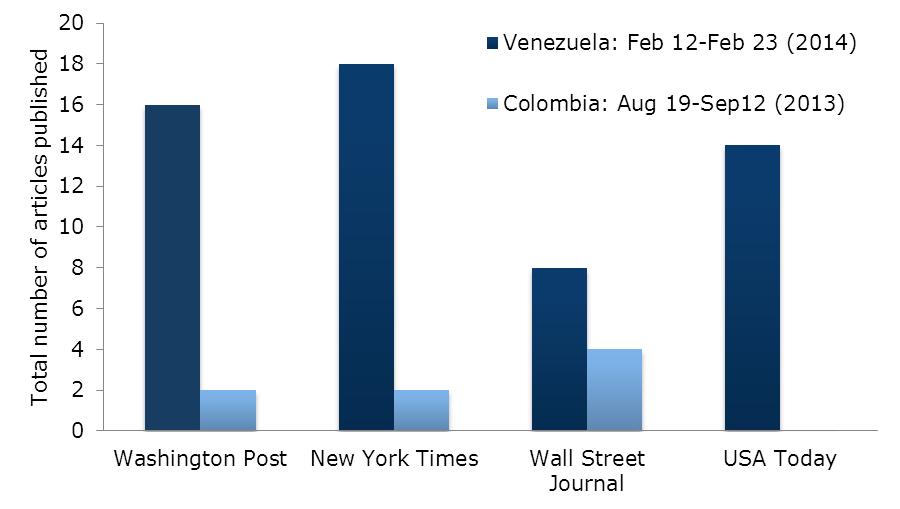
This is especially remarkable if we consider the high levels of repression carried out by the Colombian police and military in response to these protests. The International Office for Human Rights Action in Colombia described the violence as “unprovoked” and “indiscriminate” and attributes all of the violence to state forces.
The incidence of deaths in both Colombia and Venezuela[i], so far, is only slightly higher in Venezuela, with 13 deaths versus 12 deaths in Colombia.[ii] Yet there was very little coverage, and almost no criticism of the Colombian government as compared to the harsh attacks on the Venezuelan government in the U.S. media.
As mentioned earlier, US Secretary of State John Kerry and President Obama made public statements regarding the protests in Venezuela. Both demanded that students arrested in Venezuela be released, without regard as to whether any had been arrested for allegedly committing crimes such as arson and assault. There were no such statements from U.S. officials regarding the hundreds arrested in Colombia.
It is possible that both the huge differences in the amount of media coverage, and the responses to these two sets of protests by both the media and U.S. government officials has to do with the protesters and their aims, and the respective governments. The Colombian farmers were protesting against policies strongly supported by the U.S. government; they were also protesting against a government that the U.S. sees as a strategic ally, home to U.S. military bases and receiving billions of dollars in U.S. aid. The Venezuelan protesters are demanding the ouster of a government that the U.S. government has [spent] millions of dollars trying to get rid of, including U.S. support for the 2002 military coup against the government.
[i] The total amount of deaths reflects data from the most recent figures from Venezuela Transparencia, as of Monday, February 24 2014.
[ii] It is important to note that so far only six of the 13 deaths in Venezuela are confirmed to be opposition protesters.

Venezuelan Opposition Mayor Accused of Manipulating Tragic Death
By Tamara Pearson | Venezuelanalysis | February 26, 2014
Merida – A 34 year old man, Jimmy Vargas, died on Monday while he was involved in a violent street blockade. Some opposition leaders and media blamed the government, however video footage shows it was an accident. Two other people have died this week as a result of the blockades.
Vargas died at the Camino Real residential area, in San Cristobal, Tachira state. Footage, sent to CNN shows that it was an accident. However, CNN and other news agencies also broadcast repeatedly footage of Vargas’ mother blaming the National Guard and president Nicolas Maduro for the death.
Carmen Gonzalez, the mother, stated, “Maduro and those around him killed [my son], they are the ones who killed him, they killed him, they are the ones who gave the orders for him to be killed, they are killing all of Venezuela… and I’m going to go out and fight for my son, my son died fighting for his country, fighting for the freedom of his country…”
On social networks the story was spread that Vargas had been hit by a rubber bullet in his left eye, and other stories claimed a tear gas canister shot by the National Guard had hit him.
The newspaper El Nacional also blamed the government, headlining “Two deaths this Monday because of attacks by GNB [National Guard] and motorbike riders [government supporters] on protests”. Madurados.com headlined “Another tragedy! In rubber bullet attack by the GNB Jimmy Vargas dies in San Cristobal”.
Similarly, The New York Times included a ¼ page full-color photo of Jimmy Vargas on a stretcher, with the caption, “Carmen Gonzalez, 58, cried over the body of her son, who was killed Monday in clashes with the police.”
However Vargas’ doctor, Luis Diaz, reported that he had suffered severe traumatic brain injury (TBI) after falling from the second floor of a building, the newspaper Ultimas Noticias reported.
Vargas’ sister, Jindry, told NTN24 that her brother fell from the second floor the building after the National Guard fired rubber bullets and tear gas bombs at him, causing him to lose his balance. In the video Jimmy Vargas tried to climb down on to a balcony ledge and he lost his balance on the ledge, out of line of shot of the National Guard.
Further, the opposition mayor of San Cristobal, Daniel Cebellos, told the public that Vargas had been murdered. He tweeted on Monday night, “Since late night…the brutal attack of the GNB continues, more than 10 injuries (3 by bullet) and 1 youth of 34 years murdered”. He continued, “I call on the MUD [opposition coalition] that while they continue to kill our people in the streets there’s no peace for the government. The dialogue they propose is one big lie”.
Despite the evidence, Cebellos further tweeted this morning, “We are accompanying Jimmy Vargas and his family in this moment of grief. We reject the violence and repression.” Cebellos included a photo of Vargas’ funeral procession.
Tachira governor, Vielma Mora accused Cebellos of using a public funeral procession to “inflame” people “against the national government”.
“A citizen who, may he rest in peace, fell from the second floor, he was in guarimba (violent disturbances), it seems he lost his balance… do you know what the mayor of San Cristobal did with a few people? They paraded him through the city… like a war trophy”.
Meanwhile, there has been another death as a result of violent opposition blockades. El Carabobeño reported that a motorbike rider died last night after crashing into a barricade. Eduardo Anzola, 29, in Valencia, died instantly, the paper reported, after he didn’t see the barricade because of the darkness. Two other people have died as a result of crashing into barricades, in Caracas and Merida, and one other motorbike rider was killed when wire at a barricade cut his throat.
On Monday, Alba Ciudad and Panorama report that Antonio Valbuena, 32, died of a shot to the head, in Maracaibo. Valbuena was participating in a demonstration of motorbike riders, who were removing barricades so that their procession could get through. At one point, a witness said that a “man in a balaclava came out and began to shoot… one of the bullets hit Antonio in the head”.
The Case for Humanitarian War- Again
By Ajamu Baraka | Black Agenda Report | February 25, 2014
With the predictable failure of the Syrian peace conference, the call for the Obama administration to wage a humanitarian war to save civilians in Syria is once again being championed by some elements of the mainstream media in the U.S. This shouldn’t be a surprise to anyone, since certain powerful voices in the U.S. corporate media have long been in lock-step with some of the most hawkish elements in the Obama administration regarding the use of force in Syria.
A sober, clear-eyed analysis of the logic of the decisions by the Obama administration suggest that the failure of the peace conference was a programmed outcome. The inescapable conclusion as to why the conference was even held, therefore, is that administration hawks saw the failure of the conference as a valuable public relations weapon to move public opinion in favor of more direct military involvement.
Before I am accused of being overly cynical or even conspiratorial, a review of the decisions made in the days and weeks leading up to the conference provides more than adequate evidence to support this contention.
If the Obama administration had been even remotely committed to brokering some kind of diplomatic solution, would it have insisted that all of the parties to the talks be bound by the terms of the Geneva communiqué that called for “regime change” in the form of a transitional government? Would the administration have excluded Iran or been committed to pretending that the “legitimate opposition” was represented by the Syrian National Coalition, a motley crew of slavish opportunist exiles who everyone knows have no real connection to the political and military situation on the ground?
The propaganda value of the talks seems to be the only plausible explanation for why the administration would engineer the elaborate charade in Geneva. The decision to hold the talks knowing that they were going to lead to failure is where the real cynicism lies.
As I have argued since the beginning of this manufactured conflict, peace and particularly the humanity of the Syrian people are the last things on the minds of U.S. policy-makers. The often-invoked concerns for the starving people of Homs and all of the other innocents in this brutal conflict continue to be no more than a crude subterfuge to allow the administration to pursue its broader regional geostrategic objective – the elimination of the Syrian state.
That is why the Islamic fundamentalist groups that U.S. intelligence services helped to arm, train and deploy with destructive efficiency (without much real concern if they were affiliated with al-Qaeda) have targeted all of the institutions of the Syrian state – schools, hospitals, government agencies, electrical stations, water and sanitation facilities, food distribution networks – as part of their strategy. Generalized mayhem, reducing the population to dependence on their networks and territorial dismemberment have all moved the administration toward realization of its strategic objective. But because of the successes of the Syrian armed forces and the uncertainties generated as a result of internal conflicts breaking out among Islamist forces in the country, Washington decision-makers want to make sure that the Syrian government is not able to retake or re-consolidate its influence in contested zones. This can only be assured as a result of more direct military intervention on the part of the U.S. and its allies.
So the next act in this macabre play is now centering on the very real sufferings of the Syrian people. The administration’s man at the U.N., Lakhor Brahimi, set this direction in motion by skillfully moving the peace talks toward the issue of humanitarian concerns. No longer needing the chemical weapons excuse, the administration along with its coterie of collaborationist human rights organizations and media apologists, are now demanding U.N. access to the areas where the Syrian governmental forces have hemmed in the armed groups.
Taking a page from its Libyan playbook on how to manipulate the public to support war, the Obama administration had a draft U.N. Security Council resolution circulated that placed the full blame on the Syrian government for the humanitarian situation in the country.
The language in the resolution was seen as so one-sided and belligerent by some U.N. members that it had no chance of being supported, which of course was the real objective. Orchestrated by U.S. Ambassador to the U.N. Samantha Power, the resolution appeared aimed at invoking a veto in the Security Council that would set the stage for another illegal NATO-led military assault on the Syrian armed forces. Instead, a resolution was passed over the weekend that some characterized as more balanced because it called on “all sides” to allow humanitarian aid to reach civilians and condemned acts of terror. But all of the delegations understand that this compromise resolution is primarily targeting the Syrian government.
This concern for the humanity of the Syrians is comical if it was not so deadly serious. Sen. John McCain – the same Vietnam-era war criminal who was silent on the uprising of the people in Bahrain, the slaughter of innocent civilians in the various military assaults by Israel in Gaza and who supported the illegal war against Iraq that resulted in the deaths of over a million Iraqi’s – loudly condemned the Obama administration for not doing more for people suffering in Syria.
McCain as well as the hawks in the Obama administration and in the media know that they have a powerful weapon with the imperial and racist notion of the U.S. government’s “responsibility to protect.” The New York Times, Washington Post and a number of other major newspapers are now on record suggesting that the “use of force” by the Obama administration to end the starvation of innocents trapped in besieged cities is morally justified.
No one can deny the reality of tens of thousands of innocents suffering from the savage brutality of war. And who can disagree with relieving the sufferings of innocent civilians trapped in the middle of warring factions? U.S. decision-makers are well aware that most polling data suggest that when issues of humanitarian concerns are introduced, public support for more direct involvement in Syria shifts from a majority that is opposed to a slight majority that would support it.
So the U.S. public has been saturated over the last two weeks with stories about the trapped civilians, the cruel al-Assad government opposing humanitarian access and the innocent American administration that only wants to help the suffering Syrian people. The sad part of all of this is that with the anti-war and anti-imperialist movement in shambles, suffering from a combination of institutional weakness, marginalization and the effects of the “liberal virus” that has confused and disarmed U.S. radicals, the administration may very well be successful in maneuvering the public into supporting more direct military involvement.
The consequence of all of this for the people of Syria will be more violent destruction, brutality and displacement. But I am sure that the pro-imperialist and pro-war Democrats in the Obama administration have concluded that for the Syrian people, freedom – as they define it – is “worth the price” in death and destruction. And they will not see any irony in this.
Ajamu Baraka is a human rights activist and organizer. Baraka is an Associate Fellow at the Institute for Policy Studies (IPS) in Washington, D.C.
Call It Democracy
BRUCE COCKBURN
“Call It Democracy”
Padded with power here they come
International loan sharks backed by the guns
Of market hungry military profiteers
Whose word is a swamp and whose brow is smeared
With the blood of the poor
Who rob life of its quality
Who render rage a necessity
By turning countries into labour camps
Modern slavers in drag as champions of freedom
Sinister cynical instrument
Who makes the gun into a sacrament –
The only response to the deification
Of tyranny by so-called “developed” nations’
Idolatry of ideology
North South East West
Kill the best and buy the rest
It’s just spend a buck to make a buck
You don’t really give a flying fuck
About the people in misery
IMF dirty MF
Takes away everything it can get
Always making certain that there’s one thing left
Keep them on the hook with insupportable debt
See the paid-off local bottom feeders
Passing themselves off as leaders
Kiss the ladies shake hands with the fellows
Open for business like a cheap bordello
And they call it democracy
See the loaded eyes of the children too
Trying to make the best of it the way kids do
One day you’re going to rise from your habitual feast
To find yourself staring down the throat of the beast
They call the revolution
IMF dirty MF
Takes away everything it can get
Always making certain that there’s one thing left
Keep them on the hook with insupportable debt
Related article

True Colors of Venezuelan Student Movement Apparent in Feb. 22nd Releases
By Alex Main | CEPR Americas Blog | February 24, 2014
On the night of February 22nd, a bizarre incident took place in the Venezuela media-sphere. At around 4:00 pm Venezuela time, a number of the country’s private media outlets posted a release from a protest group identified only as the “student movement.” The rhetoric and tone of the statement matches the positions often expressed by extreme rightwing factions within Venezuela’s opposition over the last 14 years. Venezuela, it alleges, is in the grip of Cuban communists:
Foreign forces have laid a military siege on Venezuela. Their mercenaries attack us in a vile and savage manner. Their goal is to enslave us and be the masters of our existence, dishonoring the flags that we have held up in the street and that we will defend with our lives.
We want our Freedom. To protect it it’s vital to defend the Sovereignty of the Nation, expelling the Cuban communists that are here usurping the government and the Armed Forces.
The release demands that “the usurper [Venezuelan president] Nicolas Maduro and all of his cabinet be deposed” and states that the protests will continue until this and other demands are met. The statement also calls for defensive action against state security:
The regime has declared war on any civilian who doesn’t accept its marxist ideology. Our call is for defense: to not allow the invaders profane your street, your avenue, your property. Prevent their access so that they don’t shoot up your neighborhood, don’t destroy your properties, don’t hurt your loved ones and, above all, so that they know that here there are battle-seasoned Venezuelans, who won’t allow themselves to be enslaved through the use of force.
The rhetoric found in this release is reminiscent of the language used by the promoters of the “guarimba” protests in 2004 which – similarly to many of the protests that have been occurring in Venezuela over the last two weeks – involved protesters blocking major roads and with bonfires and barricades and damaging public property. The explicit goal of the 2004 guarimba protests was to create enormous chaos in city streets thereby forcing the government to either step down or engage in mass repression. Or, in the words of Luis Alonso, the main promoter of the guarimba ten years ago:
THE ONLY objective of “THE GUARIMBA” (…) is to create anarchistic chaos on the national level with the help of all citizens and in the main cities of Venezuela, so as to force the CASTRO-COMMUNIST regime of Venezuela to order “PLAN AVILA [a military contingency plan to enforce public order that was used during the 1989 Caracazo protests and that left thousands dead].”
If mass repression occurred, the guarimberos believed that elements of the military opposed to the “Castro-communist” project would rebel and oust the government.
Needless to say, the terminology and goals of the students’ release probably doesn’t reflect the point of view of most Venezuelan opposition supporters and it certainly doesn’t reinforce the common portrayal of the young protesters as peaceful and reasonable.
But then, as if by magic, the original release of the unnamed “students’ movement” was removed from many sites and in a few cases replaced with a much less polemical text. Here is a link to the early version of an El Nacional article on the student movement release that contains the text of the original statement. Later that evening the editors quietly replaced the original statement with the second one, as you can see in this updated version of the same article. El Nacional, one of the largest newspapers in the country, and other outlets that made the switch, never informed their readers of having done so. Here’s a translation of a few key excerpts from the second release:
[Venezuela’s] youth can’t stay silent in the face of the profound pain in all Venezuelans’ hearts resulting from the hate and division that is being sowed. Our consciences remain clear in protesting those who wish to establish violence, ignore the country’s most urgent problems and trample human rights.
The exacerbation of insecurity, the deterioration of the quality of life of Venezuelans, the economic crisis, the repression and criminalization of citizens’ protests cause us to raise our voices. We want reconciliation and respect for democratic principles and the Constitution.
(…) We dream of a Venezuela where inclusion, peace and prosperity are possible.
No more talk of “Cuban communists” that have taken over the government and army or of the need to remove the “usurper” Nicolás Maduro. Instead, we see a series of demands that, while based at times on highly questionable premises, appear to be more reasonable, e.g., “liberty for all of the detained young people, (…) the disarming of violent groups, (…) the end of media censorship [regarding the claim of censorship, I recommend reading Mark Weisbrot’s latest post on the Venezuelan media].”
However, one demand from the re-worked release is similar to the main demand of the original release: the second release calls for “the renovation and re-legitimizing of public powers.” Though this language may seem innocuous at full glance, the basic meaning is clear: those in power are not legitimate and should be removed. In the most charitable interpretation, this can be read as a call for immediate elections, despite the fact that Maduro was elected less than a year ago and that his popular legitimacy was reaffirmed in municipal elections last December in which pro-government parties won the total vote by a ten-point margin.
It is also interesting to note that, unlike most recent youth protest movements like the 2011-2013 Chilean movement, the 2012 Quebec student protests or even the U.S. Occupy Wall Street movement, the demands of the Venezuelan students who have taken to the streets focus neither on social justice issues nor on the government’s education policies. It is telling that the University of Chile Student Federation which was instrumental in ending the Pinochet dictatorship and played a key role in the 2011-2013 protests, released a statement which had the following to say about the Venezuelan student movement:
We reject any attempt at destabilization, hoarding of food and of coup-mongering that aims to bypass the sovereign decisions of the people of Venezuela (…) Similarly, we don’t feel represented by the actions of Venezuelan student sectors that have taken the side of the defense of the old order and are opposed to the path that the people have defined.
Protest Coverage in Haiti and Venezuela Reveals U.S. Media Hypocrisy
By Kevin Edmonds | NACLA | February 21, 2014
The media coverage of the events unfolding in Venezuela provides a troubling example of how the imperial ambitions of the United States can magnify crises—especially when contrasted with the current political situation in Haiti.
Both Venezuela and Haiti have been facing anti-government protests, with the respective oppositions citing poor leadership, corruption, electoral fraud, and a deteriorating economy as their primary motivations in calling for change. However, the international media’s escalation of the Venezuelan crisis and their complete silence when it comes to Haiti, raises some important questions about the United States’ inconsistency in upholding the values of human rights and democracy.
Haiti has been enduring a political crisis since the highly controversial election of President Michel Martelly, who received his mandate from only 16.7 percent of registered voters, and has been running the country without a fully functioning government in order to avoid dealing with constitutionally mandated checks and balances. For the third year in a row, Martelly has promised to hold elections to fill legislative and local seats without yet following through.
As evidence of Martelly’s unbridled commitment to democracy, instead of holding elections for mayors whose terms expired in 2012, he personally handpicked the representatives, appointing them as “municipal agents.” As a result of Martelly’s political inaction on the national level, one third of the seats in the Haitian Senate remain empty. This congressional inability to establish quorum on issues of national importance has been particularly convenient for the President. In September 2013, the Senate put forward a resolution to indict President Martelly, Prime Minister Laurent Lamothe, and the Minister of Justice Jean Renel Sanon for high treason, lying to the public, and playing a harmful role in the death of Judge Jean Serge Joseph.
Earlier in 2013, Judge Joseph had been given the task of overseeing a high profile corruption investigation against President Michel Martelly’s wife Sophia and their son Olivier. Judge Joseph had reported receiving threats to dismiss the corruption case during a meeting with Martelly, the Prime Minister, and the Minister of Justice and Public Security. Joseph refused, and two days later he died under suspicious circumstances.
Because the Haitian Senate has only 16 of 30 members currently active, the impeachment vote was not passed on a technicality. This was in spite of the decision, which saw 7 of the 16 members vote in favor of Martelly’s impeachment, with 9 abstentions and 0 voting against the motion. According to the Haitian Constitution, abstentions do not count as votes—with Article 117 stating that “All acts of the Legislature must be approved by a majority of the members present [emphasis added].” Thus, in regular circumstances the decision by the Senate would move forward with the impeachment. Therefore, this purposefully fragmented political system does a great deal to serve the interests of impunity.
This political crisis is especially worrying when the murder of opposition leaders in Haiti has gone largely unreported in the international press. Most recently, on February 8, Daniel Dorsainvil, one of Haiti’s leading human rights activists and his wife Girldy Lareche were gunned down in Port au Prince. While conflicted motives for the shooting have emerged, Haiti’s human rights community fears that the murders were politically motivated. Dorsainvil was the Coordinator of the Platform for Haitian Organizations for the Defense of Human Rights (POHDH). POHDH was established after the coup d’état of Jean Bertrand Aristide in 1991. According to POHDH’s website, “The systematic suppression of the military against the democratic and popular movement, which followed this event, and the mass amount of human rights violations in general, was the motivation for social and community development organizations to regroup with the purpose of initiating actions specifically in the field of human rights.”
A civil engineer by training, Dorsainvil had been a tireless advocate for justice, routinely speaking out against the Martelly government for its disregard of human rights, political scandals, and the consistent delaying of elections. Dorsainvil’s latest initiative was the establishment of the Patriotic People’s Democratic Movement (MPDP), a group of thirty political and social organizations openly standing in opposition to Martelly’s government. While this attack is tragic on its own, it comes after numerous threats against Haitian human rights defenders such as Patrice Florvilus, Mario Joseph, and André Michel.
In May 2013, Patrice Florvilus, the Executive Director of Defenders of the Oppressed, was subjected to numerous death threats. Margaret Satterthwaite, Director of the Global Justice Clinic at New York University School of Law, remarked:
The targeting of Patrice Florvilus and other attorneys demonstrates a troubling pattern of state obstruction of legitimate human rights work in Haiti…The government’s use of state institutions such as law enforcement, and its failure to address judicial and extra-legal threats leave human rights defenders dangerously exposed. All sectors of the government, from the police to the courts, are responsible for safeguarding human rights.
Due to the neglect and failure of the Haitian government to protect Florvilus and his family from attacks, he has had to relocate to Montreal in December 2013.
In October 2013, human rights lawyer Andre Michel was arrested by the Haitian National Police due to his initiation of legal proceedings against Martelly’s wife and son related to charges of corruption, which Judge Joseph oversaw before his death. Haitian human rights organizations condemned the arrest as an arbitrary and politically motivated attempt to intimidate human rights activists and members of the opposition.
Thus, while Martelly was praised by President Obama in early February for his leadership, Haiti has also seen a slew of anti-government protests due to the political crisis, human rights abuses, and economic decline. The lack of media attention regarding Martelly’s consistent attacks on popular organizations and human rights defenders in Haiti, in contrast to Venezuela is a stark reminder of how abuses of power can be marginalized if one has influential friends in the right places.
Unlike What the Media Says or Implies, the Violence in Venezuela Is Being Perpetrated by the Opposition
By Steve Ellner | Venezuelanalysis | February 20, 2014
The slant of the Venezuelan private media and the international media on what is happening in Venezuela is clear: The government is responsible for the violence. In the first place government-ordered gunmen are shooting at pacific demonstrators and the violence generated by the opposition is just a response to the brutality of police and military forces. But there is considerable evidence that shows that the violence, including that of unidentified motorcyclists against the demonstrators, is being carried out by the opposition. Consider the following:
1. Violent actions have been carried out by the opposition since the time of the 2002 coup. The “guarimba” which means urban violence (or “foquismo”) was publicly advocated by opposition leaders in 2003-2004 as the only way to prevent the establishment of a dictatorial regime in Venezuela.
2. On April 11, 2002, the day Chávez was overthrown, the Venezuelan and international media and the White House used juxtaposition of images of Chavistas shooting pistols in downtown Caracas, on the one hand, and peaceful anti-government demonstrators, on the other to justify the coup. However the Irish-produced documentary “The Revolution Will Not Be Televised” and other documentaries demonstrated by the flow of the camera that the demonstrators were far away from the Chavistas and that they were shooting in response to sniper fire against them. If snipers were responsible for the 15-20 killings (of opposition demonstrators along with Chavistas) that justified the coup of April 2002, is there any reason to doubt that the unidentified individuals who are attacking demonstrators are not acting on behalf of sectors of the opposition?
3. The violence that has rocked Venezuela during the last two weeks has targeted public buildings, such as the headquarters of the Fiscalía General (Attorney General), the public television channel (Channel 8), the state-owned Banco de Venezuela, the house of the Chavista governor of Tachira, trucks of the state grocery store chain PDVAL, and dozens of metro buses in Caracas.
4. None of the opposition leaders have explicitly condemned the opposition-promoted violence. Opposition mayors in Caracas and elsewhere have refrained from using their police force to contain the violence.
5. The so-called “peaceful” demonstrators engage in disruptions by closing key avenues in an attempt to paralyze transportation. Where I live, on the main drag between the twin cities of Barcleona and Puerto La Cruz, the demonstrators occupy two of the three lanes on both sides and as a result traffic backs up for miles. A number of tragedies have been reported of people in a state of emergency who were unable to make it to a hospital or clinic on time.
6. The term “salida,” which has become a main slogan of the protesters, implies regime change. Obviously the opposition is not calling for a constitutional solution in which Maduro resigns and is replaced by the president of the National Assembly Diosdado Cabello, as the constitution stipulates. Regime change is a radical slogan that implies radical tactics.
7. Political scientist and Venezuelan specialist David Smilde of the University of Georgia, who is not pro-Chavista but rather evenhanded in his analyses, has stated that the Venezuelan government has nothing to gain by the violence.
8. The government has nothing to gain by the violence because the media is largely on the side of the opposition and present a picture of the violence which directly and indirectly blames the government. Consider the following front page article titled “Capital City Suffers Night Violence” of El Universal (February 20), one of Venezuela’s major newspapers:
“Anoche la Guardia Nacional Bolivariana y la Policía Nacional Bolivariana arremetieron casi simultáneamente contra las diferentes manifestaciones que se producían en distintos puntos de la ciudad capital, mientras el presidente Nicolás Maduro hablaba en cadena nacional de radio y televisión. En los enfrentamientos hubo perdigones, bombas lacrimógenas mientras las cacerolas sonaban desde las ventanas.”
Translation: “Last night, the National Guard and National Police attacked almost simultaneously different demonstrations that were taking place in distinct areas of the capital city,,, In the confrontations there was gunshot [and] tear gas while people banged on pots and pans from their windows (in protest of the government).”
9. The Venezuelan government has shown great restraint in the context of opposition- promoted violence and disruption. In nearly any other country in the world, the disruption of traffic in major cities throughout the country would have resulted in mass arrests.
10. Governments, particularly undemocratic ones, which lack active popular support and completely control the media effectively use repression against dissidents. This is not the case in Venezuela. None of the non-state channels and newspapers (that the vast majority of Venezuelans get their news from) supports the government and most of them are ardently anti-government. Furthermore, unlike governments that use massive repression (such as Egypt under Mubarak), the Chavista government and movement has a greater mobilization capacity, particularly among the popular sectors of the population, than the opposition. As Smilde says, the use of violence by the government makes absolutely no sense.
Tide slowly turning at the New York Times
By Jonathon Cook | February 20, 2014
A decade ago, I wrote a commentary for the International Herald Tribune (now the International New York Times) arguing that Israel’s wall that was then just starting to be built in the West Bank was really a land grab. Difficult to believe now, but in those days that was a controversial opinion.
The paper then received the “largest postage in our history”, as an editor told me – possibly not surprising as the Anti-Defamation League, a Zionist organisation, had urged its followers to complain and had even published a template letter of condemnation on its website to help them. The result: the paper published a whole page of letters attacking me and dropped me as a writer.
So it is with some pleasure I see that the same paper has again been overwhelmed with letters following three recent articles on BDS in both the NYT and INYT : Omar Barghouti making the case, and Jodi Rudoren and Roger Cohen attacking it, the former implicitly and the latter explicitly.
What’s so different this time is that the INYT’s letters page is dominated by readers backing Barghouti and attacking Rudoren and Cohen. Not only that, but the arguments used to support BDS are intelligent and well-informed, while the few letters attacking BDS sound tired and formulaic.
The fact that the NYT has allowed the BDS debate into its pages is a triumph for the cause. That its international sister publication (and the NYT website) has then allowed its letters page to be dominated by BDS supporters is another small landmark.
We can mark a further victory when the NYT itself publishes a page of such letters. The time cannot be far off.
www.nytimes.com/2014/02/19/opinion/the-case-for-the-israel-boycott.html?_r=0
McCain urges Syria military intervention
Press TV – February 16, 2014

Hawkish US Senator John McCain has called on the Obama administration to employ its already-devised plan of military intervention against the Syrian government.
“The only way to achieve success at Geneva is to change the balance of power on the ground,” McCain said in a statement on Saturday, referring to the failure of the so-called Syria peace talks in Geneva.
“There are options far short of an Iraq-style invasion that can, and should, be employed to change the calculation of the Syrian regime, stem the violence, and ultimately achieve a negotiated political solution,” he added.
The second round of negotiations ended on Saturday without any concrete results about the unrest in Syria.
“The second round of Syria peace talks ended today with no progress toward a negotiated political settlement to the conflict and UN Special Envoy Lakhdar Brahimi recognizing that failure is looming,” McCain said.
“After three weeks of talks, we are moving further and further away from a peaceful political solution,” he argued.
The Arizona Republican senator also criticized President Barack Obama for allowing Russia to put pressure on him.
“Russia has recently prevented the passage of a much-needed UN resolution on bringing aid to desperate Syrian civilians,” he said. “Such actions indicate that the Russian government is simply not a partner for peace in Syria and cannot be relied on to help secure a successful outcome.”
During a press conference on Friday, White House press secretary Jay Carney said there is no military solution for the crisis in Syria.
“The crisis in Syria is a crisis. The circumstances on the ground are horrific that is why we have to bring the parties together to try to compel them towards a negotiated political settlement because there isn’t a military solution here,” Carney said.
Superhumans and Subhumans on NPR
 (more information about Shaloman)
NPR Check | August 2, 2009
Covering the anti-gay shootings and killings in Tel Aviv, NPR’s hourly news bulletin this Sunday morning stated the following:
(Dave Pignanelli): “Officials say they believe it is the worst hate crime in in Israel in decades.”
(Linda Gradstein): “The shooting has shocked many in Israel where hate crimes are almost unknown.”
Worst hate crime in decades? Hate crimes almost unknown? Ignoring the bitter irony of “hate crimes almost unknown” in a state that has a general policy of state run hate crimes against non-citizens in territory it controls – can one find evidence of deadly attacks by individual Israelis against people based solely on race, religion, etc?
Here are a few I found in about 5 minutes of Googling on the Internets:
- May of 1990 a lone Israeli gunman killed 7 and wounded 10 Palestinian workers not far from Tel Aviv in Israel.
- November of 1992 a grenade attack on an Arab market in Jerusalem killed 1 and wounded 11. Palestinians.
- August 5, 2005 an Israelis gunman killed four Israeli Arabs and wounding 13 others on a bus in Israel.
- August 17, 2005 – though not in Israel proper, an Israeli citizen killed 3 and wounded 2 random Palestinians near a settlement in the West Bank.
These incidents are clearly recognizable as standard hate crimes, but if your news coverage is almost always pro-Israeli government/military, it’s hard not to adopt the same (widespread and very much alive) racist ideology that fuels Israeli expansionism and militarism and degrades the humanity of Arabs to the point where they have simply been erased.
US scraps ‘glossy propaganda’ plans for Afghanistan aid projects
RT | February 14, 2014
A US federal agency that sought to pay photographers for “positive images” of its work in Afghanistan has canceled the program. The project, created to combat negative news coverage, collapsed amid charges that the effort amounted to propaganda.
Using US$1 billion on aid programs in Afghanistan, the US Agency for International Development (USAID) solicited proposals on Monday for a project that aimed to “help inform Afghans about the assistance American taxpayers are providing,” an anonymous USAID official told USA Today of Thursday’s decision.
“The wording of the (request) did not appropriately articulate that purpose and is being re-evaluated,” the official said.
In addition to targeting Afghans, the program was intended to gather support in the United States for USAID initiatives in Afghanistan. Over 12 years old, the war in Afghanistan is highly unpopular with the American public, if the war can be called an issue of popular awareness at all. A CNN poll released at the New Year found record low 17 percent support for the ongoing efforts in Afghanistan.
The proposal was quickly criticized by a public advocacy group as a blatant hype campaign.
“USAID should instead be focusing on accomplishing mission goals, not glossy propaganda,” said Scott Amey, general counsel for the Project on Government Oversight, a non-partisan government watchdog organization. “Waste, fraud, and poor performance have already resulted in billions being lost, let’s not throw additional money down the drain.”
The agency called the budding program one that would serve to show positive influences of US aid in the war-torn country amid the “negative” images usually shown by news organizations.
“USAID is executing the most massive US international assistance campaign ever, and the gains particularly in health and education have been impressive, yet the overwhelming majority of pictures recording that effort are negative, and at least to some extent misleading,” the solicitation reads. “This is because professional photographers working for news agencies are the prime source of high-quality images of USAID work in Afghanistan. News photographs by their very nature focus on the negative.”
Top objectives of the project included countering negative representations of Afghanistan, distributing those images through USAID social media, and to establish a long-term contract that would continually provide such images “to conventional media and directly to the US public.”
USAID also sought to influence American thought on efforts in Afghanistan.
“The US and Afghan publics require accurate, well-balanced information about USAID work abroad,” the proposal states. “Currently, this requirement is not being met in Afghanistan.”
USAID did not disclose how much contract photographers would earn for the photos.
The announcement of the “positive image” proposal on Monday came alongside the unveiling of three new USAID development programs worth almost $300 million to wean Afghanistan off its ‘war economy,’ which is heavily subsidized today by opium exports – a trade that had been practically squashed while the country was under Taliban rule.
Under the USAID initiative, $125 million will go to reviving Afghanistan’s food and farm sector, and another $77 million to opening up the country to greater international trade and investment. The last program, valued at about $100 million, would seek to assist Afghanistan’s educational system.
A report released late last month by the Special Inspector General for Afghanistan Reconstruction (SIGAR) found that Afghanistan cannot be trusted to properly spend the millions of dollars it receives in aid from the United States. The report found that none of Afghanistan’s 16 ministries could be entrusted with USAID funds without high risk of that assistance being stolen or wasted.
In September, the SIGAR chastised USAID for poor oversight of money the agency spent there. A SIGAR report highlighted how USAID gave over $230 million to the Afghan Ministry of Health with little guidance for how the money was to be spent.
“Despite financial management deficiencies at the Afghan Ministry of Public Health, USAID continues to provide millions of US taxpayer dollars in direct assistance with little assurance that the (ministry) is using these funds as intended,” according to the SIGAR report.
Meanwhile, after a long, protracted struggle that sought to convince Afghanistan President Hamid Karzai to approve a security deal, the US is considering leaving the issue suspended until the Afghan presidential elections in April in order to address Karzai’s successor.
The Obama administration has long hoped to get the long-lasting bilateral security deal with Kabul signed by the end of 2013, yet Karzai has refused to take responsibility for leaving a several thousand-strong US military contingent in the country beyond 2014.
On the Eve of an Illegal Attack on Syria, Avaaz/350.org Board Members Beat the Drums of War
By Cory Morningstar | Wrong Kind of Green | August 30, 2013

Appalling.
350.org’s Van Jones (U.S. Advisory Council Board member and NRDC trustee), is calling for airstrikes on Syria. [CNN Video below.]
From the 350.org website:
“Van Jones is a globally recognized, award-winning pioneer in human rights and the clean-energy economy. He is a co-founder of three successful non-profit organizations: The Ella Baker Center for Human Rights, Color of Change and Green For All. Jones is the best-selling author of the definitive book on green jobs, The Green-Collar Economy. He served as the green jobs advisor in the Obama White House in 2009. Jones is currently the President of Rebuild the Dream.” [Emphasis added.]
Never has the legacy of Ella Baker been so disgraced. Ella, today, spinning in her grave, once conveyed to the world:
“Remember, we are not fighting for the freedom of the Negro alone, but for the freedom of the human spirit a larger freedom that encompasses all mankind.”
Ella would surely spit on Van Jones if she were alive today.
350.org’s Ricken Patel (350.org International Advisory Council member – and Avaaz founder) is also pounding the drums of war. Just 4 days ago, on August 22, 2013, Patel himself urged Avaaz supporters to demand world leaders “place a no-fly zone over Syria.” Those who comprise Avaaz are already up to their necks – in the blood of the Libyan people who they helped annihilate. [Further reading: Did Libya’s Citizens Demand Foreign Intervention? A ridiculous question, yet according to Avaaz, the answer is yes.]
The following link is Google’s cache of the Avaaz/Patel campaign to demand a no fly zone (https://secure.avaaz.org/en/syria_no_fly_zone/). It is a snapshot of the page as it appeared on 22 Aug 2013 18:08:13 GMT: http://webcache.googleusercontent.com/search?q=cache:vzBe8PMa7H8J:https://secure.avaaz.org/en/syria_no_fly_zone/+&cd=1&hl=en&ct=clnk&gl=ca&client=firefox-a
Screenshots of Patel’s email:


Add to this the “Humanitarian Intervention” and “Responsibility to Protect” doctrines. The crème de le crème of imperial rhetoric. Such doctrines, created by American “think-tanks”, for the elite, by the elite, are of critical use for a declining and morally bankrupt empire. An empire that brilliantly attempts to convince and portray, utilizing the language within these doctrines, that the atrocities they manufacture, call for, and carry out, are somehow honourable and admirable – as opposed to what they actually are: crimes against humanity. Orwell would have called this psychopathic persistence a stunning feat in doublespeak.
Many so-called civil society organizations/NGOs have been instrumental in making these doctrines palatable to the public.
Related article

Featured Video
Iran’s Next Strike May Not Explode. It Could Shut You Down
or go to
Aletho News Archives – Video-Images
From the Archive
Zionism’s Violent Legacy
By Donald Neff | Washington Report On Middle East Affairs | January 1996
On January 4, 1948, Jewish terrorists drove a truck loaded with explosives into the center of the all Arab city of Jaffa and detonated it, killing 26 and wounding around 100 Palestinian men, women and children.[1] The attack was the work of the Irgun Zvai Leumi – the “National Military Organization,” also known by the Hebrew letters Etzel – the largest Jewish terrorist group in Palestine. The Irgun was headed by Revisionist Zionist Menachem Begin and had been killing and maiming Arabs, Britons and even Jews for the previous ten years in its efforts to establish a Jewish state.
This terror campaign meant that at the core of Revisionist Zionism there existed a philosophical embrace of violence. … continue
Blog Roll
 Aletho News
- Trump’s Iran war is on an Israeli leash
- Saudi oil boss issues global supply warning
- Riyadh Says Its Oil System Is Intact. The Numbers Say Otherwise.
- Trump and Netanyahu Want to “Finish the Job” on Iran
- US ‘one-sided dictation’ not Iran’s beliefs makes rational talks impossible: Baghaei
- Iran’s Next Strike May Not Explode. It Could Shut You Down /Col Doug Macgregor
- Iran: US political targets legitimate if assassinations return
- Iraq shuts key border crossing with Iran under US pressure: Report
- Undersea Internet cables could be targeted in retaliation for attacks on Iran: IRGC deputy chief
- EU sending ‘biased’ observers to interfere in Serbian election – president
- If Americans Knew
- Heidi Levine recounts how Palestinian youths helped save her in settler attack
- DAILY UPDATE: Latest essential news on Palestine, Israel, & region
- Trump’s Intensifying Sabotage of the ICC, for Israel’s Sake
- Israeli military detain US and UK volunteers in West Bank including Democratic NY politician Brad Lander
- Americans at National Conservatism Conference held in Israel this year criticize Israel
- Christiane Amanpour exits CNN with a legacy shaped by the debate over Israel
- Israel’s war on Iran is the final move in a decades-old strategy
- Israel Denies Entry to French Journalist, U.S. Researcher Amid Rise in Entry Denials
- Gaza’s hospitals are running out of life-saving fuel – Daily Update
- Mysterious bot accounts reportedly spread fake ‘man on the street’ videos for Michigan Senate candidate
- No Tricks Zone
- E-Cars Reduce CO2 Emissions By Only 41% Compared To Internal Combustion Engine Vehicles
- Predictions Made By Renowned Climate Professor Over Past Decades Have Been Proven To Be Poor
- New Study Suggests Large Regions Of The Pacific Ocean Have Been Cooling For The Last 80 Years
- Germany’s Green Energy Debacle: High Energy Costs Force Kahla Porzellan to Close After 182 Years!
- New Study: 50 Years Of The Most Aggressive ‘Net Zero’ Policies Can Only Affect The Global Climate By 0.03°C
- US September “Heat” Was No Record…Many Records Set Decades Ago
- Latest European Green Energy Debacle; Portugal’s Largest Flagship Solar Park Insolvent!
- Green Energy Debacle: German Expert Professor Fritz Vahrenholt Warns Of Severe Economic And Social Consequences
- Two More Paleo Reconstructions Affirm Meters-Higher Sea Levels Across Ireland, Brazil 7000-6000 Years Ago
- New Study: Earth And Venus Surface Warmth Largely Explained By Convection And Lapse Rate, Not CO2 Or Radiation

