The New Crossfire: Where Both Sides Support War With Syria
By Peter Hart | FAIR | August 28, 2013
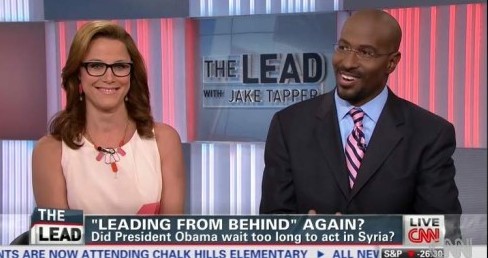 CNN is bringing back Crossfire next month, but viewers on August 27 got a taste of what they might expect: The left thinks we should bomb Syria, while the right thinks we should have started that a long time ago.
On the show The Lead, guest host John Berman moderated a “debate” between conservative S.E. Cupp and left-leaning Van Jones.
“Look, I want to commend the president for finally following through on our red line threats,” Cupp declared–before explaining that Obama’s plan was too timid:
We should absolutely intervene to stop the genocide of more than 100,000 people. We should absolutely intervene to stop Al-Qaeda and Islamic extremism from jihadizing yet another conflict. It is absolutely our obligation, and instead we do the bare minimum to save face and pat ourselves on the back for our civility and our diplomacy. I think it’s pathetic.
OK, and from the left? Jones said:
This president has now said there is a red line. It was not clear before whether the line was crossed. It’s crossed, he’s moving forward. I think we need to stand behind this president and send a clear message to Assad that this type behavior is not acceptable.
And:
If you kill Assad right now, wonderful. You have a huge power vacuum. Who is going to fill it? Listen, people have a nostalgia for 1953 when the U.S. could just sort of thump out dictators like in Iran. This is not the world we live in. It is a tough neighborhood over there, and the idea that we should have a more bloodthirsty and reckless president, I reject.
I’m not sure what “thumping out dictators like in Iran” is supposed to mean; in 1953, the United States supported a coup against Iran’s elected president.
But back to Syria: The American public is generally and overwhelmingly skeptical of military strikes on Syria. But in CNN‘s left/right debate, that point of view seems to be missing entirely.
The Guardian of What?: The Media and War Propaganda
By Jeremy Salt | Palestine Chronicle | August 28, 2013
If there is any comfort in how the Guardian has been reporting the Middle East, especially Libya and Syria, it is that many of its readers, judging from their remarks in ‘Comment is Free’, do not appear to believe or trust it.
The Guardian sells itself as the global beacon of liberal opinion. It is liberal on social issues and alongside the chatterers, it has some excellent political correspondents and commentators, notably Gary Younge and Seamas Milne. As liberals themselves, its readers around the world must think they are on safe ground when quoting from the Guardian but if so, where the Middle East is concerned, they are deluding themselves.
Throughout the crisis in Syria the Guardian has been not so much reporting the conflict as running a propaganda campaign against the government in Damascus, to the benefit of the armed Islamist groups and the outside governments sponsoring them. The wellsprings of its ‘reporting’ have been the unsubstantiated claims of ‘activists’ no matter how wild and improbable. Without any evidence it is now accusing the Syrian government of being responsible for the alleged nerve gas/chemical weapons attack in the Ghouta district around Damascus. The far greater likelihood that the armed groups were responsible for this atrocity scarcely rates a mention. Building on the unsubstantiated claim that it was the Syrian military, Martin Chulov argues in favor of another one, that it was Bashir’s brother Maher who was personally responsible (the same accusation is being made by the Israeli intelligence propaganda outlet Debkafile, from which Chulov may well have taken his lead). This is how propaganda works. Once set in motion it just needs a push to keep it rolling.
Buttressing its editorial and reports, Fawaz Gerges is given space to claim that it is up to the Syrian government to prove that it was not responsible for this atrocity. This is nonsense: if the Syrian government was not responsible for this atrocity, how can it prove what it did not do, especially when anything it says will be dismissed out of hand by the mainstream media and the governments arming, financing and training the ‘rebels’? The onus of proof lies on those making the accusations, and so far neither the Guardian nor the anti-Assad campaigning Kim Sengupta of the Independent (where Robert Fisk has provided balance with some reports giving the perspective of the Syrian government) nor William Hague nor anyone else making this accusation has produced a scrap of evidence that this attack was carried out by the Syrian military.
Probability points in the direction of the armed groups. The ‘rebels’ are known to have acquired stocks of sarin. They used a chemical weapons compound in their home-made missile attack on a military outpost at Khan al Assal in March that killed dozens of soldiers and civilians. (1) In May this year Carla del Ponte, a member of the UN Independent Commission of Inquiry on Syria said investigators had evidence that the ‘rebels’ had used sarin gas. (2) In May also Turkish police seized sarin gas along with hand guns, grenades, ammunition and unspecified ‘documents’ from apartments where Jabhat al Nusra members were living in Adana and Mersin. (3) Early in June the Syrian military seized two barrels of sarin gas from a ‘rebel’ hideout in Hama. (4)
On top of all this the armed groups have filmed themselves experimenting with chemical weapons on rabbits. As they have slaughtered thousands of civilians in the most barbaric fashion there is no argument that moral considerations would prevent them from taking this further atrocious step – and it is they who have every reason to take it. They are being ground down across the country and at this stage only direct military intervention is going to save them and save the project to destroy the Syrian government. It is a measure of the desperation of their outside sponsors that Bandar bin Sultan, Saudi Arabia’s intelligence chief, was recently in Moscow with an offer from his government to buy $15 billion worth of Russian arms if Russia would just allow the passage of a UN Security Council resolution authorizing a military attack on Syria. Putin said no, and what a coincidence it is that a short time later there is a mass atrocity that gives the western-led collective the pretext it wants to attack Syria without a UNSC resolution behind them.
Clearing positions held by the armed groups a few days after the apparent nerve gas/chemical weapons attack, Syrian soldiers found stocks of chemicals, gas masks, syringes and anti-neurotoxin drugs in tunnels at Jobar, one of the three districts on the outskirts of Damascus, along with Ain Tarma and Zamalka, targeted in the attack. Several soldiers were taken to hospital in critical condition. The official Syrian news agency English-language news site, SANA ran photos of cylinders of chemicals and other material, including syringes, produced by the ‘Qatar-German Company for Pharmaceutical Industries’. There is no company of this name but there is a company called Qatar-German Medical Devices whose QG logo can be seen on a box found in the tunnel marked ‘Flow I.V. Cannula’. The army also found a basement stocked with quantities of chemical agents manufactured in Saudi Arabia and a number of European countries. The material included equipment for making chemical weapons and anti-neurotoxins in case the armed men poisoned themselves.
The discovery of this material was followed by the Medecins Sans Frontieres statement that three of the hospitals it supports in the Damascus governorate had received 3,600 patients displaying neuro-toxic symptoms in three hours on the morning of August 21, of which number 355 had died. While MSF cannot say who was responsible for this atrocity, its statement highlights the complete improbability of the Syrian government carrying out a mass chemical weapons/nerve gas attack on civilians in suburbs only a few kilometers from the center of Damascus, shortly after the arrival of UN chemical weapons inspectors and indeed only several kilometers from where they were staying, killing or wounding thousands and filling its own hospitals with the victims. At face value the accusation is ludicrous, yet such is the propaganda whipped up against the Syrian government over the past three years that some people will believe it to be capable of anything.
Not only do the armed groups, their backers and the media salesmen of their pitch, including the Guardian, want the world to believe that the Syrian government was responsible for this atrocity, they want the world to believe that Bashar is stupid, indeed so stupid that he would have ordered this attack within three days of the arrival of the UN chemical weapons inspectors. This canard is reminiscent of the accusation that the Syrian government arranged the assassination of Rafiq Hariri in 2005. The killing was a master stroke used as a lever to get the remaining Syrian troops out of Lebanon, and to blacken Syria’s name internationally. By the time all the four suspects had been freed and Syria cleared by the UN tribunal of any responsibility the media had moved on. It is a long time since it has shown any interest in who killed Hariri. Like the Hariri killing the first question to be asked in the wake of this latest atrocity is ‘who benefits?’ In both cases the answers are clear: in the first, Israel, the US and their proxies in Lebanon; in the second, the armed groups and the outside governments supporting them, including, of course, Israel, which is now leading the charge for a direct military attack on Syria.
By disseminating the deceit and lies put out by Libyan and then Syrian ‘rebels’ and ‘activists’, Al Jazeera ruined its reputation. The Guardian has run the same line as this mouthpiece of the government of Qatar yet remains protected by its mystique as a beacon of liberal opinion. Many of its readers are clearly confused when all they have to do is see that the emperor has no clothes: far from being the guardian of liberal opinion, this newspaper is the guardian of western, gulf and Israeli interests in the Middle East against Iran, Syria and Hezbollah. Its correspondents are still writing seriously and positively about a Palestinian ‘peace process’ that is a grotesque sham. Israel is playing with the Palestinians, as a cat plays with a mouse. It has Abbas in its pocket and by abandoning Syria and embracing Muhammad Morsi and the deposed ruler of Qatar, Ismail Haniyeh and Khalid Misha’al have found themselves without any backers. Not since its foundation has Israel enjoyed such a good run. If only the governments in Tehran and Damascus could be destroyed and Hezbollah extinguished life would be perfect.
The Guardian has never even attempted to provide balanced coverage of what is going on in Syria. There has been no counterweight – no antidote – to the anti-Assad and pro-rebel reporting and comment of Ian Black and Martin Chulov. The techniques will be familiar to all but the most inert readers. The paper runs headlines which are not justified in the text. The claims of ‘activists’ are given prominence and the claims of the Syrian government minimized, without there ever being any doubt about what the Guardian wants its readers to believe. It has downplayed or ignored the evidence of terrible atrocities by the armed groups (such as the massacres this August of hundreds of villagers in the Lattakia governorate (5) , of more than 100 people in Khan al Assal (6) and the massacre by Jabhat al Nusra of an estimated 450 Kurdish women and children around the Syrian-Turkish border town of Tal Abyad). (7) It has printed the wildest claims without any attempt to substantiate them, such as the allegation by a London-based ‘activist’ that the Syrian government was packing detainees into shipping containers and dumping them at sea. It has allowed ‘activists’ to shift the blame for car and suicide bombings on to the government even when it is government institutions that have been bombed and government employees who have been the victims. It has expected its readers to believe that the Syrian government is exploding bombs in densely populated residential areas in the middle of its own cities. It relies on the so-called Syrian Observatory for Human Rights when it must know that it is a completely tainted source. The only explanation for this can be that this one-man band is saying what the Guardian wants to hear and what it wants its readers to believe.
The strategy of the armed groups has been to destroy infrastructure and terrorize the civilian population. This they have largely succeeded in doing. Syrians are pouring out of the country to get away from them. In the name of a twisted pseudo-revolution these armed men are supported by a collective of foreign governments. The line of the moment following the alleged chemical weapon/nerve gas attack is that ‘all red lines have been crossed’ when these governments crossed all red lines in international law long ago by financing and arming groups such as the brigades of the Free Syrian Army and Jabhat al Nusra. International law prohibits armed intervention in other countries and the use of mercenaries. International law forbids the application of economic sanctions against member states of the UN yet in all these categories the collective bent on the destruction of the Syrian government has shown complete contempt for international law. Of course this is merely standard procedure. International law is for other people, not the ‘international community’ as represented by the UK, France and the US [or Israel] and nowhere have they treated international law with more contempt than in the Middle East.
These governments are making the most strenuous effort in the history of the modern Middle East to destroy an Arab government. The reason has been clear from the beginning: Syria is Iran’s strongest regional ally and is being targeted as a second best option to targeting Iran itself. The takfiris inside Syria, demeaning Islam with their shouts of ‘Allahu Akbar’ every time they cut a throat, are doing the work of governments that have done nothing but damage to the Middle East for the past century. The prime losers are the Syrian people. About 100,000 have been killed in this conflict and much of their country’s infrastructure has been deliberately torn to shreds. The chief regional beneficiaries are Israel and Saudi Arabia, holding hands under the table. The destruction of the Syrian government would be an unparalleled strategic triumph for Israel and the ‘west’, which is why Russia and China have not budged in their position that it is the Syrian people who must decide their own future and not outside governments and armed gangs and why Russia in particular will be planning its riposte should Barack Obama be talked into launching a Cruise missile strike.
The Guardian’s propaganda cover for the Syrian ‘rebels’ follows its support for the Libyan ‘rebels’ against another dictator. The protest movement in Benghazi was seized upon by Britain, France and the US as the opportunity to intervene and destroy the government in Tripoli. There was no countrywide movement against Muammar al Qadhafi and the ‘rebels’ could not have advanced a yard beyond the city limits of Benghazi without the cover of NATO missiles. Qadhafi was brought down after a seven month blitz by the air forces of three of the most powerful militaries in the world and eventually murdered after several previous attempts to murder him by missile strike had failed, while killing members of his family. Thousands of innocent Libyans were killed during this prolonged aerial assault. This neo-imperialist adventure was fully underwritten by the mainstream media. None of the war crimes committed by NATO forces or ‘rebels’ on the ground had the same impact on editorials and ‘reporting’ as the claims that the Libyan leader was bombing his own people from the air, using black mercenaries and distributing Viagra to his troops. These sensational allegations were later shown to be lies, but by this time they had served their purpose in setting up Qadhafi as someone who deserved to be killed (rather than put on trial, embarrassing in the process Blair, Sarkozy and others who benefitted from Libyan money and oil concessions). With Libya out of the way the same western governments and the same mainstream media flapped on like vultures to Syria and another supposed dictator, leaving the Libyans to clean up the mess they had created as best as they could.
Having shed the shackles of balanced journalism in Libya and Syria, the Guardian is now defending media ethics and responsibility in the Edward Snowden- Glenn Greenwald affair. Greenwald has been revealing secrets from Snowden’s store of official documents. David Miranda, his partner, was detained for nine hours by British intelligence while in transit through London. If the purpose was to shut Greenwald up by putting pressure on his relationship, his scarcely repressed fury is an indication that it will not work. Alan Rusbridger, the Guardian’s editor-in-chief, had been having private conversations with British intelligence and only decided to take action, by destroying material the Guardian had on hard drives, when threatened with legal action. This was a significant exercise of the power of the surveillance state which had to be challenged, but how much more significant is media support for mass death and destruction delivered to Syria by groups of men financed, armed and trained by outside governments?
The Guardian does not actually call for war. It leaves that to other people. It merely sets the stage. It runs an editorial based on the assumption that this chemical weapons attack was the work of the Syrian government. The possibility that the armed groups might have done it is not even taken into account. It observes that ‘choosing between bad options is even more complex [supporting armed groups responsible for one atrocity after another is obviously not considered a bad option] … this paper has resisted the calls for military intervention in Syria [as if there is not already military intervention in Syria] … but we do appear to be coming ever closer to a tipping point with difficult judgments ahead.’ Without calling for war itself, this beacon of liberal opinion then quotes with approval the arch conservative William Hague, who talks of civilized values while pushing for a war that would bury them in further great mounds of bodies.
Behind the mask of asinine geniality Hague is a warmonger. He has wanted ‘intervention’ in Syria – a war kicked off with the declaration of a no-fly zone and now possibly a Cruise missile strike – for years and now sees it in his grasp. The Guardian should have been on to his smiling duplicity and double-speak like a terrier on to a rat. Instead it is joining the chorus line for war. That is the reality behind its own double-speak. The Syrian government agreed to allow UN inspectors into the districts targeted in this apparent nerve gas/chemical weapons attack but as soon they approached these districts, they were shot at by snipers. If it can be proven that it is the armed groups that carried out this attack it is a safe bet that we will hear no more talk of red lines being crossed. Obama said he would not take a decision until he had proof but now we are being told by an unnamed US official that the on the spot inquiry is too little and, not even a week after the event, too late. The British media is talking of a military attack being launched within days.
The US media is much more reserved: after all, their country is being pushed into the front line by governments that would never have the guts to attack by themselves but will only run in from behind once the US takes the lead. Obama is still holding back and has the intelligence and sense not to fall for this if, unfortunately, not necessarily the strength of character to resist the pressure being applied to him. Britain, France and Israel want to strike now, while the propaganda is running hot and strong and before the UN inspectors ruin their rush to war by concluding that this attack around Damascus either was or might have been the work of the armed groups.
This will not be Libya. This never was Libya. This will not begin and end with a few Cruise missiles fired at Syria from warships in the eastern Mediterranean. This may well spark a major war involving Turkey, Iran, Israel, Hezbollah and Russia for which those pushing for war must be held responsible right now and not just afterwards. If the decision is taken the Guardian will wring its hands about the horrors of war but it will still justify it on humanitarian grounds and the ‘responsibility to protect’. Amidst the smoke and carnage, the question of who fired the chemical weapons around Damascus will soon be forgotten.
– Jeremy Salt is an associate professor of Middle Eastern history and politics at Bilkent University in Ankara, Turkey.
Notes:
1. See ‘Russia’s UN envoy says Syria rebels used chemical weapons’, Los Angeles Times,July 9,2013, reporting the statement by Russian UN ambassador Vitaly Churkin that armed groups had used sarin gas in the attack at Khan Assal on March 15, killing 26 people, including 16 military personnel, and wounding 86.
2. See ‘UN’s Del Ponte says evidence Syrian rebels ‘used sarin’. BBC News Middle East, May 6, 2013.
3. See ‘Adana’da El Kaide operasonyu:12 gozalti ( Al Qaida operation at Adana: 12 arrested), Zaman, May 28, 2013.
4. ‘Syrian army seized sarin cylinders from militants in Hama’, Press TV, June 2, 2013.
5. See ‘Massacre in Latakia, August 2013. A documentary report on Al Nusra massacre in Lattakia’, Sham Times, August 8, 2013. Translated by Australians for Reconciliation in Syria.
6. See ‘UN rights chief calls for investigation into Syrian massacre’, Reuters.com., reporting on the ‘apparent’ massacre ‘carried out by Syrian opposition forces in the town’.
7. See ‘Defend the Kurds in Syria from massacre and ethnic cleansing’, Kurdistan Times, August 8,2013, reporting the massacre of 120 children and 330 women by Jabhat al Nusra at Tal Abyad on August 5. While the numbers have not been independently verified, the massacre triggered off an exodus of tens of thousands of Syrian Kurds into northern Iraq. Syrian Kurds have given details of massacres of Kurds carried out by Jabhat al Nusra across northern Syria.
Western logic on Syria: ‘We need to bomb it to save it’
RT | August 27, 2013
The military buildup in the Mediterranean indicates that Assad’s opponents intend to militarily intervene in Syria under cover of ‘humanitarian intervention’, a disingenuous narrative that could not be further from the truth.
Pictures and videos that have surfaced following the alleged use of chemical agents in the eastern suburbs of Damascus are profoundly disturbing and a thorough and substantial investigation into what took place there is absolutely essential. However, it is conversely disturbing that those Western governments who have staunchly supported anti-government militants are using this opportunity to legitimize the use of force against the government in Damascus.
The United States, Britain, and France are unwavering in their assertions that the Assad government and the Syrian Arab army were the perpetrators of the chemical weapon attack, despite no evidence to substantiate these claims. These governments seem to be sure that Damascus is guilty on the basis of it preventing a UN investigation team from visiting the site, and when investigators eventually did reach the area, it didn’t matter to them because they argued that the Syrian government had destroyed all evidence of wrongdoing.
Assad’s opponents have constructed a deeply cynical and hysterical political narrative that Western leaders are now parroting in unison.
There are several reasons why Damascus showed hesitation in allowing UN inspectors to access the site, the most apparent being that this attack allegedly took place in rebel-held strongholds on the outskirts of the capital, and that the security of the UN team could not be guaranteed if rebels attacked them or launched more chemical weapons during their visit.
Syrian rebels have demonstrated their hostility to UN forces on previous occasions; anti-government groups kidnapped 21 UN peacekeepers in the Golan Heights in March, and another four peacekeepers later in May. That the UN convoy was fired upon by unidentified snipers is hardly surprising in that it is another stunt in a series of moves to escalate the situation to provoke an international response.
The UN team eventually made it to the site to collect evidence and, contrary to Western assertions, the UN claimed that it was still possible for the team of experts to gather necessary evidence despite the time elapsed since the alleged attack.
Who benefits from using chemical weapons?
The narrative that the Assad government used chemical weapons, specifically while a UN team was in Damascus to investigate previous uses of chemical weapons, is tactically and politically illogical and in no way serves the interests of the Syrian government.
These attacks transparently serve the interests of anti-government militias who have long called for NATO intervention, as well as the Syrian political opposition who are now refusing to take part in any planned Geneva negotiations. Furthermore, allegations that the regime used chemical weapons benefits the international opponents of Assad, who have materially and financially aided and armed non-state actors and foreign fighters on an unprecedented scale.
Above all, the use of chemical weapons benefits the arms industry, as four US warships with ballistic missiles are moving into position in the eastern Mediterranean Sea, ready to shower Damascus with Tomahawk cruise missiles – all under the auspices of protecting civilians. Lockheed Martin’s stock prices have dramatically shot up since news of the chemical weapons attack.
There are numerous revelations that would suggest that anti-government militias have access to these weapons and are in fact guilty of using them. Carla Del Ponte, head of a UN commission of inquiry that looked into the use of chemical weapons in northern Syria in late March suggested that the evidence was stronger to implicate anti-government militants in using chemical weapons, not the Syrian government.
In May, Turkish police found cylinders of sarin nerve gas in the homes of Syrian militants from the Al-Qaeda-linked Al-Nusra Front who were detained in the south near Syria’s northern border. In July, Russian experts submitted reports to the UN detailing how the missiles used in previous chemical weapon attacks were crude and not factory made, and that the chemical components found were not consistent with what the Syrian military has.
The Syrian military has just recently discovered chemical weapons in a rebel tunnel in the Jobar suburb of Damascus, including shells, gasmasks manufactured in the United States, chemical substances of Saudi Arabian origin. Arabic language reports also indicate that a former high-ranking Saudi Arabian member of Al-Nusra Front claimed that the group possessed chemical weapons in a tweet.
NATO intervention replicating the Kosovo model?
The speeches and statements from John Kerry, Laurent Fabius, or William Hague all imply that military action will be taken against Damascus despite lacking a legal basis of action. If ‘humanitarian intervention’ were to be undertaken, it would need approval from the UNSC in the form of a resolution, but such a resolution would not be passed because countries such as Russia believe that this kind of intervention would be used as a pretext to remove the legal government of Syria, as it has been used in the recent past in the former Yugoslavia, Iraq and Libya – all with undeniable abuses of force that have resulted in substantial civilian casualties.
Reports indicate that Obama’s team is now studying the NATO mission in Kosovo as a “possible blueprint for acting without a mandate from the United Nations.” It is ominous, alarming and bizarre how NATO’s intervention in the former Yugoslavia could be used a positive reference point for anything. NATO rained down bombs for 78 straight days, effectively smashing civilian infrastructure in Serbia and Montenegro while hospitals, schools, and public utilities were damaged beyond repair, killing over 1,200 civilians and injuring 4,500 more.
Despite Obama’s cautious tone in recent interviews, all indications point to military intervention already being decided. Carla Del Ponte’s assessment was whitewashed, and any other evidence provided by the UN that does not fit conveniently into the Western narrative will be suppressed – the US position is that it is already “too late” for any evidence to be credible.
The huge military buildup of US and British ships and warplanes in the Mediterranean comes while the Pentagon is reportedly making the initial preparations for a cruise missile attack on Syrian government forces.
The intransigence and cynical duplicity of Assad’s opponents is unparalleled, and their media outlets are complicit in pulling the heart strings of their audiences while offering a totally one-sided perspective in support of R2P, the ‘right to protect.’
The US, Britain, and France see themselves as righteous protectors, and rationality and evidence will not be enough to break their dangerous and ridiculous delusions; these states are the vanguards of militant corporatism and have demonstrated that they seek only their private economic and geopolitical objectives in the region.
Those countries that represent a balanced approach to this crisis should not stand idly by while the West ‘comes to the aid’ of the Syrian people with cruise missiles and airstrikes – they should not allow intervention under ‘humanitarian’ auspices to harm civilians and topple the legal authorities in Damascus.
Related articles
- Hysteria around chemical attack suits those who want military intervention in Syria – Lavrov (rt.com)
- Russia ‘regrets’ US decision to shelve Syria talks (alethonews.wordpress.com)
Tony Blair says UK and US should intervene in Syria
Press TV – August 27, 2013
Former British Prime Minister Tony Blair has called on London and Washington to go to war in Syria to end what he claimed to be attacks on civilians “not seen since the dark days of Saddam”.
“People wince at the thought of intervention. But contemplate the future consequence of inaction and shudder,” said Blair who took Britain to the war in Iraq based on fabricated claims that Saddam had ready-to-launch weapons of mass destruction.
“Western policy is at a crossroads: commentary or action …. After the long and painful campaigns in Iraq and Afghanistan, I understand every impulse to stay clear of the turmoil …. But we have collectively to understand the consequences of wringing our hands instead of putting them to work,” he wrote in an article for The Times on Tuesday.
Blair’s comments come as there are serious qualms that the claims, led by Britain, the US and France, of Syrian government having carried out the chemical attack that allegedly killed hundreds of people on Wednesday are nothing but another deception to justify war, as was the case in Iraq.
British Prime Minister David Cameron and US President Barack Obama have been rattling sabers since Wednesday, saying they should intervene to end what Washington described as a “moral obscenity”.
However, Britain and its western allies have so far offered no evidence to support their claims against the government of Syrian President Bashar al-Asad.
The Conservative British PM will also have a hard time to persuade MPs to start a war after he was forced to promise to put any military action in Syria to parliamentary vote earlier this year after 82 Conservatives MPs signed a letter to demand such a process.
The opposition Labour party has also demanded the coalition government to ask for MPs’ approval before taking any military action.
Cameron has indicated he will consult the parliament with his office saying he could recall the parliament from a summer recess before it ends on Monday to discuss the situation in Syria.
Related article
Russia ‘regrets’ US decision to shelve Syria talks
RT | August 27, 2013
Moscow has voiced “regret” over a US decision to put off bilateral talks over Syria. Russia has sought to placate calls for military action over the alleged use of chemical weapons, saying there is no evidence of the Assad regime’s complicity.
The US government announced it was postponing bilateral talks with Russia late Monday, citing “ongoing consultations” over the Syrian government’s alleged use of chemical weapons.
Russian and American officials had been scheduled to meet in The Hague on Wednesday for bilateral talks on the Syrian conflict.
Russian Deputy Foreign Minister Gennady Gatilov tweeted a response to the move Tuesday morning, expressing concern over Washington’s decision.
“It is a pity that our western partners have decided to cancel the bilateral US-Russian meeting to discuss calls for an international conference on Syria,” Gatilov wrote on Twitter. He added in a later post that discussing terms for a political solution were needed now more than ever in the face of possible military intervention in Syria.
 Deputy Minister of Foreign Affairs Gennady Gatilov (RIA Novosti / Vladimir Fedorenko)

Foreign Affairs Committee chairman of the Russian Duma, Aleksey Pushkov also posted on his Twitter, alleging the US had already made the decision to strike Syria and they had gone too far.
A number of western countries including France, the US and the UK have condemned President Bashar Assad’s government for last week’s alleged chemical weapons attack in a Damascus suburb and called for a response, hinting at possible military action. On Monday, Russian President Vladimir Putin told British Prime Minster David Cameron in a phone conversation that there was still no evidence the Assad government was behind the attack.
However, Cameron insisted that Assad’s forces were behind the “chemical weapons” attack, saying that the Syrian opposition did not have the facilities to orchestrate such an attack. Cameron also cited the Syrian government’s delay in allowing a team of UN experts to examine the site as an indication that it had something to hide.
Washington has also seen an increase in rhetoric, urging action against the Assad government. Samantha Power, the US Ambassador to the UN, decried the Assad government for the attack on her Twitter account, and demanded accountability:
“Haunting images of entire families dead in their beds. Verdict is clear: Assad has used CWs against civilians in violation of int’l norm.”
Meanwhile, the UN weapons inspectors are due to start their second day of investigations in the Damascus suburb of Ghouta, where the toxic attack happened last Wednesday. The team’s convoy of vehicles came under fire from unknown assailants Monday as they visited the area.
In spite of the sniper attack, the team managed to collect samples for analysis and gather witness testimonies at a local hospital. Contradicting claims from the US and UK that the probe was too late to yield accurate results, the UN stressed the mission was still valid, although almost a week has passed since the supposed attack.
The alleged attack took place last Wednesday in an eastern suburb of Syria’s capital. Media published conflicting reports on the death toll, ranging from “dozens” to over 1,300 dead. French charity Medecins sans Frontieres (Doctors without Borders) put the death toll at about 355.
Russia Warns US Again Against Syria Intervention
Al-Manar | August 26, 2013
Russian Foreign Minister Sergei Lavrov has warned US Secretary of State John Kerry over the “extremely dangerous consequences” of launching military action against Syria, the foreign ministry said Monday.
Russia, USLavrov told Kerry in a telephone call Sunday that Moscow was “deeply alarmed” by comments from US officials indicating a readiness to intervene in Syria over alleged use of chemical weapons which the Syrian government had strongly denied, it said in a statement.
“Sergei Lavrov drew attention to the extremely dangerous consequences of a possible new military intervention for the whole Middle East and North Africa region,” it added. Lavrov told Kerry that it appeared certain elements inside the United States wanted to launch military action in Syria outside of the United Nations to undermine joint US-Russia efforts to organize a peace conference.
The Russian minister urged his US counterpart “to refrain from using military pressure against Damascus and not to give in to provocations.” The ministry said Kerry promised to “attentively” study the arguments of the Russian side.
Russia underlined the necessity of an objective UN investigation into the claimed chemical attack and repeated its doubts that the Syrian government of President Bashar al-Assad was to blame. “There is mounting evidence that the incident was a pretence set up by the rebel opposition with the aim of accusing the Damascus government of everything,” the statement said.
Syria gives green light to UN chemical weapons team
Press TV – August 25, 2013
The Syrian government has given the green light to the UN team of chemical weapons inspectors to investigate the site of the recent alleged chemical attack in the country.
The Syrian Foreign Ministry made the announcement on Sunday, after an agreement was reached between the UN team and Syrian Foreign Minister Walid Muallem.
“An agreement was concluded today in Damascus between the Syrian government and the United Nations during the visit of the UN High Representative for Disarmament Angela Kane,” the ministry said in a statement.
The accord would “allow the UN team led by Professor Aake Sellstroem to investigate allegations of chemical weapons use in Damascus Province,” the statement stated, adding that it “is effective immediately.”
The Syrian government and the UN also agreed that the UN team should start its investigation of the sites from Monday.
Damascus also promised to observe ceasefire during the UN team’s visit to the site of the attack.
“Syria is ready to cooperate with the inspection team to prove that the allegations by terrorist groups of the use of chemical weapons by Syrian troops in the Eastern Ghouta region are lies,” Muallem was quoted as telling Kane.
On August 21, the head of the so-called opposition Syrian National Coalition, George Sabra, claimed that 1,300 people were killed in a government chemical attack on militant strongholds in Damascus suburbs of Ain Tarma, Zamalka and Jobar.
The Syrian government, however, has vehemently rejected the allegation, saying the foreign-backed militants had carried out the attack.
On Saturday, the Syrian forces found chemical agents in tunnels dug by the militants in Jobar. A number of soldiers suffocated as they entered the area.
The UN investigators are staying at a hotel just a few kilometers away from the site of the attack. They arrived in Syria on August 18.
The US has reportedly said Syria’s permit for the UN inspection is too late to be credible. A senior American official has said the access should have been granted immediately after the attack.
Related article
- Syria Opposition Preventing Chemical Attack Probe: Russia (syrianfreepress.wordpress.com)
Featured Video

Iran’s Next Strike May Not Explode. It Could Shut You Down
or go to
Aletho News Archives – Video-Images
From the Archive
Zionism’s Violent Legacy
By Donald Neff | Washington Report On Middle East Affairs | January 1996
On January 4, 1948, Jewish terrorists drove a truck loaded with explosives into the center of the all Arab city of Jaffa and detonated it, killing 26 and wounding around 100 Palestinian men, women and children.[1] The attack was the work of the Irgun Zvai Leumi – the “National Military Organization,” also known by the Hebrew letters Etzel – the largest Jewish terrorist group in Palestine. The Irgun was headed by Revisionist Zionist Menachem Begin and had been killing and maiming Arabs, Britons and even Jews for the previous ten years in its efforts to establish a Jewish state.
This terror campaign meant that at the core of Revisionist Zionism there existed a philosophical embrace of violence. … continue
Blog Roll
 Aletho News
- Trump’s Iran war is on an Israeli leash
- Saudi oil boss issues global supply warning
- Riyadh Says Its Oil System Is Intact. The Numbers Say Otherwise.
- Trump and Netanyahu Want to “Finish the Job” on Iran
- US ‘one-sided dictation’ not Iran’s beliefs makes rational talks impossible: Baghaei
- Iran’s Next Strike May Not Explode. It Could Shut You Down /Col Doug Macgregor
- Iran: US political targets legitimate if assassinations return
- Iraq shuts key border crossing with Iran under US pressure: Report
- Undersea Internet cables could be targeted in retaliation for attacks on Iran: IRGC deputy chief
- EU sending ‘biased’ observers to interfere in Serbian election – president
- If Americans Knew
- At least 160 Israeli settler attacks in 2 weeks
- Will Gaza’s Ancient Christian Community Disappear Forever?
- Israel’s vision of regional security rests on keeping Arab states weak
- Heidi Levine recounts how Palestinian youths helped save her in settler attack
- DAILY UPDATE: Latest essential news on Palestine, Israel, & region
- Trump’s Intensifying Sabotage of the ICC, for Israel’s Sake
- Israeli military detain US and UK volunteers in West Bank including Democratic NY politician Brad Lander
- Americans at National Conservatism Conference held in Israel this year criticize Israel
- Christiane Amanpour exits CNN with a legacy shaped by the debate over Israel
- Israel’s war on Iran is the final move in a decades-old strategy
- No Tricks Zone
- E-Cars Reduce CO2 Emissions By Only 41% Compared To Internal Combustion Engine Vehicles
- Predictions Made By Renowned Climate Professor Over Past Decades Have Been Proven To Be Poor
- New Study Suggests Large Regions Of The Pacific Ocean Have Been Cooling For The Last 80 Years
- Germany’s Green Energy Debacle: High Energy Costs Force Kahla Porzellan to Close After 182 Years!
- New Study: 50 Years Of The Most Aggressive ‘Net Zero’ Policies Can Only Affect The Global Climate By 0.03°C
- US September “Heat” Was No Record…Many Records Set Decades Ago
- Latest European Green Energy Debacle; Portugal’s Largest Flagship Solar Park Insolvent!
- Green Energy Debacle: German Expert Professor Fritz Vahrenholt Warns Of Severe Economic And Social Consequences
- Two More Paleo Reconstructions Affirm Meters-Higher Sea Levels Across Ireland, Brazil 7000-6000 Years Ago
- New Study: Earth And Venus Surface Warmth Largely Explained By Convection And Lapse Rate, Not CO2 Or Radiation

