Kurdish leader says Syria Kurds not after forming own government
Press TV – July 21, 2013
A senior Syrian Kurdish leader has rejected earlier reports that Kurds are planning to establish an independent Kurdish government in northern Syria.
China’s Xinhua news agency on Sunday quoted Salih Muslim, the leader of the Democratic Union Party (PYD), as saying, “There is no intention among the Kurds to form their own government, nor to secede from Syria.”
On Saturday, Qatar-based al-Jazeera news network quoted Muslim as saying that Syria’s Kurds were planning to create a “temporary autonomous government to administer their regions in the north.”
The Syrian government has granted the Kurds a certain level of autonomy since 2012 and they are now controlling security of the region.
In recent months, Kurdish fighters, who are opposed to foreign interference in Syria, have been battling foreign-backed militants in the north.
This comes as clashes continued between PYD-linked Kurdish militants and foreign-backed Takfiri militants around several villages in northeastern Syria near the border with Turkey on Saturday.
The Kurdish militants took control of a checkpoint and also seized light weapons, ammunition, a vehicle mounted with a heavy machinegun, and a mortar launcher.
On July 17, the Kurdish fighters took control of the town of Ras al-Ain in the border province of Hasakah, forcing out the al-Qaeda-linked militants.
Foreign-sponsored militancy has taken its toll on the lives of many people, including large numbers of Syrian soldiers and security personnel, since March 2011.
Western powers and their regional allies including the Israeli regime, Turkey, Saudi Arabia and Qatar are supporting anti-Syria militant groups, including al-Qaeda-linked terrorists.
ProPublica and the Fear Campaign Against Iran

By Jim Lobe | LobeLog | July 18, 2013
Last Thursday, the highly respected, non-profit investigative news agency ProPublica featured a 2,400-word article, “The Terror Threat and Iran’s Inroads in Latin America”, by its award-winning senior reporter, Sebastian Rotella, who has long specialized in terrorism and national-security coverage. In support of its main thesis that Iran appears to be expanding its alleged criminal and terrorist infrastructure in Venezuela and other “leftist, populist, anti-U.S. governments throughout the region,” Rotella quotes the Director of National Intelligence (DNI), Lt. Gen. James Clapper (ret.), as telling a Senate hearing last year that Iran’s alliances with Venezuela and other “leftist, populist, anti-U.S. government” could pose
…an immediate threat by giving Iran – directly through the IRGC, the Quds Force [an external unit of the IRGC] or its proxies like Hezbollah – a platform in the region to carry out attacks against the United States, our interests, and allies.
Now, there is a serious problem with that quotation: Clapper never said any such thing. Indeed, the exact words attributed to the DNI were first spoken at a House Foreign Affairs Committee hearing entitled “Ahmadinejad’s Tour of Tyrants and Iran’s Agenda in the Western Hemisphere” (page 2) by none other than the Committee’s then-chair, Florida Republican Rep. Ileana Ros-Lehtinen, whose hostility toward Iran is exceeded only by her views on Cuba and Venezuela.* It is, after all, one thing to have the head of the U.S. intelligence community tell Congress that the threat of an attack against the United States from various “platforms” in Latin America is “immediate.” It’s quite another for a far-right Cuban-American congresswomen from Miami to offer that assessment, particularly given her past record of championing Luis Posada Carriles and the late Orlando Bosch, both of whom, according to declassified CIA and FBI documents, were almost certainly involved in the 1976 mid-air bombing of a Cuban civilian airliner, among other terrorist acts.
I personally have no doubt that the misattribution was unintentional and merely the product of sloppiness or negligence. But negligence matters, particularly when it is committed in pursuit of a thesis that Rotella has long propagated (more on that in upcoming posts) and that comes amid an ongoing and well-orchestrated campaign against Iran that could eventually result in war, as Israeli Prime Minister Binyamin Netanyahu reminded us yet again Sunday. Of course, such a glaring mistake also detracts from the credibility of the rest of the article, much of which is based on anonymous sources whose own credibility is very difficult to assess.
The Iranian threat and anonymous sourcing
Most of the article concerns a hearing with the rather suggestive title, “Threat to the Homeland: Iran’s Extending Influence in the Western Hemisphere”, which was held July 9 by the Subcommittee on Oversight and Management Efficiency of the Republican-led House Homeland Security Committee with the apparent purpose of rebutting a still-classified State Department report, which included a two-page unclassified appendix concluding that Iran’s influence in the region is actually on the wane. In addition to reporting on the hearing, however, Rotella provides some original reporting of his own in the lede paragraphs, setting an appropriately dark and menacing tone for the rest of his story:
Last year, Iranian President Mahmoud Ahmadinejad visited his ally President Hugo Chavez in Venezuela, where the firebrand leaders unleashed defiant rhetoric at the United States.
There was a quieter aspect to Ahmadinejad’s visit in January 2012, according to Western intelligence officials. A senior officer in the Iranian Revolutionary Guards Corps (IRGC) traveled secretly with the presidential delegation and met with Venezuelan military and security chiefs. His mission: to set up a joint intelligence program between Iranian and Venezuelan spy agencies, according to the Western officials.
At the secret meeting, Venezuelan spymasters agreed to provide systematic help to Iran with intelligence infrastructure such as arms, identification documents, bank accounts and pipelines for moving operatives and equipment between Iran and Latin America, according to Western intelligence officials. Although suffering from cancer, Chavez took interest in the secret talks as part of his energetic embrace of Iran, an intelligence official told ProPublica.
The senior IRGC officer’s meeting in Caracas has not been previously reported.
The aim is to enable the IRGC to be able to distance itself from the criminal activities it is conducting in the region, removing the Iranian fingerprint,” said the intelligence official, who requested anonymity because he is not authorized to speak publicly. “Since Chavez’s early days in power, Iran and Venezuela have grown consistently closer, with Venezuela serving as a gateway to South America for the Iranians.”
The bold face, added for emphasis, is designed to illustrate Rotella’s heavy reliance on anonymous “intelligence officials”, none of whose nationalities are specified. In the context of an investigative report, that failure begs a series of questions that bear on the credibility of the account.
For example, does he include Israelis in his definition of “Western officials” or “Western intelligence officials?” After all, it would be one thing to cite a Swedish intelligence official who may tend to be somewhat more objective in describing Iranian-Venezuelan intelligence cooperation; it’s quite another to quote an Israeli “official” responsible to a government that has been aggressively promoting a policy of confrontation with Iran for many years now. And if his sources agreed to talk to Rotella only on the condition of being identified as “Western officials” or “Western intelligence officials”, why did they do so? (Indeed, the only identified “Western intelligence official” quoted — or misquoted — by Rotella in the entire article is Clapper.) Identifying at least the nationality of the officials with whom Rotella spoke with would help readers assess their credibility, but he offers no help in that regard.
Moreover, given the details about the meeting provided by Rotella’s sources, why was the senior IRGC officer who set up the purported joint intelligence program with the Venezuelans not named? That omission sticks out like a sore thumb.
But the problems in Rotella’s article go beyond the misattribution of the Ros-Lehtinen quote or his heavy reliance on anonymous sources. Indeed, it took all of about 30 minutes of Googling (most of which was devoted to tracking down the alleged Clapper quote) to discover that the story also includes distortions of the record in relevant criminal proceedings and a major error of fact in reporting the testimony of at least one of the hearing’s four witnesses — all of whom, incidentally, share well-established records of hostility toward Iran.
But before going into the results of my Google foray, let’s hear what a former top U.S. intelligence analyst had to say about Rotella’s article. I asked Paul Pillar, a 28-year CIA veteran who served as the National Intelligence Officer for the Near East and South Asia from 2000 to 2005 (which means he was in charge of the analysis of those regions for the CIA and all other U.S. intelligence agencies), if he could read it. This was his emailed reply:
The article certainly seems to be an effort to go out of the way to raise suspicions about Iranian activities in the hemisphere, by dumping together material that is either old news or not really nefarious, and stringing it together with innuendo. Almost all of the specifics that get into anything like possible terrorist activities are old. The Iranian efforts to make diplomatic friends in Latin America by cozying up with the regimes in Venezuela and elsewhere that have an anti-U.S. streak is all well known, but none of that adds up to an increase in clandestine networks or a terrorist threat. The closest the article gets in that regard is with very vague references to Venezuela being used by “suspected Middle Eastern operatives” and the like, which of course demonstrates nothing as far as Iran specifically is concerned. Sourcing to an unnamed “intelligence officer” is pretty meaningless.
As we will try to show in subsequent posts by Marsha Cohen and Gareth Porter (who both contributed substantially to this post), Pillar’s assessment could apply to a number of Rotella’s articles, especially about the Middle East and alleged Iranian or Hezbollah terrorism, going back to his years at the Los Angeles Times. What virtually all of them have in common is the heavy reliance on anonymous intelligence sources; a mixture of limited original reporting combined with lots of recycled news; a proclivity for citing highly ideological, often staunchly hawkish neoconservative “experts” on Middle East issues from such think tanks as the Washington Institute for Near East Policy (WINEP), the Foundation for the Defense of Democracies (FDD), the American Enterprise Institute (AEI) and the American Foreign Policy Council (AFPC) without identifying them as such; a surprising deference (considering his status as an investigative reporter) toward “official” accounts or reports by friendly security agencies, some of which work very closely with their Israeli counterparts (see, for example, this 2009 story about an alleged plot against the Israeli embassy in Azerbaijan about which Gareth plans to write a post); and a general failure to offer critical analysis or alternative explanations about specific terrorist incidents or groups that are often readily available from academic or other more independent and disinterested regional or local specialists.
Iran in Latin America
In the meantime, it’s also important to set the context for Rotella’s latest article. It came amid an intense campaign over the past couple of years by Iran hawks, including individuals from the various neoconservative think tanks cited above, to highlight the purported terrorist threat posed by Iran and Hezbollah from their Latin American “platforms,” as Ros-Lehtinen put it. Those efforts culminated in legislation, the “Countering Iran in the Western Hemisphere Act of 2012,” approved overwhelmingly by Congress last December. Among other provisions, it required the State Department to report to Congress on Iran’s “growing hostile presence and activity in the Western Hemisphere,” along with a strategy for neutralizing it, within six months. That report, only a two-page annex of which was publicly released, was submitted at the end of last month.
To the disappointment of the bill’s chief sponsors, notably the Republican chairman of the subcommittee, Rep. Jeff Duncan, the report concluded that, despite an increase in Tehran’s “outreach to the region working to strengthen its political, economic, cultural and military ties, … Iranian influence in Latin America and the Caribbean is waning.” And while the rest of the report remains classified, its contents reportedly were consistent with those of the State Department’s 2013 Country Reports on Terrorism, also released last month, which found no evidence of Iranian or Hezbollah terrorist plotting or operations in the Americas, in contrast to what it described as a sharp increase of such activity in Europe, the Middle East and Asia during the past year.
Duncan, who, incidentally, spoke on a panel on Evangelical Christian support for Israel at AIPAC’s annual conference last year, and who in 2011 became the only member of Congress given a 100-percent rating on the Heritage Action for America legislative scorecard, expressed outrage at these conclusions, accusing the State Department of failing to “consider all the facts.” In particular, he charged that the State Department had not taken into account new evidence “documenting Iran’s [ongoing] terrorism activities and operations in the Western Hemisphere” compiled by an Argentine prosecutor, Alberto Nisman, in a 502-page report released (perhaps not entirely coincidentally) just one month before the State Department was due to submit its study.
The Nisman Report and the AMIA bombing
In 2006, Nisman, the chief prosecutor in the case of the 1994 bombing of the Argentine-Israeli Mutual Association (AMIA) building, released an even longer controversial report on that case in which he concluded that the bombing had been ordered by Iran’s top leadership and carried out by Hezbollah operatives under the direction of Iran’s cultural attaché at its Argentine embassy, Mohsen Rabbani. (Gareth wrote his own critique of the 2006 report for the The Nation in 2008, joining many Argentine journalists and researchers in questioning Nisman’s theory of the case. Last week he published a related story for IPS that noted the diminished credibility of Nisman’s primary source, a former Iranian intelligence operative named Abdolghassem Mesbahi. He plans a new series on the subject to begin later this month.) The State Department report, Duncan said at the hearing, “directly contradicts the findings from Mr. Nisman’s three-year investigation, which showed clear infiltration of the Iranian regime within countries in Latin America using embassies, mosques, and cultural centers.”
Indeed, according to Nisman’s new report, Iran, through Rabbani and other operatives, has established “clandestine intelligence stations and operative agents” throughout Latin America, including in Guyana, Brazil, Chile, Colombia, Paraguay, Suriname, Trinidad & Tobago and Uruguay and, most especially in the Tri-Border Area (TBA) of Argentina, Brazil, and Paraguay, a region about which Rotella wrote rather darkly when he was Buenos Aires bureau chief for the Los Angeles Times in the late 1990’s. (In fact, a 15-year-old article on the TBA as a “Jungle Hub for World’s Outlaws” and a refuge for terrorists was cited by WINEP’s Matthew Levitt in written testimony submitted at last week’s hearing. Long one of Rotella’s favorite sources, Levitt, the subject of a rather devastating — albeit pay-walled — profile by Ken Silverstein in Harper’s Magazine last year, has been a major figure in the U.S.- and Israeli-led campaign to persuade the European Union to list Hezbollah as a terrorist entity, a campaign that has been boosted by Rotella’s work, as reflected in this article published by ProPublica last April. The symbiotic relationship between the two men may be the subject of a subsequent LobeLog post.)
Nisman, whose new report has been promoted heavily by neoconservative media and institutions over the past six weeks (see, for example, here, here, here, and here), had been invited by the chairman of the Homeland Security Committee, Texas Rep. Michael McCaul, to testify at last week’s hearing. But, as noted by Rotella in the article, “his government abruptly barred him from traveling to Washington”, a development which, according to McCaul, constituted a “slap in the face of this committee and the U.S. Congress” and was an indication that Argentine President Cristina Fernandez de Kirchner had no intention to “pursue justice and truth on Iranian involvement in the AMIA bombing.”
(In his message to me, Pillar noted that there were other good reasons why Kirchner would not want to see Nisman “being used as a prop in Duncan’s hearing …[given] other equities …regarding relations with Washington,” including the ongoing lawsuit against Argentina by a group of hedge funds — led by Paul Singer, a billionaire and major funder of hard-line pro-Israel organizations — that have sponsored full-page ads in the Washington Post and other publications highlighting, among other things, Argentina’s allegedly cozy relationship with Iran.)
In his article, Rotella, who appears to have accepted without question the conclusions of Nisman’s 2006 report on the AMIA bombing, also offers an uncritical account of the prosecutor’s latest report, quoting affirmations by Duncan, McCaul, as well as the four witnesses who testified at the hearing, that the report’s main contentions were true — Iran and Hezbollah are indeed building up their terrorist infrastructure in the region. “The attacks in Buenos Aires in the 1990s revealed the existence of Iranian operational networks in the Americas,” Rotella’s writes. “The Argentine investigation connected the plots to hubs of criminal activity and Hezbollah operational and financing cells in lawless zones, such as the triple border of Argentina, Brazil and Paraguay and the border between Colombia and Venezuela.”
The Nisman Report and the JFK Bomb Plot
After noting U.S. Treasury designations in 2008 of two Venezuelans as terrorists “for allegedly raising funds for Hezbollah, discussing terrorist operations with Hezbollah operatives, and aiding travel of militants from Venezuela to training sessions in Iran”, Rotella provides the purported Clapper quote about Venezuela and its allies offering “a platform in the region to carry out attacks against the United States, our interests, and allies”, suggesting (falsely) that the DNI himself endorsed Nisman’s view that Iran was behind a plot to attack JFK airport six years ago:
The aborted 2007 plot to attack JFK (airport) was an attempt to use that platform, according to the Argentine special prosecutor. A Guyanese-American Muslim who had once worked as a cargo handler conceived an idea to blow up jet fuel tanks at the airport. He formed a homegrown cell that first sought aid from al Qaida, then coalesced around Abdul Kadir, a Guyanese politician and Shiite Muslim leader.
The trial in New York federal court revealed that Kadir was a longtime intelligence operative for Iran, reporting to the Iranian ambassador in Caracas and communicating also with Rabbani, the accused AMIA plotter.
‘Kadir agreed to participate in the conspiracy, committing himself to reach out to his contacts in Venezuela and the Islamic Republic of Iran,’ Nisman’s report says. ‘The entry of Kadir into the conspiracy brought the involvement and the support of the intelligence station established in Guyana by the Islamic regime.’
Police arrested Kadir as he prepared to fly to Iran to discuss the New York plot with Iranian officials. He was convicted and sentenced to life in prison.
But this account of the case is tendentious, to say the least, and here I am relying on Gareth’s research into the case which he covered in an IPS story last week. While Rotella claimed that the would-be terrorist “cell” had “coalesced around” Kadir, the original criminal complaint that was submitted to the U.S. district court in New York on which the arrests of the four men accused in the plot were based makes clear that Kadir was a secondary participant at the time the arrest was made. In addition, the complaint made no mention of any ties between Kadir and Iran.
Moreover, Rotella’s assertion that the trial revealed Kadir to have been “longtime intelligence operative for Iran” is unfounded, apparently based on nothing more than a set of personal letters Kadir had sent by ordinary mail to Rabbani and the Iranian ambassador to Venezuela and the fact that some contact information for Rabbani was found in Kadir’s address book.
But Kadir’s letters to Rabbani were clearly not the work of an Iranian intelligence operative. They consisted of publicly available information about the political, social and economic situation in Guyana, where Kadir was a member of parliament. Indeed, the fact that they were sent by regular mail — and the lack of any known replies by the addressees — suggests that Kadir’s relationship to Iranian intelligence was even more distant and less interactive than that of George Zimmerman’s to the Seminole County Sheriff’s office in Florida.
During the subsequent trial in 2010, the prosecution tried to play up the letters and even asked Kadir if he was a spy for Iran, which he denied strongly. No other evidence implicating Iran in the plot was introduced. Even the U.S. Attorney’s press release issued after Kadir’s sentencing (and discoverable within milliseconds on Google) offers no indication that Iran had any knowledge of the plot at the time of his arrest. Finally, if indeed the U.S. government had acquired any evidence that Rabbani or any other Iranian official had a role in the plot, as asserted by Nisman, it seems reasonable to ask why he wasn’t indicted along with Kadir and the three others? Yet, in spite of all these factors, Rotella appears to accept Nisman’s argument that the Iranian government had a role in the case and that Kadir was its “long-time intelligence operative” presumably in charge of its “intelligence station” in Guyana.
Rotella next cites the purported testimony (of unknown origin) of Fernando Tabares, the former director of Colombia’s intelligence agency who
…described a mission by an Iranian operative to Colombia via Venezuela in 2008 or 2009. Working with Iranian officials based at the embassy in Bogota, the operative, according to Nisman’s report, ‘was looking at targets in order to carry out possible attacks here in Colombia,’ Tabares testified.
Apart from the vagueness of this account about the unidentified Iranian operative and his mission — as well as the absence of any corroborating evidence — Rotella omitted the easily discoverable fact (via Google) that Tabares himself was sentenced in 2010 to eight years in prison for abuse of trust and illegal wire-tapping, a detail that may reflect on the former intelligence chief’s credibility.
Iranian migrants (refugees?) to Canada
A couple of paragraphs later, Rotella cites the testimony of Joseph Humire, “a security expert” and one of the four witnesses who testified at last week’s hearing. According to Rotella, Humire, executive director at the Center for a Secure Free Society
…cited a report last year in which the Canadian Border Services Agency described Iran as the top source of illegal migrants to Canada, most of them coming through Latin America. Between 2009 and 2011, the majority of those Iranian migrants passed through Caracas, where airport and airline personnel were implicated in providing them with fraudulent documents, according to the Canadian border agency.
But Rotella misreports Humire’s testimony. Humire did not say that Iran was the top source of illegal migrants to Canada; he said Iran was the top source country of improperly documented migrants who make refugee claims in Canada — a not insignificant difference, particularly because the number of Iranian asylum-seekers who come to Canada each year averages only about 300, according to the CSBA report, which noted that 86% won their asylum claims. In addition, the report, a heavily redacted copy of which was graciously provided to me by Humire, indicates that, between 2009 and 2012, more of these migrants flew into Canada from Mexico City and London than from Caracas.
Moreover, the picture painted by the redacted CSBA report is considerably less frightening than that offered by either Rotella or, for that matter, Humire’s testimony.
Many of these migrants use “facilitators” to enter Canada, according to the report. “…Information provided by the migrants on their smugglers suggest possible links to organized criminal elements both within and outside of Canada…Many people seeking refuge in Canada use fake documents and rely on middlemen to help them flee persecution in their homelands.“
“While Iranian irregular migrants mainly enter Canada to make refugee claims, it is possible that certain individuals may enter with more sinister motives”, the report cautioned, observing that 19 Iranian immigrants had been denied entry on security grounds since 2008.
So, instead of the flood of Iranian operatives pouring into Canada as suggested by Rotella, what we are talking about is a relatively small number of Iranians who are seeking asylum from a repressive regime. And, like hundreds of thousands of other refugees around the world, they rely on traffickers who provide them with forged or otherwise questionable documents. A few of these may be entering Canada for “more sinister motives”, but Rotella offers no concrete evidence that they have done so.
Yet Rotella follows his brief — if fundamentally flawed — summary of Humire’s remarks about Iranian asylum-seekers in Canada with his own riff, going “out of the way to raise suspicions about Iranian activities,” as Pillar notes, and returning once again to those anonymous “security officials” as his sources.
Humire’s allegations are consistent with interviews in recent years in which U.S., Latin America and Israeli security officials have told ProPublica about suspected Middle Eastern operatives and Latin American drug lords obtaining Venezuelan documents through corruption or ideological complicity.
“There seems to be an effort by the Venezuelan government to make sure that Iranians have a full set of credentials,” a U.S. law enforcement official said.
Last year’s secret talks between Iranian and Venezuelan spies intensified such cooperation, according to Western intelligence officials who described the meetings to ProPublica. The senior Iranian officer who traveled with the presidential entourage asked Venezuelan counterparts to ensure access to key officials in the airport police, customs and other agencies and “permits for transferring cargo through airports and swiftly arranging various bureaucratic matters,” the intelligence official said.
Venezuelan leaders have denied that their alliance with Iran has hostile intent. They have rejected concerns about flights that operated for years between Caracas and Tehran. The State Department and other U.S. agencies criticized Venezuela for failing to make public passenger and cargo manifests and other information about secretive flights to Iran, raising the fear of a pipeline for clandestine movement of people and goods.
The flights have been discontinued, U.S. officials say.
ProPublica’s high standards
I personally believe that ProPublica, since it launched its operations in 2008, has performed an invaluable public service in providing high-quality investigative journalism at a time when the genre risked (and still risks) becoming virtually extinct. As a result, readers of the agency have come to expect its articles not only to compile existing information that is already publicly available in ways that connect the dots, but also provide significant, previously unpublished material with important insights into the events of the day in ways that seriously challenge conventional wisdom as defined by mainstream media and, as ProPublica’s mission statement puts it, “those with power.” The question posed by Rotella’s latest article — as well as other work he has published on alleged Iranian and Hezbollah terrorism — is whether it meets the mission and high standards that ProPublica readers expect.
Given the misattribution of a quotation critical to the story’s thesis; the prolific use of anonymous “Western intelligence sources” and the like; the citation of sources with a clear ideological or political axe to grind; the omission of information that could bear on those sources’ credibility; the more or less uncritical acceptance of official reports that are known to be controversial but that generally reflect the interests of the axe-grinders; and the failure to confirm misinformation that can be quickly searched and verified, one can’t help but ask whether Rotella’s work meets ProPublica’s standards.
That question takes on additional and urgent importance given the subject — alleged terrorist activities by Iran and Hezbollah — Rotella specializes in. All of us remember the media’s deplorable failure to critically challenge the Bush administration’s allegations — and those of anonymous “Western intelligence sources”, etc. — about Saddam Hussein’s links to Al Qaeda and other terrorist groups, as well as his vast and fast-growing arsenal of weapons of mass destruction (WMD), including a supposedly advanced nuclear-weapons program. We now face, in many respects, a comparable situation with respect to Iran. Bearing that history in mind, any media organization — but especially one of ProPublica’s stature and mission — should be expected to make extraordinary efforts not only to verify its information, reduce its reliance on anonymous sources and avoid innuendo, but also to aggressively challenge “official” narratives or those that are quite obviously being promoted as part of a campaign by parties with a clear interest in confrontation — even war — with Iran. The stakes are considerable.
Gareth Porter and Marsha Cohen contributed substantially to this report.
*Today, shortly before this blog post was published and one day after I contacted the DNI press office to confirm that the quotation had been misattributed to DNI Clapper, ProPublica issued the following correction: “Due to an error in testimony by a congressional witness, this story initially misattributed a statement made by Rep. Ileana Ros-Lehtinen, R-Fla., to James Clapper, the Director of National Intelligence. The story has been revised to correct the attribution and incorporate Clapper’s actual statement to a Senate committee.” In my view, the wording of the correction, suggesting that the misattribution was the fault of a witness, underlines the importance of meticulous fact-checking when dealing with such a charged issue. As noted above, Clapper was the only identified Western intelligence official cited in the article, and his quotation — or non-quotation — is critical to the overall credibility of the underlying thesis: that Iran and Hezbollah are building a terrorist infrastructure in the Americas aimed at the U.S. While the quote in question is now properly attributed to Ros-Lehtinen (who was never mentioned in the original version), the implicit suggestion that she has serious expertise on the issue, in my opinion, makes the article’s underlying thesis even less credible.
Further weakening the thesis is the introduction in the article’s corrected version of the Arbabsiar case (the alleged 2011 plot to kill the Saudi ambassador in Washington) about which Rotella was initially skeptical but which he and/or his editors have now seen fit to include in the story. But citing the Arbabsiar case begs a serious question: If Iran, the Quds Force and Hezbollah have built up all these terrorist hubs and smuggling networks throughout Latin America and the Caribbean (and even into Canada), why would Quds Force commanders resort to recruiting a totally inexperienced, obviously unstable Iranian-American failed used-car salesman (now described by Rotella as “an Iranian-American operative”) to make contact with the Zetas to arrange the assassination? Conversely, if the Quds commanders felt they had to resort to Arbabsiar to establish contact with the Zetas to get the job done, then the existence of the terrorist infrastructure depicted in Rotella’s article looks even more doubtful than it did in the original story.
UPDATE: Apparently, the witness who misattributed the Ros-Lehtinen/Clapper quote was AFPC’s Ilan Berman (who most recently misattributed the quote in a usnews.com op-ed co-authored with Netanel Levitt on July 15). Berman, a leading figure in the continuing sanctions campaign against Iran, suggested shortly after the 2003 U.S. invasion of Iraq that Washington should pursue regime change in Iran.
Photo Credit: Prensa Miraflores
Related article
Einhorn on Getting to Yes with Iran
By Dan Joyner | Arms Control Law | July 13, 2013
I’ll try to stay calm as I write this. I’ll try.
I just read Robert Einhorn’s new article over at Foreign Policy entitled “Getting to ‘Yes’ with Iran.” Most of you will know that for the past four years, until May, Einhorn was a key member of the Obama administration’s diplomatic team working on the Iran nuclear issue, and was involved in the P5+1 negotiations with Iran. Because of this, I think its fair to take his opinions as fairly representative of the US perspective on the ongoing diplomatic process with Iran.
It’s honestly hard to know where to begin to criticize this piece. There’s so very much to criticize. I think the most maddening aspect to it is simply the tone throughout – the paternalistic, arrogant tone that drives most of the world crazy about US “diplomacy,” and makes them want to collectively scream at us “who the f#&*! do you think you are!?!” Here are a few jewels:
The two sides could try to work out a road map containing the general elements or principles of a phased, comprehensive deal, including an outline of the key elements of an Iranian civil nuclear program that would be permitted in an end-state. . .
More specifically, any acceptable approach to permitting enrichment would have to provide confidence that Iran could not quickly or secretly “break out” of agreed arrangements and use its enrichment capabilities to produce highly-enriched uranium for nuclear weapons. This would require limits on Iran’s enrichment capacity (both in terms of numbers and types of centrifuges), restrictions on its stocks of enriched uranium (in terms of quantities and locations), and special monitoring measures capable of detecting a breakout at the earliest possible moment. . .
The question of whether the negotiations’ end-state should include a domestic enrichment program cannot be answered until we have explored such practical arrangements with the Iranians. Such engagement will not be easy for either side. It will require the United States and its partners to do what they have so far avoided: talk about what would make an Iranian enrichment program acceptable. And it will require the Iranians to recognize that the United States and the international community will not accept an unrestricted enrichment program, but only a regulated capability that denies them the opportunity to convert their program rapidly or clandestinely to the production of nuclear weapons.
Do you hear it? How many times he uses words like “permit,” “accept,” and “acceptable”? This drives the rest of the world crazy – how the U.S. and the West generally put themselves in the position of parents telling other states – as if they were little children and not fully equal sovereigns – what they will accept and not accept, permit and not permit those states to do in their own countries! And if you don’t go along with these parental orders, the U.S. and E.U. will slap sanctions on you, like a parent punishing a child. Nevermind if there is no international legal basis either for the substantive “non-acceptance” of the activity, or for applying punitive sanctions, as is the case with Iran’s nuclear program. Dad’s going to do it anyway, because he knows what’s best, and because he can.
Do you not see how this drives other states crazy, and makes them want to defy these edicts from the West, just on principle? It’s basic schoolyard psychology. And we would feel and respond the same way, if the tables were turned.
But wait, there’s more. He also tries his hand at legally justifying the U.S. refusal to recognize Iran’s right to peaceful uranium enrichment:
The United States has been justified in rejecting an unfettered “right to enrich.” The Nonproliferation Treaty protects the right of compliant parties to pursue nuclear energy for peaceful purposes, but it is silent on whether that right includes enrichment, which is a dual-use technology that can also produce fissile material for nuclear weapons. Lawyers can debate whether a right to enrich is included in the treaty, but what is not debatable is that Iran has forfeited — at least temporarily — any right to enrichment (and reprocessing) until it can demonstrate convincingly that it is in compliance with its NPT obligations. For the time being, whatever rights it has to these technologies have been suspended by a series of U.N. Security Council resolutions, which are legally binding on all U.N. members, including Iran.
Well, I wrote a whole book on why he is wrong in his assessment of the NPT and Article IV. I’d be happy to explain it to him sometime, or he can just buy the book and read it (it’s out in paperback!), now that he’s out of office and has time to actually think about policies, instead of running around implementing them based on erroneous understandings. And as far as the Security Council resolutions are concerned, I’ve written about them as well, including in an article in the George Washington International Law Review. And I’m currently writing another piece in which I will discuss more thoroughly the issue of states’ rights in international law. In that piece I plan to demonstrate that the rights of states, including the one codified in NPT Article IV, have jurisprudential meaning and implications, and impose obligations on other actors to respect them – including the Security Council. And when the Council acts to prejudice these rights, its decisions are null and void.
But coming back to a macro view of this piece by Einhorn, it really makes for a depressing read. It convinces me that there really is no hope for a practical, negotiated solution, as long as the U.S. approaches the negotiating table with this attitude and with these erroneous ideas about both the principle and practicality of what they’re hoping to accomplish through them.
Related article
Benjamin & His Terrible, Horrible, No Good, Very Bad Lies: Netanyahu Cries ‘Wolf’…Again
By Nima Shirazi | Wide Asleep in America | July 16, 2013

“[An Iranian nuclear bomb] was a lot further away 15 years ago when I started talking about it. It was a lot further away 10 years ago. It was a lot further away five years. It was a lot further away five months ago. They are getting there, and they are getting very, very close.”
– Benjamin Netanyahu, March 7, 2012
“Red line, white line, black line and the like is for children. This is the level of this guy’s character.”
– Mahmoud Ahmadinejad, October 2, 2012
Israeli Prime Minister Benjamin Netanyahu took to the Sunday morning airwaves to spout tired talking points about the non-existent threat Iran’s safeguarded, civilian nuclear program poses to Israel, the United States, and presumably Neptune and Krypton.
In a renewed propaganda blitz, Netanyahu told CBS‘ Bob Schieffer on “Face the Nation” that Iran is getting “closer and closer to the bomb,” and resurrected a number of embarrassing phrases including “red line,” “credible military threat” and something about ticking clocks.
“They’re edging up to the red line,” Netanyahu said. “They haven’t crossed it yet. They’re also building faster centrifuges that would enable them to jump the line, so to speak, at a much faster rate – that is, within a few weeks.” He also said Iran is “building ICBMs [intercontinental ballistic missiles] to reach the American mainland in a few years.”
Dismissing the recent Iranian election as irrelevant to what he insists are devious Iranian intentions, Netanyahu called Hassan Rouhani, who will be inaugurated as Iran’s new president on August 3rd, “a wolf in sheep’s clothing,” whose maniacal strategy will be, “Smile and build a bomb.”
The media carried the news with headlines like “Israeli PM threatens to strike Iran” and “Israel Increases Pressure on U.S. to Act on Iran,” quoting Netanyahu as claiming that, when it comes to blah blah blah, “I won’t wait until it’s too late.” We’ve been here before.
It was boring then and it’s boring now.
“If sanctions don’t work, they have to know that you’ll be prepared to take military action — that’s the only thing that will get their attention,” Netanyahu said, suggesting that Iranians are subhumans who only understand grunts and shoves, rather than rational actors preserving and protecting their inalienable national rights and refusing to back down to offensive and illegal demands made by serially-aggressive nuclear-armed bullies.
Netanyahu urged the United States government to “make clear that the nuclear option” – whoops, Freudian slip of the war criminal’s tongue – “the military option which is on the table is truly on the table,” but lamented that there seemed to be “no sense of urgency” when it comes to stopping Iran from doing something every intelligence agency on the planet – including Israel’s – says it’s not doing.
The Israeli Prime Minister and his military and political acolytes, have repeatedly called for the United States to issue a “credible military threat” against Iran. Netanyahu did so again at a Cabinet meeting prior to his appearance on “Face the Nation.”
Threatening – let alone committing – an unprovoked attack on Iran is unquestionably a violation of the United Nations Charter.
Still, an obsession is an obsession and, at least, Netanyahu isn’t ashamed of being obsessed. “Iran is the most important, the most urgent matter of all,” he whined, before throwing up a silly hodgepodge of scary-sounding words in an attempt to be taken seriously. All the problems in the world – including Israel’s ongoing colonization of Palestine – won’t amount to a hill of beans, he cried, if the “messianic, apocalyptic, extreme regime” in Tehran acquires “atomic bombs.” Such a ghastly scenario would present “a terrible, catastrophic change for the world and for the United States,” he said, because the United States apparently isn’t part of the world. (Actually, considering the isolation the United States and Israel – along with lackey states like Palau and Micronesia – face in the United Nations, Netanyahu may be on to something here.)
Of course, the often-repeated assessment of the U.S. intelligence community that Iran is not actually building a bomb and has no nuclear weapons program went unmentioned, as did the fact that Iran has supposedly been “a year or so” away from developing nuclear weapon for roughly a decade now.
Unsurprisingly, “Face the Nation” host Bob Schieffer challenged none of Netanyahu’s assertions; all the warmongering and propaganda was given a free pass. This is especially bizarre considering, in January 2012, then-Defense Secretary Leon Panetta told Schieffer on the same program, “Are they trying to develop a nuclear weapon? No.”
Netanyahu has been leading the charge against Iran since the mid-1990s, warning of weapons programs that don’t exist and calling for sanctions and explicit military threats. His talking points since then literally have not changed – and are identical to those he used to encourage the United States to invade Iraq a decade ago.
Here’s a reminder of why the Israeli Prime Minister’s CBS interview may actually have been a rerun:
The suggestion that Iran would soon be in possession of, or be in a position to quickly manufacture, nuclear weapons has been in constant circulation for nearly three decades. In 1984, Iran was reportedly moving “very quickly” towards a nuclear weapon and could have one as early as 1986. By the early 1990’s, the CIA predicted Iran was “making progress on a nuclear arms program and could develop a nuclear weapon by 2000,” later changing their estimate to 2003.
Israeli estimates have always been of an especially hysterical quality. In March 1992, The Jerusalem Report, noting that “Israel keeps a wary watch on Teheran’s march to the Bomb,” predicted that, “[b]y the year 2000, Iran will almost certainly have the Bomb.”
A few months later, Israeli Major General Herzl Budinger insisted that, unless “Iran’s intensive effort to develop atomic weapons is not ‘disrupted,'” it would “become a nuclear power by the end of the decade.” Then-Israeli Foreign Minister Shimon Peres shared similar assessment later that year.
On November 8, 1992, the New York Times reported Israel was confident Iran would “become a nuclear power in a few years unless stopped.” An Israeli “senior army officer” feared “the Iranians may have a full nuclear capability by the end of the decade.”
In March 1993, a Washington Post report headlined “Israel seeking to convince U.S. that West is threatened by Iran” noted that Israeli leaders attempting to push their American counterparts into taking a stronger stance on Iran. The article quoted then-Israeli Prime Minister Yitzhak Rabin warning of “megalomaniacal” Iran intent on establishing “a Middle East empire.”
The alarm was still ringing a couple of years later when, on January 11, 1995, Benjamin Netanyahu told a nearly empty Knesset hearing that “within three to five years, we can assume that Iran will become autonomous in its ability to develop and produce a nuclear bomb, without having to import either the technology or the material.”
His solution to this crisis? “[The nuclear threat] must be uprooted by an international front headed by the U.S. It necessitates economic sanctions on Iran,” he declared.
By 1996, Israeli assessments put an Iranian nuclear bomb four years away. One year later, they confidently predicted it would happen by 2005. By mid-2001, Israel was still holding fast to its 2005 deadline and reaffirmed such a warning in 2003.
By 2004, however, an Israeli intelligence report determined that “within three years Iran would have the means to produce an atomic bomb by itself.” In 2005, Israel’s Defense Minister Shaul Mofaz said Iran was “less than one year away.” At the same time, Israeli Military Intelligence’s prediction was 2007, then 2008, later revised to 2012, then returned to 2008. In 2007, Israeli Military Intelligence said Iran would become nuclear weapons capable by mid-2009. A year later, the 2009 threshold referred to “an operable nuclear weapon,” rather than just capability.
When 2009 rolled around, then-Prime Ministerial candidate Benjamin Netanyahu told an American Congressional delegation that Israeli “experts” determined Iranian nuclear weapons capability “was probably only one or two years away,” while Israeli Defense Minister Ehud Barak put the window of opportunity to stop Iran from acquiring nuclear weapons at a mere six to 18 months. At the time, Mossad chief Meir Dagan insisted, “the Iranians will have by 2014 a bomb ready to be used, which would represent a concrete threat for Israel.”
Later that same year, Brigadier General Yossi Baidatz, “argued that it would take Iran one year to obtain a nuclear weapon and two and a half years to build an arsenal of three weapons. By 2012 Iran would be able to build one weapon within weeks and an arsenal within six months.” A month later, Netanyahu said, “Iran has the capability now to make one bomb or they could wait and make several bombs in a year or two.”
By 2010, some Israeli officials said Iran was only a year away from a bomb, some said it “one to three years away from having a breakout nuclear capability,” and others said it still had seven years to go. An unnamed “Israeli policy maker” revealed to Jeffrey Goldberg that Iran would have a nuclear weapon “nine months from June – in other words, March of 2011.” In early 2011, the prediction jumped to 2015.
Nevertheless, a year later, the Times of London claimed an Israeli security report assessed Iran may become a nuclear power “within a year,” a conclusion subsequently confirmed by Ehud Barak. Six months later, in mid-2012, Barak suggested that Iran would take “several years” for Iran to “turn nuclear.” Shortly thereafter, Netanyahu reportedly put the “red line” of Iranian nuclear capability at just “a few months away,” later telling the United Nations in September (along with his trusty cartoon bomb drawing) that Iran would have “enough enriched uranium for the first bomb” by mid-to-late 2013. By October, Ehud Barak added an extra “eight to 10 months” to the timeline.
Accompanying all of these predictions, of course, have been fever-pitched threats of an ever-imminent Israeli military strike on Iran and its nuclear infrastructure. In 2012, the predictions of such an illegal assault were especially incessant. Not a month went by without hysterical rumors of a new Middle East war in the offing.
This past January, a new prediction emerged. McClatchy Newspapers reported that “Israeli intelligence officials now estimate that Iran won’t be able to build a nuclear weapon before 2015 or 2016, pushing back by several years previous assessments of Iran’s nuclear ambitions.” The report is based on “[i]ntelligence briefings given to McClatchy over the last two months” which “confirmed that various officials across Israel’s military and political echelons now think it’s unrealistic that Iran could develop a nuclear weapons arsenal before 2015. Others pushed the date back even further, to the winter of 2016.”
In early March 2013, Netanyahu claimed that “Iran is getting closer” to his self-determined “red line” of nuclear weapons capability and is “putting itself in a position to cross that line very quickly once it decides to do so.” Later that same month, in a joint press conference in Jerusalem with President Obama, Netanyahu warned of “Iran’s relentless pursuit of nuclear weapons” before reiterating his position that “in order to stop Iran’s nuclear programs peacefully, diplomacy and sanctions must be augmented by a clear and credible threat of military action.” Soon thereafter, the Israeli press publicized claims by anonymous Israeli officials that “Iran could have the capability to build a nuclear bomb by July.”
Well, it’s July, so Netanyahu tells us Iran is getting “closer and closer.”
Sadly, Netanayhu’s tired propaganda never seems to elicit the glazed-over, yawning-inducing dismissal from the U.S. press that it so sorely deserves; rather, he gets to schedule high-profile interviews on major networks whenever he wants to reissue his warmongering bromides.
A diplomatic cable sent from sent from the U.S. Embassy in Tel Aviv in 2005, published by Wikileaks, noted that, despite Israeli warnings that Iran would reach a critical nuclear weapons capability within six months, some Israeli “officials admitted informally that these estimates need to be taken with caution. The head of the MFA’s [Ministry of Foreign Affairs] strategic affairs division recalled that GOI assessments from 1993 predicted that Iran would possess an atomic bomb by 1998 at the latest.”
Another cable from 2009 wondered whether “the Israelis firmly believe” their hysterical predictions about Iran’s nuclear progress “or are using worst-case estimates to raise greater urgency from the United States).”
In truth, Netanyahu himself is increasingly viewed as an Israeli Chicken Little. In early 2013, McClatchy Newspapers reported that Israeli officials “have said there’s a widening gulf between Netanyahu’s remarks and the intelligence reports he receives,” and quoted one unnamed “intelligence officer” as wondering, “Did we cry wolf too early?”
While the alarmism will surely continue unabated, the answer is obvious.
Related articles
MEK Re-Ups 3 Year Old Nuclear Propaganda
Terror Group is Sounding Board for Dubious US Intel
By Nima Shirazi | Wide Asleep in America | July 13, 2013
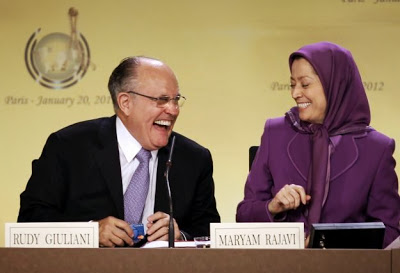
Rudy Giuliani with MEK leader Maryam Rajavi
(Photo Credit: Jacques Demarthon / AFP)
Embracing its recent removal from the U.S. State Department’s list of designated foreign terrorist organizations, the Mujahedeen-e Khalq (MEK), an exiled Iranian terror cult with deep pockets and close ties to the Washington establishment, is attempting to ramp up the fear-mongering and propaganda over Iran’s nuclear program following last month’s election of moderate cleric Hassan Rouhani as the Islamic Republic’s next president.
In April 2013, the group opened an office in Washington DC and officially registered as a lobbying organization the following month.
Now, a Reuters article from July 11, 2013 reported the MEK and its affiliate organizations such as the National Council of Resistance of Iran (NCRI) claim to have “obtained reliable information on a new and completely secret site designated for [Iran’s] nuclear project,” despite providing no credible evidence to back up the allegation.
The supposed site is said to be “located in a complex of tunnels beneath mountains 10 km (6 miles) east of the town of Damavand, itself about 50 km northeast of Tehran.” The MEK claimed that construction of the site began in 2006 and it was recently completed. “The site consists of four tunnels and has been constructed by a group of engineering and construction companies associated with the engineering arms of the Ministry of Defence and the IRGC (Iran’s elite Revolutionary Guards force),” a statement from the terror group said.
Unsurprisingly, the Iranian government immediately denied the allegations.
As in nearly all media reports on the MEK, Reuters credits the group with having “exposed Iran’s uranium enrichment facility at Natanz and a heavy water facility at Arak” in 2002. But beyond the fact that Iran’s nuclear program was never a secret, this specific claim is untrue, as nuclear experts Jeffrey Lewis and Mark Hibbs pointed out back in 2006.
In fact, the U.S. intelligence community had been tracking Iran’s nuclear facility development for quite some time, notably its construction at both Natanz and Arak. Lewis notes that, in 2002, “someone leaked that information to an Iranian dissident group, the National Council of Resistance of Iran (NCRI), which then released the second-hand dope in a press conference where they got the details wrong.” The information the MEK supposedly gleans from sources inside Iran are actually just leaks received from intelligence agencies in the United States and Israel.
Since then, the MEK has not itself provided a single shred of credible information regarding Iran’s nuclear program. Furthermore, in early 2007, an unnamed senior official at the International Atomic Energy Agency (IAEA) revealed to the Los Angeles Times, “Since 2002, pretty much all the intelligence that’s come to us [from the United States about the Iranian nuclear program] has proved to be wrong” and has never led to significant discoveries inside Iran.
“They gave us a paper with a list of sites. [The inspectors] did some follow-up, they went to some military sites, but there was no sign of [banned nuclear] activities,” the official told The Guardian at the time. Additionally, the LA Times reported that “U.S. officials privately acknowledge that much of their evidence on Iran’s nuclear plans and programs remains ambiguous, fragmented and difficult to prove.”
Additionally, the Associated Press reported this past May that, when it comes to accusations about the Iranian nuclear program and despite their terrible track record, “about 80 percent of the intelligence comes from the United States and its allies.”
Reuters, writing about the MEK’s most recent revelation, noted, “The group released satellite photographs of what it said was the site. But the images did not appear to constitute hard evidence to support the assertion that it was a planned nuclear facility.” Clearly, a non-state actor like the MEK doesn’t have satellites of its own floating around in space taking pictures of Iranian mountains; it’s obviously getting the information from government organizations with advanced spying resources.
Though these latest claims by the MEK have garnered quite a bit of attention this week, they are, in fact, nothing new. Allegations about tunnel systems have long been a go-to source of alarmism over Iran’s nuclear program. Back in January 2010, on the heels of promoting an opinion piece that explicitly advocated an unprovoked military attack on Iran, The New York Times‘ William Broad published a hysterical report, which claimed, “Over the past decade, Iran has quietly hidden an increasingly large part of its atomic complex in networks of tunnels and bunkers across the country.”
The report goes on to lament that Iranian efforts to protect their own nuclear infrastructure from military attack is viewed by the U.S. administration as “a stealth weapon, complicating the West’s military and geopolitical calculus.” Translation: it’s harder to spy on things and then blow them up when they’re not out in the open and that’s annoying.
Broad doesn’t even try to mask the frustration:
“It complicates your targeting,” said Richard L. Russell, a former Central Intelligence Agency analyst now at the National Defense University. “We’re used to facilities being above ground. Underground, it becomes literally a black hole. You can’t be sure what’s taking place.”
Even the Israelis concede that solid rock can render bombs useless. Late last month, the Israeli defense minister, Ehud Barak, told Parliament that the Qum plant was “located in bunkers that cannot be destroyed through a conventional attack.”
Despite the decades of threats from the United States and Israel, then-U.S. Defense Secretary Robert Gates didn’t realize the blistering irony when, discussing the heavily-fortified uranium enrichment site at Fordow, he said, “If they wanted it for peaceful purposes, there’s no reason to put it so deep underground, no reason to be deceptive about it, keep it a secret for a protracted period of time.”
Later in his report, Broad describes Iranian President Mahmoud Ahmadinejad as a tunnel aficionado and quotes Greg Duckworth, a “civilian scientist” described as having “recently led a Pentagon research effort to pinpoint enemy tunnels,” as saying, “Deeply buried targets have been a problem forever. And it’s getting worse.”
As the January 2010 report continues, a familiar name emerges under the heading “An Opposition Watchdog.” Who could that be? Broad writes, “In 2002, the National Council of Resistance of Iran, an opposition group, revealed that Iran was building a secret underground nuclear plant at Natanz that turned out to be for enriching uranium. Enrichment plants can make fuel for reactors or, with a little more effort, atom bombs.”
He goes on to sing the praises of NCRI for having announced “that Iran was digging tunnels for missile and atomic work at 14 sites” in 2005 and announcing “that Iran was tunneling in the mountains near Natanz, the sprawling enrichment site” in 2007, which he says was confirmed by satellite images.
In December 2009, Broad writes that NCRI issued yet another report on “Iranian military tunneling,” which claimed “Iran had dug tunnels and bunkers for research facilities, ammunition storage, military headquarters and command and control centers.”
“A group of factories” in the mountains east of Tehran, it insisted without providing proof, specialize in “the manufacturing of nuclear warheads.”
Broad even quotes the Los Alamos National Laboratory’s Frank Pabian saying of the MEK, “They’re right 90 percent of the time. That doesn’t mean they’re perfect, but 90 percent is a pretty good record.” Mohamed ElBaradei, former IAEA Director-General, had a different take on the group. “We followed whatever they came up with. And a lot of it was bogus.”
In his reporting, William Broad never once identifies the MEK or NCRI as an officially designated terrorist group, which at the time they both were and had been for over a decade.
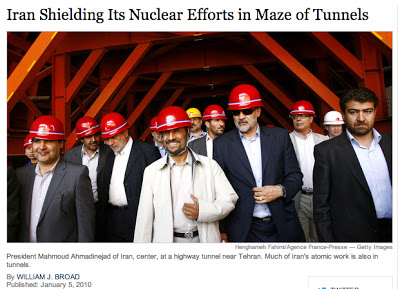
To hammer home how deliberately alarmist the claims actually were, the Times even published the article with a photograph of a smiling Mahmoud Ahmadinejad and his entourage in red hardhats emerging from what is apparently supposed to resemble a steel-reinforced underground lair. Yet the photo is wholly unrelated to any of the allegations made within the report.
The caption beneath of the picture reads, “President Mahmoud Ahmadinejad of Iran, center, at a highway tunnel near Tehran. Much of Iran’s atomic work is also in tunnels.”
Yes, that really happened. Fit to print, indeed.
The focus on Iranian tunnels leads inevitably to discussion of American military capabilities and the challenges faced by less vulnerable facilities. Broad, in his 2010 report, noted that the “Pentagon is racing to develop a deadly tunnel weapon” for such circumstances. That weapon has since been completed and tested, but has not been sold to Israel for fear it might be used without American authorization.
Clearly, the MEK’s latest revelations are recycled claims and, like before, are essentially allegations based on vague intelligence leaked to the group by American officials. The MEK merely acts as a laundering service for the unproven accusations of its handlers in the United States and Israel.
Unfortunately, the mainstream press – even when skeptical about the information – continues to dutifully provide a platform for such propaganda and fear-mongering by publishing such accusations.
The NYT Continues to Misinform on Chemical Weapons in Syria
By Michael McGehee · NYTX · July 11, 2013
Writing in his original preface to Animal Farm, George Orwell wrote about how “inconvenient facts [can be] kept dark, without the need for any official ban”:
Anyone who has lived long in a foreign country will know of instances of sensational items of news – things which on their own merits would get the big headlines – being kept right out of the British press, not because the Government intervened but because of a general tacit agreement that ‘it wouldn’t do’ to mention that particular fact […] At any given moment there is an orthodoxy, a body of ideas which it is assumed that all right-thinking people will accept without question. It is not exactly forbidden to say this, that or the other, but it is ‘not done’ to say it, just as in mid-Victorian times it was ‘not done’ to mention trousers in the presence of a lady. Anyone who challenges the prevailing orthodoxy finds himself silenced with surprising effectiveness. A genuinely unfashionable opinion is almost never given a fair hearing, either in the popular press or in the highbrow periodicals.
One way in which readers, listeners, or viewers can gauge the validity of news stories is by how quickly they drop off the media’s radar. If a story is sensationalist hype it will likely disappear as fast as it appeared. Another way is if the story gets reported at all.
Earlier this year was the scare story of an impending North Korea attack on the United States. The mainstream media, especially in the U.S. and the West, went ballistic (pun intended) on supposed North Korean threats. Hundreds, possibly thousands, of articles claimed over and over that North Korea threatened to attack South Korea and the United States. That was the popular narrative repeated ad infinitum. But it’s not entirely true. What North Korea “threatened” was retaliation, not an attack. Kim Jong-Un said his country would respond to South Korean and American aggression.
But, let’s rewind to the New Year. According to the Washington Post: “In New Year’s speech, N. Korea’s Kim says he wants peace with South”:
SEOUL — In a domestically televised New Year’s Day speech, North Korean supreme leader Kim Jong Eun said he wants to “remove confrontation” on this divided peninsula and called on “anti-reunification forces” in South Korea to end their hostility toward the North.
The lengthy address, which laid out North Korea’s goals for the year, marked Kim’s first formal remarks since the election two weeks ago of Park Geun-hye as South Korea’s next president.
The North Korean leader asked for a detente — but with prerequisites that the conservative Park is likely to be reluctant to accept. Both sides, Kim said, must implement joint agreements signed years ago by the North and liberal, pro-engagement presidents in Seoul. Those agreements call for, among other things, economic cooperation, high-level government dialogue and the creation of a special “cooperation” zone in the Yellow Sea, where the North and South spar over a maritime border.
The peace overture was replied with the annual South-Korean-U.S. military exercise, but this time with an interesting twist: the exercise included a scenario of a pre-emptive attack on North Korea. Worse, the U.S. pulled out its B-52’s, that are capable of firing nuclear weapons, and flaunted them recklessly.
In chronological order: North Korea requests peace and steps to move in that direction, to which South Korea and the United States respond with a mock scenario of a pre-emptive strike, including the possible use of nuclear weapons, to which North Korea says it will retaliate against any such attack, and, finally, the American media largely ignores this context, that Kim was vowing retaliation, and whips up hysteria of North Korea coming out of the blue with threats of nuking America.
But then the story simply went away.
We have seen this also with the recent case of Syria and the regime’s alleged use of chemical weapons.
A month ago the White House came out with the claim that the Syrian government used chemical weapons “on a small scale against the opposition multiple times in the last year.”
And though FAIR’s Peter Hart quickly pointed out that skepticism was “warranted,” the mainstream media saturated news outlets with the story.
But, like the North Korean “threat,” the story simply went away.
Until yesterday.
The story is back on the radar as Russia provided the UN, and Western countries with their report on the Sarin attack in Aleppo, Syria. Unlike the US, the Russians have (and provided) evidence that it was the rebels who carried out the chemical attack.
According to Rick Gladstone of The New York Times, in his article “Russia Says Study Suggests Syria Rebels Used Sarin,” and which appears on page A7 of the July 10, 2013 edition, Moscow’s “scientific analysis of a suspected chemical weapons attack in Syria on March 19 showed it probably had been carried out by insurgents using Sarin nerve gas of ‘cottage industry’ quality delivered by a crudely made missile.” Gladstone then informs us that Russia’s findings “contradicted conclusions presented by Western nations, including the United States, that the Syrian government had been responsible.”
The most troubling aspect of Gladstone’s article was this passage: “The American conclusion was based in part on indirectly procured soil samples and interviews with survivors, as well as the Syrian insurgency’s lack of technical ability and materials to carry out a chemical weapons attack.”
The problem? Those last sixteen words—“the Syrian insurgency’s lack of technical ability and materials to carry out a chemical weapons attack”—are presented, not as a claim, but as a fact. As we at the NYTimes eXaminer pointed out last month, The New York Times has ignored two important news items that undermine this assertion: (1) the hacking of Britam, a British defense company, revealed a plan by Washington for the use of chemical weapons in Syria, and then blame it on the government; and (2) the arrest of Syrian rebels in Turkey, who happened to be in possession of Sarin nerve gas.
All of this occurred before the White House came out with their claim that the Syrian government was behind the Sarin attacks, and was readily available in the press, though not reported by The New York Times. To this day the “paper of record” has yet to mention either of these two incidences, even as they claim that the Syrian rebels have a “lack of technical ability and materials to carry out a chemical weapons attack.”
Readers should be concerned with why sensationalist stories of a threatening North Korea, and chemical weapon-using Syria, can appear long enough to outrage the public, but stories of false flags, and rebels getting caught with the very chemical weapons we claim they don’t have, go unreported.
How Do You Know When President Obama is Lying?
By JEFF COHEN | CounterPunch | July 8, 2013
I was a young person when I first heard the quip: “How do you know when the President is lying? His lips are moving.” At the time, President Nixon was expanding the war in Vietnam to other countries and deploying the White House “plumbers” to commit crimes against antiwar leakers.
Forty years have passed. Sadly, these days, often when I see President Obama moving his lips, I assume he’s lying.
Like Nixon, our current president is prolonging an endless, borderless and counter-productive war (“on terror”) and waging a parallel war against “national security” leakers that makes the plumbers’ burglary of Daniel Ellsberg’s psychiatrist’s office look almost quaint.
The World War I vintage Espionage Act, originally used to imprison socialists for making antiwar speeches, has been used by the administration against whistleblowers with a vengeance unprecedented in history: eight leakers have been charged with Espionage under Obama, compared to three under all previous presidents. The Obama administration has prosecuted not a single CIA torturer, but has imprisoned a CIA officer who talked about torture with a journalist. National Security Agency official Thomas Drake, who was unable to get abuses fixed internally, now has a criminal record for communicating with a reporter years ago about sweeping domestic surveillance.
So there I was watching Obama’s lips move about NSA whistleblower Edward Snowden at a June 27 press conference. Saying he wouldn’t be “scrambling military jets to go after a 29-year-old hacker,” Obama added that he would not “start wheeling and dealing and trading on a whole host of other issues, simply to get a guy extradited.”
I didn’t believe a word of it.
Given Obama’s war on whistleblowers and journalists who utilize them, and given the Army’s abusive treatment of military whistleblower Bradley Manning (apparently aimed at getting him to implicate WikiLeaks), it’s inconceivable that Obama was truly blasé about Snowden. To deter future whistleblowers, Snowden would have to be caught and made an example of – and probably mistreated (like Manning, in hopes of getting him to turn against WikiLeaks and even journalist Glenn Greenwald).
As his lips were moving, Obama knew well that he would go to extreme lengths to prevent this articulate young man from securing asylum in some Latin American country, where he could continue to inform the world’s media about the Surveillance State that has blossomed alongside the Warfare State under the Bush and Obama administrations.
That Obama wasn’t truthful became clear when the U.S. campaign of “wheeling and dealing” led to possible asylum countries retreating in fear one after another (Vice President Biden was deployed to pressure Ecuador’s president by phone). And even clearer with last week’s outrageous, international law-breaking that effectively forced down the presidential plane of Bolivian President Evo Morales.
And if Obama eventually does scramble jets to force down a plane with Snowden on board, the commander-in-chief will be applauded for taking bold and decisive action by mainstream TV talking heads, “national security” experts and the opposition he seems most intent on pleasing: conservatives. Criticism from civil libertarian and peace voices (or unions and environmentalists, for that matter) has rarely daunted Obama.
The bipartisan consensus in support of our bloated Military/Surveillance State – which so undermines our society as a whole – is reflected in Congress and both the Bush and Obama administrations, as well as mainstream media.
When it comes to issues of U.S. militarism and spying, the allegedly “progressive” MSNBC often seems closer to the “official network of the Obama White House” than anything resembling an independent channel. With a few exceptions (especially Chris Hayes), MSNBC has usually reacted to expanded militarism and surveillance by downplaying the abuses or defending them.
Had McCain or Romney defeated Obama and implemented the exact same policies, treating whistleblowers like Manning and Snowden as foreign espionage agents, one would expect MSNBC hosts to be loudly denouncing the Republican abuses of authority.
But with Obama in power, a number of MSNBC talking heads have reacted to the Snowden disclosures like Fox News hosts did when they were in hysterical damage control mode for Bush – complete with ridiculously fact-free claims and national chauvinism that we’ve long come to expect from the “fair & balanced” channel.
As Snowden arrived in Russia from Hong Kong, MSNBC host Ed Schultz blustered on about Snowden as a “punk” and “coward.” Railing about the “security of the country” in tones Hannity would approve of, Schultz questioned Snowden’s patriotism and credibility, asking: “If the United States of America is doing something so egregiously wrong in its surveillance program, how come he’s the only one speaking up?
In O’Reilly-like blissful ignorance, Schultz seemed unaware of the three NSA whistleblowers who’d loudly spoken up way earlier than Snowden – and gathered for an illuminating USA Today interview a week before his tirade.
I watched one MSNBC host function as an auxiliary prosecutor in Obama’s Justice Department, going after Snowden – while trying to link WikiLeaks and journalist Glenn Greenwald to criminal flight.
MSNBC’s Melissa Harris-Perry has been condemning Snowden by contrasting him with civil disobedients who “love their country” and submit to arrest – while Snowden just wants to “save his own skin.” She proclaimed: “This is different. This is dangerous to our nation.” Should we similarly dismiss Dan Ellsberg, who leaked the top secret Pentagon Papers to a dozen newspapers in 1971 by going on the lam from the FBI. Or Watergate’s “Deep Throat,” who saved his own skin by hiding his identity for 30 years after leaking secrets that helped crash the Nixon presidency?
In a bizarre monologue attacking Snowden (who’s risked plenty, in my view), Harris-Perry hailed those who engage in civil disobedience for being willing “to risk your own freedom, your own body in order to bring attention to something that needs to be known. Martin Luther King Jr. was arrested, attacked, smeared. Nelson Mandela went to prison for 27 years.” (My emphasis.)
Nelson Mandela? He wasn’t a civil disobedient who gave himself up. He was a fugitive, fleeing the apartheid police. He was on the lam domestically, like Snowden is now internationally. And some reports indicate that South African authorities were able to nab Mandela thanks to the U.S. CIA (one of the agencies now working to apprehend Snowden).
MSNBC’s Rachel Maddow has also disappointed. After doing a typically thorough presentation on the force-down of President’s Morales’ plane, she ended her report by expressing displeasure only that Washington had apparently gotten allies to go out on the limb “for nothing.” Her objection to the harassment seemed to be: it hadn’t succeeded. I didn’t hear opposition to the action had Snowden actually been on board and apprehended.
The Snowden/NSA story proves once again that – especially on so-called “national security” issues – we need strong, independent media not enmeshed with the corporate/political power structure and not allied with one of the two corporate parties.
We can’t count on MSNBC to heed the lesson taught by legendary independent journalist I.F. “Izzy” Stone, after years reporting from Washington: “All governments lie and nothing they say should be believed.”
Jeff Cohen was an MSNBC pundit and senior producer in 2002-3 until being terminated for political reasons, along with Phil Donahue, on the eve of the Iraq invasion. He is director of the Park Center for Independent Media at Ithaca College, founder of the media watch group FAIR, and author of Cable News Confidential: My Misadventures in Corporate Media. He cofounded the online action group RootsAction.org, which has petitioned for Snowden.
As Obama regurgitates Israel lobby script on Syria, America sliding toward another Iraq
By Maidhc Ó Cathail | The Passionate Attachment | July 5, 2013
At a Washington Institute policy forum luncheon debate on June 28 entitled “Arming the Rebels: Sliding Toward Iraq or Inching Toward Stability,” Andrew J. Tabler, a senior fellow in the institute’s program on Arab politics, hinted at the pro-Israel think tank’s influence over President Obama’s recent shift in Syria policy. Referring to his Foreign Affairs piece entitled “Syria’s Collapse: And How Washington Can Stop It,” Tabler said he would like to say that it “follows a lot” of President Obama’s responses in a major June 17 television interview. Whether out of modesty or a desire to downplay the Israel lobby’s role in deepening Washington’s involvement in the destabilization of Syria, a smiling Tabler added, “I’m sure that he didn’t read it and then just go and regurgitate it to Charlie Rose.”
WINEP’s executive director Robert Satloff was similarly coy in his introduction. Describing Tabler as a “very consulted” expert on Syria, Satloff said, “I won’t go into the details of the consultations” he has with senior government officials “but suffice to say that the arguments that we’ll be hearing today very much reflect the arguments that are on the table.”
Given the proven track record of such arguments made “in the national interest” by partisans of Israel, it would appear that its oblivious American proxy is rapidly sliding toward another Iraq.
Maidhc Ó Cathail is an investigative journalist and Middle East analyst. He is also the creator and editor of The Passionate Attachment blog, which focuses primarily on the U.S.-Israeli relationship. You can follow him on Facebook and Twitter @O_Cathail.
Related articles
- Ó Cathail: ‘Israel dominates US Syria policy’ (thepassionateattachment.com)
- Did an Israel lobby front group organize McCain’s trip to Syria? (thepassionateattachment.com)
Featured Video

Iran’s Next Strike May Not Explode. It Could Shut You Down
or go to
Aletho News Archives – Video-Images
From the Archive
Zionism’s Violent Legacy
By Donald Neff | Washington Report On Middle East Affairs | January 1996
On January 4, 1948, Jewish terrorists drove a truck loaded with explosives into the center of the all Arab city of Jaffa and detonated it, killing 26 and wounding around 100 Palestinian men, women and children.[1] The attack was the work of the Irgun Zvai Leumi – the “National Military Organization,” also known by the Hebrew letters Etzel – the largest Jewish terrorist group in Palestine. The Irgun was headed by Revisionist Zionist Menachem Begin and had been killing and maiming Arabs, Britons and even Jews for the previous ten years in its efforts to establish a Jewish state.
This terror campaign meant that at the core of Revisionist Zionism there existed a philosophical embrace of violence. … continue
Blog Roll
 Aletho News
- Trump’s Iran war is on an Israeli leash
- Saudi oil boss issues global supply warning
- Riyadh Says Its Oil System Is Intact. The Numbers Say Otherwise.
- Trump and Netanyahu Want to “Finish the Job” on Iran
- US ‘one-sided dictation’ not Iran’s beliefs makes rational talks impossible: Baghaei
- Iran’s Next Strike May Not Explode. It Could Shut You Down /Col Doug Macgregor
- Iran: US political targets legitimate if assassinations return
- Iraq shuts key border crossing with Iran under US pressure: Report
- Undersea Internet cables could be targeted in retaliation for attacks on Iran: IRGC deputy chief
- EU sending ‘biased’ observers to interfere in Serbian election – president
- If Americans Knew
- At least 160 Israeli settler attacks in 2 weeks
- Will Gaza’s Ancient Christian Community Disappear Forever?
- Israel’s vision of regional security rests on keeping Arab states weak
- Heidi Levine recounts how Palestinian youths helped save her in settler attack
- DAILY UPDATE: Latest essential news on Palestine, Israel, & region
- Trump’s Intensifying Sabotage of the ICC, for Israel’s Sake
- Israeli military detain US and UK volunteers in West Bank including Democratic NY politician Brad Lander
- Americans at National Conservatism Conference held in Israel this year criticize Israel
- Christiane Amanpour exits CNN with a legacy shaped by the debate over Israel
- Israel’s war on Iran is the final move in a decades-old strategy
- No Tricks Zone
- E-Cars Reduce CO2 Emissions By Only 41% Compared To Internal Combustion Engine Vehicles
- Predictions Made By Renowned Climate Professor Over Past Decades Have Been Proven To Be Poor
- New Study Suggests Large Regions Of The Pacific Ocean Have Been Cooling For The Last 80 Years
- Germany’s Green Energy Debacle: High Energy Costs Force Kahla Porzellan to Close After 182 Years!
- New Study: 50 Years Of The Most Aggressive ‘Net Zero’ Policies Can Only Affect The Global Climate By 0.03°C
- US September “Heat” Was No Record…Many Records Set Decades Ago
- Latest European Green Energy Debacle; Portugal’s Largest Flagship Solar Park Insolvent!
- Green Energy Debacle: German Expert Professor Fritz Vahrenholt Warns Of Severe Economic And Social Consequences
- Two More Paleo Reconstructions Affirm Meters-Higher Sea Levels Across Ireland, Brazil 7000-6000 Years Ago
- New Study: Earth And Venus Surface Warmth Largely Explained By Convection And Lapse Rate, Not CO2 Or Radiation

