Who Is An Objective Journalist?
By Ann Robertson and Bill Leumer | Worker’s Compass | July 2, 2013
In a recent New York Times article article David Carr questioned whether someone could be both a journalist and an activist, a question that was prompted by the role of Glenn Greenwald, a writer for The Guardian and a political activist, in reporting on Edward Snowden’s National Security Agency leaks.
As Carr put it, “The question of who is a journalist and who is an activist and whether they can be one and the same continues to roar along, most recently in the instance of Glenn Greenwald’s reporting for The Guardian on the secrets revealed by Edward J. Snowden.” Carr also framed the question as “a fight between objectivity and subjectivity.”
Carr initially seemed to concede that one and the same person could be both an activist and a journalist, even though the activists are “driven by an agenda.” In fact, the title of his article conveyed exactly that point: “Journalism, Even When It’s Tilted.” And, as Carr noted, this is an important concession since journalists are afforded special legal protections in the case of reporting leaks. Mr. Greenwald needs this protection because there are some government officials who would like to see him prosecuted.
However, towards the end of his article Carr began to raise caveats. Activism, he concluded, does not prevent someone from being a journalist; it rather tends to make them bad journalists: “But I think activism – which is admittedly accompanied by the kind of determination that can prompt discovery – can also impair vision.” And he added: “…the tendentiousness of ideology creates its own narrative.” In other words, activism can on rare occasions be helpful in unearthing the truth, but usually it is a barrier.
But perhaps Mr. Carr has failed to grasp the larger picture, possibly due to his own unspoken commitments. Everyone falls into one of two categories. There are those who basically have resigned themselves to established society, perhaps because of ideological compatibility, a strong strain of pragmatism, or a conviction that attempts to change society are entirely futile. Then there are others who are critical and are prepared to embark on a campaign to try to change what they find objectionable. Neither of these groups has a monopoly on objectivity; both positions rest on a set of fundamental values that can be rationally supported. And both involve a kind of activism: one aims at changing society while the other aims at refraining from changing it.
Yet there is a superficial difference between the two: those who want to change society do stand out. Unlike Mr. Carr, they do not seamlessly blend in with the surrounding social institutions and the values embodied in them. Accordingly, they might seem as if they have an agenda that uniquely distinguishes them, but that is only from the perspective of people like Mr. Carr, whose agenda ties him to the status quo but who has not sufficiently reflected on his own social commitments and therefore is unable to acknowledge them. No one, in other words, is exempt from having an “agenda.”
This point was graphically illustrated when “Meet the Press” host David Gregory pointedly asked Greenwald why he should not be charged with a crime for divulging Edward Snowden’s leaks. Here Gregory stood smugly on the side of those who wield power and was quick to demonstrate this point by his tendentious question, perhaps with the thought in mind of winning a promotion, which is a rampant form of another kind of activism.
To his credit, Carr elicited Greenwald’s response to the counterposing of activism and journalism, and this was Greenwald’s response: “It is not a matter of being an activist or a journalist; it’s a false dichotomy. It is a matter of being honest or dishonest. All activists are not journalists, but all real journalists are activists. Journalism has a value, a purpose – to serve as a check on power.” And Greenwald added: “I have seen all sorts of so-called objective journalists who have all kinds of assumptions in every sentence they write. Rather than serve as an adversary of government, they want to bolster the credibility of those in power. That is a classic case of a certain kind of activism.”
Greenwald’s rejection of the purported dichotomy between activism and journalism is, of course, entirely correct. Everyone is an activist of one kind or another. The distinction should rather be drawn between those who are conscious activists and those who, like Mr. Carr and Mr. Gregory, are unconscious activists. Those who fail to reflect on their own commitments are sometimes the most vicious.
Ann Robertson and Bill Leumer may be reached at sanfrancisco@workerscompass.org
Rafael Correa, the Press, and Whistleblowers
By ADAM CHIMIENTI | CounterPunch | June 25, 2013
Once again, we are witnessing a growing frustration with “tiny” Ecuador. The United States government is clearly not happy with what would be the latest diplomatic slap in the face coming from the South American country, i.e. the pending arrival of NSA whistleblower Edward Snowden in the coming days. Beyond the United States’ government though, the US press corps are also seemingly up in arms. Why are they so angry? Well, it appears that they are indignant over the perceived hypocrisy of President Rafael Correa.
According to an article from The Atlantic (and another similar one from NPR here), the Ecuadorian leader “has created a safe space for foreigners like Assange — and now possibly Snowden –[but] he doesn’t do the same for dissenters within his own country.” News agencies like NBC News and The Atlantic think this is “interesting” and want to know ‘Why Ecuador?’ Such inquiries naturally turn to the NGOs, who are also less than pleased with this unruly little country. Freedom House, the Committee to Protect Journalists and others are upset that this very week, the one-year anniversary of Assange being holed up in the Ecuadorian Embassy in London (and the same week that the Snowden asylum request is being reviewed), the Ecuadorian National Assembly has passed a Communications Bill that detractors claim is a major blow to a free press.
Claims of Hypocrisy
For several of the opposition figures and US-based observers, Ecuador’s new media legislation has sealed the deal on the stasi-like state that they imply or openly charge Correa has been dreaming about for years. In other words, transparency advocates like Assange and Snowden are compromising their credibility by associating with the Correa government. Ileana Ros-Lehtinen, the right-wing terrorist supporter/US Congresswoman representing Miami, has been busy tweeting as much. The Ecuadorian government, however, asserts that the bill is meant to place more media power in the hands of public groups and move away from privately owned media monopolies.
Meanwhile, the Council of Hemispheric Relations, Center for Strategic and International Studies, and the Heritage Foundation all say that Ecuador must be punished for this latest insult to the US government. James Roberts of Heritage lashed out at the South American leader on June 24, writing in the National Review Online:
“Rafael Correa has demonstrated a blatant disregard for international standards of justice. That kind of conduct may not be surprising from a man who seeks to don the mantle of Chávez, but it should not be rewarded with trade preferences.”
It doesn’t take much imagination to understand how a figure like Correa would have been dealt with a few decades back, but it appears that the more heavy-handed approach is not really possible at the moment, much to the dismay of the powerful and connected.
Returning to the issue of freedom, has the defiant president of Ecuador used the National Assembly to pass a law that NPR, The Atlantic and others tell us will be used to make the country less transparent and more hostile to journalists who only wish to be free to monitor the government and act as a check on state power? Well, let’s hold off on the most absurd elements of irony here for a moment and address the issue at hand.
About a Coup
It should certainly not be regarded as a good thing if the case was simply a cut-and-dry example of authoritarian overreach. Freedom of the press, as we are learning with the Snowden case, has seemingly never before been so important, or so contentious for that matter. However, the Ecuadorian issue is not so simple and it was certainly complicated after a day of crisis nearly three years earlier when factions of the National Police and armed forces attacked the president of Ecuador on September 30, 2010. The event was widely regarded as a coup attempt. What exactly went down is still somewhat unclear. There was a dramatic showdown between Correa himself and police officers that were angered by a supposed attempt to cut their pay. What is for certain, though, is that it was a countrywide, well-coordinated attempt to shut down the National Assembly, the two major airports in Guayaquil and Quito and eventually a hospital where the president was being treated for wounds. Furthermore, the plotters were also attacking journalists throughout the country, and most of these were pro-government reporters working for public media outlets.
The opposition press has taken an active role in attempts to discredit Correa since he first ran for president. He has elaborated on his views of the press and they are certainly not very congenial. In 2012, during a public TV interview in Spain, Correa said, “one of the main problems around the world is that there are private networks in the communication business, for-profit businesses providing public information, which is very important for society. It is a fundamental contradiction.”
One of the issues that NGOs and journalists have cited in their litany of complaints about Ecuador’s endangered freedom of the press actually stems from the 2010 police and military uprising. During the chaos that ensued during the alleged coup attempt, one reporter from the paper of record in Guayaquil took the opportunity to claim that Correa had ordered police to fire on a crowd of innocent onlookers caught up in the melee, presumably aiming to provoke anti-government sentiments. The claim turned out to be completely unsubstantiated. The government fined the journalist and his paper El Universo some $40 million for defamation but later withdrew the charges. Consider what might have happened in the US if the Los Angeles Times or Washington Post would have falsely claimed that Barack Obama had personally ordered military or police forces to fire on a crowd of protesters and innocent people were injured as a result somewhere in Washington, D.C It would be difficult to imagine a reporter and his editors ever committing such a stupid move, but if they had, there would have been some serious consequences. Alas, this is not really too shocking in the context of a sensationalist Latin American press.
Televised and Untelevised Revolutions
That dramatic Ecuadorian affair is reminiscent of the 2003 documentary film The Revolution Will Not Be Televised,directed by the Irish filmmakers Kim Bartley and Donnacha Ó Briai. The pair happened to be in Caracas, Venezuela during one of several 21st century Latin American coup attempts thus far. The film provided a key glimpse into the nature of media in the region, so often dominated by pro-US elites. It showed the efforts expended by private media outlets to incite anger and get people out in the streets in order to challenge the power of anti-Washington governments.
Right up until his death, it was a sort of requirement for US and European governments, journalists and NGOs to claim that Hugo Chávez Frías was a dictator for not renewing the license of RCTV. The outlet, owned by Marcel Granier, was one of the most virulent anti-government television stations operating on the state-owned airwaves and the Venezuelan government eventually forced them over to cable television. The criticism of the allegedly authoritarian leader served to cover up the very questionable coverage by corporate media. Indeed, one anti-Chávez commentator honestly noted six months ago that the idea that Chavez ever controlled the Venezuelan media was a myth. He pointed out that back in April 2002,
“Coup plotters collaborated with Venezuelan media figures before the coup. The media refused to show statements by officials condemning the coup d’état. When the coup d’état failed, the private Venezuelan networks refused to broadcast the news that Chávez had returned to power.”
“Correa is a Very Smart Guy”
The Venezuelan experience did not escape the attention of the rather astute and confident Correa. Neither did the fact that, only 15 months prior to the attempted coup in Ecuador, there was a successful coup in Honduras, removing the president of that country, Manuel Zelaya, by gunpoint in the middle of the night. This was considered to be illegal by President Obama himself, although soon after the offending and illegitimate new government of Roberto Micheletti was accepted by his administration and is still backed to this day by Washington (under current President Porfirio Lobo). This support comes despite a terrible record of human rights abuses and, yes, a genuine threat to a the flow of crucial information. Journalists have been censored and intimidated since the 2009 coup in Tegucigalpa and, what’s worse, have frequently been murdered by the government and its allies. Honduras consistently ranks as one of the most dangerous places in the world to be a journalist. The double standards are blatant and many would like to see the opinion-makers from the States take a closer look in the mirror.
Popular Support and Popular Media
Anyone who would have spent some time watching The Revolution Will Not Be Televised would have also learned what President Hugo Chávez, then only a mere three years into his presidency, meant to the millions of impoverished and the historically marginalized majority in Venezuela. This did not stop the State Department and its allies from focusing on how best to rid Venezuela of its president. (Incidentally, while doing an internship for the State Department in the fall of 2001, I was invited by the Public Diplomacy department to work on ideas on how to get the message out to Venezuelan people about the dangerous nature of President Chávez.) That coup attempt failed, as the one in Ecuador would eight and a half years later, mainly because the people staunchly backed the president of the Republic.
At the time of the 2002 coup attempt, Chávez was wildly popular and the same was true of Rafael Correa in September 2010; two weeks before the coup attempt, polls found that he had the support of 67% of respondents in the capital Quito and nearly 60% in his native Guayaquil, the second largest city. Correa actually got a nice bump in approval ratings after the whole affair and, more recently, he has just won a major reelection bid in February of this year precisely because he has brought political and economic stability to the country of 15 million people. Poverty has been reduced dramatically since Correa took office. Public works projects have resulted in huge improvements to the country’s infrastructure and, more importantly, there is a sense of independence from the yoke of neocolonialism so prevalent in years past.
It appears that Correa and the government may have some good reasons to increase the influence of publicly owned media companies and challenge private corporate media elites. This foray into press control is a dangerous game, however, especially since there appear to be some genuine concerns from indigenous and environmental activists who oppose the government’s expansive plans for an economy based primarily on extraction. Often, those who disagree with Correa are dismissed as childish Marxists, or more alarmingly, terrorists. There must be more attempts to reach a humane and considerate consensus on some of these crucial issues, especially as the Chinese enter the fray in search of resources to fuel their economic needs and a gateway into South America (and Ecuador recovers from two major oil spills so far this year). There are clearly opportunities, but also responsibilities to the environment and the people that live outside of the metropoles.
With such considerations in mind, is there a reason to agree with the opinion-makers in the US who would dub Correa as a dictator, increasingly revealing his dangerous nature?
One of Correa’s main antagonists is Martin Pallares, a senior political editor at one of the major national newspapers El Comercio. Pallares recently said, “I think freedom of press in Ecuador is gravely threatened by a system managed by the government. They have the objective to discredit the media, affect their credibility. And they also want to characterize the press like political adversaries and destabilization agents.” In a very important sense, the media should or even must by its nature act like political adversaries. Destabilization is a different story however. In the case of the coups in Latin America, there is typically interference by Western powers, especially the United States, and this often serves to destabilize governments Washington deems troublesome (through the funding of local civil society groups via the National Endowment for Democracy, USAID and, of course, the CIA). The message is often that these groups are just trying to further democratic causes, but this belies an obvious mission by colluding corporate and government powers that is evident throughout the many anti-democratic interventions and support of such leaders in postwar history (from Iran in 1953 to both the Maldives and Paraguay in 2012).
Felonious Journalists
Returning to the issue of irony, here you have several of the leading news outlets in the US reporting on the lack of media freedom in Ecuador, yet ignoring the major issues raised by leakers, journalists, and publishers such as Bradley Manning, Julian Assange, Glenn Greenwald and Edward Snowden. In effect, these major corporate outlets are legitimizing or are even themselves guilty of demonization of these individuals who have put everything on the line to get the public talking about some serious violations of human rights and privacy, and the dangerous encroachment of the corporate state. One has to wonder if the fact that many of these commentators themselves are getting paid major corporate money has anything to do with their take on the Snowden/Ecuador affair.
If you watched the Sunday morning talk show highlights, you should be able to draw your own conclusion. One jaw-dropping example of the corporate media’s lack of objectivity in this discussion was the meticulously staged interview that George Stephanopoulos did with General Keith Alexander, the man who has access to the personal data of nearly anyone he so chooses to target. There were several moments in which the responses to some of the host’s softball questions were so weak (lots of babbling about dots) that it was unbelievable that Stephanopoulos didn’t pounce. Yet, why he did not or would not do such a thing is evident considering the establishment’s treatment of the recently departed journalist Michael Hastings, loathed for his refusal to play footsie with the biggest fish in the game. That sort of behavior simply cannot be tolerated.
Also on the talk show rounds, there was David Gregory’s aggressive and ethically revealing accusation thrown at guest Glenn Greenwald in the form of a ‘tough question’. Gregory actually asked Greenwald why he shouldn’t be charged with a crime, and The Guardian columnist sharply replied that it was “pretty extraordinary that anybody who would call themselves a journalist would publicly muse about whether or not other journalists should be charged with felonies”, with no evidence of wrongdoing. But there you have the attitude that the establishment needs to maintain close ties; it mustn’t be overly adversarial and never threaten the stability of the government or a particular administration, even if that means sitting on stories such as the spying on US citizens, like The New York Times was guilty of in 2004 when it delayed publication of a story on government surveillance after being approached by the Bush Administration.
Indy (media) to the Rescue
Modern professional journalism often leaves us wanting for more. Thankfully, we have the independent media outlets that are often way ahead on exposing some of the more heinous crimes of the times. This helps millions around the world identify the mantras of the media elite in the United States: 1) the corporate bias is never to be exposed or acknowledged; 2) it should never be overly adversarial to the government; and 3) a “journalist” should always attempt to divert from important issues that arise from whistleblowing by attacking the whistleblower’s character.
Of course, all of these conventions go out the window when it comes to perceived enemies, in which case the media, NGOs, corporations and the US government always work together in delegitimization and destabilization efforts. Snowden has followed Assange’s lead and is headed to Ecuador not simply because, as The Atlantic has suggested, both parties feel persecuted or they want to ‘poke the US in the eye’. The reason why Ecuador has offered asylum and why Snowden was seeking it from them is because they believe that there is hope in the future, beyond the grossly excessive power of the United States and its presumed worldwide dominion. The whistleblowers and the Ecuadorian leaders, like countless others around the world, believe that the only hopeful way forward is to shatter the antiquated and dangerous notions inherent in establishment journalism, corporate supremacy, and US hegemony. I guess it is no surprise that the privileged classes vehemently disagree.
Adam Chimienti is a teacher and a doctoral student originally from New York. He can be reached at ajchimienti@gmail.com.
Related articles
- Huffington Post Misguidedly Attacks Rafael Correa
- Reporting Ahead of Ecuadorean Elections Fits a Familiar Narrative
- The Ecuadorian Coup: Its Larger Meaning
- Behind the Coup in Ecuador – The Attack on ALBA
- Target: Ecuador
- Ecuador Will Cease Participation In School Of The Americas
- Ecuador to maintain foreign policy, ties with Iran: FM
Bush’s Foiled NSA Blackmail Scheme
By Dennis J Bernstein | Consortium News | June 21, 2013
In early 2003, as the U.S. and British governments were seeking international acquiescence to their aggressive war on Iraq, an unexpected cog thrown into the propaganda machine was the disclosure that the National Security Agency was spying on UN Security Council members in search of blackmail material.
The revelation received little attention in the mainstream U.S. news media, which was almost fully on board the pro-war bandwagon, but the disclosure received wide international attention and stopped the blackmail scheme. U.S. President George W. Bush and British Prime Minister Tony Blair were forced to abandon a UN resolution and invade Iraq with a ragtag “coalition of the willing.”

Former British Prime Minister Tony Blair.
Several months later, the identity of the leaker was revealed, a young woman named Katharine Gun who worked as a linguist at the NSA’s UK counterpart, British Government Communications Headquarters. Gun lost her job and was charged under British secrecy laws, but the case was dropped because the court would have required the Blair government to disclose that it also had twisted the arms of legal advisers to extract an opinion endorsing the invasion.
Now, a decade later, Edward Snowden, a young American systems analyst working for the NSA, has leaked documents revealing a global surveillance network and prompted another international debate – about government spying vs. personal privacy. Katharine Gun joined Pacifica’s “Flashpoints” host Dennis J Bernstein to discuss both cases.
DB: What exactly was your position when you decided to leak a certain document?
KG: My title was linguist analyst. I was a Mandarin Chinese speaker. We translated interceptions and produced reports for the various customers of GCHQ, which are normally the Foreign Office or MI-5 and MI-6.
DB: Can you explain the document you released and the significance of the timing?
KG: It was released at the end of January 2003, just before the invasion of Iraq. I saw an email that had been sent from the NSA to GCHQ. It was a request for GCHQ to help the NSA intercept the communications of six nations that sat on the Security Council at that time. It was to intercept their domestic and office telecoms in order to obtain all the information we could about the delegates, which the U.S. could then use to achieve goals favorable to U.S. interests. They called for the whole gamut of information, which made me think they would potentially use the information to blackmail or bribe the U.N. delegates.
DB: This bugging took place at the United Nations?
KG: Presumably, yes. Or it could involve the United Nations headquarters or also their domestic residence.
DB: The idea was to get the necessary information one way or the other to influence the key members to support the U.S. quest for war in Iraq?
KG: Yes. At the time, if you were not working for the intelligence services or the foreign offices of the U.S. or U.K. you would probably assume that the goal of [President George W.] Bush and [Prime Minister Tony] Blair at that time was to work diplomatically to reach a solution. But we now know, after several leaks over the years about the run-up to the war in Iraq, that war was the agenda all along. When I saw the email it made me think, “This is evidence that war is the agenda.” That’s why I decided the public needed to know.
DB: GCHQ is the British Government Communications Headquarters, the equivalent to the NSA [National Security Agency]. You were working there in the lead-up to the Iraq War. Can you remind us what governments were bugged?
KG: Six nations, smallish countries: Angola, Cameroon, and Pakistan, I think. Mexico was mentioned, and possibly Chile as well. They were countries that are generally not known for their big powerful positions at the U.N.
DB: What went through your mind leading up to the decision to leak this information? This big decision changed history a bit. How did you make this courageous decision that also changed your own life?
KG: I was very concerned. I had informed myself about the realities of Iraq and the situation there because I grew up during the first Gulf War and the following years of sanctions. It was in the back of my mind that Iraq was a country that was virtually destroyed, and that the people were living in impoverished conditions. It made me think that another attack on them would not be fair and justified because there was nothing about Iraq that was a threat to either the U.S. or the U.K.
So when I saw the email and realized what was going on behind closed doors was an attempt to get the U.N. to authorize what would then have become a pre-emptive strike on a country, I thought the public should know about this because it angered me.
DB: What happened after you made this information available? What happened with your position? Were you intimidated, attacked?
KG: Initially I tried to remain anonymous, but when I realized the information revealed in the newspaper at the time was identifiable to GCHQ, I decided I didn’t want to lead a double life at GCHQ and pretend I had nothing to do with it. I confided to my line-manager and said it was my leak. Then I was arrested under suspicion of breaking the Official Secrets Act, questioned, and released on bail for eight months.
In November 2003, much to our surprise, they decided to charge me, despite having waited so long. After discussions with my legal team, which included Liberty, an organization very similar to the U.S. ACLU, we decided I would plead non-guilty, because I personally felt that although I did the act, I didn’t feel guilt, because I didn’t feel I had done anything wrong. Our defense would have been to establish the defense of necessity, which is not yet tested in a court of law. My legal team then asked for all the legal advice leading up the war, and at that point, the prosecution decided to drop all charges against me.
DB: What do you think made them decide to prosecute you, and what information made them drop the charges? Were they trying to backpedal? Were they trying to make sure no other folks in positions like you would do it again?
KG: It’s speculation on my part because obviously they haven’t disclosed. I suspect one of the reasons they charged me was to make an example of my actions to try to deter people from it. On the other hand, when they dropped the charges, I suspect there may have been a variety of reasons. When we asked for the legal advice from the then-Attorney General, at that time his legal advice had not been fully disclosed.
During the run-up to the war, Blair asked for legal advice, obviously. The first draft was about 13 pages long. The language was very cautious – it didn’t say there was a definite reason for war. There were many legal terms of caution, but at some point Blair was told the legal advice was not good enough. He needed a watertight case. The Attorney General then re-drafted his advice, and condensed it to a single page that was then issued to the House of Commons.
That is what persuaded all the MPs in the House of Commons to vote for Britain’s involvement in the war. Eventually information came out, not from myself, but from other means and it became apparent that the legal advice had not been at all watertight to start with.
DB: Daniel Ellsberg said your most important and courageous leak is the only one made in time to avert an imminent possible war. Was your desire to avert war?
KG: Yes, I was hoping the British ministers would see the truth and question the actions of Blair and the secret negotiations he was having with Bush at the time. I wanted more transparency on the issue. I wanted people to question what was going on and to generally challenge this bandwagon for a preemptive strike against a country that was already very impoverished and no threat to anybody whatsoever.
DB: Did you ever hear from folks who based on your revelations, learned they were bugged?
KG: No.
DB: So there were no thank yous coming across from that part of the world?
KG: No. At the time of the leak, my name didn’t come out. Eight months later my name was made public.
DB: Did it change your life?
KG: I lost my job. The secure, full-time, long-term employment was no longer possible. That has made an impact, primarily financially, on my life and my family’s life.
DB: We are now seeing extraordinary NSA leaks from Edward Snowden in the British Guardian. What are your thoughts on this?
KG: I think Snowden is probably is a lot more clued-up than I was at the time. My leak was a single issue. Snowden has had a long period of time working within the U.S. intelligence services. He’s obviously a very technically savvy professional. I admire him for taking this tremendous step, which he thought out very carefully and methodically. He has made some very good points. These kinds of issues should be in the public domain because it involves innocent members of the public. We, the public, should be able to have a measure of a say in these matters.
DB: We hear that people like you, who were leaking before the war, and Snowden now, are putting people’s lives in jeopardy, endangering the people. We hear that secrecy is necessary to prevent terrorist attacks, and that many have been prevented by this kind of secrecy, investigation, wiretapping and bugging that’s going on now.
KG: There is absolutely no evidence that my leaks in any way endangered anybody else.
DB: But you were accused of that.
KG: Yes, they love to throw accusations around, there’s no doubt about that. But in my case, the majority of views supported my actions. In Snowden’s case, people who have a fair and just understanding of the issues at-large are supportive of his actions, as they would be of Private Manning, who is currently on trial.
DB: Did you lose any friends or associates, over this?
KG: Ironically, not really. Many of my friends and colleagues from GCHQ have also left GCHQ, partly to progress in their professions. They didn’t see much chance for their linguistic skills progressing much further within GCHQ and I continue to be in touch with them.
DB: If you had it all to do over again, would you?
KG: That’s a difficult question. Now I’m married and have a child. I would hope that I would still do it, but perhaps I would be more savvy about how I did it. Snowden was very clued-up and seems to know exactly what he should be doing – how to stay safe and keep out of the way of being unjustly arrested and tried without due process of law.
DB: Your language skills. Are you using them now?
KG: Not now. I’m only fluent in Mandarin Chinese. I speak some Japanese and am now trying to learn Turkish.
DB: That may in handy in the next decade or so. Thank you for talking to us.
~
Dennis J Bernstein is a host of “Flashpoints” on the Pacifica radio network and the author of Special Ed: Voices from a Hidden Classroom. You can access the audio archives at www.flashpoints.net.
Related articles
- A British Precursor to Snowden Case (consortiumnews.com)
- British spy agency has access to global communications, shares info with NSA (alethonews.wordpress.com)
UN rejects US claim on Syria chemical weapons
Press TV – June 21, 2013
UN experts say they do not confirm the claims by the United States, France and Britain that the Syrian government has used chemical weapons against the militants.
“We are not able to say who has used chemical agents or chemical weapons,” said Paulo Pinheiro, chairman of the United Nations human rights investigation committee on Syria, on Friday.
Speaking to reporters after an informal meeting with UN Security Council ambassadors, Pinheiro said he would not comment on evidence, including multiple blood, tissue and soil samples, that the US, Britain and France have sent to the UN about the possible use of chemical weapons in Syria.
The technical data presented by the three countries is of limited value to the UN which, according to its rules, can pass a final judgment on the situation only after its own inspectors personally collect evidence.
Based on the unsubstantiated claim that the Syrian government has used chemical weapons against the militants, President Barack Obama ordered the CIA last week to provide arms to the anti-Syrian groups, saying the government of President Bashar al-Assad had crossed Washington’s red lines.
In an article on the Washington Post on Friday, Colum Lynch and Joby Warrick write that the US move “rests on unverifiable claims” that lack transparency.
Weapons experts say Obama’s declaration of Washington’s red line in terms of more involvement in Syria “handed the Syrian opposition a powerful incentive to fabricate evidence” against the Assad government regarding the chemical arms use, the article said.
“If you are the opposition and you hear” that the White House has drawn a red line on the use of nerve agents, then “you have an interest in giving the impression that some chemical weapons have been used,” said Rolf Ekeus, a Swedish scientist who headed UN weapons inspections in Iraq during the 1990s, the article read.
Related articles
- PressTV: Russia dismisses ‘unconvincing’ US claims on chemical weapons use by Syria (jhaines6.wordpress.com)
- New weapons supplied to militants in Syria (fromthetrenchesworldreport.com)
Most in US distrust newspapers, TV reports: Gallup poll
Press TV – June 21, 2013
A new nationwide opinion poll indicates that over 77 percent of people in the United States do not trust mainstream newspapers and television reports.
The survey, which was conducted by Gallup on June 1-4, was based on nationwide telephone interviews with 1,529 American adults. Its results were released on June 17.
Only 23 percent of Americans trust news institutions in the United States. The figure shows a fall from 25 percent in 2012 and 28 percent in 2011.
The Gallup poll also pointed out that news consumers have found increasingly better ways to access news amid the expanding social media sites and the Internet in general, making it difficult for the news industry to find a suitable niche.
Newspapers and television ranked near the bottom of the confidence list of 16 societal institutions, placing alongside banks, Congress and big businesses.
Americans’ in all key demographic groups including conservatives, moderates and liberals have experienced a drop in confidence in mainstream news since the early 2000s. The confidence has worsened further since 2007, the study revealed.
The opinion poll was released as mainstream media outlets are under fire for their extensively lopsided coverage of key international events including the Israeli aggression against the Palestinians, the National Security Agency’s spy scandal involving whistleblower Edward Snowden, and the unresolved Boston Marathon bombings.
Venezuela Promotes Breastfeeding over Baby Food, Corporate Media Spins Out of Control
By Tamara Pearson | Venezuelanalysis | June 20, 2013
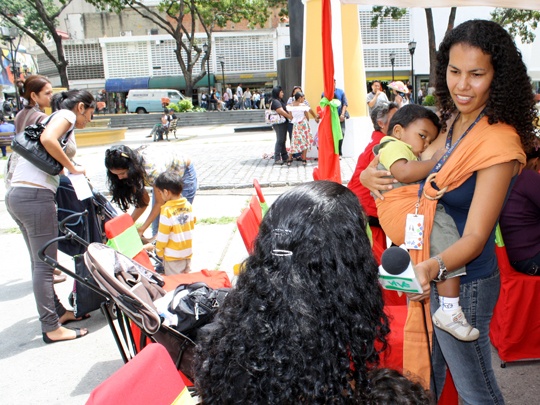
A Venezuelan public media journalist breastfeeds as she works. Public breastfeeding is fairly accepted in Venezuela (blog.chavez)
Venezuela’s national assembly is debating a reform to its breastfeeding law which could see baby food companies like Nestle fined in certain situations. The corporate media have reacted hysterically to the law, claiming that President Nicolas Maduro is “taking bottles from babies’ mouths”.
Though breastfeeding is widely promoted by the Venezuelan government, and public breastfeeding is relatively de-stigmatised, a study by Venezuela’s National Nutrition Institute (INN) between 2006 and 2008 showed that only 55% of mothers exclusively breastfed when their baby was born, going down to 20% when their baby was three months old, and 11% by six months.
The percentages have probably increased since then, with broad educational campaigns in public schools and health centres, and actions such as mass public breastfeeding in plazas, organised by the INN.
However, the low figures reflect the low confidence some mothers have in their ability to breastfeed, as well as the power of multinational infant formula companies in health centres. It is common practice to give infant formula to babies from the moment they are born, without the consent of parents, according to LactArte, a pro-breastfeeding collective in Venezuela. Companies give gifts and other promotions to health workers and health centres in order to create alliances with them, and give free samples of the products to new mothers, thereby creating dependent consumers of new born babies, or at least discouraging exclusive breast feeding.
What the law actually says
In 2007 Venezuela’s national assembly passed the Law of Protection, Promotion, and Support for Breastfeeding. The law regulates the way baby formula and baby food companies advertise and label their products, and how they interact with hospitals and clinics. However, the companies have been ignoring the law, as it doesn’t specify penalties. The reform to the law currently being discussed is looking at penalties of US$600 – $50,000, and also training for health professionals. Once the reform is passed in first discussion by the assembly, it will be subject to “street parliament” – discussion by collectives and Venezuelan citizens, to then be passed by the national assembly in second discussion.
The 2007 law argues that breastfeeding provides babies with “all the necessary nutrients” in their first six months, as well as “protecting them and immunising them from illness and contributing to the development of their breathing and gastrointestinal capacity”. It states that “mothers have the right to breastfeed their children, with the support and collaboration of the fathers… [who] should provide all the support necessary so that mothers can provide this human right… The state, with solidarious participation from organised communities, will promote, protect, and support exclusive breastfeeding…of children under six months of age and breastfeeding with complementary food … until the age of two”.
Concretely under the law, health workers and health centres must help mothers start breastfeeding within the first half hour of birth, and guarantee that the newborn is always near the mother after birth, except in exceptional medical situations. They should also educate mothers, fathers, and the family on the issue, and abstain from providing babies under the age of 6 months with food other than breast milk, except when there is a specific medical need. Health centres must create human milk “banks”.
Baby food and formula products must be in Spanish or Venezuelan indigenous languages (Nestle products for example, often aren’t), and they should inform of the risks of including such food in the baby’s diet too early. Publicity or labelling can’t create the impression that such food is equal to breast milk, and publicity of any kind discouraging breastfeeding is not allowed.
All food aimed at children under three must include labelling that clearly states its ingredients, including any GMO products, and milk formulas must including a warning that “breast milk is the best food for children under two years old”.
Samples, prizes, and promotions of baby food and formula are prohibited. Likewise, companies are prohibited from donating toys, books, posters or other products which promote or identify their company to health centres, and they are also prohibited from donating “gifts” to health centre workers and from sponsoring events or campaigns aimed at pregnant or breastfeeding women, fathers, health professions, families, and communities.
Breastfeeding rights in Venezuela
Last year, with the passing of the new labour law, women’s breastfeeding rights were further expanded. Post-natal leave was extended to six months, and articles 344-352 state that mothers have the right to two half hour breaks per day to breastfeed. If there is no breastfeeding room provided by the work place, that is extended to two 90 minute breaks, and all employers of more than 20 workers must maintain a nursery centre with a breastfeeding area.
For Luisa Calzada and Kaustky Garcia, of LactArte, breastfeeding is also an act of food sovereignty – that is, third world productive or economic independence from greedy transnationals. Garcia argued that such sovereignty has been “sabotaged” in Venezuela by the “transnational industry dedicated to the business of infant formulas”. Indeed the industry is huge here – visit any supermarket or corner shop and you’ll see full aisles or shelves of powdered baby milk formula and compote.
LactArte supports a boycott of Nestle, one of the main powdered milk formula companies here, producing the infamous Cerelac since 1886. They argue that there is“collusion” between the baby food industry and the medical industry, with the food transnationals enlisting an “army of health professionals” to sell baby formula.
According to Business Insider, infant formula is an $11.5 billion market. The International Baby Food Action Network (IBFAN) claims that Nestle, apart from distributing free samples of its products in maternity wards, also uses “humanitarian aid” to create markets, and offers gifts and sponsorship to influence health workers to promote its products. According to a 1982 New Internationalist article, Nestle makes mostly third world mothers dependent on its formula in three ways: “Creating a need where none existed, convincing consumers the products are indispensable, and linking products with the most desirable and unattainable concepts- then giving a sample”.
What the corporate media are saying
The 2007 law and the draft reforms do not ban the production or sale of baby food or formula, as national and international media have alleged, nor do they apply any fines to mothers or penalise any choices regarding her body that a mother may make. The penalties are only for health care centres and their workers, and baby food and formula companies.
However the corporate media over the last two weeks has completely distorted the issue. Fox News Latino headlined “Venezuela Wants To Ban Baby Bottles To Promote Breast-Feeding” and stated that “Motherly love has become a state affair in Venezuela”.
Growing Your Baby also headlined “Venezuela considering baby bottle ban”, and opened with the utterly misinformed and misleading question, “What would you do if you woke up one morning and learned that baby bottles were no longer being made or sold in your country? This question may become a reality for Venezuelan moms who may not have planned on breastfeeding”.
Reuters won the prize however for manipulation and sensationalism, with the headline “Venezuela considers taking bottles from babies’ mouths”, while other agencies have carried similar titles along the “banning” theme, with CNN’s article “Venezuela considering a ban on baby bottles” and Huffington Post ‘Venezuela considers baby bottle ban to encourage breastfeeding’. Al Jazeera went as far as to argue in its piece that “some mothers don’t want the government telling them how to feed their children”. If Al Jazeera had bothered to read the 2007 law, it would have discovered that is actually the point of the law – to stop companies interfering, through misleading information and other gimmicks, in the breastfeeding process.
Venezuelan corporate press and other Spanish language media have been equally manipulative. Here is a small selection of their headlines: EFE: “Venezuela is debating a law to prohibit baby bottles”, Semana: “Baby bottle and dummy: the new enemies of Chavismo”, El Pais: “The Venezuelan government wants to oblige mothers to breastfeed”, El Popular: “Venezuela: Nicolas Maduro wants to eliminate the use of baby bottles”, Noticias24 “They’ll prohibit baby bottles in health centres of Venezuela in order to force breastfeeding”, El Mundo, “Venezuela declares war on the baby bottle”, and Entornointeligente, “Goodbye to baby bottles for stimulating breastfeeding”.
Garcia argued that the media campaign to demonise the law and the proposed reforms is being pushed by the milk formula industry. She said it has had an impact in Venezuela, with “many women, even those not using baby bottles, feeling scared”.
“They are worried that the government is going to try to help them to breastfeed, that the government will take away their baby bottles and infant formulas, and is going to prohibit them from feeding their infants with baby bottles, but that’s absolutely false. First of all it’s unpractical, and secondly it is this government which has most given freedom and provided information so that families can freely chose the path they desire for their children,” she said.
The World Health Organisation recommends that babies be exclusively breast fed during the first six months, and in 1981 the 34th World Health Assembly adopted a resolution which included the International Code of Marketing Breast-Milk Substitutes. Funnily enough, it stated that food companies shouldn’t promote their products in hospitals, give free samples to mothers, or provide misleading information. One wonders if these international bodies were also accused of “stealing the bottle from babies mouths”, or is that sort of rubbish reserved for countries like Venezuela where a revolution is trying to get some justice at the expense of the poor transnationals?
Snowden: Don’t mention the I-Word!
By Steve Sailer | June 18, 2013
The New York Times’ “public editor” writes a little piece that asks an interesting question in the title:
Following Up on the N.S.A. Revelations: Were They Really ‘Confirmations’?
By MARGARET SULLIVAN
She lists various articles over the last eight years that recounted much of what Edward Snowden said. For example, James Bamford has been covering the NSA since his 1982 book The Puzzle Palace. Bamford regularly discloses interesting information in Wired, such as the revelations of the more central NSA whistleblower William Binney.
And there were plenty of disclosures about telephone metadata snooping going back to Carl Cameron’s four-part Fox series in 2001.
No doubt there are lots of reason Snowden got so much publicity, but let me mention a subtle one. Unlike Bamford, Binney, Cameron and many others who have looked into snooping in America, Snowden, as far as I can tell, has never mentioned the I-Word: Israel.
Generally, anybody who looks into NSA questions pretty quickly notices that the NSA outsourced some spying on Americans to Israelis, and that, by now, the question of which country is the dog and which country is the tail has gotten murky. For example, here’s a 2012 Wired article by Bamford:
Shady Companies With Ties to Israel Wiretap the U.S. for the NSA
But that’s not the kind of thing that the media or, to be frank, the great majority of the American public wants to think about. We’ve all been socialized to shut our brains off when it comes to this tail wagging the dog question. Cameron got to keep his job at Fox, for example, but his series got erased from the official record.
Snowden, in contrast, has kept things nice and neat for people. Everybody seems to have a nice strong opinion about Snowden in part because he hasn’t set off the mental shutdown process that the I-Word provokes in well-trained Americans.
Gaza Government: “We Never Prevented Muslim Students From Attending Christian Schools”
By Saed Bannoura | IMEMC & Agencies | June 18, 2013
The Palestinian Ministry of Education, under the Hamas-led government in the Gaza Strip, denied reports claiming that the Islamic Resistance Movement (Hamas) and its government ever prevented Muslim students from attending Christian schools in the coastal region.
The Ministry issued a press release [Monday June 17 2013] stating that such a claimed decision was never made, and that students have the right to choose any school they deem fit.
The statement came after an Israeli news agency claimed that Hamas is preventing Muslim students from attending Christian school in Gaza.
An official at the Ministry of Education in Gaza stated that the government supports all schools, including Christian schools, and does not differentiate between them.
The official added that Christian schools in Gaza are an important aspect of the social fabric, and that all Christians in Gaza are an integral part of the Palestinian society.
“What the Israeli agency claimed it’s a baseless lie”, he said, “a lie that aims at creating tension between Muslims and Christians in the Gaza Strip”.
Leaked: NSA’s Talking Points Defending NSA Surveillance
By Mike Masnick | techdirt | June 14, 2013
The government has been passing around some “talking points” to politicians and the press trying to spin the NSA surveillance story. We’ve got the talking points about scooping up business records (i.e., all data on all phone calls) and on the internet program known as PRISM. Both are embedded below. Let’s dig in on a few of the points, starting with the business records/FISA issue:
The news articles have been discussing what purports to be a classified, lawfully-authorized order that the Foreign Intelligence Surveillance Court (FISA Court) issued under an Act of Congress – the Foreign Intelligence Surveillance Act (FISA). Under this Act, the FISA Court authorized a collection of business records. There is no secret program involved here – it is strictly authorized by a U.S. statute.
“There is no secret program here”? Bullshit. Why, then, have so many people, both in the Congress and the public been shocked at the extent to which the NSA is snarfing up data? This is a secret program, enabled by a secret interpretation of the FISA Amendments Act, by the FISA Court, which the DOJ and the NSA insist the public is not allowed to know. Yes, it’s a secret program. Saying otherwise is simply lying.
It authorizes only metadata collection, which includes barebones records – such as a telephone number or the length of a call.
“Barebones records” and “metadata” are terms being used to play down the extent of the collection of info, but it ignores multiple reports that note the amount of data actually collected — including phone numbers, call times, call location, among other things — is more than enough to identify who someone is and a variety of important characteristics about that person.
This legal tool, as enacted by Congress, has been critical in protecting America. It has been essential in thwarting at least one major terrorist attack to our country in the past few years.
“At least one” is a lot less than the “dozens” NSA boss Keith Alexander recently stated. But, so far the only “one” identified, involving an attempted NYC Subway bombing was shown not to have needed this data collection program to uncover and stop. So, nope.
Despite what appears to be a broad scope in the FISA Court’s order, the Intelligence Community uses only a small fraction of a percent of the business records collected to pursue terrorism subjects.
This is meaningless. That’s like saying, even though we search everyone’s house illegally, we only actually arrest a small number of people. No one would allow such house searches under the 4th Amendment, so why is it okay with phone records?
All three branches – Congress, the Courts, and the Executive Branch – review and sign off on FISA collection authorities. Congress passed FISA, and the Intelligence Committees are regularly and fully briefed on how it is used.
Except many in Congress have made it clear they did not review this kind of program, or were led to believe that the NSA did not collect this kind of information. And those who are being briefed now say the program goes way beyond what they were told. And, those who did know about it beforehand, tried to dig deeper into the program, but were blocked. As for “the Courts” reviewing it, we’re talking about the FISA Court which is a rubberstamp in black robes, having approved every single request of it for the past three years. It last rejected a request back in 2009, and that was only one out of 1320. In its entire history, since 1979, the court has rejected a grand total of 11 applications. 11. Out of 33,939 applications. That’s 0.03%. Not 3%. 0.03% with not a single rejection in over three years. That’s not careful review. That’s a rubber stamp. As for the executive branch signing off on it, what do you expect? They’re going to hold back their own ability to spy on people?
The FISA Court authorizes intelligence collection only after the Intelligence Community has proven its case, based on underlying facts and investigations.
Well, we already covered the rubber stamp issue above, but Section 215 of the Patriot Act requires that the government present a case that the data it is seeking “must be relevant to an authorized preliminary or full investigation to obtain foreign intelligence information not concerning a U.S. person or to protect against international terrorism or clandestine intelligence activities.” I’d love to see the argument that all data is somehow relevant to the investigation. Of course, I can’t see it, because it’s secret.
This legal tool has been reauthorized only after ongoing 90-day renewal periods. That means that every 90 days, the Department of Justice and the FBI must prove to the Foreign Intelligence Surveillance Court that they have the facts and legal basis to renew this legal authority. It is not a rubber stamp.
Ha ha ha. So, we violate your privacy without any opposing view — but we do it every 90 days for seven straight years.
FISA-authorized collections are subject to strict controls and procedures under oversight of the Department of Justice, the Office of the Director of National Intelligence and the FISA Court, to ensure that they comply with the Constitution and laws of the United States and appropriately protect privacy and civil liberties.
What kind of “strict controls and procedures” allow for the collection of every single record of every single phone call, and then also make it accessible to the 29-year-old IT guy in Hawaii? Just wondering…
Moving on to the “NSA internet talking points.”
Section 702 is a vital legal tool that Congress reauthorized in December 2012, as part of the FISA Amendments Act Reauthorization Act, after extensive hearings and debate. Under Section 702, the Foreign Intelligence Surveillance Court (FISA Court) certifies foreign intelligence collection. There is no secret program involved – it is strictly authorized by a U.S. statute.
Again, “no secret program,” merely a secret interpretation of the law, in a secret ruling by a secret court. What’s everyone complaining about?
Section 702 cannot be used to target any U.S. person. Section 702 also cannot be used to target any person located in the United States, whether that person is an American or a foreigner.
Note the careful choice of words: it cannot be used to target a person in the US. It can, however, be used to collect info on a person in the US if they’re not “the target” of the investigation. Fun with words!
The unauthorized disclosure of information about this critical legal tool puts our national security in grave danger, puts Americans at risk of terrorist and cyber attacks, and puts our military intelligence resources in danger of being revealed to our adversaries.
Right. So this is not a new program, it’s no surprise, people shouldn’t be concerned… and now that you know about it we’re all going to die!
How does anyone take these jokers seriously?
Featured Video
Iran’s Next Strike May Not Explode. It Could Shut You Down
or go to
Aletho News Archives – Video-Images
From the Archive
Zionism’s Violent Legacy
By Donald Neff | Washington Report On Middle East Affairs | January 1996
On January 4, 1948, Jewish terrorists drove a truck loaded with explosives into the center of the all Arab city of Jaffa and detonated it, killing 26 and wounding around 100 Palestinian men, women and children.[1] The attack was the work of the Irgun Zvai Leumi – the “National Military Organization,” also known by the Hebrew letters Etzel – the largest Jewish terrorist group in Palestine. The Irgun was headed by Revisionist Zionist Menachem Begin and had been killing and maiming Arabs, Britons and even Jews for the previous ten years in its efforts to establish a Jewish state.
This terror campaign meant that at the core of Revisionist Zionism there existed a philosophical embrace of violence. … continue
Blog Roll
 Aletho News
- Trump’s Iran war is on an Israeli leash
- Saudi oil boss issues global supply warning
- Riyadh Says Its Oil System Is Intact. The Numbers Say Otherwise.
- Trump and Netanyahu Want to “Finish the Job” on Iran
- US ‘one-sided dictation’ not Iran’s beliefs makes rational talks impossible: Baghaei
- Iran’s Next Strike May Not Explode. It Could Shut You Down /Col Doug Macgregor
- Iran: US political targets legitimate if assassinations return
- Iraq shuts key border crossing with Iran under US pressure: Report
- Undersea Internet cables could be targeted in retaliation for attacks on Iran: IRGC deputy chief
- EU sending ‘biased’ observers to interfere in Serbian election – president
- If Americans Knew
- At least 160 Israeli settler attacks in 2 weeks
- Will Gaza’s Ancient Christian Community Disappear Forever?
- Israel’s vision of regional security rests on keeping Arab states weak
- Heidi Levine recounts how Palestinian youths helped save her in settler attack
- DAILY UPDATE: Latest essential news on Palestine, Israel, & region
- Trump’s Intensifying Sabotage of the ICC, for Israel’s Sake
- Israeli military detain US and UK volunteers in West Bank including Democratic NY politician Brad Lander
- Americans at National Conservatism Conference held in Israel this year criticize Israel
- Christiane Amanpour exits CNN with a legacy shaped by the debate over Israel
- Israel’s war on Iran is the final move in a decades-old strategy
- No Tricks Zone
- E-Cars Reduce CO2 Emissions By Only 41% Compared To Internal Combustion Engine Vehicles
- Predictions Made By Renowned Climate Professor Over Past Decades Have Been Proven To Be Poor
- New Study Suggests Large Regions Of The Pacific Ocean Have Been Cooling For The Last 80 Years
- Germany’s Green Energy Debacle: High Energy Costs Force Kahla Porzellan to Close After 182 Years!
- New Study: 50 Years Of The Most Aggressive ‘Net Zero’ Policies Can Only Affect The Global Climate By 0.03°C
- US September “Heat” Was No Record…Many Records Set Decades Ago
- Latest European Green Energy Debacle; Portugal’s Largest Flagship Solar Park Insolvent!
- Green Energy Debacle: German Expert Professor Fritz Vahrenholt Warns Of Severe Economic And Social Consequences
- Two More Paleo Reconstructions Affirm Meters-Higher Sea Levels Across Ireland, Brazil 7000-6000 Years Ago
- New Study: Earth And Venus Surface Warmth Largely Explained By Convection And Lapse Rate, Not CO2 Or Radiation

