Ricardo Haussmann – a reliable commentator for the Guardian on Venezuela?
By Dr Francisco Dominguez | Venezuela Solidarity Campaign | March 3, 2013
Last Monday the Guardian Comment is Free website carried a piece by Ricardo Haussmann on Venezuela entitled The legacy of Hugo Chávez: Low growth, high inflation, intimidation.
The piece painted a doomsday scenario for modern day Venezuela, arguing that “Venezuelan leader Hugo Chávez is a master at holding onto power, but it has cost his country and people dearly.”
Ironically this came out just days before the Venezuelan economy was announced to have grown 5.6% in 2012 on the back of a huge housing stimulus.
Worse still, the piece appeared just a couple of days before the anniversary of the ‘Caracazo’ of 1989. The Caracazo is the day when the Venezuelan people rose up against a package of cuts forced on them. Over two thousand people were then brutally executed by state security forces in what has been termed Venezuela’s worst human rights disaster in history. In stark contrast, precisely on February 27 (2013), Venezuela was elected by about three quarters of the governments represented in the UN to become permanent member of the United Nations Human rights Council for three years.
What is the link between this and Ricardo Haussmann?
In 1989, he was an economic advisors to the soon-to-be-disgraced president Carlos Andres Perez who carried out the cuts and subsequent Caracazo violence.
As this academic paper points out:
“Pérez appointed to his economic cabinet a team of radically pro-market technocrats largely recruited from the Instituto de Estudios Superiores de Administración (IESA). These ministers–among whom were Miguel Rodríguez, Moisés Naím, Ricardo Haussmann, Gerver Torres, and Julián Villalba–became known as the “IESA Boys,” by analogy to the “Chicago Boys” of Pinochet’s Chile. This team designed the shock “paquete” that Pérez promised in his inaugural address in February 1989 and put into effect two weeks later”.
After that, from 1992 to 1993, Haussmann served as Minister of Planning in Venezuela and as a member of the Board of the Central Bank of Venezuela also under Carlos Andres Perez. Clearly the ‘Caracazo’ was not severe enough to break his link with President Perez.
Around the same time, Haussmann was Chair of the IMF-World Bank Development Committee. Judging by the nature and tone of his attack on the current Venezuelan government, one may have expected this to have been the dawn of some golden IMF-sponsored growth across Latin America.
Yet as economist Mark Weisbrot has pointed out, this period marked the worst economic performance of the Continent in a century. Only with the recent leftward shift (in many ways led by Venezuela) was there a much needed combination of economic growth and social justice.
Rejected by the Carter Centre
Haussmann later based himself in the US at Harvard, but came to prominence again following the 2004 recall referendum against Hugo Chavez, when he published a paper claiming that “statistically” the outcome could have been the result of fraud. At the time, the Wall Street Journal was amongst those who recycled the claim. The well respected Carter Centre debunked the myth and the politically motivated claims of fraud by stating clearly that “the results were accurate”.
Haussmann’s and Venezuela’s new right
In the run up to last October’s election, won by Hugo Chavez in a landslide victory, it was Haussmann (acting as an advisor to the defeated right-wing candidate Henrique Capriles) who claimed the right-wing opposition would have 200,000 people at polling stations and could then announce their own results before the official ones.
Luckily this plan – which was seen by many as the start of a worrying destabilisation aimed at getting the legitimate results not recognised internationally – failed to pick up momentum due to the scale of Hugo Chavez’s victory, with Capriles himself recognising the results. But this was not before the Spanish newspaper ABC had published a fake exit poll claiming Hugo Chavez had lost.
Surely his role as an advisor to the right-wing political candidate should have featured in the Guardian piece. This would better explain the reasons for the content of the piece.
Likewise sections of the British media have also recently quoted Diego Arria (who denies the 2002 coup in Venezuela was even a coup!) and the 2002 coup-supporting, hard right-wing MP (and friend of George W.Bush) María Corina Machado. Both are prominent signatories to a recent public petition calling on the Venezuelan military to overturn the country’s elected government.
Of course, people are entitled to express their views on Venezuela. But it’s clear that the Venezuelan people have time and again rejected the views pushed by Haussmann and the other members of the Venezuelan right recently attracting such interest in certain quarters of the British media.
Related articles
AIPAC aims to play ‘major strategic ally’ card to save aid for Israel from US cuts?
RT | March 03, 2013
US aid to Israel may be saved from sequestration and moved into Pentagon budget. That might be the result if the Israeli lobby in Washington gets its way and the American people aren’t paying attention, political analyst Robert Naiman told RT.
The annual conference of the American Israel Public Affairs Committee (AIPAC) is reportedly focused on the congressional designation of Israel as a “major strategic ally” of the US, a unique status that would be enjoyed only by the Jewish state. The move is seen as facilitating Israel’s military action against Iran’s alleged nuclear weapons program, which also appears on the conference agenda.
But according to the policy director at Just Foreign Policy Robert Naiman, the pro-Israel conference is focusing on Iran so as not to draw attention to the unresolved Israeli-Palestinian conflict – as well as protecting US funding of Israel from budget cuts.
RT: The US has been Israel’s faithful ally since the foundation of the state. Why does it need to become official, why the formalization?
RN: Well, according to lobbyists associated with the American Israel Public Affairs Committee, it has to do with the coming threat of budget cuts. Under this sequester… there’re supposed to be across-the-board cuts to the US budget. So that should mean that the US aid to Israel, which is substantial, billions of dollars a year, should also be cut – but the Israel lobby doesn’t want the aid to Israel to be cut. So their long game is that with this designation of ‘major strategic ally’ they would move things that are currently paid out of the US aid to Israel into the base Pentagon budget. They’ll argue, ‘well, this is about the national security needs…’
So their goal here is to exempt aid to Israel from the so-called across-the-board cuts. But of course they don’t want to announce that on the marquee, because Americans are going to be told: ‘oh, now we have to cut Head Start early childhood education because of the sequester cuts, but meanwhile aid to Israel is going to be protected.’ That’s going to make a lot of people in the United States very angry.
RT: It’s clear how Israel would benefit from this. But the US rubber-stamping the status of Israel as its ‘major strategic ally’ – how do they benefit from it?
RN: Well, they don’t – it has nothing to do with the benefit to the US. This is about what you can get away with if you’re lobbyist in Washington and the American people aren’t paying attention. If AIPAC and members of Congress are in a closed room, they’re going to agree on one thing. If the American people don’t find that out, it’s not reported in the press. This isn’t in the New York Times, it’s not in the Washington Post. It’s in the insider press that covers the stuff, Jewish telegraphic agency, for example, that covers AIPAC. So outside the people who follow such news, this is not in the mainstream American media yet.
RT: The conference will focus mainly on Iran, which is seen as the emerging threat. But the conflict with the Palestinians is very real and has been for decades. Why isn’t solving that on the agenda?
RN: Well, the American Israel Public Affairs Committee doesn’t want to solve the Israeli-Palestinian conflict, they’re completely content with the status quo. They want Israel to retain control of the West Bank, they want Israeli settlements in the West Bank to expand, so they’re completely happy with that. In fact, these are the people that do a lot to drive the focus on Iran, the American Israel Public Affairs Committee and the Israeli government, which are like two twin brothers. This focus now actually helps them change the channel from the Israeli-Palestinian conflict. They don’t want anybody to think about or talk about… three million Palestinians who don’t get to vote for the government that rules their lives, while their neighbors can stir in the Israeli Knesset.
Related article
- AIPAC To Hill: Don’t Touch Israel Aid (theuglytruth.wordpress.com)
Why Isn’t Closing 129 Chicago Public Schools National News?
A Black Agenda Radio Commentary by Bruce A. Dixon | February 27, 2013
If you don’t live in Chicago you might not know that the CEO and the dozens of other six figure a year mayoral cronies who run the Chicago Public Schools want to close 129 public schools this year, more than a third of the city’s total. It’s not national news for the same reason that closing 40 public schools in Philadelphia last year wasn’t national news, and massive school closings in the poorer neighborhoods of cities across the country is not news either.
It’s not news because school closings and school privatization, the end game of the bipartisan policies the Obama administration, Wall Street, the US Chamber of Commerce, a host of right wing foundations and deep pockets and hordes of politicians in both parties from the president down are pushing down the throats of communities across the country, are deeply unpopular. The American people, and especially the parents, teachers, grandparents, and other residents of poorer neighborhoods where closings and privatization are happening emphatically don’t want these things.
Even the word describing their policy, “privatization” is so vastly unpopular that they’ve taken it out of circulation altogether. The best way, our leaders imagine, to contain and curtail resistance to their deeply unpopular policies is to avoid naming them for what they are, to keep them on the down low, to not report on their implementation, and certainly to not cover any civic resistance to them.
Local elites in each city and school district concoct real or imaginary “crises” to which the solution is always firing more experienced teachers, hiring more temps in their place, instituting more high-stakes testing, closing more public schools and substituting more unaccountable (and often profitable) charter schools, frequently in the same buildings that once housed public schools. In Chicago the “crisis” is precipitated every year when the CPS (that’s Chicago Public Schools – Chicago’s never had an elected school board, they’re all mayoral appointees) honchos announce the schools are in a billion dollar hole. The Chicago Teachers Union of course, took a look over the same books and revealed that despite the host of top $100,000 a year officials whose jobs never seem to be cut, the system was nine figures in the black, not ten in the red. Naturally, local and national media didn’t report that either.
Chicago’s teachers have done what those in New York, Houston, Dallas, L.A. and others have not, and spent their union dues funding outreach and collaboration with parents across the city, so neighborhood hearings on the school closings are packed to overflowing with outraged parents, indignant local business people, angry teachers and concerned students. If CNN, MSNBC, or Fox News gave the school closings and privatization story a fraction of the coverage they gave deceptive and dishonest pro-privatization movies like Waiting For Superman and Won’t Back Down, the outrage against the move to privatize education would be unstoppable. The most coverage the wave of school closings have received lately was a misleading segment on Melissa Harris-Perry’s weekly TV show on whether school closings were “racist” or not, with no examination of the how or why they happen or the growing resistance to them.
Oceans of ink and hot air have been expended claiming that “social media” would somehow take up the slack created by the disappearance of local news gathering organizations, and how these things can somehow fuel and sustain a wave of public outrage that can topple unjust authority and make the will of the people felt. But when it comes to the war of our elite waged to privatize public education, we haven’t seen it yet.
Contact Bruce A. Dixon at bruce.dixon(at)blackagendareport.com.
Related articles
NYT’ Steven Davidoff Doesn’t Consider the Successful 300 Years of Financial Transactions Taxes In London
CEPR Beat the Press | February 26, 2013
Steven Davidoff really doesn’t like financial transactions taxes (FTT) but is not honest enough to acknowledge this fact. Instead he tells readers that proponents of a tax haven’t thought about its consequences and uncritically repeats every piece of nonsense produced by the financial industry to attack the idea.
In the course of a 1300 word essay we get assessments of the tax from Credit Suisse, Blackrock, and the Partnership for the City of New York, which is effectively the New York City Chamber of Commerce. All of these accounts are presented uncritically, as though the purveyors of this information had no interest other than conveying the truth. We are also told that the New York Stock Exchange “threatened to jump across the Hudson River to New Jersey” in reaction to a plan to increase the city’s stock tax in the 1966 (interesting image). Davidoff apparently never heard of businesses making threats to extract concessions from governments.
The NYT running a column like Davidoff’s is like the Iowa City Press Citizen running a column on a plan to cut back farm subsidies where the views of the state’s leading wheat and corn farmers are presented as unquestioned truth, along with a study from the corn growers trade organization. I suspect that the Press Citizen has higher standards.
Meanwhile when it comes to the proponents of the tax, Davidoff lectures:
“advocates of this neat idea conveniently ignore the century of less-than-successful experience with this tax, including New York State’s own failed attempt.”
This comment is more than a little bizarre. Davidoff writes as though proponents of the tax are completely ignorant of economics and have not done research into the history of financial transaction taxes.
Contrary to this assessment, the proponents of the tax include some of the world’s most prominent economists. Furthermore, there is extensive research on the history of financial transactions taxes. Much of it can be found right here on the European Commission’s (EC) website.
Contrary to Davidoff’s bizarre comment, implying the New York tax is a rare example of a government implementing such taxes, nearly all financial markets operated with financial transactions taxes for long periods of time (more than 300 years in the case of London’s market). Most of the world’s major financial centers, including London, Switzerland, Hong Kong and Singapore, still have financial transactions taxes on their stock exchanges. Perhaps Davidoff should be lecturing these governments on how their taxes really don’t work.
As far as the substance, Davidoff tells us that research shows that the tax will increase rather than decrease volatility. There are two different notions of volatility at play here. One is the volatility associated with normal price fluctuations over the course of a day or week. This is likely to be increased by a tax since it will increase the costs for arbitragers to enter a market. That means that we may see somewhat larger divergences between prices than would otherwise be the case. This could mean that the gap in the price of oil between two markets may rise to 0.4 percent rather than 0.3 percent before arbitragers whittle it down again.
Proponents of FTTs are probably not much concerned about this sort of volatility. The economic consequences are likely close to zero. Furthermore, since the levels of taxation being debated would just raise transactions costs back to where they were 10-15 years ago, it is difficult to believe that the effects could be too severe. (We did have very liquid capital markets in the 1990s.)
The type of volatility that more likely concerns proponents of FTTs are the sharp movements that are not driven by fundamentals, such as the 1987 crash and the flash crash in the spring of 2011. While it is difficult to prove that a FTT will reduce the likelihood of such sharp movements, it is worth noting that such events did not occur in the 50s, 60s, and 70s, when trading costs were much higher than in the last three decades.
As far as the incidence of the tax, Davidoff gives us the assessment of Blackrock:
“that if the financial transaction tax were set at 0.1 percent per trade, an investor putting $10,000 in its global equity fund would lose more than $2,300 in expected returns over a 10-year period. This amount would rise to $15,000 if the money were invested in a more actively managed European fund.”
Incredibly, Blackrock assumes that its trading does not in any way respond to the tax. If this were true then Blackrock’s funds would quickly go out of business since their cost would be far higher than others in the industry. There have been a range of trading elasticities estimated by various studies (see the EC research), with most estimates close to -1.0. (None are near zero.) If the elasticity is near -1 then trading volume would decline by roughly the same amount that the tax increases trading costs.
This means that if the tax doubled trading costs, then trading volume would be roughly cut in half. That means that if Blackrock’s fund managers responded as the research suggests, then they would cut back the number of trades by enough so that the non-tax trading costs for their $10,000 account would fall by roughly $2,300 over the course of a decade or $15,000 in the case of its more actively managed European fund. This would be revenue lost to Blackrock, not to its clients.
In this respect it is worth noting that the sharp decline in trading costs over the last four decades has not been associated with higher returns to investors, but rather to a more than proportionate increase in trading volume. This has caused the total amount spent on trading financial assets to rise sharply relative to the size of the economy. These trading costs are money out of investors’ pockets and a drain on the economy.
Davidoff’s effort to claim that the tax could not raise any revenue approaches the bizarre. He tells readers:
“In Britain, for example, where the financial transaction tax has fluctuated from half a percent to 2 percent, the tax has raised significantly less revenue than one might expect, about £3 billion a year. The reason is that investors who trade regularly in Britain use options to avoid the tax, which applies only to trading in stock. The result may be that the tax pushes investors into more risky securities in their efforts to avoid it.”
First, it is worth noting that £3 billion comes to 0.2 percent of UK’s GDP. (The UK had raised almost 0.3 percent of GDP from this tax before the 2008 crash [Table 2].) This would be the equivalent of almost $400 billion over the 10-year budget horizon in the United States. That is almost 3 times as much as President Obama has proposed to save by cutting the Social Security cost of living adjustment. In other words, in the current budget debates it would be regarded as real money.
Second, the decision to not tax derivatives like options is a political one made by governments that have been closely allied with the financial industry. The tax being put in place by 11 countries in the European Union would tax options and other derivatives. In the 1980s Japan had a broadly based tax that was imposed on a wide range of financial assets including options. This tax raised an amount of revenue that was close to 1.0 percent of its GDP. This would amount to $2 trillion over the 10-year budget horizon in the United States.
At one point Davidoff tells readers:
“As for seeking revenue gains to solve budget problems, if the tax is too small, it will have no effect.”
Huh? The Securities and Exchange Commission imposes a tax of 0.002 percent on stock trades in the United States. This tax raises roughly $1.2 billion to finance its budget. Is Davidoff suggesting that the SEC should get rid of this tax because it is not really raising money?
As I said, Davidoff doesn’t like FTTs, that’s pretty clear from reading this piece even though he tells us:
“This is not to say that a financial transaction tax by itself is such a terrible idea.”
He has a case built with non-sequitors (one example of the horror of FTTs is that traders fled a tax imposed by Sweden in the 1980s and instead did their trades in London, which also had a tax). And he ignores all sorts of evidence that FTTs can and do raise large amounts of revenue without disrupting capital markets. This piece lets us know where Davidoff stands on FTTs, it doesn’t provide much information on the merits of the policy.
Related articles
- Economist: Financial Transactions Tax Would Bring in Hundreds of Billions a Year (voicerussia.com)
- 5 Reasons Why The U.S. Needs A Financial Transactions Tax (thinkprogress.org)
Chávez Haters Not “Limited by Truth, Reality or Common Sense”
By Dan Beeton | CEPR Americas Blog | February 26, 2013
A new op-ed in the Guardian by Ricardo Hausmann portrays a dystopian fictional Venezuela, one in which the Venezuelan government has run the economy into the ground despite abundant oil wealth, but yet its charismatic president continues to be re-elected through some sort of sinister trickery.
Sound familiar? It should: it’s the same tired story repeated in the U.S. and U.K. media almost every day, but in this case Hausmann was apparently given free rein to present his own set of “facts.” It isn’t surprising that Hausmann would write something so divorced from reality; he went to elaborate lengths to invent a conspiracy theory about supposed fraud in Venezuela’s 2004 recall referendum by relying on fake exit polls. An independent panel of statisticians selected by the Carter Center determined that Hausmann and his colleague Roberto Rigobón had in fact found no evidence of fraud. [PDF]
But let’s get back to Hausmann’s latest Guardian piece, starting with the economy. Hausmann writes, “Since 1999, the year [Chávez] took over the presidency, Venezuela has had the lowest average GDP growth rate and the highest inflation of any Latin American country except Haiti.”
The source for this “lowest average GDP growth rate” to which Hausmann links is a highly opinionated BBC article which in turn quotes a colleague of Hausmann’s from the Center for International Development at Harvard University who has a Bachelor of Arts degree in economics. Had Hausmann consulted official government data, or growth numbers for the region from the IMF, he would have found a very different set of facts.
In fact, Brazil, Mexico, El Salvador, Guatemala, Jamaica, Nicaragua, Paraguay, Uruguay, and other countries all had lower average GDP growth than did Venezuela since 1999, according to IMF data.
Hausmann’s next sentence reads: “[Venezuela] has also seen a fivefold increase in assassinations to arguably the highest murder rate in the world.”
Why does Hausmann want to “argue” the case for Venezuela having the “highest murder rate” in the world? Because the U.N. keeps track of such figures, and at 91 per hundred thousand, post-coup Honduras’ homicide rate is about twice as high as Venezuela’s; El Salvador’s is also much higher.
Hausmann then makes the usual claims about Chávez “eliminat[ing] checks and balances” and describes – without providing any evidence – “a very large civilian army of political activists that are handsomely compensated by the state for their party work.” Such distortions of Venezuela’s democracy belittle both the many elections in which voters have overwhelmingly chosen pro-Chávez legislators and state and local officials, and the bottom-up nature of much of the transformative processes occurring in Venezuela. Hausmann then claims that Chávez “dominate[s] the airwaves,” even though Venezuelan state television has a 5.4 percent audience share while more than 94 percent of the TV seen by Venezuelans is not pro-government.
As Hausmann himself writes, “in choosing your narrative, be creative. Don’t be limited by truth, reality or common sense. …Whenever you fail, blame a conspiracy.” Hausmann has provided an excellent demonstration of the former with his Guardian op-ed, just as his post-recall referendum fantasy stories were a great example of the latter.
Related articles
- World Bank and IMF Forecasts Follow Predictable Pattern for Haiti, Venezuela
- There is an alternative: what Venezuela can teach us about the banking sector
- Venezuela’s Economy Grows by 5.5 Percent in 2012
- Economic BS in Rich Countries is Reinforced by BS about Venezuela
- The Achievements of Hugo Chavez
- Venezuela Among the Most Positive Countries, Gallup Says
Reporting on Romer’s Charter Cities: How the Media Sanitize Honduras’s Brutal Regime
By Keane Bhatt | NACLA | February 19, 2013
On the evening of Saturday, September 22, human rights lawyer Antonio Trejo stepped outside a wedding ceremony to take a phone call. Standing in the church parking lot of a suburb of Tegucigalpa, Honduras, he was shot six times by unknown assailants. Despite his requests, he had been granted no police protection in the face of death threats; Trejo had believed he would be targeted by wealthy landowners over his outspoken advocacy on behalf of small farmers seeking to reclaim seized territories.1 In his death, Trejo joined dozens of fallen peasant leaders whom he had defended, as well as murdered opposition candidates, LGBT activists, journalists, and indigenous residents. All were victims of the violence and impunity that has reigned in Honduras since the 2009 coup d’état against its democratically elected and left-leaning president, Manuel Zelaya.
Earlier that day, Trejo had appeared on television, denouncing the powerful interests behind the government’s push for ciudades modelos—swaths of land to be ceded to international investors and developed into autonomous cities, replete with their own police forces, taxes, labor codes, trade rules, and legal systems. He had helped prepare motions declaring the proposal unconstitutional.
This concept of “charter cities” has been promoted for a couple of years by Paul Romer, a University of Chicago–trained economist teaching at New York University. He described his brainchild in a co-authored op-ed as “an effort to build on the success of existing special zones based around the export-processing maquila industry.” A “new city on an undeveloped site, free of vested interests” could bypass the “inefficient rules” that hinder “peace, growth and development” worldwide, he argued. With new and stable institutions, the charter city could become an “attractive place for would-be residents and investors.”2
The international press swooned over Romer’s revolutionary idea: Foreign Policy magazine named him one of its Top 100 Global Thinkers of 2010 for “developing the world’s quickest shortcut to economic development”;3 that same year, The Atlantic dedicated a 5,400-word paean to Romer and his “urban oases of technocratic sanity,” which held the promise that “struggling nations could attract investment and jobs; private capital would flood in and foreign aid would not be needed.”
But the applicability of Romer’s radical vision in Honduras always depended on the enthusiasm of the authoritarian, post-coup government of Porfirio Lobo. Lobo owes his presidency to the sham elections of 2009, which took place under the U.S.-backed de facto military government that overthrew Zelaya and were marred by violent repression and media censorship. With the exceptions of the U.S.-financed International Republican Institute and National Democratic Institute, international observers boycotted the electoral charade that foisted Lobo into power.
Romer’s lofty theories also remained utterly detached from the brutal nature of the collaborating government. “Setting up the rule of law” from scratch in a new city, he contended, would be an antidote to “weak governance” (weak in no small part due to Lobo’s appointment of coup perpetrators to high-level government positions).4 In a co-authored paper, Romer also mischaracterized his allies, the “elected leaders in Honduras,” as earnest in their intent to end a “cycle of insecurity and instability that stokes fear and erodes trust.”5 (Romer offered no comment when Lobo designated Juan Carlos “El Tigre” Bonilla, accused of past ties to death squads, as the national chief of police.)6
Even on its own terms, Romer’s development theory is disconnected from reality. He has repeatedly invoked Hong Kong as the sunny inspiration for the remaking of Honduras: “In a sense, Britain inadvertently, through its actions in Hong Kong, did more to reduce world poverty than all the aid programs that we’ve undertaken in the last century,” he claimed.7 Romer neglected to add that the city developed as a hub for the largest narcotrafficking operation in world history, through which Britain inflicted untold misery on the Chinese mainland. Britain dealt a humiliating military defeat to China (which had attempted to prohibit illegal British opium from entering its borders), took over Hong Kong, and forced China to abandon its tariff controls in 1842. Given that Hong Kong was one of the spoils of a drug war, and that its inhabitants were permitted democratic elections only 152 years after its incorporation into an empire, Romer’s dream for Honduras could just as easily be considered a nightmare.
Romer’s focus on good rule making is similarly fanciful; his effort to change the rules that engender poverty conspicuously excludes the international legal privileges that allow undemocratic leaders to sell a country’s resources and borrow in its name (he wrote positively of a trade agreement that Lobo struck with Canada this summer).8 Romer also approved of the legal architecture that “gives the United States administrative control in perpetuity over a piece of sovereign Cuban territory, Guantanamo Bay,” through a 1901 treaty that he failed to mention was ratified by a militarily occupied Cuba. Whether Romer knows it or not, his endorsement of power politics is clear: Investor-owned cities would be safe from future efforts by governments to repossess sovereign territory, because “Cuba respects the treaty with the United States, even as they complain bitterly about it.”9
Romer rebutted criticisms that his idea smacks of neocolonialism: “There are some things that it shares with the previous colonial enterprises,” he admitted, “but there’s this fundamental difference: at every stage, there’s an absolute commitment to freedom of choice on the part of the societies and the individuals that are involved.”10 Which choices are available to individuals living under a coercive, illegitimate government is a question left unanswered, and the adulating press could not be bothered to probe further.
After all, it would be impolite to reveal Romer’s close cooperation with a government whose security forces—many of whom are personally vetted, armed, and trained by the United States—killed unarmed students Rafael Vargas, 22, and Carlos Pineda, 24, as well as pregnant indigenous Miskitu women Juana Jackson Ambrosia and Candelaria Trapp Nelson, among others.11 Indeed, the Committee of Families of the Detained and Disappeared of Honduras observed that more than 10,000 official complaints have been filed against Honduras’s military and police since the coup. Such unsavory details might have chastened The Atlantic’s ebullient portrait of the “elegant, bespectacled, geekishly curious” professor, and would have tarnished President Obama, who praised Lobo for his “strong commitment to democracy” while providing his brutal security apparatus with $50 million in aid last year.12
In their coverage of Romer’s charter cities, the media have almost entirely excised the innumerable human rights violations occurring under the undemocratic Honduran regime. The New York Times is a case in point. About a week after Amnesty International, Human Rights Watch, the Inter-American Commission on Human Rights, and even the U.S. State Department were compelled to release statements of condemnation over Antonio Trejo’s assassination, Times reporter Elisabeth Malkin fawned over Romer’s idea while ignoring the killing of one of its most prominent critics. (Romer himself offered no public statement in the wake of Trejo’s death-squad-style killing.) Charter cities promised to “simply sweep aside the corruption, the self-interested elites, and the distorted economic rules that stifle growth in many poor countries,” asserted the imperturbable Malkin. She added with uncommon journalistic authority, “Nobody disputes that impoverished, violent Honduras needs some kind of shock therapy.”13
This is not the first instance in which the Times has glossed over inconvenient facts to laud shock therapy, a doctrine of massive privatization and investor-friendly deregulation developed at the University of Chicago.14 Many years after Chile’s coup government pushed through a rash of measures designed by economist Milton Friedman and his acolytes, the Chicago Boys, the Times reported that “Chile has built the most successful economy in Latin America, and one of the vital underpinnings of that growth was the open economic environment created by the former military dictator, Gen. Augusto Pinochet.”15 Leaving aside Pinochet’s torture and murder of tens of thousands of dissidents, Chile’s per capita gross domestic product was practically unchanged 13 years after the coup; Pinochet’s “free-market” experiment also ended with re-nationalizations in banking and copper extraction, the institution of capital controls, and continuous state support for Chile’s exports.16
Following in this dubious tradition of portraying a reactionary societal experiment as a formula for prosperity, the Times’ first piece on Honduran charter cities appeared in its Sunday magazine in May 2012. Author Adam Davidson, co-creator and host of National Public Radio’s Planet Money program, considered charter cities a “ridiculously big idea” for fixing an “economic system that kept nearly two-thirds of [Honduras’s] people in grim poverty.” Davidson related the story of Octavio Sánchez, Lobo’s chief of staff, who met with Romer to develop a “secure place to do business—somewhere that money is safe from corrupt political cronyism or the occasional coup.”17 Davidson, however, scrupulously avoided Sánchez’s own role as an apologist for the 2009 military overthrow of Zelaya. Days after Zelaya’s ouster, Sánchez advised Christian Science Monitor readers not to “believe the coup myth,” and in an Orwellian flourish, the Harvard Law graduate declared that “the arrest of President Zelaya represents the triumph of the rule of law.”18
In November, Planet Money provided an obsequious follow-up on Romer and Sánchez’s collaboration, scrubbing any mention of the 2009 coup and Lobo’s emergence from it, and portraying Sánchez as an idealistic dreamer. “Instead of fighting to do two, three or four reforms during the life of a government,” Sánchez asked, “why don’t you just do all of those reforms at once in a really small space? And that’s why this idea was appealing. It’s really the possibility of turning everything around.”19
Planet Money’s co-hosts unwittingly conveyed the fundamental obstacle to shock therapy: “Paul Romer has this killer idea and no real country to try it in; Octavio has the same idea, but no way to sell it to his people.” They acknowledged that even with “a government that’s ready to go,” the “people in Honduras” viewed Romer’s plan as “basically Yankee imperialism.” The episode concluded by explaining the apparent collapse of the charter cities initiative, resulting partly from the post-coup government’s lack of transparency (Romer was “stunned”), as well as a Honduran Supreme Court ruling in October that found charter cities unconstitutional. Romer remains unfazed, the hosts said. He has a promising lead in North Africa—another opportunity to answer “one of the oldest problems in economics: how to make poor countries less poor.”
Regardless of what Romer and his media sycophants think of the charter city’s (questionable) efficacy, their deafening silence on its antidemocratic implications and Honduras’s human rights abuses is unconscionable. In this insulated world, Honduran victims of economic hardship and state terror, and their own proposals to solve poverty, remain invisible. Pinochet, the original administrator of shock therapy, distilled the insouciance of today’s intellectual and media culture when, in 1979, he remarked, “I trust the people all right; but they’re not yet ready.”20
Keane Bhatt is a regular contributor to the MALA section of NACLA Report and the creator of the Manufacturing Contempt blog on the NACLA Website.
1. Alberto Arce, “Slain Honduran lawyer Complained of Death Threats,” Associated Press, September 25, 2012.
2. Paul Romer and Octavio Sánchez, “Urban Prosperity in the RED,” The Globe and Mail: April 25, 2012.
3. “The FP Top 100 Global Thinkers,” Foreign Policy, November 26, 2012. Sebastian Mallaby, “The Politically Incorrect Guide to Ending Poverty,” The Atlantic, July/August 2012.
4. Romer and Sánchez, “Urban Prosperity.” Dana Frank, “Honduras: Which Side Is the US On?,” The Nation, May 22, 2012.
5. Brandon Fuller and Paul Romer, “Success and the City: How Charter Cities Could Transform the Developing World,” Macdonald-Laurier Institute, April 2012.
6. Katherine Corcoran and Martha Mendoza, “New Honduras Top Cop Once Investigated in Killings,” Associated Press, June 1, 2012.
7. Sebastian Mallaby, “Politically Incorrect Guide.”
8. Romer and Sánchez, “Urban Prosperity.”
9. Can “Charter Cities” Change the World? A Q&A With Paul Romer,” Freakonomics.com, September 29, 2009.
10. Jacob Goldstein and Chana Joffe-Walt, “Episode 415: Can a Poor Country Start Over?” NPR’s Planet Money, November 9, 2012.
11. Javier C. Hernandez, “An Academic Turns Grief Into a Crime-Fighting Tool,” The New York Times, February 24, 2012; Annie Bird and Alexander Main, “Collateral Damage of a Drug War,” Center for Economic and Policy Research and Rights Action, August 2012.
12. U.S. Office of the Press Secretary, “Remarks by President Obama and President Lobo of Honduras Before Bilateral Meeting,” whitehouse.gov, October 5, 2011; Dana Frank, “Honduras.”
13. Elisabeth Malkin, “Plan for Charter City to Fight Honduras Poverty Loses Its Initiator,” The New York Times, September 30, 2012
14. Naomi Klein, The Shock Doctrine: The Rise of Disaster Capitalism (Metropolitan Books, 2007).
15. Nathaniel C. Nash, “Terrorism Jolts a Prospering Chile,” The New York Times, April 9, 1991.
16. Paul Krugman, “Fantasies of the Chicago Boys,” The Conscience of a Liberal (blog), The New York Times, March 3, 2010.
17. Adam Davidson, “Who Wants to Buy Honduras?,” The New York Times Magazine, May 8, 2012.
18. Octavio Sánchez, “A ‘Coup’ in Honduras? Nonsense,” The Christian Science Monitor, July 2, 2009.
19. Goldstein and Joffe-Walt, “Can a Poor Country.”
20. John B. Oakes, “Pinochet in No Rush”, The New York Times, May 3, 1979.
Related articles
- Honduras: Murdered Lawyer’s Brother Killed in Aguán (alethonews.wordpress.com)
- NPR Examines One Side of Honduran “Model Cities” Debate (alethonews.wordpress.com)
- IMF Ignores Proven Alternatives With Recommendations to Honduras (alethonews.wordpress.com)
- Killings Continue in Bajo Aguán as New Report Documents Abuses by U.S.-Trained Honduran Special Forces Unit (alethonews.wordpress.com)
- Honduras: Miguel Facusse is Tragically Misunderstood (alethonews.wordpress.com)
‘Noble Savages’: Chagnon’s new book triggers resignation and protests
Survival for Tribal Peoples | February 26, 2013
 Davi Kopenawa, Yanomami spokesperson and shaman, has spoken out against Napoleon Chagnon’s new book ‘Noble Savages’.
© Fiona Watson/Survival

A new book by controversial American anthropologist Napoleon Chagnon has triggered a wave of protests among experts and Yanomami Indians:
- Marshall Sahlins, ‘the world’s most respected anthropologist alive today’, has resigned from the US National Academy of Sciences in protest at Chagnon’s election to the Academy. Sahlins previously wrote a devastating critique of Chagnon’s work in the Washington Post.
- Davi Kopenawa, a spokesman for Brazil’s Yanomami and President of the Yanomami association Hutukara, has spoken out about Chagnon’s work: ‘[Chagnon] said about us, ‘The Yanomami are savages!’ He teaches false things to young students. ‘Look, the Yanomami kill each other because of women.’ He keeps on saying this. But what do his leaders do? I believe that some years ago his leader waged a huge war – they killed thousands of children, they killed thousands of girls and boys. These big men killed almost everything. These are the fierce people, the true fierce people. They throw bombs, fire machine guns and finish off with the Earth. We don’t do this…’
- A large group of anthropologists who have each worked with the Yanomami for many years have issued a statement challenging Chagnon’s assessment of the tribe as ‘fierce’ and ‘violent’. They describe the Yanomami as ‘generally peaceable.’
- Survival International’s Director Stephen Corry has said, ’Chagnon’s work is frequently used by writers, such as Jared Diamond and Steven Pinker, who want to portray tribal peoples as ‘brutal savages’ – far more violent than ‘us’. But none of them acknowledge that his central findings about Yanomami ‘violence’ have long been discredited.’
Napoleon Chagnon’s autobiography ‘Noble Savages: My Life Among Two Dangerous Tribes – the Yanomamö and the Anthropologists’, has just been published. His 1968 book ‘Yanomamö: The Fierce People’ portrayed the Yanomami as ‘sly, aggressive and intimidating’, and claimed they ‘live in a state of chronic warfare’. It is still a standard work in undergraduate anthropology.
The Yanomami live in Brazil and Venezuela and are the largest relatively isolated tribe in South America. Their territory is protected by law, but illegal goldminers and ranchers continue to invade their land, destroying their forest and spreading diseases which in the 1980s killed one out of five Brazilian Yanomami.
 Napoleon Chagnon’s view that the Yanomami are ‘sly, aggressive and intimidating’ and that they ‘live in a state of chronic warfare’ has been widely discredited.
© Fiona Watson/Survival

Chagnon’s work has had far-reaching consequences for the rights of the Yanomami. In the late 1970s, Brazil’s military dictatorship, which was refusing to demarcate the Yanomami territory, was clearly influenced by the characterization of the Yanomami as hostile to each other and in the 1990s, the UK government refused funding for an education project with the Yanomami, saying that any project with the tribe should work on ‘reducing violence’.
Most recently, Chagnon’s work was cited in Jared Diamond’s highly controversial book ‘The World Until Yesterday’, in which he states that most tribal peoples, including the Yanomami, are ’trapped in cycles of violence and warfare’ and calls for the imposition of state control in order to bring them peace.
Survival International’s Director Stephen Corry said today, ‘The greatest tragedy in this story is that the real Yanomami have largely been written out of it, as the media have chosen to focus only on the salacious details of the debate that rages between anthropologists or on Chagnon’s disputed characterizations. In fact, Yanomamö: The Fierce People had disastrous repercussions both for the Yanomami and tribal peoples in general. There’s no doubt it’s been used against them and it has brought the 19th century myth of the ‘Brutal Savage’ back into mainstream thinking.’
Related articles
Oscar Prints the Legend: Argo’s Upcoming Academy Award and the Failure of Truth
By Nima Shirazi | Wide Asleep in America | February 23, 2013
One year ago, after his breathtakingly beautiful Iranian drama, “A Separation,” won the Academy Award for Best Foreign Film, writer/director Asghar Farhadi delivered the best acceptance speech of the night.
“[A]t the time when talk of war, intimidation, and aggression is exchanged between politicians,” he said, Iran was finally being honored for “her glorious culture, a rich and ancient culture that has been hidden under the heavy dust of politics.” Farhadi dedicated the Oscar “to the people of my country, a people who respect all cultures and civilizations and despise hostility and resentment.”
Such grace and eloquence will surely not be on display this Sunday, when Ben Affleck, flanked by his co-producers George Clooney and Grant Heslov, takes home the evening’s top prize, the Best Picture Oscar, for his critically-acclaimed and heavily decorated paean to the CIA and American innocence, “Argo.”
Over the past 12 months, rarely a week – let alone month – went by without new predictions of an ever-imminent Iranian nuclear weapon and ever-looming threats of an American or Israeli military attack. Come October 2012, into the fray marched “Argo,” a decontextualized, ahistorical “true story” of Orientalist proportion, subjecting audiences to two hours of American victimization and bearded barbarians, culminating in popped champagne corks and rippling stars-and-stripes celebrating our heroism and triumph and their frustration and defeat. Salon‘s Andrew O’Hehir aptly described the film as “a propaganda fable,” explaining as others have that essentially none of its edge-of-your-seat thrills or most memorable moments ever happened. O’Hehir sums up:
The Americans never resisted the idea of playing a film crew, which is the source of much agitation in the movie. (In fact, the “house guests” chose that cover story themselves, from a group of three options the CIA had prepared.) They were not almost lynched by a mob of crazy Iranians in Tehran’s Grand Bazaar, because they never went there. There was no last-minute cancellation, and then un-cancellation, of the group’s tickets by the Carter administration. (The wife of Canadian ambassador Ken Taylor had personally gone to the airport and purchased tickets ahead of time, for three different outbound flights.) The group underwent no interrogation at the airport about their imaginary movie, nor were they detained at the gate while a member of Iran’s Revolutionary Guard telephoned their phony office back in Burbank. There was no last-second chase on the runway of Mehrabad Airport, with wild-eyed, bearded militants with Kalashnikovs trying to shoot out the tires of a Swissair jet.
One of the actual diplomats, Mark Lijek, noted that the CIA’s fake movie “cover story was never tested and in some ways proved irrelevant to the escape.” The departure of the six Americans from Tehran was actually mundane and uneventful. “If asked, we were going to say we were leaving Iran to return when it was safer,” Lijek recalled, “But no one ever asked!…The truth is the immigration officers barely looked at us and we were processed out in the regular way. We got on the flight to Zurich and then we were taken to the US ambassador’s residence in Berne. It was that straightforward.”
Furthermore, Jimmy Carter has even acknowledged that “90% of the contributions to the ideas and the consummation of the plan was Canadian [while] the movie gives almost full credit to the American CIA… Ben Affleck’s character in the film was only in Tehran a day and a half and the real hero in my opinion was Ken Taylor, who was the Canadian ambassador who orchestrated the entire process.”
O’Hehir perfectly articulates the film’s true crime, its deliberate exploitation of “its basis in history and its mode of detailed realism to create something that is entirely mythological.” Not only is it “a trite cavalcade of action-movie clichés and expository dialogue,” but “[i]t’s also a propaganda movie in the truest sense, one that claims to be innocent of all ideology.”
Such an assessment is confirmed by Ben Affleck’s own comments about the film. In describing “Argo” to Bill O’Reilly, Affleck boasted, “You know, it was such a great story. For one thing, it’s a thriller. It’s actually comedy with the Hollywood satire. It’s a complicated CIA movie, it’s a political movie. And it’s all true.” He told Rolling Stone that, when conceiving his directorial approach, he knew he “absolutely had to preserve the central integrity and truth of the story.”
“It’s OK to embellish, it’s OK to compress, as long as you don’t fundamentally change the nature of the story and of what happened,” Affleck has remarked, even going so far as to tell reporters at Argo’s BFI London Film Festival premier, “This movie is about this story that took place, and it’s true, and I go to pains to contextualize it and to try to be even-handed in a way that just means we’re taking a cold, hard look at the facts.”
In an interview with The Huffington Post, Affleck went so far as to say, “I tried to make a movie that is absolutely just factual. And that’s another reason why I tried to be as true to the story as possible — because I didn’t want it to be used by either side. I didn’t want it to be politicized internationally or domestically in a partisan way. I just wanted to tell a story that was about the facts as I understood them.”
For Affleck, these facts apparently don’t include understanding why the American Embassy in Tehran was overrun and occupied on November 4, 1979. “There was no rhyme or reason to this action,” Affleck has insisted, claiming that the takeover “wasn’t about us,” that is, the American government (despite the fact that his own film is introduced by a fleeting – though frequently inaccurate1 – review of American complicity in the Shah’s dictatorship).
Wrong, Ben. One reason was the fear of another CIA-engineered coup d’etat like the one perpetrated in 1953 from the very same Embassy. Another reason was the admission of the deposed Shah into the United States for medical treatment and asylum rather than extradition to Iran to face charge and trial for his quarter century of crimes against the Iranian people, bankrolled and supported by the U.S. government. One doesn’t have to agree with the reasons, of course, but they certainly existed.
Just as George H.W. Bush once bellowed after a U.S. Navy warship blew an Iranian passenger airliner out of the sky over the Persian Gulf, killing 290 Iranian civilians, “I’ll never apologize for the United States of America. Ever. I don’t care what the facts are.” Affleck appears inclined to agree.
If nothing else, “Argo” is an exercise in American exceptionalism – perhaps the most dangerous fiction that permeates our entire society and sense of identity. It reinvents history in order to mine a tale of triumph from an unmitigated defeat. The hostage crisis, which lasted 444 days and destroyed an American presidency, was a failure and an embarrassment for Americans. The United States government and media has spent the last three decades tirelessly exacting revenge on Iran for what happened.
“Argo” recasts revolutionary Iranians as the hapless victims of American cunning and deception. White Americans are hunted, harried and, ultimately courageous and free. Iranians are maniacal, menacing and, in the end, infantile and foolish. The fanatical fundamentalists fail while America wins. USA -1, Iran – 0. Yet, “Argo” obscures the unfortunate truth that, as those six diplomats were boarding a plane bound for Switzerland on January 28, 1980, their 52 compatriots would have to wait an entire year before making it home, not as the result of a daring rescue attempt, but after a diplomatic agreement was reached.
Reflecting on the most troubled episodes in American history is a time-honored cinematic tradition. There’s a reason why the best Vietnam movies are full of pain, anger, anguish and war crimes. By contrast, “Argo” is American catharsis porn; pure Hollywood hubris. It is pro-American propaganda devoid of introspection, pathos or humility and meant to assuage our hurt feelings. In “Argo,” no lessons are learned by revisiting the consequences of America’s support for the Pahlavi monarchy or its creation and training of SAVAK, the Shah’s vicious secret police.
On June 11, 1979, months before the hostage crisis began, the New York Times published an article by writer and historian A.J. Langguth which recounted revelations relayed by a former American intelligence official regarding the CIA’s close relationship with SAVAK. The agency had “sent an operative to teach interrogation methods to SAVAK” including “instructions in torture, and the techniques were copied from the Nazis.” Langguth wrestled with the news, trying to figure out why this had not been widely reported. He came to the following conclusion:
We – and I mean we as Americans – don’t believe it. We can read the accusations, even examine the evidence and find it irrefutable. But, in our hearts, we cannot believe that Americans have gone abroad to spread the use of torture.
We can believe that public officials with reputations for brilliance can be arrogant, blind or stupid. Anything but evil. And when the cumulative proof becomes overwhelming that our representatives in the C.I.A. or the Agency for International Development police program did in fact teach torture, we excuse ourselves by vilifying the individual men.
Similarly, at a time when the CIA is waging an illegal, immoral, unregulated and always expanding drone execution program, the previous administration’s CIA kidnappers and torturers are protected from prosecution by the current administration, and leaked State Department cables reveal orders for U.S. diplomats to spy on United Nations officials, it is surreal that such homage is being paid to that very same organization by the so-called liberals of the Tinsel Town elite.
Upon winning his Best Director Golden Globe last month, Ben Affleck obsequiously praised the “clandestine service as well as the foreign service that is making sacrifices on behalf of the American people everyday [and] our troops serving over seas, I want to thank them very much,” a statement echoed almost identically by co-producer Grant Heslov when “Argo” later won Best Drama.
This comes as no surprise, considering Affleck had previously described “Argo” as “a tribute” to the “extraordinary, honorable people at the CIA” during an interview on Fox News.
The relationship between Hollywood and the military and intelligence arms of the U.S. government have long been cozy. “When the CIA or the Pentagon says, ‘We’ll help you, if you play ball with us,’ that’s favoring one form of speech over another. It becomes propaganda,” David Robb, author of “Operation Hollywood: How the Pentagon Shapes and Censors the Movies” told The Los Angeles Times. “The danger for filmmakers is that their product — entertainment and information — ends up being government spin.”
Awarding “Argo” the Best Picture Oscar is like Barack Obama winning a Nobel Peace Prize: an undeserved accolade fawningly bestowed upon a dubious recipient based on a transparent fiction; an award for what never was and never would be and a decision so willfully naïve and grotesque it discredits whatever relevance and prestige the proceedings might still have had.*
So this Sunday night, when “Argo” has won that coveted golden statuette, it will be clear that we have yet again been blinded by the heavy dust of politics and our American mantra of hostility and resentment will continue to inform our decisions, dragging us closer and closer to the abyss.
***** ***** *****
* Yes, in this analogy, the equivalent of Henry Kissinger is obviously 2004’s dismal “Crash.”
*****
1 The introduction of “Argo” is a dazzingly sloppy few minutes of caricatured history of Iran, full of Orientalist images of violent ancient Persians (harems and all), which gets many basic facts wrong. In fact, it is shocking this intro made it to release as written and recorded.
Here are some of the problems:
1. The voiceover narration says, “In 1950, the people of Iran elected Mohammad Mossadegh, the secular democrat, Prime Minister. He nationalized British and U.S. petroleum holdings, returning Iran’s oil to its people.”
Mossadegh was elected to the Majlis (Iranian Parliament) in 1944. He did not become Prime Minister until April 1951 and was not “elected by the people of Iran.” Rather, he was appointed to the position by the representatives of the Majlis.
Also, the United States did not have petroleum interests in Iran at the time.
2. After briefly describing the 1953 coup, the narrator says Britain and the United States “installed Reza Pahlavi as Shah.”
Wow. First, the Shah’s name was not Reza Pahlavi. That is his father’s (and son’s) name. Furthermore, Mohammad Reza Pahlavi was not installed as Shah since he had already been Shah of Iran since September 1941, after Britain and the Soviet Union invaded and occupied Iran and forced the abdication of his father, Reza Shah Pahlavi.
During the coup in 1953, the Shah fled to Baghdad, then Rome. After Mossadegh had been forced out, the Shah returned to the Peacock Throne.
This is not difficult information to come by, and yet the screenwriter and director of “Argo” didn’t bother looking it up. And guess what? Ben Affleck actually majored in Middle East Studies in college. Unsurprisingly, he didn’t graduate.
The rest of the brief intro, while mentioning the torture of SAVAK, glosses over the causes of the revolution, but lingers on the violence that followed. As it ends, the words “Based on a True Story” appear on the screen. The first live action moment we see in “Argo” is of an American flag being burned.
Such is Affleck’s insistence that “Argo” is “not a political movie.”
Still, as Kevin B. Lee wrote in Slate last month, “This opening may very well be the reason why critics have given the film credit for being insightful and progressive—because nothing that follows comes close, and the rest of the movie actually undoes what this opening achieves.”
He continues,
Instead of keeping its eye on the big picture of revolutionary Iran, the film settles into a retrograde “white Americans in peril” storyline. It recasts those oppressed Iranians as a raging, zombie-like horde, the same dark-faced demons from countless other movies— still a surefire dramatic device for instilling fear in an American audience. After the opening makes a big fuss about how Iranians were victimized for decades, the film marginalizes them from their own story, shunting them into the role of villains. Yet this irony is overshadowed by a larger one: The heroes of the film, the CIA, helped create this mess in the first place. And their triumph is executed through one more ruse at the expense of the ever-dupable Iranians to cap off three decades of deception and manipulation.
And brilliantly concludes,
Looking at the runaway success of this film, it seems as if critics and audiences alike lack the historical knowledge to recognize a self-serving perversion of an unflattering past, or the cultural acumen to see the utterly ersatz nature of the enterprise: A cast of stock characters and situations, and a series of increasingly contrived narrow escapes from third world mobs who, predictably, are never quite smart enough to catch up with the Americans. We can delight all we like in this cinematic recycling act, but the fact remains that we are no longer living in a world where we can get away with films like this—not if we want to be in a position to deal with a world that is rising to meet us. The movies we endorse need to rise to the occasion of reflecting a new global reality, using a newer set of storytelling tools than this reheated excuse for a historical geopolitical thriller.
Related articles
Was the British Raj beneficial for India?
The Hindu Perspective | February 19, 2013
The idea that British rule in India was a force for good is not uncommon in Britain and even in certain sections of westernised Indian elite. Read right-of-centre British newspapers and you will regularly find articles and columns that glorify Britain’s colonial past, giving the impression that Britain was spreading the light of Western Civilisation to the dark corners of the world. Many British history books still do their best to highlight the benefits that British rule brought to the numerous colonies, rather than the hardships.
Recently in an interview with the BBC, Niall Ferguson, a British historian who has recently produced a six-part documentary series for Channel 4, and also works in a research department at Oxford University, said that British rule greatly benefited the ruled nations and people.
To be sure, many white Britons, perhaps even the majority, think that the colonial era is not something to be proud of. But at the same time it must be acknowledged that the idea of British rule as benevolent is not just a fringe idea. In this light it is worth examining some facts about the British Raj that are seldom discussed in the media.
History is never black and white. There are benefits that come out of otherwise bad situations. In the case of India, British rule certainly did have some benefits, such as development of previously absent infrastructure. Of course, colonial historians such as Niall Ferguson will be fast to point this out:
By the 1880s the British had invested £270 million in India, not much less than one-fifth of their entire investment overseas.
But at what cost were these investments made? The pro-colonial authors miss out or even cover-up some basic points about the British Raj, which should be the foundation of any debate about the ‘merits’ of colonialism.
The economic devastation of India under British rule is discernible from the fact that India’s share of world trade fell from 17% percent in 1800 (almost equal to America’s share of world trade in 2000) to less than 2%. It is a very telling fact that during British rule of India, British per capita gross domestic product increased in real terms by 347 per cent, Indian by a mere 14 per cent. But even more important are the famine statistics of British-controlled India.
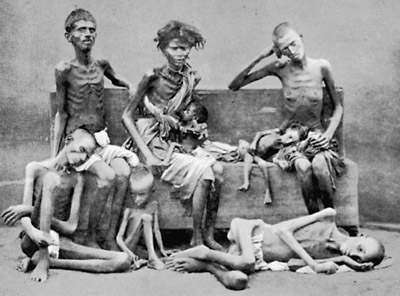
According to British records, one million Indians died of famine between 1800 and 1825, 4 million between 1825 and 1850, 5 million between 1850 and 1875 and 15 million between 1875 and 1900. Thus 25 million Indians died in 100 years! Since Independence, although poverty still exists, there have been no such mass famines, a record of which India should be proud. Funnily enough, there is no mention of this by pro-colonial authors. It is certainly a strange omission on their part and something they should be ashamed of. Perhaps not surprising as it would make British investment in India seem trivial and pointless by comparison. Any rational person would rather avoid millions of deaths than have a few railway tracks built and some land irrigated.
How did these famines occur? The main reason was not bad weather or natural causes but rather the breaking up of India’s indigenous crop patterns. The British replaced food crops such as rice and wheat and instead forced Indian farmers to produce jute, cotton, tea and oil seeds, which they needed as raw materials for their home industries. The implication of this in times of shortages was catastrophic, as the famine figures show.
Niall Ferguson also credits the British with labouring to improve India’s public health:
It was the British who introduced quinine as an anti-malarial prophylactic, carried out public programmes of vaccination against smallpox – often in the face of local resistance – and laboured to improve the urban water supplies that were so often the bearers of cholera and other diseases.
Once again, there is some truth in this, but also some omission, and some downright distortion. On the subject of smallpox vaccination, it is well documented that before the British arrived, Indians had a system of immunisation against smallpox, in which cowpox was used inoculate against smallpox. The British doctor J Z Holwell wrote a book in 1767 describing the system, accepting that it was safe and effective. European medicine did not have any treatment against the disease at that time.
Inoculation against smallpox became a part of Western medicine by 1840. No sooner did that happen that the British in India banned the older method of vaccination, denouncing it as barbaric, without making certain that sufficient number of inoculators in the new technique existed. Smallpox in India became a greater scourge than before. This is not the only example in which the British undermined and even banned indigenous systems of knowledge, particularly medicine, creating dire consequences.
In writing this article I am not trying to stir up bitterness. As I have mentioned, many if not most white Britons see colonialism as a dark part of their history, and refrain from glorifying it or acting triumphant over it. I am simply trying to combat the smug, celebratory version of Imperial history that is in vogue in some circles. This distorted version of history should be discarded into the dustbin of history.
This article is dedicated to the millions men, women and children, of India as well as other nations, who perished in unnecessary and avoidable famines during the colonial era.
Related article
- British PM falls short of apology for India massacre (worldbulletin.net)
Related book review
Featured Video

Iran’s Next Strike May Not Explode. It Could Shut You Down
or go to
Aletho News Archives – Video-Images
From the Archive
Zionism’s Violent Legacy
By Donald Neff | Washington Report On Middle East Affairs | January 1996
On January 4, 1948, Jewish terrorists drove a truck loaded with explosives into the center of the all Arab city of Jaffa and detonated it, killing 26 and wounding around 100 Palestinian men, women and children.[1] The attack was the work of the Irgun Zvai Leumi – the “National Military Organization,” also known by the Hebrew letters Etzel – the largest Jewish terrorist group in Palestine. The Irgun was headed by Revisionist Zionist Menachem Begin and had been killing and maiming Arabs, Britons and even Jews for the previous ten years in its efforts to establish a Jewish state.
This terror campaign meant that at the core of Revisionist Zionism there existed a philosophical embrace of violence. … continue
Blog Roll
 Aletho News
- Trump’s Iran war is on an Israeli leash
- Saudi oil boss issues global supply warning
- Riyadh Says Its Oil System Is Intact. The Numbers Say Otherwise.
- Trump and Netanyahu Want to “Finish the Job” on Iran
- US ‘one-sided dictation’ not Iran’s beliefs makes rational talks impossible: Baghaei
- Iran’s Next Strike May Not Explode. It Could Shut You Down /Col Doug Macgregor
- Iran: US political targets legitimate if assassinations return
- Iraq shuts key border crossing with Iran under US pressure: Report
- Undersea Internet cables could be targeted in retaliation for attacks on Iran: IRGC deputy chief
- EU sending ‘biased’ observers to interfere in Serbian election – president
- If Americans Knew
- The Israel Lobby’s Changing Fortunes
- AIPAC has become such a political liability that it’s shifting to a more “nimble” approach to buying politicians
- At least 160 Israeli settler attacks in 2 weeks
- Will Gaza’s Ancient Christian Community Disappear Forever?
- Israel’s vision of regional security rests on keeping Arab states weak
- Heidi Levine recounts how Palestinian youths helped save her in settler attack
- DAILY UPDATE: Latest essential news on Palestine, Israel, & region
- Trump’s Intensifying Sabotage of the ICC, for Israel’s Sake
- Israeli military detain US and UK volunteers in West Bank including Democratic NY politician Brad Lander
- Americans at National Conservatism Conference held in Israel this year criticize Israel
- No Tricks Zone
- E-Cars Reduce CO2 Emissions By Only 41% Compared To Internal Combustion Engine Vehicles
- Predictions Made By Renowned Climate Professor Over Past Decades Have Been Proven To Be Poor
- New Study Suggests Large Regions Of The Pacific Ocean Have Been Cooling For The Last 80 Years
- Germany’s Green Energy Debacle: High Energy Costs Force Kahla Porzellan to Close After 182 Years!
- New Study: 50 Years Of The Most Aggressive ‘Net Zero’ Policies Can Only Affect The Global Climate By 0.03°C
- US September “Heat” Was No Record…Many Records Set Decades Ago
- Latest European Green Energy Debacle; Portugal’s Largest Flagship Solar Park Insolvent!
- Green Energy Debacle: German Expert Professor Fritz Vahrenholt Warns Of Severe Economic And Social Consequences
- Two More Paleo Reconstructions Affirm Meters-Higher Sea Levels Across Ireland, Brazil 7000-6000 Years Ago
- New Study: Earth And Venus Surface Warmth Largely Explained By Convection And Lapse Rate, Not CO2 Or Radiation

