Radwan Ziadeh Calls For War On Syria
Ikras | October 7, 2011

State Dept Tool Radwan Ziadeh With Hillary
US State Department tool Radwan Ziadeh today called for a war on Syria. Speaking on Aljazeera’s prime-time, evening newscast “daily harvest”, Washington’s favorite Syrian “human rights activist” did not actually utter the word “war”, but that word is rarely used even by the powers that wage the war. Instead he opted for the agreed upon euphemism of “international protection.”
He went on to explain “international protection” would be justified under Chapter 7 of the UN Charter. Like the minute fraction of Arabs (they are always a minute fraction) that previously supported Western wars on Iraq and Libya, Ziadeh and a handful of like-minded friends are quick to cite Chapter 7 as a “legal basis” for their self-serving collaboration and a fig leaf for their treason. This is not the first time Ziadeh has expressed his support for a potential war on Syria, but he’s never been as clear as he was today.
Short of the American military invasion and occupation of Syria which Ziadeh is hoping for, at which time he can fly into Damascus on a US Air Force C-17 like Ahmad Chalabi arrived in Iraq, he is unlikely to ever return to the country where he would certainly be arrested and put on trial for treason regardless if the current regime remains in power or not. Ziadeh, who has appeared before anti-Syrian, Zionist groups, has also expressed his willingness, in the event he becomes part of a Western-installed regime in Damascus, to recognize the Zionist entity and continues his silence on Israel’s occupation of the Syrian Golan Heights.
Pro-Israeli hawk urges U.S. to “get tough” with sole Islamic nuclear power
Max Puts the Boot into Pakistan
By Maidhc Ó Cathail | October 7, 2011
While much attention has been paid to Admiral Mike Mullen’s allegations that Pakistan’s ISI was behind recent attacks on American targets in Afghanistan attributed to the Haqqani network, the subsequent call by an influential neoconservative pundit for the United States to “get tough with Pakistan” seems to have gone unnoticed.
Writing this week in two of the neoconservative flagship outlets, Commentary and The Weekly Standard, Max Boot argues for a more aggressive U.S. approach to Pakistan’s premier intelligence agency. “I suggest we start treating Pakistan’s Inter-Services Intelligence Agency the way we treated Iran’s Quds Force in Iraq,” Boot opines in Commentary, an influential magazine founded by the American Jewish Committee, a key component of the pro-Israel lobby. “That is to say, apply the full range of our power–everything from diplomatic pressure, economic sanctions, to kinetic military action–to curb the menace posed by this group.”
Currently a senior fellow in national security studies at the influential Council on Foreign Relations, Max Boot clearly has the kind of influence that could turn his not-so-humble suggestion into American policy. In March 2010, General David Petraeus, then head of U.S. Central Command, turned to Boot for help when some articles appeared in the American media noting that Petraeus’s testimony before the Senate Armed Services Committee implied that Washington’s uncritical support of Israeli policy toward the Palestinians was hurting U.S. interests in the region.
Petraeus forwarded one of the articles to Boot, with a note saying, “As you know, I didn’t say that. It’s in a written submission for the record….” In his reply, Boot dismissed the source’s credibility, but promised Petraeus that he would write “another short item pointing people to what you actually said as opposed to what’s in the posture statement.” Appreciative, but clearly still concerned to ingratiate himself with Israel’s powerful supporters, six minutes later Petraeus wrote back: “Thx, Max. (Does it help if folks know that I hosted Elie Wiesel and his wife at our quarters last Sun night?! And that I will be the speaker at the 65th anniversary of the liberation of the concentration camps in mid-Apr at the Capitol Dome…).” When the Russian-born Jewish writer assured the four-star general that this wasn’t relevant since he wasn’t being accused of being anti-Semitic, a relieved Petraeus signed off with a “Roger!” followed by a smiley emoticon.
The embarrassing spectacle of one of America’s most eminent military commanders seeing fit to grovel in such a demeaning way before a young pro-Israeli hack would surely have ended General Petraeus’s career in Washington before it began if the American public had been made aware of the incident. The Israel-centric U.S. media, however, chose to studiously ignore the revealing Petraeus-Boot correspondence. As a consequence of the media’s silence, the servile Petraeus is currently director of the CIA, overseeing the murderous drone strikes which are predictably enraging the Pakistani people; while his self-assured confidant is goading American policy-makers from his safe perch at the neocons’ primary warmongering media outlets to escalate such provocative policies against the world’s sole Islamic nuclear power–a country which, not insignificantly, has been designated as Israel’s greatest strategic threat by Foreign Minister Avigdor Lieberman.
While most Americans remain oblivious to the crimes being committed in their names around the world, those concerned about Pakistan’s security would do well to remember that what’s on the pages of Commentary and The Weekly Standard one day will most likely be on the lips of the Israel lobby’s compliant Congressmen and Pentagon and White House officials the next.
Maidhc Ó Cathail is an investigative journalist and Middle East analyst.
Truth and Falsehood in Syria
By Jeremy Salt | Palestine Chronicle | October 5, 2011
Ankara – As insurrection in Syria lurches towards civil war, the brakes need to be put on the propaganda pouring through the western mainstream media and accepted uncritically by many who should know better. So here is a matrix of positions from which to argue about what is going on in this critical Middle Eastern country:
1. Syria has been a mukhabarat (intelligence) state since the redoubtable Abd al Hamid al Serraj ran the intelligence services as the deuxieme bureau in the 1950s. The authoritarian state which developed from the time Hafez al Assad took power in 1970 has crushed all dissent ruthlessly. On occasion it has either been him or them. The ubiquitous presence of the mukhabarat is an unpleasant fact of Syrian life but as Syria is a central target for assassination and subversion by Israel and western intelligence agencies, as it has repeatedly come under military attack, as it has had a large chunk of its territories occupied and as its enemies are forever looking for opportunities to bring it down, it can hardly be said that the mukhabarat is not needed.
2. There is no doubt that the bulk of people demonstrating in Syria want peaceful transition to a democratic form of government. Neither is there any doubt that armed groups operating from behind the screen of the demonstrations have no interest in reform. They want to destroy the government.
3. There have been very big demonstrations of support for the government. There is anger at the violence of the armed gangs and anger at external interference and exploitation of the situation by outside governments and the media. In the eyes of many Syrians, their country is again the target of an international conspiracy.
4. Whatever the truth of the accusations made against the security forces, the armed groups have killed hundreds of police, soldiers and civilians, in total probably close to 1000 at this stage. The civilian dead include university professors, doctors and even, very recently, the son of the Grand Mufti of the Republic. The armed gangs have massacred, ambushed, assassinated, attacked government buildings and sabotaged railway lines.
5. Bashar al Assad has a strong base of personal popularity. Although he sits on top of the system it is misleading to call him a dictator. The system itself is the true dictator. Deeply rooted power in Syria – entrenched over five decades – lies in the military and intelligence establishment, and to a lesser degree in the party structure. These are the true sources of resistance to change. The demonstrations were Bashar’s opportunity to pass on the message, which he did, that the system had to change.
6. In the face of large scale demonstrations earlier this year the government did finally come up with a reform program. This was rejected out of hand by the opposition. No attempt was even made to test the bona fides of the government.
7. The claim that armed opposition to the government has begun only recently is a complete lie. The killings of soldiers, police and civilians, often in the most brutal circumstances, has been going on virtually since the beginning.
8. The armed groups are well armed and well organised. Large shipments of weapons have been smuggled into Syria from Lebanon and Turkey. They include pump action shotguns, machine guns, Kalashnikovs,RPG launchers, Israeli-made hand grenades and numerous other explosives. It is not clear who is providing these weapons but someone is, and someone is paying for them. Interrogation of captured members of armed gangs points in the direction of Saad al Hariri’s Future Movement. Hariri is a front man for the US and Saudi Arabia, with influence spreading well beyond Lebanon.
9. Armed opposition to the regime largely seems to be sponsored by the outlawed Muslim Brotherhood. In 1982 the government ruthlessly crushed an uprising initiated by the Brotherhood in Hama. Many thousands died and part of the city was destroyed. The Brotherhood has two prime objectives: the destruction of the Baathist government and the destruction of the secular state in favor of an Islamic system. It is almost palpably thirsting for revenge.
10. The armed groups have strong support from outside apart from what is already known or indicated. Exiled former Syrian Vice President and Foreign Minister, Abd ul Halim Khaddam, who lives in Paris, has been campaigning for years to bring down the Assad government. He is funded by both the EU and the US. Other exiled activists include Burhan Ghalioun, backed by Qatar as the leader of the ‘national council’ set up in Istanbul. Ghalioun, like Abd ul Halim Khaddam, lives in Paris and like him also, lobbies against the Assad government in Europe and in Washington. Together with Muhammad Riyad al Shaqfa, the leader of the Muslim Brotherhood in Syria, he is receptive to outside ‘humanitarian intervention’ in Syria on the Libyan model (others are against it). The promotion of the exiles as an alternative government is reminiscent of the way the US used exiled Iraqis (the so-called Iraqi National Congress) ahead of the invasion of Iraq.
11. The reporting by the western media of the situations in Libya and Syria has been appalling. NATO intervention in Libya has been the cause of massive destruction and thousands of deaths. The war, following the invasion of Iraq, is yet another major international crime committed by the governments of the US, Britain and France. The city of Sirte has been bombarded day and night for two weeks without the western media paying any attention to the heavy destruction and loss of life that must have followed. The western media has made no attempt to check reports coming out of Sirte of the bombing of civilian building and the killing of hundreds of people. The only reason can be that the ugly truth could well derail the whole NATO operation.
12. In Syria the same media has followed the same pattern of misreporting and disinformation. It has ignored or skated over the evidence of widespread killings by armed gangs. It has invited its audience to disbelieve the claims of government and believe the claims of rebels, often made in the name of human rights organisations based in Europe or the US. Numerous outright lies have been told, as they were told in Libya and as they were told ahead of the attack on Iraq. Some at least have been exposed. People said to have been killed by state security forces have turned up alive. The brothers of Zainab al Husni claimed she has been kidnapped by security forces, murdered and her body dismembered. This lurid account, spread by Al Jazeera and Al Arabiyya amongst other outlets, was totally false. She is still alive although now, of course, the propaganda tack is to claim that this is not really her but a double. Al Jazeera, the Guardian and the BBC have distinguished themselves by their blind support of anything that discredits the Syrian government. The same line is being followed by the mainstream media in the US. Al Jazeera, in particular, having distinguished itself with its reporting of the Egyptian revolution, has lost all credibility as an independent Arab world news channel.
13. In seeking to destroy the Syrian government the Muslim Brotherhood has a goal in common with the US, Israel and Saudi Arabia, whose paranoia about Shia Islam reached fever pitch with the uprising in Bahrain. Wikileaks revealed how impatient it was for the US to attack Iran. A substitute target is the destruction of the strategic relationship between Iran, Syria and Hizbullah. The US and the Saudis may want to destroy the Alawi-dominated Baathist regime in Damascus for slightly different reasons, but the important thing is that they do want to destroy it.
14. The US is doing its utmost to drive Syria into a corner. It is giving financial support to exiled leaders of the opposition. It has tried (and so far failed thanks to Russian and Chinese opposition) to introduce an extensive program of sanctions through the UN Security Council. No doubt it will try again and depending on how the situation develops, it may try, with British and French support, to bring on a no-fly zone resolution opening the door to foreign attack. The situation is fluid and no doubt all sorts of contingency plans are being developed. The White House and the State Department are issuing hectoring statements every other day. Openly provoking the Syrian government, the US ambassador, accompanied by the French ambassador, travelled to Hama before Friday prayers. Against everything that is known about their past record of interference in Middle Eastern countries, it is inconceivable that the US and Israel, along with France and Britain, would not be involved in this uprising beyond what is already known.
15. While concentrating on the violence of the Syrian regime, the US, European governments (especially Britain) have totally ignored the violence directed against it. Their own infinitely greater violence, of course, in Libya, Iraq, Afghanistan and other places, doesn’t even come into the picture. Turkey has joined their campaign against Syria with relish, going even further than they have in confronting the Syrian regime. In the space of a few months Turkey’s ‘zero problem’ regional policy has been upended in the most inchoate manner. Turkey eventually lent its support to the NATO attack on Libya, after initially holding back. It has antagonised Iran by its policy on Syria and by agreeing, despite strong domestic opposition, to host a US radar missile ‘defence’ installation clearly directed against Iran. The Americans say its data will be shared with Israel, which has refused to apologise for the attack on the Mavi Marmara, plunging Israeli-Turkish relations into near crisis. So from ‘zero problems’, Turkey now has a regional policy full of problems with Israel, Syria and Iran.
16. While some members of the Syrian opposition have spoken against foreign intervention, the ‘Free Syrian Army’ has said that its aim is to have a no-fly zone declared over northern Syria. A no-fly zone would have to be enforced, and we have seen how this led in Libya to massive infrastructural destruction, the killing of thousands of people and the opening of the door to a new period of western domination.
17. If the Syrian government is brought down, every last Baathist and Alawi will be hunted down. In a government dominated by the Muslim Brotherhood the status of minorities and women would be driven backwards.
 18. Through the Syria Accountability Act, and through sanctions which the EU has imposed, the US has been trying to destroy the Syrian government for twenty years. The dismantling of unified Arab states along ethno-religious lines has been an Israel aim for decades. Where Israel goes, the US naturally follows. The fruits of this policy can be seen in Iraq, where an independent state in all but name has been created for the Kurds and where the constitution, written by the US, separates Iraq’s people into Kurds, Sunni, Shia and Christian, destroying the binding logic of Arab nationalism. Iraq has not known a moment’s peace since the British entered Baghdad in 1917. In Syria ethno-religious divisions (Sunni Muslim Arab, Sunni Muslim Kurd, Druze, Alawi and various Christian sects) render it vulnerable in the same way to the promotion of sectarian discord and eventual disintegration as the unified Arab state the French tried to prevent coming into existence in the 1920s.
19. The destruction of the Baathist government would be a strategic victory of unsurpassed value to the US and Israel. The central arch in the strategic relationship between Iran, Syria and Hizbullah will have been destroyed, leaving Hizbullah geographically isolated, with a hostile Sunni Muslim government next door, and leaving Hizbullah and Iran more exposed to a military attack by the US and Israel. Fortuitously or otherwise, the ‘Arab spring’ as it has developed in Syria has placed in their hands a lever by which they may be able to achieve their goal.
20. It is not necessarily the case that a Muslim Brotherhood-dominated government in Egypt or Syria would be hostile to US interests. Wanting to be seen as a respectable member of the international community and another good example of ‘moderate’ Islam, it is likely and certainly possible that an Egyptian government dominated by the Brotherhood would agree to maintain the peace treaty with Israel for as long as it can (i.e. until another large scale attack by Israel on Gaza or Lebanon makes it absolutely unsustainable).
21. A Syrian government dominated by the Muslim Brotherhood would be close to Saudi Arabia and hostile to Iran, Hizbullah and the Shia of Iraq, especially those associated with Muqtada al Sadr. It would pay lip service to the Palestine cause and the liberation of the Golan Heights but its practical policies would be unlikely to be any different from the government it is seeking to destroy.
22. The Syrian people are entitled to demand democracy and to be given it, but in this way and at this cost? Even now, an end to the killing and negotiations on political reform is surely the way forward, not violence which threatens to tear the country apart. Unfortunately, violence and not a negotiated settlement is what too many people inside Syria want and what too many governments watching and waiting for their opportunity also want. No Syrian can ultimately gain from this, whatever they presently think. Their country is being driven towards a sectarian civil war, perhaps foreign intervention and certainly chaos on an even greater scale than we are now seeing. There will be no quick recovery if the state collapses or can be brought down. Like Iraq, and probably like Libya, looking at the present situation, Syria would enter a period of bloody turmoil that could last for years. Like Iraq, again, it would be completely knocked out of the ring as a state capable of standing up for Arab interests, which means, of course, standing up to the US and Israel.
23. Ultimately, whose interests does anyone think this outcome would serve?
~
Jeremy Salt is associate professor in Middle Eastern History and Politics at Bilkent University in Ankara, Turkey. Previously, he taught at Bosporus University in Istanbul and the University of Melbourne in the Departments of Middle Eastern Studies and Political Science. Professor Salt has written many articles on Middle East issues, particularly Palestine, and was a journalist for The Age newspaper when he lived in Melbourne.
Zainab al-Hosni, the “Flower of Syria,” Alive and on TV: Will Human Rights Organizations and Mass Media Issue Corrections?
By Yoshie Furuhashi | Monthly Review | October 5, 2011
Zainab al-Hosni, dubbed the “Flower of Syria,” who the Syrian opposition claimed was tortured and murdered, burned and decapitated, by the Syrian government, has just appeared on Syrian TV, very much alive.
The case of opposition propaganda about Zainab al-Hosni is particularly noteworthy because this is one that Amnesty International and Human Rights Watch, the most influential human rights organizations, both eagerly seized upon, seeking to turn its sensationalist character into a spur to prod the UN Security Council to act against Syria.
Will AI and HRW, and mass media such as CNN, France24, and the Associated Press, which followed the human rights organizations and also uncritically promulgated the Syrian opposition claim, issue corrections? Or will they continue looking for a new Syrian opposition remake of Kuwait’s “incubator babies” story or the Libyan rebels’ “African mercenaries” story?
Here is the video of the TV interview with Zainab, who says she fled from her family home because her brothers were beating her:
Reply to Avaaz re ‘Bolivia: Stop the crackdown’
By Derrick O’Keefe | September 28, 2011
To the Avaaz team,
I too am concerned by the violence of the Bolivian police in this incident and the lack of consultation of local indigenous peoples. I support the call for dialogue, consultation and debate within Bolivia to resolve this situation, and hope that such a resolution will respect the local ecology and indigenous rights.
However, I feel your petition call-out is irresponsible for failing to mention the long-standing and ongoing pressure, interference and threats against Bolivia’s government and process of social change by the governments of the United States, Canada and Europe — the very countries to whose citizens you are appealing to sign this petition.
Your call-out also elides important context and complexities; most importantly the fact that other mass social movement organizations (which include other indigenous peoples) have pushed for the highway’s construction and were planning to block the march before police intervened. The tensions between so-called ‘development’ and the preservation of forests and indigenous rights are more challenging given hundreds of years of colonial and neo-colonial domination of this small, poor and landlocked country.
Failing to provide this context leaves your members and supporters without any motivation to pursue their most important political task: challenging their own government’s policies that unequivocally back their multi-national corporations and pursue alliances with the most anti-democratic, anti-environment political elements in Bolivia.
Finally, I must say that I have noted in the past that your group — for its many laudable efforts — does have a tendency to promote rather soft or easy causes. I have written you in the past encouraging you to organize a campaign against the NATO occupation of Afghanistan and its corrupt, puppet government, but I never heard a response. With the upcoming 10th anniversary of this brutal, disastrous war, this would be a perfect time for Avaaz to launch an appeal to oppose the US, Canadian and other NATO governments’ policy of endless war.
Sincerely,
Derrick O’Keefe
Vancouver, Canada
Link for ‘Bolivia: Stop the crackdown’
~
Bolivia Rising notes:
Avaaz is a member of The Climate Group.
The Climate Group is pushing REDD: http://www.theclimategroup.org/_assets/files/Reducing-Emissions-from-Deforestation.pdf
The Rockefeller Brothers Fund also acts as an incubator for in-house projects that later evolve into free-standing institutions – a case in point being The Climate Group, launched in London in 2004. The Climate Group coalition includes more than 50 of the world’s largest corporations and sub-national governments, including big polluters such as energy giants BP and Duke Energy, as well as several partner organizations, such as NGO Avaaz. The Climate Group are advocates of unproven carbon capture and storage technology (CCS), nuclear power and biomass as crucial technologies for a low-carbon economy. The Climate Group works closely with other business lobby groups, including the International Emissions Trading Association (IETA), which works consistently to sabotage climate action. The Climate Group also works on other initiatives, such as the Voluntary Carbon Standard, a new global standard for voluntary offset projects. One marketing strategist company labeled the Climate Group’s campaign “Together” as “the best inoculation against greenwash.” The Climate Group has operations in Australia, China, Europe, India, and North America. It was a partner to the Copenhagen Climate Council.
http://www.theclimategroup.org/about-us/our-partners/
The U.S. backed Avaaz NGO (Soros funding) has never endorsed the People’s Agreement of Cochabamba. Neither has any other corporate green group.
The environmental movement? It’s a movement, all right. A movement to protect the world’s wealthiest families and corporations who fund the movement via tax-exempt foundations.
Libya and the Big Lie: Using Human Rights Organizations to Launch Wars
By Mahdi Darius Nazemroaya | Don DeBar’s Blog | September 24, 2011
The war against Libya is built on fraud. The United Nations Security Council passed two resolutions against Libya on the basis of unproven claims, specifically that Colonel Muammar Qaddafi was killing his own people in Benghazi. The claim in its exact form was that Qaddafi had ordered Libyan forces to kill 6,000 people in Benghazi. These claims were widely disseminated, but always vaguely explained. It was on the basis of this claim that Libya was referred to the U.N. Security Council at U.N Headquarters in New York City and kicked out of the U.N. Human Rights Council in Geneva.
False claims about African mercenary armies in Libya and about jet attacks on civilians were also used in a broad media campaign against Libya. These two claims have been sidelined and have become more and more murky. The massacre claims, however, were used in a legal, diplomatic, and military framework to justify NATO’s war on the Libyans.
Using Human Rights as a Pretext for War: The LLHR and its Unproven Claims
One of the main sources for the claim that Qaddafi was killing his own people is the Libyan League for Human Rights (LLHR). The LLHR was actually pivotal to getting the U.N. involved through its specific claims in Geneva. On February 21, 2011 the LLHR got the 70 other non-governmental organizations (NGOs) to sent letters to the President Obama, E.U. High Representative Catherine Ashton., and the U.N. Secretary-General Ban-ki Moon demanding international action against Libya invoking the “Responsibility to Protect” doctrine. Only 25 members of this coalition actually assert that they are human rights groups.
The letter is as follows:
We, the undersigned non-governmental, human rights, and humanitarian organizations, urge you to mobilize the United Nations and the international community and take immediate action to halt the mass atrocities now being perpetrated by the Libyan government against its own people. The inexcusable silence cannot continue.
As you know, in the past several days, Colonel Moammar Gadhafi’s forces are estimated to have deliberately killed hundreds of peaceful protesters and innocent bystanders across the country. In the city of Benghazi alone, one doctor reported seeing at least 200 dead bodies. Witnesses report that a mixture of special commandos, foreign mercenaries and regime loyalists have attacked demonstrators with knives, assault rifles and heavy-caliber weapons.
Snipers are shooting peaceful protesters. Artillery and helicopter gunships have been used against crowds of demonstrators. Thugs armed with hammers and swords attacked families in their homes. Hospital officials report numerous victims shot in the head and chest, and one struck on the head by an anti-aircraft missile. Tanks are reported to be on the streets and crushing innocent bystanders. Witnesses report that mercenaries are shooting indiscriminately from helicopters and from the top of roofs. Women and children were seen jumping off Giuliana Bridge in Benghazi to escape. Many of them were killed by the impact of hitting the water, while others were drowned. The Libyan regime is seeking to hide all of these crimes by shutting off contact with the outside world. Foreign journalists have been refused entry. Internet and phone lines have been cut or disrupted.
There is no question here about intent. The government media has published open threats, promising that demonstrators would meet a “violent and thunderous response.”
Accordingly, the government of Libya is committing gross and systematic violations of the right to life as guaranteed by the Universal Declaration of Human Rights and the International Covenant on Civil and Political Rights. Citizens seeking to exercise their rights to freedom of expression and freedom of assembly are being massacred by the government.
Moreover, the government of Libya is committing crimes against humanity, as defined by the Explanatory Memorandum to the Rome Statute of the International Criminal Court. The Libyan government’s mass killing of innocent civilians amount to particularly odious offences which constitute a serious attack on human dignity. As confirmed by numerous oral and video testimonies gathered by human rights organizations and news agencies, the Libyan government’s assault on its civilian population are not isolated or sporadic events. Rather, these actions constitute a widespread and systematic policy and practice of atrocities, intentionally committed, including murder, political persecution and other inhumane acts which reach the threshold of crimes against humanity.
Responsibility to Protect
Under the 2005 World Summit Outcome Document, you have a clear and unambiguous responsibility to protect the people of Libya. The international community, through the United Nations, has the responsibility to use appropriate diplomatic, humanitarian and other peaceful means, in accordance with Chapters VI and VIII of the Charter, to help to protect the Libyan population. Because the Libyan national authorities are manifestly failing to protect their population from crimes against humanity, should peaceful means be inadequate, member states are obliged to take collective action, in a timely and decisive manner, through the Security Council, in accordance with the UN Charter, including Chapter VII.
In addition, we urge you to convene an emergency Special Session of the UN Human Rights Council, whose members have a duty, under UNGA Resolution 60/251, to address situations of gross and systematic violations of violations of human rights. The session should:
Call for the General Assembly to suspend Libya’s Council membership, pursuant to Article 8 of Resolution 60/251, which applies to member states that commit gross and systematic violations of human rights.
Strongly condemn, and demand an immediate end to, Libya’s massacre of its own citizens.
Dispatch immediately an international mission of independent experts to collect relevant facts and document violations of international human rights law and crimes against humanity, in order to end the impunity of the Libyan government. The mission should include an independent medical investigation into the deaths, and an investigation of the unlawful interference by the Libyan government with the access to and treatment of wounded.
Call on the UN High Commissioner of Human Rights and the Council’s relevant Special Procedures to closely monitor the situation and take action as needed.
Call on the Council to remain seized of the matter and address the Libyan situation at its upcoming 16th regular session in March.
Member states and high officials of the United Nations have a responsibility to protect the people of Libya from what are preventable crimes. We urge you to use all available measures and levers to end atrocities throughout the country.
We urge you to send a clear message that, collectively, the international community, the Security Council and the Human Rights Council will not be bystanders to these mass atrocities. The credibility of the United Nations — and many innocent lives — are at stake. [1]
According to Physicians for Human Rights: “[This letter was] prepared under the guidance of Mohamed Eljahmi, the noted Libyan human rights defender and brother of dissident Fathi Eljahmi, asserts that the widespread atrocities committed by Libya against its own people amount to war crimes, requiring member states to take action through the Security Council under the responsibility to protect doctrine.” [2]
The letters signatories included Francis Fukuyama, United Nations Watch (which looks out for Israel’s interests), B’nai B’rith Human Rights Commission, the Cuban Democratic Directorate, and a set of organizations at odds with the governments of Nicaragua, Cuba, Sudan, Russia, Venezuela, and Libya. Some of these organizations are viewed with hostility as organizations created to wage demonization campaigns against countries at odds with the U.S., Israel, and the European Union. Refer to the annex for the full list of signatories for consultation.
LLHR is tied to the International Federation for Human Rights (FIDH), which is based in France and has ties to the National Endowment for Democracy (NED). FIDH is active in many places in Africa and in activities involving the National Endowment for Democracy. Both the FIDH and LLHR also released a joint communiqué on February 21, 2011. In the communiqué both organizations asked for the international community to “mobilize” and mention the International Criminal Court while also making a contradictory claiming that over 400 to 600 people had died since February 15, 2011. [3] This of course was about 5,500 short of the claim that 6,000 people were massacred in Benghazi. The joint letter also promoted the false view that 80% of Qaddafi’s support came from foreign mercenaries, which is something that over half a year of fighting proves as untrue.
According to the General-Secretary of the LLHR, Dr. Sliman Bouchuiguir, the claims about the massacres in Benghazi could not be validated by the LLHR when he was challenged for proof. When asked how a group of 70 non-governmental organizations in Geneva could support the LLHR’s claims on Geneva, Dr. Buchuiguir has answered that a network of close relationship was the basis. This is a mockery.
Speculation is neither evidence nor grounds for starting a war with a bombing campaign that has lasted about half a year and taken many innocent civilian lives, including children and the elderly. What is important to note here is that the U.N. Security Council decided to sanction the Libyan Arab Jamahiriya on the basis of this letter and the claims of the LLHR. Not once did the U.N. Security Council and the member states pushing for war once bother to even investigate the allegations. In one session in New York City, the Indian Ambassador to the U.N. actually pointed this out when his country abstained from voting. Thus, a so-called “humanitarian war” was launched without any evidence.
The Secret Relationship between the LLHR and the Transitional Council
The claims of the Libyan League for Human Rights (LLHR) were coordinated with the formation of the Transitional Council. This becomes clear with when the close and cagey relationship of the LLHR and the Transitional Council becomes apparent. Logically, the Obama Administration and NATO had to also be a part of this.
Whatever the Transitional Council is and whatever the intent of some of its supporters, it is clear that it is being used as a tool by the U.S. and others. Moreover, five members of the LLHR were or would become members of the Transitional Council almost immediately after the claims against the Libyan Arab Jamahiriya were disseminated. According to Bouchuguir this includes Mahmoud Jibril and Ali Tarhouni.
Dr. Mahmoud Jibril is a Libyan regime figure brought into Libyan government circles by Saif Al-Islam Qaddafi. He would undemocratically be given the position of Transitional Council prime minister. His involvement with the LLHR raises some real questions about the organization.
The economist Ali Tarhouni on the other hand would become the minister for oil and finance for the Transitional Council. Tarhouni is Washington’s man in Libya. He was groomed in the United States and was present at all the major meetings about plans for regime change in Libya. As Minister of Oil and Finance the first acts he did were privatize and virtually handover Libya’s energy resources and economy.
The General-Secretary of the LLHR, Sliman Bouchuiguir, has even privately admitted that many influential members of the Transitional Council are his friends. A real question of interests arises. Yet, the secret relationship between the LLHR and the Transitional Council is far more than a question of conflict of interest. It is a question of justice and manipulation.
Who is Sliman Bouchuiguir?
Sliman Bouchuguir is an unheard of figure for most, but he has authored a doctoral thesis that has been widely quoted and used in strategic circles in the United States. This thesis was published in 1979 as a book, The Use of Oil as a Political Weapon: A Case Study of the 1973 Arab oil Embargo. The thesis is about the use of oil as an economic weapon by Arabs, but can easily be applied to the Russians, the Iranians, the Venezuelans, and others. It examines economic development and economic warfare and can also be applied to vast regions, including all of Africa.
Bouchuguir’s analytical thesis reflects an important line of thinking in Washington, as well as London and Tel Aviv. It is both the embodiment of a pre-existing mentality, which includes U.S. National Security Advisor George F. Kennan’s arguments for maintaining a position of disparity through a constant multi-faced war between the U.S. and its allies on one hand and the rest of the world on the other hand. The thesis can be drawn on for preventing the Arabs, or others, from becoming economic powers or threats. In strategic terms rival economies are pinned as threats and as “weapons.” This has serious connotations.
Moreover, Bouchuiguir did his thesis at George Washington University under Bernard Reich. Reich is a political scientist and professor of international relations. He has worked and held positions at places like the U.S. Defense Intelligence College, the United States Air Force Special Operations School, the Marine Corps War College, and the Shiloah Center at Tel Aviv University. He has consulted on the Middle East for the Foreign Service Institute of the U.S. State Department and received grants such as the Defense Academic Research Support Program Research grant and the German Marshal Fund Grant. Reich also was or is presently on the editorial boards of journals such as Israel Affairs (1994-present), Terrorism: An International Journal (1987-1994), and The New Middle East (1971-1973).
It is also clear that Reich is tied to Israeli interests. He has even written a book about the special relationship between the U.S and Israel. He has also been an advocate for a “New Middle East” which would be favourable to Israel. This includes careful consideration over North Africa. His work has also focused on the important strategic interface between the Soviet Union and the Middle East and also on Israeli policy in the continent of Africa.
It is clear why Bouchuiguir has his thesis supervised under Reich. On October 23, 1973, Reich gave a testimony at the U.S. Congress. The testimony has been named “The Impact of the October Middle East War” and is clearly tied to the 1973 oil embargo and Washington’s aim of pre-empting or managing any similar events in the future. It has to be asked, how much did Reich influence Bouchuiguir and if Bouchuiguir espouses the same strategic views as Reich?
The “New North Africa” and a “New Africa” – More than just a “New Middle East”
A “New Africa” is in the works, which will have its borders further drawn out in blood like in the past. The Obama Administration and its allies have opened the gateway for a new invasion of Africa. United States Africa Command (AFRICOM) opened the salvos of the war through Operation Odyssey Damn, before the war on Libya was transferred to NATO’ Operation Unified Protector.
The U.S. has used NATO to continue the occupation of post-Second World War Europe. It will now use AFRICOM to occupy Africa and create an African NATO. It is clear the U.S. wants an expanded military presence in Libya and Africa under the disguise of humanitarian aid missions and fighting terrorism – the same terrorism that it is fanning in Libya and Africa.
The way is being paved for intervention in Africa under the guise of fighting terrorism. General Carter Ham has stated: “If we were to launch a humanitarian operation, how do we do so effectively with air traffic control, airfield management, [and] those kind of activities?” [4] General Ham’s question is actually a sales pitch for fashioning African military partnerships and integration, as well as new bases that could include the use of more military drones against Libya and other African countries. The Washington Post and The Wall Street Journal (WSJ) have both made it clear that the Pentagon is actively trying to establish more drone bases in Africa and the Arabian Peninsula to expand its wars. [WP] In this context, the AFRICOM Commander that there are ties between the Al-Shabaab in Somalia, Al-Qaeda in the Islamic Maghreb in North Africa, and the Boko Harem in Nigeria. [6]
The War in Libya is a Fraud
General Ham has said: “I remain confident that had the U.N. not made the decision, had the U.S. not taken the lead with great support, I’m absolutely convinced there are many, many people in Benghazi alive today who would not be [alive].” [7] This is not true and a far stretch from reality. The war has cost more lives than it could have ever saved. It has ruined a country and opened the door into Africa for a neo-colonial project.
The claims of the Libyan League for Human Rights (LLHR) were never supported or verified. The credibility of United Nations must be questioned as well as many humanitarian and human rights organizations that have virtually pushed for a war. At best the U.N. Security Council is an irresponsible body, but it has clearly acted outside of due legal process. This pattern now appears to be repeating itself against the Syrian Arab Republic as unverified claims are being made by individuals and organizations supported by foreign powers that care nothing for authentic democratic reforms or liberty.
NOTES
[1] United Nations Watch et al., “Urgent Appeal to Stop Atrocities in Libya: Sent by 70 NGOs to the US, EU, and UN,” February 21, 2011:
http://www.unwatch.org/site/apps/nlnet/content2.aspx?c=bdKKISNqEmG&b=1330815&ct=9135143
[2] Physicians for Human Rights, “PHR and Human Rights Groups Call for Immediate Action in Libya,” February 22, 2011:
http://physiciansforhumanrights.org/press/press-releases/news-2011-02-22-libya.html
[3] The International Federation for Human Rights (FIDH) and the Libyan League for Human Rights (LLHR), “Massacres in Libya: The international community must urgently,” respond, February 21, 2011:
Click to access article_a9183.pdf
[4] Jim Garamone, “Africa Command Learns from Libya Operations,” American Forces Press Service, September 15, 2011:
http://www.defense.gov/news/newsarticle.aspx?id=65344&reason=1
[5] Gregory Miller and Craig Whitlock, “U.S. U.S. assembling secret drone bases in Africa, Arabian Peninsula, officials say,” The Washington Post, September 20, 2011; Julian E. Barnes, “U.S. Expands Drone Flights to Take Aim at East Africa,” The Wall Street Journal (WSJ), September 21, 2011.
[6] Garamone, “Africa Command Learns,” Op. cit.
[7] Ibid.
ANNEX: SIGNATORY OF THE URGENT LETTER FOR ACTION ON LIBYA
February 12, 2011 – Geneva, Switzerland
1. Hillel C. Neuer, United Nations Watch, Switzerland
2. Dr. Sliman Bouchuiguir, Libyan League for Human Rights, Switzerland
3. Mary Kay Stratis, Victims of Pan Am Flight 103, Inc., USA
4. Carl Gershman, President, The National Endowment for Democracy, USA
5. Yang Jianli, Initiatives for China, USA – Former prisoner of conscience and survivor of Tiananmen Square massacre
6. Yang Kuanxing, YIbao – Chinese writer, original signatory to Charter 08, the manifesto calling for political reform in China
7. Matteo Mecacci, MP, Nonviolent Radical Party, Italy
8. Frank Donaghue, Physicians for Human Rights, USA
9. Nazanin Afshin-Jam, Stop Child Executions, Canada
10. Bhawani Shanker Kusum, Gram Bharati Samiti, India
11. G. Jasper Cummeh, III, Actions for Genuine Democratic Alternatives, Liberia
12. Michel Monod, International Fellowship of Reconciliation, Switzerland
13. Esohe Aghatise, Associazione Iroko Onlus, Italy
14. Harris O. Schoenberg, UN Reform Advocates, USA
15. Myrna Lachenal, World Federation for Mental Health, Switzerland
16. Nguyên Lê Nhân Quyên, Vietnamese League for Human Rights, Switzerland
17. Sylvia G. Iriondo, Mothers and Women against Repression (M.A.R. Por Cuba), USA
18. David Littman, World Union for Progressive Judaism, Switzerland
19. Barrister Festus Okoye, Human Rights Monitor, Nigeria
20. Theodor Rathgeber, Forum Human Rights, Germany
21. Derik Uya Alfred, Kwoto Cultural Center, Juba – Southern Sudan
22. Carlos E Tinoco, Consorcio Desarrollo y Justicia, A.C., Venezuela
23. Abdurashid Abdulle Abikar, Center for Youth and Democracy, Somalia
24. Dr. Vanee Meisinger, Pan Pacific and South East Asia Women’s Association, Thailand
25. Simone Abel, René Cassin, United Kingdom
26. Dr. Francois Ullmann, Ingenieurs du Monde, Switzerland
27. Sr Catherine Waters, Catholic International Education Office, USA
28. Gibreil Hamid, Darfur Peace and Development Centre, Switzerland
29. Nino Sergi, INTERSOS – Humanitarian Aid Organization, Italy
30. Daniel Feng, Foundation for China in the 21st Century
31. Ann Buwalda, Executive Director, Jubilee Campaign, USA
32. Leo Igwe, Nigerian Humanist Movement, Nigeria
33. Chandika Gautam, Nepal International Consumers Union, Nepal
34. Zohra Yusuf, Human Rights Commission of Pakistan, Pakistan
35. Sekou Doumbia, Femmes & Droits Humains, Mali
36. Cyrille Rolande Bechon, Nouveaux Droits de l’Homme, Cameroon
37. Zainab Al-Suwaij, American Islamic Congress, USA
38. Valnora Edwin, Campaign for Good Governance, Sierra Leone
39. Patrick Mpedzisi, African Democracy Forum, South Africa
40. Phil ya Nangoloh, NamRights, Namibia
41. Jaime Vintimilla, Centro Sobre Derecho y Sociedad (CIDES), Ecuador
42. Tilder Kumichii Ndichia, Gender Empowerment and Development, Cameroon
43. Amina Bouayach, Moroccan Organisation for Human Rights, Morocco
44. Abdullahi Mohamoud Nur, CEPID-Horn Africa, Somalia
45. Delly Mawazo Sesete, Resarch Center on Environment, Democracy & Human Rights, DR Congo
46. Joseph Rahall, Green Scenery, Sierra Leone
47. Arnold Djuma, Solidarité pour la Promotion Sociale et la Paix, Rwanda
48. Panayote Dimitras, Greek Helsinki Monitor, Greece
49. Carlos E. Ponce, Latina American and Caribbean Network for Democracy, Venezuela
50. Fr. Paul Lansu, Pax Christi International, Belgium
51. Tharsika Pakeerathan, Swiss Council of Eelam Tamils, Switzerland
52. Ibrahima Niang, Commission des Droits Humains du Mouvement Citoyen, Senegal
53. Virginia Swain, Center for Global Community and World Law, USA
54. Dr Yael Danieli, International Society for Traumatic Stress Studies, USA
55. Savita Gokhale, Loksadhana, India
56. Hasan Dheeree, Biland Awdal Organization, Somalia
57. Pacifique Nininahazwe, Forum pour le Renforcement de la Société Civile, Burundi
58. Derik Uya Alfred, Kwoto Cultural Center, Southern Sudan
59. Michel Golubnichy, International Association of Peace Foundations, Russia
60. Edward Ladu Terso, Multi Media Training Center, Sudan
61. Hafiz Mohammed, Justice Africa Sudan, Sudan
62. Sammy Eppel, B’nai B’rith Human Rights Commission, Venezuela
63. Jack Jeffery, International Humanist and Ethical Union, United Kingdom
64. Duy Hoang, Viet Tan, Vietnam
65. Promotion de la Democratie et Protection des Droits Humains, DR Congo
66. Radwan A. Masmoudi, Center for the Study of Islam & Democracy, USA
67. María José Zamora Solórzano, Movimiento por Nicaragua, Nicaragua
68. John Suarez, Cuban Democratic Directorate, USA
69. Mohamed Abdul Malek, Libya Watch, United Kingdom
70. Journalists Union of Russia, Russia
71. Sindi Medar-Gould, BAOBAB for Women’s Human Rights, Nigeria
72. Derik Uya Alfred, Kwoto Cultural Centre, Sudan
73. Sr. Anne Shaym, Presentation Sisters, Australia
74. Joseph Rahad, Green Scenery, Sierra Leone
75. Fahma Yusuf Essa, Women in Journalism Association, Somalia
76. Hayder Ibrahim Ali, Sudanese Studies Center, Sudan
77. Marcel Claude Kabongo, Good Governance and Human Rights NGO, DR Congo
78. Frank Weston, International Multiracial Shared Cultural Organization (IMSCO), USA
79. Fatima Alaoui, Maghrebin Forum for environment and development, Morocco
80. Ted Brooks, Committee for Peace and Development Advocacy, Liberia
81. Felly Fwamba, Cerveau Chrétien, DR Congo
82. Jane Rutledge, CIVICUS: World Alliance of Citizen Participation, South Africa
83. Ali AlAhmed, The Institute for Gulf Affairs, USA
84. Daniel Ozoukou, Martin Luther King Center for Peace and Social Justice, Cote d’Ivoire
85. Dan T. Saryee, Liberia Democratic Institute (LDI), Liberia
Individuals
Dr. Frene Ginwala, former Speaker of the South African National Assembly
Philosopher Francis Fukuyama
Mohamed Eljahmi, Libyan human rights activist
Glenn P. Johnson, Jr., Treasurer, Victims of Pan Am Flight 103, Inc., father of Beth Ann Johnson, victim of Lockerbie bombing
Source: UN Watch (Refer to note 1)
Searching for Palestinian voices in the UN bid media coverage
By Jaime Omar Yassin – The Electronic Intifada – 09/27/2011
Mainstream media published hundreds of articles on the Palestinian Authority’s UN statehood bid from the point coverage began in earnest in the summer to the day of Abbas’ historic speech in the UN. Despite the dozens of headlines that pronounced the planned actions and opinions of “Palestinians,” few articles mentioned that Mahmoud Abbas is not a popularly elected leader, nor that elections have been indefinitely postponed. It’s ironic that such headlines almost always centered around the desires, opinions and agency of only one Palestinian—Mahmoud Abbas.
The New York Times, for example, published dozens of articles on the issue during this period, but only one presented opinions from within the West Bank. It appeared less than a week before Abbas’ announced request would take place at the UN [it should be noted that a recent poll finds 84% support from Palestinians in the West Bank and Gaza].
The article, however, stayed away from issues of legitimacy, neither noting nor asking its interlocutors about the legitimacy of the Abbas government. Not surprisingly, this was balanced out by an article about paranoid, antagonistic, and heavily armed Israeli settlers a few days later. The article, typical of the work of Ethan Bronner, casts the universally-accepted fact of the illegality of the settlements as a matter of “geopolitics”, and thus positions the putative statehood as an issue that affects indigenous Palestinians and Israelis equally. The Washington Post was alone in publishing a story on Gazans and the UN bid a few days before Abbas arrived in New York [Rana Baker provides this roundtable discussion by young Gazans in her EI blog].
The wide spectrum of Palestinian civil society voices, academics and policy analysts was also largely absent from coverage in media of record. While there were at least a half-dozen op-eds in the The New York Times on the subject of the UN bid, none featured opinions from Palestine-based organizations, or from organizations representing the Palestinian Diaspora. The Times’ editorial board seemed to think that one Palestinian voice, that of Abbas, was enough, along with a member of the Saudi Royal family.
It wasn’t that alternate voices from Palestine were hard to find, even for the Ramallah-centric Western press. Mustafa Barghouti, the leading opposition party leader in the West Bank, was part of a town hall meeting of independent political parties in Beit Jala in mid-September that attracted various high-profile Palestinian leaders and pundits—the event seemed uninteresting to the area desks of mainstream media. This is in keeping with the almost total media blackout on independent political parties in Palestine that has existed since the dawn of the Oslo process. Al Haq, a near-legendary legal advocacy organization is based in Ramallah and had argued the case of Palestinian nationality before the International Criminal Court a year earlier, but it was nowhere to be found in articles or opinion pages of media of record—despite the fact that the organization wrote a legal opinion on the UN bid [you can also find them on Twitter].
Israeli-friendly experts were welcome, as always: The New York Times consulted the AIPAC-affiliated Washington Institute on Near East Policy and then the former AIPAC head, Martin Indyk, in an impressive feat of overkill in the same article. The increasingly paranoid Benny Morris got a turn in Newsweek [September 19, 2011], complaining that the bid was only a symptom of the vast new existential threat that Israel faced, including the “major problem” of Israel’s “Arab minority”. The Washington Post even had an op-ed from a former state department official, who used the platform to sadistically imagine all sorts of punishments the US could visit on the Palestinian people if the UN bid went ahead.
The disinterest in Palestinian voices makes perfect sense when viewed through the prism of the US-managed peace process. The Palestinian Authority, after all, does not exist to represent Palestinians. Rather, it’s a fait acompli that the Palestinian Authority is a junior partner in the US and Israeli plan for creating a final Israeli map that includes the desirable portions of the West Bank and Gaza. When searching for opinions about any Palestinian Authority act, the opinion of the Palestinian people, its advocates and its civil society are of little consequence to reporters.
NYT Uses Old News To Incite Against Pakistan
Moon of Alabama | September 27, 2011
On page one of today’s NYT Carlotta Gall writes a long story on Pakistanis Tied to 2007 Border Ambush on Americans.
During spring 2007 and after some clashes over a border post between Afghan and Pakistani troops near the town of Teri Mangal a meeting took place with Afghan, Pakistani and U.S. officials to find a solution.
When the Afghans and U.S. officials left a tribal soldier from the Pakistani Frontier Corps opened fire on them and killed a U.S. Army Major. It was one of the frequent green on blue/blue on green incidents by a rogue soldier.
What is astonishing about today’s NYT piece is that there is nothing new in it. Zero, nada, zilch. It is just a warmed up mixture of well known facts mixed with quotes from some Afghan officials who blame Pakistan.
The whole story was already reported back in 2007:
The US serviceman died Monday in the north-western town of Teri Mangal as military officials from Pakistan, Afghanistan and the NATO-led International Security Assistance Force (ISAF) were fired upon after a trilateral meeting.An ISAF statement said that following the meeting, an individual reported to be wearing a Pakistan Frontier Corps uniform, ‘in a heinous and despicable act, fired as an assassin, into the group that had come with peaceful aims.’
The ISAF ‘expects a full investigation of this incident by the Pakistani military’, the statement said.
Administration officials in the Kurram Agency, where Teri Mangal is located, told Pakistan’s Daily Times that the gunmen was a Pakistani trooper who was deployed for security.
‘He shouted Allah-u-Akbar (God is great) and opened fire as he saw Americans,’ an official told the newspaper on condition of anonymity. He was then shot dead in an exchange of fire with US forces.
The man came from the Bhittani tribe that inhabits areas flanking Pakistan’s South Waziristan region, which has a long record of militancy, the official said.
Today’s NYT piece asserts all along that there was something nefarious about the incident or something kept hidden by the Pakistanis.
Only down the 35th of 36 paragraphs, which hardly anyone will read, is it quoting high ranking U.S. officers who say there was nothing like that:
Both Generals Helmly and McNeill accept as plausible that a lone member of the Frontier Corps, whether connected to the militants or pressured by them, was responsible, but they also said it was possible that a larger group of soldiers was acting in concert. The two generals said there was no evidence that senior Pakistani officials had planned the attack.
So what please is the purpose of this piece but anti-Pakistani propaganda?
A four year old story of a tribal soldier who turned against some Americans rewarmed with some quotes but without any new facts. Why is this news on page one of the NYT? Who decided to re-issue this story? What is its function if not to prepare the public for the coming war on Pakistan?
CBC and Pacifica Disgraced by Kay
Public Broadcasters Disgraced as Agents of the 9/11 Cover-Up
Anthony Hall | Salem News | September 18, 2011
(LETHRIDGE, Alberta) – Pacifica and the Canadian Broadcasting Corporation have joined forces in featuring Jonathan Kay in 9/11/11 coverage aimed at renewing the psychological warfare essential to the invasions, torture, Genocide, illegal occupations and Islamophobia characterizing the 9/11 wars.
Jonathan Kay was a featured guest highlighted in the network coverage of the tenth anniversary of 9/11 as broadcast by both Pacifica Radio in the United States and the English-language radio division of the Canadian Broadcasting Corporation. Kay wrote for Rupert Murdoch’s News Corporation a hate-inspired, tenth-anniversary text claiming that those engaged in seeking answers for the copious unanswered questions concerning 9/11 are engaged in “absolving” all Muslims collectively of a “terrible crime.” (p. 167)
Kay’s diatribe was funded by a prominent Israeli-based think tank whose leadership comes largely from the Project for the New American Century. PNAC is the think tank which observed in 2000 that its ambitious program of military expansion and invasions could not be met without a “catalyzing event” like a new Pearl Harbor. Entitled “Among the Truthers”, Kay diverts attention away from the evidence of what did and did not happen on 9/11. Instead Kay appoints himself as a psycho-anthropologist in pursuit of what this war promoter and Isamophobe describes as “the growing conspiracist underground.”
In his 9/11/11 coverage Michael Enright, host of CBC Radio’s flag ship show, Sunday Morning, demeaned on air his old colleague, Barrie Zwicker. Zwicker and Enright worked together for many years as reporters at The Globe and Mail, the main competitor in Canada of Kay’s National Post. Zwicker is the author of “Towers of Deception: The Media Cover-Up of 9/11”. As his wonkey subtitle proclaims, Kay equates even the most accomplished of those engaged in the quest for 9/11 truth, investigators like Zwicker as well as Professor David Ray Griffin, with “Birthers, Armageddonites, Vaccine Hysterics, Hollywood Know-Nothings and Internet Addicts.”
Aged 77, the fit, mentally-agile Zwicker was a guest earlier today on Michael Enright’s program. The struggling host could not come anywhere close to keeping up with Zwicker. Instead Enright displayed an ignorance of his subject matter unbefitting of a broadcaster holding a high level of public trust in Canada’s Crown-owned agency. Like the CBC, the Pacifica stations in the United States have frequently featured Kay as an expert commentator on 9/11. While the CBC did not broach the subject of 9/11 skepticism in its 9/11/11 coverage, at least Pacifica did include in its tenth-anniversary broadcast the perspectives of, for instance, architect Richard Gage and University of Copenhagen Chemistry Professor, Niels Harrit. Both educators are highly critical of the official conspiracy theory of 9/11.
See
http://www.veteranstoday.com/2011/05/27/jonathan-kay-defends-the-sacred-myth-of-911/
http://www.amazon.com/Towers-Deception-Media-Cover-up-11/dp/0865715734
http://davidraygriffin.com/books/911-ten-years-later-when-state-crimes-against-democracy-succeed/
http://www.salem-news.com/articles/september072011/911-facts-ah.php
Turn off. Tune out. Unplug. Disbelieve.
By Greg Felton | September 10th, 2011
The horrible thing about the Two Minutes Hate was not that one was obliged to act a part, but that it was impossible to avoid joining in. Within thirty seconds any pretence was always unnecessary. A hideous ecstasy of fear and vindictiveness, a desire to kill, to torture, to smash faces in with a sledge hammer, seemed to flow through the whole group of people like an electric current, turning one even against one’s will into a grimacing, screaming lunatic. And yet the rage that one felt was an abstract, undirected emotion which could be switched from one object to another like the flame of a blowlamp.
Winston Smith, Ministry of Truth, Oceania
And so it begins.
The compulsory veneration of the seminal event 10 years ago that gave us our national security state will dominate our media and be pounded into our consciousness. In newspapers, on TV and on radio we will be assaulted by endless replays of the World Trade Centre collapse, interviews with survivors or bereaved relatives, stories of pain and suffering, heroic portrayals of rescuers, and moralizing about the need to defend our freedoms.
We will have drummed into us, subtly and not so subtly, the official story of how the U.S. was attacked by Muslim terrorists, and why we citizens must, for our own safety, willingly accept sacrifices to our civil liberties, the evisceration of the rule of law, the deaths of our soldiers in needless aggressions, and the mutation of our civilian police from law enforcers to law breakers.
There will be no proper context, factual analysis or intelligent debate because the commemoration is designed to impose obedience to authority, not foster understanding. If this sounds too bizarre for words, it shouldn’t; history is full of events that become moralized and take on a life of their own. The WTC attack, like the Crucifixion and the Holocaust™, is just another moralized historical event around which a moral absolutism is built. That absolutism engenders its own political authority to propagate the core belief and coerce public obedience to it. Those who reject the manufactured reality to seek the truth, suffer ostracism, slander, torture or even death. Truth is the enemy of the state.
In each of these three examples, a prominent death has been exploited to coerce public obedience to a political authority. The Christian Church uses the icon of the crucified, and then risen, Jesus to compel Christians into self-identify with it accepting that Jesus died for them.
But why would Jesus go out of his way to be tortured and put to death in such a gruesome manner? That question cannot be discussed freely because it invites alternate theories about Jesus’ nature and motives, many of which are contained in the gnostic gospels.
Imposing belief in the literal truth of the Crucifixion and Resurrection had nothing to do with Jesus, but everything to do with the Church, whose political authority is based not on the history of Jesus but on the myth of Jesus. Since a myth cannot withstand scrutiny because it has no rational foundation, so the Church can only defend its power by waging war on free belief and massacring its critics, even heterodox Christians.
The Zionism Church (a.k.a. Israel and The Lobby) exploits Hitler’s persecution of Jews to sermonize about Jewish victimhood. The emotional blackmail of Jewish suffering includes the mantra of 6 million dead, gas chambers, Western guilt for not saving Jews, and the belief that Jews need a “homeland” to be free from persecution.
But are not Jews today persecuting Palestinians, and do not Palestinians deserve a homeland for the same reason? Can’t ask that question! If you doubt or in anyway weaken the canonical verities of the 6 million dead, the gas chambers, and the need for Israel you’re not only a heretic but an “anti-Semite,” and deserving of whatever persecution or violence that is inflicted on you. Israel is based on myths, not fact, and the fear of having those myths uncovered lies behind the Zionist persecution of free belief [or even examination] and Palestinian rights.
The Terrorism Church (a.k.a. Project for the New American Century) has exploited the WTC attack to instill in us the myth that Muslim terrorists flew hijacked aircraft into the WTC and Pentagon, killing thousands of innocent Americans. The need to defend the U.S. from subsequent attacks made necessary the USA PATRIOT Act, which superseded the Constitution, and gave us our security-obsessed state.
But if Muslims in aircraft did all that, what explains all those explosions in the buildings below the level of impact, and the inability of a steel-framed structure to withstand a simple fire the way WTC1 did on Feb. 14, 1975? For that matter why would Muslims commit an act of violence knowing full well what the retribution would be? Way out of bounds! Any question about what happened and who was responsible invites analyses of the official absurdity, which the public is supposed to accept as holy writ. We can’t have a police-state if we don’t fear Muslims, and if we don’t fear Muslims, we need to ask who else could have planned and carried out the attack. That leads us to Israeli involvement, which is verboten.
The ability to believe an absurdity is easy if you accept the given zero-sum frame of reference between good and evil. If the absurdity is presented as “good,” then criticisms can be neatly compartmentalized and dismissed as “evil.” When George W. Bush said the Muslims attacked because they hate American freedoms, he reduced these alleged hijackers to evil stereotypes.
When a person or cause is stigmatized as evil, defence becomes impossible. This is why otherwise intelligent people cry “conspiracy theory” when faced with facts about the absurdity of the WTC narrative. To listen to a dissenting opinion would amount to respecting the devil. To foster this image, these “churches” promote hatred of the “other”: Jews killed Jesus; Nazis killed Jews; and Muslims attacked the WTC. (Though Nazis did kill Jews, this good/evil dogma does not recognize the Zionist Jews who helped run the concentration camps and prop up the Nazi regime.)
Without a convenient scapegoat for people to vent their hatred, and without the image of the state as society’s saviour, belief in the absurdity will collapse. It is here we see how official demonization of “terrorist” Muslims is similar to the daily “Two Minutes Hate” orgy in George Orwell’s 1984. The object of the hate is Emmanuel Goldstein, the number one “enemy of the people.” Goldstein was never proven to be a real person, but the daily hate hurled at his image reinforced public loyalty and dependence to the state security apparatus.
As you read this except from 1984, note how Orwell’s depiction of Goldstein as a contrived object of hatred closely resembles our depiction of Osama bin Laden:
Somewhere or other he was still alive and hatching his conspiracies: perhaps somewhere beyond the sea, under the protection of his foreign paymasters, perhaps even—so it was occasionally rumoured—in some hiding-place in Oceania itself…. What was strange was that although Goldstein was hated and despised by everybody, although every day and a thousand times a day, on platforms, on the telescreen, in newspapers, in books, his theories were refuted, smashed, ridiculed, held up to the general gaze for the pitiful rubbish that they were in spite of all this, his influence never seemed to grow less. Always there were fresh dupes waiting to be seduced by him. A day never passed when spies and saboteurs acting under his directions were not unmasked by the Thought Police. He was the commander of a vast shadowy army, an underground network of conspirators dedicated to the overthrow of the State.
As if on cue, Israel’s Canadian satrap Stephen Harper gave official sanction to hatred of Muslims in an interview with the CBC. After Sept. 11, 2001, he said the major threat to Canada was still “Islamicism”—a nonsense propaganda term meant to incite public hatred of Muslims and sympathy for the state. To emphasize the point, Harper claimed that Canada even had “homegrown” Islamic radicals, necessitating a return to arbitrary police-state powers to execute warrantless arrests and coerce testimony from witnesses. According to the CBC, neither the police or prosecutors had a reason to make use of these powers, but now we’re supposed to believe they do have a reason?
“WTC Victim–Hate Week” reaches its nauseating crescendo on Sunday, but unlike Oceania, Canada has no law to compel citizens to take part. It is therefore the duty of every rational human being not to participate in this orgy of fraud. Wherever you find yourself: Turn off. Tune out. Unplug. Disbelieve.
~
Greg Felton is an investigative journalist specializing in the Middle East, Canadian politics, the media, and language. He holds a Master’s Degree in political science from the University of British Columbia and speaks French, Russian, and Mandarin. He is author of The Host and The Parasite: How Israel’s Fifth Column Consumed America.
Featured Video
“Historic Russia”: The Land Putin Will Not Give Back
or go to
Aletho News Archives – Video-Images
Book Review
Why the War on Conspiracy Theories Is Bad Public Policy
By Kevin Barrett • Unz Review • February 1, 2019
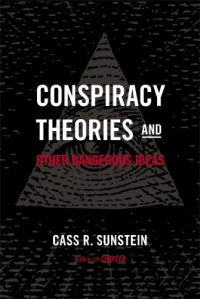 A Review of Conspiracy Theories and Other Dangerous Ideas by Cass Sunstein (based on an earlier paper co-authored with Adrian Vermeule); In Defense of Troublemakers: The Power of Dissent in Life and Business by Charlan Nemeth; and Conspiracy Theories and the People Who Believe Them, edited by Joseph E. Uscinski
On January 25 2018 YouTube unleashed the latest salvo in the war on conspiracy theories, saying “we’ll begin reducing recommendations of borderline content and content that could misinform users in harmful ways—such as videos promoting a phony miracle cure for a serious illness, claiming the earth is flat, or making blatantly false claims about historic events like 9/11.”
At first glance that sounds reasonable. Nobody wants YouTube or anyone else to recommend bad information. And almost everyone agrees that phony miracle cures, flat earthism, and blatantly false claims about 9/11 and other historical events are undesirable.
But if we stop and seriously consider those words, we notice a couple of problems. First, the word “recommend” is not just misleading but mendacious. YouTube obviously doesn’t really recommend anything. When it says it does, it is lying. … continue
Blog Roll
 Aletho News
- BRITAIN’S WARNING: PREPARE FOR WAR
- “Historic Russia”: The Land Putin Will Not Give Back
- How the Cambridge Analytica scandal still haunts Mark Zuckerberg
- The Ongoing Cancellation Campaign Against a Dissenting Academic in Norway
- Yemen and ‘the Houthis’: Challenging Sami Hamdi’s Narrative
- No, Christians did not invent Zionism
- AIPAC-led lobbying network opens branches in Cypriot, Greek parliaments
- Araghchi blasts ‘parasitic’ alliance as US taxpayers pay for Israel’s war on Iran
- Easy fix for Europe’s chaos? Stop fueling war against Russia
- Putin’s key remarks on peace talks and Europe’s ‘schizophrenia’
- If Americans Knew
- An error has occurred; the feed is probably down. Try again later.
- No Tricks Zone
- Two New Studies Find Thwaites Glacier Melt Cannot Be Driven By Human Activity Or A Warming Ocean
- E-Cars Reduce CO2 Emissions By Only 41% Compared To Internal Combustion Engine Vehicles
- Predictions Made By Renowned Climate Professor Over Past Decades Have Been Proven To Be Poor
- New Study Suggests Large Regions Of The Pacific Ocean Have Been Cooling For The Last 80 Years
- Germany’s Green Energy Debacle: High Energy Costs Force Kahla Porzellan to Close After 182 Years!
- New Study: 50 Years Of The Most Aggressive ‘Net Zero’ Policies Can Only Affect The Global Climate By 0.03°C
- US September “Heat” Was No Record…Many Records Set Decades Ago
- Latest European Green Energy Debacle; Portugal’s Largest Flagship Solar Park Insolvent!
- Green Energy Debacle: German Expert Professor Fritz Vahrenholt Warns Of Severe Economic And Social Consequences
- Two More Paleo Reconstructions Affirm Meters-Higher Sea Levels Across Ireland, Brazil 7000-6000 Years Ago

