“Free Tripoli” – just don’t mention the corpses
By Lizzie Phelan | Pravda | September 6, 2011
The war on Libya has not only been a war that has vindicated NATO’s claim to the most powerful military force on earth, capable of imposing its will through sheer aggression wherever it sees fit, but it has also been a war that has reasserted the western mainstream media’s power to not just fabricate events but to create.
The first media victory was when it got away with claiming that Gaddafi’s government was attacking it’s own citizens in Tripoli from the air, a claim which formed part of the pretext for NATO’s intervention and also served to create panic and anger amongst the city’s residents. No one was held to account when later Russian intelligence satellites and visits from independent observers to the areas alleged to have been targeted, revealed no evidence that such attacks had taken place.
One of the most powerful lies was churned out by none other than British Foreign Secretary William Hague who claimed in the first days of the crisis that Gaddafi had fled to Venezuela. The Libyan government admitted repeatedly that their media was wholly incompetent and unable to provide alternative information at the time, with the result that the people of Libya like the rest of the world believed the claims that were being made. In this instance the result was to create a sense even amongst his traditional support base that they had been abandoned and betrayed. Of course Mr Hague made no apology for such irresponsible remarks when soon after Gaddafi showed his face in the streets of Tripoli.
More recently, the BBC has yet to apologise for using blatantly fake footage from a demonstration in India claiming it was in Tripoli’s Green Square, as part of their evidence that the city had fallen.
Such fabrications continued throughout the six months, as the media reported that areas had been “captured” by the rebels, when in reality, these areas had been blitzed from the air and the sea by NATO rockets with the sole aim of destroying any threat of resistance to its allies the rebels.
As the alliance bombed the rebels’ path to Tripoli, on its way massacring at least 85 civilians in the Zlitan town of Majer, the leaders of hundreds of the country’s tribes, including the largest, Wafalla, Tarhouna, Washafana and Zlitan, reasserted their determination to defend their areas, and to descend on Tripoli should it come under threat.
Meanwhile, the masses of men and women of Tripoli who turned out in rallies against the rebels, felt confident that should the rebels show up in their city they would be able to defeat them with the arms that Gaddafi’s government had been issuing to them since the beginning of the crisis.
Now many of those people have been massacred, have fled or are in hiding. They may or may not have underestimated the ruthless might of NATO, but the media’s narrative that Tripoli fell without resistance is contested by the fact that it took the massacre of thousands and at least five days to establish tentative TNC control of the capital as well as by eyewitnesses accounts of what happened during those five days and beyond.
From the beginning of the fighting in Tripoli on August 20th when I and 35 other journalists became trapped inside the Rixos hotel, it was virtually impossible to get a clear idea of what was happening on the streets outside. Throughout that period the sounds of bombs, gunfire and other heavy weaponry was almost non-stop, with shrapnel and bullets occasionally making their way inside the hotel. But like the rest of the world, the only information we had, apart from the odd moments of communication with contacts inside the city, was from the mainstream international media.
Since my release, I have begun to collate information from residents in the capital in the absence of information from sources which are recognized internationally as “independent”. The following report is based on these accounts and the sources identity must be kept confidential due to the systematic targeting of anyone who betrays disloyalty to the rebels, which as I experienced myself, includes challenging their version of events in the media.
 On the first day, rebels from sleeper cells inside Tripoli emerged and began attacking checkpoints manned by Libyan special forces. As is the pattern with their advance into areas on the way to the capital they faced a swift initial defeat. But the first images emerging around the world of the rebels inside Tripoli NATO ensured it would not be short lived. The organisation sanctioned to “protect civilians”, rapidly moved to bomb all checkpoints in the densely packed city. The vast majority of these were manned by volunteers – ie ordinary citizens that had been armed with Kalashnikovs since the beginning of the crisis – so that the rebels could easily move into the city by sea and by road. (see attached image of mother and 17 year old daughter, both volunteers manning checkpoint in Tripoli.)
This was followed by masses of youth and other residents in the capital pouring into the streets to defend their city as they had pledged to do during mass rallies.
The following day, NATO responded with intensified aggression. Eyewitnesses report that during this day, the broadcasting station in Tripoli was bombed, killing dozens. Shortly after the rebels claimed control of Libyan TV and the international media dutifully repeated the claim, blocking any mention of how the takeover had occurred.
Adding to the media’s campaign of confusion, reports of Gaddafi’s sons being caught and that Gaddafi along with other family members had fled the country continued to beam out of televisions across the world.
Having become accustomed to such psychological operations designed to weaken the people’s support for the government by making them believe it had betrayed them, masses defied the reports and marched to Green Square. From inside the Rixos, during the short periods when phone access was revived, my contacts in the city who were in Green Square at the time, informed me that Muammar Gaddafi had been seen driving through the city in his army fatigues urging people to remain strong and not be deceived by the west’s relentless propaganda. This has since been reported by further contact with other residents who were in the streets at the time.
Following relentless bombardment, the masses were pushed back to Gaddafi’s compound Bab al-Azizia where they resisted the rebels’ advance for a further 24 hours. It was during this time that Saif al-Islam, who until then the media and International Criminal Court had been insisting was captured and arrested, showed up at the Rixos hotel where we were trapped. Calm and confident, he took out a group of journalists to Bab al-Azizia where upon their return, they confirmed seeing thousands in and around the compound waving the green flag, including as the tribes had pledged, from their people across the country.
But like the peaceful march in the western mountains on July 24th which was attacked by NATO and the rebels, the masses in Bab al-Azizia were broken up by NATO bombing an entrance for the rebels and attacks by Apache gunships.
The same fate was visited upon gatherings in Green Square. Bab al-Azizia alone was reported to have been bombed 63 times during that time.
With both Green Square and Bab-Alzizia now in control of the rebels, the resistance continued in areas like Tripoli’s poorest neighbourhood Abu Saleem, which a few weeks previously had held a mass demonstration against the NATO aggression and in support of the Jamahiriya. Fighting against the rebels also raged on in Salah Eldeen and El Hadba.
Armed with Kalashnikovs and Rocket Propelled Grenades, the citizens of these areas fighting 8,000 kg bombs, Apache gunships, US, European and UAE special forces and the rebels laden with NATO’s sophisticated weaponry, became part of the carnage and piles of bodies were reported to line the streets.
Since then, any area known to have supported Gaddafi has reportedly been bombed or been subjected to homes and apartments being burnt and looted. And even the mainstream media has been unable to ignore the systematic targeting and lynching of anyone with black skin. It is widely known that Gaddafi’s opponents deeply loathed his rhetoric and policies in support of Black Africa.
With Sirt, Sabha and Beni Walid being amongst the last areas still flying the green flag high, the rebels claim to be giving these a deadline before they resort to a “military response”, implying that in the meantime, a non-military avenue will be pursued. Yet again, the media fail to highlight that the rebels’ ally, NATO, has been openly bombing these areas.
The same media has unquestioningly swallowed NATO’s line that the targets have been exclusively “Gaddafi’s forces”, in the face of evidence before their very eyes to the contrary and in the absence of any independent investigation into the death toll of the 30,000 bombs estimated to have been dropped over the past six months.
The last concrete figures on the second day of fighting put the death toll in 12 hours of fighting in Tripoli alone at 1,300 with 900 injured. Far from Tripoli falling without resistance these figures suggest that Tripoli fell with the masses resisting being massacred.
As in Zlitan, Zawiya and elsewhere, the same atrocities as those committed in Tripoli, are being carried out in Beni Walid and Sirt with the complete silent complicity of journalists and “independent” observers on the ground. This is “free Libya”, so long as the thousands of dead and in hiding upon which it is based goes unmentioned.
Let us Honor Our Own
By Joharah Baker for MIFTAH – August 29, 2011
It’s a never ending struggle, this uphill battle with Israel’s mighty propaganda machine. But as they say, no rest for the weary.
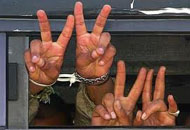 Over the past few months, Israel has been sullying the reputation of yet another aspect of Palestinian governance. In late May, the Palestinian Media Watch, an Israeli watchdog organization that tracks Palestinian media for incitement against Israel released a report claiming that the Palestinian Authority is paying salaries to Palestinian prisoners in accordance with a newly published law.
The PMW spread the news as quickly and with as much venom as possible. “In other words, all Palestinians in Israeli prisons for terror crimes officially join the PA payroll. According to the definition in the PA law, Palestinian car thieves in Israeli prisons will not receive a salary, but Hamas and Fatah terrorist murderers will,” the report read.
“The PA also gives a salary to Israeli Arabs convicted of terror crimes against Israel – the country of which they are citizens. PA benefits to Israeli Arab terrorists, in fact, are greater than the ones extended to Palestinian terrorists.”
Since then, the slandering has taken hold, especially since the PMW called on donor countries to cut aid to the PA altogether since, according to their logic, the money will go to “terrorists” and their families.
This is not the first time the Palestinians have been accused of supporting terrorism and incitement towards Israel. After the PA came to power in 2004 and devised its own school curriculum, Israel immediately began tearing the books apart, page at a time and claiming they were full of anti-Israeli sentiments. An excellent article published earlier this month by The Guardian notes that Israeli textbooks, which are rarely in the spotlight, are far more inciting and racist than that of the Palestinians. The article points out that the word “Palestinians” is only used when in reference to “terrorists.” Otherwise, Palestinians are referred to as Arabs – uneducated, deviant, camel riders.
Claims of incitement are not limited to schoolbooks, unfortunately. When Palestinians named a square after Dalal Al Mughrabi, a Palestinian fighter who was killed during a military operation against Israel in 1978, Israel was up in arms, claiming the Palestinians should not be allowed to name streets or squares after “terrorists.” Israeli watchdog groups and the Israeli government play on the fact that Palestinians have named streets after Abu Jihad (Khalil Al Wazir) and Yehya Ayash. The prisoner stipends are just the latest episode in the drama.
What Israelis should know is that any country in the world with a welfare system is responsible for its citizens, including the families of prisoners. There is nothing out of the ordinary in this. Actually, the PA has been doing it for years. The United States does not punish the family of a murderer nor would Israel cut government benefits from the family of Yigal Amir. Neither should the Palestinians abandon their own people.
Additionally, Palestinian prisoners in Israeli jails are a whole other ballgame. These men and women are not imprisoned for stealing cars, or for selling drugs. They are there because they are resisting a belligerent military occupation of their land, which has oppressed them and their people for decades. The PA’s allocations to prisoners and their families is in no way an endorsement of “terrorism and violence” but rather a means of helping mostly young men and women and their families to resume a life that has been interrupted by an occupying authority. Any other country would have done the same.
Besides, countries should not interfere in the internal affairs of others. If the Palestinians want to name a street after one of their national heroes, regardless of how this person is perceived by Israel, that is their business. The Palestinians have never objected to the fact that Israel named its international airport after David Ben Gurion, Israel’s founding father and a man who advocated the transfer of Palestinians after the 1948 war. “We should prevent Arab return at any cost,” he said in June, a month after Israel’s declaration of independence and 800,000 Palestinians were forced from their homes virtually overnight.
For the Palestinians, Ben Gurion is no hero. The thousands of political prisoners in Israeli jails, on the other hand, certainly are.
~
Joharah Baker is Director of the Media and Information Department at the Palestinian Initiative for the Promotion of Global Dialogue and Democracy (MIFTAH). She can be contacted at mid@miftah.org.
Request for correction to BBC NEWS
9/11 Blogger – 08/31/2011
To: the editor of BBC NEWS Magazine online.
This letter is a request for correction regarding mistakes found in article “9/11 conspiracy theories” published August 29, 2011.
1. On point 1, quote: “the transponder, which provides the exact location of the plane, was turned off or changed”
Airplane transponder is a machine that provides ground control with some data originating from the plane, such as the altitude of the plane, its name, its bearing and other data. It doesn’t provide horizontal (map) location of the plane, which can be read by primary radar data, which originates from ground radar installations and will continue to function whatever happens to the plane transponder.
Your assertion is wrong, so you’re requested to correct and clarify it.
2. On point 2, quote: “Controlled demolition is always carried out from the bottom floors up”
As you can see in the destruction of 12-14 rue parant – glacis – Belfort on February 21, 2008 (link) controlled demolition can start from the middle floors downward.
Your assertion is wrong, so you’re requested to substitute the word “always” with “usually”.
3. Also on point 2, quote: “No evidence has ever been found of explosive charges despite the extensive hand searches”
As clearly stated by NIST in their official website FAQ (point 12), quote: [Question] “Did the NIST investigation look for evidence of the WTC towers being brought down by controlled demolition? Was the steel tested for explosives or thermite residues? The combination of thermite and sulfur (called thermate) “slices through steel like a hot knife through butter.”
[Answer] “NIST did not test for the residue of these compounds in the steel.”
Your assertion is false and misleading, so you’re requested to inform the reader that NIST admits it never looked for explosives/incendiaries residues during their official investigation (US congress H.R. 4687 gives mandate to NIST and NIST alone to investigate the collapse and provide an official explanation on the collapses causes and dynamics).
4. On point 4, quote: “the military never gave orders to the air force to shoot the commercial airliner down.”
As clearly stated in 9/11 Commission Report page 40-41 in the chapter titled “United 93 and the shootdown order”, quote: “The Vice President authorized fighter aircraft to engage the inbound plane. He told us he based this authorization on his earlier conversation with the President”
You may remind that in the United States the President is also the commander in chief of the military.
Also, in the same page we have, quote: “At approximately 10:30, the shelter started receiving reports of another hijacked plane, this time only 5 to 10 miles out. Believing they had only a minute or two, the Vice President again communicated the authorization to ‘engage’ or ‘take out’ the aircraft.”
Your assertion is two times false, so you’re requested to correct and clarify it.
5. Point 5, quote: “Some scientists, who are sceptical of the official account, have examined four dust samples from Ground Zero and claim to have found thermitic material which reacts violently when heated up”
The scientific study you refer to is “Active Thermitic Material Discovered in Dust from the 9/11 World Trade Center Catastrophe”, published by The Open Chemical Physics Journal. It is a peer-reviewed paper, which to date (August 29, 2011) has never been challenged by another peer-reviewed study or publication, as such the information within is considered scienfically correct until such a confutation appears.
So it’s not a mere claim by some sceptical scientists, but science’ position on the issue.
Your assertion is misleading, so you’re requested to provide credit to the study as a peer-reviewed scientific study.
6. Also on point 5, quote: “Furthermore, there is an alternative explanation for the “thermitic material” the sceptical scientists found in the dust – it is just a type of primer paint”.
The study itself poses the same question and scientifically refutes it – you may look in the document itself, point 7 “Could the Red Chip Material be Ordinary Paint?” to learn the reasons why the material cannot be any type of primer paint.
Your assertion is refuted by an unchallenged, peer-reviewed scientific study, and as such you must inform the readers your opinion is not scientifically based.
I hope to see the corrections soon, in a much needed confirmation that journalism has no master but truth.
Sincerely
Riccardo Pizzirani – Sertes
Western press and addressing grievances in Gaza
By Mohammed Suliman – The Electronic Intifada – 08/26/2011
In 2006, the Israeli authorities imposed an overall siege on the Gaza Strip forcing 1.6 million Palestinians to live under miserable conditions. Since then, Gaza, depending on the degree of instability in the area, has been largely covered in the world media, sometimes enjoying the status of a quasi-main theme.
However, many of these subjects dealt with by the Western press are quite unimportant to deal with publicly. The only importance they have seems to be that of their context.
One needs though to be as critical as not to fall victim to any deliberate misrepresentation of facts or any other well-handled, yet ill-timed treatment of any of these controversial subjects.
The real oppressor of Gaza women’s rights
Only last night, a fellow journalist and I had an argument over the recently recurring theme in the Western press of the oppression of women’s rights in the Gaza Strip. We both came to an agreement that one can confidently state women’s rights are flagrantly abused in Gaza but, unlike how Western press tends to show it, the question remains who the real oppressor of women’s rights in Gaza is.
The issue of women’s rights in Gaza is one part of a larger— to avoid the word “propaganda”— misinformation scheme that should be seen as an attempt to divert the world’s attention from the indispensable issues which need to be constantly and unfalteringly addressed in the Western press.
Take this for example. “Sorry, Hamas, I’m wearing blue jeans” is an article that, on the surface of it, seems to be a credible and well intentioned attempt to encapsulate how women’s rights are abused a daily basis in Gaza by the government, the people, their religion and customs. It features the resentment of “a defiant Palestinian feminist from Gaza reflect[ing] on being secular in a religious land.”
Reading through the article, one can’t but feel irritated at the blatantly Orientalist character of it. It is indeed one of the most deeply flawed and misrepresentative articles that falls into this exact category of misinformation that I have spoken of earlier.
I will not go further to reply to this article since the real resentment felt toward it and generated by its blatant inaccuracy has already been highlighted by several responses which none has written but Palestinian women (and men) from Gaza refuting its baseless arguments and countering what it displays as “facts”.
The unfortunate “Gaza Youth Manifesto”
Likewise, recently a group of Palestinian youth from Gaza has issued a “manifesto” on their Facebook page called Gaza Youth Breaks Out. It outstandingly highlighted the anger and frustration that have grown so immense inside the chests of young Gazans that they cannot be any longer suppressed. Unluckily, however, its writers poured out their fury indiscriminately at every possible cause they deemed as conducive to their miserable conditions instead of carefully underlining the principal source and prime perpetrator of this unendurable suffering.
Hence, the true causes for this suffering, i.e. Israel, its 2008/09 invasion of the Gaza Strip, the five-year relentless blockade, and its daily heinous crimes against Palestinian civilians, were (unintentionally, I assume) relegated and not as much accentuated as the uncommendable behavior of the Hamas government in Gaza toward its people which replaced Israel as the originator of Gaza’s youth distress.
That said, the GYBO manifesto has received worldwide attention from Western press and media outlets including the Guardian and the BBC. But did any of them take the time to listen to the grievances the manifesto itself prompted in a considerable portion of Gaza’s youth due to its misguided content and damaging quality?
Of course, not. Because simply that is what Western press had been looking for and now that it rose from within Gaza youth itself, they wouldn’t hesitate to embrace this unfortunate manifesto. (Note: under great deal of criticism, the group had to issue a second manifesto, which appears on the group’s Facebook page).
Whether deliberate or not, digressions as such only harm the Palestinians and are aimed at diverting the world’s attention from the base injustice the Palestinians are forced to live under besides the daily crimes committed against them by the Israeli armed forces. Moreover, they do seem to attract the attention of an audience, that has become used to prosaic coverage of continuous and flagrant Israeli violations of basic human rights.
Still, this does not mean issues of human rights’ abuses should be disregarded. The suppression exercised by the government and other violations of human rights should always be brought to light to help fight against it.
But there is still a huge difference between objective reporting of incidents of human rights violations and other obviously subjective and unrepresentative or misleading publications.
The “rising middle class” and addressing minor grievances
Similarly, a newly published Associated Press feature story throws light on the widening gap between a very tiny (rising?) middle class and the majority of the people who live under the poverty line, as the article illustrates.
Well-written, objective, and supported with facts and figures as it might seem, the article should nonetheless be dismissed as misleading and lacking in analytical interpretation necessary to explain the real origins of the discontent the people of Gaza have.
“A budding middle class in the impoverished Gaza Strip is]…[fueling perhaps the most acrimonious grass roots resentment yet toward the ruling Hamas movement.”
The introductory statement of the article is inaccurate since, from the beginning it presupposes the presence of this “resentment” toward the Hamas government in Gaza, and it doesn’t go further to place this feeling within its greater context which is that of the Israeli occupation and its blockade of the Gaza Strip.
The only and real grievances the people of Gaza have are those toward Israel and its blockade of the Gaza Strip which has fueled in them so much anger and despair to the extent that, like the GYBO, they started to resent everything around them, on the top of which is the Hamas government. So even this sense of dissatisfaction toward the government is basically a form of grievous indignation toward Israel itself.
Quite normally people would hate the government under whose control they have had to endure the most miserable conditions. It is true the government in Gaza isn’t doing enough to at least alleviate the people’s Israeli-inflicted suffering. It’s also true that there is too much corruption inside the government itself to be concealed or ignored any longer, but trying to make these issues the prime source of people’s anger is dubious since it ignores the fact that what people are enraged about, above all things, is the Israeli siege.
However, since this siege is something the people of Gaza have started to take for granted, criticizing the government, blaming it, and feeling resentment toward it has become a trend. It has become much easier and, indeed, practical for them. (One feels obliged to praise Israel for having relieved itself of the burden of taking responsibility for the people it occupies).
Although, the article makes it clear the majority of the people are discontented and frustrated, at some point it seems to ridiculously question the fact that there is a humanitarian crisis in Gaza while there are others— a very small minority— who live in self-indulgence. It also never accounts for the so called “rise of the middle class” in Gaza except by simplistically relating it to the attitudes of the Hamas government and the “corruption” of some of its “loyalists”.
The only thing this article seems to do is deflect the readers’ attention from the real origins of frustration in Gaza represented by Israel’s overall inhuman policy toward the Palestinians to few, indeed, unimportant issues.
Israel’s siege and crimes are always the issue
While in other countries, which seem to enjoy wealth and maintain stability, suppression is exercised by governments on a larger scale and women’s rights are abused at a more serious level, little attention is paid to them. Likewise, the grievances toward an assumed middle class rise in Gaza is a completely preposterous issue to discuss when only a few days ago Israeli airstrikes killed 15 Palestinians in the Gaza Strip. (update: 11 Palestinians were killed in Israeli airstrikes during the past two days).
At a time when the people of the Gaza Strip, both wealthy and poor, are woken from their sleep by Israeli warplanes bombing their neighborhoods, grievances, suffering and anger of this sort is all what the world needs to know about Gaza.
‘Politico’ features claim for Israeli sovereignty of W.B. where ‘Jews have been the majority’ since 1800s
By Philip Weiss on August 23, 2011
Josh Block used to work for AIPAC. Then he started a PR shop with Clintonite Lanny Davis, and now he’s at the Progressive Policy Institute. So he considers himself a liberal Democrat. And he gets a platform at Politico to spew falsehoods about Jewish numbers and sovereignty. This is what it means to be progressive in the U.S. establishment:
the fictional Palestinian state conjured up for the United Nations doesn’t meet international law standards. Its legislature hasn’t met in nearly five years; it can’t hold elections as required under its own law, and it doesn’t have defined territory — instead claiming land once held briefly by Jordan, where Jews have been the majority population since the 1800s, and now under Israeli sovereignty.
How Michael Ruppert’s ‘Peak Oil’ Pile is Gaining Tonnage
By Dave McGowan | March 5, 2005
Excerpt:
It appears that, unbeknownst to Westerners, there have actually been, for quite some time now, two competing theories concerning the origins of petroleum. One theory claims that oil is an organic ‘fossil fuel’ deposited in finite quantities near the planet’s surface. The other theory claims that oil is continuously generated by natural processes in the Earth’s magma. One theory is backed by a massive body of research representing fifty years of intense scientific inquiry. The other theory is an unproven relic of the eighteenth century. One theory anticipates deep oil reserves, refillable oil fields, migratory oil systems, deep sources of generation, and the spontaneous venting of gas and oil. The other theory has a difficult time explaining any such documented phenomena.
So which theory have we in the West, in our infinite wisdom, chosen to embrace? Why, the fundamentally absurd ‘Fossil Fuel’ theory, of course — the same theory that the ‘Peak Oil’ doomsday warnings are based on.
I am sorry to report here, by the way, that in doing my homework, I never did come across any of that “hard science” documenting ‘Peak Oil’ that Mr. Strahl referred to. All the ‘Peak Oil’ literature that I found, on Ruppert’s site and elsewhere, took for granted that petroleum is a non-renewable ‘fossil fuel.’ That theory is never questioned, nor is any effort made to validate it. It is simply taken to be an established scientific fact, which it quite obviously is not.
So what do Ruppert and his resident experts have to say about all of this? Dale Allen Pfeiffer, identified as the “FTW Contributing Editor for Energy,” has written: “There is some speculation that oil is abiotic in origin — generally asserting that oil is formed from magma instead of an organic origin. These ideas are really groundless.” (http://www.fromthewilderness.com/free/ww3/04_04_02_oil_recession.html)
Here is a question that I have for both Mr. Ruppert and Mr. Pfeiffer: Do you consider it honest, responsible journalism to dismiss a fifty year body of multi-disciplinary scientific research, conducted by hundreds of the world’s most gifted scientists, as “some speculation”?
Another of FTW’s prognosticators, Colin Campbell, is described by Ruppert as “perhaps the world’s foremost expert on oil.” He was asked by Ruppert, in an interview, “what would you say to the people who insist that oil is created from magma …?” Before we get to Campbell’s answer, we should first take note of the tone of Ruppert’s question. It is not really meant as a question at all, but rather as a statement, as in “there is really nothing you can say that will satisfy these nutcases who insist on bringing up these loony theories.”
Campbell’s response to the question was an interesting one: “No one in the industry gives the slightest credence to these theories.” Why, one wonders, did Mr. Campbell choose to answer the question on behalf of the petroleum industry? And does it come as a surprise to anyone that the petroleum industry doesn’t want to acknowledge abiotic theories of petroleum origins? Should we have instead expected something along these lines?:
“Hey, everybody … uhhh … you know how we always talked about oil being a fossil fuel? And … uhmm … you know how the entire profit structure of our little industry here is built upon the presumption that oil is a non-renewable, and therefore very valuable, resource?
And remember all those times we talked about shortages so that we could gouge you at the pumps? Well … guess what, America? You’ve been Punk’d!”
For the sake of accuracy, I think we need to modify Mr. Campbell’s response, because it should probably read: no one in the petroleum industry will publicly admit giving any credence to abiotic theories. But is there really any doubt that those who own and control the oil industry are well aware of the true origins of oil? How could they not be?
Surely there must be a reason why there appears to be so little interest in understanding the nature and origins of such a valuable, and allegedly vanishing, resource. And that reason can only be that the answers are already known. The objective, of course, is to ensure that the rest of us don’t find those answers. Why else would we be encouraged, for decades, to cling tenaciously to a scientific theory that can’t begin to explain the available scientific evidence? And why else would a half-century of research never see the light of day in Western scientific and academic circles?
Maintaining the myth of scarcity, you see, is all important. Without it, the house of cards comes tumbling down. And yet, even while striving to preserve that myth, the petroleum industry will continue to provide the oil and gas needed to maintain a modern industrial infrastructure, long past the time when we should have run out of oil. And needless to say, the petroleum industry will also continue to reap the enormous profits that come with the myth of scarcity.
How will that difficult balancing act be performed? That is where, it appears, the ‘limited hangout’ concerning abiotic oil will come into play.
Perhaps the most telling quote to emerge from all of this came from Roger Sassen, identified as the deputy director of Resource Geosciences, a research group out of Texas A&M University:
“The potential that inorganic hydrocarbons, especially methane and a few other gasses, might exist at enormous depth in the crust is an idea that could use a little more discussion. However, not from people who take theories to the point of absurdity. This is an idea that needs to be looked into at some point as we start running out of energy. But no one who is objective discusses the issue at this time.”
The key point there (aside from Sassen’s malicious characterization of Kenney) is his assertion that no one is discussing abiotic oil at this time. And why is that? Because, you see, we first have to go through the charade of pretending that the world has just about run out of ‘conventional’ oil reserves, thus justifying massive price hikes, which will further pad the already obscenely high profits of the oil industry. Only then will it be fully acknowledged that there is, you know, that ‘other’ oil.
“We seem to have plum run out of that fossil fuel that y’all liked so much, but if you want us to, we could probably find you some mighty fine inorganic stuff. You probably won’t even notice the difference. The only reason that we didn’t mention it before is that – and may God strike me dead if I’m lying – it is a lot more work for us to get to it. So after we charged you up the wazoo for the ‘last’ of the ‘conventional’ oil, we’re now gonna have to charge you even more for this really ‘special’ oil. And with any luck at all, none of you will catch on that it’s really the same oil.”
And that, dear readers, is how I see this little game playing out. Will you be playing along?
Several readers have written to me, incidentally, with a variation of the following question: “How can you say that Peak Oil is being promoted to sell war when all of the websites promoting the notion of Peak Oil are stridently anti-war?”
But of course they are. That, you see, is precisely the point. What I was trying to say is that the notion of ‘Peak Oil’ is being specifically marketed to the anti-war crowd — because, as we all know, the pro-war crowd doesn’t need to be fed any additional justifications for going to war; any of the old lies will do just fine. And I never said that the necessity of war was being overtly sold. What I said, if I remember correctly, is that it is being sold with a wink and a nudge.
The point that I was trying to make is that it would be difficult to imagine a better way to implicitly sell the necessity of war, even while appearing to stake out a position against war, than through the promotion of the concept of ‘Peak Oil.’ After September 11, 2001, someone famously said that if Osama bin Laden didn’t exist, the US would have had to invent him. I think the same could be said for ‘Peak Oil.’
I also need to mention here that those who are selling ‘Peak Oil’ hysteria aren’t offering much in the way of alternatives, or solutions. Ruppert, for example, has stated flatly that “there is no effective replacement for what hydrocarbon energy provides today.” )
The message is quite clear: “we’re running out of oil soon; there is no alternative; we’re all screwed.” And this isn’t, mind you, just an energy problem; as Ruppert has correctly noted, “Almost every current human endeavor from transportation, to manufacturing, to plastics, and especially food production is inextricably intertwined with oil and natural gas supplies.” )
If we run out of oil, in other words, our entire way of life will come crashing down. One of Ruppert’s “unimpeachable sources,” Colin Campbell, describes an apocalyptic future, just around the corner, that will be characterized by “war, starvation, economic recession, possibly even the extinction of homo sapiens.”
My question is: if Ruppert is not selling the necessity of war, then exactly what is the message that he is sending to readers with such doomsday forecasts? At the end of a recent posting, Ruppert quotes dialogue from the 1975 Sidney Pollack film, Three Days of the Condor:
Higgins: …It’s simple economics. Today it’s oil, right? In 10 or 15 years – food, Plutonium. And maybe even sooner. Now what do you think the people are gonna want us to do then?
Turner: Ask them.
Higgins: Not now – then. Ask them when they’re running out. Ask them when there’s no heat in their homes and they’re cold. Ask them when their engines stop. Ask them when people who’ve never known hunger start going hungry. Do you want to know something? They won’t want us to ask them. They’ll just want us to get it for them.
The message there seems pretty clear: once the people understand what is at stake, they will support whatever is deemed necessary to secure the world’s oil supplies. And what is it that Ruppert is accomplishing with his persistent ‘Peak Oil’ postings? He is helping his readers to understand what is allegedly at stake.
Elsewhere on his site, Ruppert warns that “Different regions of the world peak in oil production at different times … the OPEC nations of the Middle East peak last. Within a few years, they — or whoever controls them — will be in effective control of the world economy, and, in essence, of human civilization as a whole.”
Within a few years, the Middle East will be in control of all of human civilization?! Try as I might, I can’t imagine any claim that would more effectively rally support for a U.S. takeover of the Middle East. The effect of such outlandish claims is to cast the present war as a war of necessity. Indeed, a BBC report posted on Ruppert’s site explicitly endorses that notion: “It’s not greed that’s driving big oil companies – it’s survival.”
A few final comments are in order here about ‘Peak Oil’ and the attacks of September 11, 2001, which Ruppert has repeatedly claimed are closely linked. In a recent posting, he bemoaned the fact that activists are willing to “Do anything but accept the obvious reality that for the US government to have facilitated and orchestrated the attacks of 9/11, something really, really bad must be going on.” That something really, really bad, of course, is ‘Peak Oil.’
To demonstrate the dubious nature of that statement, all one need do is make a couple of quick substitutions, so that it reads: “for the German government to have facilitated and orchestrated the attack on the Reichstag, something really, really bad must have been going on.” Or, if you are the type that bristles at comparisons of Bush to Hitler, try this one: “for the US government to have facilitated and orchestrated the attack on the USS Maine, something really, really bad must have been going on.”
Israel doesn’t respond to violence, it foments violence
Ibrahim Hewitt | MEMO | 22 August 2011
 Yet more tragic loss of life, this time in Eilat and Gaza, and yet again Israel “responds” with “full force”; the bombs dropped on overcrowded Gaza City, and the resultant deaths, are testimony to that. However, this is nothing new for the Palestinians. The violence being unleashed on them by Israel now is not a response to what happened in Eilat, nor was the attack on Israeli soldiers and civilians in Eilat “the trigger”, as the BBC has claimed, for Israel’s disproportionate “response”. It’s just Israel being even more violent than usual. Let’s face it, Israel is an aggressive, occupying (and nuclear-armed) power which doesn’t respond to violence, it foments violence.
In the week prior to the attack in Eilat, Israel killed two Palestinians, including a mentally disabled young man whose only crime was to wander too close to the border; trigger-happy Israeli soldiers shot him ten times, mainly in the head. Four Palestinians were wounded by Israel in the days pre-Eilat, including a child; a number of civilian targets were bombed and Palestinian fishermen off the coast of Gaza were attacked by Israeli gunboats, leaving one injured. This brief summary of Israel’s violence “pre-response” doesn’t take into account the ongoing Israeli oppression of Palestinians in the occupied West Bank and Jerusalem, where the occupation authorities have approved thousands of new housing units for illegal settlers in the past few week and are threatening to deport prominent Palestinians from their own city.
The world is driven by concern for Israel’s security, which takes precedence over all other aspects of Middle East affairs. The Arab spring? How will it affect Israel? Palestinian reconciliation? How will it affect Israel? This Western fetish for Israel’s security is the reason why the Zionist state can, and does, act with impunity. Of course, any state has the right to defend its people from outside attack, but doesn’t that right also extend to Palestinians living under occupation and siege? Are they not also entitled to act in self-defence when Israeli soldiers enter Gaza at will, or shoot a mentally-unstable boy for wandering, in his own country, too close to the border with the Zionist state? Isn’t that “response” from Israeli soldiers probably not much older or wiser than the 17-year old victim the sort of thing which was condemned when East German border guards shot people who got too close to the Berlin Wall? The downfall of that wall has been commemorated in recent days; the Israel version continues to be built but nobody in Washington or European capitals cares. It’s Israel, after all, and Israeli security comes top of the list of concerns, especially for the many US Senators and Congressmen and women who take summer breaks in Israel, all expenses paid.
Few journalists, and even fewer politicians, seem willing to look at the situation in the Holy Land objectively so that the general public have a more balanced understanding of events. Instead, we always hear about “Israel’s response” to this Palestinian rocket or that attempted incursion by terrorists. Few delve deeper behind the headlines to ask why Palestinians fire rockets into Israel, or why the resistance groups try to live up to their name and resist. Few point out that Palestinians are resisting the Israeli occupation of their land, and are entitled by international law to do so with whatever means are at their disposal. It is telling that they have been labelled as “terrorists” by the people running Israel who are adept at flouting international law, to the extent that many Israeli politicians and military officers will not travel abroad for fear of being arrested on war crimes charges.
Who are the real “terrorists”, the occupiers or the occupied? This is an important question, so important in fact, that politicians and the media are afraid to answer it. But when my wife’s friend and her mother email us to say that they were “hiding under the bed trying to shut out the terrifying noise of the bombs”, it is a question to which we are entitled to expect an honest answer.
The laws of cause and effect are really quite simple in this situation, despite attempts in the media and Israeli propaganda to convince us otherwise: Israel was founded in 1948 on Palestinian land following a UN Partition Plan passed by the General Assembly as Resolution 181 (virtually the only UN resolution Israelis have ever stood by, even though it was not mandatory). The people who drafted that plan did not consult the Palestinians on what they thought about giving up more than half of their country to provide a home for Jewish immigrants from Europe. It was thus the Palestinians who paid the price for European anti-Semitism and were the victims of a campaign of brutal ethnic cleansing at the hands of Jewish militias which saw the nascent Israeli state establish itself on more land than the UN ever envisaged or sanctioned. Likewise, in June 1967 Israel kicked-off a war and took even more of historic Palestine, occupying the West Bank and Gaza Strip which, since 1948, had been administered by Jordan and Egypt respectively. The Zionist state has been colonising the West Bank in defiance of international law ever since. Ergo, Palestinians resist the theft and occupation of their land. Which European or American citizen, supporter of Israel or not, could say with hand on heart that they would not resist the occupation of their own country if that ever took place? End the occupation and the need for resistance will also end. It’s not rocket science.
But Zionist Israel is different, quite probably due in part to the American politicians who holiday at the state’s expense. They’ve been bought, and have been for many years, by the powerful Israel Lobby in Washington. That Lobby is now very influential in Britain and the rest of Europe.
What do the Lobbyists make, though, of the claim made by journalist Harriet Sherwood that “an Israeli official told the Guardian: ‘We knew they were out there’, suggesting intelligence had picked up the possibility of an attack” on Eilat? If Israel’s intelligence was so certain, to the degree that Prime Minister Netanyahu could tell the world just hours later that “the people who gave the order” for the attack “are no longer amongst the living”, it also suggests that the Israelis could have prevented it. The Gaza Strip is more than 200 kilometres away from Eilat; if the Israelis “knew they were out there”, why didn’t they intercept the people who carried out the attack on Eilat before it could take place? Since when has Israel been shy of pre-emptive strikes and why was it decided not to make one on this occasion?
I am thinking the unthinkable. Did the Israeli government decide to allow the attack, despite the potential cost in Israeli lives, to go ahead in order to have an excuse – as if it ever needs an excuse – to launch another assault on Gaza and divert attention from its domestic problems in the process? The cancellation of large-scale protests in Israel over the weekend seems to tick at least one of those boxes. Politics is a dirty business, especially in the Middle East, so I wouldn’t rule anything out. Perhaps the families of those Israelis killed in Eilat could ask their government for an answer.
I was brought up by my parents on Tyneside to be honest and stand up for what is just and right. Those core British values of my youth have stayed with me to this day. That’s why I don’t understand why our Prime Minister and senior politicians, backed by an all too compliant media, abandon those core values, which they otherwise espouse so passionately, when the issue in question is the Israel-Palestine conflict. They dance to the Israel Lobby’s tune ever so willingly and call for “restraint” from both parties, as if there is some degree of parity between the military capabilities of Israelis and Palestinians. This is a conflict between a heavily-armed occupier and an almost 100% civilian population under occupation, not a clash of equals, but that simple fact appears to have passed them by.
South Africa’s Nobel Peace Laureate Archbishop Desmond Tutu once said, “If you are neutral in situations of injustice, you have chosen the side of the oppressor.” Silence is not an option when faced with Israeli injustice in occupied Palestine. When will we have politicians and a media who understand this and side with the oppressed for a change?
BBC admits role in 1953 Iranian coup
Press TV – August 21, 2011

The BBC Persian TV channel has at last acknowledged the role of the BBC Persian radio in the toppling of the democratically elected government of Iran in the 1953 coup.
The coup overthrew the government of the then Iranian Prime Minister Mohammad Mosaddegh leading to the restoration of absolute monarchy under dictator Mohammad-Reza Pahlavi who was later toppled in the Islamic Revolution in 1979.
In a documentary aired on August 18 on the anniversary of the coup, BBC Persian channel admitted for the first time to the role of the BBC Persian radio as the propaganda arm of the British government in Iran.
After repeated denials of the BBC Persian radio’s role in helping London oust Mosaddegh, the program entitled Cinematograph detailed how the radio network broadcast anti- Mosaddegh programs to undermine his government.
“The British government used the BBC Persian radio for advancing its propaganda against Mosaddegh and anti-Mosaddegh material were repeatedly aired on the radio channel to the extent that Iranian staff at the BBC Persian radio went on strike to protest the move,” the Cinematograph narrator said.
Britain had lost its power as a world empire after the World War II and Mosaddegh’s efforts to nationalize Iran’s oil industry, which bore fruit on March 19, 1951, meant Britain lost one of the most important resources it formerly fully controlled under the guise of the British-owned Anglo-Iranian Oil Company due to subservience of the Pahlavi regime.
This comes after the BBC Persian channel aired another documentary on March 19, 2010 that categorically dismissed the broadcaster’s Persian radio role in the 1953 coup claiming the radio channel even went against the policies of the British government.
The Cinematograph also quoted a classified document going back to July 21, 1951 in which a Foreign Office official thanked the British ambassador for his proposals that were followed to the word by the BBC Persian radio to strengthen its propaganda against Mosaddegh.
“The BBC had already made most of the points which you listed, but they were very glad to have an indication from you of what was likely to be most effective and will arrange their programme accordingly,” the document shown in part on the program read.
“We should also avoid direct attacks on the ‘ruling classes’ since it seems probable that we may want to deal with a government drawn from those classes should Mosaddegh fall,” it added.
The document further stressed that the Foreign Office “shall be grateful for [the ambassador’s] comments on the propaganda line we have proposed”.
Israel kills 15 in Gaza then tries to shift blame to Hamas
By Jalal Abukhater – The Electronic Intifada – 08/20/2011
Quoting from Haaretz:
“In response to the ongoing rocket fire, an IDF spokesperson stated that the military will not tolerate any attempt at harming Israeli civilians or soldiers, and will continue to “act with determination and strength against any source of terror.” The spokesperson also claimed that Hamas must be “held responsible” for the ongoing attacks.”
Israel is quickly trying to shift the blame for the war crimes it is committing in Gaza to Hamas. Suddenly those firing rockets (after 10 were killed for no reason last night, now 15) are the bad guys and Israel is the good guy doing self defense in this equation.
In times like this, what alternative would you give to the resistance groups other than fire rockets? Their families are killed, their children are either dying or becoming handicapped due to continuous raids. The 1.6 million population of Gaza is terrorized night and day, there isn’t any place in that open air prison safe from the random Israeli shelling, not even UNRWA schools as we have seen in 2009. Israel aims to collectively punish all those who live in Gaza for the crime of living in Gaza.
Let us keep in mind that for the past two years, al-Qassam and the majority of Gaza factions have respected the ceasefire treaty in order to maintain security in the besieged Gaza Strip. In fact, Hamas faced internal issues after it started suppressing armed groups who planned to launch rockets into Israeli cities. It was almost always Israel which would strike first or assassinate political figures which would prompt them to launch rockets in retaliation.
The blood thirsty leadership of Israel bombs Gaza for no reason other than their own self satisfaction. Another reason is that no one would interrupt them in their war crimes process, the US and EU leadership hurries to condemn Eilat attack while barely giving attention, if any, to those civilians slaughtered in Gaza.
And of course, let us not forget that Israel started bombing Gaza on Thursday for no reason. There is no evidence of any connection between Gaza militants and Eilat attack. The only proof the IDF claimed was that Eilat attackers used AK47, which is a weapon that only comes from Gaza (In fact the AK47 or Kalashnikov is the world’s most common firearm). This was literally said on the tongue of the IDF spokesperson Lt. Colonel Avital Leibovich interviewed by the The Real News Network’s Lia Tarachansky as This site has brought it to my attention.
Tarachansky: On what are you basing your conclusion that this group [the Popular Resistance Committees] is responsible for the terror attacks?
IDF Spokesperson: We did not say that this group was responsible for the terror attack. We based this on intelligence information as well as some facts that [we] actually presented an hour ago to some wires and journalists. Some of the findings that were from the bodies of the terrorists, and they are using for example Kalashnikov bullets and Kalashnikov rifles are very common in Gaza —
Tarachansky: Many terrorist groups use Kalashnikovs —
IDF Spokesperson: No, not many terror groups. I’m not saying — I’m referring to the terrorists that came from Gaza.
Tarachansky: Prime Minister Netanyahu said today that the group that was responsible for the terror attack was the one that was eliminated [in Gaza] and you’re saying that’s not the case?
IDF Spokesperson: I don’t know what he said [when speaking on Israeli national television] — I’m not Prime Minister Netanyahu. I’m saying that the group came from Gaza and I’m giving you proof why it came from Gaza — how we know it came from Gaza. This is all I’m saying.
Despite the continuing terror Gaza suffers, Israeli media is doing an even more horrible job. I spent yesterday going through almost all Israeli English news websites, non of those websites mentioned Gaza civilian deaths along with news on rockets coming into Israel. In the matter of fact, I kept reading news reports on Haaretz, Jerusalem Post, and Ynet to realize there is nothing about Palestinian civilian deaths, they only mentioned rockets, Israelis injured, and Gazan militants who were killed. Covering up the real news from the public is dangerous!
This tweet by +972 magazine’s Noam Sheizaf couldn’t describe it better:
By reporting only rockets fired 2 Israel in its top stories & hiding news over dead in Gaza, Israeli media is making public want more blood
Fake flexibility from London’s Israel lobby
By David Cronin – The Electronic Intifada – 08/19/2011
Predictably, the European Union responded quickly to yesterday’s violence in Southern Israel. “I condemn unreservedly all such acts of terror,” the bloc’s foreign policy chief Catherine Asthon said.
Will Ashton be issuing another statement today to denounce the Israeli military in similarly strong terms for murdering an infant in Gaza a few hours later? Or for ending a teenager’s life in the early hours of this morning? I’m sure that she won’t. The most we can expect is that she will call for “restraint” (that weasel word which diplomats have rendered meaningless through overuse).
And did she post something on her website expressing revulsion at how Israeli troops shot dead Sa’d al-Majdalwai, a 17 year old with a mental disability, also in Gaza earlier this week? Of course, she didn’t. Why? Because he was too low down in the hierarchy of victims to get noticed. And because the European Union applies different standards to the Israeli forces of occupation and the Palestinians who resist them. Violence by Israel is “regrettable” (or, in most cases, elicits no comment); violence by Palestinians is always categorized as “terrorism”.
A phony plea for understanding
Ashton may try to appear balanced — she has repeatedly criticized the expansion of Israeli settlements in the West Bank — but, in reality, there is little to distinguish her from former colleagues in the British parliament such as Lorna Fitzsimons. Who, you might ask? Fitzsimons was an elected representative of the Tony Blair-led Labor Party in Westminster between 1997 and 2005. After losing her seat, she took up a job running a propaganda outfit called the Britain Israel Communications and Research Centre (BICOM).
Fitzsimons had an opinion piece published by The Guardian in London this week, in which she sought to come across all reasonable. Purporting to be a big fan of mutual understanding, she patted her own back for organizing a “roundtable discussion” recently, where representatives of Benjamin Netanyahu’s Likud and the Palestinian party Fatah chatted amiably. She proceeded to illustrate how she has no interest in understanding the concerns of Palestinians by insisting “there cannot be a mass return of Palestinian refugees to [present-day] Israel.”
War criminal in London
BICOM’s team includes a “senior visiting fellow” named Michael Herzog. He is a retired brigadier-general from the Israeli army. During Operation Cast Lead, that relentless three-week assault on Gaza’s civilians in late 2008 and early 2009, Herzog was chief of staff to Ehud Barak, Israel’s defense minister. As he was involved in planning that operation and advising on strategy, Herzog must be held accountable for the war crimes committed in its execution. Next time he pops into BICOM’s London offices for a cup of tea and some blue-sky thinking, the police should be alerted and be ready to arrest him.
Herzog has at least done one good thing: he has proven that BICOM’s declared belief that Israel should display “considerable flexibility” (as Fitzsimons wrote in her Guardian article) amounts to waffle. In a new briefing paper for the center, Herzog contends that any future Palestinian state would have to be non-militarized but that Israel would maintain a long-term military presence along the Jordan River.
So while the Palestinians could have nothing more destructive in their arsenal than pea-shooters, the West Bank would remain surrounded by one of the world’s most powerful armies. That, it appears, is what the Israel lobby means by flexibility.
Featured Video

“Historic Russia”: The Land Putin Will Not Give Back
or go to
Aletho News Archives – Video-Images
Book Review
Why the War on Conspiracy Theories Is Bad Public Policy
By Kevin Barrett • Unz Review • February 1, 2019
 A Review of Conspiracy Theories and Other Dangerous Ideas by Cass Sunstein (based on an earlier paper co-authored with Adrian Vermeule); In Defense of Troublemakers: The Power of Dissent in Life and Business by Charlan Nemeth; and Conspiracy Theories and the People Who Believe Them, edited by Joseph E. Uscinski
On January 25 2018 YouTube unleashed the latest salvo in the war on conspiracy theories, saying “we’ll begin reducing recommendations of borderline content and content that could misinform users in harmful ways—such as videos promoting a phony miracle cure for a serious illness, claiming the earth is flat, or making blatantly false claims about historic events like 9/11.”
At first glance that sounds reasonable. Nobody wants YouTube or anyone else to recommend bad information. And almost everyone agrees that phony miracle cures, flat earthism, and blatantly false claims about 9/11 and other historical events are undesirable.
But if we stop and seriously consider those words, we notice a couple of problems. First, the word “recommend” is not just misleading but mendacious. YouTube obviously doesn’t really recommend anything. When it says it does, it is lying. … continue
Blog Roll
 Aletho News
- BRITAIN’S WARNING: PREPARE FOR WAR
- “Historic Russia”: The Land Putin Will Not Give Back
- How the Cambridge Analytica scandal still haunts Mark Zuckerberg
- The Ongoing Cancellation Campaign Against a Dissenting Academic in Norway
- Yemen and ‘the Houthis’: Challenging Sami Hamdi’s Narrative
- No, Christians did not invent Zionism
- AIPAC-led lobbying network opens branches in Cypriot, Greek parliaments
- Araghchi blasts ‘parasitic’ alliance as US taxpayers pay for Israel’s war on Iran
- Easy fix for Europe’s chaos? Stop fueling war against Russia
- Putin’s key remarks on peace talks and Europe’s ‘schizophrenia’
- If Americans Knew
- An error has occurred; the feed is probably down. Try again later.
- No Tricks Zone
- Two New Studies Find Thwaites Glacier Melt Cannot Be Driven By Human Activity Or A Warming Ocean
- E-Cars Reduce CO2 Emissions By Only 41% Compared To Internal Combustion Engine Vehicles
- Predictions Made By Renowned Climate Professor Over Past Decades Have Been Proven To Be Poor
- New Study Suggests Large Regions Of The Pacific Ocean Have Been Cooling For The Last 80 Years
- Germany’s Green Energy Debacle: High Energy Costs Force Kahla Porzellan to Close After 182 Years!
- New Study: 50 Years Of The Most Aggressive ‘Net Zero’ Policies Can Only Affect The Global Climate By 0.03°C
- US September “Heat” Was No Record…Many Records Set Decades Ago
- Latest European Green Energy Debacle; Portugal’s Largest Flagship Solar Park Insolvent!
- Green Energy Debacle: German Expert Professor Fritz Vahrenholt Warns Of Severe Economic And Social Consequences
- Two More Paleo Reconstructions Affirm Meters-Higher Sea Levels Across Ireland, Brazil 7000-6000 Years Ago

