Huffpo gives platform to Israel lobbyist’s claim based on 3000-year-old artifacts
By Philip Weiss on November 23, 2010
Marty Kaplan at Huffpo: “I take Israel personally.” Further proof that the left is permeated by the Israel lobby. Further proof that Zionism has produced a giant IQ drop in what I grew up thinking were the smartest people in the country. Note that Kaplan hadn’t been to Israel in 40 years till he visited lately; but he regards the wall there as his wall. And note the 3000-year-old artifacts of Jewish civilization Kaplan sees at the Israel Museum that combined with genealogical records at the Holocaust museum justify Zionist land claims for him and the rest of the “Jewish people.”
If Christians said this kind of stuff, Huffpo would scream that they are religious nuts. When Shlomo Sand tried to contest this type of racial thinking, he was eviscerated in our country as being “political,” when his only politics are trying to save Jewish minds from mythology that blinds them to the facts before them.
Re mythology, note the “competing narratives” claim at the end of this excerpt. Tony Kushner once said to me that most American Jews have an idea of Israel that is a delusion on top of a fantasy; and that’s what we see here. A guy who hasn’t been to a place in 40 years, who is happily making his life as an empowered minority in the U.S., declares that a western “narrative” about a Jewish right to the land is equal to the Palestinian narrative of 63 years of actual dispossession. I am not saying there is not an Israeli narrative; but it is shot through with all sorts of diaspora projection on the part of people who haven’t been there in decades and whose ideas of Jewish powerlessness are fed by a visit to the Holocaust museum, and who can thereby elide the plain history of Palestinian expulsion/discrimination. Young Jews will have to save us from these ideas… Kaplan:
[T]his is the point where I have to, leap to, declare my love and support for the existence of the Jewish state of Israel. I think the international campaign to delegitimize Israel is based on a malicious misreading of history, abetted by a level of naïveté, ignorance and racism that would surprise me if I hadn’t just lived through the past two years of media and politics. I reject the contention that Zionism is racism, colonialism or any other -ism designed to steal land, disenfranchise citizens or exterminate enemies. The 3,000-year-old artifacts of Jewish civilization that I saw in the Israel Museum and the Nazi Who-is-a-Jew? genealogical charts that I saw at Yad Vashem and the secular Israeli majority I saw in the streets and know from the Diaspora, reminded me that Israel’s nationhood derives from its existence as a people, not as a religion.
I actually came back from Israel more of a hawk than when I left. I am more respectful of the security fence — my security fence — than I was before. Yes, I know the case against it, but I’ve returned convinced that its designers are motivated by fighting terrorism, not by appropriating land or humiliating Palestinians. I haven’t concluded that a pre-emptive strike on Iran is a good idea, but I’m less inclined to think that the threat Iran poses is only a politically pumped-up neocon job. I no longer think that “settlements” is a useful, or necessarily pejorative, term; it encompasses too wide a variety and history of dwellings to be deployed as a shorthand for obstructionism. Like everything else in Israel, it’s complicated.
But don’t get me wrong: I’m closer to J Street than to AIPAC. When Netanyahu acts as though the status quo can go on indefinitely, I not only despair at his delusion; I wear it as my own albatross, whether I want to or not. When he catastrophically bungled the response to the Gaza flotilla stunt, I was unable to prevent myself from feeling personally soiled….
Israel is a battleground between two competing narratives. The Palestinian account of history, its assignment of right and wrong, is a mirror image of the Israeli version; just about everything is flipped. No negotiation between Israelis and Palestinians can settle the matter of which narrative is right. No historian, journalist, political figure or international tribune can sort through the dueling accounts and create a composite that either side will accept.
Evidence of Iran Nuclear Weapons Program May Be Fraudulent
By Gareth Porter | t r u t h o u t | 18 November 2010
Since 2007, the International Atomic Energy Agency (IAEA) – with the support of the United States, Israel and European allies UK, France and Germany – has been demanding that Iran explain a set of purported internal documents portraying a covert Iranian military program of research and development of nuclear weapons. The “laptop documents,” supposedly obtained from a stolen Iranian computer by an unknown source and given to US intelligence in 2004, include a series of drawings of a missile re-entry vehicle that appears to be an effort to accommodate a nuclear weapon, as well as reports on high explosives testing for what appeared to be a detonator for a nuclear weapon.
In one report after another, the IAEA has suggested that Iran has failed to cooperate with its inquiry into that alleged research, and that the agency, therefore, cannot verify that it has not diverted nuclear material to military purposes.
That issue remains central to US policy toward Iran. The Obama administration says there can be no diplomatic negotiations with Iran unless Iran satisfies the IAEA fully in regard to the allegations derived from the documents that it had covert nuclear weapons program.
That position is based on the premise that the intelligence documents that Iran has been asked to explain are genuine. The evidence now available, however, indicates that they are fabrications.
The drawings of the Iranian missile warhead that were said by the IAEA to show an intent to accommodate a nuclear weapon actually depict a missile design that Iran is now known to have already abandoned in favor of an improved model by the time the technical drawings were allegedly made. And one of the major components of the purported Iranian military research program allegedly included a project labeled with a number that turns out to have been assigned by Iran’s civilian nuclear authority years before the covert program is said to have been initiated.
The former head of the agency’s safeguards department, Olli Heinonen, who shaped its approach to the issue of the intelligence documents from 2005 and 2010, has offered no real explanation for these anomalies in recent interviews with Truthout.
These telltale indicators of fraud bring into question the central pillar of the case against Iran and raise more fundamental questions about the handling of the Iranian nuclear issue by the IAEA, the United States and its key European allies.
Drawings of the Wrong Missile Warhead
In mid-July 2005, in an effort to get the IAEA fully behind the Bush administration’s effort to refer the Iranian nuclear dossier to the United Nations Security Council, Robert Joseph, US undersecretary of state for arms control and international security, made a formal presentation on the purported Iranian nuclear weapons program documents to the agency’s leading officials in Vienna. Joseph flashed excerpts from the documents on the screen, giving special attention to the series of technical drawings or “schematics” showing 18 different ways of fitting an unidentified payload into the re-entry vehicle or “warhead” of Iran’s medium-range ballistic missile, the Shahab-3.
When IAEA analysts were allowed to study the documents, however, they discovered that those schematics were based on a re-entry vehicle that the analysts knew had already been abandoned by the Iranian military in favor of a new, improved design. The warhead shown in the schematics had the familiar “dunce cap” shape of the original North Korean No Dong missile, which Iran had acquired in the mid-1990s, as former IAEA Safeguards Department Chief Olli Heinonen confirmed to this writer in an interview on November 5. But when Iran had flight tested a new missile in mid-2004, it did not have that dunce cap warhead, but a new “triconic” or “baby bottle” shape, which was more aerodynamic than the one on the original Iranian missile.
The laptop documents had depicted the wrong re-entry vehicle being redesigned.
When I asked Heinonen, now a senior fellow at Harvard University’s Belfer Center, why Iran’s purported secret nuclear weapons research program would redesign the warhead of a missile that the Iranian military had already decided to replace with an improved model, he suggested that the group that had done the schematics had no relationship with the Iranian missile program. “It looks from that information that this group was working with this individual,” said Heinonen, referring to Dr. Mohsen Fakrizadeh, the man named in the documents as heading the research program. “It was not working with the missile program.”
Heinonen’s claim that the covert nuclear weapon program had no link to the regular missile program is not supported by the intelligence documents themselves. The IAEA describes what is purported to be a one-page letter from Fakrizadeh to the Shahid Hemat Industrial Group dated March 3, 2003, “seeking assistance with the prompt transfer of data” for the work on redesigning the re-entry vehicle.
Shahid Hemat, which is part of the Iranian military’s Defense Industries Organization, was involved in testing the engine for the Shahab-3 and, in particular, in working on aerodynamic properties and control systems for Iranian missiles, all of which were reported in the US news media. “Project 11” was the code name given to the purported re-entry vehicle project.
Heinonen also suggested that the program’s engineers could have been ordered to redesign the older Shahab-3 model before the decision was made by the missile program to switch to a newer model and that it couldn’t change its work plan once it was decided.
However, according to Mike Elleman, lead author of the most authoritative study of the Iranian missile program thus far, published by the London-based International Institute for Strategic Studies (IISS) last May, Iran introduced the major innovations in the design of the medium-range missile, including a longer, lighter airframe and the new warhead shape, over a period of two to five years. Elleman, told me in an interview that the redesign of the re-entry vehicle must have begun in 2002 at the latest.
The schematics on the laptop documents’ redesigned warhead were dated March-April 2003, according to the IAEA report of May 2008.
Heinonen’s explanation assumes that the Iranian military ordered an engineer to organize a project to redesign the warhead on its intermediate-range ballistic missile to accommodate a nuclear payload, but kept the project in the dark about its plans to replace the Shahab-3 with a completely new and improved model.
That assumption appears wholly implausible, because the reason for the shift to the new missile, according to the IISS study, was that the Shahab-3, purchased from North Korea in the early to mid-1990s, had a range of only 800 to 1,000 km, depending on the weight of the payload. Thus, it was incapable of reaching Israel. The new missile, later named the Ghadr-1, could carry a payload of conventional high-explosives 1,500 to 1,600 kilometers, bringing Israel within the reach of an Iranian missile for the first time.
The missile warhead anomaly is a particularly telling sign of fraud, because someone intending to fabricate such technical drawings of a re-entry vehicle could not have known that Iran had abandoned the Shahab-3 in favor of the more advanced Ghadr-1 until after mid-August 2004. As the IISS study points out, the August 11, 2004, test launch was the first indication to the outside world that a new missile with a triconic warhead had been developed. Before that test, Elleman told me, “No information was available that they were modifying the warhead.”
After that test, however, it would have been too late to redo the re-entry vehicle studies, which would have the biggest impact on news media coverage and political opinion.
Iranian statements about the Shahab-3 missile would have been misleading for anyone attempting to fabricate these schematics. The IISS study recalls that Iran had said in early 2001 that the Shahab-3 had entered “serial production” and declared in July 2003 that it was “operational.” The IISS study observes, however, that the announcement came only after the US invasion of Iraq, when Iran felt an urgent need to claim an operational missile capability. The study says it is “very dubious” that the missile was ever produced in significant numbers.
Skepticism and Resistance at the IAEA
A second inconsistency between the laptop documents and the established facts emerged only in 2008. At a briefing for IAEA member states in February 2008, Heinonen displayed an organization chart of the purported research program, showing a “Project 5” with two sub-projects: “Project 5/13” for uranium conversion and “Project 5/15” for uranium ore processing. Kimia Maadan, a private Iranian firm, is shown to be running “Project 5.”
One of the key documents in the collection, a one-page flow sheet for a uranium-conversion process, dated May 2003, with Kimia Maadan’s name on it, is marked “Project 5/13.”
Bush administration hardliners and the IAEA safeguard department had been convinced in the 2004-2005 period that Kimia Maadan was a front for the Iranian military. In a 2005 report, the IAEA questioned how that company, with such “limited experience in ore processing,” could have established an ore processing plant at Gchine in such a short time from 2000 to mid-2001 on its own.
But in January 2008, Iran provided documents to the IAEA showing that Kimia Maadan had actually been created by the civilian Atomic Energy Organization of Iran (AEOI) in 2000 solely to carry out a contract to design, build and put into operation an ore-processing facility. The documents also established that the firm’s core staff consisted entirely of experts who had previously worked for AEOI’s Ore Processing Center and that the conceptual design and other technical information had been provided to Kimia Maadan by AEOI.
But the most explosive new evidence provided by Iran showed that the code number of “Project 5/15” on ore processing, supposedly assigned by the Iranian military’s secret nuclear weapon research program, had actually been assigned by the AEOI more than two years before the purported nuclear weapons program had been started. In the context of the documents on Kimia Maadan’s relationship with AEOI, the IAEA report of February 2008 acknowledged, “A decision to construct a UOC [uranium ore concentration] plant at Gchine, known as ‘project 5/15,’ was made August 25, 1999.”
An unpublished paper by the IAEA safeguards department, leaked to the media and the Washington, DC-based Institute for Science and International Security (ISIS) in 2009, identified early 2002 as the formal beginning of what it called the Iranian military’s “warhead development program.”
Asked about this contradiction, Heinonen told me he couldn’t answer the question, because he did not recall the specific dates involved.
After the IAEA had acquired that new evidence of fraud in January 2008, an IAEA official familiar with the internal debate inside the agency told me that some IAEA officials had demanded that the agency distance itself publicly from the intelligence documents. But IAEA reports made no concession to those demands. Instead, beginning with the May 2008 report, the agency began to use language implying that the documents were considered reliable.
Behind the scenes, a conflict was about to boil over between Heinonen and then IAEA Director General Mohammed ElBaradei, who was skeptical about the authenticity of the laptop documents and refused to give them any official IAEA endorsement. In late 2008, Heinonen began pushing ElBaradei to approve publication of his department’s favorable assessment of the intelligence documents, which concluded that Iran had done research and development on nuclear weapons components and speculated that it was continuing to do so.
But ElBaradei refused to do so and in August 2009, diplomats from the UK, France and Germany, who were supporting Heinonen’s view of the documents, leaked to Reuters and The Associated Press that, for nearly a year, ElBaradei had been suppressing “credible” evidence of Iran’s covert work on nuclear weapons.
ElBaradei responded to those political pressures to publish the safeguards department speculative study in an interview with The Hindu on October 1, 2009, in which he declared, “The IAEA is not making any judgment at all whether Iran even had weaponisation studies before because there is a major question of authenticity of the documents.”
Evidence of Israel’s Role
The origin of the laptop documents may never be proven conclusively, but the accumulated evidence points to Israel as the source. As early as 1995, the head of the Israel Defense Forces’ military intelligence research and assessment division, Yaakov Amidror, tried unsuccessfully to persuade his American counterparts that Iran was planning to “go nuclear.” By 2003-2004, Mossad’s reporting on the Iranian nuclear program was viewed by high-ranking CIA officials as an effort to pressure the Bush administration into considering military action against Iran’s nuclear sites, according to Israeli sources cited by a pro-Israeli news service.
In the summer of 2003, Israel’s international intelligence agency, Mossad, had established an aggressive program aimed at exerting influence on the Iran nuclear issue by leaking alleged intelligence to governments and the news media, as Israeli officials acknowledged to journalists Douglas Frantz and Catherine Collins. According to the book, “The Nuclear Jihadist,” as part of the program, Mossad sometimes passed on purported Iranian documents supposedly obtained by Israeli spies inside Iran.
German sources have suggested that the intelligence documents were conveyed to the US government, directly or indirectly, by a group that had been collaborating closely with Mossad. Soon after Secretary of State Colin Powell made the existence of the laptop documents public in November 2004, Karsten Voight, the coordinator of German-American cooperation in the German Foreign Ministry, was quoted in The Wall Street Journal as saying that they had been transferred by an Iranian “dissident group.” A second German source familiar with the case was even more explicit. “I can assure you,” the source told me in 2007, “that the documents came from the Iranian resistance organization.” That was a reference to the Mujahideen-E-Khalq (MEK), also known as the People’s Mujahideen of Iran, the armed Iranian exile group designated as a terrorist organization by the US State Department.
The National Council of Resistance in Iran (NCRI), the political arm of the MEK, was generally credited by the news media with having revealed the existence of the Iranian nuclear facilities at Natanz and Arak in an August 2002 press conference in Washington, DC. Later, however, IAEA, Israeli and Iranian dissident sources all said that the NCRI had gotten the intelligence on the sites from Mossad.
An IAEA official told Seymour Hersh that the Israelis were behind the revelation of the sites and two journalists from Der Spiegel reported the same thing. So did an adviser to an Iranian monarchist group, speaking to a writer for The New Yorker. That episode was not isolated, but was part of a broader pattern of Israeli cooperation with the MEK in providing intelligence intended to influence the CIA and the IAEA. Israeli authors Melman and Javadanfar, who claimed to have good sources in Mossad, wrote in their 2007 book that Israeli intelligence had “laundered” intelligence to the IAEA by providing it to Iranian opposition groups, especially the NCRI.
Israeli officials also went to extraordinary lengths to publicize the story of covert Iranian experiments on a key component of a nuclear weapon, which was one of messages the intelligence documents conveyed. As a result of satellite intelligence brought to the attention of the IAEA in 2004 by Undersecretary of State John Bolton, the IAEA requested two separate investigations at the main Iran military research center at Parchin. The investigations, in January 2005 and November 2005, were aimed at examining the charge that Iran was using facilities at Parchin to test high explosives used in the detonation of a nuclear weapon. In each investigation, the IAEA investigators were allowed complete freedom to search and take environmental samples at any five buildings in the complex and their surroundings. But they failed to find any evidence of any Iranian nuclear weapons-related experiments.
At that point, Israeli intelligence came up with a new story. Hersh reported that, earlier in 2006, Mossad had given the CIA an intelligence report – purportedly from one of its agents inside Iran – claiming that the Iranian military had been “testing trigger mechanisms” for a nuclear weapon. The experiment supposedly involved simulating a nuclear explosion without using any nuclear material, so that it could not be detected by the IAEA. But there were no specifics on which to base an IAEA investigation – no test site specified and no diagrams – and CIA officials told Hersh they could not learn anything more about the identity of the alleged Israeli agent.
The CIA evidently did not regard the Israeli claim as credible, because the intelligence community issued a National Intelligence Estimate (NIE) in late 2007, which said that Iran had ended all work on nuclear weapons in 2003 and had not restarted it. Israel expressed dismay at the US intelligence estimate, but Israeli officials admitted that the official position that Iran was still working actively on a nuclear weapon was based on an assumption rather than any hard evidence.
Israel encountered yet another problem in its effort to promote the covert Iranian nuclear weapon narrative. The IAEA analysts doubted that Iran would be able to develop a nuclear weapon small enough to fit into the missile it had tested in 2004 without foreign assistance, as David Albright, former IAEA contract officer and director of the Institute for Science and International Security, wrote in a letter to The New York Times in November 2005.
Sometime between February and May, however, yet another purported Iranian document conveniently materialized that addressed the problem of the US NIE and the “small bomb” issue noted by Albright. The document was a long, Farsi-language report purporting to be about the testing of a system to detonate high explosives in hemispherical arrangement. Based on the new document, the IAEA safeguard department concluded that the “implosion system” on which it assumed Iran was working “could be contained within a payload container believed to be small enough to fit into the re-entry body chamber of the Shahab-3 missile.”
The document was given to the IAEA by a “Member State,” which was not identified in the leaked excerpts from an unpublished IAEA report describing it. But Albright, who knows Heinonen well, told me in a September 2008 interview, that the state in question was “probably Israel.”
The day before the Reuters and Associated Press stories attacking ElBaradei over his refusal to publish the report appeared in August 2009, the Israeli daily Haaretz reported that Israel “has been striving to pressure the IAEA through friendly nations and have it release the censored annex.” The operation was being handled by the director general of the Israel Atomic Energy Commission and the Foreign Ministry, according to the report. The Israeli objective, Haaretz reported, was to “prove that the Iranian effort to develop nuclear weapons is continuing, contrary to the claims that Tehran stopped its nuclear program in 2003.”
Rethinking the Case Against Iran
Once the intelligence documents that have been used to indict Iran as plotting to build nuclear weapons are discounted as fabrications likely perpetrated by a self-interested party, there is no solid basis for the US policy of trying to coerce Iran into ending all uranium enrichment. And there is no reason for insisting that Iran must explain the allegations in those documents to the IAEA as a condition for any future US-Iran negotiations.
News coverage of the purported intelligence documents over the past few years has created yet another false narrative that distorts public discourse on the subject. Almost entirely ignored is the possibility that the real aim of Iran’s nuclear program is to maintain a bargaining chip with the United States, and to have a breakout capability to serve as a deterrent to a US or Israeli attack on Iran.
The evidence that documents at the center of the case for a covert Iranian nuclear weapons program are fraudulent suggests the need for a strategic reset on Iran policy. It raises both the possibility and the need for serious exploration of a diplomatic solution for the full range of issues dividing the two countries, which is the only sensible strategy for ensuring that Iran stays a non-nuclear state.
Rape Story – Phillip D. Zelikow… 911 Myth Maker
By Andrew | Rense | 10-12-7
When you ask people to revisit the events of 9/11 and reconsider what really happened, you enter the twilight zone of public mythology where people don’t want to rethink unhappy events and where you challenge their personal egos. Did you know that for the same reason that 2/3 of the women raped never report it, 2/3 of the victims of fraud never seek redress either? They find themselves at odds with their own egos; they simply don’t want to admit that they have been so violated or duped. I believe that the story of Philip Zelikow is important to help people beyond their own egos and see how America is being raped.
Most people have never heard of Philip D. Zelikow, but he is best known as the executive director of the 9/11 Commission. He basically wrote the 9/11 Commission Report. Immediately prior to Bush appointing him to head the 9/11 Commission, Zelikow was the executive director of the little known Aspen Strategy Group whose members include Dick Cheney, Condoleeza Rica, and Paul Wolfowitz. Although most people don’t know anything about Zelikow, they recognize Cheney, Rice and Wolfowitz as the Neoconservatives most responsible for stampeding America into the current unfortunate conflicts in Afghanistan and Iraq.
http://en.wikipedia.org/wiki/Aspen_Strategy_Group#Group_Members
Zelikow’s record gets really interesting when we consider that he went on to write the 9/11 Commission Report. He earned a law degree from the University of Houston Law School and a Ph. D. from Tufts University. He wrote books too. He wrote a book on The Kennedy Tapes, and another on Why People Don’t Trust Government. One of his areas of expertise is PUBLIC MYTHOLOGY. http://en.wikipedia.org/wiki/Philip_D._Zelikow
While at Harvard he actually wrote about the use, and misuse, of history in policymaking. As he noted in his own words, “contemporary” history is “defined functionally by those critical people and events that go into forming the public’s presumptions about its immediate past. The idea of ‘public presumption’,” he explained, “is akin to [the] notion of ‘public myth’ but without the negative implication sometimes invoked by the word ‘myth.’ Such presumptions are beliefs (1) thought to be true (although not necessarily known to be true with certainty), and (2) shared in common within the relevant political community.” So Zelikow, the guy who wrote The 9/11 Commission Report, was an expert in how to misuse public trust and create PUBLIC MYTHS.
If 9/11 was nothing but a huge HOAX, you would naturally expect that the event itself would have to be perfectly scripted.
In 1998, Zelikow actually wrote Catastrophic Terrorism about imagining “the transformative event” three years before 9/11. Here are Zelikow’s 1998 words; Readers should imagine the possibilities for themselves, because the most serious constraint on current policy [nonaggression] is lack of imagination. An act of catastrophic terrorism that killed thousands or tens of thousands of people and/or disrupted the necessities of life for hundreds of thousands, or even millions, would be a watershed event in America’s history. It could involve loss of life and property unprecedented for peacetime and undermine Americans’ fundamental sense of security within their own borders in a manner akin to the 1949 Soviet atomic bomb test, or perhaps even worse. Constitutional liberties would be challenged as the United States sought to protect itself from further attacks by pressing against allowable limits in surveillance of citizens, detention of suspects, and the use of deadly force. More violence would follow, either as other terrorists seek to imitate this great “success” or as the United States strikes out at those considered responsible. Like Pearl Harbor, such an event would divide our past and future into a “before” and “after.” The effort and resources we devote to averting or containing this threat now, in the “before” period, will seem woeful, even pathetic, when compared to what will happen “after.” Our leaders will be judged negligent for not addressing catastrophic terrorism more urgently.
http://www.ksg.harvard.edu/visions/publication/terrorism.htm
If we can get people to see that the guy who wrote The 9/11 Commission Report got his Ph.D. in PUBLIC MYTHS and actually had his hand in scripting the 9/11 event itself in 1998, they might be more receptive to the idea that the official story of 9/11 should be revisited.
The other problem is getting them to look again at an unhappy event. Don’t show them the unhappy pictures or the long videos of planes crashing into the WTC Towers or of the Towers collapsing. Instead show them short videos of what the first reporters said immediately after the explosions at the Pentagon and at Shanksville, Pennsylvania.
and
On September 11, 2001, the immediate reports on the ground told the truth. I think most people can see that it was later that the myth-makers retold the myth the way Zelikow scripted it to be remembered. This may be 2007, but when we consider the power of mythology the psychology of the average man hasn’t changed in 4000 years. And when everyone in the political community believes the same myth, it becomes a parallel reality. With TV reinforcing the 9/11 myth every single day, it has become stronger than any belief system that I can remember, but we must explore ways to challenge it.
Israeli media airs fraudulent arson allegations
Footage contradicts arson allegations
Ma’an – 16/11/2010
BETHLEHEM — International solidarity activists hit back this week at allegations broadcast in Israeli media that they and Palestinian farmers set fire to “state land” in the occupied West Bank.
Ynet news and Arutz Sheva, two Israeli media outlets, reported Sunday that “leftists” and “foreign anarchists” were caught in an arson attempt near an illegal settlement between Bethlehem and Hebron.
“Residents who witnessed the incident said they [believed] the group was planning to blame the arson attack on the Jews,” Arutz Sheva reported alongside video footage it and Ynet broadcast as evidence.
A dozen people “can be seen wandering around the field, stopping occasionally to bend over and set new fires. The group does not appear anxious, and does nothing to extinguish the flames,” the report continued.
Those present, however, have dismissed the reports as nonsensical and point to new footage, filmed on the ground rather than the hillside where settlers taped and later edited their “arson” evidence.
The group was assisting Palestinian farmers clearing weeds on farmland to prepare it for replanting, one international told Ma’an. Part of that work necessitated burning various piles of brush in bundles controlled by dirt and stones, he said noting that the method is typical among farmers across the West Bank.
The new footage from the incident in Saffa village, near the Beit Ummar village and illegal Bet Ayin settlement, shows mostly mundane labor, recorded as background for a series of interviews planned for the day, according to an international who asked not to be named due to fears of retribution from security services.
Faced with accusations of criminality, however, members of the group are releasing the videotape both to clear their names and to shine light on settler harassment against Palestinian farmers and an unquestioning news media across the Green Line.
The way an innocent farming initiative was edited to portray illegal activity “provides real insight into how Israeli media report news,” he said noting the timing, as settlers struggle to explain a recent wave of violence and vandalism against Palestinians.
Since the start of the olive harvest last month, there have been scores of complaints about settlers cutting down trees, stealing olives or preventing farmers from harvesting their crops, rights groups and police say.
A senior Israeli intelligence officer acknowledged that there had been acts of violence and vandalism by Jews in the West Bank, noting in particular recent attacks against mosques there.
“We are not happy about the situation connected with Jewish extremists in the West Bank,” he told a group of foreign journalists on Sunday, speaking on condition of anonymity.
But the witness to the event in Saffa said his footage showed Israeli authorities working with settlers to target farmers. He spotted Bet Ayin settlers on a hilltop overlooking the scene, and he filmed them communicating with others including, according to locals, intelligence officials who routinely operate in the area.
Soldiers soon arrived, and they arrested six of the eight internationals. “None of us was provided an explanation of why we were arrested, but rather just told to get in the jeeps by aggressive soldiers,” the witness said. The internationals were interrogated and lectured, and their passports were photocopied.
Meanwhile, “They called for all of the land owners to come and, in the photos on the digital camera LCD, point out what they owned. The farmers also had their ownership deeds with them,” he added. The Palestinians were not detained; the authorities seemed satisfied with their ownership claims.
In other parts of the footage, an international can be heard asking a soldier why he was being detained. The soldiers never explained why, and none of the internationals was ever charged with a crime.
George Hale and AFP contributed to this report.
See also: Hasbara Lie Exposed: “Staged” Settler Violence is Actually Tree Pruning
They can’t contain themselves
By Peter Voskamp | Mondoweiss | November 13, 201
Dum Spiro Spero: “While I breathe I hope” is South Carolina’s state motto. With that in mind, it was unsettling to hear Republican Lindsey Graham of South Carolina call for military action against Iran from, of all places, the Canadian Maritimes.
“The last thing America wants is another military conflict, but the last thing the world needs is a nuclear-armed Iran… Containment is off the table,” the Agence France-Presse quoted Graham as saying in Halifax. This week’s calls for ratcheting up the military option with Iran have an odd geographic discordance to them.
While a senator of the south was in foggy Nova Scotia, Israeli’s Benyamin Netanyahu was in humid New Orleans.
“Containment against Iran won’t work,” Netanyahu told the Jewish Federations of North America, echoing his American friend.
In the wake of the mid-term elections, it feels like a pile on — a version of “when did you stop beating your wife?” When, President Obama, did you become soft on potentially nuclear-armed Holocaust denying sponsors of terrorism who want to obliterate Israel and the West?
These containment-dismissers follow veteran Washington Post columnist David Broder and his suggestion of an invigorating war with Iran to get the country into the swing of things and to raise Obama’s poll numbers for 2012.
Even the recent WikiLeaks document-drop on Iraq has been used to rationalize belligerence. The New York Times focused on Iran; Michael Gordon and Andrew Lehren filed a 2,267-word front-page piece detailing various border skirmishes and intelligence that suggested various Shiite insurgents were being trained and armed by elite Iranians.
Der Spiegel, meanwhile, in its English-language International on-line edition, devoted about a paragraph or two to Iran, of an entirely different flavor:
“The special attention the Americans were paying to weapons shipments from Iran reads more like a deliberate search for proof that Iran was one of the main supporters of the Shiite militias in Iraq, especially given the relatively sporadic discoveries of such weapons. The reports do show, however, that such weapons shipments existed. Nevertheless, the documents offer no evidence that the government in Tehran controlled the arms trade centrally.”
The Guardian had a similar response to how U.S. publications reacted to the WikiLeaks revelations:
“Much of the U.S. press also focused on the claim that the WikiLeaks papers supported the former president George Bush’s claim that the war in Iraq was severely complicated by Iran’s covert role. The Washington Times said the leaked documents showed ‘Iran was orchestrating one side of the Iraqi insurgency.’”
And, back in July when the first WikiLeaks material was published, the Weekly Standard made the most of reports in the Guardian of various alleged collaborations between al Qaeda and Iran.
“One of the more interesting aspects of the WikiLeaks document dump is the persistence of intelligence reports indicating collusion between al Qaeda, al Qaeda-affiliated parties, and Iran.”
The same Standard article went on to qualify that it could not vouch for the veracity of the reports.
Arthur Brisbane, the current Public Editor for the Times, offered an email from Executive Editor Bill Keller to explain in part the venerable paper’s choices with WikiLeaks:
“‘We chose the documents that struck us as most interesting,’ Mr. Keller said in an e-mail message. ‘We did our own analysis of the material. We decided what to write. We did not discuss any of those matters with WikiLeaks, or give them an advance look at our stories.’”
With all this impatience with containment, one must ask: what’s the rush? Iran is a country of 72 million people and not yet a single nuclear weapon. The world lived nearly a half a century with a Soviet Union armed with thousands of nuclear warheads. Not to mention China, India, Pakistan and Israel herself.
Stemming the proliferation of nuclear weapons is a noble aim, but the proliferation of heated exhortations that could needlessly spark another ill-starred cataclysm in the Middle East feels like the clearer, and more present, danger.
Obama increases Clandestine Ops against Venezuela
By Eva Golinger | Postcards from the Revolution | November 11, 2010
Millions of dollars are being channeled to opposition groups in Venezuela via USAID, while the Pentagon has established a new PSYOP program directed at Venezuela, including a “5-day a week television program in Spanish broadcast in Venezuela” during 2011
The 2010 annual report of the Office of Transition Initiatives (OTI), a division of the US Agency for International Development (USAID), regarding its operations in Venezuela, evidences that at least $9.29 million USD was invested this year in efforts to “support US foreign policy objectives…and promote democracy” in the South American nation. This amount represents an increase of almost $2 million over last year’s $7.45 million distributed through this office to fund anti-Chávez political activities in the country.
The OTI is a department of USAID dedicated to “supporting US foreign policy objectives by helping local partners advance democracy in priority countries in crisis. OTI works on the ground to provide, fast, flexible short-term assistance targeted at key political transition and stabilization needs”.
Although OTI is traditionally used as a “short-term” strategy to filter millions of dollars in liquid funds to political groups and activities that promote US agenda in strategically important nations, the case of Venezuela has been different. OTI opened its office in 2002, right after the failed coup d’etat against President Hugo Chavez – backed by Washington – and has remained ever since. The OTI in Venezuela is the longest standing office of this type in USAID’s history.
OTI’S CLANDESTINE OPS
In a confidencial memo dated January 22, 2002, Russell Porter, head of OTI, revealed how and why USAID set up shop in Venezuela. “OTI was asked to consider a program in Venezuela by the State Department’s Office of Andean Affairs on January 4…OTI was asked if it could offer programs and assistance in order to strengthen the democratic elements that are under increasing fire from the Chavez government”.
Porter visited Venezuela on January 18, 2002 and then commented, “For democracy to have any chance of being preserved, immediate support is needed for independent media and the civil society sector…One of the large weaknesses in Venezuela is the lack of a vibrant civil society…The National Endowment for Democracy (NED) has a $900,000 program in Venezuela that works with NDI, IRI and the Solidarity Center to strengthen political parties and the Unions…This program is useful, but not nearly sufficient. It is not flexible enough, nor does it work with enough new or non-traditional groups. It also lacks a media component”.
Since then OTI has been present in Venezuela, channeling millions of dollars each year to feed the political conflict in the country. According to the 2010 annual report, OTI is now operating “out of the US Embassy and is part of a larger US diplomatic effort to promote democracy in Venezuela”.
The principal investment of the $9.29 million in US taxpayer dollars in 2010 went to the opposition’s campaign for the legislative elections, held last September 26 in Venezuela. “USAID works with several implementing partners drawn from the spectrum of civil society…offering technical assistance to political parties…and supporting efforts to strengthen civil society”.
In Venezuela, it’s widely known that the term “civil society” refers to the anti-Chavez opposition.
A SECRET FLOW OF FUNDS
Despite revealing its overall budget, the actual flow of funds from USAID/OTI to groups in Venezuela remains secret. When OTI opened its offices in 2002, it contracted a private US company, Development Alternatives Inc (DAI), one of the State Department’s largest contractors worldwide. DAI ran an office out of El Rosal – the Wall Street of Caracas – distributing millions of dollars annually in “small grants of no more than $100,000” to hundreds of mainly unknown Venezuelan “organizations”.
From 2002 to 2010, more than 600 of these “small grants” were channeled out of DAI’s office to anti-Chavez groups, journalists and private, opposition media campaigns.
In December 2009, DAI began to have severe problems with its operations in Afghanistan, when five of its employees were killed by alleged Taliban militants during an attack on their office December 15 in Gardez. Just days earlier, another DAI “employee”, Alan Gross, had been detained in Cuba and accused of subversion for illegally distributing advanced satellite equipment to dissidents.
When an article written by this author titled “CIA Agents assassinated in Afghanistan worked for “contractor” active in Venezuela, Cuba”, published December 30, 2009 on the web, evidenced the link between DAI’s operations in Afghanistan, Cuba and Venezuela, and their suspicious nature, the CEO of DAI, Jim Boomgard, was alarmed. Days later, he attempted to coerce me into a private meeting in Washington to “discuss” my article. When I refused, he threatened me by claiming that my writing was “placing all DAI employees worldwide in danger”. In other words, if anything happened to DAI employees, I would be personalIy responsible.
But Boomgard, who claimed little knowledge of his company’s operations in Venezuela, understood that what DAI was doing in Venezuela was nowhere near as important (to his company) as what DAI was doing in Afghanistan and other countries in conflict. Weeks later, DAI abruptly closed its office in Caracas.
Nonetheless, OTI continues its operations in Venezuela, and although it has other US “partners” managing a portion of its annual multimillion-dollar budget, such as IRI, NDI, Freedom House and the Pan American Development Foundation (PADF), there is zero transparency regarding funding to Venezuelan groups.
A report published in May 2010 by the Spanish think tank FRIDE assessing “democracy assistance” to Venezuela revealed that a significant part of the more than $50 million annually in political funding from international agencies to anti-Chavez groups in Venezuela was entering illicitly. According to the report, in order to avoid Venezuela’s strict “currency control laws”, US and European agencies bring the monies in dollars or euros into the country and then change them on the black market to increase value. This method also avoids leaving a financial record or trace of the funds coming in to illegally finance political activities.
If DAI is no longer operating in Venezuela and distributing “small grants” to Venezuelan groups, then how are USAID’s multimillion-dollar funds reaching their recipients? According to USAID, they now operate from the US Embassy. Is the US Embassy illegally dishing out funds directly to Venezuelans?
OTI’s 2010 report also reveals the agency’s ongoing intentions to continue supporting and funding Venezuelan counterparts. In the section marked “Upcoming Events”, OTI makes clear where energies will be directed, “December 2012 – Presidential elections”.
PSYCHOLOGICAL OPERATIONS
USAID isn’t the only US agency intervening in Venezuela’s affairs. In the Pentagon’s 2011 budget, a new request for a “psychological operations program” for the Southern Command (USSOUTHCOM), which coordinates all US military missions in Latin America, is included. Specifically, the request refers to the establishment of a “PSYOP voice program for USSOUTHCOM”.
PYSOP are, “planned operations to convey selected information and indicators to foreign audiences to influence their emotions, motives, objective reasoning, and ultimately the behavior of foreign governments, organizations, groups and individuals. The execution of PSYOP includes conducting research on various foreign audiences; developing, producing and disseminating products to influence these audiences; and conducting evaluations to determine the effectiveness of the PSYOP activities. These activities may include the management of various websites and monitoring print and electronic media”. Or, as the 2011 request indicates, running a radio or audio program into a foreign nation to promote US agenda.
USSOUTHCOM’s new PSYOP program in Latin America will complement a new State Department initiative run out of the Board of Broadcasting Governors (BBG), which manages US propaganda worldwide. BBG’s whopping 2011 budget of $768.8 million includes “a 30-minute, five-day-a-week VOA [Voice of America] Spanish television program for Venezuela”.
This increase in PSYOP and pro-US propaganda directed at Venezuela evidences an escalation in US aggression towards the region.
And the Office of the Director of National Intelligence (DNI) is still running a special intelligence “mission” on Venezuela and Cuba, set up in 2006. Only four of these country-specific “mission management teams” exist: Iran, North Korea, Afghanistan/Pakistan, and Venezuela/Cuba. These “missions” receive an important part of DNI’s $80 billion annual budget and operate in complete secrecy.
Missile mirth
American Goy | 11-11-10
You are looking at an airplane (of course! duh! right?!):
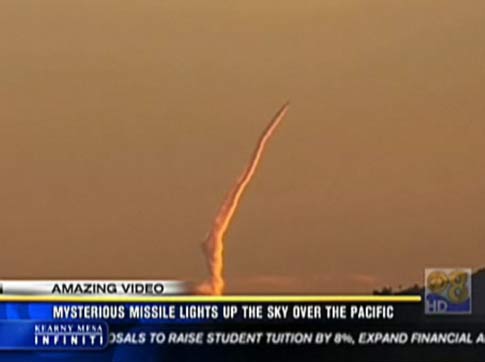
Jon Stewart is just soooooooo hilarious, as he mocks the whole missile launch controversy:
Huffington Post article and video of the man himself.
NYPost weighs in here.
Science lesson from a hack:
Time magazine blog.
Physics, it turns out, can get in the way of a good story. After all, the earth is round, which can make horizontal contrails look vertical on the horizon. For an explanation of what actually appears to have happened, see here. This so-called “missile” was likely a flight from Honolulu to Phoenix, or a UPS cargo flight.
I notice one innocuous word, likely.
As in we don’t know still what the hell it was.
But wait, we now have official word from the Pentagon, hot off the presses.
Lets go there now and finally get the clarification we need on what it was, and to be able to act smug and laugh at the conspiracy idiots.
UPI: Military: California contrail not missile.
“There is no evidence to suggest that this is anything else other than a condensation trail from an aircraft,” said the statement from Col. Dave Lapan, acting deputy assistant secretary of defense. “As stated yesterday, NORAD and USNORTHCOM determined that there was no threat to the U.S. homeland.”
The statement does not say whether the plume came from a military, commercial, government or private aircraft.
Right.
Having a conspiracy addled brain, I am seeing here a non denial denial.
Of course there is no evidence (physical) other than the video, which can, indeed, be a contrail of a plane (or a missile).
After all, we did not get clarification on what the hell it was from the Pentagon.
But don’t fret, there was no threat, from most probably a plane – nothing to see here, go away already.
The Pentagon has spoken, TV has lampooned it, move along, move along.
…
Meanwhile, in the UK, much more saner coverage, and quoting of actual experts and not paid hack “journalists” paid to push a story:
The Telegraph, UK: Mystery ‘missile’ launch in US: the theories.
Doug Richardson, the editor of Jane’s Missiles and Rockets, said it might have been a Standard interceptor, the anti-missile weapon which is fitted to the US Navy’s Aegis guided-missile cruisers as part of the American missile defence programme.
He said: “It’s a solid propellant missile, you can tell from the efflux [smoke] but they’re not showing enough of the tape to show whether it’s staging [jettisoning its sections].”
Doug Richardson, the editor of Jane’s Missiles and Rockets.
Verdict: missile.
Robert Ellsworth, the former US Deputy Secretary of Defence, said it was “pretty big” but “not a Tomahawk” cruise missile.
He said: “It could be a test firing of an intercontinental ballistic missile from a submarine to demonstrate to Asia that we can do that.”
Robert Ellsworth, the former US Deputy Secretary of Defence.
Verdict: missile.
We have one naysayer in the article, for balance:
A more down-to-earth – and non-military – explanation was given by John Pike, director of the US-based security analyst firm globalsecurity.org.
He said: “The local station chopped up the video and so it’s hard to watch it continuously but at one place you can see it has changed course – rockets don’t do that.”
He added it was most likely to be a normal aircraft contrail which appears different in the sun: “It’s an airplane that is heading toward the camera and the contrail is illuminated by the setting sun.”
John Pike, director of the US-based security analyst firm globalsecurity.org.
Verdict: airplane.
Let me jump in and state that modern missiles, such as tomahawk (and many others) of course CAN change course, depending on their programming.
And the tomahawk is a really old technology.
One more article for good measure, the Pentagon version: our friends from the north,
The Canadian Press;
The Pentagon and NASA experts have determined that a billowing contrail seen streaking into the skies above Southern California was likely caused by an airliner and not a missile.
Defence Department spokesman Col. Dave Lapan said Wednesday that officials were satisfied it was an airplane contrail distorted by camera angle, winds and other environmental factors including a setting sun.
Military experts studied the video and talked to all government agencies that might have been involved in a missile launch and none reported having launched one, Lapan said.
The conclusion was independently supported by Al Bowers, associate director of research at NASA’s Dryden Flight Research Center in the Mojave Desert, and Patrick Minnis, a senior research scientist at NASA’s Langley Research Center in Virginia, who studies remote sensing of the atmosphere and Earth’s surface.
“A missile would look like that,” said Bowers, whose 27-year career has included stints as chief or lead engineer on such programs as the SR-71 spyplanes turned over to NASA by the Air Force.
“It could potentially have a contrail that shape,” he told The Associated Press. “(But) the motion looks a little suspect to me, and my conclusion would be that, yeah, it’s most probably an aircraft.”
A missile would look like that… indeed.
But it was not moving like a 1950’s missile, it was making corrections to its flight.
Like, for example (pure speculation on my part) a Tomahawk missile, or an anti-missile missile defense guided missile.
Again, despite hundreds of satellites in the sky, despite NASA monitoring, despite NORAD monitoring, despite air traffic controllers monitoring, we still do not know what it was.
If it was an airplane, kindly tell us what flight it was – civilian or military.
If civilian, please list the type, the flight number, the destination and its origination.
Otherwise, Jon Stewart, Time bloggers, Pentagon officials, NASA officials, americangoy are all just speculating.
A complete coincidence over this quote unquote missile launch (of course it’s a plane, just look at the picture, it’s so painfully obvious!) is that there happens to be a nearby American military complex.
globalsecurity.org (yes, John Pike’s site, quoted in this article).
The Naval Air Weapons Station, Point Mugu, operates and maintains station facilities and provides support services for Naval Air Warfare Center, Weapons Division and assigned tenants and activities.
Point Mugu is part of the Naval Air Warfare Center Weapons Division (NAWCWPNS), the Navy’s full spectrum research, development, test evaluation, and in-service engineering center for weapons systems associated with air warfare (except for anti-submarine warfare systems), missiles and missile subsystems, aircraft weapons integration and assigned airborne electronic warfare systems. NAWCWPNS also maintains and operates the air, land, and sea Naval Western Test Range Complex (NWTRC).
Readers of UNCOVERAGE.net in the “national defense arena (shall we say?)” say the U.S.S. Ronald Reagan, a Nimitz-class nuclear-powered carrier, is involved in exercises off San Diego, California right now.
A caller to the Rush Limbaugh show Wednesday morning said that he believes it was a missile launch that was likely made from the high-security “Point Mugu” Naval Base off the coast of California.
Elaine Grossman at Global Security Newswire confirms the obscure San Nicolas Island, which is part of the Naval Base Ventura County (NBVC) Point Mugu facility, is used for clandestine testing of missiles from other countries.
Of course, when you accept the government version, you must also accept the fact that the authorities have no idea what flies where over our heads in our national airspace, that NORAD, NASA, air traffic controllers, satellites, anti missile radars searching the skies for Russian, Chinese, Iranian, terrorist missiles and planes do not track objects in the sky nor do they keep records of those objects (civilian planes, missiles, military jets, etc).
Do you feel better now?
…
Look at the picture.
Isn’t it obvious it is just a plane?
If you question this official narrative, that would make you a conspiracy theorist – one of those nutters lampooned in the news media.
I mean look at the picture.
It’s obvious.
The Parcel Bomb Plot – Al-Qaeda’s Latest Christmas Gift to Israel
By Maidhc Ó Cathail | MEMO | 08 November 2010
While Al-Qaeda in the Arabian Peninsula (AQAP) may have claimed responsibility for the parcel bomb plot, it’s worth considering how this latest Yemen-linked terror scare has been a gift to their avowed enemies.
A mere two weeks before the discovery of mail bombs addressed to “two places of Jewish worship in Chicago,” Rupert Murdoch sounded prescient as he received an award from the Anti-Defamation League for his support of Israel. “The terrorists continue to target Jews across the world,” declared the media mogul in his acceptance speech. “But they have not succeeded in bringing down the Israeli government – and they have not weakened Israeli resolve.” Equating criticism of Israel with anti-Semitism, the Fox News owner smeared the growing worldwide condemnation of Israel’s rogue behaviour as an “ongoing war against the Jews.”
Benjamin Netanyahu, a frequent London house guest of Murdoch and a likely recipient of his political contributions, was quick to make hay of the foiled plot. Briefing the cabinet on his impending address to the General Assembly of the Jewish Federations of North America, the Israeli Prime Minister told them that it would be “held against the background of reports about the attempt to attack the Jewish community in Chicago.”
Linking the parcel bomb plot to some of the most iconic terrorist attacks of the post-9/11 era, Netanyahu said that “it does not matter if the target was a synagogue in Chicago or a railway station in Madrid, London, Mumbai or Bali.” Deftly associating his increasingly isolated government with the victims of those attacks, the Israeli Prime Minister proclaimed: “We are facing a growing wave of terrorism by extremist Islam.”
Netanyahu, never one prone to understatement, offered this analysis of the unsuccessful attempt to use desktop printers as terror weapons: “It is growing in the scope and brazen gall of its attacks, in the weapons with which it is arming itself, and in the sweeping objectives of the leaders of global terrorism.”
He then assured his colleagues that “one of the main issues” he would be addressing in New Orleans with American Jewish leaders was “the steps that the civilized and free world must take in order to stop this wave that threatens us all.”
Needless to say, those “steps” are unlikely to include an end to the 43-year occupation and colonisation of the West Bank or a lifting of the 4-year blockade of Gaza.
An American apologist for Israel’s self-appointed guardian of “the civilized and free world” took a similar line. Joel Pollak, a Republican candidate in the midterm elections, released a statement condemning the attempted terror attack, saying he would be spending the Jewish Sabbath in West Rogers Park “in solidarity with the people of the 9th congressional district who were the direct targets of Al Qaeda terror.” Sounding a lot like Netanyahu, Pollak attempted to rally his constituents by telling them, “We must not stop fighting to eradicate the twin evils of terror and hatred.”
Again, we can take it as read that the “terror and hatred” Americans are being urged to combat only applies to Israel’s enemies.
DEBKA-Net-Weekly, which describes itself as “the leading geopolitical newsletter,” has even attempted to implicate Israel’s current enemy number one, Iran. The next issue, for subscribers only, promises to reveal “how the al Qaeda air package plot fit [sic] into the selective partnership between Tehran and al Qaeda and homes in on the areas where their schemes dovetail.”
But how trustworthy is “the leading newsletter in this rarefied field”?
“Debka is prepared mostly by former Mossad operatives. A reliable stream of information,” Martin Peretz, the Islamophobic editor-in-chief of the staunchly pro-Israel New Republic assures us.
Ever since an Israeli firm let the Christmas Day crotch bomber “slip through” security at Schiphol Airport without a passport, a few influential voices with close ties to Israel have been instrumental in making Yemen “the new buzzword.”
Appearing on Fox News two days later, the No. 1 pro-Israel advocate and leader in Congress, Senator Joe Lieberman, announced: “Iraq was yesterday’s war. Afghanistan is today’s war. If we don’t act preemptively, Yemen will be tomorrow’s war.”
Within a week, Bruce Riedel, a senior fellow at the Saban Center in the Brookings Institution, had an op-ed in The Daily Beast titled “The Menace of Yemen.” Touting the botched Christmas Day plot as evidence of “the growing ambition of al Qaeda’s Yemen franchise,” Riedel called for “significant American support to defeat AQAP.”
Riedel’s employer, the Saban Center, is named after Haim Saban, the Israeli-American media mogul, who in 2002 pledged $13 million to found the Saban Center for Middle East Policy. Two years later, the billionaire admitted to the New York Times, “I’m a one-issue guy and my issue is Israel.”
“The US may be walking into a bit of a trap,” warns Gregory Johnsen, a Yemen expert and doctoral candidate at Princeton University’s Department of Near Eastern Studies.
That “trap” has been best described by Philip Giraldi. “America’s misguided war on terror,” Giraldi pointed out in a recent article, “is in fact a complete adoption of Israeli security paradigms without any regard for the actual threats that confront the US, making Israel’s many enemies also the foes of Washington.”
Israel must be very grateful indeed for this latest terror scare. If Al-Qaeda in the Arabian Peninsula did not exist, they might have to invent it.
Maidhc Ó Cathail is a widely published writer based in Japan.
STL = Sandbag the Lebanese
Just as Israel Intended
By RANNIE AMIRI | CounterPunch | November 5, 2010
“Thanks to Hariri’s killing, Israel was able to launch more than one project in Lebanon.”
– Major-General Amos Yadlin, former head of Israeli Military Intelligence, 27 October 2010
“I call on all Lebanese, citizens and politicians alike, to boycott [the Special Tribunal for Lebanon] and end all cooperation with its investigators … Everything they obtain reaches the Israelis. It’s enough.”
– Hezbollah Secretary-General Sayyid Hassan Nasrallah, 28 October 2010
You cannot blame Israeli intelligence officials like Amos Yadlin for being unable to contain their glee. After pulling off an operation whose blame will fall at the feet of a hated enemy, it is hard not to.
Imagine their delight too when a U.N.-sanctioned body has been so successfully co-opted as a result that it could lead to the collapse of Lebanon’s government.
Such is the case with the Special Tribunal for Lebanon (STL)—the U.N-backed court established to investigate and prosecute the perpetrators of the Feb. 14, 2005 assassination of the late Lebanese premier and billionaire Rafiq al-Hariri.
Reports indicate that the tribunal’s upcoming report will indict high-ranking Hezbollah figures in the murder. The STL’s investigation and the question of its financial support—Lebanon funds nearly half its budget—has dramatically increased tension between the country’s two major political coalitions: the Hezbollah-led, opposition March 8 alliance and the United States and Saudi-backed ruling March 14 alliance headed by the late prime minster’s son, Saad al-Hariri.
Hassan Nasrallah’s recent call for Lebanon to boycott the STL came on the heels of a visit by two (male) STL investigators and their translator to a private obstetrics/gynecology clinic in the Shia-dominated, southern Beirut suburb known as the Dahiyeh. They were apparently seeking the mobile telephone numbers of a dozen patients known to be the wives and daughters of Hezbollah officials.
The investigators did not get far. Once their presence was known, they were quickly surrounded by a torrent of angry neighborhood [residents] and driven out under a barrage of insults. The phone records they so coveted were not to be had.
Over the past two years, Lebanese authorities have uncovered multiple Israeli espionage rings operating in the country, leading to the arrest of more than 100 agents working on behalf of the Mossad. A number of them were employed in the telecommunications sector, specifically Alfa, one of country’s two mobile service providers.
As news outlets have reported, the STL is expected to rely heavily on telecom data in issuing their indictments. Despite clear signs they have been compromised by Israeli intelligence, the STL persists in collecting the tainted data, just as they tried to do at the Dahiyeh clinic.
According to the Lebanese daily As-Safir, Alfa was successfully penetrated in the July 2006 war, allowing Israel to target individuals and infrastructure in a conflict which killed 1,200 Lebanese, mostly civilians.
Yadlin: “We reformulated a large number of Israeli Mossad cells in Lebanon and created tens of new cells to serve Israel … The most important thing for us was to control the telecoms network in Lebanon, something which benefited us even more than we expected” (Al-Manar).
In an August 2010 press conference, Nasrallah made public video footage intercepted from Israeli reconnaissance planes. The aerial clips were of West Beirut’s coastline, the Feb. 14 route of Hariri’s motorcade, and the assassination site.
“We have definite information on the aerial movements of the Israeli enemy the day Hariri was murdered. Hours before he was murdered, an Israeli drone was surveying the Sidon-Beirut-Jounieh coastline as warplanes were flying over Beirut” Nasrallah said.
Statements made by Ahmad Nasrallah (no relation to Hassan), a known Israeli agent arrested in 1996, were also disclosed. At the direction of his Israeli handlers, he admitted to falsely telling Hariri that Hezbollah was planning an assassination attempt. Doing so allowed Ahmad Nasrallah to influence the path Hariri’s motorcade would take.
Israeli collaborators in Lebanon also confessed to having surveilled March 14 leaders, including (vehemently anti-Hezbollah) Lebanese Forces head Samir Geagea. Why? “This is the answer for the people asking why March 14 members were the ones who were assassinated. The answer is that Israel wants the blame to fall on Syria and Hezbollah” Nasrallah replied.
The evidence presented at the press conference was compelling but admittedly circumstantial. However, when assessed in light of Israel’s espionage networks in Lebanon—especially those operating in the sphere of telecommunications—and the matter of false witnesses (“witnesses” who initially fingered Syria for Hariri’s killing but whose testimony was later recanted once determined to have been fabricated), there is little doubt the STL investigators’ time would be better spent exploring Israeli complicity in the crime than rummaging around a women’s health clinic in the Dahiyeh.
Yadlin: “These [spies] succeeded in many assassination operations against our enemies in Lebanon. They also made great achievements in besieging Hezbollah and obliging the Syrian army to withdraw from Lebanon.”
Because it has ignored both Israel’s political and military incentives to incriminate Hezbollah (and corroborative spy testimony and video evidence), the STL and its chief prosecutor, Daniel Bellemare, are doing a great injustice to Lebanese who want to see Hariri’s killers brought to justice. Instead, they appear intent on sandbagging the truth and the stability of Lebanon … just as Israel intended.
You cannot blame Israeli intelligence officials for being unable to contain their glee.
Rannie Amiri is an independent Middle East commentator.
Most Yemenis See al-Qaeda Presence as ‘Myth’
History of Fake Attacks Cement Belief Saleh Govt Using AQAP as Excuse
By Jason Ditz | Antiwar.com | November 03, 2010
“The truth is there is no al-Qaeda.” Such a comment rarely finds currency in a nation’s popular consciousness but in Yemen, home to what the CIA calls the most dangerous of al-Qaeda’s many affiliates (al-Qaeda in the Arabian Peninsula, or AQAP), it is all too common.
For some AQAP is just a cynical excuse for the Saleh government to get increased foreign military aid from the US and others. Other Yemenis, particularly in the south, see it as an excuse to attack separatist groups that have nothing to do with international terrorism.
It isn’t naivete on the part of Yemenis, however, but a natural function of the Yemeni government’s constant use of “al-Qaeda” as a justification for attacks on separatist-linked civilians, and as a catch-all for the many different groups that have bones to pick with the Saleh regime.
Indeed AQAP appears responsible for precious little of the internal violence in Yemen, and the group’s focus on overseas targets makes it difficult to sell the idea of them being something for the Yemeni military to focus on. What few attacks they have claimed were usually clear retaliation for the government offensive, raising the inevitable question of whether the Saleh regime is simply hitting a hornet’s nest over and over and claiming a “threat” when it gets stung.
Featured Video
“Historic Russia”: The Land Putin Will Not Give Back
or go to
Aletho News Archives – Video-Images
From the Archive
How Ukraine Tortured and Slaughtered Donbass
By Kit Klarenberg | Al Mayadeen | July 11, 2024
Almost immediately after the proxy war erupted, ISIS-tier footage of the torture and murder of Russians in Ukrainian custody emerged.
On July 6th, the New York Times published an astonishing investigation: In Ukraine, Killings of Surrendering Russians Divide an American-Led Unit. The article documents in grim detail how Chosen Company, an international volunteer battalion for Kiev, routinely executes Russian prisoners of war. It is the very first mainstream admission that this practice – a brazen breach of the Geneva Conventions, and a grave war crime – is widespread among Ukraine’s fighters, both foreign and homegrown. … continue
Blog Roll
 Aletho News
- Record Oil, Empty Tanks: The UAE’s Miracle Recovery
- Burnham tackles Britain’s poverty with aggression in Yemen
- Peace in Ukraine: the easy way – or the hard way
- Trump & the Rrrrussians
- US taxpayer money laundered back through Ukraine – Musk
- Before COVID, an NIH lab chief proposed making a SARS-like bat virus more infectious
- Gates, Bourla on Trial in Netherlands Accused of ‘Great Reset’ Scheme at Vaccine Injury Hearing
- BRITAIN’S WARNING: PREPARE FOR WAR
- “Historic Russia”: The Land Putin Will Not Give Back
- How the Cambridge Analytica scandal still haunts Mark Zuckerberg
- If Americans Knew
- DAILY UPDATE: Latest essential news on Palestine, Israel, & region
- Damning report shows the media must confront its failures on Gaza
- BBC senior broadcaster speaks out on Gaza coverage
- Netanyahu vows vast West Bank invasion in response to 20-minute skirmish that left 2 Israeli soldiers and 2 Palestinian fighters dead
- Tied up and tortured: Israel using US-made electroshock weapons on Palestinian detainees
- The outsourced risk: how newsrooms rely on Gaza’s freelancers without protecting them
- Gaza bakeries forced to shut as Israel blocks flour shipments
- Gaza’s breast cancer patients face a deadly wait for treatment amid Israel’s genocide
- DAILY UPDATE: Latest essential news on Palestine, Israel, & region
- The Israel Lobby’s Changing Fortunes
- No Tricks Zone
- Two New Studies Find Thwaites Glacier Melt Cannot Be Driven By Human Activity Or A Warming Ocean
- E-Cars Reduce CO2 Emissions By Only 41% Compared To Internal Combustion Engine Vehicles
- Predictions Made By Renowned Climate Professor Over Past Decades Have Been Proven To Be Poor
- New Study Suggests Large Regions Of The Pacific Ocean Have Been Cooling For The Last 80 Years
- Germany’s Green Energy Debacle: High Energy Costs Force Kahla Porzellan to Close After 182 Years!
- New Study: 50 Years Of The Most Aggressive ‘Net Zero’ Policies Can Only Affect The Global Climate By 0.03°C
- US September “Heat” Was No Record…Many Records Set Decades Ago
- Latest European Green Energy Debacle; Portugal’s Largest Flagship Solar Park Insolvent!
- Green Energy Debacle: German Expert Professor Fritz Vahrenholt Warns Of Severe Economic And Social Consequences
- Two More Paleo Reconstructions Affirm Meters-Higher Sea Levels Across Ireland, Brazil 7000-6000 Years Ago

