Fossil Fuel Investment Has Dropped By A Third Since 2015
By Paul Homewood | Not A Lot Of People Know That | October 30, 2022
There was one chart I forgot to show from the IEA’s World Energy Outlook yesterday:

https://www.iea.org/reports/world-energy-outlook-2022
As we can see, investment in fossil fuels has fallen by a third since 2015 in terms of GDP. Part of this was due to the collapse in oil and gas prices in 2014, but undoubtedly the anti-fossil fuel agenda pursued across the West for climate reasons has had a major impact as well.
Either way, this is the real reason why prices have rocketed, not the invasion of Ukraine.
Further evidence can be found in Fig 1.3, which shows that investment has remained steady in countries without a Net Zero pledge:

The real concern is that we are only seeing the early signs of much worse to come. When the cuts in fossil fuel investment really start to bite and existing oil fields begin to dry up, there will be a catastrophic energy crisis. Shortages will be very real and prices will rise well above today’s levels, as demand stays high and we find that renewable energy simply cannot keep up with demand.
The IEA’s naively oversimplistic projections simply assume that building wind and solar farms will do the trick. But the world is a complex place and does not work like that.
The Russian invasion of Ukraine has given us a warning. We had better not ignore it.
Oxford, England proposes dystopian surveillance system that limits driving

By Ken Macon | Reclaim The Net | October 27, 2022
If the city goes through with plans, motorists might need special permits and open themselves up to more surveillance to drive through Oxford, England. The Oxfordshire County Council is considering giving permits to households that only allow them to drive through the city for 100 days per year per vehicle.
To implement the plan, ANPR (automatic number plate readers) cameras will be installed at “traffic filter” locations across the city.
Private cars will not be allowed across the filters without a permit. All other vehicles, including coaches, buses, vans, taxis, mopeds, HGVs, and motorbikes will be allowed through traffic filters at all times.
Consultation for the plan ended October 13 and the council is expected to make a decision in November. If they approve the plan, it will cost £3 million ($3.48 million) to implement.
Oxfordshire County Council’s minister for highways management Andrew Grant said that the traffic filter scheme is part of a “vision for a vastly improved Oxford.”
“We want to improve lives, transport and health for the people that live and work here. We have done a lot of modeling to reach these locations and we want to encourage people to choose to use their cars less,” he added.
“This is not about being anti-car, it’s about managing the way we use our roads so that they are safe for everyone. It’s about designing Oxford for the next decades and we want to hear from everyone. I would encourage people to comment and take part in the consultation, especially people who would not normally think about going online and commenting on it.”
Some that are against the plan have voiced their opinion.
Over 3,400 people have signed a petition opposing the installation of traffic filters on Hollow Way and Marston Ferry Road.
EU approves gasoline car ban
Samizdat | October 28, 2022
 The EU has reached an agreement that would oblige carmakers to achieve a 100% cut in CO2 emissions by 2035. The measure would effectively ban the sale of new petrol and diesel-fueled cars in the bloc starting from that year. The deal was struck on Thursday between negotiators from EU member states, the European Parliament, and the European Commission, which all must agree when a new law is to be adopted within the EU.
“The European Commission welcomes the agreement reached last night by the European Parliament and Council ensuring all new cars and vans registered in Europe will be zero-emission by 2035,” the Commission said in a press release following the deal’s announcement.
The agreement also included a 55% cut in CO2 emissions for new cars sold from 2030 against 2021 levels, which exceeds the existing target of a 37.5% reduction.
EU climate policy chief Frans Timmermans said the agreement is a signal to all that “Europe is embracing the shift to zero-emission mobility.”
According to the press release, the new regulation aims “to make the EU’s transport system more sustainable, provide cleaner air for Europeans, and marks an important step in delivering the European Green Deal.”
The agreement is provisionary and now requires formal adoption by both the European Parliament and the EU Council. The timeframe for this is so far unclear.
German Energy Apocalypse Update VII
eugyppius – October 25, 2022
The only published footage of the damage to the Nord Stream pipelines, featured on my Nord Stream Conspiracy Thread, turns out to come from Expressen, a Swedish newspaper. Their reporters hired undersea drone operators and took a boat out to the site of the explosions off the island of Bornholm. There, they found a sizeable crater and 50 metres of missing pipeline. That this is how the images should have made their way to us, rather than through any official path, speaks volumes about the eagerness of Swedish authorities to suppress this story.
Protests against the insane energy policy of the German government are gathering momentum, particularly in the East; sporadic reports are even appearing in major media outlets now. This is surely one reason that the Minister President of Saxony, Michael Kretschmer, continues to stray from official CDU talking points, calling for negotiated peace in Ukraine and likening EU sanctions to a “tsunami” threatening the German economy.
Feared gas shortages are causing chaos as customers rush to change suppliers in search of better prices, or because their current contracts have been cancelled. Several municipal utilities have flatly stopped accepting new customers, but this option is not available to the so-called Grundversorger or “basic suppliers”—the utilities that supply the majority of gas in their region. These are legally bound to take all comers, and many of them are already having difficulty meeting sudden surges in demand.
Their day-to-day solvency may also soon be a problem:
[I]t is not only the procurement prices that have risen sharply, but also the interim financing costs—that is, the sum with which the municipal utilities must bridge the time from the purchase of gas to the onward sale to the customer, and to the increase in customers’ instalment payments, [an Association of Municipal Enterprises] spokesman explained. “Both together increase the liquidity needs of the municipal utilities, and this in turn affects their ability to supply customers with electricity and gas.”
Who knows how all this will play out, and what effect (if any) proposed price limits on electricity and gas will have on the markets, but I have a crazy vision of a near-future dystopia, where a minority of wealthy customers who have maintained wildly expensive contracts with alternate providers can still heat their homes, while everyone else deals with constant outages and ad-hoc rationing schemes.
Zelensky’s economic advisor has announced that he expects the Federal Republic to contribute 500 million dollars every month to Ukraine’s defence. That sounds like a lot, but we must remember that Germany’s antigen testing program, at its height, cost around a billion Euros a month. The government has pissing away money on crazy things for a long time now.
A survey of German companies, the majority of them small businesses, shows that 25% (up from 14% four months ago) are considering whether to lay off employees, and that 90% are planning to raise prices further than they already have. Almost six in ten are delaying planned investments.
“We have been seeing a creeping shift in industrial production for some time now,” says Rainer Kirchdörfer, Chairman of the Family Business Foundation [which conducted the survey]. “We will only recognise the deindustrialisation and loss of prosperity years from now, and by then it will be irreversible.”
The economic chaos has hit the chemical industry especially hard, and among the early shortages are iron and aluminium salts, crucial precipitating agents used in wastewater treatment. Four federal states have already relaxed their rules on water purification. Chemicals necessary for the treatment of drinking water are also increasingly scarce.
Can’t we just increase our production of biogas to end our dependence on Russia and save the climate at the same time, asks the drooling knuckle-dragging morons at Westdeutscher Rundfunk ?
Overall, the share of biomethane in the German gas market could triple, according to a study by the German Biomass Research Centre in Leipzig. The Capital Bioenergy Office says in a statement that biogas plants could offset about 4 percent of Russian natural gas imports in the short term. It also says it is possible for biogas to provide 46% of the electricity from gas-fired power plants.
So, if we put all of our grain into power production, we have the prospect not only of freezing to death, but of starving to death too. I’m glad state media are investigating this promising angle.
Finally, Business Insider has discovered that the real victims of the gas crisis won’t be young children in fragile health or elderly pensioners on fixed incomes, but female professionals. Ordinances requiring offices to set thermostats at 19C, according to some garbage study, will cognitively disadvantage women, while (even worse) advantaging men, who bizarrely are alleged to perform their best at this precise temperature. Happily, though, Tagesschau has consulted Dr. Georg Ertl from University Hospital at Würzburg, who believes this unfortunate sexism, brought upon us by the furtherance of liberal democracy, can be countered by … caps and stockings.
The EU’s energy security now rests in Turkey’s hands
Europe has sought to bypass Russian gas with disastrous results. Turkey is set to reap the benefits.
By Karin Kneissl | The Cradle | October 24 2022
“Geography is the constant of history,” is a quote attributed to the German statesman Otto von Bismarck. Today, those words ring true as we witness geography altering global politics, finance, and alliances.
The geostrategic importance of Turkey has rarely been as clear to European politicians as it has been in recent months, as the continent grapples with a burgeoning energy crisis this coming winter.
Whether it is grain exports from the Black Sea region or the flow of energy supplies from the eastern producing countries, the Bosphorus and the links to Eurasia are once again playing a decisive geopolitical role, as they so often have throughout history. The fact is, Turkey is now crucial for the security of Europe.
Pipeline politics
On the occasion of Turkish President Recep Tayyip Erdogan’s meeting with his Russian counterpart Vladimir Putin in Sochi at the beginning of August 2022, the focus was mainly on bilateral cooperation in energy matters.
Putin told journalists after the tete-a-tete that Europeans should be grateful to Ankara for its gas supplies due to the reliability of the TurkStream pipeline.
Last year, Russian natural gas accounted for around 45 percent of European gas imports. But that share has fallen to less than 10 percent after supplies were halted via the eastbound Yamal-Europe pipeline and suspected US-backed operatives blew up Nord Stream, which also curtailed exports via Ukraine.
The Russian-Turkish TurkStream gas pipeline project was announced in December 2014 after Moscow realized that the long-planned SouthStream project – meant to deliver Russian natural gas via the Black Sea directly to European Union (EU) member state Bulgaria – was not feasible.
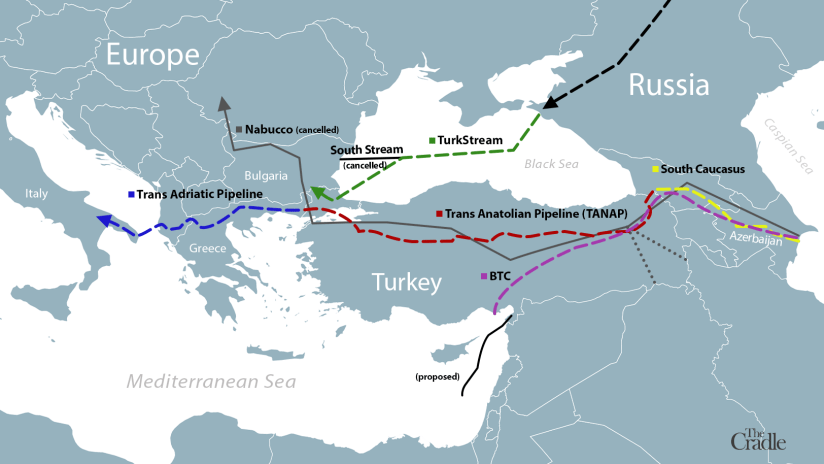
Russian energy giant Gazprom and the Italian energy company ENI were the main partners in the consortium. However, following the Crimean crisis in March 2014, the EU Commission blocked this major infrastructure project, citing competition rules.
As far as Moscow was concerned, this arrangement had already been completed in the form of terminals and pipeline routes. Thousands of work contracts had been issued between Bulgaria and Hungary at the time.
Construction was scheduled to begin in June 2014, but Brussels alluded to apparent violations of competition rules in the awarding of contracts by the Bulgarian authorities and brought everything to a halt.
Turkey as a Russian energy hub
Nine months later, during a joint press conference with Erdogan in Ankara, Putin remarked that “If Europe does not want to carry it out, then it will not be carried out.” Putin then announced the TurkStream project, which was formally launched in early 2020.
One pandemic and a war later, the world has experienced and continues to experience rising natural gas prices, while Russian-Turkish energy cooperation is intensifying. On 19 October, Erdogan said he had agreed with Putin to set up a comprehensive hub for Russian natural gas built in Turkey from where Europe could meet its energy needs.
“If Turkey and our potential buyers are interested, we could consider building another gas pipeline and creating a gas hub in Turkey for sale to third countries, especially in Europe,” Putin proposed. In addition, a gas exchange could also be created in Turkey to determine prices, he added.
Neither the EU nor the US have welcomed these developments or, in some cases, faits accomplis. Turkey makes no secret of the fact that it wants to expand its status in the China-led Shanghai Cooperation Organisation (SCO) and will probably soon become the tenth member of this important regional organization.
It should be noted that the SCO’s statutes stipulate energy and security – especially the fight against terrorism – as its essential agenda. The EU, it must be said, is only just discovering the importance of these issues.
Attempts to bypass Russian gas
In the recent past, governments and energy companies have looked to Turkey as an alternative to the existing transit routes for oil and gas between the east and west. In 2005, the 1750 km long Baku-Tbilisi-Ceyhan (BTC) pipeline was opened, transporting Caspian oil across the Caucasus to the Turkish Mediterranean port.
Crucially, this route had the backing of Washington, reinforcing the close connection between politics and the oil business. As per an apt saying from the early 20th century US oil industry: “The oil business is too important to leave it to the oil people.”
The Nabucco pipeline project, intended to reduce Europe’s reliance on Russia’s gas, consisted of a consortium of six corporations based on the initiative of the Austrian partly state-owned OMV. The project was supported politically and financially by the European Commission, with the premise being that natural gas would be supplied from the Caspian region via Turkey to Central Europe to the Baumgarten hub in Austria.
Billions were spent on marketing this project between 2002 and 2014. However contractual agreements surrounding the deal never materialized. Though inconceivable now, Iran was also initially planned as an alternative supplier, yet these efforts failed from 2005 onwards due to UN Security Council sanctions on Iran from 2008 until the present.
Additionally, supply contracts with Iraq and Turkmenistan were targeted in vain, although these arguably had a lot to do with complete mismanagement. In the case of Turkmenistan, countless advisory opinions were commissioned on the status of the Caspian Sea under international law, sea, or lake, and the possible transit pipelines for landlocked Turkmenistan.
A failed strategy
After many years of mere marketing and a lot of hot air between Brussels and Vienna around the Nabucco project, OMV’s partners finally backed out in 2014. It was clear that there was no natural gas available.
In my book “Der Energiepoker” (The Energy Poker) I wrote in 2006: “If the managers had not gone to the State Opera to see Verdi’s Nabucco, but had seen the operetta by Johann Strauss “Wiener Blut” (Viennese Blood), then this natural gas pipeline would have been given a more appropriate name.
Now, in view of the Nord Stream 2 pipeline boycotted by the EU, OMV is facing further setbacks, as the contracts with take-or-pay clauses were drafted in such a way that payment would have to be made for the Russian natural gas, even if there was no physical delivery. These conditions apparently apply until 2040.
EU will buy Russian energy indirectly
While the EU wants to bypass Russian energy sources for political reasons, Turkey, India, and China, among others, will gladly fill in the consumer void. As described, Turkey already benefited in 2014 from the SouthStream project, which became TurkStream. The EU ultimately lost out, while Ankara stood to gain, with the EU presently buying Russian natural gas via Turkey.
This energy route is set to expand even further once the Russian natural gas hub in Turkey is established. Turkey thus becomes the safeguard of the EU’s energy security. While this was the case a few years ago with non-Russian natural gas and oil, it now looks as if Russia is merely adapting its role for the European market on a regional basis.
For some years, Ankara aligned its prospective role as a hub for BTC and the Nabucco project with its EU accession ambitions. Now it seems that Turkey will become a member of the SCO much faster, and despite its NATO membership, part of the security cooperation with Russia and China.
The EU is more dependent than ever on the goodwill of those it once created obstacles for, and Turkey and Russia are no exception. The coming months will show with all their force just how irresponsibly the EU governments handled the continent’s energy security needs.
Von der Leyen presented with Great Reset award
The Bill & Melinda Gates Foundation has singled out Ursula von der Leyen for her “extraordinary commitment” to the UN Sustainable Development Goals
Free West Media | October 23, 2022
The Gates Foundation named Von der Leyen as one of the four winners of the so-called Goalkeepers Global Goals Awards. The other winners are Radhika Batra, co-founder of Every Infant Matters; Zahra Joya, a journalist from Afghanistan; and Vanessa Nakate, a climate activist from Uganda.
Until recently, the World Economic Forum’s Great Reset was called a conspiracy theory. This week, the EU Commission president received an award for her commitment to the same Great Reset.
The award ceremony, presented by Bill Gates and his ex-wife Melinda French Gates, was not supposed to be satire: Von der Leyen was praised for her role in the purchase and distribution of Corona vaccines. Her husband Heiko, is the director of Orgenesis, which is owned by Pfizer – the same company that Ursula signed a secret 71 billion euro contract with.
“It is a great honour to receive this award,” the EU boss said. She dedicated the award to the millions of Europeans who “helped us all get through the pandemic”. “From the scientists, who developed the life-saving vaccines, to the healthcare workers on the frontline. This award is also for them.”
Meanwhile the European Public Prosecutor’s Office has launched an investigation into the EU’s procurement of Corona vaccines. There has long been criticism of the secrecy surrounding the European Commission’s billion-dollar contracts with vaccine maker Pfizer.
And Von der Leyen has refused to clarify her negotiations with Pfizer boss Albert Bourla.
Russia’s homage to Nord Stream pipelines
BY M. K. BHADRAKUMAR | INDIAN PUNCHLINE | OCTOBER 22, 2022
David Brinkley, the legendary American newscaster with a career that spanned an amazing fifty-four years from World War II once said that a successful man is one who can lay a firm foundation with the bricks others have thrown at him. How many American statesmen ever practised this noble thought inherited from Jesus Christ remains doubtful.
Russian President Vladimir Putin’s stunning proposal to Turkish President Recep Erdogan to build a gas pipeline to Turkiye to create an international hub from which Russian gas can be supplied to Europe breathes fresh life into this very “Gandhian” thought.
Putin discussed the idea with Erdogan at their meeting in Astana on October 13 and since spoke about it at the Russian Energy Week forum last week where he proposed creating the largest gas hub in Europe in Turkey and redirecting the volume of gas, the transit of which is no longer possible through the Nord Stream, to this hub.
Putin said it may imply building another gas pipeline system to feed the hub in Turkiye, through which gas will be supplied to third countries, primarily European ones, “if they are interested.”
Prima facie, Putin does not expect any positive response from Berlin to his standing proposal to use the string of the Nord Stream 2, which remained undamaged, to supply 27.5 billion cu. metres of gas through the winter months. Germany’s deafening silence is understandable. Chancellor Off Scholz is terrified about President Biden’s wrath.
Berlin says it knows who sabotaged the Nord Stream pipelines but won’t reveal it as it affects Germany’s national security! Sweden too pleads that the matter is far too sensitive for it to share the evidence it has collected with any country, including Germany! Biden has put the fear of God into the minds of these timid European “allies” who have been left in no doubt what is good for them! The western media too is ordered to play down Nord Steam saga so that with the passage of time, public memory will fade away.
However, Russia has done its homework that Europe cannot do without Russia gas, the present bravado of self-denial notwithstanding. Simply put, the European industries depend on cheap, reliable supplies of Russian gas for their products to remain competitive in the world market.
Qatar’s energy minister Saad al-Kaabi said last week that he cannot envisage a future where “zero Russian gas” flows to Europe. He noted acerbically, “ If that’s the case, then I think the problem is going to be huge and for a very long time. You just don’t have enough volume to bring (in) to replace that (Russian) gas for the long term, unless you’re saying ‘I’m going to be building huge nuclear (plants), I’m going to allow coal, I’m going to burn fuel oils.’”
Quintessentially, Russia plans to replace its gas hub in Haidach in Austria (which Austrians seized in July.) Conceivably, the hub in Turkiye has a ready market in Southern Europe, including Greece and Italy. But there is more to it than meets the eye.
Succinctly put, Putin has made a strategic move in the geopolitics of gas. His initiative rubbishes the hare-brained idea of the Russophobic European Commission bureaucrats in Brussels, headed by Ursula von der Leyen, to impose a price cap on gas purchases. It makes nonsense of the US’ and EU’s plans to put down Russia’s profile as a gas superpower.
Logically, the next step for Russia should be to align with Qatar, the world’s second biggest gas exporter. Qatar is a close ally of Turkey, too. At Astana recently, on the sidelines of the summit of the Conference on Interaction and Confidence-Building Measures in Asia (CICA), Putin held a closed-door meeting with the Emir of Qatar Sheikh Tamim bin Hamad Al Thani. They agreed to follow up with another meeting soon in Russia.
Russia already has a framework of cooperation with Iran in a number of joint projects in the oil and gas industry. Russian Deputy Prime Minister Alexander Novak recently disclosed plans to conclude an oil and gas swap deal with Iran by the end of the year. He said that “technical details are being worked out – issues of transport, logistics, price, and tariff formation.”
Now, Russia, Qatar and Iran together account for more than half of the world’s entire proven gas reserves. Time is approaching for them to intensify cooperation and coordination on the pattern of the OPEC Plus. All three countries are represented in the Gas Exporting Countries Forum (GECF).
Putin’s proposal appeals to Turkiye’s longstanding dream to become an energy hub at the doorstep of Europe. Unsurprisingly, Erdogan instinctively warmed up to Putin’s proposal. Addressing the ruling party members in the Turkish parliament this week, Erdogan said, “In Europe they are now dealing with the question of how to stay warm in the coming winter. We don’t have such a problem. We have agreed with Vladimir Putin to create a gas hub in our country, through which natural gas, as he says, can be delivered to Europe. Thus, Europe will order gas from Turkey.”
Apart from strengthening its own energy security, Turkiye also can contribute to Europe’s. No doubt, Turkiye’s importance will take a quantum leap in the EU foreign policy calculus, while also strengthening its strategic autonomy in regional politics. This is a huge step forward in Erdogan’s geo-strategy — the geographic direction of Turkish foreign policy under his watch.
From the Russian viewpoint, of course, Turkiye’s strategic autonomy and its grit to pursue independent foreign policies works splendidly for Moscow in the present conditions of western sanctions. Conceivably, Russian companies will start viewing Turkiye as a production base where western technologies become accessible. Turkiye has a customs union agreement with the EU, which completely removes customs duties on all industrial goods of Turkish origin. (See my blog Russia-Turkey reset eases regional tensions, Aug 9, 2022)
In geopolitical terms, Moscow is comfortable with Turkiye’s NATO membership. Clearly, the proposed gas hub brings much additional income to Turkiye and will impart greater stability and predictability to the Russia-Turkey relations. Indeed, the strategic links that tie the two countries together are steadily lengthening — the S-400 ABM deal, cooperation in Syria, the Akkuyu Nuclear Power Plant, Turk-stream gas pipeline, to name a few.
The two countries candidly admit that they have differences of opinion, but the way Putin and Erdogan through constructive diplomacy keep turning adverse circumstances into windows of opportunity for “win-win” cooperation is simply amazing.
It does need ingenuity to get the US’ European allies to source Russian gas without any coercion or boorishness even after Washington buried the Nord Stream gas pipelines in the depths of the Baltic Sea. There is dramatic irony that a NATO power is partnering Russia in this direction.
The US foreign policy elite drawn from East European stock are rendered speechless by the sheer sophistication of the Russian ingenuity to bypass without any trace of rancour the shabby way the US and its allies — Germany and Sweden, in particular — slammed the door shut on Moscow to even take a look at the damaged multi-billion dollar pipelines that it had built in good faith in the depths of the Baltic Sea at the insistance of two German chancellors, Gerhard Schroeder and Angela Merkel.
The current German leadership of Chancellor Olaf Scholz looks very foolish and cowardly – and provincial. The European Commission’s Ursula von der Leyen gets a huge rebuff in all this which will ultimately define her tragic legacy in Brussels as a flag carrier for American interests. This becomes probably the first case study for historians on how multipolarity will work in the world order.
EU parliament wants to give up both Nord Stream pipelines: “Nord Stream” to be abolished
Establishment parties vote for doom in Brussels
FRONT NIEUWS | October 15, 2022
It should now be official. Nord Stream 1 and 2 are not repaired. Last week the EU parliament already voted on the further procedure with the two pipelines. Without much ado they simply decided to abandon the project, with the CDU/CSU, SPD, Greens, FDP and Free Voters voting in favour. This means: a further rise in gas prices and further deindustrialization of Germany and Europe, reports Wochenblick.at.
Europe on its way to the abyss
Germany, Austria and all of Europe are suffering from the suicidal sanctions against Russia. The industry goes bankrupt or migrates to the US, which lures German entrepreneurs with cheap energy and good conditions, traditional companies that have already survived economic crises and two world wars will not survive the impoverishment program of the system. The fate of Germany as one of the most important industrialized countries is thus sealed.
This vote shows very clearly that the old parties are simply not interested in promoting the interests of their own country, and even of Europe. They have opened the door to ever-increasing poverty and stabbed their own citizens in the back.
Bernhard Zimniok, MEP of the AfD, reported in a video about the vote and the attempted cover-up by Brussels:
Europe Reloaded – Heartfelt thanks to journalist and ER contributor Michel van der Kemp for producing a translation of the video:
Hello from Brussels. Last week, the EU Parliament voted on a motion to finally give up Nord Stream 1 and 2. In doing so, the EU Parliament made a mistake that was very helpful to us:it accidentally initiated a roll-call vote instead of an electronic vote, which nobody noticed at first and which the EU Assist website, which documents all voting results, has therefore recorded on its site. On the one hand, an electronic vote means that it is known exactly how many votes were cast for or against a motion or how many abstained. But it also means that the election takes place more or less anonymously, because no member of parliament has to raise their hand, they just press a button. A roll-call vote is practically the opposite: It is documented exactly which member of parliament voted and how. When the administration realized their mistake and changed it on their website, the child had already fallen into the well, because EU Assist documented exactly who voted and how. Of all the German MPs, only the three non-attached, one from the SPD, the left and of course we from the AfD voted against giving up Nord Stream 1 and 2. The Greens, FDP, Freier Wahler (Free Choice), CDU/CSU and all but one of the SPD MPs voted to finally abandon Nord Stream 1 and 2 and thus voted for the fact that gas prices will continue to rise and that we may soon run out of gas, so voting for potential blackouts and cold apartments. Anyone who supports these parties is calling for a loss of prosperity and the collapse of the German economy, indeed of the entire country. Only the AfD makes politics for Germany!
The “creative” destruction of Europe
The future impoverishment of Germany and all of Europe is probably entirely in the interest of those forces who have [in mind] something very different for the world. With the destruction of the European continent, the breeding ground for the Great Reset has been created. The peoples have been disintegrated and fragmented by mass migration, the economy is virtually non-existent, the population is impoverished and destitute.
“You will own nothing” is one of the dogmas of the future, which the WEF has put into circulation. No one will voluntarily surrender his property, and taking it is not possible without arousing the resentment of the people. This is different in the event of a major crisis, perhaps even a war, where in the end – except for a few – no one is left with anything. A dystopian “brave new world” can be built on such a foundation.
After the end of “Nord Stream” one no longer has to face the unpleasant question of who is responsible for the terrorist attack on the pipelines.
EU’s LNG storage space runs out as Brussels braces for winter without Russian gas
By Drago Bosnic | October 14, 2022
The European Union’s self-imposed energy crisis is taking a turn for the worse. The political elites in Brussels and their suicidal subservience to Washington DC is breaking records day by day. The latest energy hurdle the bloc is facing is a chronic lack of transport ships carrying liquefied natural gas (LNG) from the United States to EU countries. According to Bloomberg, as the bloc is trying to prepare for a winter without Russian natural gas and other crucial commodities, LNG shipping rates are surging, but this will not be enough to meet the EU’s energy needs this season. The report states that European countries are now paying to keep the LNG transport ships loaded with natural gas in ports as onshore LNG storage facilities are full.
As companies are racing to charter entire fleets of LNG transport ships, there is a growing fear that there will not be enough vessels capable of transporting natural gas from the US. This problem is further exacerbated by those ready to pay for the already-loaded ships to stay in ports. Gas Market Report by the International Energy Agency (IEA), released on October 3, states that the demand for LNG in EU member states surged by 65% for the first three quarters of 2022 when compared to the same period last year.
In the aftermath of anti-Russian sanctions, the EU was forced to import less from Russia. According to OilPrice.com, in June, the bloc imported more natural gas from the US than from Russia for the first time in its history. A Reuters report claims that up to 70% of US LNG exports were sent to the EU in September, which was a 7% increase in comparison to August. In the meantime, countries in East Asia and South America are also trying to acquire more natural gas in preparation for the winter season, which is adding even more pressure on shipping companies. Worse yet, US states in New England, which are dependent on LNG imports, are now forced to compete with EU buyers, which further drives up prices, according to Seeking Alpha.
The October 11 report published by Bloomberg states that the cost to charter a transport ship loaded with LNG and set to sail across the Atlantic Ocean rose to $397,500 per day. This new record for Atlantic LNG shipping rates represents an increase of over 6% in less than a week, as the previous record of $374,000 per day was set on October 3. However, to better understand just how mind-boggling the shipping prices are now, it’s better to compare on a yearly basis. In 2021, the Atlantic LNG freight rate was $91,000 per day. With the newest record, which has very likely already been topped, this is an increase of over $306,500 per day, or 337%, and an approximately 500% increase since January 2022, according to Spark Commodities.
The LNG shipping price assessor reports that this broke the 2021 all-time record high for the Pacific Ocean freight rates which happened at the height of the supply chain crisis. The price is expected to surge further as traders are hoarding even more natural gas. The scramble to buy more LNG and charter additional transport ships to carry it is very likely to create the next big shortage in the energy market, experts and traders agree.
The shortage has become so severe that LNG exporters in Asia are now selling natural gas directly from their ports instead of offering to ship it to buyers. However, many buyers lack LNG shipping vessels of their own and are forced to pay exorbitant prices to get natural gas to their own ports, while in some cases they can’t even find a way to transport the LNG they already paid for. According to LNG traders, there are very few transport ships left to charter for the rest of 2022 and they are charging astronomical rates.
The shipping issues for LNG are a clear indicator that pipelines have no viable alternatives. However, with NATO countries and satellite states being involved in sabotage operations against Russia-EU pipelines, be it through sanctions or terrorist acts such as the Nord Stream 1 and 2 explosions, Brussels is now forced to contend with both US LNG producers and freight companies and their exorbitant prices.
There’s growing frustration in the EU as it is painfully obvious that the US is making astronomical profits thanks to the escalation of tensions between Brussels and Moscow. Global demand for LNG transport vessels is driving freight rates even higher, which will make pipelines even more important. The EU will have a clear choice – either come to an agreement with Russia and stop acts of sabotage or continue paying several times more for LNG and brace for certain shortages as storage space runs out.
Drago Bosnic is an independent geopolitical and military analyst.
Carbon proles ruled by carbon kings: Welcome to Planet Schwab
By David Craig | TCW Defending Freedom | October 12, 2022
In his 2020 book The Denial , journalist Ross Clark describes a dystopian future in which everything we buy or do has a carbon (CO2) value and each household or individual has a maximum allowance to use each month. Only the elite have no restrictions.
Now, disturbingly, it looks like that fiction is edging closer to becoming fact – as outlined in an article by Klaus Schwab’s World Economic Forum entitled My Carbon: An approach for inclusive and sustainable cities.
The writers, Kunal Kumar and Mridul Kaushik, see the ground for a carbon-controlled future as having been laid by what happened during the pandemic, and how willingly we submitted to the Project Fear clampdown on our freedoms.
‘A huge number of unimaginable restrictions for public health were adopted by billions of citizens across the world,’ they say. ‘There were numerous examples globally of maintaining social distancing, wearing masks, mass vaccinations and acceptance of contact-tracing applications for public health.’
They claim that our caving in to Covid dikats ‘demonstrated the core of individual social responsibility’. But perhaps all it really demonstrated is how bullying authorities, using Project Fear backed up by heavy-handed policing and mainstream media panic-peddling, coerced us into abject, cowering submission.
In a section on ‘The Fourth Industrial Revolution’, the authors discuss how advances in emerging technologies, such as artificial intelligence, blockchain and digitisation, can enable tracking personal carbon emissions – one being a smartphone app. There are ‘a significant number of programs and applications enabling citizens to contribute towards carbon emissions by providing them in-depth awareness on the choices of personal carbon for food, transport, home energy and lifestyle choices.’
Perhaps most chilling is a proposed model showing how our rulers plan to control our individual carbon usage. It falls into three main approaches:
Economic Behaviour: The price of carbon will increase so ordinary people will eat less, heat their homes less, buy fewer products and restrict their travel.
Cognitive awareness: We will have to monitor our personal ‘carbon footprints’ so we can reduce our usage as part of the transition to a Net Zero society. This will cover most areas of everyday life.
Social norms: We will all be given fixed allowances of what are called a ‘fair share’ and ‘acceptable levels’ of personal emissions, which will be set by the ruling elites.
However, there is one part of this wonderful carbon-controlled future the WEF article doesn’t mention. I suspect the allowances scheme will include a carbon trading facility. This will allow ordinary people to sell parts of their allowances to companies which will sell them on to the political, business and media elites.
This will ensure the privileged can continue to live lives of unrestricted luxury with unlimited travel, the most expensive foods and other life pleasures. Meanwhile, the rest of us are likely to be huddling in our tiny, barely-heated homes, eating locally-grown potatoes, cabbage, insects or lab-produced fake meat.
It’s a grim picture. But perhaps we should be grateful to Klaus Schwab and his cohorts for so clearly describing the future they are preparing for us.
Saskatchewan drafting legislation to protect economic autonomy
By Jorgen Soby | The Counter Signal | October 12, 2022
Saskatchewan Premier Scott Moe has begun drafting Alberta-style Sovereignty Act legislation.
Moe says it’s time to defend and assert Saskatchewan’s economic autonomy by “drawing the line.” He wants to take several steps, including introducing provincial legislation to clarify and protect Saskatchewan’s constitutional rights.
The proposal would give the province exclusive use over their resources like electricity and any emissions associated with fertilizer, oil and gas.
Like all provinces, Saskatchewan has exclusive areas of jurisdiction under the Constitution, but Moe’s government is accusing the Trudeau Liberals of infringement.
“Saskatchewan is taking action to unlock our economic potential and defend Saskatchewan’s economy, families and jobs from federal intrusion that could cost our province as much as $111 billion by 2035,” Moe wrote on Twitter.
According to the Saskatchewan government, new climate change policies could cost the province over $110 billion within the next thirteen years.
The Alberta government called proposed federal environmental laws a “Trojan Horse.”
Chief of Justice Catherine Fraser, who spent 30 years serving as the Chief of Justice for Alberta, described the proposal as an unconstitutional legislative scheme. Fraser retired shortly after providing her statement.
Saskatchewan’s SaskPower says the Canadian federal government proposed Clean Electricity Standard is not achievable.
While the Canadian government has debated additional energy costs, many EU countries face an ongoing energy sector supply crisis. Some people in Scotland have been burning their energy bills to protest aggressive energy price increases. Law enforcement in France has been refusing gas station access to some citizens.
Featured Video

The Source of America’s Wars – Kristol Clear
or go to
Aletho News Archives – Video-Images
From the Archives
Is Israel to blame for the Iraq War?
American Goy | March 10, 2008
I am so tired of this old canard that “Israel had nothing to do with USA’s war with Iraq – in fact, it officially advised America against it”.
Bullshit. … continue
Blog Roll
 Aletho News
- Ceasefire for all or for none: Iran shuts Hormuz over Lebanon attacks
- Strait of Hormuz is Iran’s ‘nuclear weapon’ that forced US retreat: Medvedev
- Energy crisis will last for months – Kremlin envoy
- Europe’s quiet role in the war on Iran
- Forty days that shook the Empire: How Iran turned the tables on US and prevailed
- Netanyahu unilaterally declares Lebanon outside of ceasefire deal
- Israeli leaders: ‘Not a single goal’ achieved in war with Iran
- What on earth just happened? Trump, Iran, and the unlikely ceasefire
- Alberta Bill Would Fine Political Deepfakes $10,000 Without Satire Exemptions
- Iran declares ‘historic victory’ over US, says enemy forced to accept its proposal
- If Americans Knew
- Gazans face a triple crisis: severe shortages of water and bread, healthcare in tatters
- NY Times reports how Netanyahu took the US into Iran War
- A sigh of relief over Iran, but Gaza and Lebanon in dire straits – Daily Update
- Thousands dead and neighborhoods razed to the ground: Aid agencies fear southern Lebanon is becoming the new Gaza
- The war the US is fighting for Israel could cost trillions
- ‘Cigarette Burns, Nail Wounds’: Toddler Tortured in Gaza to Coerce Father
- Trump Says US Sent ‘a Lot of Guns’ to Protesters in Iran
- Israeli forces destroy 17 UN peacekeeper cameras in south Lebanon
- US-Israeli strikes ‘completely destroy’ synagogue in Tehran
- Archbishop for US Military Says Iran War Is Unjust Under Catholic Teaching
- No Tricks Zone
- An Inconvenient Tree: Uncovered In Alps… Europe Much Warmer Than Today 6000 Years Ago
- New Study Reports A 60% Slowdown In Greenland’s Ice Loss Rate In The Last Decade
- Low Intensity Tornado Wrecks Major Solar Farm, Creating A Potential Toxic Dump
- New Study Finds Warming Saves Lives…Cold Temperatures 12 Times More Deadly Than Excess Heat
- German Science Blog Accuses PIK Climate Institute Of Hallucinating Climate Tipping Points
- Devastating Assessment Of Comirnaty Vaccine By Former Senior Pfizer Europe Toxicologist
- New Study: CO2 Is ‘Effectively Negligible’ As An Explanatory Climate Change Factor Since 2000
- Former Pfizer Toxicologist Dr. Helmut Sterz Tells Bundestag Hearing Pfizer Vaccine Should Have Never Been Approved
- Energy Expert: Germany’s Nuclear Phaseout Was A “500 Billion Euro Mistake”
- New Research: South Australia’s Mid-Holocene Sea Surface Temperatures Were 4°C Warmer Than Today
 Aletho News