India Cancels Offshore Wind Tender–Due To Lack Of Interest
By Paul Homewood | Not A Lot Of People Know That | August 13, 2025
Now India is losing interest in offshore wind.
Renewablesnow report:
The Indian government has cancelled the process to allocate sea-bed lease rights for a total of 4,500 MW of offshore wind projects, it was announced on Tuesday.
While SECI itself did not state a reason for the decision in its announcement, The Economic Times quoted two sources as saying that there was a lack of interest among project developers. …
This follows Trump’s US move away from offshore wind and the lack of bidders at Germany’s offshore auction last week.
Meanwhile Orsted have had to launch a massive $9.4 billion Share Rights Issue, largely because of huge losses on offshore wind projects.
It seems that it is only the UK where anybody wants to build wind farms at sea, but only because of the obscene subsidies on offer.
NO WOODS, NO MEAT, NO FREEDOM
The HighWire with Del Bigtree | August 14, 2025
Unusually dry summer conditions on Canada’s Atlantic coast have prompted two provinces to take the unprecedented step of banning hiking, camping, and even walking in the woods in a bid to prevent forest fires. Learn about other alarming measures being floated in the name of climate change—from ticks that can trigger a meat allergy to proposals for calculating the carbon footprint of every medical procedure to determine its “importance.”
The Future of Food
corbettreport – August 10, 2025
Use these links to watch it somewhere else!
WATCH ON:  /
/  /
/  /
/  /
/  /
/  or DOWNLOAD THE MP4
BP Reopen “Uneconomic” North Sea Oil Field
By Paul Homewood | Not A Lot Of People Know That | August 10, 2025
From the Telegraph :
BP is to reopen a key North Sea field and pump new oil and gas for at least a decade, despite Ed Miliband’s attempts to cut back the offshore industry.
The energy giant is reviving the Murlach field, which was declared uneconomic and taken out of use in 2004, has now become viable partly due to new technologies.
BP won agreement to reopen Murlach, 120 miles east of Aberdeen, under the previous government and has since been installing equipment, with production potentially restarting next month.
The milestone comes despite efforts by the Energy Secretary to bring an end to new fossil fuel production in the North Sea. Mr Miliband and his predecessors have almost doubled the taxation rate on oil and gas profits and banned the issuing of licences for new exploration and production.
BP said the Murlach field contained 20 million barrels of recoverable oil and 600 million cubic metres of gas – enough to keep it in production for 11 years. “Murlach is expected to produce around 20,000 barrels of oil and 17 million cubic feet of gas per day,” it said.
It means BP can partially reverse the decline in North Sea output, which has seen oil production fall from 96,000 barrels per day in 2020 to 70,000 last year. Gas production has fallen from 221m square feet a day to 197m. … Full story here.
What is significant is here is the introduction of new technologies to make all this possible. How many other abandoned fields can be brought back into production in this way.
Naturally Greenpeace are not happy, with Doug Parr saying “The North Sea is on death’s door. Reserves are drying up and what’s left and untapped is barely enough to keep it on life support. The only sensible thing to do is to pivot [from] the North Sea to something we have an abundance of, and something that will never run out – wind.”
But Mike Tholen, of trade body Offshore Energies UK, commented:
“Redevelopment of decommissioned fields is now a feature of the North Sea as new and innovative technologies make such opportunities possible.
“Looking ahead, the independent Climate Change Committee says the UK will need 13 billion to 15 billion barrels by 2050 come what may. We could produce half of this at home. But at the moment only four billion barrels are on track to be realised, which means imports will have to rise and the UK economy will miss out as jobs and capital move overseas.”
In what world, other than crazy Ed’s, would it make sense to import that oil and gas when we could produce it ourselves at great benefit both to the economy and government revenues?
EPA Finally Proposes To Rescind The Endangerment Finding
By Francis Menton | Manhattan Contrarian | July 29, 2025
It’s been a long time coming. But today the EPA, through its Administrator Lee Zeldin, finally began the formal process of rescinding the so-called “Endangerment Finding” (EF). The EF is the 2009 regulatory action by which the Obama-era EPA purported to determine that CO2 and other greenhouse gases constitute a “danger to human health and welfare.” That Finding then formed the basis for all subsequent federal greenhouse gas regulations, including efforts of Obama and Biden regulators to force the closure of all power plants running on coal and natural gas, and to mandate increased vehicle mileage to levels that no internal combustion engine could meet.
EPA initiated the rescission process today by means of an announcement in a speech by Zeldin, who appeared at an event in Indianapolis, and also through this document, titled “Reconsideration of 2009 Endangerment Finding and Greenhouse Gas Vehicle Standards.” The document looks to be about a couple of hundred pages long, although it’s hard to know exactly, because the pages aren’t numbered.
Long time readers here will know that I have been an active participant in efforts, beginning when President Trump first took office in 2017, to get the EF rescinded. Immediately after Trump’s inauguration in January 2017, co-counsel Harry MacDougald and I filed a Petition to EPA, on behalf of the Concerned Household Electricity Consumers Council (CHECC), seeking the rescission. Here is a post I wrote in April 2017, describing the initiation of the petition process, and also linking to our Petition. But during Trump’s first term, despite the critical importance of the EF in supporting all of the burdensome “climate” regulations, EPA never undertook the rescission process. We continued to press the point, filing some seven supplements to our Petition during the four years of Trump’s first term. For example, here is a post from July 2017 announcing the first of the Supplements to our Petition, based on new research at the time.
Ultimately our Petition was denied in 2022 by the Biden EPA. We then appealed that denial to the DC Circuit, where our appeal was denied in 2023, and to the U.S. Supreme Court, where certiorari was denied in 2024.
Well, the proposal in today’s document will reverse the denial of our Petition. I can’t give you a page cite, but this quote is from the page of the EPA document that contains footnote 15:
If finalized, this action would also rescind denial[] of petitions for reconsideration of the Endangerment Finding in 2022 . . . entitled “Endangerment and Cause or Contribute Findings for Greenhouse Gases Under Section 202(a) of the Clean Air Act; Final Action on Petitions,” 87 FR 25412 (Apr. 29, 2022). . . .
Vindication!
As to the grounds for the prospective rescission, EPA appears ready to take on both the legal and scientific bases of the EF. As to the legal analysis, the following quote comes from the page preceding footnote 42:
Section IV.A of this preamble describes our primary proposal to rescind the Endangerment Finding by concluding that CAA section 202(a) does not authorize the EPA to prescribe standards for GHG emissions based on global climate change concerns or to issue standalone findings that do not apply the statutory standard for regulation as a cohesive whole. If finalized, this proposal would require rescinding the Endangerment Finding and resulting regulations because we lacked statutory authority to issue them in the first instance. . . . Next, we propose that the Nation’s response to global climate change concerns generally, and specifically whether that response should include regulating GHG emissions from new motor vehicles and engines, is an economically and politically significant issue that triggers the major questions doctrine under UARG and West Virginia, and that Congress did not clearly authorize the EPA to decide it by empowering the Administrator to “prescribe … standards” under CAA section 202(a). Throughout this section, we propose that the Endangerment Finding relied on various forms of Chevron deference to depart from the best reading of the statute and exceeded the EPA’s authority in several fundamental respects, any one of which would independently require rescission to conform to the best reading of the law.
On the subject of “climate science,” the following quote comes from the document’s pre-amble:
[T]he Administrator has serious concerns that many of the scientific underpinnings of the Endangerment Finding are materially weaker than previously believed and contradicted by empirical data, peer-reviewed studies, and scientific developments since 2009.
Then, on the page with footnote 87 there begins a lengthy section titled “Climate Science Discussion.” The gist of this entire section is that the alarmists have not proved their claims. There are lengthy paragraphs reviewing data on all the major “extreme weather” claims, and citing work showing no increasing or accelerating trends in things like hurricanes, tornadoes, wildfires, sea level and the like. Here is a paragraph that reiterates a theme of our Petition, namely that the amount of human caused global warming cannot be separated from what may be caused by natural factors:
The Administrator is also troubled by the Endangerment Finding’s seemingly inconsistent treatment of the nature and extent of the role human action with respect to climate change. The Endangerment Finding attributes the entirety of adverse impacts from climate change to increased GHG concentrations, and it attributes virtually the entirety of increased GHG concentrations to anthropogenic emissions from all sources. But the causal role of anthropogenic emissions is not the exclusive source of these phenomena, and any projections and conclusions bearing on the issue should be appropriately discounted to reflect additional factors. Moreover, recent data and analyses suggest that attributing adverse impacts from climate change to anthropogenic emissions in a reliable manner is more difficult than previously believed and demand additional analysis of the role of natural factors and other anthropogenic factors such as urbanization and localized population growth (2025 CWG Draft Report at 14-22, 82-92).
The process here will likely take until around the end of this year for EPA to formally enact the rescission. And then the legal battles begin — first to the DC Circuit, and then to the Supreme Court. The big question: Can the administration get this process to the Supreme Court in time to avoid a reversal of this whole regulatory effort by a Democratic administration that could be elected in 2028? I would think that if the Supremes have upheld this effort of Trump’s EPA before January 2029, it will be very difficult for a subsequent administration to reverse. On the other hand, if the status as of January 2029 is that the DC Circuit has struck down EPA’s rescission and the matter is pending in the Supreme Court, it would be much easier to attempt a reversal. But the ongoing failure of “net zero” energy transition plans in places like New York, California, Germany and the UK may make reversal a dead letter anyway.
I want to offer my thanks and gratitude to the small band of independent thinkers who have fought this lonely battle all these years, in the face of the billions of dollars at the hands of the climate industrial juggernaut. For particular mention: the members of CHECC (including its moving force, James Wallace); my co-counsel Harry MacDougald; the few think tanks that have taken on this issue, including the Competitive Enterprise Institute (who filed a Petition for rescission of the EF along with ours) and the Heartland Institute; the CO2 Coalition, including its Chair Will Happer and Executive Director Greg Wrightstone; CFACT; the Global Warming Policy Foundation (I serve on its Board); and Anthony Watts and Charles Rotter at Watts Up With That. I’m sure that there are a few that I have forgotten. Congratulations to all!
EV Update: Will The Market Survive The Expiration Of The Federal Tax Credit?
By Francis Menton | Manhattan Contrarian | July 26, 2025
How quickly things change.
It was barely more than a year ago that climate activists and federal bureaucrats thought they had maneuvered the internal combustion engine (ICE) automobile to the brink of extinction. ICE vehicles had become like dinosaurs, inferior to their new competitors the EVs, and therefore headed for the scrap heap of history. Customers were flocking to the trendy new EVs, which were seeing rapidly rising sales.
And the all-powerful federal bureaucracy was going to give the final push to put ICE vehicles out of their misery. On June 7, 2024 President Biden’s National Highway Traffic Safety Administration had issued a final rule (“Corporate Average Fuel Economy [CAFE] Standards for Passenger Cars and Light Trucks for Model Years 2027 and Beyond and Fuel Efficiency Standards for Heavy-Duty Pickup Trucks and Vans for Model Years 2030 and Beyond”) jacking up mandatory average vehicle mileage to 50+ [mpg] as of 2031, with further increases to follow from there. Since no ICE vehicles bigger than a baby carriage could achieve that mileage, the only path forward for vehicle manufacturers would be rapid conversion to making only EVs. NHTSA’s mileage rule had also quickly followed an equally draconian mandate from EPA, finalized on April 18, 2024 (“Multi-Pollutant Emissions Standards for Model Years 2027 and Later Light-Duty and Medium-Duty Vehicles”) setting strict and declining limits for CO2 emissions that no ICE vehicles would be able to meet by the early 2030s. And meanwhile, 2022’s Inflation Reduction Act had extended a $7500 tax credit to buyers of new EVs through December 31, 2032.
So all the pieces were in place. By some time in the early 2030s, it would be effectively illegal to sell new ICE cars, and they would be rapidly disappearing from the roads.
Well, not so fast. Suddenly, the rapid advance of the EV may have stalled out completely. The federal regulators have reversed their direction. And customer preferences seemingly favorable to EVs may turn out to evaporate as soon as federal tax benefits end, an event now just a couple of months away.
NHTSA’s CAFE standards just got eviscerated by the “One Big Beautiful Bill” Act. Although the standards themselves have not yet been rescinded, the OBBB re-set the enforcement mechanism to have a maximum penalty of zero. This is from a July 8, 2025 memo from the law firm Sidley & Austin:
In one of its many changes, the One Big Beautiful Bill Act, enacted on July 4, 2025, eliminated civil penalties for noncompliance with federal fuel economy standards. Specifically, Section 40006 of the Act amends the language of the Corporate Average Fuel Economy (CAFE) statute to reset the maximum civil penalty to $0.00. Although the statute and its implementing regulations otherwise remain in place, this amendment removes any civil penalties for producing passenger cars and light trucks that do not meet fuel economy requirements.
As to the EPA-mandated CO2 emissions limits for vehicles, EPA announced on March 12, 2025 that it was beginning a process of reconsidering the vehicle greenhouse gas emissions rule that had just been adopted less than a year before. Excerpt:
U.S. Environmental Protection Agency (EPA) Administrator Lee Zeldin announced the agency will reconsider the Model Year 2027 and Later Light-Duty and Medium-Duty Vehicles regulation and Greenhouse Gas Emissions Standards for Heavy-Duty Vehicles. In addition to imposing over $700 billion in regulatory and compliance costs, these rules provided the foundation for the Biden-Harris electric vehicle mandate that takes away Americans’ ability to choose a safe and affordable car for their family and increases the cost of living on all products that trucks deliver.
That one may be in the regulatory grinder for many months, but with little doubt as to what the final result will be, namely full rescission.
And the $7500 per new vehicle tax credit? After just having been extended to 2032 by the Inflation Reduction Act of 2022, the credit has now been modified by the OBBBA to end as of September 30, 2025. From Kiplinger, July 12:
With the passage of President Donald Trump’s 2025 tax reform, known as the One Big Beautiful Bill (OBBB) the federal EV tax credit will expire for vehicles purchased or leased after September 30, 2025. As a result, buyers have only a short window left to take advantage of these federal savings.
All of a sudden, EVs and ICE vehicles are set to compete on a completely level playing field, with no mandates or tax credits propping up the EV side of the competition. How will that turn out? It remains to be seen, but data from the first half of the year indicate that the previous rapid increase in EV sales may already be stalling out. In a reversal for a previously rapidly-growing market segment, sales of EVs in the second quarter of 2025 declined significantly from the same period the prior year. From Cox Automotive, July 14, 2025:
[S]ales of new electric vehicles (EVs) in the second quarter of 2025 were lower year over year by 6.3%, in line with the Cox Automotive forecast. A total of 310,839 new EVs were sold in the U.S, down from 331,853 in the same period a year earlier. Sales in Q2 were higher than in Q1 by 4.9%, and total EV sales through the first half of 2025 set a record at 607,089, representing a 1.5% year-over-year increase.
Cox continues to predict a spike in EV sales in the third quarter of 2025, in the run-up to the expiration of the tax credit on September 30. However, after that, it is entirely likely that there will be a significant decline. Without the government mandates and subsidies, it’s hard to see EVs expanding much beyond being a niche product used as a second (or third) vehicle by affluent buyers.
Qatar threatens to stop LNG exports to EU over climate rules: Reports
Al Mayadeen | July 26, 2025
Qatar has warned it may suspend liquefied natural gas (LNG) exports to the European Union in response to the bloc’s climate agenda, as outlined in the Corporate Sustainability Due Diligence Directive (CSDDD), Die Welt reported on Saturday.
The warning came in a letter from Qatari Energy Minister Saad Sherida Al-Kaabi to the Belgian government.
Al-Kaabi, who also heads QatarEnergy, cautioned that the company may seek alternative markets outside the EU if the directive’s regulations are not revised. The CSDDD mandates companies trading with the EU to scrutinize their supply chains for compliance with sustainable development goals.
“I strongly believe that companies should not be forced to choose between complying with the climate policies of their home jurisdictions and EU regulations,” the minister wrote, criticizing the directive for imposing requirements that, in some respects, exceed the objectives of the Paris Agreement, arguing that it infringes on national sovereignty and the right of states to set their own climate targets.
Al-Kaabi urged EU officials to remove the provision requiring non-EU companies to adopt climate transition plans.
According to Eurostat, Qatar was the EU’s third-largest LNG supplier in the first quarter of 2025, accounting for 10.8% of imports. The US ranked first with 50.7%, followed by Russia at 17%. A withdrawal of Qatari and Russian LNG would leave the EU scrambling to replace over a quarter of its current LNG supply.
Under the REPowerEU plan launched in 2022, the EU aims to phase out Russian pipeline gas by 2027–2028 and end all Russian energy imports by the end of 2027.
Meanwhile, Moscow has warned that the West’s pivot away from Russian hydrocarbons is a strategic error. Russian officials claim that European countries will ultimately face higher prices and increased dependency, buying Russian energy indirectly through intermediaries.
Kathryn Porter On The Spanish Blackouts
By Paul Homewood | Not A Lot Of People Know That | July 17, 2025
Kathryn Porter has a detailed analysis of the concise but informative report produced by Red Eléctrica de España (“REE”), the Spanish Transmission System Operator on the Spanish blackouts.
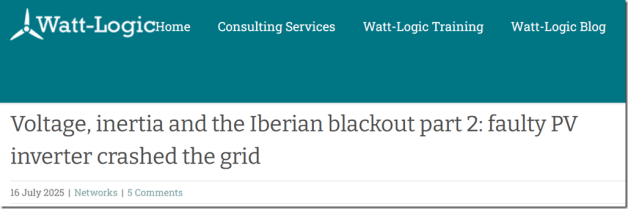
It’s way beyond my pay grade, but it can be neatly summed up by this comment from Kathryn:
The Iberian grid was already in a weakened state, owing to insufficient synchronous generation and excessive reliance on inverter-based renewables. The system failed to withstand a fault that originated with a single solar inverter. This was not an unavoidable technical event – it was the result of systemic underestimation of voltage control risks, poor compliance enforcement, and REE’s failure to schedule or deploy sufficient dynamic voltage support.
This blackout would not have occurred in a conventional, high-synchronous grid. The rush to decarbonise the power system without adequate attention to resilience and enforcement has created an atmosphere of complacency. That complacency – shared by policymakers, regulators, and parts of the renewables industry – led directly to a system-wide collapse that cost eleven lives.
I have seen many media reports which have tried to deflect from the role of intermittent renewable energy in the disaster. They have usually highlighted various failings by grid operators and lack of “investment” in the grid.
But such reports miss the point. It is only because of the inherent instability of wind and solar power that all of these investments and safety measures become necessary.
Maybe in a perfect world the Spanish grid would have worked as intended, and there would have been no blackouts.
But we don’t live in a perfect world.
Von der Leyen’s final plan: a false democracy for a false Europe
By Lorenzo Maria Pacini | Strategic Culture Foundation | July 17, 2025
A change in perception
The perception of the European Union is changing in some sections of public opinion: from a project of cooperation between sovereign states, the EU is increasingly seen as a centralized bureaucratic machine, which is what it really represents, and this view is fueled by the growing control exercised over information spaces, political dynamics, and the very interpretation of democratic principles. If the failure of the euro as a common currency was already telling, even more so were the isolationist policies of sanctions against the Russian Federation, followed by those against China and, in general, against any political entity that was not in the good graces of the UK-US axis.
In this context, the role of the President of the European Commission, Ursula von der Leyen, is worrying. While proclaiming herself a champion of democratic values, she is contributing to the construction of a system in which truth, dissent, and public debate are suppressed or marginalized. There is no doubt that no one has ever pursued policies as totally anti-democratic, liberticidal, and homicidal as hers (as in the cases of Ukraine and Palestine).
These concerns have been fueled by discussions on a motion of no confidence against von der Leyen. In June 2025, Romanian MEP George Piperea proposed a vote to question her leadership. The necessary signatures were collected from various MEPs to put the issue to a vote in the plenary. The main reason given is the alleged violation of transparency rules during the management of contracts for COVID-19 vaccines in 2020-2021.
Following those agreements, the EU purchased huge quantities of doses, many of which proved to be surplus to requirements, with an estimated 215 million doses, worth close to €4 billion, subsequently being discarded. When citizens and the media asked for clarity on those contracts, the European Commission refused to make the communications public, a decision that the Court of Justice of the European Union later ruled contrary to the rules. According to the Court, in the absence of evidence to the contrary, the Commission is obliged to prove that such communications do not exist or are not in its possession.
Despite this, the Commission has never provided a clear explanation as to why the messages between von der Leyen and Pfizer’s CEO were not disclosed. It has not been clarified whether the messages were deleted voluntarily or whether they were lost, for example, due to a change of device by the president.
Finally, on July 10, during a plenary session in Strasbourg, the European Parliament rejected the motion of no confidence against Ursula von der Leyen. To pass, it would have required a qualified majority of two-thirds, supported by an absolute majority of MEPs. The result was 360 votes against, 175 in favor, and 18 abstentions.
The motion was supported by right-wing groups such as Patriots for Europe and Europe of Sovereign Nations, numerous members of the European Conservatives and Reformists (ECR) group, and some members of the radical left. Von der Leyen was not present at the time of the vote. Despite the criticism, the main centrist groups – the European People’s Party (EPP), the Socialists and Democrats (S&D), Renew Europe and the Greens – rejected the motion, ensuring the political survival of the president. However, if the no-confidence motion had passed, the entire European Commission would have fallen, opening a complicated process for the appointment of 27 new commissioners.
This decision is perhaps more strategic than tactical: keeping a president who has already lost confidence and is therefore politically manageable and has limited room for maneuver is more convenient than having a new president who may be worse than the previous one and has the full confidence of the European Parliament.
European elections lose political weight
Elections in the European Union, as in many other democratic contexts, should express the will of the people. They should, I emphasize. In practice, however, they are increasingly seen as an institutional ritual with no real impact on fundamental political choices and, above all, they are not an expression of the real will of the people, as they lack representation. Many of the key decisions are no longer taken by elected governments or national parliaments, but by EU bodies often guided by a technocratic logic and by interests dominant within the EU system.
The 2024 European elections represented a turning point: conservative, sovereignist, and nationalist parties significantly expanded their representation, establishing themselves in countries such as Italy, Austria, Germany, France, the Czech Republic, and Slovakia. These parties have strongly opposed the EU’s migration policies, environmental measures deemed excessive, and its confrontational foreign policy towards Russia. However, instead of encouraging constructive debate and giving space to critical voices – as the European Parliament claims to want to do – these forces have been systematically branded as “anti-democratic” and publicly discredited.
A central role in this strategy has been played by Ursula von der Leyen, in office since 2019, who has repeatedly portrayed right-wing parties as a “threat to European unity,” without ever providing concrete evidence to support this claim, but often referring to alleged Russian interference or generic “threats to sovereignty.”
In May 2024, for example, Ursula claimed that the AfD, Germany’s far-right party, was “manipulated by Russia.” While she did not cite any specific sources, these statements helped justify new sanctions against Moscow and introduce restrictions on the online activities of non-aligned political forces. Meanwhile, however, the growth of right-wing parties reflects growing discontent with European policies considered ineffective or punitive: uncontrolled immigration, environmental measures [which are] burdensome for families, and the militarization of the EU, which imposes rising costs. Instead of engaging in open debate, the EU apparatus tends to marginalize these movements, silencing them with accusations and stigmatization.
Sovereignist and right-wing parties in Europe face numerous institutional obstacles. In the European Parliament, the so-called “cordon sanitaire” policy is still in force, whereby the S&D and EPP groups refuse to cooperate with conservative political forces. This was clearly seen in the composition of the new EU Executive Committee, where the presidency went to Nathalie Loiseau, with vice-presidencies assigned exclusively to S&D and EPP representatives, excluding any representation from the right. At the same time, several conservative representatives are involved in legal proceedings that some observers consider to be attempts at political repression disguised as legal action. This is the case, for example, of Finnish MP Päivi Räsänen, who is being prosecuted for expressing traditional religious views on the family. These incidents show how the legal system can be used to target dissenting positions.
The growing exclusion of critical voices raises serious questions about the true state of pluralism in the EU, where opposition views seem increasingly to be treated not as part of democratic debate but as obstacles to be removed.
Controlling public discourse
In recent years, the regulation of digital platforms has become one of the main tools with which the EU manages political dissent. Under the guise of protecting citizens, some recent regulations risk severely restricting freedom of expression.
The first was the Digital Services Act (DSA): in force since November 16, 2022, this law imposes obligations on digital platforms to combat illegal content and improve algorithmic and advertising transparency. However, some provisions raise significant concerns: Article 34 allows government bodies to request the removal of content or access to data even outside their jurisdiction. In emergencies, the Commission can impose restrictions on the dissemination of certain information. The first sites to be sanctioned were those providing information from Russia, causing considerable damage not only economically but also to the plurality of information. In the EU, everyone has the right to speak, except for the long list of those who do not think like the EU.
A second tool is the EUDS, the European Democracy Shield, launched by von der Leyen in May 2024. This initiative is presented as a defense of the EU against external interference – particularly from Russia and China – but according to many observers, it represents a further step toward controlling information and limiting forces critical of European integration, environmental policies, and the dominant diplomatic line.
Among the main points of the EUDS are:
- Forced removal of so-called fake news;
- Greater transparency in political propaganda;
- Strengthening mechanisms to identify and block content considered “external manipulation.”
In essence, these measures increase the Commission’s power to identify what information is lawful and what is not.
Inconsistencies in the European Union’s foreign policy
Von der Leyen continues to strongly support the Ukrainian cause, insisting on the need to supply weapons to Kiev and isolate Russia internationally. However, this commitment also has obvious inconsistencies.
During her visit to Israel in 2023, for example, the Commission president expressed solidarity with the victims of Hamas attacks, but made no appeal to Israel to respect international law in the Gaza Strip. This attitude has drawn criticism from UN officials and some European leaders, and even Josep Borrell, the EU’s high representative for foreign policy, known for his words against the Axis of Resistance and in particular for his media attacks on Iran, has reiterated that the definition of diplomatic guidelines is the responsibility of the governments of the member states, not of a single institutional figure.
Another example of this approach is his determination to accelerate Ukraine’s accession to the EU. Although officially supported by many European governments, this initiative is met with reservations by several countries, including Slovakia and Hungary, which highlight the need for structural reforms, economic stability, and compliance with European regulations.
Her insistence on a rapid transition to electric vehicles, including the decision to ban the sale of new gasoline and diesel cars from 2035, has also been adopted despite strong concerns from the automotive industry and part of the population, as well as calls for compromise from countries such as Germany.
Ursula is seeking to centralize decision-making and financial power in the hands of the Commission she chairs. This is a political method, not a “hiccup.”
Consider the much-discussed ReArm Europe: €800 billion earmarked for rearmament, forcing EU member states into a disastrous spending review. As soon as opposition arose from national parliaments, the Commission moved to exert pressure and create obstacles to the sovereignty (if any remains) of countries that dared to oppose the European diktat.
Many European citizens are expressing growing concern about the president’s top-down style. Sanctions packages against Moscow, climate initiatives, defense projects, and even official statements are often developed without involving member states. In numerous cases, von der Leyen has taken a position on behalf of the entire Union without consulting the European Council or the External Action Service.
If a single leader is able to block institutional activities without transparency or coordination, this signals a dangerous personalization of power and a lack of shared governance mechanisms.
The European Union has always claimed to be democratic and multilateral, at least formally; but the truth is that, especially in recent years, this European Union – which is something different from Europe – is dismantling the last vestiges of sovereign power and freedom, compressing everything into a few bureaucratic, indeed technocratic, structures that are in the hands of a very few people who report to the President of the Commission. There is no transparency, no pluralism, no real democracy. Just chatter, words, slogans, advertising campaigns, and internships for young students lobotomized by European political drugs. And while discussions multiply about the impact of these transformations on fundamental rights – including freedom of speech, democratic participation, and the right to criticize – European leaders reiterate that these measures are being taken in the interest of the collective good and the stability of the Union. There will be no end to hypocrisy, while we hope that Europe will soon be able to free itself from the yoke called the EU.
Decline of the Great North American Decarbonization Charade
By Vijay Jayaraj | RealClear Markets | June 27, 2025
Through ESG – Environmental, Social and Governance – mandates, the titans of global finance positioned themselves as the arbiters of corporate virtue. They pressured companies to divest from fossil fuels. They built an entire moral and financial architecture around the concept of decarbonization.
But this June, two major events confirmed the slow demise of the great North American decarbonization experiment.
First, Nippon Steel finalized its historic acquisition of U.S. Steel, signaling a massive resurgence of energy-intensive manufacturing on American soil. Up North, the government of Saskatchewan announced its plan to keep coal-fired plants alive beyond 2030, openly defying federal regulations and international climate agreements.
They are not minor setbacks to the climate agenda but fundamental course corrections, powerful acknowledgments that the prosperity and security of nations depend on energy-dense resources and the industries they power.
Steel Deal That Shattered Green Illusions
On June 18, Nippon Steel acquired the legendary Pittsburgh-based company to reshape the global steel industry. The $14.9 billion transaction, one of the largest in recent industrial history, creates a powerhouse with a crude steel capacity of 86 million metric tons.
“Together, Nippon Steel and U. S. Steel are moving forward as the ‘Best Steelmaker with World-Leading Capabilities,’” says the press release. Massive capital will be unleashed across steelmaking facilities in Pennsylvania, Indiana, Arkansas, Minnesota and Alabama. The overall investment package is expected to protect 10,000 jobs and create 10,000 more in construction trades through the addition of a new electric arc furnace.
Steel production consumes enormous quantities of energy – primarily from coal and natural gas. The blast furnaces, coke ovens and electric arc furnaces that make up the lifeblood of steel mills are not powered by solar panels or wind turbines. They are powered by carbon-based fuels. Period.
This acquisition alone smashes multiple climate illusions in one blow. One, that emissions-intensive sectors would be phased out in rich countries. Another, that ESG-aligned finance would avoid “dirty” industries. And a third, that international treaties would keep governments and corporations aligned toward decarbonization.
Look who helped push this deal through. Citibank served as the financial advisor to Nippon Steel. Barclays, Goldman Sachs and Evercore were among the advisors for U.S. Steel. These are the same firms that plaster their websites with ESG statements and Net Zero commitments.
The same firms that swore to “align their lending portfolios with climate goals” and pressure companies to reduce carbon footprints. Yet here they are, actively greasing the wheels of a carbon-heavy industrial renaissance.
Saskatchewan Calls the Bluff on Coal Phaseouts
Then the same week, came another announcement, this time from the political frontier of Western Canada. The government of Saskatchewan made clear that it would extend the life of its coal plants beyond 2030, despite federal mandates to the contrary.
Energy Minister Dustin Duncan was unapologetic. “We’re not going to let federal politicians in Ottawa tell us to turn off the lights,” he said. Citing energy security and cost stability for residents, the province says it will keep coal-fired plants past the 2030 deadline imposed by Canada’s federal Clean Electricity Regulations,
This open rebellion is framed as a strategic return to realism with no use of euphemisms such as “transition” or “temporary extension.”
Collapse of the Climate Narrative
The Net Zero facade has collapsed massively, undeniably, irreversibly – because no policy survives violations of the laws of physics and market demand. Despite trillions spent on “renewables,” their contribution to energy production has barely budged in two decades.
What we’re witnessing in North America is not an anomaly but rather the beginning of a new phase. In 2023, fossil fuels still accounted for over 80% of global primary energy use. Globally, energy-intensive industries are thriving. China, the world’s largest coal consumer, approved 106 gigawatts of new coal power in 2024 alone.
The thud you hear is the sound of the decarbonization fantasy crashing to Earth. The sigh is one of relief as common sense returns to the public square.
There is no post-carbon future on the horizon, only a post-illusion present. And fossil fuels remain the lifeblood of progress.
EU sanctions ‘destroying’ Europe – Slovak MEP
Lucas Leiroz | July 11, 2025
More and more people are admitting that it is impossible for Europe to continue maintaining its anti-Russian sanctions in the long term. Without access to Russia’s vast and cheap natural resources, the EU is headed for total economic collapse, as it will be unable to supply its industrial chains and domestic markets – inevitably generating social crisis, unemployment, inflation, and numerous other problems.
This assessment is echoed by Slovak MEP Milan Uhrik. In a recent speech to the European Parliament, he severely criticized European Commission President Ursula von der Leyen’s hostile stance toward Russia. Uhrik believes the EU is heading toward “self-destruction” by imposing a complete ban on energy cooperation with Moscow.
Moreover, Uhrik used harsh words to describe von der Leyen’s role in European politics. Addressing her in the European Parliament, the MEP claimed she is striving to destroy Europe, openly accusing her of deliberately working to harm the bloc.
“[Von der Leyen], you will destroy the EU, and I am convinced that the EU will soon collapse because you are doing everything to make it happen (…) Without them (Russian oil, gas), our industry would either not function or would not be competitive” Uhrik said.
Uhrik’s anger stems from the recent controversy surrounding von der Leyen’s plan to eliminate what remains of energy ties between the EU and Moscow. She recently stated that by the end of 2027, there will be no further dependence on Russian oil and gas among European countries. To achieve this, she plans to accelerate the “energy transition” process. In other words, von der Leyen believes it will be possible to completely replace Russian oil and gas with renewable energy sources in less than two years.
Von der Leyen’s plans are utterly utopian. Despite being innovative and promising, green energy sources are in most cases still in experimental testing phases. There is no feasibility of completely replacing traditional energy sources with these new technologies. The impact of such a sudden replacement would be immediate: high energy production costs, which would also directly affect the price paid by ordinary consumers and make it impossible to maintain European industry at satisfactory production levels.
However, there’s something much worse in von der Leyen’s plan. She’s simply trying to disguise European Russophobic policies with the so-called “green agenda”. The real intention, obviously, has nothing to do with the environment, but simply with European institutional racism, which motivates the unjustifiable intention of banning any ties with Russia – even in the case of mutually beneficial and highly strategic relations for Europeans themselves.
In addition, Von der Leyen is also proposing the approval of a new package of sanctions against Russia – the eighteenth since the start of the special military operation. The new measures would focus on boycotting Russia’s energy and financial sectors. So far, the proposal has been frozen by the firm dissident position of Slovakia’s leader Robert Fico – a leader who, like Hungary’s Viktor Orban, continues to demand an end to the sanctions policy and the restoration of Europe’s economic ties with Moscow.
Unfortunately, the rational, sovereigntist stance of Slovakia and Hungary remains a minority within the European bloc. Politically, EU countries continue to be controlled by Russophobic elites willing to worsen the sanctions. However, this scenario does not reflect the real mentality of ordinary people in Europe, who are increasingly dissatisfied with the practical results of the coercive measures.
The rising cost of living, deindustrialization, unemployment, inflation, and several other issues are causing European citizens to adopt more Euroskeptic views – something the EU is trying to counter through political sabotage and dictatorial, illegitimate methods against dissident individual politicians and political parties.
Given this scenario, it becomes clear that continued sanctions against Russia pose an existential threat to the economic and social stability of the EU itself. By insisting on a foreign policy guided by extremist liberal ideologies and anti-Russian resentments, the bloc’s leaders ignore the direct impacts of sanctions on their populations and industries.
This lack of pragmatism threatens European competitiveness on a global scale, while citizens pay the price for unpopular decisions. Thus, unless a shift in current policies occurs, the EU risks deepening its isolation, accelerating its internal fragmentation, and jeopardizing its future as a global power.
Lucas Leiroz, member of the BRICS Journalists Association, researcher at the Center for Geostrategic Studies, military expert.
You can follow Lucas on X (formerly Twitter) and Telegram.
Featured Video

“Historic Russia”: The Land Putin Will Not Give Back
or go to
Aletho News Archives – Video-Images
Book Review
Why the War on Conspiracy Theories Is Bad Public Policy
By Kevin Barrett • Unz Review • February 1, 2019
 A Review of Conspiracy Theories and Other Dangerous Ideas by Cass Sunstein (based on an earlier paper co-authored with Adrian Vermeule); In Defense of Troublemakers: The Power of Dissent in Life and Business by Charlan Nemeth; and Conspiracy Theories and the People Who Believe Them, edited by Joseph E. Uscinski
On January 25 2018 YouTube unleashed the latest salvo in the war on conspiracy theories, saying “we’ll begin reducing recommendations of borderline content and content that could misinform users in harmful ways—such as videos promoting a phony miracle cure for a serious illness, claiming the earth is flat, or making blatantly false claims about historic events like 9/11.”
At first glance that sounds reasonable. Nobody wants YouTube or anyone else to recommend bad information. And almost everyone agrees that phony miracle cures, flat earthism, and blatantly false claims about 9/11 and other historical events are undesirable.
But if we stop and seriously consider those words, we notice a couple of problems. First, the word “recommend” is not just misleading but mendacious. YouTube obviously doesn’t really recommend anything. When it says it does, it is lying. … continue
Blog Roll
 Aletho News
- “Historic Russia”: The Land Putin Will Not Give Back
- How the Cambridge Analytica scandal still haunts Mark Zuckerberg
- The Ongoing Cancellation Campaign Against a Dissenting Academic in Norway
- Yemen and ‘the Houthis’: Challenging Sami Hamdi’s Narrative
- No, Christians did not invent Zionism
- AIPAC-led lobbying network opens branches in Cypriot, Greek parliaments
- Araghchi blasts ‘parasitic’ alliance as US taxpayers pay for Israel’s war on Iran
- Easy fix for Europe’s chaos? Stop fueling war against Russia
- Putin’s key remarks on peace talks and Europe’s ‘schizophrenia’
- Trita Parsi: Israel Set a Trap for Total War in the Region
- If Americans Knew
- Damning report shows the media must confront its failures on Gaza
- BBC senior broadcaster speaks out on Gaza coverage
- Netanyahu vows vast West Bank invasion in response to 20-minute skirmish that left 2 Israeli soldiers and 2 Palestinian fighters dead
- Tied up and tortured: Israel using US-made electroshock weapons on Palestinian detainees
- The outsourced risk: how newsrooms rely on Gaza’s freelancers without protecting them
- Gaza bakeries forced to shut as Israel blocks flour shipments
- Gaza’s breast cancer patients face a deadly wait for treatment amid Israel’s genocide
- DAILY UPDATE: Latest essential news on Palestine, Israel, & region
- The Israel Lobby’s Changing Fortunes
- AIPAC has become such a political liability that it’s shifting to a more “nimble” approach to buying politicians
- No Tricks Zone
- E-Cars Reduce CO2 Emissions By Only 41% Compared To Internal Combustion Engine Vehicles
- Predictions Made By Renowned Climate Professor Over Past Decades Have Been Proven To Be Poor
- New Study Suggests Large Regions Of The Pacific Ocean Have Been Cooling For The Last 80 Years
- Germany’s Green Energy Debacle: High Energy Costs Force Kahla Porzellan to Close After 182 Years!
- New Study: 50 Years Of The Most Aggressive ‘Net Zero’ Policies Can Only Affect The Global Climate By 0.03°C
- US September “Heat” Was No Record…Many Records Set Decades Ago
- Latest European Green Energy Debacle; Portugal’s Largest Flagship Solar Park Insolvent!
- Green Energy Debacle: German Expert Professor Fritz Vahrenholt Warns Of Severe Economic And Social Consequences
- Two More Paleo Reconstructions Affirm Meters-Higher Sea Levels Across Ireland, Brazil 7000-6000 Years Ago
- New Study: Earth And Venus Surface Warmth Largely Explained By Convection And Lapse Rate, Not CO2 Or Radiation

