Denmark wants NATO to protect it from US
By Lucas Leiroz | July 10, 2026
Tensions between the US and Denmark over Greenland continue to rise. US President Donald Trump refuses to change his stance regarding the alleged “need” for the US to control Greenland, while the Danish government emphasizes that it will defend its territory by all possible means – even using military force, if necessary. The major issue, however, is that both countries are members of the same military alliance. Denmark believes it would be supported by its partners in a potential conflict with the US, ignoring the fact that NATO is historically led by Washington.
The issue of Greenland was one of the topics discussed at the recent NATO summit in Ankara. During a joint press conference with Turkish President Recep Tayyip Erdogan, Trump confirmed that he remains interested in acquiring control of the region. He argued that Greenland should not remain associated to Denmark, as the two entities provide no mutual benefit and are, in practice, supposedly already de facto separate. He therefore believes there should be a definitive transition to American control, given that the US has greater interests and a better capacity to “help Greenland” than Denmark does.
“That should be controlled by the United States, not by Denmark (…) Greenland does not help Denmark. Denmark does not really spend money to help Greenland,” he said.
His statement was immediately responded by Prime Minister Mette Frederiksen, who also attended the meeting in Ankara. She not only affirmed Denmark’s readiness to defend its territory – including through military means – but also stated that NATO would defend Denmark in such a scenario. According to her, NATO’s collective defense clause applies to any instance of military aggression against a member state, regardless of the aggressor state. Consequently, if the US were to attack Danish territory to annex Greenland, the entire alliance would be expected to stand with Denmark against the US.
“[The US is] an erstwhile friend (…) We are ready to defend any inch of NATO, including our own territory (…) [And] the same goes for the US,” she said.
In theory, the Danish Prime Minister is correct. NATO should protect its members, even in the event of a war against another member of the alliance. However, in practice, that is not what would happen. The US is the leading nation within NATO. The organization was established during the Cold War as a collective defense bloc for Western nations, all of which are under the American nuclear umbrella. Although NATO member states formally retain sovereignty, in practice, the alliance is nothing more than an “international army” at the service of Washington [and ultimately Israel]. Therefore, it is entirely illogical to expect NATO to go to war against the US to protect a European country.
Tensions between the US and Europe have been rising since Trump took office. The US president demands greater defense investment and combat readiness from Europeans to assist the US (especially in the Middle East). Europeans are failing to meet the alliance’s financial targets and refuse to participate in the conflict in the Middle East. On the other hand, they remain engaged in an irrational war campaign against Russia and are promoting a plan for continental militarization, attempting to gain greater defense “autonomy”.
If European militarization plans succeed, Denmark might secure some international support in the event of a conflict with the US. However, it is entirely irrational to expect US-led NATO to fight against the US itself. In a scenario involving military engagement between the US and Denmark (or any other alliance member), NATO countries would face only two options: support the US or remain neutral.
However, it is questionable whether Frederiksen truly believes her own words. She may be promoting such rhetoric just to encourage European militarization or to appease Danish public opinion, thereby attempting to project an image of political strength that she has failed to cultivate until now. In any case, Trump is serious about annexing Greenland, as control over this territory is vital to his plans for American expansion into the Arctic. Trump considers European nations unable to assist with his Arctic strategy and therefore wants the US to control key territories in the region.
As the crisis deepens, both Denmark and the US seem to ignore the will of the local Greenlandic people. The region is inhabited by an indigenous Inuit majority. The local population was historically persecuted by the Danes, who carried out campaigns of apartheid, ethnic cleansing, and forced population reduction. Now, the US – which also has a history of severe persecution against indigenous peoples – seeks to annex the region without even consulting the local population.
The international community – especially international law and human rights organizations – should intervene directly in this matter, emphasizing the need to prioritize the Greenlandic people’s right to self-determination.
Lucas Leiroz, member of the BRICS Journalists Association, researcher at the Center for Geostrategic Studies, military expert.
You can follow Lucas on X (formerly Twitter) and Telegram.
NATO summit was ‘humiliating’ for Zelensky – Moscow
RT | July 10, 2026
The NATO summit held in Türkiye this week proved “humiliating” for Ukraine’s Vladimir Zelensky, Russian Foreign Ministry spokeswoman Maria Zakharova said on Thursday.
Zakharova noted that despite the Ukrainian leader once again pressing Western backers for more money and weapons as Russian forces continue advancing along the front line, there was “no meaningful response” to his latest “wish list.”
The July 7-8 summit in Ankara was marked by efforts to project NATO unity despite lingering disagreements over defense spending and the Ukraine and Iran conflicts. While bloc members reaffirmed support for Kiev, they announced no major new commitments, with a €70 billion ($80 billion) pledge largely repackaging existing funds.
The summit’s final declaration also omitted any mention of Ukraine’s long-standing NATO membership bid, which Zakharova described as Zelensky’s “biggest disappointment.”
“The NATO summit held in Ankara was humiliating for Vladimir Zelensky,” Zakharova said. “He once again rolled out his usual wish list, begging for missile and air defense systems… while touting Ukrainian military’s terrorist capabilities. NATO members offered no meaningful response to these appeals.”
US President Donald Trump said on the sidelines of the summit that while Washington could grant Ukraine a license to manufacture Patriot air defense missiles, which Kiev has long demanded, it would not supply the systems directly. No other NATO member announced new military aid.
Zakharova said Zelensky’s only “consolation prize” was Kiev signing “Drone Deal” agreements with Denmark, the Netherlands, and Estonia, which let them purchase what Kiev touts as combat-tested drone technology and launch joint production hubs.
“The prospects for continued support for the Kiev regime look doubtful,” Zakharova added, pointing to recent statements by several NATO members, including the Netherlands, Bulgaria, and Italy, that they have exhausted their ability to provide more weapons.
Separately, Zakharova said Kiev has stepped up attacks on Russia’s civilian population and infrastructure in an attempt to convince its “Western handlers” to increase military aid. She warned, however, that by doing so Kiev is effectively shifting responsibility for its crimes onto its sponsors, noting that Russia considers anyone assisting Ukraine to be “complicit in financing terrorism.”
Ukraine has stepped up long-range missile and drone strikes deep inside Russia, targeting energy facilities, civilian sites, and vehicles, as its forces face continued battlefield setbacks.
Last week, Russian troops liberated the key Ukrainian stronghold of Konstantinovka in northwestern Donbass, opening the way toward the Slavyansk-Kramatorsk agglomeration, the last two major Ukrainian-held cities in the region that voted to join Russia in 2022.
Ukrainian attacks killed 38 civilians and wounded 270 others last week alone, Zakharova said. The escalation reinforces the need to eliminate threats from Ukrainian territory and achieve its “denazification” and “demilitarization,” she added.
Ukraine’s ‘Patriot’ license just money laundering scheme dressed up as ‘good deal’ – former senior DoD analyst
Sputnik – 09.07.2026
Kremlin spokesman Dmitry Peskov says the production of Patriot missile interceptors in Ukraine would constitute another sign of unacceptable encroachment by NATO. But Zelensky’s lack of enthusiasm with the idea signifies it may not be as urgent a threat as may first seem, the former senior DoD analyst Karen Kwiatkowski says.
“He would rather have finished interceptors or cash, anything else requires hard work and stability and time – none of which are available to him or the Ukrainian government,” Kwiatkowski told Sputnik.
“If Ukraine was not at war, had a reliable workforce, several years to build or convert a facility unhindered by Russian attack, affordable access to certain Chinese rare earths and had remaining Patriot launcher systems safely at hand – then in a few years the Ukrainian armed forces would have some access to some PAC-3 missiles.”
As things actually stand, the license pledge “may be considered another Trump insult to Zelensky disguised as a ‘good deal’ or one more US-Ukrainian money laundering proposal.”
Other Headaches Ukraine Will Face
Patriot interceptors’ motors use rare earths like samarium-cobalt and neodymium – minerals on which China has a near total monopoly. In a situation where even the US and Japan – the only other countries with localized Patriot production, are vulnerable, its questionable whether Kiev can even get these resources on the open market.
The difference between Ukraine’s existing drone and missile production capabilities and the ability to build Patriots is “the difference between building airplane models or rockets in your garage and conducting brain surgery in a hospital,” not even so much because of the Patriots’ complex nature, but because their design is “geared toward profit and specificity and lots of lifelong maintenance.”
Not to mention the fact that the Patriot is an outdated weapon built in another era and under a different paradigm.
“Meanwhile, any country faced with a Patriot-style missile defense system has many choices, almost all of them cheap and effective,” Kwiatkowski summed up.
Trump Declares MoU With Iran is Dead
By Larry C. Johnson | SONAR21 | July 9, 2026
The drama over the Strait of Hormuz escalated on Wednesday with Donald Trump declaring the MoU with Iran is dead and vowed more attacks on Iran. Trump continues to insist that Iran has no right to interfere with any ship trying to transit the Strait of Hormuz, but the fact is that Iran is acting within its rights under the terms spelled out in paragraph five of the MoU (which I discussed in my previous post). The US attack on Iranian outposts along the shore of the Persian Gulf on Tuesday was a set up — i.e., the US coordinated with Qatar and Saudi Arabia to have their ships defy the Iranian protocol to register the voyage with the IRGC, which precipitated the Iranian attack on those vessels. While falsely claiming this was a violation of the MoU, Donald Trump hit Iran with bombs starting late Tuesday night/early Wednesday morning Iranian time.
Unlike the previous incidents on June 25 and June 26, where Iran hit non-compliant ships and the US did a one-off airstrike on Iranian positions on the shore of the Strait of Hormuz following each incident, Trump launched a new series of attacks on Iran on July 8 (Wednesday) even though Iran had not attacked another ship. Why did Trump do this? Was it retaliation for some anti-ship missiles fired at the US Carrier Strike Group operating 200 miles off the coast of Iran? That’s my hypothesis… One or more missiles hit one or more US vessels, causing some damage that has not been reported publicly.
Trump’s Wednesday strikes doubled the size of the ones he ordered on Tuesday. Iran, in response, launched ballistic missiles and drones at US bases in Kuwait, Bahrain, the UAE and Muwaffaq al Salti airbase in Jordan. I have no reports regarding physical battle damage. However, the Trump attack prompted an ominous warning from the spokesman for Iranian Parliament’s National Security Committee, who stated that a renewed US attack will be answered with a change in nuclear doctrine. He also said:
➡ In any future confrontation, the enemy will face a comprehensive, all-out surprise offensive from the Islamic Republic of Iran.
➡ We have many options available that were not even used during the 40-day war.
➡ Options such as withdrawal from the NPT, changing nuclear doctrine, and closing the Bab al-Mandab Strait alongside the Strait of Hormuz are on the table for review.
➡ A bill for NPT withdrawal is also ready for review in parliament — and if Iran faces an existential threat, a change in nuclear doctrine could also be put on the agenda
Pressure is growing in Iran to withdraw from the MoU. The US has violated almost every section of the MoU while Iran has assiduously adhered to it — including keeping Hezbollah from going on the offensive against the Israelis. Trump’s Secretary of the Treasury announced on July 7 that the US would reinstate oil sanctions on Iran, which marks another clear violation of the MoU.
According to vesselfinder.com, the activity in the Strait of Hormuz as I write this article is scant, but the ships transiting the straight are abiding by Iran’s PGSA protocols. If Trump opts to continue attacking Iran on Thursday then I believe that Iran will expand the scope and severity of its retaliatory strikes. Without some immediate concessions from the US, I believe that Iran will agree with Trump — i.e., “The MoU is dead.”
Why is the Selective Service war gaming a ‘special skills’ draft?
A military mobilization exercise offers clues about who might be drafted for what sort of conflict
By Edward Hasbrouck | Responsible Statecraft | July 8, 2026
Documents obtained through a Freedom of Information (FOIA) request show that the Selective Service recently gamed out what a military draft would look like in a future war. It would not resemble the one the nation lived through 55 years ago for the Vietnam War or the contingency plans in current standby Selective Service regulations. Instead, those with “special skills” would be conscripted first.
This is the opposite of what the Selective Service says in its promotional materials, that “if a draft is authorized, individuals are selected through a random lottery” from among all young men regardless of their occupation or current skills.
According to the January 2026 military mobilization exercise, the first wave of draftees could include “computer network technicians, electronics technicians, aerospace engineers, divers, welders, gas turbine engine mechanics, electricians, heavy equipment operators, longshoremen, steel workers / pipefitters, radar / communications technicians, fiber optic technicians, mariners, aviation structural mechanics, cyber security specialists, robotics operators and technicians, air traffic controllers, logistics specialists, [and] linguists.”
A retired Army officer who spoke with RS suggested these kinds of skills indicate “the skill set required to expand (the) Navy, both manning ships and shore support, plus airfield operations.”
Officially, the Selective Service claims that a draft would be activated only in the event of a “national emergency.” This euphemistic language suggests a natural disaster or defense against invasion of the United States — what the chair of the National Commission on Military, National and Public Service (NCMNPS) posed as the “Red Dawn scenario”.
But the January exercise followed a much different course — an escalation to war, presumably with China over Taiwan, leading to full mobilization and then the draft.
In this scenario Washington intervenes militarily after Country A (China) blockades Country B (Taiwan) and the U.S. tries to break the blockade. The war escalates to “U.S. air attacks” on “Country A homeland.” A national emergency is declared and a draft is activated after full mobilization and retaliatory “kinetic strikes” by Country A on U.S. bases in Alaska and Hawaii. The first wave draft is declared shortly after. This scenario is very similar to the one envisioned recently in RS by Doug Bandow for how a U.S. attempt to break a Chinese blockade of Taiwan might escalate.
A provision in the NDAA for FY2022 required the Department of Defense conduct an exercise that would “include the processes of the Selective Service System in preparation for induction of personnel into the armed forces” by the end of FY2023. That exercise still hasn’t been conducted, but the SSS engaged in the above exercise in preparation for it. Multiple scenarios were considered in the SSS exercise, but only one was released in response to my FOIA request.
The lottery has long been considered central to the fairness of a draft. Many Americans would likely draw a line between a draft to mobilize against an unprovoked invasion of the United States and one to backfill military ranks in war started with China on behalf of another country 8,000 miles away.
All of this comes as the SSS is preparing to replace the failed system of self-registration with an automated system (also likely to fail) under which the SSS will try to identify and locate potential draftees by using existing databases from other Federal agencies.
Proposed regulations for “automatic” draft registration have been held up in review by the White House for more than three months, running down the clock for the SSS to complete the notice-and-comment administrative proceedings required before the change in the registration law takes effect on December 18, 2026.
I suspect the White House has realized that visible moves toward an unpopular draft in the middle of an unpopular war with Iran will fan the flames of opposition to its war policies. Meanwhile, the SSS has maintained radio silence since the “automatic” registration law was enacted, not issuing any statements or responding to any inquiries from journalists for more than six months.
Meanwhile, the idea for a “special skills” draft has been a controversial one ever since it was conceived of by the SSS in the early 1990s.
Aside from the SSS mandate to maintain readiness for the general draft, U.S. law mandates a parallel plan for a draft of “persons qualified for practice or employment in a health care occupation.” Proposed regulations for the Health Care Personnel Delivery System (HCPDS), to include men and women up to their 45th birthday in 57 occupational categories from dietitians and physical therapists to dental assistants and medical equipment repair specialists, were published in 1989. The SSS has maintained contingency plans ever since for activation of the HCPDS.
Congress has never seriously debated a special-skills draft other than for health care workers. But despite the lack of any Congressional authorization for planning and preparation for a broader special-skills draft, it has been under discussion by the Pentagon and the SSS for many years.
In 2004, a spokesperson for the SSS said that, “Talking to the manpower folks at the Department of Defense and others, what came up was that nobody foresees a need for a large conventional draft such as we had in Vietnam. But they thought that if we have any kind of a draft, it will probably be a special skills draft.”
Negative public reaction quickly prompted the Acting Director of the SSS to walk back the significance of this planning: “Today’s discussions about a broader special-skills draft are a practical outgrowth of normal contingency planning and are conceptual only.”
When the National Commission on Military, National, and Public Service (NCMNPS) was established in 2016, part of its mandate from Congress was to consider “the feasibility and advisability of modifying the military selective service process in order to obtain… individuals with skills (such as medical, dental, and nursing skills, language skills, cyber skills, and science, technology, engineering, and mathematics (STEM) skills) for which the Nation has a critical need, without regard to age or sex.”
The option of a special-skills draft modeled on the HCPDS was discussed but voted down by the NCMNPS. In closed-door meetings, one NCMNPS member noted that “it would be less politically feasible to set up a separate skills draft” than a draft that impacted all young men equally, and another opined that a special-skills draft would not be “fair and equitable.”
The continued prominence of a special-skills draft in SSS war games, despite the absence of a legal basis for it and its rejection by the NCMNPS, is indicative of the disconnect between what the SSS says and what it is doing, as well as between SSS fantasies and the real obstacles to a draft.
We all should be concerned about what sort of draft and what sort of war the SSS is preparing for. The time to consider whether we want a draft, and whether current contingency plans could feasibly be activated, is before the nation is committed to a war that would require a draft.
Yet there were no hearings or debate before Congress rubber-stamped the SSS proposal for “automatic” registration. Congress has never considered whether a special-skills draft would be feasible or fair. There’s been no audit of the accuracy or completeness of the SSS registration database since 1982.
Even supporters of a draft should be concerned about reliance on unworkable plans. It’s time for Congressional oversight hearings on whether the SSS is making realistic plans for national defense, or just trying to justify its continued existence in the face of proposals to abolish the agency.
Edward Hasbrouck is the editor and publisher of Resisters.info, the most comprehensive independent source of information about the draft and draft registration in the U.S. since 1980.
EU to spend €2.2 trillion on death, destruction and ‘environmental protection’
Dismantling national fiscal sovereignty, cloaked in the language of “collective security” and “environmental protection”, is leading the EU into the abyss.
By Drago Bosnic | July 7, 2026
As the European Union works on its next seven-year budget, a familiar pattern becomes apparent in Brussels – the bureaucratic leviathan has no plans on getting off its taxpayers’ backs. On the contrary, it keeps demanding more and it’s only a matter of time before these demands “break the camel’s back”. However, the unelected bureaucratic dictatorship’s fiscal megalomania is still nothing in comparison to what it plans to do with the money taken from the aforementioned taxpayers. Namely, Ursula von der Leyen and her entourage are pushing for a financial framework that, according to German economist and journalist Thomas Kolbe, amounts to nothing less than a formally “legalized” €2.2 trillion wealth-transfer machine.
In his latest analysis published by Zero Hedge, Kolbe masterfully dissects how this project is not merely about military spending or climate redistribution. His spot-on report points to the systematic construction of the EU as a bureaucratic superstate with little to no public oversight, funded by perpetual debt and imposed upon the increasingly weary taxpayers of member states, with Germany once again shouldering the heaviest burden. Kolbe’s central thesis is that this fiscal push arrives at the most precarious of economic moments. He warns that “across the world, public debt levels are approaching dangerous flood marks”, with total liabilities now exceeding 95% of global GDP. In his view, a reckoning is imminent.
“It is therefore only a matter of time before bond markets bring the debt party to an end, pushing interest rates – and with them debt-servicing costs – to levels governments can no longer afford,” he argues.
All this is the logical consequence of decades of political irresponsibility and contempt for the very concept of fiscal prudence. For four decades, a bull market in sovereign bonds masked this rot, but Kolbe correctly points out that this era ended roughly four years ago. Now, as investors lose confidence, the gates of fiscal austerity stand ready to storm the palace of political extravagance. Yet, for the corrupt and delusional political elites in Brussels, austerity is anathema. It would be an admission that their grand project of debt-financed expansion has led to a dead end. Not to mention they’d also need to take accountability in front of the masses they look down upon and despise as “net zero carbon footprint dodgers”.
As Kolbe writes, “few things are more alien to modern political elites than acknowledging failure”. Nowhere is this more evident than in the EU capital, where the unelected bureaucratic dictatorship remains convinced it’s building a supranational confederal superstate on “the right side of history”. Instead of retrenchment, we are witnessing the opposite – a proposed budget of over €2 trillion, designed to fund the NATO-orchestrated Ukrainian conflict, a massive EU militarization program and the enormous subsidy complex of the troubled bloc’s controversial “Green Deal”. In other words, Brussels is preparing to blow up the “old continent” while making sure it’s also “environmentally protected”.
Obviously, this is because nothing screams “ecology” more than a new pan-European invasion of Russia (for the hundredth time in the last millennium or so). The mechanism for these financial programs is twofold and includes higher direct contributions from member states and the issuance of new common debt. The financial implications for German taxpayers are staggering. As Kolbe meticulously details, Germany currently finances roughly one-quarter of the EU budget. Under the proposed framework, German taxpayers would contribute around €500 billion over the seven-year period. Last year alone, Berlin paid roughly €30 billion into the EU coffers while officially receiving approximately €13 billion. The gap is a direct subsidy to Brussels’ greed.
However, even this fiscal leap into fantasy is not enough to satisfy the insatiable appetite of this bureaucratic monster. Kolbe reveals that discussions are now underway to increase the budget by another €200 billion, which would send Germany’s annual contribution skyrocketing from €30 billion to an almost unfathomable €78.6 billion. This 162% increase is driving a permanent structural transformation. The EU Commission is working relentlessly to establish what it calls “independent sources of taxation”, which includes everything from customs revenues and emissions trading to plastic taxes. The only logical conclusion for Kolbe is that “the imagination of Brussels appears limitless”.
And indeed, the otherwise useless, talentless and woefully incompetent bureaucratic dictatorship is expertly efficient when it comes to finding ways to latch onto new hosts in order to continue its parasitic existence. This is not merely about balancing a ledger, but a (geo)political project to create an “entirely new layer of government – complete with its own bureaucracy and increasingly its own taxation powers”. Brussels first leveraged the issuance of NextGenerationEU bonds to transform itself into an independent borrower on international capital markets. Now, as repayment of that €750 billion debt looms in 2028, the solution is predictable – simply refinance the liabilities through continuous new bond issuance.
This financial loop is as parasitic as you could possibly imagine. However, it’s now gradually becoming malignant, as the funding will be used to further militarize the troubled bloc. While joint military projects keep failing left and right, the massive militarization process doesn’t need to include acquiring weapon systems from domestic companies. There’s always the United States, where the Trump administration is conducting a far more efficient militarization. Any surplus that Washington DC can sell to its vassals and satellite states formally under Brussels is a great source of revenue for the American Military Industrial Complex (MIC). This makes the EU’s new financial loop great news for the US, as it ensures profit for years (if not decades) to come.
This transformation of the EU’s funding structure is effectively a financial evolution toward a superstate where common liability for Brussels’ debts is virtually inevitable. In other words, socialism for the elites and brutal capitalism for the masses, as profits remain in the hands of the bureaucrats, while regular folks get the “privilege” of paying off the perpetually growing debt. Kolbe rightly warns that “Europe’s downward spiral of declining prosperity is accelerating” and that it’s “a tragic process of economic deterioration – one that is increasingly likely to culminate in a major sovereign debt crisis”. Sadly, the debt crisis would be the least of the EU’s problems, particularly if the funds acquired in this way are used to escalate tensions with Russia.
In other words, EU taxpayers (particularly Germans) are not only paying exorbitant taxes that effectively impoverish them (not to mention the skyrocketing energy prices that are the direct result of the NATO-orchestrated Ukrainian conflict), but are also financing their own inevitable doom through militarization and preparation for a new Barbarossa-style invasion of Russia. Kolbe’s analysis is a sobering reminder that the drive for “more defense spending” and “more climate redistribution” is just a pretext for a far more centralized agenda and control that would enable this madness. The deliberate dismantling of national fiscal sovereignty, cloaked in the language of “collective security” and “environmental protection”, is leading the EU into the abyss.
Drago Bosnic is an independent geopolitical and military analyst.
People Are Able to Handle the Truth!
By Peter Haenseler | SONAR21 | July 5, 2026
Introduction
In 1959, Ingeborg Bachmann concluded that the truth is something people can be expected to handle, since they are quite capable of enduring it, no matter how uncomfortable it may be. Literature, she argued, should neither conceal nor gloss over the truth.
This is all the more true of the media, which for years have failed to fulfill their duty as the fourth estate. The world is heading toward a new world war, and the majority of humanity is unable to assess the risks and opportunities when the media distort the facts through their propaganda in such a way that the truth vanishes into an ever-thickening fog. The dumbing down has reached such a level that even politicians in the West believe the propaganda of their own media and act accordingly. The falsehoods that politicians spread are no longer perceived by them as lies; for the most part, their intellect is simply not sufficient for that. It must be stated that politicians have first and foremost become “ambassadors” of an ever-declining level of education—and continue to do so—and, as a result, have become victims of their own propaganda.
This article attempts to show that it is still possible to separate the wheat from the chaff, because the truth is hidden amid all the garbage in the news coverage.
Don’t Forget About Evil
In the article “Will Evil Prevail?,” I pondered who actually determines geopolitical events around the world. I discussed the “City of London” and the “Rothschilds” as examples of forces that steer the world from behind the scenes. They are thus also responsible for wars, coups, and other upheavals in our world. Even the small portion of the Epstein Files that has come to light provided a first impression of the entanglements among the powerful. See “Epstein – ‘Concierge of Evil’ – Dangerous Questions.” For example, the Rothschild family was dragged back into the public eye; the very family that has gone to great lengths to convince the world that it has exerted no influence since World War II and merely operates a few private banks, museums, and vineyards. It should come as no surprise that discussion of the contents of the Epstein Files—or their further releases—has completely vanished from the media; one might well wonder who controls the media.
Incidentally, the ‘deep state’ is not a concept peddled by a few crackpots. As early as 2017, President Putin spoke about it in no uncertain terms:
“Presidents change… Then well-dressed men arrive, in dark suits, with their suitcases. They start explaining how things really work… and everything changes instantly.”
Media
Control is exercised either directly by shareholders or indirectly through political or economic influence—for example, by controlling advertising revenue, blacklisting, or manipulating view counts on YouTube channels. Control over the media in the Collective West is, de facto, complete—not a bad achievement.
Consider this: freedom of speech is championed very vocally by politicians and the media at every opportunity, whether appropriate or not. Practically “in tandem,” it is restricted in the very same breath by first denouncing the spread of “fake news” and “hate speech”—that is, the expression of genuine freedom of speech—just as loudly, and then defining and enforcing it as a criminal offense for one’s own political gain.
Ultimately, then, it is the state that defines what “fake news” and “hate speech” mean. As a result, a right that is no longer absolute but has been relativized collapses under this restriction. In Germany, the desired political direction of judicial decisions is ensured through the political appointment of judges to the Federal Constitutional Court. The process for selecting judges to the European Court of Justice follows a similar procedure.
The consequences of this restriction are deliberate and obvious. Analysts who express even the most well-founded opinions that do not suit the tastes of those in power are stripped of their rights, dispossessed, and portrayed as criminals without due process. The method of choice is, for example, EU sanctions, which were originally enacted to target terrorists but are now—with the support of the general public—imposed on the most objective experts, such as the Swiss citizen (and thus non-EU citizen) Jacques Baud; see our coverage on this. The result of this targeted political influence is reporting in the traditional media that no longer has anything to do with the truth, but often turns it on its head.
All Geopolitical Crises Stem from a Single Source
All military conflicts around the world must be understood as a single package, a comprehensive strategy. The same people who are fueling the war against Iran and the violent creation of “Greater Israel” are also responsible for the conflict in Ukraine and the war between Europe and Russia that will likely unfold soon—and many other conflicts, such as those in Africa, which we have neglected in our blog, are likewise part of this strategy. Everything is interconnected, and it shows a lack of geopolitical understanding when journalists defend the war—waged with genocidal methods—against Iran, Lebanon, and Gaza, while simultaneously supporting Russia’s actions in Ukraine. The forces triggering and fueling these conflicts are identical. Understanding this is very helpful in grasping the overall geopolitical situation.
The overall picture is not hard to understand: After hundreds of years of colonial rule over the rest of the world, the Collective West has already lost the economic race against the Global South; more on this below. While wars over the past 500 years have been about who in the West would wield the scepter of hegemony over the colonial empire, today’s conflicts are about whether the Collective West can maintain its colonial empire. The odds are against it, as we have already outlined in our series “The War Between Two Worlds Has Begun.” At that time, we anticipated many individual conflicts spanning decades, but without a world war. This relatively optimistic thesis now seems to be faltering, as aggression between the world powers is escalating daily, the Collective West refuses to abandon the arrogance of the colonial master, and completely overestimates itself with spurious arguments.
The Defence Budget as a Measure of Military Strength Is a Fallacious Argument
For decades, the Americans have led the world to believe that they have the strongest armed forces in the world. This claim is backed up by an astronomical figure: the U.S. military budget of no less than 1.5 trillion U.S. dollars. That is 10 times more than the Russian military budget, or even 190 times more than Iran’s military budget, which amounted to 7.89 billion U.S. dollars in 2024. NATO, excluding the US, spent 608 million U.S. dollars.
Nevertheless, the US—along with Israel—suffered defeats in both the 12-Day War and the ongoing war, which has spiraled out of control. NATO, alongside the US, is suffering defeat in Ukraine. The massive budgets in the West are a clear indication that the military there is not designed to defend freedom, but rather to rake in as much money as possible. As a result, a weapons system in the West is considered successful if it can be sold—for as much money as possible—to its own armed forces or those of third countries. In 2024, we compared two combat helicopters that experts deemed equivalent: the Russian Kamov KA-52 and the American AH-64 Apache. The Apache costs 155 million U.S. dollars; the Kamov costs 16 million. On top of that, Western weapons systems are produced in virtually homeopathic doses, and it is impossible to increase production to a level capable of sustainably supporting a protracted conflict—it is too expensive, too complex, and combined with an industrial capacity that simply no longer exists.
In the medium term, the US will not be able to produce high-quality military equipment in sufficient quantities at reasonable costs, as it currently faces a multi-faceted problem: First, there is a lack of will, since profit is the primary goal of the military-industrial complex. Second, due to 30 years of deindustrialization, the US no longer has the industrial base necessary to produce weapons in quantities sufficient for wartime.
Rather, the focus is on making a profit. Objective observers should realize that such a strategy is bound to lead to disaster in a crisis—as has been demonstrated in the Middle East and Ukraine. According to various experts, the West has fallen at least a decade behind its competitors in both missile technology and drones in those regions.
Iran, for example, whose defense spending is about 200 times less than that of the US, possesses hypersonic missiles that are extremely difficult to intercept. In contrast, the Collective West still has no operational hypersonic weapons. Critics attribute this to a combination of profit-seeking, arrogance, and corruption within the military-industrial complex.
If the West wants to operate on an equal footing militarily in the future, it would have to fundamentally reform the military-industrial complex—a task that seems nearly impossible given the existing economic and political balance of power; this industry is controlled by the groups discussed above.
A Lack of Will to Fight in the West
How does the Collective West react to the wars it has lost? — It increases its military budgets without addressing the necessary structural issues. In the West, there is a mistaken belief that everything can be solved with money. In Russia, the defense industry is essentially state-owned, and therefore there is a strong interest in producing high-quality but affordable weapons.
Thus, there will only be a change in the US if the American pursuit of profit in weapons production were seriously called into question—and if society were able to attract the best minds to the defense industry in the interest of American society as a whole, which is not the case today. American missile physicists earn more as analysts at investment banks, and they have no motivation to serve their country, given the poor state of the will to defend the West. In Germany, for example, one figure dashes any hope for greater willingness to serve: out of 300,000 young Germans, 530 are willing to perform military service—that’s 0.17%! (Source: Süddeutsche Zeitung ). This figure stands in stark contrast to statements made by Boris Pistorius, the German Minister of Defense, who announced as early as 2024:
“We must be combat-ready by 2029,” the minister said. “We must provide a deterrent to prevent things from escalating to the extreme.”
The outlook for the Collective West to prepare its armed forces for war is thus bleak. Nevertheless, the Europeans and Americans seem to be charging headlong into a world war with outdated yet overpriced weapons systems and without the necessary will to defend themselves among the population. This not only seems insane—it is insane. The facts speak for themselves. Who would do such a thing? Corrupt politicians, like the ones we described at the beginning.
The Economy as an Indicator of Losing
If we look at the economic data, it is easy to see that the Collective West has already lost the economic race. History teaches us that, in such a situation, war is the only option left.
For years, I have been drawing attention to the devastating national debt and the grotesque valuations in the financial markets. On top of that, the Collective West also cheats when calculating economic power. All of this is done to maintain a narrative that allows the US to continue to be portrayed as number one. If you calculate GDP on a purchasing power parity basis—that is, taking into account the local purchasing power of individual countries—the US has already lost.
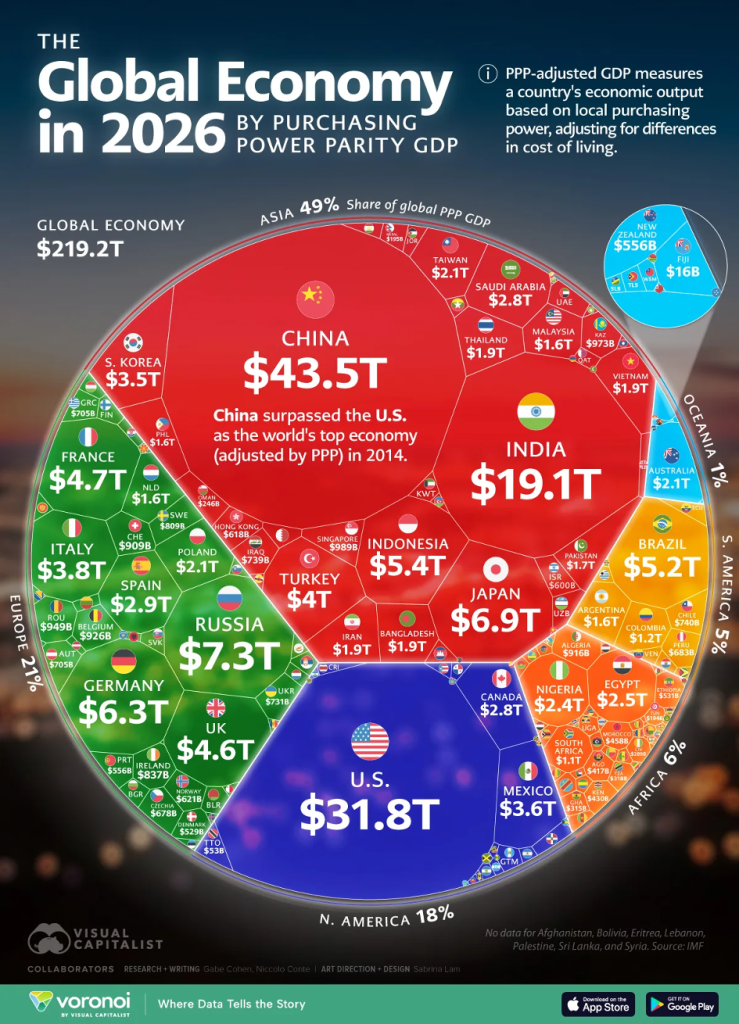
Source: Visual Capitalist
According to this calculation, China ranks ahead of the US, Russia ahead of Japan, and Germany.
Furthermore, the Collective West, as the aggressor, finds itself in a domestic political and economic situation that does not allow for a military showdown with Russia, Iran, and China: US debt stands at over 121%—the last time this was the case was at the end of World War II, following an industrial war that brought the US global dominance. After 35 years, and under economic and political conditions that remained favorable to the US, this debt was reduced to below 40%.
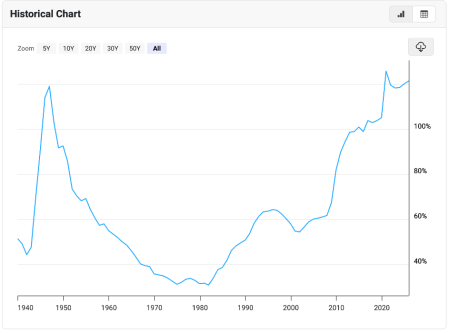
 Source: Macrotrends
In 1945, the Americans reached the height of their power. Together with the Soviet Union, they dominated the course of the war, held 22,000 metric tons of gold, and American industry produced 70% of the world’s manufactured goods. This is what true “full spectrum dominance” looks like: military dominance, industrial dominance, gold—because whoever has the gold sets the rules. Now the US is once again facing a world war, and the situation looks much like it did after the last war, with one major difference: China is at least the US’s economic equal, with far more favorable economic conditions.
These are not the conditions necessary for a military conflict on a global scale—neither financially, nor economically, nor, consequently, politically.
Middle East
It is clear from the text of the MOU that Iran has defeated both Israel and the US militarily; otherwise, the Americans would never have signed such a document. Israel cannot, without risking the collapse of its own delusions of great-power status, comply with the spirit of the document and end the war in Lebanon and Gaza. Therefore, there will be no peace.
Our comments on this topic: “Iran Defeats the US – Thoughts.” In Iran, voices are growing louder claiming that the president and foreign minister are not negotiating hard enough—public pressure in Iran is calling for a tougher stance toward the US and Israel. Iran’s Supreme Leader, Mojtaba Khamenei, has approved the memorandum of understanding (MoU) with the US to end the regional war under certain conditions. However, in a public statement, he said that he fundamentally held a “different view,” but had agreed to the agreement after receiving guarantees from President Masoud Pezeshkian that Iran’s national rights and the “Resistance Front” would be safeguarded. This is a clear indication that the Iranians are ultimately unwilling to make compromises at the expense of Lebanon and Gaza.
It is to be expected that the conflict in the Middle East will continue: Neither the US nor Israel is willing to accept defeat in the war and deal with its consequences. This stance maintains a state of limbo that could tip in one direction or the other at any moment. However, this strategy is countered by the fact that time is running out for the West because of Hormuz. The dwindling oil reserves were the main reason the US signed this MOU in its current form in the first place. The Americans are thus seeking a state of limbo that allows them to prepare their next military steps in peace; however, this state can only be maintained if the Strait of Hormuz remains open in the meantime. While approximately 130 ships passed through the Strait of Hormuz daily until February 28, 2026, these numbers dropped to practically zero, then stabilized at 5%–10% of pre-war levels, before surging to 70 ships on June 25, 2026. These figures should be treated with caution: It is said that the majority of these 70 ships were exporting oil from Iran after the US lifted the oil sanctions upon signing the agreement. If the Israelis do not withdraw from Lebanon and the Iranians remain steadfast—which is to be expected—then the Strait of Hormuz will remain a congested bottleneck: the time bomb for the West’s supply of raw materials continues to tick.
The Iranians can wait—the Americans cannot. When assessing the situation, one should simply disregard Donald Trump’s statements, because Trump speaks of peace one moment and war the next, changing his mind sometimes several times a day. He seems to believe that he can achieve something with the Iranians through this “New York-style deal-making” terror, but that is not the case, since he achieves only one thing: Americans are increasingly proving themselves to be agreement incapable, thereby threatening world peace.
War in Europe
The armed conflict in Ukraine, instigated by the West, began in 2014. Only those who do not classify Ukraine’s years-long artillery shelling of the Donbass as an act of war claim that the Russians started the war in February 2022. This is just one fact that is so obvious that one can only wonder at the West’s arguments that Russia is the aggressor.
Another fact is that this war has completely transformed the technology and tactics of warfare—the parties had to adapt to a new kind of war dominated by drones and missiles. Tank columns and troop concentrations are attacked by inexpensive drones as soon as they are detected—and they are detected very quickly. The warring parties had to undergo migration and learn this new art of warfare. The Russians, in particular, have done this successfully and now dominate the battlefield in a new way: through slow, efficient advances, because massed attacks produce only one thing—heavy casualties. Similar waves of technological advancement have occurred time and again. The machine gun, which was already in use before World War I but whose significance was underestimated at the time, brought an end to maneuver warfare as early as the first year of the war, when large columns of soldiers advanced toward the enemy and were wiped out. Toward the end of World War I, the tank brought some movement back to the front lines. However, comparing the frontline situation in Ukraine to that of World War I is a flawed analogy: Slow movements in small groups seem, so far, to be the only way to survive the drone barrage and maintain mobility.
Recently, Western media have been reporting that the Ukrainians have the upper hand in the war. However, this is fake news that has nothing to do with the reality on the ground. One must distinguish between the fighting on the front lines and NATO’s drone attacks in Russia. On the Donbass front, only a few fortified cities still stand in the Russians’ way; once those are taken, the Donbass will be liberated. Beyond that, there are no longer any fortifications worth taking seriously. Rather than going into details, I refer you to one of the best channels, Military Summary, which has been providing a twice-daily update on the situation at the front since the war began.
The West has not yet recognized the signs of the times. Its experts believe they will be successful in a war against Russia. However, they have not even defined their war aims in any way. Thus, they have no strategic plan against Russia other than to weaken it.
First and foremost, the Germans set the start of the war against Russia for 2030. However, it is now 2026, and the Germans apparently assume that, with Ukraine acting as their proxy, they can send drones and cruise missiles into Russia with impunity until 2030. Europe’s approach is, of course, coordinated with the US. The use of these weapons systems is not possible without American input. President Putin made this very clear a few days ago.
Many observers and experts both inside and outside Russia believe that President Putin will soon decide to launch a strike against targets in Europe—including those outside Ukraine.
There is a wide range of opinions on this topic. We have already published several articles on this subject: In “Will 1914 Repeat Itself? Will War Between Europe and Russia Finally Break Out?,” we also examined the Karaganov Doctrine, which advocates the use of nuclear weapons, and concluded that an attack is necessary, but not with nuclear weapons. Scott Ritter subsequently addressed the “Karaganov fallacy” and also spoke out clearly against the use of nuclear weapons.
Conclusion
In the Middle East, I see no realistic chance of ending the war, because that would mean, on the one hand, the withdrawal of American forces, and Israel would then be left alone as a small, genocidal aggressor. The Israelis are under pressure and are continuing their genocide in Gaza and Lebanon, paying no heed whatsoever to agreements between the US and Iran, because for Netanyahu personally, maintaining the war is the only way to survive politically.
In Russia, pressure is mounting on President Putin to adopt a more aggressive stance toward Europe, which is no longer even attempting to conceal its direct involvement in the war against Russia. Russia is intensifying its attacks on Ukraine, in part by destroying every gas station in eastern Ukraine to paralyze transportation logistics. Ground forces are making visible progress, and once the last fortified cities in the Donbas are liberated—which is likely to happen within the next few weeks—the path to the Dnieper will be clear.
President Putin is thus banking on a military solution in Ukraine and waiting for an energy crisis to unfold in Europe, where many flights are already being canceled under flimsy pretexts.
The concerted media coverage in the West claiming that the tide has turned in Ukraine finds not the slightest confirmation in the reality on the ground in Ukraine. The fuel shortage in Russia is also being exaggerated. In some regions, fuel is being rationed at gas stations. However, this is in no way sufficient to change Russia’s course of action.
Very occasionally, I have the opportunity to speak with someone who lives in Kyiv. According to this person, the situation is catastrophic, and over 90% of the population is against Zelensky. When I asked why the people weren’t rising up, the source replied that people were so intimidated by the terror of the security and intelligence services that the communication necessary for an uprising was impossible. Ukraine, which is portrayed by the West as a shining example of democracy, seems to be a time bomb whose ticking goes unheard out of fear.
My concerns that a war between Europe and Russia might break out—even though Europe has virtually no military power—have never been greater. President Putin will not be the one to take the first step toward a Third World War. Only he knows how much longer he will tolerate the West’s systematic provocations and how he will respond to them.
Extremists attack five Malian towns in coordinated dawn attack
Al Mayadeen | July 4, 2026
Mali’s army announced on Saturday that insurgents launched attacks before dawn against its positions in Aguelhok, Anefis, Gao, Sévaré, and Kenieroba, spanning the country’s north and center. Fighting in the different locations began around 5 am local time.
The army says the assaults were attempted strikes on its positions, according to a statement carried on state television.
In Gao, a local official told Reuters that gunfire and rocket fire had targeted a military camp since before dawn. Explosions were also reported in Sévaré, with aircraft later spotted flying over the area, a security source told AFP.
In Kenieroba, roughly 74 kilometers from Bamako, a major prison complex holding extremist prisoners came under attack. There were no immediate reports of casualties.
FLA claims gains in Anefis
The Azawad Liberation Front (FLA), a Tuareg-led separatist movement, confirmed it carried out the assault on Anefis, in the northeastern Kidal region.
For his part, spokesperson Mohamed Elmaouloud Ramadane told Reuters that several army positions in the town had fallen and that clashes were ongoing inside it.
A resident reached by AFP said armed fighters had entered the town but that the army camp had not yet fallen, and government forces were still resisting.
JNIM, the al-Qaeda-linked coalition that has also operated alongside the FLA, had not issued a claim as of Saturday.
Anefis and Aguelhok are the only locations in the Kidal region where Malian troops have maintained a presence since the collapse of government control there in late April, when FLA and JNIM fighters seized the city of Kidal itself.
Russian forces, deployed to Anefis after that offensive, are also stationed in the area, making it a focal point for both Bamako and Moscow’s regional military presence.
Part of a broader pattern since April
Saturday’s attacks come just over two months after JNIM and the FLA carried out a coordinated wave of strikes on military and administrative targets across Mali, including in Bamako, Kati, Gao, Sévaré, and Kidal.
That offensive killed Defense Minister Sadio Camara, whose responsibilities were temporarily transferred to President Assimi Goïta, and led to the withdrawal of Malian and Russian forces from Kidal and other northern towns.
Russia’s Defense Ministry described the April events as a foiled coup attempt involving roughly 12,000 fighters, it said were trained with Western support.
Forget the Vietnam war ‘gap’ we have a real credibility chasm today
Leadership has spun, misled, and kept the populace in the dark through many wars during the country’s 250-year history. This may be the worst.
By Gregory Daddis | Responsible Statecraft | July 3, 2026
When it comes to war, the Trump administration faces a credibility problem. According to CNN, between late March and early June, the president claimed he was on the verge of reaching a peace deal with Iran at least 38 times. Such fabrications came nearly a full year after Trump declared that Iran’s nuclear facilities had been “obliterated” and suffered “monumental damage.”
Secretary of Defense Pete Hegseth has been equally sanguine these past months, bragging at one April Pentagon press conference that Operation Epic Fury, the campaign against Iran launched on February 28, had been “a historic and overwhelming victory on the battlefield, a capital-V military victory.” And yet the war continued on.
Now, a tenuous “memorandum of understanding” to reopen the Strait of Hormuz and lift Iranian sanctions, while raising alarm among some members of Congress, has been painted by Trump as a major win thanks to a “record high” stock market and “tumbling” oil prices.
Such optimistic yet fallacious progress reports elicit memories of another American war in which credibility became contested ground, both at home and abroad. The lies of Vietnam created a “credibility gap” between the White House and American public — one that has now turned into a credibility chasm undermining the trust necessary for political leaders to deliver on their national security promises.
It is with good reason that the American war in Vietnam has come to be seen as one of the most contentious conflicts in our nation’s 250-year history. The political-military struggle set a historical benchmark for how we talk about — and lie about — war. Distortion and deception seemed indivisible from the very conduct of American military interventionism.
The duplicity started early. Gen. Paul D. Harkins, the first chief of the U.S. military assistance command in Vietnam, openly boasted that “I am an optimist, and I am not going to allow my staff to be pessimistic.” Not surprisingly, rosy reports flowed into Washington. The communist insurgents were diminishing in strength and influence. The Saigon government was attracting loyalty among the rural population. The war was being won.
In August 1964, months after Harkins’ tour ended, Washington Post reporter Arnold Beichman shared a popular refrain Americans were still singing outside of Saigon. “We are winning, this we know / General Harkins tells us so.” When Beichman asked a group of U.S. advisors if they thought the South Vietnamese indeed were winning, they unanimously declared “no.”
Less than a year later, there seemed little doubt about the U.S. advisory mission’s inability to stanch the communist tide. In the spring of 1965, President Lyndon Johnson dispatched ground combat troops to South Vietnam at the behest of senior military commanders. At Johns Hopkins University that April, the president suggested he had little choice but to escalate. “We do this in order to slow down aggression,” he shared.
But the falsehoods only multiplied. Johnson spoke of the “deepening shadow of Communist China,” masking the reality that this conflict was, at its core, a Vietnamese civil conflict. He spoke of strengthening the world order by defeating North Vietnam, avoiding questions of how such a small Southeast Asian country could pack such a huge international wallop. And he spoke of increasing “the confidence of the brave people of South Vietnam,” overlooking the damage being done by American firepower on an already dispossessed rural population.
As American troops poured into South Vietnam, journalists took note of the disconnects between official White House narratives and their own observations. David Wise of the New York Herald Tribune first used the term “credibility gap” in May 1965, followed by Murrey Marder of the Washington Post that December. Marder found “creeping signs of doubt and cynicism about Administration pronouncements” and a “perceptibly growing distrust… about the candor or validity of official declarations.”
White House untrustworthiness was undermining U.S. foreign policy. Worse was yet to come.
By the summer of 1967, two years after U.S. Marines first landed at Da Nang, the war had devolved into a blood-stained impasse. The military command in Vietnam dutifully reported progress at daily press briefings, disparagingly called the “Five O’clock Follies” by skeptical journalists. Back home, the media increasingly spoke of a “stalemate” that only “moved to a higher level of combat, casualties, and destruction.”
Concerned about growing domestic discord, the president summoned home his war managers to help “sell” the war. In November, General William Westmoreland, Harkins’ successor, and U.S. Ambassador Ellsworth Bunker presented an optimistic report on Meet the Press. The general highlighted “significant evidence” of “real progress being made,” while Bunker intimated that media reports were misrepresenting the allied war effort. Days later, the president castigated the disparities between “constructive dissent and storm-trooper bullying.”
Then the walls crumbled. In early 1968, Vietnamese communists launched a general offensive across South Vietnam during the Tet holiday, hoping to spur a general uprising among the southern population. The American public relations campaign came crashing down as television viewers back home watched military police fighting across shattered U.S. embassy grounds.
When word of the attacks reached respected news broadcaster Walter Cronkite, his reaction mirrored many of his fellow Americans. “What the hell is going on,” he reportedly asked. “I thought we were winning the war.” And still, the war dragged on.
By the time of Richard Nixon’s presidency, in historian Christian Appy’s words, “the credibility gap took on Grand Canyon-like proportions.” The New York Times’ June 1972 decision to publish the “Pentagon Papers,” a classified record of duplicitous decisions leading the nation to war, surely aided in this massive breakdown of trust. When asked to justify leaking the secret report, whistleblower Daniel Ellsberg turned the tables, asking what made officials “feel like they had a right to keep silent about the lies that had been told… the crimes that had been committed, the illegalities, the deception of the American public?”
The lies of which Ellsberg spoke matter because they endure, having been replicated, if not intensified, by a Trump administration indifferent to being truthful about the causes, conduct, and consequences of war. Indeed, the administration seemingly has gone out of its way to hide any inconvenient truth from the American public. Earlier this month, Secretary Hegseth declared the Pentagon press office a “classified space,” curtailing journalists’ ability to report on national security issues. The Five O’clock Follies look comparatively transparent.
Of course, Vietnam was not the only case of political leaders using deception to justify military adventurism. The Bush administration’s decision to invade Iraq in 2003, for instance, was far less an “intelligence failure” than a comprehensive case of intelligence manipulation.
Yet the war in Vietnam, perhaps better than any conflict over the nation’s 250-year history, lays bare how dishonesty perpetuates conflict and how the responsibility, if not burden, of citizens in a democracy is to demand a more truthful accounting of wartime decision-making and to question overzealous “progress” reports.
Historian Barbara Tuchman thought the solution for opposing senior officials who peddle falsehoods lay outside the halls of government. Writing less than a decade after Saigon’s fall, she believed that avoiding similar “betrayals” like the one in Vietnam depended upon “educating the electorate to recognize and reward integrity of character and to reject the ersatz.”
If Americans haven’t necessarily rewarded integrity at the ballot box lately, we shouldn’t lose hope that credibility and character still matter when it comes to wartime leadership. There is no better time than our 250th anniversary to demand that our leaders shrink the credibility chasm that we are peering across today.
This article is part of an RS series reflecting on the 250th anniversary of American Independence and its impact and meaning for modern U.S. foreign policy, war, and peace.
Gregory A. Daddis is the Melbern G. Glasscock Endowed Chair in American History at Texas A&M University and author of Faith and Fear: America’s Relationship with War since 1945 (2025). He served 26 years in the U.S. Army before entering academia and is a board member of the Quincy Institute.
India to collect voice samples of arrested Ukrainian and US mercenaries
RT | July 3, 2026
India will collect the voice samples of six mercenaries – five Ukrainians and a US national – who were arrested in March by the National Investigation Agency (NIA), New Delhi’s anti-terror agency.
Together with another Ukrainian, they were arrested in March; all have been charged with aiding insurgent groups in neighboring Myanmar and providing them with weaponry.
The six were presented before a Delhi court on Friday amid heavy security, and were told they would remain in custody until August 1. They consented to have their voices recorded.
The court will decide the date for collecting voice samples on Saturday, when the remaining Ukrainian will be presented before it.
The NIA is also seeking an extension of the investigation period to 180 days under the Unlawful Activities Prevention Act, India’s primary anti-terrorism legislation.
The probe focuses on the alleged illegal entry of the mercenaries into the Indian border state of Mizoram, where foreign nationals are required to obtain a special permit, as well as their subsequent illegal crossing into Myanmar.
The Ukrainian men in custody are Petro Hurba, Taras Slyviak, Ivan Sukmanovskyi, Marian Stefankiv, Maksim Honcharuk, and Viktor Kaminskyi; three were detained at Delhi’s airport, while the others were taken in by the NIA in Lucknow. Matthew Aaron VanDyke, the US citizen, was arrested at an airport in the coastal city of Kolkata.
The Ukrainian Foreign Ministry, at the time of their arrest, demanded the immediate release of its citizens and access to them, claiming there were no “established facts proving the involvement of the said Ukrainian citizens in unlawful activities on the territory of India or Myanmar.”
It also accused Indian and Russian media of publishing “distorted interpretations of the available facts.”
But reports at the time indicated that the Indian intelligence agencies were on the trail of the suspects after gathering significant inputs, likely from Interpol or with help from foreign intelligence agencies.
Mizoram’s chief minister, Lalduhoma, alleged last year that “thousands” of Western mercenaries linked to Kiev had crossed over to Myanmar via his state.
The chief minister of the neighboring state of Manipur, N. Biren Singh, suggested in 2024 that authorities suspected the involvement of foreign mercenaries in the violence in the state, referring to combat forces linked to Myanmar. At that time, New Delhi announced it would fence the entire 1,643 kilometer (1,020-mile) border with its neighbor to the east.
NATO Prepares for War, Hitler-Style Prison Camps and Blockade of Russia
Sputnik – 30.06.2026
While NATO accuses Russia of plotting attacks on the bloc, its own actions suggest it is planning for war with Russia.
Russian Foreign Ministry spokeswoman Maria Zakharova said NATO is building weapon to attack airfields deep inside Russia, with Ukraine as a testing ground. This spring, the NATO-led Joint Expeditionary Force held wargames to practise besieging and capturing Russia’s Kaliningrad region.
Questions have also been raised over the Namejs 2025 exercises in the Baltics.
Lithuanian media said the exercise played out setting up a temporary prison camp called “Selonia” in Latvia for “potential collaborators” — civilians suspected of political disloyalty.
- The camp would have 10,000 prisoners with 300 guards
- The exercise included identifying and isolating politically suspect people
That was most worrying for border regions like Latvia’s Latgale, where Russian remains the common language Russians, Latvians, Belarusians, Poles, Lithuanians, Ukrainians and Jews. Russian- and Belarusian-speaking communities in Lithuania could also be targeted, including parts of the Polish minority.
Echoing the Nazi occupation, the drills involved labeling parts of the population as potential enemies, compiling lists of “disloyal” citizens and preparing prison camps even before any conflict begins.
Other war games were held near Bornholm Island in the Baltic Sea, where chemical weapons were dumped after World War II. The aim was to control sea traffic — possibly planning for Baltic Sea blockade on Russian ports.
Moscow insists that it has no desire for war with NATO. Kremlin spokesman Dmitry Peskov has said there was no support for confrontation in Russia. Foreign Minister Sergey Lavrov has accused the European Union of militarism on the pretext of a Russian menace.
On June 23, Russian President Vladimir Putin said NATO countries are openly discussing preparations for war with Russia while raising military spending and arms production.
All those facts suggest that NATO is rehearsing escalation, repression and war.
A banal collection of nonentities and grifters

Ashes of Pompeii | June 30, 2026
Across the European Union, governance has increasingly devolved into an exercise in moral posturing. When virtue signalling becomes the primary policy guide, pragmatic statecraft is abandoned. The result is a continent plagued by strategic blunders, driven by an elite class that prioritizes appearing righteous over being effective.
At the heart of this dysfunction is the Brussels bubble, an insulated ecosystem entirely disconnected from the real world. The leaders populating this space generally lack practical experience, possessing only the specific skill set required to navigate internal party machinations. Consequently, they have consistently failed upwards. Ursula von der Leyen stands as the ultimate archetype of this phenomenon. After an, at best, mediocre career in German politics, culminated by a totally unsuccessful term as Minister of Defence, she was elevated to the head of the European Commission through backroom political horse trading rather than visionary leadership. This general lack of democratic accountability is fuelled by a profound sense of hubris and an entitlement to lead the globe. Apparently the natural order of things places Europe as the world’s moral, economic (and even military LOL) leader. Diversity and Identity Politics may rule in Brussels politics, where quotas are more important than merits, but in foreign policy Europe seems to think it has a God-given mandate to rule the world. Virtue signalling has entirely replaced serious political discourse as the main political language, ensuring that only the most ideologically compliant rise to the top.
This environment breeds rampant careerism, where the ultimate goal is securing a prestigious post through absolute subservience to the EU elite and the United States. Loyalty to Washington is routinely rewarded over national interest, as seen in the appointments of Annalena Baerbock to the United Nations and Mark Rutte to NATO. Alongside this sycophancy comes institutional corruption. The Pfizer scandal perfectly encapsulates this rot, with Von der Leyen at the center of the scandal. But the intense scrutiny she should be facing is glaring for its absence. When leaders operate with such opacity and prioritize personal or political advancement over transparency, the entire administrative apparatus rots from the inside.
This moral posturing yields disastrous foreign policy, most notably regarding Ukraine. The fundamental question is not what the EU can do to help Ukraine win, but why it is even meddling at all. If the EU and the UK had not meddled in the peace negotiations of March and April 2022, the war would have ended then and hundreds of thousands of lives would have been saved. Furthermore, Ukraine would have secured far better territorial and political conditions than it is likely to achieve in any postwar settlement today. The early peace talks were derailed by Western interference, turning a potential diplomatic resolution into a grinding war of attrition. Instead of pursuing a pragmatic peace, European leaders chose to signal moral superiority, prolonging a devastating conflict. We can debate whether this was to satisfy their ideological vanity or out of simple subservience to Washington.
Domestic policies suffer equally. Driven by the moral imperative of green virtue signalling, European leaders prematurely dismantled reliable energy infrastructure, triggering severe economic crises. Meanwhile, the current trade dispute with China exposes profound intellectual dishonesty. The EU labels China’s success in manufacturing and exports as “overcapacity”. Yet, one must ask if Germany had overcapacity during all those decades where it maintained a highly successful export led economy. They refuse to acknowledge their own loss of competitiveness, choosing instead to penalize Beijing for outperforming them in the global market. By weaponizing trade terminology to mask their own industrial decline, Brussels prioritizes ideological protectionism over economic reality.
It must be noted that the United Kingdom suffers from most of these same ailments. London’s political class is equally plagued by careerism, a disconnected bubble, and a reliance on virtue signalling over practical governance. Ultimately, whether in Brussels or London, the shift toward governance by moral posturing has been catastrophic. When leaders are unelected, subservient to foreign powers, and selected for ideological purity and party loyalty, rather than competence, the nation suffers. Europe has traded statecraft for virtue signalling, leaving itself strategically vulnerable and economically weak.
Future historians will look back on today’s leaders and wonder just how could such a banal collection of nonentities and grifters rise to become in the “elite” of the once powerful Europe.
Featured Video

The Search for Truth: Charlie Kirk’s Assassination One Year Later
or go to
Aletho News Archives – Video-Images
From the Archives
The 9/11 “Double-Cross” Conspiracy Theory
BY LAURENT GUYÉNOT • UNZ REVIEW • SEPTEMBER 6, 2022
Is it true that “9/11 was an inside job”? Yes, insofar as Israel is “inside” the U.S. But for the 9/11 truthers who have identified Israel as the main perpetrators, “9/11 was an inside job” is at best a half-truth, and at worst an integral part of the Zionist operation, like a secondary flag sewn as a lining under the false flag of Islamism. Victor Thorn (1963-2017) wrote in his book 9/11 made in Israel: The Plot Against America (2011): “In essence, the ‘9-11 truth movement’ was created prior to Sept. 11, 2001 as a means of suppressing news relating to Israeli complicity. . . . The slogan ‘9-11 was an inside job’ was quite possibly the greatest example of Israeli propaganda ever devised.” In milder terms, it is “controlled opposition”.
A genuine truth movement would have pointed to Israel as the prime suspect from the start. From day one, it was obvious who would benefit. … continue
Blog Roll
 Aletho News
- Europe’s mounting social chaos… chickens coming home to roost for proxy war against Russia
- US-Russia Diesel Deal Becomes Massive Defeat for Ukraine
- Hormuz and the Looming Economic Catastrophe
- Dhubab offensive, media blitz and the rapid unraveling of Saudi-backed coalition’s new gambit
- Putin Conveys to Trump Iran’s Vision on Possible Conflict Resolution – Kremlin
- The Search for Truth: Charlie Kirk’s Assassination One Year Later
- ‘Harsh reality’: Iran says France seeks monopoly on power and intimidation, not peace for all
- When Will This White House Madness End?
- Huckabee aide goes to ‘unusual lengths’ to portray ‘Israel’ positively
- Trump Announces Diesel Supply Deal With Putin Following Phone Call
- If Americans Knew
- Israeli forces kill another child in Gaza – Daily Update
- Gaza ceasefire exists in name only, say more than 100 organizations
- Nearly 2 Million in Gaza Need Urgent Shelter Assistance as Winter Looms: IOM Chief Warns
- Suppressing Palestinian resistance: US charity under fire for AI monitoring of Gaza classrooms
- Thousands Are Held in Israeli Torture Camps. This Is What Happens Inside
- Israel puts Gaza’s sick, injured, newborn in peril – Daily Update
- Report claimed Mark Levin used by Israeli government to influence Trump
- Over 2,000 Gazans have died awaiting medical evacuation amid Israel’s continued siege
- How a U.S. Diplomat Suppressed and Altered Reports Critical of Israel
- 5 Palestinians Die from Israeli Strikes in Gaza as Relentless Attacks Continue
- No Tricks Zone
- New Study: 50 Years Of The Most Aggressive ‘Net Zero’ Policies Can Only Affect The Global Climate By 0.03°C
- US September “Heat” Was No Record…Many Records Set Decades Ago
- Latest European Green Energy Debacle; Portugal’s Largest Flagship Solar Park Insolvent!
- Green Energy Debacle: German Expert Professor Fritz Vahrenholt Warns Of Severe Economic And Social Consequences
- Two More Paleo Reconstructions Affirm Meters-Higher Sea Levels Across Ireland, Brazil 7000-6000 Years Ago
- New Study: Earth And Venus Surface Warmth Largely Explained By Convection And Lapse Rate, Not CO2 Or Radiation
- 2025 Nature Paper Claiming Worsening Global Drought Gets RETRACTED …Heavily Flawed
- New Study: ‘Global Drought Shows No Detectable Recent Acceleration Under Climate Warming’
- Economic Masterminds: German Socialists Suggest Taxing Productivity Gains Stemming From Using AI
- The South China Sea Has Not Been Cooperating With The Climate Change Narrative

