Two legal organizations, European Lawyers for Democracy and Human Rights and the Cyprus Democratic Lawyers Association, have called for the termination of British claims over the military bases at Akrotiri and Dhekelia, describing them as remnants of colonial rule that undermine the sovereignty of the Cypriot people.
In a joint statement, the organizations argued that Cyprus remains only partially decolonized more than six decades after gaining independence. They said the agreements establishing the bases in 1960 were imposed as a condition for independence, allowing Britain to retain control over parts of the island for strategic military use.
The statement challenged Britain’s assertion that Akrotiri and Dhekelia are sovereign British territories. According to the groups, the arrangement was established under unequal and coercive circumstances at the time of independence and therefore cannot be considered the result of genuine consent.
UN resolution cited on territorial integrity
The organizations pointed to United Nations General Assembly Resolution 1514 of 1960 on decolonization, which they say prohibits the fragmentation of colonial territories during the decolonization process and protects their territorial integrity.
They also cited the 2019 advisory opinion by the International Court of Justice regarding the Chagos Archipelago. In that case, the court determined that the decolonization of Mauritius was not lawfully completed after Britain separated the islands in 1965 and concluded that the UK should end its administration of the territory.
According to the statement, the same legal reasoning applies to Cyprus. The groups argued that the British bases represent a continuation of colonial authority under a different framework, dividing the island’s territory and turning it into a staging ground for foreign military operations.
Security risks from foreign military activity
The organizations also warned that the use of the bases by other states, including the United States, could expose Cyprus to regional conflicts. They said activities conducted from the bases, including operations that could be interpreted as unlawful self-defense, might threaten the island’s security and territorial integrity.
The statement additionally cited a 2024 advisory opinion by the International Court of Justice regarding Israeli policies in the Occupied Palestinian Territory, arguing that third-party states must not assist in maintaining situations that violate international law.
The organizations said the issue ultimately concerns international law, decolonization, and the protection of the Cypriot people’s rights. They argued that Cyprus has the right to challenge the arrangement in international forums and demand the complete end of colonial-era structures.
Finally, the groups urged the Government of Cyprus to stop its tolerance of the British bases and to begin discussions with the United Kingdom on steps toward their removal and the return of all Cypriot territory to national control.
The incident comes amid escalating regional tensions following coordinated US and Israeli strikes on Iran. Tehran has since launched missile and drone attacks across the region, with British officials noting that some projectiles were fired in the direction of Cyprus.
The Judaeo-American war on Iran was intended to be a lightning strike routing, fought exclusivelyfrom the air, lasting only a few days. Instead, Washington and its Zionist proxy have blundered into a major multi-front conflict, which could well threaten the Empire’s very existence. The initial US aerial bombardment’s centrepiece was Supreme Leader Ali Khamenei’s February 28th murder. Initially hailed by Western media as “the assassination of the century,” the vile act has resulted in catastrophe for the perpetrators.
The Islamic Republic’s relentless battering of Zionist entity civilian centres and military and intelligence infrastructure, and US bases throughout West Asia, hasn’t been deterred one iota. Vast crowdstook to the streets of Tehran in vengeful mourning. Their righteous anger has pullulated throughout the Arab and Muslim world. Ever since, incensed Shiites have violently clashed with security forces in multiple major Pakistani cities. Meanwhile, Bahrain teeters on the brink of all-out revolution. Now, Mojtaba Khamenei, the slain Supreme Leader’s son, has taken his place.
Iranian citizens of every ethnic and religious extraction braved US-Israeli airstrikes to celebrate his ascension. Commonly perceived as a hardliner with strong ties to the Iranian Revolutionary Guards Corps, the expectation that the new Supreme Leader will adopt a considerably less conciliatory, patient approach than his father is widespread. Western sources forecast Mojtaba may decide the Islamic Republic “must move quickly to obtain nuclear weapons in order to forestall future US and Israeli attacks,” overturning Ali Khamenei’s longstanding fatwa against their development by Tehran.
US President Donald Trump has declaredhe is “not happy” with Mojtaba taking power, and Israeli apparatchiks are likewise perturbed by the development. Nonetheless, this was an inevitable upshot of assassinating the former Supreme Leader. There was also no reason to believe doing so would precipitate the Islamic Republic’s collapse, or lead to Tehran’s military submission. It begs the obvious question of why Washington and Tel Aviv electively helped install a ruler more committed than ever to expelling the Empire from West Asia.
Similarly, Hezbollah’s extraordinary broadsides of the Zionist entity since Khameinei’s assassination should dispel any notion – as perpetuated by Israeli political and military chiefs – the groupwas obliterated by Tel Aviv’s criminal October 2024 invasion of Lebanon. That incursion was prefaced by an operation in which thousands of pagers used by senior Hezbollah operativeswere detonatedsimultaneously, having been wired with explosives by Mossad pre-purchase, killing and injuring many. A week-and-a-half later, the group’s Secretary General Hassan Nasrallah was lethally targetedin a Zionist entity airstrike.
Evidently, the Resistance cannot be crushed via high-level assassinations. In fact, such actions actively strengthen its members. This inconvenient reality has been well-known to the CIA since at least 2009. In July that year, the Agency produced a top secret assessment laying out the pros and cons of liquidating “high value targets” (HVTs). It was prepared in advance of Barack Obama’s CIA chief Leon Panetta shifting US “counter-terror” operations from capturing and torturing high-level suspects, to outright executing them.
The assessment concluded HVT operations “can play a useful role when they are part of a broader counterinsurgency strategy,” and sought to “assist policymakers and military officers involved in authorizing or planning” such strikes. However, it listed many “potential negative effects” of “high value” assassinations. Israel’s past killing of Hamas and Hezbollah leaders were specifically cited as examples of how the strategy can spectacularly backfire. We have witnessed the CIA’s unheeded cautions play out in real-time since February 28th.
Foremost among prospective blowback from HVT operations is that the risk high-level assassinations can increase an “insurgent” group’s support. This occurs when killing a target “[strengthens] an armed group’s bond with the population, radicalizing an insurgent group’s remaining leaders, creating a vacuum into which more radical groups can enter, and escalating or deescalating a conflict in ways that favor the insurgents.” Such actions can also “[erode] the ‘rules of the game’ between the government and insurgents,” thus exacerbating “the level of violence in a conflict”:
“HVT strikes, however, may increase support for the insurgents, particularly if these strikes enhance insurgent leaders’ lore, if noncombatants are killed in the attacks, if legitimate or semi-legitimate politicians aligned with the insurgents are targeted… An insurgent group’s unifying cause, deep ties to its constituency, or a broad support base can lessen the impact of leadership losses by ensuring a steady flow of replacement recruits.”
The CIA assessment noted several historical instances of supposed HVT successes. When high-level targets have “prominent public profiles”, assassinations can in specific instances shatter a target group. However, this was not the case with Hamas or Hezbollah. The pair “carry out state-like functions, such as providing healthcare services,” so group leaders are well-known to citizens of Gaza and Lebanon. Yet, their “highly disciplined nature, social service network, and reserve of respected leaders” mean they can easily “reorganize” in the wake of assassinations.
The Zionist entity had by this point been engaged in “targeted-killings” against Hamas, Hezbollah, and other Resistance groups since the mid-1990s. However, their “decentralized command structures, compartmented leadership, strong succession planning, and deep ties to their communities” made them “highly resilient to leadership losses.” Undeterred, Tel Aviv’s high-level assassinations continued apace. In the early 2000s, Hamas founder Sheikh Yassin and the group’s leader in Gaza Abdel Aziz al-Rantisi were murdered. However, the killings “strengthened solidarity” between Resistance factions, while “[bolstering] support for hardline militant leaders.”
The obvious lessons of this wanton bloodletting remained unlearned by the Zionist entity, once the Gaza Holocaust erupted. In June 2024, elite imperial journal Foreign Affairs published a report unequivocally headlined Hamas Is Winning. It boldly concluded “Israel’s failing strategy makes its enemy stronger.” The outlet also recorded how “according to the measures that matter,” Hamas was considerably bigger and more powerful than on October 7th 2023. Israel had thus stumbled into a deeply ruinous attritional war, with a “tenacious and deadly guerrilla force.”
Hamas’ surging popularity with Palestinians throughout the Gaza genocide was found to have significantly enhanced the group’s “ability to recruit… [and] attract new generations of fighters and operatives.” This granted Hamas the ability to launch “lethal operations” in areas previously “cleared” by the IOF “easily”. Foreign Affairs charged the Zionist entity, to its “great detriment”, failed to comprehend how “the carnage and devastation it has unleashed in Gaza has only made its enemy stronger.”
It is not merely Hamas that has been galvanised by the Gaza genocide. Israel’s “carnage and devastation” has greatly expanded the ranks and resolve of the entire Resistance, while its constituent members have won hearts and minds globally in ever-mounting numbers.Tel Aviv and its Anglo-American puppet[master]s have no good choices left to make, in a criminal war of choice waged against an indefatigable adversary committed to total victory, the likes of which they have never faced off against before.
The calamitous outcomes of Judaeo-American conflict with Iran were amply spelled out in a June 2025 report by the Israel-based Institute for National Security Studies. Among other things, it cautioned against assassinating Ali Khamenei, as the Islamic Republic “would likely have little difficulty selecting a successor, who could prove to be more extreme or more capable,” while uniting the Iranian public and government more than ever behind all-out victory. The consequences of disregarding this prophetic curse will reverberate throughout West Asia for centuries.
US President Donald Trump said Saturday that countries relying on oil shipments through the Strait of Hormuz should take responsibility for “safeguarding” the vital maritime corridor, with the United States offering its “assistance.”
“The United States of America has beaten and completely decimated Iran, both Militarily, Economically, and in every other way, but the Countries of the World that receive Oil through the Hormuz Strait must take care of that passage, and we will help — A LOT!” Trump reiterated on social media.
“The US will also coordinate with those Countries so that everything goes quickly, smoothly, and well. This should have always been a team effort, and now it will be,” he further claimed.
Trump says US destroyed Iran military, but demands China secure Hormuz
Earlier, Trump posted on Truth Social, calling for multiple nations to send warships alongside the US to keep the Strait of Hormuz “open, safe, and free”. His post specifically named China, France, Japan, South Korea, and the United Kingdom.
The request drew immediate attention for its irony, as China is both a strategic rival of the United States and maintains close relations with Iran. Trump’s call for Chinese assistance in a US-led operation to secure a major oil chokepoint underscores the contradictions and hyperbole in his adminstration’s messaging, following a horrific press conference by War Secretary Pete Hegseth a day earlier.
Trump also claimed that Iran’s military capabilities are “100% destroyed”, yet immediately acknowledged that Tehran could still deploy drones, mines, or short-range missiles along the strait. He urged the creation of an international coalition to manage threats in the waterway, highlighting a sharp contradiction between his declaration of total victory and the perceived need for global military support.
Kharg Island strike escalates Gulf tensions
Earlier, the Trump administration conducted an attack on Kharg Island, a critical hub for Iranian oil exports. While the strike did not target oil infrastructure, reports suggest Washington may be considering a larger operation to invade and control the island, a move that could further destabilize the region.
US control over Kharg Island could provoke Iranian retaliation against shipping routes, oil facilities in the Strait of Hormuz, or the island itself, pushing energy markets into uncertainty.
Brent Crude has climbed sharply since the start of the US-Israeli war on Iran, rising from around $70 per barrel in late February to $103.14 for April contracts. Analysts interpret Trump’s public statements as an attempt to reassure buyers and ease market anxiety, yet the combination of strikes on Kharg Island and the ongoing threat in the Strait of Hormuz continues to push prices higher.
Conflicting US messaging and regional skepticism
Trump’s post follows a series of contradictory statements from senior US officials over the past week. Hegseth previously insisted the Strait of Hormuz was not closed, blaming Iranian missiles for disrupted shipping while claiming the situation was under control. Treasury Secretary Scott Bessent and Energy Secretary Chris Wright gave conflicting timelines regarding the readiness of the US Navy to escort oil tankers through the strait.
Analysts remain skeptical about the US’s ability to secure Hormuz, citing capacity constraints, Iran’s asymmetric military capabilities, and the logistical challenges of establishing a multinational escort operation. RBC Capital Markets described the proposed $20 billion US insurance program for vessels as limited and unlikely to reassure market participants fully.
Despite Trump’s claims of decapitated Iranian forces, Tehran’s military remains operational, with the capability to target enemy assets and infrastructure in the Gulf and beyond.
Everything Trump has said about the war with Iran is pure lie or at least a major distortion of the facts. In the middle of this week he boasted that he had supposedly destroyed virtually the entire defense infrastructure of the country, including its naval fleet, air force, and missile capabilities. He even went so far as to declare that the United States had won the war.
Only the hypocritical journalists of the Pentagon’s propaganda machine — the same ones who like to present themselves as impartial and even critical of Trump’s domestic policies — can pretend to believe it and attempt to brainwash their audience with this farce.
Just as with Hamas in Gaza and Hezbollah in Lebanon, the imperialist industry of lies is trying to force down the audience’s throat the idea that Iran is on its knees before the omnipotence of the United States and Israel. Yet U.S. intelligence itself admits that the Iranian regime “is not in danger,” despite nearly two weeks of incessant bombing and heavy manipulation.
Of course Iran is the victim of a cowardly war of aggression, whose enemies have no shame in bombing kindergarten schools killing 160 girls or in causing acid rain that brings illness to civilians through attacks on oil facilities. They are historic war criminals, accustomed to using the vilest and most despicable methods to achieve their objectives of annihilation.
But the country’s political and military high command knew this was inevitable and had been preparing for a confrontation of this magnitude for decades. Iranian resilience has few competitors in the world. They are prepared to endure high costs with the certainty that their war is sacred and that victory will be achieved.
Because victory, in an asymmetric and disproportionate war such as that of an oppressed country against the greatest oppressive power in the history of humanity, does not need to — and will not — be achieved through the destruction of the enemy. It is enough to prevent the United States and its Israeli outpost from achieving their short- and medium-term objectives. In a time of structural crisis of the imperialist system, even in its very heart — the United States itself — not only will the enemy fail to achieve its goals, but it will also weaken in a way never seen before.
When have American military bases been struck as they are being struck in this war? When have Americans had to evacuate so many embassies and consulates as they are doing now? When has the all-powerful U.S. arms industry been so humiliated by seeing such expensive defense systems devastated — the very systems that supposedly protect its clients in the region?
Iran has the potential to generate indelible economic damage to the United States and to the entire global imperialist system. And it is already showing its weapons by closing the Strait of Hormuz and bombing refineries in the Persian Gulf. In a certain sense, the game has turned against imperialism: it seems that control over the world economy is not as tight as once believed. It seems that those who control, in a certain sense, this world economy are not the developed, rich, first-world countries, but rather the “lunatic” and “fanatical” ayatollahs.
The magazine The Economist, the leading mouthpiece of international bankers, revealed the despair of these speculators by featuring on its most recent cover the headline: “A War Without Strategy.” The most powerful people in the world are beginning to panic in the face of Iranian resilience and are already questioning the effectiveness of Trump’s aggression.
Let us not deceive ourselves: they fully support the total destruction of Iran. For them, not a single stone of the millennia-old Persian society should be left standing. We are speaking of the promoters of the genocide of at least 70,000 Palestinians. Proof of this support is the shameful vote in the UN Security Council, proposed by the puppet state of Bahrain, which condemned the legitimate Iranian retaliation against artificial regimes sustained by the United States and Israel in the Gulf, yet said not a single word about the aggression Iran is suffering.
Indeed, the game has turned against imperialism. The closure of Hormuz means the strangulation of the global economic system and therefore the suffocation of the American economy itself. The use of international oil reserves is already being seriously considered to contain the exponential rise in prices — an absolutely exceptional measure effective only in the very short term.
The White House, although it does not admit it, knows that the plan is backfiring: Trump, nervous, has already said that the U.S. armed forces will escort ships that need to pass through the Strait of Hormuz in order to guarantee the transport of oil. It seems like a bluff, at least for now. In any case, if they attempted it, at the current level of escalation there is little doubt that Iran would destroy the escort and sink those ships.
The United States would already be wasting about $2 billion per day on this war. It is extremely costly for public finances, especially with a staggering debt of nearly $40 trillion. The continuation of the war could accelerate a new financial crisis worse than that of 2008 — as well as an oil crisis worse than that of 1973. The global capitalist system itself would be brought to its knees.
The position of The Economist expresses the dissatisfaction of the international bourgeoisie, including the American one. Some Democratic and even Republican congressmen have once again been mobilized to criticize the government. At the same time, they also represent layers of ordinary citizens, workers, small business owners, and farmers who feel betrayed by Trump after he was elected promising to end imperialist wars under the slogan “America First.”
A Reuters/Ipsos poll released the day after the war began showed that only one in four Americans supported the imperialist aggression, while 43% opposed it. In subsequent polls there was greater balance: first 56% opposed and 44% in favor (NPR/PBS/Marist, March 2–4); then 42% in favor of stopping the attacks and 34% in favor of continuing them (NYT, March 6–9). This indicates that the CNN-Fox News-NYT-WP propaganda apparatus has worked to present the aggression against Iran from a positive point of view, leading many Americans to believe that the United States is right after the initial shock.
But trust in the media is no longer as blind as it once was. In 2001 a Washington Post/ABC News poll showed 93% support for the invasion of Afghanistan, while Gallup showed nearly 90%. When the United States invaded Iraq two years later, support was also enormous: 72% according to Gallup and 70% according to the Pew Research Center. The extermination of civilians and the military disaster, despite the destruction of those countries and the eventual expulsion of the U.S. army, led to a wave of protests across the country, driven by the outbreak of the capitalist crisis in 2008. Since then, the political consciousness of Americans has been rising, even if timidly due to the high dose of stupidity among the American people.
Today there is a growing number of influencers, mainly on the right, who oppose neoliberal globalization whose military manifestation is precisely the aggressions carried out by the United States army. Many former members of the armed forces, intelligence services, and the U.S. government are now independent commentators who enjoy great popularity and openly criticize imperialist actions. Most importantly, they influence the very social base of the Trump government: citizens disillusioned with establishment politicians and with the status quo who believed Trump would be different. Although not yet entirely visible, there is a crisis within Trumpism reflected in the complete marginalization of figures such as Tulsi Gabbard and Robert F. Kennedy Jr., while Marco Rubio takes the reins of foreign policy.
American society has been divided for some time, and since the first months of the second term the Trump administration itself has suffered a possibly incurable fracture. The military and economic disaster of the aggression against Iran will certainly contribute to further weakening this fragile political and social structure.
On the surface it may even seem that Iran is losing the war. But deep down, the defeat has already been decreed for the United States.
As American military forces arrived in Afghanistan, they began building a network of bases to rule the entire nation. This repeated the mistakes of the Vietnam war. Each base required clean water, electricity, security, and frequent resupply, which required guarding bridges, road mine clearing, weekly supply convoys, and helicopter runs. This was expensive, required much manpower, left forces dispersed, provided ample targets for the enemy, and alienated the population with frequent “search and destroy” patrols that caused much death and destruction. Employing this failed strategy in Afghanistan was more difficult as the rugged terrain limited airpower while numerous caves provided the enemy with great hiding locations. In some areas, it was not practical to establish military outposts on good defensive terrain since mountaintops lacked road access and a local water supply. Nevertheless, American Generals insisted on military outposts everywhere, no matter the vulnerability of the base.
American combat forces should have remained mostly out of sight as a reserve force to protect large cities and dispatch units to rural areas only when a large enemy force converged to attack local forces. American aid should have focused on improving the economic infrastructure and local militia forces in a long-term, passive effort that would minimize manpower requirements, causalities, and costs.
Iran’s retaliatory strikes on Israel and the United Arab Emirates (UAE) are reportedly contributing to a rapid collapse of the genocidal so-called ‘Rapid Support Forces’ (RSF) in Sudan.
The US government’s mistake with Iran has been that it clearly fell into believing its own lies. Think tanks, donors, paid advisors, lobby groups, and establishment analysts are all responsible for the catastrophic mistakes that have been made in attacking the Islamic Republic.
What was supposed to be a war, destined to be all over in four days, quickly turned into weeks, months, and now, in US President Donald Trump’s own words, a “forever” war. In order to understand why, we have to assess the way the political system in Washington works.
As we now know, US politicians are oftentimes chosen by the donor class. Most of the US Congress and Senate take considerable sums from AIPAC and affiliated pro-Israeli, pro-war donors. The Israeli Lobby not only pays its chosen politicians, but also hands them materials to run through, so that they skip to the Zionist script and position themselves as attack dogs against anyone who stands up to the lobby.
Hiding underneath this, we have think tanks, which are the policy expert wing of the lobbyists. These think tank “experts” are brought in as the brains behind the operation. They shift around between holding positions within different administrations, sitting on boards, and writing briefs or analyses for think tanks.
Then you have the mainstream media, which is owned by many of the same people funding the think tanks and lobby groups, employing articulate individuals to parrot their propaganda. The media itself is a bubble, where the so-called “reputable” outlets rely on each other for validity and help to police the boundaries of the “acceptable” discourse, meaning the likes of the New York Times, BBC, and others.
When it comes to broadcast media in specific, the top suppliers of stories, soundbites, on-the-ground footage, and leads are Reuters, AFP, and the Associated Press. Oftentimes, broadcast media channels will simply copy and paste the leads or descriptions from what these suppliers provide, altering them ever so slightly to suit their channel’s bias. That is why they often use very similar language and report the same stories for their news bulletins. Anyone who has worked in a newsroom knows this to be the case.
This trio of information control, which often intersects and enjoys some crossover, is what pollutes the minds of the masses on a daily basis. This is important to understand in order for the rest of this article to make sense.
Falling for their own lies
In the lead-up to the illegal attack on the Islamic Republic of Iran, the Western ruling class constantly repeated the idea that Iran and its allies were severely weakened. Revelling in what will likely prove to be a pyrrhic victory in Syria, with the installation of a pro-US Zionist collaborator regime in Damascus, the annihilation of Gaza’s infrastructure, along with the severe blows to Hezbollah’s leadership, all three elements of the Zionist information control system began to grow arrogant.
Think Tanks like the Zionist Washington Institute for Near East Policy(WINEP) held a series of conferences about the disarmament of Hezbollah and discussed how the so-called Gaza ceasefire was supposed to be weaponized in “Israel’s” favour, while discussing war on Iran as if it was like putting down a once dominant racehorse with a broken leg.
Still, today, if you look at WINEP’s homepage, there are analysis pieces, written by Zionists salivating over a victory over Iran and envisaging how the future will pan out in a West Asia dominated by the Israelis. “The Middle East’s 1919 Moment” and “A Levant Without Militias” discuss the downfall of Iran and Hezbollah, respectively. Even at a time of great crisis for the Zionist entity, they cannot help but fantasize about how they will dominate in the future.
The trio of information control has created a parallel universe for themselves, one which they continue to cling to, for fear of shattering their entire view of reality.
When Donald Trump and Israeli PM Benjamin Netanyahu claimed to have greatly degraded Iran, it wasn’t just them speaking; they were in lockstep with the think tanks, lobbyists, and donors. Just as was the case when former US envoy to Lebanon, Morgan Ortagus, confidently asserted that Hezbollah was defeated.
For them, assessing the realities on the ground was no longer a priority; what was important was bolstering a narrative that would lead to the war that the Zionist entity desired. In essence, what they had done was fall for their own nonsense.
All of this stems from the psychological blow the Zionist regime and its loyal supremacist backers suffered on October 7, 2023. When a few thousand Palestinian Resistance fighters, armed with light weapons, tore down the illusion of the Israeli surveillance regime and collapsed its southern command within hours, the Zionists went into a kind of mental hysteria.
Suddenly, on that day, it was proven that the theory of Hezbollah’s late Secretary General, Sayyed Hassan Nasrallah, was correct: “Israel” is indeed weaker than a spider’s web. This meant for them that two things had to be achieved: the first was that their so-called “deterrence capacity” had to be re-established, which they believed would be achieved through committing the world’s first live-streamed genocide.
The second imperative was that the Zionist project had to be rapidly accelerated. At first, this appeared unlikely, yet their perceived successes in Lebanon and Syria appeared to give them the impression that it was possible.
Along comes the second Trump Presidency, which was bought and paid for by the Zionist billionaire class.
Donald Trump, a man with a vocabulary no greater than that of a 10-year-old, is their perfect puppet. Not only this, his entire administration is staffed with ultra-Zionists or paid shills who lack basic intelligence. Therefore, the Zionists saw that this was the perfect time for them to hatch the last phase of their so-called master plan to expand their regime and rule the entire region.
In the process of doing this, the Zionists dismantled the United Nations and the notion of International Law, instead ushering in “the law of the jungle.” There are no longer international norms or red lines, just total chaos.
Meanwhile, as this was going on, the Zionists adopted the attitude toward the global population that they should be scared into submission; should they dare stand up to oppose the tyranny everyone has watched unfold before their very eyes. When they are surprised because things aren’t going their way, they cry victim and, in a fit of rage, attempt to punish you. This is a reflection of their unstable mental state.
All of this is relevant because it explains how we have gotten to this point and why this trio of information control has bought into their own nonsense. The war on Iran was evidently going to be a catastrophe, but they did it anyway. Those of us who have been monitoring the situation could also tell that Lebanese Hezbollah was far from militarily finished, which the Israeli media are now beginning to come to terms with.
What do they do now that the situation is getting out of hand? They censor and desperately lie to cover their tracks. They censor their deaths, lie about the destruction and missile hits, fake air defense victories, and claim tactical and operational military victories that don’t exist. One example of this is the US Trump administration, which claimed to have destroyed Iran’s navy during the first days of the war and still brags about sinking new ships.
The Israelis take things even further: with dozens of military vehicles hit and their soldiers falling into ambush after ambush in Lebanon, only two soldiers have died, according to them. They have even banned the filming of Iranian and Hezbollah missile strikes, threatening their own population with fines and jail time for doing so. Sometimes, they will claim to have intercepted all incoming projectiles or say they fell in open spaces, yet not too long after, published videos show direct hits. It’s getting so bad there, in terms of censorship, that their own people are getting agitated.
These people lived in a “reality” where Hezbollah was weak and Iran was weak, claiming that it had only a few thousand missiles and a handful of launchers; a “reality” in which killing Iran’s leader, Sayyed Ali Khamenei, would instantly lead to regime change, where the Iranian people would suddenly fight against their government because Netanyahu told them so. Perhaps the only thing they don’t believe is their laughable lies about Iranian protester deaths; that nonsense is reserved for the Pahlavist cult.
As the entire planet is witnessing, Iran and the Axis of Resistance that it backs are far from weak. Their determination is strong, and their capabilities are clearly greater than the Zionists expected. The longer this insane arrogance continues, the worse things are going to get, because just as we saw in the Gaza Strip, nobody is about to back down and become the slaves of the terrorist entity occupying Palestine.
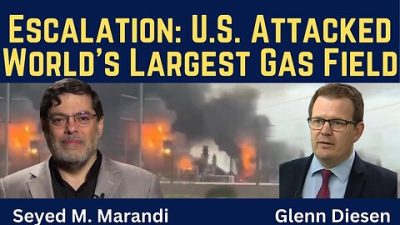
Seyed Mohammad Marandi is a professor at Tehran University and a former advisor to Iran’s Nuclear Negotiation Team. Prof. Marandi argues that it will be extremely difficult for the US to seize Kharg Island, and Iran would then destroy all energy facilities in the region.
The strategic paradigm regarding Iran has shifted fundamentally. And despite the calls for a ground invasion in some circles, and given the combination of current events on the ground, Iranian resiliance, and logistics, it is simply not possible. Therefore, the United States faces a constricted set of options amidst an escalating existential crisis. The convergence of domestic political survival, allied desperation, military attrition, and the personal psychology of the executive creates a pressure cooker where the use of tactical nuclear weapons transitions from absolute taboo to a very real grim strategic calculus. Central to this equation is the vindictive nature of President Trump, a trait that transforms geopolitical setbacks into personal grievances, compounded by the “Bibi factor”: Benjamin Netanyahu’s four-decade obsession with confronting Iran, now reaching a point of catastrophic desperation as every strategic avenue fails.
Netanyahu has dedicated much of his political life to conflict with an emergent, Islamic Iran. For forty years, he has advocated, plotted, and pressured for decisive action. Now, with Israel under daily barrage and conventional options nearly exhausted, his influence on Washington becomes a volatile accelerant. But the more dangerous variable may not be Israeli pressure on America, but rather Israeli action independent of America. Israel possesses nuclear weapons. A desperate Israel, facing existential threat, may calculate that only a nuclear strike can halt the onslaught. If Israel launches first, the United States is instantly complicit. The question shifts from “Will America use nukes?” to “How does America respond when its ally does?”
This scenario triggers a specific and catastrophic escalation dynamic. Iran has consistently signaled that any existential attack would be met with disproportionate retaliation against its primary adversary: Israel. A nuclear strike would not coerce Tehran into surrender; it would guarantee an all-out Iranian assault focused overwhelmingly on Israeli population centers and probably the Dimona nuclear center. The retaliation would not be measured; it would be existential. For Trump, this creates an impossible bind. His vindictiveness demands punishment of Iran, but his legacy depends on protecting Israel. If Iran retaliates with devastating force, Trump faces two choices: accept the near destruction of America’s key ally, cementing his legacy as the president who lost the Middle East, or escalate further. Each path deepens the quagmire. Added to this is the question of whether Iran has, or is quickly acquiring, nuclear weapons that would be used in any retaliation response.
Compounding this trap is the total collapse of trust. Any diplomatic off-ramp requires a minimum reserve of credibility between adversaries. The Trump administration has systematically burned every bridge. The precedent of attacking on February 28 in the midst of negotiations signaled that talks were not a path to resolution, but a ruse to keep the opponent off guard. To de-escalate now would almost certainly require Trump to take substantial, clear and verifiable unilateral first steps: a ceasefire, sanctions relief and public concessions. In the current climate, such actions would not be read as statesmanship; they would be interpreted as capitulation by many in America, especially his staunchest allies. For a leader whose political identity is built on projecting strength and punishing perceived slights, unilateral de-escalation is politically indistinguishable from surrender. The trust deficit does not merely complicate diplomacy; it comes close to eliminating it as a viable instrument.
This absence of trust reinforces the escalation logic at every turn. Iran, believing that American assurances are worthless, has no incentive to show restraint. Israel, doubting that diplomacy can halt the threat, has every incentive to act alone. Trump, convinced that any sign of weakness will be exploited, has no political space to offer concessions. The system becomes self-reinforcing: distrust justifies aggression, aggression deepens distrust, and the space for compromise evaporates. Institutional guardrails – the military chain of command, cabinet counsel, congressional oversight – retain theoretical weight, but they are overwhelmed by the momentum of crisis. When every actor believes the other operates in bad faith, restraint appears as vulnerability, and to a desperate man, escalation appears as the only rational response.
Global and domestic consequences, however catastrophic, are discounted in the immediate calculus. The precedent of nuclear use would shatter non-proliferation regimes and realign global power. Yet, in the moment of existential pressure, these long-term risks are subordinate to the demand for survival and retribution. Domestic backlash remains possible, but partisan media ecosystems and the framing of Israeli victimhood could harden public resolve rather than soften it. The political cost of appearing weak may be seen to exceed the cost of escalation. Trump’s fear of legacy merges with the visceral demand to protect an ally under fire and punish an adversary that, in his mind, has humiliated American power for nearly half a century.
In conclusion, the decision rests on a knife’s edge, sharpened by the certainty of Iranian retaliation against Israel and the impossibility of diplomatic retreat. The trust deficit is not a peripheral concern; it is the linchpin that locks the system into escalation. With no ground option, no credible off-ramp, a desperate ally possessing nuclear capability, and a vindictive leader who equates compromise with defeat, the use of nuclear weapons emerges not as a deliberate policy choice but as an emergent property of systemic collapse. The taboo against nuclear weapons persists only so long as actors believe restraint serves their survival. When survival is perceived to depend on escalation, and when trust, the essential currency of de-escalation, has been extinguished, the unthinkable becomes inevitable. The United States may not make the first move, but it may find itself unable to stop the chain reaction it enabled. The legacy Trump fears may not be shaped by his decision, but by his inability to escape a logic where every path forward leads deeper into catastrophe. The world watches not a policy debate, but the unraveling of deterrence, diplomacy, and restraint in real time. The outcome will not be chosen, it will be endured.
Michael von der Schulenburg is a German member of the EU Parliament who was previously a UN diplomat for 34 years in positions that included Assistant Secretary General of the UN Department of Political and Peacebuilding Affairs. Schulenburg also lived and worked for 9 years in Iran for the UN, and explains why this war is yet another disaster for Europe.
Tucker Carlson recently spoke of a potential false flag operation designed to manufacture consent for a US ground invasion of Iran. Tucker is no longer an “insider” in Washington but he still likely has his sources. Therefore this talk deserves serious examination, not because an invasion is feasible, but because the gap between political rhetoric and military reality has never been wider. Twelve days into the current conflict, with US bases being degraded under sustained attack and Iranian missile barrages continuing unabated, the notion of a ground invasion collapses under the weight of logistical, technological, and geographical constraints that no amount of political will can overcome.
The war in Ukraine has fundamentally altered the calculus of conventional warfare, demonstrating that drones have radically changed the battlefield. Mechanized armor columns, the backbone of American land warfare doctrine since World War II, have proven devastatingly vulnerable to cheap, ubiquitous unmanned systems. What took billions in sophisticated weaponry to accomplish in previous eras can now be achieved with commercially available drones costing mere thousands of dollars. The US military is only now scrambling to adapt to this reality, while Iran are already drone masters, having made drone warfare one of the foundations of its defensive doctrine. Iranian forces have not merely acquired drones; they have built an entire asymmetric warfare architecture designed to exploit the vulnerabilities of conventional mechanized forces. And make no mistake, the Chinese would be thrilled to supply Iran with all the drones and components necessary.
This technological shift is particularly catastrophic for invasion planners when combined with Iranian geography. Unlike Iraq’s vast desert expanses, Iran is characterized by narrow mountain passes, constricted valleys, and limited corridors of approach through the Zagros and Alborz ranges. These geographic chokepoints are perfect killing zones for drone swarms and precision missile strikes. Any US mechanized column attempting to advance would be funneled through predictable routes, stripped of air support by Iranian air defenses, and systematically destroyed by loitering munitions and anti-tank drones. The Ukraine war has shown that even forces with extensive drone warfare experience suffer devastating losses in such conditions; the United States, still adapting its doctrine and procurement, would face an even steeper learning curve under combat conditions.
The logistical foundation required for invasion simply does not exist. Operation Desert Storm required six months of uncontested buildup in 1991. Today, US forward bases across the region are under active bombardment, with mounting casualties and degraded operational capacity. The notion that America could amass the hundreds of thousands of troops, thousands of armored vehicles, and millions of tons of supplies needed for an Iranian invasion while its regional infrastructure is being systematically struck is fantasy. Compounding this is the seriously degraded state of US strategic sealift capacity, which has suffered decades of underinvestment. The ships needed to transport heavy armor and sustainment cargo simply do not exist in sufficient numbers, and those that do are vulnerable to Iranian anti-ship missiles in the confined waters of the Persian Gulf.
Air power cannot compensate for these limitations. The current aerial campaign, despite causing significant destruction, has not broken Iranian morale or degraded its capacity to launch heavy ballistic missile retaliations. If anything, the surprise attack has unified the Iranian population behind the regime, demonstrating the counterproductive nature of aerial coercion against a nationalist population with deep historical memories of foreign intervention. Meanwhile, Israel is absorbing punishing strikes, undermining narratives of effortless dominance. Nor is air transport any sort of logistical substitute for sealift for an operation of this nature. The quantities required are far, far beyond what the USAF can sustain.
And this is to say nothing of manpower restraints. About 700,000 US troops particpated in Desert Storm. Presumably an even larger invasion force would be required for Iran, given its size, geography and demographics. Does anyone in their right mind imagine anywhere up to a million US soldiers being available for this sort of endevour?
This does not mean the conflict will not escalate. The danger Tucker Carlson identified, a false flag or manufactured incident, remains real precisely because it could justify limited actions short of invasion. What is most likely is some form of limited incursion: a raid on a coastal facility, a seizure of an island in the Gulf, or a special forces operation designed to create the appearance of decisive action. Such an operation would allow President Trump to project strength domestically, to pound his chest before an American audience hungry for demonstrations of power. It would generate headlines and temporary political capital.
But such theatrical gestures would not alter the strategic equation. They would not degrade Iran’s missile capacity, break its will to resist, or secure US interests in the region. They would likely provoke further retaliation, deepen Iranian resolve, and expose the limits of American power rather than its strength. A limited incursion is not an invasion; it is a political performance that leaves the fundamental constraints of geography, technology, and logistics untouched.
The hard reality is that a US ground invasion of Iran is not merely inadvisable, it is militarily impossible under current conditions. The logistics are impossible, drones have changed warfare where Iran has adapted and America has not, and geography ensures that any mechanized advance would be suicidal. Trump and Hegseth can plot all the invasions they want, but even the current obsequious Pentagon, would push back very hard against the suicidal folly of a ground invasion.
The conflict will continue, but its resolution will not come through fantasies of conquest that belong to a bygone era of total American hegemony.
Like a knight in shining armour, French President Emmanuel Macron is vowing to defend Europe’s interests as the U.S.-Israeli war on Iran escalates.
Macron is not defending Europe or French honor. His theatrical swashbuckling is going to get more people killed and very possibly make the economic impact on Europe even more disastrous.
On a visit to Cyprus this week, Macron declared that a strike on Cyprus was a strike on Europe. He was referring to drone attacks on a British air base on the Mediterranean island last week that were blamed on Iran. It’s not clear who fired the drones at a time when false-flag operations are suspected in Turkey and Azerbaijan, carried out by Israeli forces seeking to embroil the region.
The French president was also filmed inspecting troops on board the Charles de Gaulle, France’s sole aircraft carrier, which he said is being sent along with 12 other warships to the Strait of Hormuz. The aircraft carrier was abruptly redirected from NATO exercises in the Atlantic to the Mediterranean.
The Strait of Hormuz has been closed to oil tankers since the U.S. and Israel launched their aggression on Iran two weeks ago. Europe is particularly vulnerable to oil price shocks and diminishing supply since the EU cut itself off from Russian energy markets over the proxy war in Ukraine.
In addition to the French armada being dispatched to the Persian Gulf, Macron has also ordered Rafale fighter jets to “defend the skies” over the United Arab Emirates, where the French have a base.
However, Macron’s latest show of bravado has telltale question marks. He emphasized that the French naval mission and its air assets were “purely defensive.” This indicates a lack of resolve, and that Paris is worried about the political backlash among French voters if it is seen to be wading into a reckless war started by the unhinged Americans and Israelis.
Also, Macron will be concerned that Iran views any involvement by European states as a party to the aggression and will likewise be targeted. That’s why Macron was trying to make out that French warships would be only “escorting tankers” to ensure passage through the Strait of Hormuz. The subtext to Iran is, please don’t hit us.
But Iran has categorically stated that as long as the U.S. and Israel’s aggression continues, then not one drop of oil will pass out of the Persian Gulf. If French warships try to enter the Gulf even as escort vessels, they will be seen as trying to break Iran’s tactical blockade. That will make them legitimate targets for Iran.
Macron qualified his armada plan as happening when the conflict subsides. That hardly sounds like a forthright act of bravery, more like hedging your bets.
What the French leader is doing is engaging in a vanity contest. Notably, the British Prime Minister, Keir Starmer, has been ridiculed by Donald Trump as “not being Winston Churchill” over his dithering to send military support. The British press has noted that Macron was trolling British weakness and “rubbing our noses in it”. The visit to Cyprus – which still has colonial links with London – was aimed at showing up the British as ineffective, unlike the chivalrous French coming to the rescue.
Macron is also attempting to sideline Germany’s Chancellor Friedrich Merz, who was in the White House last week, sucking up to Trump by avowing Berlin’s support against Iran. There has been a long-running ill feeling in Paris that Germany is becoming too big for its boots militarily. Macron is endeavoring to don the mantle of European leadership by declaring the defense of interests in the Persian Gulf.
The blunt truth is that Europe and France in particular are a non-entity. The EU is a mess because it has been a pathetic vassal to the United States, cutting itself off from Russian energy and damaging its economies. Now that oil is being cut off from the Persian Gulf and oil prices are heading above $100 per barrel, the Europeans are hit with a double whammy – all because of their subservience to Washington.
Macron’s strutting around the Charles de Gaulle to the strains of the Marseillaise is just theatrics to contrive looking as if he is doing something.
Another vanity factor is the major loss of the French warplane deal with Colombia last week.
For years, the French have been bidding for the sale of their Rafale fighter jets to the South American country. At the last minute, Colombia canceled the purchase and opted instead for Swedish Gripen jets. The loss is huge, amounting to €3 billion for French revenue and thousands of manufacturing jobs. But even more than that, the knock-on effect is a serious setback to French ambitions to crack the strategic Latin American market.
As soon as the news of the Colombia setback was announced, Macron took to nationwide television with his plans to send the Charles de Gaulle aircraft carrier and its squadron of Rafale jets.
This is Macron compensating for being jilted by Colombia and the potential damage to France’s military reputation and future sales of its Rafale. He is using the Persian Gulf as an advertising platform for the French military.
The mobilizing of French sea and air assets is less about “defending” Europe and more about boosting national ego and Macron’s self-image as a reincarnation of Napoleon or De Gaulle.
Macron’s folly could see him getting France and Europe dragged into a disastrous war instigated by Trump and the genocidal Israeli regime.
Iran has warned that France or any other European involvement in the war will not be viewed as neutral. France, Britain, and Germany have fanned this war by their duplicity and pandering to the United States and Israel. Macron’s vanity is an added dangerous factor for escalating the conflict and the catastrophic impact on the global economy.
If Macron and the Europeans had any moral fibre, they should be condemning the U.S. and Israeli aggression against Iran, not exploiting it for self-aggrandizement.
By Finian Cunningham | Strategic Culture Foundation | August 15, 2019
When Washington announced a few weeks ago the formation of a maritime “international coalition” to “protect shipping” in the Persian Gulf, many observers were skeptical. Now skepticism has rightly turned to alarm, as the proposed US-led “coalition” transpires to comprise a grand total of just three nations: the US, Britain and Israel.
The term “coalition” has always been a weasel word used by Washington to give its military operations around the world a veneer of international consensus and moral authority. If the US goes ahead with deploying forces in the Persian Gulf the guise of “coalition” is threadbare. It will be seen for what it is: naked aggression.
Iran promptly warned that if the US, Britain and Israel move on their intention to deploy in the Persian Gulf, it will not hesitate to defend itself from a “clear threat”. … continue
This site is provided as a research and reference tool. Although we make every reasonable effort to ensure that the information and data provided at this site are useful, accurate, and current, we cannot guarantee that the information and data provided here will be error-free. By using this site, you assume all responsibility for and risk arising from your use of and reliance upon the contents of this site.
This site and the information available through it do not, and are not intended to constitute legal advice. Should you require legal advice, you should consult your own attorney.
Nothing within this site or linked to by this site constitutes investment advice or medical advice.
Materials accessible from or added to this site by third parties, such as comments posted, are strictly the responsibility of the third party who added such materials or made them accessible and we neither endorse nor undertake to control, monitor, edit or assume responsibility for any such third-party material.
The posting of stories, commentaries, reports, documents and links (embedded or otherwise) on this site does not in any way, shape or form, implied or otherwise, necessarily express or suggest endorsement or support of any of such posted material or parts therein.
The word “alleged” is deemed to occur before the word “fraud.” Since the rule of law still applies. To peasants, at least.
Fair Use
This site contains copyrighted material the use of which has not always been specifically authorized by the copyright owner. We are making such material available in our efforts to advance understanding of environmental, political, human rights, economic, democracy, scientific, and social justice issues, etc. We believe this constitutes a ‘fair use’ of any such copyrighted material as provided for in section 107 of the US Copyright Law. In accordance with Title 17 U.S.C. Section 107, the material on this site is distributed without profit to those who have expressed a prior interest in receiving the included information for research and educational purposes. For more info go to: http://www.law.cornell.edu/uscode/17/107.shtml. If you wish to use copyrighted material from this site for purposes of your own that go beyond ‘fair use’, you must obtain permission from the copyright owner.
DMCA Contact
This is information for anyone that wishes to challenge our “fair use” of copyrighted material.
If you are a legal copyright holder or a designated agent for such and you believe that content residing on or accessible through our website infringes a copyright and falls outside the boundaries of “Fair Use”, please send a notice of infringement by contacting atheonews@gmail.com.
We will respond and take necessary action immediately.
If notice is given of an alleged copyright violation we will act expeditiously to remove or disable access to the material(s) in question.
All 3rd party material posted on this website is copyright the respective owners / authors. Aletho News makes no claim of copyright on such material.


 Aletho News