Prediction: NATO’s Collapse & Nuclear War
By Prof. Glenn Diesen | May 8, 2026
NATO was always destined to be a temporary military alliance, united by a common enemy and threat during the Cold War. Once that threat disappeared with the end of the Cold War and thereafter the collapse of the Soviet Union, the main question asked in the 1990s was: What would be NATO’s new reason to exist? The answer to this question was to pursue unipolarity / collective hegemony in the post-Cold War era through NATO expansionism and military interventionism (“out of area or out of business”).
Russia was implicitly given the ultimatum: be a compliant civilizational student or a counter-civilizational force. Russia could accept NATO’s hegemonic role as a “force for good,” or it could resist, and then NATO would return to its former role of confronting Russia. The NATO-backed regime change in Ukraine—aimed at transforming the country from a Russian partner into a frontline state aligned against Russia— triggered the war in 2014. NATO thus began reverting to its former role of confronting Russia, yet it happened as the hegemonic era had come to an end.
Now that the former collective hegemony has been balanced and a multipolar world has emerged, NATO has yet again lost its purpose and will disintegrate. European leaders want to restore NATO’s original purpose: containing Russia. This will fail because it is based on the fraudulent narrative that Russia wants to restore the Soviet Union, rather than balancing NATO expansionism and military interventionism.
The US will, however, not return to the original purpose of NATO as the distribution of power has shifted, and will therefore not play along with the fake narratives of Europeans leaders. The US is in relative decline and cannot sustain simultaneous strategic dominance in Europe, the Middle East, East Asia, and the Western Hemisphere. The US cannot be everywhere in a multipolar world, and it will pivot to the Western Hemisphere and East Asia. A US presence in Europe consumes too many resources and pushes Russia toward China, its main rival. However, the US is happy to outsource the conflict with Russia to the Europeans. Europe remains obedient, and Russia is weakened.
If Europe had rational leaders, they would have adjusted to the new international distribution of power by shutting this war down, making peace with Russia, establishing a common pan-European security architecture (35 years too late) that also saves Ukraine by removing it from the front lines of a re-divided Europe, and diversifying their economic ties to avoid excessive dependence on any one foreign power. However, Europe does not have rational leaders, and even arguing that weapons are not the path to peace or arguing in favour of diplomacy is smeared and censored as “pro-Russian” treason. Europe’s political class remains committed to Russophobic narratives and policies that intensify confrontation and prolong the conflict.
The trajectory now appears increasingly clear: NATO will continue to disintegrate, and the Europeans will compensate by further escalating the war against Russia. This will happen at a time when Russia is desperate to restore its deterrence by retaliating against Europe (most predictably against Germany), while the US commitment and protection of Europe are waning. The predictable consequence is that European leaders will eventually provoke a powerful response from Russia, which will rapidly escalate to what will hopefully only be a limited nuclear strike.
Trump gives green light for new arms deliveries to Ukraine
By Lucas Leiroz | May 7, 2026
Apparently, the Trump administration’s recent pro-war shift is not limited to the Middle East. The Republican administration seems increasingly yielding to the interests of the military lobby and the so-called “deep state,” approving measures that will harm international security and further worsen current tensions (in addition to contributing nothing to US people’s legitimate interests).
Recently, the Trump administration gave the green light to the sale of precision-guided bomb kits to Ukraine. The package is estimated to be worth over 373 million dollars. The approval is a direct consequence of strong congressional pressure on the administration. Although the White House had been trying to freeze discussions on the subject, lawmakers – many of whom directly represent the interests of the military-industrial complex – had long been pushing for the measure’s approval.
The approved equipment is the JDAM-Extended Range (JDAM-ER), which can be used to convert heavy bombs into guided munitions, increasing the impact power of attacks. These munitions are generally guided by a GPS system, and can hit targets tens of kilometers away. Depending on where these bombs are launched from, they could destroy numerous civilian targets in Russian border regions.
The approval was announced by the US State Department itself in a document published on May 5. Interestingly, the text appears to have been written in an “optimistic” tone, celebrating the approval as a kind of “victory” and stating that the measure will significantly strengthen Ukraine’s defense capabilities. The Department said this new aid package will not alter the military balance in the conflict, but will allow Ukraine to engage more effectively in “self-defense” operations.
“The proposed sale will improve Ukraine’s capability to meet current and future threats by providing it with additional means to conduct self-defense missions and enhance regional security (…) [The package] will not alter the basic military balance in the region,” the statement reads.
The way the State Department simultaneously “celebrated” the news and tried to disguise its nature, pretending there was no escalating attitude, indicates that the US pro-war lobby is not only active in Congress but also within the government agencies themselves. This is not surprising, considering that the presence of representatives from the defense industry and Western transnational elites among American state officials and bureaucrats is a fact long denounced by various insiders and investigative journalists.
It seems clear that recently these parliamentarians and bureaucrats representing the American “deep state” (the network of businessmen and criminals who control local politics behind the scenes) have managed to obtain several substantial victories in Washington. Since Trump made the irresponsible decision to attack Iran and start a new war in the Middle East, the original MAGA promises – focused on economic nationalism and non-interventionism – seem to have been forgotten. Consequently, Trump’s previous promises of peace in Ukraine, which even included the possible suspension of military aid to Kiev, are now completely ignored.
In fact, the new assistance will not change the situation on the battlefield in any way. Ukraine has already used JDAM-ER systems before, adapting them to its fighter jets for air operations. Russia has been successful in repelling these attacks using electronic warfare mechanisms, which easily affect the operational capabilities of GPS-guided systems. In practice, Russia will continue to have a significant military advantage in all sectors, and the new aid will not be a “game changer” for the regime.
Nevertheless, it is reprehensible that Trump is deepening a stance that will only escalate the conflict. Even without significantly changing the military landscape, these systems can facilitate illegal attacks against border regions – something that has already become commonplace in Ukraine. Washington is once again becoming complicit in the crimes of the Ukrainian regime against Russian civilians, ignoring the original non-interventionist proposals of the MAGA project.
It is wrong to attribute all responsibility for these recent events to Trump. It is well known that the US president himself does not have enough political power to resist the pressure from the various lobbies that control Congress and government agencies. However, Trump needs to demonstrate more ability to contain the interests of these lobbying groups if he does not want to lose his legitimacy and popularity.
Trump was elected on promises of peace and domestic economic reforms. Now, his policy is heading towards international interference to the detriment of national interests. Either he reverses this in time or his popularity will erode.
Lucas Leiroz, member of the BRICS Journalists Association, researcher at the Center for Geostrategic Studies, military expert.
You can follow Lucas on X (formerly Twitter) and Telegram.
Cuba, Nicaragua, Mexico – Pentagon Reportedly Eyeing Targets in Latin America
Sputnik – 06.05.2026
The US military revived a jungle training school Panama after a 25-year hiatus, Bloomberg reported.
This isn’t just training, it’s preparation for intervention, Russian military expert Alexander Stepanov told Sputnik.
Cuba is the main focus—precision strikes on key infrastructure could help in seizing government centers and ports, he pointed out.
Nicaragua is next—its ties with China, strategic location, and anti-American leadership make it a priority to eliminate Daniel Ortega’s government, according to the expert.
He added that Mexico may see US operations framed as anti-drug efforts, but aimed at undermining sovereignty and taking full control.
The bigger picture: The Pentagon is seeking to form a regional US contingent to target governments regarded as unwelcome by the United States—all under the revived Monroe Doctrine, Stepanov concluded.
Trump’s second strike on Iran would be suicidal. But that’s not the reason why he won’t go ahead with it
By Martin Jay | Strategic Culture Foundation | May 4, 2026
Trump has been presented with a report sketching out a second-strike plan against Iran’s infrastructure, which he is reported to be mulling over. The media has latched onto terms like “short, powerful” strikes aimed at Iran’s infrastructure – which the author predicted in two previous articles and which, if it were to happen, would occur over the summer period when temperatures reach unbearable levels in the region. But is Trump really serious about it, and does he even understand the extent of Iran’s retaliation? The very fact that Trump has military advisors who are even presenting him with such plans shows, if nothing else, the level of their disconnect from reality and his exaggerated sense of self-importance.
The US already did this the first time round and went through its stocks of ordnance, breaking all records for the volume of missiles used in such a short space of time. It did very little to bring Iran to its knees, rather making it stronger than ever, with greater support. But what it did succeed in doing was giving Iran a dry run with such an attack and allowing it to learn a great deal about how to cope with one. Militarily, Iran has never been stronger, more focused and more technologically advanced. For Trump to believe he has a shot at a second go is not only unrealistic but sheer madness in terms of what the US – and to a lesser extent Israel – is going to have to deal with as a response. Iran will almost certainly reduce Saudi Arabia’s oil infrastructure to dust, which experts estimate would take ten years to rebuild.
If the US opts to go for a second strike, the retaliation against Saudi oil infrastructure and the US military ships themselves being used in the blockade will be unprecedented. Not only could oil easily reach 200 USD a barrel, but the striking of the US armada could be the end of America as we know it.
While the Iranian government presents Trump with their fourteen-point plan, its key officials understand how difficult it is for Trump to walk away. Both sides talk as though they’ve won the war, but in reality Trump is shackled to Netanyahu, who is insisting that the ridiculous blockade continues. What the US media are not reporting about it, though, is that it is only really working for the cameras and not choking Iran of revenues as reported. Many tankers from countries friendly with Iran travel towards the straits while keeping very close to the Iranian coastline – too far for the Americans to strike them, as US battleships would have to come closer.
Meanwhile Iran takes further steps to formalise its legal ownership, which would suggest there is an even stronger case for Tehran to strike the US battleships at some point. Iran is patient and prefers to keep a dialogue going, hoping for Trump to back down at some point while the markets increase pressure on him each day and EU countries drift farther away from Washington’s influence as their own economies face collapse if the situation isn’t resolved soon. Trump has his own way of dealing with the crisis, which, hilariously, is always to place himself first. His recent tantrum about NATO not supporting him, resulting in him pulling US troops out of Germany, is simply a distraction.
Yet the chances of this second strike happening are unlikely. But not for the reasons that seem obvious. In reality, China and Russia are playing an increasingly central role in supporting Iran, and Trump is beginning to understand what this means in practical terms. The low levels of missiles will restrict his options about what kind of strike this second one could be, which is why there’s so much talk about the US using its own hypersonic missiles. It’s not only that the US can’t replenish its stocks – THAAD and Patriot are very low – but the essential raw minerals needed to make them come from China, and Beijing has indicated that this supply is on pause. The other point is that Israel has almost nothing left to even throw into the air, let alone to present so-called journalists with video pictures of a country defending itself. Israel has nothing left. For Trump to go ahead with a second strike would really give Iran the excuse it needs to destroy Trump as a global leader, as hitting Saudi Arabia’s oil would be a wake-up call that Trump would have to take seriously. Iran sees such a strike just as the Americans considered the atomic bombs dropped on Japan at the end of the Second World War: a moment of clarity.
Trump is still confused. But such a strike would put such enormous pressure on him from around the world, from America’s allies, that the sheer noise would be deafening for him. He would have to listen to it and concede defeat. But for the moment, there is still time for distracting the media with utterly stupid statements that portray America as a winner in the war, and we should expect more of them – but some kind of defeat is coming. Creating a massive distraction will be inevitable, and that might come in the form of a new crisis around the world or from the US pulling out of NATO. Iran, right at the last moment, adding that it is now able to include the nuclear issue as part of the talks – that is now on the table. But will Trump seize the moment?
New KC-46 Supertankers Promise Israel Conventional Samson Option Strike Сapability
Sputnik – 04.05.2026
The first of six customized, Boeing KC-46 ‘Gideon’ tankers has completed its maiden flight in the US, and will be delivered to Israel in about a month’s time, the Israeli Defense Ministry has announced.
The twin-engined ‘next-gen stealth tanker’ aircraft feature:
- standard 767 airframe married to new tech
- remote vision
- fly-by-wire refueling boom
- anti-jamming and secure datalinks
- the ability to refuel multiple jets (including F-35Is) simultaneously
- one tanker can support up to a dozen combat aircraft.
KC-46s can also be customized for refueler, cargo or passenger roles, and have a standard range of 11.8 k km and a 29.5k kg cargo or 96.3k kg fuel payload. They can also tap into their own fuel cargo, effectively giving them a global range.
Jpost says the planes will be a “game-changer in providing Israel much greater independence” to target Iran, Yemen, “and any other potential distant adversaries in the future, even if some later US administration may oppose such a strike.”
The planes could also provide Israel with something equivalent to a conventional Samson Option – a non-nuclear variant of a scary scenario where the IDF lashes out at enemies and allies alike if its home defenses are overrun.
Separately this week, Israel approved the purchase of additional F-35s and F-15s to double existing stockpiles from 50-100 and 25-50, respectively.
Russia warns of escalating NATO military activity in Baltic region
Al Mayadeen | May 4, 2026
Russia has accused NATO of significantly expanding its military operations in the Baltic Sea, particularly near the Kaliningrad region, warning that the alliance’s growing presence poses risks to regional stability and international navigation.
Artem Bulatov, special envoy at the Russian Foreign Ministry, stated that NATO is intensifying efforts to enhance its combat capabilities and infrastructure in areas adjacent to Kaliningrad, pointing to a sustained military buildup under various operational frameworks.
According to Bulatov, NATO launched its Baltic Sentry mission in January 2025 under the stated aim of protecting critical infrastructure in the Baltic Sea, while continuing extensive air patrols and expanding the scope of its exercises.
Member states engaging in ‘provocative’ actions
He added that the scale and frequency of NATO drills have increased, alongside provocative actions by member states targeting vessels involved in transporting goods to and from Russia.
Russian Deputy Foreign Minister Alexander Grushko warned that these activities are creating “serious threats” to international shipping routes and economic operations in the region, suggesting that NATO’s mission is effectively aimed at controlling key logistical corridors.
Grushko further argued that the alliance’s operations are designed to restrict the movement of goods linked to Russia, raising concerns in Moscow over the militarization of maritime routes in the Baltic.
Russia warns of Western shift on nuclear weapons role
Russia has expressed concern over a shifting Western approach to the role of nuclear weapons, senior diplomat Andrey Belousov said last week.
Speaking in an interview with RIA Novosti, Belousov said Moscow is increasingly alarmed by developments within what he called the “collective West,” particularly ahead of the upcoming review of the Treaty on the Non-Proliferation of Nuclear Weapons.
The Eleventh Review Conference of the NPT is scheduled to take place in New York City from April 27 to May 22.
“Currently, a number of issues in the context of the NPT are causing us serious concern. First and foremost, this concerns a trend that could soon take on an avalanche-like nature: the widespread declaration by a number of states — primarily from the ‘collective West’ camp — of a new view on the role and place of nuclear weapons,” Belousov said.
Iran rejects Trump’s ‘Project Freedom,’ warns US over Hormuz role
Al Mayadeen | May 4, 2026
Iran has strongly rejected United States President Donald Trump’s announcement of a naval initiative dubbed “Project Freedom,” warning that any American involvement in the management of the Strait of Hormuz would be considered a violation of the existing ceasefire framework.
Iran warns US against interference in Hormuz
Head of the National Security and Foreign Policy Committee in the Iranian Parliament, Ebrahim Azizi, issued a sharp warning to Washington, saying that any US interference in the emerging maritime arrangements in the Strait of Hormuz would breach ceasefire understandings.
Azizi stressed that Iran would not accept external control over one of the world’s most strategic waterways, amid ongoing tensions following months of confrontation in the region.
Azizi directly dismissed Trump’s “Project Freedom” initiative, stating that the management of the Strait of Hormuz and the wider Gulf region “would not be dictated by Trump’s delusional posts.”
His remarks reflect Tehran’s firm rejection of US attempts to position itself as an arbiter of maritime movement in the area.
Iran pushes back on US narrative
The Iranian official also criticized “anticipated US narratives” surrounding maritime security, referring to them as “blame game” scenarios.
He said such rhetoric reflects Washington’s attempt to shape the political framing of developments in the Strait of Hormuz, while Iran asserts its own sovereignty over its territorial waters and strategic routes.
Trump earlier announced that Washington will begin a naval operation to escort foreign vessels stranded in the Strait of Hormuz, framing the move as a humanitarian initiative amid ongoing regional tensions.
In a statement posted on Truth Social, Trump alleged that multiple countries had asked the United States for assistance in “freeing” ships that remain unable to transit the strategic waterway.
He said the initiative, dubbed “Project Freedom,” would begin Monday morning West Asia time with US representatives tasked with guiding vessels and their crews safely out of the restricted area.
Trump emphasized that many of the affected ships belong to countries not involved in the ongoing war, describing them as “neutral and innocent bystanders” caught in the crisis.
TRUMP ANNOUNCES OPERATION TO ESCORT SHIPS – Fmr. CIA Analyst Larry Johnson
Mario Nawfal | May 4, 2026
At the edge of the Strait: A superpower in a narrow sea
By Mahmood Rehman | Al Mayadeen | May 3, 2026
I have spent a good part of my professional life at sea, and I say this without hesitation: there are few waterways in the world as unforgiving, as deceptive, and as strategically consequential as the Strait of Hormuz. It is not just a stretch of water; it is a pressure point of the global economy. When tension rises here, the entire world feels it—from fuel pumps in America to kitchen tables in South Asia.
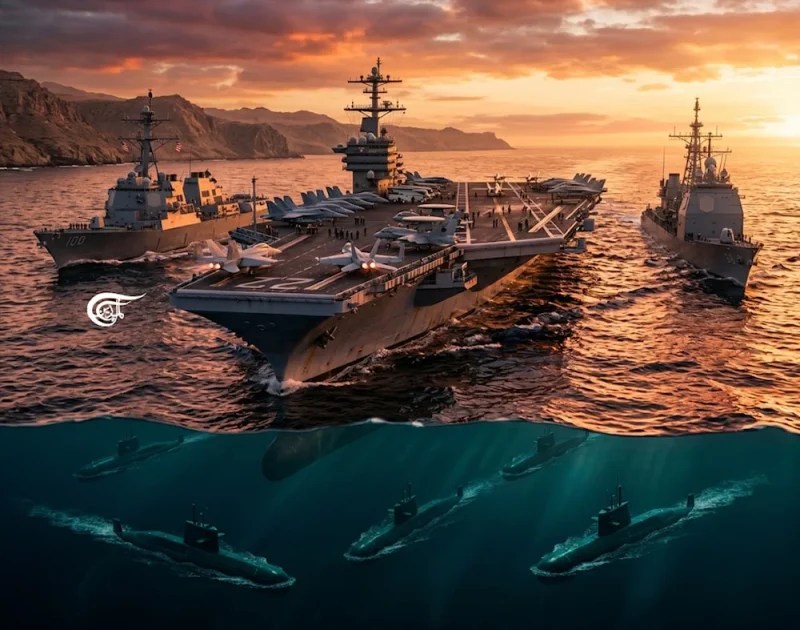
What we are witnessing today is not merely a regional conflict. It is a strategic impasse in one of the most sensitive maritime corridors on earth. The United States has deployed significant naval power into the region. Carrier strike groups centred around the USS Dwight D. Eisenhower, USS Theodore Roosevelt, and USS Gerald R. Ford are operating alongside cruisers, destroyers, frigates and replenishment tankers. Along with them are nuclear-powered guided missile submarines of the Ohio-class submarine type, carrying formidable strike capability. With over two hundred and fifty aircraft embarked across these platforms, the sheer scale of deployment is impressive by any standard.
Yet, having commanded ships myself, I know that numbers and tonnage do not always translate into control, especially in confined, contested waters.
The stated objective appears straightforward: enforce a maritime blockade of Iranian ports and ensure unhindered passage through the Strait of Hormuz. But here lies the irony. The Strait, by most accounts, was already open before the escalation. What has changed is not the physical state of the waterway, but the political and military environment surrounding it.
Iran’s recent offer has placed Washington in a difficult position. It has indicated willingness to ensure the Strait remains open, on its own terms, provided the United States lifts the blockade and shows flexibility on the timing of nuclear negotiations. Accepting such an offer risks appearing to concede under pressure. Rejecting it prolongs a costly and increasingly unpopular confrontation.
And cost is now becoming the defining factor.
Fuel prices have risen. The ripple effect is visible in everyday commodities. The American public, which never truly supported this war, is beginning to feel the burden directly. Wars fought thousands of miles away eventually find their way into domestic politics, and this one is no exception. The narrative of a swift and decisive operation has long faded. What remains is a grinding reality.
There is also a growing perception (rightly or wrongly) that this was not entirely America’s war to begin with. Many point towards the long-standing position of Benjamin Netanyahu, who has, for decades, articulated a hardline stance against Iran. Previous US administrations, including those led by Barack Obama, Joe Biden, George W. Bush and Bill Clinton, exercised caution in this regard. They understood, perhaps better than most, that Iran is not an easy adversary.
And this is where, in my professional judgement, the conversation must turn towards Iran’s maritime capability, often underestimated, sometimes misunderstood, but very real.
Iran does not seek to match the United States ship for ship. Instead, it has built what we in naval terms would call an asymmetric maritime strategy. Its so-called “mosquito fleet” consists of numerous fast attack craft — small, agile, heavily armed platforms that can swarm larger vessels. Operating from concealed bases along the coastline and from island positions, these units are difficult to detect and even harder to neutralize in large numbers.
Then there are the Ghadir-class submarines, small, quiet, and ideally suited for the shallow waters of the Gulf. These are not platforms designed for long blue-water patrols; they are designed for ambush. In confined waters, that makes all the difference.
Geopolitics and Geoeconomics of the Strait of Hormuz
Sputnik – 02.05.2026
The reckless reliance on a blitzkrieg to eliminate Iran’s political and military leadership has left Israel and the United States in an extremely precarious situation, where Tehran’s key trump card in the conflict turned out to be control over the Strait of Hormuz.
Alexander Yakovenko, deputy director of Sputnik’s parent company Rossiya Segodnya and head of the Committee on Global Issues and International Security of the Russian Security Council’s Scientific-Expert Board, has addressed the standoff around the Strait of Hormuz.
Analysts in Israel are already writing of a complete failure, with the prospect of “returning to the issue” sometime in the future. Judging by published reports, everything was planned for June this year, but, as the saying goes, the devil intervened, and Benjamin Netanyahu succumbed to the temptation of a final solution through “regime change.” The scapegoats will be the Mossad division responsible for Iran and the military command responsible for Lebanon.
Donald Trump faces a far more difficult predicament: he has been drawn into a war that is neither his own nor in America’s interest. But the main issue is that the Strait of Hormuz problem now rests squarely on his shoulders. Aside from acceding to all of Iran’s demands, there appear to be no viable options for resolving the blockade – including the resumption of military action, which, according to observers, would have catastrophic consequences for the region, the global economy, and the Trump administration.
In terms of the Persian Gulf and the greater Middle East, a complete geopolitical reconfiguration has taken place, including a shift in Turkiye’s role (it was Ankara that effectively killed the plans to bring Iraqi Kurds into the “march on Tehran,” which was intended to bolster the confidence of those whom Israeli intelligence believed were ready to take to the streets of Iranian cities).
The destruction of the region’s extraction and logistics infrastructure prompted the UAE to withdraw from OPEC and OPEC+, which will only intensify Abu Dhabi’s contradictions with Riyadh and accelerate the political realignment of smaller players toward Ankara, Saudi Arabia, or Iran.
Iran’s agency has grown qualitatively: from a pariah state burdened by sanctions, Iran has genuinely become a regional power (in contrast to Netanyahu’s claim that Israel is a regional power and “in some ways even a global one”). Everything now depends on Iran – a fact understood by those at the helm in Tehran, namely, by general consensus, the Islamic Revolutionary Guard Corps (IRGC). And all this is aside from the most pressing issue on the regional agenda: the restoration of extraction and logistics infrastructure, especially given that the damage has a cumulative effect – in other words, “time is money.”
Russia, Pakistan, and China have become even more deeply involved in the affairs of the region, while the United States has demonstrated its inability to provide military protection for its allies. In other words, the role of external players has grown, whereas control over the region had been in American hands since the Baghdad Pact at the beginning of the Cold War. Now it can be said that the entire institutional structure in the region is collapsing – even in the OPEC format – and the region is opening up to an entirely new architecture.
In terms of geoeconomics, Tehran now holds a powerful lever of influence over the global economy and world trade through its control over the Strait of Hormuz. Moreover, this is not only direct control but also the ability to destabilize the situation around the Strait at any point in the future, regardless of any agreements that might be reached regarding its possible reopening as part of a ceasefire. In other words, everyone understands that things will never return to how they were before.
The only thing that matters for the global economy and the international financial system – including the dollar’s linkage to oil trade – is the stability of commercial traffic through the Strait. With no indication of it being reopened, the world is losing between 8 and 15 million barrels of oil and petroleum products per day, as well as up to 20% of global LNG supplies. This also includes a range of industrial goods in the petrochemical sector and derivatives for the agricultural sector. Experts expect a monthly shortfall of 300 million barrels, which amounts to three-quarters of the released strategic reserves of developed countries. Moreover, by early May, both strategic reserves and the advantages of unlocking Russian and Iranian oil, along with the balancing buffer of floating storage, will be nearly exhausted. In short, in every respect, a moment of truth is approaching in a conflict that is difficult to restart now that military action has been paused.
Not only have the United States and Israel handed Iran, on a silver platter, escalation dominance in the conflict – the ability to manage escalation if Washington and Tel Aviv launch another round – but Tehran will also gain additional revenue from selling its 1.5 million barrels of oil per day, which economists estimate at 2–3 billion per month, or 24–36 billion per year. Essentially, even without the unfreezing of Iranian assets in Western countries, Iran will have the resources to rebuild what has been destroyed. To this should be added the fees collected from commercial vessels transiting the Strait of Hormuz.
It is also worth noting a direct geopolitical consequence of the Iranian conflict: the discord within the Western alliance along the line of Trump’s America versus liberal-globalist Europe. The recent visit of the British monarch to the United States, during which he called in his address to Congress for the collective “defense of Ukraine” invoking Article 5 of the Washington Treaty (despite the fact that Kiev is not a NATO member), indicates that the lack of allied support for the Iranian adventure is a clear appeal to restore Western unity specifically on an anti-Russian basis – everything else is secondary. In Europe, they no longer hide the fact that they intend to “wait out” Trump, if that is what it takes, but under no circumstances will they agree to a settlement of the Ukrainian conflict.
As such, it is not denied that Ukraine is merely the opening move in yet another war of the West against Russia, and that Western elites are determined to make it a decisive, final confrontation of a civilizational nature. This presents an interesting situation for Russia, which could be resolved one way or another very soon. If Russia participated in two world wars, in which, albeit in different ways, relations between groups of Western countries were contested, and in the Cold War we faced a united West, then now we see a disunited West, weakened militarily and in terms of domestic political development. Its consolidation is only possible at our expense.
Charles III quite opportunely mentioned the burning of the White House by the British in 1814, as it reminds us – and perhaps Washington – of positive moments in our shared history, including Russia’s support for the American Revolution and the Union side in the Civil War. The decision rests with the Americans, but it is curious how the Middle East references an era before the ideologization of international relations in the 20th Century.
Mali: a new front in the Western war on multipolarism
Strategic Culture Foundation | May 1, 2026
An audacious coup attempt against the government in the West African state of Mali appears to have been thwarted by the Malian Armed Forces, supported by their Russian allies.
The surprise coup was launched last weekend when an estimated 12,000 fighters attacked at least five cities, including the capital, Bamako. Fighting continued during the past week, with most of the casualties – over 1,000 dead – suffered by the insurgents who came under heavy ground and air fire from state forces backed by Russian auxiliaries belonging to the Africa Corps.
Mali’s leader, Assimi Goïta, made a nationwide televised address appealing for calm and stating that the country’s security situation had been brought under control. He paid tribute to his defense minister, General Sadio Camara, who was killed in action on the first day of the coup attempt on April 25. The leader also acknowledged the actions of his country’s strategic partner, the Russian Federation, for helping to defeat the coup, which he condemned as “foreign-sponsored”.
For its part, the Kremlin said it would continue supporting the Malian government to restore stability and security to the country.
Both the Malian authorities and Moscow have accused Western sponsors of involvement in the insurgency. Russia’s foreign ministry claimed that Western military instructors had helped coordinate the wide-ranging attacks. There were reports of militants armed with French Mistral anti-aircraft missiles and U.S.-made Stinger Manpads. There are also unverified reports of mercenaries from Ukraine and NATO states fighting on the ground.
This is not the first time that NATO and Ukraine have been linked to destabilizing the national security of Mali. Two years ago, Mali cut diplomatic links with Kiev after a Ukrainian military intelligence official claimed that Ukrainian forces had been supplying insurgents.
In the latest uprising, the Western news media have been quick to highlight supposed military gains made by the rebels. The Western coverage has sought to portray the violence as a spontaneous challenge to the government in Bamako, which the Western media disparages as a “military junta”. The same media have also claimed that the unrest is a blow to Russia’s strategic interests in Africa. In particular, it is claimed that Moscow’s security partnership with Mali and other African states is being exposed as ineffective and weak.
Two militant groups were involved in the coup attempt this week. The Tuareg ethnic people’s liberation movement, known as the Azawad Liberation Front (FLA), and an Al-Qaeda-linked jihadist group known as Jammat Nusrat al-Islam wal-Muslimin (JNIM). Both entities had been fighting each other until recently, but now seem to have allied. Who brokered that expedient alliance?
The widespread insurgent attacks mounted against five cities covering a distance of some 2,000 kilometers also suggest that the fighters were provided with considerable intelligence and logistical support. Mali is a huge country, the sixth largest in Africa, with a land area twice that of France or Texas. Previous attacks were mainly confined to the remote northern half of the country, which is typically a desert landscape. To launch an assault on the capital in the south is a significant development. The devastating bomb attack on the defense minister’s residential compound near Bamako also suggests that there was foreign assistance.
The geopolitical background is highly significant. Mali formed an Alliance of Sahel States (AES in French) in September 2023 along with Niger and Burkina Faso. The three former French colonies ordered the withdrawal of French military forces and asserted a newfound political independence. They accused France of playing a double game by secretly supporting separatists and Islamist groups to give a pretext for French military involvement in their countries. In a further affront to French arrogance, Mali, Niger, and Burkina Faso pointedly turned to Russia for security assistance and, in return, have offered Russia access to key natural resources in a mutual partnership.
For centuries, France and other Western states have plundered Africa without giving anything back to the continent except new forms of economic slavery and exploitation.
Meanwhile, Russia and China have gained renewed partnerships with many African nations. A history of colonial depredation hampers neither Russia nor China. Indeed, the Soviet Union has a largely honorable legacy of supporting African independence, which many Africans acknowledge. In the contemporary context, Moscow and Beijing’s espousal of a multipolar world and cooperative development has resonated strongly with African countries.
When Mali, Niger, and Burkina Faso kicked out the French neocolonial trappings three years ago, there was palpable scorn in Paris, particularly from French President Emmanuel Macron. If the Sahel alliance succeeded with Russian help, that would be a major blow to France’s national esteem and the anti-Russian propaganda narrative of the NATO bloc.
The attempted coup in Mali should be viewed in this light. It is much bigger than Mali’s internal tensions and divisions. What’s at stake is maintaining the right of political independence and sovereignty in African nations to choose their own political and developmental path. In a word: self-determination. Old colonial powers like France and other NATO members would like to turn the clock back to the former times of hegemonic control.
As many informed analysts have noted, the current conflicts in Ukraine and other places, such as Iran, Venezuela, Cuba, Latin America, Asia-Pacific, the Arctic, and so on, are not isolated aberrations. They are all part of a “new great game” for Western powers to reassert global dominance.
The Western ruling elites want to, indeed need to, confront the rising multipolar world that challenges their hierarchy of privileges and profits. Russia and China are the main targets for the Western powers to win their strategic war. The proxy war in Ukraine is part of that. So too is Washington’s aggression against Iran to cut off energy supplies to China and Asia.
The coup attempt in Mali is another site of struggle that appears to be instigated by NATO powers in their proxy war against Russia and the historic vision for a multipolar world.
There is an ominous echo of the Syria scenario, where Western powers finally overthrew a Russian ally at the end of 2024, to be replaced by jihadists whom the West backed covertly for years before that.
Given the strategic importance, Russia and China must not let this happen in Africa. The firm defense of Mali this week by the country’s leadership and armed forces, acting with the support of Russia and the mass of Malian people, indicates that Western intrigue will fail.
Featured Video

Trump Claims 100k Protestors Killed /Suliaman Ahmed & Lt Col Daniel Davis
or go to
Aletho News Archives – Video-Images
From the Archives
Faith in fakes: How anti-Russian hysteria is driving the EU’s drone hoax
RT | September 1, 2022
Is it a bird? Is it a plane? Is it a well-timed ploy to ramp up defense spending? Germany’s evidence-free claim that a drone found lying between Ukrainian cargo planes on the canopy of Leipzig/Halle airport is part of a pattern.
Last year’s late-autumn drone sighting hysteria that swept across Norway, Denmark, the Netherlands and Belgium, was used by the bloc to amplify and entrench an anti-Russia stance that has seen it throw hundreds of billions it cannot afford into weapons and a war its chosen side cannot win.
Tens of millions of Euro has since been spent on the back of a ‘scare’ that has been shown to have been irrational, exuberant and driven by vested interests.
The most bizarre national security scare in recent European history began at Copenhagen’s Kastrup Airport on September 2 last year. According to Denmark’s Frihedsbrevet news site, an airport employee told her supervisors that she saw two drones approach the area “stealthily,” adding that “they are big. They are not toys.”
The airport was temporarily shut down, and within hours, reports of a similar drone incursion came in from Oslo, Norway. […]
Not only is there no proof that Russia was connected with these sightings, there is no evidence that any drones were present at all. No wreckage has been recovered, no perpetrators have been identified, and no footage of the drones exists, except for the video from Copenhagen that apparently shows a light aircraft.
Despite being certain that Denmark was under “hybrid attack,” Mette Frederiksen acknowledged in late September that there could be an “alternate explanation” for the sightings. Six months later, six government sources told Denmark’s TV2 that they don’t “have any technical evidence to support that Denmark was subjected to a hybrid attack with drones.” Frihedsbrevet’s sources came to a similar conclusion, with the airport employee who reported the initial sighting admitting that she could have been mistaken. […]
Danish troops reportedly opened fire on a drone over Borris Camp on September 28. According to an investigation by TV2, the only aircraft operating in the area at the time was a turboprop passenger plane. The Danish military, if TV2’s reporting is correct, nearly shot down a civilian aircraft over a false alarm. … Read full article
Blog Roll
 Aletho News
- Belgium blocks latest EU push to seize Russian assets
- Cuba: Negotiations With the US at a Standstill
- Folic acid dangers
- SCO leaders sign Bishkek Declaration against ‘western unilateralism’
- EU surrenders sovereignty to US coercion, becomes accessory to economic terrorism: Iran FM spokesman
- Washington sanctions regime reaches its breaking point
- New US ‘precision’ missiles responsible for multiple civilian deaths in Iran – report
- Economy will withstand US sanctions, Iran Central Bank governor says
- India’s anti-terror agency to question jailed Ukrainian mercenary
- Trump Censorship Machine Loses Again in Court
- If Americans Knew
- NY TIMES: These Generals Fought for Israel. Now They See ‘Jewish Terrorism’ as the Threat.
- Gaza ‘ceasefire’ has merely slowed the pace of societal destruction
- Ask Not What Your Country Can Do For… Israel
- Israeli army shoots first and finds reasons to justify mass killings later, veterans group says
- First day of school for West Bank children marred by injustice – Daily Update
- Palestinian Christian Family Displaced by Israeli Colonizers
- Military leaders warn Hegseth against extending Iran war operations
- COMMENTARY: Why Israel Can Brag About Murdering Western Aid Workers
- ‘Horrific’: Masked Israeli Settlers Attack, Injure Palestinian Woman and NBC Crew
- Gaza’s archaeological heritage was destroyed in Israel’s genocide. These volunteers are trying to salvage it from the rubble.
- No Tricks Zone
- Fear Of Debate: Alarmist German Climate Scientist Calls On Mainstream Media To Discredit Skeptic Voices
- End-Of-August Arctic Sea Ice Extent Hasn’t Fallen In 20 Years, Official Data Show!
- News-Making Nepal Region Has Had As-Warm Or Warmer Periods Than The 2000s In The 1600s, 1700s, 1800s
- 2025 Study: ‘There Exists No Unequivocal Experimental Evidence For The CO2 Greenhouse Effect’
- 2026 Atlantic Cyclone Energy Index Running At 85% Below Normal!
- New Research Shows Soil Respiration And Temperature Drive CO2 Change, Not Humans
- Comparison Of Two German Weather Forecasts: From 25 Years Ago And From Today
- Veteran Swiss Meteorologist On Germany’s Recent Heat Wave: “You’re A Really Crazy Country”
- New Research Documents The Lack Of Any Net Decline In GBR Coral Cover Since The 1980s
- New Study Details Massive Recent Sea Ice Expansion And Cooling In The Greenland Sea
 Aletho News