What Would Happen If the US Stopped Supporting Ukraine?
By Connor O’Keeffe – Mises Wire – 12/06/2023
Over the weekend, border-policy negotiations between Senate Democrats and Republicans fell apart. The talks were meant to firm up Republican support for the president’s massive $105 billion military support proposal ahead of Wednesday’s vote by including additional funds for border security in the spending package. Now, with no imminent approval of further aid to Ukraine, hawks in government and the media are trying to stoke panic about what will happen if Kyiv is cut off from US support.
In a letter to Congress Monday, White House budget director Shalanda Young told Congress the funds will dry up by the end of the year:
I want to be clear: without congressional action, by the end of the year we will run out of resources to procure more weapons and equipment for Ukraine and to provide equipment from U.S. military stocks. There is no magical pot of funding available to meet this moment. We are out of money—and nearly out of time.
Young goes on to forecast disaster for Ukraine if more money isn’t allocated. But is that really accurate? Are the Ukrainian people doomed if Washington stops funding the war?
If we’re going to understand what might happen in the absence of US involvement in Ukraine, we must first understand Washington’s actual effect on the war, the true nature of which has been laid out brilliantly in a series of recent columns by Ted Snider.
Russia’s invasion of Ukraine began with a bombardment of cruise missiles on February 24, 2022. Later that day, infantry and armored divisions rolled in from Russia, Belarus, and Crimea while paratroopers dropped in around the capital city of Kyiv.
Days later, as the shock and confusion of the initial offensive began to dissipate, Ukrainian president Volodymyr Zelensky attempted to set up indirect talks with Russian president Vladimir Putin. Zelensky called then–Israeli prime minister Naftali Bennett and asked him to contact Putin and to serve as a mediator. Bennett agreed.
Over the next week, Bennett had a series of phone calls with Putin before traveling to Moscow and Berlin to help organize diplomatic communication channels. His effort culminated in a March 10 meeting between the Russian and Ukrainian foreign ministers in Turkey.
In the series of talks that followed, Bennett described both sides as making “huge concessions” in pursuit of a ceasefire.
But Kyiv’s Western backers were resistant to the truce. At a special summit on March 24, NATO decided not to support or approve the peace negotiations. Still, Zelensky and Putin kept at it. And on March 29, the two sides reached an agreement.
According to a draft unsealed this past June, Russia had agreed to pull its forces back to prewar boundaries. In exchange, Ukraine had agreed it would not seek NATO membership.
So why didn’t it happen? Well, it may have started to. In early April, Russia withdrew its forces from northern Ukraine, around Kyiv—an action Putin later said was related to the Istanbul agreement.
But then, according to Bennett, former German chancellor Gerhard Schröder, Turkish foreign minister Mevlüt Çavuşoğlu, and the leader of the Ukrainian delegation to the talks, David Arakhamia, the West pressured Zelensky to abandon negotiations and fight.
Assuming the best intentions, it’s possible officials in Washington and Brussels believed the Ukrainians could win enough battles to improve their leverage in future negotiations. But that is not what happened.
Instead, Washington bankrolled a horrifying twenty-one-month war of attrition that has cost the people of Ukraine greatly in land, lives, and limbs. After talks broke down, Russia laid permanent claim to tens of thousands of square miles of Ukrainian territory that it had earlier agreed to relinquish.
Last summer, Ukrainian forces began attempting to retake this land by force in the so-called counteroffensive. But they have since lost more territory than they have gained. Ukraine keeps its casualty count classified, but by the end of August US estimates had put it north of two hundred thousand. And it has likely climbed substantially with the ongoing struggle to break through heavy Russian minefields.
As their supply of military-aged men has dwindled, the average age of a Ukrainian soldier has climbed to forty-three. And now there is a push within the Ukrainian government to lower the draft age to begin conscripting those who have so far been too young to be eligible.
The Ukrainian people are being put through hell. And now even senior Ukrainian military officials admit there is no military path out.
If the purpose of stifling the Istanbul agreement was to help the Ukrainians gain more leverage, the West must admit failure before Ukraine loses even more.
And if Washington’s intentions were more nefarious—as comments from officials like Mitch McConnell, who have framed the war as an easy way to burden Russia without spilling American blood, suggest—that’s all the more reason to call off this horrific project.
That brings us back to the original question. What would happen if the United States stopped supporting Ukraine? We already know. Ukraine and Russia would work toward a deal. It won’t go as well for Ukraine as it did almost two years ago when they were stronger. But it’s not a path to fear. Because the alternative is that the White House gets its way and this brutal, unnecessary war carries on. And that’s so much worse.
UK special forces secretly operated in Ukraine – media
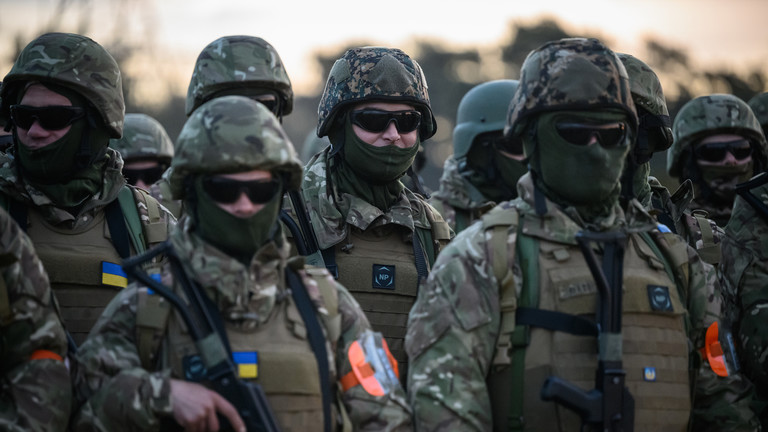
Ukrainian soldiers getting training from British troops in South East England, February 24, 2023. © Leon Neal / Getty Images
RT | December 6, 2023
British special forces operators were embedded with Ukrainian troops in the early days of the conflict, Declassified UK reported on Wednesday, citing the newly published book by Polish journalist Zbigniew Parafianowicz.
Parafianowicz is the Ukraine correspondent for the Polish daily Dziennik Gazeta Prawna. His latest work, ‘Polska na Wojnie’ (Poland at War), examines Warsaw’s role in the neighboring conflict.
According to Declassified, at one point, a Polish government minister – who is not named – told Parafianowicz about a time in March 2022 when he was traveling from Kiev to Zhitomir.
“It was a time when the Russians were still standing in Bucha, and the route was a gray zone. It was possible to run into Russians. We passed the last checkpoint. The Ukrainians told us that we continue at our own risk,” the unnamed minister reportedly said. “Well, and who did we meet next? Ukrainian soldiers and … British special forces. Uniformed. With weapons.”
According to Parafianowicz’s source, the British and the Ukrainians worked together, driving around the countryside with artillery tracking radars, “learning about this war.”
The same official also said that Polish special forces based in Lublin had been in Brovary, a suburb of Kiev, “on the first day” of the hostilities. Poles – along with Brits and Americans – had been training the Ukrainian special forces since 2014, the minister said. According to Parafianowicz, Britain’s Special Air Service (SAS) had trained President Vladimir Zelensky’s security detail as well.
Another source, identified only as a high-ranking Polish officer, said that these commandos did not return to Poland, but “went in the opposite direction” – to Kharkov and parts of Donbass controlled by Ukrainians.
“They cooperated with the British,” the officer said. “Later, we worked out a formula for our presence in Ukraine … we were simply sent on paid leave. Politicians pretended not to see this.”
According to Declassified, some of these Polish commandos may have trained members of the neo-Nazi ‘Azov’ movement – specifically the ‘Kraken’ unit based in Kharkov – in the use of British-supplied NLAW rocket launchers. Social media posts identified them only as “instructors from NATO countries.”
Parafianowicz’s book appears to confirm previous media reports about NATO commandos fighting alongside Ukrainian troops. In April 2022, the French daily Le Figaro claimed that SAS and Delta Force operators had waged a “secret war” on behalf of Ukraine since the beginning of Russia’s military operation. Shortly after those revelations, The Times said a number of SAS operators had returned to Ukraine to teach Kiev’s soldiers how to operate British-made anti-tank rockets. Last December, a British military publication admitted that up to 300 Royal Marines had been deployed to Ukraine for “discrete operations.”
Classified Pentagon documents that were leaked in April this year also showed at least 50 British special forces operators were still active in Ukraine as of March.
Analyst: US Claims to Desire Peace With China ‘Nullified’ by ‘Extraordinarily Belligerent’ Behavior
By Fantine Gardinier – Sputnik – 06.12.2023
The US is pushing the Philippines into adopting a belligerent stance in a small territorial dispute with China as part of longstanding plans to weaken Beijing by starting a war in the South China Sea, an essential sea lane to the Chinese economy, a regional expert told Sputnik.
The monthslong standoff over Second Thomas Shoal in the South China Sea has continued to simmer as China and the Philippines challenge the other’s claim of sovereignty over the submerged coral reef and the United States inserts itself into the dispute.
On Monday, Beijing said that the American littoral combat ship USS Gabrielle Giffords “illegally intruded” in the waters near the shoal, which the US Navy claimed was “conducting routine operations in international waters … consistent with international law.”
Such maneuvers are called “Freedom of Navigation Operations” (FONOPS) and are designed to show US contempt for what it considers the “excessive” maritime claims of other nations according to the UN Convention on the Law of the Sea (UNCLOS), a treaty the US has never ratified.
“The US deliberately disrupted the situation in the South China Sea, seriously violated China’s sovereignty and security, seriously undermined regional peace and stability, and seriously violated international law and basic norms governing international relations, fully demonstrating that the US is the biggest threat to peace and stability in the South China Sea,” the southern command of the People’s Liberation Army said in a statement on the episode.
KJ Noh, a scholar, educator and journalist focusing on the Asia-Pacific, and a member of Veterans for Peace, told Sputnik on Tuesday that the US had thrown its weight behind Manila in the dispute in the hopes of turning what should be a small, peacefully-resolved territorial dispute into a casus belli with Beijing, allowing it to deal a mortal blow to the Chinese economy.
Noh referred to a recently published article in a Hong Kong-based newspaper highlighting how the US is violating international law in its purported push to “stop China from violating international law.”
“So what Alex Lo in the South China Morning Post is pointing out is that the US always talks the talk that, you know, that it is following the ‘rules-based international order’ – which is essentially US hegemony, it has nothing to do with international law. And at the same time, it is always criticizing and decrying China’s violations of the UNCLOS, the United Nations Convention on the Law of the Sea. And what Alex Lo is pointing out is that as the US encircles China with myriad bases and weaponizes them in order to create this massive threat projection platform, it is breaking the law, left, right and center.”
“And so, for example, he points out that in the Cocos Islands, which are possessed by Australia, the understanding is that the caucus islands are not supposed to be militarized. But even as we speak, the Australians are turning it into a platform to launch both submarines and planes. And so this is in direct violation of the understanding that Australia has with the United Nations.”
“And then the other very, very egregious violation is the Chagos Archipelago. Now, once again, you know, the Chagos Islands, the UK forced the Chagos Islanders off – essentially did an ethnic cleansing threatening them with genocide – and then force them off the islands and turned it into a base which it turned over to the United States. And this land, the Chagos Islands, should be given back to the Chagos Islanders. This was the ruling of the legitimate international courts, and the US and the UK have refused to do that.”
“And so all of this goes to show that the United States claims that the United Nations Convention on the Law of the Sea applies to China, but in fact all the rulings and all the agreements that are part of international law the US routinely violates in order to escalate to war against China. So this is just a very, very good example of pointing out the extraordinary hypocrisy of the United States as it prepares for war.”
“The US actions are continually ratcheting up, continual escalation, continually accelerating the material conditions for war. All of this is direct preparation for war. And so whatever the US says in public or in diplomatic venues means nothing. It’s completely nullified by these extraordinarily belligerent – and as Alex Lo points out illegal – actions that the US is currently engaging in.”
“As the US escalates to war with China, the South China Sea, along with Taiwan Island in the East China Sea, and then the Korean Peninsula, will be the three main battlegrounds. The US is preparing these for kinetic war and in order to prepare this for kinetic war, the idea is to choke off the South China Sea. And once thier shooting war starts in the South China Sea, it doesn’t matter if the US wins it or not, just the disruption to trade and traffic will be enough to bring China down. China’s economy will shrink by 25 to 35% because $5.3 trillion worth of goods and most of China’s oil travels through the South China Sea. So this is the game plan.”
“And what they are doing is they’re weaponizing the Philippines as its key provocateur against China. And so inside that larger context, what the Philippines has done is they’ve run aground a rusting ship, the Sierra Madre, on the Second Thomas Shoal, which China claims – and that entire area that China claims, it’s actually contested between four countries, and these contestations would have been resolved peacefully, except for that the United States got involved on the part of the Philippines and then created this fraudulent tribunal by which it now claims that it has legitimate rights.”
“So since the Philippines has run aground a rusting ship on the Second Thomas Shoal in order to squat it, essentially they’re claiming squatter’s rights and they leave a bunch of sailors in there for months at a time. These sailors cannot get off the ship, you know, the reef is not self-sustaining, it’s mostly submerged. And the Chinese want them to leave and they want them to get that junked ship off the Thomas Shoal. It’s like if you were to leave your junked car on my lawn in order to claim it as yours. I mean I think you might be a little bit upset there.”
“So this is the essential contestation that’s happening. The Chinese assert that the Sierra Madre should be removed and the Philippines should not squat in that area, and the US is threatening to use this as a kind of casus belli that, you know, if China does anything against the Philippines, then the US will use the mutual defense treaty to get involved. So it’s a very delicate situation and essentially the US is trying to provoke war in the South China Sea.”
“We have to understand geostrategic and global war in terms of choke points: who controls the choke points determines who has strategic advantage. And in this case, the US is trying to gain or leverage strategic advantage by initiating a shooting war in the South China Sea. The US doesn’t have to win it, all you need is the congestion, that congestion will damage China. That’s the game plan that’s mapped out by Rand in their 2015 war document.”
UK nuclear site ‘leaking’ – The Guardian

Sellafield nuclear reprocessing facility November 26, 2001 in Cumbria, England © Getty Images / Graham Barclay/BWP Media/Getty Images
RT | December 5, 2023
Sellafield, regarded as the most hazardous nuclear site in Europe, has developed a leak in a massive radioactive waste silo that has prompted concerns about the facility’s safety measures, as well as potential dangers to the public and the environment, The Guardian has reported.
The two-square-mile (6km sq) plant, located in Cumbria in England’s northwest, is responsible for the storage and decommissioning of nuclear waste from nuclear weapons programs and power generation. It was previously used to generate nuclear power from 1956 to 2003.
However, the decades-old facility, Europe’s largest nuclear site, has a catalog of safety issues, the newspaper said, including asbestos and fire hazards. Perhaps more concerningly, though, are cracks in storage silos which have prompted diplomatic squabbles with affected countries, including the US, Norway and Ireland.
Damage to one silo of toxic radioactive waste has caused a leak of “potentially significant consequences,” The Guardian said on Tuesday, citing official documents seen by the outlet. It adds that the leak, which it says is likely to continue until 2050, could contaminate groundwater should the situation worsen further.
Scientists are attempting to assess the full risks of the leak using “ongoing radiological dose assessments” and statistical modeling, the newspaper added. In June, the UK’s Office for Nuclear Regulation (ORR) said in a report that the risk presented by the leak is “as low as reasonably practicable.” However, the nuclear regulator remained concerned by the full impact of the leak and at what rate, if any, it may affect groundwater.
An unnamed expert who sits on a committee that monitors Sellafield and other nuclear sites told The Guardian : “It’s hard to know if transparency is put aside because no one’s brave enough to say ‘we simply don’t know how dangerous this is – other than certainly dangerous.’”
An EU report in 2001 warned that an accident at Sellafield could be more hazardous than that of the Chernobyl disaster in 1986, which exposed about five million people in Europe to radiation. Sellafield contains substantially more radioactive material than the Chernobyl facility did at the time.
Reports of Sellafield’s crumbling facade have sparked US concerns about the safety standards at the site, according to diplomatic cables seen by the publication. It has also led to complaints from the governments of both Ireland and Norway – with Oslo worried about the potential of radioactive particles being carried towards its territory by winds across the North Sea.
Health problems brought on by exposure to nuclear radiation depend on the dose but can range from nausea and vomiting to cardiovascular disease and cancer. Extremely high exposure is, in most cases, fatal.
Top Defense Official: US Can Handle Middle East, Russia and China All at Once
By Kyle Anzalone | The Libertarian Institute | December 5, 2023
Vice Chairman of the Joint Chiefs of Staff Adm. Christopher Grady said the Pentagon was prepared to fight a proxy war against Russia in Ukraine, aid the Israeli onslaught in Gaza, and arm Taiwan for a potential war with China. The Admiral argued all the military efforts could be completed simultaneously and the Navy was not stretched thin.
At an Atlantic Council event, Grady said, “You look at what is required to support Ukraine, look at what might be required to support our partner in Israel, and then, of course, you put Taiwan on top of that—we have the construct that we do with combatant commanders and the rest that should allow us to command and control those three things all at one time.” He continued, “It’s part of our campaigning process, which is central to the national defense strategy. Is it challenging? Sure.”
After Russia invaded Ukraine in February 2022, the Biden administration pledged to give Ukraine the weapons needed to win the war. Over the past 19 months, Washington has sent Kiev tens of billions in arms.
Over the past two months, Washington has sent Tel Aviv 15,000 bombs and 57,000 artillery shells. Israel has targeted civilian homes with American-made bombs. However, the White House has refused to place any conditions on the aid it sends to Tel Aviv.
The transfers have stretched American weapons depots to their redline levels. The shortage has led the White House to send cluster variants of artillery shells to both Ukraine and Israel.
In addition to arms transfers, the US has deployed tens of thousands of soldiers to Eastern Europe to train Ukrainian troops and facilitate weapons shipments to Kiev. In the Middle East region, the White House deployed two aircraft carrier strike groups.
Grady’s belief that the US could fight a three-front war is White House policy. President Joe Biden is pushing Congress to pass a $106 billion funding package to fund arming Ukraine, Israel, and a military buildup in the Asia-Pacific.
The Admiral also indicated that military-to-military talks between the US and China may start soon. “So we’re ready when they are and I suspect we’ll see that shortly, “he said.
During a meeting between Biden and Chinese President Xi Jinping last month, the two leaders agreed to resume military-to-military communications. However, the US has engaged in a pair of provocative naval maneuvers in the South China Sea to challenge Beijing’s territorial claims.
US House Speaker issues Ukraine ultimatum to Biden
RT | December 5, 2023
Getting the Republican-majority House of Representatives to approve additional funding for Ukraine would require first securing the US border with Mexico, Speaker Mike Johnson told the White House on Tuesday.
The Louisiana Republican was responding to Monday’s public letter from Office of Management and Budget (OMB) Director Shalanda Young, who warned that the US was “out of money—and nearly out of time” in terms of aid to Ukraine and Israel. Young argued that cutting off US aid would “kneecap Ukraine on the battlefield” and increase the “likelihood of Russian military victories.”
Johnson first addressed Israel, noting that the House approved the Israel Security Supplemental Appropriations Act (HR 6126) on November 2, but that Democrats who control the Senate “voted to block consideration of the bill.”
As for Ukraine, Johnson wrote, the Republican position has remained unchanged since his meeting with Young and National Security Advisor Jake Sullivan on October 26, when he laid out “two essential prerequisites: security at our border, and critical answers regarding the funds requested.”
Six days prior, President Joe Biden had announced the proposal to bundle the funding for Israel, Ukraine, Taiwan and immigration and border enforcement in a $106 billion package, of which about $60 billion would go to Kiev.
Additional funding for Ukraine is “dependent upon enactment of transformative change to our nation’s border security laws,” Johnson wrote on Tuesday. The House passed the Secure the Border Act of 2023 (HR 2), “more than six months ago,” he noted, but the Senate Democrats have “refused to act” on it.
Pointing to over 6.5 million “illegal alien encounters” along the southern US border since Biden took office, of which 294 involved people “on the terrorist watchlist,” Johnson called the situation “an unconscionable and unsustainable catastrophe.”
In addition to “madness” on the border, Johnson noted that the White House still owed Congress “a full accounting of how prior US military and humanitarian aid” to Ukraine was spent “and an explanation of the president’s strategy to ensure an accelerated path to victory.” He accused Biden of “failure thus far to present clearly defined objectives,” and to provide Kiev the weapons it needed on time.
“Rather than engaging with Congressional Republicans to discuss logical reforms, the Biden Administration has ignored reality, choosing instead to engage in political posturing,” the House speaker said.
Talks on a border security bill in the Senate collapsed earlier in the day, as Democrats denounced the Republican proposal as “extreme,” claiming it would “end asylum as we know it.”
Peace Talks With Russia? UK & US Seeking Quick Face-Saving Exit From Ukraine Debacle – CIA Vet
By Ekaterina Blinova – Sputnik – 05.12.2023
There is a rumor in British diplomatic circles about forcing Ukraine to negotiate a way out of the conflict with Russia, per the UK podcast Politics at Jack and Sam’s. Could the reported chatter be real, and if so, what’s behind it?
The Western press is citing Ukrainian politicians expressing criticism with regard to President Volodymyr Zelensky’s failed counteroffensive, with British observers suggesting that the Kiev regime could soon be forced to sit down with Russia and hold talks. As it recently turned out, it was then-UK Prime Minister Boris Johnson who encouraged Zelensky to tear up the preliminary peace agreement with Moscow in 2022. Is London’s position on Ukraine changing?
“Well, their opinion is going to have to change, because the events on the ground are going to dictate it, with Ukraine losing militarily and neither the US nor the UK being in a position to supply any kind of significant weaponry,” retired CIA intelligence officer and State Department official Larry Johnson told Sputnik. “And even if they did, who’s going to use it? That’s Ukraine’s fundamental problem right now – it’s a lack of manpower. And over the last couple of weeks, we’ve seen more and more stories, more independent evidence that Ukraine has just suffered massive losses, both killed and wounded, that are incapable of returning to the fight. So, I think this flood of information will keep pouring out. And each day it’s going to add to the problems that Zelensky faces in trying to hang on to power.”
This is not the first time the rumor of potential Russo-Ukrainian negotiations has made its way to the press. In late November, the German newspaper Bild alleged a plot between Washington and Berlin to twist Zelensky’s arm into holding talks with Russia by substantially diminishing military aid to Kiev. According to the German publication, there is also a plan B envisaging a frozen conflict that would solidify a new “quasi-border” between Ukraine and Russia along the contact line.
Per Johnson, even if the West is ready for negotiations over Ukraine, they should bear in mind that nobody in Russia would allow them to fool Moscow after the derailed Istanbul talks of March 2022 and the Bucha hoax widely circulated by the Western press. However, it’s still unclear what the US and its NATO allies really want: a sustainable peace, or merely a frozen conflict.
“Well, again, this is the problem,” the former CIA analyst pointed out. “There has been no negotiation of any substance between the United States and Russia for now more than two years. The last time Putin entered into negotiations to negotiate a peace – that was a year ago, in April. And the West, Biden, Boris Johnson, they sabotaged it. They destroyed it. They made sure that the Ukrainians knew that they were not to agree to any deal. And that’s how they treat it. My own perception is that the Russians are still smarting over that betrayal, because they legitimately thought they had an agreement in place. And then within days, as they’re pulling back their forces from north of Kiev, the tank forces, the United States and the United Kingdom launched this propaganda campaign, accusing Russia of war crimes in Bucha. It was a blatant lie, it wasn’t true. But again, the truth didn’t matter anymore.”
Meanwhile, The Economist, a British magazine, has drawn attention to the fact that Zelensky’s approval rating is in free fall after the botched counteroffensive attempt, while Ukrainian Armed Forces Commander-in-Chief Valery Zaluzhny commands 70% support. Per the media, the two are at odds, as Zelensky apparently fears that Zaluzhny may be picked as his successor.
“Well, the Americans are trying to figure out how to get rid of Zelensky,” Johnson said. “And I think this is just a natural outgrowth of the various plotting and scheming. I think part of it is wishful thinking on the part of Americans. They launched this war as a proxy war against Russia, fully expecting Ukraine to defeat Russia. It was going to cause the collapse of Vladimir Putin and could ultimately lead to the breakup of Russia. And instead, it’s not turned out that way at all. It has completely backfired.”
“So what you’re getting now are these, let’s call them crazy ideas. People keep thinking that, ‘Okay, we can engineer this in such a way that maybe we will replace Zelensky with Zaluzhny.’ [… ] But these are the kinds of rumors that are circulating. What’s clear is that Zelensky does not have a secure hold on the presidency in Ukraine. And right now, there is a meeting underway in Washington with, I guess, the next in line for the presidency, probably because Zelensky himself didn’t feel secure leaving Ukraine right now to go beg for more money. And so he’s sticking close to home in order to just, I think, try to preserve his position.”
The Real Problem With US Foreign Policy…

By Ron Paul | December 4, 2023
Over the weekend Defense Secretary Lloyd Austin explained to the American people what’s really wrong with US foreign policy. Some might find his conclusions surprising.
The US standing in the world is damaged not because we spent 20 years fighting an Afghan government that had nothing to do with the attacks on 9/11. The problem has nothing to do with neocon lies about Iraq’s WMDs that led untold civilian deaths in another failed “democratization” mission. It’s not because over the past nearly two years Washington has taken more than $150 billion from the American people to fight a proxy war with Russia through Ukraine.
It’s not the military-industrial complex or its massive lobbying power that extends throughout Congress, the think tanks, and the media.
Speaking at the Reagan National Defense Forum in California’s Simi Valley, Austin finally explained the real danger to the US global military empire.
It’s us.
According to Secretary Austin, non-interventionists who advocate “an American retreat from responsibility” are the ones destabilizing the world, not endless neocon wars.
Austin said the US must continue to play the role of global military hegemon – policeman of the world – because “the world will only become more dangerous if tyrants and terrorists believe that they can get away with wholesale aggression and mass slaughter.”
How’s that for reason and logic? Austin and the interventionist elites have fact-checked 30 years of foreign policy failures and concluded, “well it would have been far worse if the non-interventionists were in charge.”
This is one of the biggest problems with the neocons. They are incapable of self-reflection. Each time the US government follows their advice into another catastrophe, it’s always someone else’s fault. In this case, as Austin tells us, those at fault for US foreign policy misadventures are the people who say, “don’t do it.”
What would have happened if the people who said “don’t do it” were in charge of President Obama’s decision to prop-up al-Qaeda to overthrow Syria’s secular leader Assad? How about if the “don’t do it” people were in charge when the neocons manufactured a “human rights” justification to destroy Libya? What if the “don’t do it” people were in charge when Obama’s neocons thought it would be a great idea to overthrow Ukraine’s democratically-elected government?
Would tyrants and terrorists have gained power if Washington did NOT get involved? No. Tyrants and terrorists got the upper hand BECAUSE Washington intervened in these crises.
As Austin further explained, part of the problem with the US is democracy itself. “Our competitors don’t have to operate under continuing resolutions,” he complained. What a burden it is for him that the people, through their representatives, are in charge of war spending.
In Congress, “America first” foreign policy sentiment is on the rise among conservatives and that infuriates Austin and his ilk. He wants more billions for wars in Ukraine and Israel and he wants it now!
And our economic problems? That is our fault too. Those who “try to pull up the drawbridge,” Austin said, undermine the security that has led to decades of prosperity. Prosperity? Has he looked at the national debt? Inflation? Destruction of the dollar?
There is a silver lining here. The fact that Austin and the neocons are attacking us non-interventionists means that we are gaining ground. They are worried about us. This is our chance to really raise our voices!
NATO chief admits Ukrainian failure
By Lucas Leiroz | December 4, 2023
Increasingly, military leaders are admitting Ukraine’s inability to carry out the fight under its current military circumstances. In a recent statement, the head of the alliance, Jens Stoltenberg, stated that the West needs to be prepared to receive “bad news” from Ukraine, belatedly recognizing the reality that many analysts had already reported before.
Stoltenberg made pessimistic comments, lamenting Ukraine’s poor military progress. According to him, Moscow has a great advantage in the conflict, in addition to accumulating a large number of weapons for the military scenario in the winter. The secretary stated that the Russian defense industry is producing weapons “on war footing”, operating in an accelerated manner in order to achieve the country’s military results.
He also said that the front lines have remained almost unchanged in recent months, but that it is necessary to be prepared for bad news regarding Ukrainian positions. However, for him, support for Ukraine is vital and must be maintained, even if expectations are negative.
“We have to be prepared for bad news. Wars move in phases, but we must stand by Ukraine in good and in bad times alike”, he said.
Another interesting topic commented on by Stoltenberg was the inability of Western countries to produce enough weapons to support Ukraine. He admitted that the West is weakened industrially, unable to meet Ukrainian demands.
He compared the capabilities of Russian and European industrial production and concluded that Moscow is working better in this sector, which explains some difficulties of the Ukrainian military in achieving good results on the battlefield. In addition, the secretary stated that the Russians plan to continue attacking Ukrainian energy infrastructure in order to harm the country’s ability to produce weapons and equipment domestically during the winter.
“I think one of the main problems that we must address is the fragmentation of the European defense industry. We are not capable of working so closely together as we should (…) Russia has amassed a large missile stockpile ahead of winter, and we see new attempts to strike Ukraine’s power grid and energy infrastructure”, he added.
In fact, Stoltenberg’s words come at a serious moment, in which the vulnerability of Ukraine can no longer be hidden. The country is suffering many losses since its failed “counteroffensive” attempt. Also, the mainstream media is running out of arguments to disguise the defeat of the Kiev regime, which makes the speeches of Western propagandists become more realistic.
In addition, there is another important factor to understand this process, which is the escalation in Palestine. With Israel suffering from various problems on the battlefield and in need of broad Western support, NATO needs to take the focus of public opinion away from Ukraine and begin to justify a policy of support for the Zionist state. For this reason, it is already becoming commonplace for Western leaders and media to be realistic about the Ukrainian situation. The objective is to explain that this war is impossible to be won, having no longer any need to maintain unrestricted support.
In other words, Western officials and journalists are preparing public opinion for the unavoidable defeat of the neo-Nazi regime and trying to focus on Israel as a new “emergency.” In addition, excuses such as “low industrial production” or “Russian attacks on infrastructure” are inappropriately used to try to justify Ukraine’s situation. But, indeed, the real reason is simply Russian military superiority.
In fact, the West has proven unable to produce weapons fast enough to defend Ukraine. In the same sense, Moscow has launched several heavy artillery and aviation strikes against Ukrainian critical infrastructure. But these are only a few factors that do not fully explain the outcome of the war. Kiev’s failure is mainly due to the factor that the Russians are militarily much superior and have a more efficient military strategy. Even at times when Kiev was receiving large amounts of weapons from NATO on a daily basis the regime’s forces were not able to achieve positive results because the Russians always had a greater military power and a more appropriate strategy. So, Stoltenberg does not explain the real reasons for the defeat by talking only about industrial production.
Finally, it must be emphasized how admitting defeat is also a moral blow against the West. NATO is clearly demoralized due to the frustration in Ukraine. The pro-Kiev propaganda machine has not been able to substantiate any of its narratives, having now to admit that its predictions were wrong. It is very likely that the mainstream media and Western officials will lose their credibility, with public opinion simply ceasing to believe what is said by them.
Lucas Leiroz, journalist, researcher at the Center for Geostrategic Studies, geopolitical consultant.
What We Are Not Allowed to Say
By Christine E. Black | OffGuardian | December 3, 2023
Censorship imperils cultures and civilization. When governments and elites prohibit speaking or writing without threats, shaming, or epithets meant to shut down discussion, free thinking dies. People also die.
A censorship industrial complex grew around Covid hysteria, which began as a war on a virus. New full-blown wars, with guns, bombs, tanks, and planes, and thousands dead now explode around us as free speech is lost in wars’ rubble, and propaganda buries truths.
With money and massive influence, private for-profit industries like pharmaceutical companies, capture US agencies, such as the Food and Drug Administration and the Centers for Disease Control, that then bolster industry profits rather than protect public health. Similarly, captured politicians help corporations profit from wars, as Marine Corp Brigadier General Smedley Butler notes in his book, War is a Racket and as Dwight D. Eisenhower warned against in his 1961 Farewell Address. Corporate and government elites get rich from wars based on lies, such as wars in Iraq and Afghanistan – and they sit rich now in retirement.
What truths might we uncover, sifting through wars’ rubble? Children and young people didn’t need Covid shots as they were at little risk from serious illness from Covid, and some countries stopped recommending them. Yet, vaccines are a main source of revenue for pediatricians. A “pandemic of the unvaccinated” never happened though entertainers, highly paid media figures, and politicians viciously maligned those who waited or declined a Covid shot.
Most people contracted Covid anyway, whether they got multiple shots or not. Shots did not prevent transmission. Thousands of Covid vaccine-injured people have been bullied into silence and rendered invisible. These are all statements we have been forbidden from making in the last few years; those who dare utter them faced rancor or ridicule or worse.
Don’t talk about Covid shots, school and business closings, or the many beloved businesses and churches that closed for good because of bureaucratic mandates.
Don’t talk about vaccine injuries or deaths or children’s learning losses or epidemics of addictions; don’t talk about child and teen suicides.
Don’t talk about Robert F. Kennedy Jr’s astute observations that Haiti and Nigeria had the some of the least restrictive Covid policies on earth, had about a one percent Covid vaccine rate, and have had some of the lowest Covid death rates in the world, observations noted in his book, Letter to Liberals.
Don’t talk about how Covid shots may cause Covid, or how Pfizer’s own product literature states that Covid is one of the side effects of the shot. When we talk about these topics, listeners often stiffen and bristle, their eyes may go blank as they dismiss us with pity or contempt before we even complete a spoken paragraph. Now, new disasters and traumas affect the world, and many insist we not talk about them to avoid snarling and insults or worse.
Violence and war exploded in the Middle East recently, and more unutterable statements come to mind. For instance, criticizing the policies of the Israeli government does not equal anti-Semitism. Great Britain, the same colonial power that colonized and divided the African continent and other countries like poker chips among winners, made The Balfour Declaration in 1917 that declared a “home for the Jews” in Palestine, where Palestinians already lived.
Was this presumptuous and elitist for the British to declare?
Is a single, open, and democratic state in Israel with equal rights for all the best solution to the conflicts and violence, as Israeli American writer, activist, and Israeli Defense Force veteran Miko Peled has stated? Peled is the son of an Israeli general and grandson of one of the signers of the Israeli Declaration of Independence. His father was an Israeli war hero turned peace maker. He changed his thinking on Israel; so did Miko Peled. Peled writes his story in his book, The General’s Son and shares his views in talks and interviews, such as this one on the Katie Halper program.
In spite of how propaganda bombards us, we may note as Miko Peled does, that Palestinians are not simply evil barbarians, beheading babies and raping women. Islam is not a religion of fanatics and terrorists, in Palestine, or anywhere else, as the media often portrays it. It is one of the world’s major religions. The word, Islam, means “submission to the will of God.” The Arabic word, “salaam” which means peace, is part of the common greeting among Muslims all over the world.
Spreading peace is a requirement of the faith. Similarly, sharing God’s peace is expected among Christians and Jews.
Christians have been criticized for their views on Israel. An older and much more well-read peace activist friend shared with me that some evangelical Christians who support Israel, stand with Israel, do so because they believe Israel is the final launching pad for the Rapture when Christians will be zapped up to Heaven, and Jewish people will be too if they convert to Christianity. Jewish people who do not will perish.
What do Jewish people think of this scenario? What if they do not want to “accept Jesus,” but simply wish to remain Jewish? It is confusing. Plenty of the world’s worst violence has been committed and continues in the name of or under the cover of religion.
Statements we are not supposed to make call us to make them now. Statements I make above could be wrong. Many may disagree with them. However, censorship kills with its shaming epithets meant to shut down discussion and thought, like the labels “anti-Semitic” or “conspiracy theorist,” “science denier” or “anti-Vaxxer.”
Censorship imperils us when we are forbidden to speak without threats and insults, such as when we were told, “You don’t care if others die of Covid” if we decided not to wear a mask or to move about freely in 2020 and 2021. Similarly, we were told, “You deserve to be excluded from society if you decline a vaccine” even when some of us had natural immunity or didn’t think we needed it. Even worse, some of us were told, “You deserve to die – or lose your job or friends or education — if you don’t comply.”
Many said such horrible things in the last few years.
Slogans and advertising language often replace free speech and obliterate open thought, as they did during the Covid period, as they do during all wars. Should we be wary of sloganeering and pre-packaged language like “wiped off the map,” “Israel’s 9-11,” “rid the world of evil,” “mushroom cloud,” “weapons of mass destruction,” “pandemic of the unvaccinated,” – sloganeering that stops empathy and reflection, closes debate, and whips populations into war frenzies? Should we question slogans and manipulative phrases?
What questions might we ask about slogans like Israel’s “right to exist”? What does that mean? After a suicide bomber killed his niece in Israel years ago, Miko Peled asked questions. He joined dialogue groups of Israelis and Palestinians and changed his thinking.
US military veteran suicides have been at epidemic levels after soldiers returned from multiple deployments in disastrous wars in Iraq and Afghanistan, ignited by sloganeering after 9-11 and the launch of the so-called “war on terror,” which was to “rid the world of evil.” How might those veterans react now, hearing this same kind of language about “Israel’s 9-11”? This past week, I learned of another veteran who committed suicide.
Can we keep our minds opened, our hearts softened to alternative perspectives? During Covid lockdowns, rigid thinking and censorship caused the US to harm its own children relentlessly as their suicides, addictions, developmental delays, learning losses, and despair increased. Children around the world starved, were abused, exploited, and enslaved because of lockdown policies we were forbidden to question. Has an entire generation of young people been harmed?
Free societies do not ban statements and opinions. Free societies permit questions and debate. Statements above may be phrased as questions as well. For instance, do Covid shots work? Have they worked to stop transmission and illness and death? Was discussion of early Covid treatment suppressed, as Dr. Peter McCollough noted early in lockdowns? Are Covid vaccine-injured people silenced? Where may we find their stories?
Should western cultures have shut down in 2020 in an attempt to avoid a single pathogen? By what authority did bureaucrats suspend the US Constitution in 2020 and forbid assembly, speech, protest, group worship, and community gatherings? What were the harms? Who benefitted from lockdowns and Covid shots and how? How much money changed hands? Who wrote the checks and who got paid?
Why are Palestinians fighting? How do we end the violence and build peace? Should the US fund violence in Israel the ways it does? What has life been like in Gaza and the West Bank of Palestine for the last few decades? Could lockdowns have made life there worse?
Israel has been criticized as one of the most repressive countries in the world for Covid restrictions and Covid shot mandates. Protesting Covid policies is a privilege Palestinians in Gaza would not have had. They have lacked basic medicines, clean water, and schools free of bombings for years.
Was the Balfour Declaration a good idea? Conservative Jewish Rabbi Yisroel Dovid Weiss, speaking at a Let the Quran Speak conference, supports Palestinians and criticizes leaders of the state of Israel on religious grounds.
Documentary films like Occupation 101 and Peace, Propaganda, and the Promised Land provoked my thinking when I helped organize public showings of them while working with peace groups. We led discussions of these films along with War Made Easy, a film based on Norman Solomon’s book by the same name, and The Ground Truth, a film about the horrific effects on the eight-ten percent of the population, sent on multiple deployments to fights those wars.
In the last few years, the same US government that sent military members to fight and die in catastrophic wars forced Covid shots on them until refusers struck down the unlawful mandates.
Stories from outsiders and whistleblowers may teach us, stories from former insiders in the military, in industry, in governments. Soldiers sent to fight disastrous wars may have lost limbs or memory or cognitive function from IEDs. They learned and changed and spoke – what we were not allowed to say.
Describing this latest violence as “Israel’s 9-11” is especially dangerous as we recall the unfathomable destruction and carnage that such language unleashed on the world more than twenty years ago with the launch of the so-called “war on terror”.
What did we learn? Outsiders and independent thinkers — who have said what was forbidden — have often changed history. From the so-called “war on terror,” the war on a virus, the current war in Israel and Palestine, perhaps they will now.
Christine E. Black‘s poetry has been published in Antietam Review, 13th Moon, American Journal of Poetry, New Millennium Writings, Nimrod International, Red Rock Review, The Virginia Journal of Education, Friends Journal, The Veteran, Sojourners Magazine, Iris Magazine, English Journal, Amethyst Review, St. Katherine Review, Dappled Things and other publications.
Hamas holds Israel fully responsible for not extending ceasefire
Palestine Information Center – December 3, 2023
DOHA – Member of Hamas’s political bureau Ezzat al-Resheq has described the Israeli occupation’s claims made recently against his Movement following seven days of humanitarian ceasefire as “intended to justify its resumption of the genocidal war on the civilians in the Gaza Strip.”
“The occupation is still repeating its false claims regarding its justifications for resuming its aggressive war against our people,” Resheq said in press remarks on Saturday.
“The occupation is spreading false and baseless stories, including claims of a missile being launched from the Gaza Strip,” the Hamas official added, stressing that all these false claims and stories were “aimed at covering up its premeditated intent to resume its brutal bombardments and barbaric raids and commit horrific massacres against defenseless civilians.”
“We showed responsiveness to the mediators in the negotiations over extending the temporary truce, but we like to affirm that the occupation is fully responsible for the failure to extend the humanitarian ceasefire after it refused to deal positively with offers it had received through the mediators,” he underlined.
Featured Video
Matt Bracken: US Plans Massive MOAB Strike on Iran?
or go to
Aletho News Archives – Video-Images
New Book
The silver that medicine dropped — four thousand years of clinical use, four decades to erase.
Colloidal Silver — First Edition, 2026, Paperback
Lies are Unbekoming | October 16, 2026
Silver was medicine. Not alternative medicine. Not folk medicine. Medicine. In surgery. In obstetrics. In the burn ward. In water treatment. In the household medicine chest. Every physician before 1938 knew this.
By the 1870s, silver nitrate was standard in surgical wound care across the leading hospitals of Britain, Germany, and the United States. Colloidal silver preparations — Collargol, Argyrol, Protargol — entered European and American practice through the 1890s and early 1900s and became standard antiseptics in military field medicine. By the time Fleming grew his first penicillin mould in 1928, silver was the first-line antimicrobial of the Western pharmacopoeia. The Lancet and the British Medical Journal carried the clinical reports in volume. The practice ran continuously through the Victorian era, the Edwardian era, the First World War, the interwar period. By 1980, almost all of it was gone.
What has not been treated at book length, until now, is how a four-thousand-year clinical record disappeared from mainstream medicine within four decades of the Flexner Report — and what the honest account of silver looks like once that record is reassembled.
Colloidal Silver reconstructs the pre-1938 record from The Lancet, the British Medical Journal, and the primary literature of the era; recovers Robert Becker’s bioelectric framework from the regeneration research the pharmaceutical model buried; and places silver inside a practical terrain-paradigm guide to its current place — in water, on the body, inside the body, and in the chronic conditions where antibiotics have failed. … continue
Blog Roll
 Aletho News
- China’s FM: Palestinian cause is ‘greatest injustice of the century’
- US sympathy for Palestinians surpasses support for Israelis
- Israeli rabbi permits occupiers to steal Palestinian olive harvest in West Bank
- Spanish firm sells Latvia vehicles equipped with Israeli tech despite arms embargo
- Saudi Arabia under fire… Yemen is burning down the House of Saud
- Israeli Spy Pollard stole the files, today’s it’s delivered through official channels
- Why Iran Didn’t Walk Away
- US arms supplied to Ukraine found in war-torn Sudan – Moscow
- The silver that medicine dropped — four thousand years of clinical use, four decades to erase.
- My Latest Presentation to the UN Security Council
- If Americans Knew
- NPR investigation finds evidence of widespread fraud at mall kiosks tied to Israeli skincare brand
- Tucker Carlson exposes Israeli Lies about the Oct 7th attack, Charlie Kirk, and the U.S.
- Israel has detained thousands of Palestinian children since Oct 7th – over half spent time in solitary, many uncharged
- Israeli Analysis: Is Netanyahu Planning an ‘October Surprise’ Attack Before Israel’s Election?
- Israeli settlers brutally attack Palestinians and Washington Post female photographer, 65
- Words Have Changed, Occupation Continues: The Reality of the Gaza Ceasefire
- Gaza’s child amputees are growing faster than their prosthetics allow
- Israel keeps Palestinians struggling just to survive–Daily Update
- Israeli firm used online ads to run vast spy operation, researchers say
- No, the world zionist movement is not an antisemitic conspiracy theory
- No Tricks Zone
- New Study Suggests Large Regions Of The Pacific Ocean Have Been Cooling For The Last 80 Years
- Germany’s Green Energy Debacle: High Energy Costs Force Kahla Porzellan to Close After 182 Years!
- New Study: 50 Years Of The Most Aggressive ‘Net Zero’ Policies Can Only Affect The Global Climate By 0.03°C
- US September “Heat” Was No Record…Many Records Set Decades Ago
- Latest European Green Energy Debacle; Portugal’s Largest Flagship Solar Park Insolvent!
- Green Energy Debacle: German Expert Professor Fritz Vahrenholt Warns Of Severe Economic And Social Consequences
- Two More Paleo Reconstructions Affirm Meters-Higher Sea Levels Across Ireland, Brazil 7000-6000 Years Ago
- New Study: Earth And Venus Surface Warmth Largely Explained By Convection And Lapse Rate, Not CO2 Or Radiation
- 2025 Nature Paper Claiming Worsening Global Drought Gets RETRACTED …Heavily Flawed
- New Study: ‘Global Drought Shows No Detectable Recent Acceleration Under Climate Warming’

