Henry and Hillary – Familiar Bedfellows
By Sheldon Richman | FFF | November 19, 2014
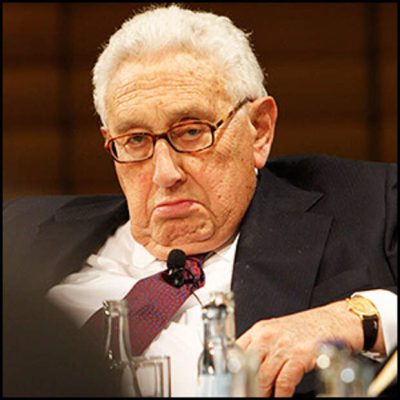
It says a lot about former secretary of state and presumed presidential aspirant Hillary Clinton that she’s a member of the Henry Kissinger Fan Club. Progressives who despised George W. Bush might want to examine any warm, fuzzy feelings they harbor for Clinton.
She has made no effort to hide her admiration for Kissinger and his geopolitical views. Now she lays it all out clearly in a Washington Post review of his latest book, World Order.
Clinton acknowledges differences with Kissinger, but apparently these do not keep her from saying that “his analysis … largely fits with the broad strategy behind the Obama administration’s effort over the past six years to build a global architecture of security and cooperation for the 21st century.”
Beware of politicians and courtiers who issue solemn declarations about building global architectures. To them the rest of us are mere “pieces upon a chess-board.” Security and cooperation are always the announced ends, yet the ostensible beneficiaries usually come to grief. Look where such poseurs have been most active: the Middle East, North Africa, Ukraine. As they say about lawyers, if we didn’t have so-called statesmen, we wouldn’t need them.
If I didn’t know better, I’d suspect some pseudonymous writer of having fun with irony in this review. Behold:
President Obama explained the overarching challenge we faced in his Nobel lecture in December 2009. After World War II, he said, “America led the world in constructing an architecture to keep the peace…”
Keep the peace — if you don’t count the mass atrocity that was the Vietnam War, the U.S.-sponsored Israeli oppression of Palestinians, and various massacres carried out by U.S.-backed “leaders” in such places as Bangladesh (formerly East Pakistan), East Timor, Chile, and elsewhere.
One Henry Kissinger had a hand in all these crimes, by the way. Strangely, Clinton doesn’t mention them. (See Christopher Hitchens’s devastating two-part indictment here and here, later turned into The Trial of Henry Kissinger.)
America, at its best, is a problem-solving nation.
Iraq, Syria, Afghanistan, and Libya are only the latest examples of problems America solved during Madam Secretary’s tenure, building on the glorious successes of George W. Bush’s team. Henry the K is no doubt flattered by the homage.
Kissinger is a friend, and I relied on his counsel when I served as secretary of state. He checked in with me regularly, sharing astute observations about foreign leaders and sending me written reports on his travels.
Now things make sense. That Hillary Clinton thought Kissinger — Henry Kissinger — a worthy advisor is something we should all know as 2016 looms.
What comes through clearly in this new book is a conviction that we, and President Obama, share: a belief in the indispensability of continued American leadership in service of a just and liberal order.
There really is no viable alternative. No other nation can bring together the necessary coalitions and provide the necessary capabilities to meet today’s complex global threats. But this leadership is not a birthright; it is a responsibility that must be assumed with determination and humility by each generation.
It takes chutzpah to write humility even remotely in connection with Kissinger. And if the U.S. empire is indispensable to justice and liberalism — and where are these, exactly? — we are in trouble. The record is not encouraging. Kissingerian “realism” creates global threats.
The things that make us who we are as a nation — our diverse and open society, our devotion to human rights and democratic values — give us a singular advantage in building a future in which the forces of freedom and cooperation prevail over those of division, dictatorship and destruction.
Devotion to human rights and democratic values — as shown in Egypt, where Clinton stuck by another friend, Hosni Mubarak, against a popular uprising. The woman has some friends!
“Any system of world order, to be sustainable, must be accepted as just — not only by leaders, but also by citizens,” he writes.
The suggestion that Kissinger cares what ordinary citizens anywhere think is ridiculous. What he cares about is states, which he puts in one of two categories: those that buckle under to the Indispensable Empire and those that do not.
Henry, er, Hillary in 2016? You might want to rethink that.
Henry Kissinger, America’s most notorious war criminal

Press TV – December 1, 2023
The most notorious and hawkish America’s former top diplomat, known more for his war crimes and export of imperialism than diplomacy, died on Thursday. He was 100.
Henry Kissinger, a key architect of America’s Cold War foreign policy during the presidencies of Richard Nixon and Gerald Ford, breathed his last at his home in Kent, Connecticut.
While in the United States, he is often lauded for bringing about rapprochement with China, around the world, he is known as an infamous war criminal with blood of millions of people on his hands.
It is estimated that the victims of his blatant war crimes number from several hundred thousand to several million, from Argentina, Bangladesh, Cambodia, Chile, Cyprus, East Timor, Palestine, South Africa, to Vietnam.
In 1973, quite scandalously, he was handed a Nobel Peace Prize for negotiating a ceasefire deal in the Vietnam War, although the earlier flare-up and spread of the devastating war to neighboring Cambodia was entirely his handiwork.
In the eight years that he was the US Secretary of State, Kissinger shaped America’s interventionist foreign policy, which later became a benchmark for his successors to export American hegemony and imperialism around the world.
Christopher Hitchens, the author of The Trial of Henry Kissinger, in his 2001 book called for the former top US diplomat to be prosecuted for conspiracy to commit murders, kidnappings and torture across the world.
“The US could either persist in averting their gaze from the egregious impunity enjoyed by a notorious war criminal and lawbreaker, or they can become seized by the exalted standards to which they continually hold everyone else,” wrote Hitchens.
What are Kissinger’s main crimes?
One of his most notorious roles was in Cambodia, where he masterminded the expansion of the Vietnam War through a secret bombing campaign in 1969 and ground invasions by US forces for years.
The US is believed to have rained down more than 540,000 tonnes of bombs in a campaign called Operation Menu that was executed without the backing or knowledge of the US Congress.
The deadly military adventure caused an eight-year civil war between the Cambodian government and the Khmer Rouge regime, which led to the killing of around 275,000–310,000 people and displaced millions of others.
In declassified cables in 1970, Kissinger was heard conveying this message to his deputy Alexander Haig after speaking to Nixon: “He wants a massive bombing campaign in Cambodia… It’s an order, it’s to be done. Anything that flies, on anything that moves. You got that?”
Author and TV personality Anthony Bourdain, after visiting Cambodia, wrote in his 2011 book A Cook’s Tour: “Once you’ve been to Cambodia, you’ll never stop wanting to beat Henry Kissinger to death with your bare hands”.
“Witness what Henry did in Cambodia – the fruits of his genius for statesmanship – and you will never understand why he’s not sitting in the dock at The Hague next to Milošević.”
He also played an instrumental role in the massacre of the East Timorese people by the Indonesian forces in the mid-1970s.
Kissinger and President Ford, during a meeting with the Indonesian dictator Suharto in December 1975, gave him instructions to invade East Timor, which triggered a civil war that left at least 200,000 people dead, according to 2001 declassified documents.
In Chile, Kissinger worked behind the scenes to destabilize and undermine the government of Salvador Allende who was seen as a threat to US hegemony in South America at a time when all other Latin American countries had US-installed military dictatorships.
Less than three years into Allende’s rule, amid skyrocketing inflation and massive strikes that were orchestrated by the CIA, a US-engineered coup led by General Augusto Pinochet toppled the democratically-elected government.
A Chilean government report later revealed that over 40,000 people were killed, tortured, or imprisoned during Pinochet’s murderous regime at the behest of the US government and Kissinger.
In Argentina, Kissinger militarily backed junta leader General Jorge Rafael Videla after he toppled the democratically-elected government of President Isabel Perón in March 1976, according to declassified cables.
These actions led to the Dirty War between 1976 and 1983, where Argentina’s military junta killed between 10,000 and 30,000 people. Many of them were subjected to enforced disappearances.
Kissinger was also involved in Bangladesh, previously known as East Pakistan, where he and Nixon backed the genocide of people by West Pakistan.
Following his death on Thursday, Bangladesh’s Foreign Minister AK Abdul Momen said Kissinger backed the Pakistani military regime during the 1971 war and failed to apologize to the people of Bangladesh for his actions.
Kissinger was also responsible for consolidating the US vassal dictatorship in Iran in the 1970s, which had long-lasting unwanted consequences for Washington.
What role did Kissinger play in Iran?
Kissinger’s political opportunism is particularly evident in the example of relations with Iran, which American diplomacy under his leadership saw, in the words of Leader of the Islamic Revolution Ayatollah Seyyed Ali Khamenei, as a “milking cow.”
In the 1970s, accompanying then-US President Nixon, he traveled to Tehran and initiated massive military deals on the export of arms worth billions of dollars to Iran.
In his eyes, the best solution for Iran was a rigid military dictatorship that would spend massively on American weapons and other expensive products, and at the same time play the role of a US proxy against the regional countries that refused to lean toward Washington.
Such an attitude was formed partly as a consequence of the defeat in the Vietnam War, which is why the American authorities did not like the idea of repeating the same scenario in West Asia, with huge American casualties.
In 1975, when he held the position of Secretary of State and National Security Advisor, Kissinger was the key man in signing a $15 billion deal that included $6.4 billion for the purchase of eight US nuclear reactors.
The Shah’s regime then planned to build a total of twenty nuclear power plants with the import of enriched uranium, for which Washington and its allies showed great enthusiasm, seeing it as a lucrative opportunity for their companies.
These treaties collapsed four years later due to mass popular discontent with the West-backed dictatorship and the success of the Islamic Revolution, the prospect of which Kissinger understandably dreaded.
He was among the loudest proponents of providing asylum to the deposed Shah, arguing that it was America’s “moral obligation.”
On the aggression of the Baathist Iraqi regime on Iran, he said “It’s a pity they both can’t lose.”
Three decades later, when Iran announced the continuation of the development of a civilian nuclear program, this time with its own technology and without multibillion-dollar contracts with American and Western companies, Kissinger turned the tables.
In an opinion piece for the Washington Post in 2005, Kissinger wrote that “for a major oil producer such as Iran, nuclear energy is a wasteful use of resources.”
This radical switch once again confirmed that Americans have an essential problem with the technological prowess and progress of independent countries because they believe only the US has the right to a monopoly of advanced technologies.
In the 2000s, Kissinger became an advocate of American interventionism in West Asia and met regularly with then-US President George W. Bush and Vice President Dick Cheney to advise them on the disastrous invasion of Iraq.
The collapse of American imperial ambitions in Iraq and other countries of the region culminated in his intensified anti-Iranian rhetoric.
In 2014, when Iraq and Syria were under the grip of Takfiri terrorism, he stated that “Iran is a bigger problem than Daesh,” arguing that the latter’s fall would open the door to Tehran’s alleged “imperial agendas.”
In addition to giving unequivocal support to anti-Iranian terrorism, he also strongly opposed the 2015 nuclear agreement between Iran and world powers, clinched during the presidency of Barack Obama.
He maintained the same stance after Obama’s megalomaniac successor Donald Trump scrapped the deal, saying any attempts to reinstall the deal are “extremely dangerous.”
Zaluzhny Talking Peace With Russia Behind Zelensky and Biden’s Backs: Sy Hersh
By Ilya Tsukanov – Sputnik – 01.12.2023
President Zelensky admitted this week that Ukraine’s counteroffensive failed to “achieve the desired results” and that Kiev is now in “a new phase” of the conflict with Russia. Meanwhile, Valery Zaluzhny, the general who enraged Zelensky by calling the crisis a “stalemate,” was absent from a Thursday meeting between the president and his generals.
Russia and Ukraine’s top generals have been holding secret discussions aimed at putting the Ukrainian crisis to bed, with Ukraine’s president, and the Biden administration, left out. That’s according to a new report by veteran investigative journalist Seymour Hersh citing informed US sources.
The negotiations, said to be spearheaded by Russian Chief of General Staff Valery Gerasimov and Ukrainian Armed Forces Commander-in-Chief Valery Zaluzhny, still have “a lot of questions” left to be ironed out, one source, a US businessman with years of experience dealing with high-level Ukrainian diplomatic and military issues in the government, told Hersh. These include what to do about war criminals, matters of citizenship, ordnance disposal, and cross border economics, as well wrangling to assure “peace with honor,” according to a second source.
Russian officials have made no official statements on the matter, and Sputnik could not independently confirm the veracity of this information at the time of writing. Moscow has repeatedly said throughout the crisis that Ukrainian membership in NATO would constitute crossing its security “red lines.”
Hersh’s sources also told him that Zaluzhny’s bombshell interview in a British business magazine last month in which he admitted that Ukraine’s counteroffensive had reached a “stalemate” and that there would be no “deep and beautiful breakthrough” was “arranged” after Zaluzhny and Gerasimov had spoken several times.
The interview and accompanying op-ed written by Zaluzhny were “carefully orchestrated” by the Ukrainian commander to send a message to the Ukrainian government and the “madman who staked his life upon winning politically and militarily” at the helm that “the war is over and we want out,” according to a US official Hersh says was involved in the early stages of the general-to-general discussions.
“So the message that was sent to Zelensky is that we are going to have talks with the Russians with or without you and they are going to be military-to-military. Your neighbors are fed up with you, especially Poland and Hungary, and they want their Ukrainian refugees to go back to a peaceful country,” the official said. The state of Ukraine’s collapsed economy and the question of “how do you operate a country with no GNP?” was also driven home, the source added.
The US president and his foreign policy team have been left out of the talks, and “the White House is totally against the proposed agreement,” according to the US official who spoke to Hersh. “But it will happen. Putin has not disagreed,” the source said.
Zelensky has reportedly been told that “this is a military-to-military problem to solve and the talks will go on with or without you,” if need be. “We can finance his voyage to the Caribbean,” the official added.
Zelensky-Zaluzhny Spat
Hersh’s story comes after a month of escalating tensions between Zaluzhny and Zelensky after the publication of Zaluzhny’s interview and article in Western media on November 1, with Ukraine’s president first adamantly insisting that the conflict with Russia was “not a stalemate,” and emphasizing emphatically to US media that he would never negotiate with Moscow and Russian President Vladimir Putin under any circumstances.
The behind-the-scenes battle has come to include sackings of Zaluzhny allies, the mysterious bombing death attack of one of his aides, and a poisoning attack against Marianna Budanova, the wife of the Ukrainian military’s Main Intelligence Directorate chief.
On Thursday, Zelensky appeared to change his tune regarding the fate of Ukraine’s counteroffensive, saying it “did not achieve the desired results” as quickly as expected, that Kiev will be shifting to “a new phase of war” as winter sets in, and mobilize resources to build fortifications in Zaporozhye, Ukrainian-occupied areas of Donetsk, Kherson, Kharkov, Sumy, Chernigov, Kiev, Rovno and Volyn.
Meanwhile, Commander Zaluzhny was conspicuously absent from a meeting between Zelensky and his generals during a visit to a command post in Kharkov region.
One factor that the Hersh story did not account for is Ukraine’s neo-Nazi problem. Veteran international relations expert Gilbert Doctorow told Sputnik this week that notwithstanding the political rivalries or conflicts in Kiev, they are just “a tempest in a teapot” given the power of the neo-Nazi street thug “grey cardinals” mobilized during the 2014 coup, who can and will do everything in their power to block any peace deal.
Canada pushing unwinnable war harms Ukrainians
By Yves Engler | December 1, 2023
The Liberals and elements of the dominant media are criticizing the Conservatives for their insufficient commitment to Ukraine. But it’s those who have promoted the NATO proxy war that have damaged the country.
The prime minister and Liberal ministers have denounced the Conservatives for not voting for the Canada-Ukraine free trade deal. They are seeking to paint Pierre Poilievre as not serious or influenced by Donald Trump, which may be true. Trudeau stated, “the real story is the rise of a right-wing, American MAGA-influenced thinking that has made Canadian Conservatives — who used to be among the strongest defenders of Ukraine, I’ll admit it — turn their backs on something Ukraine needs in its hour of need.”
The Conservatives countered days of criticism by seeking to amend a foreign affairs committee report on Ukraine to add a call for Canada to send more arms.
Irrespective of the merits of the trade deal, the notion that NATO proxy warriors are ‘supporting’ Ukraine simply doesn’t hold up. With Washington, Ottawa has pushed a client state to fight a horrific and ever more obviously unwinnable war, as a series of recent revelations underscore.
As Reuters reports the Ukrainian military is having increasing difficulty finding fighters with many seeking increasingly elaborate ways of bypassing conscription. As a result, they’ve largely run out of new men, which is forcing troops to stay at the front for longer periods. Morale is collapsing.
As recently confirmed by the head of the Ukrainian delegation in Ukraine-Russia peace talks this could have been avoided if the US and UK hadn’t scuttled a deal in the spring of 2022. David Arakhamia, who is now parliamentary leader of Volodymyr Zelenskyy’s Servant of the People party, said Russia was prepared to end the war if Ukraine agreed to neutrality, but UK Prime Minister Boris Johnson told Zelensky not to sign the peace deal. Former Israeli Prime Minister Naftali Bennett, Turkish foreign minister Mevlut Cavusoglu, Vladimir Putin and others have echoed this account of the initial peace negotiations.
Arakhamia’s revelations confirm that Ukraine is a Western client state. Last week marked the 10th anniversary of the beginning of the Maidan protests that greatly exacerbated Ukraine’s subordination to the West. An elected, if corrupt, president that drew support largely from the Russian speaking east and south of the ‘cleft country’ was deposed in a violent foreign-promoted insurrection. Recent revelations from the trial of the Maidan Massacre confirm that far right forces shot Maidan protesters. University of Ottawa professor Ivan Katchanovski noted, “Maidan massacre trial verdict confirms that Maidan snipers massacred many Maidan protesters and police and shot at ARD and BBC TV journalists.” The massacre led to the ouster of elected president Viktor Yanukovych.
Canada played a significant part in stoking opposition to Yanukovych who promoted Ukrainian neutrality. Immediately after he won an election, which Canadian observers found to be fair, Ottawa began to undermine him. Canadian officials’ criticism of Yanukovych grew and early in the three-month Maidan protest movement, foreign minister John Baird visited Maidan square with Ukrainian Canadian Congress head Paul Grod to support the demonstrators. At the height of the protests opposition forces, including the far-right C14, used the Canadian Embassy in Kyiv, which was immediately adjacent to Maidan square, as a staging ground for a week in their bid to topple Yanukovych. After Yanukovych was ousted, Baird immediately “welcomed the appointment of a new government”, saying, “the appointment of a legitimate government is a vital step forward in restoring democracy and normalcy to Ukraine.” But the country’s constitutional provisions dealing with impeachment or replacing a president were flagrantly violated.
The coup spurred right-wing violence, Russia’s intervention in Crimea and a war that left 14,000 dead in the east. The smoldering conflict contributed to Russia’s February 2022 invasion, which contravenes international law but was provoked by NATO’s efforts to turn Ukraine into a Western bulwark on Russia’s border.
Ten days ago, defence minister Bill Blair declared that Canada would support Ukraine “for as long as it takes, with whatever it takes.” Last week Ottawa announced another $60 million in arms, including over 10,000 assault guns and 9 million rounds of ammunition, for Ukraine.
Even if NATO maintains the political support for continuing to pump in weapons, there’s little chance Ukraine will regain most of the territory it has lost. There’s a greater chance it will lose more territory.
The country would have been far better off to accept the deal offered a month into the invasion (or adhere to the Minsk II agreement prior to the invasion). But the Anglosphere prioritized weakening Russia so they bolstered ultra-nationalist Ukrainian forces wanting to fight. Tens of thousands of dead later Ukraine has little prospect of garnering the deal that was previously on offer. It is also far more dependent on outside forces.
For Ukrainians the situation is a disaster. As an Economist headline recently admitted. “Putin seems to be winning the war in Ukraine—for now”.
Kiev’s counteroffensive casualties top 125,000 – Moscow
RT | December 1, 2023
In the six months since Kiev launched its push against Russian defensive lines, it has lost over 125,000 troops and 16,000 heavy weapons, Russian Defense Minister Sergey Shoigu estimated during a ministerial meeting on Friday.
The Ukrainian government and its Western backers had high expectations for the operation, for which the former’s army was provided with main battle tanks and other advanced arms. Ukrainian officials predicted that the push would help their country reclaim territory lost since major hostilities started in February 2022, and potentially launch an incursion into Crimea, which had broken away from Kiev in the wake of the 2014 armed coup.
“Total mobilization in Ukraine, delivery of Western arms and deployment of strategic reserves by the Ukrainian command have not changed the situation on the battlefield,” the Russian minister reported. “Those desperate actions simply increased the losses of the Ukrainian armed forces.”
As such, Kiev’s military has been “significantly degraded” while Russian forces are “taking a more advantageous position and widening the zone under their control on all fronts,” Shoigu added.
Last week, Shoigu put Ukrainian casualties in November at 13,700, which pushed the Russian estimate of total Ukrainien losses in the counteroffensive over the 100,000 benchmark.
The most senior Ukrainian general, Valery Zaluzhny, reported in early November that the frontline situation had devolved into a “stalemate” and that Kiev’s side was unlikely to achieve a breakthrough unless some surprise technological development gave it a decisive edge over Moscow. His assessment has been rejected by officials, with President Vladimir Zelensky maintaining that Ukrainians are still making progress.
On Friday, the Associated Press published an interview with the Ukrainian leader, in which he said, “Look, we are not backing down, I am satisfied.” He blamed a shortage of Western weapons for the underwhelming results of the Ukrainian operation and declared that a “new phase” in the hostilities was beginning this winter.
Hamas: Israel made decision to resume its criminal aggression

Palestine Information Center – December 1, 2023
GAZA – The Hamas Movement said in a statement issued Friday that the Israeli occupation bore responsibility for the end of the truce for rejecting terms to free more hostages and extend it.
The Movement pointed out that Israel refused an offer to release more captives and the dead bodies of an Israeli family killed in Israeli air strikes.
“We offered to hand over the bodies of the Bibas family, release their father so that he can participate in their burial, and hand over two Israeli captives,” the group said in a statement.
Israel refused “all these offers because it had made a prior decision to resume its criminal aggression against the Gaza Strip,” it added.
Hamas held the US administration and its president, Biden, fully responsible for the continuation of Israeli war crimes in the Gaza Strip after its absolute support and the green light it gave it following its Secretary of State Anthony Blinken’s visit to Israel.
The group also stressed that the Palestinian people and resistance led by Al-Qassam Brigades are steadfast.
UK escalating tensions across Middle East
By Lucas Leiroz | December 1, 2023
The collective West seems increasingly interested in worsening the crisis in the Middle East. Now, the United Kingdom is sending a new combat ship to the Persian Gulf region with the aim of deterring Iranian and pro-Palestinian forces. Amid growing tensions in the maritime zone of the Middle East, the British measure tends to escalate the crisis significantly.
According to Defense Secretary Grant Shapps, the destroyer HMS Diamond is heading to the Persian Gulf to “strengthen the United Kingdom’s presence” in the Middle East. The ship will join the frigate HMS Lancaster, which has been stationed in the region since last year. For Shapps, improving the UK’s defense capacity in that area is essential to guarantee British interests amid the current conflict situation.
“HMS Diamond is en route to join Operation Kipion, the UK’s maritime presence in the Gulf and the Indian Ocean (…) Recent events have proven how critical the Middle East remains to global security and stability,” he added in a statement (…) From joint efforts to deter escalation, following the onset of the renewed conflict in Israel and Gaza, to now the unlawful and brazen seizure of MV Galaxy Leader by the Houthis in the Red Sea – it is critical that the UK bolsters our presence in the region, to keep Britain and our interests safe from a more volatile and contested world,” he said.
More than that, Shapps also added that the destroyer will help deter regional actors, mainly “Iran and its proxies.” With these words, Shapps clearly refers to Hezbollah and mainly to the Yemeni Houthis, who recently launched a series of naval assaults, making the Israeli maritime presence in the Red Sea unworkable. Furthermore, it has also been stated that sending the ship will contribute to ensuring “freedom of navigation”, which is a common rhetoric of British and American strategists.
“Freedom of navigation” operations are naval military mobilizations carried out in disputed or conflict regions with the excuse of guaranteeing freedom of passage for civilian and merchant ships. Among Western navies, these operations have become commonplace to provoke enemy countries in a “disguised” way. The US constantly promotes such incursions into maritime zones claimed by China in Asia, for example. Now, the UK wants to do something similar in the Middle Eastern region, where military tensions are growing rapidly.
Around fifty large merchant ships pass through the Bab-el-Mandeb Strait daily, while one hundred pass through the Strait of Hormuz. These are extremely busy maritime areas that facilitate the commercial flows of local countries. The problem is that the sea is one of the first areas affected in a war scenario. Pro-Palestinian forces are intercepting Israeli ships reaching the Red Sea through the straits. Soon, it is possible that ships from Western countries will also begin to be attacked, as these states are giving full and unrestricted support to Israel’s military campaign in Gaza.
The UK uses this scenario as a justification for sending warships to the region, but this does not seem to be the correct way to deal with the situation. Instead of “deterring” the Palestinian and Iranian allies, the UK will be provoking them further and contributing to the deterioration of the crisis. The more Western interventionism is being conducted in the Middle Eastern situation, the more tensions will escalate, which is why London is making a serious mistake.
However, it is noteworthy that the British maneuver is inserted in a context of increased naval interventionism by London in several “tense” regions.
For example, in addition to the ship heading to the Gulf, the deployment of an international task force led by the British was also announced. The aim is allegedly to launch patrols from the English Channel to the Baltic Sea. In addition to the UK, countries such as Denmark, Finland, Iceland, the Baltic states, Norway and Sweden are participating in the project. The group is being called the Joint Expeditionary Force (JEF) and, according to Shapps, will “defend our shared critical infrastructure against potential threats”.
As we can see, once again the irresponsible maneuvers of Western countries can lead to serious consequences. In order to supposedly “protect their interests”, these countries implement dangerous escalatory measures that tend to create real problems. Maritime tensions in the Middle East will grow as there is more Western participation in favor of Israel – in the same sense that maritime tensions in Europe will begin to emerge from the moment that the maneuvers of Western countries began to generate security problems for Russia.
Instead of creating false enemies and launching bellicose measures, the best thing for the West to do is to calm tensions and reestablish dialogue for a peaceful solution. But unfortunately this strategic sense no longer seems to exist among Western decision makers.
Lucas Leiroz, journalist, researcher at the Center for Geostrategic Studies, geopolitical consultant.
You can follow Lucas on X (former Twitter) and Telegram.
NATO Chief Puts Hypocrisy on Full Display
By Ted Snider | The Libertarian Institute | November 29, 2023
NATO Secretary General Jens Stoltenberg put NATO’s hypocrisy on display while talking to reporters ahead of the meeting of NATO foreign ministers in Brussels on November 28.
Asked by a reporter about American and European struggles to continue providing Ukraine with weapons and ammunition, Stoltenberg replied, “It’s our obligation to ensure that we provide Ukraine with the weapons they need. Because it will be a tragedy for Ukrainians if President Putin wins.”
The tragedy for Ukrainians has already happened. Their infrastructure and economy are destroyed, their population is dispersed, their relatives are dead or injured and their land is lost. The greater tragedy to come is not the war ending, but the war continuing. In the first weeks of the war, Ukrainians could have kept almost all of their land and lost almost none of their lives for a promise not to join NATO. The political West ordered them to walk away from the negotiating table and onto the battlefield. They promised them—directly or indirectly—as much military and financial support as it takes for as long as it takes. Nearly two years later, Ukraine will likely have to make the same promise, but they have lost that land and they have lost those lives.
Russia brought tragedy to Ukraine; the United States, United Kingdom, and their NATO allies bloated and magnified that tragedy. The tragedy now would not be ending the war even if it means “Putin wins.” The tragedy now is that NATO is willing to continue feeding a war that they know Ukraine can’t win. “When Ukraine launched its big counteroffensive this spring,” The Wall Street Journal reported, “Western military officials knew Kyiv didn’t have all the training or weapons—from shells to warplanes—that it needed to dislodge Russian forces.” Ukrainian Commander-in-Chief Valery Zaluzhny has said that the war has reached a “stalemate” that over time can only favor Russia.
The tragedy for Ukrainians would not be negotiating an end to the war, it would be NATO exercising the “obligation” to continue the war.
Stoltenberg gave a second reason for continuing to provide Ukraine with the weapons they need; so that Ukrainians can go on dying for NATO goals and NATO security. If the war ends now, “it will be dangerous for us,” Stoltenberg said. The United States “will continue to provide support” to Ukraine “because it is in the security interest of the United States to do so.” NATO must “stay the course” because “[t]his is about also about our security interests.”
Stoltenberg knows this war is not being fought because Russia wanted to conquer other territory; Stoltenberg knows this war is being fought because Russia wanted to defend its territory. This war did not happen because Russia was a threat to NATO territory, it happened because NATO was a threat to Russian territory. How do we know that Stoltenberg knows this? Because he said so.
Putin “sent a draft treaty that they wanted NATO to sign, to promise no more NATO enlargement,” Stoltenberg said on September 7, 2023. “That… was a pre-condition for not invade Ukraine.” He then said that when “we didn’t sign that… he went to war to prevent NATO, more NATO, close to his borders.”
“President Putin,” Stoltenberg concluded, “invaded a European country to prevent more NATO.”
Stoltenberg has publicly stated his awareness that this war was fought, not over American or NATO security concerns, but over Russian security concerns.
U.S. Secretary of Defense Lloyd Austin also recently said that the United States must go on supporting Ukraine or Russia would win and steamroll on over the Baltic countries, Poland, and beyond. Russian Foreign Minister Sergey Lavrov mocked Austin, saying, “This comes from a man who holds a high-ranking position and cannot but receive expert views… and who cannot but understand what is going on in Ukraine and that Russia has never had and can never have any aggressive or expansionist plans.”
Ukraine’s chief negotiator in the Belarus and Istanbul talks with Russia has also recently said that stopping NATO from expanding to Ukraine and Russia’s borders was the “key point” for Russia and that “[e]verything else was simply rhetoric and political ‘seasoning.’”
Stoltenberg says that if Russia is allowed to win “the message to all authoritarian leaders—not only in Moscow, but also in Beijing—is that when they violate international law, when they invade another country when they use force, they get what they want. So this is about the whole idea of a rules-based international order, where territorial borders are respected.”
Stoltenberg transitions from “international law” to “rules-based order” because his case cannot be made without hypocrisy on the former. International law applies equally to everybody. But the United States or NATO have frequently invaded other countries by force and disrespected their territorial borders: Panama, Grenada, Libya, Kosovo, Iraq and Syria. Before Ukraine, modern Russia had not. But the rules-based order, unlike international law, allows Stoltenberg to make the case that Russia has violated the rules but the U.S. and NATO have not because the rules are made up as you go along so that the United States is always within them and Russia is always without. Under the unwritten rules-based order, rules are applied when they benefit the U.S. while the U.S. is exempt when they don’t.
American and NATO support for Ukraine may be about U.S. insistence on enforcing the rules-based system, but the United States is not an enforcer of international law.
Stoltenberg’s third reason for continuing to press the war in Ukraine is read right off the U.S. script; “… we need to continue to support them also knowing that the stronger Ukraine is on the battlefield, the stronger the handle will be on the negotiating table.” That point has passed. Ukraine is in a weaker position on the battlefield than they were before the counteroffensive. Russia is winning the war of land, the war of attrition on weapons, the war of attrition on lives, and the technological war. Ukraine had a better seat at the negotiating table in the first weeks after the invasion when the political West ordered them to stop negotiating. They were in a better position a year ago when they recaptured areas of Kherson before the counteroffensive. Far from strengthening Ukraine’s position on the battlefield or at the negotiating table, supporting the continuation of the war seems to be putting Ukraine in a weaker and weaker position. The terms that will be offered Ukraine today are likely much worse than the terms they were offered at the start of the war. And they will likely be worse tomorrow.
Stoltenberg says that “if you want a negotiated, peaceful solution, which ensures that Ukraine prevails as a sovereign, independent nation, then the best way to get there is to continue to provide military support to Ukraine.” But it is not war that will guarantee Ukraine sovereignty. As Lavrov recently pointed out, Russia recognized the sovereignty of Ukraine based on a declaration of independence and a constitution that declared Ukraine’s neutrality and non-membership in NATO, and Russia will continue to when those conditions are reinstated. The best way to ensure Ukraine’s territorial integrity and sovereignty is not to help it fight for the right to be in NATO but to encourage it to promise not to join NATO.
Finally, Stoltenberg put NATO’s hypocrisy on display not only by what he said, but by what he did not say. If the words that Stoltenberg said were meant to rally Western ears, the words he did not say will be the loudest in Ukrainian ears. Though Ukraine is fighting, in part, for the right to be in NATO, that is the one thing that Stoltenberg, hypocritically, did not offer Ukraine. The “Allies have stated again and again the last time at the NATO Summit with all the leaders present in Vilnius” that they will “provide support to Ukraine,” that they “will step up” their support for Ukraine, that they will “help them… to modernize their army” and that they will “ensure full interoperability between the Ukrainian forces and the NATO forces.” The one thing Stoltenberg did not say that NATO has offered Ukraine is membership in NATO.
Ukraine should fight to defend NATO’s insistence on the right of a country to choose its own alliances and to join NATO without being offered membership in NATO. That is the final hypocrisy put on full display in Stoltenberg’s comments to reporters.
US military aid to Ukraine may be postponed until after 2024 elections
By Ahmed Adel | November 29, 2023
Members of the US Congress fear that if a military and financial aid package for Ukraine cannot be agreed before Christmas, it could be delayed until after the 2024 presidential elections, which take place in the distant November. The Economist notes that due to this funding uncertainty, “now America has become one of Ukraine’s greatest worries” since Washington has been “Ukraine’s greatest saviour as it marshalled arms, money and more to help” to fight Russian forces.
According to the London-based outlet, “the longer the delay, the more the Republican and Democratic parties will “become consumed by election fever.”
“If there is no deal before Christmas, some in Congress worry, a fresh allocation of aid may be delayed until after the elections in November 2024,” the Economist reported, citing a source in the US Senate, who added that if Donald Trump was to be elected president, funding could stop completely.
Ukrainian officials fear that without American support, Kiev’s allies in Europe could lose heart, with the magazine highlighting that Ukraine is trying to boost its defence industry, which was famous during the Soviet era but has been badly neglected since.
“No matter how much we grow local production, we would be hugely dependent on Western partnerships,” admitted a senior official in Kiev.
Another Ukrainian source cited by the Economist said, “In the spring the flow of military supplies was a broad river. In the summer it was a stream. Now it is a few drops of tears.”
Without US and Western funding, Ukraine’s collapse would be imminent since this was the decisive factor in why the eastern European country’s military has survived for as long as it has. The situation is so dire that the Ukrainian Ministry of Economy and the National Bank believe that Ukraine’s GDP is expected to reach pre-crisis 2021 levels only in 2030.
Ukraine’s GDP dropped 29.1% last year, falling from 5.5 trillion hryvnia to 3.8 trillion hryvnia at constant prices, considering 2021 as the base year. With an average annual growth rate of 4.8%, the Ukrainian economy will reach pre-crisis levels only in 2030, when GDP will reach 5.6 trillion hryvnia at 2021 prices.
In comparison, the International Monetary Fund expects an average growth of 4.3% per year for the Ukrainian economy from 2025 to 2028.
Meanwhile, the Russian economy, which contracted 2.1% last year to 132.5 trillion rubles in 2021 prices, is forecast to grow 2.45% this year, reaching a GDP of 135.7 trillion rubles. Despite the sanctions, this value represents approximately 445 billion rubles more than recorded before the crisis.
Evidently, the sanctions against Russia have failed whilst Ukraine continues to struggle. Yet, despite this reality, the Biden administration is adamant about maintaining sanctions and financing Ukraine and is only blocked from doing so because of the strong opposition in Congress.
Biden’s unrelenting yet failed Ukraine policy will likely be his undoing since his popularity continues to plummet in the polls.
The latest Morning Consult poll, updated on November 27, had Biden’s approval rating at 38% and his disapproval rating at 55%. According to FiveThirtyEight’s average of all polls, Biden’s approval rating sat at 39%, with 54.7% disapproving.
The New York Times/Siena College polls at the beginning of November showed Trump ahead of Biden in four of the six swing states. Still, more indicators of the president’s electoral peril soon followed. Biden’s popularity in head-to-head matchups with Trump is dwindling, as seen in the fact that among the latest surveys this month from 13 separate pollsters, Biden’s position is worse than their previous polls in all but two.
As Politico highlighted, “And while polls suggest most of the movement comes from voters abandoning Biden — who might become undecided but not swing to supporting Trump — the Republican has also started to gain steam. Trump’s vote share in the national polling average is higher now than at any point in the past year.”
A massive reason for the swing in popularity between Biden and Trump is their respective positions on the Ukraine war. Trump has claimed he can end the conflict in 24 hours, and even though this is doubtful, it points to the fact that he wants to wrap up this war quickly. Biden, on the other hand, not only instigated the start of the war but is attempting to continue it for as long as possible, even at the expense of the American taxpayers who are already struggling with the cost of living.
If funding of Ukraine is discontinued until at least November 2024, Moscow will likely have ended the war by then after achieving their goals and will be ready to start engaging in slow normalisation efforts with Washington – if Trump were to be elected. And even if Congress eventually approves a new aid package for Ukraine, it will only merely delay for a short duration Russia’s final victory.
Ahmed Adel is a Cairo-based geopolitics and political economy researcher.
How to Lose A Carrier Strike Group in An Afternoon
By William Schryver – imetatronink – November 28, 2023
Imagine a scenario where China, for whatever reason, announces a “no warships allowed” closure of the Taiwan Strait. It’s not an implausible scenario at all. The Chinese have spoken openly of the possibility. They regard the entirety of the strait as their sovereign waters, and assert the right to exercise control over them.
Now imagine a US carrier strike group is commanded to challenge the blockade in order to assert what the empire regards as “freedom of navigation” through what the “rules-based international order” defines as international waters.
Then imagine the distinct possibility of a perceived provocation that escalates to a limited engagement that escalates into a launch of the carrier’s air wing and then escalates to the launch of a mixed-salvo of 500+ Chinese kamikaze drones and anti-ship missiles, plus a full complement of ECCM jammers and a couple hundred decoys.
Also bear in mind that very similar scenarios could just as easily play out in the Baltic Sea or the Persian Gulf.
And the day it finally happens — as I fear it surely will — the world will suddenly begin operating on radically altered terms.
Americans don’t want to keep funding Ukraine – congresswoman
RT | November 28, 2023
Republican Representative Marjorie Taylor Greene has said that any spending bill pairing US border security with more military aid for Ukraine amid the conflict with Russia would be “a slap in the face” of the American people.
US Senate Majority Leader Chuck Schumer announced on Sunday that he will hold a vote on President Joe Biden’s request for $106 billion in military assistance for Ukraine and Israel during the first week of December.
The Biden administration has so far failed to push through its supplementary ‘national security’ proposal, with Schumer saying that “the biggest holdup” is opposition from the Republicans, who insist that additional aid to Kiev should be combined with funding for security on the US-Mexico border.
“Our border is the worst national security crisis in US history,” Greene wrote on X on Tuesday. According to AP, illegal crossings on the US-Mexico border surpassed a daily average of more than 8,000 people in September. However, the flow has subsided by around 14% since then.
“Ukraine is not the 51st state,” she said. “US border security should not be paired with funding for the losing war in Ukraine.”
The congresswoman slammed the Democratic Party for resisting the Republican push for more spending and increased security on the border. “Democrats want the daily invasion into America, they don’t want to fix it,” she wrote.
“Americans do not support the war in Ukraine and don’t want to continue funding Ukraine,” Greene said. “So any bill pairing our own border security with more billions for Ukraine is a slap in the face to the American people.”
The Biden administration has provided Ukraine with more than $76 billion in military and other assistance since the start of the conflict between Moscow and Kiev in February 2022. However, it has recently said that the money is running out, as some Republicans refuse to back any new aid packages for Ukraine. US Secretary of Defense Lloyd Austin, who visited Kiev last week, announced a new tranche of arms and ammunition worth just $100 million.
READ MORE: Origin of US weaponry used by Hamas must be investigated – congresswoman
The US public also appears be souring on support for Ukraine, with a recent poll AP-NORC showing that around 45% of Americans believe that Washington is sending too much money to Kiev.
West ‘screwed over’ Ukraine – ex-Zelensky aide
RT | November 27, 2023
The West has essentially thrown Ukraine under the bus in its conflict with Russia by failing to provide Kiev with the necessary amount of military aid, Aleksey Arestovich, a former aide to President Vladimir Zelensky, has claimed.
Writing on Telegram on Sunday, Arestovich weighed in on the differing views of Ukrainian officials as to why Kiev’s conflict with Moscow is still in full swing despite several major attempts at peace.
According to the former presidential aide, the West bears most of the blame for the situation.
“The real responsibility lies with those who promised Ukraine real support for waging a real, big war and did not provide it. In other words, they screwed us over.”
Arestovich claimed that Ukraine “had won its war” by managing to survive in the first few months of the conflict. “This war of ours could have well ended with the Istanbul Agreements,” he suggested, referring to the talks in the Turkish city in the spring of 2022, which initially made some progress but stalled after then-British Prime Minister Boris Johnson’s visit to Kiev. The negotiations collapsed but Russia maintains it is open to diplomatic engagement with Kiev.
After the Istanbul talks, the conflict entered another phase in which Ukraine had no chance of winning without securing massive Western arms supplies, including warplanes and long-range missiles, the former official continued. “But nothing came. We paid a huge price for that.”
Arestovich suggested that the West would now try to force Ukraine to accept the loss of several regions, which overwhelmingly voted to join Russia in a series of public referenda last autumn.
He also suggested that, while Kiev found itself in a tough spot mostly due to the West’s inaction, the Ukrainian leadership’s “stupidity and corruption has given them many formal and informal reasons to screw us over.”
Arestovich’s remarks came amid Ukraine’s faltering counteroffensive, which has been underway since early summer but has failed to gain any significant ground. Last month, Moscow said Kiev had lost more than 90,000 troops since the start of the push, with Defense Minister Sergey Shoigu claiming that Ukrainian casualties had reached more than 13,000 soldiers in November alone.
Earlier this month, Valery Zaluzhny, Ukraine’s top general, admitted that hostilities had reached a stalemate, an assessment rejected by Zelensky. Meanwhile, on Sunday, Mariana Bezuglaya, a senior Ukrainian MP, blasted Zaluzhny over the lack of a strategic plan for 2024 and called on the military leadership to step down.
Featured Video
Matt Bracken: US Plans Massive MOAB Strike on Iran?
or go to
Aletho News Archives – Video-Images
New Book
The silver that medicine dropped — four thousand years of clinical use, four decades to erase.
Colloidal Silver — First Edition, 2026, Paperback
Lies are Unbekoming | October 16, 2026
Silver was medicine. Not alternative medicine. Not folk medicine. Medicine. In surgery. In obstetrics. In the burn ward. In water treatment. In the household medicine chest. Every physician before 1938 knew this.
By the 1870s, silver nitrate was standard in surgical wound care across the leading hospitals of Britain, Germany, and the United States. Colloidal silver preparations — Collargol, Argyrol, Protargol — entered European and American practice through the 1890s and early 1900s and became standard antiseptics in military field medicine. By the time Fleming grew his first penicillin mould in 1928, silver was the first-line antimicrobial of the Western pharmacopoeia. The Lancet and the British Medical Journal carried the clinical reports in volume. The practice ran continuously through the Victorian era, the Edwardian era, the First World War, the interwar period. By 1980, almost all of it was gone.
What has not been treated at book length, until now, is how a four-thousand-year clinical record disappeared from mainstream medicine within four decades of the Flexner Report — and what the honest account of silver looks like once that record is reassembled.
Colloidal Silver reconstructs the pre-1938 record from The Lancet, the British Medical Journal, and the primary literature of the era; recovers Robert Becker’s bioelectric framework from the regeneration research the pharmaceutical model buried; and places silver inside a practical terrain-paradigm guide to its current place — in water, on the body, inside the body, and in the chronic conditions where antibiotics have failed. … continue
Blog Roll
 Aletho News
- China’s FM: Palestinian cause is ‘greatest injustice of the century’
- US sympathy for Palestinians surpasses support for Israelis
- Israeli rabbi permits occupiers to steal Palestinian olive harvest in West Bank
- Spanish firm sells Latvia vehicles equipped with Israeli tech despite arms embargo
- Saudi Arabia under fire… Yemen is burning down the House of Saud
- Israeli Spy Pollard stole the files, today’s it’s delivered through official channels
- Why Iran Didn’t Walk Away
- US arms supplied to Ukraine found in war-torn Sudan – Moscow
- The silver that medicine dropped — four thousand years of clinical use, four decades to erase.
- My Latest Presentation to the UN Security Council
- If Americans Knew
- NPR investigation finds evidence of widespread fraud at mall kiosks tied to Israeli skincare brand
- Tucker Carlson exposes Israeli Lies about the Oct 7th attack, Charlie Kirk, and the U.S.
- Israel has detained thousands of Palestinian children since Oct 7th – over half spent time in solitary, many uncharged
- Israeli Analysis: Is Netanyahu Planning an ‘October Surprise’ Attack Before Israel’s Election?
- Israeli settlers brutally attack Palestinians and Washington Post female photographer, 65
- Words Have Changed, Occupation Continues: The Reality of the Gaza Ceasefire
- Gaza’s child amputees are growing faster than their prosthetics allow
- Israel keeps Palestinians struggling just to survive–Daily Update
- Israeli firm used online ads to run vast spy operation, researchers say
- No, the world zionist movement is not an antisemitic conspiracy theory
- No Tricks Zone
- New Study Suggests Large Regions Of The Pacific Ocean Have Been Cooling For The Last 80 Years
- Germany’s Green Energy Debacle: High Energy Costs Force Kahla Porzellan to Close After 182 Years!
- New Study: 50 Years Of The Most Aggressive ‘Net Zero’ Policies Can Only Affect The Global Climate By 0.03°C
- US September “Heat” Was No Record…Many Records Set Decades Ago
- Latest European Green Energy Debacle; Portugal’s Largest Flagship Solar Park Insolvent!
- Green Energy Debacle: German Expert Professor Fritz Vahrenholt Warns Of Severe Economic And Social Consequences
- Two More Paleo Reconstructions Affirm Meters-Higher Sea Levels Across Ireland, Brazil 7000-6000 Years Ago
- New Study: Earth And Venus Surface Warmth Largely Explained By Convection And Lapse Rate, Not CO2 Or Radiation
- 2025 Nature Paper Claiming Worsening Global Drought Gets RETRACTED …Heavily Flawed
- New Study: ‘Global Drought Shows No Detectable Recent Acceleration Under Climate Warming’

