Iran rejects Trump’s ‘Project Freedom,’ warns US over Hormuz role
Al Mayadeen | May 4, 2026
Iran has strongly rejected United States President Donald Trump’s announcement of a naval initiative dubbed “Project Freedom,” warning that any American involvement in the management of the Strait of Hormuz would be considered a violation of the existing ceasefire framework.
Iran warns US against interference in Hormuz
Head of the National Security and Foreign Policy Committee in the Iranian Parliament, Ebrahim Azizi, issued a sharp warning to Washington, saying that any US interference in the emerging maritime arrangements in the Strait of Hormuz would breach ceasefire understandings.
Azizi stressed that Iran would not accept external control over one of the world’s most strategic waterways, amid ongoing tensions following months of confrontation in the region.
Azizi directly dismissed Trump’s “Project Freedom” initiative, stating that the management of the Strait of Hormuz and the wider Gulf region “would not be dictated by Trump’s delusional posts.”
His remarks reflect Tehran’s firm rejection of US attempts to position itself as an arbiter of maritime movement in the area.
Iran pushes back on US narrative
The Iranian official also criticized “anticipated US narratives” surrounding maritime security, referring to them as “blame game” scenarios.
He said such rhetoric reflects Washington’s attempt to shape the political framing of developments in the Strait of Hormuz, while Iran asserts its own sovereignty over its territorial waters and strategic routes.
Trump earlier announced that Washington will begin a naval operation to escort foreign vessels stranded in the Strait of Hormuz, framing the move as a humanitarian initiative amid ongoing regional tensions.
In a statement posted on Truth Social, Trump alleged that multiple countries had asked the United States for assistance in “freeing” ships that remain unable to transit the strategic waterway.
He said the initiative, dubbed “Project Freedom,” would begin Monday morning West Asia time with US representatives tasked with guiding vessels and their crews safely out of the restricted area.
Trump emphasized that many of the affected ships belong to countries not involved in the ongoing war, describing them as “neutral and innocent bystanders” caught in the crisis.
TRUMP ANNOUNCES OPERATION TO ESCORT SHIPS – Fmr. CIA Analyst Larry Johnson
Mario Nawfal | May 4, 2026
At the edge of the Strait: A superpower in a narrow sea
By Mahmood Rehman | Al Mayadeen | May 3, 2026
I have spent a good part of my professional life at sea, and I say this without hesitation: there are few waterways in the world as unforgiving, as deceptive, and as strategically consequential as the Strait of Hormuz. It is not just a stretch of water; it is a pressure point of the global economy. When tension rises here, the entire world feels it—from fuel pumps in America to kitchen tables in South Asia.
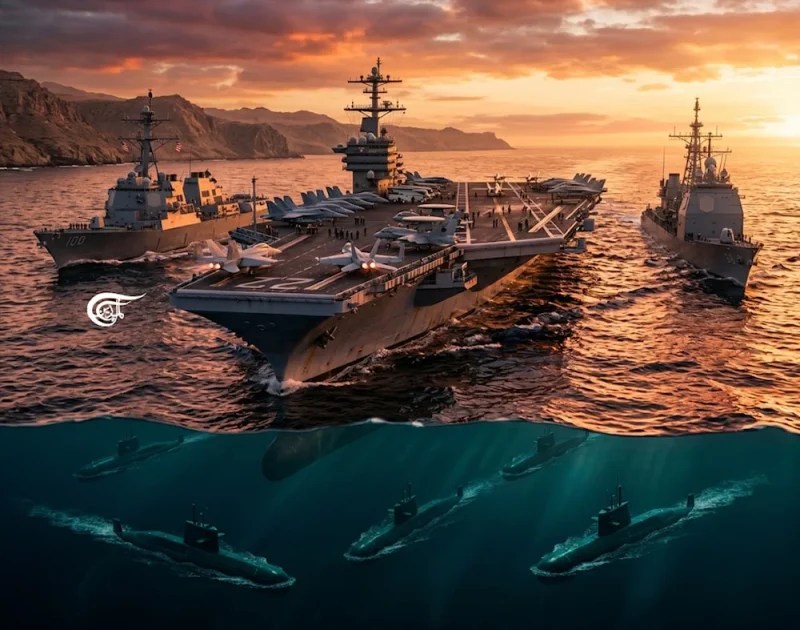
What we are witnessing today is not merely a regional conflict. It is a strategic impasse in one of the most sensitive maritime corridors on earth. The United States has deployed significant naval power into the region. Carrier strike groups centred around the USS Dwight D. Eisenhower, USS Theodore Roosevelt, and USS Gerald R. Ford are operating alongside cruisers, destroyers, frigates and replenishment tankers. Along with them are nuclear-powered guided missile submarines of the Ohio-class submarine type, carrying formidable strike capability. With over two hundred and fifty aircraft embarked across these platforms, the sheer scale of deployment is impressive by any standard.
Yet, having commanded ships myself, I know that numbers and tonnage do not always translate into control, especially in confined, contested waters.
The stated objective appears straightforward: enforce a maritime blockade of Iranian ports and ensure unhindered passage through the Strait of Hormuz. But here lies the irony. The Strait, by most accounts, was already open before the escalation. What has changed is not the physical state of the waterway, but the political and military environment surrounding it.
Iran’s recent offer has placed Washington in a difficult position. It has indicated willingness to ensure the Strait remains open, on its own terms, provided the United States lifts the blockade and shows flexibility on the timing of nuclear negotiations. Accepting such an offer risks appearing to concede under pressure. Rejecting it prolongs a costly and increasingly unpopular confrontation.
And cost is now becoming the defining factor.
Fuel prices have risen. The ripple effect is visible in everyday commodities. The American public, which never truly supported this war, is beginning to feel the burden directly. Wars fought thousands of miles away eventually find their way into domestic politics, and this one is no exception. The narrative of a swift and decisive operation has long faded. What remains is a grinding reality.
There is also a growing perception (rightly or wrongly) that this was not entirely America’s war to begin with. Many point towards the long-standing position of Benjamin Netanyahu, who has, for decades, articulated a hardline stance against Iran. Previous US administrations, including those led by Barack Obama, Joe Biden, George W. Bush and Bill Clinton, exercised caution in this regard. They understood, perhaps better than most, that Iran is not an easy adversary.
And this is where, in my professional judgement, the conversation must turn towards Iran’s maritime capability, often underestimated, sometimes misunderstood, but very real.
Iran does not seek to match the United States ship for ship. Instead, it has built what we in naval terms would call an asymmetric maritime strategy. Its so-called “mosquito fleet” consists of numerous fast attack craft — small, agile, heavily armed platforms that can swarm larger vessels. Operating from concealed bases along the coastline and from island positions, these units are difficult to detect and even harder to neutralize in large numbers.
Then there are the Ghadir-class submarines, small, quiet, and ideally suited for the shallow waters of the Gulf. These are not platforms designed for long blue-water patrols; they are designed for ambush. In confined waters, that makes all the difference.
Geopolitics and Geoeconomics of the Strait of Hormuz
Sputnik – 02.05.2026
The reckless reliance on a blitzkrieg to eliminate Iran’s political and military leadership has left Israel and the United States in an extremely precarious situation, where Tehran’s key trump card in the conflict turned out to be control over the Strait of Hormuz.
Alexander Yakovenko, deputy director of Sputnik’s parent company Rossiya Segodnya and head of the Committee on Global Issues and International Security of the Russian Security Council’s Scientific-Expert Board, has addressed the standoff around the Strait of Hormuz.
Analysts in Israel are already writing of a complete failure, with the prospect of “returning to the issue” sometime in the future. Judging by published reports, everything was planned for June this year, but, as the saying goes, the devil intervened, and Benjamin Netanyahu succumbed to the temptation of a final solution through “regime change.” The scapegoats will be the Mossad division responsible for Iran and the military command responsible for Lebanon.
Donald Trump faces a far more difficult predicament: he has been drawn into a war that is neither his own nor in America’s interest. But the main issue is that the Strait of Hormuz problem now rests squarely on his shoulders. Aside from acceding to all of Iran’s demands, there appear to be no viable options for resolving the blockade – including the resumption of military action, which, according to observers, would have catastrophic consequences for the region, the global economy, and the Trump administration.
In terms of the Persian Gulf and the greater Middle East, a complete geopolitical reconfiguration has taken place, including a shift in Turkiye’s role (it was Ankara that effectively killed the plans to bring Iraqi Kurds into the “march on Tehran,” which was intended to bolster the confidence of those whom Israeli intelligence believed were ready to take to the streets of Iranian cities).
The destruction of the region’s extraction and logistics infrastructure prompted the UAE to withdraw from OPEC and OPEC+, which will only intensify Abu Dhabi’s contradictions with Riyadh and accelerate the political realignment of smaller players toward Ankara, Saudi Arabia, or Iran.
Iran’s agency has grown qualitatively: from a pariah state burdened by sanctions, Iran has genuinely become a regional power (in contrast to Netanyahu’s claim that Israel is a regional power and “in some ways even a global one”). Everything now depends on Iran – a fact understood by those at the helm in Tehran, namely, by general consensus, the Islamic Revolutionary Guard Corps (IRGC). And all this is aside from the most pressing issue on the regional agenda: the restoration of extraction and logistics infrastructure, especially given that the damage has a cumulative effect – in other words, “time is money.”
Russia, Pakistan, and China have become even more deeply involved in the affairs of the region, while the United States has demonstrated its inability to provide military protection for its allies. In other words, the role of external players has grown, whereas control over the region had been in American hands since the Baghdad Pact at the beginning of the Cold War. Now it can be said that the entire institutional structure in the region is collapsing – even in the OPEC format – and the region is opening up to an entirely new architecture.
In terms of geoeconomics, Tehran now holds a powerful lever of influence over the global economy and world trade through its control over the Strait of Hormuz. Moreover, this is not only direct control but also the ability to destabilize the situation around the Strait at any point in the future, regardless of any agreements that might be reached regarding its possible reopening as part of a ceasefire. In other words, everyone understands that things will never return to how they were before.
The only thing that matters for the global economy and the international financial system – including the dollar’s linkage to oil trade – is the stability of commercial traffic through the Strait. With no indication of it being reopened, the world is losing between 8 and 15 million barrels of oil and petroleum products per day, as well as up to 20% of global LNG supplies. This also includes a range of industrial goods in the petrochemical sector and derivatives for the agricultural sector. Experts expect a monthly shortfall of 300 million barrels, which amounts to three-quarters of the released strategic reserves of developed countries. Moreover, by early May, both strategic reserves and the advantages of unlocking Russian and Iranian oil, along with the balancing buffer of floating storage, will be nearly exhausted. In short, in every respect, a moment of truth is approaching in a conflict that is difficult to restart now that military action has been paused.
Not only have the United States and Israel handed Iran, on a silver platter, escalation dominance in the conflict – the ability to manage escalation if Washington and Tel Aviv launch another round – but Tehran will also gain additional revenue from selling its 1.5 million barrels of oil per day, which economists estimate at 2–3 billion per month, or 24–36 billion per year. Essentially, even without the unfreezing of Iranian assets in Western countries, Iran will have the resources to rebuild what has been destroyed. To this should be added the fees collected from commercial vessels transiting the Strait of Hormuz.
It is also worth noting a direct geopolitical consequence of the Iranian conflict: the discord within the Western alliance along the line of Trump’s America versus liberal-globalist Europe. The recent visit of the British monarch to the United States, during which he called in his address to Congress for the collective “defense of Ukraine” invoking Article 5 of the Washington Treaty (despite the fact that Kiev is not a NATO member), indicates that the lack of allied support for the Iranian adventure is a clear appeal to restore Western unity specifically on an anti-Russian basis – everything else is secondary. In Europe, they no longer hide the fact that they intend to “wait out” Trump, if that is what it takes, but under no circumstances will they agree to a settlement of the Ukrainian conflict.
As such, it is not denied that Ukraine is merely the opening move in yet another war of the West against Russia, and that Western elites are determined to make it a decisive, final confrontation of a civilizational nature. This presents an interesting situation for Russia, which could be resolved one way or another very soon. If Russia participated in two world wars, in which, albeit in different ways, relations between groups of Western countries were contested, and in the Cold War we faced a united West, then now we see a disunited West, weakened militarily and in terms of domestic political development. Its consolidation is only possible at our expense.
Charles III quite opportunely mentioned the burning of the White House by the British in 1814, as it reminds us – and perhaps Washington – of positive moments in our shared history, including Russia’s support for the American Revolution and the Union side in the Civil War. The decision rests with the Americans, but it is curious how the Middle East references an era before the ideologization of international relations in the 20th Century.
Mali: a new front in the Western war on multipolarism
Strategic Culture Foundation | May 1, 2026
An audacious coup attempt against the government in the West African state of Mali appears to have been thwarted by the Malian Armed Forces, supported by their Russian allies.
The surprise coup was launched last weekend when an estimated 12,000 fighters attacked at least five cities, including the capital, Bamako. Fighting continued during the past week, with most of the casualties – over 1,000 dead – suffered by the insurgents who came under heavy ground and air fire from state forces backed by Russian auxiliaries belonging to the Africa Corps.
Mali’s leader, Assimi Goïta, made a nationwide televised address appealing for calm and stating that the country’s security situation had been brought under control. He paid tribute to his defense minister, General Sadio Camara, who was killed in action on the first day of the coup attempt on April 25. The leader also acknowledged the actions of his country’s strategic partner, the Russian Federation, for helping to defeat the coup, which he condemned as “foreign-sponsored”.
For its part, the Kremlin said it would continue supporting the Malian government to restore stability and security to the country.
Both the Malian authorities and Moscow have accused Western sponsors of involvement in the insurgency. Russia’s foreign ministry claimed that Western military instructors had helped coordinate the wide-ranging attacks. There were reports of militants armed with French Mistral anti-aircraft missiles and U.S.-made Stinger Manpads. There are also unverified reports of mercenaries from Ukraine and NATO states fighting on the ground.
This is not the first time that NATO and Ukraine have been linked to destabilizing the national security of Mali. Two years ago, Mali cut diplomatic links with Kiev after a Ukrainian military intelligence official claimed that Ukrainian forces had been supplying insurgents.
In the latest uprising, the Western news media have been quick to highlight supposed military gains made by the rebels. The Western coverage has sought to portray the violence as a spontaneous challenge to the government in Bamako, which the Western media disparages as a “military junta”. The same media have also claimed that the unrest is a blow to Russia’s strategic interests in Africa. In particular, it is claimed that Moscow’s security partnership with Mali and other African states is being exposed as ineffective and weak.
Two militant groups were involved in the coup attempt this week. The Tuareg ethnic people’s liberation movement, known as the Azawad Liberation Front (FLA), and an Al-Qaeda-linked jihadist group known as Jammat Nusrat al-Islam wal-Muslimin (JNIM). Both entities had been fighting each other until recently, but now seem to have allied. Who brokered that expedient alliance?
The widespread insurgent attacks mounted against five cities covering a distance of some 2,000 kilometers also suggest that the fighters were provided with considerable intelligence and logistical support. Mali is a huge country, the sixth largest in Africa, with a land area twice that of France or Texas. Previous attacks were mainly confined to the remote northern half of the country, which is typically a desert landscape. To launch an assault on the capital in the south is a significant development. The devastating bomb attack on the defense minister’s residential compound near Bamako also suggests that there was foreign assistance.
The geopolitical background is highly significant. Mali formed an Alliance of Sahel States (AES in French) in September 2023 along with Niger and Burkina Faso. The three former French colonies ordered the withdrawal of French military forces and asserted a newfound political independence. They accused France of playing a double game by secretly supporting separatists and Islamist groups to give a pretext for French military involvement in their countries. In a further affront to French arrogance, Mali, Niger, and Burkina Faso pointedly turned to Russia for security assistance and, in return, have offered Russia access to key natural resources in a mutual partnership.
For centuries, France and other Western states have plundered Africa without giving anything back to the continent except new forms of economic slavery and exploitation.
Meanwhile, Russia and China have gained renewed partnerships with many African nations. A history of colonial depredation hampers neither Russia nor China. Indeed, the Soviet Union has a largely honorable legacy of supporting African independence, which many Africans acknowledge. In the contemporary context, Moscow and Beijing’s espousal of a multipolar world and cooperative development has resonated strongly with African countries.
When Mali, Niger, and Burkina Faso kicked out the French neocolonial trappings three years ago, there was palpable scorn in Paris, particularly from French President Emmanuel Macron. If the Sahel alliance succeeded with Russian help, that would be a major blow to France’s national esteem and the anti-Russian propaganda narrative of the NATO bloc.
The attempted coup in Mali should be viewed in this light. It is much bigger than Mali’s internal tensions and divisions. What’s at stake is maintaining the right of political independence and sovereignty in African nations to choose their own political and developmental path. In a word: self-determination. Old colonial powers like France and other NATO members would like to turn the clock back to the former times of hegemonic control.
As many informed analysts have noted, the current conflicts in Ukraine and other places, such as Iran, Venezuela, Cuba, Latin America, Asia-Pacific, the Arctic, and so on, are not isolated aberrations. They are all part of a “new great game” for Western powers to reassert global dominance.
The Western ruling elites want to, indeed need to, confront the rising multipolar world that challenges their hierarchy of privileges and profits. Russia and China are the main targets for the Western powers to win their strategic war. The proxy war in Ukraine is part of that. So too is Washington’s aggression against Iran to cut off energy supplies to China and Asia.
The coup attempt in Mali is another site of struggle that appears to be instigated by NATO powers in their proxy war against Russia and the historic vision for a multipolar world.
There is an ominous echo of the Syria scenario, where Western powers finally overthrew a Russian ally at the end of 2024, to be replaced by jihadists whom the West backed covertly for years before that.
Given the strategic importance, Russia and China must not let this happen in Africa. The firm defense of Mali this week by the country’s leadership and armed forces, acting with the support of Russia and the mass of Malian people, indicates that Western intrigue will fail.
Iran Blockade Complications /Lt Col Daniel Davis & Nima Alkhorshid
Daniel Davis / Deep Dive – May 1, 2026
Larry Johnson: U.S. Desperation Grows as Iran Is Winning
Glenn Diesen | April 30, 2026
Trump and Putin speak for 90 minutes as Russia offers its support to Iran, while the US is growing desperate as the war and economic war fail. Johnson is a former CIA intelligence analyst who also worked at the U.S. State Department’s Office of Counterterrorism.
Read Larry Johnson’s Sonar21: https://sonar21.com/
Follow Prof. Glenn Diesen:
- Substack: https://glenndiesen.substack.com/
- X/Twitter: https://x.com/Glenn_Diesen
- Patreon: https://www.patreon.com/glenndiesen
Support the research by Prof. Glenn Diesen:
- PayPal: https://www.paypal.com/paypalme/glenndiesen
- Buy me a Coffee: buymeacoffee.com/gdieseng
- Go Fund Me: https://gofund.me/09ea012f
New US shipment of 6,500 tons of military aid arrives in Israel
MEMO | April 30, 2026
Israel said Thursday it received a new shipment of 6,500 tons of ammunition and military equipment from the US in 24 hours, Anadolu reports.
“Two cargo ships carrying thousands of air and ground munitions, military trucks, Joint Light Tactical Vehicles (JLTVs), and additional military equipment were offloaded at the ports in Ashdod and Haifa,” the Defense Ministry said in a statement.
The daily Maariv said the shipments are part of a “central effort to enhance Israel’s readiness for developments in the war.”
According to the paper, more than 115,600 pieces of military equipment have arrived in Israel via 403 airlifts and 10 maritime shipments since the start of the war with Iran in February.
Israel has been engaged in ongoing military offensives in Gaza since October 2023 with US backing, alongside escalating hostilities involving Lebanon and tensions with Iran.
Military aid to Ukraine vital for ‘US hegemony’ – Republican senator
By Lucas Leiroz | April 30, 2026
Despite initial attempts by Donald Trump to establish diplomatic dialogue with Russia on the Ukrainian issue, there are still many politicians in the US interested in taking the conflict to its ultimate consequences. Even among Republicans themselves, there are several “hawkish” figures trying to boycott the peace process and promoting the escalation of the conflict.
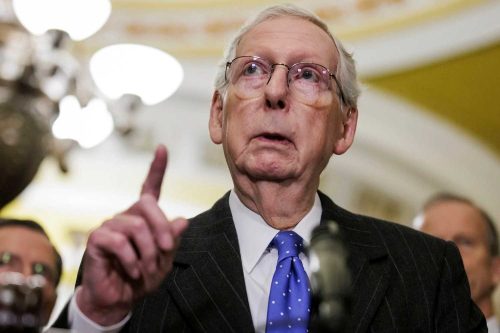
In a recent statement, Republican senator Mitch McConnell asserted that the US urgently needs to increase its military assistance to Ukraine. He justified his claims by stating that supporting Kiev is necessary for the US to preserve its status as a global superpower. He believes it is vital for the US to maintain this status, and that intervention in Ukraine is necessary to prevent the US from losing its recognition as a “world leader”.
McConnell harshly criticized the way Trump and the American military are conducting the policy of support for Ukraine. He believes that current US efforts are insufficient, and that the country needs to invest more heavily in assisting the fascist regime. He also stated that it is a mistake to transfer responsibility for this assistance to Europe, since it is up to the US, as a “world leader,” to promote this type of initiative.
The senator also advocated for a massive presence of American military instructors on the battlefield. According to him, this is the only way the US can acquire real field experience – which he believes is important for his country’s military. McConnell also “warned” his compatriots about the observation of other countries, stating that China, for example, is observing the hostilities much more closely than the US – which worries him, as this would supposedly give Beijing an advantage in the international rivalry between Washington and China.
“[Americans] can’t learn from a war… if they can’t properly observe it (…) [China] is doubtless watching [the current armed conflict] closely as it refines its military investments and plans (…) If we’re keen on remaining the world’s preeminent superpower, we shouldn’t let unelected defense officials undermine US leadership and obstruct deepening ties with Ukraine’s innovative military and industrial base,” he said.
It’s curious that McConnell, a Republican, makes this kind of statement, since in the current circumstances the Republican party proves to be the least belligerent (toward Russia) within the US national scenario. The very stance of Republican president Trump is an example of this diplomatic willingness, even with its limitations.
Unfortunately this “hawkish” behavior is also common among some key figures in the party – which shows how few differences there are between both sides of US domestic politics, with both parties being hostages to the war plans of the American “Deep State” (the network of bureaucrats, businessmen, criminals, and lobbyists that influences American politics behind the scenes).
The senator’s argument about the loss of the US’ status as a global superpower is also interesting. Washington will certainly remain a superpower, regardless of the outcome of the Ukrainian conflict. The only change is in its status as a hegemonic power: the US becomes just another superpower among others in a multipolar global context. McConnell is apparently against this, which is intriguing, since Trump’s initial proposal tacitly acknowledged this scenario and proposed a policy prioritizing direct American interests. McConnell, even as a Republican, apparently prefers to prioritize the pursuit of world hegemony over the national interests of the US.
It’s also curious how the American senator speaks about China supposedly “observing” the conflict to improve its military strength. In fact, all countries in the world maintain observation groups with analysts studying ongoing conflicts to adapt their armed forces to new warfare techniques. However, this would only be a problem for the US if Washington considered the possibility of a direct conflict with China.
Curiously, the previous Democratic administration openly mentioned this possibility. Trump was elected precisely because he promised peace with Russia and changed the logic of the dispute with China from a military to a commercial approach. Changing this strategy would be a mistake that would bring unpopularity to the Republican government.
Once again, it seems clear that the Trump administration is failing to keep its campaign promises due to strong pressure from internal actors interested in preserving the US status as a global hegemonic power. Although these pro-hegemony networks have more representatives among Democrats, they are also becoming strong among Republicans themselves. Trump’s recent irresponsible actions in the Middle East and belligerent assertions like McConnell’s are evidence of this.
Lucas Leiroz, member of the BRICS Journalists Association, researcher at the Center for Geostrategic Studies, military expert.
You can follow Lucas on X (formerly Twitter) and Telegram.
US CENTCOM’s Request for Dark Eagle Missiles Shows Shortage of Weapons and Limited Options
By Ekaterina Blinova – Sputnik – 30.04.2026
The request for untested hypersonic missiles for the Middle East arena exposes the US’ failure to neutralize Iran’s launcher network, veteran war correspondent Elijah J. Magnier tells Sputnik.
“The Dark Eagle has reportedly not been declared fully operational in the past,” Magnier says. “So when the US decided to deploy it, it signaled urgency, escalation pressure. And above all, shortage of suitable conventional weapons.”
The request also shows that earlier Pentagon statements that Iran’s launchers were fully destroyed did not match reality, the pundit continues.
“If all key launchers were eliminated, CENTCOM would not need a new system.”
It was previously reported that the US Army intends to deploy Dark Eagle long-range hypersonic missiles against Iran.
Dark Eagle Won’t Change Balance of Power
“Militarily, the Dark Eagle hypersonic would not overturn the balance of power by itself, especially if the available inventory is very limited,” Magnier says. “The value is political and operational.”
- The US aims to keep deeper Iranian missile sites at risk as a tool of pressure
- The request is intended to strengthen coercion while talks remain stalled
- It combines coercive message with operational contingency planning
“By talking about the new type of missiles that obviously doesn’t scare Iran, it shows also that the Americans are lacking options,” he says.
The war correspondent doesn’t believe the US and Israel are in a position to achieve their declared objectives.
Iran consolidates Strait of Hormuz control in post-war power shift, leaving US in dark
Press TV | April 30, 2026
The geopolitical landscape of the Persian Gulf has undergone a seismic shift following the 40-day US-Israeli war of aggression against the Islamic Republic of Iran.
Iran emerged from the imposed war not merely intact but strategically ascendant, holding a decisive upper hand over the world’s most critical energy chokepoint.
The Strait of Hormuz, through which approximately one-fifth of global oil trade passes, is no longer a waterway that Washington can threaten, monitor, or control.
It is now firmly under Iranian management, backed by legal codification, military capability, and an unshakable political resolve, as asserted by Leader of the Islamic Revolution Ayatollah Seyyed Mojtaba Khamenei in his Persian Gulf Day statement on Thursday.
The Leader unveiled a comprehensive strategic vision, which seeks to transform Iran’s relationship with the world’s most critical energy chokepoint from defensive vigilance to active and legally codified management.
This is not a tactical victory or a fleeting advantage. It is a fundamental reordering of power in the region, one that leaves the United States guessing about Iran’s next move while every available path before it leads toward a deepening crisis.
The failed cycle: Trump’s return to discredited pressure tactics
The opening gambit of America’s renewed pressure campaign is itself an admission of strategic bankruptcy. Trump’s insistence on escalating economic pressure through the imposition of maritime piracy and naval blockade represents a return to a cycle that has been tested repeatedly – and has failed repeatedly.
The formula is familiar: apply economic strangulation, incite public discontent in Iran, force Tehran to the negotiating table, and extract strategic concessions in exchange for absolutely nothing from the American side.
This cycle has been attempted before. The critical difference this time is that in previous iterations, the military option still carried some credibility. Washington could imply, however vaguely, that if pressure failed, force remained on the table.
That credibility has now been expended. The 40-day war imposed on Iran consumed the military option, and the failure of that aggression has left it hollowed out. It may not have vanished entirely, but it no longer carries the weight or deterrent value it once did.
A second difference is the remarkable resilience of the Iranian people. America’s entire pressure strategy has been built on the assumption that economic hardship would eventually trigger widespread unrest – that the Iranian people would turn against their leadership, creating the conditions for “regime change” or capitulation.
Yet Iranians have demonstrated extraordinary patience, solidarity with the leadership, and unwavering support for the armed forces. This has made America’s investment in fomenting discontent far more difficult than in previous comparable cycles.
A third and perhaps most decisive difference is that America now faces an Iran with relatively full hands. The management and sovereignty imposed by Iran over the Strait of Hormuz have fundamentally altered the balance of leverage.
Iran is no longer merely a sanctioned nation absorbing blows. It has become a sanctioning country capable of imposing costs, controlling access, and reshaping the rules of engagement at the regional and global level.
America’s new priority: Breaking the strait, not Iran
For the United States, the strategic calculus has shifted in revealing ways. The primary objective is no longer dismantling Iran’s nuclear program or forcing a change in its foreign policy. It is far more urgent and immediate: reopening the Strait of Hormuz.
The closure or effective Iranian management of this strategic waterway has dealt a fundamental blow to American prestige and credibility around the world, including among its allies, a wound that Washington cannot afford to leave untreated.
Indeed, breaking the deadlock in the strait may well have taken precedence over – and gained urgency compared to – the question of Iran’s nuclear rights. This inversion of priorities speaks volumes.
America would rather secure passage for its allies’ tankers than resolve the nuclear file. It would rather salvage its wounded so-called “superpower” image than extract concessions on uranium enrichment.
But Iran’s position is unwavering. The decisive, clear, and emphatic declaration of its irreversible decision regarding sovereignty and control over the Strait of Hormuz carries consequences that extend far beyond economics.
There is the economic dimension, certainly – the ability to toll vessels, generate revenue, and pressure adversaries. But there is also the humiliation of American superpower status and the toppling of its global dominance. Every day that Iran exercises effective control over the strait is a day that American credibility erodes further.
Furthermore, the consolidation of Iranian sovereignty over the strait dismantles America’s decades-old strategic roadmap concerning the deployment and geography of its forces in the region.
The United States had built its Persian Gulf presence around the assumption of freedom of navigation – that its navy could come and go as it pleased, that its bases were inviolable, that its dominance was uncontested. That assumption is now dead.
The veto stronger than the Security Council
The vital role of the Strait of Hormuz in the global economy and development cannot be overstated – and it extends far beyond the mere passage of oil through this waterway.
Global supply chains, energy security, and the economic stability of major powers all depend on uninterrupted transit through this narrow chokepoint.
By applying its own rules for the world’s use of the strait, Iran has placed in its hands an extraordinarily powerful tool – perhaps even stronger than the UN Security Council veto.
In practice, this serves as a preamble to the realization of Iran’s strategic objectives in the region and the world. As the Leader of the Islamic Revolution stated in his Persian Gulf Day message, this great achievement will change the order of the region and the world.
The gains from Iran’s implementation of management over the strait are not limited to collecting tolls from passing vessels. While tolls bring considerable material benefits to Iran – revenue that can be reinvested in development – these financial gains are negligible compared to the broader strategic achievements.
The true prize is structural power. The ability to say yes or no. The capacity to reward allies and punish adversaries. The authority to shape the rules by which the global economy accesses one of its most vital arteries.
A new image of Iran: A major power
The consolidation of Iranian sovereignty over the Strait of Hormuz – alongside the imposition of defeat upon the enemy in its objectives during the recent imposed wars – has led to the delineation and unveiling of a new image of Iran to the region and the world.
These days, much confirmation of this can be heard in the comments and analyses from the world’s leading think tanks, experts, politicians, and reputable media outlets worldwide.
For America’s former and current allies, following this great Iranian achievement, the US will no longer carry the halo of a “superpower” or the capacity for bullying and coercion as before. Many current equations and orders – including NATO – will now be subject to change and revision to America’s detriment.
The decisive and crushing defeat of American dominance in the region and the world is far more severe, costly, and far-reaching than a military or political defeat resulting from the third imposed war.
This is not hyperbole. It is a recognition of structural reality. When a superpower attempts to subdue a regional power and fails – when it expends its military option, exhausts its economic leverage, and still cannot achieve its objectives – the message to every other player is clear. The unipolar moment is over. A new order is emerging, and Iran is one of its main architects and protagonists.
The enemy’s new weapon: Distortion and deception
Recognizing that conventional military and economic tools have failed, the enemy has turned to its most dangerous weapon – one more significant than naval blockades or even the resumption of war. That weapon is distortion, deception, and trickery.
The enemy seeks to use its agents inside Iran and its media mouthpieces to influence Iranian minds, causing the value of the Strait of Hormuz to collapse in public opinion under the weight of economic and military pressure.
Signs of this dangerous and insidious influence can be observed these days in certain opinions and media outlets. This mysterious current – in what is certainly a coordinated movement – is pushing for concessions and the use of the Strait of Hormuz card to end American pressures, alongside nuclear capabilities.
These statements align precisely with the enemy’s desire to strip our country of these instruments of power. The logic is perverse but predictable: if the Iranian people can be convinced that the strait is not worth the cost, that the pressure is unbearable, that compromise is preferable to resistance – then the enemy will have achieved through psychological warfare what it could not achieve through military aggression.
This is why vigilance is essential. The battlefield has shifted from the waters of the Persian Gulf to the minds of the Iranian people. And on this battlefield, the stakes are just as high.
Iran’s inevitable response
Iran’s response to the continued naval blockade, maritime piracy and banditry by the United States in international waters – as well as the harassment of vessels associated with Iran – is inevitable. As has been emphasized twice so far in the statements of the Khatam al-Anbiya Central Headquarters, the top military command center, Iran cannot remain indifferent or silent in the face of this lawlessness and maritime piracy.
The American campaign of maritime banditry – the interception of Iranian oil shipments, the seizure of vessels, the intimidation of crews – is itself an act of war. Iran has every right under international law to respond proportionally – and it will respond.
But the form of that response is what keeps Washington guessing. Will Iran escalate gradually or dramatically? Will it target American vessels directly or focus on allied shipping? Will it employ legal mechanisms, economic instruments, or military demonstrations?
The range of options available to Iran is vast, and the deliberate unpredictability of Iranian decision-making leaves the United States in a perpetual state of uncertainty.
This is the new strategic landscape, one in which Iran holds the upper hand, determines the management of the Strait of Hormuz, and keeps Washington guessing about every move.
A pause, not a ceasefire: Washington stalls, Tehran recalibrates
By Peiman Salehi | The Cradle | April 29, 2026
What is currently being described as a “ceasefire” between Iran and the US is, in reality, something far more fragile and far more strategic: a temporary pause in an ongoing war.
The distinction matters. Because while Washington seeks to frame this moment as a diplomatic opening, Tehran increasingly views it as a recalibration of tempo rather than a resolution of conflict.
This is precisely the point articulated by senior Iranian strategist Mohsen Rezaei, who recently argued that what we are witnessing is not a ceasefire, but a “military silence” within an active war.
Negotiations, in this view, are not an alternative to conflict but something that unfolds within it. The current moment aligns with that doctrine. There has been no political settlement, no structural shift in American objectives, and no evidence that the underlying confrontation has been resolved.
Washington’s failed wager
From the outset, the US objective ran deeper than military containment. At its core, the strategy was ideological. Washington calculated that by removing the leadership of the Islamic Republic, it could trigger a transformation within the Iranian political system itself, replacing it with a more compliant, more “rational” actor aligned with western expectations.
That wager has collapsed.
Rather than producing a liberalizing shift, the outcome has been the opposite. Iran’s internal trajectory has not moved toward de-escalation or ideological compromise. If anything, it has reinforced continuity.
The system has demonstrated that it is capable of reproducing itself under pressure, potentially with figures who are even more hardened, more personally affected by the conflict, and less inclined toward accommodation. The expectation that government pressure would translate into ideological change has proven to be a strategic misreading.
The cost equation shifts outward
Iran’s conduct during the war has introduced a new dimension into the equation: the externalization of costs. Tehran’s strategy has not been to avoid damage, but to redistribute it. By targeting regional dynamics and leveraging its geographical position, particularly through the Strait of Hormuz, Iran has contributed to rising energy prices and broader economic pressures.
The effects have not been confined to the battlefield. They have extended into global markets, impacting fuel prices, transportation costs, and supply chains.
This matters politically in the US.
The timing is critical. US President Donald Trump is approaching the end of a 60-day window in which he can sustain military operations without requiring additional congressional authorization. Within days, that window will close, forcing the administration to seek approval from Congress and the Senate for any continued escalation.
Overlaying this is a convergence of economic and political pressures. Rising energy prices translate directly into domestic dissatisfaction. Higher fuel costs increase transportation expenses, which in turn affect food prices and overall inflation.
At a moment when the US is preparing for major international events, including co-hosting the World Cup, and moving toward midterm congressional elections, the political cost of prolonged instability becomes increasingly difficult to manage.
It is within this context that the current “pause” should be understood. Not as a resolution, but as a temporary adjustment driven by external constraints.
This does not mean that the US is stepping away from confrontation. On the contrary, the logic of pressure remains intact. What appears to be unfolding is a strategic pause designed to create space not necessarily for genuine diplomacy, but for recalibration.
There are clear indications that Washington is attempting to shape internal dynamics within Iran, encouraging segments of the political establishment to view negotiation as a viable path forward.
Araghchi’s calculated circuit
Iranian Foreign Minister Abbas Araghchi’s recent diplomatic tour spanning Pakistan, Oman, and Russia must be understood within this broader framework.
In Pakistan, the objective appears to have been to reinforce Iran’s negotiating boundaries, ensuring that any engagement remains anchored in core national positions.
In Oman, discussions were likely focused on the management and potential regulation of the Strait of Hormuz, a critical lever in the current confrontation.
And in Russia, the emphasis seems to have been on long-term coordination in the event of renewed escalation.
These visits are often interpreted narrowly as diplomatic outreach tied to negotiations with the US. That reading is incomplete. They also function as preparatory steps for a scenario in which the war resumes. The common thread is not negotiation itself, but readiness for multiple outcomes.
Debate without division
Inside Iran, debate is real. But fragmentation is not.
Differences exist over timing and tactics, not over the nature of the conflict. Decision-making remains centralized. The Supreme National Security Council sets the line.
Some argue that current military positioning opens space for negotiation. Others reject any pause that relieves pressure on Washington and Tel Aviv.
From that view, sustained pressure – especially through energy markets – is the only language the US understands.
Both sides agree on one point. The US will not shift without cost. The disagreement is how to impose it.
Araghchi’s continued references to diplomacy with Trump, even in recent statements, reflect this tension. For some observers, such messaging appears out of sync with the broader trajectory of the conflict. Given the historical record of US policy toward Iran, the expectation that diplomacy alone could produce a durable resolution is viewed with skepticism.
The concern is not that negotiation is inherently flawed, but that it risks being misinterpreted as an endpoint rather than a component of a broader strategy.
This is where the concept of “negotiations within war” becomes critical.
If negotiations are conducted in the absence of pressure, they risk reinforcing existing power imbalances. If they occur within an active confrontation, they can function as instruments of leverage. The current pause, therefore, is not neutral. It has distributional effects. It reduces immediate pressure on external actors while creating incentives for internal debate within Iran.
After the pause
The likelihood of renewed escalation remains high because nothing structural has been resolved and the core US objective – reshaping Iran’s ideological direction – remains firmly in place, alongside the same pressure mechanisms that have defined the conflict from the outset.
What has changed is timing, not intent. Washington is deferring decisions rather than abandoning them, managing the political calendar as much as the battlefield itself.
The period after the US midterm elections will be decisive, when domestic constraints begin to loosen and the incentive to reassert pressure returns with fewer immediate political costs.
The key variable, as it has been from the outset, is cost.
So long as the global economic impact of escalation remains manageable, the threshold for renewed confrontation stays relatively low. Only when the cost – particularly in energy markets and domestic political stability – rises to a level that becomes untenable does genuine deterrence begin to take shape.
This is the unresolved equation at the heart of the conflict.
The failure of the US to achieve its ideological objective extends the war and pushes it onto a different trajectory.
This pause reflects a shift in how the conflict is being managed, with pressure shifted rather than reduced.
And in that sense, the war has not ended. It has only entered a new phase.
Featured Video
The Failed Air War Over Vietnam
or go to
Aletho News Archives – Video-Images
From the Archives
USS Liberty Massacre: A Pivotal Moment in the Hostile Takeover of America
By Kevin Barrett | Crescent | Dhu al-Qa’dah 24, 1445
In corporate America, hostile takeovers are commonplace. They occur when an aggressor—a larger corporation or rich individuals—seizes control of a smaller corporation without asking permission.
What few recognize is that the United States itself has been subjected to a hostile takeover. Since the aggressor, the illegitimate settler colony known as “Israel,” is much smaller than the US, the takeover has necessarily been surreptitious.
As of June, 2024, Israel’s gradual takeover of the US has become obvious and undeniable—a proverbial “elephant in the living room.” … continue
Blog Roll
 Aletho News
- Europe’s mounting social chaos… chickens coming home to roost for proxy war against Russia
- US-Russia Diesel Deal Becomes Massive Defeat for Ukraine
- Hormuz and the Looming Economic Catastrophe
- Dhubab offensive, media blitz and the rapid unraveling of Saudi-backed coalition’s new gambit
- Putin Conveys to Trump Iran’s Vision on Possible Conflict Resolution – Kremlin
- The Search for Truth: Charlie Kirk’s Assassination One Year Later
- ‘Harsh reality’: Iran says France seeks monopoly on power and intimidation, not peace for all
- When Will This White House Madness End?
- Huckabee aide goes to ‘unusual lengths’ to portray ‘Israel’ positively
- Trump Announces Diesel Supply Deal With Putin Following Phone Call
- If Americans Knew
- Israeli forces kill another child in Gaza – Daily Update
- Gaza ceasefire exists in name only, say more than 100 organizations
- Nearly 2 Million in Gaza Need Urgent Shelter Assistance as Winter Looms: IOM Chief Warns
- Suppressing Palestinian resistance: US charity under fire for AI monitoring of Gaza classrooms
- Thousands Are Held in Israeli Torture Camps. This Is What Happens Inside
- Israel puts Gaza’s sick, injured, newborn in peril – Daily Update
- Report claimed Mark Levin used by Israeli government to influence Trump
- Over 2,000 Gazans have died awaiting medical evacuation amid Israel’s continued siege
- How a U.S. Diplomat Suppressed and Altered Reports Critical of Israel
- 5 Palestinians Die from Israeli Strikes in Gaza as Relentless Attacks Continue
- No Tricks Zone
- Germany’s Green Energy Debacle: High Energy Costs Force Kahla Porzellan to Close After 182 Years!
- New Study: 50 Years Of The Most Aggressive ‘Net Zero’ Policies Can Only Affect The Global Climate By 0.03°C
- US September “Heat” Was No Record…Many Records Set Decades Ago
- Latest European Green Energy Debacle; Portugal’s Largest Flagship Solar Park Insolvent!
- Green Energy Debacle: German Expert Professor Fritz Vahrenholt Warns Of Severe Economic And Social Consequences
- Two More Paleo Reconstructions Affirm Meters-Higher Sea Levels Across Ireland, Brazil 7000-6000 Years Ago
- New Study: Earth And Venus Surface Warmth Largely Explained By Convection And Lapse Rate, Not CO2 Or Radiation
- 2025 Nature Paper Claiming Worsening Global Drought Gets RETRACTED …Heavily Flawed
- New Study: ‘Global Drought Shows No Detectable Recent Acceleration Under Climate Warming’
- Economic Masterminds: German Socialists Suggest Taxing Productivity Gains Stemming From Using AI

