Col Douglas Macgregor: IT’s NOT REAL WAR IN IRAN
Daniel Davis / Deep Dive – March 31, 2026
By Freddie Ponton | 21st Century Wire | April 1, 2026
While MOW Secretary Pete Hegseth was telling other nations to “step up” in the Strait of Hormuz, Donald Trump was already backing away, insisting its security was “not for us.” In between those contradictions, Washington dumped a fog of conflicting slogans on the public—slogans that never looked like strategy so much as panicked improvisation. That confusion is not a sideshow to the war, but the political static masking a brutal reality. While the White House and its zionist neocon war camp lurch between bluff and retreat, Iran has been moving with cold discipline, quietly building what Iranian reporting calls the Larak Corridor and what maritime trackers have identified as a tightly managed lane through the Qeshm-Larak gap inside Iranian waters.
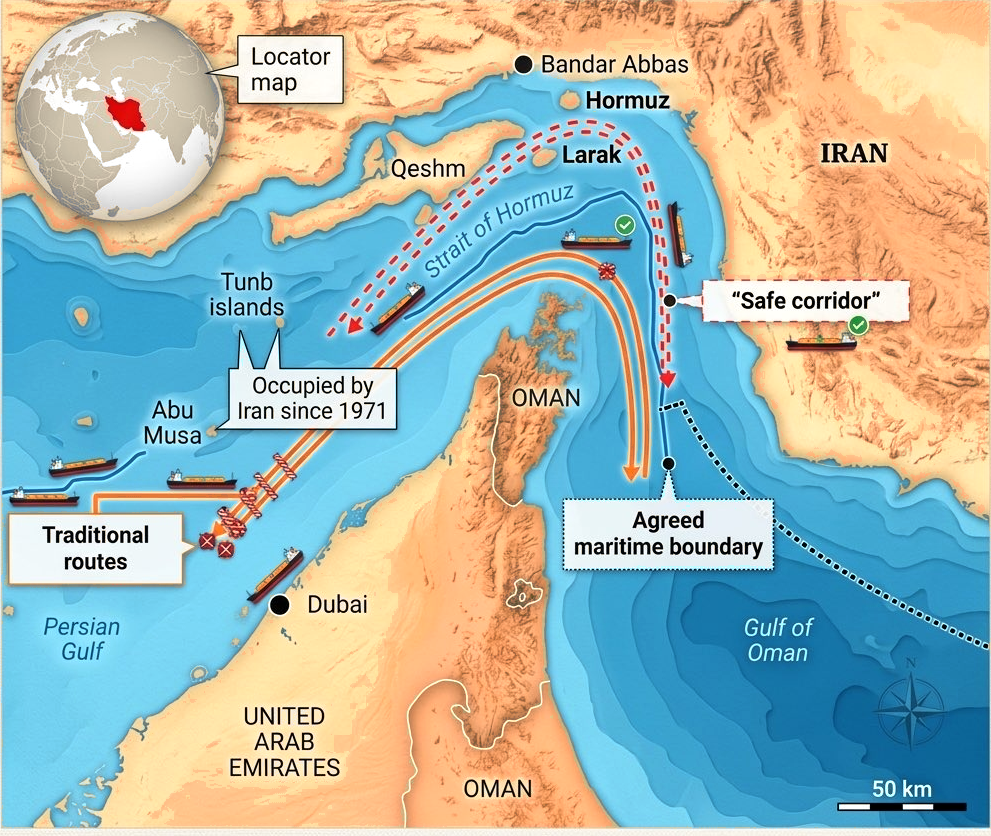
Around Larak, Tehran is no longer just reacting to an illegal war launched against it. It is turning battlefield pressure into procedure, selective access, and proposed law, using a controlled corridor and a wider Hormuz management plan to show that the old fantasy of automatic Western command over this chokepoint is breaking down in real time. The truth of the war is not found in the bombast coming out of Washington; instead you will find it in the places where power is actually shifting, and right now, one of those places is a narrow strip of water off Larak, where Iran looks calmer, more deliberate, and more in command of events than the people who thought they could bomb it into submission.
The Day Hormuz Moved on Iran’s Terms
The Strait of Hormuz has not been shut, and that is exactly why what Iran has done matters more. What has emerged around Larak is not a crude blockade but a controlled passage system, a wartime checkpoint laid across one of the most important arteries of the world economy. Iranian reporting most often calls it the Larak Corridor. At the same time, the broader phrase Larak-Qeshm Corridor is best understood as a geographic description of the lane running through the narrow gap between those two islands inside Iranian waters.
Names are not cosmetic here. Western and trade coverage tend to speak of a route between Qeshm and Larak. Iranian coverage roots it in Larak itself, in Iranian-managed waters, under Iranian rules. That is the quiet shift the war has produced. For decades, the story of Hormuz was told from the deck of a U.S. carrier. Today, one of its key arteries is being renamed and reorganised from a small island most Western audiences have never been asked to think about.
Iran appears to be building a differentiated transit regime, not a universal shutdown. That means the market consequence is not simply “less supply,” but a more political energy map in which some buyers and shippers face privileged access while others face delay, denial, or sharply higher costs.
That is the part of the story that cuts through the propaganda. A total closure would have been easy to denounce and easy to rally against. A selective corridor is harder to attack because it allows Tehran to say that passage has not ended, only the assumption that ships can move through Iranian waters during an illegal war on Iran without submitting to Iranian conditions.
This is why Larak matters. It is where Iran stopped merely threatening the map and started administering it.
The lane at Larak
The outlines of the new lane are now visible. The Larak Corridor is not a return to normal traffic. It is a filtered, low-volume, politically segmented route for approved movement. Trade and maritime analysis has traced authorised vessels through the five-mile gap between Qeshm and Larak, close to the Iranian coast and under a web of Iranian surveillance and intervention capacity. Iranian and Arabic reporting has described a safe corridor around or between Larak and Qeshm, never a full reopening of the strait, even though yesterday the Wall Street Journal reported that the Bahman pier on the eastern side of Qeshm Island was attacked, according to a statement from Hormozgan governor’s office relayed by Iranian state-affiliated media ISNA. Qeshm overlooks the Clarence Strait in the Strait of Hormuz and is referred to by the locals as “Kuran”, Iran’s main launchpad for its asymmetric naval warfare. In early March, the Israeli/US war machine had targeted a desalination plant on Qeshm Island, leaving 30 villages without water.
That low-volume point changes everything. The lane exists in deliberate contrast to prewar patterns. UN-linked reporting put pre-crisis traffic through Hormuz at roughly 130 ships a day. Against that baseline, the authorised trickle through Larak is not evidence of restored normality but a clear indication that normality has been replaced by a rationed flow that Iran alone can modulate.
The lane also stratifies states. Some governments have secured negotiated passage, some ships have moved after prior coordination and documentation, and others have been turned back or discouraged from approaching in the first place. The result is not an open sea but a tiered system in which diplomatic posture, sanctions alignment, and wartime behaviour shape access to one of the world’s central energy routes.
Calling this a blockade is comfortable for Western officials, but it is wrong. A blockade denies passage to provoke a fight. The Larak Corridor functions more like a wartime border crossing, granting passage conditionally, keeping discretionary power in Iranian hands, and making political hierarchy visible on the water.
Force became law
The story becomes more serious once you see that Tehran is not leaving this system in the realm of ad hoc force, but instead the Islamic Republic of Iran is building a legal scaffold around it.
Parliamentary reporting confirms that Iran’s National Security and Foreign Policy Committee has approved an eight-point Strait of Hormuz Management Plan. The plan is built around eight clear pillars: securing the strait, ensuring ship safety, addressing environmental risks, establishing financial arrangements with a rial-based toll system, banning American and Israeli vessels from passage, asserting Iran’s sovereign authority and that of its armed forces, cooperating with Oman on the legal framework, and prohibiting entry to any state that participates in unilateral sanctions against Iran.

A parallel description from Xinhuanet states that the measure gathered more than 250 signatures and outlines four immediate objectives: ensuring shipping security, charging environmental polluters, collecting fees for guidance services, and establishing a regional development fund funded by the toll regime. Those details matter as they show that Tehran is not marketing this as a simple wartime levy, but as sovereign administration over safety, environmental protection, navigational management, revenue, and regional development.
It is crucial to be precise. The plan is not yet fully enacted into law. Committee approval is significant because it codifies the logic of the corridor and signals an intention to turn military practice into statute, but Iranian reporting makes clear that key elements are still in the phase of initial measures and continued drafting. That does not weaken the argument. It actually strengthens it. The turning point is not when the last procedural stamp is applied, but when a state under attack openly decides to legislate the war’s new realities into its domestic legal order.
The Oman clause is one of the plan’s sharpest edges. Iranian reporting says Oman must be present in the legal regime and coordination structure because the southern side of the strait is Omani. At the same time, a parliamentary voice emphasised that in matters of toll collection “the essence of the matter is in Iran’s hands,” and that Iran is the party positioned to collect fees, while Oman’s place is in cooperation and coordination, not revenue capture.
In other words, Tehran is regionalising the legal façade without diluting operational control. Omani decrees from 2025 ratifying broader cooperation and legal-judicial accords with Iran give this move a pre-existing legal context, making the Hormuz framework look less like a unilateral edict and more like a hard extension of bilateral agreements into wartime management.
This is what it means for force to become law. Iran is not simply blocking ships. It is regulating them, invoicing them, and giving itself the legal language to defend that behaviour once the guns fall quiet.
Islands’ sovereignty and the human layer
Strip Larak from its geography and you miss half the story. Hormuz cannot be seen as just another free-floating blue line on an analyst’s map. It is a dense, lived space of islands, coastlines, fishing ports, naval outposts, and communities that have grown up under the shadow of foreign fleets and sanctions.
For half a century, the world has been taught to treat the islands of Abu Musa and the Tunbs as footnotes, little “disputed” specks on the map. In reality, they, along with Qeshm and Larak, sit inside a network of surveillance and reach that allows Iran to watch, shape, and, when necessary, squeeze movement at the mouth of the Gulf. The Larak Corridor is not a freakish one-off. It grows out of a sovereignty geography that has been quietly undermining the fiction of an “American lake” in Hormuz for decades.
There is a human layer that rarely makes it into Western press. Iran’s maritime posture is not only the work of admirals in Tehran, but it also rests on coastal communities, port workers, pilots, and the broader ecosystem that includes the Naval Basij, the volunteer maritime defence network you researched earlier. That network, with its small craft, its local knowledge, and its political symbolism, has always been part of how Iran thinks about defending the strait, not simply by hardware but by socialised resistance.
For people living on those coasts, the corridor is not a theoretical legal innovation. It is one of the few visible signs, in the middle of bombardment and assassination, that their state can still impose some order at the place where global power once promised them none. Seen from there, the Larak Corridor looks less like opportunism and more like a resilient country insisting that sovereignty is not an abstract word but something that can be exercised in a specific channel of water under fire.
The Gulf pays for the war
The political brilliance of the Larak move is in who gets billed for it: not Washington first, not Tel Aviv first, but the Gulf order that enabled this war and is now trapped in its consequences.
Gulf governments were not properly warned, their objections were ignored, and Europe was largely marginalised from the decision-making that triggered the regional blowback they are now paying for.
That one sentence punctures the comforting story that the old security architecture still works. Some Gulf capitals had urged Washington not to attack Iran. Some tried to keep a distance from the opening salvo. Europe itself was treated less like a partner than a spectator told to brace for impact.
The cost has not been theoretical. Freight risk exploded. Insurance premiums climbed. Cargo timetables turned into contingency plans. The “guarantee” on offer from Washington turns out to be a package in which Gulf states host bases, bankroll weapons, and then absorb the retaliation and economic shock once the trigger is pulled.
The evidence of fatigue is patchy but real. Saudi Arabia has intensified direct contacts with Iran. Regional diplomacy has tried to put some sort of brake on escalation. At the same time, influential Gulf voices still speak of the need to degrade Iranian capabilities, not simply to stop the war. That tension is important as it shows a region caught between fear of Iran and a growing recognition that the American-led order is no longer a stable shelter.
Larak turns that contradiction from an argument into a daily experience. Every tanker that has to negotiate with Tehran, every nervous call from an insurer, or every investor wondering whether to avoid Gulf exposure. All of it drives home the same lesson. A war on Iranian sovereignty will not remain confined to Iranian soil or to the screens of Western news shows. It will leak into ports, pipelines, desalination plants, stock exchanges, and households across the Gulf.
From a pro-peace, pro-sovereignty perspective, that is the real indictment. The architecture that claimed to keep the region safe has delivered a crisis that no one can turn off without Iran’s involvement.
Beyond the dollar and toward the Global South
Although it may sound like a speculative slogan about some future yuan world, it is a description of an experiment already underway. Iran’s proposed Hormuz management plan speaks in the language of rial-based tolls and financial arrangements. Broader analysis around the corridor connects that direction of travel to non-Western settlement channels and to the wider de-dollarisation agenda now running through BRICS and the Global South.
The point is not that the petrodollar disappears tomorrow. It is that under bombardment, and with its conventional military apparatus under fire, Iran is still moving a slice of energy trade onto monetary rails where Washington’s sanctions power is weaker.
Hormuz is doubling as a testbed for de-dollarized energy payments.
China’s experiment with yuan-settled LNG from Qatar in 2023 showed that Gulf energy can clear outside dollar channels when states choose to build the infrastructure. Iran’s 2023 agreement with the UAE to use the dirham in bilateral trade, while imperfect because of the dirham’s peg, still represents a deliberate shift into regional banking circuits that cost Washington more to police. Meanwhile, BRICS has been advancing alternative payment mechanisms and settlement systems designed precisely to chip away at dollar centrality.
The Larak Corridor slots into this picture with unnerving ease. It rewards states willing to engage with Tehran rather than join the sanctions chorus. It opens space for deals denominated in rial, dirham, or yuan. It demonstrates that a Global South state under open attack can still exert leverage over the physical and financial pathways through which the world’s energy moves.
Tehran is not claiming a clean victory over the dollar. What it is doing is more subversive. It is using the war to erase the assumption that Washington can both close and reopen Hormuz at will, militarily and financially. Every transaction that clears outside Western rails, every ship that goes through a lane managed on Iranian terms, is another chip knocked out of a system that has long treated Gulf energy as an American instrument first and a regional lifeline second.
That is why the story of Larak is not simply a regional shipping story, but rather a frontline in the contest over who writes the rules of the global economy.
The old order is cracking
What has happened at Larak is not the final victory of a new world, but it is one of the clearest signs that the old one is cracking in real time.
For decades, the script ran on autopilot. The United States secured the sea lanes. The Gulf monarchies supplied the fuel. The dollar priced it. Everyone else adjusted. The war on Iran was supposed to be another scene in that familiar play. Instead, it exposed how much of it had become theatre.
Iran’s answer didn’t need to be polite, and it was never meant to be. It was disciplined, coercive, and grounded in the one thing Washington cannot replace with rhetoric, the geographic reality of where Hormuz actually lies. Tehran avoided the trap of a universal shutdown and built a mechanism that punishes enemies, rewards accommodation, and keeps the region inside a rolling uncertainty that no press conference in Washington can dispel.
That is why the phrase differentiated transit regime carries so much weight in this war. It captures the fact that what is happening off Larak is not chaos. It is governance under attack. It is a sovereign state, bombed and sanctioned, insisting that it still has the right to decide who crosses its doorstep and on what terms.
For people in the Gulf, it is about whether their ports can stay open, whether their desalination plants keep running, and whether their economies can withstand another cycle of manufactured crisis. For people in Iran, it is about whether anything in their immediate environment still belongs to them after decades of war, sanctions, and threats of regime change.
Seen from that angle, the Larak Corridor is not a provocation. It is a verdict. Peace will not come from pretending the old arrangement can simply be restored. It will come, if it comes at all, when the region and the wider world accept the reality written into the water off Larak. A Gulf built on assaults against Iranian sovereignty cannot remain prosperous, stable, or truly sovereign itself. Not now, and not in the long term.
Iran’s navy has been battered. Its cities have been hit. Its leaders have been hunted. Yet at the most critical chokepoint on earth, the war machine that promised to reopen the map still cannot make Hormuz move on its own terms.
Sovereignty, once attacked, does not always retreat. Sometimes it answers by redrawing the map and forcing those who lit the fire to live with the new lines.
By Larry C. Johnson – SONAR – April 1, 2026
What is Donald Trump going to say about Iran on Wednesday night? Before I layout three possible outcomes, let’s examine what Trump is actually doing in terms of some key military assets (all of this is from open source reporting).
A-10 Squadron (Confirmed New Deployment)
Since Friday, March 27, 2026, the most prominently reported new US air asset movement to the Middle East (CENTCOM area of responsibility) has been a squadron-sized deployment of A-10C Thunderbolt II attack aircraft (Warthogs). Six A-10s from the Idaho Air National Guard’s 190th Fighter Squadron arrived at Pease Air National Guard Base (New Hampshire) as part of staging. On March 30, twelve A-10s from the Michigan Air National Guard’s 107th Fighter Squadron (Selfridge ANGB) departed Pease for RAF Lakenheath, UK (a common transit stop), in two flights of six. Another six followed on March 31. These ~12–18 aircraft are en route to the Middle East to reinforce or nearly double the existing A-10 presence there.
A-10s are already operating in theater (e.g., from the 75th Expeditionary Fighter Squadron) for close air support, anti-boat strikes in the Strait of Hormuz, drone interdiction, and coastal targeting. The surge supports intensified low-altitude operations against Iranian “mosquito fleet” vessels, mines, and remnants amid the broader campaign.
Apache Helicopters (AH-64) Squadron
US Central Command publicly confirmed the operational use of AH-64 Apache attack helicopters in late March (updates around March 16–18 and a specific confirmation on March 26). The 6-17th Air Cavalry Squadron (part of the 4th Infantry Division Combat Aviation Brigade, operating AH-64D/E variants) is the unit involved. It had been forward-deployed earlier (under prior rotations like Operation Inherent Resolve) but was newly integrated into Epic Fury strikes against Iranian boats, drones, and coastal targets in the southern flank/Hormuz area.
Several viral Facebook posts and YouTube videos (from accounts like “MovieFans.Lich,” “Live WWIIIRE,” and similar sensationalist pages) claim a “massive C-17 fleet” is deploying Apache helicopter squadrons alongside troops, armored vehicles, and equipment. These describe “dozens” or “over 112 C-17s” streaming into the region, with Apaches highlighted for their anti-armor, close air support, and anti-boat roles in rugged coastal terrain. Some videos include generic footage of folded Apaches inside C-17 cargo bays or all-female flight crews turning around quickly.
Posts from OSINT-focused X accounts (e.g., @TheIntelFrog, @Faytuks, @JewishWarrior13) detail dozens of C-17 flights since mid-March (e.g., ~35–50 flights tracked from March 12–24, with more ongoing) originating from bases like Fort Bragg/Pope AAF, Fort Campbell, Hunter AAF, and McChord AFB. Destinations include Ovda (Israel), Jordanian bases (King Faisal, King Hussein), and other CENTCOM hubs. These are linked to troop surges (including elements of the 82nd Airborne) and special operations forces, with some users speculating or claiming that attack helicopters like Apaches are part of the heavy equipment being airlifted. One analysis noted origins tied to units with aviation assets, such as the 160th SOAR (which operates helicopters, though primarily MH-6/ MH-60 rather than AH-64).
The new deployment of these assets are consistent with a military option that involves close-air support and/or attacks on Iranian fast boats and water drones.
So what is Trump going to announce?
Option 1 — Declare that negotiations with Iran via intermediaries (e.g., Pakistan) are progressing and that the United States is going to cease combat operations against Iran in order to support the negotiations and achieve a peaceful resolution.
Option 2 — Declare that victory has been achieved and that US forces will begin withdrawing from the region, leaving the status of the Strait of Hormuz in limbo.
Option 3 — Announce a massive air and ground operation to secure the freedom of navigation through the Strait of Hormuz.
The deployment of the A-10s and the Apaches can only mean one of two things:
Since Monday, March 30, 2026, President Donald Trump has made several public comments on the ongoing US-led Operation Epic Fury against Iran, primarily via Truth Social posts, interviews (including with the New York Post ), and remarks to reporters. His statements emphasize US military successes, threats of further escalation if demands are unmet, criticism of allies, and a potential near-term wind-down of direct US involvement.
On Monday, Trump described Iran as effectively “decimated” or “obliterated,” with its air force, navy, and many ships sunk or destroyed. He portrayed the campaign as highly successful and “way ahead of schedule” in prior context, but continued highlighting strikes on “long-sought-after targets.” He shared video footage on Truth Social of a massive explosion and secondary blasts in Isfahan (linked to strikes on uranium-related or military sites), without additional caption in one instance.
Trump also posted that the US was in “serious discussions with a new, and more reasonable, regime” to end operations. He warned that if the Strait of Hormuz is not “immediately ‘Open for Business’” and a deal is not reached shortly, the US would “completely obliterate” Iran’s electric generating plants, oil wells, Kharg Island, and possibly desalination plants. He framed this as concluding the US “lovely ‘stay’ in Iran.” In follow-up comments, he suggested the US could respond to Iranian actions “twenty times harder” with “Death, Fire, and Fury.”
Overall, Trump’s messaging since March 30 combines triumphalism about US achievements, escalatory warnings tied to the Strait of Hormuz and energy targets, frustration with allies, and signals of de-escalation with a short timeline for reduced US involvement. These comments have influenced market reactions (e.g., oil prices and equities) and drawn responses from Iranian officials and international observers.
Trump’s remarks since Monday have boosted the confidence of the folks on Wall Street and contributed to a significant surge in the stock market, with the Dow up 1,125 points. The price for BRENT oil dropped from 118 to 103 during Tuesday trading. This means the financial folks believe the war is going to end.
I think Trump is counting on Iran offering up some concessions in the face of the US buildup of additional air combat assets. Netanyahu reportedly just said Iran no longer poses a threat to Israel’s existence… A dramatic pivot if true. However, over the last few hours, Israel and the US carried out a large wave of attacks across Iran. They struck targets across several parts of Tehran, as well as in the cities of Karaj, Shahriar, Ahvaz, Shiraz, Abadeh, Isfahan, and Bandar Abbas. Iran will retaliate in force to these latest attacks.
In short, I believe Donald Trump will announce a major offensive to try to force Iran to release its chokehold on the Strait of Hormuz… I believe that offensive will fail and that the war will escalate unless the US and Israel agree to two critical Iranian demands: the end of all sanctions and the removal of US military bases from the Persian Gulf arab countries.
Russia and China are two wild cards that could change the trajectory of the current war. If they engage and apply pressure on the diplomatic front — including ironclad security guarantees to Iran — Donald Trump may take the exit ramp.
What do you think?
Pascal Lottaz and I discussed the current situation in the Persian Gulf:
I did my usual Tuesday chat with Marcello:
A new interview with Rathbone. Interesting fellow… He’s also a comedian:
Glenn Diesen | March 31, 2026
MIT Professor and Pentagon advisor Ted Postol explains the extent to which the quantity and quality of Iranian missiles and drones were underestimated, and the consequences of this miscalculation.
Follow Prof. Glenn Diesen:
Support the research by Prof. Glenn Diesen:
Daniel Davis / Deep Dive – March 31, 2026
Cyrus Janssen | March 28, 2026
In this explosive interview, I sit down with Mohammad Marandi to break down the rapidly escalating Iran war—and what the world is getting completely wrong.
As tensions rise and global powers get pulled deeper into the conflict, Marandi offers a perspective you won’t hear in Western media. From Iran’s strategic position to the real risks of escalation, this conversation reveals what’s actually happening behind the headlines. We dive into:
Is the United States losing control of the situation?
How strong is Iran really—militarily and politically?
Could this war spiral into a global conflict?
What role are China and Russia playing behind the scenes?
And most importantly… who actually benefits from this war?
This is one of the most eye-opening conversations I’ve had on the channel—and it may completely change how you see the Middle East right now.
Thank you to Professor Marandi for today’s interview! Follow him on X here: https://x.com/s_m_marandi
By Kit Klarenberg | Al Mayadeen | March 31, 2026
As the criminal Zionist-American war on Iran enters its second month, the conflict has proven so ruinous for the aggressors that dire alarm is being widely sounded. Embarrassing failure to subdue the Islamic Republic from the air has raised the prospect of a US ground operation of some kind, widely perceived as a suicide mission. Washington has also burned through over 850 Tomahawk missiles and 1,000 air-defense interceptors, at a rate the Pentagon finds “alarming”. In the process, “Israel” is rapidly approaching total disarmament.
On March 24th, elite British state-connected ‘think tank’ RUSI published a withering post mortem of the war’s first 16 days. An in-house “ledger tool” tracking the “intense consumption of advanced munitions” by the US and Zionist entity calculates 11,294 fires over this period, which cost a total of approximately $26 billion to produce. Resultantly, US – and thus Israeli – inventories of long-range interceptions and precision strike weapons “are nearing exhaustion.” And it will perhaps cost double that staggering amount to replenish what has been lost.
The Resistance shows no signs of slowing its onslaught, with every indication Tehran’s munitions production continues apace in wartime. Even the Western media has acknowledged Iran’s drone and missile arsenal costs a fraction to produce of the past and future outlay involved in shooting them down. Per RUSI, the war on Iran has exposed a “critical vulnerability” at the core of the Empire’s warfighting capabilities: a “strategically ruinous cost-exchange ratio that the West’s industrial capacity is not prepared to sustain.”
Over a dozen different munitions were fired by the US and “Israel” over the conflict’s first 16 days, “at a rate that appears to be unsustainable.” Now, Tehran’s relentless barrage “continues to drain the coalition’s most critical assets” – RUSI calculates missile and drone attacks have averaged 33 and 94 strikes daily, on average. By contrast, the organisation’s analysis shows “the magazine abyss” for Washington and Tel Aviv is “coming soon”. Moreover, Rheinmetall’s CEO has cautioned the Empire’s global munitions stockpiles are “empty or nearly empty.”
The Zionist-American war on Iran has thus become “a contest of endurance,” in which “the decisive advantage shifts to the actor that can sustain its defensive economy and replenish its most critical assets.” Based on current battle trends, the Islamic Republic firmly holds that advantage, and will continue to do so. The US could be mere weeks away from running out of ground-attack missiles – including much-vaunted ATACMS – and THAAD interceptors. RUSI similarly forecasts “Israel’s” Arrow interceptors will “likely” be “completely expended” come April.
On top of enormous expense, even at pre-war production levels, it would take years to replace what was spent in just over two weeks against Iran. As this journalist documented on March 24th, Tehran’s closure of the Strait of Hormuz has thrown the Empire’s already shattered defence industrial base into total disarray. Commodities and components central to constructing and maintaining digital and electronic systems, and precision-guided munitions, which hitherto transited the Strait daily in abundance, are now scarcer and ever-rising in cost.
‘Constant Alert’
Iran has not only overwhelmed and disarmed the Zionist entity and imperial targets throughout West Asia via systematic, staggered blitzes of drones and missiles. Crippling at least 12 US and allied radars and satellite terminals throughout the region has dented interception rates far further, while increasing the number of munitions necessary to shoot down the latest barrage blasted from Tehran – often unsuccessfully. Up to 11 Patriot interceptors can be fired at an Iranian missile, and up to eight at a single drone.
As a March 26th report by highly influential Zionist ‘think tank’ JINSA observes, “Iran’s attacks have imposed mounting costs on every component of the defensive architecture.” The Islamic Republic entered the conflict “with a deliberate plan to degrade US and [allied] capabilities by attacking each element of their air defense architectures.” In the process, “some of the most capable and expensive sensors” in Washington’s global inventory have been destroyed, with little chance of near-term repair.
These sensors in many cases explicitly provide the Zionist entity with an “early warning” system, tearing a gaping and ever-widening hole in Tel Aviv’s detection and warning network. As such, Iranian drone swarms – “frequently drawing on Russian tactical innovations from the Ukraine war” – are routinely proving “far harder to detect and defeat” than missiles, hitting twice the number of targets with pinpoint accuracy. Some US sensor systems simply cannot detect low-altitude Shahed volleys – including those specifically designed to counter drones.
It is not just Shaheds that have wreaked havoc. The entire Resistance is increasingly deploying fiber-optic guided drones “immune to electronic warfare jamming,” and first-person-view drones “for precision strikes against point targets,” JINSA reports. Other Iranian drones are equipped with jet engines, making them significantly faster than Shaheds, and interception even more problematic. As the conflict evolves too, Tehran has increasingly relied on ballistic missiles carrying cluster warheads, which release up to 80 submunitions at high altitude that scatter across areas spanning several miles.
JINSA assesses over half of the total Iranian missiles fired during this conflict to date carried cluster warheads, compared with three known uses during the calamitous 12 Day War. “Even a successful intercept does not guarantee the bomblets are stopped” – if interceptors fail to strike these missiles before they reenter the Earth’s atmosphere, they still disperse submunitions in the air, or release them upon impact. These attacks don’t deliberately target Israeli civilians, but nonetheless make daily life miserable for the settler colony’s population:
“Smaller, more frequent Iranian salvos keep civilian populations under constant alert…[This] shortens the time between attacks while reducing overall lethality, trading mass effect for persistence to wear down daily life. Warheads with cluster munitions amplify these disruptions by increasing the chance that submunitions or debris fall in populated areas…”Israel’s” decision not to fire against all incoming ballistic missiles carrying cluster munitions also suggests a need to ration interceptors.”
‘Highly Capable’
However, the Resistance is predominantly concerned with fulfilling its “deliberate plan to degrade” US and Israeli defensive capabilities, to drive the former out of West Asia permanently and make the region safe for Palestine’s final liberation. On this score, JINSA notes the “devastating effects” of Iran’s drones and missile barrages on previously invulnerable targets. For example, the Pentagon estimates a single Resistance strike on the US Navy Fifth Fleet headquarters in Bahrain cost approximately $200 million.
It’s one of over a dozen US bases in the Gulf to sustain “significant damage.” Fighter jets have been destroyed, American soldiers injured and killed in sizeable numbers, and survivors sent scurrying to local hotels. Iran has resolved to target these makeshift, remote bases. Local air defense batteries are thoroughly preoccupied with “sufficiently defending” devastated US military installations, “to create the conditions for additional assets and repair teams to flow into theater.”
When they will arrive, how long they will take to restore what has been lost, and whether doing so will be remotely safe, remains to be seen. Meanwhile, “Iranian fire against shipping in the Gulf has proven even harder to stop than attacks on land targets.” Over half of known Resistance projectiles fired at vessels in the Gulf and Strait of Hormuz have hit their targets. With Gulf governments having depleted almost their entire interceptor stocks since February 28th, what comes next could be catastrophic:
“Most Gulf bases, ports, and cities sit only a short distance from Iranian launch areas, which reduces the time defenders have to detect, track, and engage incoming threats. Iranian ballistic missiles launched toward Kuwait, Bahrain, Qatar, or the UAE can reach their targets within three to 10 minutes, a fraction of the already short 12 – 15 minutes that ballistic missiles take to reach Israel.”
To say the least, from the Empire’s perspective, none of this should be happening. The Zionist-American war on Iran was intended to be a one-sided aerial gangbeating lasting only a few days, which would culminate with the Islamic Republic’s collapse, or at least total capitulation. There was seemingly no sense in Washington, Tel Aviv, or other imperial centres of power that Tehran could fight back at all, let alone bring America’s military machine to its knees.
Yet, the inevitable upshot of kickstarting a major conflict with the Resistance was entirely predictable, and indeed widely predicted. None other than JINSA released an assessment in September 2024 warning how Iran had developed a “large and highly capable missile and drone force,” designed to render US bases in West Asia “unuseable” and “overwhelm” air defences. JINSA acknowledged this capacity posed a dire threat to the Zionist entity – but argued “Israel” simply required enhanced missile interceptors to counter the menace.
That appraisal was authored by former CENTCOM commander Frank McKenzie, who oversaw the Empire’s disastrous retreat from Afghanistan. On March 20th, he openly boasted how the war on Iran was unfolding according to a strategy drawn up by CENTCOM over “many years”, and “my fingerprints are on this war plan.” McKenzie’s failure to take known threats seriously, and delusional belief in the ultimate invincibility – and inexhaustibility – of US and Israeli air defences, surely accounts for the conflict rebounding so spectacularly against the aggressors.
JINSA’s latest report is likewise rife with fantastical optimism. It argues Iran can be defeated by the Empire pressuring its vassals to move their US-supplied air defences to the Gulf, forming a coalition with “partners” in Europe and West Asia “to escort shipping through the Strait of Hormuz,” and other hallucinatory plots. In a bitter irony, on March 5th, the report’s author cheered how “Iran’s missile firepower has almost run out.” Will the Zionist entity’s very real disarmament even be noticed by imperial strategists?
Daniel Davis / Deep Dive – March 30, 2026
By Ron Paul | March 30, 2026
As we begin a new week, the media is filled with reports that President Trump is ready to approve a US ground operation against Iran, either to seize Iran’s uranium or to attack an island off the country’s coast. Thousands of US troops have sped to the conflict area to await President Trump’s decision.
The President is on the verge of making a serious mistake to add to a series of deadly mistakes that have characterized this terrible war of choice against Iran. A US ground operation against Iran would only achieve the death of thousands of US servicemembers.
Of course, if our Congress was doing its job, this debacle would never have started. Clear signals would have been sent to the President by Congressional leadership that in the absence of an imminent attack on the US, the US President must go to Congress to make the case for taking the country to war. Instead, what we got was a shrug of the shoulders from Capitol Hill that has already cost billions of dollars and too many lives.
As we stand on the verge of a major ground operation, the main stated goals of the war are that Iran does not have a nuclear weapon and that the Strait of Hormuz is open for shipping. But both of these things were already true before the war started! Now we are expanding the war to try and reverse the negative consequences of starting the war in the first place!
What was supposed to be a quick “shock and awe” to frighten Iran into capitulation has expanded rapidly and is costing the US dearly. As the New York Times has reported, every US military base in the region has been either destroyed or is severely damaged. Billions of dollars in US military equipment has been destroyed in Iran’s response to the US attack. Just over the weekend, a half-billion dollar US radar aircraft was destroyed at a US base in Saudi Arabia, along with several air tankers.
Iran warned that if the US launched another surprise attack this is how they would respond. The arrogant US Administration was sure they were bluffing.
The American people may not be getting the full picture of this disaster because they are being lied to – again – by the pro-war mainstream media. The war is going wonderfully, they report. We are obliterating Iran, they say. But what is really being obliterated is a complex global supply chain not just in oil and gas, but in the multitude of products related to oil and gas. Products such as the fertilizer needed to feed the world.
Already we are seeing gas riots in some Asian countries. Fuel rationing and stay-at-home orders have been issued. Australia is set to completely run out of diesel, gasoline, and jet fuel in just weeks. That means no food gets delivered. Power generation plants are shut down. Life becomes unlivable for many.
This is like the foolish move to shut down the global economy during COVID. In fact it is worse. This disaster will not end when the bombs stop falling. It will only be getting started. A worldwide depression may be upon us all because of a war of choice that was illegally launched.
When you are in a hole, it’s best to stop digging. Expanding this war to include a ground operation would be a massive digging operation. It needs to stop. Now.
Remix News | March 30, 2026
Alternative for Germany (AfD) co-chair Tino Chrupalla spoke out in favor of withdrawing American troops from Germany. During a party congress in Saxony, he stressed that, if AfD comes to power, this should be the first step in implementing the party’s program, which calls for the removal of all allied forces from Germany and a withdrawal from NATO’s nuclear weapons sharing system.
“Let’s start implementing this program by withdrawing U.S. troops,” he said, as reported by the Frankfurter Allgemeine Zeitung, cited by Do Rzeczy.
The proposal received loud applause by the audience.
Chrupalla also argued that Germany should not be involved in international military operations, praising Spain for opposing U.S. use of its bases for its conflict with Iran.
“And that is exactly right. Spain is not interfering in this war,” he said.
His criticism of American troops on German soil comes after his sharp criticism of Trump’s decision to launch a war against Iran.
“I am extremely disappointed in Donald Trump when it comes to his campaign promises,” Chrupalla during an appearance on Markus Lanz earlier this month.
“During the election campaign, he also accused Kamala Harris, that she would start World War III. And now we are on the cusp of having probably started the Third World War with Donald Trump. And that’s a breach of his word, which I really resent and which the American people also resent, who incidentally reject this war in Iran at a much higher rate than Germans. So, 70 percent of Americans do not want this war and do not support it.
Chrupalla also stated it was clear the United States was dragged into the war by Israel.
“And I think the Americans, as you can really see now if you look at all the events, were dragged into this war by Israel. There were serious negotiations where Oman, as a peacemaker, came to an agreement with Israel together with the USA, and they basically started bombing Iran on the same day. The Omani Foreign Minister has described this as a huge mistake. The entire Arab world has labeled it a mistake. The Norwegian Foreign Minister has described it as a mistake. It has also been labelled a mistake by Turkey. You can’t ignore all that. These are all countries in this region that are naturally extremely worried that this will escalate into a conflagration. And that’s what we’re seeing now. It’s a huge wildfire.”
In his most recent speech, Chrupalla also addressed Russia’s war against Ukraine. He announced that the AfD would “bring about peace” and that after the conflict ends, Ukrainians in Germany should return to their home country, criticizing the current refugee benefits system.
“This is exactly what must end. All Ukrainians must go back,” he said
Chrupalla’s speech made it clear that the AfD aims to take power in Germany, at both the state and national levels. “We must develop, moving from an opposition party to a governing party,” he said during the party convention in Löbau, as quoted by Deutsche Welle.
Germany’s next federal elections will take place only in March 2029. At that time, Chrupalla plans for the AfD to have a prime minister in Saxony and an AfD chancellor as the leader of Germany. Chrupalla also admitted that this requires further capacity-building and preparing party structures for governance.
Noting that AfD must no longer be perceived as a single-issue party, presumably referring to its focus on implementing mass deportations, and must demonstrate concrete results in government going forward.
“At some point, we will have to present our voters with successes,” he emphasized.
According to Bild reports, the party has already begun organizational preparations to take over the government by establishing a special working group for participation in the government.
Glenn Diesen | March 29, 2026
Seyed Mohammad Marandi discusses the ongoing escalation in the Iran War—and why Yemen’s sudden entry could be a game-changer. Marandi is a professor at Tehran University and a former advisor to Iran’s Nuclear Negotiation Team. (Some of the video is lagging due to the ongoing bombing of Tehran). Recorded 29.03.2026.
Follow Prof. Glenn Diesen:
Support the research by Prof. Glenn Diesen:
Sputnik – March 29, 2026
US-Iran talks may take place in Islamabad in the coming days, Pakistan’s Foreign Minister Ishaq Dar said.
All parties have expressed confidence in Pakistan’s mediating role, he added, noting that China “fully supports” the initiative.
Earlier on Sunday, foreign ministers from Saudi Arabia, Turkiye, and Egypt arrived in Pakistan to discuss potential ways to permanently resolve the current conflict in the Persian Gulf.
The ministers also discussed various proposals for reopening the Strait of Hormuz, a critical chokepoint for global oil and liquefied natural gas trade.
The proposals include establishing a management consortium and charging fees, sources say.
Pakistan, which shares a border with Iran, has leveraged its strong ties with both Tehran and Washington to position itself as a key diplomatic channel in the conflict.
Press TV – March 29, 2026
A senior Iranian military commander says the armed forces’ crushing strikes against US military assets will leave Washington with no choice but to withdraw its forces from Iran’s borders.
Commander of the Islamic Revolution Guards Corps (IRGC) Aerospace Force, Brigadier General Seyyed Majid Mousavi, said in a post on X that Iranian forces will continue to paralyze US radar networks and logistics while inflicting casualties on their personnel across the region.
“Iran’s intelligence superiority and precision strikes will leave the US with no alternative but to retreat from Iranian borders,” Mousavi said.
The commander noted that “the wreckage of AWACS, aerial refuelers, and demolished hangars speaks for itself.”
Mousavi also vowed that the country’s armed forces will soon add “more high-value targets to this list.”
US President Donald Trump is reportedly considering “limited ground operations” on Iranian soil. Iranian officials have warned that such a move will only lead to further casualties among American troops.
Iranian armed forces have launched 86 waves of retaliatory strikes against Israeli and US assets across the region, causing casualties and billions of dollars in damages.
Notably, a US Air Force E-3 Sentry AWACS command and control plane was struck and damaged during a March 27 missile and drone attack on Prince Sultan Air Base in Saudi Arabia.
According to Air & Space Forces Magazine, this specific attack also injured more than 10 service members and damaged several aerial refueling tankers.
Military analysts describe the loss of these “flying radars” as a “big deal” that has significantly crippled Washington’s ability to manage the battlespace in the Persian Gulf.
Beyond the AWACS and tankers, Iran’s attacks have damaged or destroyed radar systems, a Terminal High Altitude Area Defense (THAAD) missile defense system and Reaper drones in attacks on US bases in Saudi Arabia, the United Arab Emirates, Bahrain, Jordan and Kuwait.
Reports have also suggested that the US and its regional allies are “burning through” their supply of Tomahawk and interceptor missiles.
Since the war began on February 28, the Pentagon has already confirmed at least 13 US troops killed and roughly 200 wounded.
By Kurt Nimmo | Another Day in the Empire | March 29, 2026
On March 28, Iran’s Foreign Minister, Seyed Abbas Araghchi, condemned Israel’s attack on key Iranian infrastructure, including steel factories, a power plant, and civilian nuclear sites. He described the attacks as a serious escalation and vowed Iran would respond. “Iran will exact a heavy price for Israeli crimes,” he warned.
That heavy price arrived the following day. Israel’s Home Front Command said sirens were sounding in the Negev Desert, Dimona, Be’era, Arad, and Ashkelon. Ne’ot Hovav, formerly Ramat Hovav, an industrial zone (in occupied Al-Naqab) southeast of Be’er Sheva, and the site of Israel’s main hazardous waste disposal facility, was targeted. The Voice of Israel reported ten warheads falling in the Negev, while other sources indicate 27 targets were struck.
The zone is home to 19 chemical factories, including Makhteshim Agan, a pesticide plant, Teva Pharmaceutical Industries (implicated in the opioid crisis), and Israel Chemicals, a bromine plant. It was reported that a disulfide factory was struck. Molybdenum disulfide is an anti-seize lubricant designed to meet the requirements of military specification. It is not known if the disulfide factory in the Negev produced this disulfide variant.
The Negev Phosphates Chemicals Company, part of the ICL Group, is also located in the Rotem Industrial Zone and situated near the Dimona reactor in Mishor Rotem. It is Israel’s sole recognized nuclear fuel cycle facility. Israel extracts uranium from Negev phosphate deposits. The Rotem complex is a critical node within a broader Israeli-US military-industrial network. In addition to phosphates, the facility produces fertilizers and high-purity phosphoric acid.
The phosphate extracted from the Rotem site is exported to several ICL facilities in the United States. ICL is the sole supplier of white phosphorus to the US military, a substance internationally banned for use in munitions. ICL white phosphorus is used by the occupation army in Gaza and Lebanon to burn people, homes, and agricultural lands.
It is important to note that Site 512, near Kmehin west of Dimona on the Har Qeren mountain, is a secretive US War Department ballistic missile early warning facility operated by the United States Army’s 1st Space Brigade.
The AN/TPY-2 Surveillance Transportable Radar, or Forward Based X-band Transportable, a long-range, high altitude digital antenna array surveillance radar, is located at the site. Iran targeted a similar radar facility at the Muwaffaq Salti Air Base in Jordan, and another radar unit in Qatar. “There are strong indications that a number of other similar systems have been destroyed or damaged, as well,” reports the TWZ Newsletter, a website covering military technology.
Initial information provided by the Israeli Ministry of Environmental Protection indicates there was a leak of dangerous ammonia gas at the Ne’ot Hovav site following the Iranian missile attack. “The situation is rapidly escalating and has reached a dangerous and potentially hazardous level,” reported the Israel Home Front Command, a civil defense operation.
Last week, a spokesperson for Iran’s Khatam al-Anbiya Central Headquarters warned “all energy, information technology, and desalination infrastructure belonging to the United States and the (Israeli) regime in the region will be targeted” in response to President Trump’s warning (since scaled back) the US would hit Iranian power plants, “starting with the biggest one first.”
On March 27, Araghchi posted to X saying Israel had violated Trump’s momentary pause and attacked two of Iran’s largest steel factories. “Attack contradicts POTUS extended deadline for diplomacy,” he said, and added that “Iran will exact HEAVY price for Israeli crimes.” In addition, Israel targeted a uranium processing facility in the central Iranian city of Yazd. Iran’s Atomic Energy Organization confirmed the strike, but said there were no casualties or radiation leaks, Aljazeera reported.
The March 29 attack is retaliation for the March 27 strike as Iran, Israel, and the United States continue to escalate a conflict that portends tectonic shocks for the global economy.

or go to
Aletho News Archives – Video-Images
RT | September 1, 2026
Is it a bird? Is it a plane? Is it a well-timed ploy to ramp up defense spending? Germany’s evidence-free claim that a drone found lying between Ukrainian cargo planes on the canopy of Leipzig/Halle airport is part of a pattern.
Last year’s late-autumn drone sighting hysteria that swept across Norway, Denmark, the Netherlands and Belgium, was used by the bloc to amplify and entrench an anti-Russia stance that has seen it throw hundreds of billions it cannot afford into weapons and a war its chosen side cannot win.
Tens of millions of Euro has since been spent on the back of a ‘scare’ that has been shown to have been irrational, exuberant and driven by vested interests.
The most bizarre national security scare in recent European history began at Copenhagen’s Kastrup Airport on September 2 last year. According to Denmark’s Frihedsbrevet news site, an airport employee told her supervisors that she saw two drones approach the area “stealthily,” adding that “they are big. They are not toys.”
The airport was temporarily shut down, and within hours, reports of a similar drone incursion came in from Oslo, Norway. […]
Not only is there no proof that Russia was connected with these sightings, there is no evidence that any drones were present at all. No wreckage has been recovered, no perpetrators have been identified, and no footage of the drones exists, except for the video from Copenhagen that apparently shows a light aircraft.
Despite being certain that Denmark was under “hybrid attack,” Mette Frederiksen acknowledged in late September that there could be an “alternate explanation” for the sightings. Six months later, six government sources told Denmark’s TV2 that they don’t “have any technical evidence to support that Denmark was subjected to a hybrid attack with drones.” Frihedsbrevet’s sources came to a similar conclusion, with the airport employee who reported the initial sighting admitting that she could have been mistaken. […]
Danish troops reportedly opened fire on a drone over Borris Camp on September 28. According to an investigation by TV2, the only aircraft operating in the area at the time was a turboprop passenger plane. The Danish military, if TV2’s reporting is correct, nearly shot down a civilian aircraft over a false alarm. … Read full article
 Aletho News If Americans Knew No Tricks Zone
 Aletho News