Israeli Pager Attacks, Ukraine Collapse, and the Tennessee Munitions Factory Explosion that Killed 16
By Conor Gallagher – naked capitalism – November 3, 2025
On October 10, an explosion ripped through the Accurate Energetic Systems (AES) facility in Bucksnort, Tennessee, killing 16 workers and injuring at least four others.
Officials from the Bureau of Alcohol, Tobacco, Firearms and Explosives (ATF) and the National Center for Explosives Training and Research estimate that between 24,000 and 28,000 pounds of explosives detonated and leveled the 15,000-square-foot building. It was as if the facility had been hit by a fabled US MOAB or MOP bomb—two of the military’s heaviest non-nuclear bombs.
In this post we’ll look at the immediate cause of the explosion, contributing factors, and how the explosion is an indictment of imperial America’s wars abroad and its social policy at home.
Immediate Cause
Here’s what we know so far based on comments from investigators. From The Nashville Tennessean :
Scientists as well as local and federal authorities say they’ve developed several hypotheses for what caused the deadly explosion at the rural munitions plant. But Jamey VanVliet, special agent in charge at the Nashville ATF office, did not say what those hypotheses were.
“I will not speculate on the cause of the explosion or comment on a potential cause, except to say at this point, there is no indication of a threat to public safety,” VanVliet said. He did say that the area of origin for the blast was on the lower floor production level of the pour cast building…
McCracken said the initial explosion happened in one of those production kettles.
“And then we believe that in addition to that, there was a sympathetic detonation of other explosive material stored on that main floor,” he said.
The building was used to manufacture cast booster used in commercial mining and military uses, McCracken explained.
“Commonly, they’re comprised of a mixture of TNT and RDX. (They) are the two explosive compounds combined together to make a cast booster,” McCracken said. “They’re the components mixed together, and then, by hand, they’re poured into a cardboard tube.”
Here is some relevance background on cast boosters, from the Big Chemical Encyclopedia:
An explosive booster is a sensitive explosive charge that acts as a bridge between a (relatively weak) conventional detonator and a low-sensitivity (but typically high-energy) explosive such as TNT. By itself, the initiating detonator would not deliver sufficient energy to set off the low-sensitivity charge. However, it detonates the primary charge (the booster), which then delivers an explosive shockwave that is sufficient to detonate the secondary, main, high-energy charge.
A common form for boosters is to cast the explosive material into a cylindrical shell made of cardboard or plastic; these are accordingly known as cast boosters.
Cast boosters are generally a 50/50 mix of TNT and PETN or RDX. The mixture is melted in a steam kettle and poured into molds to harden. Speaking strictly from a performance standpoint, cast boosters are often preferred over other booster products because of their high detonation pressures, insensitivity, water resistance, and ease of priming.
Contributing Factors
While we wait for the official cause, there are other details already available that helped make the explosion more likely.
TNT Shortages and Alternatives
The New York Times in a write up on the Tennessee disaster notes that TNT production in the US has for decades largely relied on foreign suppliers from China, Poland, Russia and Ukraine since the last U.S. government-owned factory in the country closed in the 1980s. Following the elevation of Project Ukraine to a hot war in 2022 and the scramble to arm both sides, as well as the US and allies fueling Israel’s genocide and other destruction projects in West Asia for the past two years, TNT has become more scarce, especially in the US.
If we go back to another piece in the Times on September 1, there’s more detail on this shortage. It’s titled “Ukraine War Leads to Global Shortage of TNT.” But that’s not really accurate. It’s more of a shortage in the US and for US-aligned states in the New Cold War instigated by Washington:
A second and important source of supply for commercial use had been TNT recovered from munitions like land mines, shells and bombs that the Pentagon regularly decommissions. While the weapons were deemed too old for use by American troops, the explosives inside of them were typically still fully viable and could be recycled.
But according to officials in the civilian blasting industry, those sources have dried up as the U.S. military has elected to keep older weapons in its arsenal since Russia invaded Ukraine in 2022.
Poland had been the Pentagon’s sole authorized supplier of TNT. But it has been sending much of what it makes across its border to Ukraine, which is using all that it produces for its own military purposes.
That comes as two of the other main sources of TNT, Russia and China, have stopped exporting to the United States, the officials said.
Yes, nations typically will stop selling you explosives when you’re out to destroy them. Strategic thinkers in the US do not appear to have foreseen this possibility. A Reuters deep dive from 2024 details years of miscalculations that led the US to this current point in which it is scrambling to supply its wars. And the crap runs downhill.
The US, in response, has turned to other, riskier explosives manufacturing while simultaneously relaxing its usual lax oversight even further. Or as the New York Times puts it, “all of this has put pressure on U.S. weapons production.”
That pressure exploded in Bucksnort.
What did the US’ inability to arm its Ukraine proxy mean for AES? Some background:
AES is believed to be the primary U.S. manufacturer of TNT for artillery shells, although it is unclear how much of their TNT is sourced from overseas… Reports from February 2025 indicated that Russia was firing up to 10,000 shells a day, while Ukraine was firing approximately 2,000 shells daily.
Issues with 155mm shell production have been noted even before the current conflict. Between summer 2014 and fall 2015, the U.S. produced no shells due to manufacturing mismanagement. In 2021, defects were found in shells produced at an American facility. Over $100 million was reportedly spent on unsuccessful attempts to update the explosives used in Army shells, with materials sourced globally, including from China and areas in eastern Ukraine controlled by Russia.
Concerns about production facilities have also been raised. In Tennessee, a $147 million factory dedicated to explosives was found idle, while a Pennsylvania shell-casing factory, dating back to the Korean War, was operating with minimal upgrades. In Iowa, manufacturing flaws led to production line shutdowns.
The PETN Connection
To make up for the shortage of TNT, the US is increasingly turning to pentaerythritol tetranitrate, or PETN. It is made by three factories in the United States, according to the Times. AES in Bucksnort produced PETN explosives—as well as HMX and RDX— according to an archived version of its website (since it has been partially scrubbed). Again from the Times :
The Accurate Energetic Systems website states that the company also produces several other types of explosives that are in high demand by governments and commercial industries. Those explosives include HMX, which is used in various types of ordnance; PETN, which is used in detonating cord and can also be used in the mining industry; and RDX, which is a main component of C-4 explosive blocks commonly used by the military.
PETN is more expensive and technologically complex to use compared to TNT. It’s also much more powerful:
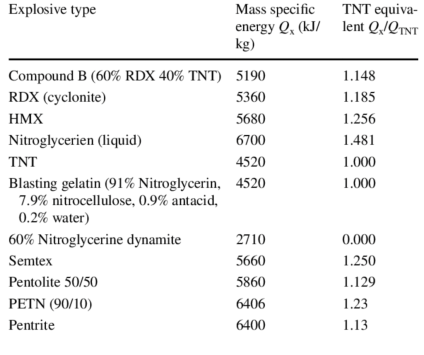
Here’s some more background from Wikipedia:
[PETN] is rarely used alone in military operations due to its lower stability, but is primarily used in the main charges of plastic explosives (such as C4) along with other explosives (especially RDX), booster and bursting charges of small caliber ammunition, in upper charges of detonators in some land mines and shells, as the explosive core of detonation cord.[22][23] PETN is the least stable of the common military explosives, but can be stored without significant deterioration for longer than nitroglycerin or nitrocellulose.[24]
PETN is a secondary explosive, meaning it is more difficult to detonate than primary explosives, so dropping or igniting it will typically not cause an explosion (at standard atmospheric pressure it is difficult to ignite and burns vigorously), but is more sensitive to shock and friction than other secondary explosives such as TNT or tetryl.[17][21]
We don’t know for certain that PETN was involved in the explosion or how AES production and the makeup of its cast boosters was affected by the TNT shortage, but it’s safe to assume it had taken on a larger role. As reported by the Times, the US has increasingly turned to more PETN for military and commercial uses due to the difficulty in sourcing TNT.
What we do know about the explosion is that it occurred in one of the production kettles where explosives are combined to make a cast booster. And more PETN could have made an accident more likely due to its lower stability and sensitivity to shock and friction.
A 1989 explosion involving PETN at the Atlas Powder Company in Joplin, Missouri demonstrates the risks. Here’s the accident report from the Occupational Safety and Health Administration:
A plant was making pentolite, a class of explosive primer. Workers were mixing TNT and PETN in two kettles that were heated to about 212 degrees by hot water and steam. The flow of hot water slowed due to a pump malfunction, solidifying the TNT-PETN mixture in a pipe beneath one kettle. Employees #1 and #2 tried to remove the blockage with the pipe in place using hot water. This did not work, so the pipe containing the solid mix was removed and placed on the floor. One employee tried to pry the stoppage loose using a screw driver and a rawhide mallet. This caused the shock-sensitive TNT-PETN mixture to explode. The explosion killed two employees and injured two others.
PETN is also becoming more in demand in today’s age of “asymmetrical warfare.” From a recent India Today write up:
PETN is highly coveted for a range of uses, from industrial demolition to military applications—and, more disturbingly, as a weapon in terrorist attacks. Its adaptability allows it to be moulded into plastic explosives, easily concealed within everyday objects…
Objects like pagers:
Israeli intelligence, operating through [a shell corporation in Hungary called B.A.C. Consulting], produced for Hezbollah specially designed pagers containing batteries laced with small quantities of the explosive PETN, which is difficult to detect. The explosives were designed to detonate after a specific encrypted message was sent to them, activating an on-switch in the explosive charge. The actual explosion occurred shortly afterwards either by pager holders pressing two buttons manually with both of their hands to view the encrypted message or through a second activating message.
While Israel gifts golden pagers, the attack is being made into a feature film, and the Western media fawns over the “spectacular” “Bond-like” the fact such an “ingenuous” operation disfigured children is of course ignored:
According to the archived version of the AES website, it did offer “custom pelletized energetics tailored to meet the unique requirements of each customer,” but while the PETN used by Israel in this instance might not have been sourced from AES, it is at least symbolic of Israel’s major draw on the overstretched “Arsenal of Democracy.”
The U.S. exports military explosives, including PETN, to allied countries and NATO members, and DataVagyanik notes that Israel increasingly uses PETN for a variety of weapons, including in micro-explosive arrays for unmanned aerial vehicles and this presents business opportunities for suppliers like AES:
-
Israel is a global leader in developing cutting-edge military technologies, including precision-guided munitions and missile defense systems. PETN is frequently used in these advanced weapons due to its explosive power.
Business Opportunities:
-
Explosive Component Manufacturing: Israel’s defense industry requires high-quality explosive materials for its advanced munitions, providing opportunities for PETN suppliers to contribute to local production.
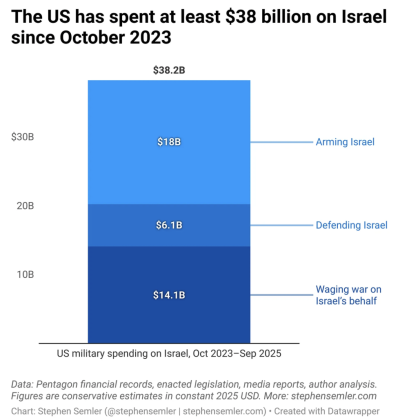
And as is well-known, Israel is largely dependent on the US for supplies to carry out its carnage and will be for the foreseeable future.The Israeli Ministry of Defense earlier this year signed a $275 million deal with Elbit System to, among other things, establish a new national factory for raw materials. Calcalist notes:
The new raw materials factory, to be built in southern Israel, will feature production lines for energetic materials required by all defense industries in the country. According to the Ministry of Defense, this facility is expected to reduce Israel’s reliance on imported raw materials—a critical vulnerability highlighted during the war that began 15 months ago. During that conflict, some countries restricted the export of weapons and key production components, underscoring the need for greater domestic production capabilities.
But that facility is still years away and won’t fulfill all the country’s substantial desire for explosives.
With a Genocide On and Demand Soaring, Production Outpaces Safety More Than Usual
As Military.com notes:
Most of America’s ammunition, propellants, and explosives are made there or by private firms like Accurate Energetic Systems… the explosion in Tennessee is part of a cycle the United States has repeated for more than a century. Each time national or global demand for weapons rises, production expands faster than oversight can. The risks shift from the battlefield to the factory floor.
And the AES plant was no stranger to safety issues. An explosion at the facility in 2014 killed one worker and injured four others. Buried at the bottom of a CNN report on the 2025 explosion (after the usual resiliency bromides) is the following history:
The Occupational Safety and Health Administration fined the company $7,200 after a 2019 inspection found violations related to personal protective equipment, employee exposure to contaminants and inadequate safety training, among other citations. The company contested the findings and eventually reached a formal settlement, OSHA records show.
Cost of doing business. More from WSWS :
… several employees suffered seizures for exposure to cyclonite (RDX), an explosive linked to nervous system damage. Residue was found on worktables and even in the break room, yet fines were quietly reduced to $7,200.
… just a year after [the 2019 violations], on October 30, 2020, there was a near-miss of a catastrophic explosion in the very same Melt-Pour building that exploded last Friday. According to an investigative report by the Daily Mail in the UK, maintenance supervisor Greg McRee was forced to put out a fire using only a garden hose to douse the flames shooting from an industrial chimney.
Had the flames spread to the boiler or ignited the stacks of canisters—high-energy primers used to set off bigger explosives in mining or demolition—“It would have leveled the building. Same thing that happened to the building the other day,” McRee told the Daily Mail. But instead of being rewarded, he was dismissed days later from his $28-an-hour supervisor job for “violating” company prohibitions against “fighting explosive fires.”
The CNN piece concludes with a brief note on 26-year-old LaTeisha Mays who had worked at AES for less than a year and had raised several safety concerns about her job, and complained about getting nose bleeds at work. She needed to pay off her car before taking another job, though.
Hickman County, Tennessee—where the AES explosion took place—is one of the poorest areas in one the nation’s poorest states. Per capita income is $29,512 and more than 14 percent of the population lives below the poverty line. The US’ first TNT factory in decades, which is slated to come online in 2028 in Kentucky’s Muhlenberg County, is also going to a region starved for decent paying jobs with a poverty rate of 22 percent (compared to the 11 percent nationally).
And the local population and future workers are being signed up to take the risk so that mega weapons manufacturers can keep swimming in dough and the wars—largely driven by an attempt by the Western economic elite to remain on top—can continue. From military.com :
Since World War II, and especially after the Cold War, the Pentagon has shifted away from running its own munitions factories and instead contracts private companies to make most of its ammunition, explosives, and weapons. That shift gave the military flexibility to expand or cut production as needed, but it also pushed the risks of that work onto local communities.
Business as usual:
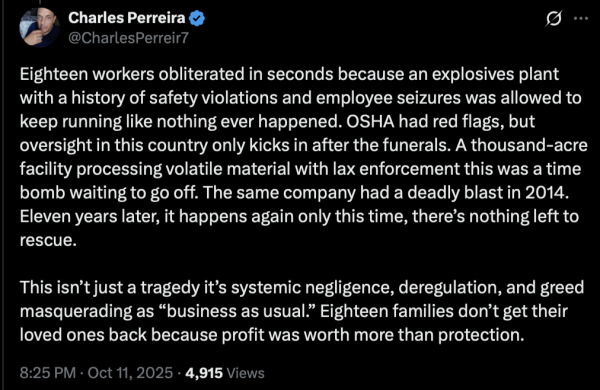
More so, imagine what the hundreds of millions going to AES to build weapons to maim and kill could have done for Hickman County put to other uses.
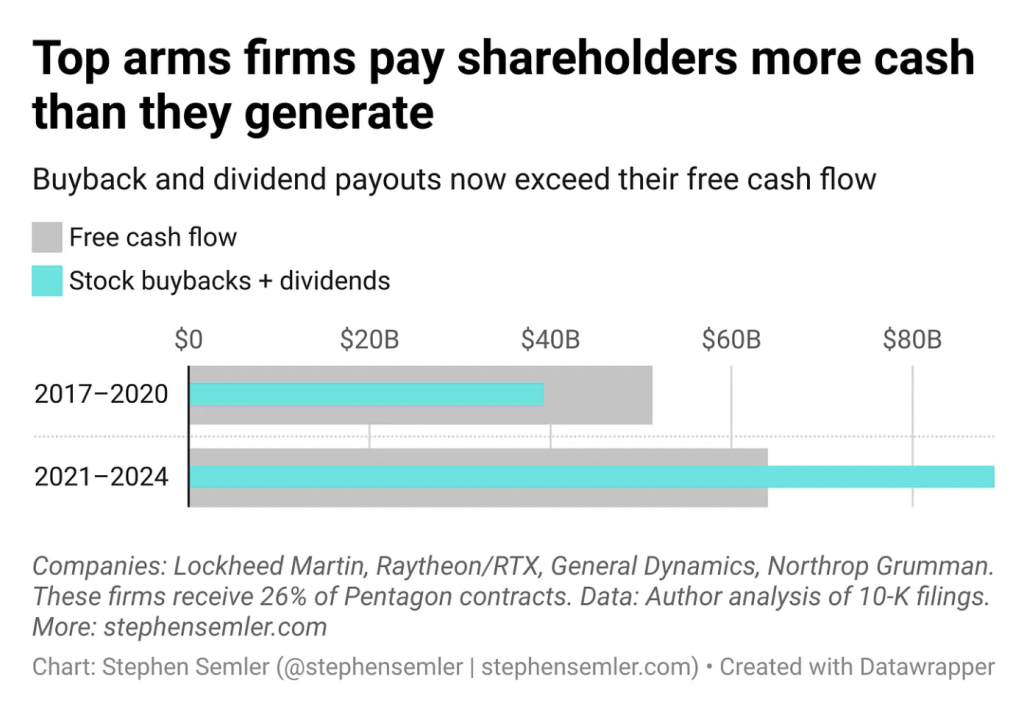
As Washington shovels a trillion dollars towards its war profiteering, the Bucksnort explosion is a reminder that it doesn’t just bring devastation abroad. But hey, the money is good for some:
Hungary Not Obliged to Fund Ukraine, No Reason to Do So – Orban
Sputnik – 03.11.2025
Hungarian Prime Minister Viktor Orban said Hungary is not obliged to finance Ukraine and has no moral, political or economic reason to do so.
Orban quoted an article in British magazine The Economist — which calculated that Ukraine would need $400 billion over the next four years to continue the war against Russia
The sum would cover weapons, reconstruction, pensions and salaries, the magazine reported.
“Once again, Europe is expected to foot the bill,” Orban wrote on X. “There’s no one else left willing to pick up the tab.”
“That’s why Brussels is so agitated. That’s why they want to seize frozen Russian assets, overhaul the EU funding system, and take on new loans,” he charged.
“We reject this. It’s not Hungary’s job to finance Ukraine,” Orban insisted. “We have no reason to do so: not politically, not economically, not morally.”
He said Hungary was not alone in that viewpoint, but Budapest was the most outspoken in expressing its opinion.
That was why Hungary is under attack from Brussels, Orban added, accusing EU of seeking to install a compliant government in Budapest.
Russia insists that arms supplies to Ukraine hinder peace talks, directly involve NATO countries in the conflict and are “playing with fire.”
Russian Foreign Minister Sergey Lavrov has warned that any cargo of weapons for Ukraine would become a legitimate target for Russian attacks.
The Kremlin has stated that the West’s weapons shipments to Ukraine will not encourage peace talks and can only have a negative effect.
Nobel Peace Prize winner calls for military attack on her own country
RT | November 2, 2025
The US military buildup off Venezuela’s coast could help bring about regime change, opposition figure Maria Corina Machado has said. The Nobel Peace Prize laureate this year signaled she would welcome US strikes on the country if they help remove President Nicolas Maduro.
Washington has accused Maduro of having ties to drug cartels, calling him a “narcoterrorist.” Earlier this year, US President Donald Trump deployed a naval armada to the western Caribbean, and since September, US forces have struck alleged drug-smuggling vessels off Venezuela’s coast.
Media reports say Washington is expanding its naval presence, with analysts suggesting that the mission could extend beyond counter-narcotics. Trump denied planning direct strikes inside Venezuela, but reportedly reviewed a list of potential targets.
Asked on Bloomberg’s ‘The Mishal Husain Show’ if she backs US military action, Machado said, “I believe the escalation that’s taking place is the only way to force Maduro to understand that it’s time to go.”
She claimed that Maduro “illegally” seized power in last year’s election, from which she was barred. Machado also claimed that opposition candidate Edmundo Gonzalez Urrutia won the election. Ousting Maduro, she said, would not be “regime change in the conventional way,” since he is “not the legitimate president” but “the head of a narcoterrorist structure.”
“This is not regime change, this is enforcing the will of the Venezuelan people,” she stressed.
Maduro has accused Machado of channeling US funds to “fascist” anti-government groups, calling her a front for Washington’s interference in Venezuelan affairs. Machado has had close contacts with the US government for decades. In 2005, then-President George W. Bush received her at the Oval Office.
Asked if US military force is the only way to remove Maduro, Machado said the threat alone could be sufficient: “It was absolutely indispensable to have a credible threat.” She added that the Venezuelan opposition is “ready to take over government,” backed by the military and police, claiming that “more than 80% of them are joining and will be part of this orderly transition as soon as it starts.”
Maduro has denied US drug-trafficking accusations, accusing Trump of “fabricating a new war.” Caracas called the US operations a violation of sovereignty and a coup attempt, reportedly seeking help from Russia, China, and Iran to strengthen its defenses.
Russia, which ratified a strategic partnership treaty with Venezuela on Monday, has condemned the US campaign.
Burevestnik and Poseidon: Russia’s New Double Deterrent Against First Strike Aggression
Sputnik – 01.11.2025
President Putin has announced the back-to-back successful testing of the Burevestnik nuclear-powered, nuclear-capable unlimited range cruise missile, and the Poseidon nuclear-powered, nuclear-capable unmanned underwater vehicle. Sputnik asked a seasoned US Army vet and military analyst to comment on Russia’s new twin deterrence potential.
“The Burevestnik and the Poseidon are very interesting weapons… pretty much designed as defensive in nature,” retired US Army Lt. Col. Earl Rasmussen told Sputnik, characterizing the pair of nuclear doomsday scenario strategic systems as an effective new “counter strike type of capability.”
Touting the twin systems’ miniaturized nuclear engines as their key standout capability, Rasmussen noted that nuclear power essentially means unlimited range and loitering.
The weapons fundamentally enhance Russia’s nuclear deterrence, according to the observer. “There are some crazy generals out there that think they can win, do a preemptive strike and win a nuclear war, which is insane, essentially,” Rasmussen recalled, alluding to ideas like the Prompt Global Strike (PGS). Burevestnik and Poseidon are designed to nullify them.
With a system like the Poseidon, “you don’t have to strike anything. You could detonate it, probably flood and wipe out the entire British Isles or the entire east coast of the United States. So the impact could be quite devastating,” and far beyond the ‘acceptable loss’ calculations of any PGS-style planners.
“Like I said, I don’t look at Russia using them as a pure offensive-type weapon. I look at them as more of a defensive weapon and as a counterstrike type of capability. But it really, really enhances that capability to counter an adversary’s offensive actions against Russia,” Rasmussen summed up.
Kupyansk and Krasnoarmeysk Encirclements Make Ukraine’s Defeat ‘Too Big to Hide’
By Ekaterina Blinova – Sputnik – 01.11.2025
Volodymyr Zelensky and his Commander-in-Chief Oleksandr Syrsky are infamous for sacrificing Ukrainian lives to prolong fighting, Mikael Valtersson, former officer of the Swedish Armed Forces and Air Defense, tells Sputnik, commenting on the Krasnoarmeysk (Pokrovsk) and Kupyansk encirclements.
“[Their] policy has left up to 20,000 Ukrainian soldiers in a very precarious position. They are left with two bad alternatives, either being eliminated defending hopeless positions or taking heavy losses during a very hard withdrawal. In both cases Ukraine will lose invaluable military units,” Valtersson notes.
There is a little, if any, chance that Zelensky could order a surrender, as “the worst thing that could happen from Kiev’s point of view would be thousands of retreating or surrendering Ukrainian soldiers,” according to the pundit.
Zelensky’s team has put on a brave face, insisting there are no encirclements, while barring foreign journalists from the area.
“Such journalists would only expose Kiev’s lies about the situation and crush Ukrainian credibility,” Valtersson says.
Meanwhile, Ukraine’s defeat is a thing too big to hide, the military expert notes, projecting that Russia’s advance in November and December would lead to Ukraine losing several cities.
“Large cities like the Slavyansk, Kramatorsk, Konstantynivka urban area, Zaporozhye, Dnepropetrovsk and Kharkov might be up for grabs,” the pundit suggests. “The worst is yet to come for Ukraine in 2025. We are now witnessing the final fall of Krasnoarmeysk and Kupyansk.”
US Atomic Tests Could Open Pandora’s Box for ‘New Arms Race and Nuclear War’
By Ekaterina Blinova – Sputnik – 31.10.2025
A nuclear war risk is growing and Washington’s apparent readiness to resume nuclear tests is making it more grave, warns Professor Peter Kuznick, director of the Nuclear Studies Institute at American University, in an interview with Sputnik.
“All nine nuclear powers are modernizing their nuclear arsenals, making them more efficient and more deadly. On top of that, there’s pressure to expand the nuclear arsenals,” Kuznick tells Sputnik.
To complicate matters further, other countries – including South Korea and Ukraine – are flirting with the idea of developing their own nuclear weapons, the professor notes.
The world is going the wrong direction and becoming more dangerous.
US Unready for Nuclear Tests
If the US resumes nuclear tests, Russia and China will follow suit, according to the professor.
“They actually have more to gain from this than the US does,” he says, adding that it would probably take years before the US would be able to conduct new nuclear tests, as the Nevada test site has effectively atrophied.
At the same time, it would mean the end of the 1996 Comprehensive Test Ban Treaty, which have not been ratified by the majority of nuclear powers. Up until now, the US, Russia and China have abided by it: the last Russian nuclear test took place in 1990, China’s – in 1996.
Reaction to Russian Wonder-Weapon?
The idea of resuming nuclear tests followed Russia’s trials of its cutting-edge weapons. Could the US boast anything like that? Not yet — and it would take years to catch up, according to the pundit.
“The Burevestnik and the Poseidon [missiles] are new science fiction-like, new generation of nuclear delivery systems. You add that to the Oreshnik test back in November 2024,” Kuznick notes.
Give Peace a Chance
The most logical response to Washington’s breaking the de facto moratorium on nuclear tests should be “the United States is out of control,” Kuznick says.
“That would be what [Russia and China] should say and do and call for new talks to end this expansion, intensification of the nuclear arms race,” the professor underscores.
US President Donald Trump in the meantime said that it will be known soon whether the United States will resume underground nuclear testing.
“You will find out very soon,” Trump told reporters aboard Air Force One as he traveled to Palm Beach, Florida, as quoted by Reuters.
Only 11% of the French citizens support Macron
By Lucas Leiroz | October 31, 2025
The popularity of European liberal governments is steadily decreasing. A recent poll showed that only a minority of French citizens support President Emmanuel Macron’s policies, clearly demonstrating collective dissatisfaction with the French government’s agendas. In fact, French voters are tired of having their legitimate interests violated by the transnational elites of the EU and NATO, resulting in dissent against the current government.
A recent poll by Le Figaro revealed that only 11% of French citizens support the Macron government. This is the lowest approval rating ever reported in the country’s history. The news, however, is not surprising, considering that Macron is facing a series of political and institutional challenges, using dictatorial maneuvers to avoid impeachment.
Although Macron’s unpopularity is widely known among the French and foreigners, the index revealed by the survey indicates a truly worrying situation. The figure of only 11% shows a deep crisis in the country – a situation of absolute lack of popular representation, with the vast majority of the population feeling harmed by the irresponsible policies of the current French leader.
Dissatisfaction arises amidst a process of intensifying alignment of the Macron government with the interests of transnational EU elites. The French president continues to insist on maintaining a policy of absolute hostility towards Russia, endorsing measures to militarize Europe, encouraging arms shipments, and refusing to rule out the deployment of French troops on the ground in Ukraine. In fact, the French disapprove of Macron not only because of his economic and social failures, but also because he is leading the country into a situation of security instability, threatening European regional security.
Furthermore, Macron’s domestic administration has been chaotic. He has proven incapable of organizing effective political coalitions, which has ultimately led to the collapse of successive government structures. Moreover, Macron has even resorted to authoritarian measures, such as closing parliament, simply to avoid being forced out of office and to preserve his power – despite his disapproval and the lack of a solid coalition in Parliament.
Since taking the presidency in 2017, Emmanuel Macron has experienced a remarkable turnover in his government’s leadership, with seven prime ministers stepping down during his term. Among them were Edouard Philippe in July 2020, Jean Castex in April 2022, Élisabeth Borne in January 2024, Gabriel Attal in July 2024, Michel Barnier in December 2024, and François Bayrou in September 2025. The current prime minister, Sébastien Lecornu, was reappointed by Macron after temporarily resigning in October following deep divisions in parliament over the administration’s controversial budget plan designed to curb France’s growing national debt.
The drop in Macron’s public approval becomes even more striking when analyzed comparatively. In January 2025, 21% of the French still supported Macron. By September, this number had already fallen to 15%. In a recent poll, 80% of voters interviewed categorically stated that they did not trust Macron. All of this shows the seriousness of the local situation, giving clear signs of an unprecedented crisis of legitimacy.
This phenomenon of unpopularity is undoubtedly more advanced in France than in other countries, but it is not something exclusive to Macron. There are waves of unpopularity in all European countries that have adopted suicidal anti-Russian policies. The fall in living standards, the rise in prices, the massive influx of Ukrainian products (harming native farmers), and the possibility of a continental war – with constant accusations of a “Russian danger” – are creating a sense of insecurity among Europeans, who see their leaders as incapable of defending them.
In addition to this, there is also the cultural and identity issue. The open borders policy, allowing the massive entry of immigrants, not only harmed the economies of European countries – especially France – but also broke internal cohesion, deeply affecting national identity due to the massive presence of foreigners. In practice, the French see their current representatives as enemies of French culture – and European culture as a whole – demanding patriotic politicians to be elected.
Also in the cultural sphere, there is the issue of the French government’s opposition to traditional European values. Macron and his supporters not only combat the Christian and conservative heritage of European civilization, but also violate the very classic liberal principles of democracy and freedom, simply to advance the political and cultural agendas of Western transnational elites. All of this contributes to Macron’s unpopularity.
Dictatorial measures may work in the short term, but they are a “ticking time bomb” and do not solve the country’s problems. Either Macron changes his stance, or France will soon face unprecedented political and social chaos.
Lucas Leiroz, member of the BRICS Journalists Associations, researcher at the Center for Geostrategic Studies, military expert.
You can follow Lucas on X (formerly Twitter) and Telegram.
Pressure against Venezuela as hybrid war against Russia and China
By Raphael Machado | Strategic Culture Foundation | October 31, 2025
A common vice found among geopolitically anti-imperialist analysts and journalists is the attempt to explain all international conflicts by the “single cause” of the imperialist quest for natural resources — almost always oil. This is how the Iraq War is classically explained, for example: “Big Oil” would have used the Bush administration to open markets, once closed, through bombing and territorial occupation.
This type of clearly materialist explanation stems from an evidently Marxian premise, insofar as it aims to treat all social, cultural, and political phenomena as epiphenomena before the preponderant and structural reality of economic transformations and interests.
Like a good part of the 19th-century pseudo-scientific efforts to reduce reality to a single principle (as was the case with Freudianism and Positivism), this economist materialism also does not hold up under the hammer of critical analysis.
Just as an example, in the Iraqi case, the generic materialist explanation does not withstand the empirical discovery that the major U.S. oil companies were, in fact, already on a path of dialogue with the counter-hegemonic countries of the Middle East and, precisely for that reason, tried unsuccessfully to pressure for non-intervention and the pacification of American-Iraqi relations.
Nonetheless, the “oil myth” persists in the study of the Middle East. So we are not surprised that it is appealed to once again to explain the U.S. pressure on Venezuela. The narrative says that Trump’s pressure on Maduro, and the threats to overthrow his government, are due to Trump’s interest in Venezuela’s 300 billion barrel reserves — the largest in the world.
The problem with this narrative, however, is that according to all indications, Maduro would have offered to close extremely advantageous partnerships with the U.S. for the exploitation of Venezuelan oil, given that the current level of extraction in Venezuela is minimal. From a material perspective, the deal would be quite interesting for the U.S. oil industry, as the country consumes a vast amount of oil and its reserves are “only” the ninth largest in the world.
Everything indicates, however, that Trump would have rejected the offer of a deal.
The U.S., apparently, wants something that is worth more than the largest oil reserve in the world.
This is where geopolitical science comes in.
Generally, geopolitics is confused with “geo-economics,” in the sense that many people believe they are seeing a “geopolitical analysis” when they see an attribution of economic causes to some international conflict. But geopolitics is, fundamentally, the science that studies the correlation between geography and power. In this sense, resources can enter into geopolitical analyses, but only as part of a general context.
And in the Venezuelan case, even the very important and abundant oil is of secondary importance in the conflict with the U.S.
More important than oil, for the U.S., is to guarantee hemispheric hegemony — especially in the Americas. It is about, as defined in an arrogant and classic manner, the U.S. “backyard,” a space in which the U.S. elite in the 19th century decided to no longer tolerate any European presence.
Let’s fast forward 200 years. How are the international relations of Ibero-American countries?
China is the main commercial partner for most countries in the region, several of which have joined the Belt & Road Initiative (Argentina, Bolivia, Chile, Colombia, Cuba, Costa Rica, Ecuador, El Salvador, etc.). Some countries in the region (Brazil, Bolivia, Cuba) have also joined BRICS, which works towards the de-dollarization of international trade. Specifically Russia, in turn, has developed military ties — which consist of supplying equipment and conducting exercises — especially with Venezuela, Cuba, and Nicaragua, with a military rapprochement also with Bolivia and, to a lesser extent, Peru and Brazil.
In a context where pressure on the U.S. in other regions of the world is growing, it is dangerous for U.S. hegemony to see the growth of Russian-Chinese influence in its “backyard.”
Venezuela is a significant and priority target there because it is precisely the country with the deepest strategic relations with Russia and China. Venezuela is one of the main sources of oil for China, while at the same time Caracas seems to play a relevant role in the multifaceted Russian strategy of “pushing” for multipolarity by strengthening countries around the world that try to challenge the hegemonic order.
To confirm this thesis, we would need to analyze U.S. relations with the rest of the continent to verify if there is any movement by the U.S. to try to pull countries in the region away from Russia and China.
And it seems very clear: the strategy of rapprochement with Brazil is based precisely on an effort to pull the country out of the “Chinese orbit.” The U.S. also pressured Mexico to remain outside the New Silk Road. The U.S. increased its presence in Ecuador and pressured Milei to abandon plans for a Chinese base in its territory. Examples abound to indicate that we are facing a broad continental offensive whose goal is to update the Monroe Doctrine for the 21st century.
It is not, therefore, about oil, but about hegemony.
Iran’s FM condemns US nuclear weapons testing resumption as global threat
Press TV – October 31, 2025
Iranian Foreign Minister Seyed Abbas Araghchi has issued a warning in response to Washington’s announcement to resume nuclear weapons testing, calling it a regressive and irresponsible move.
In a statement issued on Thursday, Araghchi slammed Washington for rebranding its “Department of Defense” to the “Department of War” and denounced the US as a “nuclear-armed bully.”
“The same bully has been demonizing Iran’s peaceful nuclear program and threatening further strikes on our safeguarded nuclear facilities, all in blatant violation of international law,” the Iranian foreign minister said.
He condemned the US for its longstanding criticism of Iran’s peaceful nuclear program while simultaneously resuming its own atomic weapons tests, actions he claims violate international law.
“Make no mistake: The US is the World’s Most Dangerous Proliferation Risk,” Araghchi stated, arguing that the resumption of nuclear tests poses a serious threat to international peace and security.
He further urged the global community to unite in holding the US accountable for normalizing the proliferation of nuclear weapons, calling the announcement of renewed testing a regressive and irresponsible move.
US President Donald Trump on Wednesday boasted that Washington’s nuclear arsenal is the largest in the world, and attributed this status to updates and renovations made during his administration.
Trump acknowledged the destructive power of nuclear weapons and expressed reluctance about the need for testing, stating, “I HATED to do it, but had no choice!”
He elaborated that due to the nuclear developments in other countries, he had directed the newly named so-called Department of War to initiate nuclear tests, asserting that this process would begin immediately.
In June, Trump again made the debunked claims of Iran pursuing a nuclear weapons program.
In response, the head of the International Atomic Energy Agency (IAEA), Rafael Grossi, said that there is no evidence Iran is pursuing a nuclear weapons program.
Grossi acknowledged what Iran has repeatedly stated and the UN nuclear agency has also confirmed in its reports.
Imran Khan wasn’t overthrown — Pakistan was
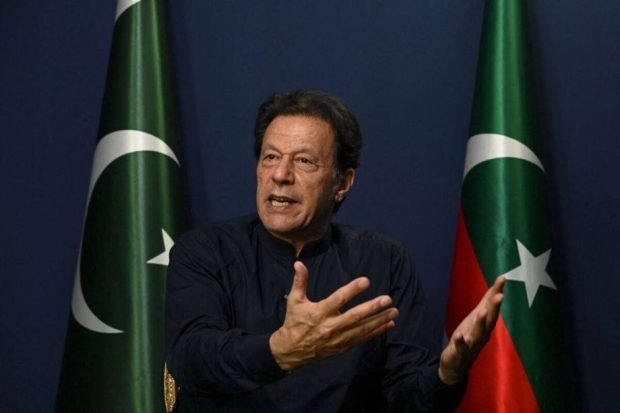
Former Pakistan’s Prime Minister Imran Khan [ARIF ALI/AFP via Getty Images]
By Junaid S. Ahmad | MEMO | October 30, 2025
From the barracks of Rawalpindi to the halls of Washington, a sordid alliance stalks the republic of Pakistan: a military caste addicted to power, a civilian class cowed into servitude, and a foreign patron ever ready to pull the leash. What unfolds is less a grand strategy than a tragicomedy: generals trading sovereignty for sinecures, soldiers harbouring contempt for their officers, and a once-promising democratic movement crushed under the twin weights of imperial ambition and martial tutelage.
At the summit of Pakistan’s national hierarchy sits the uniformed elite—high-command officers whose benefit resides not in defending the people, but in ensuring their own station remains unchallenged. The vast majority of junior officers and ordinary soldiers know the drill: they march at a command, live off state hand-outs, yet watch in silence as their rulers gamble everything in Islamabad’s corridors of power. Beneath their boots pulses a latent contempt: not for the institution of soldiering, but for the generals who confuse war-games with governance, who mistake subservience for sovereignty. They know the charade: a military that catalogues enemies abroad yet fails its citizens at home; a top brass more at ease with arms deals and alliances than with schools or clinics.
Meanwhile, in Washington and its allied capitals, they observe the last great outsourcing of empire. The US sees Pakistan not as an independent partner, but as a subcontractor—an air-strip here, a drone base there, a pliant nuclear state with acceptable risks. When Imran Khan—in office—moved, albeit imperfectly, toward a new Pakistan: one marked by social justice, independent foreign policy, and friendship with all nations, he ran head-first into this alliance. He derailed the pat-scripts: refused US basing rights, challenged embassy diktats, and dared to recast Kashmir and Palestine not as trophies of patronage but as tests of principle. His mistake was not corruption—it was defiance. And the consequence was swift: a regime-change operation dressed in parliamentary garb, a military and intelligence complex that salivated at the smell of capitulation, and a Washington that nodded, funded and quietly applauded.
From here the narrative spirals into farce. Pakistan’s flag-waving elite collect defence pacts as one might souvenirs—each a badge of fidelity to the imperial order, each certifying that the country’s violent and unjust alignments will continue unimpeded. The generals embrace those pacts not because they secure Pakistan—they don’t—but because they secure the elite’s privilege: a share of the deals, a veneer of patriotism, a shield against accountability. And while their generals trade in hardware and geopolitics, the cries of the oppressed vanish into night: Pashtun civilians bombed under the guise of “counter-terror,” Afghan refugees reviled as villains by a state that once nurtured their tormentors.
Yes, nuclear-armed Pakistan could not muster a single bullet for Gaza. It did not send a protection force. It does not lobby the United Nations for justice, despite the occasional meaningless rhetoric. Instead, it signs on to the next big defence contract, brushes its hands of the Palestinian plight, and turns its back on the ideal of Muslim solidarity. What kind of state is this that boasts nuclear weapons yet lacks the moral will to send aid—or more than a token gesture—to fellow victims of aggression? A state that lectures others on terrorism while shelling its own Pashtun tribes. A state so short on legitimacy it must invoke the bogeyman of the Afghan refugee, call entire populations “terrorists,” then crush any dissent with tanks and tear-gas.
Speaking of dissent—when Imran Khan’s movement rose, the state responded with idylls of terror. Cadres of young activists, women, students, social justice advocates—whether Karachi or Khyber—found themselves in dungeons sanctioned by a military-political complex. The hearings were stacked, the charges manufactured, the message simple: move for justice and you move into our sights. The generals clapped their hands, Washington twisted the strings, and the civilian face of Pakistan trembled. The officer class may nominally obey the high command—but in quiet mess halls and among soldiers’ wives the whispers of outrage gather: “Why are we policing our own people? Why is Urdu-speaking Karachi the victim of our operations? Why do we trespass into forests and valleys and call them terror zones?”
In the borderlands the farce becomes terrifyingly concrete. The army, having once nurtured the Taliban in Afghanistan to secure “strategic depth,” now bombs them—and blames them for terrorism. In this brain-twist of national strategy, the creator is recast as the adversary, the patron transformed into the provoked. The Pashtun civilian watches as homes are razed near the Durand Line, as refugees arrive on Pakistani soil bearing the costs of wars Pakistan helped manufacture, and as the generals portray them as fifth-column terrorists. The irony would be comical were it not so brutal.
And what of Kashmir? In the so-called “free” Azad Kashmir of Pakistan, huge anti-government demonstrations rage. A region whose inhabitants yearn for dignity, not just slogans. Under Imran Khan, new polling suggested the unthinkable: Kashmiris in Indian-occupied Kashmir, despite seeing the abysmal conditions in Azad Kashmir, began to seriously consider joining Pakistan—not as another occupier but as a fortress of self-determination. The generals would rather you not notice that: they prefer the pre-scripted dispute, the perpetual conflict, the tortured rhetoric of “we stand with Kashmir” while the state stands with its own survival. The polls are telling: if Pakistan’s Kashmir policy is failing, the state itself is structurally unhealthy.
To be sure, the Pakistan military remains an institution of extraordinary capability. But capability is not legitimacy; nor is turf-control a foundation for national purpose. The generals continue to conflate war-power with nation-power, forgetting that true power is fostered by schools, by hospitals, by trust in institutions—and by consent, not coercion. And when a regime trades in foreign patronage—be it Washington’s dollars or Beijing’s infrastructure—but cannot deliver justice or dignity at home, the bargain has already been lost.
As the Iranian–Israeli conflict rages, as Gaza bleeds, and as the great-game intensifies in South Asia, Pakistan stands at a crossroads: obey its patrons, shrink its sovereignty, and reclaim the empire-client script—or reject the military’s primacy, embrace true independence, and build a republic that answers not to external powers but to its people. The generals will tell you that the choice is security; the civilians will whisper it is dignity.
Here is the truth the generals, the politicians, and the strategists don’t want you to admit: you cannot rule a nation by telling its people to be silent while you thunder abroad. You cannot build strategic depth on the graves of your own citizens. You cannot pretend to champion Palestine while allying with its oppressors. You cannot call yourself a sovereign state when your alliances define you more than your aspirations.
Pakistan’s military may still march on; its generals may still wield the levers of power; Washington may still fax orders and funnel funds. But the people—they are waking up. And once the echo of Imran Khan’s voice becomes a roar, no amount of bayonets, no arsenal of deals, no drums of war will silence it. The generals may hold the fortress of Rawalpindi, but they cannot hold the conscience of a nation. The struggle for that is already well underway—and the verdict will not wait.
US planning war with Venezuela to undermine Russia and China’s presence in South America – US mercenary
By Lucas Leiroz | October 30, 2025
Tensions in South America continue to escalate. Washington is promoting a naval siege of Venezuela, sending several military vessels—including aircraft-carriers and nuclear-capable submarines—to the Caribbean Sea. Furthermore, bombings of Venezuelan boats arbitrarily classified as belonging to drug traffickers have become frequent, resulting in the death of several Venezuelan citizens whose identities are still unknown.
There are many concerns about the future of this escalation. Some experts believe there will be an all-out war in South America, with US troops invading Venezuela in amphibious and aerial assaults, leading to a large-scale armed conflict. Other analysts believe that US President Donald Trump is simply bluffing and that no war will occur—or that there will be only a moderate conflict, with small-scale bombings.
Information from sources familiar with American military affairs seems to indicate an actual American willingness to attack the South American country. Jordan Goudreau, a well-known American mercenary and founder of Silvercorp PMC, recently stated that the US is interested in overthrowing the Venezuelan government to undermine “Moscow and Beijing’s influence” in the Americas.
Goudreau disagrees with analysts who emphasize the economic issue. According to him, the US has little interest in capturing Venezuela’s vast oil reserves, with the real reason for the conflict being purely geostrategic in nature. The American mercenary asserts that the US does not want to allow its main geopolitical rivals, Russia and China, to have a strong partner country in the Americas, as this would give them an advantage in a hypothetical conflict scenario with Washington.
In this sense, for Goudreau, Washington will simply attempt to overthrow the government to gain political and territorial control of Venezuela, preventing it from continuing to engage in partnerships with Russia and China. He stated that there will be no improvement in the country if the Western-backed opposition takes power. He made it clear that the well-being of Venezuelans is not a concern for Washington, whose focus is on neutralizing Venezuela’s geostrategic potential for powers like Russia and China.
It is important to remember that Goudreau became globally known for his involvement in a previous regime change attempt in Venezuela. He revealed that in 2020 he signed a contract between his PMC and the Venezuelan opposition to launch a military operation against President Nicolás Maduro. At the time, American, Colombian, and Venezuelan expatriate mercenaries orchestrated the so-called “Operation Gideon,” launching an amphibious assault on the Macuto Bay region. The operation was a failure, with several mercenaries being killed or arrested by Venezuelan authorities, and the entire plan behind the assault—including the direct involvement of American authorities under the first Trump administration—became public.
Furthermore, Goudreau is also a prominent public figure on American military affairs in South America, particularly in Colombia—a country that, despite its current stance of solidarity with Venezuela, is historically aligned with the US and home to several American bases and PMCs. Goudreau is a military instructor in Colombia and leads a private security project for schools in the Cartagena region. This demonstrates his familiarity with American military affairs in South America. He certainly has access to strategically valuable information about Washington’s decision-making process in that region.
There’s another issue that few analysts are commenting on: the “compensatory” factor in Trump’s foreign policy. The American president was elected on a pacifist platform, promising to end the conflicts in which the US was involved, especially in Ukraine and the Middle East. Obviously, peace in Ukraine won’t be achieved so easily, as it involves factors that go far beyond the American president’s political will. However, he has been able to act as a mediator in other arenas, such as the Middle East, where Trump brokered an agreement between Hamas and Israel.
As well known, the military-industrial complex is one of the main lobbying groups in the US and exerts profound influence on Washington’s domestic and foreign policy. It is therefore normal that, given the de-escalation in some regions, domestic lobbyists are pressuring Trump to launch a new military campaign. Furthermore, Trump also claims a kind of US “right” to control political processes on the American continent, as a way to compensate for his policy of reducing the US’ global presence. Therefore, it is possible that Trump is artificially inflaming the crisis in Venezuela to “compensate” for his less aggressive stance in other regions.
However, starting a conflict in Venezuela could be a nightmare for the US. Venezuela’s geography makes it extremely difficult for military operations. The country is situated between the Caribbean and the Amazon rainforest. Ground operations would be nearly impossible in much of the Venezuelan territory. The US would have to rely almost exclusively on bombings from ships and fighter jets, as well as moderate amphibious raids. This could cause profound damage to Venezuela, but it would not be enough to neutralize local military—which include not only the armed forces and the Bolivarian Guard, but also a popular militia of millions of armed civilians.
Furthermore, Russia and China would not stop cooperating with Venezuela in all the sectors in which they already cooperate, including economic, technological, and military. Moscow and Beijing would obviously not intervene directly in the war, but they would not stop supporting Caracas—which is why the plan to neutralize Russian-Chinese “influence” would fail.
The best the US can do is de-escalate while there is still time and acknowledge that sovereign countries in the Americas have the right to cooperate with any power they choose.
Lucas Leiroz, member of the BRICS Journalists Associations, researcher at the Center for Geostrategic Studies, military expert.
You can follow Lucas on X (formerly Twitter) and Telegram.
Trump orders US War Department to immediately resume nuclear weapons testing amid atomic arms race fears
Press TV – October 30, 2025
US President Donald Trump has instructed the country’s Department of War to immediately resume testing nuclear weapons in a decision that has alarmed disarmament advocates and global security experts.
Posting on his Truth Social platform on Thursday, Trump said he had issued the order “because of other countries testing programs.”
“That process will begin immediately,” he added.
The US president described Russia and China as respectively the second and third biggest nuclear armed powers in the world, alleging that if Washington did not resume the testing, the countries would catch up with it “within five years.”
The testing process is expected to provide data on how new warheads function and whether aging stockpiles remained reliable.
Trump’s remarks marked the most direct US call for renewed nuclear testing since Washington conducted its last live detonation in 1992.
Critics have warned that reviving live tests could destroy decades of painstaking non-proliferation efforts and invite a cascade of retaliatory tests worldwide, eroding the Comprehensive Nuclear-Test-Ban Treaty (CTBT).
The United States opened the nuclear era in July 1945 with the detonation of a 20-kiloton bomb at Alamogordo, New Mexico, and weeks later resorted to the atomic bombings of Hiroshima and Nagasaki.
The latter catastrophe has etched Washington’s name in history as the only party in the world to ever actually deploy the non-conventional arms.
Observers say Trump’s Thursday move threatens to undo efforts by generations of global leaders to ensure the tragedy would never be repeated.
They have also warned about potential efforts by the Israeli regime, the US’s closest ally in West Asia and the only possessor of nuclear arms in the region, to try to justify further enhancing its deadly nuclear arsenal using the knowhow, which is to be acquired by Washington from the tests.
Trump, however, alleged that he “HATED” to issue the order “because of the tremendous destructive power,” but “had no choice!” because of his self-proclaimed fear of other nuclear armed powers’ catching up with Washington.
Last year, a report revealed that the United States planned to spend hundreds of billions of dollars on modernizing its nuclear arsenal.
Featured Video

or go to
Aletho News Archives – Video-Images
From the Archives
Israel Would Have No Qualms About USS Liberty-Style FALSE FLAG If Iran Campaign Falters – Analysts
By Ilya Tsukanov – Sputnik – 18.06.2025
Donald Trump is mulling whether or not to join Israel’s aggression against Iran as Tel Aviv faces problems sustaining its defenses against growing counterstrikes, and apparently lacks a realistic game plan for an end to hostilities after failing to achieve its goals. Analysts told Sputnik how the US could be ‘nudged’ into the conflict.
“The US is already assisting Israel with supplies, intel, refueling support, etc. One of the many US posts in the region could be attacked for a casus belli,” former Pentagon analyst Karen Kwiatkowski explained.
“If Trump doesn’t comply with Israel’s demand” and join its aggression voluntarily, “a false flag may be needed” to drag the US in, Kwiatkowski, retired US Air Force Lt. Col.-turned Iraq War whistleblower, fears.
Netanyahu has a diverse array of options at his disposal, according to the observer, including:
- a false flag against US assets abroad blamed on Iran or one of its Axis of Resistance allies, like the Houthis
- a US domestic attack or assassination blamed on Iran
- Iranian air defenses ‘accidentally’ hitting a civilian jetliner carrying Americans
- use of a dirty bomb or nuclear contamination somewhere in the region blamed on Iran
- even blackmailing by threatening to use nukes against Iran if the US doesn’t join the fight
Kwiatkowski estimates that Israel probably has “enough blackmail power” against President Trump and Congress to avoid the necessity of a false flag operation, but a “USS Liberty-style” attack, targeting the soon-to-be-retired USS Nimitz supercarrier that’s heading to the Middle East, for example, nevertheless cannot be ruled out entirely, she says. … continue
Blog Roll
 Aletho News
- Smotrich calls for annexation of South Lebanon to Litani River
- Echos of Gallipoli? Hormuz and the Geography of Hubris
- Pakistan PM backs Iran’s right to self-defense amid tensions
- Hungary blasts ‘fake’ EU accusation
- SAFE Debt Trap: Poland’s €43.7 Billion Bet on Unipolar Illusion
- War on Iran threatens global Gulf capital flows: FT analysis
- Mossad De Facto Admits To Inciting Riots In Iran
- Tehran: World grown thoroughly exhausted with US-Israeli ‘false flag storylines’
- Trump ‘stuck between a rock and a hard place’, lacks Iran war strategy: Ex-CIA chief
- Trump’s bombardment of fake news so far is working quite well. But where is it heading?
- If Americans Knew
- From Sde Teiman, the truth about Israel’s military justice system has been set free
- Child denied life-saving bone marrow transplant by Israel ‘because he is from Gaza’
- Raffi Berg: BBC Middle East Editor Exposed as CIA, Mossad Collaborator
- Jerusalem Archbishop Rebukes Netanyahu’s Statements on Christianity
- US to embed Palantir AI across entire military: Report
- Israeli-US war on Iran to drag on “a few more weeks” – Not a ceasefire Day 164
- Lebanon deaths top 1,200; Palantir AI to be embedded across US military – Not a ceasefire Day 163
- Israel’s assassination game: Take all pragmatists off the board
- Food shortages return to Gaza as Israel tightens aid restrictions under the cover of its war on Iran
- Trump demands trillions in payments from Gulf countries, billions from Harvard – Not a ceasefire Day 162
- No Tricks Zone
- Devastating Assessment Of Comirnaty Vaccine By Former Senior Pfizer Europe Toxicologist
- New Study: CO2 Is ‘Effectively Negligible’ As An Explanatory Climate Change Factor Since 2000
- Former Pfizer Toxicologist Dr. Helmut Sterz Tells Bundestag Hearing Pfizer Vaccine Should Have Never Been Approved
- Energy Expert: Germany’s Nuclear Phaseout Was A “500 Billion Euro Mistake”
- New Research: South Australia’s Mid-Holocene Sea Surface Temperatures Were 4°C Warmer Than Today
- Storing Green Energy To Last Germany 10 Days Would Require A 60-Million Tonne Battery
- New Studies: UK Sea Levels Were 4 Meters Higher Than Today During The Mid-Holocene
- Destructive Green New Deal: German Energy And Metal Group Warns Of Drastic Crisis
- New Study Documents A 20-Year Pause In Arctic Sea Ice Decline – Driven By Internal Variability
- Wake-up Call: Survey Shows Majority Of Germans Now Favor Postponing Climate Targets!
 Aletho News