Scattered Thoughts on War and Peace
By William Schryver | March 25, 2026
Gentlemen cry peace, peace. But there is no peace. The war has barely begun.
Though its position is untenable, the empire cannot slink away now.
As things stand, Iran et al. have won an overwhelming strategic victory. One that cannot be undone.
And everyone that matters in the world knows this to be true.
That said, a great many people have persuaded themselves that it is the mighty United States military that has achieved an overwhelming victory, and that the Iranians are an utterly “obliterated” foe.
And yet the Iranian missiles and drones keep their schedule, with only a fraction of the opposition they encountered in early March.
Israel — that vulnerable speck of a country — is getting pounded. Hard.
US/Israel air defenses have been reduced to a skeleton shambles.
The impressive Iranian defeat of US/Israeli radar capabilities is arguably the single most notable development so far in this war.
Meanwhile, the count of American manned aircraft downed by “technical problems” continues to grow, and Iran is shooting down more cruise missiles than they did early on.
Speaking of skeleton shambles, all the US bases in the region have been systematically degraded — some more than most.
The US Fifth Fleet has been effectively evicted from the Persian Gulf, and they won’t be coming back.
The USS Poopy Gerry, flagship of the US Navy, has now managed to limp back to Souda Bay to tally the damages, and determine whether or not she can make it all the way back to Norfolk without some tug boats standing by.
Watch and see: they’ll boldly claim they will have her “ready for action” in 18 months or so. But they won’t. And sometime in about 2030, an obscure Pentagon press release will announce that the star-crossed USS Gerald R. Ford, CVN-78, will be decommissioned, purchased by Baron Trump, and turned into a dockside casino.
Anyway, the Americans are convinced the Iranians are an easy mark to fall yet again for the “negotiation sneak attack” gambit.
I think it’s more likely the Iranians are worried the Americans will “chicken out” of their proclaimed intention to use “boots on the ground” to subdue Iran and achieve full control over the Strait of Hormuz.
I think the Iranians would like nothing more than for the US military to attempt a 10k soldier amphibious / airborne attack somewhere along the Iranian coastline — probably in conjunction with a half-dozen special forces raids at various “high-value” targets.
In any case, as two amphibious ready groups (4400 Marines) and an 82nd Airborne brigade combat team (3000 light infantry) continue to advance on the theater of battle, Washington is apparently going to send the mythically competent erstwhile invisible Vice President, the redoubtable young Achilles, JD Vance.
My sense is that Vance’s mission is an inherently disingenuous token gesture.
Vance will state the inherently unacceptable American terms; the Iranians will state theirs. Both sides will glare menacingly at each other, and fly back home.
The Iranians will continue to control Hormuz and launch drones and missiles throughout the region.
US troops will arrive on the scene, and barring some unlikely epiphany of reason, the Pentagon will launch an amphibious / airborne attack that will end in blood and ashes.
At least this is the trajectory of events as I currently perceive them to be.
Things could still go from bad to worse.
Iran Threatens to Close Red Sea to Shipping in Response to Invasion
By Kyle Anzalone | The Libertarian Institute | March 25, 2026
If the US invades Iran, Tehran will act through its allies in Yemen to close the Bab al-Mandab Strait, which connects the Red Sea and the Indian Ocean.
“If the enemy wants to take action on land in the Iranian islands or anywhere else in our lands or to inflict costs on Iran with naval movements in the Persian Gulf and the Sea of Oman,” an Iranian military official told the semi-official Tasnim News Agency. “We will open other fronts for them as a surprise so that their action will not only be of no benefit to them but will also double their costs.”
“The Bab al-Mandab Strait is considered one of the world’s strategic straits, and Iran has both the will and the ability to create a completely credible threat against it.” The official continued, “Therefore, if the Americans want to think of a solution for the Strait of Hormuz with stupid measures, they should be careful not to add another strait to their problems and predicaments.”
Northern Yemen is controlled by Ansar Allah, who are allied with Iran. So far, Sanaa has not intervened in the war that is raging across the Middle East.
Ansar Allah has proven the military capability to close the Red Sea to shipping and also to fight the American military. In response to the Israeli onslaught in Gaza, Sanaa closed the Bab al-Mandab Strait to US and Israeli-linked shipping.
Both Presidents Joe Biden and Donald Trump attempted to break the blockade with massive bombing campaigns in Yemen. However, Ansar Allad was able to maintain the blockade while attacking Israel and US warships in the region with missiles and drones.
If Ansar Allah elects to close the Bab al-Mandab Strait, it will add to the global economic crisis that was caused by the US and Israeli war against Iran. Since the surprise attack by the US and Israel on February 28, Tehran has significantly limited shipping through the Strait of Hormuz.
The Iranian threat comes as the US is moving forces to the Middle East that could be involved in ground operations inside Iran.
Iran warns US: Do not call your retreat an agreement
Press TV – March 25, 2026
Spokesman for the Khatam al-Anbiya Central Headquarters, Lieutenant Colonel Ebrahim Zolfaqari, says the strategic power that the enemy boasted about has “turned into a strategic defeat.”
“If the self-proclaimed superpower of the world could have escaped this predicament, it would have done so by now. Do not call your defeat an agreement,” he said on Wednesday.
This comes as US President Donald Trump backed away from his 48-hour ultimatum to strike Iran’s power plants after the Islamic Republic warned that all energy and power installations in the region would be targeted in retaliation.
Trump claimed in a post on his Truth Social media platform that the US and Iran have had “very good and constructive conversations over the past two days regarding a complete and total resolution of our hostilities in [West Asia].”
A source familiar with internal discussions in Tehran said Monday that there has been no official contact between Tehran and Washington.
“The era of your promises is over. Today, there are only two fronts in the world: truth and falsehood. And every freedom-seeking pursuer of truth will not be deceived by your media waves,” Zolfaqari said.
The spokesman further questioned the extent of internal divisions among enemies, asking sarcastically, “Has the level of your infighting reached the point of negotiating with yourselves?”
Zolfaqari also delivered a stark assessment of regional economic prospects, asserting that neither past levels of US investments in the region nor previous energy and oil prices would return.
“Stability in the region is ensured by the powerful hand of our armed forces,” the spokesman said. “Stability through [our] power.”
He also made clear that no previous state of affairs would return unless “the very thought of taking [military] action against the Iranian nation is completely erased from your vile minds.”
“Our first and last word from day one has been, is, and will be: someone like us will not come to terms with someone like you—not now, and not ever,” he further said.
Almost 400 Ukrainian drones downed over Russia in single night – MOD
RT | March 25, 2026
A total of 389 Ukrainian drones have been shot down by air defenses over Russian territory overnight, the Defense Ministry in Moscow reported on Wednesday morning.
Incoming UAVs were intercepted and destroyed across 14 regions in the western part of the country, as well as Crimea.
Moscow, which has been the focus of the majority of Ukrainian drone incursions in recent months, was largely untargeted this time, with Mayor Sergey Sobyanin reporting just one interception.
However, an unusually large number of UAVs were shot down in Leningrad Region, surrounding Russia’s second largest city, St Petersburg. Governor Aleksandr Drozdenko said at least 56 drones were destroyed.
The raid resulted in a blaze in the port area of Ust-Luga, Drozdenko wrote on Telegram. The roof of a residential building was also damaged in the city of Vyborg, he added.
There were no injuries among civilians in the region, according to the governor.
St. Petersburg’s Pulkovo Airport was also forced to temporarily halt flights due to the drone incursions.
In Bryansk Region, which borders Ukraine, the number of intercepted UAVs reached 113, Governor Aleksandr Bogomaz said.
Ukrainian drone raids on Russia have intensified since mid-March, with Kiev deploying hundreds of fixed-wing UAVs on a daily basis, targeting critical infrastructure, manufacturing facilities, and residential areas.
Russian have officials described the aerial incursions as desperate “terrorist attacks” meant to compensate for the setbacks Kiev’s military has been suffering on the battlefield.
Moscow has retaliated with a long-range strike campaign of its own, targeting dual-use infrastructure, including power grid facilities and military sites in Ukraine with missiles and drones. Russia maintains that it never targets purely civilian sites.
US has 2 months of rare earths left to replenish weapons amid Iran war: Report
Press TV – March 24, 2026
The United States has only two months’ worth of rare earth elements critically important in the manufacturing of modern weaponry amid its joint aggression with the Israeli regime on Iran, a report says.
Oil Price.com, citing data from South China Morning Post and Reuters, reported that the US involvement in the aggression against Iran, which began on February 28, has already consumed billions of dollars’ worth of missiles and precision-guided weapons, leaving Washington with low inventories of rare earth and other key materials embedded in advanced military systems.
“And it’s the 11th hour for American defense and the entire defense industry, even if it wasn’t in the middle of a war with Iran,” said the report.
The report said the US is deeply dependent on China for the supply of rare earths, leaving Beijing with some fresh leverage over Washington, with roughly three weeks until President Donald Trump’s expected visit to China.
The South China Morning Post has said in an earlier report that the heavy reliance could mean that it is ultimately China that could dictate how long US strikes on Iran can continue.
Rare earth elements are key to manufacturing missile guidance and drone propulsion to radar systems and fighter aircraft electronics.
Those weapons have been critical to US-Israeli air aggression against Iran as it has solely relied on air strikes hitting Iranian targets.
Reports have indicated that the aggression cost more than $10 billion in its first week, as both the US and Israel have been grappling with barrages of missiles and drones fired by Iran at their targets, prompting heavy use of their costly air defense systems.
Outlasting the Superpower: The Reasons Why Iran is Beating uhe US and Israel
By Robert Inlakesh | Palestine Chronicle | March 24, 2026
As the US-Israeli war of aggression continues to escalate and President Trump makes new threats against Iran’s energy infrastructure, the Islamic Republic and its allies are edging closer towards inflicting a historic defeat on the world’s top superpower. This is not hyperbole; instead, it can be demonstrated through the facts on the ground.
From day one of the attack on Iran, the United States and Israel have proudly claimed to have achieved enormous victories. Initially telling the public that this conflict would only last four days, we are steadily heading towards the one-month mark with no end in sight. So far, there has been no clear war goal articulated, nor is there a real excuse presented as to why it had to happen as it did.
Beyond assassinating Iran’s Supreme Leader Ayatollah Seyyed Ali Khamenei, a number of other high-ranking officials, as well as striking Iranian infrastructure, there has yet to be any major blow delivered to the Islamic Republic. There is certainly nothing that could be argued to represent a strategic victory for Washington and Tel Aviv either.
In fact, Israel’s assassinations during the 12-day war, in June of 2025, actually delivered a bigger blow to the Iranian military leadership, along with killing nuclear scientists. The Israeli Mossad even succeeded in effectively sabotaging Iranian air defenses at the beginning of the war and successfully utilized a large number of agents to carry out armed action inside the country. This time, the agents appear to have been a relative non-factor, and Iran retaliated much quicker than it did during the 12-day war.
Despite this, day in and day out, US President Donald Trump and his Secretary of War Pete Hegseth continue to present to the public contradictory claims regarding how they are allegedly winning the war.
How Iran is Defeating the US Empire
The US government has repeatedly claimed that Iran’s navy is “at the bottom of the ocean,” that its air force and air defenses have been “destroyed,” while Trump himself claimed that “90% of Iran’s missiles” had been eliminated.
However, the US military itself continues to announce it is targeting more Iranian naval vessels, while the Islamic Republic itself has shown video footage of underground facilities where its naval assets are stored. The Iranian air defenses, which were allegedly destroyed according to the Trump administration, managed to intercept an F-35 fighter jet, forcing it to conduct an emergency landing, while they are shooting enemy drones out of the sky on a daily basis.
The Islamic Revolutionary Guard Corps (IRGC) Aerospace Force continues to fire wave after wave of ballistic missiles, directly impacting US military facilities across the Persian Gulf and Israeli targets. It also launches its own drone swarms. In addition to the IRGC, the Iranian Armed Forces also have their own separate drone attack units that operate around the clock.
Iranian attacks, along with the support of their Iraqi allies, have now forced a full NATO withdrawal from Iraq, as US forces take round-the-clock missile and drone hits to their bases. Every US base in the Persian Gulf, Iraq, and Jordan has been damaged, in some cases entirely destroyed. Hezbollah also returned to the scene in Lebanon, stronger than ever, with its arms stockpiles replenished, managing to prevent the Israeli military from advancing in south Lebanon, all after both Tel Aviv and Washington claimed that the party had been defeated.
The USS Abraham Lincoln aircraft carrier was fired upon and has been forced to retreat, out of active striking distance of Iran, as the USS Gerald R. Ford is in need of repairs. The IRGC even fired missiles at the British-US military base in Diego Garcia, revealing that they possess missiles that can strike targets at over 4,000 kilometers.
Every day or so, there is another surprise that Tehran appears to be able to pull off. What have the Israelis and Americans done in return? They bomb civilian areas, police stations, and oil storage facilities in order to create acid rain across Tehran. They also strike the openings and exits to missile bases, which are simply dug out and remain largely unaffected.
Iran has retaliated each time a new escalation is committed by either the US or Israel, whether that be against oil facilities, water desalination plants, or nuclear facilities. Tehran does not show any signs of weakness; large crowds show up in support of their government.
Because Iran is no longer exporting food during the war, the prices of goods on the shelves have actually decreased, as government subsidies are being offered, as well as free public transport.
The blockade of the Strait of Hormuz has meant that the Persian Gulf Arab states have taken enormous economic hits, while the price of oil has skyrocketed and is having a major impact on the global economy. It is an oil crisis worse than that of 1973. Fertilizer costs, too, have increased; over 40% so far.
Things have gotten so bad that the US is now weighing lifting the sanctions on Iran in order to allow purchases of its oil, just to bring the costs down. A move that the Trump administration has tried to repackage as some kind of strategic move, but is evidently a sign of how terribly the war is going for them.
Iran’s oil production is also up to a high that hasn’t been seen in at least 46 years, meaning that since the revolution in 1979 against the US-backed Shah, birthing the Islamic Republic, the country’s production has never reached such levels. As of now, only nations that gain Iran’s permission are able to purchase or transit through the Gulf of Hormuz. In other words, they have total dominance.
Escalation Without a Plan
Donald Trump’s depictions of Iran as a nation that is defeated, without any military capabilities and with a scared remaining leadership, are the opposite of reality. If anything, it appears that the Islamic Republic is only becoming more entrenched and popular, as one would expect given that a foreign attack targeting the nation’s civilian population is ongoing.
Ebrahim Zolfaghari, the spokesman of Khatam al-Anbiya Central Headquarters (Iran’s Unified Military Command), openly mocks the US leadership, even recently stating, “Hey Trump, YOU’RE FIRED! You’re familiar with this sentence. Thank you for your attention to this matter. The Central Headquarters of Khatam al-Anbiya.”
While it is undeniable that the US and Israelis may have the technological edge, they are simply out of their depth and have no viable military strategy. As a next step, it is likely that the US could try to deploy ground forces to take over islands in the Persian Gulf, but this will change nothing even if they succeed. In all likelihood, it will be a costly endeavor that will result in little more than a photo op and fail to actually open the Strait of Hormuz.
Capturing Kharg Island from Iran will not stop Iran from blocking ships from transiting the Persian Gulf; that’s simply not how things work. Tehran may even decide to just allow the US to take it over, then hit it relentlessly with missiles and drones. As for the Strait of Hormuz, as long as Iran has missiles capable of sinking ships and mines that can do the same, it remains closed.
Which brings us to the conclusion: Iran is defeating the United States. Yet, it is not Washington that is making its own decisions; it is clearly under the control of policymakers in Tel Aviv. This is not a war for the United States’ interests—it is a war for Israel’s interests.
The Israeli calculation, as I have been writing about here for Palestine Chronicle for months, is that if they manage to inflict enough damage to Iran’s civil infrastructure—targeting electricity, agriculture, its industrial capacity, oil and gas, water, etc.—then it believes it can weaken the government in the long term. It is a Syrian regime-change tactic, but it is ultimately a costly gamble that doesn’t appear to be working right now. In Syria, the regime change didn’t come during the war; it happened due to the sanctions and lasting devastation to the country.
Israel knows that it is only the United States military that can deliver blows harsh enough to have a chance at crippling Iran in the long run, so it has used its puppet—Donald Trump—to commit to a war that no past administration would dare attempt. The US president is compromised and is willing to drag his nation, as well as the entire West, down in order to please Israel.
This war destroys the US military’s power projection, cripples its role in West Asia, demonstrates it is a liability to allies, while representing a victory for its two top enemies, Russia and China. Washington is also now draining its military stockpiles, compromising its military readiness, should it seek to engage in hostilities with either Moscow or Beijing. Although predicting the future is impossible, as of right now, this is shaping up to be the most disastrous US war, perhaps in its history.
– Robert Inlakesh is a journalist, writer, and documentary filmmaker. He focuses on the Middle East, specializing in Palestine. He contributed this article to The Palestine Chronicle.
Is Netanyahu’s war gamble threatening the future of ‘Israel’?: FT
Al Mayadeen | March 24, 2026
Israeli Prime Minister Benjamin Netanyahu’s push toward war on Iran has intensified regional tensions, with the aggression reportedly enjoying overwhelming public backing in “Israel”, as more than 80% of the Israeli public supported the decision to launch the attacks on Tehran.
Yet, Gideon Rachman argues in The Financial Times that the consequences of this escalation are far from the decisive outcome that was anticipated. Rather than delivering a quick resolution, the war has expanded in scope and complexity, raising new risks for both military personnel and settlers.
Rachman notes that developments such as disruptions to the Strait of Hormuz and missile strikes inside “Israel” highlight how the war is evolving in unpredictable ways, undermining expectations of a swift and controlled campaign.
‘Israel’ rapidly losing US popular support
A central pillar of “Israel’s” long-term security has been strong bipartisan support from the United States. However, recent actions, particularly the genocide in Gaza and the escalation with Iran, are eroding that foundation.
Rachman points to shifting US public opinion, noting that for the first time, more Americans express sympathy for Palestinians than for Israelis. This shift, he suggests, reflects growing concern over the humanitarian consequences of ongoing offensives and could influence future US policy.
Rachman also highlights the evolving political landscape in Washington. Within both major US parties, there is increasing debate over the scale and nature of support for “Israel”. He warns that future presidential candidates may adopt more restrictive positions, potentially reshaping the alliance.
For example, Trump’s MAGA base has been increasingly expressing anti-“Israel” sentiments, questioning the nature of bilateral relations between the United States and the Israeli regime. This phenomenon spilled into the government itself after the resignation of Joe Kent, the Trump administration’s head of counterterrorism, who said the US was pulled into the war on Iran because of “Israel”.
Military strategy vs diplomatic solutions
Netanyahu’s approach, as described by Rachman, places significant emphasis on military power as the primary means of ensuring security. However, the outcomes of recent military actions raise questions about the effectiveness of this strategy.
Despite claims of decisive victories, Hamas remains active in Gaza, and “Israel’s” aggression against Lebanon and the Resistance did not eliminate Hezbollah, leading to renewed confrontation. Similarly, attacks on Iran’s nuclear program have not produced lasting strategic gains.
Therefore, Rachman argues that diplomatic engagement remains the only viable long-term path to stability. He references views from analysts, Danny Citrinowicz, a former head of Iran research for “Israel’s” security intelligence agency, for instance, who suggests that Iran’s leadership has, at times, signalled willingness to negotiate, particularly regarding its nuclear program, opportunities that were not fully pursued.
The most pressing threat ‘Israel’ faces
According to Citrinowicz, as cited by Rachman, the most significant long-term threat facing “Israel” may not be Iran itself, but the gradual erosion of US political and military support.
This support has historically included substantial military aid, advanced defense systems, and diplomatic backing, elements that have been crucial to “Israel’s” security. However, Rachman warns that prolonged confrontation risks weakening this relationship.
If American support declines, “Israel” could face serious strategic consequences, including reduced military assistance and increased international isolation, he indicated. Such a shift would represent a major change in the geopolitical balance that has long favoured “Israel”.
Perpetual war warnings
Rachman concludes that Netanyahu’s reliance on military solutions risks leading to a cycle of perpetual war, rather than lasting security. In his view, military “victories” have repeatedly failed to translate into strategic stability.
Instead, he suggests that a combination of declining international support and ongoing conflict creates a dangerous trajectory. Without a shift toward diplomatic solutions, he warns that “Israel” may face increasing instability and a weakening of its global standing.
Echos of Gallipoli? Hormuz and the Geography of Hubris
In a naval chokepoint, always bet on the shore over the ship
Ashes of Pompeii | March 24, 2026
“History is not a teacher, it teaches nothing. History is a warden, and it punishes for poorly learned historical lessons”
– Vladimir Putin.
The ghosts of 1915 still haunt the narrow waters of the Dardanelles. The Battle of Gallipoli remains one of history’s warnings against racist and strategic hubris. As geopolitical tensions rise and speculation grows about potential U.S. military action in the Strait of Hormuz, the shadow of the this far off battle should be casting a long, dark silhouette over modern war planning. But of course it isn’t. Technology has evolved, the fundamental truths of geography and human resilience have not, and lessons sometimes need to be repeated.
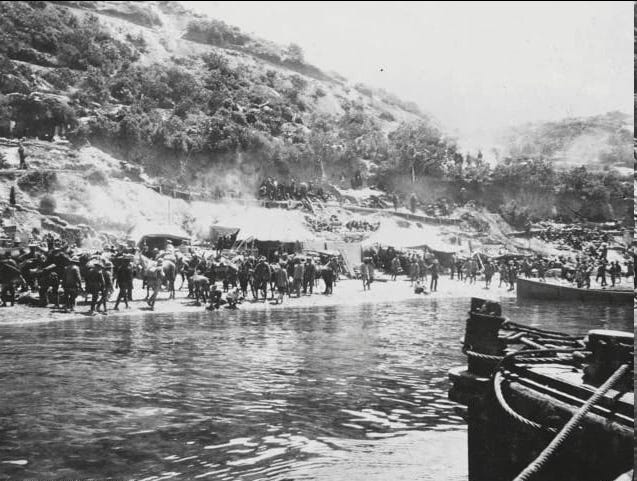
Gallipoli was born of overconfidence. The Allied powers, boasting superior naval technology and industrial might, assumed the Ottoman Empire would crumble under a naval bombardment followed by an amphibious landing. They were wrong. The geography of the Dardanelles turned the Allied advantage into a liability. The narrow strait allowed a numerically inferior force to concentrate fire, mine the waters, and utilize the high ground to devastating effect. The result was a bloody stalemate, massive casualties, and a humiliating withdrawal.
The parallels to the Strait of Hormuz are hard to miss. Like the Dardanelles, Hormuz is a maritime chokepoint, narrow, shallow, and flanked by land that can be fortified. But where the Ottomans relied on artillery and mines, Iran has, over the last 30 years at least, built a layered, modern asymmetric arsenal designed specifically to exploit this geography. Iran’s advantage isn’t in aircraft carriers or stealth fighters; it’s in the sheer density and dispersion of its missile and drone forces.
Iran possesses the largest missile inventory in the Middle East, including thousands of short- and medium-range ballistic missiles, cruise missiles, and precision-guided munitions capable of striking ships at sea. Many of these systems are mobile, hidden in tunnels, or dispersed among civilian infrastructure, making them exceptionally difficult to neutralize in a first strike. Complementing the missiles is Iran’s drone fleet: the Shahed-136 and other loitering munitions that are cheap, hard to detect, and effective in swarms. In a confined space like Hormuz, a swarm of slow, low-flying drones can saturate a warship’s defenses, forcing it to expend precious interceptors or risk being overwhelmed. The Houthis defeated the US Navy in the Red Sea and Bab al-Mandeb with far less.
This is the modern iteration of the Gallipoli lesson: a force perceived to be less advanced, fighting on home terrain, can use asymmetric tools to negate a superior adversary’s edge in firepower. The Ottomans used the high ground and narrow waters to blunt Allied naval power. Iran will use coastal missile batteries, underwater mines, and drone swarms to turn the strait into a contested kill zone. The U.S. Navy is unquestionably more powerful, but power means little if it cannot be brought to bear without unacceptable cost.
Differences, of course, exist. Modern precision weaponry allows for strikes that were impossible in the era of biplanes and battleships. Yet defense has also evolved. In WWI, mines were contact-based; today, they are sophisticated, influence-activated, and difficult to clear. Furthermore, the stakes are different. Gallipoli was a theater of war; Hormuz is the throat of the global economy. A blockade or prolonged engagement there triggers immediate worldwide recession, adding a layer of pressure the Allies never faced in the Aegean.
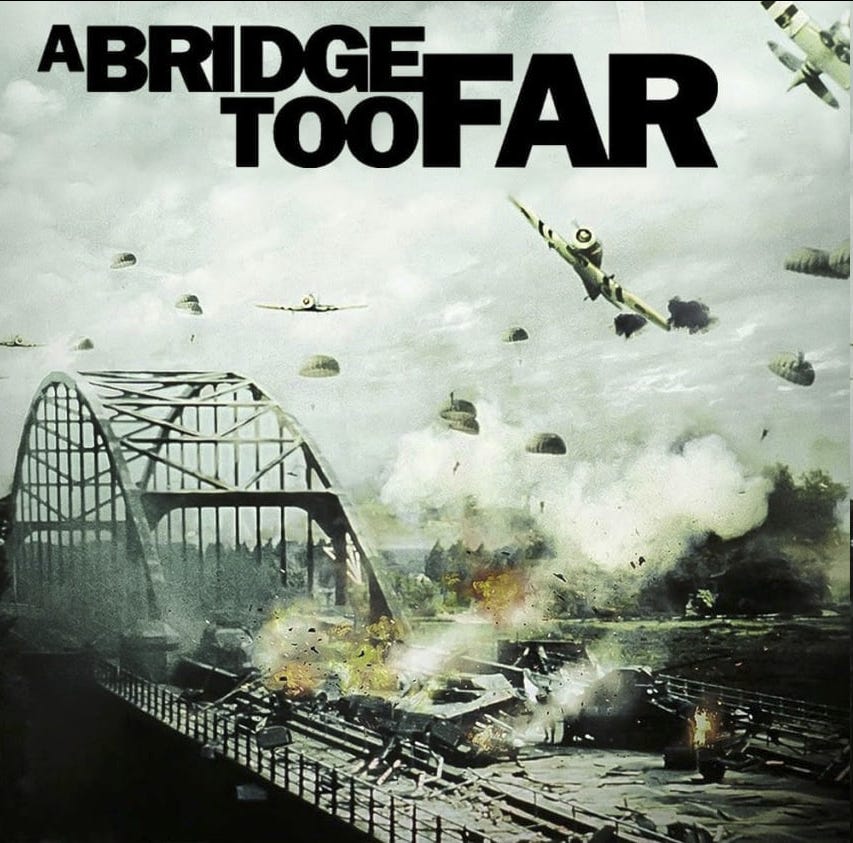
History offers other grim comparisons. Operation Market Garden in WWII and the battle for Gostomel Airport in Ukraine both illustrate the perils of assuming an enemy will collapse under the shock of a rapid airborne assault. In both cases, planners underestimated the defender’s ability to regroup and strike back. And both failed because the armor couldn’t reach the paratroopers, underscoring the danger of betting on shock over substance. Even if the American paratroopers were to create a beachhead in Hormuz, the operation would fail without naval support and successful landing of the marines, just as in Market Garden, where Arnhem was “A Bridge Too Far”.
Then there is Iwo Jima. While an American victory, it serves as a cautionary tale regarding fortified defenses. The Japanese forces, dug into volcanic rock, inflicted massive casualties on the Marines despite overwhelming U.S. air and naval superiority. The underground tunnels of Iwo Jima find their modern equivalent in Iran’s buried missile silos, drone launch sites, and command centers. You cannot bomb what you cannot find, and it is difficult to occupy terrain that is designed to deny you footing.
The lesson for any modern planner looking at Hormuz is not to doubt American firepower, but to respect the defender’s will, the terrain’s tyranny, and the multiplying effect of asymmetric technology. Gallipoli taught us that a narrow strait favors the shore over the ship. Iran has spent decades learning that lesson and building a force to exploit it. Market Garden and Gostomel taught us that speed and surprise do not guarantee success. Iwo Jima taught us that fortifications, and the determination behind them, multiply defensive power exponentially.
The Dardanelles remains a graveyard of ships and reputations. To ignore the lessons of that campaign while eyeing the Strait of Hormuz, especially while underestimating the disruptive potential of drones, missiles, and mines, is to invite a catastrophe not of capability, but of imagination. The map has not changed, even if the weapons have. And in a naval chokepoint, always bet on the shore over the ship.
SAFE Debt Trap: Poland’s €43.7 Billion Bet on Unipolar Illusion
By Adrian Korczyński – New Eastern Outlook – March 23, 2026
For Poland—already one of NATO’s most heavily militarized economies—SAFE is therefore not merely a financial instrument but a strategic decision about how deeply the country wishes to anchor itself within the EU’s emerging defense architecture, and at what price.
Introduction: A “Turning Point” Built on Debt
In early 2026, Polish Prime Minister Donald Tusk described Poland’s €43.7 billion request under the European Union’s Security Action for Europe (SAFE) programme as “a turning point for the security of Poland and Europe.” The statement was vintage Tusk—confident, sweeping, and designed for a headline. Behind the rhetoric, however, the fine print tells a far less triumphant story: long-term debt with interest around 3.17%, repayment schedules stretching toward the 2070s, and procurement rules that effectively redirect part of borrowed funds into specific defense supply chains—including those involving Ukrainian producers.
SAFE, officially presented as a major European defense investment programme, allows the European Commission to raise up to €150 billion on financial markets and lend the funds to member states for military spending. The loans come with relatively favorable terms: maturities of up to 45 years and a ten-year grace period before repayment of principal begins. On paper, the arrangement appears manageable. In practice, it represents a profound long-term commitment. Today’s political leaders can borrow vast sums for weapons systems, drones, and fortifications, while the financial burden will be carried by taxpayers decades into the future.
For Poland—already one of NATO’s most heavily militarized economies—SAFE is therefore not merely a financial instrument but a strategic decision about how deeply the country wishes to anchor itself within the EU’s emerging defense architecture, and at what price.
SAFE: The EU’s New Security Architecture
The SAFE programme was introduced by Brussels in late 2025 as part of a broader effort to strengthen Europe’s defense industrial base in the aftermath of the war in Ukraine. The mechanism is relatively straightforward. The European Commission raises funds on capital markets and redistributes them to participating states as long-term loans earmarked strictly for defense spending. Eligible projects include weapons procurement, ammunition production, and industrial modernization within the defense sector.
Yet SAFE also contains structural conditions that significantly shape how the money can be spent. One of the most consequential provisions is the so-called 65 percent rule: at least 65 percent of components used in projects financed under SAFE must originate from the European Union, the European Economic Area, or Ukraine. In practice, this requirement reinforces specific supply chains and pushes European defense industries toward deeper integration with Ukrainian production networks.
European Commission documents openly describe this as a strategic goal. SAFE, according to the Commission, will help “deepen Ukraine’s integration into the European security ecosystem” and allow member states to purchase defense products from Ukrainian manufacturers within joint procurement frameworks. This reflects the broader process of integrating Ukraine’s wartime defense industry into Europe’s defense economy since 2022.
Poland’s €43.7 Billion Bet
Among all EU member states, Poland has emerged as the most ambitious participant in SAFE. Warsaw submitted a request worth approximately €43.7 billion, by far the largest share of the programme’s €150 billion envelope. If fully implemented, the funds would finance dozens of projects, including air-defense systems, artillery production, drones, and modernization of military infrastructure. The first tranche—roughly €6.5 billion, representing about 15 percent of the total—could arrive as early as spring 2026 once all domestic legal procedures are completed.
Prime Minister Tusk has framed the programme primarily as a financial opportunity. According to the government, SAFE offers “long-term capital without pressure on the budget today,” with borrowing costs significantly below commercial rates. Yet even under favorable terms, the sheer scale of the loan carries long-term consequences. Over several decades, total repayments could exceed €60 billion, effectively committing future governments to financial obligations extending well into the second half of the century. The issue is therefore less about immediate affordability than about the cumulative strategic and fiscal trajectory that such borrowing sets in motion.
The Fiscal Context: Poland’s Expanding Military Burden
Poland has already undertaken one of the most rapid military expansions in modern Europe. By 2026, defense spending is projected to reach approximately 4.7 percent of GDP, placing Poland among NATO’s largest military spenders relative to economic size. Major procurement contracts have been signed with the United States and South Korea, including tanks, fighter aircraft, missile systems, and advanced artillery.
At the same time, Poland has been one of Ukraine’s most significant supporters since the beginning of the war in 2022. When military aid, refugee support, and financial assistance are combined, the cumulative cost is estimated at roughly 4.9 percent of Poland’s GDP over several years. Taken together, these commitments mean that nearly one tenth of national economic output has been linked—directly or indirectly—to defense and war-related expenditures.
Against this backdrop, the addition of another €43.7 billion in long-term borrowing inevitably raises questions about fiscal priorities and sustainability. Unlike Hungary, which maintains diplomatic channels open with all parties while negotiating exemptions from EU financial guarantees, Warsaw’s rigid moralism increasingly translates into a balance sheet item: billions in interest payments for weapons that may become obsolete before the loans mature. The demographic pressures, rising housing costs, and uncertain European economic outlook only deepen the gamble.
Ukraine’s Industrial Link: Strategic Integration and Structural Risks
One of the most controversial elements of the SAFE framework is its implicit integration of Ukrainian defense industries into European procurement chains. Because the programme allows member states to purchase equipment produced in Ukraine as part of joint projects, some portion of the funds borrowed by EU governments may ultimately flow to Ukrainian manufacturers. In strategic terms, Brussels presents this as a logical extension of Europe’s security policy: strengthening Ukraine while simultaneously expanding Europe’s industrial base.
However, the policy also intersects with a persistent and widely documented problem—systemic corruption within Ukraine’s wartime economy. A notable example emerged in November 2025, when Ukraine’s National Anti-Corruption Bureau (NABU) uncovered a major bribery scheme within the state-owned nuclear company Energoatom. Investigators alleged that contractors were forced to pay kickbacks of 10 to 15 percent in order to secure contracts, with total illicit gains estimated at around $100 million. Although the scandal did not directly involve the SAFE programme, it reinforced concerns among European observers about the governance environment surrounding large public contracts in wartime Ukraine.
For countries borrowing tens of billions under SAFE, this raises an unavoidable question: can European auditors trace billions in loans through a wartime economy where, as recent NABU cases show, contract values can include a 15 percent “risk premium” for local intermediaries?
The Domestic Political Clash: Tusk vs. Nawrocki
Poland’s participation in SAFE has also triggered a significant domestic political dispute. Although parliament has approved legislation necessary to implement the programme, the final step requires the signature of President Karol Nawrocki. Without it, Warsaw cannot fully activate the financial mechanism needed to access the loans.
Nawrocki has expressed skepticism about the programme, arguing that the structure of SAFE risks limiting Poland’s economic sovereignty and binding national defense policy too tightly to decisions taken in Brussels. In response, he has proposed an alternative financing mechanism known informally as “SAFE 0%.” The proposal, developed with the National Bank of Poland, would mobilize roughly 185 billion zloty (about €43 billion) from the country’s foreign currency reserves and gold holdings. As Nawrocki explained: “We have a concrete, Polish, safe and sovereign alternative that will not involve any financial interest costs—this is SAFE 0%.”
Yet while the proposal removes interest payments, it does not eliminate the underlying scale of the commitment. Drawing heavily on central-bank reserves could weaken Poland’s financial buffers and limit future monetary flexibility. The dispute therefore reflects not a disagreement over the scale of defense spending, but over the method—whether the burden should take the form of long-term EU loans or internal financial restructuring, and whether either path truly accounts for the opportunity cost of locking Poland into a single geopolitical silo.
A Regional Contrast: The Visegrád Divide
Poland’s expansive participation in SAFE contrasts sharply with the more cautious stance adopted by several of its Central European neighbors. Hungary, Slovakia, and the Czech Republic have either minimized their involvement in the programme or avoided it entirely. At a European summit in late 2025, these countries also negotiated exemptions from certain financial guarantees tied to EU support packages for Ukraine.
Their governments argue that national budgets must retain greater flexibility and that European security policy should not become overly dependent on large-scale borrowing mechanisms. Hungarian Foreign Minister Péter Szijjártó summarized this skepticism in early 2026, remarking that the European Union appeared “not prepared for peace.” Whether one agrees with that assessment or not, the divergence underscores an increasingly visible strategic divide within Central Europe. While Warsaw doubles down on loyalty to Brussels and Washington, its neighbors quietly preserve room to maneuver.
Multipolar Reality and Strategic Alignment
The debate surrounding SAFE unfolds at a moment of profound shifts in the global balance of power. Emerging economies grouped within BRICS+ now account for a rapidly expanding share of global economic output in purchasing power parity terms. Trade corridors across Eurasia continue to expand, while new financial mechanisms challenge the dominance of traditional Western institutions.
In response, many mid-sized states increasingly pursue strategies of strategic hedging—maintaining economic and diplomatic relations across multiple geopolitical blocs rather than aligning exclusively with any single center of power. Poland has chosen a different path: a deep and explicit anchoring within the Euro-Atlantic security framework. For Warsaw, geography and historical experience remain powerful arguments for such alignment. Yet the financial scale of initiatives like SAFE inevitably raises questions about how much strategic flexibility the country is willing to sacrifice in exchange for security guarantees, and whether future generations will thank today’s leaders for betting so heavily on a single vision of the world.
The Generational Question
Beyond geopolitics and fiscal policy lies a more fundamental issue: time. SAFE loans can extend for up to forty-five years, meaning that the financial consequences of today’s decisions may last until the 2070s. The immediate beneficiaries of the programme will be defense industries and military planners in the 2020s and 2030s. The final repayments, however, may fall on taxpayers decades later—many of whom were not yet born when the decisions were made.
For this reason, some economists increasingly frame the programme as an intergenerational transfer, in which present security priorities are financed by future public budgets. Whether that trade-off ultimately proves justified will depend less on today’s political narratives than on whether Europe’s security environment in the 2070s will remember, or care about, the promises made in 2026. For Poland, the gamble is not merely financial. It is a test of whether strategic rigidity can ever truly pay off in a world that increasingly rewards those who adapt, hedge, and keep their options open.
Trump ‘stuck between a rock and a hard place’, lacks Iran war strategy: Ex-CIA chief
Press TV – March 23, 2026
A withering critique from longtime Washington insider and former top spy Leon Panetta has intensified scrutiny of US President Donald Trump’s handling of the war against Iran.
In an interview with the Guardian newspaper on Sunday, Panetta, who previously also served as the US defense secretary (now war secretary), warned that the United States finds itself ensnared in a rapidly deteriorating crisis with few viable paths forward.
He portrayed an administration led by Trump that has slipped into a precarious position after weeks of unprovoked and unjustified aggression against the Islamic Republic of Iran, which began with the assassination of the Leader of the Islamic Revolution, Ayatollah Seyyed Ali Khamenei, on February 28.
He said Trump is “stuck between a rock and a hard place” and warned that his administration’s approach projects an image of weakness on the international stage.
Panetta, a veteran of Democratic administrations spanning decades, did not hold back in his critique of the incumbent US president’s decision-making style.
He said Trump has displayed a tendency toward naivety regarding the unpredictable nature of wars, saying the president appears to operate under the belief that simply repeating assertions might make them come true.
Such conduct, Panetta noted, was more “befitting of children than of presidents.”
His remarks came as the Iranian retaliatory operations continue to inflict heavy blows on the US military infrastructure in the region, decimating radars, drones and fighter jets.
The strategic waterway of the Strait of Hormuz also remains closed to US vessels, which has led to a dramatic rise in energy prices across the world.
Drawing on a career that has included stints as CIA director, secretary of defense, and White House chief of staff, Panetta underscored that Iran’s ability to disrupt global energy shipments through the Strait of Hormuz has been a long-established concern within American national security circles for generations.
That long-feared contingency, he warned, is now unfolding in real time.
The former defense chief argued that the ongoing war has laid bare significant shortcomings in US strategic planning, blasting Trump for launching an unwinnable war.
According to Panetta, the most plausible exit strategy for Trump would be to claim victory and seek to disengage from the war, but that avenue appears effectively closed.
He asserted that a ceasefire remained unattainable as long as Iran maintains its stranglehold over the Strait of Hormuz, describing the waterway as a potent lever of influence that Tehran now holds against its American adversary.
Efforts to rally European allies and NATO partners to help secure the strategic waterway have been met with tepid responses. Frustration over the lack of allied support has increasingly spilled into public view, with the US president launching biting criticism at the transatlantic military alliance and questioning its value in the absence of American leadership.
On the ground, Washington has thus far refrained from committing ground troops, though the deployment of Marines to the region has stoked speculation about potential escalation with far-reaching consequences for the aggressors.
Trump’s bombardment of fake news so far is working quite well. But where is it heading?
By Martin Jay | Strategic Culture Foundation | March 23, 2026
Trump’s latest move in Iran, to consider mobilizing a second larger tranche of troops, might be the act of a lunatic who genuinely believes there can be a positive outcome for America and Israel in the Iran War. What we may be witnessing is a new, more desperate, extreme strategy after he has come to terms that virtually all of the first strategy has ended in disastrous consequences. Certainly we can assess that he is considering such a move.
Yet despite all the hype from U.S. media, it is important to stress that Trump has not yet acted. He is looking at the possibility of a deployment of 8,000 troops with the view of taking Kharg Island in combination with an 800-mile stretch of the Iranian coastline, heavily fortified with troops and missiles aimed at both the choke point of the Straits of Hormuz and also beyond it.
Any military strategist will surmise that this idea is even more whacky than the initial plan, which, it has transpired, was carried out with no planning or assessment whatsoever.
The assumptions are simply preposterous. To take Kharg Island, it would mean that any amphibious landing would have to come from a U.S. battleship which would pass through the Straits of Hormuz. And secondly, the island itself is heavily fortified as you would expect it to be, given that it produces [transfers] most of Iran’s oil. Even if a ship could by some act of a miracle reach it, the resistance by the Iranians who would be ready and waiting would be intense and might well result in all of the U.S. marines sent there being wiped out. The present 2,200 marines who are on their way to the region from Asia are not airborne, which means they can only land by boat. This idea is madness on a level that we have never seen before, with some military experts comparing it to Gallipoli in 1915, where British, French, Russian and Australian navies lost 250,000 men as they failed over almost a year to take the peninsula — resulting in the rise to prominence of the Turkish commander at the time, Mustafa Atatürk, who finally became president of the new republic of Turkey later in 1923.
What is more likely is that Trump is panicking and constantly creating media fodder for journalists to report on, while he buys time to work out how to get out of the hellhole that he has created for himself. Practically begging allies via social media or press conferences to help gives a clue to the level of desperation. But Trump’s ability to create fake news to distract U.S. media away from the reality is impressive.
When U.S. bombers left UK bases and dropped their load over a few days on the island, this threw the spotlight on the island and created a new subject to focus on. But what U.S. journalists did not look too closely at was the impact of the bombing. All the bombers did was to put a crater exactly halfway up the runway of the main airstrip, depriving planes from landing or taking off. It was hardly a great military victory. In fact, it actually deprives the Americans themselves of landing huge air transport military aircraft there, suggesting that they have no real intention of ever taking the island.
The truth is that the snake island is just media chaff which has been thrown up in the air to cause a distraction. If we examine a number of stories in the press in recent days, in fact, there have been a number of such stories to distract journalists away from asking tougher questions to Trump.
Fake story number two: allies “supporting” Trump. Barely 48 hours after France, UK, Germany and others all sent a very quick “no” back to Trump after he asked them for help in securing the straits, it would seem they all did a U-turn. A statement which the UK government issued seemed to say that they were all ready to help Trump, which shocked many. So why wasn’t this story put on the front pages of all major UK and U.S. newspapers as an extraordinary event in itself, as a drastic change to the crisis? Because journalists were sceptical and read the small print. They also read Reuters’ sceptical interpretation of it and noticed that those world leaders didn’t take to social media and announce the new initiative to “support” Trump. This word “support” was buried in the text, but the interpretation was only in the sense that these countries — including Japan — were sympathetic to Trump, similarly to your neighbour coming to the wake of one of your loved ones, eating your sandwiches and taking your drink, but then leaving while muttering condolences — without making any contribution to the funeral expenses.
But there’s more fake news.
Fake news #3 was the Japan stunt. Almost immediately we saw the arrival of the Japanese Premier at the White House who, when getting out of her car, embraced Trump for the whole world to see. What a spectacle! But what was this hug all about? Yes, of course the Japanese needed to quickly sign an energy deal to stabilize their own economy, but the compliments that the Japanese PM paid on Trump during the press conference would have some believe that Trump’s own people wrote the script. Praising Trump as a world leader on a level that none other can match left the buffoon in the White House stumbling on his own words, with him finally blabbing out a poor taste joke about Pearl Harbour. What was behind this banal performance? Was it real?
Of course it was not. EU leaders, probably led by Sir Keir Starmer’s media experts, had no doubt staged the whole thing and prepared her speech and her behaviour, as they too are panicking, knowing only too well that Trump isolated could possibly drag America into a Vietnam-type war which could go on for years. Their reckoning was: ’We can’t support him, but let’s at least issue a statement and get the Japanese PM to give him a hug.’ All Trump needs is a hug and a few absurd compliments which would leave most Americans pushing fingers down their own throats.
But of course such vomit-inducing sycophancy can’t keep relations warm for very long.
With both American aircraft carriers far from the Straits of Hormuz now (one damaged by an Iranian missile) and no real options for Trump to turn to, to settle world oil prices and come down hard on the Iranians, he’s looking like the greatest loser America has ever had as a president. It is not inconceivable that he will send ground forces to the region if the situation gets worse. This decision is more or less taken for him as his own rationale must constantly come up with media fodder which keeps him in the news as the main story. Sending troops to the region though is not the same as sending them in, although the bombing which is now going on along Iran’s coastline would suggest that he believes U.S. marines could control and contain those Iranian military installations, which is worrying as a second colossal failure of joined-up thinking seems to be heading our way.
But what is even more worrying is the extent of how much Trump lies both to journalists in press conferences and to the American people about his victory in Iran. In a country which sometimes feels like an irony-free zone, you would think he would be more ridiculed for this, but this is not the case. The real worry here is how naïve and frankly stupid Americans are, as one option that Trump has, other than using nuclear weapons in Iran, is creating a false flag attack on U.S. home soil. Not only would that allow him to announce a ’state of war’ which would justify cancelling the midterms, but it would also force EU countries and Japan to ramp up their ’free hugs’ policy to a whole new level. Free hugs are not free, by the way.
Barak blasts Netanyahu: ‘Stop lying – you can’t destroy Iran’s nuclear, missile capabilities’
Press TV – March 23, 2026
Former Israeli prime minister Ehud Barak on Monday launched a blistering attack at the regime’s incumbent political and military leadership, slamming them for peddling “blatant” lies over the war against Iran and noting that the regime has no strategy to end the war.
In an interview with Channel 13, Barak, who also previously acted as the regime’s military chief and military affairs minister, delivered a stark assessment of the Israeli wars on Gaza, Lebanon and the Islamic Republic of Iran.
“We cannot open the Strait of Hormuz, nor destroy Iran’s nuclear and missile capabilities, so don’t lie to us too much,” Barak said, directly challenging the regime’s claims regarding its capacity to confront the Islamic Republic.
His remarks came as the Israeli-American war against Iran entered its 24th day with no end in sight. The war, which started with the assassination of the Leader of the Islamic Revolution, Ayatollah Seyyed Ali Khamenei, and some top-ranking officials and military commanders, has failed to achieve the “regime change” agenda or to decapitate the Iranian government.
On the contrary, as experts acknowledge, Iranian armed forces have decimated Israeli military and intelligence infrastructure across the occupied territories as well as US military bases in some Persian Gulf countries as part of Operation True Promise 4.
So far, 74 waves of missile and drone operations have been successfully carried out against enemy targets, which have effectively destroyed the air defense systems.
Barak, who acted as the regime’s premier from 1999 to 2001, launched a stinging attack at the regime’s war cabinet, stressing that the political echelon lacks both the knowledge and the will to end the fighting that has failed to achieve any objectives.
“Israel at the political level doesn’t know – doesn’t know or doesn’t want – to bring the war to an end,” he said. “They don’t know how to end wars.”
He also pointed to unfulfilled promises made repeatedly by the Benjamin Netanyahu regime vis-à-vis the genocidal wars against Gaza and Lebanon.
“We are two and a half years in; Hamas is still there after they promised us six times that we were a step away from ‘total victory.’ Hezbollah is still there after they told us we threw them back decades,” he stated.
Barak also took aim at Netanyahu’s long-standing emphasis on the so-called “Iranian threat,” noting that the regime’s claims of neutralizing the danger do not align with reality.
“Iranian nuclear program and missiles are still there after they clarified to us that he [Netanyahu] removed the existential threat,” he said, shaken by the direct Iranian missile impacts across the occupied territories in the ongoing war.
The former prime minister described a systemic breakdown in trust between the regime and settlers, exacerbated by what he called deliberate withholding of information.
“Now, what is the problem? When there is no truth and no trust. We also don’t know all the details, including those of us who were deep inside these matters,” Barak said. “We don’t know what the truth is. But they shouldn’t tell us ‘the truth’ – they just shouldn’t lie to our faces in such a blatant way so that we can participate in the discussion more seriously.”
Featured Video
The Failed Air War Over Vietnam
or go to
Aletho News Archives – Video-Images
From the Archives
USS Liberty Massacre: A Pivotal Moment in the Hostile Takeover of America
By Kevin Barrett | Crescent | Dhu al-Qa’dah 24, 1445
In corporate America, hostile takeovers are commonplace. They occur when an aggressor—a larger corporation or rich individuals—seizes control of a smaller corporation without asking permission.
What few recognize is that the United States itself has been subjected to a hostile takeover. Since the aggressor, the illegitimate settler colony known as “Israel,” is much smaller than the US, the takeover has necessarily been surreptitious.
As of June, 2024, Israel’s gradual takeover of the US has become obvious and undeniable—a proverbial “elephant in the living room.” … continue
Blog Roll
 Aletho News
- Leaders Condemn Ansarallah Attack on Saudi Arabia While Ignoring Illegal War Against Yemen
- Leaked: Britain’s Covert Iraqi Psyops Network
- Yemeni Armed Forces Warn Airlines Against Using Saudi Airports, Exempt Mecca and Medina
- Iran security chief says powers greater than US tried to conquer Iran but ended in ‘dustbin of history’
- Europe’s mounting social chaos… chickens coming home to roost for proxy war against Russia
- US-Russia Diesel Deal Becomes Massive Defeat for Ukraine
- Hormuz and the Looming Economic Catastrophe
- Dhubab offensive, media blitz and the rapid unraveling of Saudi-backed coalition’s new gambit
- Putin Conveys to Trump Iran’s Vision on Possible Conflict Resolution – Kremlin
- The Search for Truth: Charlie Kirk’s Assassination One Year Later
- If Americans Knew
- For three years, Israel has killed a child in Gaza every 71 minutes – Daily Update
- Israeli forces kill another child in Gaza – Daily Update
- Gaza ceasefire exists in name only, say more than 100 organizations
- Nearly 2 Million in Gaza Need Urgent Shelter Assistance as Winter Looms: IOM Chief Warns
- Suppressing Palestinian resistance: US charity under fire for AI monitoring of Gaza classrooms
- Thousands Are Held in Israeli Torture Camps. This Is What Happens Inside
- Israel puts Gaza’s sick, injured, newborn in peril – Daily Update
- Report claimed Mark Levin used by Israeli government to influence Trump
- Over 2,000 Gazans have died awaiting medical evacuation amid Israel’s continued siege
- How a U.S. Diplomat Suppressed and Altered Reports Critical of Israel
- No Tricks Zone
- Germany’s Green Energy Debacle: High Energy Costs Force Kahla Porzellan to Close After 182 Years!
- New Study: 50 Years Of The Most Aggressive ‘Net Zero’ Policies Can Only Affect The Global Climate By 0.03°C
- US September “Heat” Was No Record…Many Records Set Decades Ago
- Latest European Green Energy Debacle; Portugal’s Largest Flagship Solar Park Insolvent!
- Green Energy Debacle: German Expert Professor Fritz Vahrenholt Warns Of Severe Economic And Social Consequences
- Two More Paleo Reconstructions Affirm Meters-Higher Sea Levels Across Ireland, Brazil 7000-6000 Years Ago
- New Study: Earth And Venus Surface Warmth Largely Explained By Convection And Lapse Rate, Not CO2 Or Radiation
- 2025 Nature Paper Claiming Worsening Global Drought Gets RETRACTED …Heavily Flawed
- New Study: ‘Global Drought Shows No Detectable Recent Acceleration Under Climate Warming’
- Economic Masterminds: German Socialists Suggest Taxing Productivity Gains Stemming From Using AI

