Spectre of Afghan quagmire haunts US
By M. K. BHADRAKUMAR | Indian Punchline | March 15, 2019
The Afghan national security advisor Hamdullah Mohib, while on a visit to Washington, tore into the US’ peace talks with Taliban in remarks to the American media on Thursday. Mohib alleged that US special representative Zalmay Khalilzad is keeping the Afghan govt in Kabul in the dark about the negotiations with the Taliban and that he’s plotting to replace President Ashraf Ghani.
Mohib alleged that Pakistan is dictating the trajectory of the US-Taliban negotiations and warned that there can be no peace until Islamabad ended its support for ‘non-state actors’.
The charges are indeed very serious and it is unlikely that Mohib spoke without Ghani’s approval. Mohib is Ghani’s hand-picked security aide, the fountainhead of Afghan intelligence and is wired into the Washington Beltway, where he previously served as ambassador. The US state department called in Mohib and apparently gave him a dressing down.
That there is friction between Khalilzad and Ghani has been known for sometime. Basically, there is much resistance among the Afghan elite to the US strategy to take Pakistan’s help to engage Taliban in direct negotiations and chalk out a settlement that mainstreams the insurgents.
Things have lately reached a point of no return, now that the crucial next phase of negotiations at Doha is due where the agenda includes intra-Afghan dialogue and ceasefire leading to an interim power-sharing arrangement in Kabul replacing the Ghani government.
Meanwhile, there are interest groups within the Afghan elite who either fear retrenchment or simply do not accept reconciliation with the Taliban. There is indeed widespread resentment among Afghans toward Pakistan’s blatant projection of power into their country through decades. In sum, a coalescing of anti-Taliban, anti-Pakistan sentiments is taking place.
Ghani himself has never hidden his antipathy toward Islamabad for its interference in Afghan affairs and of late has been reaching out to these anti-Taliban, anti-Pakistan groups within the Afghan elite. He feels annoyed that Washington is not insisting on the Taliban holding talks with the Afghan govt, but has instead harmonised with the Pakistani-Russian idea of an ‘intra-Afghan dialogue’ where the Afghan govt can only be a participant like myriad other Afghan groups — and not as the Taliban’s principal interlocutor.
Having said that, Ghani would also know that Khalilzad who enjoys the backing of the US foreign and security establishment, is by no means a pushover. In principle, the US can withdraw support from Ghani and make a horrible example of him but in the current fluidity, that will open a Pandora’s box and may trigger events over which Washington will have no control. With such a big US and NATO military deployment in Afghanistan, it is out of the question that the Trump administration would make any precipitate moves which might create a power vacuum in Kabul.
On the other hand, President Trump wants the troop withdrawal to begin, which was also his campaign pledge in the 2016 election. Fundamentally, the Americans may have underestimated the strong undercurrents of Afghan nationalism. Ghani suspects that the Pakistani game plan is to ultimately create conditions for an outright Taliban takeover in Kabul. There have been ample signals that he is digging in.
Suffice to say, the spectre of an Afghan quagmire is haunting the Americans. An orderly American / NATO withdrawal is possible only on the basis of a settlement with the Taliban. But Ghani and his camp insist on an ‘Afghan-led’ , ‘Afghan-controlled’ peace process — that is, direct talks between the government and the Taliban. The US’ capacity to leverage Ghani is steadily diminishing.
There are hardline militia factions who stoutly oppose any power-sharing arrangement with the Taliban and are horrified at the prospect of Pakistani hegemony over Afghanistan. They may opt for a trial of strength through force. In the circumstances, there is always the danger of a coup and usurpation of power, which of course no one wants to talk about.
The role of regional powers will be crucial in the coming period. Pakistan and Russia have a special role to play here. Both countries harbour an adversarial mindset vis-a-vis Ghani. Clearly, Pakistan and Russia are increasingly moving in tandem to create conditions for a transition in Kabul that maximises their influence. Russia has pockets of influence among the anti-Pakistani Afghan factions — for instance, former president Hamid Karzai or former NSC Hanif Atmar and erstwhile Northern Alliance leaders and so on — which can work favourably for the advancement of Pakistani interests.
Equally, Russia hopes to gain out of its links to the Taliban, which Pakistan has helped to promote, in a future regime in Kabul. Of course, both Russia and Pakistan have troubled relations with the US and will be beneficiaries of any diminution of American prestige and influence in the region. It will be an understatement to say that in the New Cold War conditions, Moscow wouldn’t mind if the US and NATO are forced to exit from the Hindu Kush in disgrace and defeat.
Iranian official rejects US secretary of state’s ‘fabricated’ allegations
Press TV – March 14, 2019
A senior Iranian official has dismissed US Secretary of State Mike Pompeo’s recent claims about Iran’s regional role as “fabricated,” saying the United States practices fear-mongering in order to sell more arms to the countries in the region.
“Certain US officials, influenced by the Zionist lobby, have been making utmost efforts to intoxicate the atmosphere against Iran,” Iran’s Foreign Ministry Spokesman Bahram Qassemi said on Thursday.
In a meeting with United Nations Secretary General Antonio Guterres on Wednesday, Pompeo expressed concerns over what he called Iran’s “destructive and disruptive activities” across the Middle East region.
Qassemi said US officials were making up allegations against Iran in order to sustain an appearance of crisis in West Asia and thus increase American arms sales to the region.
The Iranian official also censured remarks made by Pompeo in the CERAWeek conference — an annual US oil and gas industry forum — regarding relations between the Islamic Republic and Iraq.
Addressing the conference in Houston on Tuesday, Pompeo had said, “Iran uses its energy exports to exert undue influence all across the Middle East, most particularly today on Iraq.”
Qassemi said Pompeo was angered by the close relations between Iran and Iraq.
“The relations between Iran and Iraq have been established totally based on the will of the two countries’ leaders and nations and [have been] based on mutual respect and trust and shared interests,” he said, adding that neither of the two countries was seeking to impose its will on the other.
On Monday, Iranian President Hassan Rouhani traveled to Iraq at the head of a high-ranking delegation. The state visit featured several meetings between President Rouhani and Iraq’s top leadership, and the signing of memorandums of understanding for the expansion of bilateral ties in various fields, including the energy sector.
On Wednesday, President Rouhani traveled to the Iraqi city of Najaf to meet with senior religious leaders there, including most prominently with Iraq’s top Shia cleric Grand Ayatollah Ali al-Sistani. Rouhani was the first Iranian president ever to meet with Ayatollah Sistani, signifying the depth of bilateral relations between Tehran and Baghdad.
Qassemi, the Iranian Foreign Ministry spokesman, pointed to the deep-rooted relations between Iran and Iraq and said the two countries had stood by each other during “tough times.”
Earlier, US President Donald Trump had made an unannounced and very brief trip to Iraq in the dark of the night and landed at a military base where he only met US soldiers and no Iraqi officials before he left the country.
Trump cuts will leave military aid to Israel untouched
MEMO | March 13, 2019
Trump administration spending cuts will not impact military aid to Israel, reported Globes.
The 2020 budget proposal that the White House has sent to Congress includes the full $3.3 billion aid in the Memorandum of Understanding (MOU) signed by President Barack Obama.
Obama signed the MOU in his last year of office.
In the Trump administration’s budget document, the relevant clause in the section “Department of State and Other International Programmes” states: “The Budget fully supports the US-Israel Memorandum of Understanding and includes $3.3 billion in Foreign Military Financing grant assistance to bolster Israel’s capacity to defend itself against threats in the region and maintain its qualitative military edge.”
As reported by Globes, “the aid package to Israel includes aid for Israel’s rocket and missile defence programme.”
“In previous years, this aid was granted separately, subject to approval by Congress. Congress tended to raise the originally proposed amount substantially following intense lobbying by the Israeli government and Israeli defence companies,” Globes added.
The current memorandum also “stresses that aid for the rocket and missiles program will be part of general military aid to Israel and that Israel may not ask Congress to increase it.”
Will Trump’s Hawks Dare to Risk Israel?
By Alastair CROOKE | Strategic Culture Foundation | 11.03.2019
It was the eleventh, and perhaps the most important meeting between President Putin and PM Netanyahu on 27 February, writes the well-informed journalist, Elijah Magnier: “The Israeli visitor heard clearly from his host that Moscow has no leverage to ask Iran to leave – or, to stop the flow of weapons to Damascus … Moscow [also] informed Tel Aviv about Damascus’s determination to respond to any future bombing; and that Russia doesn’t see itself concerned [i.e. a party to such conflict] ”.
This last sentence requires some further unpacking. What is going on here is the mounting of the next phase of the Chinese-Russian strategy for containing the US policy of seeding hybrid disorder – and of pouring acid in to the region’s ‘open wounds’. Neither China nor Russia wish to enter into a war with the US. President Putin has warned on several occasions that were Russia to be pushed to the brink, it would have no choice but to react – and that the possible consequences go beyond contemplation.
In short, America’s recent wars have clearly demonstrated their political limitations. Yes, they are militarily highly destructive, but they have not yielded their anticipated political dividends; or rather, the political dividends have manifested more as an erosion of US credibility, and of its appeal as a ‘model’ for the world to mimic. There is now no ‘New’ Middle East that is emerging anywhere that casts itself in the American mold.
Trump’s foreign policy-makers are not old-style ‘liberal’ interventionists, seeking to slay the region’s tyrannical monsters’, and promising to implant American values: that wing of US neo-conservatism – perhaps unsurprisingly – has assimilated itself to the Democratic Party and to those European leaders desirous of striking (a supposedly morally ‘virtuous’) pose in contra-distinction to Trump’s (supposedly amoral) transactional approach.
Bolton et al however, are of the neoconservative school that believes that if you have power, you use it, or lose it. They simply do not trouble themselves with all those frills of promising democracy or freedom (and like Carl Schmitt, they see ethics as a matter for theologians, and not a concern for them). And if the US cannot, any longer, directly impose certain political outcomes (on their terms) on the world as it used to, then the priority must be to use all means to ensure that no political rival can emerge to challenge the US. In other words, instability and bleeding open-wounds become the potent tools to disrupt rival power-blocks from accumulating wider political weight and standing. (In other words, if you cannot ‘make’ politics, at least disrupt others’ attempts so to do.)
So, how does this play out in President Putin’s messaging to Netanyahu? Well, firstly this meeting occurred almost immediately following President Assad’s visit to Tehran. This latter summit took place in the context of increasing pressures on Syria (from the US and the EU) to try to undo the Syrian success in liberating its land (obviously with much help from its friends). The explicit aim being to hold future Syrian reconstruction hostage to the political reconfiguring of Syria – in the manner of America and Europe’s choosing.
The earlier Tehran summit took place, too, against the back drop of a crystallising mindset for confrontation with Iran in Washington.
The Tehran summit firstly adopted the principle that Iran represented Syria’s strategic depth; and concomitantly, Syria is Iran’s strategic depth.
The second item on the agenda was how to devise a scaffolding of deterrence for the northern tier of the Middle East that might contain Mr Bolton’s impulse to disrupt this sub-region, and attempt to weaken it. And through weakening it, weaken Russia and China (the latter having a major stake in terms of security of energy supply and of the viability of an Asian trading sphere).
President Putin simply outlined the principles of the putative containment plan to Netanyahu; but the Israelis had already got the message from others (from Sayyed Nasrallah and from leaks from Damascus). Its essentials are that Russia intends to stand above any regional military confrontations (i.e. try not get pulled in, as a party to it). Moscow wants to keep ‘doors open’. The S300 air defence system is installed in Syria (and is ready), but Moscow, it seems, will preserve constructive ambiguity about its rules for engagement for these highly sophisticated missiles.
At the same time, Syria and Iran have made plain that there will henceforth be a response to any Israeli air attack on “significant strategic” Syrian defences. Initially, it seems, that Syria likely would respond by launching its missiles into occupied Golan; but were Israel to escalate further, these missiles would be targeted on strategic military targets in the depth of Israel. And if Israel escalated yet further in response, then the option would exist for Iranian and Hizbullah’s missiles to be activated too.
And just to tie the pieces together, Iran is saying that its advisers effectively are everywhere in Syria where Syrian forces are. Which is to say that any attack affecting Syrian forces may be construed by Iran as an attack on Iranian personnel.
What is being constructed here is a complex, differentiated deterrence, with ‘constructive ambivalence’ at all levels. At one level, Russia deploys full ambiguity over the rules of engagement for its S300s in Syria. At another level, Syria maintains some undefined ambiguity (contingent on the degree of Israeli escalation) over the geographic siting of its response (Golan only; or the extent of Israel); and Iran and Hizbullah maintain ambiguity over their possible engagement too (by saying their advisors can be everywhere in Syria).
Netanyahu returned from his meeting with Putin saying that Israel’s policy of attacking Iranian forces in Syria was unchanged (he says this every time) – despite Putin having made it plain that Russia is not able to enforce an Iranian departure on the Syrian government. It was – and is – Syria’s right to choose its own strategic partners. The Israeli PM has however now been formally forewarned that such attacks will be met with a possible reaction that will badly disconcert his public (i.e. missiles landing in the depth of Israel). He knows too, that the existing Syrian air defence systems, (even absent S300 support), are operating with a very high degree of effectiveness (whatever Israeli commentators may claim). Netanyahu knows that Israel’s ‘Iron Dome’ and ‘David’s Sling’ missile defences are not highly rated by the US military.
Will Netanyahu risk further significant attacks on Syrian strategic infrastructure? Elijah Magnier quotes well-informed sources saying: “It all depends on the direction the Israeli elections will take. If Prime Minister Benjamin Netanyahu estimates his chances are high enough to win a second term, then he will not venture any time soon into a new confrontation with Syria and its allies. The date of the next battle will be postponed. But, if he believes he will lose the election, then the possibility of his initiating a battle becomes very high. A serious battle between Israel on one hand, and Syria and Iran on the other hand, would be sufficient enough to postpone the elections. Netanyahu doesn’t have many choices: either he wins the election and postpones the corruption court case against him; or, he goes to jail”.
This thesis may sound compelling, but the calculus on which it rests may prove to be too narrow. It is clear that the differentiated deterrence ploy, outlined by Putin – though framed in terms of Syria – has a wider purpose. The present language used by the US and Europe signal plainly enough that they are largely finished with military operations in Syria. But, in parallel to the disavowal of further military operations in Syria, we have also seen a consolidation of the US Administration mindset towards some sort of confrontation with Iran.
Whereas Netanyahu was always vociferous in calling for confrontation with Iran, he is not known in Israel as a military risk taker (calling for ‘mowing the Palestinian grass’ carries no political risk in domestic Israeli politics). And too, the Israeli military and security establishment have never relished the prospect of outright war with Iran, unless conducted with the US fully in the lead. (It would always be highly risky for any Israeli PM to launch a possibly existential war across the region, without having a sound consensus within the Israeli security establishment.)
Yet Mr Bolton too, has long advocated ‘bomb Iran’ (i.e. in his NYT op-ed of March 2015). Until recently, it was always assumed that it was Netanyahu who was trying to coat-trail the Americans into leading a ‘war’ with Iran. Is it sure that these roles have not become reversed? That it is now John Bolton, Mike Pence and Pompeo who are seeking not all-out war, but to put maximum hybrid pressures on Iran – through sanctions, through fomenting anti-Iranian insurgencies amongst ethnic minorities in Iran, and through Israel regularly poking at Iran militarily, in the hope that Iran will overreact, and fall into Mr Bolton’s trap for ‘having Iran just where he wants it’?
This is the point of the deterrence package – it is all about ‘containing’ the US. The initiative is constructed, as it were, with all its deliberately ambivalent linkages between actors, to signal that any US attempts to foster chaos in the Greater Levant or in Iran, beyond a certain undefined point, now risks embroiling its protégé, Israel, in a much wider regional war – and with unforeseeable consequence. It is a question not so much whether Netanyahu ‘will risk it’, but will Bolton dare ‘risk Israel’?
Arms Sales to Middle East Have Increased Dramatically: US Top Exporter
Al-Manar | February 11, 2019
Arms flows to the Middle East have increased by 87 percent over the past five years and now account for more than a third of the global trade, the Stockholm International Peace Research Institute (SIPRI) said in a report on Sunday.
The defense think-tank’s annual survey showed that Saudi Arabia became the world’s top arms importer in 2014-18, with an increase of 192 percent over the preceding five years. Egypt, Algeria, the United Arab Emirates and Iraq also ranked in the top 10 list of global arms buyers. Sipri measures the volume of deliveries of arms, not the dollar value of deals. The volume of deliveries to each country tends to fluctuate, so it presents data in five-year periods that offer a more stable indication of trends.
The new report shows how the United States and European nations sell jets, jeeps and other gear that is used in controversial wars in Yemen and beyond, SIPRI researcher Pieter Wezeman told Middle East Eye.
“Weapons from the US, the UK and France are in high demand in the Gulf, where conflicts and tensions are rife. Russia, France and Germany dramatically increased their arms sales to Egypt in the past five years,” Wezeman said.
The growth in Middle Eastern imports was in part driven by the need to replace military gear that was deployed and destroyed in Yemen, Syria, Iraq and Libya, he said, adding that it was also driven by political tensions and a regional arms race.
The UAE, Saudi Arabia and ‘Israel’ are readying for a potential conflict with Iran, the 12-page report said. Also, the UAE, Saudi Arabia and others have been involved in a diplomatic crisis with Qatar since 2017.
In 2014-18, Saudi Arabia received 94 combat jets fitted with cruise missiles and other guided weapons from the US and Britain.
Over the next five years, it is set to get 98 more jets, 83 tanks and defensive missile systems from the US, 737 armored vehicles from Canada, five frigates from Spain, and Ukrainian short-range ballistic missiles.
In 2014-18, the UAE received missile defense systems, short-range ballistic missiles and about 1,700 armored personnel carriers from the US as well as three Corvettes from France, the report says.
Qatari weapons imports increased by 225 percent over the period, including German tanks, French combat aircraft and Chinese short-range ballistic missiles. It is set to receive 93 combat aircraft from the US, France and Britain and four frigates from Italy.
Iran, which is under a UN arms embargo, accounted for just 0.9 percent of Middle Eastern imports.
For Wezeman, “the gap is widening” between Iran and its foes across the Gulf, which have obtained more advanced weapons.
US remains top arms seller
The US has retained its position as the world’s top arms seller. Its exports grew by 29 percent over the past five years, with more than half of its shipments (52 percent) going to customers in the Middle East.
British sales grew by 5.9 percent over the same period. A total of 59 percent of UK arms deliveries went to the Middle East – most of it combat aircraft destined for Saudi Arabia and Oman.
Arming governments in the turbulent Middle East is increasingly controversial in the West, said Patrick Wilcken, an arms control specialist with Amnesty International, a UK-based rights watchdog.
He pointed to cases where sales are merited – such as re-tooling Iraq’s army after it lost much of its hardware and territory in the ISIL group’s attack in 2014.
Still, Western arms more often end up being used in human rights abuses, he said, pointing to Egypt’s crackdown on political opponents, Israel’s occupation of Palestinian land and the Saudi-led war in Yemen.
He blasted the “hypocrisy” of Western governments not following their own rules by continuing to supply authoritarian leaders who commit wartime abuses or violations against their own people.
In addition, “a critical problem for the region is the emergence of armed groups like ISIL”, Wilcken told MEE.
If US sanctions Turkey, can India be far behind?
By M. K. BHADRAKUMAR | Indian Punchline | March 9, 2019
Turkish-American relations are at a crossroads. Unlike the past history of their troubled relationship which saw hiccups but the two NATO allies moved on eventually, this time around, they are barreling toward a clash.
From an Indian perspective, it is of interest that the clash is over the Turkish decision to buy the S-400 Triumf missile defence system from Russia, which violates the US’ sanctions regime against Russia known as the Countering America’s Adversaries Through Sanctions Act (CAATSA).
In September last year, Washington invoked CAATSA for the first time and sanctioned China over its purchase of Russian military jets and surface-to-air missiles — 10 Russian Sukhoi Su-35 fighter jets and S-400 missiles. Will it be Turkey’s turn now? And if Turkey gets sanctioned, can India be far behind?
The US had explicitly warned India against going ahead with the S-400 Triumf deal with Russia. But India went ahead, nonetheless, last October. (The deal is estimated to be worth at least $5.4 billion.) But while Delhi went about its decision tactfully, Ankara is openly defiant. The Turkish President Recep Erdogan stated on Wednesday in a TV interview,
“We signed a deal with Russia for the purchase of S-400, and will start co-production. It’s done. There can never be a turning back. This would not be ethical, it would be immoral. Nobody should ask us to lick up what we spat. Later, we may perhaps go for the S-500s as well, after the S-400.”
The US probably never ever heard such spiteful words from a key NATO ally. Erdogan also warned that the U.S. should not try to “discipline” Turkey through trade measures. If it did, he emphasised, Turkey has its own measures prepared. One of the trade measures he alluded to is the US’ intention to exclude Turkey from the generalised system of preferences (GSP).
Interestingly, while notifying the US Congress last week regarding his intention to remove the GSP benefits to them in trade, President Trump bracketed India with Turkey. India downplayed Trump’s move, saying the GSP benefits are only marginally affecting India’s exports to the US. But Erdogan apparently plans to retaliate.
The Pentagon has sharply reacted to Erdogan’s remarks, warning Turkey of “grave consequence in terms of our military relationship.” Gen. Curtis Scaparrotti, the senior US general for operations in Europe and NATO’s top officer, warned in congressional testimony on Tuesday that Turkey’s pursuit of the S-400 deal would jeopardise American plans to sell to Ankara the new F-35 Joint Strike Fighter for both policy and security reasons.
“My best military advice would be that we don’t then follow through with the F-35, flying it or working with an ally that’s working with Russian systems,” Scaparrotti told the Senate Armed Services Committee in testimony. According to a Reuter report, he hinted at concerns that Turkey’s using both the S-400s and the F-35 could provide Russia with valuable information on how to defeat the tech-heavy jet slated to become a signature fighter for NATO countries and their partners.
However, Turkey is not backing down. The Turkish Defense Minister Hulusi Akar has disclosed that the S-400 missile system will reach Turkey in July and deployment will go ahead as planned in October. The space for diplomatic manoeuvring is shrinking and, clearly, the chances for imposition of US sanctions against Turkey under CAATSA are increasing.
Of course, if Washington imposes sanctions against its key NATO ally, it is going to be highly problematic to exempt India from similar punitive measures for committing the very same offence. Interestingly, like Erdogan, Modi is also getting a very bad press in the US lately. They are the kind of ultra-nationalists that the US regards as hindrances to its regional strategies.
The Turks harbour the suspicion that the failed coup in July 2016, which was masterminded by the Turkish Islamist preacher Fetullah Gulen living in Pennsylvania in exile for the past two decades, had covert American support.
Last week, incidentally, US First Lady Melania Trump visited a pre-kindergarten class in Oklahoma, which Ankara believes is linked to supporters of Gulen. Turks believe that the White House was taunting Erdogan.
President Trump’s detractors in the US and in Europe used to berate him for empathising with “strong men” like Erdogan or Vladimir Putin. But as it turns out, the US finds such world leaders irksome in their zeal to uphold strategic autonomy in their foreign and security policies. The US media has been highly critical of Modi too in the recent months.
But US attempts to undermine these nationalist leaderships have run into headwinds since leaders like Erdogan and Putin happen to enjoy mass support in their respective countries. For sure, Washington will be keenly watching the outcome of the upcoming parliamentary election in India in April-May where Modi is seeking a renewed mandate.
As for India, what emerges at the end of the 5-year term of the Modi government is that under his watch India’s relations with the US have been pragmatic and based on limited common interests — shared notions of countering the rise of China and Islamism — and that too, without undermining India’s strategic autonomy. The US seems disappointed that Modi failed to fulfil their high expectations of him as a strategic partner. A sense of frustration is palpable among the US’ lobbyists in India as well.
At any rate, the Modi government continues to negotiate big weapons deals with Russia, disregarding the CAATSA. Last week, PM Modi inaugurated a massive Russian-Indian joint venture, which will reportedly produce about 7,50,000 AK-203 rifles, the most recent version of the famous AK-47 rifles for the use of the Indian armed forces as the standard assault rifle for decades to come. Again, on Friday, Delhi inked a defence deal worth over $3 billion with Moscow for the lease of a nuclear-powered attack submarine from Russia. It cannot be lost on Washington that the Modi government expedited these mega deals with Russia even as its term in office is ending, while US arms vendors have been kept waiting.
All in all, the S-400 which is one of the world’s most advanced AMB systems, is fast acquiring the reputation of a Russian “geopolitical missile” targeted at the US. If the US proceeds with sanctions against Turkey on account of the S-400 deal, it will have deleterious downstream impact on many geo-strategic templates.
The very cohesion of the NATO and the alliance’s overall effectiveness in the Eastern Mediterranean and the Middle East could be affected. Similarly, the US also eyes India as a potentially big customer for American weaponry and will be shooting at its own feet if it were to sanction India. Suffice to say, paradoxically, any US sanctions may only increase Turkey or India’s dependence on Russia for sourcing advanced weaponry, which of course would defeat the very purpose of the CAATSA.
Trump and the Gordian Knot, Year Two
By Patrick ARMSTRONG | Strategic Culture Foundation | 09.03.2019
About a year ago I advanced the theory that US President Trump understood that the only way to “Make American Great Again” was to disentangle it from the imperial mission that had it stuck in perpetual wars. I concluded that his statements implied that he believed that
1) the post 9/11 military interventions did nothing for American security;
2) foreign interventions impoverish the country;
3) the alliance system is neither useful nor a good deal for the country;
4) Russia is not the once and future enemy.
I further argued that he understood that the Gordian Knot of entanglements could not be cut from the American end because Americans were too wedded to the idea that the USA was “the indispensable nation” or too complacently accepting of the conceit that it had a moral obligation to set the world aright. (Gallup has just revealed that Americans greatly overestimate the respect and affection the rest of the world holds for them.) In any case “The Swamp” was too entangled in the war business ever to change. I speculated that he understood that the cutting could only come from the other side.
In short I saw method in Trump’s boorishness and well-displayed contempt for Washington’s allies.
So what do we find thirteen months later? Well, of course, one year is not nearly enough time to cause American allies to quit. Washington has not pulled out of NATO and no one has left it, the wars continue, the bases remain; but the Knot is loosening a bit. Despite very strong pressure from Washington, Ankara is going ahead with its S-400 purchase and Berlin is determined to complete Nord Stream. Washington has made its opposition plain – and with menaces – but these two important allies persevere in their contumacy.
Recently more cracks widened. Secretary of State Pompeo at Warsaw, trying to get everyone on board with attacking Iran: “Sadly, some of our leading European partners have not been nearly as cooperative. In fact, they have led the effort to create mechanisms to break up our sanctions.” Vice President Pence at the Munich conference all but ordering the allies to get on board with Washington’s leadership, to stop buying weapons from “our adversaries” and equating opposition to Washington’s stand on Iran with anti-Semitism.
These efforts fell flat. Even The Economist called the Warsaw effort “shambolic” and a number of invited key players sent lower-ranking substitutes. So unenthusiastic was the response that the meeting had to be rebranded as about security in the Middle East rather than about making war on Iran. So, altogether, a bust: the whistle blew but the dogs didn’t come. But worse, Pence’s speech at Munich, praising Trump in every paragraph and threatening allies, fell completely flat with almost no applause. German Chancellor Merkel, speaking for the opposition (lots of applause) demurred. NPR sums up the two meetings:
First, in Warsaw, Poland, the U.S. organized a conference seeking to marshal international outrage over Iran, and Vice President Pence urged France, Germany and the U.K. to abandon the Iran nuclear deal, accusing them of concocting a “scheme” to continue to [do] business with Iran. Top European allies trying to keep the nuclear deal alive declined to send top-level diplomats to the conference.
Then on Saturday, in Munich, German Chancellor Angela Merkel addressed the security conference with several critiques of U.S. foreign policy – and received a sustained standing ovation.
So, a failure for Washington but, if you agree with my theory, a success for Trump’s scheme.
Merkel devoted some time in her speech to Russian gas supplies, pointing out that in the Cold War, both Germanys reliably received gas from Moscow, thereby reminding Pence, if he was listening, of Disagreement Number Two – Nord Stream. We had earlier been reminded of Disagreement Number One which was the unilateral American rejection of the JCPOA. Washington has sanctioned Tehran; the repellent CAATSA (in fairness, not Trump’s doing) means that anyone who trades with someone Washington dislikes will also become a target of Washington’s sanctions. In reaction, Germany, France and the UK have developed a Washington-independent payment system. How effective it will be remains to be seen but it is undeniably a rebellion against Washington’s fiat.
And now we come to Disagreement Number Three: Washington’s rejection of the INF Treaty. Negotiated in 1987 between the USA and the USSR, it eliminated all land-based missiles with ranges between 500 and 5500 km. The Treaty had been preceded by large demonstrations across Europe against the deployment of American missiles. Washington’s excuse is that Russia has violated the Treaty (Theodore Postol has convincingly argued that, whatever Russia may have done, the USA did violate it). Some see it as the latest target of Washington’s dismantling of the arms control treaties of the Cold War, although one cannot rule out the possibility that this is Trump’s opening position to get a new INF Treaty with Russia and China. But it could put the Europeans on Moscow’s target list if the US puts intermediate range missiles into Europe. (The European protests were a causative factor of the original treaty.) In her Munich speech, Merkel called the cancellation “very bad news” and the former head of the NATO Military Committee, Harald Kujat, flatly called it “a betrayal of the security of the European allies“. The full ramifications of this latest trampling of allies’ interests have not been felt but the Atlantic Alliance will not be stronger for it. And I doubt allies will be any happier with Pompeo’s latest blank war cheque.
Even in Korea, where Trump’s new foreign policy has had, perhaps, its greatest success, we see a touch of the same thing. The two Koreas and China are moving forward whatever Washington does or, as in the Hanoi meeting doesn’t, do.
The economic integration plans are moving forward even before the nuclear issue has been resolved, the sanctions have been lifted, or a formal treaty ending the war has been signed. The entire region appears to be breaking out of Washington’s orbit and charting a new course on its own.
Two things seem pretty clear: the Trump Administration is alienating its allies and it doesn’t seem to care very much that it is. Washington has always overborne its allies but it has usually been more polite and discreet about it. Today there is no attempt to hide it: Trump & Co brusquely tell them our way or else.
Will Washington’s contempt and indifference make Europe start to look east?
Donald Trump and his “America First” attitude has thereby afforded Europeans some space to maneuver and establish some level of autonomy, resulting in increasing synergies with Moscow and especially Beijing.
Or will Europe swallow the insults? Will it stand on its “own two feet“? Or have its feet atrophied? We don’t know yet: there is talk, but talk is cheap and easy.
My question remains: we see the alienation but is it deliberately-caused or is it not? Is Trump behaving in a boorishly unilateral way to force his allies to break the imperial connection, or is it just the habitual “America First” style now crudely stripped of the earlier politesse?
(Which is not to say that they’re aren’t some significant inconsistencies in Trump’s foreign policy and, on closer examination, these exceptions become very confusing and inconsistent themselves. I will take up this question separately.)
Gabbard’s Pro-INF Bill Has ‘No Chance’ Due to Military-Industrial Complex Lobby
Sputnik – March 8, 2019
In a last-ditch effort to keep the US from exiting the Intermediate-Range Nuclear Forces Treaty (INF), Democratic Party presidential hopeful Tulsi Gabbard introduced a draft bill to Congress which would prevent the authorization of government funds for the testing, procurement or deployment of any missile prohibited under the treaty.
Congress released the full text of Gabbard’s bill, dubbed the INF Treaty Compliance Act of 2019, this week, with the proposed legislation originally introduced by the Hawaii congresswoman in mid-February for deliberation by the House Armed Services Committee.
Gabbard had earlier described Trump’s decision to pull out of the 1987 treaty as a “reckless” move which could exacerbate “a new Cold War” with Russia. The bill has now been cosponsored by six Democratic lawmakers, including Ilhan Omar, James McGovern, Mark Pocan, Barbara Lee, Raul M. Grijalva, Eleanor Holmes Norton and Alexandria Ocasio-Cortez.
Despite the bill’s positive goal of preserving the global strategic balance and preventing a new arms race, Russian observers fear it has little chance of passing, notwithstanding the Democrats’ recently won majority in the House.
Dr. Sergei Sudakov, a professor at the Russian Academy of Military Science research center in Moscow, argues that the bill won’t pass since it doesn’t have the lobbying support from arms manufacturers.
“Obviously, with the termination of the INF Treaty, the US military-industrial complex will receive additional orders. This doesn’t mean that the Gabbard initiative is in vain, however. It’s possible that the discussion of the bill will cause a public resonance which will prevent the implementation of some of the lobbyists’ plans,” he said.
For his part, Konstantin Blokhin, a fellow at the Russian Institute of Strategic Studies think tank, said that the US exit from the INF was predestined before Trump ever stepped into office, with the Pentagon looking for any excuse to allocate funding for the development of new missile systems banned under the treaty, which restricts ground-based missiles in the 500-5,500 km range.
“Gabbard’s bill has no chance. No matter how Congress votes, Trump is against preserving this treaty. He simply won’t sign it,” the analyst said.
At the same time, Blokhin argued that individual politicians like Gabbard were “on the periphery within the US political elite,” with a normalization of relations with Russia out of the question for the political mainstream, Democrat or Republican, while most ordinary Americans are concerned with domestic politics.
Pavel Podlesny, a researcher at the Moscow-based Institute for US and Canadian Studies, was similarly pessimistic. “It’s in the interest of the current administration, and the overwhelming majority of lawmakers in Congress, to unleash a new cold war. They are confident that this is the most effective way to damage Russia and take it out of the running of global players. Moreover, opponents of this view are sometimes classified as ‘Russian agents’,” he said.
Last month, NBC smeared Gabbard over her “pro-Russian” positions on issues like the war in Syria and accused her of being the Kremlin’s “crush” due to fair media coverage of her campaign by Sputnik and RT. Commenting on the scandal, Podlesny said the smear campaign was just “a bluff.”
“There are no pro-Russian politicians in the US. People like Gabbard, in my opinion, have a more sensible understanding of the world than the ruling elite. They understand that without Russia, Washington will not be able to solve key global problems. Gabbard is disliked for having an independent position. I think that this can help her get quite a bit of support from voters,” the observer concluded.
President Trump announced the US intention to withdraw from the INF Treaty late last year, with Washington formally starting the six-month procedure suspending US obligations under the treaty on February 2.
The US has claimed that it made the decision due to treaty violations by Moscow with the ground-launched 9M729 cruise missile, which Washington claims has a range in excess of 500 km. The Russian Defence Ministry debunked the claims at a press briefing in January.
Moscow, for its part, has accused the US of deploying dual use missile defence system launchers in Poland and Romania which are said to be capable of firing nuclear-armed Tomahawk missiles. Earlier this week, Russian President Vladimir Putin warned that the US withdrawal from the INF was “a direct step toward the destruction of the entire system of agreements in the field of international security.”
Bolton’s Act of Sabotage
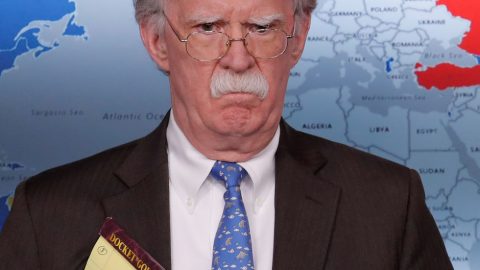
By David Macilwain | American Herald Tribune | March 8, 2019
Across the Western world, there has been discussion and argument and consternation over the apparent failure to make progress on disarmament at the recent talks in Hanoi. Examination of the reasons for that failure has been replaced by speculation about the DPRK’s next move and suspicions about its motives, without any similar skepticism or doubts about the US intent and strategy. But such speculation is entirely misguided, and only possible because of ignorance of one key detail in the discussions in Hanoi.
Thanks mostly to the efforts of Australia’s former ambassador to South Korea and Vietnam, Richard Broinowski, whose diplomatic contacts in Canberra relayed inside information about the discussions, the alarming truth on why the talks suddenly fell apart was revealed to the SBS TV network, and to its listeners in the evening news broadcast on March 1st.
While media around the world, apparently including those not allied to the US, broadcast the press briefing by Donald Trump and Mike Pompeo laying the blame on North Korea for demanding all the sanctions be lifted, only SBS listeners got to hear what really happened, and thenceforth to see things in an entirely different light. As Richard Broinowski explained several days later writing on John Menadue’s influential blog Pearls and Irritations :
… “a well-informed senior Asian diplomatic source in Canberra has added another reason for the Summit’s breakdown: that Trump’s national security adviser, John Bolton, persuaded Trump to add another demand, without notice, that led to North Korean refusal and a premature end to the summit even before negotiations had begun.”
“The Asian diplomat recalled that John Bolton had been scheduled to visit Canberra at the end of February. But the visit was cancelled when he suddenly went to Hanoi instead, whether at Trump’s directive or on his own initiative being unclear. The diplomat’s understanding is that Bolton suggested to Trump that as well as demanding a complete inventory of North Korea’s nuclear weapons and delivery systems, Trump should also request details of the country’s chemical and biological arsenal, a demand Kim found unexpected, and for which he was unprepared, and refused. Trump then broke off the meeting before substantive negotiations had even begun.”
We may all too easily forget the anticipation before these crucial talks between Trump and Kim Jong Un, where it at least looked possible that Trump might “do a deal” on a basis that the North Koreans could accept. The early signs were more than promising, with Kim Jong Un assuring that he would not have been there had he not sought progress on denuclearisation, and Trump prepared to take him at his word. While “substantive negotiations” had not begun, the North Koreans had already suggested they would make very significant concessions in return for the lifting of some sanctions and some other commitments by the US to reduce tensions – “security guarantees” in other words.
It’s worth noting in this context that Sergei Lavrov, speaking at a parallel meeting of the Valdai Club in Ho Chi Minh city had stated quite clearly that the US must make significant concessions, rather than demanding that the DPRK completely denuclearise before lifting sanctions. As always it’s worth reading Lavrov’s wide-ranging and straightforward remarks on the poor state of the world and the destabilizing and destructive role being played by the US.
The necessity for lifting some sanctions on the DPRK is further emphasized by the news that their food production this year is severely restricted by the worst climatic conditions for a decade, making food imports and relief urgent. Their demands for sanctions relief in Hanoi concerned this issue rather than anything connected with the nuclear program.
The truth of the story of Bolton’s demands, which look very much like a planned act of sabotage, is beyond doubt and endorsed in statements from South Korea’s former unification minister Chong Se-Hyun published in Korean newspapers and reported elsewhere. The Sydney Morning Herald and the Australian also covered the story on the following Monday, but this was a temporary blip on their normally unchallenging sympathy for the official US viewpoint. Australia’s other State broadcaster the ABC, however, made no mention of it, simply repeating Trump’s cover-up claim on the sanctions removal.
These media along with their Western partners in officially approved disinformation are now once again adding to the rumor mill on “North Korea’s ongoing nuclear threat” with suspect stories about the renewal of a missile launching site. Satellite photos taken only hours after the failure of the talks claim to show such activity. The Australian Strategic Policy Institute, which has close links to government, has meanwhile warned that moves to scale down the annual war games proposed belatedly as a “goodwill gesture” by the US, are “dangerous and will embolden the North”.
Putting things into a wider perspective, former Australian ambassador to the UN and nuclear disarmament negotiator Richard Butler added his weight to the subject the following day with this footnote on Broinowski’s article:
“This report has now been confirmed by a report published in the March 4th edition of The Bulletin of the Atomic Scientists, which cites a statement by the DPRK Foreign Minister, Ri Yong-Ho, in Hanoi, that “John Bolton disrupted the talks by demanding that North Korea disclose its chemical and biological arsenal as well as its nuclear arsenals”. This would seem to answer the question I posed in my article on whether or not a spanner had been thrown into the works and if so, by whom? Not unusually, there seems to have been no report of this highly salient fact by western mainstream media.”
What matters here however is not simply to expose the misinformed and fraudulent claims made about the failure of the Hanoi talks. Bolton and his allies – whoever they are – evidently sought to sabotage the talks and the possibility of agreement and détente, against the intention of Donald Trump. The last thing they want is to lose the pretext for maintaining and expanding missile systems in the region aimed at threatening or “countering” China. An informative report from the East Asia Forum think-tank also makes this suggestion:
For many in the US security community the ‘no deal’ comes as a relief. There were concerns that Trump would be eager to rush into a deal, no matter what the costs of the concessions, to claim the diplomatic achievement for his administration. This seemed an over-urgent goal due to the impending report by FBI special prosecutor Robert Mueller on the Trump campaign’s ties to Russia and possible obstruction of justice, as well as the heat on Trump from his former fixer Michael Cohen’s damning testimony last week to Congress.
So far from returning to the US with an extra feather in his golden cap, Donald Trump came home to face the music, and not just from the Russia-gate witch-hunt. Even though he had called off the talks with Kim Jong Un, he had already engaged in friendly exchanges and pleasantries that some found offensive, inviting media to repeat the tired nonsense about his dealings with President Putin – that “Trump takes the advice of “dictators” over that of his own intelligence community”. (perhaps not an unwise move under the circumstances!)
The story of his brief meeting with Kim then immediately focussed on how Trump had “taken Kim’s word” over the case of Otto Warmbier, the detained American student allegedly killed by mistreatment in a North Korean hospital. The grotesque demand of the DPRK for $500 million compensation for his death from a US court illustrates the problem that many in the US seem to have in relating to those with a different viewpoint and different attitude. If similar suits were brought against the US government by relatives of the millions of North Koreans who have died over the last sixty-five years as a direct or indirect result of US aggression and sanctions, the US would be bankrupted.
It’s hard not to conclude that the man who was considered “too extreme” to join the regime of George W Bush because of his preference for armed attacks and even nuclear strikes over diplomacy has now launched a soft coup against his own President. Immediately following the Vietnam venture, Bolton was making threats of military action against Venezuela’s President Maduro which had a strange resonance. The demand that Venezuela’s democratically elected President be replaced by an unknown and unelected puppet selected and launched like a missile into Caracas by the US and its European allies is now being copied by the self-selected “Interim President of the United States”, John Bolton.
And a world under this new de facto President with his choice of puppet might just make us look back on the Golden Age of Trump if we are lucky enough to survive it.
Netanyahu Threatens to Deploy Israeli Navy to Enforce US Oil Sanctions on Iran
Sputnik – March 7, 2019
Earlier, despite threats to bring Tehran’s crude oil exports down “to zero,” Washington granted ‘temporary waivers’ on Iranian oil to major importers including China, India, Italy, Japan, South Korea, Greece, and Turkey, as well as Taiwan. Unless they are renewed, these waivers may expire in May.
Israeli Prime Minister Benjamin Netanyahu has threatened to deploy the Israeli Navy to help tackle suspected Iranian efforts to smuggle out oil via maritime routes to skirt US sanctions.
“Iran is trying to circumvent the sanctions through covert oil smuggling over maritime routes, and to the extent that these attempts widen, the Navy will have a more important role in blocking these Iranian actions,” Netanyahu said, speaking to graduates of the Israeli Naval Academy in Haifa on Wednesday, according to the Jerusalem Post.
“I call on the entire international community to stop Iran’s attempts to circumvent the sanctions by sea, and of course, by [other] means,” Netanyahu added.
The prime minister did not clarify how the Israeli Navy, whose fleet consists mostly of coastal patrol ships, missile boats, corvettes and support ships, would tackle the suspected Iranian oil smuggling, or whether Israeli efforts would include preparedness for direct armed confrontation at sea. At present, the Israeli Navy operates primarily in the Mediterranean Sea, as well as the Gulf of Aqaba and the Red Sea.
Boarding merchant vessels in international waters without the flag state’s permission is illegal under the Convention on the High Seas, and may be interpreted as an act of aggression.
Tehran has repeatedly warned that it may resort to closing the Strait of Hormuz, a key strategic waterway through which roughly 20 percent of the world’s oil passes, if it is provoked into doing so and its oil exports interfered with. Oil exports are a vital lifeline for Iran’s economy, with the country exporting some $40.1 billion of crude oil in 2017, contributing to nearly 5 percent of total world supplies.
Former UN Arms Inspector: Europe as Much to Blame for Demise of INF Treaty as US
Sputnik – 06.03.2019
WASHINGTON – The European member nations of NATO are as much to blame for the destruction of the intermediate Nuclear-Forces (INF) Treaty as the Trump administration, former United Nations Chief Weapons Inspector on Iraq Scott Ritter told Sputnik on Tuesday.
“Europe is as much to blame for the demise of the INF Treaty as is the US,” Ritter said. “NATO’s slavish echoing of the US accusations void of any demonstrable proof that the US claims had any validity provided the diplomatic cover the US needed to proceed to withdraw from the treaty.”
On Monday, the Kremlin press service said that Russian President Vladimir Putin had signed a decree suspending Russia’s obligations under the INF Treaty until the United States resumes its compliance with the agreement. Putin’s decree came into effect on the day it was signed.
The United States formally suspended its obligations under the INF Treaty last month and gave Russia six months to comply with its demands, prompting Russia to do the same.
Putin said Moscow did not want a costly arms race but ruled out any new talks on arms controls, saying all earlier proposals remained on the table.
Ritter pointed out that the Trump administration had falsely accused Russia of being in violation of the INF Treaty.
“The US demands vis-à-vis the 9M729 missile were unreasonable. The missile had not been demonstrated to be in violation of the INF Treaty. US accusations were not backed up with any evidence that corroborated the claimed violations,” he said.
There were measures that could have been taken to ascertain whether the 9M729 was in compliance with the INF Treaty, such as a technical inspection of the missile itself, Ritter pointed out. However, the US government refused to pursue those options, he said.
Instead, the US government declared “the Russians to be non-compliant, and demanding that the 9M729 be destroyed. This was an unrealistic and unreasonable demand, purposefully designed to prompt a Russian refusal and as such trigger a US withdrawal — which was the goal all along,” he said.
The US already had the physical infrastructure in place to deploy INF systems in Europe. The Mk 41 Aegis Ashore sites in Poland and Romania could be modified to fire Tomahawk cruise missiles with little effort, Ritter pointed out.
“It seems NATO has little or no institutional memory … NATO doesn’t seem to have woken up to this reality, and the fact that these facilities are in two nations that welcome this kind of anti-Russian provocation means that local protests are unlikely,” he said.
If the US seeks to develop a new INF-type system along the lines of the former Pershing II missile, then the issue will become more complicated, Ritter cautioned.
“It is unlikely any European nation would allow a new INF system to be deployed on its soil, and the consensus-driven reality of NATO is such that getting unanimous consent for such deployment is unlikely,” he said.
Europe was given a reprieve from the reality of living under the threat of imminent nuclear destruction by the INF Treaty, but that era has now ended, Ritter warned.
“Now they will once again know what that nightmare is like. Europe will need to relearn the lessons from the 1980s. The INF Treaty was a unique agreement forged out of the reality of US-Soviet arms control talks during the height of the Cold War. This environment is not likely to be replicated,” he said.
It was unrealistic to think the INF Treaty could be brought back to life, Ritter explained.
“Any effort to create a new treaty vehicle involving China, India, Pakistan, etc. would have to be linked to US and Russian strategic weapons as well. This kind of broad-based multilateral approach to nuclear arms control is virtually impossible to consider under current global conditions,” he said.
In this Aug. 29, 2017, file photo, Japan Air Self-Defense Force demonstrates a training to utilize the PAC-3 surface to air interceptors at the U.S. Yokota Air Base on the outskirts of Tokyo
Moreover, without the INF Treaty, it is likely that the New START Treaty will be scrapped as well, Ritter pointed out.
“There is not the kind of diplomatic foundation for meaningful arms control talks between Russia and the US, and one is not likely to exist while Trump remains president,” he said.
Ritter was one of the first INF inspectors and was assigned to the Votkinsk Portal Monitoring Facility from June 1988-July 1990. He also carried out other INF inspections, as well as handled other treaty-related tasks.
See also:
Japan to Host US Missiles Despite Russian Claim That They Violate the INF Treaty
Featured Video

Iran’s Next Strike May Not Explode. It Could Shut You Down
or go to
Aletho News Archives – Video-Images
From the Archive
Zionism’s Violent Legacy
By Donald Neff | Washington Report On Middle East Affairs | January 1996
On January 4, 1948, Jewish terrorists drove a truck loaded with explosives into the center of the all Arab city of Jaffa and detonated it, killing 26 and wounding around 100 Palestinian men, women and children.[1] The attack was the work of the Irgun Zvai Leumi – the “National Military Organization,” also known by the Hebrew letters Etzel – the largest Jewish terrorist group in Palestine. The Irgun was headed by Revisionist Zionist Menachem Begin and had been killing and maiming Arabs, Britons and even Jews for the previous ten years in its efforts to establish a Jewish state.
This terror campaign meant that at the core of Revisionist Zionism there existed a philosophical embrace of violence. … continue
Blog Roll
 Aletho News
- Trump’s Iran war is on an Israeli leash
- Saudi oil boss issues global supply warning
- Riyadh Says Its Oil System Is Intact. The Numbers Say Otherwise.
- Trump and Netanyahu Want to “Finish the Job” on Iran
- US ‘one-sided dictation’ not Iran’s beliefs makes rational talks impossible: Baghaei
- Iran’s Next Strike May Not Explode. It Could Shut You Down /Col Doug Macgregor
- Iran: US political targets legitimate if assassinations return
- Iraq shuts key border crossing with Iran under US pressure: Report
- Undersea Internet cables could be targeted in retaliation for attacks on Iran: IRGC deputy chief
- EU sending ‘biased’ observers to interfere in Serbian election – president
- If Americans Knew
- AIPAC has become such a political liability that it’s shifting to a more “nimble” approach to buying politicians
- At least 160 Israeli settler attacks in 2 weeks
- Will Gaza’s Ancient Christian Community Disappear Forever?
- Israel’s vision of regional security rests on keeping Arab states weak
- Heidi Levine recounts how Palestinian youths helped save her in settler attack
- DAILY UPDATE: Latest essential news on Palestine, Israel, & region
- Trump’s Intensifying Sabotage of the ICC, for Israel’s Sake
- Israeli military detain US and UK volunteers in West Bank including Democratic NY politician Brad Lander
- Americans at National Conservatism Conference held in Israel this year criticize Israel
- Christiane Amanpour exits CNN with a legacy shaped by the debate over Israel
- No Tricks Zone
- E-Cars Reduce CO2 Emissions By Only 41% Compared To Internal Combustion Engine Vehicles
- Predictions Made By Renowned Climate Professor Over Past Decades Have Been Proven To Be Poor
- New Study Suggests Large Regions Of The Pacific Ocean Have Been Cooling For The Last 80 Years
- Germany’s Green Energy Debacle: High Energy Costs Force Kahla Porzellan to Close After 182 Years!
- New Study: 50 Years Of The Most Aggressive ‘Net Zero’ Policies Can Only Affect The Global Climate By 0.03°C
- US September “Heat” Was No Record…Many Records Set Decades Ago
- Latest European Green Energy Debacle; Portugal’s Largest Flagship Solar Park Insolvent!
- Green Energy Debacle: German Expert Professor Fritz Vahrenholt Warns Of Severe Economic And Social Consequences
- Two More Paleo Reconstructions Affirm Meters-Higher Sea Levels Across Ireland, Brazil 7000-6000 Years Ago
- New Study: Earth And Venus Surface Warmth Largely Explained By Convection And Lapse Rate, Not CO2 Or Radiation

