Integrity Initiative: The Sinister Chain of Events Leading Up to Salisbury
By Kit Klarenberg – Sputnik – March 4, 2019
In several reports to date, I’ve documented how the Integrity Initiative – the shadowy UK government-funded military intelligence front – and its assorted operatives and media assets systematically shaped news reporting on, and Whitehall’s response to, the apparent poisoning of Sergei Skripal and his daughter Yulia on 4 March 2018.
Now, on the anniversary of that fateful and ever-mystifying day, I’ll attempt to track some of the activities of the Initiative’s parent, the Institute for Statecraft, and other key figures and organizations directly and indirectly connected to the body in the years immediately prior.
Troublingly, the information collected here inevitably represents but a negligible fragment of a much wider clandestine picture. The full extent of the British state’s sinister and long-running secret machinations leading up to the Salisbury incident certainly isn’t ascertainable at this time, and may well never be.
‘Peculiar Struggle’
In July 2014, Institute for Statecraft ‘senior research fellow’ Victor Madeira wrote an article for the organization’s website, Russian Subversion — Haven’t we been here before?. In it, he suggested that far from a “new type of warfare”, the West’s tussle with Russia in the wake of the Maidan coup was “actually only the latest chapter in a 100-year-old playbook the Bolsheviks called active measures”, albeit “modernised to exploit the speed and reach of 21st-century mass/social media”.
After attempting to link various tactics employed by the Soviet Union to the modern day, Madeira somewhat chillingly concludes the piece with a quote from Ronald Lindsay, UK ambassador to Germany, who in February 1927 urged Whitehall to realise they were engaged in a “new kind of war” with the then-burgeoning Soviet Union.
“Anti-subversive measures could not be gradual; they had to be part of a package of ‘economic boycott, breach of diplomatic relations’ as well as ‘propaganda and counter-propaganda, pressure on neutrals.’ He argued a diplomatic breach with Moscow would at least turn ‘the present peculiar struggle into an armed conflict of the old-fashioned sort’ that Great Britain and the West could win,” Madeira records.
A document authored by the academic — who 2010 — 2014 tutored and lectured at Cambridge under former MI6 chief Richard Dearlove — in January 2015 (Russian Federation Sanctions ) makes clear he, and presumably his Institute employers, support Lindsay’s strategy and objectives.
The file sets out a number of “potential levers” for achieving a number of “main aims”, including “peace with Ukraine”, the “return” of Crimea, “behaviour change” and/or “regime change” — for, much to Madeira’s evident chagrin, the wave of sanctions imposed upon Russian individuals and businesses the previous March weren’t having a sufficiently deleterious impact on the Kremlin, or the Russian people.
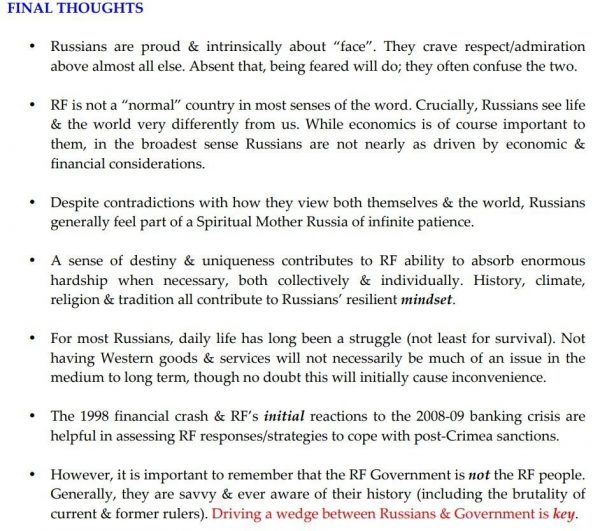
Victor Madeira’s Ruminations on the Russian People
“[Russia] is not a ‘normal’ country in most senses of the word. Crucially, Russians see life and the world very differently from us… Russians are not nearly as driven by economic and financial considerations… For most Russians, daily life has long been a struggle (not least for survival). Not having Western goods and services will not necessarily be much of an issue in the medium to long-term,” he wrote.
Moreover — and perhaps worst of all in Madeira’s mind — President Vladimir Putin — someone who “survived abysmal post-WW2 conditions” and “[believes] nothing the West can do is worse than what [he’s] already endured in life” — remains popular among the Russian public due to “the chaos” of the 1990s, and for having “restored stability, prosperity and pride”.
“Fear of renewed uncertainty and chaos… keeps Russians in check”, he writes — as a result, “driving a wedge between Russians and [their] government is key.”
The bullet-pointed “levers” that make up the bulk of the document span areas including ‘diplomacy’, ‘finance’, ‘security’, ‘technology’, ‘industry’, ‘military’, and even ‘culture’, and include; suspending or expelling Russia from “G8, WTO… and similar organisations”; “[expanding] existing sanctions regimes to anyone helping [Russia] break them”; “[arresting] every known RF agent — not least ‘agents of influence'”; “banning RF delegates” from a variety of international fora, “[advocating the] view RF [is] untrustworthy of hosting [international sporting events]; “[banning] Russian companies from launching IPOs in [the] West”‘; asset freezes and “visa bans” for the “top 100 RF government officials and [their] immediate families”; “[sanctioning] RF media”; and much, much more.
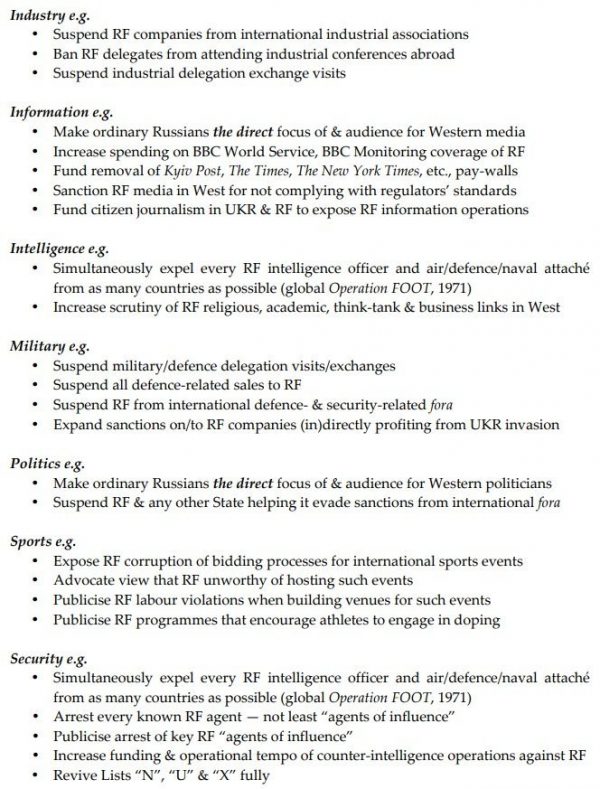
‘Potential Levers’ for Regime Change in Russia Outlined by Victor Madeira
Certain “levers” — such as suspending visits by the Bolshoi and Kirov Ballets to Western countries — are baffling, while others — for instance “repatriating” the children of Russian government studying abroad, or “[increasing] scrutiny” of Russian religious organizations in Western countries — appear wanton and excessive, if not outright barbarous.
However, one of Madeira’s suggestions, about which he was apparently so enthusiastic he mentions it thrice, “simultaneously [expelling] every RF intelligence officer and air/defence/naval attache from as many countries as possible (global ‘Operation Foot’)” — is especially striking.
Operation Foot saw 105 Soviet officials deported from the UK in September 1971 at the behest of then-Prime Minister Edward Heath, the largest expulsion of foreign state personnel by any government in history. Eerily, several mainstream media outlets would reference the historic mass defenestration when Whitehall successfully corralled 26 countries into expelling over 150 Russian diplomatic in response to the Salisbury incident, 27 March 2018.
‘Something Dreadful’
On 12 October 2016, Institute for Statecraft chief Chris Donnelly met with retired senior UK military official General Richard Barrons, Joint Forces Command chief 2013 — 2016. Their discussion was incendiary.
“We have led comfortable lives since the end of the Cold War. Wars have been away matches on our terms, with resources we have chosen to apply. Our institutions are now failing to deliver or being bypassed. Our world system is being challenged, by Russia, China… the power of initiative and decision is ebbing away from the West. [The] US can no longer protect us,” the document’s introduction states.
As 50 percent of the UK’s energy, and 40 percent of the UK’s food, is “from abroad”, the country “has vital interests in having the ability to engage globally, but that engagement will no longer be on our terms alone”. However, while in recent wars “the opposition had no peer capabilities and could pose no military threat” to the UK, the conflicts “have not required the full mobilisation of the military or any motivation of civilian society” and “given us the impression we can afford war at two percent GDP”, despite the UK needing “£7 billion just to our current force up to effectiveness”.
Moreover, “mixed success” in these conflicts is also said to have “left a bad aftertaste” with “no appetite for intervention” among the British public and politicians, and UK armed forces “cannot themselves speak out and say ‘we are broken’… as that would breach the rules of democratic control”.
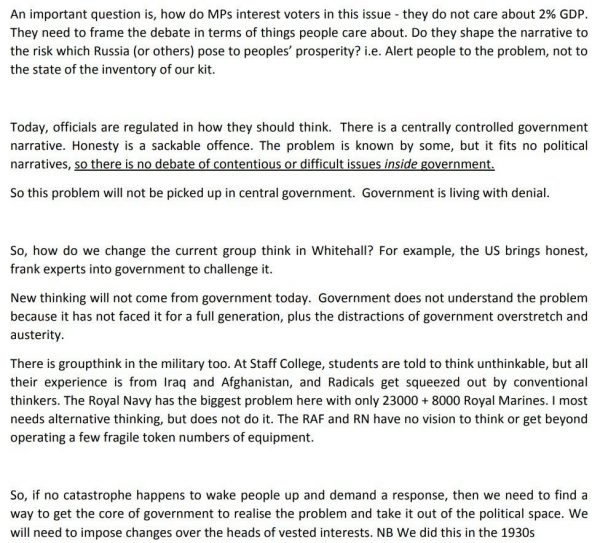
Record of Richard Barrons’ Meeting with Chris Donnelly
Barrons goes on to despair that the subordination of the military to civil servants and ministers in the Ministry of Defence means “the military do not do policy” — a state of affairs he believes must be radically changed, with the armed forces removed from government control and transformed into “an independent body outside politics”.
“Government is living in denial… We need discussion and debate as to how Russia can be managed and deterred. We need to deal with Russia by doing things that are serious… If no catastrophe happens to wake people up and demand a response, then we need to find a way to get the core of government to realise the problem and take [the military] out of the political space. We will need to impose changes over the heads of vested interests… [we] must either generate the debate or wait for something dreadful to happen to shock us into action. We must generate an independent debate outside government… there is not a moment to be lost,” Barrons concludes.
Serious Matters
Barrons’ fears of a loss of US military protection were no doubt widespread within the British establishment — for some time, US Presidential candidate Donald Trump had been questioning the necessity of NATO, advocating a protectionist and insular ‘America first’ agenda in respect of world affairs.
Likewise, Trump’s repeated suggestion of improved relations between Washington and Moscow should he become President were unquestionably unwelcome in many quarters — not least, of course, the offices of the Institute for Statecraft. It’s perhaps unsurprising then the organisation played a pivotal role in kickstarting ‘RussiaGate’.
The month after Donnelly’s meeting with Barrons, and mere weeks after Trump’s shock election victory, Andrew Wood — UK ambassador to Russia 1995 — 2000, and a member of the Institute’s ‘expert team’ — was a delegate at the eighth annual Halifax International Security Forum in Canada. Senator John McCain was also in attendance, and the pair would speak privately on the event’s sidelines about allegations of Trump’s collusion with the Russian state, in particular, the claims of former MI6 operative Christopher Steele, and his ‘Trump-Russia’ dossier.

Andrew Wood’s Institute for Statecraft Staff Profile
How and why McCain and Wood met, and precisely what they discussed, isn’t remotely clear — Wood has offered several wildly divergent accounts of the event since, variously suggesting the meeting was entirely chance and initiated by McCain due to the issue “being very much in the news”, that he approached McCain due to his personal concerns after being shown the dossier by Steele, and that he was actively “instructed” by Steele to relay the dossier’s contents to the Senator, without having actually seen a copy in full.
In any event, as a result of their conversation, the Senator dispatched his aide David Kramer, former assistant secretary of state in the Bush administration, to meet with Steele in London and discuss the dossier’s contents, and arrange for a copy to be sent to Washington. On 9 December, McCain met then-FBI Director James Comey and provided him with the dossier, which Comey then circulated across all US intelligence agencies. It would reach the desk of outgoing President Barack Obama and several senior members of Congress in the first week of January 2017.
This development would be reported 10 January by CNN — the article stated the dossier suggested Russian operatives possessed “compromising personal and financial information” about Trump, but the outlet refrained from publishing specific details of the dossier as they hadn’t been “independently corroborated”.
CNN breaking cover — the dossier had been an “open secret” among US journalists for some time by that point — would provide BuzzFeed News with the ‘public interest’ defense it required to justify publishing the dossier, which it did 11 January, despite acknowledging its contents were “unverified, and potentially unverifiable”, and contained “clear” factual errors.
In the days afterward, the publication was severely criticised by many other media outlets — Washington Post columnist Margaret Sullivan called the dossier “scurrilous allegations dressed up as an intelligence report meant to damage Donald Trump” — and the ethics of publishing unsubstantiated information offered by entirely anonymous sources was hotly debated.
However, these misgivings were quickly silenced, thanks in no small part to a number of esteemed ‘experts’ who vouched for Steele’s credibility in the media — the earliest, most enthusiastic and prominent being none other than Wood himself. He would describe Steele as “very professional and thorough in what he does”, and “a very competent, professional operator” who wouldn’t “make things up”, among other effusive plaudits.
It would take months for Wood to reveal he wasn’t merely ‘familiar’ with Steele, but the pair were in fact long-time friends — and moreover he was an “associate” of Steele’s firm (what form this relationship takes, and whether Wood receives any remuneration from Orbis Intelligence, remains uncertain). Conversely, his association with the Institute for Statecraft has never been acknowledged by the mainstream media, and would never have been known if it wasn’t for the leak of the organization’s internal files in November 2018.
The leak also revealed that in March 2017, the Integrity Initiative submitted a bid for Ministry of Defense funding — among its key performance indicators achieving a “tougher stance in government policy towards Russia”, the publication of “more information in the media on the threat of Russian active measures”, the growth of its cluster network “across Europe” and “greater awareness in all areas of society of the threat posed by Russian active measures to UK’s democratic institutions”.
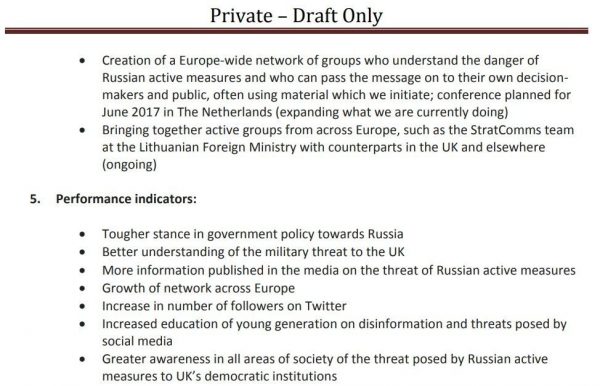
Integrity Initiative Bids for MoD Funding, March 2017
Russ to Judgement
BuzzFeed would again be used as a conduit for virulently anti-Russian propaganda in June, when it published a series of articles — From Russia With Blood – documenting 14 ‘suspicious deaths’ in Britain it claimed were potential or likely assassinations carried out by Russian “security services or mafia groups”, which UK authorities somehow failed to properly investigate.
The investigation caused something of a sensation, landing BuzzFeed in the running for a variety of prestigious journalism awards, including the Pulitzer and Orwell prizes — Investigations Editor Heidi Blake, who led the series, said her team’s work had cemented the outlet as a “major force in global news”.
However, examination of the seven articles offers much reason for scepticism. First and foremost, suggestions of possible Russian involvement in the deaths hinge almost entirely on the accusations of anonymous intelligence sources, without supporting documentation of any kind. In fact, the pieces often contain information directly contradicting the notion a featured individual was even murdered, let alone by Russians.
For instance, the third installment, The Man Who Knew Too Much, delved into the case of Dr. Matthew Puncher, a UK radiation scientist who’d been conducting work at a Russian nuclear facility, and was found stabbed to death in his kitchen in February 2016.
BuzzFeed notes Puncher’s wife Kathryn told investigators her husband tried to hang himself with a computer cable the the week prior, and Detective Constable Rachel Carter, who inspected the scene, told the inquest “there was no sign of a struggle, none of the furniture had been knocked over, and all the blood belonged to Puncher”, and she was “satisfied” he’d committed suicide as “all the information told us he was very depressed and no-one in his family seemed particularly surprised he had taken his own life”.
However, BuzzFeed had other ideas, stating “four American intelligence officials… believe he was assassinated”. Alternatively, a former senior Scotland Yard counter-terror officer unconnected to the case was quoted as suggesting — also anonymously — the Russian state could have given Puncher drugs to “create depression” and precipitate his suicide.
The fourth installment — The Secrets Of The Spy In The Bag — deals with Gareth Williams, the GCHQ codebreaker seconded to MI6 who died in a Pimlico flat owned by the spying agency in August 2010 and is similarly dubious in the extreme.
Williams’ demise is unambiguously mysterious — his decomposing naked body was found in a padlocked sports bag in the bath, although no fingerprints or traces of his DNA were found on the rim of the bathtub, bag, bag’s zip, or padlock, and an inquest ruled his death to be “unnatural and likely to have been criminally mediated”.
Litvinenko’s been in the news a lot the last couple of days, but nothing about MI6 spy Gareth Williams. The Met found it was ‘probably’ a self-inflicted ‘accident’ that he ended up padlocked inside a bag, in a bath, with none of his fingerprints on either. pic.twitter.com/wofSh40rvY
— dan barker (@danbarker) March 12, 2018
Ironically, much of the article’s content raises serious questions about the role of Williams’ employer’s in his death. For instance, BuzzFeed notes he’d been dead for around 10 days by the time his body was found, but astoundingly neither GCHQ nor MI6 had alerted authorities to his absence from work. It would take his sister informing GCHQ Williams was missing at 11:30 am GMT on 23 August for the agency to contact police — albeit five hours later.
The outlet also records how in the ensuing investigation police were prevented from interviewing Williams’ colleagues at MI6, or reviewing relevant documents, and instead forced to rely upon officers from national counter-terrorism force SO15, which took no formal statements from witnesses, and passed on only anonymised briefing notes to their Metropolitan force counterparts.
Conversely, BuzzFeed fails to mention coroner Dr. Fiona Wilcox ruling involvement of SIS staff in Williams’ death was a legitimate line of inquiry for police — instead again relying on the unsubstantiated claims of the anonymous quartet of US intelligence officials that Williams had been tracing international money-laundering routes used by organised crime groups to blame his probable murder on the Kremlin, and/or Russian gangsters.
The eponymous investigation — focusing on the suicide of Scot Young, an associate of oligarch Boris Berezovsky — is perhaps the series’ most puzzling, for more reasons than one. Young — a corrupt tycoon with clear criminal connections — lost all his money on a failed property endeavor, spent time in prison for contempt of court, and suffered a lengthy and costly divorce battle.
Such a litany of crippling personal calamities — and doctors’ appraisal of him as “paranoid, with a manic flavour” with a “complex delusional belief system” — would surely make Young at least a potential candidate for suicide watch, and indeed police concluded he’d taken his own life by throwing himself from his apartment window.
Three of his associates, Paul Castle, Robbie Curtis, and Johnny Elichaoff likewise “experienced dramatic financial [collapses]” in which they lost all their potentially ill-gotten gains, and subsequently took their own lives — Castle and Curtis both jumped in front of oncoming trains, while Elichaoff leaped off the roof of a London shopping centre.
Yet again though, the word of anonymous US intelligence officials is sufficient to perk BuzzFeed’s suspicions about all their deaths, the unnamed operatives saying Russia could have “engineered” their suicides “through manipulation and intimidation tactics”.
The article’s discussion of Berezovsky’s death is likewise suspect and contradictory, quoting Richard Walton, Scotland Yard’s former counter-terror commander, as saying his department investigated the exiled Russian’s death “very thoroughly” and “hadn’t been able to find any evidence of murder”. Fascinatingly though, in seeking to construct a case for Berezovsky being unlawfully killed, BuzzFeed notes business partner, Georgian oligarch Badri Patarkatsishvili, died from an apparent heart attack in 2008. American spy agencies are said to have intelligence suggesting he was murdered, and while predictably none is presented in the article, Patarkatsishvili was provably subject to at least one assassination plot prior to his death — and it certainly wasn’t Russian in origin.In 2007, covert recordings revealed three Georgian national security service officials had plotted to kill ‘Georgia’s Richest Man’ at the behest of then-President Mikheil Saakashvili. In one recording they debate the best means of execution, an official suggesting they use a poisonous substance which will “kill a person two hours after touching it”. “You smear [it] on the door handle,” they say — the precise method by which Sergei and Yulia were contaminated with novichok, according to UK authorities.
Whatever the meaning of that parallel, BuzzFeed’s series is highly significant, for it was fundamental to cementing the notion of frequent Kremlin-directed murders on British soil in the public consciousness in the year prior to Salisbury. Almost inevitably too, it was widely invoked in the immediate wake of the apparent poisoning as evidence, if not proof, of Russian state involvement.
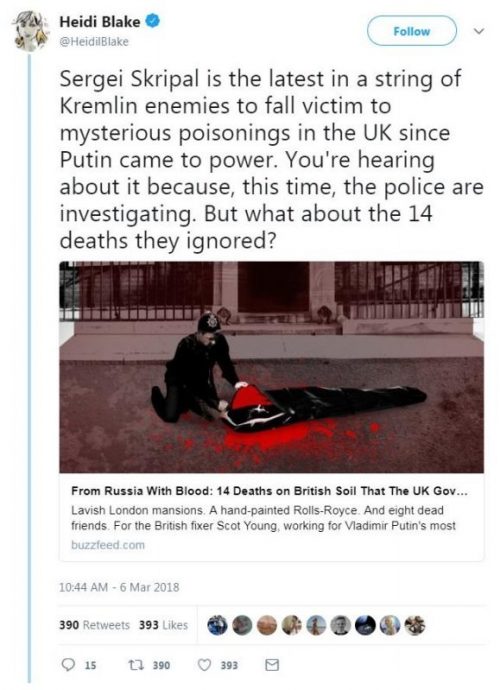
A Tweet by BuzzFeed Investigations Editor Heidi Blake on Skripal, Documented by Integrity Initiative
Among those seeking to connect From Russia With Blood with the attack on the Skripals was none other than BuzzFeed’s Heidi Blake herself. Her Twitter postings on the subject would be documented by the Integrity Initiative in regular roundups of social media activity relating to the incident — and reference to the series was made in an Initiative briefing document (likely circulated to journalists), Russian Lies and the Skripal Case, which called the “evidence” presented by her team’s investigation “compelling”.
So it was on 13 March 2018, nine days after the Salisbury incident, then-Home Secretary Amber Rudd announced British police and MI5 would reinvestigate the numerous ‘suspicious deaths’ detailed by BuzzFeed — a development the outlet reported rather triumphally. However, a mere four months later, Home Secretary Sajid Javid revealed police had determined there was “no basis on which to re-open any of the investigations”. Fittingly, in December an inquest concluded Alexander Perepilichnyy, one of the ‘BuzzFeed 14′, had died of entirely natural causes.
Whatever the truth of the matter, a month prior the Initiative invited Blake to head an hour-long ‘Investigative Masterclass’ at an event the organization convened at London’s Frontline Club — Tackling Tools of Malign Influence.
‘A Good Shepherd’
Also in June 2017, BBC Diplomatic Editor Mark Urban somewhat miraculously began conducting a series of interviews with Sergei Skripal in the latter’s Salisbury home.
“I was intending to write a book about East-West espionage… My intention was to focus the story on a handful of people, using their stories, and the moment these narratives intersected at Vienna airport, during the swap of 2010, as the key to its structure. Skripal was to be one of the central half-dozen or so stories… I was doing this in my own time — there was no contract. The only sense in which this was a ‘book’ in June 2017 was in my own imagination,” Urban claims.
Over the course of their discussions, Skripal would disclose much about his time in the intelligence services, spell as a double-agent for MI6, incarceration in Russia after discovery, and life in Britain post-exile — although his enduring patriotism Urban found particularly notable.
“[Skripal] is… an unashamed Russian nationalist, enthusiastically adopting the Kremlin line in many matters, even while sitting in his MI6-purchased house,” Urban records, “he was adamant, for example, Putin had not surreptitiously introduced Russian troops into east Ukraine, as much of the Western press reported. If regular units had gone in, he insisted, they would have been sitting in Kiev very soon.”
“The problem with the Ukrainians is they are incapable of leadership. They need Russia for that. The Ukrainians are simply sheep who need a good shepherd,” Skripal explained.
Such sentiments may explain why Skripal seemingly remained in regular contact with the Russian embassy after his arrival in the UK. Speaking to the Independent 7 March 2018, former Kremlin official Valery Morozov, an associate of Skripal likewise exiled to the UK, claimed Skripal had meetings with Russian military intelligence officers “every month”.
Strikingly, he also rejected the notion the apparent nerve agent attack had anything to do with the Kremlin.
“Putin can’t be behind this. I know how the Kremlin works, I worked there. Who is Skripal? He is nothing for Putin. Putin doesn’t think about him. There is nobody in Kremlin talking about former intelligence officer [sic] who is nobody. There is no reason for this. It is more dangerous for them for such things to happen,” Morozov cautioned.
Urban would bizarrely fail to reveal having bagged the unprecedentedly fortuitous scoop until three months after the Salisbury incident — an extremely curious delay, perhaps partially explained by his lucrative book deal with publisher Pan Macmillan being announced mere days later.
Yes, I met Sergei Skripal a few times in 2017 while working on a book project. He’s a remarkable man with a dry sense of humour and a great resilience given all he’s been through https://t.co/hfppMtFM0H
— Mark Urban (@MarkUrban01) July 4, 2018
The resultant work, The Skripal Files, was published in October — rather than a history of “East-West espionage”, the project had evolved into an extensive telling of the government’s official narrative on the Salisbury incident, buttressed by discussions of alleged Kremlin assassinations in the UK, and Skripal’s life and career.
However, while widely marketed as the “definitive account” of the affair, the name Pablo Miller doesn’t appear once in the text — an amazing oversight given Miller was Skripal’s MI6 recruiter and handler, and neighbour in Salisbury, rendered all the more perplexing by Miller and Urban once having served in the same tank regiment.
Miller’s connections to the Salisbury incident are unclear, and by design — immediately afterwards he deleted his LinkedIn account, which revealed him to be a Senior Analyst at Christopher Steele’s Orbis Intelligence, and on 7 March Whitehall issued a D-notice blocking mention of him in the mainstream media. Miller also has unclear connections to Integrity Initiative, his name appearing on a list of invitees to an event hosted by the organization, alongside representatives of the BBC, Porton Down, the FCO, the MOD and the US Embassy.
Adding to the intrigue, Initiative operative Dan Kaszeta — a “counterfeit” chemical weapons ‘expert’ who was the very first source to suggest Sergei and Yulia may have been struck by novichok, a mere four days after the Salisbury incident — noted he’d met Urban “several times over the past few years” in a glowing review of The Skripal Files (since removed from the web) he wrote for the organization in December 2018.
In what may just be an intensely spooky coincidence, as 2017 drew to a close British-American TV project Strike Back: Retribution – a spy-drama based on a novel of the same name by ex-SAS soldier Chris Ryan — began airing on Sky One in the UK. The series followed the activities of Section 20, a fictional branch of British Defence Intelligence, which conducts secretive high-risk missions throughout the globe.
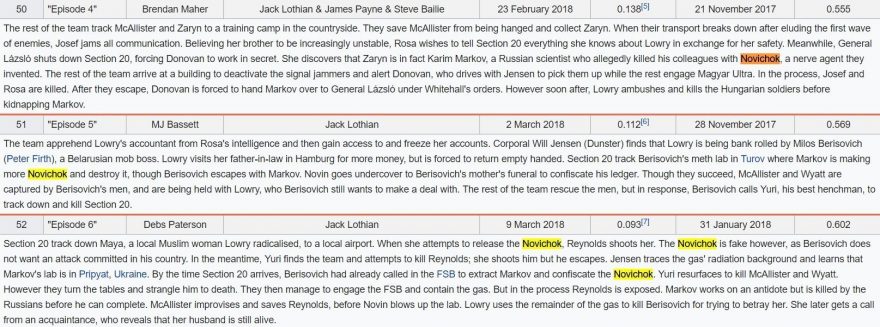
‘Strike Back: Retribution’ Episode Summaries
In episode four, broadcast 21 November, it’s revealed character Ilya Zaryn — who Section 20 rescued from the clutches of a terrorist group — is, in fact, Karim Markov, a Russian scientist who murdered a number of his colleagues with novichok, and is assisting the terrorists in their nefarious schemes.In the next episode, Section 20 locate Zaryn/Markov in a laboratory in Turov, Belarus, where he’s found producing more novichok — but while they manage to destroy the facility and the nerve agent, the dastardly Russian escapes.
In the next, Section 20 track Markov to a lab in Pripyat, Ukraine — but in attempting to contain the nerve agent, Section 20 operative Natalie Reynolds is contaminated. The unit forces Markov to create an antidote, but is killed before he can concoct one — Reynolds’ fellow agent Thomas McAllister manages to improvise and save her, however.
The series would air early the next year in the US on Cinemax — the second episode featuring novichok was transmitted 2 March, two days prior to the Salisbury incident, the third 9 March, five days after.
Expecting the Unexpected
Mainstream hostility towards the Kremlin had been intense ever since 2014, but ‘RussiaGate’ pushed this antipathy into overdrive. Critical, aggressive and paranoid media reports and statements by politicians had become an essentially daily staple by the start of 2018.
CC0
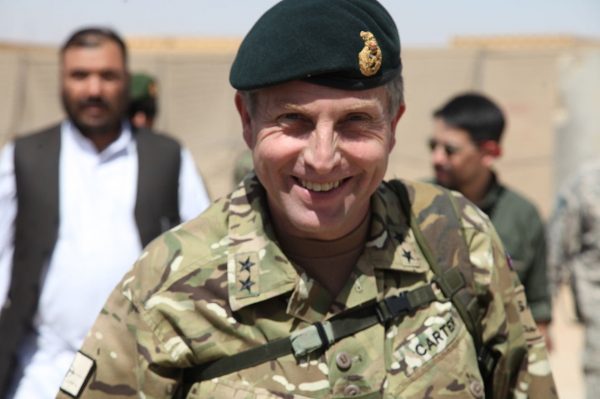
UK Chief of General Staff Gen. Nick Carter (File)
Nonetheless, on 22 January General Nicholas Carter, UK Chief of General Staff, offered perhaps the most hawkish speech on Russia since the demise of the Soviet Union. Speaking at a Royal United Services Institute event, Carter described the country as the “most complex and capable state-based threat to our country since the end of the Cold War”, and warned hostilities could start “sooner than we expect”, particularly as he — ironically — claimed the Kremlin had “[convinced] ordinary Russians the West is a threat… We have been made to appear as the enemy”.
“If Russia sees itself in decline, and more able now to go to war than in the future, does this encourage them to think of war? Perhaps compare the situation today to 1912 when the Russian Imperial Cabinet assessed that it would be better to fight now, because by 1925 Russia would be too weak in comparison to a modernised Germany; and Japan, of course, drew similar conclusions in 1941. Russia worries, I think, that the West will achieve a technological offset in the next decade,” he cautioned.
Carter said the conflict — which he naturally envisaged being initiated by Russia — would “start with something we don’t expect”.
Not long after the speech, Operation Toxic Dagger was launched — a vast three week effort in which 40 Commando Royal Marines, Public Health England, the Atomic Weapons Establishment and Porton Down’s Defence Science and Technology Laboratory collaborated to prepare Britain’s armed forces for Chemical, Biological, Radiological and Nuclear operations by creating “realistic exercise scenarios based on the latest threat information”.
The endeavour included “company-level attacks and scenarios concerning CBRN vignettes, concluding with a full-scale exercise involving government and industry scientists and more than 300 military personnel”, with a “chemical decontamination area set up not merely to treat ‘polluted’ commandos, but also wounded prisoners”.
It was convened on Salisbury Plain — several of the Royal Marines taking part would be seconded to Operation Morlop, a multi-agency ‘clean-up’ effort launched in Salisbury in the wake of the poisoning of the Skripals, less than a fortnight after Operation Toxic Dagger was completed.
Ansarullah: UK’s Hunt distorting terms of Hudaydah ceasefire deal
Press TV – March 5, 2019
Yemen’s Houthi Ansarullah movement has censured recent comments by British Foreign Secretary Jeremy Hunt on the control of Hudaydah, saying the top UK diplomat is distorting the terms of a UN-mediated ceasefire deal reached between the Yemeni warring sides in Sweden over the strategic Red Sea port city.
During a visit to Yemen on Sunday, Hunt — whose country has been a major supporter of the deadly Saudi-led war on Yemen — claimed that Hudaydah “was supposed to be cleared of militia and left under neutral control by the beginning of January.”
Mohammed Abdul-Salam, a spokesman for the Houthi movement, rejected the comments in a statement released on Monday, stressing that the Hudaydah truce had never mentioned handing over the port city to a “neutral” party.
The ceasefire, he added, had stipulated that after the withdrawal of the warring sides, Hudaydah would be patrolled by an unspecified “local force” with UN observers.
“We are prepared to carry out the redeployment in the first step, but the other party refused because they do not want to expose the aggression mercenaries and to lose the pretexts and justifications for continuing the aggression on the West Coast,” Abdul-Salam said.
Representatives from the Houthi movement and the Riyadh-sponsored government of the ex-president, Abd Rabbuh Mansur Hadi, agreed to cease fighting in Hudaydah during peace talks in Sweden last December.
Under the agreement, the rival parties also agreed to the withdrawal of their troops and the deployment of UN monitors to the port city, a lifeline for millions of Yemenis.
However, the Houthis – who control Hudaydah — have repeatedly complained about ceasefire breaches by the Saudi-backed side.
Elsewhere in his remarks, the Houthi spokesman said that the countries, which are involved in the bloody military campaign against Yemen, especially Britain are the ones violating the Hudaydah truce.
He also said the UN special envoy for Yemen – a British national — was relying on the UK in dealing with the Yemen issue.
“Martin Griffith appears not to be an envoy of the United Nations, but an English envoy representing Britain, especially after the British Foreign Office has made its objectives and position clear, which is in line with the obstruction of the agreement,” the Houthi official added.
“Britain has clearly revealed that it manages the process of blocking the agreement through its envoy to Yemen under the cover of the United Nations,” he pointed out.
Hudaydah, the entry point for most of Yemen’s commercial goods and vital aid, has seen some of the heaviest fighting in the four-year Saudi war.
Saudi Arabia and the UAE launched the offensive against Hudaydah in June 2018, but they have faced strong resistance put up by Yemeni armed forces – led by the Houthis — and the city’s residents.
The Saudi-led coalition claims that the Houthis are using the port for weapons delivery, an allegation rejected by the fighters.
The UK has licensed over £4.7 billion worth of arms exports, including missiles and fighter jets, to Riyadh since the Saudi regime and its allies launched a broader military campaign against Yemen in early 2015.
Britain has also been providing combat intelligence and target data to Saudi Arabia over the course of the war.
A Stumble at Hanoi, but Negotiations Remain on the Agenda
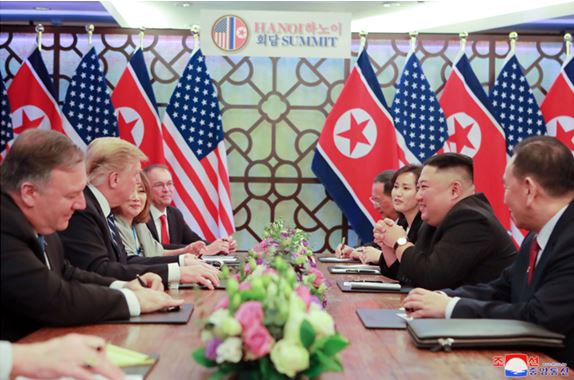
By Gregory Elich | Zoom in Korea | March 4, 2019
President Trump’s hasty decision to pull the plug on the Hanoi Summit ahead of schedule came as a stunning surprise. The feeling of disappointment in those who were hoping for success contrasted with the sense of relief in the U.S. foreign policy establishment, which remains steadfastly opposed to any improvement in relations.
The widespread assumption going into the summit was that the Trump administration would be able to buy off North Korea with diplomatic trinkets. It was thought that among these would be limited sanctions exemptions, such as allowing humanitarian organizations greater latitude to operate in North Korea. It was also anticipated that a document would be signed which would recognize that the Korean War had ended in 1953. While a peace declaration would have a symbolic “feel good” value, it would change no facts on the ground, and leave the North Koreans essentially empty-handed.
By all accounts, the North Koreans have been more clear-eyed about what they need in talks with U.S. negotiators than they had been given credit. Symbolic measures will not suffice. The North Koreans have serious and well-founded security concerns, given the various wars and military interventions the United States has launched around the world and its decades-long hostility to North Korea.
The Trump administration’s current campaign to destabilize Venezuela and substitute its handpicked lackey as that country’s president can only have further clarified thinking on security matters for the North Koreans.
A more immediate concern for North Korea is the impact of economic sanctions, which have as their aim the collective punishment of the entire population. According to a senior U.S. State Department official, during discussions on sanctions relief with their North Korean counterparts, U.S. negotiators “did our own calculations, and [the damage] tallies up to the tune of many, many billions of dollars.” North Korea’s GDP may be difficult to assess with precision, but it is estimated at around $30 billion. That places it below Vermont, which ranks dead last among U.S. states in terms of GDP. Given the economic damage/GDP ratio, it is obvious that the sanctions war is inflicting enormous hardship on the North Korean people.
According to North Korean Foreign Minister Ri Yong-ho, “Our proposal was that, if the U.S. lifts some of the UN sanctions, or in other words those aspects of the sanctions that impede the civilian economy and the people’s livelihood, we will completely and permanently dismantle the production facilities of all nuclear materials, including plutonium and uranium, in the Yongbyon complex, through a joint project by technicians from our two countries, in the presence of American experts”
“They were willing to give everything, including all the facilities at Yongbyon,” revealed an unnamed source. “Not just one physical reactor, but the whole complex. They were also willing to present their willingness to fully dismantle in the form of an official document. They were getting down to business pretty seriously. And then Mr. Trump and the American side turned down the proposal and left,” to the dismay of the North Koreans.
U.S. Secretary of State Mike Pompeo urged the president to reject the North Koreans’ proposal, as facilities outside of Yongbyon were not included, and nuclear weapons and missiles would remain untouched. National Security Advisor John Bolton may have added objections as well, given his well-known aversion to anything other than unilateral disarmament by North Korea.
“The President in his discussions challenged the North Koreans to go bigger,” a State Department official announced. “The President encouraged Kim to go all in, and we were… prepared to go all in as well.” Trump wanted the North Koreans to put their entire program on the table in exchange for relief on economic sanctions.
From the North Korean standpoint, complete dismantlement of its nuclear program cannot come without a security guarantee. According to Foreign Minister Ri, that guarantee is “even more important” than lifting sanctions. After all, it was for security reasons that North Korea developed its nuclear program, and its security will need to be assured through other means if it denuclearizes. “Given the current level of trust between our two countries,” Ri explained, the dismantlement of the Yongbyon facility is “the biggest step toward denuclearization that we can take at the present moment.” Trump’s proposed grand bargain failed to provide a secure basis for the North Koreans to abandon their nuclear program. Also unaddressed is the concept of denuclearization of the Korean Peninsula, which is habitually interpreted in a one-sided manner in the West as applying solely to North Korea. The meaning of that term needs to be clarified through further negotiations.
The U.S. side, however, remains wedded to the idea of maximum punishment as a negotiating tool and is unwilling to grant relief on economic sanctions without North Korea’s complete denuclearization. That is the essence of the current impasse between the two sides. In an interview broadcast on Fox News, Trump said, “The sanctions are there, and I didn’t want to give up the sanctions unless we had a real program.”
It seems clear that if both parties can agree on timing and sequencing, the possibilities for progress are there, starting with a partial lifting of economic sanctions in exchange for partial denuclearization.
Although the Hanoi Summit failed to produce a concrete result, it would be incorrect to say that it failed. Diplomacy is a process, not a single event. The summit did not end in rancor, and both sides have pledged to continue negotiations. KCNA, the North Korean news agency, reported that the summit “offered an important occasion for deepening mutual respect and trust,” and it noted that President Trump and Chairman Kim Jong Un “agreed to keep in close touch” and “continue productive dialogues for settling the issues discussed at the Hanoi Summit.”
“They were constructive discussions,” points out a State Department official. “There’s room to continue talking.” In Mike Pompeo’s assessment, “There have been lots of things that we’ve moved forward on, and I think we have a set of shared common understandings. I’ve seen enough congruence between what the two sides are trying to accomplish. I saw the goodwill between the two leaders.”
Despite the lack of agreement, Kim reiterated his commitment to maintain a freeze on nuclear and ballistic missile testing, while the U.S. is renaming and reducing the scope of its annual Foal Eagle and Key Resolve military exercises.
The main impediment to progress is U.S. bi-partisan opposition to dialogue and any reduction of tensions in East Asia. An often-repeated charge is that last year’s Singapore Summit produced no tangible result. However, the Singapore Summit was a short meeting meant to establish an agreement on intent, in which not only did North Korea promise to work toward denuclearization, but both sides committed to improve relations and build a peace regime on the Korean Peninsula. After decades of hostility and confrontation, the summit redirected the relationship to one of dialogue. That is no small thing. Critics who argue that detailed steps should have been drawn up in that initial meeting are, of course, intentionally distorting the nature of the meeting in an attempt to discredit the concept of U.S.-North Korea negotiations.
Similarly, those who wish to block progress can be expected to argue that the lack of an agreement at Hanoi proves that it is a mistake to meet with the North Koreans and talks must come to a halt. Nevertheless, U.S. and North Korean leaders remain invested in the process, and the less influence opponents have on U.S. negotiating strategy, the more chance of success. Moreover, although there is internal opposition from conservative forces in South Korea, the detente process between the two Koreas has developed its own momentum, which can be expected to exert a positive influence on the U.S. position. For now, there is certainly more reason for hope than despair.
Gregory Elich is a Korea Policy Institute associate and on the Board of Directors of the Jasenovac Research Institute. He is a member of the Solidarity Committee for Democracy and Peace in Korea, a columnist for Voice of the People, and one of the co-authors of Killing Democracy: CIA and Pentagon Operations in the Post-Soviet Period, published in the Russian language. He is also a member of the Task Force to Stop THAAD in Korea and Militarism in Asia and the Pacific.
His website is https://gregoryelich.org
Follow him on Twitter at @GregoryElich
US Deploys THAAD Missile System to Israel
Sputnik – 04.03.2019
WASHINGTON – The United States military deployed a Terminal High Altitude Area Defense (THAAD) anti-ballistic missile battery to Israel, European Command (EUCOM) said in a statement on Monday.
“At the direction of the Secretary of Defense, US European Command deployed a THAAD system to Israel in early March,” the statement said.
The move is intended to demonstrate the United States’ ongoing commitment to Israel’s security, the statement added.
As part of the deployment, US service members will work in different locations in Israel to help local military forces align their existing air and missile defence architecture with the THAAD system.
The exercise will allow the US military to incorporate key capabilities stationed in the country and Europe with its partners in the Israeli military, EUCOM said.
The THAAD system, considered one of the most advanced in the world, will be added to the existing Israeli air defence. The latter currently includes the Iron Dome, designed to shoot down short-range rockets and the Arrow system.
Commenting on the exercise, IDF Spokesperson Brig.-Gen. Ronen Manelis specified the US anti-ballistic missile battery would be deployed in the south of the country and that about 200 American servicemen would participate in the drills.
As Pakistan Calls for Peace, India Refuses to Reveal Air Raid Details – Report
Sputnik – 03.03.2019
India’s Finance Minister Arun Jaitley has stated that security agencies will not publish any operational details about the air raid against militant groups in Pakistan, the newspaper Dawn reported. The statement comes following calls to release evidence that the Indian Air Force hit militant camps in airstrikes on 26 February, which led to an escalation in tensions between the two neighbours.
“The armed forces must have, and our security and intelligence agencies must have, a full leeway in dealing with situations, and if anybody wants operational details to be made public […] he certainly does not understand the system”, Jaitley said.
India’s finance minister also denied allegations that the Indian military activities were connected with the upcoming general elections in May.
At the same time, Pakistani Foreign Minister Shah Mahmood Qureshi called for a resolution to the escalating tensions between Pakistan and India via dialogue and diplomatic channels instead of military power.
“Peace is our priority and we do not desire war with India”, Qureshi said.
Calls to publish proof of striking militant camps came after Pakistan stated that the Indian airstrike on 26 February had hit an empty hillside. The air raid over Pakistani territory, which led to an escalation in tensions between Delhi and Islamabad, came in wake of a deadly attack on a security convoy that claimed the lives of 40 servicemen on 14 February carried out by the terrorist group Jaish-e-Mohammed (JeM).
New Delhi insists that Islamabad is harbouring and supporting militants that commit terrorist acts on Indian territory. Pakistan denies both the accusations and the existence of militant camps.
US & South Korea agree to scrap major military drills to foster denuclearization – Seoul
RT | March 3, 2019
Washington and Seoul will no longer be conducting large-scale Foal Eagle and Key Resolve war games, the South Korean defense ministry said Sunday. It comes several days after US President Trump complained about the drills’ cost.
The cancellation of the annual wargames, initially scheduled to kick off in spring, was announced by the South Korean military, as it made public the details of a call between Acting US defense chief Patrick Shanahan and his South Korean counterpart, Jeong Kyeong-doo, Yonhap reported.
Seoul said that the move to call off the exercises was in support of the diplomatic efforts to pursue a nuclear-free Korean peninsula. The drills have been paired since 2001 and traditionally take place in February-March. North Korea saw the allies’ annual saber-rattling as preparation for invasion.
“The minister and secretary made clear that the alliance’s decision regarding the adjustment of the exercise and drills reflects both countries’ expectation to back diplomatic efforts to reduce tensions and achieve the complete denuclearization of the Korean Peninsula through a final, full verified method,” the ministry said in a statement.
By ditching the costly wargames the US and South Korea are not eliminating joint exercises completely, though: they are planning new command post drills and will continue to carry out field maneuvers. However, these are expected to be conducted on a significantly lower scale. In the run-up to the announcement, unnamed officials told CNN that Washington and Seoul might instead carry out drills “at a small unit level” that would feature “virtual training.” NBC News reported, also citing officials, that the large-scale war games would be replaced by “mission-specific training.”
The scaling-down was widely expected, since Trump has repeatedly bemoaned the drills’ hefty price tag the US has to cover. Following the first Trump-Kim summit in June 2018, Trump said that the US would halt joint drills with South Korea, while calling them “quite provocative,” stirring unease among his own military.
Shortly after that, Washington and Seoul suspended large-scale Ulchi Freedom Guardian exercises scheduled for August.
In November, then Pentagon chief James Mattis stated that the Foal Eagle drills were “being reorganized a bit to keep it at a level that will not be harmful to diplomacy.”
Speaking in the wake of his Hanoi summit with North Korean leader Kim Jong-un this week, Trump said the drills with South Korea were “fun and nice” but a “very, very expensive thing,” and that he “gave that up quite a while ago.”
Foal Eagle typically sees some 11,500 US troops taking part alongside 290,000 South Korean military forces in the drills that include air, ground and naval field operations. Key Resolve is a computer-simulated exercise that also used to draw in a large number of troops from both sides, including about 12,200 Americans and 10,000 South Koran servicemen.
Can Netanyahu Risk A “Battle Of Missiles” With Syria?
By Elijah J. Magnier | American Herald Tribune | March 2, 2019
It was the eleventh and the most important meeting between the Russian President Vladimir Putin and the Israeli Prime Minister Benjamin Netanyahu. The Israeli visitor heard clearly from his host that Moscow has no leverage to ask Iran to leave or to stop the flow of weapons to Damascus and that Iran will remain in Syria and that Russia has no say over the Syrian-Iranian relationship. Moscow informed Tel Aviv about “Damascus’s determination to respond to any future bombing and that Russia doesn’t see itself concerned”.
According to well-informed sources in Damascus, “the few hours of the visit of President Bashar al-Assad to Tehran were enough to send messages in all directions. The first message was the fact that the visit took place just before Netanyahu’s scheduled meeting with Putin. The second message was to display the robust cemented relationship between Iran and Syria, immune from any outside interference from the US or Russia and that Syria has the sovereign right to choose its strategic partners. The secretive nature of the visit – not even Russia was informed in advance – speaks volumes about the Syrian-Iranian relationship”.
“Russia exerted pressure on President Obama to prevent the US from bombing Damascus on the false flag pretext of chemical weapons and set up its military apparatus in Syria in 2015. Russia helped Syria to victory, imposed a political dialogue, and protected Syria in the international arena, speeding up the return of refugees (the US wanted to use the refugees in a failed attempt to gain concessions that it could not obtain by war). Moreover, Russia is putting pressure on many countries to contribute to the reconstruction of Syria and to resume diplomatic relations with Damascus. Russia is a strategic ally but exerts no power of control over the central government”, said the source.
The strategic relationship between Tehran and Damascus started – under the “Axis of the Resistance” – long before the war. In 2011, Iran rushed to support the central government to prevent the US-EU-Arab “regime-change” plan. It thwarted the transformation of Syria into Islamic Emirates ruled by Takfiri jihadists. Tehran offered oil, financial and military support to Syria throughout its seven years of war and rejected any proposition, even by Russia, to change President Assad for any other Syrian personality, as repeatedly proposed by the US.
Russia enjoys an excellent relationship with Israel and intends to maintain that relationship. Iran, on the other hand, is ready to wage war against Israel if Netanyahu ever decides to bomb significant strategic objectives in Syria. The head of Iran’s National Security Council, Admiral Ali Shamkhani, said Iran will respond by hitting Israeli targets if Israel bombs Syria. The same warning was delivered by Syria’s Ambassador to the UN, who recently warned that his country will retaliate if Damascus is bombed.
Since these last warnings, Israel has refrained from violating Syria sovereignty (except for one insignificant artillery bombing against an empty position in south Syria). Iranian officials in Syria had a curt response to their Russian counterparts who asked to have details on the locations of their military deployment in Syria. Iranians told the Russian military to inform Israel that the Iranian positions have been integrated with those of the Syrian army all over Syrian territory, and that any bombing of the Syrian army will hit Iranian advisors.
Iran in effect asked Russia to inform Israel that any future Israeli attack will trigger a retaliatory response, since the presence of Iranian advisors in the Levant is at the official request of the Syrian government. It is legitimate for all allied forces, if under attack, to respond with the similar firepower against any future aggression.
Netanyahu seems willing to bomb Syria. Nevertheless, if Iran and Syria stand by their promised response, he will not be able to stop the precision missiles ready to be launched against Israel. The Israeli Prime Minister is not aiming to dislodge Iran from Syria, an objective he knows to be impossible. Neither can he aspire to destroy Syria’s military capacity because Russia continues to supply Damascus with highly sophisticated weapons. His only plausible objective is an electoral one, with the goal of escaping imminent indictment for bribery charges related to corruption. A second term may postpone his indictment and prolong his immunity.
However, if the Israeli Prime Minister decides to bomb Syria, his decision will have a boomerang effect, especially if Syrian missiles hit deadly targets in the heart of Israel. Will Netanyahu take the risk and bomb his political future? It is his decision.
N. Korea offered to halt nuclear, long-range rocket testing for partial relief of sanctions – FM
RT | February 28, 2019
North Korea offered a “realistic proposal” to halt nuclear and missile tests in exchange for partial sanctions relief, Foreign Minister Ri Yong-ho told reporters in Hanoi after the failed Trump-Kim summit.
North Korea demanded the partial lifting of sanctions that “that hamper the civilian economy and the livelihood of our people.”
In exchange for partial lifting of sanctions by the US, North Korea would permanently remove plutonium and uranium processing facilities and Yongbyon, in the presence of US experts, Ri said, adding that the “US was not ready to accept our proposal.”
The North Korean official said Washington demanded “one more” measure beyond dismantling Yongbyon, which went too far for Pyongyang.
“Our proposal will never change although US proposes negotiations again in the future,” said Ri, who then left without taking questions from the press.
Wednesday’s summit in Hanoi began on a high note but ended early and without a deal.
“It was about the sanctions basically,” US President Donald Trump told reporters after parting ways with Kim Jong-un. “They wanted the sanctions lifted in their entirety and we couldn’t do that. Sometimes you have to walk, and this was just one of those times.”
No deal, but Kim Jong-un promised no missile tests – Trump
RT | February 28, 2019
Despite no formal deal being reached, North Korean leader Kim Jong-un said that he wouldn’t test weapons or anything nuclear-related, US President Donald Trump told reporters after the aborted Hanoi summit.
Pressed by reporters about potential fallout over the failure to reach a denuclearization agreement with the North Korean leader, Trump stated that he had received assurances that Pyongyang will continue to halt weapons development.
“He said the testing will not start,” Trump said of Kim. “He said he’s not going to do testing of rockets or missiles or anything having to do with nuclear. And all I can tell is that’s what he said, and we’ll see.”
Trump and Kim’s Hanoi, Vietnam summit came to an abrupt end on Thursday after the two sides failed to reach a consensus on appropriate steps Pyongyang must take in order for US sanctions to be lifted. Kim reportedly promised to dismantle a nuclear facility at Yongbyon in exchange for the lifting of all sanctions – but Washington wanted more concessions, including the destruction of a purported uranium enrichment plant.
The US president said that while the talks were constructive, “Sometimes you have to walk and this was one of those times.”
Featured Video
Iran’s Next Strike May Not Explode. It Could Shut You Down
or go to
Aletho News Archives – Video-Images
From the Archive
Zionism’s Violent Legacy
By Donald Neff | Washington Report On Middle East Affairs | January 1996
On January 4, 1948, Jewish terrorists drove a truck loaded with explosives into the center of the all Arab city of Jaffa and detonated it, killing 26 and wounding around 100 Palestinian men, women and children.[1] The attack was the work of the Irgun Zvai Leumi – the “National Military Organization,” also known by the Hebrew letters Etzel – the largest Jewish terrorist group in Palestine. The Irgun was headed by Revisionist Zionist Menachem Begin and had been killing and maiming Arabs, Britons and even Jews for the previous ten years in its efforts to establish a Jewish state.
This terror campaign meant that at the core of Revisionist Zionism there existed a philosophical embrace of violence. … continue
Blog Roll
 Aletho News
- Trump’s Iran war is on an Israeli leash
- Saudi oil boss issues global supply warning
- Riyadh Says Its Oil System Is Intact. The Numbers Say Otherwise.
- Trump and Netanyahu Want to “Finish the Job” on Iran
- US ‘one-sided dictation’ not Iran’s beliefs makes rational talks impossible: Baghaei
- Iran’s Next Strike May Not Explode. It Could Shut You Down /Col Doug Macgregor
- Iran: US political targets legitimate if assassinations return
- Iraq shuts key border crossing with Iran under US pressure: Report
- Undersea Internet cables could be targeted in retaliation for attacks on Iran: IRGC deputy chief
- EU sending ‘biased’ observers to interfere in Serbian election – president
- If Americans Knew
- AIPAC has become such a political liability that it’s shifting to a more “nimble” approach to buying politicians
- At least 160 Israeli settler attacks in 2 weeks
- Will Gaza’s Ancient Christian Community Disappear Forever?
- Israel’s vision of regional security rests on keeping Arab states weak
- Heidi Levine recounts how Palestinian youths helped save her in settler attack
- DAILY UPDATE: Latest essential news on Palestine, Israel, & region
- Trump’s Intensifying Sabotage of the ICC, for Israel’s Sake
- Israeli military detain US and UK volunteers in West Bank including Democratic NY politician Brad Lander
- Americans at National Conservatism Conference held in Israel this year criticize Israel
- Christiane Amanpour exits CNN with a legacy shaped by the debate over Israel
- No Tricks Zone
- E-Cars Reduce CO2 Emissions By Only 41% Compared To Internal Combustion Engine Vehicles
- Predictions Made By Renowned Climate Professor Over Past Decades Have Been Proven To Be Poor
- New Study Suggests Large Regions Of The Pacific Ocean Have Been Cooling For The Last 80 Years
- Germany’s Green Energy Debacle: High Energy Costs Force Kahla Porzellan to Close After 182 Years!
- New Study: 50 Years Of The Most Aggressive ‘Net Zero’ Policies Can Only Affect The Global Climate By 0.03°C
- US September “Heat” Was No Record…Many Records Set Decades Ago
- Latest European Green Energy Debacle; Portugal’s Largest Flagship Solar Park Insolvent!
- Green Energy Debacle: German Expert Professor Fritz Vahrenholt Warns Of Severe Economic And Social Consequences
- Two More Paleo Reconstructions Affirm Meters-Higher Sea Levels Across Ireland, Brazil 7000-6000 Years Ago
- New Study: Earth And Venus Surface Warmth Largely Explained By Convection And Lapse Rate, Not CO2 Or Radiation

