‘Exercising is fun but very expensive’: Trump explains freeze on US military drills in Korea
RT | February 28, 2019
Donald Trump cited exorbitant costs as the reason for halting “fun and nice” US military drills on the Korean Peninsula – exercises which Pyongyang viewed as a serious provocation.
Speaking at a press conference after his Hanoi summit with North Korean leader Kim Jong-un, the US president told journalists that US military drills in the region would not resume for now.
“I gave that up quite a while ago because it costs us $100 million every time we do it. We fly these massive bombers in from Guam,” Trump said.
“Exercising is fun and it’s nice they play their war games – and I’m not saying it’s not necessary, because on some levels it is – but on other levels it’s not. But it’s a very, very expensive thing.”
The US president added that he “hated to see” how “hundreds of millions of dollars” were spent on the drills.
“I thought it was unfair, and frankly I was of the opinion that South Korea should help us with that. We’re protecting South Korea.”
Trump then claimed that Seoul was just one of many nations which were taking advantage of Washington’s generosity.
“We’re spending a tremendous amount of money on many countries, protecting countries that are very rich – that can certainly afford to pay us and then some. And those countries know it’s not right but nobody’s ever asked them before, but I’ve asked them, and we’re gaining a lot of money.”
The Pentagon announced that a number of joint drills with South Korea were put on hold after landmark talks between Trump and Kim in Singapore last June. However, the Pentagon said that routine joint exercises would continue, but not on such a large scale.
The drills have been seen as a major barrier to brokering a denuclearized, peaceful Korean Peninsula. Moscow and Beijing have suggested that Pyongyang suspend its nuclear weapon and missile tests in exchange for Washington giving up joint exercises with South Korea. However, Washington flatly rejected the proposal.
Trump said on Thursday that Kim told him North Korea will continue to halt missile testing, even though no formal deal was signed after their Vietnam summit.
Non-Military Federal Agencies Under Trump Expand Already Enormous Arsenals
Given that during the height of the Iraq War the Army used around 6 million rounds per month, with its planned purchase of 1.6 billion rounds, DHS would have ammo left over after matching the Army’s peak daily outpouring of hot lead for two solid decades.
By Whitney Webb | MintPress News | February 27, 2019
WASHINGTON — The massive purchases of ammo and weapons by non-military federal agencies, like the Internal Revenue Service (IRS) and Social Security Administration (SSA), that first began under the Obama administration has continued unabated under the Trump administration, while receiving less media coverage.
According to a report released last December by the Government Accountability Office (GAO) and recently highlighted by Forbes, the mass purchase of ammunition, weapons and other military-grade items by ostensibly civilian government agencies has continued up through Fiscal Year (FY) 2017, the latest year for which data is available. The report also found that many agencies had misreported the amount and size of their ammo and weapons purchases to the GAO by a significant degree. In one case, the GAO found that Immigration and Customs Enforcement (ICE) had actually spent eight times more on weapons and ammo than it had disclosed to their office.
The budgets that had been proposed for FY 2017 — which ended on September 30, 2017 — had originally been drafted under the Obama administration but were amended by the Trump administration and the then-Republican-led Congress beginning in late January 2017 following President Donald Trump’s inauguration. The Trump administration chose to leave the massive purchases of ammo and weapons by non-military agencies as they were, despite the controversy they had caused among many Trump supporters and other groups when such purchases were made under the Obama administration.
Among the agencies that acquired ammunition, weapons and related equipment in FY 2017 were:
- The IRS spent $600,000 on ammunition but refused to disclose to the GAO its intended purpose and told the GAO that it could not provide data on firearms purchases. The IRS has stated in the past that such purchases are used in “investigating potential criminal violations of the Internal Revenue Code.” Its current inventory is estimated to include 4,461 firearms, including submachine guns, and over 5 million rounds of ammunition.
- The Veterans Health Administration (VHA) of the Department of Veterans Affairs purchased around 600 firearms and nearly 20,000 rounds of ammunition, along with riot gear and camouflage uniforms. The VHA has claimed that these purchases are for “enforcing federal law at VA medical facilities (and some National Cemetery and Benefits locations).”
- The Office of the Inspector General (OIG) of the Social Security Administration (SSA) purchased around 300 firearms and 250,000 rounds of ammunition. The SSA’s OIG has stated that it uses these items for investigations into “wrongdoing by applicants, beneficiaries, contractors and third parties, and employees.”
- The National Park Service (NPS) of the U.S. Department of the Interior purchased nearly 2 million rounds, approximately 1,500 firearms, silencers, riot shields and batons, camouflage uniforms and “pyrotechnics and specialized munitions.” The stated purpose of these items is to protect “the safety and health of NPS visitors, partners, and staff, as well as our natural and cultural resources.”
Though those numbers certainly seem large — maybe even astoundingly so — on their own, they are part of a years-long effort that began during the Obama administration that has seen many non-military federal agencies arm themselves to the teeth.
DHS buys five bullets for every American man, woman and child
As the recently released GAO report notes, from FY 2010 to FY 2017, non-military federal agencies spent $1.5 billion on ammunition, weapons and military grade tactical gear. As an example, during that time frame, the VA bought 11 million rounds of ammunition, roughly equivalent to 2,800 rounds for each of its 3,957 officers. Similarly, the Department of Health and Human Services (HHS) has purchased 4 million rounds over the past eight years and acquired 1 million rounds for use by its 461 special agents. The HHS has called its arms purchases “imperative.” In addition, the SSA bought 800,000 rounds for their 270 special agents during this period, amounting to nearly 3,000 rounds per agent. Even the U.S. Postal Service acquired significant amounts of weapons and ammunition.
These purchases in the past have been the subject of some controversy, such as the mass purchases of hollow-point rounds by government agencies including the Forest Service, National Park Service, Office of Inspector General, Bureau of Fiscal Service, the Drug Enforcement Administration, U.S. Marshals, and the U.S. Immigration and Customs Enforcement. Hollow-point bullets are illegal under the Geneva Convention but government agencies spent at least $426,268 in just two years (FY 2015 and FY 2016) to acquire them.
Ammunition purchases by the Department of Homeland Security in 2013 were also controversial and were subsequently investigated by the GAO. DHS had claimed that is was buying over a billion rounds of ammunition, including hollow-point rounds, in order to “save money.” However, this has long been in doubt, given that hollow-point rounds are significantly more expensive than other rounds that do not expand upon impact.
At the time, Forbes noted that the massive ammo purchases by DHS could be used to sustain a “hot war” for more than twenty years, given that during the height of the Iraq War the Army used around 6 million rounds per month. With its planned purchase of 1.6 billion rounds, DHS would have ammo left over after matching the Army’s peak daily outpouring of hot lead for two solid decades.
DoE goes Samuel Girard on student borrower
Though the initial mass purchases of ammo and weapons by U.S. federal agencies received considerable media attention and provided fodder for numerous conspiracy theories, the fact that those purchases have continued under Trump has received surprisingly less attention. This may be because past concerns over such purchases during the Obama era were often raised along partisan lines, with conservatives being the most vocal critics. This may seem odd given the gun control stances of Obama and his supporters. Many of those who had criticized the Obama administration for these shocking purchases, a large number of whom are now Trump supporters, may perhaps be uninclined to levy similar criticism against a president they now support.
In addition, it is not surprising that the Trump administration would allow these purchases to continue given that such purchases greatly benefit American arms manufacturers, with whom the president has cultivated a close relationship while making arms sales to allies the cornerstone of his foreign policy. Thus, it would make sense that Trump would be willing to support U.S. government purchases of those same arms, by both the military — as evidenced by the Pentagon’s still-ballooning budget — and non-military agencies.
There is no denying that these purchases represent a significant amount of government waste. More importantly, these purchases reveal the gradual yet continual effort to militarize federal agencies that have historically been administrative, a trend that should concern all Americans.
While the militarization of domestic police forces has attracted attention, it is equally important to ask why regulatory agencies are now so heavily armed, considering that virtually all of those pursued by these regulatory agencies are American citizens who are wanted for minor infractions or non-violent crimes. For instance, in 2016, the Department of Education sent armed U.S. marshals after Paul Aker over a $1,500 unpaid student loan. The armed officers arrived at Aker’s home with an arrest warrant, which resulted in a two-hour standoff. “I’m still shaken,” Aker said at the time. “Why send seven guys with guns about a student loan?” The DOE, during the last two years under the Obama Administration, increased its spending on guns, ammunition and military-style equipment by 25 percent.
With so many other civilian, regulatory agencies now heavily armed, how long before Aker’s experience becomes the norm for those who fall behind on their payments to the IRS or whose pets make too much noise at a National Park?
Whitney Webb is a staff writer for MintPress News and has contributed to several other independent, alternative outlets. Her work has appeared on sites such as Global Research, the Ron Paul Institute and 21st Century Wire among others. She also makes guest appearances to discuss politics on radio and television. She currently lives with her family in southern Chile.
Nuclear Pakistan and India can’t afford miscalculation, should resolve crisis, says PM Khan
RT | February 27, 2019
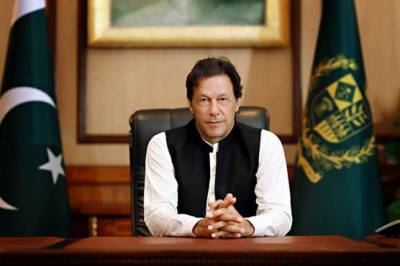
New Delhi and Islamabad cannot afford a new war with the weapons they now have, Pakistani Prime Minister Imran Khan said, adding that he and Indian PM Narendra Modi have to find a way out of the ongoing security crisis.
In a short televised address on Wednesday, Khan said neither he nor his Indian counterpart, Narendra Modi, would be in control of the situation, if the ongoing hostilities escalate further.
History tells us that wars are full of miscalculation. My question is that given the weapons we have, can we afford miscalculation? We should sit down and talk.
Khan added Pakistan is willing to work with India to investigate the suicide bombing of its police officers in Kashmir which happened two weeks ago and led to this week’s conflict between the two countries. The attack was claimed by the jihadist group Jaish-e-Mohammed (JeM), which India accuses Pakistan of harboring.
But just like any other sovereign nation, Pakistan cannot allow another country to act “as judge, jury and executioners” on its territory, he said. Wednesday’s attack on targets in India by Pakistani warplanes was meant as a show of force and determination to defend its sovereignty, the PM stressed.
“We ensured no casualties and no collateral damage in the operations we undertook,” he said.
India on Tuesday launched an air raid against what is said was a JeM training camp in Pakistani territory. Pakistan on Wednesday launched its own air raid, attacking targets in the disputed region of Kashmir. There are conflicting claims by the two nations on the outcomes and circumstances of both incidents.
At least one Indian fighter jet was shot down on Wednesday. Pakistan claims to have shot down more than one, while India insists it took out one of the Pakistani warplanes.
War on Al-Aqsa: What price for Netanyahu’s victory
By Ramzy Baroud | MEMO | February 26, 2019
On 18 February, members of extremist Jewish groups raided the Al-Aqsa Mosque compound in Occupied Al-Quds (Jerusalem). They clashed with Palestinian worshippers, as the settlers attempted to shut down the gate of Al-Aqsa itself.
The clashes involved the Israeli army and police as well, who opened fire and brutally assaulted Palestinians, leading to scores of injuries.
On February 19, the Israeli army carried out the unusual step of shutting down Al-Rahma Gate, which leads to a section of the Al-Aqsa compound that has, itself, been shut down by the Israeli army since 2003.
The provocative decision to seal the gate was made in advance, and the lock and key have the fingerprints of Israeli Prime Minister, Benjamin Netanyahu.
It is quite typical for Israeli politicians to carry out confrontational measures against Palestinians shortly before general elections are due. The nature of these measures is determined by the kind of political constituency that Israeli leaders aim to appease.
However, a war on Gaza, at least for now, is too risky an option for Netanyahu as it would take place too close to the April 9 elections date. Moreover, a botched Israeli attack on the Strip on November 11 caused Netanyahu a major embarrassment, forcing him to shelve the Gaza option for now.
That said, if the Israeli Prime Minister’s political standing grows too desperate in the coming weeks, a Gaza war may, once again, be placed on the table.
Indeed, the political union between Benny Gantz and Yair Lapid, which was declared on February 21, has certainly upped the ante for Netanyahu who has assumed that his election victory is a foretold conclusion.
Gantz and Lapid merged their two parties into one election list called Kahol Lavan (“Blue and White”), the single most serious electoral challenge for Netanyahu in years.
For the time being, Netanyahu has decided to appeal to the most messianic religious segments of Israeli society to keep his challengers at bay. This should come as no surprise as the religious, ultra-national far right has been the backbone of the Israeli leader’s coalitions for a decade.
Weeks before the Gantz and Lapid union, Netanyahu had taken several measures to show signs of goodwill towards his religious constituency.
One such overture was made on January 28, when Netanyahu ordered the UN unarmed international observers to leave the Occupied Palestinian city of Al-Khalil, where a few hundred armed Jewish settlers have been a constant source of violence. The Jewish settlers of Qiryat Arba’a live under the protection of a massive Israeli army contingent. Both groups have worked together to terrorise the Palestinian inhabitants of the city for many years.

Israeli soldier fires at Palestinian protesters in Hebron, Sept. 2016 [Anadolu]
A joint statement issued by several humanitarian organisations, including Oxfam, Norwegian Refugee Council (NRC) and Save the Children warned of the terrible fate awaiting the Palestinian community as a result of Netanyahu’s decision in Al-Khalil.
“Hundreds of civilians, including children, will see their safety put at risk by the withdrawal of international observers deployed in the city of Hebron,” the statement read.
True to form, attacks by Jewish settlers followed, as media and rights group reports point to a surge of violence against Palestinian civilians in the city.
By unleashing the wrath of Jewish settlers in Al-Khalil, Netanyahu wanted to communicate to his supporters that he remains committed to their settlement project, an unworthy cause that violates international law and comes at the price of protracted human suffering.
Similarly, the Israeli decision to shut down Al-Rahma Gate on February 19 was a pre-calculated move, aimed at uniting the entirety of the Israeli right, including the most extremist of all religious and settler groups behind Netanyahu’s leadership in the coming elections.
A trend began a few weeks earlier. On January 9, the Palestinian Ministry of Endowment documented a sharp increase of Israeli violations, involving the Israeli army and Jewish settlers at holy Palestinian sites throughout December. According to the Organization, over 100 such violations were reported, including 30 different incursions into Al-Aqsa itself.
A raid on Al-Aqsa on January 7 involved more than the usual suspects but was led by Israeli Agriculture Minister and a strong ally of Netanyahu, Uri Ariel.
This type of politically-motivated and highly militarised ‘visits’ to Al-Aqsa are reminiscent of the infamous ‘visit’ by late Israeli right-wing leader, Ariel Sharon in September 2000. At the time, Sharon wanted to increase his chances of becoming Israel’s next prime minister, and to ensure that his arch-rival (then, interestingly enough, the very Benjamin Netanyahu) did not win the Likud Party nomination. The gambit worked. Sharon sparked the Second Palestinian Uprising (2000-05), leading to the deaths of thousands and, of course, securing his seat at the helm of Israeli politics for years.
Netanyahu, ever studious and resourceful, has, indeed, mastered the art of political manipulation as his mentor and, once again, Al-Aqsa is the platform for this sinister Israeli politicking.
Netanyahu’s decision to strike an alliance with Otzma Yehudit (Jewish Power) – the rebranded party of the extremist late Meir Kahane – further demonstrates how the current surge of violence around the holy Palestinian sites is a pre-calculated political move by Netanyahu and his government.
The fact that Netanyahu would bring into his future coalition groups that are the ideological mutation of the Jewish Defense League – which is classified as ‘terrorist organisation’’ by the US Federal Bureau of Investigation (FBI) speaks volumes about the changing relationship between the US and Israel. Thanks to Washington’s blind support of Israel, Netanyahu feels politically triumphant and invincible, even above US’ laws.
However, to achieve his pathetic dream of being Israel’s longest serving Prime Minister, Netanyahu should be wary of the bloody consequences that his reckless action is sure to yield. Indeed, Netanyahu may be provoking the kind of violence that is much bigger than his ability to contain.
Al-Aqsa Mosque has served not only as a religious symbol for Palestinians but a national symbol as well, representing their coveted freedom and serving as a source of hope and unity throughout generations.
While the blood of Palestinians is irrelevant in Netanyahu’s quest for political dominance, the international community should take immediate measures to prevent what could become an Israeli-induced bloodbath in the coming weeks.
The Military Industrial State Confronts Russia and China
By Brian CLOUGHLEY | Strategic Culture Foundation | 26.02.2019
The swaggering arrogance of Washington’s Military-Industrial Complex never ceases to intrigue the rest of the world, much of which shrugs collective shoulders but has to acknowledge that the swaggering reflects the US National Defence Strategy which informs us that the military is going to concentrate on confronting Russia and China.
One of the loudest voices in the confrontation chorus is that of the Commander of US Naval Forces in Europe, Admiral James Foggo III, who knows that the noisier he is, the more money will be allocated by government to acquire more and more ships. And he is very good at being noisy. In 2016 he wrote a particularly bellicose piece for the US Naval Institute, titled ‘The Fourth Battle of the Atlantic’ in which he castigated Russia for not acknowledging that the United States is supreme. He declared that “the new Russian national security-strategy depicts the United States and NATO as threats to Russian security and accuses us of applying ‘political, economic, military, and information-related pressure’ on Russia.”
He is absolutely right about the US-NATO threat, because it has been growing for almost twenty years. As I’ve written before, after the Warsaw Pact disbanded in March 1991, NATO, although deprived of any reason to continue in existence, managed to keep going, and in 1999 added Poland, the Czech Republic and Hungary to its 16 members. As the BBC noted, these countries became “the first former Soviet bloc states to join Nato, taking the alliance’s borders some 400 miles towards Russia.”
With good reason Moscow wondered what on earth the US-NATO military cabal might be planning.
The New York Times recorded that the 1999 expansion was “opening a new path for the military alliance” and expressed delight that the ceremony took place in the town of Independence, Missouri, where “the emotional Secretary of State Madeleine K Albright watched the three foreign ministers sign the documents of accession, signed them herself, then held them aloft like victory trophies.” Ms Albright was born Marie Korbelová in Prague and “made no secret today of her joy as her homeland and the two other nations joined the alliance.” But neither she nor anyone else is on record as explaining what “new path” would be taken by NATO.
NATO continued to expand around Russia’s borders, inviting Bulgaria, Estonia, Latvia, Lithuania, Romania, Slovakia and Slovenia to join in 2002, which they did two years later.
There is little wonder that Russia is apprehensive about NATO’s intentions, as the muscle-flexing coalition lurches ever more eagerly towards conflict.
Further, the US itself has hundreds of military bases, spread all round the world. As noted by Nick Turse “Officially, the Department of Defense maintains 4,775 “sites,” spread across all 50 states, eight US territories, and 45 foreign countries. A total of 514 of these outposts are located overseas, according to the Pentagon’s worldwide property portfolio… But the most recent version of that portfolio, issued in early 2018 and known as the Base Structure Report, doesn’t include any mention of al-Tanf [the US Special Forces base in Syria] or for that matter, any other base in Syria. Or Iraq. Or Afghanistan. Or Niger. Or Tunisia. Or Cameroon. Or Somalia. Or any number of locales where such military outposts are known to exist and even, unlike in Syria, to be expanding.”
Yet Admiral Foggo insists that “an enduring objective of Russian foreign policy today is to challenge NATO and elevate Russia on the European stage once again.” Well, certainly Russia wants to be on the European stage, and it must be pointed out that it’s closer to that stage than is the US. It wants to trade with Europe — as is appreciated by the main European powers, Germany and France — and would be crazy to take action that would work against this mutually beneficial cooperation.
Unfortunately, Poland and the Baltic States of Estonia, Latvia and Lithuania are verging on the paranoid about Russia’s supposed “threat” to them — but there has been no indication of any sort by Moscow that Russia has any intention of moving against them in any way. Trade with these countries is important, too, but this hasn’t stopped the paranoid quartet from indulging in a vastly expensive operation to “decouple power grids from Russia” in spite of the fact that “Russia, on which the Baltic states currently rely to balance their power flows, has never cut power or threatened to do so.”
This is all part and pattern of the anti-Russia obsession that is mounting in much of the West, and plays into the hands of such as Admiral Foggo who now, some three months after an incident in the Kerch Strait last November, announced it “irritates me to no end” that Russia detained and charged 24 Ukrainian sailors who were involved in the illegal passage of some Ukrainian vessels. Foggo’s fury lies in his belief that “They are uniformed Ukrainian sailors and officers and chiefs. They’re not criminals, and they are being charged under a criminal code.”
None of his pronouncements make sense, but on February 19 Foggo despatched the guided-missile destroyer Donald Cook to the Black Sea where it is to conduct “maritime security operations and enhance regional maritime stability, combined readiness and naval capability with our NATO allies and partners in the region.” The provocative sortie by the Donald Cook will achieve absolutely nothing other than the heightening of tension between the US and Russia, which, unfortunately, is the object of the exercise.
Which brings us to the other region where the US Navy fandangos for freedom, the South China Sea.
On that side of the world the US is represented militarily by Admiral Philip S Davidson, the Commander US Indo-Pacific Command, who doesn’t like China. On February 12 he warned the US Senate Armed Services Committee that China’s “first aircraft carrier group, centered around its refurbished Soviet-built carrier, reached initial operational capability in mid-2018” and its “first domestically-built aircraft carrier has completed four sets of sea trials since May 2018 and will likely join the PLA Navy fleet in 2019.” This is very interesting, but what he doesn’t say is that the United States has eleven fully operational carrier strike groups, one of which, headed by the carrier John C Stennis, as recorded by Stratfor, “is underway in the US 7th Fleet area of operations in support of naval operations to ensure maritime stability and security in the Central Region.” It is, as noted by the US Naval Institute “in the South China Sea” where it will contribute to tension by sailing through waters averred by China to be its own. Admiral Davidson announced that China was not abiding by the UN Convention on the Law of the Sea and naturally failed to note any amusing irony in the fact that the United States has not ratified the Convention. But in any event, in the eyes of Washington’s Military Industrial State, UN rules are valuable only when they coincide with US policy.
On January 7 the US Pacific Fleet announced that the USS McCampbell, a guided missile destroyer, had carried out a “freedom of navigation” operation, sailing within 12 nautical miles of China’s Paracel Islands “to challenge excessive maritime claims.” Then on February 11 they were at it again, with CNN reporting a 7th Fleet announcement that the guided-missile destroyers USS Spruance and USS Preble had sailed within 12 nautical miles of the Spratly Islands “to challenge excessive maritime claims and preserve access to the waterways as governed by international law.”
Washington has woven a pattern of military confrontation, from the Baltic and the Kerch Strait to the South China Sea, that is intended to antagonise Russia and China. It may be claimed that provocational manoeuvres in the air, at sea and on land are undertaken with the aim of altering Chinese and Russian policies, but the only consequence of these juvenile jamborees is to heighten tension, increase distrust, and pave the way to war. That’s the path envisaged by the New York Times in 1999, and it’s being followed faithfully.
One can only hope that Trump might see the beckoning light of cooperation and prosperity rather than following the path of confrontation, but he seems to be at the mercy of the Military Industrial State. If so, there can only be grave trouble ahead.
UK Rejects International Court of Justice Opinion on the Chagos Islands
By Craig Murray | February 26, 2019
In parliament, Alan Duncan for the government has just rejected yesterday’s stunning result at the International Court of Justice, where British occupation of the Chagos Islands was found unlawful by a majority of 13 to 1, with all the judges from EU countries amongst those finding against the UK.
This represents a serious escalation in the UK’s rejection of multilateralism and international law and a move towards joining the US model of exceptionalism, standing outside the rule of international law. As such, it is arguably the most significant foreign policy development for generations. In the Iraq war, while Britain launched war without UN Security Council authority, it did so on a tenuous argument that it had Security Council authority from earlier resolutions. The UK was therefore not outright rejecting the international system. On Chagos it is now simply denying the authority of the International Court of Justice; this is utterly unprecedented.
Duncan put forward two arguments. Firstly that the ICJ opinion was “only” advisory to the General Assembly. Secondly, he argued that the ICJ had no jurisdiction as the case was a bilateral dispute with Mauritius (and thus could only go before the ICJ with UK consent, which is not given).
But here Duncan is – against all British precedent and past policy – defying a ruling of the ICJ. The British government argued strenuously in the present case against ICJ jurisdiction, on just the grounds Duncan cited. The ICJ considered the UK’s arguments, together with arguments from 32 other states and from the African Union. The ICJ ruled that it did have jurisdiction, because this was not a bilateral dispute but part of the UN ordained process of decolonisation.
The International Court of Justice’s ruling on this point is given at length in paras 83 to 91 of its Opinion. This is perhaps the key section:
88. The Court therefore concludes that the opinion has been requested on the matter of decolonization which is of particular concern to the United Nations. The issues raised by the request are located in the broader frame of reference of decolonization, including the General Assembly’s role therein, from which those issues are inseparable (Western Sahara, Advisory Opinion, I.C.J. Reports 1975, p. 26, para. 38; Legal Consequences of the Construction of a Wall in the Occupied Palestinian Territory, Advisory Opinion, I.C.J. Reports 2004 (I), p. 159, para. 50).
89. Moreover, the Court observes that there may be differences of views on legal questions in advisory proceedings (Legal Consequences for States of the Continued Presence of South Africa in Namibia (South West Africa) notwithstanding Security Council Resolution 276 (1970), Advisory Opinion, I.C.J. Reports 1971, p. 24, para. 34). However, the fact that the Court may have to pronounce on legal issues on which divergent views have been expressed by Mauritius and the United Kingdom does not mean that, by replying to the request, the Court is dealing with a bilateral dispute.
90. In these circumstances, the Court does not consider that to give the opinion requested would have the effect of circumventing the principle of consent by a State to the judicial settlement of its dispute with another State. The Court therefore cannot, in the exercise of its discretion, decline to give the opinion on that ground.
91. In light of the foregoing, the Court concludes that there are no compelling reasons for it to decline to give the opinion requested by the General Assembly.
As stated at para 183, that the court did have jurisdiction was agreed unanimously, with even the US judge (the sole dissenter on the main question) in accord. For the British government to reject the ICJ’s unanimous ruling on jurisdiction, and quote that in parliament as the reason for not following the ICJ Opinion, is an astonishing abrogation of international law by the UK. It really is unprecedented. The repudiation of the UN Working Group on Arbitrary Detention over Julian Assange pointed the direction the UK is drifting, but that body does not have the prestige of the International Court of Justice.
The International Court of Justice represents the absolute pinnacle of, and embodies the principle of, international law. In 176 decisions, such as Nigeria vs Cameroon or Malaysia vs Indonesia, potentially disastrous conflicts have been averted by the states’ agreement to abide by the rule of law. The UK’s current attack on the ICJ is a truly disastrous new development.
I have taken it for granted that you know that the reason the UK refuses to decolonise the Chagos Islands is to provide an airbase for the US military on Diego Garcia. If Brexit goes ahead, the Chagos Islands will also lead to a major foreign policy disagreement between the UK and US on one side, and the EU on the other. The EU will be truly shocked by British repudiation of the ICJ.
I have studied the entire and lengthy ICJ Opinion on the Chagos Islands, together with its associated papers, and I will write further on this shortly.
Mr Bolton’s Long Game Against Iran – Pakistan Becomes Saudi Arabia’s New Client State
By Alastair CROOKE | Strategic Culture Foundation | 25.02.2019
The Wall Street Journal has an article whose very title – Ambitions for an ‘Arab NATO’ Fade, Amid Discord – more or less, says it all. No surprise there at all. Even Antony Zinni, the retired Marine General who was to spearhead the project (but who has now resigned), said it was clear from early on that the idea of creating an “Arab NATO” was too ambitious. “There was no way that anybody was ready to jump into a NATO-type alliance,” he said. “One of the things I tried to do was kill that idea of a Gulf NATO or a Middle East NATO.” Instead, the planning has focused on ‘more realistic expectations’, the WSJ article concludes.
Apparently, “not all Middle Eastern nations working on the proposal, want to make Iran a central focus – a concern that has forced the US to frame the alliance as a broader coalition”, the WSJ recounts. No surprise there either: Gulf preoccupations have turned to a more direct anxiety – which is that Turkey intends to unloose (in association with Qatar) the Muslim Brotherhood – whose leadership is already gathering in Istanbul – against Turkey’s nemesis: Mohammad bin Zaid and the UAE (whom Turkish leadership believes, together with MbS, inspired the recent moves to surround the southern borders of Turkey with a cordon of hostile Kurdish statelets).
Even the Gulf leaders understand that if they want to ‘roll-back’ Turkish influence in the Levant, they cannot be explicitly anti-Iranian. It just not viable in the Levant.
So, Iran then is off the hook? Well, no. Absolutely not. MESA (Middle East Security Alliance) maybe the new bland vehicle for a seemingly gentler Arab NATO, but its covert sub-layer is, under Mr Bolton’s guidance, as fixated on Iran, as was ‘Arab NATO’ at the outset. How would it be otherwise (given Team Trump’s obsession with Iran)?
So, what do we see? Until just recently, Pakistan was ‘on the ropes’ economically. It seemed that it would have to resort to the IMF (yet again), and that it was clear that the proximate IMF experience – if approved – would be extremely painful (Secretary Pompeo, in mid-last year, was saying that the US probably would not support an IMF programme, as some of the IMF grant might be used to repay earlier Chinese loans to Pakistan). The US too had punished Pakistan by severely cutting US financial assistance to the Pakistani military for combatting terrorism. Pakistan, in short, was sliding inevitably towards debt default – with only the Chinese as a possible saviour.
And then, unexpectedly, up pops ‘goldilocks’ in the shape of a visiting MbS, promising a $20 billion investment plan as “first phase” of a profound programme to resuscitate the Pakistani economy. And that is on top of a $3 billion cash bailout, and another $3 billion deferred payment facility for supply of Saudi oil. Fairy godmothers don’t come much better than that. And this benevolence comes in the wake of the $6.2 billion, promised last month, by UAE, to address Pakistan’s balance of payments difficulties.
The US wants something badly – It wants Pakistan urgently to deliver a Taliban ‘peace agreement’ in Afghanistan with the US which allows for US troops to be permanently based there (something that the Taliban not only has consistently refused, but rather, has always put the withdrawal of foreign forces as its top priority).
But two telling events have occurred: The first was on 13 February when a suicide attacker drove an explosives-laden vehicle into a bus that was transporting IRGC troops in the Sistan-Baluchistan province of Iran. Iran’s parliamentary Speaker has said that the attack that killed 27 members of Iran’s elite Islamic Revolutionary Guards Corps (IRGC) was “planned and carried out, from inside Pakistan”. Of course, such a provocative disruption into Iran’s most ethnically sensitive province may mean ‘nothing’, but perhaps the renewed inflow of Gulf money, fertilizing a new crop of Wahhabi madrasa in Pakistan’s Baluch province, may be connected – as IRCG Commander, General Sulemani’s stark warning to Pakistan suggests.
In any event, reports suggest that Pakistan, indeed, is placing now intense pressure on the Afghan Taliban leaders to accede to Washington’s demand for permanent military bases in Afghanistan.
The US, it seems, after earlier chastising Pakistan (for not doing enough to curb the Taliban) has done a major U-turn: Washington is now embracing Pakistan (with Saudi Arabia and UAE writing the cheques). And Washington looks to Pakistan rather, not so much to contain and disrupt the Taliban, but to co-opt it through a ‘peace accord’ into accepting to be another US military ‘hub’ to match America’s revamped military ‘hub’ in Erbil (the Kurdish part of Iraq, which borders the Kurdish provinces of Iran). As a former Indian Ambassador, MK Bhadrakumar explains:
“What the Saudis and Emiratis are expecting as follow-up in the near future is a certain “rebooting” of the traditional Afghan-Islamist ideology of the Taliban and its quintessentially nationalistic “Afghan-centric” outlook with a significant dosage of Wahhabi indoctrination … [so as to] make it possible [to] integrate the Taliban into the global jihadi network and co-habitate it with extremist organisations such as the variants of Islamic State or al-Qaeda … so that geopolitical projects can be undertaken in regions such as Central Asia and the Caucasus or Iran from the Afghan soil, under a comprador Taliban leadership”.
General Votel, the head of Centcom told the US Senate Armed forces Committee on 11 February, “If Pakistan plays a positive role in achieving a settlement to the conflict in Afghanistan, the US will have opportunity and motive to help Pakistan fulfill that role, as peace in the region is the most important mutual priority for the US and Pakistan.” MESA is quietly proceeding, but under the table.
And what of that second, telling occurrence? It is that there are credible reports that ISIS fighters in the Deir a-Zoor area of Syria are being ‘facilitated’ to leave East Syria (reports suggest with significant qualities of gold and gemstones) in a move to Afghanistan.
Iran has long been vulnerable in its Sistan-Baluchistan province to ostensibly, secessionist factions (supported over the years by external states), but Iran is vulnerable, too, from neighbouring Afghanistan. Iran has relations with the Taliban, but it was Islamabad that firstly ‘invented’ (i.e. created) the Deobandi (an orientation of Wahhabism) Taliban, and which traditionally has exercised the primordial influence over this mainly Pashtoon grouping (whilst Iran’s influence rested more with the Tajiks of northern Afghanistan). Saudi Arabia of course, has had a decades long connection with the Pashtoon mujahidin of Afghanistan.
During the Afghan war of the 1980s and later, Afghanistan always was the path for Islamic fundamentalism to reach up into Central Asia. In other words, America’s anxiety to achieve a permanent presence in Afghanistan – plus the arrival of militants from Syria – may somehow link to suggest a second motive to US thinking: the potential to curb Russia and China’s evolution of a Central Asian trading sphere and supply corridor.
Putting this all together, what does this mean? Well, firstly, Mr Bolton was arguing for a US military ‘hub’ in Iraq – to put pressure on Iran – as early as 2003. Now, he has it. US Special Forces, (mostly) withdrawn from Syria, are deploying into this new Iraq military ‘hub’ in order, Trump said, to “watch Iran”. (Trump rather inadvertently ‘let the cat out of the bag’ with that comment).
The detail of the US ‘hub encirclement’ of Iran, however, rather gives the rest of Mr Bolton’s plan away: The ‘hubs’ are positioned precisely adjacent to Sunni, Kurdish, Baluch or other Iranian ethnic minorities (some with a history of insurgency). And why is it that US special forces are being assembled in the Iraqi hub? Well, these are the specialists of ‘train and assist’ programmes. These forces are attached to insurgent groups to ‘train and assist’ them to confront a sitting government. Eventually, such programmes end with safe-zone enclaves that protect American ‘companion forces’ (Bengahazi in Libya was one such example, al-Tanaf in Syria another).
The covert element to the MESA programme, targeting Iran, is ambitious, but it will be supplemented in the next months with new rounds of economic squeeze intended to sever Iran’s oil sales (as waivers expire), and with diplomatic action, aimed at disrupting Iran’s links in Syria, Lebanon and Iraq.
Will it succeed? It may not. The Taliban pointedly cancelled their last scheduled meeting with Pakistani officials at which renewed pressure was expected to be exerted on them to come to an agreement with Washington; the Taliban have a proud history of repulsing foreign occupiers; Iraq has no wish to become ‘pig-in-the middle’ of a new US-Iran struggle; the Iraqi government may withdraw ‘the invitation’ for American forces to remain in Iraq; and Russia (which has its own peace process with the Taliban), would not want to be forced into choosing sides in any escalating conflict between the US, Israel and Iran. Russia and China do not want to see this region disrupted.
More particularly, India will be disconcerted by the sight of the MESA ‘tipping’ toward Pakistan as its preferred ally – the more so as India, likely will view (rightly or wrongly), the 14 February, vehicle-borne, suicide attack in Jammu-Kashmir that resulted in the deaths of 40 Indian police, as signaling the Pakistan military recovering sufficient confidence to pursue their historic territorial dispute with India over Jammu-Kashmir (perhaps the world’s most militarised zone, and the locus of three earlier wars between India and Pakistan). It would make sense now, for India to join with Iran, to avoid its isolation.
But these real political constraints notwithstanding, this patterning of events does suggest a US ‘mood for confrontation’ with Iran is crystalizing in Washington.
Israel Burying ‘Nuclear Waste With Radioactive Content’ in Golan – UN Report
Sputnik – 25.02.2019
The UN has been adopting resolutions condemning the Israeli occupation of the Golan Heights for decades; however Tel Aviv hasn’t changed its policies and is continuing to exercise sovereignty over the disputed territory, including holding municipal elections.
Secretary-General of the UN Antonio Guterres has presented a report to the UN Human Rights Council based on Syrian accusations against Israel’s action in the Golan Heights, saying that Israel has been burying “nuclear waste with radioactive content in 20 different areas populated by Syrian citizens” in the occupied territory. Most of the waste has allegedly been dumped in the area near Al-Sheikh Mountain.
According to the report, this puts “the lives and health of Syrians in the occupied Syrian Golan in jeopardy” and violates the 4th Geneva Convention.
Israel is suspected of possessing nuclear weapons, but no evidence proving or disproving the suspicion has been presented so far. Tel Aviv has neither confirmed, nor denied possessing nuclear weapons.
The Golan Heights was seized by Israel from Syria during the Six-Day War in 1967. In 1981, Tel Aviv decided to extend its laws to the occupied territory and established a civil administration in a move that drew condemnation from the UN Security Council and was labelled illegal in terms of international law. Israel justified the decision by saying that it was aimed at safeguarding its borders from aggressive military acts by its neighbours.
In 2018, the UN General Assembly adopted a resolution urging Israel to immediately withdraw its forces from the Golan Heights after Tel Aviv organised local elections in the Golan Heights on 30 October.
US Base in Okinawa to Be Relocated Despite Referendum Results – Japanese PM Abe
Sputnik – 25.02.2019
A total of 72.2 percent of those who voted in the referendum on the Japanese island of Okinawa voted against plans to build a new military airfield for US troops in their prefecture, the referendum’s results showed on 25 February.
Japanese Prime Minister Shinzo Abe said that he “took seriously” the results of the referendum in Okinawa on transferring the US Futenma base to Henoko in the same prefecture, but “it is impossible to postpone the transfer dates”.
“I have considered the referendum results with all seriousness and will do everything to reduce Okinawa’s burden… It’s been over 20 years since Japan and the United States signed an agreement about returning the entire territory of Futenma [to the prefecture]. But it has still not been returned. We cannot postpone the relocation any longer”, the prime minister stated.
He continued on by saying that the authorities need to “avoid a situation where the Futenma base, considered the most dangerous in the world, keeps being surrounded by schools and residential buildings”.
The statement comes after a non-binding referendum was held in Okinawa on 24 February, in which local residents expressed their attitude to the relocation of US Marine Corps Futenma Air Station from the densely populated city of Ginowan, where it is currently situated, to the Henoko district.
A total of 19.1 percent of voters supported the plans for the US base relocation, while 8.8 percent refrained from responding yes or no.
In numerical terms, 434,273 people voted against the Tokyo-Washington plans, while 114,933 supported the move, with 52,682 others choosing neither of the options.
The US Marine Corps base Futenma was constructed in 1945. Talks on its relocation to a less populated area within the Okinawa prefecture started over two decades ago, but the government’s plans have been hampered by local residents’ protests.
While Ginowan residents have been calling on the government to close the Futenma base due to their environmental concerns, aircraft incidents and accidents related to the behavior of US troops, residents of Henoko district are also unwilling to see the base relocated to their region. The administration of Okinawa would like to see the base outside the prefecture instead of its relocation to another site within its administrative borders and called a non-binding referendum in hopes that it would demonstrate the prefecture’s strong opposition to the relocation project.
See also:
Microsoft workers demand company cancel $480 million US military contract
Press TV – February 23, 2019
Nearly 100 employees at Microsoft have demanded that the US technology company cancel a $480 million hardware contract to supply the US military, the latest example in the last year of tech employees protesting cooperation with the Pentagon on emerging technologies.
Some 94 workers signed a petition on Friday calling on the company to stop developing “any and all weapons technologies” for the US Defense Department.
Microsoft won a contract in November to supply the US Army with at least 2,500 prototypes of augmented reality headsets, which digitally display contextual information in front of a user’s eyes.
The US Defense Department has said the devices would be used on the battlefield and in training to improve soldiers “lethality, mobility and situational awareness.”
In the petition to Microsoft executives, posted on Twitter, the workers said they “did not sign up to develop weapons, and we demand a say in how our work is used.” They called on the company to develop “a public-facing acceptable use policy” for its technology and an external review board to publicly enforce it.
Microsoft president Brad Smith said in an October blog post that the company remained committed to assisting the military and would advocate for laws to ensure responsible use of new technologies.
Though many US government agencies want to draw upon the expertise of the biggest American tech companies, employee resistance has added a new challenge to already complicated relationships.
Worker opposition led Google’s parent company Alphabet Inc last year to announce it would cancel a Pentagon contract in which its artificial intelligence technology is used to analyze drone imagery.
In other cases, employee criticism has invited greater public scrutiny to deals, such as $10 billion cloud computing contract yet to be awarded and various contracts with US Immigration and Customs Enforcement.
Japanese PM Abe set to ignore local referendum on US Okinawa military base relocation
RT | February 23, 2019
Japanese Prime Minister Shinzo Abe has said his government will press ahead with the controversial relocation of a US military base on the island of Okinawa, despite local objection.
Okinawa is home to two-thirds of the US’ Japanese bases. Tokyo wants to relocate one of these – US Marine Corps Air Station Futenma, located in a densely populated area – to the more remote coastal area of Henoko. While residents near the base have been angered by a series of aircraft accidents, they also oppose the relocation to Henoko, claiming that planned land-reclamation works there will devastate the coral-rich coastal environment.
Okinawans will vote on the relocation on Sunday in a non-binding referendum, with nearly 70 percent expected to vote ‘No,’ according to a poll by Kyodo News. Okinawa’s Governor Denny Tamaki, who campaigned on an anti-base platform last year, has also traveled to Washington DC to lobby against the move.
The Japanese government intends to go ahead with the relocation “without being swayed by referendum results,” Abe told parliament on Wednesday.
Many Okinawans are unhappy with the base’s current location, as well as the planned relocation. They hope a ‘No’ vote will force the government to move the base off the island altogether.
The behavior of US troops stationed on Okinawa has also incensed locals, with the 1995 kidnap and gang-rape of a 12-year-old girl by three US soldiers triggering mass protests on the island. Two cases of rape and murder by US troops again caused protests in 2016. One year later, Okinawa was back in the news after a drunk Marine plowed his truck into another vehicle while running a red light, killing an elderly Japanese man.
Canadian military in Haiti. Why?
By Yves Engler · February 22, 2019
 Canadian troops may have recently been deployed to Haiti, even though the government has not asked Parliament or consulted the public for approval to send soldiers to that country.
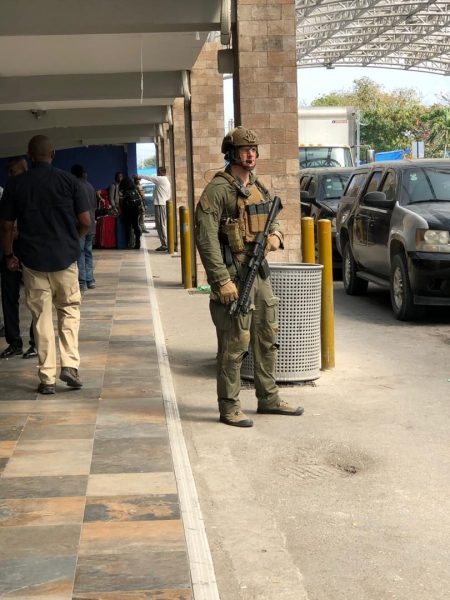
Last week the Haiti Information Project photographed heavily-armed Canadian troops patrolling the Port-au-Prince airport. According to a knowledgeable source I emailed the photos to, they were probably special forces. The individual in “uniform is (most likely) a member of the Canadian Special Operations Regiment (CSOR) from Petawawa”, wrote the person who asked not to be named. “The plainclothes individuals are most likely members of JTF2. The uniformed individual could also be JTF2 but at times both JTF2 and CSOR work together.” (CSOR is a sort of farm team for the ultra-elite Joint Task Force 2.)
What was the purpose of their mission? The Haiti Information Project reported that they may have helped family members of President Jovenel Moïse’s unpopular government flee the country. HIP tweeted, “troops & plainclothes from Canada providing security at Toussaint Louverture airport in Port-au-Prince today as cars from Haiti’s National Palace also drop off PHTK govt official’s family to leave the country today.”
Many Haitians would no doubt want to be informed if their government authorized this breach of sovereignty. And Canadians should be interested to know if Ottawa deployed the troops without parliamentary or official Haitian government okay. As well any form of Canadian military support for a highly unpopular foreign government should be controversial.
Two days after Canadian troops were spotted at the airport five heavily armed former US soldiers were arrested. The next day the five Americans and two Serbian colleagues flew to the US where they will not face charges. One of them, former Navy SEAL Chris Osman, posted on Instagram that he provided security “for people who are directly connected to the current President” of Haiti. Presumably, the mercenaries were hired to squelch the protests that have paralyzed urban life in the country. Dozens of anti-government protesters and individuals living in neighborhoods viewed as hostile to the government have been killed as calls for the president to step down have grown in recent months.
Was the Canadian deployment in any way connected to the US mercenaries? While it may seem far-fetched, it’s not impossible considering the politically charged nature of recent deployments to Haiti.
After a deadly earthquake rocked Haiti in 2010 two thousand Canadian troops were deployed while several Heavy Urban Search Rescue Teams were readied but never sent. According to an internal file uncovered through an access to information request, Canadian officials worried that “political fragility has increased the risks of a popular uprising, and has fed the rumour that ex-president Jean-Bertrand Aristide, currently in exile in South Africa, wants to organize a return to power.” The government documents also explain the importance of strengthening the Haitian authorities’ ability “to contain the risks of a popular uprising.”
The night president Aristide says he was “kidnapped” by US Marines JTF2 soldiers “secured” the airport. According to Agence France Presse, “about 30 Canadian special forces soldiers secured the airport on Sunday [Feb. 29, 2004] and two sharpshooters positioned themselves on the top of the control tower.” Reportedly, the elite fighting force entered Port-au-Prince five days earlier ostensibly to protect the embassy.
Over the past 25 years Liberal and Conservative governments have expanded the secretive Canadian special forces. In 2006 the military launched the Canadian Special Operations Forces Command (CANSOFCOM) to oversee JTF2, the Special Operations Regiment, Special Operations Aviation Squadron and Canadian Joint Incident Response Unit.
CANSOFCOM’s exact size and budget aren’t public information. It also bypasses standard procurement rules and their purchases are officially secret.While the Canadian Security Intelligence Service (CSIS), Communications Security Establishment and other government agencies face at least nominal oversight, CANSOFCOM does not.
During a 2006 Senate Defence Committee meeting CANSOFCOM Commander Colonel David E. Barr responded by saying, “I do not believe there is a requirement for independent evaluation. I believe there is sufficient oversight within the Canadian Forces and to the people of Canada through the Government of Canada — the minister, the cabinet and the Prime Minister.”
The commander of CANSOFCOM simply reports to the defence minister and PM.
“Even the U.S. President does not possess such arbitrary power,” notes Michael Skinner in a CCPA Monitor story titled “Canada’s Ongoing Involvement in Dirty Wars.”
This secrecy is an important part of their perceived utility by governments. “Deniability” is central to the appeal of special forces, noted Major B. J. Brister. The government is not required to divulge information about their operations so Ottawa can deploy them on controversial missions and the public is none the wiser. A 2006 Senate Committee on National Security and Defence complained their operations are “shrouded in secrecy”. The Senate Committee report explained, “extraordinary units are called upon to do extraordinary things … But they must not mandate themselves or be mandated to any role that Canadian citizens would find reprehensible. While the Committee has no evidence that JTF2 personnel have behaved in such a manner, the secrecy that surrounds the unit is so pervasive that the Committee cannot help but wonder whether JTF2’s activities are properly scrutinized.” Employing stronger language, right wing Toronto Sun columnist Peter Worthington pointed out that, “a secret army within the army is anathema to democracy.”
If Canadian special forces were secretly sent to Port-au-Prince to support an unpopular Haitian government Justin Trudeau’s government should be criticized not only for its hostility to the democratic will in that country but also for its indifference to Canadian democracy.
Featured Video

Iran’s Next Strike May Not Explode. It Could Shut You Down
or go to
Aletho News Archives – Video-Images
From the Archive
Zionism’s Violent Legacy
By Donald Neff | Washington Report On Middle East Affairs | January 1996
On January 4, 1948, Jewish terrorists drove a truck loaded with explosives into the center of the all Arab city of Jaffa and detonated it, killing 26 and wounding around 100 Palestinian men, women and children.[1] The attack was the work of the Irgun Zvai Leumi – the “National Military Organization,” also known by the Hebrew letters Etzel – the largest Jewish terrorist group in Palestine. The Irgun was headed by Revisionist Zionist Menachem Begin and had been killing and maiming Arabs, Britons and even Jews for the previous ten years in its efforts to establish a Jewish state.
This terror campaign meant that at the core of Revisionist Zionism there existed a philosophical embrace of violence. … continue
Blog Roll
 Aletho News
- Trump’s Iran war is on an Israeli leash
- Saudi oil boss issues global supply warning
- Riyadh Says Its Oil System Is Intact. The Numbers Say Otherwise.
- Trump and Netanyahu Want to “Finish the Job” on Iran
- US ‘one-sided dictation’ not Iran’s beliefs makes rational talks impossible: Baghaei
- Iran’s Next Strike May Not Explode. It Could Shut You Down /Col Doug Macgregor
- Iran: US political targets legitimate if assassinations return
- Iraq shuts key border crossing with Iran under US pressure: Report
- Undersea Internet cables could be targeted in retaliation for attacks on Iran: IRGC deputy chief
- EU sending ‘biased’ observers to interfere in Serbian election – president
- If Americans Knew
- AIPAC has become such a political liability that it’s shifting to a more “nimble” approach to buying politicians
- At least 160 Israeli settler attacks in 2 weeks
- Will Gaza’s Ancient Christian Community Disappear Forever?
- Israel’s vision of regional security rests on keeping Arab states weak
- Heidi Levine recounts how Palestinian youths helped save her in settler attack
- DAILY UPDATE: Latest essential news on Palestine, Israel, & region
- Trump’s Intensifying Sabotage of the ICC, for Israel’s Sake
- Israeli military detain US and UK volunteers in West Bank including Democratic NY politician Brad Lander
- Americans at National Conservatism Conference held in Israel this year criticize Israel
- Christiane Amanpour exits CNN with a legacy shaped by the debate over Israel
- No Tricks Zone
- E-Cars Reduce CO2 Emissions By Only 41% Compared To Internal Combustion Engine Vehicles
- Predictions Made By Renowned Climate Professor Over Past Decades Have Been Proven To Be Poor
- New Study Suggests Large Regions Of The Pacific Ocean Have Been Cooling For The Last 80 Years
- Germany’s Green Energy Debacle: High Energy Costs Force Kahla Porzellan to Close After 182 Years!
- New Study: 50 Years Of The Most Aggressive ‘Net Zero’ Policies Can Only Affect The Global Climate By 0.03°C
- US September “Heat” Was No Record…Many Records Set Decades Ago
- Latest European Green Energy Debacle; Portugal’s Largest Flagship Solar Park Insolvent!
- Green Energy Debacle: German Expert Professor Fritz Vahrenholt Warns Of Severe Economic And Social Consequences
- Two More Paleo Reconstructions Affirm Meters-Higher Sea Levels Across Ireland, Brazil 7000-6000 Years Ago
- New Study: Earth And Venus Surface Warmth Largely Explained By Convection And Lapse Rate, Not CO2 Or Radiation

