Putin’s Self-Defense Warning Twisted as ‘Unacceptable Threat’ to US
By Finian CUNNINGHAM | Strategic Culture Foundation | 22.02.2019
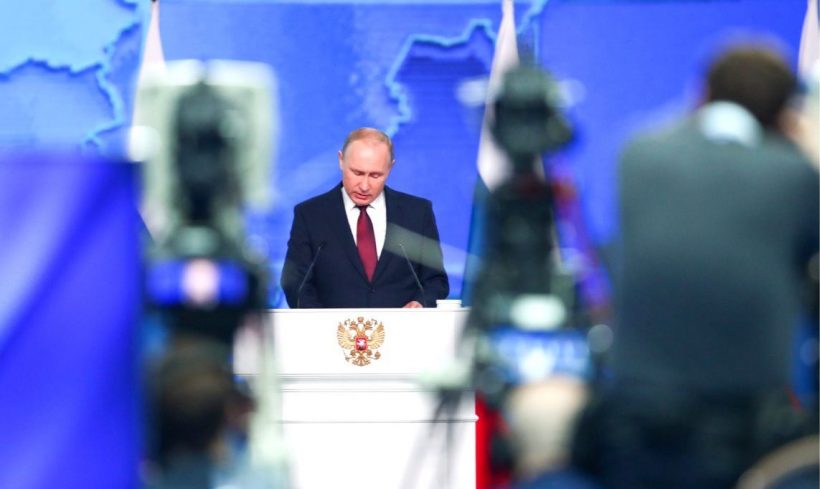
With stupendous double-think, Western news media claimed this week that Russian President Vladimir Putin was “threatening” the United States and its NATO allies with nuclear missiles.
The New York Times accused the Russian leader of “nuclear saber-rattling” while Radio Free Europe headlined: ‘Putin threatens to target the US with missiles’. Many other news outlets conveyed the same depiction of Russia somehow escalating bellicose tensions, based on Putin’s annual state-of-the-nation address this week.
Buried beneath the sensational headlines was a little more context that hints at the gross distortion being propagated by the Western media.
The New York Times disdained Putin was speaking with an “aggressive tone” and “doubling down on threats against the United States”.
The Times then went on to report: “President Vladimir Putin used his state-of-the-nation address to make some of his most explicit threats yet to start a nuclear arms race with the US after [sic] the Trump administration said this month that America was withdrawing from a landmark arms control treaty.”
Obliquely, but crucially, what the Western media coyly admit is that Putin’s remarks this week on deploying new missiles systems are in response to Washington’s decision to unilaterally abandon the Intermediate-range Nuclear Forces (INF) Treaty.
In other words, decisions have consequences. But for the Western media, they seem to be only preoccupied by consequences.
Furthermore, the Washington Post added somewhere lurking in the bowels of its coverage: “Putin emphasized that Russia will only respond if the United States makes the first move.”
That is, if the US installs short- and medium-range missiles in Europe then Russia will take symmetrical measures to target America territory and that of its NATO allies.
Radio Free Europe even breezily reported Putin as saying, “we don’t want confrontation” and added: “Putin said Russia wanted friendly relations with the United States and remained open for arms control talks with Washington.”
So, Western media are correctly – albeit coyly – noting that the Russian leader is acting in response to actions taken by Washington, and that he is explicitly appealing for friendly relations instead of confrontation. And yet the headlines were all screaming that Putin was “threatening the US”.
This willful distortion is reprehensibly adding to already dangerous international tensions. It is also a baleful failure to accurately determine which party is actually responsible for the brooding confrontational climate. Russia is being blamed for “threatening” the US and its allies when the reality is the reverse: it is the US that is unleashing the dangers of nuclear conflict, as even the Western media obliquely admit.
The Trump administration’s decision to walk away – unilaterally – from the 1987 INF Treaty is the key here. The US side claims that Russia has violated the treaty with its development of a land-launched cruise missile within the banned range of 500-5,500 kilometers. Moscow counters that the 9M729 (also known as SSC-8) missile has an operating range below the lower limit banned by the INF. Last month, in an unprecedented move, the Russian ministry of defense publicly disclosed the missile’s flight specifications at a press conference. Moscow points out that the US has not provided substantiating details to back up its claims that Russia is in breach of the treaty.
For its part, Russia accuses the US side of violating the INF treaty by already installing missile systems in Romania and Poland which can deploy offensive cruise warheads as well as performing as anti-missile systems. The US says its Aegis Ashore system is solely defensive.
However, rather than negotiating through the claims and counter-claims, it is the US side which decided to terminate its participation in the INF Treaty – just like it did with the Anti-Ballistic Missile (ABM) Treaty back in 2002 under President GW Bush.
The abandonment of a second major arms control accord is solely the responsibility of the US. The third remaining treaty, New START, is also at risk from redundancy by Washington.
With the INF now being trashed, the US has freed itself to potentially deploy additional missile systems in Europe right on Russia’s borders. The eastward expansion of NATO over the past three decades means that US nuclear weapons could be deployed with a strike capability on Moscow within 10-12 minutes, not hours as with strategic warheads.
President Putin this week noted that Washington has not indicated if it will refrain from installing medium-range nuclear missiles in Europe.
But the Russian leader emphatically specified the condition that “if” the US does embark on such a threatening deployment then Russia will take “symmetrical measures”. He warned that new hypersonic and submarine-launched missiles will be deployed to match the 10-12 minute flight time that the US could poise against Moscow. The Russian weapons will target European launch sites for the US missiles as well as “decision-making centers” in American territory.
Of course, such a dramatic proximity of nuclear capability is extremely alarming and deplorable. The risk of error is manifold greater in such a scenario in a way that far exceeds the Cold War decades. Putin noted that the scenario recalls the Cuban missile crisis in 1962 when the world almost witnessed a nuclear war. The reference point is apt for today’s predicament. The Soviet Union deployed nuclear missiles in Cuba in 1962 after the US installed ballistic missiles in Turkey the year before in 1961. Again, as now, it is the US side that is initiating the dynamics of provocation.
Any objective observer can see that it is the US that is continually upping the ante for nuclear war. The jettisoning of the ABM is now followed by the US discarding the INF based on dubious, unverified claims. Russia in fact views the ulterior rationale of the US as covertly wanting to free itself from the arms controls restriction in order to exert threatening pressure on Moscow for geopolitical goals: those goals may include forcing Russia to be compliant with American foreign policy interests, or opening up Russia’s natural resources to American capital exploitation, and so on.
Putin’s remarks this week are clearly consistent with Russia’s defensive doctrine for using nuclear forces. Moscow is patently stating that it will take “reciprocal steps” if Washington follows through on its offensive trajectory. Yet Western media invert the situation to portray Russia as “threatening” the US.
This is analogous to a gang marauding outside a home. Then the mob ringleader announces that projectiles are to be readied to lob over the garden wall. The homeowner shouts out: just try it and we’ll shoot your henchmen. Nobody in their right mind could fault the homeowner. It’s called self-defense.
But in Russia’s case, self-defense is twisted by dutiful, brainwashed Western news media as “unacceptable threat”.
The End of Truth as We Know It – Or Knew It
By Jeremy Salt | American Herald Tribune | February 21, 2019
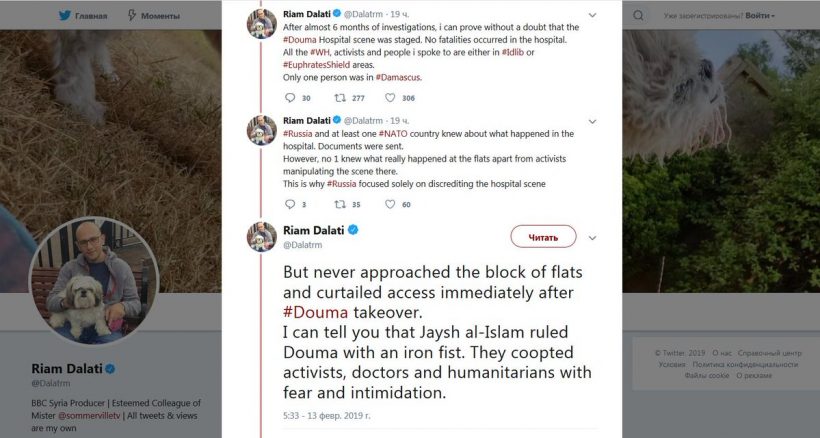
The claim (or admission) by the BBC journalist Riam Dalati that the alleged sarin attack on Douma in April 2018, was staged was received by the Russian embassy in London with glee. “Remarkable that the British MSM chose to ignore it’, whoever it was at the embassy wrote. ‘No breaking news, no articles, nothing.’
Remarkable? Not at all, given the endless track record of the media in ignoring news that does not suit its agenda. The real interest lies in the fact that an insider has owned up. His personal opinion only, according to the BBC, which along with the rest of the media, had taken the initial version of the alleged attack for granted, thus setting Syria up for the cruise missile strike by the US, Britain, and France which soon followed.
‘I can prove without a doubt that the Douma hospital scene was staged,’ Dalati wrote. Well, enough of the evidence has already been produced to prove that. As for the sarin, in July 2018, the OPCW (Organization for the Prevention of Chemical Weapons) put out an interim report indicating that whatever was used at Douma was not sarin, but most probably chlorine.
The next question is ‘used by whom?’ Again the evidence suggests that the yellow gas cylinders shown in the media propaganda blitz were not dropped from an aircraft but planted at the scene by the ‘activists’ who faked the whole episode.
The OPCW now seems to be reaching the point where it will release its full report. What it might contain opens the doors to endless speculation. It has already indicated that it found traces of chlorine and it may point an accusing finger at ‘the regime’ but without having the proof that it did it.
So expect something ultimately inconclusive, i.e. there is evidence of chlorine having been used, the Syrian regime might have used it but we really can’t say, leaving enough room for western governments to argue that they were right to bomb on the basis of the facts that were known at the time and for E. Higgins and company to argue that their version has not been disproved.
With Idlib, the last redoubt of the takfiris in Syria, now the focal point of political maneuvers and possibly military action, any credibility given by the OPCW to the accusations against the Syrian military might encourage the takfiris to try again, most likely in Idlib province, the location of the alleged chemical weapons attack in Khan Shaikhun in April, 2017. Without having the proof, the US launched a missile strike against a Syrian air base by way of retaliation.
Another faked attack would give the US and its law-breaking friends the pretext needed to disrupt or forestall any Syrian military campaign to drive the takfiris out of Idlib, which, far from having quietened down following the ‘de-escalation’ agreement reached by Turkey, Iran and Russia, is now an even hotter hothouse of takfiri activity.
The main group, Hayat Tahrir al Sham (HTS) basically still Jabhat al Nusra/Al Qaida in Syria despite the name change, and its allies have routed their ‘moderate’ enemies and taken control of between 70 to 90 per cent of the province, including Idlib city, which lives under a harsh form of sharia law.
The HTS collective has tens of thousands of armed fighters on call. So does the rival Turkish-supported National Liberation Front. The entire province is awash with arms and armed groups refusing to adhere to any agreements drawn up in Astana or Sochi and saying they will fight to the last.
Along with the fighting men are the civilians, the families of the takfiris and the normal civilian population of the province who are helpless in the face of the violence and intimidation all around them and the scheming of powerful actors far from the scene.
At present nothing is clear. The US is apparently planning to withdraw troops from northern Syria but has not withdrawn them. Erdogan and Putin have met to discuss what the US is up to, as well as the situation in Idlib and Turkey’s desire to set up a buffer zone running 460 kms and 32 kms deep along the Syrian border (on the Syrian side). Russia and Iran have so far refused to support the idea.
The buffer zone would be set up against the Kurdish People’s Protection Units (YPG), aligned with Turkey’s Kurdistan Workers’ Party (PKK) and ‘terrorists’ in the view of the Turkish government but not in the eyes of the US, which, of course, has been using the Kurds in pursuit of its own strategic interests
Turkey has recently been committing itself to the territorial and political integrity of Syria, raising an obvious question: if this is the case, why did you make such strenuous attempts to destroy both over the past eight years?
The US is on the brink of defeat in Syria. Not just defeat but defeat by Russia, which is why Trump’s plan to withdraw is facing furious criticism at home by neocons who want more war, somewhere, anywhere, and ‘liberals’ who hate Trump and will buy into almost anything that brings him down. In their views on Syria, Iran, Hizbullah, Hamas and now Venezuela the two groups are indistinguishable, even if they also affect to hate each other.
Idlib will be liberated sooner or later. If the takfiris are insisting that they will fight to the last drop of their blood that is because they have nowhere else to go. The foreigners among them can’t go back to their own countries. Turkey does not want them on its side of the border although, as the Syrian Kurds claim, it might allow them to move into Afrin, occupied by the Turkish army in March 2018. As fighters or police, they would have their uses. What happens to them when Afrin is finally returned to the hands of the Syrian state is an issue for the future.
But back to Douma. Was the district being bombed at the time a chemical weapons attack was alleged? Of course, it was. It had been taken over by one of the most murderous takfiri groups in Syria, Jaysh al Islam, and the army was shelling Douma to drive them out. What government and what army would not be constitutionally bound to do the same?
Douma was not under siege by the Syrian army, as the corporate media kept telling the world. It was being held hostage by a murderous armed group, for which the presence of civilians, deterring the army from a full-on ground military assault, was a prized asset. Civilians died in the shelling but the most likely cause of the breathing difficulties suffered by those given genuine medical treatment was smoke and dust inhalation. Jaysh al Islam and the White Helmets converted their distress into a chemical weapons attack and then ran around a clinic spraying water over everyone to prove the point.
The arguments will continue over the provenance of the yellow cylinders that gave Eliot Higgins something else to do. These were normal industrial gas cylinders that had been filled with chlorine which could only be released if someone opened the valve with a monkey wrench or if the valve had opened on impact. That a Syrian military helicopter would drop these cylinders in the hope that somehow the valve would open or break on landing is surely nonsensical.

The valves were intact so how the chlorine could have got out of the cylinders without someone manually opening them remains unexplained by those making the claim that the cylinders were dropped from a helicopter. There was no evidence of anyone in the house where the cylinders were found having been affected and as someone has observed, even the chickens running around nearby were unharmed. In short, the whole scenario screams one word: fake.
One thing not to be forgotten is that when the takfiris finally were pushed out of Douma, a makeshift chemical weapons factory, complete with how-to-make instructions and receipts for the machinery and chemical compounds received, was found underground in an elaborate network of tunnels.
Neither the factory nor the tunnels, nor the brutal nature of the takfiris holding Douma, or their previous crimes, including their previous alleged use of chemical weapons were items for show or discussion in the media.
Neither was the story one of armed fanatics taking over a district close to a national capital and holding its citizens hostage. Neither was the story one of foreign governments and the armed groups they were supporting besieging an entire country. The facts were reversed so that it was the Syrian government and army laying siege to its own people and killing them with chemical weapons.
Over the past eight years, the propaganda onslaught by these governments and the corporate media has been total. No authoritarian state or dictatorship could have done a better hatchet job on public opinion but these arch manipulators of public opinion are self-described liberals.
Therein lies their advantage. The citizens of an authoritarian state don’t believe their government or their media in the first place but western media consumers still cling to the illusion of a free press guarding their interests and are thus sucked in all the time. ‘Free for whom?’ and ‘Whose interests is the media really guarding?’ are questions that are rarely asked except by seekers after truth pushed to the margins of public debate.
The worst excesses of the takfiris – Islamic State beheadings, the throwing of people off the roofs of high buildings, the drowning of caged captives in a swimming pool and the burning of a Syrian soldier – had to be reported because they were indescribably inhuman and could not be ignored but the mundane terrorism of groups just a cut below the Islamic State in barbarity was either underplayed, ignored or blamed where possible on the Syrian military.
In the eyes of the media these groups were not terrorists but rather the ‘opposition’ or ‘rebels’ standing up to the ‘regime,’ its barrel bombs and its chemical weapons attacks, all of them, the best evidence suggests, launched by the takfiris with the intent of incriminating the Syrian government and bringing on a US-led air war.
Roughly about the same time as Riam Dalati was uttering his truth on his tweet, a Berlin-based outfit calling itself the ‘Global Public Policy Institute’ was putting out a report on chemical weapon use in Syria entitled ‘Nowhere to Hide: The Logic of Chemical Weapons Use in Syria.’
This ‘institute’ counted the number of such attacks in Syria, 336, of which number it attributed 98 percent to the ‘Assad regime’ and the rest to the Islamic State. The fact that it uses the word ‘regime’ to describe the legitimate government of Syria is the first tell-tale sign of where this report is going to lead.
The next is the sources of information, ‘our friends and partners,’ as the GPPI calls them: the Syrian Archive, the Syrian American Medical Society (SAMS) Mayday Rescue, the White Helmets, the Syrian Network of Human Rights, the VDC (Violations Documentation Centre) and Human Rights Watch, every single one of them fully engaged in propaganda attacks on the Syrian government if not actually embedded (like the White Helmets) with the takfiri groups.
The 47 pages of this report are beautifully laid out. The graphics and maps are meticulously done. As a school project, the GPPI would get 10 marks for presentation but nothing for content. On the basis of ‘evidence’ coming from such tainted sources, what makes the authors think that any reasonably well-informed person could believe their claims, and how is it that well-established German charitable foundations can hand over money for the production of such garbage?
The Syrian crisis has spawned an industry of parasites, feeding off its agony. There is no shortage of money for anyone smart enough to harvest it by giving the media what it wants and setting themselves up as a conduit for government propaganda. There is a market for lies and deceit and the laws of supply and demand being what they are, the demand is being met.
There is a truth here about the media that needs to be said. It was never truly independent, never the watchdog of the people’s interests in all seasons but it was arguably a lot better than what it has become. The explanation for this state of affairs lies partly in the death of the independent proprietor and the monopoly corporatization of the media. The proprietor’s or the board’s interest is now immeasurably greater than those of the independent owner who used to wander around the editorial floor once a week to make sure everything was ok and the staff was happy.
The corporation is global, not local, with interests that the small independent owner would hardly be able to comprehend because the leading newspaper or the television station is usually just one small part, and mostly a lesser part, of an empire that spans communications in all its branches. Conflict of interest, affecting news presentation, is inbuilt.
If the newspaper has value, it lies in its use as a weapon against or for a government depending on what the government is willing to give in return. Rupert Murdoch is the past master in using the media this way. Even if they lose money, he will keep his flagship papers going.
In the past 20 years, we have seen an abrogation of journalistic integrity for which it is hard to find a parallel in modern history. The Vietnam war was launched and maintained on the basis of lies but it did not take long for journalists to emerge who challenged the official narrative and exposed it for what it was. Compare this with Iraq and the way the media ran with the official narrative on ‘weapons of mass destruction’ from the beginning until the very one, when not one could be found.
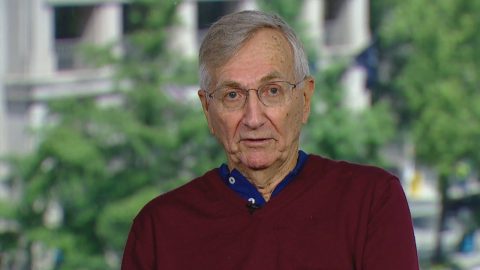
Seymour Hersh was the leading example of journalistic integrity in Vietnam (which is not to minimize the reporting of others in the small group exposing the official lies) and, amazingly enough, is still the leading example half a century later.
For his audacity in challenging the accusation that the Syrian government was responsible for the apparent chemical weapons on the outskirts of Damascus in August 2013, and showing that it was the so-called rebels, supported by outside governments, who were most probably responsible for this atrocity, Hersh was pushed to the margins of mainstream journalism in his own country and eventually out of it altogether.
*(Seymour Hersh)
Syria is only part of a broad mosaic of ill intent, however. It was attacked in the first place because it was a strategic ally of Iran. Russia’s twin successes, in deflecting US penetration of Ukraine and making the Americans look stupid in Syria, was followed by allegations of Russian interference in the 2016 US elections. There was no proof then and there is no proof now but the same empty accusations are being repeated by the same columnists, anchors and talk show hosts all the time.
We are now facing a multi-pronged assault on truth in which governments and the corporate media are partners. On both sides of the Atlantic, they have lined up against the renewed primary enemy, Russia, wherever it is and whatever it does.
Russia lost the Democrats the US elections. Russia stole Crimea from Ukraine.
Russia saved the Syrian dictator from defeat. Russia is supporting the dictator Maduro. Russia trades with Iran. Russia does not regard Hizbullah and Hamas as terrorists as we do. Russia does not give open-ended support to Israel but rather regards it as a primary fomenter of disorder in the Middle East.
Russia poisoned the Skripals, of course. Skripal senior was a former double agent, double-crossing Russia while working for British intelligence. There is no obvious reason why Russia would want a washed-out former spy dead but of course, it had to be Russia that daubed the door handle of his house with Novichok. There was no proof, but who else could it be but Russia, and if you say ‘British intelligence,’ setting up a new round of Russia-bashing, then wash your mouth out with soap.
Mysterious Russian figures turn up in Salisbury. The British government says they are agents, stopping off at the Skripals’ house to put a few drops of Novichok on the door handle before sauntering off down the main street to look into the window of a shop selling collectibles and rare stamps.
They seemed to be enjoying themselves. They seemed in no hurry at all to get away from the scene of the crime and take the first plane back to Moscow, but isn’t that exactly the way well-trained Russian agents would behave?
Somewhere along the way they dropped what was left of their Novichok into a rubbish bin, cunningly concealed in a hi-tech perfume bottle, Nina Ricci, ‘Premier Jour.’ Enough still left to kill 4000 people, said the newspapers, but failing to kill the Skripals and killing only poor Dawn Burgess, who pulled it out of the bin and apparently sprayed or dabbed herself with some.
We don’t really know who these Russians were and what they were doing in Salisbury but we need proof, not accusations and suppositions, and the British government does not have it. We can reach conclusions on the basis of what we know or think we know but the lies told by the British government over the attack on Iraq in 2003, plus the death/murder of the UN weapons inspector David Kelly five months after the war was launched, are sufficient reasons not to believe or trust anything this government says.
This new cold war is drifting steadily towards the brink of a hot one. The US is confronting Russia through missile bases, economic sanctions and interference in the politics of states around Russia’s borders.
Trump has just announced the withdrawal of the US from the Intermediate-range Nuclear Forces (INF) treaty, accusing Russia of breaching it and saying ‘we will move forward with developing our own military response options.’
In fact, Russia had already accused the US of violating the treaty. In May, 2018, the US/NATO opened a missile base in Romania where, Russia claimed, the US had simply transferred the launchpad for the Aegis integrated naval weapons system, which utilizes Tomahawk cruise and intermediate range missile banned by the INF treaty, from sea to land.
These missiles have a range of 300-3400 miles and their apparent positioning in Romania was naturally regarded as a direct threat by Russia.
The withdrawal of the US from the INF and Trump’s threat that the US will ‘move forward’ by developing its own options raises the apprehension in Russia that the US will station other cruise and intermediate range missiles in Europe once it finds willing partners.
In his state of the union address, Putin said that such missiles could reach Russia in 10 to 12 minutes and warned of a symmetrical response, if the US deployed them in Europe, directed not just at the US but at the states hosting its missiles.
To those contemplating such measures, he said: ‘Let them count the speed and range of our missiles. That is all I ask.’
It is not just Russia that the US is threatening, however, but China. If China held naval exercises off the US or British coasts the world would quickly be facing another 1962 Cuba crisis, only much more dangerous, but the US and Britain give themselves the right to hold such exercises off the Chinese coast in the South China Sea.
As for Venezuela, the US has reverted to the crude gunboat imperialism of the late 19th century (not that gunboat imperialism ever went away). ‘Do what we want or else’ is the message sent to Maduro and the Venezuelan people. What the US wants is the resurrection of the 1823 Monroe Doctrine, and the complete domination of Latin America, including open access to its resources.
In essence, the imperialism of the 21st century is the same as the imperialism of the 20th or the 19th centuries. In the 1940s and 1950s the people of Asia, the Middle East and Africa struggled to lift the yoke of occupation, economic domination and the plundering of their natural resources off their necks. In the third millennium, they are still struggling, especially in the Middle East and Latin America.
The members of the ‘western’ collective fight among themselves but always fall into line when the alpha dog barks at them. Considerations of right and wrong, law, ethics, morality and justice are irrelevant. The alpha dog has barked and the pack must obey. Riam Dalati’s exposure of media deceit is interesting but still a mere detail on a very large and dirty canvas as the ‘west’, its governments and its media, tries to maintain control of a world fast slipping from its hands.
Jeremy Salt has taught at the University of Melbourne, Bosporus University (Istanbul) and Bilkent University (Ankara), specialising in the modern history of the Middle East. His most recent book is “The Unmaking of the Middle East. A History of Western Disorder in Arab Lands” (Berkeley: University of California Press, 2008.)
Caving under MSM pressure? Tulsi Gabbard interview on The View has some supporters fuming

© Reuters / Brian Snyder
RT | February 21, 2019
US Presidential candidate Tulsi Gabbard is being accused of “flip-flopping” on her Syria stance and “caving” to mainstream media pressure after a combative interview on The View.
Questioned aggressively by panelist Meghan McCain, the daughter of the late Senator John McCain, Gabbard said there was “no disputing the fact” that Syrian President Bashar Assad is a “brutal dictator” who “used chemical weapons against his people.”
The comments stand in stark contrast to previous statements made by the Hawaii congresswoman, who in the past said she was “skeptical” about allegations that the Syrian government used chemical weapons on citizens and called US efforts to overthrow Assad an “illegal war.”
She faced a major backlash from both the media and her colleagues in congress for taking a trip to Syria and meeting Assad himself in 2017.
While Gabbard tried to offer a balanced view of the situation in Syria, it was the antagonistic questioning from McCain that immediately grabbed headlines, with many framing the interviewer in a heroic light for “confronting” Gabbard, the “Assad apologist.”
During the interview, Gabbard also said that US military interventions are often “begun and waged from a place of humanitarianism” despite having previously taken a tougher stance on “military adventurism” and the reasons behind it.
Gabbard did push back many times against the panel of hostile hosts, saying repeatedly that US interventions have historically made bad situations worse and increased suffering, some of her supporters accused her of folding in the face of “bullying” from McCain.
Others acknowledged that Gabbard might have been trying to appease the panelists to get her wider point about the human costs of US interventions across, but argued that she risked alienating the people who already supported her in the process — and said that if she starts making concessions now, she will be forced to make more.
When the conversation turned to Venezuela, Gabbard angered the panel again, saying that the US trying to choose the leader of that country was “not something that serves the interests of the Venezuelan people,” despite co-host Ana Navarro’s hailing Donald Trump for “leading the solidarity and support of freedom-loving Venezuelans.”
Vladimir Putin: 2019 State Of The Union Address To Russia’s Federal Assembly
Official translation of Russian President Vladimir Putin’s State of the Union Address to Russia’s Federal Assembly as published by the Kremlin’s website on February 20, 2019.
Members of the Federation Council, State Duma deputies, citizens of Russia,
Today’s Address is primarily devoted to matters of domestic social and economic development. I would like to focus on the objectives set forth in the May 2018 Executive Order and detailed in the national projects. Their content and the targets they set are a reflection of the demands and expectations of Russia’s citizens. People are at the core of the national projects, which are designed to bring about a new quality of life for all generations. This can only be achieved by generating momentum in Russia’s development.
These are long-term objectives that we have set for ourselves. However, work to achieve these strategic goals has to begin today. Time is always in short supply, as I have already said on numerous occasions, and you all know this all too well. There is simply no time for getting up to speed or making any adjustments. All in all, I believe that we have already completed the stage of articulating objectives and outlining tools for achieving our goals. Departing from the targets that were outlined would be unacceptable. It is true that these are challenging objectives. That being said, lowering the requirements for specific targets or watering them down is not an option. As I have already said, these are formidable challenges that require us to undertake major efforts. However, they are in step with the scale and pace of global change. It is our duty to keep pushing ahead and gaining momentum.
If someone prefers to work in the business as usual mode, without challenges, avoiding initiative or responsibility, they had better leave immediately. I already hear that some things are “impossible,” “too difficult,” “the standards are too high,” and “it will not work.” With such an attitude, you had better stay away.
Besides, you cannot fool the people. They are acutely aware of hypocrisy, lack of respect or any injustice. They have little interest in red tape and bureaucratic routine. It is important for people to see what is really being done and the impact it has on their lives and the lives of their families. And not sometime in the future, but now. We must not repeat the mistakes of the past decades and wait for communism to arrive. We have to change the situation for the better now.
Therefore, the work of the executive branch at all levels should be coordinated, meaningful and energetic. The Government of Russia must set the tone.
At the same time, I would like to emphasise and repeat: our development projects are not federal and even less so agency-based. They are national. Their results must be visible in each region of the Federation, in every municipality. It is here, on the ground, that the majority of specific tasks is implemented.
Allow me to underscore: thanks to years of common work and the results achieved, we can now direct and concentrate enormous financial resources – at least enormous for our country – on development goals. These resources have not come as a rainfall. We have not borrowed them. These funds have been earned by millions of our citizens – by the entire country. They need to be applied to increase the wealth of Russia and the wellbeing of Russian families.
Very soon, this year people should feel real changes for the better. It is on the basis of their opinion and assessments at the beginning of next year that we will evaluate the first results of our work on the national projects. And we will draw the appropriate conclusions about the work quality and performance at all levels of executive power.
Colleagues,
Let me now share some specifics on our objectives. I will begin with the key objective of preserving our nation, which means providing all-around support to families.

Presidential Address to the Federal Assembly. Photo: TASS
Family, childbirth, procreation and respect for the elderly have always served as a powerful moral framework for Russia and its multi-ethnic people. We have been doing everything in our power to strengthen family values and are committed to doing so in the future. In fact, our future is at stake. This is a task shared by the state, civil society, religious organisations, political parties and the media.
Russia has entered an extremely challenging period in terms of demographics. As you know, the birth rate is declining. As I have already said, this is caused by purely objective reasons, which have to do with the immense human losses and birth dearth experienced by our country in the 20th century, during the Great Patriotic War and the dramatic years following the dissolution of the Soviet Union. This does not mean, however, that we must accept this situation or come to terms with it. Definitely, not.
We succeeded in overcoming the negative demographic trends in the early 2000s, when our country faced extreme challenges. This seemed to be an impossible challenge at the time. Nevertheless, we succeeded, and I strongly believe that we can do it again by returning to natural population growth by late 2023 – early 2024.
Today, I wanted to talk about a new package of measures that has already been prepared to support families.
First, it is important that having children and bringing them up do not put families at the risk of poverty or undermine their wellbeing. As you know, we have already provided for the payment of subsidies for the first two children until they reach 18 months. Benefits for the first child are paid from the federal budget, and families can use the maternity capital subsidy for obtaining benefits for their second child. The size of the subsidy depends on the regional subsistence level for a child. It may vary from 8,000 rubles in Belgorod Region, for example, to 22,000 rubles in Chukotka Autonomous Area, with the national average of over 11,000 rubles a month per child. Currently these allocations are reserved to families whose income does not exceed the subsistence wage multiplied by 1.5 per person. It is time that we make the next step.
Starting January 1, 2020, I propose raising the bar to two subsistence wages per family member. This is what people have requested and these requests come directly into the Executive Office. This measure will increase the number of families entitled to additional benefits by almost 50 percent. Some 70 percent of families with one or two children will be able to benefit from help from the Government.
Second. At present, carers looking after children with disabilities and people disabled since childhood receive an allowance of only 5,500 rubles. I suggest increasing this to 10,000 rubles, starting July 1. Of course, I understand that it is still a small amount. However, it will be an additional measure of support for families with a child who needs special care.
Third. The income of Russian families must, of course, increase. This is a serious task that requires a comprehensive solution. I will speak about this in greater detail later. But we need direct measures. First of all, the tax burden on families needs to be relieved. The approach should be very simple: the more children there are, the lower the tax. I propose increasing federal tax relief on real estate for families with many children. I also propose lifting taxes on 5 square metres in a flat and 7 square metres in a house per each child.
What does this mean? If, for example, right now, 20 square metres in a flat are not subject to tax, the new measure will mean that for a family with three children, an extra 15 square metres will not be subject to tax. Regarding plots of land that belong to families with many children, I propose that 600 square metres should be exempt from tax, and this means most plots of land will be free from taxation. Let me remind you that this benefit is already available to pensioners and people of pre-retirement age. Of course, in many Russian regions there are local tax benefits on land and property for large families. However, the benefit being imposed at the federal level guarantees that it will be available everywhere in the country. I want to ask regional officials to propose additional tax measures to support families with children.
Fourth, the Government and the Central Bank need to consistently maintain the policy to lower mortgage rates to 9 percent, and then to 8 percent or below, as stipulated in the May 2018 Executive Order. At the same time, special measures of support should be provided for families with children, of course. As a reminder, last year, a preferential mortgage programme was launched for families that have had their second or subsequent child. The rate for them is 6 percent. Anything higher is subsidised by the state. However, only 4,500 families have used the benefit.
The question is why. It means that people are somehow dissatisfied with the proposed conditions. But it is also clear why. A family making a decision to buy housing certainly makes plans for a long or at least medium term, a lasting investment. But with this programme, they take out a loan, start paying the instalments, and the grace period ends. The interest is actually subsidised only for the first 3 or 5 years. I propose extending the benefit for the entire term of the mortgage loan.
Yes, of course, it will require additional funding, and the cost will be rather high: 7.6 billion rubles in 2019, 21.7 billion rubles in 2020, and 30.6 billion rubles in 2021. But the programme is estimated to reach as many as 600,000 families. We certainly need to find the money. We know where to get it. We have it, and we just need to use it in the areas that are of major importance to us.
And one more direct action solution. Considering the sustainability and stability of the macroeconomic situation in the country and the growth of the state’s revenues, I consider it possible to introduce another measure of support for families having a third and subsequent children. I suggest paying 450,000 rubles directly from the federal budget to cover this sum from their mortgage. Importantly, I propose backdating this payment starting January 1, 2019, recalculating it and allocating relevant sums in this year’s budget.
Let us see what we have. If we add this sum to the maternity capital, which can also be used for mortgage payments, we will get over 900,000 rubles. In many regions, this is a substantial part of the cost of a flat. I would like to draw the attention of the Government and the State Duma to this issue. If need be, the budget will have to be adjusted accordingly. An additional 26.2 billion rubles will be required for this in 2019. The relevant figures for 2020 and 2021 are 28.6 billion rubles and 30.1 billion rubles, respectively. These are huge funds but they should be allocated and used in what I have already described as a very important area.
It is necessary to give families an opportunity not only to buy ready-made housing but also to build their own housing on their land. I would like to ask the Government to draft in cooperation with the Central Bank convenient and, most importantly, affordable financial instruments for supporting private housing construction because it is not covered by mortgage loans today.
And, last but not least, the tax on land must be fair. Obviously, the cadastral or market value of a land plot can change but tax rates must not go up and down unpredictably like roller coaster rides. We have already limited to 10 percent the annual growth of the tax rates for residential property. I suggest establishing the same limit for land plots.
Moving on, today, when construction companies build social facilities and transfer them to the state or municipalities, they have to pay profit tax and VAT. We need to relieve construction companies of this burden (including our innovations in the construction sector). This will serve as an impetus for the comprehensive development of cities and townships, ensuring that families have everything they need near their homes: clinics, schools and sports facilities. By doing this, we will enable parents to work, study, live happily and enjoy parenthood.
We have come close to guaranteeing universal access to kindergartens, but by the end of 2021, we will have to resolve the problem with nurseries by enabling them to accept 270,000 more children, including in the private sector, with 90,000 places to be created as early as this year. The federal and regional budgets should allocate 147 billion rubles for this purpose, over a three-year period. Let me add that enrolling in a nursery group, kindergarten, getting subsidies, benefits or the tax deductions that I have already mentioned and, I hope, that we will come up with, together with you, all this should happen without any additional applications, excessive paperwork or having to visit various social services. By the end of 2020, all the key government services must be provided in a proactive format where a person will only need to send in a request for a service that he or she needs, and the system will take care of all the rest independently and automatically.
I would like to emphasise that the package of measures to support families proposed today is not an exhaustive list of initiatives. It sets the priorities. Considering the challenges posed by the state of Russia’s demographics, we will continue to channel more and more resources into this area. I ask all of you, colleagues, including both the Government and the Federal Assembly, to think about it and suggest solutions.
Colleagues, solving our demographic problems, increasing life expectancy and reducing mortality rates are directly related to eradicating poverty. Allow me to remind you that in 2000, there were more than 40 million people living below the poverty line. Now there are about 19 million, but this is still too many, too many. However, there was a time when their number dropped to 15 million, and now it has grown a little again. We must certainly focus our attention on this — on combating poverty.
Furthermore, there are even more people facing serious financial problems than those officially living below the poverty line. They are forced to cut spending on such essentials as clothes, medicines and even food. Those most often faced with poverty are large or single parent families, families with members with disabilities, as well as single pensioners and people who cannot find a good job, a well-paid job because there are no openings or they lack qualifications.
There are many reasons for poverty, not only in our country, but also in the world, but it always literally crushes a person, dimming their life prospects. The state must help people, help them out of difficult life situations. The experience of some of our regions shows that it is possible to work effectively for this. I will name these regions: Kaluga, Ulyanovsk, Tomsk, Vologda, and Nizhny Novgorod Regions, and a number of other regions of Russia. Their experience shows that so-called social contracts can be a working mechanism of such support.
How does it work and what is this all about? The state helps people find jobs and improve their skills. The state provides financial resources to families to run a household farm or to start a small business, and by the way, these are substantial resources of tens of thousands of rubles. Let me emphasise that support programmes will be tailored to meet the needs of every specific applicant. The allocation of these resources creates some obligations for the recipients: they have to go through training, find a job in the given field and provide a steady income for their family and children. Mechanisms of this kind are in place around the world and are very effective. Social contracts can change the lives of those who really want to do it.
It is estimated that more than 9 million people will be able to benefit from these support measures over a five-year period. I instruct the Government to assist the regions that are proactive in introducing social contracts and work with them on co-financing mechanisms.
Moving on, there are currently many people and families taking out loans for various purposes, including consumer loans. Of course, borrowers have to be aware of their obligations and refrain from assuming an excessive burden. That being said, anything can happen: people can lose their job or become ill. In this case, the last thing is to force people into a corner, and it is also pointless in economic terms. Additional legal guarantees are needed to protect people. I propose introducing mortgage payment holidays, as we have recently discussed in Kazan, to enable people who lose their income to suspend mortgage payments. They must get a chance to keep their home, if it is the only property they own, and postpone loan payments. This is not an easy task, and we have to understand how this can be done so as not to harm financial institutions while supporting the people. This can be done, however.
I also ask the Bank of Russia and law enforcement agencies to put things right without delay in the microlending segment and protect people from fraud or extortion by dishonest lenders.
Let me emphasise that as we seek to overcome poverty and develop the social security net, we need to reach every family in need and understand the problems it faces. It should not be possible to refuse assistance simply because the life circumstances a person is facing are slightly inconsistent with the criteria set by a programme.
And, of course, it is necessary to be scrupulous and attentive to every detail. By way of example, and this is not a very good example for our work, I would like to say the following: pensions were adjusted for inflation under the pension reform this year. But if a pensioner’s income exceeded the subsistence rate, the social payments were no longer made at the same level. They were either cancelled altogether or reduced. As a result, the pensions were not increased at all, or the increases were much less than a pensioner expected. So many people feel cheated with good reason. Probably, many people in this hall understand what this is all about. We made payments from the regional or federal budget to achieve the subsistence level. We made adjustments for inflation and the cost of living either matched or exceeded it. So these payments were discontinued and that was it.
It was necessary to take into account all the nuances but this was left undone, and of course, this should not be allowed to happen. This injustice, and it is certainly an injustice, should be sorted immediately. Starting this year, adjustments of pensions and monthly payments should by all means be above the subsistence rate of pensioners that is established every year. In other words, the state should first bring pensions to the subsistence level and only after that make adjustments in pensions and monthly payments. Payments for the first months of this year must be recalculated and people should be paid the money due to them that they have not received.
I would like to emphasise that all those who work in the social sphere or join the government or municipal services in order to help people resolve their urgent problems, must meet the highest professional standards. I believe by and large this is the case. Of course, this is a very complicated job. We all understand that working with people every day, from morning until night, is indeed difficult. But if you have this job you should realise that it is no less important to understand people, to know what they feel, empathise, share their worries and concerns and never permit yourself arrogant attitudes or a lack of respect for people, either in word or deed. I would like you to always remember this.

Presidential Address to the Federal Assembly. Photo: TASS
Colleagues,
The next important subject is healthcare. I know that, on the one hand, its current state seems to be improving, and medical treatment is becoming more accessible. Nevertheless, many people are not satisfied. It is easy to understand the reasons for this. As a rule, people judge the healthcare system by its primary component, that is, outpatient clinics and paramedic stations. People voice complaints with regard to their work. Quite often, they have to wait many days to see a specialist, and it is impossible to quickly undergo the required tests free of charge. People in remote communities are even having trouble getting appointments with medical personnel. Yes, the number of paramedic stations and mobile medical units continues to increase, but people in areas where there are no such facilities care nothing about the overall statistics.
I want to emphasise that medical treatment should become accessible for everyone by the end of 2020 in all populated areas across Russia without exception and for all citizens, regardless of their place of residence. For your information, an additional 1,590 outpatient clinics and paramedic stations are to be built or renovated in 2019–2020, and I hope that this will be accomplished.
Today, a number of regions are implementing the Thrifty Outpatient Clinic project. As a result, the waiting time to get an appointment and see a doctor is reduced three or four times over, on the average. I have visited such outpatient clinics, and they are operating very well. Much better conditions are created for people with disabilities and for parents with children. Unfortunately, there are very few such outpatient clinics so far; they are rather an exception than the rule all across the nation.
Considering the best regional practices , and, I repeat, there are such practices, I hereby instruct the Government to approve the high standards of thrifty outpatient clinics by the end of the year and their certification regulations. Next year, you have to team up with the regions to introduce mechanisms incentivising managers and medical personnel to improve the quality of their work. First of all, we have to completely convert all paediatric outpatient clinics to new standards already in 2021. Please note that the sign “Thrifty Outpatient Clinic” is not what counts. Most importantly, people should at long last perceive the state’s respectful and truly considerate attitude towards their health.
Improving IT penetration in healthcare will make it more accessible. Online links between medical institutions, pharmacies, doctors and patients must be streamlined over the next three years. Let me add that social security medical assessment boards must be finally included into this digital network in order to free elderly people, people with disabilities and families with children from waiting lists and the need to produce various certificates that are often useless.
Primary care is understaffed. To address this matter, comprehensive efforts to develop medical education should be accompanied by initiatives that produce immediate results. In this connection, I propose removing age restrictions for the Country Doctor programme so that professionals over the age of 50 can also receive a one-time payment when moving to a rural area or a small city: 1,000,000 rubles for doctors and 500,000 rubles for paramedics.
The most complex surgery is currently performed not only at federal, but also at regional clinics and centres using the most advanced equipment. At the same time, patient recovery is also critical. We have never had a system of this kind, but we have to start with something. A lot has to be done in this area. Let us begin by creating at least two world-class recovery facilities for children, just as we did with perinatal centres, and proceed from there.
In my last year’s Address, I proposed a programme for fighting cancer. At least 1 trillion roubles will be allocated to this effect over the next six years. This is about providing timely, effective and accessible treatment, using advanced technologies that are effective in most cases and enable people to overcome this dangerous disease. Today, the leukaemia recovery rate for children exceeds 80 percent, and for certain types of cancer, more than 90 percent of patients recover. Not that long ago, in the mid-1990s, this disease was almost untreatable and only 10–20 percent of children could be saved. Russia lacked both the technology and capabilities at the time. In many cases, the only option was to turn to foreign clinics. Those who could afford it did so.
We were aware of how tragic this situation was, which prompted us to focus on improving cancer treatment for children, developing oncohaematology, using the capabilities offered by our research institutions, the healthcare system, and worked proactively with our foreign partners (some doctors simply moved from Germany to Moscow, and spent a lot of time here, and probably still do), which yielded results.
We will continue working to overhaul the system of cancer care. Early detection is of crucial importance. In fact, we have revived the system of health screening and regular medical check-ups. These have to include cancer screening. It has to be made obligatory. People must have the opportunity to make appointments remotely, to choose a suitable time for visiting an outpatient clinic, including in the evening or at the weekend, so that the check-up can be carried out without any additional formalities.
Next, over the next few years we must create a number of new areas combining healthcare with social services. Thus, we must overhaul the system of assistance for people who need long-term help at medical facilities or at home, adjust this system to the needs of specific families and individuals, support people with their everyday needs by assigning district nurses or carers, or training relatives in medical or other necessary skills. The application of these recipient-oriented principles of assistance began last year in Volgograd, Kostroma, Novgorod, Pskov, Ryazan and Tula regions. We must introduce them throughout the country within a timeframe of four years.
Palliative care is a matter of not only medical but also of social, public and moral concern. According to the available information, some 800,000 people need this assistance, and volunteers have told me that the figure is around one million. As you know, in January I visited a children’s hospice in St Petersburg, where we discussed this matter. I know that yesterday the State Duma adopted in the second reading amendments to the legislation on palliative care. I would like work on this law to be completed as soon as possible. We will then monitor its application so we can promptly make amendments, taking into account the opinions of volunteers, whom I have mentioned, doctors, carers, members of the public and religious associations and benefactors, that is, everyone who have long been providing heartfelt palliative care.
Colleagues, people have increasingly high demands on environmental safety issues. Perhaps, the most painful topic is municipal waste. If you remember, it came up for the first time during one of my Direct Lines. Yes, we have probably neglected the waste disposal problems for maybe a hundred years, which means we have never paid attention to them. Many landfills are overfilled because waste has been accumulating there for decades. The landfills have turned into real mountains of garbage near residential areas.
By the way, I am also interested to know how you issued permits for the construction of residential neighbourhoods next to these dumps and landfills. Didn’t you think of that? You should have. I urge the representatives of the authorities at all levels: pretending that nothing is happening, turning away, brushing aside people’s needs is absolutely unacceptable. These issues are difficult, of course, but difficult issues must also be addressed.
This year, the regions began adopting a new system of solid municipal waste management. However, if the only change is a rise in rubbish clearance prices – well, this is not real work; it is a sham. People need to see what they are paying for and what real changes are happening. It is necessary to restore order in this area, to get rid of shady businesses that do not bear any responsibility and only get super-profits dumping trash at random sites.
We need to build a civilised and safe system of waste treatment, recycling and disposal. Surprisingly, a year ago I personally had to interfere on some matters. I had to talk to the Interior Ministry and the Prosecutor’s Office several times. You know, surprisingly, I would like to say it again, almost nothing moved forward until I gave an order to station a guard there and not to let anyone in. This is the only way it works, because these shady companies, the so-called fly-by-nights, they just make quick profits and shut down their so-called business.
I ask the Russian Popular Front to ensure effective public control here, including reliance on public environmental inspectors. Their signals regarding any violations must be considered by the authorities, who must adopt specific measures. In the next two years, 30 large problem landfills within city boundaries must be closed and rehabilitated, and in six years, all the rest. At the same time, it is necessary to increase the share of waste treatment from today’s 8–9 percent to 60, so as not to accumulate new millions of tonnes of trash.
It is necessary to introduce stricter environmental requirements when it comes to utility services and energy and transport enterprises. In part, I am urging businesses to play a more active role in natural gas motor fuel projects, and invest in the formation of a network of fuelling stations and fuel systems using liquefied natural gas. We have enough of it, more than any other country. Indeed, this is a complicated and costly project but it should be carried out because it will produce results not only for businesses but for the people as well.
A positive effect from the industry’s transfer to the best affordable technologies and strict environmental standards should be felt by residents of major industrial centres of the country, primarily the 12 cities I mentioned in the 2018 Address. These places should be finally removed from the zone of real environmental disaster. Over a period of the next six years, the amount of polluting emissions in the air should be reduced there by no less than 20 percent.
To prevent anyone from the temptation of dodging the implementation of this job, it is necessary to strictly monitor industrial and other companies responsible for this, to map out the specific steps they should take to minimise environmental damage, and to register all this in a law on emission quotas. I know all too well what this is all about. I know that fairly influential lobbyists are trying to impede this draft law as much as they can. I know their arguments very well too: the need to preserve jobs and a complicated economic situation.
But this cannot go on endlessly in this manner. It must not. Let me recall that in making such decisions we should be guided by the interests of the people of Russia rather than corporate interests or interests of some individuals. Colleagues, please pass this law during the spring session.
Finding solutions for environmental problems is the job of our researchers and people in industry. Each of us is responsible for this. I am urging young people, among others, to take a more active part in this work. We must hand over to the future generations an environmentally safe country and preserve Russia’s natural potential as well as its specially protected areas. This year new national parks will open in the republics of Daghestan, Komi and Sakha (Yakutia), Altai Territory and Chelyabinsk Region. However, I would like to draw your attention to the fact that many specially protected areas do not yet have precise borders and their regulations are not observed.
I have instructed the Ministry of Natural Resources to conduct a detailed audit. All sanctuaries must be registered in the cadastre. It is also necessary to adopt a law according to which only environmental tourism can take place in nature reserves, without any withdrawal of territories, wood cutting or major construction work. Naturally, it is necessary to take into account the interests of the locals but these issues should be resolved in a package.
Colleagues, the number of students from small towns and remote areas studying at the best Moscow and regional universities is increasing. According to international assessments, our elementary, middle and high school students demonstrate good results in the humanities and hard sciences. We can see it ourselves, based on the results of contests and various student competitions. All this is an indicator of qualitative changes in our school education.
However, despite all these achievements, we must not overlook the obvious problems in this crucial area. The share of schools with modern study conditions has increased from 12 percent in 2000 (only 12 percent) to 85 percent in 2018. But even today, some 200,000 children still go to schools where there is no proper heating, water supply and sewage system. Yes, it is less than 1.5 percent of all schoolchildren, but when their parents see these conditions, any words about justice and equal opportunities only irritate them. I want to draw the attention of the heads of the regions where poorly equipped schools still exist. This problem can be completely resolved within two years. We can do it. I know that the Government is thinking about it and making certain decisions. I am asking you to support the regions that lack their own resources.
When in 2006 we started providing internet connections to schools, the technology was completely different. You know, it seemed like a real breakthrough. And it was indeed a breakthrough at the time. Right now, this technology seems ancient, and we have new tasks to resolve. By the end of 2021, all Russian schools must have a high-speed internet connection rather than just a connection. Let me remind you that in 2006, when schools were being hooked up to the internet, the recommended speed was 128 kbps. Now we need 50 Mbps or 100 Mbps, which is at least 400 times higher. This will help our kids to gain access to lessons and lectures by prominent teachers, to contests and Olympiads; it will allow them to significantly expand their capabilities and get involved in online projects with their fellow students from other regions and countries. The content of educational programmes must also change. The national standards and programmes must reflect the priorities of the country’s science and technology development, while the federal lists of recommended textbooks must include the best of the best books.
Of course, human resources are the most important issue. I have already spoken today about expanding the Country Doctor programme. I propose starting a similar programme for education, the Country Teacher. Teachers who decide to move to smaller towns and villages will receive a one-time payment of one million rubles.
We must work consistently to strengthen the common environment of education and culture. The culture and education centres in Kaliningrad, Kemerovo, Vladivostok and Sevastopol will open no later than in 2023. Our leading museums and theatres will be represented there, and branches of art schools will start working there already next year. The demand for a rich cultural environment is very high, primarily in the regions, where a great number of talented and committed people are working.
I propose greatly expanding assistance to local cultural initiatives, that is, projects dealing with local history, crafts and the preservation of the historical heritage of our peoples. For example, additional allocations can be made towards this from the Presidential Grants Fund. In addition, we will allocate over 17 billion rubles within the Culture national project for the construction and renovation of rural culture clubs and over 6 billion rubles for supporting culture centres in Russia’s small towns.
I would like to remind you that medical and educational institutions are exempt from profit tax, but only until January 1, 2020. I propose making this incentive of unlimited duration and also extending it to the regional and municipal museums, theatres and libraries. By the way, this will allow them to save some 4 billion rubles, which they will invest in development or will use to raise salaries. And lastly, this measure will encourage private investment in local cultural establishments.
Colleagues, I would like the heads of regions to ensure that salaries in education, healthcare, culture and other public sectors are kept on a par with the average wage in the given region’s economy. Colleagues, this is very important. I keep talking about this at all my meetings. We must not lower this standard. At the same time, the average wage in the economy must grow. Over 40 million people who work in the public and defence sectors and are non-working pensioners receive fixed payments. These payments must grow together with the inflation at the least. I ask the Government to take this into account.
More than 70 million people work in manufacturing, agriculture or the services or are small business owners. The state of Russia’s economy has a direct bearing on their income, wellbeing and confidence in the future. The primary tool for achieving steady wage increases is to promote quality employment and free enterprise, qualified, well-paid jobs in all regions, including both traditional and new sectors. High economic growth rates are essential. This is the only way to overcome poverty and ensure steady and perceptible increases in income. This is the key to success. As soon as in 2021, Russia’s economic growth rate must exceed 3 percent and stay above the global average afterwards. This objective should not be discarded.
The Government and the Central Bank are once again tasked with complying with the target inflation rate. I have already said this, and we knew that this would happen when we put aside financial resources for the national projects. This was an expected outcome, and now we need to make sure that the situation gets back to normal. We can do this. As I said, the Government and the Central Bank must ensure that the inflation targets are met and create a favourable macroeconomic environment for facilitating growth in general. We have a strong financial safety cushion.
I have something positive to share with you. For the first time ever, our reserves fully cover not only the sovereign debt, which is quite small, but also private borrowings. These funds are at work, and investment of the National Welfare Fund generates budget revenue. Therefore, I would like to address those of our colleagues who constantly criticise the Government, its financial and economic ministries and ask where the money went and where we invested it. We set a target to reach a certain level, after which we can use these funds, although cautiously so as not to cause any macroeconomic disturbances. We are about to reach this level, and are beginning to do it. The proceeds from these investments go to the federal budget. In 2018, proceeds from investing the National Welfare Fund in the amount of 70.5 billion rubles were added to the budget.
To achieve high growth rates, it is also necessary to resolve systemic problems in the economy. I will highlight four priorities here.
The first one is faster growth in labour productivity, primarily based on new technologies and digitalisation; the development of competitive industries and, as a result, an increase in non-primary exports by more than 50 percent in six years.
The second one is to improve the business climate and the quality of national jurisdiction, so that no one moves their operations to other jurisdictions, to ensure that everything is reliable and runs like clockwork. Growth in investment should increase by 6–7 percent in 2020. Achieving this level will be one of the key criteria for evaluating the Government’s work.
The third priority is removing infrastructural constraints for economic development and for unlocking the potential of our regions.
And the fourth thing is training modern personnel, of course, and creating powerful scientific and technological foundations.
Now I would like to expand on our specific tasks in these fields.
A colossal guaranteed demand for industrial and high-tech products is being formed in Russia, I can say this without any exaggeration. So the words I would like to use – we are faced with historical opportunities for a qualitative growth of Russian business, mechanical engineering and machine-tool making, microelectronics, IT-industry, and other industries. The national projects alone include – just think of it – 6 trillion rubles worth of procurement plans for medical and construction equipment, instruments, telecommunications systems, and systems for housing and public utilities. And these resources should work here in Russia.
So I am urging the Government, the regions, the representatives of state-owned companies I see here in this room – you certainly want to buy all the most modern equipment and as inexpensively as possible. Naturally, everyone wants to be and should be competitive, but wherever possible, you need to rely on our producers, on domestic ones. We must find them, and even work together with them. Of course, there must be a competitive environment, but we already have the tools to support Russian manufacturers. We must not forget about these tools, and use them.
I would like to emphasise that access to state contracts must be equal (at least for our own, for national companies), and the orders should go to those who prove their sustainability with hard work and results, with willingness to change, to introduce advanced technology and increase labour productivity, and offer the best competitive products.
As concerns the defence industry, we must use our current capacities for diversification, to expand civil production. Colleagues understand what I am talking about here. There are certain targets for each year. And they must be achieved, no matter what.
And of course, now is the time for more daring initiatives, for creating businesses and production companies, for promoting new products and services. This wave of technological development allows companies to grow and win markets very quickly. There are already examples of successful companies, innovative companies. We need many more of them, including in such fields as artificial intelligence, Big Data, the Internet of Things and robotics.
I am instructing the Government to create the most comfortable conditions for private investment in technological startups and to involve development institutions in their support. I am asking members of parliament to promptly pass the laws that are most crucial for creating the legal framework of the new digital economy, laws that will allow to close civil deals and raise funds using digital technology, to develop e-commerce and services. The entire Russian legislation must be geared up to reflect the new technological reality. These laws must not restrict the development of innovative and promising industries but push this development forward.
The most crucial indicator of a business’s efficiency and competitiveness lies in expanding export and entering external markets. The success of our agricultural industry is, of course, a good example of such development. Our agricultural export increased by 19.4 percent in 2018 reaching $25.8 billion. In 2024, we must reach $45 billion. Incidentally, we are not only one of the largest wheat exporters (last year we exported 44 million tonnes). We have at least one more significant achievement. Thanks to the developments of Russian researchers we are no longer dependent on other countries for wheat seeds. Experts will confirm how critically important this is. Russia must have the entire range of its own advanced agricultural technology, which must be available not only to large but also to small farms. This is literally a matter of national security and successful competition in the growing food markets.
Improving the quality of life for those who work in rural areas is a key long-term factor of the agricultural industry’s steady growth. I would like to point out to the Government that as soon as this year, they must approve a new development programme for rural territories that must be enforced as of January 1, 2020.
One more thing. I think everybody will agree that our massive natural resources constitute our natural advantage. They need to be used for increasing the production of organic produce. I am instructing the Government to create a protected brand for clean products, a brand that will guarantee safety of the technology used and win the reputation of high quality both on the domestic and foreign markets. Trust me, it will be extremely popular abroad. There is hardly anything clean left there.
Colleagues, to achieve the ambitious goals facing the country, we must rid the system of everything that restricts freedom of enterprise and business initiative. Honest businesses should not face the risk of criminal or administrative prosecution. I have already noted this matter in one of my Addresses, and I have cited the relevant figures. Unfortunately, the situation has not improved much.
Today, almost half of all cases (45 percent) opened against entrepreneurs do not get to trial. What does this mean? This means that they were opened in a slipshod manner or under some unclear pretext. And what does this mean in practice? As a result, 130 jobs are lost on average every time a business closes down as result of an investigation. Let us think about this figure; this is becoming a major economic problem.
The business community points to a number of legislative and law enforcement problems. I agree that we need to closely analyse the criteria under which all employees of a company can be considered to be part of a group that is guilty of collusion just through the fact of working for that company. To be honest, this is complete nonsense, but, unfortunately, it happens time and again. And this leads to a stricter detention during the investigation and a more substantial penalty later on. Additionally, we need to strictly limit the grounds for extending the term of detention during the investigation of so-called economic criminal cases. Today, this sometimes happens without any grounds, simply because the investigators had no time to conduct the required expert checks or as a result of delays in the investigation.
We have discussed this matter with the Prosecutor General and the President of the Supreme Court. This is what happens: a person is kept behind bars, and he has not been summoned for questioning for several months. The prosecutor wants to know why he had not been questioned, and they tell him that the investigator was on holiday. Of course, investigators, especially those at the Interior Ministry, handle a tidal wave of criminal cases, and we need to do something about that, we need to take a closer look at this matter. Perhaps we should set aside additional resources and increase the number of investigators. Nevertheless, how can this be explained? A person is kept behind bars while the investigator has left on holiday and has not questioned him for several months. This should not happen, we need to sort this out. I ask the Supreme Court and the Prosecutor General’s Office to analyse all these problems once again and to submit their proposals.
I suggest that our business associations and the Agency for Strategic Initiatives create a special digital platform – in fact, they themselves have advanced this initiative – which entrepreneurs will use to make public any instances of pressure on business and to demand a formal court hearing.
I urge the heads of law enforcement agencies not to be wary of this. This initiative will serve as an additional support, so that senior officials at these agencies will promptly receive the objective information they need to make decisions, at least at the departmental level. I ask the Government and the business community to discuss the technological solutions and the legal framework for implementing this initiative, and the law enforcement agencies – the Interior Ministry, the Federal Security Service, the Prosecutor General’s Office and the Investigative Committee – to coordinate regulations for working with the entrepreneurs’ complaints, including deadlines. This platform must start working, at least in pilot mode, by the end of the year.
Next, the Government has proposed overhauling the regulatory framework. This is good, and we must give all-round support to this. However, I believe that this is not enough. We must take even more radical steps. Indeed, let us draw the line and suspend all the existing regulatory laws and departmental regional orders, letters and instructions as of January 1, 2021. In the two years until then, we must update the regulatory laws together with the business community, retaining only those documents that satisfy current requirements and shelving the rest.
When we discussed this issue, many of our colleagues said honestly that they were terrified. Yes, this is scary, but the problem does exist. It will not be an easy job. The files are really thick in some areas and departments. They have been piling up for decades since the Soviet era, or even “as far back as Ochakov and the Crimean war.” [The quote is from Alexander Griboyedov’s Woe from Wit written in 1824.] I am not referring to the year 2014, of course. (Laughter) Some of these documents go back to the time of Alexander Griboyedov or even before him. So much has been written and regulated. But frankly, I doubt that even the personnel of these agencies know everything that is written in these documents. Hence, we must complete their analysis within two years. There is nothing to fear. We must roll up our sleeves and do it, keeping or updating only the documents we really need to properly organise our activities.

Presidential Address to the Federal Assembly.
Colleagues, infrastructure upgrades need to be accelerated using state-of-the-art technology. This is essential for enhancing a country’s connectivity, and especially for Russia, the world’s largest country with its vast territory. This is essential for strengthening statehood, unleashing the country’s potential and driving national economic growth.
This year, the railway section of the Crimean Bridge will be launched, and will become a powerful impetus. I would like to take this opportunity to thank all the construction and railway workers. We saw that a bypass railway was built near Krasnodar alongside an approach railway to this junction from the Caucasus coast. As I have said, trains will begin using the Crimean Bridge in 2019, creating a powerful development driver for Crimea and Sevastopol.
In addition to this, the expressway linking Moscow and St Petersburg is expected to be completed, creating new business opportunities and jobs for people living in Novgorod, Tver, Leningrad and Moscow regions.
More than 60 airports will benefit from upgrades over the next six years, including international airports in Khabarovsk, Yuzhno-Sakhalinsk and Petropavlovsk-Kamchatsky.
In 2025, the throughput capacity of the Baikal-Amur Mainline and Trans-Siberian Railway will grow 1.5 times, reaching 210 million tonnes, which is very important for the development of Siberia and Russia’s Far East.
Let me reiterate that key indicators related to social and economic development and quality of life in all Russia’s Far Eastern regions are expected to exceed the national average. This is a national cause, and a major priority of our efforts to promote Eastern Siberia and the Far East as strategic territories. All agencies have to constantly keep this in mind.
In September, we will have a meeting in Vladivostok to discuss what each of the federal agencies has done and intends to undertake for the Far East. All the plans for building and upgrading roads, railways, sea ports, air service and communications must prioritise regional development, including promoting these regions as travel destinations.
There is enormous interest in Russia, our culture, nature and historical monuments. Taking into consideration the success of the World Cup, I propose making greater use of e-visas and thinking more broadly about how to streamline visa processing for tourists coming to Russia.
Next. This year we must adopt a master plan for developing the infrastructure of a digital economy, including telecommunications networks, as well as data storage and processing capacities. Here we need to look ahead as well. The task for the next few years is to provide universal access to high-speed internet and start using 5G communications networks.
To achieve a revolution in communications, navigation and systems for remote sensing of the Earth, we must dramatically increase the capabilities of our satellite group. Russia has unique technology for this, but such tasks require a fundamental upgrade of the entire space industry. I am instructing Roscosmos and the Moscow Government to establish a National Space Centre. My colleagues came to me and told me about it. This is a good project is designed to unite relevant organisations, design bureaus and prototype production facilities, and to support scientific research and the training of personnel.
We are seeing that global competition is increasingly shifting to science, technology and education. Just recently, it seemed inconceivable that Russia could make not just a breakthrough but also a high-tech breakthrough in defence. This was difficult, complex work. Much had to be restored or started from scratch It was necessary to break new ground and find bold, unique solutions. Nevertheless, this was done. It was done by our engineers, workers and scientists, including very young people that grew up with these projects. Let me repeat that I know all the details of this large-scale effort and I am completely justified in saying, for instance, that the development of the Avangard strategic hypersonic glide vehicle is tantamount to the launching of the world’s first artificial satellite. And not just in terms of enhancing the country’s defence capability and security, although this is the primary goal, but in influencing the consolidation of our scientific potential and the development of unique technological assets.
At one time, the nuclear defence project gave the country nuclear power. The construction of a missile shield that started with the launch of the world’s first artificial satellite allowed the country to begin peaceful space exploration. Today, we need to use the personnel, knowledge, competences and materials we have acquired from developing the next generation of weapons to produce the same kind of results for civilian applications.
We have yet to implement new ambitious scientific and technological programmes. An Executive Order on genetic research has already been signed, and I propose launching a similar large-scale programme at the national level on artificial intelligence. In the middle of the next decade, we should be among the leaders in these science and technology areas, which, of course, will determine the future of the world and the future of Russia.
To implement such projects, we need to accelerate the development of an advanced scientific infrastructure. Incidentally, the reactor PIK, a mega-science class research unit was recently launched in Leningrad Region. Over the next 20 years, it will be one of the world’s most powerful sources for neutron research, enabling scientists to conduct unique research in physics, biology, and chemistry, and to develop new drugs, diagnostic tools, and new materials.
For the first time in decades, Russian shipyards will break ground for several modern research vessels capable of working in all strategic areas, including the Arctic seas and the Antarctic, exploring the shelf and the natural resources of the World Ocean.
To promote powerful technological development, we need to build a modern research and development model. This is why we are setting up research and education centres in the regions that will integrate all levels of education with the potential of research facilities and business. Within three years, centres like this should be established in 15 regions in the Russian Federation, the first five this year. Three of them – in Tyumen and Belgorod Regions and Perm Territory – are close to completion and are to open this year.
We need specialists capable of working at advanced production facilities, developing and applying breakthrough technology solutions. Therefore, we need to ensure a broad introduction of updated curricula at all levels of professional education, to organise personnel training for the industries that are still being formed.
At the end of August, Russia will host the WorldSkills world championships – so let us wish our team success. Their success is significant for increasing the prestige of the skilled labor occupation. Relying on the WorldSkills movement experience, we will accelerate the modernisation of secondary vocational education, which includes installing modern equipment at more than 2,000 shops in colleges and technical schools by 2022.
Passion for a future career and creativity is formed at a young age. In the next three years, thanks to the development of children’s technology parks, quantoriums and education centres for computer skills, natural sciences and the humanities, around one million new spots in extracurricular education programmes will be created. All children must have access.
The Sirius educational centre in Sochi is becoming a true constellation. The plan was for centres supporting gifted children, based on its model, to open in all regions by 2024. But our colleagues said they can finish this work early, within two years. Such proactive efforts deserve praise.
I think every national project has reserves for increasing the pace. I expect that our companies and the business community will get involved in such projects as Ticket to the Future that provides school pupils in their sixth year and above with the opportunity to discover their career interests and intern at actual companies, research centres and other places.
I want to speak directly to our young people. Your talents, energy and creative abilities are among Russia’s strongest competitive advantages. We understand and greatly value this. We have created an entire system of projects and personal growth competitions in which every young person, from school to university age, can show what they are made of. These include ProeKTOriYA, My First Business, I Am A Professional, Russian Leaders and many others. I want to stress that all this is being created for young people to take advantage of these opportunities. I urge you to take a chance and use them, be bold, realise your dreams and plans, do something of value for yourself, your family and your country.
Colleagues, Russia has been and always will be a sovereign and independent state. This is a given. It will either be that, or will simply cease to exist. We must clearly understand this. Without sovereignty, Russia cannot be a state. Some countries can do this, but not Russia.
Building relations with Russia means working together to find solutions to the most complex matters instead of trying to impose solutions. We make no secret of our foreign policy priorities. These include strengthening trust, countering global threats, promoting cooperation in the economy and trade, education, culture, science and technology, as well as facilitating people-to-people contact. These tenets underpin our work within the UN, the Commonwealth of Independent States, as well as within the Group of 20, BRICS and the Shanghai Cooperation Organisation.
We believe in the importance of promoting closer cooperation within the Union State of Russia and Belarus, including close foreign policy and economic coordination. Together with our integration partners within the Eurasian Economic Union, we will continue creating common markets and outreach efforts. This includes implementing the decisions to coordinate the activities of the EAEU with China’s Belt and Road initiative on the way to a greater Eurasian partnership.
Russia’s equal and mutually beneficial relations with China currently serve as an important factor of stability in international affairs and in terms of Eurasian security, offering a model of productive economic cooperation. Russia attaches importance to realising the potential of the special privileged strategic partnership with India. We will continue to promote political dialogue and economic cooperation with Japan. Russia stands ready to work with Japan on finding mutually acceptable terms for signing a peace treaty. We intend to promote deeper ties with the Association of Southeast Asian Nations.
We also hope that the European Union and the major European countries will finally take actual steps to put political and economic relations with Russia back on track. People in these countries are looking forward to cooperation with Russia, which includes corporations, as well as small and medium-sized enterprises, and European businesses in general. It goes without saying that this would serve our common interests.
The unilateral withdrawal of the USA from the INF Treaty is the most urgent and most discussed issue in Russian-American relations. This is why I am compelled to talk about it in more detail. Indeed, serious changes have taken place in the world since the Treaty was signed in 1987. Many countries have developed and continue to develop these weapons, but not Russia or the USA – we have limited ourselves in this respect, of our own free will. Understandably, this state of affairs raises questions. Our American partners should have just said so honestly rather than make far-fetched accusations against Russia to justify their unilateral withdrawal from the Treaty.
It would have been better if they had done what they did in 2002 when they walked away from the ABM Treaty and did so openly and honestly. Whether that was good or bad is another matter. I think it was bad, but they did it and that is that. They should have done the same thing this time, too. What are they doing in reality? First, they violate everything, then they look for excuses and appoint a guilty party. But they are also mobilising their satellites that are cautious but still make noises in support of the USA. At first, the Americans began developing and using medium-range missiles, calling them discretionary “target missiles” for missile defence. Then they began deploying Mk-41 universal launch systems that can make offensive combat use of Tomahawk medium-range cruise missiles possible.
I am talking about this and using my time and yours because we have to respond to the accusations that are leveled at us. But having done everything I have just described, the Americans openly and blatantly ignored the provisions envisaged by articles 4 and 6 of the INF Treaty. According to Item 1, Article VI (I am quoting): “Each Party shall eliminate all intermediate-range missiles and the launchers of such missiles… so that… no such missiles, launchers… shall be possessed by either party.” Paragraph 1 of Article VI provides that (and I quote) “upon entry into force of the Treaty and thereafter, neither Party may produce or flight-test any intermediate-range missile, or produce any stages or launchers of such missiles.” End of quote.
Using medium-range target missiles and deploying launchers in Romania and Poland that are fit for launching Tomahawk cruise missiles, the US has openly violated these clauses of the Treaty. They did this some time ago. These launchers are already stationed in Romania and nothing happens. It seems that nothing is happening. This is even strange. This is not at all strange for us, but people should be able to see and understand it.
How are we evaluating the situation in this context? I have already said this and I want to repeat: Russia does not intend – this is very important, I am repeating this on purpose – Russia does not intend to deploy such missiles in Europe first. If they really are built and delivered to the European continent, and the United States has plans for this, at least we have not heard otherwise, it will dramatically exacerbate the international security situation, and create a serious threat to Russia, because some of these missiles can reach Moscow in just 10–12 minutes. This is a very serious threat to us. In this case, we will be forced, I would like to emphasise this, we will be forced to respond with mirror or asymmetric actions. What does this mean?
I am saying this directly and openly now, so that no one can blame us later, so that it will be clear to everyone in advance what is being said here. Russia will be forced to create and deploy weapons that can be used not only in the areas we are directly threatened from, but also in areas that contain decision-making centres for the missile systems threatening us.
What is important in this regard? There is some new information. These weapons will fully correspond to the threats directed against Russia in their technical specifications, including flight times to these decision-making centres.
We know how to do this and will implement these plans immediately, as soon as the threats to us become real. I do not think we need any further, irresponsible exacerbation of the current international situation. We do not want this.
What would I like to add? Our American colleagues have already tried to gain absolute military superiority with their global missile defence project. They need to stop deluding themselves. Our response will always be efficient and effective.
The work on promising prototypes and weapon systems that I spoke about in my Address last year continues as scheduled and without disruptions. We have launched serial production of the Avangard system, which I have already mentioned today. As planned, this year, the first regiment of the Strategic Missile Troops will be equipped with Avangard. The Sarmat super-heavy intercontinental missile of unprecedented power is undergoing a series of tests. The Peresvet laser weapon and the aviation systems equipped with Kinzhal hypersonic ballistic missiles proved their unique characteristics during test and combat alert missions while the personnel learned how to operate them. Next December, all the Peresvet missiles supplied to the Armed Forces will be put on standby alert. We will continue expanding the infrastructure for the MiG-31 interceptors carrying Kinzhal missiles. The Burevestnik nuclear-powered cruise missile of unlimited range and the Poseidon nuclear-powered unmanned underwater vehicle of unlimited range are successfully undergoing tests.
In this context, I would like to make an important statement. We did not announce it before, but today we can say that as soon as this spring the first nuclear-powered submarine carrying this unmanned vehicle will be launched. The work is going as planned.
Today I also think I can officially inform you about another promising innovation. As you may remember, last time I said we had more to show but it was a little early for that. So I will reveal little by little what else we have up our sleeves. Another promising innovation, which is successfully being developed according to plan, is Tsirkon, a hypersonic missile that can reach speeds of approximately Mach 9 and strike a target more than 1,000 km away both under water and on the ground. It can be launched from water, from surface vessels and from submarines, including those that were developed and built for carrying Kalibr high-precision missiles, which means it comes at no additional cost for us.
On a related note, I want to highlight that for the defence of Russia’s national interests, two or three years ahead of the schedule set by the state arms programme, the Russian Navy will receive seven new multipurpose submarines, and construction will begin on five surface vessels designed for the open ocean. Sixteen more vessels of this class will enter service in the Russian Navy by 2027.
To conclude, on the unilateral withdrawal by the USA from the Treaty on the Elimination of Intermediate-Range and Shorter-Range Missiles, here is what I would like to say. The US policy toward Russia in recent years can hardly be called friendly. Russia’s legitimate interests are being ignored, there is constant anti-Russia campaigning, and more and more sanctions, which are illegal in terms of international law, are imposed without any reason whatsoever. Let me emphasise that we did nothing to provoke these sanctions. The international security architecture that took shape over the past decades is being completely and unilaterally dismantled, all while referring to Russia as almost the main threat to the USA.
Let me say outright that this is not true. Russia wants to have sound, equal and friendly relations with the USA. Russia is not threatening anyone, and all we do in terms of security is simply a response, which means that our actions are defensive. We are not interested in confrontation and we do not want it, especially with a global power like the United States of America. However, it seems that our partners fail to notice the depth and pace of change around the world and where it is headed. They continue with their destructive and clearly misguided policy. This hardly meets the interests of the USA itself. But this is not for us to decide.
We can see that we are dealing with proactive and talented people, but within the elite, there are also many people who have excessive faith in their exceptionalism and supremacy over the rest of the world. Of course, it is their right to think what they want. But can they count? Probably they can. So let them calculate the range and speed of our future arms systems. This is all we are asking: just do the maths first and take decisions that create additional serious threats to our country afterwards. It goes without saying that these decisions will prompt Russia to respond in order to ensure its security in a reliable and unconditional manner.
I have already said this, and I will repeat that we are ready to engage in disarmament talks, but we will not knock on a locked door anymore. We will wait until our partners are ready and become aware of the need for dialogue on this matter.
We continue developing our Armed Forces and improving the intensity and quality of combat training, in part, using the experience we gained in the anti-terrorist operation in Syria. Much experience was gained by practically all the commanders of the Ground Forces, by covert operations forces and military police, warship crews, army, tactical, and strategic and military transport aviation.
I would like to emphasise again that we need peace for sustainable long-term development. Our efforts to enhance our defence capability are for only one purpose: to ensure the security of this country and our citizens so that nobody would even consider pressuring us, or launching an aggression against us.
Colleagues, we are facing ambitious goals. We are approaching solutions in a systematic and consistent way, building a model of socio-economic development that will allow us to ensure the best conditions for the self-fulfillment of our people and, hence, provide befitting answers to the challenges of a rapidly changing world, and preserve Russia as a civilisation with its own identity, rooted in centuries-long traditions and the culture of our people, our values and customs. Naturally, we will only be able to achieve our goals by pooling our efforts, together in a united society, if all of us, all citizens of Russia, are willing to succeed in specific endeavours.
Such solidarity in striving for change is always the deliberate choice of the people themselves. They make this choice when they understand that national development depends on them, on the results of their labour, when a desire to be needed and useful enjoys support, when everyone finds a job by vocation one is happy with, and most importantly, when there is justice and a vast space for freedom and equal opportunity for work, study, initiative and innovation.
These parameters for development breakthroughs cannot be translated into figures or indicators, but it is these things – a unified society, people being involved in the affairs of their country, and a common confidence in our power – that play the main role in reaching success. And we will achieve this success by any means necessary.
Thank you for your attention.
Rats Begin Leaving the Labour Ship
By Stuart Littlewood | American Herald Tribune | February 20, 2019
A group of seven perpetually-whingeing MPs has quit the UK Labour Party to go independent. They are Chuka Umunna, Luciana Berger, Chris Leslie, Angela Smith, Mike Gapes, Gavin Shuker and Ann Coffey. Their gripes are various but boil down to disgruntlement with Jeremy Corbyn and his leadership especially over Brexit and anti-Semitism.
Stop the War Coalition observes that the seven “have voted for war, foreign military intervention and the renewal of Trident throughout their political careers. A warmongering foreign policy is central to the so-called values they talked about in today’s launch and is arguably the main unifying strand of their political ideologies.”
STWC points out that the four of them who sat in Parliament in 2003 (Ann Coffey, Mike Gapes, Chris Leslie and Angela Smith) all voted for the Iraq War and have continually supported the policy of military intervention. With seven fewer warmongers in the Labour Party, says STWC, “now is a chance to redouble our efforts to ensure that Labour is never dragged into any more catastrophic wars and is a party rooted in peace.”
Momentum, a large pro-Corbyn pressure group dedicated to “transforming Labour”, take a swipe at the deserters’ new ‘independent’ status and especially Chris Leslie and Chuka Umunna. “Just when Labour has the flailing Tories on the ropes, they have decided to leave the fight. Whatever they say, their real goal is simply to stop Jeremy Corbyn’s Labour Party coming to power and prevent a transformation of this country for the many, not the few.
“They are even reportedly planning to deliberately stand in marginal seats where splitting part of the Labour vote would have the most effect – that effect being that the Tory wins. In short, they are trying to create a Blairite spoiler party.
“Leslie and Chuka have been undermining the leadership from the very moment Jeremy was elected…. They will do everything they can to sabotage Labour now, and we know they’ll have major donors and corporate backing already lined up.”
Without the party ‘brand’ they are nothing
According to the BBC Ms Berger said Labour had become institutionally anti-Semitic and she was “embarrassed and ashamed” to stay. “I am leaving behind a culture of bullying, bigotry and intimidation.”
Chris Leslie said Labour under Corbyn had been “hijacked by the machine politics of the hard left”.
Mike Gapes said he was “sickened that Labour is now perceived by many as a racist, anti-Semitic party” and “furious that the Labour leadership is complicit in facilitating Brexit”.
Angela Smith had previously told Channel 4 News: “Labour MPs are being pushed to the very edge by the attitude of the leadership on Key issues such as Brexit and anti-Semitism.”
And the ever-talkative Chuka Umunna said they had taken the first step and urged other Labour MPs – and members of other parties – to join them in building a new politics. “It is time we dumped this country’s old-fashioned politics and created an alternative that does justice to who we are today and gives this country a politics fit for the here and now – the 21st Century.”
Jeremy Corbyn responded by expressing disappointment that the MPs felt unable to continue working for the policies that “inspired millions” at the 2017 election.
Some in the media are comparing the Seven with the Gang of Four who quit the Labour Party in 1981 to form the SDP. But they don’t bear comparison. The Four (Roy Jenkins, David Owen, William Rodgers and Shirley Williams) were high-calibre and talented. Even they couldn’t make a real political breakthrough. These Seven are small fry. At least five of them (Berger, Umunna, Leslie, Gapes and Smith) are listed supporters of Israel and presumably endorse its military occupation of Palestinian lands and vicious oppression of the Palestinian people; and they spend much of their time stooging for that racist regime while complaining about racism within the Labour party. As for Umunna, Wikipedia reports him as saying that his moral values come from Christianity, which is strange given his admiration for Israel and, as far as I’m aware, his reluctance to publicly condemn its horrendous crimes against the indigenous people in the place where Christianity was born.
Furthermore none of the seven respects the British people enough to implement their democratic wish to leave the EU – all are agitating for a second referendum.
While there’s much to complain about with Labour’s leadership and among the many airheads not yet purged, the party is well shot of troublemakers who just walk out. The danger is that the Not-So-Magnificent Seven will serve as a magnet for other malcontents with little regard for British interests, only their own warped ambition.
Corbyn’s reaction on Labour’s Facebook page was to say: “I am disappointed that these MPs have felt unable to continue to work together for the Labour policies that inspired millions at the last election and saw us increase our vote by the largest share since 1945.”
And Shadow Chancellor John McDonnell felt the “honourable thing for them to do” would be to stand down as MPs and seek re-election to Parliament in by-elections without the Labour ticket. However, it seems the seven intend to remain super glued to their Parliamentary seats, calling themselves The Independent Group and practising “new politics”.
Less than two years ago these quitters won their seats with the Labour machine’s support and on a Corbyn manifesto that stirred the blood and vastly increased Labour’s standing. They should reflect on the fact that without party help and without the party brand they are nothing.
On the other hand I suspect it won’t be long before we see this breakaway as another milestone in the wider conspiracy to frustrate the chances of a Corbyn government by dark forces with a belligerent agenda in the Middle East and an eye on other juicy targets.
Two years ago I and others were urging Corbyn to detach himself from the Labour Party’s Blairite ‘rump’ that was out to destroy him, to take his huge army of supporters and start a new party with a clean sheet and without the unpleasant baggage that lumbers modern Labour. The process now seems to be happening the other way round. The baggage is leaving.
And the seven desertions are likely to attract more in coming weeks.
US Threats to Venezuelan Military Violate UN Charter – Lavrov
Sputnik – 20.02.2019
Russian Foreign Minister Sergei Lavrov said on Wednesday that Washington’s threats to Venezuela’s military violated the United Nations Charter, and are representative of direct interference in the state’s internal affairs.
He also stated that Moscow grew worried about developments in Venezuela following US President Donald Trump’s recent statement urging the Venezuelan military to accept opposition leader Juan Guaido’s offer of amnesty.
“We are concerned about what is happening around Venezuela. The threats heard from the US, which are actively supported and stimulated by the Venezuelan opposition, which in fact directly invites external intervention, are certainly a violation of the UN Charter and direct interference in the internal affairs of an independent country,” Lavrov said during a press conference following talks with his Zambian counterpart Joseph Malanji.
Lavrov’s remarks come after US President Donald Trump said on Monday in a speech to Venezuelan Americans in Miami that the military of the Latin American country could either accept opposition leader Juan Guaido’s amnesty offer or “lose everything” as there would otherwise be no way out for them.
On 16 February Venezuelan opposition leader Juan Guaido, who earlier declared himself the country’s interim president, called on the Venezuelan Armed Forces, supporting President Nicolas Maduro, to change sides, giving the military seven days to do so, in the anticipation of humanitarian aid arrivals to the crisis-hit country. Prior to that, Venezuela’s Ambassador to Russia Carlos Rafael Faria Tortosa said US humanitarian aid could be a trap to be followed by military invasion.
Venezuela has long been facing political turmoil and the situation deteriorated on 23 January, when opposition leader Juan Guaido declared himself interim president, disputing President Nicolas Maduro’s re-election last year. While the United States has openly backed Guaido, the European Union did not issue a joint statement following suit because the motion was vetoed by Italy, according to a diplomatic source. Despite this, however, many European countries have individually voiced their support for the Venezuelan opposition leader.
Russia, China, Mexico, among other nations, voiced support for Maduro, who, in turn, accused Washington of orchestrating an attempted coup.
Democracy and the Corrupt Seven
By Craig Murray | February 19, 2019
I have heard it argued again and again on television this last 48 hours that it is deeply undemocratic for the electorate to be offered a choice that is any more complicated than between Red Tories and Blue Tories. It is apparently unthinkable and deeply wrong that Corbyn’s standard German style social democracy – which is routinely labeled “hard left” and “communist” – should be proffered to voters for them to support, or not.
The overwhelmingly Blairite MPs have put this case again and again to Labour Party members in repeated leadership elections, and have been roundly and repeatedly defeated. But now, according to no less a person than Tom Watson, Deputy Leader of the party, the losers’ policies must be embraced by the Party and adopted by its leadership, as to do otherwise is an affront to democracy. I confess I find this argument impossible to follow.
Corbyn has compromised already to a huge extent, even accepting that a Labour government will retain massive WMDs, in deference both to the imperialist pretensions of the Blairites and the personal greed of the demented Strangeloves who comprise the membership of the GMB Union. Labour’s pro-Trident stance will persist, until such time as enough Blairites join this forced march, or rather chauffeur driven drive, across their personal caviar and champagne strewn desert to their promised land of media contracts, massively remunerated charity executive jobs, and non-executive directorships.
Democracy is a strange thing. This episode has revealed that it is apparently a democratic necessity that we have another referendum on Brexit, while being a democratic necessity not to have another referendum on Scottish Independence, while the notion that the MPs, who now have abandoned the party and manifesto on which they stood, might face their electorates again, is so disregarded that none of the fawning MSM journalists are asking about it. In rejecting this option, the Corrupt Seven are managing the incredible feat of being less honorable than Tory MPs defecting to UKIP, who did have the basic decency to resign and fight again on their new prospectus.
Dick Taverne is a more directly relevant precedent, particularly as he was deselected as sitting Labour MP precisely because of his support for the EU. Taverne resigned, and fought and won his seat in a by-election in 1973, before losing it in the second 1974 election. There are also precedents for crossing the floor and not resigning and fighting under your new banner, but then there are also precedents for mugging old ladies. It is deeply dishonorable.
Luciana Berger is a one trick pony and it is worth noting that her complaints about anti-Semitism in the Labour Party date back to at least 2005, while Tony Blair was still Prime Minister. Berger had already by April 2005 spotted anti-Semitism in the National Union of Students, in the Labour Party and in her student union newspaper, those being merely the examples cited in this single Daily Telegraph article. I am extremely sorry and somewhat shocked to hear of the swamp of anti-semitism in which we were all already mired in 2005, but I do find it rather difficult to understand why the fault is therefore that of Jeremy Corbyn. And given that Tony Blair was at that time Prime Minister for eight years, I cannot understand why it is all Corbyn’s fault and responsibility now, but it was not Blair’s fault then.
On the contrary, the Telegraph puff piece states that Berger had met Blair several times and was Euan Blair’s girlfriend. This was of course before the privately educated Londoner was foisted on the unfortunate people of Liverpool Wavetree, doubtless completely unfacilitated by her relationship with Euan Blair.
The kind of abuse Berger has evidently been attracting since at least 2005 is of course a crime. Two people have quite rightly been convicted of it. Joshua Bonehill-Paine and John Nimmo sent a series of truly disgusting tweets and both were jailed. Both are committed long term neo-nazis. Yet I have repeatedly heard media references to the convictions squarely in the context of Labour Party anti-semitism. I have never heard on broadcast media it explained that neither had anything to do with the Labour Party. Like the left wing anti-semitism Berger has been reporting since at least 2005, this Nazi abuse too is all somehow Jeremy Corbyn’s fault.
It is further worth noting that in that 2005 article Berger claims a 47% increase in attacks on Jews, which is highly reminiscent of recent claims from community groups, such as the 44% increase claimed 2015 to 2017 or the 78% increase in violent crimes against Jews in the UK in 2017 alone claimed by the government of Israel.
One antisemitic attack is too many and all anti-semitism is to be deplored and rooted out. But if all these claims repeated again and again over decades of 30, 40, 50, 60 or 70% increases in attacks per year were true, then we would be now talking of at least 12,000 violent attacks on Jews per year, if we take Ms Berger’s 2005 claim as the baseline.
Yet we are not seeing that. The average number of convictions per year for violent, racially motivated attacks on Jewish people in the UK is less than one.
If we add in non-violent crimes, the number of people convicted per year for anti-semitic hate crime still remains under 20. And I am not aware of a single such conviction related in any way to the Labour Party.
Let me be perfectly plain. I want everybody convicted and imprisoned who is involved in anti-semitic hate crime. But the facts given above would cause any honest journalist to treat with more scepticism than they do, the repeated old chestnut claims of huge year on year increases in anti-semitic incidents.
There really are in logic only two choices; either anti-semitism is, contrary to all the hype, thankfully rare, or the entire British police, prosecutorial and judicial system must be systematically protecting the anti-semites. And I hardly see how they could blame Jeremy Corbyn for that.
None of this will stop the relentless promotion of the “Corbyn anti-semitism” theme, as the idea of a leader not completely behind the slow extirpation of the Palestinian people is unthinkable to the mainstream media class. The Corbyn anti-semitism meme is possibly the most remarkable example of evidence free journalism I have ever encountered.
Still more fascinating is the way the broadcasters are going to devote an astonishing amount of time to these political puppets. Of one thing I can assure you – these seven MPs will get more airtime than the 35 MPs of the SNP, with at least twice as many Question Time and Today programme appearances.
At some stage they will have to form a new party, in order to get airtime in elections. At what stage Blair declares for them is an interesting question. It is also a crucial test of just how horribly degraded the Lib Dems have now become. My old friend Charlie Kennedy will be spinning in his grave at an alliance with the Blairite warmonger faction, but the modern party appears bereft of any of the old Liberal values, cleared away by Clegg and his fellow orange Tories. If the party members do not revolt at association with Mike Gapes and Angela Smith, it really is time to wind the party up.
That the Corrupt Seven are some of the most unpleasant people in British politics is not entirely relevant, nor is the question of which interest groups are funding them. They are just an emission of puss, a symptom of the rottenness of the British body politic. They have nothing interesting to say and are feeble tools of the wealthy, thrown out as protection for a crumbling political system. The end of the UK is not pretty, and this is one of its uglier moments. It really is beyond time to crack on with Scottish Independence and the reunification of Ireland.
UPDATE
So now it is eight. If you want to understand that the UK truly is not a functioning democracy, consider this. Joan Ryan is all over the MSM this morning as being the eighth defector to the Independent Group. Yet astonishingly, while she is universally reported as citing anti-semitism as the reason she is leaving, it appears not one MSM journalist has asked her about her receipt of US$1 million from the Israeli Embassy for spreading Israeli influence. Not one. Nor has any mainstream media outlet cited the fact in its reporting today. Most, of course, never even mentioned it at the time.
Walter Jones and the Vote to End US War on Yemen
By Ron Paul | February 18, 2019
In a fitting legacy for my friend Walter Jones, Jr. who passed away last week, the US House made history by voting in favor of H.J.Res. 37, a resolution “Directing the removal of United States Armed Forces from hostilities in the Republic of Yemen that have not been authorized by Congress.” As George O’Neill wrote in the American Conservative magazine this week, the historic 248-177 victory for a bill demanding the end of the US participation in the nearly five year Saudi war of aggression “reflects how many hearts and minds were influenced by the late Congressman’s tireless efforts.”
Walter Jones did not care who controlled Congress. He was happy to join forces with any Member to end the senseless US global military empire, which sends thousands of young men and women off to patrol foreign borders, overthrow foreign governments, and needlessly put themselves at risk in missions that have nothing to do with the safety and security of the United States.
US participation in the Saudi war on Yemen is a classic example of the abuse of the US military that made Walter Jones most angry. When the Saudis decided in 2015 that they wanted their puppet to be Yemen’s president, they launched a brutal and inhuman war that many call the worst humanitarian disaster of our time. Millions face starvation as Saudi bombs and US sanctions combine to create a hell on earth that is unrelated in any way to US national security.
Why this ongoing support for Saudi death and destruction in Yemen? Washington’s neocons have successfully promoted the lie that the Saudi attack on Yemen is all about preventing Iran from gaining more strength in the Middle East. Ironically it was the neocon-backed US attack on Iraq in 2003 that provided the biggest boost for Iranian influence in the region. Now, after Iraq’s “liberation,” Baghdad’s ties to Tehran are closer than ever.
Meanwhile, who exactly are we supporting in Yemen? Even CNN, normally a big backer of US military actions overseas, has noticed something funny about US participation in the Saudi war on Yemen. As a CNN investigation found this month, “Saudi Arabia and its coalition partners have transferred American-made weapons to al Qaeda-linked fighters, hardline Salafi militias, and other factions waging war in Yemen, in violation of their agreements with the United States.” Does that sound like we are on the side of the “good guys” in this battle? We are helping the Saudis arm al-Qaeda? Is this really a smart move?
So we should be encouraged that Walter Jones’ legacy is being honored in the House vote to end the US participation in the Yemen war. While US “humanitarian” aid is being used as a weapon for regime change in Venezuela, the warmongers in Washington have never lifted a finger to help those suffering from a real genocide in Yemen.
If the Yemen War Powers resolution passes the Senate, which is likely, Congress will have provoked the first veto from President Trump. Such a veto should not discourage us. Even the strongest army cannot stop an idea whose time has come. Ending senseless US wars is an idea whose time has come. We can thank Walter Jones for his role in making it so.
US Top General Takes to CNN to Dispute Syria Withdrawal
Sputnik – 15.02.2019
US General Joseph L. Votel, who has presided over stagnant results in America’s wars since being named commander of US Central Command last year, recently publicly disagreed with US President Donald Trump’s decision to pull US troops from Syria.
“It would not have been my military advice at that particular time,” Votel told CNN of the plan to withdraw troops. Of course, the advice of US generals has brought the country 18 years of war with nothing to show for it except the Pentagon’s expanded budget. The United States now spends about 40 percent more on the military per year than it did during the height of the Iraq War in 2005.
“I would not have made that suggestion, frankly,” said Votel, referring to the decision to bring the troops back home to the US — a process that’s evidently ongoing and also a source of mystery. Exits are notoriously dangerous military maneuvers, so the US has kept quiet on the precise number of forces it has maintained across Syria, Iraq and Afghanistan.
Some analysts have suggested that the military’s consistent refusal over the years to be transparent about troop numbers in the above-mentioned countries has backfired, leaving them with little evidence for their assertions that Trump is killing a critical mission.
The US Constitution, of course, leaves final military decisions up to the president and not the generals, who are subordinate to the office.
Trump has advocated withdrawing US personnel from costly foreign military engagements that lack clear objectives, but his administration has waffled on putting those desires into motion for about two years, variously saying Daesh has been defeated, calling out the need to prevent a Daesh resurgence and combat Iran and plainly admitting that there is nothing in Syria for the US military except “sand and death.”
On Friday, Votel was back on the Pentagon’s message that Daesh is not actually defeated, even though the terrorists’ land holdings have been reduced from the size of Britain to less than a square mile. Daesh “still has leaders, still has fighters, it still has facilitators, it still has resources, so our continued military pressure is necessary to continue to go after that network,” said Votel to CNN, as reported by The Hill.
In any event, achieving the top post in US Central Command (CENTCOM) is often seen as a boon for the careers of military officers. Former CENTCOM chiefs include retired generals David Petraeus and James Mattis, who would go on to become the head of the Central Intelligence Agency and US Secretary of Defense, respectively, after their stints as CENTCOM commanders.
Former UK Ambassador to Syria Peter Ford tells Sputnik not to read too much into Votel’s comments but instead to observe the “continuing efforts of the media and political establishment to undermine Trump,” who has expressed far more anti-interventionist sentiments than his predecessor both during his campaign and while in office.
Tulsi Gabbard presents bill to stop Trump from pulling out of INF treaty
RT | February 15, 2019
Democratic presidential candidate Tulsi Gabbard has introduced a bill to Congress which would prevent President Donald Trump from withdrawing the US from the Intermediate-Range Nuclear Forces Treaty (INF).
Speaking at a press conference on Friday morning, Gabbard said that Trump’s decision to pull out of the 1988 treaty was “reckless,” was “exacerbating a new Cold War” with Russia, and could spark another arms race.
“Walking away from this agreement doesn’t solve our problems, it makes them worse. It doesn’t bring us closer to peace, it moves us closer to war,” she said.
Gabbard said she was introducing the bill, called the “INF Treaty Compliance Act,” not only to prevent the escalation of a new Cold War, but to “stop more American taxpayer dollars from being wasted on military adventurism that makes our people and our country less safe.”
She said that rather than scrapping the treaty, the US should be working to expand it and bring in other countries, including China.
The bill would prohibit “a single taxpayer dollar from being used for weapons that would breach the treaty,” she said.
The bill is co-sponsored by three of Gabbard’s House colleagues including freshman congresswoman Rep. Ilhan Omar.
Both Washington and Moscow have repeatedly accused each other of violating the terms of the nuclear pact — and earlier this month, Russia said it would quit the treaty in a “mirror response” to Trump’s decision.
Featured Video

Iran’s Next Strike May Not Explode. It Could Shut You Down
or go to
Aletho News Archives – Video-Images
From the Archive
Zionism’s Violent Legacy
By Donald Neff | Washington Report On Middle East Affairs | January 1996
On January 4, 1948, Jewish terrorists drove a truck loaded with explosives into the center of the all Arab city of Jaffa and detonated it, killing 26 and wounding around 100 Palestinian men, women and children.[1] The attack was the work of the Irgun Zvai Leumi – the “National Military Organization,” also known by the Hebrew letters Etzel – the largest Jewish terrorist group in Palestine. The Irgun was headed by Revisionist Zionist Menachem Begin and had been killing and maiming Arabs, Britons and even Jews for the previous ten years in its efforts to establish a Jewish state.
This terror campaign meant that at the core of Revisionist Zionism there existed a philosophical embrace of violence. … continue
Blog Roll
 Aletho News
- Trump’s Iran war is on an Israeli leash
- Saudi oil boss issues global supply warning
- Riyadh Says Its Oil System Is Intact. The Numbers Say Otherwise.
- Trump and Netanyahu Want to “Finish the Job” on Iran
- US ‘one-sided dictation’ not Iran’s beliefs makes rational talks impossible: Baghaei
- Iran’s Next Strike May Not Explode. It Could Shut You Down /Col Doug Macgregor
- Iran: US political targets legitimate if assassinations return
- Iraq shuts key border crossing with Iran under US pressure: Report
- Undersea Internet cables could be targeted in retaliation for attacks on Iran: IRGC deputy chief
- EU sending ‘biased’ observers to interfere in Serbian election – president
- If Americans Knew
- AIPAC has become such a political liability that it’s shifting to a more “nimble” approach to buying politicians
- At least 160 Israeli settler attacks in 2 weeks
- Will Gaza’s Ancient Christian Community Disappear Forever?
- Israel’s vision of regional security rests on keeping Arab states weak
- Heidi Levine recounts how Palestinian youths helped save her in settler attack
- DAILY UPDATE: Latest essential news on Palestine, Israel, & region
- Trump’s Intensifying Sabotage of the ICC, for Israel’s Sake
- Israeli military detain US and UK volunteers in West Bank including Democratic NY politician Brad Lander
- Americans at National Conservatism Conference held in Israel this year criticize Israel
- Christiane Amanpour exits CNN with a legacy shaped by the debate over Israel
- No Tricks Zone
- E-Cars Reduce CO2 Emissions By Only 41% Compared To Internal Combustion Engine Vehicles
- Predictions Made By Renowned Climate Professor Over Past Decades Have Been Proven To Be Poor
- New Study Suggests Large Regions Of The Pacific Ocean Have Been Cooling For The Last 80 Years
- Germany’s Green Energy Debacle: High Energy Costs Force Kahla Porzellan to Close After 182 Years!
- New Study: 50 Years Of The Most Aggressive ‘Net Zero’ Policies Can Only Affect The Global Climate By 0.03°C
- US September “Heat” Was No Record…Many Records Set Decades Ago
- Latest European Green Energy Debacle; Portugal’s Largest Flagship Solar Park Insolvent!
- Green Energy Debacle: German Expert Professor Fritz Vahrenholt Warns Of Severe Economic And Social Consequences
- Two More Paleo Reconstructions Affirm Meters-Higher Sea Levels Across Ireland, Brazil 7000-6000 Years Ago
- New Study: Earth And Venus Surface Warmth Largely Explained By Convection And Lapse Rate, Not CO2 Or Radiation

