NATO propaganda promotes war, military spending
Third in a four-part series on the 70th anniversary of the North Atlantic Treaty Organization.
By Yves Engler · April 1, 2019
 The first two installments of the series showed how NATO was set up to blunt the European left and to justify European/North American dominance across the globe. Recently, the alliance has intensified pressure on Canada to increase spending on the military and participate in more wars.
As its Cold War pretext fades further from view, NATO has become more belligerent. In 1999 Canadian fighter jets dropped 530 bombs in NATO’s illegal 78-day bombing of Serbia. During the 2000s tens of thousands of Canadian troops fought in a NATO war in Afghanistan. In 2011 a Canadian general led NATO’s attack on Libya in which seven CF-18 fighter jets and two Canadian naval vessels participated.
In a dangerous game of brinksmanship, NATO has massed troops and fighter jets on Russia’s border. Five hundred Canadian troops lead an alliance mission in Latvia while the US, Britain and Germany head missions in Poland, Lithuania and Estonia. Over the past decade Canadian naval vessels have almost constantly engaged in NATO patrols in the Mediterranean and Indian Ocean.
In addition to spurring deployments and war, militarists use the alliance to boost socially and ecologically damaging military spending. “Canada’s defence spending questioned at NATO parliamentary meeting”, noted a November CBC headline while a National Post editorial bemoaned “Canada’s continuing failure to honour our pledge to NATO allies to spend 2 per cent of GDP on defence.” In 2006 NATO countries adopted a pledge to put 2% of economic output into their military.
NATO has also been used to push weapons procurement. Calling for expanding the jet fleet, senior military officials told the Globe and Mail in 2017 that “Canada’s fighter fleet is not big enough to meet its NORAD and NATO obligations at the same time.” In a history of the first century of the navy Marc Milner describes a series of reports in the mid-1960s concluding that the Royal Canadian Navy was “too small to meet Canada’s NATO obligations” and should be expanded “to meet NATO and North American commitments.”
NATO has also been invoked to justify arming the US war machine. In 1967 the Prime Minister responded to calls by opponents of the war in Vietnam to end the Defence Production Sharing Agreement, the arrangement under which Canada sold the US weapons, with the claim that to do so would imperil NATO. Lester Pearson claimed this “would be interpreted as a notice of withdrawal on our part from continental defense and even from the collective defence arrangements of the Atlantic alliance.”
In 2017 the Justin Trudeau government “hid behind Canada’s NATO membership”, according to NDP foreign critic Hélène Laverdière, when it opposed international efforts to ban nuclear weapons. At a time when he made a big display about “suffocating” the (nuclear) arms race Pierre Trudeau justified nuclear tipped cruise missiles testing in Canada. In 1983 the Prime Minister said, “having declared our support for the two track strategy, Canada should bear its fair share of the burden which that policy imposes on the NATO alliance.”
NATO is a nuclear weapons club. These monstrous bombs have been “a fundamental component” of the alliance’s military planning. Through NATO Canada has effectively committed to fighting a nuclear war if any country breached its boundaries. Additionally, the alliance does not restrict its members from using nuclear weapons first.
NATO supports various militarist organizations in this country and operates a public diplomacy division. Founded in 1966 the NATO Association of Canada, formerly Atlantic Council of Canada, promotes the alliance. With an office in Toronto its staff and interns organize public events and publish different materials. A decade older than the NATO Association of Canada, the Canadian NATO Parliamentary Association seeks “to increase knowledge of the concerns of the NATO Parliamentary Assembly among parliamentarians.”
A number of Canadian organizations receive NATO’s largess. Conference of Defense Associations conferences in Ottawa have received support from NATO while the Canadian Global Affairs Institute has held numerous joint symposiums with NATO. The annual Halifax International Security Forum, which brings together hundreds of academics and policymakers, is sponsored by NATO. In the late 1980s the Canadian Institute for Strategic Studies had “agreements with NATO’s Information Service to conduct a national/regional speakers tour.”
In other words NATO spends money (which ultimately come from our taxes) to convince Canadians that wars and military spending are good for us.
Trump Tells the Truth: Sanctions Cause People to Suffer
By Ron Paul | April 1, 2019
This week President Trump admitted what the Washington policy establishment of both parties would rather be kept quiet. Asked why he intervened to block a new round of sanctions on North Korea, he told the media that he believes the people of North Korea have suffered enough. “They are suffering greatly in North Korea… And I just didn’t think additional sanctions at this time were necessary,” he said.
The foreign policy establishment in Washington, whether they are neocons, “humanitarian interventionists,” so-called “realists,” or even progressives have long embraced sanctions as a way to pressure governments into doing what Washington wants without having to resort to war.
During my time in Congress I saw many of my antiwar colleagues on the Left vote for sanctions because they believed sanctions are more “humane” than war. Neocons and other interventionists endorse sanctions because they know that sooner or later they will lead to war, their preferred foreign policy.
With his characteristic bluntness, President Trump has exposed this big lie. Sanctions are not a more humane alternative to war. They are just another form of war. In fact they are perhaps the cruelest form of war because they do not target the military of an adversary, but rather the innocent civilian population. As President Trump said, they make people suffer.
Sanctions are meant to make life so miserable for the civilian population that it rises up and overthrows a leader out of favor in Washington. In Iraq in the 1990s, those sanctions cost the lives of a half a million children, but then-Secretary of State Madeleine Albright infamously said she thought the price was worth it. But still the people didn’t rise up and overthrow Saddam even as their lives became more and more miserable. So the neocons had to concoct some lies about WMDs and Iraq was invaded anyway. An estimated million more people were killed in that war. So much for the “humanitarianism” of sanctions.
Sanctions often target water supplies, sewage treatment, medicine, food supply and other essentials for civilian life. After the people suffer under the “soft” war of sanctions, though, they most often are forced to suffer again as the US attacks anyway. That was the case in Iraq, Libya, Syria, and elsewhere. And it may soon be the case for Venezuela and perhaps even North Korea.
In Yemen, sanctions have contributed to the death of some 80,000 children from starvation. Millions more are facing starvation, yet they continue to resist Saudi and US demands that they overthrow their government.
Sanctions do not inspire people to rise up and overthrow their governments. Most civilians suffering under sanctions couldn’t throw out their rulers even if they wanted to – after being impoverished and malnourished for years they are really expected to take on their own government’s military?
I am glad to hear President Trump tell the truth about sanctions. They hurt the powerless in the false hope that the powerful will change their behavior. No new sanctions on North Korea is a good start. Now how about dismantling the inhumane and counterproductive sanctions from Caracas to Damascus and from Moscow to Beirut. Let’s return to a foreign policy of peace and engagement, backed by a strong military for our defense alone.
Stand By for Space Wars
By Brian Cloughley | CounterPunch | March 29, 2019
There was much international news in mid-March, although little of it was encouraging for those who prefer peace to war, handshakes to saber-rattling, and cooperation to confrontation.
On March 27 India’s Prime Minister Modi tweeted with nauseating smugness that his forces had destroyed a satellite in earth orbit at a height of 300 kilometers (the International Space Station orbits at about 400). He boasted that this was wonderful because “India is only the 4th country to acquire such a specialized & modern capability. (2) Entire effort is indigenous. India stands tall as a space power! It will make India stronger, even more secure and will further peace and harmony.”
It is astonishing, even in this twisted era, that any national leader could claim that causing an orbiting satellite to explode into thousands of pieces will “further peace and harmony”, but Modi has a pressing need to obtain such headlines because India’s national elections begin in two weeks’ time. There’s nothing more important to a politician than winning an election, and if it takes a mint of money and an explosion in space, then so much the better.
Pakistan was predictably critical, but made the point that “Space is the common heritage of mankind and every nation has the responsibility to avoid actions which can lead to the militarization of this arena,” which was eminently sensible but unfortunately irrelevant in the US-led advance to militarization of space.
But a few days earlier there was one item of good cheer which showed that friendly cooperation between the US and Russia continues, albeit unobtrusively. It concerned the International Space Station, about which it was reported on March 15 that “A Russian Soyuz rocket carrying NASA astronauts Nick Hague and Christina Koch along with Roscosmos’ Alexei Ovchinin lifted off as planned from the Baikonur cosmodrome in Kazakhstan . . . Their Soyuz MS-12 spacecraft reached a designated orbit about nine minutes after the launch, and the crew reported they were feeling fine and all systems on board were operating normally.”
The mission was successful, technically and professionally, but did not in any way diminish Washington’s anti-Russian bias or its determination to militarize space.
A forecast for the second quarter of 2019 by the analytical think-tank STRATFOR reflects the Washington Establishment’s line that “Military competition between the United States and Russia will prevail . . .” but does not record that the military budget of the United States is vastly more than that of Russia, or that, as headlined in the 2018 Report by the Stockholm International Peace Research Institute, world defence expenditure “falls sharply in Russia, but rises in Central and Western Europe.” As is well-known, the US will spend 716 billion dollars on its military in 2019, but what is not publicised by the Western media is that Russia’s 2019 outlay is 45 billion dollars.
The word ‘competition’ (“the activity or condition of striving to gain or win something by defeating or establishing superiority over others”) is hardly appropriate when the figures involved are 716 compared to 45 whether these be dollars or coconuts, but the competition myth continues, supported energetically by Washington’s military-industrial complex — and especially by the generals, spurred on by the lure of lucrative post-retirement jobs with manufacturers of military systems. Stars and Stripes records that “major U.S. defense contractors have hired hundreds of former high-level government officials in recent years, including at least 50 since Trump became president. The report lends new visibility to long-standing concerns about a revolving door between the government agencies that award massive contracts for military supplies and services and the businesses that profit from those contracts.”
Which leads us to General “Fighting Joe” Dunford, who at his Senate hearing for appointment as Chairman of the Joint Chiefs of Staff said “my assessment today, Senator, is that Russia presents the greatest threat to our national security.” In October 2018 he reiterated that “the Russian challenge is not isolated to the plains of Europe. It is a global one” requiring the armed forces of the United States “to be able to project power to an area . . . and then once we’re there we’ve got to be able to freely manoeuvre across all domains . . . sea, air, land, space, and cyberspace.”
Naturally he didn’t mention that at the very time he uttered his confrontational challenges there was close cooperation in air, land and space between the US and Russia whose astronauts were “able to freely manoeuvre” in harmony, adding to world knowledge and engendering trust by jointly conducting research projects in the International Space Station.
This is in accord with the United Nations ‘Treaty on Principles Governing the Activities of States in the Exploration and Use of Outer Space’, otherwise known as the Outer Space Treaty of 1967, which, among other things “establishes basic principles related to the peaceful use of outer space. This includes that the exploration and use of outer space shall be carried out for the benefit and in the interests of all countries . . .”
It is the wish of the world — or most of the world — that space should be forever free of weapons. The Treaty lays down that “States Parties to the Treaty undertake not to place in orbit around the earth any objects carrying nuclear weapons or any other kinds of weapons of mass destruction, install such weapons on celestial bodies, or station such weapons in outer space in any other manner.”
But although the United States signed and ratified the Space Treaty in 1967, it strongly objected to later attempts to refine it. In February 2008 the New York Times reported that “The Russian foreign minister, Sergey V Lavrov, presented a Russian-Chinese draft treaty banning weapons in space to the United Nations Conference on Disarmament, an idea that was quickly rejected by the United States.”
It is a difficult to imagine why there could be any objection to a treaty aimed at “prevention of the placement of weapons in outer space,” but the White House responded that it opposes any treaty that seeks “to prohibit or limit access to or use of space.” Indeed the White House said that such a treaty would be impossible to enforce because “any object orbiting or transiting through space can be a weapon if that object is intentionally placed onto a collision course with another space object. This makes treaty verification impossible.” The US continues to be resistant to any treaty forbidding deployment of weapons in space.
It was therefore unsurprising when Trump put forward his plan for militarising space in March last year, and in August tweeted “Space Force All the Way!” Then he declared on February 19 that “we’re investing in new space capabilities to project military power and safeguard our nation’s interests, especially when it comes to safety and defense” and signed a directive ordering the Pentagon to create a Space Force as the sixth branch of the military.
The result of his brainwave is that the US is going to “project military power” in space, which is directly contrary to “the basic principles related to the peaceful use of outer space” noted in the Outer Space Treaty.
The US refuses to move onward from the original treaty, and on March 20 Newsweek summed up Washington’s policy by noting that “the United States has blamed Russia and China for militarizing space, while refusing to sign their joint proposal against placing weapons there.”
On February 19, while preparations were in full swing for launch of the joint Russia-US mission to the International Space Station three weeks later, the White House announced that “President Donald J Trump’s Space Policy Directive-4 is a bold, strategic step toward guaranteeing American space dominance” by “establishing the United States Space Force which among other tasks will “organize, train and equip our space warfighters with next-generation capabilities.”
In the words of the US Administration, “space is now a warfighting domain just like the air, land and sea” so it’s goodbye to a future of harmonious exploration and scientific research in the regions beyond our globe. It had been hoped that the Treaty would go far to assist in “maintaining international peace and security and promoting international co-operation and understanding” but Washington has no intention of agreeing to any international law that would prohibit extra-terrestrial weaponisation, and Trump’s Space Directive has now set the seal on Washington’s preparedness to confront in space as well as by land and sea and in the air. India’s ultra-nationalist prime minister Modi has shown that the US example is being followed and that militarization of space is gathering speed. Stand by for Space Wars.
Russia’s Response To India’s ASAT Missile Test Wasn’t What New Delhi Expected
By Andrew Korybko | EurasiaFuture | 2019-03-31
India probably thought that Russia would enthusiastically accept its entry into the “space super league” as Prime Minister Modi described it, but Moscow is actually pretty critical of New Delhi’s anti-satellite missile tests and urged it to join a Russian-Chinese multilateral mechanism for preventing the weaponization of space, something that it curiously announced around the same time as the Pakistan-Russia Consultative Group on Strategic Stability met in Islamabad and “agreed on the need for preserving multilateralism in the field of international security and disarmament”.
Indian Boasting Meets Russian “Balancing”
India’s anti-satellite (ASAT) missile test was heralded by Prime Minister Modi as an unprecedented achievement that catapulted his nation into the “space super league” of only four countries capable of pulling off this military feat, which he thought would boost his reelection prospects ahead of the upcoming onset of general elections that will continue into May. The Indian leader also intended to send a strong signal to China and Pakistan, one that he anticipated would be positively received by his American ally and passively accepted by his country’s Old Cold War-era Russian one, but while Washington is behaving as expected, Moscow is not. In fact, it can even be said that the Russian reaction took India off guard because New Delhi has yet to recognize the new reality of its relations with Moscow, which have undergone a drastic change since the Pulwama incident that accelerated previous trends.
Russia’s 21st-century grand strategy is to “balance” between the various forces of Afro-Eurasia in order to facilitate the emerging Multipolar World Order and maintain harmony in the Eastern Hemisphere, to which end it commenced a game-changing rapprochement with former rival Pakistan that’s since seen Moscow prioritize its relations with the global pivot state in order to “make up for lost time”. Russia announced its “Return to South Asia” by offering to mediate between Pakistan and India following the recent uptick in bilateral tensions between them, but while this was warmly welcomed by Islamabad, it was shot down by New Delhi whose Ambassador to Russia was later proven to have lied about the reason for rejecting this unprecedented diplomatic outreach. It’s therefore not for naught that Russia’s response to India’s ASAT test was “diplomatically critical” and nothing like what New Delhi anticipated.
Russia’s Carefully Worded Response
The Russian Ministry of Foreign Affairs put out a carefully worded statement about this a day after the test on 28 March, with the Google Translated version being shared below because an official English translation has yet to be published on their website at the time of writing:
“We drew attention to the anti-satellite weapon test conducted by India on March 27, as a result of which an Indian spacecraft in a low near-earth orbit was hit by a interceptor ballistic missile as a target. We note the non-directionality of this test against a specific country declared by the Indian leadership, as well as their confirmation of the immutability of the New Delhi foreign policy to prevent the deployment of weapons in outer space and thereby the development of an arms race in it.
At the same time, we are compelled to state that this step of India in many respects was the result of the substantially degraded situation in the field of arms control. Russia has repeatedly warned that the destructive actions of the United States to undermine the entire architecture of international security and strategic stability, including the one-sided and unlimited expansion of the global US missile defense systems, as well as the reluctance to abandon plans for putting weapons into space, make other states think about improving their own similar potentials in the interests of strengthening their national security. We urge Washington to take a responsible position, think again and abandon the insane, and most importantly – absolutely unrealizable – the idea of universal military domination. It is still possible to stop the arms race unfolding in various regions of the world. It is important to assist the responsible states in maintaining an adequate level of international security and stability.
For our part, we intend to continue taking all the necessary steps to prevent an arms race in outer space. With the support of a solid group of like-minded people, the idea of developing a multilateral legally binding instrument for keeping outer space peaceful based on the Russian-Chinese draft treaty on preventing the placement of weapons in outer space, the use of force or the threat of force against space objects, as well as a multilateral initiative – political obligations not to place weapons first in space. We offer our Indian partners to actively join these joint efforts of the international community.”
As can be seen, Russia hinted that India is a “rogue state” whose strategically destabilizing test was influenced by the US, which sent the signal that it would be acceptable for its ally to do this at the time that it did after recently pulling out of the INF Treaty and creating its so-called “Space Force”.
The Chinese & Pakistani Angles
Another important point to pay attention to is the last one where Russia urged India to join the multilateral mechanism that it proposed together with China to prevent the weaponization of space. It’s extremely unlikely that India will do this, however, seeing as how the whole point of this test was to send an aggressive signal to its Asian Great Power neighbor and “fellow” BRICS “frenemy”, though it’s not surprising that Russia would play the part of the Eurasian “balancer” by publicly suggesting that it join that framework. Although Russia’s intentions were positive in doing so and aimed at preserving peace in the supercontinent, India’s ruling Hindutva supremacists must have taken supreme offense at its suggestion because it implies that the two rising powers are equals unlike the BJP’s implied attitude towards its neighbor, especially in the hyper-jingoist run-up to the general elections.
Furthermore, it’s extremely curious that Russia’s statement came a day before the Pakistan-Russia Consultative Group on Strategic Stability met in Islamabad and “agreed on the need for preserving multilateralism in the field of international security and disarmament”, with this outcome once again showing that Islamabad is much more responsible of a regional actor than New Delhi is which has yet to signal any interest whatsoever in Moscow’s multilateral security proposal. Both the symbolism and timing of this development shouldn’t be dismissed as a mere coincidence since it undoubtedly sent a powerful political signal that the previous state of affairs has changed in South Asia and that Russia seems to have more in common with Pakistan nowadays than it does with India, with the first-mentioned aiming to unite Eurasia through its global pivot state grand strategy while the latter is trying to divide it through the US’ “Indo-Pacific” paradigm.
Concluding Thoughts
India’s present leadership has proven itself to be remarkably short-sighted in recent weeks when it comes to advancing the country’s strategic interests, having been both humiliated by Pakistan after its reckless response to the Pulwama incident and now “diplomatically criticized” by Russia following its irresponsible election gimmick of an ASAT test. Just like the latest events accelerated previous trends involving Russia’s position towards South Asia, so too have they also done the same for India’s one towards Eurasia, with it now being evident that New Delhi is siding more closely with Washington than with its notional BRICS “partners” in Moscow and especially Beijing. Given the clear pattern that’s visibly being established, it can be expected that India will continue to engage in strategically destabilizing unilateral action at the behest of its new American patron as it moves away from its erstwhile policy of “multi-alignment” and towards a new US-influenced model instead.
Russia must get out of Venezuela, all options open – Trump
RT | March 27, 2019
US President Donald Trump has warned that Russia must get out of Venezuela. Two planeloads of Russian troops are currently in the Latin American country under the terms of a 2001 cooperation treaty.
Speaking at the White House, Trump also warned that “all options are open” when it comes to getting Russia out of Venezuela.
Around 100 Russian troops touched down in Caracas on Saturday, a show of support for President Nicolas Maduro’s government. The move caused consternation in Washington, however, with Vice President Mike Pence calling the deployment an “unnecessary provocation.”
Pence also called on Russia to withdraw its support of Maduro and “stand with Juan Guaido,” the Washington-sponsored opposition leader who declared himself interim president in January.
Trump met with Guaido’s wife, Fabiana Rosales, on Wednesday, and pledged his support to her husband. After the momentum behind his play for the presidency fizzled out, Guaido has continued to criticize Maduro’s government, on Tuesday accusing the Venezuelan leader of violating the country’s constitution by welcoming the Russian troops.
The Russian Foreign Ministry, meanwhile, insisted that the deployment was carried out “in strict accordance with the constitution of that country and with full respect for its legal norms.”
US officials have repeatedly warned Russia against intervening in the Guaido/Maduro power struggle. National Security Adviser John Bolton tweeted on Monday that the “United States will not tolerate hostile foreign military powers meddling with the Western Hemisphere’s shared goals of democracy, security, and the rule of law.”
Countdown to “Full Spectrum Dominance”
By T.J. Coles | CounterPunch | March 20, 2019
The US is formally committed to dominating the world by the year 2020. With President Trump’s new Space Directive-4, the production of laser-armed fighter jets as possible precursors to space weapons, and the possibility of nuclear warheads being put into orbit, the clock is ticking…
Back in 1997, the now-re-established US Space Command announced its commitment to “full spectrum dominance.” The Vision for 2020 explains that “full spectrum dominance” means military control over land, sea, air, and space (the so-called fourth dimension of warfare) “to protect US interests and investment.” “Protect” means guarantee operational freedom. “US interest and investment” means corporate profits.
The glossy brochure explains that, in the past, the Army evolved to protect US settlers who stole land from Native Americans in the genocidal birth of the nation. Like the Vision for 2020, a report by the National Defense University acknowledges that by the 19th century, the Navy had evolved to protect the US’s newly-formulated “grand strategy.” In addition to supposedly protecting citizens and the constitution, “The overriding principle was, and remains, the protection of American territory … and our economic well-being.” By the 20th century, the Air Force had been established, in the words of the Air Force Study Strategy Guide, to protect “vital interests,” including: “commerce; secure energy supplies; [and] freedom of action.” In the 21stcentury, these pillars of power are bolstered by the Cyber Command and the coming Space Force.
The use of the Army, Navy, and Air Force—the three dimensions of power—means that the US is already close to achieving “full spectrum dominance.” Brown University’s Cost of War project documents current US military involvement in 80 countries—or 40% of the world’s nations. This includes 65 so-called counterterrorism training operations and 40 military bases (though others think the number of bases is much higher). By this measure, “full spectrum dominance” is nearly half way complete. But the map leaves out US and NATO bases, training programs, and operations in Estonia, Latvia, Poland, and Ukraine.
As the US expands its space operations—the fourth dimension of warfare—the race towards “full spectrum dominance” quickens. Space has long been militarized in the sense that the US uses satellites to guide missiles and aircraft. But the new doctrine seeks to weaponize space by, for instance, blurring the boundaries between high-altitude military aircraft and space itself. Today’s space power will be harnessed by the US to ensure dominance over the satellite infrastructure that allows for the modern world of internet, e-commerce, GPS, telecommunications, surveillance, and war-fighting.
Since the 1950s, the United Nations has introduced various treaties to prohibit the militarization and weaponization of space—the most famous being the Outer Space Treaty (1967). These treaties aim to preserve space as a commons for all humanity. The creation of the US Space Force is a blatant violation of the spirit, if not the letter, of those treaties. In more recent decades, successive US governments have unilaterally rejected treaties to reinforce and expand the existing space-for-peace agreements. In 2002, the US withdrew from the Anti-Ballistic Missile Treaty (1972), allowing it to expand its long-range missile systems. In 2008, China and Russia submitted to the UN Conference on Disarmament the proposed Treaty on the Prevention of the Placement of Weapons in Outer Space, the Threat or Use of Force Against Outer Space Objects. This would have preserved the space-as-a-commons principle and answered US claims that “enemies” would use space as a battleground against US satellites.
But peace is not the goal. The goal is “full spectrum dominance,” so the US rejected the offer. China and Russia introduced the proposed the treaty again in 2014—and again the US rejected it. Earlier this year, the US withdrew from the Intermediate-Range Nuclear Forces (INF) treaty. Last month, President Trump sent an unclassified memo on the new Space Directive-4 to the Vice President, Joint Chiefs of Staff, NASA, and the Secretaries of Defense and State.
The document makes for chilling and vital reading. It recommends legislating for the training of US forces “to ensure unfettered access to, and freedom to operate in, space, and to provide vital capabilities to joint and coalition forces.” Crucially, this doctrine includes “peacetime and across the spectrum of conflict.” As well as integrating space forces with the intelligence community, the memo recommends establishing a Chief of Staff of the Space Force, who will to join the Joint Chiefs of Staff. The memo also says that US space operations will abide by “international law.” But given that the US has rejected anti-space weapons treaties, it is barely constrained by international law.
In late-2017, Space.com reported on a $26.3m Department of Defense contract with Lockheed Martin to build lasers for fighter jets under the Laser Advancements for Next-generation Compact Environments program. The report says that the lasers will be ready by 2021. The article links to Doug Graham, the Vice President of Missile Systems and Advanced Programs at Lockheed Martin Space Systems. In the original link Graham reveals that the Air Force laser “is an example of how Lockheed Martin is using a variety of innovative technologies to transform laser devices into integrated weapon systems.”
As if all this wasn’t bad enough, the British Ministry of Defence (MoD) states in a projection out to the year 2050: “Economies are becoming increasingly dependent upon space-based systems … By 2050, space-based weapon systems may also be deployed, which could include nuclear weapons.” But this is extremely reckless. Discussing technologies, including the artificial intelligence on which weapons systems are increasingly based, another MoD projection warns of “the potential for disastrous outcomes, planned and unplanned … Various doomsday scenarios arising in relation to these and other areas of development present the possibility of catastrophic impacts, ultimately including the end of the world, or at least of humanity.”
“Full spectrum dominance” is not only a danger to the world, it is a danger to US citizens who would also suffer the consequences, if and when something goes wrong with their leaders’ complicated space weapons.
Israel, Greece to Build Radar on Crete Amid Rapprochement– Reports
Sputnik – March 19, 2019
The Long Horizon marine radar system will be built by Israel and Greece in eastern Crete, the Greek newspaper Kathimerini reports. The enhanced coverage of the radar will allow both countries to monitor the Eastern Mediterranean basin. The daily has not disclosed the cost of the project, saying only that it is “not insignificant,” especially taking into account Greece’s reduced military budget.
According to the outlet, Athens and Tel Aviv have been drifting together recently, boosting their military ties among other things. Greece has recently agreed with Israel to share know-how for its navy, which has begun to develop. According to the outlet, 40 Israeli probationers will be carried by a Greek transporter from Haifa to Crete, without any stops in Cyprus, by the end of the month. The Israelis will join the Greek forces during upcoming drills and then return to Haifa after a stop in Milos and Rhodes.
On the other hand, Athens has been open to the possibility of bolstering its arms gaps with the help of Israel, as Kathimerini noted. Among other things, Greece has rented seven drones from Israel for search and rescue operations.
Israel’s Haaretz reports that Cyprus also shares the Israeli interests in the region. The list of common interests includes a stance on the situation in Syria and Lebanon as well as uneasy relations with Turkey.
Apart from military and political cooperation, which is to be confirmed during an upcoming trilateral Greek-Israeli-Cypriot summit with US Secretary of State Mike Pompeo, the three countries are developing a major economic project — the undersea East Med pipeline, designed to deliver natural gas from the Eastern Mediterranean to Europe via Greece and Cyprus. Greek Prime Minister Alexis Tsipras, Israeli PM Benjamin Netanyahu and Cyprus President Nicos Anastasiades are expected to sign the grand deal, agreed upon in 2018, within the month, as the Greek media earlier reported.
The 2,000-kilometre underwater pipeline is intended to have a capacity of 12 billion cubic metres of gas annually, delivering fuel from Israel’s Leviathan, named one of the largest young gas reserves in the world, and the Aphrodite offshore gas fields. Additionally, the venture was boosted in February when it was announced that large gas deposits had been discovered in Cyprus.
The line, which is almost twice as long as Russia’s Turk Stream pipeline, is estimated to cost $8 billion and is said to be the world’s deepest underwater gas pipeline. Egypt, the only Muslim nation besides Jordan that has a peace treaty with Israel, is also seeking to export its newly discovered gas reserves, and has expressed interest in joining the project.
AIPAC Is Coming to Town – Again!
And the Israelis are having an election
By Philip Giraldi • Unz Review • March 19, 2019
The Trump Administration has delivered yet another concession to Israel’s embattled Prime Minister Benjamin Netanyahu on the eve of parliamentary elections: the Israeli military occupation of much of the Palestinian West Bank and of the Golan Heights will no longer be referred to in official U.S. government documents as an occupation. America’s so-called Ambassador to Israel is a former Trump lawyer named David Friedman who is more involved in serving Israel than the United States. He personally supports the view that the illegal Jewish settlements are legitimately part of Israel, choosing to ignore their growth even though it has long been U.S. policy to oppose them. He has also long sought to change the State Department’s language on the Israeli control of the West Bank and Golan Heights, being particularly concerned about the expression “occupied,” which has legal implications. Now he appears to have won that fight, to the delight of the Netanyahu government.
And the expunging of “occupied” might be only the first of many gifts intended to bolster Netanyahu’s chances. Senator Lindsey Graham, who also boasts of his close ties to the Israeli Prime Minister, intends to initiate legislative action to go one step further and compel the United States to actually recognize Israel’s sovereignty over the Golan Heights, the Syrian territory that was annexed after fighting in 1967, but which has not been recognized as part of Israel by any other country or international body. If a vote on the bill is pushed forward and goes as expected virtually unanimously as the subject before congress is Israel, it would hugely benefit Bibi. Some sources are also predicting that recognition of the Golan Heights could easily lead to U.S. government recognition of Israel’s sovereignty over much of the West Bank.
Israel’s election is scheduled for April 9th, so there is still plenty of time for additional mischief. There have even been suggestions in the Israeli media that Netanyahu just might escalate fighting with any one or more of a number of its neighbors to enhance his wartime leader credentials. That Gaza will be pummeled is a certainty and Hezbollah in Lebanon and Syria is probably also in the gun-sights. An uncorroborated report last week out of Israel claimed that Hezbollah is operating a “terror cell” in Syria close to the border with Israel. It would serve as a pretext for a bit of military action and America’s own congress-critters would immediately be jumping up and down expressing their support for Israel’s right to “defend itself.” The big prize for Netanyahu would, of course, be success at getting the United States to attack Iran and one can bet that Mossad is cranking up “false flag” plans to bring about such an eventuality while also making it look like the Mullahs were at fault.
Netanyahu, bedeviled by corruption charges against him, is otherwise sinking into his usual pre-election mode, which is to outflank nearly everyone on the intransigent right of Israeli politics. He has entered into a coalition with the openly racist Kahanist party Otzma Yehudit, which most Israelis consider to be close to a Jewish version of fascism as it advocates, among other policies, the forceful expulsion of all Arabs.
Benjamin Netanyahu is also looking for a boost through his attendance at the annual American Israel Political Action Committee (AIPAC) summit, which is being held in Washington from March 24-26. The theme of the conference is, unfortunately, “Connected for Good,” which is clearly a boast by AIPAC rather than an admission of the shameful reality that has been delivered to the American people by a groveling and subservient congress and White House. Co-opting the United States is what it is all about, with the promotional material promising an “UNFORGETTABLE EXPERIENCE : The AIPAC Policy Conference is the largest gathering of America’s pro-Israel community. The conference is a celebration of the U.S.-Israel partnership and the premier opportunity for every attendee to lobby their Congressional office to advance the U.S.-Israel relationship. The Policy Conference is also a rich educational experience and inspirational booster shot. Attendees will hear keynote speeches by American and Israeli leaders, attend intimate educational sessions, and be wowed by moving stories of U.S.-Israel partnerships, Israeli heroism, and groundbreaking Israeli innovations that are changing our world.”
AIPAC is a seriously threatening organization with income of more than $100 million per annum, nearly 400 employees, 100,000 members, seventeen regional offices, and a “vast pool of donors.” It clearly includes a lot of smart and savvy folks who know a lot about what is going on in the Middle East, but its panels will not include a single word about shooting unarmed protesters, declaring Israel to be a “nation state for Jews alone,” its own acceptance of laws attacking freedom of speech, or its use of Jewish donated money to corrupt the American political system encouraging “allegiance to a foreign country” on the part of U.S. citizens. Bibi will undoubtedly pick up on AIPAC’s cozy theme of inclusiveness by taking the opportunity to burnish his credentials as the leader who can continue to deliver on unlimited and uncritical support from the United States. He will almost certainly meet with President Donald Trump and the two will undoubtedly mention the terrible wave of anti-Semitism that is sweeping the globe, justifying still more ethnic cleansing of the diminishing number of Arabs living in Greater Israel and the bombing of Iran.
Other leading American politicians who will be at AIPAC in supporting rolls include the slimy Senate Majority Leader Mitch McConnell, Senate Minority Leader Chuck Schumer, House Speaker Nancy Pelosi, Minority Leader Kevin McCarthy and the despicable former U.N. Ambassador Nikki Haley. It will also include numerous other congressmen, administration officials and the usual scumbags who gravitate to these events, including pardoned criminal Elliott Abrams and unindicted felon Senator Robert Menendez. Abrams, who believes that Jews and gentiles should not intermarry, is currently engaged in destroying Venezuela and just might be otherwise occupied.
A number of the “American” government attendees at the event are actually Israeli citizens. Sigal Mandelker, a committed Zionist who holds the perpetually Jewish position of Under Secretary for Terrorism and Financial Intelligence in the United States Department of Treasury, is an Israeli by birth and it is widely believed that a number of Jewish congressmen and government officials who will be attending the AIPAC conference have dual citizenship. On the conference website’s roster of attendees, it is amusing to see the official photos in which the U.S. legislators and officials are standing in front of the American flag, seemingly disinterested in the irony that what AIPAC is doing is destructive of democracy in America and a sell-out to Israeli interests, undermining those of the United States.
Netanyahu’s most serious opposition in the election appears to be a centrist coalition headed by former Israeli Defense Force chief General Benny Gantz, who has spoken of his pride in killing 1,364 “terrorists” in Gaza, and former Finance Minister Yair Lapid. It is the principal challenge to incumbent Prime Minister Benjamin Netanyahu’s re-election hopes. Israeli courts have also meanwhile banned several Arab parties while allowing extreme right-wing Jewish parties to appear on the ballot.
Whatever the outcome, the United States will be on the receiving end of what Israel decides to do post-election as Trump and company as well as the Democrats in opposition also have an election coming up next year and will want to receive the Israeli seal of approval. And AIPAC will be right there to make sure that Israel in return gets everything that it so richly deserves. Goodnight America.
Philip M. Giraldi, Ph.D., is Executive Director of the Council for the National Interest, a 501(c)3 tax deductible educational foundation that seeks a more interests-based U.S. foreign policy in the Middle East.
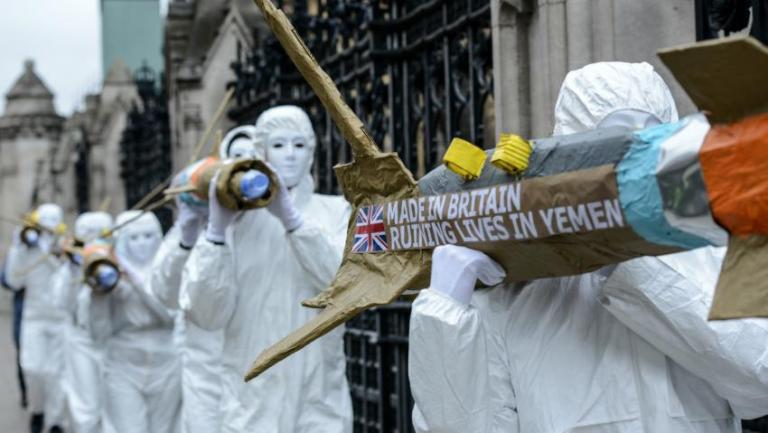
British RAF servicing Saudi jets bombing civilians in Yemen – UK armed forces minister
RT | March 18, 2019
Britain is providing “engineering support” for UK-supplied aircraft operated by the Royal Saudi Air Force, responsible for killing innocent people in Yemen, a British government minister has revealed.
Armed Forces Minister Mark Lancaster was responding to a question in parliament from Labour MP Lloyd Russell-Moyle, on military personnel seconded to BAE Systems in Saudi Arabia, when he admitted that the RAF have provided engineering and “generic training” to the Saudi Air Force involved in the bombing of Yemen.
“RAF personnel on secondment to BAE Systems in Saudi Arabia have provided routine engineering support for UK-supplied aircraft operated by the Royal Saudi Air Force (RSAF), including aircraft engaged in military operations in Yemen.”
Lancaster insisted UK personnel were not involved in the loading of weapons for operational sorties, in response to Russell-Moyle’s claim that the “British support keeps Saudi’s air war going.”
Andrew Smith of Campaign Against the Arms Trade has branded the revelation “shocking but not surprising,” arguing that UK military personnel “should not be servicing Saudi jets or supporting the Saudi armed forces.”
It’s not just the UK that has been widely criticised for being party to the Saudi-led coalition’s bombardment of Yemen.
In December, the US Pentagon revealed that they were having to claw back $331 million of taxpayer-subsidized money gifted to Saudi Arabia and the UAE over a three-year period, when it ‘accidentally’ refueled their aircraft for free during their war on Yemen.
In November, Labour’s Shadow Foreign Secretary Emily Thornberry accused the UK government of having “blood on its hands” after admitting that the RAF had trained over a hundred Saudi pilots in the past ten years.
Coalition forces led by Saudi Arabia and the United Arab Emirates have relentlessly bombed Yemen since 2015 in an effort to oust the Houthi rebels controlling the capital city of Sanaa.
They have reportedly targeted hospitals and other civilian infrastructure, leading to a massive cholera outbreak, and upwards of 60,000 people are believed to have died in the conflict since 2016 – with a further 85,000 estimated dead from famine and malnutrition.
Half of Yemen’s population relies on food aid to survive, placing them in immediate danger of starving to death after coalition forces blockaded the port city of Hodeidah last year.
Artificial Morality
By Robert Koehler | CounterPunch | March 15, 2019
Artificial Intelligence is one thing. Artificial morality is another. It may sound something like this:
“First, we believe in the strong defense of the United States and we want the people who defend it to have access to the nation’s best technology, including from Microsoft.”
The words are those of Microsoft president Brad Smith, writing on a corporate blogsite last fall in defense of the company’s new contract with the U.S. Army, worth $479 million, to make augmented reality headsets for use in combat. The headsets, known as the Integrated Visual Augmentation System, or IVAS, are a way to “increase lethality” when the military engages the enemy, according to a Defense Department official. Microsoft’s involvement in this program set off a wave of outrage among the company’s employees, with more than a hundred of them signing a letter to the company’s top executives demanding that the contract be canceled.
“We are a global coalition of Microsoft workers, and we refuse to create technology for warfare and oppression. We are alarmed that Microsoft is working to provide weapons technology to the U.S. Military, helping one country’s government ‘increase lethality’ using tools we built. We did not sign up to develop weapons, and we demand a say in how our work is used.”
Wow, words of conscience and hope. The deeper story in all this is ordinary people exercising their power to shape the future and refusing to increase its lethality.
With this contract, the letter goes on, Microsoft has “crossed the line into weapons development. . . . The application of HoloLens within the IVAS system is designed to help people kill. It will be deployed on the battlefield, and works by turning warfare into a simulated ‘video game,’ further distancing soldiers from the grim stakes of war and the reality of bloodshed.”
This revolt was what Smith was responding to when he said he believed in a “strong defense,” implying that moral clichés rather than money are what drive the decisions of large corporations, or at least this particular large corporation. Somehow his words, which he attempted to convey as reflective and deeply considered, are not convincing — not when juxtaposed with a defense contract worth nearly half a billion dollars.
Smith goes on, acknowledging that no institution, including the military, is perfect, but pointing out that “one thing is clear. Millions of Americans have served and fought in important and just wars,” cherry-picking such lauded oldies as the Civil War and World War II, where America’s enhanced lethality freed slaves and liberated Europe.
Fascinatingly, the tone of his blog post is not arrogant toward the employees — do what you’re told or you’re fired — but, rather, softly placating, seeming to indicate that the power here isn’t concentrated at the upper levels of management. Microsoft is flexible: “As is always the case, if our employees want to work on a different project or team — for whatever reason — we want them to know we support talent mobility.”
The employees who signed the letter demanded cancellation of the Defense contract. Smith offered their personal consciences an out: Come on, join another team if you don’t want to cross the line and work on weapons development. Microsoft honors employees of multiple moral persuasions!
Artificial Intelligence is a high-tech phenomenon that requires highly complex thinking. Artificial morality hides behind the nearest cliché in servitude to money.
What I see here is moral awakening scrambling for sociopolitical traction: Employees are standing for something larger than sheer personal interests, in the process pushing the Big Tech brass to think beyond their need for an endless flow of capital, consequences be damned.
This is happening across the country. A movement is percolating: Tech won’t build it!
“Across the technology industry,” the New York Times reported in October, “rank-and-file employees are demanding greater insight into how their companies are deploying the technology that they built. At Google, Amazon, Microsoft and Salesforce, as well as at tech start-ups, engineers and technologists are increasingly asking whether the products they are working on are being used for surveillance in places like China or for military projects in the United States or elsewhere.
“That’s a change from the past, when Silicon Valley workers typically developed products with little questioning about the social costs.”
What if moral thinking — not in books and philosophical tracts, but in the real world, both corporate and political — were as large and complex as technical thinking? It could no longer hide behind the cliché of the just war (and surely the next one we’re preparing for will be just), but would have to evaluate war itself — all wars, including the ones of the past 70 years or so, in the fullness of their costs and consequences — as well as look ahead to the kind of future we could create, depending on what decisions we make today. Complex moral thinking doesn’t ignore the need to survive, financially and otherwise, in the present moment, but it stays calm in the face of that need and sees survival as a collective, not a competitive, enterprise.
Moral complexity is called peace. There is no such thing as simplistic peace.
Robert Koehler is a Chicago award-winning journalist and editor.
Featured Video

Iran’s Next Strike May Not Explode. It Could Shut You Down
or go to
Aletho News Archives – Video-Images
From the Archive
Zionism’s Violent Legacy
By Donald Neff | Washington Report On Middle East Affairs | January 1996
On January 4, 1948, Jewish terrorists drove a truck loaded with explosives into the center of the all Arab city of Jaffa and detonated it, killing 26 and wounding around 100 Palestinian men, women and children.[1] The attack was the work of the Irgun Zvai Leumi – the “National Military Organization,” also known by the Hebrew letters Etzel – the largest Jewish terrorist group in Palestine. The Irgun was headed by Revisionist Zionist Menachem Begin and had been killing and maiming Arabs, Britons and even Jews for the previous ten years in its efforts to establish a Jewish state.
This terror campaign meant that at the core of Revisionist Zionism there existed a philosophical embrace of violence. … continue
Blog Roll
 Aletho News
- Trump’s Iran war is on an Israeli leash
- Saudi oil boss issues global supply warning
- Riyadh Says Its Oil System Is Intact. The Numbers Say Otherwise.
- Trump and Netanyahu Want to “Finish the Job” on Iran
- US ‘one-sided dictation’ not Iran’s beliefs makes rational talks impossible: Baghaei
- Iran’s Next Strike May Not Explode. It Could Shut You Down /Col Doug Macgregor
- Iran: US political targets legitimate if assassinations return
- Iraq shuts key border crossing with Iran under US pressure: Report
- Undersea Internet cables could be targeted in retaliation for attacks on Iran: IRGC deputy chief
- EU sending ‘biased’ observers to interfere in Serbian election – president
- If Americans Knew
- AIPAC has become such a political liability that it’s shifting to a more “nimble” approach to buying politicians
- At least 160 Israeli settler attacks in 2 weeks
- Will Gaza’s Ancient Christian Community Disappear Forever?
- Israel’s vision of regional security rests on keeping Arab states weak
- Heidi Levine recounts how Palestinian youths helped save her in settler attack
- DAILY UPDATE: Latest essential news on Palestine, Israel, & region
- Trump’s Intensifying Sabotage of the ICC, for Israel’s Sake
- Israeli military detain US and UK volunteers in West Bank including Democratic NY politician Brad Lander
- Americans at National Conservatism Conference held in Israel this year criticize Israel
- Christiane Amanpour exits CNN with a legacy shaped by the debate over Israel
- No Tricks Zone
- E-Cars Reduce CO2 Emissions By Only 41% Compared To Internal Combustion Engine Vehicles
- Predictions Made By Renowned Climate Professor Over Past Decades Have Been Proven To Be Poor
- New Study Suggests Large Regions Of The Pacific Ocean Have Been Cooling For The Last 80 Years
- Germany’s Green Energy Debacle: High Energy Costs Force Kahla Porzellan to Close After 182 Years!
- New Study: 50 Years Of The Most Aggressive ‘Net Zero’ Policies Can Only Affect The Global Climate By 0.03°C
- US September “Heat” Was No Record…Many Records Set Decades Ago
- Latest European Green Energy Debacle; Portugal’s Largest Flagship Solar Park Insolvent!
- Green Energy Debacle: German Expert Professor Fritz Vahrenholt Warns Of Severe Economic And Social Consequences
- Two More Paleo Reconstructions Affirm Meters-Higher Sea Levels Across Ireland, Brazil 7000-6000 Years Ago
- New Study: Earth And Venus Surface Warmth Largely Explained By Convection And Lapse Rate, Not CO2 Or Radiation

