The United States continues to brandish its military power all round the globe and has recently been concentrating on confronting Russia and China. Its policy and deployments were explained by the US Air Force Secretary in September when she declared that Washington felt threatened because “Less than a week ago Russia began the largest exercise on Russian soil in four decades… with more than 300,000 troops and 1000 aircraft.
On the other side of the world, China’s first aircraft carrier was declared combat ready this year, and promptly sailed into the Pacific to conduct flight operations.”
The absurdity of that statement escaped fitting comment by the West’s mainstream media, which also considers it astonishing that Russia should carry out a military exercise in its own territory following the massive build-up by the US-NATO military alliance along its borders. As pointed out on November 15 by Russia’s Foreign Ministry, this expansion can be seen “along the entire stretch of land connecting the Baltic Sea and the Black Sea. Since October, vast operational resources have been concentrated in the Baltic Region and the north of Europe, due to a series of major international exercises. They are being deployed in addition to NATO regiments already present in the countries of the eastern flank. Those regions have never seen such a military presence since the end of the World War II”.
And it is growing.
Foreign Policy in Focusobserves that “In all NATO countries in Eastern Europe, the US Air Force is investing multimillion-dollar sums in the expansion of its air bases, with more than $50 million pouring into a base in Hungary, more than $60 million allocated to the modernization of two air force bases in Romania, and two bases in Slovakia that will be upgraded with more than $100 million, besides various base upgrades in other countries in the region.”
In October President Putin said that “Russia doesn’t threaten anyone and has strictly adhered to its obligations in the sphere of international security and arms control,” but made it clear there would be decisive action if an attack takes place, and “the aggressor should know that retaliation is inevitable, and he will be destroyed.” Russia has “precision hypersonic weapons” exemplified by the Kinzhal missile and a new system, the Avangard, that will enter service in the next few months.
His outlook and approach are echoed by China’s leader, President Xi Jinping, who reminded those attending the Asia-Pacific Economic Cooperation summit in Papua New Guinea on November 17 that “History has shown that confrontation, whether in the form of a cold war, a hot war or a trade war, produces no winners.”
In early 2018 President Xi said plainly that China “will forge a powerful military that is ready to respond to the call, to fight and to win a war,” and in October, following Washington’s increasing military activity in and around the South China Sea, the President told his armed forces to “concentrate preparations for fighting a war”, which is as blunt a warning to Washington as might be expected in the circumstances, in which the US is deliberately provoking China by its widely-publicised support for Taiwan. This has gone so far as for the Defence Minister Wei Fenghe to announce that Beijing would never give up “one single piece” of its territory. He warned that “repeated challenges” to China’s stance on Taiwan would lead to military action.
What China and Russia are saying is plain, blunt and unambiguous : stay out of our territory; stop prodding our borders and cease your coat-trailing provocation.
Philippines President Rodrigo Duterte is an unpleasant person, but on November 17 he put things in perspective in his region. When questioned about US Navy operations in the South China Sea he asked in turn “Why do you have to create frictions that will prompt a response from China?”
One of the more ridiculous observations by the US Air Force Secretary concerned the commissioning of China’s first aircraft carrier. In tones of hushed horror she revealed that it “was declared combat ready this year, and promptly sailed into the Pacific to conduct flight operations.”
What upsets the US military is the fact that China now has an aircraft carrier that can defend the country from beyond its shores, unlike America’s eleven enormous aircraft carriers which sail round the world’s oceans in order to impose Washington’s will. At the moment there are two carrier groups in the Philippines Sea, ready to move into the South China Sea to conduct more provocative operations.
The Air Force Secretary added to absurdity by declaring that “now all of Southeast Asia is within reach of China’s long-range bombers” — presumably considering it irrelevant that in October, in the latest of a series of provocative operations, two nuclear-capable USAF B-52 bombers from Barksdale Air Force Base, Louisiana, overflew the South China Sea. As reported in the Air Force Times “the flights were in support of US Indo-Pacific Command’s Continuous Bomber Presence, a mission focused on deterring regional challengers.”
Regional challengers? Just who is challenging whom with a “continuous bomber presence”?
Like Russia, China has had to develop advanced weapons to counter the menace patrolling and probing its borders, and these could be employed effectively in the event of US confrontation getting out of hand.
A CNN headline in October was “US Navy proposing major show of force to warn China” and it indicated that the “Pacific Fleet has drawn up a classified proposal to carry out a global show of force as a warning to China and to demonstrate the US is prepared to deter and counter their military actions . . . The plan suggests sailing ships and flying aircraft near China’s territorial waters in the South China Sea and Taiwan Strait in freedom of navigation operations to demonstrate the right of free passage in international waters. The proposal means US ships and aircraft would operate close to Chinese forces.”
If Washington is insane enough to go ahead with this deliberately confrontational fandango, there could be serious consequences. Chinese warships could manoeuvre to bar US Navy vessels from coming with 12 nautical miles of one of its islands in the South China Sea, and if there were attempts by the US to penetrate that barrier, there could well be a serious incident. Should this involve damage to a Chinese ship, Beijing would not stand idly by and would respond appropriately. Given its inventory of weapons, especially its advanced torpedoes, this could involve destruction of one of the US Navy’s carriers.
There are similar possibilities in the north. CNN noted that “Currently the aircraft carrier USS Harry S Truman is taking the unexpected step of operating in the North Sea — sending a signal to Russia that US military forces can extend their reach to that area.” But if US warships behave aggressively it can be expected that Russia will counter such behaviour most forcefully.
In October the Commander of US Naval Forces Europe, Admiral James Foggo, told the US Naval Institute that “it would be important to have a greater naval presence in Europe than the US has had in the last two or three decades, and that this year’s presence by the Harry S Truman Carrier Strike Group and the Iwo Jima Amphibious Ready Group were part of the effort to boost presence to reassure allies and to keep an eye on Russian activity. With the Truman Strike Group now back in the region — spending time in Iceland and the North Sea ahead of Trident Juncture [the November 2018 anti-Russia US-NATO exercise based on Norway] — ‘that sends a very strong message that the United States will operate anywhere, either unilaterally or in collaboration with our NATO partners and allies. And like I said, nobody in the world can come close to a US nuclear-powered aircraft carrier in terms of firepower, dwell and endurance,’ he said.”
Foggo’s diatribe ended with the juvenile but still dangerous pronouncement that “And those guys and gals out on that carrier and the Marines are doing a fantastic job. So we’re keeping the adversaries back on their heels. They don’t know where we’re going next and that’s a good thing. And we’re working more with allies and partners because we have that additional capability. Right now I have — I think, at last count — 495,000 tons of grey-hulled shipping operating in the theatre. And that’s great. I love it.”
This type of trigger-happy immature belligerence is official warning of US policy as regards Russia and China, and it is not surprising that both nations are countering Washington’s confrontation.
It is rare that Thanksgiving falls on a significant date, as it does this year, November 22, the date President Kennedy was assassinated in 1963. When we gather to give thanks, we should remember the extraordinarily courageous John F. Kennedy and the absent presence of a man whose death, dark and bloody as it was, is a sign of hope in these dark times.
For if John Kennedy had not had the spiritual conscience to secretly carry-on a back channel letter correspondence with the courageous Nikita Khrushchev, facilitated by Pope John XXIII, we very well might not be here, having been incinerated in a nuclear holocaust.
As then, so today, do we desperately need such a meeting of minds as the U.S. continually pushes Russia into a defensive posture that makes a nuclear confrontation so much more likely.
A true war hero twice over, John Kennedy risked his life to save his men in World War II, and then, after a radical turn toward peace-making in the last year of his life, he died in his own country at the hands of his domestic enemies as a soldier in a non-violent struggle for peace and reconciliation for all people across the world.
Hope? Not because he was assassinated, but why he was assassinated.
We know who killed him: the national security state, led by the CIA, killed him, not Lee Harvey Oswald. It was a coup d’état purposely conducted in plain sight to send a message that every president since has heeded: Your job is to make war and threaten nuclear annihilation for the Deep State elites. Follow orders or else. And they have followed.
If you find my assertion about the CIA audacious and absurd, first read James Douglass’s JFK and the Unspeakable: Why He Died and Why It Matters, a book widely regarded as the best book on the assassination and its meaning. Read it very closely and slowly. Check all his sources, read his endnotes, and analyze his logic. Approach his meticulous research as if you agreed with Gandhi’s saying that truth is God and God is truth. Try to refute Douglass. You will be stymied.
Then read David Talbot’s The Devil’s Chessboard: Allen Dulles, the CIA, and the Rise of America’s Secret Government for further clarification. You will come away from these two books profoundly shaken to your core. Be a truth-seeker, if you are not one already.
Or if you prefer, call me a “conspiracy theorist,” as the CIA wants, since it was the Agency that produced CIA Dispatch # 1035-960. “Most Americans,” writes Professor Lance deHaven-Smith of Florida State University, “will be shocked to learn that the conspiracy theory label was popularized as a pejorative term by the Central Intelligence Agency (CIA) in a propaganda campaign initiated in 1967.”
This program was aimed at critics of the Warren Commission. The CIA requested that its own people and corporate media accomplices, including all its many journalist assets, besmirch the good names of anyone who dared to point out the absurdities in the government claim that Lee Harvey Oswald, a man working for the CIA as a fall guy, could have killed Kennedy.
So be careful how you use the term, if you don’t want to be working with the assassins to silence their critics.
But my intention here is not to debate the obvious. In a season of thanksgiving and hope, I want to remind you to remember and honor JFK. Because he knew the horror of war and grasped the systemic evil of its proponents within his own government, John Kennedy grew out of the war machine – in James Douglass’s words in JFK and the Unspeakable, when he was assassinated, JFK “was turning, Teshuvah, ‘turning,’ the rabbinic word for repentance,” against war and toward peace as his actions in the last year of his life make crystal clear. As a result, the unspeakable deep-state forces murdered him. He knew they would, but as a man of great courage, he knew he must follow the words of Abraham Lincoln dear to his heart: “I know there is a God – and I see a storm coming. If he has a place for me, I believe that I am ready.”
Hope comes from facing the truth, not from fleeing from it. The Trappist monk, Thomas Merton, called our denial of the truth about JFK and his turn toward peace that led to his murder by forces within his own government, the “unspeakable”: “the void that gets into the language of public and official declarations at the very moment when they are pronounced, and makes them ring dead with the hollowness of the abyss.”
We are living in that abyss today. But we can still speak; we can refuse to be silenced. And in speaking up we will find hope.
Jim Douglass asks: “How can we take hope from a peacemaking president’s assassination by his own national security state?”
He answers: “The story of why John Kennedy died encircles the earth. Because JFK chose peace on earth at the height of the Cold War, he was executed. But he turned toward peace, in spite of the consequences to himself, humanity is still alive and struggling. That is hopeful, especially if we understand what he went through and what he has given us as his vision.”
His life’s story is the story of the courage to change radically and turn toward truth and peace-making no matter what the cost.
We should all raise our glasses in a Thanksgiving toast to John Kennedy. In his story is ours; the hope he bequeathed to us through his courageous death is one of hope for life. Our gratitude to JFK must follow with our commitment to oppose the killers in our own government who want to silence us all, now and forevermore.
Defence Secretary Gavin Williamson will reaffirm Britain’s commitment to Ukraine during a visit to Kiev.
The United Kingdom will ramp up its military assistance to Ukraine, deploying additional troops and a Royal Navy ship to defend ‘freedom and democracy,’ Defence Secretary Gavin Williamson will announce on Wednesday, The Telegraph wrote.
Ukrainian Special Forces and Marines will be trained by British personnel and HMS Echo, a Royal Navy hydrographic survey ship with a company of 72, will deploy to the region.
“As long as Ukraine faces Russian hostilities, it will find a steadfast partner in the United Kingdom,” Williamson will say.
The announcement will follow through on promises Williamson made during his visit to Ukraine in September.
In his first visit as Defence Secretary to Ukraine in September, Gavin Williamson announced Britain’s decision to extend its military training operation there for another two years, until 2020.
The training, delivered through Operation Orbital, has been expanded in 2018 to include anti-armour, infantry skills, counter-sniping, and mortar planning.
This is in addition to defence skills programmes such as the identification of mines and improvised explosive devices, medical care and logistics that UK personnel have been delivering since early 2015.
British personnel have trained more than 9,500 Ukrainian armed forces personnel since the start of Operation Orbital in 2015.
During a meeting in Kiev with his Ukrainian counterpart Stepan Poltorak in September, Williamson said that London planned to deploy a Royal Navy ship to Ukraine, commit further Royal Marines and introduce a permanent naval attaché to help build Ukraine’s naval capability.
Gavin Williamson also travelled to Marinka in eastern Ukraine to see the effects of the four-year conflict in the Donbass region.
The Defence Secretary later met with President Petro Poroshenko to discuss, among other things, the tense situation in the Sea of Azov and its negative impact on the Ukrainian economy.
Russia and Ukraine are in a row over the inland Sea of Azov that they share, with both sides accusing each other of detaining each other’s’ ships illegally. However, no specific example of delaying or preventing access to a ship by Russia has been cited yet.
Tensions between Russia and Ukraine in the Sea of Azov heightened this year after Ukraine detained two Russian ships for port calls in Russia’s Crimea, which Ukraine considers to be its territory.
Russia described the move as ‘maritime terrorism’ and ramped up patrols off the country’s Azov coast, prompting Ukraine to accuse Russia of illegal searches.
The crisis escalated in October, when the Ukrainian parliament passed a draft law authorising Kiev to expand maritime controls by 12 nautical miles off its southern coast, allegedly in an effort to counter smuggling in the Black Sea.
Manlio Dinucci in this carefully documented Pandora TV production focuses on US-NATO military deployment in Italy and around the World in what might described as “Global NATO”.
Manlio Dinucci, distinguished Italian author, geopolitical analyst and geographer is a Research Associate of the Centre for Research on Globalization CRG).
The Pentagon has finally completed its first ever audit and the results are as many of us expected. After spending nearly a billion dollars to find out what has happened to trillions in unaccounted-for spending, the long look through the books has concluded that only ten percent of all Pentagon agencies pass muster. I am surprised any of them did.
Even the Pentagon is not surprised by the failure of the audit. “We failed the audit. But we never expected to pass it,” said Deputy Secretary of Defense Patrick Shanahan. Can we imagine any large US company subject to the prying eyes of the IRS being so unfazed by the discovery that its books have been so mis-handled?
As with all government programs, but especially when it comes to military spending, the failure of a program never leads to calls for funding reductions. The Pentagon’s failure to properly account for the trillions of taxpayer dollars shoveled in year after year only means, they say, that we need to send more money! Already they are claiming that with more resources – meaning money – they can fix some of the problems identified by the audit.
If you subsidize something you get much more of it, and in this case we are subsidizing Pentagon incompetence. Expect much more of it.
Outgoing chairman of the House Armed Services Committee, Rep. Mac Thornberry, warned against concluding that this mis-handling trillions of dollars should make us hesitant to continue sending trillions more to the Pentagon. The failed audit “should not be used as an excuse for arbitrary cuts that reverse the progress we have begun on rebuilding our strength and readiness,” he said.
The neocons concur. Writing in the Free Beacon, editor Matthew Continetti (who happens to be Bill Kristol’s son-in-law) warns that now is “the wrong time to cut defense.”
But I agree with the young neoconservative Continetti. I would never support cutting a penny of defense. However the Pentagon’s lost trillions have nothing to do with defense. That is money propping up the high lifestyles of those connected to the military-industrial complex.
Continetti and the neocons love to throw out bogeymen like China and Russia as excuses for more military spending, but in fact they are hardly objective observers. Look at how much the military contractors spend funding the neocon publications and neocon think tanks telling us that we need more military spending! All this money is stolen from the productive economy and diverted to enrich neocon cheerleaders at our expense.
Of course the real problem with the Pentagon and military spending in general is not waste, fraud, and abuse. It is not ten thousand dollar toilet seats or coffee mugs. The problem with military spending is the philosophy that drives it. If the US strategy is to maintain a global military empire, there will never be enough spending. Because there is never enough to control every corner of the globe. But if we are to return to a well-defended republic, military spending could easily be reduced by 75 percent while keeping us completely safe. The choice is ours!
“Colonel” Edward Mandell House is on his way to meet with King George V, who ascended to the throne after Edward VII’s death in 1910. Accompanying him is Edward Grey, British foreign secretary and acolyte of the Milner Group. The two speak “of the probability of an ocean liner being sunk” and House informs Grey that “if this were done, a flame of indignation would sweep across America, which would in itself probably carry us into the war.”
An hour later, at Buckingham Palace, King George V inquires about an even more specific event.
“We fell to talking, strangely enough, of the probability of Germany sinking a trans-Atlantic liner, . . . He said, ‘Suppose they should sink the Lusitania with American passengers on board. . . .’”
And, by a remarkable coincidence, at 2:00 that afternoon, just hours after these conversations took place, that is precisely what happened.
The Lusitania, one of the largest passenger liners in the world, is en route from New York to Liverpool when it is struck by a torpedo from a German U-boat. She sinks to the bottom in minutes, killing 1,198 passengers and crew, including 128 Americans. The disaster—portrayed as a brazen, unexpected attack on an innocent passenger liner—helps to shift public opinion about the war in the US. To the average American, the war suddenly doesn’t feel like a strictly European concern.
Every aspect of the story was, as we now know, a deception. The Lusitania was not an innocent passenger liner but an armed merchant cruiser officially listed by the British Admiralty as an auxiliary war ship. It was outfitted with extra armour, designed to carry twelve six-inch guns, and equipped with shell racks for holding ammunition. On its trans-Atlantic voyage the ship was carrying “war materiel”—specifically, more than 4 million .303 rifle bullets and tons of munitions, including shells, powder, fuses and gun cotton—“in unrefrigerated cargo holds that were dubiously marked cheese, butter and oysters.” This secret manifest was officially denied by the British government for generation after generation but in 2014—a full 99 years after the event—internal government documents were finally released in which the government admitted the deception.
And, most remarkably of all, by Edward Mandell House’s own account both Edward Grey and King George V himself were discussing the sinking of the Lusitania just hours before the event took place.
It’s a story that provides a window into the secret society’s years-long campaign to draw the United States into World War I. But in order to understand this story, we have to meet Edward Mandell House and the other Milner Group co-conspirators in America.
Strange as it might seem, there were no shortage of such co-conspirators in the US. Some, like the members of the influential Pilgrims Society, founded in 1902 for the “encouragement of Anglo-American good fellowship”—shared Rhodes’ vision of a united Anglo-American world empire; others were simply lured by the promise of money. But whatever their motivation, those sympathetic to the cause of the Round Table included some of the wealthiest and most powerful people in the United States at the time.
Many of these figures were to be found at the heart of Wall Street, in the banking and financial institutions revolving around J.P. Morgan and Company. John Pierpont Morgan, or “Pierpont” as he preferred to be called, was the nucleus of turn-of-the-century America’s banking sector. Getting his start in London in 1857 at his father’s merchant banking firm, the young Pierpont returned to New York in 1858 and embarked on one of the most remarkable careers in the history of the world.
Making his money financing the American robber barons of the late 19th century—from Vanderbilt’s railroads to Adolph Simon Ochs’ purchase of TheNew York Times to the buyout of Carnegie Steel—Morgan amassed a financial empire that, by the 1890s, wielded more power than the United States Treasury itself. He teamed up with his close allies, the House of Rothschild, to bail out the US government during a gold shortage in 1895 and eased the Panic of 1907 (which he helped to precipitate) by locking 120 of the country’s most prestigious bankers in his library and forcing them to reach a deal on a $25 million loan to keep the banking system afloat.
As we saw in “Century of Enslavement: The History of the Federal Reserve,” Morgan and his associates were only too happy to use the banking crises they helped to create to galvanize public opinion toward the creation of a central bank. . . so long as that central bank was owned and directed by Wall Street, of course.
But their initial plan, the Aldrich Plan, was immediately recognized as a Wall Street ploy. Morgan and his fellow bankers were going to have to find a suitable cover to get their act through Congress, including, preferably, a President with sufficient progressive cover to give the new “Federal Reserve Act” an air of legitimacy. And they found their ideal candidate in the politically unknown President of Princeton University, Woodrow Wilson, a man who they were about to rocket straight into the White House with the help of their point man and Round Table co-conspirator, Edward Mandell House.
GROVE: Woodrow Wilson was an obscure professor at Princeton University who from reading all that I’ve read about him wasn’t the smartest guy but he was smart enough to pick up when other people had good ideas and then he bumps into this guy named Colonel House.
Colonel House, he grew up in Beaumont, Texas, and Colonel House’s dad was like a Rhett Butler type of smuggler privateer pirate during the Confederate war with the Union. So Colonel House: first of all, he’s not a colonel. It’s just like a title he gave himself to make him seem more than he was. But he did come from a politically connected family in the south that were doing business with the British during the Civil War. So Colonel house in the early 1900’s makes Woodrow Wilson his protege and Colonel house himself is being puppeted by a few people and the layers of the Anglo-American establishment above him and so we are left with the public persona of Woodrow Wilson. And here he is.
And he’s got this, you know, this whole new Federal Reserve System that’s going to come in during his administration which was also kind of a precursor to getting America into the war because it changed our financial dependency from being self-reliant and printing our own debt-free money to being indentured to international bankers who charged us as they print money out of thin air and charged future generations for it.
The election of Woodrow Wilson once again shows how power operates behind the scenes to subvert the popular vote and the will of the public. Knowing that the stuffy and politically unknown Wilson would have little chance of being elected over the more popular and affable William Howard Taft, Morgan and his banking allies bankrolled Teddy Roosevelt on a 3rd party ticket to split the Republican vote. The strategy worked and the banker’s real choice, Woodrow Wilson, came to power with just forty-two percent of the popular vote.
With Wilson in office and Colonel House directing his actions, Morgan and his conspirators get their wish. 1913 saw the passage of both the federal income tax and the Federal Reserve Act, thus consolidating Wall Street’s control over the economy. World War One, brewing in Europe just eight months after the creation of the Federal Reserve, was to be the first full test of that power.
But difficult as it had been for the Round Table to coax the British Empire out of its “splendid isolation” from the continent and into the web of alliances that precipitated the war, it would be that much harder for their American fellow travelers to coax the United States out of its own isolationist stance. Although the Spanish-American War had seen the advent of American imperialism, the thought of the US getting involved in “that European war” was still far from the minds of the average American.
“There is nothing reasonable in such a war as that for which Europe has been making ready, and it would be folly for this country to sacrifice itself to the frenzy of dynastic policies and the clash of ancient hatreds which is urging the Old World to its destruction.”
The Sun was by no means unique in its assessment. A vote taken among 367 newspapers throughout the United States in November of 1914 found just 105 pro-Ally and 20 pro-German papers, with the vast majority—242 of them—remaining firmly neutral and recommending that Uncle Sam stay out of the conflict.
Once again, just as they did in Britain, the cabal was going to have to leverage its control of the press and key governmental positions to begin to shape public perception and instill pro-war sentiment. And once again, the full resources of these motivated co-conspirators were brought to bear on the task.
One of the first shells in this barrage of propaganda to penetrate the American consciousness was the “Rape of Belgium,” a catalogue of scarcely believable atrocities allegedly committed by the German forces in their invasion and occupation of Belgium at the start of the war. In a manner that was to become the norm in 20th century propaganda, the stories had a kernel of truth; there is no doubt that there were atrocities committed and civilians murdered by German forces in Belgium. But the propaganda that was spun from those kernels of truth was so over-the-top in its attempts to portray the Germans as inhuman brutes that it serves as a perfect example of war propaganda.
RICHARD GROVE: The American population at that time had a lot of German people in it. Thirty to fifty percent of the population had relations back to Germany, so there had to be this very clever propaganda campaign. It’s known today as “babies on bayonets.” So if you have no interest in World War I but you think it’s interesting to study propaganda so you don’t get fooled again, then type it into your favorite search engine: “babies on bayonets, World War I.” You’ll see hundreds of different posters where the Germans are bayonetting babies and it brings about emotions and it doesn’t give you the details of anything. And emotions drive wars, not facts. Facts are left out and deleted all the time in order to create wars, so I think that putting facts back in might help prevent wars. But I do know that they like to drive people on emotion. The babies on bayonets getting America into World War one, that’s a key part of it.
GERRY DOCHERTY: Children who had their arms chopped off. Nuns that were raped. Shocking things, genuinely shocking things. The Canadian officer who was nailed at Andrew’s cross on a church door and left there to bleed to death. These were the great myths peddled in order to defame and bring down the the whole image of any justification for German action and try and influence America into war.
DOCHERTY: That’s not to say that there weren’t atrocities on both sides. War is an atrocious event and there are always victims. Absolutely. And I offer no justification for it. But the lies, the unnecessary abuse of propaganda.
Even when in Britain they decided that they would put together the definitive volume of evidence to present it to the world, the person they asked to do this just so happened to have been former British ambassador to the United States, a man called Bryce you who was very well-liked in the States. And his evidence was published and put forward and there were screeds of stories after stories. But then later it was discovered that in fact the people who took the evidence hadn’t been allowed to speak to any of the Belgians directly but in fact what they were doing is they were listening to a middleman or agents who who had supposedly taken these stories.
And when one of the official committee said “Hold on, can I speak to someone directly?” “No.” “No?” He resigned. He wouldn’t allow his name to be put forward with the [official report]. And that’s the extent to which this is false history. It’s not even even acceptable to call it fake news. It’s just disgusting.
The campaign had its intended effect. Horrified by the stories emerging from Belgium—stories picked up and amplified by the members of the roundtable in the British press, including the influential Times and the lurid Daily Mail, run by Milner ally Lord Northcliffe—American public opinion began to shift away from viewing the war as a European squabble about an assassinated archduke and toward viewing the war as a struggle against the evil Germans and their “sins against civilization.”
The culmination of this propaganda campaign was the release of the “Report of the Committee on Alleged German Outrages,” better known as “The Bryce Report,” compiled for “His Britannic Majesty’s Government” and presided over by Viscount James Bryce, who, not coincidentally, was the former British Ambassador to America and a personal friend of Woodrow Wilson. The report was a sham, based on 1,200 depositions collected by examiners who “had no authority to administer an oath.” The committee, which was not allowed to speak to a single witness itself, was tasked merely with sifting through this material and deciding what should be included in the final report. Unsurprisingly, the very real atrocities that the Germans had committed in Belgium—the burning of Louvain, Andenne and Dinant, for example—were overshadowed by the sensationalist (and completely unverifiable) stories of babies on bayonets and other acts of villainy.
The report itself, concluding that the Germans had systematically and premeditatedly broken the “rules and usages of war” was published on May 12, 1915, just five days after the sinking of TheLusitania. Directly between these two events, on May 9, 1915, Colonel House—the man who Wilson called his “second personality” and his “independent self”—wrote a telegram, which the President dutifully read to his cabinet and was picked up by newspapers across the country.
“America has come to the parting of the ways, when she must determine whether she stands for civilized or uncivilized warfare. We can no longer remain neutral spectators. Our action in this crisis will determine the part we will play when peace is made, and how far we may influence a settlement for the lasting good of humanity. We are being weighed in the balance, and our position amongst nations is being assessed by mankind.”
But despite this all-out propaganda assault, the American public was still largely against entering the war. It was in this context that the same group of Wall Street financiers who had maneuvered Wilson into the White House presided over the 1916 presidential election, one that the country knew would decisively conclude America’s neutrality in the war or its decision to send forces to engage in European combat for the first time in history.
The bankers left nothing to chance. Wilson, who would predictably follow House’s lead on all matters including war, was still their preferred candidate, but his competitor, Charles Evan Hughes, was no less of a Wall Street man. Hughes’ roots were as a Wall Street lawyer; his firm represented the New York, Westchester, and Boston Railroad Company for J.P. Morgan and Company and the Baptist Bible class that he led boasted many wealthy and influential members, including John D. Rockefeller, Jr.
The affable Hughes was stiff competition for the wooden and charmless Wilson, but such was the importance of American neutrality that “He Kept Us Out of War” actually became the central slogan of the campaign that saw Wilson return to the White House.
DOCHERTY: And then, of course, came the famous election of 1916. Wilson wasn’t popular, but Wilson, simply—he had no kind of public persona which warmed people. On the contrary, he was a cold fish. He had dubious links with several of those who are powerful in Wall Street. But his propaganda for the election was “He Kept Us Out of War.” “He was a man, vote for Wilson, he kept us out of war.” And then having promised that he would continue to keep America out of war, and in fact of course within months America was was thrown into the war by its own government.
“He Kept Us Out of War.” But just as in the British election of 1906—which saw the British public overwhelmingly voting for Henry Campbell-Bannerman’s Liberal Party and their platform of peace only to get the Milnerites in the cabinet entering secret agreements to bring about war—so, too, was the American public duped at the ballot box in 1916.
In fact, in the fall of 1915, over one year before the election even took place, Wilson’s string-puller, Edward Mandell House, was engaged in a secret negotiation with Edward Grey, the Milnerite heading Britain’s foreign office. That negotiation—long hidden from the public but finally revealed when House’s papers were published in 1928—shows the lengths to which Grey and House were willing to go to draw America into the war on the side of the Allies and against the Germans.
On October 17, 1915, House drafted a letter to Grey which he called “one of the most important letters I ever wrote.” Before sending it, he split it into two separate, coded messages, to ensure it would not be readable if it were intercepted. In it, he laid out a plan to steer the US into war with Germany under the false pretense of a “peace conference.”
Dear Sir Edward :
. . . In my opinion, it would be a world-wide calamity if the war should continue to a point where the Allies could not, with the aid of the United States, bring about a peace along the lines you and I have so often discussed.
It is in my mind that, after conferring with your Government, I should proceed to Berlin and tell them that it was the President’s purpose to intervene and stop this destructive war, provided the weight of the United States thrown on the side that accepted our proposal could do it.
I would not let Berlin know, of course, of any understanding had with the Allies, but would rather lead them to think our proposal would be rejected by the Allies. This might induce Berlin to accept the proposal, but, if they did not do so, it would nevertheless be the purpose to intervene. . . .
Perhaps realizing the gravity of what was being proposed, Woodrow Wilson, the man who would later be elected for his ability to keep America out of war, merely added the word “probably” to House’s assurance that America would join the war.
The negotiations for this plan continued throughout the fall of 1915 and winter of 1916. In the end, the British government balked at the proposal because the thought that the Germans might actually accept peace—even a peace of disarmament brokered by the US—was not enough. They wanted to crush Germany completely and nothing less than total defeat would be sufficient. Another pretense would have to be manufactured to embroil the US in the war.
When, on the morning of May 7, 1915, House assured Grey and King George that the sinking of the Lusitania would cause “a flame of indignation [to] sweep across America,” he was correct. When he said it would “probably carry us into war,” he was mistaken. But in the end it was the naval issue that eventually became the pretext for America’s entry into war.
The history books of the period, following the familiar pattern of downplaying Allied provocations and focusing only on the German reactions, highlight the German policy of unrestricted submarine warfare which led to the downing of the Lusitania. The practice, which called for German U-boats to attack merchant ships on sight, was in contravention of the international rules of the sea at the time, and was widely abhorred as barbaric. But the policy was not instituted out of any insane blood lust on the part of the Kaiser; it was in response to Britain’s own policy of breaking international rules of the sea.
At the outbreak of war in 1914 the British had used their position of naval superiority to begin a blockade of Germany. That campaign, described as “one of the largest and most complex undertakings attempted by either side during the First World War,” involved the declaration of the whole of the North Sea as a war zone. As a so-called “distant blockade,” involving the indiscriminate mining of an entire region of the high seas, the practice was in direct violation of the Declaration of Paris of 1856. The indiscriminate nature of the blockade—declaring the most basic of supplies, like cotton, and even food itself to be “contraband”—was a violation of the Declaration of London of 1909.
More to the point, as an attempt to starve an entire country into submission, it was a crime against humanity. Eventually reduced to a starvation diet of 1,000 calories a day, tuberculosis, rickets, edema and other maladies began to prey on those Germans who did not succumb to hunger. By the end of the war the National Health Office in Berlin calculated that 763,000 people had died as a direct result of the blockade. Perversely, the blockade did not end with the war. In fact, with Germany’s Baltic coast now effectively added to the blockade, the starvation actually continued and even intensified into 1919.
Faced with protestations from the Austrian ambassador about the illegality of the British blockade, Colonel House, now America’s de facto president, merely observed: “He forgets to add that England is not exercising her power in an objectionable way, for it is controlled by a democracy.”
This double standard was not the exception but the rule when it came to those in America’s East coast establishment who were hungry to see the US join the Allies on the battlefields of Europe. As historian and author Ralph Raico explained in a 1983 lecture, it was these double standards that led directly to America’s entry into the war.
RALPH RAICO: The Wilson administration now takes the position which will ultimately lead to war. The German government is to be held strictly accountable for the death of any Americans on the high seas regardless of circumstances.
The Germans say, “Well let’s see if we can live with this. As long as you’re willing to put pressure on the British to have them modify their violations of international law—that is, they’re placing food on the list of contraband materials, which had never been done before. The British ,as you know, take your merchant ships off the high seas on the way to Rotterdam because they say anything that goes to Rotterdam is going to go to Germany, so they take American ships off the high seas. The British have put cotton—cotton!—on the list of contraband, confiscating these materials. They interfere with letters going to the continent because they think there’s military intelligence possibly involved. The British are imposing in many ways on Americans, so if you hold them responsible, we’ll behave ourselves as far as submarines go.”
This was not to be the case and the attitude of the Americans towards British violations of neutral rights were quite different. One reason is that the American ambassador to London, Walter Hines Page, was an extreme Anglophile. One time, for instance, he gets a message that the British have to stop interfering with American mail shipments to neutral ports, and the American ambassador goes to the British Foreign Minister Edward grey and says, “Look at the message I’ve just got from Washington. Let’s get together and try to answer this. This was his attitude. The British were never to help or were never held to the same standard as the Germans.
At home, Theodore Roosevelt, who in previous years had been a great friend of the kaiser’s and a great admirer of Germany, now says we have to get into this war right away. Besides that there’s a campaign for preparedness for building up the American army, the American Navy, drilling American citizens in combat techniques. There’s a kind of hysteria, really, that travels over the country considering that there’s—at this time certainly no chance—no chance of some kind of immediate threat to the United States.
And people like Roosevelt and Wilson begin talking in a very unfortunate way. Wilson says, for instance, “in America we have too many hyphenated Americans”—of course he meant German-Americans, Irish-Americans—”and these people are not totally loyal to our country.” Already scapegoats are being looked for and public opinion is being roused.
And this diplomatic negotiation, the exchange of memos goes on for the next few years. In January of 1917, the Americans are not having been able to budge the British in the least on any British violation of American rights; the British blockade intensifying; the Germans really feeling hunger in a very literal sense, especially the people on the on the home front; the Kaiser is persuaded by his Admirals and Generals to begin unrestricted submarine warfare around the British Isles.
The American position by this time had solidified, had become a totally rigid one, and when all is said and done when you go through all of the back-and-forth memoranda and notes and principles established, the United States went to war against Germany in 1917 for the right of Americans to travel in armed belligerent merchant ships carrying munitions through war zones. Wilson’s position was that even in that case the Germans simply had no right to attack the ship as long as there are Americans on the ship. Shall I repeat that? Armed belligerent—that is to say, English—armed English merchant ships carrying munitions could not be fired upon by the Germans as long as there were American citizens on board. And it was for the right of Americans to go into the war zone on such vessels that we finally went to war.
After months of deliberations and with the situation on the home front becoming increasingly desperate, the German military commanders decided to resume their unrestricted submarine warfare in 1917. As expected, US merchant ships were sunk, including four ships in late March alone. On April 2, 1917, Woodrow Wilson made his historic speech calling for Congress to declare war on Germany and commit US troops to European battlefields for the first time.
The speech, made over one hundred years ago by and for a world that has long since passed away, still resonates with us today. Embedded within it is the rhetoric of warfare that has been employed by president after president, prime minister after prime minister, in country after country and war after war right down to the current day. From it comes many of the phrases that we still recognize today as the language of lofty ideals and noble causes that always accompany the most bloody and ignoble wars.
With a profound sense of the solemn and even tragical character of the step I am taking and of the grave responsibilities which it involves, but in unhesitating obedience to what I deem my constitutional duty, I advise that the Congress declare the recent course of the Imperial German Government to be in fact nothing less than war against the government and people of the United States.
[…]
The world must be made safe for democracy. Its peace must be planted upon the tested foundations of political liberty. We have no selfish ends to serve. We desire no conquest, no dominion. We seek no indemnities for ourselves, no material compensation for the sacrifices we shall freely make. We are but one of the champions of the rights of mankind. We shall be satisfied when those rights have been made as secure as the faith and the freedom of nations can make them.
Four days later, on April 6, 1917, the US Congress issued a formal declaration of war against the Imperial German Government.
NARRATOR: Inside the White House, President Woodrow Wilson conferred with advisers and signed the proclamation of war against Germany. [. . .] everywhere there was cheering and waving of flags. Hindsight or cynicism might make us smile at the thought that this war was sometimes called That Great Adventure. Never again would we see our entry into a major conflict excite so many to such heights of elation. Naive? Probably. But here was a generation of young men not yet saturated by the paralyzing variety of self analysis and the mock sciences. They believed!
All along the Western front, the Allies rejoiced. The Yanks were coming.
House, the Milner Group, the Pilgrims, the Wall Street financiers and all of those who had worked so diligently for so many years to bring Uncle Sam into war had got their wish. And before the war was over, millions more casualties would pile up. Carnage the likes of which the world had never seen before had been fully unleashed.
The trenches and the shelling. The no man’s land and the rivers of blood. The starvation and the destruction. The carving up of empires and the eradication of an entire generation of young men.
Why? What was it all for? What did it accomplish? What was the point?
To this day, over 100 years later, we still look back on the horrors of that “Great War” with confusion. For so long we have been told non-answers about incompetent generals and ignorant politicians. “It’s the senselessness of war,” the teachers of this fraudulent and partial history have told us with a shrug.
But, now that the players who worked to set the stage for this carnage have been unmasked, these questions can finally be answered.
After years of bloodshed, Yemen’s Houthi movement is urging the Saudi Arabia-led coalition to join a comprehensive ceasefire if it really “wants peace,” the leader of the rebel group Mohammed Ali al-Houthi said Sunday.
At the request of Martin Griffiths, the United Nations special envoy for Yemen, the group is stopping ballistic missile and drone attacks on the coalition countries.
Al-Houthi also stressed the rebels’ readiness to freeze military operations on all fronts in an effort to reach a “just and honorable” peace.
Earlier this week the UN official told the UN Security Council that Yemen’s warring parties had agreed to hold talks in Sweden “shortly.”
Yemen has been the scene of mass casualties and civilian suffering throughout the civil war, especially after the coalition intervention in 2015.
While much of the population remains on the brink of starvation, the nation has also endured a cholera outbreak and a severe lack of medical supplies.
According to recent estimates, around 56,000 people died in the conflict.
Accidents happen. For Norway at the conclusion of NATO’s Trident Juncture 2018 military exercises, such an accident occurred with its Lockheed Martin Aegis-equipped frigate, HNoMS Helge Ingstad.
After a collision with an oil tanker, the frigate’s captain ordered the ship aground to prevent a total loss. The quick thinking may have saved the lives of Norwegian sailors and made salvaging operations easier. Thankfully no lives were lost and only eight injuries are being reported by the Western media.
The NATO exercises the Helge Ingstad was participating in simulated an invasion of Norway. As the Council on Foreign Relations made clear in their article, “NATO’s Trident Juncture Exercises: What to Know,” the imaginary invaders were obvious stand-ins for Russia.
The CFR piece would claim:
The aggressor in the simulation is fictitious, but the setting and the scale of the exercises point clearly in one direction. Tensions between NATO and Russia, which shares an Arctic border with Norway, are running high. In the last five years, Russia has annexed Crimea, destabilized eastern Ukraine, provided military aid to a brutal regime in Syria, meddled in Western elections, and either walked away from or allegedly violated major multilateral security treaties.
Of course none of what the CFR alleges is true and many of the accusations leveled against Russia by the article have long been abandoned by even most in the Western media.
The fact that Norway lost an expensive ship in the middle of this NATO exercise to prepare for a Russian invasion that will never happen suggests that the greatest threat much of Europe faces is from NATO itself, not Moscow.
NATO is a Cancer, Not a Shield
The amount of money required to host NATO members in Norway to prepare for a Russian invasion that will never happen would seem detrimental to Norwegians as well as other European nations spending money to move their forces and their equipment (40,000 personnel, 120 aircraft and 70 ships) to and from the exercise areas.
Training is important and maintaining a strong military as well as a credible deterrence is also important for all nations, both Western Europe and Russia included. But such preparations should be proportional to the prospective threats any nation or bloc of nations face. Such preparations should also clearly be made to create a deterrence rather than a provocation.
NATO’s Trident Juncture appears to be more of an exercise to enforce NATO expansion eastward toward Russia’s borders than any genuine preparation for a “Russian invasion” that even Norway’s leadership says is highly unlikely.
Such exercises and the agenda they serve benefits a handful of special interests, primarily in Washington (Lockheed Martin included), at the expense of NATO’s European members.
NATO, driven primarily by Washington and immense corporate interests who hold sway over it, has become a tool used to extend American ambitions around the globe. Few could provide a credible explanation as to what NATO’s nearly two decade-long occupation of Afghanistan has to do with defending Europe.
For Norway specifically, Afghanistan has become the grave for at least 10 of its service members and a blackhole that has swallowed several billion dollars in Norwegian expenditures.
Likewise, it was US-led NATO that destroyed the North African nation of Libya (with Norwegian assistance), transforming it into a hotbed of terrorism and triggering a refugee crisis that flooded European territory and continues to be a source of socioeconomic tension today.
In this instance, NATO directly compromised European security, and Norway’s taxpayers helped underwrite the disaster.
It is clear that NATO is not protecting Europe. It is using Europe to advance American ambitions around the globe, far beyond any reasonable jurisdiction a defense alliance aimed at protecting Europe should have. As NATO uses Europe, it is consuming funds that could be better used domestically for the European people. The net result of NATO’s activities undermine rather than uphold European security.
NATO’s Trident Juncture is simply an extension of this process, aimed at ratcheting up tensions with Russia and only further undermining European peace and stability in the process.
Other Ways NATO Undermines European Peace and Prosperity
Beyond military alliances and defense preparations, there are also alternatives for creating a deterrence to war and military aggression. These alternatives include economic cooperation. Here, such cooperation between Europe and Russia is complicated by US-led efforts to economically isolate Russia and sabotage trade and investment between Russia and its neighbors to the west.
By conducting provocative exercises aimed at Russia, tensions are only further encouraged and US efforts to place a wedge deeper between Russia and the rest of Europe further advanced.
What we’re left with is a Europe compelled to view its neighbor to the east as an enemy for lack of any viable alternative not met with Washington’s ire.
NATO, a supposed defense alliance, instead promotes tensions, exports wars and consumes the blood and treasure of member-states for foreign military adventures thousands of miles from European shores. Considering this, NATO, not Russia, seems to be the greatest threat facing Europe today.
A recent report by Brown University’s Watson Institute of International and Public Affairs on the cost of America’s wars in the aftermath of 9/11 estimates a sum totalling $5.9 Trillion. It is a figure virtually identical to the $6 Trillion figure projected by Harvard University’s Kennedy School of Government in 2013 to be the eventual cost of waging wars in Afghanistan and Iraq. Yet, as with the case of the increased danger of a nuclear war that could be the fruit of strained relations developed over the past decade with the Russian Federation, there has been no public debate in the United States about why America embarked on a programme of militarism predicated on the waging of a so-called War on Terror.
Such debate would necessarily have to centre on the three following areas:
The “hijacking” (to use the term chosen by retired US Four Star General Wesley Clark) of American foreign policy in the aftermath of the September attacks by a group of neoconservatives operating within the administration of President George W. Bush who drew up a ‘hit-list’ of seven countries intended to be destroyed over a five year period.
It would have been expected that all such countries earmarked for destruction would have had a connection to the planning of the September attacks, or, at least, have been sympathetic to the values guiding the alleged perpetrators of the deadliest attack on American soil since Pearl Harbor in 1941. Yet Iraq, Libya and Syria were all secular Arab states implacably opposed to the Sunni Islamist ideology of al-Qaeda, and Iran is a Shia nation. The common denominator among these states including Lebanon, or more accurately, Hezbollah, the Iranian-backed Lebanese Shia militia, was an enmity with the State of Israel.
As Clark stated during a speech given in October 2007 at the Commonwealth Club of California in San Francisco, there was never a public debate on a policy which commenced with the invasion of Iraq and was intended to be completed with an attack on Iran.
The unchanging policy from the administrations led by Bush Jr to Barack Obama and now Donald Trump due to ‘Deep State’ actors wielding power outside of the separated organs of government. In a scholarly paper-turned-book entitled National Security and Double Government, Michael J. Glennon, a professor of international law at Tufts University, has referred to the power usurping “Trumanite” institutions in contrast to the troika of “Madisonian” institutions of state, which he persuasively argues are no longer accountable in the way people think they are.
The corporate welfare culture surrounding the military industry as composed of the Pentagon and corporations such as Lockheed Martin, Boeing, Raytheon and others. The exorbitant costs involved with the development of the F-35 fighter plane which according to a number of US generals is pretty much “useless”, is emblematic of the inefficient weapons development regime that is more concerned with lining the pockets of corporations than with efficiency and cost-effectiveness.
The aforementioned, of course, do not mention the human cost: that of innocent civilian lives destroyed by military invasions, drone attacks and covert wars initiated by the United States. It also does not include the number of US service personnel killed, maimed and suffering from mental traumas.
All need to be factored into a comprehensive debate on why America’s sovereign debt has spiralled to uncontrollable levels, and also, why the moral standing of the United States among the international community of nations has been brought down to an all-time low.
By Prof. Neta C. Crawford | Watson Institute, Brown University | November 14, 2018
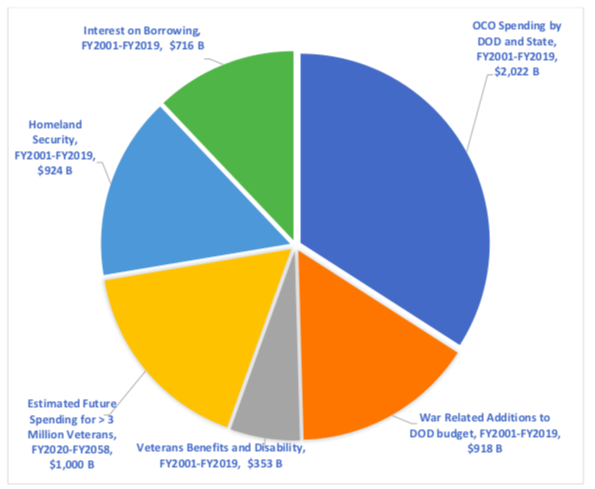
The United States has appropriated and is obligated to spend an estimated $5.9 trillion (in current dollars) on the war on terror through Fiscal Year 2019, including direct war and war-related spending and obligations for future spending on post-9/11 war veterans (see Table 1).
This number differs substantially from the Pentagon’s estimates of the costs of the post-9/11 wars because it includes not only war appropriations made to the Department of Defense – spending in the war zones of Iraq, Syria, Afghanistan, Pakistan, and in other places the government designates as sites of “overseas contingency operations,” – but also includes spending across the federal government that is a consequence of these wars. Specifically, this is war-related spending by the Department of State, past and obligated spending for war veterans’ care, interest on the debt incurred to pay for the wars, and the prevention of and response to terrorism by the Department of Homeland Security.
If the US continues on its current path, war spending will continue to grow. The Pentagon currently projects $80 billion in Overseas Contingency Operations (OCO) spending through FY2023. Even if the wars are ended by 2023, the US would still be on track to spend an additional $808 billion (see Table 2) to total at least $6.7 trillion, not including future interest costs. Moreover, the costs of war will likely be greater than this because, unless the US immediately ends its deployments, the number of veterans associated with the post-9/11 wars will also grow. Veterans benefits and disability spending, and the cost of interest on borrowing to pay for the wars, will comprise an increasingly large share of the costs of the US post-9/11 wars.
Table 1, below, summarizes the direct war costs – the OCO budget – and war-related costs through FY2019. These include war-related increases in overall military spending, care for veterans, Homeland Security spending, and interest payments on borrowing for the wars. Including the other areas of war-related spending, the estimate for total US war-related spending allocated through FY2019 is $4.9 trillion.[3] But because the US is contractually and morally obligated to pay for the care of the post-9/11 veterans through their lifetimes, it is prudent to include the costs of care for existing post-9/11 veterans through the next several decades. This means that the US has spent or is obligated to spend $5.9 trillion in current dollars through FY2019.[4] Table 1 represents this bottom-line breakdown for spent and obligated costs.
Table 1. Summary of War Related Spending, in Billions of Current Dollars, Rounded to the Nearest Billion, FY2001- FY2019[5]
Figure 1. US Costs of War: $5.9 Trillions of Current Dollars Spent and Obligated, through FY2019[10]
Further, the US military has no plans to end the post-9/11 wars in this fiscal year or the next. Rather, as the inclusion of future years spending estimates in the Pentagon’s budget indicates, the DOD anticipates military operations in Afghanistan, Pakistan, Iraq and Syria necessitating funding through at least FY2023. Thus, including anticipated OCO and other war-related spending, and the fact that the post-9/11 veterans will require care for the next several decades, I estimate that through FY2023, the US will spend and take on obligations to spend more than $6.7 trillion.
Following years of floating within the bloc, the idea of Europe creating joint military forces is on the agenda after the French President and German Chancellor called on their EU allies to unite. While the EU leadership backed the initiative, it got a mixed response among European politicians.
Deputy Chair of left-wing Die Linke’s parliamentary group Heike Haensel has lambasted the idea of creating a European army, which was backed by French President Emmanuel Macron and German Chancellor Angela Merkel. In her article for the German outlet Der Tagesspiegel, the left-wing politician insists that European policy needs a radical new beginning.
“People in Germany and Europe do not need armoured roads, weapons and armies, but crisis-proof jobs, stable social systems and decent pensions. Instead of a “European army” we need a common “European home” with Russia. That would be a true vision of a peaceful union,” she wrote.
She stated that the EU and its members have more acute challenges to spend the taxpayers’ money resolving, which “will have catastrophic consequences, not only for Europeans.” The politician pointed at problems within the Union and its member states, including growing employment and utter futility, child poverty, housing shortages and welfare problems, which are successfully exploited. She lambasted the EU leadership for focusing on more deregulation, welfare cuts and militarization instead of solving these issues.
According to her, the militarization is prompting the EU states to increase their military spending. In addition to the NATO-prescribed target of 2 percent of GDP for military budgets, up to 5.5 billion euros of taxpayers’ money is to be spent annually by the “European Defence Fund” for arms technology.
“As if this was not enough, French President Emmanuel Macron, Chancellor Angela Merkel and German coalition politicians are pushing the creation of an EU army. According to Macron, the project is to withstand Russia, China and the United States. But it must be clear that military Eurochauvinism is not an alternative, or a reforming force in the existing world order. On the contrary, the upgrade of a “military-centred EU” around France and Germany wastes resources and increases the danger of conflict,” Haensel says.
She insists that billions of euros have flown into a senseless and dangerous arms race, and should be spent on social and ecological investments as well as fighting the causes of mass migration.
In early November, French President Emmanuel Macron called for creating a European army that would be independent of the US. The German Chancellor has backed his proposal, stressing recently that “Europe must take its fate in its own hands.” She also proposed the establishment of a “European security council” in order to coordinate the process. According to her, it could be a “good supplement to NATO.” Supported by the European Commission, the idea was branded “insulting” by Donald Trump.
However, the idea of a single EU army has been floated for at least several years. Since 2013, Berlin has overseen efforts towards closer EU defence integration through the Framework Nations Concept, which envisages that Germany should share its troops and capabilities with other European countries.
The November 11th elections of the leaders of the Donetsk and Lugansk Peoples Republics along with the members of their People’s Councils has again underlined the dilemma facing Ukraine, its NATO masters, and Russia for, as Tass reported, the result makes it very clear that there is a high level of support among the peoples of the Donbass for integration with Russia.
It is a dilemma for the NATO puppet regime in Kiev since the political solidity of the Republics remains even in the face of the assassinations of Donbass leaders that have taken place since 2014 including that of Donetsk leader Alexander Zakharchenko in August of this year and in the face of the constant state of siege under which the peoples of the republics live as they resist the attempts to break them. The regime in Kiev is once again forced to recognise that it rules a divided country that is a direct result of the NATO backed putsch that put them in power and the attempts to suppress the Russian language, culture and influence in Ukraine that immediately followed that putsch.
The Russian government on Tuesday the 13th stated as much, ever hopeful, at the OSCE in Vienna,
Russia believes that Sunday’s elections … represent a major step towards dialogue between Donbass and Kiev on the implementation of the Minsk Agreements.
That belief can only be based on the fact that the elections confirm the political integrity and will of the peoples of the Donbass republics and confirm the failure of the Kiev state of siege to break them. This should, hope the Russians, force NATO and Kiev back to the Minsk agreements and a compromise political solution. But there is little chance of that when the immediate response of the US government was to condemn the elections.
Their State Department spokesperson said on the 12th,
The United States joins our European Allies and partners in condemning the November 11th, sham elections in Russia controlled eastern Ukraine. Yesterday’s illegitimate processes were an attempt by Moscow to institutionalise its Donbass proxies, the so-called …Republics. These entities have no place within the Minsk agreements or within Ukraine’s constitutional government, and they should be dismantled along with their armed formations.
It is in fact a declaration of war, founded on lies. One of them is that Russia has already annexed the territories of the republics when it has not, the other that the peoples governments are just Russian stage sets when they have proven that they are truly representative of the peoples of the Donbass and often have conflicting views with Russia on how to move forward. The third lie is that the Republics have no place in the agreements when in fact the agreements were all about the special status of the republics, or “regions” and the nature of their “interim self-government.”
The Americans finished by stating they regard the elections as a violation of Ukraine’s sovereignty and territorial integrity and that they will continue their illegal economic warfare against Russia, under the quasi-legal guise of “sanctions,” adding in for good measure, until Russia surrenders “its control of Crimea to Ukraine”.
The fact that this is the same United States that, as it spoke, was in illegal occupation of Afghanistan, and Syria, had bombed and occupied Yugoslavia, Iraq and Libya, set up the illegal status of the Serbian province of Kosovo as its puppet state under a confessed war criminal, Hashim Thaci, constantly violates the territorial integrity of China and threatens the DPRK and Iran with imminent attack. This is the same government that was involved in the overthrow of the legitimate government of Ukraine in 2014, revealing the other lie in the American statement because Ukraine does not have a legitimate, constitutional government representative of the people but one riddled with Nazis and ultra reactionary forces willing to sell their country to the Americans and Germans. The evidence of members of the present Kiev regime being involved, along with foreign snipers, including US Army snipers, in the killings in the Maidan in Kiev in 2014 is strong evidence that the shootings, chaos and final putsch were an organised NATO operation to install a puppet regime.
It is a dilemma for NATO because with the putsch they had hoped to secure control of the big naval base at Sevastopol and place their battle formations directly on Russia’s border. Russia’s quick action of acceding to the request of the Crimean people to have a referendum on Crimea’s integration with Russia saved both the Russians living there from the nightmare of rule by the Nazi infected regime of Poroshenko and saved their strategic base from falling into NATO’s hands. Instead of the quick victory they had hoped for NATO are faced with a determined opposition from two buffer states that are closely allied to and supported by Russia while stuck with a corrupt and incompetent cabal in Kiev that cannot deliver what they want, complete control of Ukraine.
For Russia the dilemma is whether to absorb the republics into Russia or maintain the very messy status quo of stalemate and siege and the danger of being dragged into a larger war in Ukraine. Integration would have a number of advantages, including bringing under Russian control the mining and industrial strength of those republics, the loyalty of their people, their military experience and resources, and a resolution of the stalemate. On the other hand the Russian leadership fears that integration will be deemed by the NATO gang as an “invasion and annexation” of Ukraine and would be used as a pretext for a wider war against Russia. A wider war can lead to a nuclear war something that Russia, unlike the United States, wants to avoid. But as we see they are already accused of annexing those territories, and that propaganda narrative is not going to change.
And so, the stalemate remains. The dilemma remains. The peoples of the Donbass have expressed their wish. They have shown their courage and their determination, their resilience. They cannot be ignored. But neither can the real concerns of the Russian government. The Minsk Accords of 2015 provide a workable framework for a political resolution that requires compromises to be made. The Donbass republics and Russia have tried to adhere to the agreements consistently while Kiev and NATO violate them at every turn and maintain a state of siege against civilian populations and cities, with daily bombardments, small but deadly engagements, always the threat of larger ones, assassinations, committing war crimes on a daily basis, all supported by the NATO democracies who, as they spent November commemorating the war dead of the past, at the same time celebrated the large scale military exercises they are holding in Norway; practice for an attack on Russia.
The United States, unpleasant as it is to tell you, seizes every opportunity for bloodshed, like a raven flying to the stink of carrion. One day its unbounded greed will deliver the fate it deserves, but its leadership is not interested in political solutions that involve compromise. They want everything. In the case of Ukraine it is clear with the assassination of Zakharchenko that their intention is to resolve the problem with war. Their reaction to the elections confirms it.
Everything the American government does points to war. Not that the world is not already at war. When has it not been, and when has the United States and it allies not been behind them? But the very quick build up of economic warfare on Iran, China, Russia, the DPRK, the rejection of nuclear arms treaties under pretexts, the continuous series of military exercises surrounding Russia, Iran, China, the occupation of Afghanistan, the reactivation of the US 2nd Fleet, the ever hysterical anti Russian, and now beginning to build, anti-Chinese propaganda, are signs they have a military solution in mind in order to solve their problems.
For Russia and the Republics the way out of the dilemma is good will, negotiations and a peaceful resolution. For the US and its allies the way out is more hostility, diktats and violence. Is there an answer?
Clausewitz gives us a clue when he says,
“Since war is not an act of senseless passion but is controlled by its political object, the value of the object must determine the sacrifices to be made for it in magnitude and also in duration. Once the expenditure of effort exceeds the value of the political object, the object must be renounced and peace must follow.”
Russia is saying simply, “your war, your siege, your assassinations, your “sanctions” have failed. The elections are a statement of strength and determination to resist. You cannot subdue them. You must abandon the effort and restore the peace. To continue is illogical, an act of stupidity, a danger to the world. The risks are not worth the object.”
Unfortunately, we all know the NATO leadership is locked into their self created fantasies and delusions and so cannot perceive reality or comprehend it when they do, any more than the captain and officers of the NATO Norwegian frigate that, despite all its high tech gear, were unable to see what was right in front of them and collided with a slow moving oil tanker and then sank after returning from the NATO exercise in the area; because they believed in their own infallibility. But this is how all wars start, with delusions, with insanity.
Christopher Black is an international criminal lawyer based in Toronto. He is known for a number of high-profile war crimes cases and recently published his novel Beneath the Clouds.
By Donald Neff | Washington Report On Middle East Affairs | January 1996
On January 4, 1948, Jewish terrorists drove a truck loaded with explosives into the center of the all Arab city of Jaffa and detonated it, killing 26 and wounding around 100 Palestinian men, women and children.[1] The attack was the work of the Irgun Zvai Leumi – the “National Military Organization,” also known by the Hebrew letters Etzel – the largest Jewish terrorist group in Palestine. The Irgun was headed by Revisionist Zionist Menachem Begin and had been killing and maiming Arabs, Britons and even Jews for the previous ten years in its efforts to establish a Jewish state.
This terror campaign meant that at the core of Revisionist Zionism there existed a philosophical embrace of violence. … continue
This site is provided as a research and reference tool. Although we make every reasonable effort to ensure that the information and data provided at this site are useful, accurate, and current, we cannot guarantee that the information and data provided here will be error-free. By using this site, you assume all responsibility for and risk arising from your use of and reliance upon the contents of this site.
This site and the information available through it do not, and are not intended to constitute legal advice. Should you require legal advice, you should consult your own attorney.
Nothing within this site or linked to by this site constitutes investment advice or medical advice.
Materials accessible from or added to this site by third parties, such as comments posted, are strictly the responsibility of the third party who added such materials or made them accessible and we neither endorse nor undertake to control, monitor, edit or assume responsibility for any such third-party material.
The posting of stories, commentaries, reports, documents and links (embedded or otherwise) on this site does not in any way, shape or form, implied or otherwise, necessarily express or suggest endorsement or support of any of such posted material or parts therein.
The word “alleged” is deemed to occur before the word “fraud.” Since the rule of law still applies. To peasants, at least.
Fair Use
This site contains copyrighted material the use of which has not always been specifically authorized by the copyright owner. We are making such material available in our efforts to advance understanding of environmental, political, human rights, economic, democracy, scientific, and social justice issues, etc. We believe this constitutes a ‘fair use’ of any such copyrighted material as provided for in section 107 of the US Copyright Law. In accordance with Title 17 U.S.C. Section 107, the material on this site is distributed without profit to those who have expressed a prior interest in receiving the included information for research and educational purposes. For more info go to: http://www.law.cornell.edu/uscode/17/107.shtml. If you wish to use copyrighted material from this site for purposes of your own that go beyond ‘fair use’, you must obtain permission from the copyright owner.
DMCA Contact
This is information for anyone that wishes to challenge our “fair use” of copyrighted material.
If you are a legal copyright holder or a designated agent for such and you believe that content residing on or accessible through our website infringes a copyright and falls outside the boundaries of “Fair Use”, please send a notice of infringement by contacting atheonews@gmail.com.
We will respond and take necessary action immediately.
If notice is given of an alleged copyright violation we will act expeditiously to remove or disable access to the material(s) in question.
All 3rd party material posted on this website is copyright the respective owners / authors. Aletho News makes no claim of copyright on such material.