No state established on land seized by force from the people living on that land can claim moral legitimacy and a ‘right’ to exist.
A purported ‘right’ to exist is not central to the existence of states anyway, let alone colonial settler states established amidst the wreckage of the genuine rights of another people.
States exist because they have strong armies because their enemies are too weak to destroy them, because they have good relations with near and far neighbors whose respect they have earned and because they have the consent of the people they govern.
They do not exist because of an imagined ‘right’ to exist. Were that to be the case, no state would ever have risen and then fallen in history. They would all still be here.
Israel understands this as well as anyone. It makes a lot of noise about its right to exist and its legitimacy but this is bluster. It knows why it exists and why it believes it will continue to exist. It has a strong military. It has nuclear weapons. It can destroy anyone who threatens to destroy it. These are the constituent elements of its existence, not morality and the ‘rights’ of which it endlessly talks.
‘Rise up and kill first” is not just the motto of Mossad but of the state. This is what it has done repeatedly ever since 1948. It has risen up and killed first, but with declining efficiency and herein lies the danger to its existence.
Its enemies are catching up. It has these enemies, not because of opposition to the establishment of a Jewish state in Palestine. They certainly did oppose it but had this been followed with admissions of moral responsibility and legal liability, accompanied by material measures to make up for the damage done. Israel might have achieved a measure of consent within the Arab world.
It does have some but in a vacuous form. The treaty with Egypt has prevented war but the people of Egypt are as resolutely opposed to Israel as they were the day it was signed. This is not blind animosity but born of the fact that instead of working for a just peace, Israel has done its best to secure an unjust peace. It wants peace entirely on its own terms, which of course can never be achieved when two parties are in dispute if a serious peace really is the desired objective.
Israel’s bona fides are not genuine and never were. It has deceived not just its enemies but its partners. It has taken them for a ride. The Oslo ‘peace process’ was all process and no peace and was never designed, in the official Israeli mind, to lead to a genuine peace. It was aimed at achieving through an endlessly stretched-out ‘peace process’ what otherwise would have had to be achieved through war and it worked perfectly.
The trade-off for a genuine peace, East Jerusalem and the West Bank, are now densely settled. Facts always matter and nothing has mattered more to the Zionists from the beginning than creating facts on the ground that could not be removed because they were facts, irrespective of what the law said.
About a million settlers now live in East Jerusalem and the West Bank colonies. How can all these facts possibly be reversed, Netanyahu and his cohorts say with the palms of their hands extended helplessly as if they had nothing to do with this process and can’t do anything about it anyway.
Of course, they can be removed, as the French settlers in Algeria were in the 1960s, after 130 years of French occupation. Israel should have been made to remove its West Bank and East Jerusalem settlers long ago, apart from the fact that they never should have been there in the first place.
In any case, this should be regarded as Israel’s problem, instead of various governments accepting Israel’s justification of an illegal presence. One punishes the lawbreaker. One does not allow it to get away with the stolen goods.
The fact of settlement was intended to smother the question of illegality and in some minds, the American in particular, the strategy has succeeded. In the official US view the territories taken in 1967 are no longer occupied but ‘administered’ or ‘contested,’ enabling the next step, the shifting of the embassy to Jerusalem.
If Israel annexes all or most of the remainder of occupied Palestine the US will not oppose it and in time it will accept it, underlining the first point that the achievements of raw power, diplomatic, economic and military, are what is important to the Zionists and not the ephemera of legitimacy and the ‘right to exist.’ These phrases are fictions, distractions, the cover for a deeply immoral and deeply illegal process.
For Palestinians the state is illegitimate. There is absolutely no reason why they should think otherwise. There is no reason why they should have accepted a recommendation of the UN General Assembly in 1947 that was only passed because of threats by the US to vulnerable delegations.
There is no reason why they should accept their expulsion from their homeland, even if they have to deal somehow with the fact of Israel’s existence. No resolution gave Israel the right to take the land and drive out the people and no resolution could have given Israel such a right. Palestinian rights are inalienable.
The Palestinians have both law and morality on their side. Israel has neither. Even while claiming legitimacy and the ‘right to exist,’ it has never abided by the UN resolutions laid down as the conditions for its acceptance as a UN member.
But for the protective arm of the US, it may well have been suspended or expelled from the UN long ago. After all, what club accepts the membership of those who are warned time and again but still refuse to obey its rules?
States often violate international law. Israel is the only state in the world that lives in permanent, continuing violation of international law, not at one but many levels. This is not incidental or accidental but the necessary condition of its existence. To live within the law, to respect the law, would mean that Israel could not be what it wants to be and could not have what it wants to have.
To be what it wants to be, at least what every government has wanted it to be since 1948, Israel must live outside the law. The law is not relevant anyway. Israel sneers at the UN and has no respect for international law when it comes to Palestinian rights. It only respects its own laws, which of their nature are occupier’s laws and thus inconsistent with and indeed in violation of international law.
Israel’s strong right arm is all that really counts. ‘Friendships’ and pseudo-alliances, such as the ‘unbreakable bond’ with the US, are important but only for as long as they serve Israel’s interests. There is no sentiment here. Israel flattered Britain with fine phrases before jumping in the direction of the US when Britain had no more to give. For seven decades the US was the gift that kept giving but now that it is running out of steam as a global power, Israel has to hedge its bets, hence Netanyahu’s currying of favor with Vladimir Putin and the ramping up of its relations with China.
In the end, Israel’s ultimate defense is not questionable ‘friendships’ and ‘mutual interests’ that never last forever in the game of nations but its own strong right arm. So how strong is it?
Well, Israel has nuclear weapons and thus the ‘Samson option,’ the ability to pull down the roof on everyone’s head as well as its own. Whether, in the final resort, it will use these weapons is a question for the future but Israel’s possession of them has not deterred its enemies.
Rationally, perhaps it should have, but who is being rational here, a government and movements that resist occupation, as is their right in international law, or a government that continues an occupation, in defiance of law, morality and against the possibility of one day being able to call the people whose land it has taken and the states around its non-declared borders genuine ‘neighbors’? Against the possibility, it might be said, of one day really being able to call the Middle East home.
Whether or not the nuclear threat is a bluff, and given the extreme nature of Zionism, it probably is not, the resistance continues. With its nuclear weapons, yes, Israel has the capacity to destroy all life in the Middle East, but short of this, what about its conventional weaponry and military strength? Is this enough to hold its enemies at bay and beat them on every occasion?
The answer has to be probably not. In 1967 Israel caught Egypt and Syria napping. With their air forces destroyed on the ground, they were rendered almost helpless from the first day but it is most unlikely that there will be another 1967.
Since then Israel’s conventional military superiority has been slowly but perceptibly declining. In the size of the territory it has taken and the size of its population it lacks strategic depth. It must fight short wars. Thus, in 2006, after only a month of fighting Hizbullah, a guerrilla organization, not a regular army, it had to withdraw. The longer a war continues the less likely it is that it will be able to win it.
Its ‘victory’ in 1973 came about because Anwar Sadat stopped his army from fighting. In the first week of the war, the Israeli forces on the east bank of the Suez Canal were routed. Sadat never intended to defeat Israel because he knew the US would not allow it, so he declared an ‘operational pause’ after nine or ten days and handed Israel the opportunity to recover and cross the canal to the western side.
With Egypt sidelined militarily because of the 1979 ‘peace treaty’, Israel was free to go on the rampage elsewhere, mainly against Lebanon, a virtually defenseless target against the operations of a large army and air forces.
‘Incursions’ ending in thousands of civilian deaths led up to the invasion of 1982. What were the consequences? For Lebanon and the Palestinians, about 20,000 dead civilians, including the thousands killed in Sabra and Shatila. For Israel, yes, the defeat of the PLO was an achievement, but not much of one compared to the establishment of a far more dangerous enemy, Hizbullah.
By 2000 Hizbullah had driven Israel out of Lebanon and in 2006 it drove it back again. All Israel could do was use its air power to devastate cities, towns, and villages, but on the ground in the south, its highly rated Merkava tanks were destroyed and its troops outfought by Hizbullah’s part-time soldiers. This was a humiliating outcome for an army touted as one of the best in the world. Borrowing from Hizbullah, the Israeli military then increased the intake of ideologically committed recruits into the ranks of its officers, many of them from West Bank settler colonies.
Since then Israel has been itching to have another go at Hizbullah but this time the deterrence factor is working against it. It knows Hizbullah has built up an armory of missiles that can cause devastation across occupied Palestine. It knows its anti-missile defenses will not be able to stop many of them. In the meantime, while weighing up its chances and while preparing the blows that it says will destroy Lebanon as well as Hizbullah, it has a softer target to pick on, Gaza.
There, its onslaughts over the years, vicious in the extreme, brutal and inhumane, have killed many thousands of Palestinians. Hundreds of Palestinians, mostly very young, have been shot dead by snipers along the Gaza fence just in the past few months, without the Palestinian will to resist being destroyed.
The Israelis are now fighting balloons carrying fire into the occupied land, while Palestinians continue to strike at settlers occupying their land on the West Bank, despite the terrible consequences to themselves and their families.
Through all of this, Israel’s actions and reactions are becoming more hysterical, exposing psychological fragility and nervousness within the shell of outward confidence. It cannot shut down Palestinian resistance, its intimidation of Iran and Hizbullah has not worked and in the US there is a growing awareness that Israel is a violent racist state that does not merit by any means the large-scale support the US has always given it.
It is fighting back with all the weapons at its disposal, including hasbara, the attempt to criminalize the BDS movement and attacks on individual academics but the tide is running against it.
States need flexibility but Israel has none. Its power is brittle and like the oak against the willow, when the storm comes it is more likely to fall. After more than seven decades, it has no friends and allies in the Middle East worthy of the name. It uses Arab governments up just as they use it up but the Arab people are just as strongly opposed to this western colonial-settler implant in their midst as they always were. To repeat, this is not because they can’t adjust but because Israel can’t. In terms of being accepted by the Arab masses, it has not moved an inch forward.
History worked once for Israel but it is not working for it now. The wheel is turning against it. All it has on its side is armed might. By no means is this to be underrated but time does not stand still and neither do enemies convinced they have a just cause standing against a state that within itself knows it does not have a just cause.
Israel is always preparing for the next war but against a real enemy, not just defenseless civilians reduced to fighting back with fire balloons, it is going to take casualties unprecedented in its history next time around.
This is the very least that is going to happen, and all because of the determination to create a Jewish state on territory populated by people who are not Jewish. In the arrogant, twisted mindset of Netanyahu, Naftali Bennet, Ayelet Shaked, Avigdor Lieberman and the racist rabbis and settlers urging them on, it is the ideology that matters and not the peace and security of the Jewish people living in Palestine. Legitimacy is not the point. The point of the sword is the point and just as Israel has lived by it, so must it live with the possibility that one day it will die by it.
– Jeremy Salt taught at the University of Melbourne, at Bosporus University in Istanbul and Bilkent University in Ankara for many years, specializing in the modern history of the Middle East. Among his recent publications is his 2008 book, The Unmaking of the Middle East. A History of Western Disorder in Arab Lands (University of California Press).
October 19, 2018
Posted by aletho |
Ethnic Cleansing, Racism, Zionism, Militarism, Timeless or most popular | Hezbollah, Israel, Middle East, Palestine, Zionism |
Leave a comment
The “special relationship” between the United States and the United Kingdom is often assumed to be one where the once-great, sophisticated Brits are subordinate to the upstart, uncouth Yanks.
Iconic of this assumption is the mocking of former prime minister Tony Blair as George W. Bush’s “poodle” for his riding shotgun on the ill-advised American stagecoach blundering into Iraq in 2003. Blair was in good practice, having served as Bill Clinton’s dogsbody in the no less criminal NATO aggression against Serbia over Kosovo in 1999.
On the surface, the UK may seem just one more vassal state on par with Germany, Japan, South Korea, and so many other useless so-called allies. We control their intelligence services, their military commands, their think tanks, and much of their media. We can sink their financial systems and economies at will. Emblematic is German Chancellor Angela Merkel’s impotent ire at discovering the Obama administration had listened in on her cell phone, about which she – did precisely nothing. Global hegemony means never having to say you’re sorry.
These countries know on which end of the leash they are: the one attached to the collar around their necks. The hand unmistakably is in Washington. These semi-sovereign countries answer to the US with the same servility as member states of the Warsaw Pact once heeded the USSR’s Politburo. (Sometimes more. Communist Romania, though then a member of the Warsaw Pact refused to participate in the 1968 invasion of Czechoslovakia or even allow Soviet or other Pact forces to cross its territory. By contrast, during NATO’s 1999 assault on Serbia, Bucharest allowed NATO military aircraft access to its airspace, even though not yet a member of that alliance and despite most Romanians’ opposition to the campaign.)
But the widespread perception of Britain as just another satellite may be misleading.
To start with, there are some relationships where it seems the US is the vassal dancing to the tune of the foreign capital, not the other way around. Israel is the unchallenged champion in this weight class, with Saudi Arabia a runner up. The alliance between Prime Minister Bibi Netanyahu and Saudi Crown Prince Mohammad bin Salman (MbS) – the ultimate Washington “power couple” – to get the Trump administration to destroy Iran for them has American politicos listening for instructions with all the rapt attention of the terrier Nipper on the RCA Victor logo. (Or did, until the recent disappearance of Saudi journalist Jamal Khashoggi. Whether this portends a real shift in American attitudes toward Riyadh remains questionable. Saudi cash still speaks loudly and will continue to do so whether or not MbS stays in charge.)
Specifics of the peculiar US-UK relationship stem from the period of flux at the end of World War II. The United States emerged from the war in a commanding position economically and financially, eclipsing Britannia’s declining empire that simply no longer had the resources to play the leading role. That didn’t mean, however, that London trusted the Americans’ ability to manage things without their astute guidance. As Tony Judt describes in Postwar, the British attitude of “superiority towards the country that had displaced them at the imperial apex” was “nicely captured” in a scribble during negotiations regarding the UK’s postwar loan:
In Washington Lord Halifax
Once whispered to Lord Keynes:
“It’s true they have the moneybags
But we have all the brains.”
Even in its diminished condition London found it could punch well above its weight by exerting its influence on its stronger but (it was confident) dumber cousins across the Pond. It helped that as the Cold War unfolded following former Prime Minister Winston Churchill’s 1946 Iron Curtain speech there were very close ties between sister agencies like MI6 (founded 1909) and the newer wartime OSS (1942), then the CIA (1947); likewise the Government Communications Headquarters (GCHQ, 1919) and the National Security Administration (NSA, 1952). Comparable sister agencies – perhaps more properly termed daughters of their UK mothers – were set up in Canada, Australia, and New Zealand. This became the so-called “Five Eyes” of the tight Anglosphere spook community,infamous for spying on each others’ citizens to avoid pesky legal prohibitions on domestic surveillance.
Despite not having two farthings to rub together, impoverished Britain – where wartime rationing wasn’t fully ended until 1954 – had a prime seat at the table fashioning the world’s postwar financial structure. The 1944 Bretton Woods conference was largely an Anglo-American affair, of which the aforementioned Lord John Maynard Keynes was a prominent architect along with Harry Dexter White, Special Assistant to the US Secretary of the Treasury and Soviet agent.
American and British agendas also dovetailed in the Middle East. While the US didn’t have much of a presence in the region before the 1945 meeting between US President Franklin Delano Roosevelt and Saudi King ibn Saud, founder of the third and current (and hopefully last) Saudi state – and didn’t assume a dominant role until the humiliation inflicted on Britain, France, and Israel by President Dwight Eisenhower during the 1956 Suez Crisis – London has long considered much of the region within its sphere of influence. After World War I under the Sykes-Picot agreement with France, the UK had expanded her holdings on the ruins of the Ottoman Empire, including taking a decisive role in consolidating Saudi Arabia under ibn Saud. While in the 1950s the US largely stepped into Britain’s role managing the “East of Suez,” the former suzerain was by no means dealt out. The UK was a founding member with the US of the now-defunct Central Treaty Organization (CENTO) in 1955.
CENTO – like NATO and their one-time eastern counterpart, the Southeast Asia Treaty Organization (SEATO) – was designed as a counter to the USSR. But in the case of Britain, the history of hostility to Russia under tsar or commissar alike has much deeper and longer roots, going back at least to the Crimean War in the 1850s. The reasons for the longstanding British vendetta against Russia are not entirely clear and seem to have disparate roots: the desire to ensure that no one power is dominant on the European mainland (directed first against France, then Russia, then Germany, then the USSR and again Russia); maintaining supremacy on the seas by denying Russia warm-waters ports, above all the Dardanelles; and making sure territories of a dissolving Ottoman empire would be taken under the wing of London, not Saint Petersburg. As described by Andrew Lambert, professor of naval history at King’s College London, the Crimean War still echoes today:
“In the 1840s, 1850s, Britain and America are not the chief rivals; it’s Britain and Russia. Britain and Russia are rivals for world power, and Turkey, the Ottoman Empire, which is much larger than modern Turkey — it includes modern Romania, Bulgaria, parts of Serbia, and also Egypt and Arabia — is a declining empire. But it’s the bulwark between Russia, which is advancing south and west, and Britain, which is advancing east and is looking to open its connections up through the Mediterranean into its empire in India and the Pacific. And it’s really about who is running Turkey. Is it going to be a Russian satellite, a bit like the Eastern Bloc was in the Cold War, or is it going to be a British satellite, really run by British capital, a market for British goods? And the Crimean War is going to be the fulcrum for this cold war to actually go hot for a couple of years, and Sevastopol is going to be the fulcrum for that fighting.”
Control of the Middle East – and opposing the Russians – became a British obsession, first to sustain the lifeline to India, the Jewel in the Crown of the empire, then for control of petroleum, the life’s blood of modern economies. In the context of the 19th and early 20th century Great Game of empire, that was understandable. Much later, similar considerations might even support Jimmy Carter’s taking up much the same position, declaring in 1980 that “outside force to gain control of the Persian Gulf region will be regarded as an assault on the vital interests of the United States of America, and such an assault will be repelled by any means necessary, including military force.” The USSR was then a superpower and we were dependent on energy from the Gulf region.
But what’s our reason for maintaining that posture almost four decades later when the Soviet Union is gone and the US doesn’t need Middle Eastern oil? There are no reasonable national interests, only corporate interests and those of the Arab monarchies we laughably claim as allies. Add to that the bureaucracies and habits of mind that link the US and UK establishments, including their intelligence and financial components.
In view of all the foregoing, what then would policymakers in the United Kingdom think about an aspirant to the American presidency who not only disparages the value of existing alliances – without which Britain is a bit player – but openly pledges to improve relations with Moscow? To what lengths would they go to stop him?
Say ‘hello’ to Russiagate!
One can argue whether or not the phony claim of the Trump campaign’s “collusion” with Moscow was hatched in London or whether the British just lent some “hands across the water” to an effort concocted by the Democratic National Committee, the Hillary Clinton presidential campaign, the Clinton Foundation, and their collaborators at Fusion GPS and inside the Obama administration. Either way, it’s clear that while evidence of Russian connection is nonexistent that of British agencies is unmistakable, as is the UK’s hand in a sustained campaign of demonization and isolation to sink any possible rapprochement between the US and Russia.
As for Russiagate itself, just try to find anyone involved who’s actually Russian. The only basis for the widespread assumption that any material in the Dirty Dossier that underlies the whole operationoriginated with Russia is the claim of Christopher Steele, the British “ex” spy who wrote it, evidently in collaboration with people at the US State Department and Fusion GPS. (The notion that Steele, who hadn’t been in Russia for years, would have Kremlin personal contacts is absurd. How chummy are the heads of the American section of Chinese or Russian intelligence with White House staff?)
While there are no obvious Russians in Russiagate there’s no shortage of Brits. These include (details at the link):
- Stefan Halper, a dual US-UK citizen.
- Ex-MI6 Director Richard Dearlove.
- Alexander Downer, Australian diplomat (well, not British but remember the Five Eyes!).
- Joseph Mifsud, Maltese academic and suspected British agent.
At present, the full role played by those listed above is not known. Release of unredacted FISA warrant requests by the Justice Department, which President Trump ordered weeks ago, would shed light on a number of details. Implementation of that order was derailed after a request by – no surprise – British Prime Minister Theresa May. Was she seeking to conceal Russian perfidy, or her own underlings’?
It would be bad enough if Russiagate were the sum of British meddling in American affairs with the aim of torpedoing relations with Moscow. (And to be fair, it wasn’t just the UK and Australia. Also implicated are Estonia, Israel, and Ukraine.) But there is also reason to suspect the same motive in false accusations against Russia with respect to the supposed Novichok poisonings in England has a connection to Russiagate via a business associate of Steele’s, one Pablo Miller, Sergei Skripal’s MI6 recruiter. (So if it turns out there is any Russian connection to the dossier, it could be from Skripal or another dubious expat source, not from the Russian government.) Skripal and his daughter Yulia have disappeared in British custody. Moscow flatly accuses MI6 of poisoning them as a false flag to blame it on Russia.
A similar pattern can be seen with claims of chemical weapons use in Syria: “We have irrefutable evidence that the special services of a state which is in the forefront of the Russophobic campaign had a hand in the staging” of a faked chemical weapons attack in Douma in April 2018. Ambassador Aleksandr Yakovenko pointed to the so-called White Helmets, which is closely associated with al-Qaeda elements and considered by some their PR arm: “I am naming them because they have done things like this before. They are famous for staging attacks in Syria and they receive UK money.” Moscow warned for weeks before the now-postponed Syrian government offensive in Idlib that the same ruse was being prepared again with direct British intelligence involvement, even having prepared in advance a video showing victims of an attack that had not yet occurred.
The campaign to demonize Russia shifted into high gear recently with the UK, together with the US and the Netherlands, accusing Russian military intelligence of a smorgasbord of cyberattacks against the World Anti Doping Agency (WADA) and other sports organizations, the Organization for the Prohibition of Chemical Weapons (OPCW), the Dutch investigation into the downing of MH-17 over Ukraine, and a Swiss lab involved with the Skripal case, plus assorted election interference. In case anyone didn’t get the point, British Defense Secretary Gavin Williamson declared: “This is not the actions of a great power. This is the actions of a pariah state, and we will continue working with allies to isolate them.”
To the extent that the goal of Williamson and his ilk is to ensure isolation and further threats against Russia, it’s been a smashing success. More sanctions are on the way. The UK is sending additional troops to the Arctic to counter Russian “aggression.” The US threatens to use naval power to block Russian energy exports and to strike Russian weapons disputed under a treaty governing intermediate range nuclear forces. What could possibly go wrong?
In sum, we are seeing a massive, coordinated hybrid campaign of psy-ops and political warfare conducted not by Russia but against Russia, concocted by the UK and its Deep State collaborators in the United States. But it’s not only aimed at Russia, it’s an attack on the United States by the government of a foreign country that’s supposed to be one of our closest allies, a country with which we share many venerable traditions of language, law, and culture.
But for far too long, largely for reasons of historical inertia and elite corruption, we’ve allowed that government to exercise undue influence on our global policies in a manner not conducive to our own national interests. Now that government, employing every foul deception that earned it the moniker Perfidious Albion, seeks to embroil us in a quarrel with the only country on the planet that can destroy us if things get out of control.
This must stop. A thorough reappraisal of our “special relationship” with the United Kingdom and exposure of its activities to the detriment of the US is imperative.
October 13, 2018
Posted by aletho |
Economics, Militarism, Russophobia, Timeless or most popular | CENTO, GCHQ, Middle East, NATO, Russia, Turkiye, UK |
Leave a comment
Greece’s Defense Minister Panos Kammenos visited the United States on October 9 to make two proposals that would change a lot if accepted: a new Balkans military alliance and substantial expanding of US military presence in the country. The latter includes setting up three military bases in Larissa, in Volos, in Alexandroupolis on a more permanent basis. The regional defense alliance, formed to diminish “Russia’s influence”, is to comprise Greece, Macedonia (FYROM), Albania, Bulgaria, and later Serbia. “I want to affirm that Greece considers the United States a strategic partner and ally… the only one, I dare to say,” he said during the meeting with US Defense Secretary James Mattis. “It is very important for Greece that the United States deploy military assets in Greece on a more permanent basis, not only in Souda Bay but also in Larissa, in Volos, in Alexandropoulis,” he added.
In the spring of 2018, the US began operating MQ-9 Reaper drones out of Greece’s Larisa Air Force Base. The American-Greek defense cooperation agenda includes the extension of the agreement for the use of the US naval base in Souda Bay, Crete, the upgrading of the Greek fleet of F-16 military jets and the plans to build a second military base in southern Crete. The United States and Greece are reportedly discussing the creation of a military base on the island of Karpathos in the South Aegean Sea, between Rhodes and Crete. According to the plans, the island will host US Patriot air defense missile systems and F-22 Raptor fighters. US F-35 will be stationed in Volos, F-16 in Andravia, while F-15 are already in Souda airbase in Crete.
As the relationship with Turkey continues to deteriorate, Greece acquires a more significant military role for the United States in the Mediterranean as well as the Middle East and North Africa (MENA) region. The Wall Street Journal reported last month, “the US military is in talks to expand its operations in Greece, including using more air and naval bases here, signaling a potential move toward the eastern Mediterranean amid growing tensions with Turkey.” According to the source, US officials who had visited Greece not long before the publication said both the government and the opposition were receptive to strengthening military ties. Joseph Dunford, chairman of the Joint Chiefs of Staff, believes that the “geography of Greece and the opportunities here are pretty significant.”
A military alliance of Greek Cyprus, Israel and Greece, Eastern Mediterranean Alliance (EMA), has actually been formed. Greece and Israel have a military cooperation agreement in place since 2015. The military ties between Cyprus and Israel are also expanding. After a trilateral conference held in Larnaca in June, defense chiefs of the three countries pledged to expand cooperation on cyber-security, joint military drills and search and rescue operations in the eastern Mediterranean. The three also visited the US together in May. Last month, the United States opened its first permanent military facility in Israel.
The US has recently changed its Syria policy, including the support of the Kurds that angers Turkey so much. With the tariffs and sanctions war unleashed by Washington against Ankara, it appears to have nothing to lose. The United States is considering permanent cuts to its military presence in Incirlik Air Base in southern Turkey, a strategic point for its military operations in Syria. This possibility is very real as several pro-government Turkish lawyers have reportedly filed charges against US Air Force officers associated with the base, alleging they are connected to those who staged the attempted coup d’état against Turkey’s government in 2016.
Greece wants Alexandroupolis to become a hub for the gas being exported from Israel via Cyprus, Crete and Greece to Italy. The route will bypass Turkey, which is adamant in its desire to prevent such a scenario. It says part of the exclusive economic zone of Cyprus is under Turkish jurisdiction. A conflict is possible and the EMA partners want the US to be on their side. America needs the allies too as it strives to increase its clout in the Middle East. Libya is among the countries it wants to control, while rolling Russia back. The United States needs military support, especially bases, as it has decided to stay in Syria “until Iran withdraws its forces”. The growing military cooperation between the EMA alliance and the US reflects nothing else but war preparations.
In summer, Greece expelled two Russian diplomats accused of attempting to instill opposition to the agreement in order to prevent Macedonia’s NATO membership. Russia’s Foreign Minister Sergey Lavrov subsequently canceled a planned visit to Athens. All these trends and events create certain background before the visit of Greek Prime Minister Alexis Tsipras to Russia scheduled on Dec. 7 (it had been previously planned for Dec.12). The two countries have always been friends and close partners but the announced plans to turn Greece into a US aircraft carrier in the Mediterranean is a matter of concern and not only for Moscow.
October 13, 2018
Posted by aletho |
Economics, Militarism, Timeless or most popular, Wars for Israel | Greece, Greek Cyprus, Israel, Libya, Middle East, Turkiye, United States |
Leave a comment
How do you feel about taxpayer-funded organizations using your tax dollars to lobby elected politicians for more of your tax dollars?
Welcome to the Canadian military.
Last week Anju Dhillon told the House of Commons “I saw first-hand the sacrifices that our men and women in the navy have made to protect our country.” The Liberal MP recently participated in the Canadian Leaders at Sea Program, which takes influential individuals on “action-packed” multi-day navy operations. Conducted on both coasts numerous times annually, nine Parliamentarians from all parties participated in a Spring 2017 excursion and a number more joined at the end of last year. The Commander of the Atlantic Fleet, Commodore Craig Baines, describes the initiative’s political objective: “By exposing them to the work of our men and women at sea, they gain a newfound appreciation for how the RCN protects and defends Canada at home and abroad. They can then help us spread that message to Canadians when they return home.”
And vote for more military spending.
MPs are also drawn into the military’s orbit in a variety of other ways. Set up by DND’s Director of External Communications and Public Relations in 2000, the Canadian Forces Parliamentary Program was labeled a “valuable public-relations tool” by the Globe and Mail. Different programs embed MPs in the army, navy and air force. According to the Canadian Parliamentary Review, the MPs “learn how the equipment works, they train with the troops, and they deploy with their units on operations. Parliamentarians are integrated into the unit by wearing the same uniform, living on bases, eating in messes, using CF facilities and equipment.” As part of the program, the military even flew MPs to the Persian Gulf to join a naval vessel on patrol.
The NATO Parliamentary Association is another militarist lobby in the nation’s capital. Established in 1955, the association seeks “to increase knowledge of the concerns of the NATO Parliamentary Assembly among parliamentarians.” In The Blaikie Report: An Insider’s Look at Faith and Politics long time NDP external and defence critic Bill Blaikie describes how a presentation at a NATO meeting convinced him to support the organization’s bombing of the former Yugoslavia.
Military officials regularly brief members of parliament. Additionally, a slew of “arms-length” military organizations/think tanks I detail in A Propaganda System: How Canada’s Government, Corporations, Media and Academia Sell War and Exploitation speak at defence and international affairs committees.
More politically dependent than almost all other industries, arms manufacturers play for keeps in the nation’s capital. They target ads and events sponsorships at decision makers while hiring insiders and military stars to lobby on their behalf.
Arms sellers’ foremost concern in Ottawa is accessing contracts. But, they also push to increase Canadian Forces funding, ties to the US military and government support for arms exports, as well as resisting arms control measures.
In a recent “12-Month Lobbying Activity Search” of the Office of the Commissioner of Lobbying of Canada the names of Lockheed Martin, CAE, Bombardier, General Dynamics, Raytheon, BAE, Boeing and Airbus Defence were listed dozens of times. To facilitate access to government officials, international arms makers Lockheed Martin, Boeing, Northrop Grumman, BAE, General Dynamics, L-3 Communications, Airbus, United Technologies, Rayethon, etc. all have offices in Ottawa (most are blocks from parliament).
The Canadian Association of Defence and Security Industries is the primary industry lobby group. Representing over 900 corporations, CADSI has two-dozen staff. With an office near parliament, CADSI lobbyists focus on industry-wide political concerns. The association’s 2016 report described: “an intense engagement plan that included hundreds of engagements with targeted decision makers, half of which were with Members of Parliament, key ministers and their staffs, including the Prime Minister’s Office. From one-on-one meetings, to roundtables, to parliamentary committee appearances, to our first ever reception on Parliament Hill, we took every opportunity to ensure the government understood our industries and heard our message.”
CADSI organizes regular events in Ottawa, which often include the participation of government agencies. The CANSEC arms bazar is the largest event CADSI organizes in the nation’s capital. For more than two decades the annual conference has brought together representatives of arms companies, DND, CF, as well as the Canadian Commercial Corporation, Defence Research and Development Canada, Innovation, Science and Economic Development Canada, Public Services and Government Services Canada, Trade Commissioner Service and dozens of foreign governments. In 2017 more than 11,000 people attended the two-day conference, including 14 MPs, senators and cabinet ministers,andmany generals and admirals. The minister of defence often speaks at the 600-booth exhibit.
The sad fact is enormous profits flow to a few from warfare. In a system where money talks, militarists on Parliament Hill will always be among the loudest voices.
To rise above their din, we need to figure out ways to amplify the sound of the millions of Canadians who prefer peace.
October 12, 2018
Posted by aletho |
Corruption, Militarism, Timeless or most popular | Canada |
Leave a comment
The United States started deploying Aegis Ashore missile defense systems, as well as MK-41 Vertical Launching Systems tubes that could be used to launch intermediate-range cruise missiles in Europe in June, according to the Russian Foreign Ministry.
Deployment of the US Mk-41 launching systems in Romania and Poland contradicts the Intermediate-Range Nuclear Forces (INF) Treaty, Vladimir Ermakov, the head of the Russian Foreign Ministry’s Department for Nonproliferation and Arms Control, stated.
“There are also serious questions regarding the actions of our American colleagues that are contrary to the INF Treaty, including the ground-based deployment of universal Mk-41 launchers in Romania and Poland,” said Head of the Russian Foreign Ministry’s Department for Nonproliferation and Arms Control Vladimir Ermakov during a general debate in the First Committee of the UN General Assembly.
He noted that Russia as a responsible and consistent supporter of the nuclear disarmament process for over 50 years has made a large-scale contribution to the reduction of strategic offensive weapons, and on February 5, 2018, Russia reached the maximum levels of carriers and warheads under the Russian-American START Treaty, as a result of which Russia’s nuclear arsenal has been reduced by more than 85% compared to the peak of the Cold War.
In May, US President Donald Trump accused Russia of allegedly violating the INF Treaty and ordered US Secretary of State Mike Pompeo to propose new sanctions against Russia in connection with these breaches. The Kremlin responded by saying that Russia had never violated the agreement.
The INF Treaty, which the Soviet Union and the United States signed in December 1987, requires the parties to eliminate all of their nuclear and conventional missiles and their launchers with ranges of 500 to 5,500 kilometers (311 to 3,417 miles). Russia and the United States have repeatedly accused each other of violating the INF Treaty.
READ MORE:
‘Most Plausible Conclusion’: NATO Sec Gen Alleges Russia Breached INF Treaty
October 10, 2018
Posted by aletho |
Militarism | INF treaty, Russia, United States |
Leave a comment
How effective is the S-300 PMU-2 “Favorit” that Russia has just delivered to Syria? Especially when employed against the F-35 stealth fighters that Israel intends to make more use of when attacking targets in Syria? Who has the edge? This is truly a hot topic for the press right now. It would be better, of course, to avoid the military hostilities and leave this as a theoretical, unanswered question, because no definite answer is possible until a real shootout takes place. Stealth technology includes both active and passive measures that reduce visibility and the chance of detection. Some of those are classified, as are the specifications and capabilities of the S-300. This makes it much more complicated to offer predictions or conclusions. But the known facts can be considered impartially and objectively.
Israeli officials play down the significance of the shipment of the S-300 to Syrian government forces. “The operational abilities of the air force are such that those (S-300) batteries really do not constrain the air force’s abilities to act,” said Tzachi Hanegbi, Israel’s regional cooperation minister. “You know that we have stealth fighters, the best planes in the world. These batteries are not even able to detect them.” Defense Minister Avigdor Lieberman said in April that “if anyone attacks us, we will retaliate, regardless of S-300, S-700 or any anything else’s presence there”. The Pentagon has also cast doubt on the S-300’s effectiveness.
Let’s give the devil his due. The F-35 is a fine example of low observable aircraft with extraordinary capabilities. It’s a formidable weapon, but so is the S-300. If the worst happens, Israel’s high-end F-35I Adir aircraft will be checkmated by this Russian-made, state-of-the-art air-defense system.
A stealth aircraft is not invincible. It has its strengths and weaknesses. In Syria, Israeli F-35s will be up against a tight, integrated air-defense network with multiple radars trying to detect and track the target from different directions.
Excessive use of stealth technology restricts the combat capabilities of an aircraft like the F-35. A plane based on stealth technology does not perform exceptionally well in combat. It cannot carry many weapons because everything is hidden inside the body. Its ability to remain invisible is reduced as soon as the radar is turned on. Low frequencies can detect a stealth aircraft. A bomb bay that has been opened to launch weapons will also give the plane away.
The S-300’s 48N6E2 missiles boast single-shot kill probability of 80% to 93% for an aerial target, 40% to 85% for cruise missiles. and 50% to 77% for theater ballistic missiles. The Russian system uses the 96L6 all-altitude detector and acquisition radar, which works in L-band. It has a 300 km range and enhanced resolution. The S-300 PMU-2 version can detect and track 100 targets. The radar is said to be able to detect stealth targets.
Large wavelength radiations are reflected by “invisible” aircraft. Radar that operates in the VHF, UHF, L and S bands can detect and even track the F-35 without transmitting weapons-quality track. It is true that no accurate targeting is possible, but at least you can tell where the plane is.
The S-300’s vertically launched missiles can be re-targeted during flight. The explosion is so powerful that no kinetic kill is needed. Multiple killing elements will strike targets throughout the vicinity.
The IAF F-35s still need to be integrated with other assets in order to enhance their chances of carrying out missions. Just to be on the safe side, they will probably be escorted by electronic warfare aircraft, which are not stealth, thus giving away their position and providing the enemy with enough time to take countermeasures. Israel has only 12 F-35s, with 50 more arriving by 2024. The price tag for each is about $100 million. It’ll be a long time before they are in place and integrated into the Air Force. And twelve are simply not enough.
Besides, the aircraft still needs to be upgraded with the full operational capability of Block 3F and subsequent Block 4 software and hardware configurations.
Once the S-300s are operational, all other Israeli non-stealth planes will face huge risks any time they fly an offensive mission into Syria. It should also be taken into account that Russia will jam the radar, navigation, and communications systems on any aircraft attacking targets in Syria via the Mediterranean Sea, as Russian Defense Minister Sergei Shoigu warned on Sept. 24, 2018.
Israel boasts a broad repertoire of standoff weapons, along with highly advanced electronic warfare systems and enhanced cyber capabilities. It also has very experienced and well trained personnel. Nevertheless, the S-300 in Syria is a deterrent to be reckoned with. Hopefully, the peace process in that war-torn country will move forward and there will be no escalation to provoke an S-300 vs. F-35 fight.
October 10, 2018
Posted by aletho |
Ethnic Cleansing, Racism, Zionism, Militarism | Israel, Russia, S-300, Syria |
Leave a comment
France will be facing the Hague-based International Criminal Court (ICC) for alleged crimes against humanity over a series of nuclear tests it had been conducting in the South Pacific for some three decades.
A French Polynesian opposition leader said a complaint has already been filed to “hold all the living French presidents accountable for the nuclear tests against,” conducted against Polynesia – French oversees territory in the South Pacific.
“It’s with a great sense of duty and determination that we filed a complaint at the International Criminal Court on October 2 for crimes against humanity,” Oscar Temaru said at the United Nations.
“We owe it to all the people who died from the consequences of nuclear colonialism,” he added.
France carried out 193 out of 210 nuclear tests from 1960 to 1996 in Polynesia. For decades, it had claimed that the explosions were controlled and clean and denied its responsibility for the health and environmental impacts of the testing.
Back in 2013, declassified documents of the defense ministry however revealed that extent of plutonium fall-out from the tests was kept hidden.
According to the documents, plutonium fallout hit the whole of French Polynesia, a much broader area than France had previously admitted.
French daily Le Parisien wrote at the time that the documents “lifted the lid on one of the biggest secrets of the French army.”
French Polynesia with a population of about 290,000 people is best known nowadays for its tourist island of Tahiti, which was exposed to 500 times the maximum accepted levels of radiation.
“We see French nuclear tests as no less than the direct result of colonization,” Temaru said, adding the testing was imposed upon the islanders “with the direct threat of imposing military rule if we refused.”
Temaru said France has “ignored and shown contempt” for repeated offers since 2013 to come to the table under supervision of the United Nations.
Earlier this year, French Polynesia’s nuclear test veterans organization, Moruroa e tatou, said only if France increases its compensation efforts 100 times, it will become credible that it takes the problem seriously.
Marking the 52nd anniversary of the first of the weapons tests, the organization said in July that despite confessions from France it was working on compensation for victims of the weapons test, the process was not functioning as it should.
It said France has been considering only four cases this year, while 100 times more cases would have to be dealt with.
October 10, 2018
Posted by aletho |
Deception, Environmentalism, Militarism, Timeless or most popular, War Crimes | France, Polynesia, Tahiti |
Leave a comment
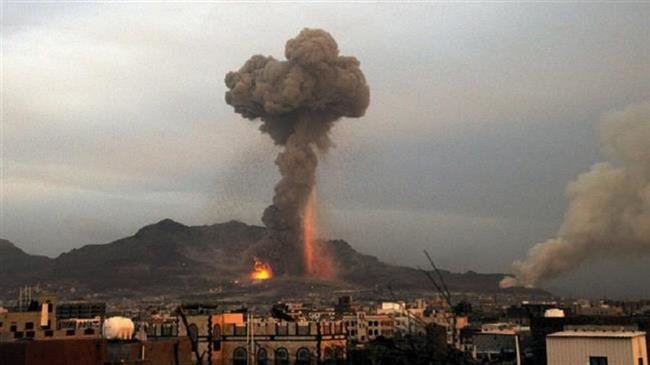
Sales of US military equipment to foreign governments have increased by 33 percent compared to the previous year’s total, a US administration official says.
Lieutenant General Charles Hooper, director of the Defense Security Cooperation Agency, told Reuters on Tuesday that the US foreign military sales hit 55.6 billion dollars in the fiscal year ending September 30.
According to Reuters, the increase in foreign military sales came in part because the Trump administration rolled out a new “Buy American” plan in April that relaxed restrictions on sales while encouraging US officials to take a bigger role in increasing business overseas for the US weapons industry.
Hooper said the $55.6 billion figure represented signed letters of agreement for foreign military sales between the United States and allies.
The United States sold over $40 billion worth of weapons last year, maintaining its position as the world’s dominant arms supplier.
A report by the Stockholm International Peace Research Institute (SIPRI) revealed in March that the US has increased its arms sales by 25 percent over the past five years.
It also said some half of US arms exports during that period have gone to the Middle East, and that Saudi Arabia registered a 225-percent rise in military purchases – almost all from the US and Europe.
Saudi Arabia was the first country US President Donald Trump visited after taking office last year. It was announced during his visit to Riyadh that Washington could sell $110 billion in military equipment to Saudi Arabia in a period of 10 years. The State Department said at the time that the deal could grow to $350 billion over a decade.
The massive arms sales come despite repeated international calls on the US to stop supporting the Saudis with modern weaponry, which the kingdom has, according to many reports, used in its devastating war on Yemen.
The White House has also been criticized by both human rights groups and US lawmakers in Congress from both political parties for allowing its Saudi ally to bomb Yemen.
Some 15,000 Yemenis have been killed and thousands more injured since the onset of the Saudi-led aggression in March 2015.
Washington has denied it is directly supplying the Saudis with weapons in the war but numerous reports have suggested that US arms have played a part in massive civilian casualties.
October 10, 2018
Posted by aletho |
Corruption, Militarism, War Crimes | United States, Yemen |
Leave a comment
MOSCOW – The bomb squad of the Russian Armed Forces’ International Mine Action Center will depart for Laos to help the country clear out remaining unexploded US bombs from the Vietnam War later on Wednesday, local media reported.
The squad consists of 36 people, according to the Krasnaya Zvezda newspaper. The mission will last until March 2019, and will focus on clearing myriads of hard-to-find US bombs that pose a threat to local residents from the Laotian jungle, as chief of the engineer troops of the Russian Armed Forces Lt. Gen. Yury Stavitsky said last week.
The United States dropped some 260 million bombs on Laos between 1964 and 1973, according to experts. The Vietnam war, which began in 1964 and ended in 1975, killed about 3 million Vietnamese and over 58,000 US nationals, as well as many people in adjacent countries, including Cambodia and Laos.
US Army investigators secretly confirmed over 300 war crimes committed by the US military, including murder, torture, rape, corpse mutilation and indiscriminate fire in civilian areas, according to the Crimes of War Education Project.
October 9, 2018
Posted by aletho |
Militarism, Timeless or most popular, War Crimes | Laos, Russia, United States |
Leave a comment
Time for the sans-culottes to rise up against Washington’s insanity
On October 21st there will be a Women’s March on the Pentagon hosted by the Global Women’s Peace Action. My wife and many of our friends will be going and even I will tag along in support in spite of my gender. We participate with some reservations as we have only demonstrated publicly twice since 9/11, once opposing the then about to start Iraq War and once against the annual meeting of the American Israel Public Affairs Committee (AIPAC). All too often demonstrations morph into progressive exercises in flagellation of what are now referred to as “deplorable” values with little being accomplished either before, during or afterwards, apart from the piles of debris left behind to be cleaned up by the Park Service. And such events are rarely even covered by the media in Washington, where the Post generally adheres closely to a neocon foreign policy tactic, which means that if you ignore something distasteful it will eventually go away.
Hopefully on this occasion it will be different because the time for talking politics is rapidly being rendered irrelevant by the speed of Washington’s disengagement from reality and Americans of all political persuasions must begin to take to the streets to object to what their government is doing in their name. I am mildly optimistic that change is coming as I find it difficult to imagine that in spite of the relentless flood of mainstream media propaganda there is even a plurality of Americans that supports with any actual conviction what the United States is doing in Syria and what it intends to do in Iran. And apart from a desire to make voting in America safer and insofar as possible interference free, I also believe that most think that Russiagate is a load of hooey and would prefer to be friends with Moscow.
Why now? “Now” is a whole new ballgame, as the expression goes, because the utter insanity coming out of Washington could easily wind up killing most of us here in the Land of the Free and the Home of the Brave. Specifically, in a press conference on Tuesday, Kay Bailey Hutchison, a former Senator from Texas who is currently the United States’ ambassador to NATO, declared that Washington was prepared to launch a preemptive attack on Russian military installations as a response to alleged treaty violations on the part of Moscow. Note particularly what Hutchison actually said: “At that point, we would be looking at the capability to take out a missile that could hit any of our countries. Counter measures would be to take out the missiles that are in development by Russia in violation of the treaty. They are on notice.”
And note further what she was implying, namely that Washington, acting on its own authority, has the right to attack a nuclear armed and powerful foreign country based on what are presumably negotiable definitions of what are acceptable weapons to base on one’s own soil. It would be an attack on a neighbor or competitor with whom one is not at war and which does not necessarily pose any active threat. By that standard, any country with a military capability can be described as threatening and one can attack anyone else based purely on one’s own assessment of what is acceptable or not.
It is quite remarkable how many countries in the world are now “on notice” for punishment when they do things that the United States objects to. United Nations Ambassador Nikki Haley has warned that she will be “taking names” of those United Nations members that criticize U.S. policies in the Middle East. As increasing discomfort with U.S. initiatives there and elsewhere is a worldwide phenomenon, with only Israel, the Philippines, Nigeria and Kenya having a favorable view of Washington, Haley’s list is inevitably a long one. Secretary of State Mike Pompeo and National Security Advisor John Bolton, when they are not fabricating intelligence and inflating threats, have likewise warned specific countries that they are being judged by Washington and will be punished at a level proportionate to their transgressions.
Hutchison is not known as a deep thinker, so one has to suspect that her expressed views were fed to her by someone in Washington. Her specific grievance against Russia relates to Moscow’s reported deployment of new land-based missiles that have a claimed range of more than 5,000 kilometers, which is enough to hit most targets in Europe. If true, the development would be in violation of the Intermediate-Range Nuclear Forces (INF) Treaty of 1987 and would definitely pose a potential threat to the Europeans, but the more serious question has to be the rationale behind threatening a nuclear war through preemptive action over an issue that might be subject to renewed multilateral negotiation.
Hutchison and the State Department inevitably went into double-speak mode when concerns were expressed about possible preemption against Russia. She clarified her earlier comments with an almost incomprehensible “My point: Russia needs to return to INF Treaty compliance or we will need to match its capabilities to protect U.S. & NATO interests. The current situation, with Russia in blatant violation, is untenable.”
Spokesman Heather Nauert at State then chimed in “What Ambassador Hutchison was talking about was improving overall defense and deterrence posture. The United States is committed to upholding its arms control obligations and expects Russia to do the very same thing.” Both disclaimers were needed, even if lacking in clarity, but they did not dispel the ugly taste of the initial comment regarding starting a war of preemption. Russia took note of the back and forth, with a Foreign Ministry spokesman drily observing “It seems that people who make such statements do not realize the level of their responsibility and the danger of aggressive rhetoric.” Hutchison and Nauert also do not seem aware of the fact that Russia’s frequently stated defense doctrine is to use nuclear weapons if and when it is attacked by a superior force, which might well be Moscow’s assessment of the threat posed by U.S. led NATO.
The disconnect between the White House’s often expressed desire to improve relations with Russia and the bureaucracy’s tendency to send the opposite message is typical of what has been referred to as Trump’s “dual-track presidency”. Gareth Porter has recently observed how President Trump, for all his faults in so many ways, is indeed desirous of military disengagement in some areas but he is repeatedly being overruled or outmaneuvered by the permanent bureaucracies in government, most notably the Pentagon and intelligence services. Hutchison, Haley, Pompeo and Bolton speak and act for that constituency even when they appear to be agreeing with the president.
So given the danger of war based on what Washington itself says about the state of the world and America’s presumed role in it, it is time to take the gloves off and march. That a high-level official can even stand up and speak about preventive war with a major nuclear power is disgraceful. She should be fired immediately. That she has not been fired means that someone somewhere high up in the bureaucracy agrees with what she said. Nuclear war is not an option. It is an end of all options.
Philip M. Giraldi, Ph.D., is Executive Director of the Council for the National Interest, a 501(c)3 tax deductible educational foundation that seeks a more interests-based U.S. foreign policy in the Middle East. Website: www.councilforthenationalinterest.org
October 9, 2018
Posted by aletho |
Militarism, Solidarity and Activism | Kay Bailey Hutchison, United States |
Leave a comment
Multiple blasts and an ensuing fire at an ammunition depot in northern Ukraine has prompted the compulsory evacuation of nearly 10,000 people in the area.
The fiery incident occurred early Tuesday morning at a Ukrainian Defense Ministry depot near the city of Chernigov, about 180 kilometers east of the Ukrainian capital of Kiev, officials said.
The area was placed on lockdown for air and land travel immediately following the explosions, they added.
No casualties have so far been reported as a result of the incident, and it was not instantly clear whether the blasts were the outcome of an accident or sabotage.
According to a statement by Ukraine’s emergency services, the airspace within a 20-kilometer radius of the military site has been closed and road and rail transport in the immediate vicinity has also been suspended.
“About 10,000 people were evacuated,” said the statement. “From 04:22 am (0122 GMT) the airspace within a radius of 20 km has been closed. The movement of rail and road transport is suspended.”
The statement further said that hundreds of emergency workers had been deployed to the munitions depot and that the chief of Ukraine’s armed forces had also traveled to the location.
Huge explosions also occurred last year at a military depot in Ukraine’s Vynnytsya region, 270 kilometers west of Kiev, prompting local authorities to evacuate 24,000 people.
The incident occurred a day after Ukrainian military started a series of large-scale aerial war games with the United States and other NATO member countries.
The “Clear Sky 2018” war games, which will run until October 19, are being held in western Ukraine.
Ukraine is involved in a military crackdown on ethnic Russians in the east of the country.
October 9, 2018
Posted by aletho |
Militarism | Ukraine |
Leave a comment
SYRIA, seat of an Islamic Caliphate. Syria, site of the Middle East’s newest liberal democracy. Syria, socialist paradise. Syria, a corrupt and murderous dictatorship that practices genocide. Syria, a failed state. Syria a state that is too strong. Syria, soon to be partitioned into ethnic enclaves. Syria, a pawn of Iran. Syria, a tool of Russia. Syria, a haven for terrorists that threaten our friends and way of life. Syria, where Saddam sent his fabled WMDs. In other words: Syria is whatever you want it to be. Syria, if it exists, apparently only exists to satisfy your desires, where you get to freely confuse where you think the world ought to go, with where it is going.
Syria, if you take at face-value any of the many authoritative North American and European pronouncements about “what needs to be done,” has seemingly joined the list of “disappeared” nation-states. It was a country made to vanish into thin air, like Libya, Iraq, and Yugoslavia before it. Anything goes when it comes to Syria: it can be whatever we imagine it to be. It was as if “Syria” was just a name for a template. We speak and behave as if it were first a tabula rasa—a clean slate—or more accurately, terra nullius—a land belonging to no one. It is land that belongs to no one, that is, until we arrive on the scene and forge our models for a new Syria. Syrians are not allowed to have their Syria until we first get a say on what Syria will be.
Syria Not For Syrians
Over the past seven years we have seen in virtually every side to the foreign debate about Syria’s present and future(s) an immense amount of apparently self-gratifying wishful thinking. We have witnessed the very real danger involved in the ideological mode of thinking, especially when the ideologies are backed by real material power and conveyed as action on the ground. Whenever we have the rare chance to hear any Syrians, they are instantly dismissed and disqualified by one side or another. We are happier dealing with a “Syria” that is a figment of our political imaginations, a projection of the discontent we have with our own domestic politics, a method for beating up all “enemies, foreign and domestic”. “Syria” is the plaything of those who are equal to any of our hedge fund managers: we pick a side, and bet on it. More than that even, “Syria” is a meeting ground for fantasy and political economy, and it’s a sign of just how ugly is the recolonization effort wrought by neoliberal globalization.
And it most definitely is the case that what we are dealing with here is globalization’s destruction of sovereignty, of national self-determination. How do we know that? Watch this: while there was no real debate about the US sending troops to Syria (where they can cancel out Syria’s sovereignty), there was instead massive, urgent, melodramatic panic about the US sending troops to its own border, where they could affirm US sovereignty. If a nation can send its troops to another continent, but not to its own border (i.e., stay at home), something is really wrong. Some must have wondered what US troops were doing on the US border, as if they naturally belonged in Syria instead. The jarring juxtaposition of the two contrasting stances came out in a single question by a reporter at a White House press briefing—a reporter who nevertheless failed to note the contrast:
“there seems to be a perception that, at times, the President makes announcements and then the White House has to come up with policy to match what the President said. Like with the talk about the military at the border, there weren’t really a lot of details about that at first. And with the issue with Syria, and him saying he wanted to, kind of, pull all the troops back”.
In another White House press briefing, reporters once again failed to notice the absurd contradiction between their thinly veiled criticisms of Trump’s desire to pull US troops back from Syria, while apparently complaining about the decision to send troops to the US border. The only way one can reconcile these two apparently contradictory positions is to recognize that they both reduce to a common denominator: the destruction of nations as viable entities. Any and all nations, everywhere, have been the target. Some were surprised to learn that this included the US itself.
Syria, likewise, is denied the right to defend itself. It has no right to its own territory. Israel is free to bomb at will, as are a range of NATO members, and the US can freely decide to make a presence for itself, to create “interests” on Syrian soil (which in principle, does not exist). When other nations send forces at the request of the Syrian government, then those nations suddenly have no right to be there. Why not? Because they are there precisely as a result of decisions made by the Syrian government, and Syria can have no government because it also has no soil. Who decided on this arrangement?
For globalization to work, it required a policeman. After all, neoliberals believe that states are still useful as law enforcers. This introduced a fatal flaw into the globalist agenda, which was pushed and enforced by states: not all states are equal in power, and thus the only reliable global policeman was the US. The US, some would argue, has no right to determine who crosses its borders, yet retains the right to decide on who is allowed across Syrian borders. That such arrangements are subject to a backlash in the US itself, the power core of globalization, is the main reason that globalization is in such extreme jeopardy.
For the globalists, Syria and the US are nonetheless alike in one key respect: they both belong to the rest of the world. What they are not allowed to belong to is themselves. The world the globalists tried to invent out of thin air was one of forced associations, unwanted encounters, and false dependencies. No wonder that the reactions have in some cases been so scathing, so filled with spite. If such reactions are deemed a problem, and if one wanted to avoid such reactions, then logically you would cease creating the causes of the problem. But the world imagined by globalists is never inhabited by real people; it’s a world where everyone is subject to “learned helplessness” and like a repeatedly abused dog learns to “just take it”—a world that is unreal, inhumane, and was therefore never sustainable.
Terra Nullius
This is how Sven Lindqvist explains the idea of “terra nullius” in his book, published in English in 2007:
“Terra nullius. From the Latin terra, earth, ground, land, and nullius, no one’s.
“Thus: no one’s land, land not belonging to anybody. Or at any rate, not to anybody that counts.
“Originally: land not belonging to the Roman Empire.
“In the Middle Ages: land not belonging to any Christian ruler.
“Later: land to which no European state as yet lays claim. Land that justly falls to the first European state to invade the territory.
“Empty land. Uninhabited land. Land that will soon be uninhabited because it is populated by inferior races, condemned by the laws of nature to die out. Land where the original inhabitants are, or can soon be rendered, so few in number as to be negligible.
“The legal fictions summed up as terra nullius were used to justify the European occupation of large parts of the global land surface”. (Lindqvist, 2007, pp. 3–4)
Syria was land not belonging to the Roman Empire, until it was. It is also land not belonging to the American Empire, and powerful interests in the US would obviously like to change that. Outside of the high echelons of the military-industrial-complex, other US interests have also vested themselves in Syria. A loose coalition has formed, ranging across from generals in the Pentagon right across to establishment media, freelance “journalists,” self-appointed humanitarian activists, and university-based anarchists and some Marxist academics. They all agree on one fundamental point: Syria can no longer belong to Syria alone; Syrian decision-making, and the right to make decisions about citizens on Syrian territory, is to be subject to some sort of veto wielded by foreigners, backed by US firepower.
For this mission of foreign ideological occupation to work, Syria first has to be symbolically and politically emptied. Only an empty zone can be so liberally filled with fantasy and spectral assaults: fabricated gas attacks, mysterious missile strikes in the dead of night, cities in ruins suggesting they were once occupied by a settled, peaceful civilization that has long disappeared, even mystery adversaries jamming US communications. The Onion, interestingly, had it right when in playing to the propaganda that has become the norm, it portrayed Syria as a land being trampled on by legendary monsters and super-human beasts, ruled by fears that “bombed-out buildings and blast craters could be harboring bands of angry scorpions, komodo dragons, mace-wielding cavaliers in full chain mail, or, as children recently swimming off the country’s coast discovered, giant piranhas”. Chemical weapons, the weapons of the new barbarians, are an essential feature of the kinds of made-up tales that are made to prevail in a frontier zone of projected fantasies of monsters. In the land of make-believe “evil,” Sadistic Arab “dictators” unleash troops powered by Viagra to engage in systematic rape, rip babies from incubators, threaten to massacre entire cities, and then wipe out communities with poison gas. Accusations we would never tolerate against our own, let alone treat credibly, are instead freely plastered on others. It’s amazing that in the new, fastidious and prickly racism-consciousness that prevails in North American media and academia, such routine colonial racism is instead still perpetuated, as much as the incessant myth-making.
Fantasy is useful in other ways: by dismissing the value of evidence, and replacing facts with belief, any accusations can be given the weight of “credibility”—but only if enough people have been successfully trained to mistake credibility for truth. What the US has developed, for example, is a fact-free, faith-based approach in its foreign policy rhetoric, one that is used to justify permanent US intervention. Why? Because there is no objective argument one can make for one country to occupy another. It’s not a matter of logic and rationality; it’s a matter of ideology and a thirst for power.
Having projected onto Syria an absence of “civilization,” this creates wide open space for demonization. Demonization is a valued part of Western myth-making structures, especially in justifying imperial domination. Demonization turns very human opponents into monsters (and they are referred to as such, as monsters, animals, and of course “evil”). Adversaries of the West are played up as villains in a morality tale, that always allocates to us—by default—the role of saviours and victors, if we will have our victory (as the late Charles Krauthammer put it, “The choice is ours. To impiously paraphrase Benjamin Franklin: History has given you an empire, if you will keep it”). We thus have these endless moral crusades on our part, where morality is used to mask politics.
Moral crusaders love it when in the distance they make out the outline of a new terra nullius on the horizon. Places like Syria offer the opportunity for adventure, to go out and exercise yourself, to use Syria as part of your own personal self-fulfillment, an object of your ambition and desire. Eurocentric missionary aspirations flourish in such contexts, robed as “humanitarian interventionism,” “internationalism,” “solidarity,” “civil society activism,” “democracy-building,” “conflict resolution,” “peace-building,” or just plain regime-change.
The paradox of foreign intervention is that it empties everyone, not just Syria. Britain and France earlier this year saw their foreign policy being taken over by the US, restricting any domestic parliamentary debate about the decision to militarily strike Syria, until well after the fact. The US was no exception: the decision to attack Syria in April of this year was done without Congressional approval. The process had been emptied of political representation by those elected and legally appointed to (dis)approve war-making, as dictated by the respective constitutions, which for a moment vanished. War, in violation of both international and domestic laws, damaged democracy in the US, UK, and France. This is what imperialism in the globalist age looks like, even when one of they key actors sometimes likes to sound like an angry anti-globalist.
The key themes of this renewed terra nullius are thus:
- land without a legitimate state to own it;
- civilization vs. barbarism (along with civilized vs. barbaric forms of violence, for example, Tomahawk missiles vs. nerve gas);
- demonization and dehumanization;
- a nation-state reduced to a “regime” which is reduced to one person who is reduced to a monster/animal; and,
- a fertile site for imposed models.
One question readers might ask is: why? Why should “terra nullius” or anything resembling the idea be in use here? One simple theory is that any society works with a finite set of cultural materials. These cultural materials can be reproduced, amended, extended, or reworded. We end up with multiple translations of a small set of original sources. Imagine that centuries after European colonialism began, we are still speaking of “civilization” vs. “barbarism,” in the very same terms. A second theory, that goes with the first, is that except in cataclysmic situations (which are extremely rare—the exception), real cultural change occurs only very slowly, at an almost glacial pace. Changes to our basic cultural materials do take place in our lifetimes, but often more in form and application than a change in the original “code”.
Moral Imperialist Economy
Whenever members of a society imagine the rest of the world as a mass of “problems,” and imagine themselves as possessing the “solutions” to those problems, what we have then is the structure for a relationship that involves a transfer of capital. The producers of problems owe a permanent debt to the exporters of solutions—ideally. Reality is different of course: this structural relationship of extraction needs to be maintained, and sometimes the maintenance costs exceed the profits. First, let’s look at some of the basic elements of the moral imperialist economy. Ideologically transforming Syria into a new terra nullius is a form of creative destruction (paralleled by real, military destruction), and as we should know, crisis always creates opportunity, and opportunity attracts opportunists.
Syria is a free for all for various patrons and clients. These new Wild Wests are a great place for freelancers of all kinds to upgrade their status, for example. Syria has thus been transformed into a Wild West of misinformation, of selective information, of forms of activism and a way to invest political interests in the creation of custom-made propaganda. Inevitably there are patrons for this or that stream of propaganda, whether it’s a news agency, the CIA, a NGO of some sort, or elements of “the crowd” funding one’s work through something like “gofundme”. The result is a kind of wild stock market for values of all kinds.
New commodities are produced by the new information warfare, designed to conduct war on the minds of all media consumers, whether of the established or social media kind (it makes little difference). One of the key new commodities is, of all things, the baby photo. Not just any babies though—no, these always have to be dead babies, sometimes mangled, sometimes partly decomposed, sometimes about to die, or those that have barely escaped death but are nonetheless permanently disfigured, burnt, or without limbs. These commodities are avidly traded by all sides. The open borders/refugee advocates have their photo of a dead Syrian child on a beach; the regime changers have pictures of child gas victims; and even the anti-imperialists have their photo of a little Palestinian boy, seized from a hospital bed, looking helpless moments before being beheaded by beefy bearded jihadists. Printing dead baby photos is like printing money. Such photos call the attention of powerful patrons, supposedly “provoked” to act when the photos are sufficiently publicized. When such patrons intervene, it further raises the value of such photos, virtually creating a demand for more. Now the most conclusive way to make one’s case “credible” is by flashing the appropriate dead baby photo. This commerce is part of the humanitarian trafficking that liberal imperial globalism encourages.
Wildly inflated numbers, numbers that go up, come down, that get divided, are indicative of the existence of this kind of stock market. Thus the debates over the number of civilians “killed by the regime,” and how often the number is inflated to include all the soldiers and civilians killed by those opposed to “the regime”. So everyone who has been killed in Syria was supposedly killed by the Syrian state—that’s convenient, because after all we have the moralistic demon tales that instruct us that “Assad is a monster,” and just like a monster, he “kills his own people”. (Funny, isn’t it, how easily we always manage to imagine these low-down Third World leaders as sub-humans.)
Status upgrades come easily: take the appropriate moralistic, virtuous stance in front of the right audience—by just saying that you believe in X or Y—and lo and behold you have achieved a status upgrade. You are one of the good people, a trusted source, a credible figure, because you said the right things to the right people in the right place at the right time. This internationalized form of virtue signalling is almost as good as printing money, and nearly identical to it in its most basic sense.
Like in the Wild West, betting in the saloon is also common when it comes to Syria. The US State Department under Obama placed all its bets on some entity they invented, which they liked to call “moderate rebels” (why not “respectable terrorists” or “polite criminals”?). They lost. Numerous left-wing academics signed on to regime change years ago, and because they only pretend to be seasoned analysts for their day jobs, they did not foresee the collapse of the anti-government forces in Syria. That list included noted “post-colonial” scholars and anthropologists, united in their belief in “democracy promotion” and remaking Syria into something palatable to them, with the right leaders in place. Five years later and a smaller group—including feminists like Gloria Steinem and Judith Butler, anarchists like Noam Chomsky and the anthropologist David Graeber, the Marxist David Harvey, and advocates of recolonization like Michael Walzer—placed their bets on socialist Kurdish militias, presumably increasing the value of their bet by the important sign value of their brand name authority. Ironically, in the process of re-imagining legendary Rojava as the site of a second Spanish Civil War, they were openly collaborating with Donald Trump (not naming him directly, since “the US government” was more convenient). These signatories were thus complicit with the very same commander-in-chief of the armed forces they were calling on for support of Syrian Kurds. They wanted “the US government,” whose President is Donald Trump, to impose sanctions on Turkey, and to develop a foreign policy that put Kurdish interests at the forefront. You can be sure that, elsewhere, in front of different crowds, they return to “the Resistance” by puffing up their little chests and sounding all “anti-Trump”—but when it came to cheering their favourite band of ethnic anarchists, they could dispel with appearances. Less “prestigious” characters, publishing in a less “prestigious” outlet, countered the call to “defend Rojava”, a call which appropriated “progressive” politics for the cause of imperialism (reigniting an old marriage). (David Harvey, by the way, having cashed in on abundant sales of his volume, The New Imperialism, has recently changed his mind: he has decided that imperialism is merely a metaphor, “rather than anything real”. Out of curiosity, we have to wonder if “capitalism” is also a metaphor, rather than anything real, seeing how Marxists have linked capitalism with imperialism. Perhaps even socialism is a metaphor, rather than anything real.)
(Recommended here is “The Fake Left at the Left Forum” by Danny Haiphong, Black Agenda Report, June 13, 2018, and “Antifa or Antiwar: Leftist Exclusionism Against the Quest for Peace,” by Diana Johnstone, Consortium News, May 21, 2018.)
Of course activists, academics, and the freelancers that make all the Twitter noise, are just bit players in the drama of their dreams. Some of the really big heavy hitters are the various weapons manufacturers, politely termed “defense contractors,” and their army of lobbyists in Washington, DC. For them, any sniff of a chance for permanent occupation smells like permanent war, and thus permanent profit, paid for by debt in the present to be paid by future tax-payers. Advocates of permanent occupation concede only one alternative to occupation: regime change, thus recolonization, which has the same effect as permanent occupation. Advocates include beneficiaries of status upgrades like Senator Lindsey Graham, converted into the de facto US Secretary of State by his friends at Fox News and CNN.
For powerful patron states like the US, “chaos” offers valuable opportunities—in the technocrats’ language, this is duplicitously referred to as “preventing chaos”. The official assumption, intended for popular consumption, is that “chaos” predates foreign intervention. Remember: other peoples are producers of problems, chaos is thus a permanent and normal state for them. Add to the assumption that chaos predates US intervention the assumption that there is no Syrian government (the officially existing one is not acceptable to the US, so it vanishes), then Syria becomes the name for a wide-open wilderness. That means the US gets to train and reinforce “local forces”—like the separatists cheered on by a select group of leftist academics. But this all costs money, what to do? Here comes Trump’s transfer of costs for extracting capital: emphasis is placed on Saudi Arabia and the Gulf States to pay for the costs of US occupation and proxy-training in Syria. This model is essentially one that places the US in the role of an international mercenary. Where such support payments are not forthcoming, then there is the fallback of debt-financed US military spending. The loans are provided by a range of creditors, domestic and foreign, including foreign central banks. Many states thus own US debt, and what we see here is essentially the rest of the planet financing its own domination by a US debt-fuelled warhorse. (This is one of the “secrets” that ought to inform revised and reworked theories of imperialism: empires function best and last longest when the ostensible objects of imperial domination actively collaborate in supporting empire. Theories uninformed by this observation can become trite conspiracy theories of imperialism.)
To maintain the value of US “investment” in Syria, the US needs to create a need for protection, while reducing the value of alternatives (competitors). One way to create a need for protection is to create that crisis that would seem to beg for it: phony gas attacks, like those happening at the end of a week of public debate that erupted after Trump announced he wished to withdraw US forces from Syria soon. Another means for bolstering US intervention in Syria is by invoking the threat of Iran.
As mentioned at the start of this section, the structural relationship of extraction needs to be maintained, and sometimes the maintenance costs exceed the profits. For example, “humanitarian activists” who plead for greater accessibility to refugees, disconnecting the fact of their homelessness from our own military interventions which uprooted those people in the first place, is one way that costs can exceed profits. Humanitarians need to prove that they are needed, and refugees prove the need. However, the backlash from citizens in receiving countries who realize that refugee entrants, in large enough numbers, will usher in a new wave of de facto austerity measures as health, education, and public housing come under pressure, represents a threat to humanitarians and their careers. With humanitarian profit-seeking threatened, one way to respond is to caricature critics as xenophobic haters, which further inflames opposition to their project—few people accept having their pockets picked and being insulted. The result is a generalized closing of doors and the rise of parties that demand an end to foreign occupations.
Finally, I do not mean to imply that all imperialism reduces to economic factors alone. There are several different types and methods of imperialism, and sometimes military imperialism is decidedly uneconomical, just as economic imperialism can appear totally pacific. Again, trite conspiracy theories about the presence of oil pipelines, or plans for building them—in other words, that there must always be some wonderfully profitable economic opportunity for imperialism to make sense—are sometimes wrong. What I am suggesting is that all types of imperialism must involve loss for the dominated, there is a transfer of values and costs, and a system of extraction, such that every type of imperialism could be analyzed as if it were economic in nature.
Dreaming of Power, Projecting Our Fantasies
No doubt most citizens in places like the US and Canada do not spend much time, or any time, worrying about Syria—and that is probably a good thing. If only their example could be followed by those with much greater power, or those with much louder voices.
One of the striking features of the Syrian war are those individuals outside of Syria who have decided to make Syria their business. This goes well beyond personal curiosity and a desire to learn about a different place—it’s instead something which is invested with a thick desire to turn Syria into something which they want and currently lack. Syria is experienced vicariously and voyeuristically. Some are learning what they can because they wish to stop our intervention in Syria, and in the process they are learning a great deal about their own society. Others, however, engage in no such reflection.
For those outsiders who would presume to have a say in Syria’s future, Syria is required to put on a pleasing performance. Syria has to perform like a “democracy” before it can be left alone; some on the left instead argue it is already democratic, and see in Syria the salvation of a true liberalism. What unites both is the assumption that Syria is culturally empty: it can create nothing of its own. At best, Syria and other places like it (target nations) are pictured as mere fertile ground ready to be planted with foreign seeds. The only job locals have is to be receivers of imports. Why would a country with a civilization that long predates either Karl Marx or Adam Smith not have a right to develop its own approaches?
As I wrote about elsewhere earlier this year, there is an internal debate among North American leftists as to whether Syria’s Ba’athists are “true socialists”. As I wrote then,
“does Syria exist to satisfy dogmatic demands in exchange for certification from those US Marxists who have never held power and thus know nothing about actual responsibility?… US Marxists in particular have an overweening sense of their centrality to the world, when they are beyond marginal at home. Perhaps their role as peripheral spectators in domestic politics is what has them casting about overseas for a mission to fulfill their frustrated ambitions”.
One would think Syria had submitted an application for a job, and “history” put us in place to acts as its judges. If Syria is not a “democracy,” or is not “socialist,” what then? Does it get destroyed as a result? I would hate to be on the receiving end of such “solidarity” and I would pray that “internationalists” learn the virtues of minding their own business.
“We’re not particularly keen to be friends with you. We’re not begging you for friendship. We want normal, civilized relations—which you arrogantly refuse, disregarding basic courtesy. You are misguided to think you have friends. Your so-called friends are just those who can’t say no to you. This is your only criteria for friendship”.—Vassily Nebenzia, ambassador of Russia to the UN Security Council, responding to US ambassador Nikki Haley on April 9, 2018.
October 6, 2018
Posted by aletho |
Ethnic Cleansing, Racism, Zionism, False Flag Terrorism, Illegal Occupation, Mainstream Media, Warmongering, Militarism, Progressive Hypocrite, Timeless or most popular | France, Syria, UK, United States |
Leave a comment

 Aletho News
