Moscow Considers US Actions in S Syria ‘Occupation’ – Russian Foreign Ministry
Sputnik – 25.10.2018
Moscow has repeatedly criticized the US military campaign in Syria, which has not been authorized by either the UN or Damascus.
Speaking at a regular briefing on Thursday, Russian Foreign Ministry spokeswoman Maria Zakharova said that the United States has occupied the southern part of Syria.
“The situation in the northeast of Syria, where the US side is still trying to flirt with separatist-minded Kurdish groups, is concerning, as well as in the south of the country near At Tanf, where there is a de facto undisguised occupation by US forces of the territory of the sovereign Syrian state,” she said.
The Russian diplomat further stated that the militants who had found such a “safe haven, a shelter in the 55-kilometer exclusive zone,” established by the US, were extorting $2,000 dollars per person from civilians who wanted to leave the area.
Zakharova also stressed that Moscow was ready for a constructive dialogue with UN Special Envoy for Syria Staffan de Mistura’s successor.
“We reaffirm the focus on constructive cooperation with Staffan de Mistura’s successor. Let me remind you that he should be appointed by the UN secretary general… The candidacy of the new special envoy should be acceptable to the authorities of the Syrian Arab Republic.”
INF Treaty
Addressing Washington’s potential withdrawal from the 1987 Intermediate-Range Nuclear Forces Treaty (INF), Zakharova said that Russia was calling on all nations to signal the US to preserve the agreement.
“We urge all those who feel their own responsibility for the destinies of the world to send an unambiguous signal to Washington about the danger of the plans announced by them,” she said.
The diplomat stressed that Russia’s missile programs, including development of cruise missiles, were carried out in full compliance with the treaty, and while Moscow intends to continue work with the agreement, Washington is unwilling to act on equal basis.
“For several years, the American side has refused to provide any objective data supporting Washington’s conclusions that the Russian 9M729 ground-based cruise missile that passed flight tests has the operating range banned by the treaty. We have repeatedly confirmed that the missile programs implemented by Russia fully meet our obligations under the INF Treaty,” she underscored, adding that the development of the 9M729 cruise missile was “transparent to the maximum affordable degree.
“The American side was never able to present any evidence to either Russia or the international community to substantiate its claims. They remain unfounded and are provocative. And we reiterate that Russia strictly abides by the provisions of the treaty,” she added.
Russia will be forced to react if the US undermines the INF treaty, Zakharova said.
“Now we are forced to seriously warn Washington. If the American side undermines the treaty, Russia will have to react. We are ready to work on maintaining its [the INF] viability, but for this we need a partner who is responsible and interested in continuing the dialogue for the sake of world stability. A solution to the problem can only be found through a frank, equitable and, of course, constructive dialogue,” she said.
The spokeswoman also added that the appeal of US President Donald Trump about China’s participation in the new INF agreements should not be addressed to Russia.
“The question about the possibility of China’s participation in certain new, modified agreements in the field of intermediate- and shorter-range missiles, which the US President publicly argued in a hypothetical manner, should not be addressed to us.”
Her remarks came just days after Donald Trump told reporters he would scrap the 1987 INF treaty, citing Russia’s alleged violations of the agreement on the development of ground-based intermediate-range missiles. Moscow has repeatedly rejected the claims, and pointed to possible US violations of the treaty with its missile defense installations in Eastern Europe.
‘Operational Emergency’ Announced at US’ Main Nuclear Weapons Plant
Sputnik – 23.10.2018
An “operational emergency” was registered at the US’ major nuclear weapons assembly site on Tuesday.
“The Pantex Plant is experiencing an operational emergency,” the Pantex Plant Twitter account tweeted Tuesday. “The Emergency Response Organization has been activated.” Local news website My High Plains reports that the Emergency Response Organization comprises elite employees with in-depth knowledge of the plant’s operations and emergency response processes.
An hour later, Pantex Plant announced that the unspecified “security incident has ended without incident.” The Texas Department of Public Safety (DPS) confirmed that an “all clear” sign had been issued to the public.
The plant, located in Carson City, Texas, is the main location where nuclear arms are assembled, disassembled and maintained in the US.
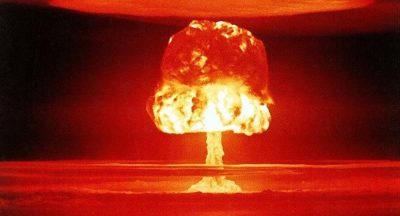 During the enigmatic incident, the Carson County Sheriff’s Department said that the eastern part of the plant was rendered completely inaccessible. Emergency teams in Armstrong County, Carson County, the Amarillo/Potter/Randall Office of Emergency Management and DPS were notified of the event and took “appropriate” action, My High Plains reported.
Local highways were temporarily shut down while officials responded to the mysterious emergency.
The plant is operated and managed by Consolidated Nuclear Security, LLC, under a contract from the US Department of Energy’s National Nuclear Security Administration.
Back in 2005, Pantex Plant also made headlines when the facility’s employees nearly detonated a W-56 warhead — 100 times stronger than the atomic bomb dropped on Hiroshima — by accident while trying to take it apart, according to the Sun.
US Withdrawal from INF Treaty: Implications for Asia Pacific
By Arkady SAVITSKY | Strategic Culture Foundation | 23.10.2018
One of the motives behind the US withdrawal from the INF Treaty is its desire to acquire first-strike capability against Russia from Europe, while keeping intact its strategic nuclear arsenal. Another motivation is the need to keep China, America’s fiercest geopolitical challenger, in its crosshairs by forcing it to alter its foreign, defense, and trade policies in order to tip the balance in Washington’s favor. The capability to knock out key infrastructure sites with precision intermediate-range strikes deep inside China, not just in the coastal provinces, is one way to make Beijing more tractable on key issues and force a rollback of its global influence. In April, Adm. Harry Harris, the commander of US Pacific Command, told the Senate Armed Services Committee that the US should renegotiate the INF Treaty to better compete with China. The admiral knew what he was talking about.
China has developed the DF-26 “aircraft carrier-killer” ballistic missile that has now rendered the old US strategy ineffective. Zachary Keck of the National Interest believes the DF-26 intermediate-range ballistic missile could stop the US Navy in its tracks without firing a shot. That threat has to be countered and one way to do it is by knocking it out with land-based, highly accurate missiles. Such systems are cheaper than aircraft carriers and can do the job without exposing thousands of servicemen to the missile threat if used for a first strike. China has been testing a new nuclear-capable, air-launched ballistic missile constructed on the basis of the DF-21 that will help that country improve its warfighting capabilities. Beijing also boasts land-based mobile missile systems (LBMMS) with DF-10 cruise missiles that have a maximum range of 1,500 to 2,000 km. China has to defend itself, and fielding these systems is the only way that it can counteract America’s huge sea, space, and air advantages.
Actually, the process of encircling China with intermediate missiles is going to kick off with the deployment of the Aegis Ashore ballistic missile-defense (BMD) systems Japan has decided to buy. The batteries will be installed in the prefectures of Akita and Yamaguchi. Using the MK-41 launcher, the Aegis Ashore can fire intermediate-range Tomahawk missiles. The deal is a blatant violation of the INF Treaty that Washington accuses Moscow of not complying with.
After a long period of indecision, the US approved the sale of military equipment to Taiwan in September, drawing China’s ire. Last summer, the State Department requested that US Marines be sent to Taiwan under the pretext of safeguarding America’s de facto embassy there. National Security Adviser John Bolton is known for his support of the idea of stationing US troops on Taiwanese soil. Bolton wants to see the China policy revisited. He argues that Taiwan is closer to the Chinese mainland and the disputed islands in the South China Sea than either Okinawa or Guam — giving US forces “greater flexibility for rapid deployment throughout the region should the need arise.” If the ongoing escalation continues, the US could wind up deploying intermediate-range missiles on that friendly island.
Other targets include North Korea and the Russian Far East, especially the Vilyuchinsk naval base on the Kamchatka Peninsula that is home to a fleet of ballistic missile submarines.
Locating and destroying mobile land-based missiles, either from the air or from the ground, is an extremely challenging mission. Fast-flying ballistic delivery technology and stealthy cruise missiles are effective against a wide variety of targets, even if sophisticated air defenses are in place to protect them. The states in the region that are unfriendly to the United States would see their biggest military advantage erode away.
Intermediate-range weapons can accomplish the same missions as strategic weapons. With the high-precision technology the US possesses today, even conventional missiles could inflict damage comparable to that of nuclear strikes. Its ground-based assets boast large magazines and can have numerous reloads at the ready. In theory, the US could impose an arms-control agreement with China on its own terms, using theater weapons as its negotiating leverage. All the countries unfriendly to the US, such as China and North Korea, as well as Russia’s Far East area, will be within the range of fast-hitting, hard to counter, intermediate-range missile systems.
Moreover, with the arms race escalating in the Asia Pacific region, the US could involve itself in some lucrative deals selling conventional intermediate-range missile systems to the countries in that area, such as Japan. A conventional version of some of these weapons will be in high demand, bringing in substantial profits and spurring US economic growth.
So, the US is encouraging an arms race in the Asia Pacific region. It has adopted a policy of encirclement with its potential enemies in the crosshairs of its intermediate-range weapons. It will have the option of destroying key sites with conventional warheads. This policy will inevitably force Russia and China closer together. The militarization of the region will further accelerate. Those targeted by the US will be incentivized to develop weapons systems that can reach the continental US. No one will win and everyone will lose. There is still time to reverse the US decision to leave the INF Treaty.
Americans should be ‘scared’ about end of INF, Carter Page tells RT
RT | October 23, 2018
The ‘Russiagate’ hysteria that originated with the Democrat-funded Steele Dossier has damaged relations between Washington and Moscow to the point of ending the INF Treaty, former Trump adviser Carter Page has told RT.
Ending the Intermediate Nuclear Forces in Europe (INF) treaty is something Americans should be “scared about,” Page told RT America’s Scottie Nell Hughes in an exclusive interview on Monday. He said he’d worked on implementing that and other nuclear treaties when he was at the Pentagon in the early 1990s, and that there are “deep problems” between the US and Russia that “misunderstandings” over the Trump presidency are only making worse.
President Donald Trump announced on Monday he was preparing to pull the US out of the 1987 arms control treaty, citing the claim by the two previous administrations that Russia “has not adhered to the agreement.”
Page was drawn to the Trump campaign in 2016 because as a candidate, Trump had “said some very positive things, some very constructive ideas as to ways to improve” the relationship between Washington and Moscow.
“Unfortunately, there were various political actors that were within the government in Washington –and also on the fringes of Washington– which helped continue the downward cycle that we’ve seen for so many years.”
Page was specifically referring to what he calls the “dodgy dossier” – an opposition research file compiled by British spy Christopher Steele, alleging Trump’s ties to Russia. Steele wrote the dossier for Fusion GPS, and was paid for it by the Clinton campaign via the Democratic National Committee (DNC) and its law firm, Perkins Coie. Page is suing Perkins Coie and the DNC for defamation.
Congressional investigations have discovered that the dossier was used to obtain a Foreign Intelligence Surveillance Act (FISA) surveillance warrant to spy on Page, and through him on the Trump campaign, which the former US Navy intelligence officer and energy consultant briefly advised in 2016.
Democrats have actually accused Page of being a “foreign agent” recruited by Russia. He laughed off those charges, telling Hughes that he would speak to the CIA every time he went to Russia for a meeting or to give a speech.
Explaining the Trump administration’s hostility towards Russia that’s in stark contrast with his campaign rhetoric, Page said that “false stories placed by the Democrats” have created a “dark cloud hanging over the administration.”
The July summit in Helsinki between Trump and Russian President Vladimir Putin held a lot of potential to advance US-Russian relations, but the political and media fallout stopped any momentum in its tracks, Page argued.
Trump is “very much a straight shooter,” Page said, but there is a “a lot of political pressures” on him to be hostile to Russia. He remains hopeful that with Trump’s “strength and perseverance,” things might just work out.
“There’s a lot that needs to be fixed,” he said.
US wants to be world’s sole power & doesn’t need treaties like INF – Russian senator
RT | October 22, 2018
Washington is ready to drop a landmark missile treaty with Moscow because it wants to become the dominant power on the globe, and that move will put its European allies in a tough spot, a senior Russian politician told RT.
The US doesn’t want to commit itself to the restrictions imposed by the Intermediate-Range Nuclear Forces Treaty (INF) because it is “seeking unilateral military advantage,” Konstantin Kosachev stated.
According to the politician, who chairs the Foreign Affairs Committee in the Lower House of parliament, “they want to be the only power in the world. And for that they don’t need these types of agreements.”
Speaking to RT on Monday, Kosachev recalled how in 2002 the US, under then-President George W. Bush, unilaterally pulled out of the Anti-Ballistic Missile Treaty (ABM Treaty), signed 30 years prior. President Donald Trump is now acting in a similar fashion, he argued.
The Intermediate-Range Nuclear Forces Treaty (INF) was signed in 1987. It effectively banned Moscow and Washington from having and developing short and mid-range missiles and the means of their delivery. Trump has said that he will “terminate” the deal, citing Russia’s alleged violations of the agreement – something Moscow’s officials deny.
Mid-range missiles will pose a “substantial threat” to Russian security if the US deploys them in Europe, Kosachev said. The senior lawmaker warned that such a move will turn the whole of Europe into a “zone of highest possible risk” and will prompt a swift response from Moscow.
“European countries are hostages in this situation.”
The European Union, meanwhile, called on both sides to maintain “constructive dialogue” to “preserve” the existing nuclear arms deal. Brussels expects the US to consider the consequences of ditching the agreement “on its own security,” as well as “the security of its allies and of the whole world,” EU spokesperson for Foreign Affairs and Security Policy, Maja Kocijancic, said in a statement.
“The world doesn’t need a new arms race that would benefit no one and on the contrary would bring even more instability,” the statement concluded.
If France Made to Pay For Pacific Nuclear Tests, it Could Set Legal ‘Precedent’
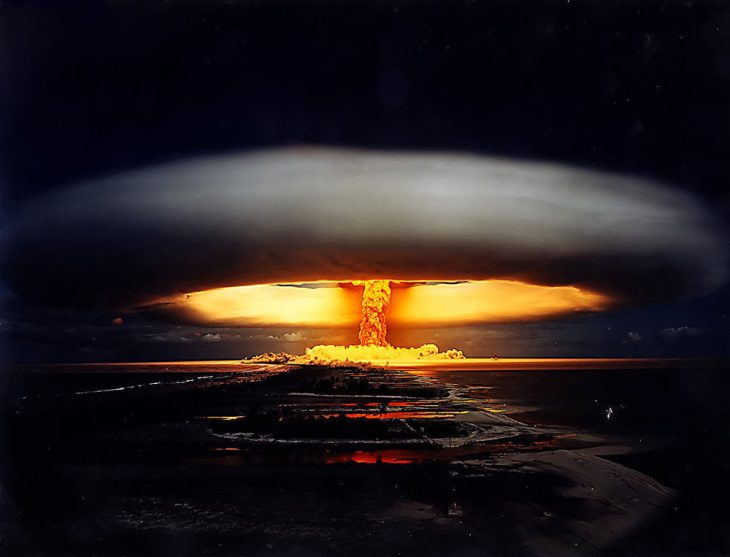
Licorne nuclear test – French Polynesia, 1970 © Flickr / Historical Records
Sputnik – October 22, 2018
Last week France was sued at the International Criminal Court for crimes against humanity over nuclear tests conducted on atolls in the Pacific Ocean. Sputnik spoke to Alexandre Dayant, a research fellow at the Lowy Institute, about the consequences of the French nuclear tests.
Mururoa and Fangataufa atolls in the South Pacific saw 196 nuclear tests over three decades until President Jacques Chirac finally ended the programme in the 1990s.
The French also conducted nuclear tests in the Sahara Desert.
A French Polynesian opposition leader, Oscar Temaru, filed a complaint at the International Criminal Court (ICC) in The Hague on October 10 claiming France had carried out crimes against humanity, in the form of local islanders.
Alexandre Dayant, a research fellow at the Lowy Institute in Australia, said the French carried out the tests between 1966 and 1996, first in the atmosphere and then in the sub-soil.
French Polynesians Have Paid Heavy Toll For Tests
Mr. Dayant said thousands of inhabitants have paid a heavy toll through birth deficits, congenital malformations and infirmities.
“The testing programme and its intentions were kept secret, and little information was provided about the possible effects of radiation to the people who worked there. For decades, France argued that the controlled explosions were clean,” Mr. Dayant told Sputnik.
“In the absence of an exhaustive epidemiological study, it was very difficult to estimate the number of potentially affected people at the time. Throughout the period of the Sahara and Polynesia trials, approximately 150,000 site workers (military contingent, contingent, civilian workers) and a local population of 80,000 were potentially exposed to doses of radioactivity,” Mr. Dayant told Sputnik.
French Polynesia, an overseas territory with a population of 290,000, is best known for the tourist resort island of Tahiti, 300 miles west of Mururoa and Fangataufa.
“This case aims to hold all the living French presidents accountable for the nuclear tests against our country,” Mr. Temaru said when he filed the complaint.
The Armaments Observatory published a study showing “the explosions have weakened the seabed and the soil is contaminated sustainably because of the fallout and the presence of toxic and radioactive debris (heavy metals and plutonium)” which threaten the population and the environment.
“Despite the mounting evidence, the French government denied all suggestion that the nuclear tests were harmful to health until 2010, when it introduced the Morin Law, a programme to give compensation to victims of radiation exposure. Nevertheless, the number of compensation cases accepted between 2010 and 2017 scandalized victims’ associations — only 13 out of more than a thousand filed. The main reason came from the fact that it was still difficult for victims to prove the link between their disease and the tests,” Mr. Dayant told Sputnik.
Call For French Polynesia to Become Independent
He said Mr. Temaru was a separatist who wanted the islands to eventually become independent like nearby Fiji and Kiribati.
Mr. Temaru claimed the Polynesians had sought a “responsible dialogue” with France since 2013 but their pleas had been “ignored and despised”.
“Fifty years after the first nuclear test on Mururoa, French Polynesians are still fighting for recognition of the effects of nuclear testing. This is why this claim, in front of the ICC, can help to put events back on the agenda,” Mr. Dayant told Sputnik.
“I don’t think Polynesians believe their claim will be heard. For the pro-independence party in French Polynesia, making this claim is more of a useful way to put events back on the political agenda, and on the international scene,” said Mr. Dayant who pointed out that when the ICC was set up it made it clear it would not prosecute crimes committed before July 2002.
Will other countries face similar claims at the ICC?
“It is a difficult question to answer to, due to the different geopolitical relationships that other Pacific Islands countries have with the US, UK and Russia. However, if successful, this particular legal procedure can be used as a precedent for future international claims,” Mr. Dayant told Sputnik.
Atlantic Council Podium Used to Force European Allies to March in Step
By Alex GORKA | Strategic Culture Foundation | 21.10.2018
Wess Mitchell, Assistant Secretary of State for European and Eurasian Affairs, the administration’s top diplomat focused on Europe and Eurasia, has warned that Europe’s energy dependence on Russia is unacceptable for the United States. That official was addressing the Atlantic Council’s “Championing the Frontlines of Freedom, Erasing the Grey Zone” event on October 18. According to him, the competition between the great powers has returned to become “the defining geopolitical fact of our time.” Through their lack of vigilance, European and American officials have allowed the growing Russian and Chinese influence in that region to “sneak up on us.” “Western Europeans cannot continue to deepen energy dependence on the same Russia that America defends it against. Or enrich themselves from the same Iran that is building ballistic missiles that threaten Europe,” the assistant secretary emphasized. Adding, “It is not acceptable for US allies in central Europe to support projects like Turkstream 2 and maintain cozy energy deals that make the region more vulnerable to the very Russia that these states joined NATO to protect themselves against.”
Something else that was highly interesting was his mention of Belarus along with Ukraine and Georgia as allies. The assistant secretary believes that “[t]he new principle is respect for the territorial integrity and sovereignty of the allies: Ukraine, Georgia and even Belarus. Washington expects states to respect the rights of their neighbors.” This makes one wonder if the Belarusian government knows it has been granted a new status. The official also mentioned Iran, which should not be allowed to sell oil to Europe because it has refused to abandon its ballistic missile program. Washington calls “on our allies to follow our lead and strengthen their laws to better screen foreign investments in their countries for national security threats.”
So, the US laws are flawless, its allies are not viewed as equal partners because they must follow America’s lead, or, in other words, do what they are told, and it’s up to Washington, not the national governments and parliaments, to decide what investments they need and where that money should come from. The leaders of the Central and Eastern European states should find it awkward, being rebuked for having overlooked “the foundational importance of the nation-state and national sovereignty,” while allowing unfriendly China and Russia to move in. “Our allies in Central Europe must not be under any illusions that these powers are their friends,” Mr. Mitchell explained. Obviously, he is quite sure that the governments of these nations are unable to grasp who is their friend and who is not. They are as naïve as small children. It’s good that the US is right here ready to enlighten them.
This highly-placed diplomat went on to explain that the United States should be seen as the protector of sovereignty, as it “rejects Russia’s territorial aggression against its neighbor Ukraine and [rejects] China’s predatory ‘debt-mongering’ throughout Central and Eastern Europe.”
Unlike its rivals, America does not seek dependencies, but rather independent states that should be “willing and able to share the burden of Western defense.” So, here is what independence à l’américaine is like, with its friends and allies absolutely free to comply with their protector’s instructions offering specific guidance about exactly how much they have to pay for defense, what investments to bring in, who to be friendly with, and how they should properly view the situation in their own region. Whatever happens in Central and Eastern Europe, everything has to revolve around the US.
“The United States has long had a tradition of not interfering in the details of European integration,” Mr. Mitchell assured us. Of course, telling the UK PM to sue the EU and thus expedite Brexit can certainly not be seen as interfering in European integration. Suggesting to French President Macron that he take France out of the EU is another example of noninterference. The Assistant Secretary expressed confidence that the allies could “beat back its competitors in Europe” with a little help from their American friends.
Also addressing the Atlantic Council’s October 18 conference, US Special Representative for Ukraine, Kurt Volker, revealed that Washington plans to stiffen the sanctions regime against Moscow “every month or two” to make it more amenable over Ukraine. The new policy suggests increasing the sanctions periodically, over time. Those remarks came after Russian President Vladimir Putin told the Valdai Club in Sochi that he hoped that a government more friendly toward Russia emerges from the Ukrainian presidential election that will be held on March 31.
Mr. Volker defied logic. On the one hand, he cited his “estimation… that the chances of their changing position now are lower then they were even a year ago.” Nevertheless, the best strategy for the West is to maintain pressure on Moscow through those economic sanctions —i.e., sticking to the very same measures that have proven to be useless, given that the “chances of their changing position now are lower.” So, the US and its allies should continue to implement a policy doomed to failure! But the ambassador states, “I think we need to keep on track. I believe that sanctions do have an impact and we see evidence of that in Russia.” What an bizarre way to convince his listeners!
“This is a shockingly big and important humanitarian catastrophe that no one talks about. We have over 10,000 people killed,” exclaimed this official who represents a nation that has just sent Ukraine, a country notorious for the corruption in its military ranks, a shipment of lethal arms so that it can kill more of its own citizens or let the weapons systems fall into the wrong hands and be used to kill other people outside of Ukraine. The “wrong hands” could use those weapons against the US military. With this kind of people you never know.
There is no penetrating insight, no reading between the lines, no wasting time on anything like analysis, and no attempts to find the logic in anything that’s said — nothing like that is required. It’s easy to understand highly-placed US State Department officials. You guys do what you are told, or else. And, just in case, don’t forget that your best friend and closest ally overseas carries a big stick to force you to march in step. These speeches are delivered from time to time to ensure that their “dear allies” remember that. The Atlantic Council’s podium fits the bill.
What Trump’s pullout from IMF treaty means
By M. K. BHADRAKUMAR | Indian Punchline | October 21, 2018
President Donald Trump’s confirmation that the US is terminating the Intermediate-Range Nuclear Forces treaty (INF) with Russia will be regarded as a defining moment in international security. The INF, which was signed by then US President Ronald Reagan and Soviet leader Mikhail Gorbachev in Washington in December 1987, has been a flagship of the disarmament process leading to the elimination of around 2,700 short and medium range ballistic missiles and preventing a US-Russia nuclear standoff in Europe.
A first-rate crisis is appearing in nuclear arms limitations and reduction processes. Now, let it be clarified this is not a temper tantrum by Trump but stems from the US policy to place accent on developing new nuclear weapons and aiming at securing a strategic dominance in the global arena. It was during the Obama administration, in 2014, that the US first alleged that Russia violated the INF treaty, but despite persistent requests from Moscow to provide substantiation of the allegation or at least to discuss the discord, Washington failed to respond.
The US has vaguely pointed the finger at the index of a Russian missile research project, but Moscow has refuted it pointing out that the US can easily see on its satellite images during field tests that these charges are totally unfounded and not substantiated by either the technical characteristics of the launcher that allegedly is at variance with the INF Treaty or in-flight telemetry data.
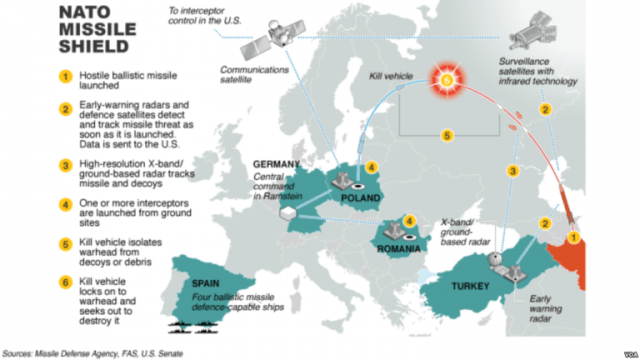
The plain truth is that it no longer suits the US to be constrained by the INF Treaty in the emerging New Cold War conditions where it has bracketed Russia and China as “revisionist powers” whom it must counter. In fact, contrary to the INF Treaty, Washington has already deployed launchers at the US antimissile base in Romania and Poland, whose specifications enable them to launch not only interceptor missiles but also strike missiles like Tomahawks.
One urgent compulsion for the US today is that the need arises for it in the downstream of the 2017 decision by Japanese government to buy two Aegis Ashore systems, as the deployment of the system in Japan will be a violation of the INF obligations – although the deployment will be in the Asia-Pacific.

Fundamentally, the US objective is nothing other than attaining nuclear superiority, which has been an elusive dream through the Cold War era. In the present context, Russian conventional forces are not a match for the US’ capability but nuclear deterrence gives Russia the status of a great power and enables it to maintain global strategic balance. Equally, China’s growing nuclear capabilities are an added factor in the American calculus. Simply put, the jettisoning of the INF will free the hands of the US to develop new weapons systems and to make large-scale deployments along the borders of Russia and China to contain them.
Russia has military-technical capabilities to respond to the challenge posed by US walking out of IMF Treaty. The hypersonic missile that it has developed is an example. Besides, Russia can also respond by deploying intermediate- and short-range missiles at its borders. To be sure, all this will directly affect European security and it may even create, hopefully, a convergence of interests between Russia and European countries to preserve the INF treaty. But the US may circumvent such a possibility by wearing down the European opposition by moving the discussion onto the multilateral NATO format.
Most importantly, the US pullout from INF treaty may bring the roof down on the New START treaty of 2010 and the Nuclear Non-Proliferation Treaty (NPT). In fact, the likelihood is high that the New START treaty may not be renewed by 2021, as is required, or that the NPT can survive. All in all, what is in the cards is the frightening scenario of a seamless, uncontrollable nuclear race – and the growing likelihood of a nuclear conflict.
Without doubt, the stakes are very high for India. The impact of the US decision on INF on the Asia-Pacific security would vitally affect Indian interests, especially in the context of the US-China rivalry where Japan (with which India has striven to forge a strong relationship) also happens to be a crucial participant. The US and Japanese pressure on India will increase to be ‘on the right side of history’ – that is, by becoming part of the US-led alliance system against China. Japan and Australia are figuring as the US’ main partners in the Indo-Pacific.
On the contrary, China will deepen its military cooperation with Russia and the two countries may be edging toward an alliance. (See my blog Military cooperation is the highlight and pillar of China-Russia strategic cooperation.) Ironically, the US will be achieving what it all along wanted, namely, injecting ‘bloc mentality’ among the countries of the Indo-Pacific, which would help consolidate its long-term presence in the region. All this means that unlike in the Cold War era, Asia is inexorably turning into the principal theatre of big-power rivalries.
US Tears up Landmark INF Treaty
By Andrei AKULOV | Strategic Culture Foundation | 21.10.2018
President Donald Trump has announced the decision to exit from the bedrock 1987 Intermediate-Range Nuclear Forces Treaty (INF Treaty), which bans all land-based missiles carrying both nuclear and conventional warheads with ranges of 500 to 5,500 kilometers, or 310 to 3,420 miles shorter- and intermediate-range missiles. It does not cover air-launched or sea-launched weapons. National Security Adviser (NSA) John R. Bolton is going to discuss the president’s decision with the Russian leadership during his upcoming visit to Moscow on Oct. 22-23.
It’s not a coincidence that the issue of alleged violations of the INF Treaty by Russia was put on the agenda of NATO defense ministers held on October 3-4 in Brussels. US Defense Secretary James Mattis said Moscow was in “blatant violation” – the view largely shared by NATO partners. The very fact that the US briefed the allies on the issue was a sign that the decision had already been made by the administration to be formally acknowledged now. The Nuclear Posture Review, released in February, called for the development of ground-launched medium-range missiles.
At the July summit, the NATO leaders agreed in the declaration that “the most plausible assessment would be that Russia is in violation of the Treaty.” But they did not say they approved the idea of deploying American missiles as a response. The missile in question is the 9M729 (NATO designation SSC-8) but the US has never said when and where it was tested to exceed the 500 kilometers limit allowed by the Treaty.
The alliance urged Russia to address these concerns. It should be noted that in its turn NATO has never addressed Russia’s concerns over US violations, such as the use of Mk41 launchers capable of firing intermediate range cruise missiles as well as armed drones and target missiles with a range exceeding the INF-imposed limitations. The list is long enough.
It is the second time the US tore up a major arms control treaty with Russia. The first one was the 1972 Anti-Ballistic Missile Treaty (the ABM Treaty) President George W. Bush Jr. pulled the US out from in 2002. Neither the USSR nor the Russian Federation ever scrapped an arms control agreement. The ensuing development of ballistic missile defense systems have become a snag on the way to hinder further arms control efforts.
Washington and Moscow have repeatedly accused each other of violations but the US decision to withdraw triggers questions. Why the proposal to negotiate a new treaty with stronger verification and compliance measures is not even on the agenda? Why new ideas on how to make the document better have not been offered for consideration by the Special Verification Commission (SVC)? Has Moscow refused to consider the possibility of adding on-site verification to the Treaty’s text? Is the idea of new strengthened inspection procedures not worth consideration and should be turned a blind eye on?
Perhaps, it’s because the US does not care about violations. It wants to get rid of the treaty for other reasons. One of them is to get the advantage by deploying such missiles near Russia’s borders to acquire a first nuclear strike capability with the strategic arsenal intact. For instance, the US Army is working on long-range artillery rockets that can exceed the 500 km range to station them in Europe. The weapon will serve as a means of delivering intermediate range strikes.
The other reason is not related to Russia or Europe. The US Nuclear Posture Review says “China likely already has the largest medium and intermediate-range missile force in Asia, and probably the world.” In his statement on withdrawal from the INF Treaty, President Trump said any agreement on intermediate range missiles must include China too. A military conflict between the US and China is likely. The US needs medium range missiles to strike its mainland. And it’s not China only. As Eric Sayers, a CSIS expert, put it “Deploying conventionally-armed ground-launched intermediate-range missiles may be key to reasserting US military superiority in East Asia.”
What will the withdrawal lead to? The INF Treaty is fundamental to European security. NATO will be divided over the issue with few nations ready to host the weapons, except Poland and the Baltic States happy to get the American military presence they have been longing for. This could lead to another rift among the allies at a time when that relationship is at a nadir because of trade wars and the rift over the Iran deal. Many Europeans still remember the 1983 protests to prevent the deployment of America’s missiles on national territories. They know well that an intermediate ground-based missile Russia will be free to deploy without the restrictions in place is not a threat to the continental USA while the countries of Old Continent will become a target. The INF Treaty will cease to be effective in six months after the US withdrawal, which is still to be made official. Europe should not sit idle watching the US leaving the Treaty. There is still some time left to press the US into thinking twice about the consequences.
The INF Treaty is not the only one teetering on the brink. The New Start Treaty, the remaining pillar of arms control, has a slim chance to survive. The Russian TASS news agency has just reported the US is unlikely to extend it and there are no talks on another agreement to take its place. Russia (the Soviet Union) and the US have always had an arms control treaty in effect since the Partial Nuclear Test Ban Treaty was concluded in 1963. Ever since the first Strategic Arms Limitation Talks (SALT I) Treaty was signed 1972, there have been negotiated constraints on nuclear arsenals. It may all change in 2021 when the New START expires, if not extended till 2026, to trigger an unfettered arms race. The entire system of arms control will unravel as a result of US withdrawal from the INF Treaty.
US Nuclear Missiles Deployed in Italy, … against Russia
By Manlio Dinucci | Global Research | October 18, 2018
The B61-12, the new US nuclear bomb which replaces the B-61 deployed in Italy and other European countries, will begin production in less than a year. The announcement was made officially by the National Nuclear Security Administration (NNSA). It reveals that the revision of the final project has now been completed with success, and the qualification stage will begin this month at the Pantex Plant in Texas. Production will be authorised to begin in September 2019.
In March 2020, the first unit of production will begin fabricating a series of 500 bombs. As from that time, in other words in about a year and a half, the United States will begin the anti-Russian deployment in Italy, Germany, Belgium, Holland and probably certain other European countries, of the first nuclear bomb in their arsenal with a precision guidance system. The B61-12 is designed with penetrating capacity, built to explode underground in order to destroy bunkers housing command centres.
Since Italy and the other countries, in violation of the Non-Proliferation Treaty, are offering the USA the bases, the pilots and the aircraft for the deployment of the B61-12, Europe will soon be exposed to a greater risk as the front line of the developing nuclear confrontation with Russia.
An even more dangerous situation appears at the same moment – the return of the Euromissiles, meaning the nuclear missiles which are similar to those deployed in Europe in the 1980’s by the USA, with the official aim of defending against Soviet missiles.
Source: PandoraTV [English subtitles]
This category of ground-based nuclear missiles of intermediate range (between 500 and 5,500 km) were eliminated with the INF Treaty of 1987. But in 2014, the Obama administration accused Russia of having experimented with a cruise missile (# 9M729) whose category was forbidden by the Treaty. Moscow denied that the missile violated the INF Treaty and, in turn, accused Washington of having installed in Poland and Romania launch ramps for interceptor missiles (elements of the “shield”), which could be used to launch cruise missiles bearing nuclear warheads.
The accusation aimed by Washington at Moscow, which is not supported by any evidence, enabled the USA to launch a plan aimed at once again deploying in Europe ground-based intermediate-range nuclear missiles. The Obama administration had already announced in 2015 that “faced with the violation of the INF Treaty by Russia, the United States are considering the deployment of ground-based missiles in Europe”. This plan was confirmed by the Trump administration – in fiscal year 2018, Congress authorised the financing of a “programme of research and development for a cruise missile which could be launched from a mobile road base”.
The plan is supported by the European allies of NATO. The recent North-Atlantic Council, at the level of Europe’s Defence Ministers, which was attended for Italy by Elisabetta Trenta (M5S), declared that the “INF Treaty is in danger because of the actions of Russia”, which it accused of deploying “a disturbing missile system which constitutes a serious risk for our security”. Hence the necessity that “NATO must maintain nuclear forces which are stable, trust-worthy and efficient” (which explains why the members of the Alliance rejected en bloc the United Nations Treaty for the prohibition of nuclear weapons).
So the grounds are being laid for a European deployment, on the borders of Russian territory, of ground-based intermediate-range US nuclear missiles. It’s as if Russia were deploying in Mexico nuclear missiles pointed at the United States.
This article was originally published in Italian on Il Manifesto.
Read more:
Featured Video

Iran’s Next Strike May Not Explode. It Could Shut You Down
or go to
Aletho News Archives – Video-Images
From the Archive
Zionism’s Violent Legacy
By Donald Neff | Washington Report On Middle East Affairs | January 1996
On January 4, 1948, Jewish terrorists drove a truck loaded with explosives into the center of the all Arab city of Jaffa and detonated it, killing 26 and wounding around 100 Palestinian men, women and children.[1] The attack was the work of the Irgun Zvai Leumi – the “National Military Organization,” also known by the Hebrew letters Etzel – the largest Jewish terrorist group in Palestine. The Irgun was headed by Revisionist Zionist Menachem Begin and had been killing and maiming Arabs, Britons and even Jews for the previous ten years in its efforts to establish a Jewish state.
This terror campaign meant that at the core of Revisionist Zionism there existed a philosophical embrace of violence. … continue
Blog Roll
 Aletho News
- Trump’s Iran war is on an Israeli leash
- Saudi oil boss issues global supply warning
- Riyadh Says Its Oil System Is Intact. The Numbers Say Otherwise.
- Trump and Netanyahu Want to “Finish the Job” on Iran
- US ‘one-sided dictation’ not Iran’s beliefs makes rational talks impossible: Baghaei
- Iran’s Next Strike May Not Explode. It Could Shut You Down /Col Doug Macgregor
- Iran: US political targets legitimate if assassinations return
- Iraq shuts key border crossing with Iran under US pressure: Report
- Undersea Internet cables could be targeted in retaliation for attacks on Iran: IRGC deputy chief
- EU sending ‘biased’ observers to interfere in Serbian election – president
- If Americans Knew
- The Israel Lobby’s Changing Fortunes
- AIPAC has become such a political liability that it’s shifting to a more “nimble” approach to buying politicians
- At least 160 Israeli settler attacks in 2 weeks
- Will Gaza’s Ancient Christian Community Disappear Forever?
- Israel’s vision of regional security rests on keeping Arab states weak
- Heidi Levine recounts how Palestinian youths helped save her in settler attack
- DAILY UPDATE: Latest essential news on Palestine, Israel, & region
- Trump’s Intensifying Sabotage of the ICC, for Israel’s Sake
- Israeli military detain US and UK volunteers in West Bank including Democratic NY politician Brad Lander
- Americans at National Conservatism Conference held in Israel this year criticize Israel
- No Tricks Zone
- E-Cars Reduce CO2 Emissions By Only 41% Compared To Internal Combustion Engine Vehicles
- Predictions Made By Renowned Climate Professor Over Past Decades Have Been Proven To Be Poor
- New Study Suggests Large Regions Of The Pacific Ocean Have Been Cooling For The Last 80 Years
- Germany’s Green Energy Debacle: High Energy Costs Force Kahla Porzellan to Close After 182 Years!
- New Study: 50 Years Of The Most Aggressive ‘Net Zero’ Policies Can Only Affect The Global Climate By 0.03°C
- US September “Heat” Was No Record…Many Records Set Decades Ago
- Latest European Green Energy Debacle; Portugal’s Largest Flagship Solar Park Insolvent!
- Green Energy Debacle: German Expert Professor Fritz Vahrenholt Warns Of Severe Economic And Social Consequences
- Two More Paleo Reconstructions Affirm Meters-Higher Sea Levels Across Ireland, Brazil 7000-6000 Years Ago
- New Study: Earth And Venus Surface Warmth Largely Explained By Convection And Lapse Rate, Not CO2 Or Radiation

