Korean defense chiefs sign ‘military pact’ after Kim & Moon adopt denuclearization roadmap
RT | September 19, 2018
South Korean President Moon Jae-in and the North Korean leader Kim Jong-un have signed a joint statement following their bilateral talks in Pyongyang. The countries’ defense chiefs have meanwhile signed a separate military pact.
As part of the military agreement, the neighbors will halt border drills from November 1, Yonhap reports. South Korean Defense Minister Song Young-moo and North Korea’s No Kwang-chol also agreed to stop military flights in the vicinity of the demarcation line. In addition, the agreement envisions setting up a buffer zone in the Yellow Sea and suspending maritime drills.
As a clear sign of mutual trust, the Pyongyang military agreement also calls for the withdrawal of soldiers from the demilitarized zone and disarming the servicemen keeping watch at Panmunjom border village. The nations also agreed that each would close eleven border guard posts by the end of 2018.
The Koreas’ armed forces will establish and operate a “joint military committee” to discuss the implementation of the military agreement on a “permanent basis,” Moon Jae-in noted.
Speaking to the press on the outcome of Moon’s visit to North Korea, Kim noted that the “agreement at Pyongyang summit will advance an era of peace, prosperity.” Kim especially noted that the military agreement will help to denuclearize the peninsula and reach a lasting peace. He also agreed to travel soon to South Korea to meet Moon for the fourth time since the reconciliation effort between the neighbors began with the Olympic Peace diplomacy earlier this year. To emphasize their commitment to peace, the nations have decided to send a united team to the 2020 Olympic Games in Tokyo, and will submit a joint bid for the 2032 Summer Olympics.
Moon meanwhile told reporters that the neighbors finally managed to agree to “specific denuclearization steps.” The South Korean president also noted that the leaders are striving to turn the demilitarized zone into a zone of peace, and that work will soon begin to reconnect cross-border rails and roads before the end of the year.
Moon arrived in North Korea on Tuesday morning for the third face-to-face meeting with his counterpart. Previously, the leaders held talks on April 27 and May 26 in the border village of Panmunjom, in an unprecedented effort to reconcile the two nations following the Korean War (1950-53). Part of Moon’s agenda for the trip was restarting the US-Korean dialogue that hit a brick wall last month, after Secretary of State Mike Pompeo canceled his visit to Pyongyang.
One of the major breakthroughs of the Pyongyang summit was the consent given by the North to allow international inspectors to document a “permanent dismantlement” of its key missile facilities. North Korea also agreed to closing its main nuclear complex in Yongbyon – although only if the United States takes reciprocal conciliatory steps, Moon told reporters. The Korean Peninsula should turn into a “land of peace without nuclear weapons and nuclear threats,” he noted.
“The North expressed its willingness to continue taking additional steps, such as permanent shutdown of the Yongbyon nuclear facility, should the United States take corresponding measures under the spirit of the June 12 North Korea-US joint statement,” the joint statement said.
‘The Era of no war has started:’ Koreas reach new agreements
Press TV – September 19, 2018
The two Koreas have agreed to take further steps toward peace following a one-on-one meeting between North Korean leader Kim Jong-un and South Korean President Moon Jae-in, who is on his first ever visit to Pyongyang.
The two leaders issued a joint statement at the end of the second day of their summit in the North Korean capital on Wednesday, agreeing to take a step closer to peace by turning the Korean Peninsula into a “land of peace without nuclear weapons and nuclear threats.”
“The era of no war has started,” Moon said at a joint press conference with Kim after issuing the statement. “Today, the North and South decided to remove all threats from the entire Korean Peninsula.”
He said that Kim “agreed to permanently close the Tongchang-ri missile engine test site and missile launch facility in the presence of experts from relevant nations.”
The South Korean president said the North’s leader had also agreed to shut down its Yongbyon nuclear facility but only if the United States took “corresponding measures.”
It was not clear what measures were expected of the US.
Moon said Pyongyang had already pledged to work toward the “complete denuclearization of the Korean Peninsula” during his first encounter with him in April, in the Demilitarized Zone (DMZ) that separates the two Koreas.
The two Koreas “have continuously shown their trust toward one another and I hope there will be another summit between the two countries as soon as possible,” Moon said.
Kim also agreed to work toward denuclearization during a summit with US President Donald Trump in Singapore back in June.
But North Korea has said denuclearization will have to be phased, with each stage coming in return for reciprocal steps by the US, potentially including the removal of US forces from the region.
Yet, no specific steps have been designated toward that goal, and Pyongyang says that, while it has taken several goodwill measures — including the suspension of missile and nuclear tests — the American side has taken no moves in return.
North Korea has also already dismantled a nuclear site and has returned the remains of some US soldiers killed in the 1950-53 Korean War to America.
In return, Pyongyang is also seeking relief from harsh international sanctions — mostly spearheaded by the US — imposed on the country over its nuclear and missile programs.
The US, however, has not offered any such relief.
Kim to visit Seoul
When President Moon hoped for another summit, he must have had little idea that his wish would be granted very soon. Kim said shortly after their meeting that he would make a visit to the South in “the near future,” in what would be the first-ever visit to the capital, Seoul, by a North Korean leader.
Moon then said that the trip could happen this year unless there were “special circumstances.” He said the trip would be “unprecedented” and would “provide a turning point for the two Koreas.”
‘This divided nation to unite on its own’
Kim described the latest agreements as a “leap forward” toward military peace on the peninsula.
“The world is going to see how this divided nation is going to bring about a new future on his own,” the North Korean leader said, in a remark potentially meaning that diplomacy with the US, which has already stalled, may not be necessary.
The two Koreas also plan to link up their railways, allow reunions for families separated by the Korean War, and to co-host the 2032 Summer Olympics, according to the joint statement.
The Korean War ended with a truce and not a peace treaty. Ever since, the two countries were on a near-constant war footing. But Kim initiated a rapprochement with South Korea in January. And the US started diplomatically engaging North Korea only later.
The two Koreas have since been advancing their relations. But the US failure to reciprocate North Korean moves has plagued diplomatic engagement between Washington and Pyongyang.
Trump ‘excited’ by developments
Following the announcement, Trump took to Twitter to describe the developments as “very exciting.”
Kim Jong Un has agreed to allow Nuclear inspections, subject to final negotiations, and to permanently dismantle a test site and launch pad in the presence of international experts. In the meantime there will be no Rocket or Nuclear testing. Hero remains to continue being… …returned home to the United States. Also, North and South Korea will file a joint bid to host the 2032 Olympics. Very exciting!
— Donald J. Trump (@realDonaldTrump) September 19, 2018
He failed to mention the North Korean demand for reciprocal US measures.
US Must ‘Show Commitment’ to Peace Talks with North Korea – Scholar
Sputnik | September 19, 2018
The Trump administration needs to take a page from North Korea’s playbook and show some type of commitment to peace that amounts to more than just suspended war games, Simone Chun, fellow at the Korea Policy Institute and member of the Korean Peace Network, told Sputnik.
North Korean leader Kim Jong Un and South Korean President Moon Jae-in marked their third meeting on Tuesday. Moon’s three-day visit to Pyongyang is expected to cover talks on the North’s continued denuclearization and the rebooting of dialogue between the Democratic People’s Republic of Korea (DPRK) and the US.
The pair previously met at the border village of Panmunjom on two different occasions in April and later in May of this year.
Chun told Radio Sputnik’s Loud & Clear on Tuesday that the United States needs to put its best foot forward and work to mend its issues with the DPRK.
“It’s very disappointing that as President Moon Jae-in is making another very historic summit… that there’s many disagreements within the Trump administration on what to do with North Korea and US negotiations,” she told hosts Brian Becker and John Kiriakou. “This is, again, Moon Jae-in taking the initiative.”
“We should really be supporting the peace process and really counter the opposition and conflicting messages coming from the Trump administration,” Chun added, before adding that “diplomacy will render better results.”
In June, US President Donald Trump and Kim met for the first time in Singapore with the hopes of finding a peaceful solution to nuclear matters that had been unfolding on the Korean Peninsula. The historic summit concluded with both leaders signing a four-point agreement that would pave the way toward peace in the region.
Although North Korea has moved toward dismantling its nuclear test sites, and the US has steered away from full-fledged war games, Chun told Becker that Washington’s efforts aren’t up to par.
“North Korea has done several irreversible steps toward denuclearization and respecting and implementing the Singapore summit, whereas the United States has so far only done one by suspending the war games,” she said. “I really think the United States should take reciprocal action and show commitment.”
And while a bilateral peace agreement between Pyongyang and Seoul would sound like great news to many, it’s likely not going to happen due to South Korea’s ties to the US.
“There’s a good chance [that Moon and Kim could sign a peace agreement], however, I know that President Moon Jae-in is still very [interested] in working with the United States. I don’t think that they’ll sign a peace treaty,” Chun said.
Kim and Moon are expected to reveal the results of their latest meeting in the days to come. Moon’s visit to Pyongyang also marks the first visit to the North by a president of South Korea in 11 years; the last meeting took place in October 2007, when former South Korean President Roh Moo-hyun was in office.
US-Indian Relations: Trump Gets a Unique Partner for America First
By Melkulangara BHADRAKUMAR | Strategic Culture Foundation | 18.09.2018
The inaugural meeting of the foreign and defence ministers of India and the United States in a new “2+2” format on September 6 in New Delhi assumed added significance as an attempt by the Trump administration to translate its Indo-Pacific vision outlined in the National Security Strategy (NSS) of last December.
The NSS had explicitly singled out Russia and China as “revisionist” powers that “challenge American power, influence and interests.” Equally, it ascribed a pivotal role to India in the Indo-Pacific. The “2+2” deliberations fleshed out these two templates.
For the first time in the post-Cold War era, the US has inserted itself into the “time-tested” relationship between India and Russia. Demolition of Indian-Russian partnership has been a hidden agenda of the US’ regional policy since the 1990s but it surged in an overt and abrasive form last week.
This shift from an aspirational approach to intrusive approach can be seen in the backdrop of the deterioration of US-Russia relations and the probability that tensions are unlikely to dissipate in a foreseeable future. The US sanctions against Russian defence sectors have been enacted in the full knowledge that India would be an acutely affected party. The US sanctions laws against Russia are acting like the Damocles’ sword to wear down India’s resistance to rollback in ties with Russia.
A similar US assault on India-Russia energy cooperation can be expected soon, which is another promising area for US exports to India. Besides, the US is also threatening to sanction Russia’s financial sector. Clearly, what the US is seeking goes far beyond a reset or atrophy in the Indian-Russian relationship. It aims at nothing less than draining the contents of the “Special Privileged Strategic Partnership” between India and Russia and make it an empty shell. Yet, partnership with Russia has been historically an anchor sheet of India’s strategic autonomy.
Indeed, it becomes a sad reflection of the huge inroads the US has made through the recent decade since the signing of the 2008 US-Indian nuclear deal to breach India’s strategic autonomy. Put differently, weakening of the India-Russia relations is an imperative need for Washington to hustle India on the path of becoming its key ally in the Indo-Pacific. Such a profound shift in the US approach can only be understood in terms of the strategic importance and the sense of urgency that the NSS attaches to the Indo-Pacific region.
The NSS ranks the Indo-Pacific as a strategically more vital area than the Middle East (which has been the principal domain so far of the US’ strategic attention.) The NSS prioritizes the “Quad” (quadrilateral alliance of the US, Japan, Australia and India) more emphatically than even Washington’s transatlantic leadership as a platform of the US’ global strategies. Washington intends to checkmate China, which the NSS has portrayed as the US’ competitor who poses challenge to its world leadership and the international order.
Washington’s Indo-Pacific strategy appeals to the Indian audience alongside the NSS’ grand designation of India as a “leading global power”. Delhi exulted over the NSS document: “We appreciate the importance given to India-United States relationship… the two responsible democracies…share the same objectives.” To be sure, the Trump administration has rekindled a decade-old Indian dream of being a “counterweight” to China.
An influential section of India’s foreign-policy elite remains wedded to the notion that fundamentally, the US helped China’s rise in the Cold War era and that India is similarly well positioned to garner American benevolence in the emergent New Cold War conditions. The “2+2” highlighted that the US has astutely tapped into the Indian elite’s “unipolar predicament”.
In the recent period since the NSS was announced, the Trump administration has declared India as a “Major Defence Partner”, opening the door for the sale of more advanced and sensitive military technologies by American vendors at par with the US’ closest allies and partners, and fostering convergence of interests with India on a range of issues like maritime security, domain awareness and so on.
Without doubt, this has been a “win-win” strategy for Washington. The signing of a Communications Compatibility and Security Agreement (COMCASA) at the “2+2” testifies to it. The COMCASA is modeled on agreements Washington has with its most important NATO and treaty allies. It is a big leap forward in developing “inter-operability” between the militaries of the US, its allies, and India, which in turn transforms India into a front-line state in the US’ military-strategic offensive against China in the Indo-Pacific. Another such “foundational agreement”, Logistics Exchange Memorandum Agreement (signed in 2016 and operationalized last year), has already opened India’s air bases and naval ports to routine use by US warplanes and battleships for refueling and resupply.
The “2+2” joint statement announced that India and US will stage their first-ever joint exercise involving all three branches of India’s military next year, and that they are setting up “hotlines” between their respective foreign and defence ministries “to help maintain regular high-level communication on emerging developments.” It commits the two countries to increased bilateral, trilateral and quadrilateral military-security cooperation. On the other hand, COMCASA is expected to pave the way for a major boost in Indian purchases of US weaponry, which is likely to begin with India’s procurement of armed naval drones for anti-submarine warfare.
All this works splendidly for the US. In sum, by playing on India’s geopolitical apprehensions regarding China’s rise as a global power and playing astutely on India’s own great-power ambitions, US is promoting on the one hand its business interests in the Indian market while on the other hand also locking India into its Indo-Pacific alliance system against China as well as progressively undermining the India-Russia “time-tested” relationship.
It’s a “win-win” strategy all the way. The Trump White House has drawn encouragement from the “2+2” to push the idea of concluding a free-trade agreement with India. Informal conversations have already begun.
Trump appears bullish that when push comes to shove, the present Indian government will bend to Washington’s diktats. Indeed, the Trump administration can count on influential back channels, too. It is no secret that the upper caste Indian Diaspora in the US has close links with the Hindu nationalist groups that mentor Modi government.
Thus, it comes as no surprise that Trump sees Prime Minister Modi as a unique partner for his “America First” project. Trump will skip the East Asia Summit in Singapore in November but is signaling interest in Modi’s invitation to him to be the guest of honor at India’s National Day celebrations in January.
Azov Sea Flashpoint: Russia, Ukraine Teetering on the Brink of War
By Peter KORZUN | Strategic Culture Foundation | 16.09.2018
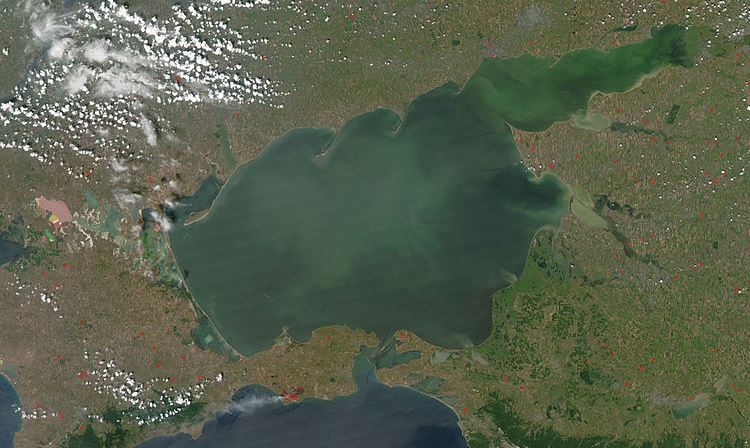
Ukraine has increased its military presence in the Azov Sea region. Ukraine’s National Security and Defense Council met on Sept. 7 and agreed to take a variety of steps to boost the country’s combat capabilities in the area, including the creation of a missile-equipped naval infantry group to counter potential amphibious attacks and naval shore bombardments. Ukraine’s Gurza-M-class armored artillery boats have been brought in to boost the naval component of the forces deployed in the region.
Russia and Ukraine enjoy free use of the Sea of Azov under the 2003 “Agreement between the Russian Federation and the Ukraine on cooperation in the use of the sea of Azov and the strait of Kerch.” The document is in place but it does not specify any precise border. The parties agree that the Sea of Azov and the Strait of Kerch are the internal waters of both Ukraine and Russia.
Talks have dragged on for a long time but have failed to produce a solution. Ukraine does not want to recognize Russia’s rights, which are based on the fact that Crimea has joined the Russian Federation. Moreover, Ukrainian authorities insist on their right to detain any ship traveling to or from Crimea without Kiev’s permission.
Ukraine is calling for the imposition of international sanctions against Russian Black Sea ports, due to what it calls the “blockade” of the Sea of Azov. It has already imposed punitive measures unilaterally. Tensions have heightened since March, when ships were detained and searched. On March 24, Ukrainian border guards stopped the Russian-flagged, Crimean-registered Nord fishing vessel in the Sea of Azov. The ship was hijacked. The crew members reported being interrogated and abused by Ukrainian authorities who held them accountable under domestic laws, not recognizing the crew as Russian citizens. The detained sailors were finally set free to return to Crimea without passports. Ukraine violated a number of international agreements and this marked the beginning of a campaign of provocative actions that has been waged ever since. Last month, the Russian Mekhanik Pogodin tanker was detained in the Ukrainian port of Kherson. Russia compared the move to the activities of Somali pirates.
The US is taking sides in order to ratchet up the tensions. The State Department has taken a deliberately provocative stance, urging Ukraine toward confrontation. Without bothering to study the details, it simply puts the blame on Russia as usual for anything that goes wrong. Washington is goading Ukraine into seeking a military solution, including such unrealistic but dangerous ideas as using the warships of NATO’s standing force to protect its shipping lanes, mining the Azov Sea, or using fast-moving attack vessels to encircle a large Russian naval asset from all directions like a wolf pack. This tactic was invented by German Admiral Karl Dönitz during WWII, when “wolf packs” of U-boats were used to attack capital ships. The very fact that such ideas have been generated and are floating around shows how unwise it is to abet Ukraine by throwing unconditional support behind it.
Stephen Blank of the American Foreign Policy Council, a leading US expert on Russia, believes that the US administration “should send anti-ship missiles available from or through the US-AGM-84 Harpoon Block II, AGM-158C LRASM A, and the Norwegian Naval Strike Missile” as well as “a viable launch platform and a targeting system, particularly a radar.” The author thinks this should be done right now, without delay. His article was published on Sept. 7 by the Atlantic Council, the prestigious think tank that advises the State Department and enjoys great influence among those who shape US foreign policy. In another article, Mr. Blanc calls for supplying Ukraine with platforms — older ships that have been decommissioned or are about to retire. Last month, Mykola Bielieskov, the Deputy Executive Director at the Institute of World Policy, called for fast-track shipments to Ukraine of the Harpoon Block II ER+ anti-ship missile, enabling it to attack Russian vessels. The idea of providing Ukraine with Island-class coast guard ships is under consideration by the US government. On Sept. 1, Kurt Volker, US Special Representative for Ukraine Negotiations, stated that the US administration “is ready to expand arms supplies to Ukraine in order to build up the country’s naval and air defense forces.”
The powers that be have failed to keep their promises and improve the lives of ordinary people in Ukraine. The presidential election will be held in March 2019. A threatening Russian bogeyman is needed to explain away the failures. The country’s economy and finances are in the doldrums and corruption is staggering. None of the problems have been solved and the West is getting tired of Ukraine. The fairy tale about Moscow’s “aggressive foreign policy” comes in handy right when the Ukrainian rulers need a scapegoat.
Nobody needs an armed conflict in the Azov Sea region. A number of countries are interested in protecting the right of free passage, enabling vessels to arrive at their destination ports without risk or delay. The region does not have to be a flashpoint. Russia and Ukraine could sit down at a round table to discuss controversial issues, as the 2003 agreement stipulates the parties should do in order to settle their disputes, should they have any, but that’s not what the State Department is calling for. The only option the US administration is considering is that of providing Ukraine with arms to fight Russia and then egging Kiev on to escalate the tensions. And those are already dangerously running high. A spark can ignite a big fire at any time if the problem is not addressed in a positive way without saber rattling. It’s a pity the US is playing such a destructive role. The time is right for Russian and Ukrainian experts and officials to set their differences aside and start talking to find a peaceful solution to this urgent problem.
Erdogan, Putin to Meet Monday in Sochi as Turkey Moves More Weapons into Syria
21st Century Wire | September 15, 2018
Turkey’s President Recep Tayyip Erdogan is scheduled to meet Russia’s President Vladimir Putin in Sochi on Monday, amid reports of a heavy Turkish arms drop into Syria in recent days.
The two leaders last met at a summit earlier this month in Tehran, and this next meeting will come just days after the Turkish army sent more ‘arms and ammunition’ into Syria’s Idlib and Hama provinces, according to a report by the Syrian Observatory for Human Rights (SOHR) released on Saturday.

The independent media outlet Muraselon is also citing multiple reports of both Turkish weapons and troops moving into these regions, including to areas under the control of the ‘rebel’ coalition National Liberation Front (NLF) – a collection of unsavory characters and the main rival of Hay’at Tahrir Al-Sham (HTS) in Idlib, according to IRIN:
Turkey’s favourite is the NLF, which is led by Fadlallah al-Hajji, a Muslim Brotherhood ally. The NLF includes Turkey-friendly Islamists like Ahrar al-Sham, the Noureddine al-Zengi Brigades, Failaq al-Sham, Jaish al-Ahrar, and groups that fought under the Free Syrian Army banner, like the Victory Army and the 2nd Coastal Division.
Big but brittle, the NLF is held together by Turkish sponsorship and shared enemies: al-Assad’s government, Syrian Kurdish groups, and hardline jihadists.
Turkey’s escalated military presence and heavy arms drop into known jihadist havens ahead of the upcoming Sochi meeting is unwelcome, and presents the potential risk for a military showdown in the future between Turkish and Syrian/Russian forces – something that all sides have warned against but Turkey’s apparent ‘double-dealing’ isn’t helping.
Kristen Iversen – Full Body Burden – Growing Up in the Nuclear Shadow of Rocky Flats
argusfest – June 20, 2012
This talk was filmed at the Tattered Cover Bookstore in Denver, Colorado on June, 19, 2012.
Kristen Iversen shared excerpts from her new book “Full Body Burden: Growing Up in the Nuclear Shadow of Rocky Flats”.
Here are some quotes about her book…
 “In this powerful work of research and personal testimony, Iversen chronicles the story of America’s willfully blinkered relationship to the nuclear weapons industry . . . masterful use of the present tense, conveying tremendous suspense and impressive control of the material.” Publishers Weekly starred review
“Superbly crafted tale of Cold War America’s dark underside . . . exquisitely researched.” Kirkus starred review
“Iversen has crafted a chilling, brilliantly written cautionary tale about the dangers of blind trust . . . Full Body Burden is both an engrossing memoir and a powerful piece of investigative journalism.” Bookpage
“Full Body Burden is one of the most important stories of the nuclear era—as personal and powerful as Silkwood, told with the suspense and narrative drive of The Hot Zone. With unflinching honesty, Kristen Iversen has written an intimate and deeply human memoir that shows why we should all be concerned about nuclear safety, and the dangers of ignoring science in the name of national security. Rocky Flats needs to be part of the same nuclear discussion as Three Mile Island, Chernobyl, and Fukushima. So does Full Body Burden. It’s an essential and unforgettable book that should be talked about in schools and book clubs, online and in the White House.
–REBECCA SKLOOT, author of The Immortal Life of Henrietta Lacks
“This terrifyingly brilliant book – as perfectly crafted and meticulously assembled as the nuclear bomb triggers that lie at its core – is a savage indictment of the American strategic weapons industry, both haunting in its power, and yet wonderfully, charmingly human as a memoir of growing up in the Atomic Age.”
–SIMON WINCHESTER, author of The Professor and the Madman and Atlantic
“News stories come and go. It takes a book of this exceptional caliber to focus our attention and marshal our collective commitment to preventing future nuclear horrors.”
–Booklist
Her website is: http://www.kristeniversen.com/
While all eyes are on Syria’s Idlib, US continues to decimate Yemen
By Darius Shahtahmasebi | RT | September 14, 2018
The US is ready to defend Syria from a brutish assault launched by Syria’s own government and its allies – or so Washington wants you to believe. In the backdrop, Yemen continues to burn in silence.
On September 3, US ambassador to the UN, Nikki Haley – eloquent diplomat that she is – retweeted a tweet from the warmonger in chief that is the US president, with the caption “All eyes on the actions of Assad, Russia and Iran in Idlib.” This is the same US administration who just facilitated the bombing of a school bus in Yemen, slaughtering at least 40 children in the process.
Maybe, just maybe, Nikki Haley should keep her eyes on herself.
If the world did direct its eyes to what is taking place in Yemen, they would know that the United Nations has just warned of an “incalculable human cost” in the works, as the US and its allies press forward with an offensive to retake the Yemeni port city of Hodeida from the Houthi rebels.
That’s right. The US, currently waving its arms in despair about human rights abuses and chemical weapons attacks that have not even taken place in Syria yet, is supporting a major offensive of its own that will lead to a humanitarian crisis of monumental proportions.
Yemen, a country already deeply in crisis, relies on the port of Hodeida for at least 70 percent of its humanitarian aid. It therefore makes sense from a humanitarian perspective to turn its location into a major war zone, am I right?
The small minority of people who are inclined to care about innocent Yemenis need not fret though. US Secretary of State Mike Pompeo has just this week certified that the Saudi-led coalition is taking sufficient steps to protect civilians. According to Pompeo, the Gulf nations involved are “undertaking demonstrable actions to reduce the risk of harm to civilians.”
“They are taking steps, in the view of the US government and this administration, in the right direction,” State Department spokeswoman Heather Nauert told a briefing, according to Reuters. “We see them taking steps. Is it perfect? No absolutely not. Do we see them doing what they can to mitigate civilian casualties? Absolutely we do.”
Thank God – I was getting worried there for a second. The US-backed Saudi-led coalition may be killing children as if they were ants, but they are taking steps to mitigate the number of children they are killing at the same time.
A seven-page memo sent to Congress and obtained by the Intercept further confirmed Pompeo’s delusional thinking, as the memo called Saudi Arabia and the UAE “strong counterterrorism partners.” Never mind that just last month, the Associated Press reported the US and its allies were actually recruiting Al-Qaeda fighters to join the coalition.
Oops.
While the Trump administration is taking a horrifying and bloody war and taking it to new depths, the truth of the matter is that this war did not begin under Donald Trump. The war in Yemen, the Arab world’s poorest nation, fast becoming the world’s worst humanitarian crisis, was started by none other than peace-prize laureate Barack Obama himself.
But why did this war start, and why has the US continued to support it?
In an overlooked interview with the Real News’ Aaron Maté, Rob Malley, President of the International Crisis Group and former Special Assistant to President Obama, gave a disturbing glimpse into who actually pulls the strings on US foreign policy.
According to Malley:
“To try to understand what the Obama administration was about, and I’ve tried to- just to try to, to explain it to myself, to try to understand how we got to where we are, let’s not forget at the time we were in the middle of these negotiations with Iran, trying to reach a nuclear deal which was extremely unpopular with our traditional allies in the region, from Israel to Saudi Arabia to the UAE and others. And the Saudis came to us and said that they were about to intervene in Yemen, to attack the Houthis that had toppled the legitimate government of the internationally recognized government at the time. And they asked for our assistance…”
“So there was on the one hand a number of voices expressing concern about that. But on the other hand were many people saying the relationship with Saudi Arabia is almost at breaking point. They believe we’d betrayed their trust for a number of reasons. But Iran, Iran negotiating the Iran deal, or the negotiations over the Iran deal was one of them. We needed to protect that deal and make sure that we could get it done, because if we didn’t have a deal there was a risk of a war with Iran. And so I think the decision was made in the end by President Obama to say we’re going to be, to support parts of this war…”
Only a peace prize laureate could pull off a feat like that. But all joking aside, the human cost of the war in Yemen is nothing short of shameless.
On October 8, 2016, an aerial bombardment targeted a crowded funeral in Sana’a, the capital of Yemen, the aftermath of which was aptly described as a “lake of blood.” According to the UN, more than 140 Yemenis were killed and at least 525 others were injured.
To date, the US-backed Saudi-led coalition has struck well over 100 hospitals, as well as wedding parties, refugee camps, food trucks, factories, transport routes, agricultural land, residential areas, and schools, to name a few. Yes, you read that right. Yemen, with only 2.8 percent of its land being cultivated, is actively targeted by the US-backed coalition. According to Martha Mundy, professor emeritus at the London School of Economics, “to hit that small amount of agricultural land, you have to target it.”
Prior to spiralling into chaos, Yemen was already dependent on imports for 90 percent of its staple foods and almost all of its fuel and medical supplies. Putting aside the mass amount of violence that the US-backed coalition has enacted, the rest of Yemen’s population is suffering due to the Saudi-imposed blockade, which has put half the population at risk of starvation. According to the UN, over 462,000 children under the age of five are suffering from severe acute malnutrition.
This is done completely on purpose. At the end of August this year, Saudi Arabia’s Crown Prince, Mohammed Bin Salman, threatened that he would continue targeting women and children in Yemen and allegedly said that he wants to “leave a big impact on the consciousness of Yemeni generations.”
“We want their children, women and even their men to shiver whenever the name of Saudi Arabia is mentioned,” the Crown Prince reportedly said.
The idea, advanced by Pompeo and his cohorts at the State Department, that the coalition has taken steps to avoid civilian casualties is by all accounts, complete nonsense. As the New York Times openly acknowledged:
“The first problem was the ability of Saudi pilots, who were inexperienced in flying missions over Yemen and fearful of enemy ground fire. As a result, they flew at high altitudes to avoid the threat below. But flying high also reduced the accuracy of their bombing and increased civilian casualties,” American officials said.
“American advisers suggested how the pilots could safely fly lower, among other tactics. But the airstrikes still landed on markets, homes, hospitals, factories and ports, and are responsible for the majority of the 3,000 civilian deaths during the yearlong war, according to the United Nations.”
In addition to supplying billions of dollars’ worth of arms to the Saudi kingdom, US personnel provide overwhelming assistance to the Saudi-led coalition to help bring Yemen to its knees by sitting in the Saudi’s command and control center, providing lists of targets, refuelling planes, running intelligence missions, and so forth.
If Donald Trump is so concerned with migrants and refugees, perhaps he should stop creating them. If he really cares about ‘America first’ and making America great again, perhaps racking up notches to America’s war crime belt is not the way to go. Legal experts have already warned the US government that its complicity in these attacks can make them a co-belligerent in Saudi Arabia’s vast, extensive list of war crimes. This warning has fallen completely on deaf ears and has not helped at all in deterring the Trump administration from continuing some of Barack Obama’s worst policies; and even now the US continues to shelter the Saudi-led coalition so that it can continue its bloodthirsty policies unabated.
Make no mistake, if the US pulled its support for Saudi Arabia, Yemen’s suffering could stop tomorrow.
Watch out for Assad though; I heard he was about to retake a Syrian city from an Al-Qaeda affiliate. Remember Al-Qaeda, the notorious terror group the US claimed was the mastermind behind the September 11 attacks? Apparently, the entire US government doesn’t, as it allies itself with Al-Qaeda in just about every battlefield that counts.
In the meantime, ordinary Yemenis continue to suffer by the millions. If you can absorb all of this and still believe the US is genuinely concerned about human rights abuses in places like Syria, then you probably deserve what’s to come next.
Saudi-led airstrikes kill 15 civilians in Yemen’s Hudaydah
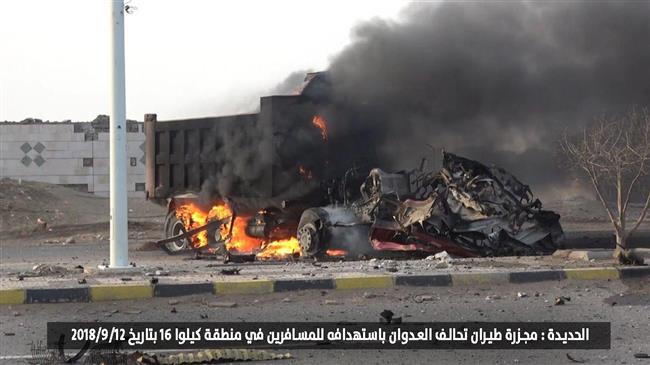
Yemeni truck targeted by a Saudi fighter jet on the outskirts of the port city of Hudaydah on September 12, 2018. (Photo by al-Masirah)
Press TV – September 12, 2018
At least 15 civilians, including one child, have been killed as the Saudi-led coalition resumed its airstrikes on the outskirts of Yemen’s port city of Hudaydah despite widespread international criticism over the war’s impact on civilians.
According to reports by Yemen’s Arabic-language al-Masirah television, about 20 civilians were also injured during Wednesday’s bombings that were launched after a brief truce since July.
The Saudi-backed forces also captured a number of towns as well as two main supply routes linking Hudaydah to the capital Sana’a and Ta’izz province, the report added.
The bombings resumed after UN-brokered peace efforts failed in Geneva last week. The talks were aborted after the UN failed to meet conditions set by Yemen’s Ansarullah movement, including transfer of wounded people to hospital for proper treatment and guarantees on the safety of the Yemeni delegation. Ansarullah also accused Saudi Arabia of planning to strand the delegation in Djibouti, where their plane was to make a stop en route to Geneva.
Delegates from Yemen’s former government and representatives of the Houthi movement held their last UN-sponsored negotiations in Kuwait in 2016 in a bid to hammer out a “power-sharing” deal, but they fell apart after the Saudi-backed side left the venue.
Saudi Arabia and a number of its regional allies launched a devastating military campaign against Yemen in March 2015, with the aim of bringing the government of former president, Abd Rabbuh Mansur Hadi, back to power and crushing Ansarullah.
Some 15,000 Yemenis have been killed and thousands more injured since the onset of the Saudi-led aggression.
More than 2,200 others have died of cholera, and the crisis has triggered what the United Nations has described as the world’s worst humanitarian disaster.
Featured Video
Trita Parsi: Israel Set a Trap for Total War in the Region
or go to
Aletho News Archives – Video-Images
From the Archive
Zionism’s Violent Legacy
By Donald Neff | Washington Report On Middle East Affairs | January 1996
On January 4, 1948, Jewish terrorists drove a truck loaded with explosives into the center of the all Arab city of Jaffa and detonated it, killing 26 and wounding around 100 Palestinian men, women and children.[1] The attack was the work of the Irgun Zvai Leumi – the “National Military Organization,” also known by the Hebrew letters Etzel – the largest Jewish terrorist group in Palestine. The Irgun was headed by Revisionist Zionist Menachem Begin and had been killing and maiming Arabs, Britons and even Jews for the previous ten years in its efforts to establish a Jewish state.
This terror campaign meant that at the core of Revisionist Zionism there existed a philosophical embrace of violence. … continue
Blog Roll
 Aletho News
- Trita Parsi: Israel Set a Trap for Total War in the Region
- Trump’s Iran war is on an Israeli leash
- Saudi oil boss issues global supply warning
- Riyadh Says Its Oil System Is Intact. The Numbers Say Otherwise.
- Trump and Netanyahu Want to “Finish the Job” on Iran
- US ‘one-sided dictation’ not Iran’s beliefs makes rational talks impossible: Baghaei
- Iran’s Next Strike May Not Explode. It Could Shut You Down /Col Doug Macgregor
- Iran: US political targets legitimate if assassinations return
- Iraq shuts key border crossing with Iran under US pressure: Report
- Undersea Internet cables could be targeted in retaliation for attacks on Iran: IRGC deputy chief
- If Americans Knew
- The Israel Lobby’s Changing Fortunes
- AIPAC has become such a political liability that it’s shifting to a more “nimble” approach to buying politicians
- At least 160 Israeli settler attacks in 2 weeks
- Will Gaza’s Ancient Christian Community Disappear Forever?
- Israel’s vision of regional security rests on keeping Arab states weak
- Heidi Levine recounts how Palestinian youths helped save her in settler attack
- DAILY UPDATE: Latest essential news on Palestine, Israel, & region
- Trump’s Intensifying Sabotage of the ICC, for Israel’s Sake
- Israeli military detain US and UK volunteers in West Bank including Democratic NY politician Brad Lander
- Americans at National Conservatism Conference held in Israel this year criticize Israel
- No Tricks Zone
- E-Cars Reduce CO2 Emissions By Only 41% Compared To Internal Combustion Engine Vehicles
- Predictions Made By Renowned Climate Professor Over Past Decades Have Been Proven To Be Poor
- New Study Suggests Large Regions Of The Pacific Ocean Have Been Cooling For The Last 80 Years
- Germany’s Green Energy Debacle: High Energy Costs Force Kahla Porzellan to Close After 182 Years!
- New Study: 50 Years Of The Most Aggressive ‘Net Zero’ Policies Can Only Affect The Global Climate By 0.03°C
- US September “Heat” Was No Record…Many Records Set Decades Ago
- Latest European Green Energy Debacle; Portugal’s Largest Flagship Solar Park Insolvent!
- Green Energy Debacle: German Expert Professor Fritz Vahrenholt Warns Of Severe Economic And Social Consequences
- Two More Paleo Reconstructions Affirm Meters-Higher Sea Levels Across Ireland, Brazil 7000-6000 Years Ago
- New Study: Earth And Venus Surface Warmth Largely Explained By Convection And Lapse Rate, Not CO2 Or Radiation

