The establishment of a military force to go abroad and overthrow governments does not appear anywhere in the Constitution of the United States, nor does calling for destruction of countries that do not themselves threaten America appear anywhere in Article 2, which describes the responsibilities of the President. Indeed, both Presidents George Washington and John Quincy Adams warned against the danger represented by foreign entanglements, with Adams specifically addressing what we now call democracy promotion, warning that the United States “should not go abroad to slay dragons.”
Since the end of the Second World War, the United States has proven to be particularly prone to attacking other countries that have only limited capability to strike back. North Korea was the exception that proved the rule when the Chinese intervened to support its ally in 1950 to drive back and nearly destroy advancing U.S. forces. Otherwise, it has been a succession of Granada, Panama, Afghanistan, Iraq, Somalia, Serbia, and Libya, none of which had the capability to hit back against the United States and the American people.
Iran just might prove to be a harder nut to crack. There has been a considerable escalation in tension between Washington and Tehran since the White House withdrew from the Joint Comprehensive Plan of Action (JCPOA) in May. The JCPOA was intended to monitor Iran’s nuclear program to ensure that it would not be producing a nuclear weapon. Since that time, the U.S. and Israel have been threatening the Iranians and accusing them of both having a secret nuclear program and engaging in widespread regional aggression. In the latest incident, President Donald Trump tweeted in response to comments made on July 21st by Iranian President Hassan Rouhani, who had told a meeting of Iranian diplomats that war between America and Iran would be a misfortune for everyone, saying “Mr. Trump, don’t play with the lion’s tail, this would only lead to regret. America should know that peace with Iran is the mother of all peace, and war with Iran is the mother of all wars.”
Trump responded in anger all in capital letters, “NEVER, EVER THREATEN THE UNITED STATES AGAIN OR YOU WILL SUFFER CONSEQUENCES THE LIKES OF WHICH FEW THROUGHOUT HISTORY HAVE EVER SUFFERED BEFORE. WE ARE NO LONGER A COUNTRY THAT WILL STAND FOR YOUR DEMENTED WORDS OF VIOLENCE & DEATH. BE CAUTIOUS!”
Interventionist U.S. national security adviser John Bolton added fuel to the fire with a statement on the following day that “President Trump told me that if Iran does anything at all to the negative, they will pay a price like few countries have ever paid before.”
President Trump’s warning that he would annihilate Iran missed the point that Rouhani was offering peace and urging that both sides work to avoid war. The Administration has already announced that it will reinstate existing sanctions on Iran and will likely add some new ones as well. After November 4th, Washington will sanction any country that buys oil from Iran, markedly increasing the misery level for the Iranian people and putting pressure on its government.
Iran, while recognizing the overwhelming imbalance in the forces available to the two sides, has not taken the threats from Washington and Tel Aviv lightly. Its Quds Revolutionary Guards Special Forces chief Major Generral Qassem Soleimani has now warned Trump that “We are near you, where you can’t even imagine … Come. We are ready … If you begin the war, we will end the war. You know that this war will destroy all that you possess.”
Iran’s Guards commanders have in the past threatened to target and destroy U.S. military bases across the Middle East, and also target Israel, within minutes of being attacked. Military targets would be defended by both Israeli and U.S. counter-missile batteries but civilian targets would be vulnerable, particularly if Hezbollah, with an estimated 100,000 rockets of various types, joins in the fighting from Lebanon.
Washington argues that its pressure on Iran is intended to force its government to end its nuclear program as well as its support for militant groups in the Middle East, where Iran, so the claim goes, is engaged in proxy wars in both Yemen and Syria. The arguments are, however, largely fabrications as Iran has no nuclear weapons program and its engagement in Syria is by invitation of the legitimate government in Damascus while aid to Yemen’s Houthi’s is very limited. And there is no Iranian threat to the United States or to legitimate American interests.
Given the size of Iran, its large population, and clear intention to resist any U.S. attack, military action against the country, which many in Washington now see as inevitable, would be by missiles and bombs from the air and sea. But it would not be a cakewalk. In the past year, Iran has deployed the effective Russian made SA-20c SAM mobile air defense units as well as the S-300 VM missile system, which together have a range of more than 100 miles that could cover the entire Persian Gulf. Radar has also been upgraded. They are the centerpieces of an air defense system that could prove formidable against attacking U.S. aircraft and incoming missiles while ballistic missiles in large numbers in the Iranian arsenal could cause major damage to U.S. bases, Israel, the Gulf States and Saudi Arabia.
All of which means that Americans will die in a war with Iran, possibly in substantial numbers, and the threat by Iran to close the strategic Strait of Hormuz is no fantasy. It has threatened to do so if its own oil exports are blocked after November 4th, even if there is no war. And if there were war, even if subjected to sustained attack, Iran would be able to threaten ships trying to use the Strait with its numerous batteries of anti-ship missiles hidden along the country’s rough and mountainous coastline, to include the Russian made SS-N-22 Sunburn, which is the fastest and most effective ship killing missile in anyone’s arsenal. Fired in volleys, it would be able to overwhelm the defenses of U.S. warships, to include aircraft carriers, if they get too close. With the Strait closed in either scenario, oil prices would go up dramatically, damaging the economies of all the major industrialized nations, including the United States. A major war would also add trillions to the national debt.
Iran also has other resources to strike back, including cadres ready and able to carry out terror attacks in the United States and Western Europe. American tourists in Europe will be particularly vulnerable. The reality is that the United States has no motive to go to war with Iran based on its own national interests but seems to be prepared to do so anyway under pressure from Israel and Saudi Arabia. If it does do so, Iran will certainly lose, but the damage to the United States at every level might possibly be very high.
July 30, 2018
Posted by aletho |
Militarism, Wars for Israel | Iran, Sanctions against Iran, United States |
Leave a comment
The frequency with which US President Donald Trump holds out threats to other countries is such that he is no longer being taken seriously. The list of countries threatened by Trump so far includes North Korea, Germany, Canada, China, Venezuela, Pakistan, Syria, Iran and Turkey.
In all fairness, Trump makes no distinction between enemies, adversaries, friends or allies. Turkey, a NATO ally, holds a record of sorts as the country most threatened by the Trump administration. In separate tweets on Thursday, Trump and Vice-President Mike Pence gave an ultimatum to Turkey that unless Andrew Brunson, an American evangelical pastor of a small Protestant church in western Turkey, is released from detention immediately, Ankara should be “prepared to face the consequences” in the form of “significant sanctions.”
For the benefit of the uninitiated, Brunson who has been living in Turkey for 23 years was arrested in the aftermath of the failed 2016 coup attempt to overthrow Erdogan, charged with spying and involvement in the failed coup. The Turkish government had probably hoped for a tradeoff – Brunson in exchange for the Islamist preacher Fetullah Gulen who is living in Pennsylvania whom Ankara regards as having masterminded the 2016 coup attempt to overthrow Erdogan. Ankara has been pressing Gulen’s extradition and Washington has been stonewalling. It’s a complicated case history, since Gulen has had links in the past with the CIA.
Turkey has shrugged off the latest threat from Trump and Pence. However, for Trump, Christian groups form a core constituency politically, and taking a tough stance on the high-profile Brunson case has endeared him to those groups. Dr. Ronnie Floyd, former president of the Southern Baptist Convention, recently made the following remark in praise of the White House effort: “I thank God we have an administration that cherishes the freedom of religion as our founders hoped we would.”
Trump’s latest threat puts Erdogan in a fix because releasing Brunson without a reciprocal move on Gulen’s extradition means a loss of face. Erdogan is acutely conscious of his strongman-image. He must be wondering whether Trump is serious about the ultimatum on Brunson’s release. Brinkmanship comes naturally to Trump. Indeed, with Trump one really doesn’t know what happens next.
But Erdogan can be more than a match for Trump in the ‘art of the deal’. At a meeting today with Russian President Vladimir Putin on the sidelines of the BRICS summit in South Africa, Erdogan added disdainfully that Trump’s real grouse in giving such an ultimatum yesterday could be that Turkey has drawn close to Russia in the recent times. That is a spin, of course. But then, Erdogan is also hoping to extract a big concession from Putin – deferment of the planned military operation to liberate the northwestern Syrian province of Idlib on the Turkish border from Ankara’s proxy groups. Turkey is keen to retain Idlib as its zone of influence.
Does Putin feel impressed that US-Turkish ties are deteriorating? There are no easy answers here. Nonetheless, Erdogan sees no harm in playing Trump against Putin. After all, who knows, Putin may hold back on the assault to liberate Idlib…
Yet, the chances are that this time around, Trump probably intends to carry out his ultimatum to impose sanctions on Turkey. The point is, US patience with Turkey seems to be wearing thin. Turkey is no longer a ‘swing’ state in the US’ Middle East strategies, given the poor state of Turkish-Israeli relations, Erdogan’s ‘pivot to Russia’ and the overall trust deficit in Turkish-American relationship. Erdogan snubbed the US threat of sanctions and upheld his decision to purchase S-400 missile defence system from Russia. Last week, Erdogan bluntly rejected the demarche by Washington that Turkey should cut back its oil imports from Iran.
July 29, 2018
Posted by aletho |
Economics, Militarism | Andrew Brunson, CIA, Fetullah Gulen, Idlib, NATO, Sanctions against Iran, Turkiye, United States |
Leave a comment
US plans to use space for military purposes may be as harmful to international security as the nuclear arms race was, Russia’s Foreign Ministry has warned, calling on the White House to “show common sense.”
US plans to develop persistent, space-based sensor architecture by the end of 2022 are yet another step towards what Washington calls “the US domination in space,” the Russian Foreign Ministry said in statement on Friday.
The comments came in response to the National Defense Authorization Act (NDAA) for Fiscal Year 2019, which was passed by the US House of Representatives on Thursday. Among other things, it envisions the deployment of special sensors as part of a space-based US missile defense system.
Moscow has slammed the American military space program as “adventurism” that may have “the most negative impact on the state of international security.”
“Russia prioritizes the use and exploration of space only for peaceful purposes” and “straight-thinking forces in all the countries support us in this,” the ministry said.
In recent years, Moscow was behind a series of initiatives aimed at preventing an arms race in space, including a draft Treaty on the Prevention of the Placement of Weapons in Outer Space and the Threat or Use of Force against Outer Space Objects (PPWT), proposed together with China in 2014.
Moscow called upon the Trump administration “to show common sense and don’t repeat the mistakes of the past” by giving up the steps that could damage the international security.
The NDAA is expected to be passed by the Senate next week. In addition to the space sensors, the document requires the Pentagon to develop a “space warfighting policy” by the end of March next year and come up with a report on the state of US space capabilities.
Boost-phase missile defense capability, using drones and “kinetic interceptors,” will also be part of research to be completed by the country’s military by December 2021.
In June, President Donald Trump ordered the creation of the US Space Force, saying that it’s going to be “something so important.”
July 27, 2018
Posted by aletho |
Militarism, Timeless or most popular | Russia, United States |
Leave a comment
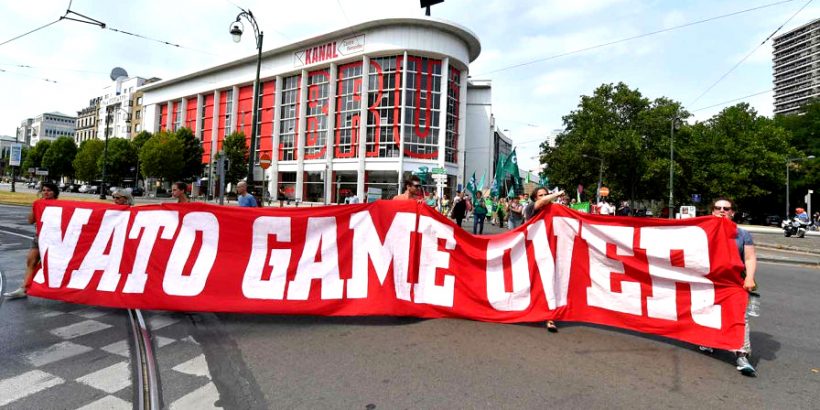
Claims that US President Donald Trump is undermining the North Atlantic Treaty Organization (NATO) by criticizing some of its members and having a cordial meeting with Russian President Vladimir Putin have sent establishment media into a frenzy to sanctify NATO as a force for peace and democracy.
A Guardian editorial (7/10/18) asserted:
The NATO alliance has helped mold the modern world and ushered in a democratic, liberal world order characterized by open trade and open societies, which after the collapse of the Soviet Union needed only to be lightly defended. This in turn contributed greatly to American peace and prosperity.
Note that “American peace” is a phrase used to describe a state that is currently bombing one country or another every 12 minutes, while US “prosperity” takes the form of spending $716 billion on the war machine annually while 40 million Americans live in poverty, giving the country a child poverty rate of 21 percent as well as the worst child mortality rate among rich nations.
A New York Times editorial (7/8/18) said that since World War II, the alliance has been “the anchor of an American-led and American-financed peace that fostered Western prosperity and prevented new world wars.” According to the paper, NATO has
linked America and Europe not just in a mutual defense pledge but in advancing democratic governance, the rule of law, civil and human rights, and an increasingly open international economy.
The Times argued that, while the alliance’s original purpose was allegedly to respond to a hypothetical Soviet attack, NATO “found a new purpose” after the fall of the USSR, “defending Muslims in the Balkans, and after 9/11, helping the United States fight terrorists in Afghanistan, Iraq, Africa and elsewhere.”
What the Times called “defending Muslims in the Balkans” was actually NATO’s invasion of Yugoslavia, an important tool in the dismantling of that country, which only under the most curious of definitions could be described as an act of “peace” or an exemplar of “the rule of law,” since the attack was illegal. Likewise, in “fight[ing] terrorists in Afghanistan,” NATO has hardly shown itself to be an agent of “peace” in a war that’s gone on for almost 17 years, during which NATO members have demonstrated their regard for “civil and human rights” by killing thousands of Afghan civilians and supporting torturers.While NATO’s occupation has yet to usher in an “open societ[y]” or democracy in Afghanistan, the alliance’s presence has coincided with the birth of ISIS in the country. Rather than embodying “peace” or “human rights,” the 2003 invasion and subsequent occupation of Iraq, which NATO took part in by way of a “training mission,” entailed torture, the killing hundreds of thousands of civilians, the use of chemical weapons, and rates of infant mortality, cancer and leukemia higher than those reported in Hiroshima and Nagasaki. Then in the Iraqi theatre of the war ostensibly aimed at ISIS, NATO demonstrated these values and helped “fight terrorists” as part of a coalition that killed thousands of civilians.
The Times’ vague reference to “fight[ing] terrorists in… Africa” notwithstanding, none of the articles discussed above or below mentioned Libya, the site of NATO’s most recent full-scale war. Yet it’s fair to say that the seemingly endless war and social collapse in Libya that have followed NATO’s attack, as well as the “hell” of beheadings, rape, and slave markets that resulted from it, aren’t features of “open societies” characterized by “peace,” “democratic” politics and “the rule of law, civil and human rights.” One struggles, in fact, to come up with a single example where such things were the goal of a NATO intervention, let alone its outcome.
Advocating Aggression
Canonizing NATO involves not only erasing its innumerable crimes but also advocating the bolstering of the organization, which would both increase the threat of war and divert resources from socially necessary goods like healthcare, housing, education, ameliorating poverty and inequality…
A Washington Post editorial (7/7/18) said:
There is considerable good news to celebrate: [NATO] has substantially beefed up defenses of its eastern flank, facing Russia; it is recommitting to vital missions in Afghanistan and Iraq; and every one of its members is increasing defense spending—the biggest buildup by US allies in 25 years. The summit is due to adopt an ambitious new plan that would allow NATO to deploy 30 battalions, 30 squadrons of planes and 30 ships within 30 days—a resource that could considerably bolster the ability of the United States to respond to crises.
The Times editorial claimed that, “faced with” an unspecified “Russian threat”—the existence of which the editorial offers no evidence for, but refers to twice—“a firm and convincing commitment to a strong NATO” is important. Thus the paper implicitly endorsed NATO’s
establishing two new military commands, expanding cyberwarfare and counterterrorism efforts, and approving a new plan to speed the reinforcement of troops and equipment to Poland and the Baltic States to deter Russian aggression.
None of this coverage addressed NATO’s threats to Russia and how these shape Russian actions. Though NATO leaders promised Soviet leader Mikhail Gorbachev in 1990 that NATO would not expand “one inch eastward” toward Russia, the alliance has since grown quite a few inches eastward by adding to its ranks Poland, Hungary, the Czech Republic, Bulgaria, Estonia, Latvia, Lithuania, Romania, Slovakia, Slovenia, Albania, Croatia and Montenegro.
As Benjamin Schwarz pointed out in The Nation (7/11/18), the US has “interfered in the pre- and post-coup political machinations in Ukraine,” and “NATO has signaled that its expansion into Ukraine is a question of when, not if.” He went on to note:
And now that NATO has created an enemy [in Russia], it justifies its [own] intensifying provocative actions—the massive annual military exercises since 2010 in Poland, Lithuania, and, on Russia’s very doorstep, in Latvia and Estonia; the creation of a permanent US Army headquarters in Poland; a new Pentagon-devised plan for a prolonged war with Russia; the US ambassador to NATO’s explicit identification of “Russia and the malign activities of Russia” as NATO’s “major” target—by declaring that they are nothing more than a necessary reaction to Russian hostility and the need, as the New York Times editorial board declared this week, to “contain” the Russian “threat.” And what, according to the Pentagon’s 2018 National Defense Strategy, makes the Russians a threat? Nothing less than that their aim—which is as unproven as it would be understandable—is “to shatter” NATO, the military pact arrayed against them.
Since 2016, NATO has had 4,000 troops in Poland, Lithuania, Latvia and Estonia.
Thus, when the Post said NATO’s military buildup “could considerably bolster the ability of the United States to respond to crises,” it should have added that NATO is a driving force in creating these crises in the first place. These media accounts suggest, however, that NATO has an unlimited right to build up its forces near Russian territory, while any Russian response to that is entirely illegitimate.
Therein lies the meta level of the absurdity of this panic about Trump being anti-NATO. By insisting that US allies in the organization pay in more heavily, he’s actually calling for NATO to be built up. In February, the Trump administration released its Nuclear Posture Review, which authorized developing and deploying so-called “low-yield” nuclear weapons to “deter” Russia in case it’s not already deterred by America’s massive nuclear arsenal.
The problem isn’t, as the media suggests, that Trump is weakening NATO; the problem is that he’s strengthening it.
Gregory Shupak teaches media studies at the University of Guelph-Humber in Toronto. His book, The Wrong Story: Palestine, Israel and the Media, is published by OR Books.
July 26, 2018
Posted by aletho |
Mainstream Media, Warmongering, Militarism | NATO, United States |
Leave a comment
The United States and Israel have been threatening Iran for something like twenty years, using the pretext that it was developing a nuclear weapon initially, but also more recently declaring that Tehran has become a threat to the entire Middle East. Both contentions are essentially lies, concocted by an Israel and Saudi Arabia that would prefer to have Iran removed as a possible impediment to their own ambitions. And they would like the United States to do the removing.
Iran is the hottest of all hot spots in the American view, but the tendency of the White House to threaten first before engaging in negotiations has meant that most nations have come to see the United States as the greatest threat to peace worldwide. In a recent interview, Russian President Vladimir Putin observed how the U.S. believes it can intervene militarily anywhere in the world because it is “spreading democracy,” a justification that no one believes in any event as the results of recent crusades in Afghanistan, Syria and Libya have been less than encouraging. Putin commented that Washington should treat all other nations with respect and it will then get respect – and cooperation – in return.
The track record of the Trump White House is not encouraging. It has twice launched barrages of cruise missiles against targets in Syria based on fabricated or incomplete intelligence suggesting that the government in Damascus had used chemical weapons against its own people. It also uniquely added juvenile humiliation to the American diplomatic arsenal, with Trump describing North Korean leader Kim Jong-un as a “rocket man” before going off into a rhapsody about how the nuclear arsenal button accessible to Trump was “bigger and more powerful” than that available to Pyongyang.
In light of past developments, one might think that it could not possibly get any worse, but it just has. Trump went after the low hanging fruit offered by Iran with a tweet that was both idiotic and embarrassing. Iran has undeniably been the enemy of choice for the White House since May, when Trump made the decision to withdraw from the 2015 Joint Comprehensive Plan of Action (JCPOA) that created an intrusive inspection regime to monitor Iran’s compliance in nuclear non-proliferation. The move was applauded by the powerful Israel Lobby and by the governments of Saudi Arabia and Israel, both of which have their own agendas for the Middle East and would prefer to see an independent Iran bombed into submission by Washington. The rest of the world deplored the decision.
In the latest incident, Trump was tweeting in response to comments made Sunday by Iranian President Hassan Rouhani, who had told a meeting of Iranian diplomats that war between America and Iran would be a misfortune for everyone, saying “Mr. Trump, don’t play with the lion’s tail, this would only lead to regret. America should know that peace with Iran is the mother of all peace, and war with Iran is the mother of all wars.”
Trump responded explosively with a tweet all in capital letters, presumably to express his rage in visual terms, “NEVER, EVER THREATEN THE UNITED STATES AGAIN OR YOU WILL SUFFER CONSEQUENCES THE LIKES OF WHICH FEW THROUGHOUT HISTORY HAVE EVER SUFFERED BEFORE. WE ARE NO LONGER A COUNTRY THAT WILL STAND FOR YOUR DEMENTED WORDS OF VIOLENCE & DEATH. BE CAUTIOUS!”
President Trump’s warning that he would annihilate Iran missed the point that Rouhani was offering peace and urging that both sides work to avoid war. The Administration has already announced that it will reinstate existing sanctions on Iran and will be adding some onerous new ones as well. After November 4th, Washington will sanction any country that buys oil from Iran, markedly increasing the misery level for the Iranian people with the objective of either making their government surrender or rising up in rebellion against it.
Enough already. The immediate knee-jerk resort to threats of using overwhelming conventional military power or even nuclear weapons to resolve international disagreements is being played far too often by a president whose understanding of the world clearly has a manic-aggressive quality derived from a life spent selling and buying real estate in New York City. And the idiotic tweeting as well is beneath the dignity of the office Trump holds, the hallmark of an insecure school bully seeking attention. Donald Trump was elected at least in part to keep America out of wars, not to start several new ones, and it is past time that he stop the posturing and remember that.
July 26, 2018
Posted by aletho |
Militarism, Russophobia, Timeless or most popular | Israel, Middle East, Saudi Arabia, United States |
Leave a comment

July 27, 2018 marks the 65th anniversary of the Armistice Agreement which brought about a ceasefire to the Korean War. The agreement was signed by North Korean General Nam Il representing both the Korean People’s Army (KPA) as well as the Chinese People’s Volunteer Army (PVA) and U.S. Army Lieutenant General Harrison, Jr. representing the United Nations Command (UNC).
While the purpose of the agreement was to “ensure a complete cessation of hostilities and of all acts of armed force in Korea until a final peaceful settlement is achieved,” the effect was an unending Korean War with decades of escalating military tension on the Korean Peninsula. And a number of arrangements made on July 27, 1953 have yet to be implemented. Most notably, the U.S. has failed to contribute a plan for withdrawing its troops within the timeframe that was discussed in Article IV of the agreement:
In order to ensure the peaceful settlement of the Korean question, the military Commanders of both sides hereby recommend to the governments of the countries concerned on both sides that, within three (3) months after the Armistice Agreement is signed and becomes effective, a political conference of a higher level of both sides be held by representatives appointed respectively to settle through negotiation the questions of the withdrawal of all foreign forces from Korea, the peaceful settlement of the Korean question, etc.
While all other foreign forces eventually withdrew, the U.S. military never left Korean soil. To this day, the U.S. has more than 28,500 of its troops stationed all over South Korea.
With the anniversary of the Armistice Agreement just around the corner, ZoominKorea spoke with Gregory Elich — member of the Solidarity Committee for Democracy and Peace in Korea and frequent contributor for ZoominKorea — about the significance of the armistice and the conditions necessary to establish permanent peace on the Korean Peninsula.
ZoominKorea: July 27 marks the 65th anniversary of North Korea (with China) and the U.S. (representing UN forces) signing the armistice to agree on a temporary ceasefire to the Korean War. Can you tell us more about the agreement — what was it supposed to do and what actually transpired following the signing?
Elich: The armistice was meant to be an interim measure to implement a ceasefire until a peace treaty would be signed. Technically speaking, then, the parties to the conflict remain at war. The armistice agreement stipulated that within three months the three sides would meet to negotiate the terms of a peaceful settlement of the war. That deadline was missed, but once the meeting did take place, the U.S. representatives were unwilling to discuss the subject of a peace treaty. Decades later, that remains the position of the United States.
On the rare occasions that U.S. media address the topic of a peace treaty, the general attitude is that the matter does not involve the United States, and dark motives are likely behind North Korea’s wish to sign a peace treaty that would formally end the Korean War.
However, the United States, along with China and North Korea, committed to negotiating a peace treaty when they signed the armistice agreement. That responsibility remains with the three parties, including the U.S. No one else can formally end the Korean War, nor can any single nation do so without the agreement of the others.
ZoominKorea: Although it is critical for the American public to understand that cooperation by the U.S. is necessary to ensure permanent peace in Korea, the cooperation between North and South Korea is also immensely important in establishing meaningful and lasting peace.
How do you see the April 27 Panmunjom Declaration playing a role in ending the Korean War?
Elich: The third section of the Panmunjom Declaration explicitly states that ending the “unnatural state of armistice” and establishing a peace regime should not be delayed. The declaration identifies this as a matter of urgent concern. So in a real way, the subject of a peace treaty is now on the South Korean agenda. That will make it more difficult for the United States to dismiss the issue.
Beyond that, the Panmunjom Declaration has enormous potential for the future of the Korean Peninsula, going far beyond the signing of a peace treaty. It is interesting to note that the first article specifies that the two Koreas will determine their destiny on their own accord. The unmistakable message is that only Koreans can choose their future, not the United States. In Kim Jong-Un’s eyes, that is the path the two Koreas should be following now. I am not sure the ever-cautious South Korean President Moon Jae-in is entirely on board with that perception, though, and he may feel that for the foreseeable future nothing can be done without the permission of the United States.
The declaration lays out specific measures to be taken to reduce tensions between the two Koreas and to build mutual trust. That comes as a welcome development after the damage done to relations by the two previous South Korean presidents. Of particular importance is the provision to implement the October 4, 2007 economic agreements between the two Koreas that former South Korean President Lee Myung-bak killed off. Those agreements hold great potential for the economic development of the entire peninsula. Unfortunately, no progress on those can be expected before the lifting of sanctions on North Korea.
ZoominKorea: North Korea has emphasized the importance of ending the Korean War, not only in its recent negotiations with South Korea and the U.S. but also for decades, since the Armistice Agreement. Progressive Koreans in the South and Overseas have also called for the end to the military conflict and signing of a peace treaty. To them, that is the priority.
To the majority of the Washington establishment and the U.S. media, however, denuclearization is the priority.
Indeed, there are many agreements to be made between signing the peace treaty and denuclearizing the Korean Peninsula — but what do you think is the most logical process for establishing peace in Korea?
Elich: In general, it makes logical sense for a peace treaty to be among the initial steps adopted in repairing relations. I see this mainly as cleaning up unfinished business from decades ago. There are complications, though.
As you point out, North Koreans and progressive Koreans in the South and abroad attach tremendous importance to the signing of a peace treaty. There is a good deal of hope that other benefits are inherent, such as an end to enmity and the withdrawal of U.S. forces from the peninsula. I don’t believe we can expect anything more from a peace treaty, in and of itself, beyond its symbolic value and the encouragement it gives to ongoing talks. After a peace treaty is signed, every other step to improve relations is a matter for further negotiation and determined struggle.
On its own, a peace treaty will not trigger a withdrawal of U.S. forces. After all, World War II ended 73 years ago, yet the U.S. military remains firmly ensconced in Germany, Japan, and Okinawa. There is no sign that the United States has any intention of ever departing.
Aside from North Korea, in the years since the Second World War the United States has officially been at peace with all of the nations it has sanctioned, threatened, subverted, bombed, and invaded. North Korea will need more solid security guarantees than a peace treaty if it is going to denuclearize.
U.S. policymakers envision expanding the role of U.S. Forces Korea (USFK) beyond the Korean Peninsula, and that will make it extremely difficult to dislodge troops from the Korean Peninsula.
Washington think tanks argue that USFK should shift from the so-called North Korea deterrence role to a regional contingency force. That is, the objective is for U.S. forces based in South Korea to be poised to intervene anywhere in Asia. This concept is in line with the Defense Department’s National Defense Strategy document, which calls for “increased strategic flexibility and freedom of action.” In the context of that policy, an improvement in U.S.-North Korean relations is irrelevant to regional plans for USFK.
There is the additional factor that USFK is a critical component in the overarching policy of encircling China and Russia, one which U.S. military planners are not going to relinquish willingly.
That does not mean the two Koreas should not pursue the withdrawal of USFK in talks with the United States. My point is that immediate removal of U.S. forces is improbable and the challenges should not be underestimated. At the very least, it will take a determined struggle to effect change. One of the main barriers that Korean progressives will have to overcome is that the U.S. military doesn’t care what citizens in any host country think about its forces. U.S. bases have been established abroad to serve imperial interests, not those of the host countries.
For the U.S. side, signing a peace treaty would make sense as a low-cost means of demonstrating goodwill and reciprocity to its interlocutors on the North Korean side. A peace treaty obligates the United States to nothing while giving North Korea something it fervently desires. That would only improve the atmosphere in talks and hasten progress toward a final agreement.
In the months ahead, if the Trump administration proves resistant to the idea of a peace treaty, then that would probably be an indication that think tank advisors are negatively influencing the U.S. negotiating strategy.
No matter what the Trump administration decides, a peace treaty may not be in the cards in the near term. A peace treaty would require approval by a two-thirds majority in the U.S. Senate before Trump could ratify it. In the current U.S. political environment, that seems like an insurmountable hurdle. Consequently, the reality is that while a peace treaty is a logical first step, it is far more likely to take place among the final stages. The completion of denuclearization may reduce the ferocity of Senate resistance to a level that would allow approval. The Trump administration may decide to postpone the signing until late in the process so as to avoid the awkwardness of Senate disapproval during negotiations with North Korea.
I see Korean reunification as a long-term goal that can only come about after U.S.-North Korean relations have substantially improved and South Korea is better able to act in its own best interests without seeking permission from the United States. Otherwise, American interference would present too high an obstacle.
ZoominKorea: What do you make of the U.S. media and its coverage of the negotiations in progress between the Trump administration and North Korea? Pundits as well as members of Congress (including members of the Democratic Party) have been vocal about criticizing Trump and his cabinet for the way they have been handling the negotiations with the North Korean leadership. Many have called out Trump for appeasing the North Koreans “too much.” What do you assess to be the motivation behind this? What kind of an impact could this have on the talks moving forward?
Elich: The Washington establishment is uneasy over President Trump’s erratic behavior. Indeed, one could even say there is open panic. There is concern over whether Trump can be consistently counted on to pay the expected fealty to the Washington consensus on foreign policy and prioritize the needs of large corporations and military contractors. The fear is that at some point Trump, through sheer misunderstanding and carelessness, may put at risk the entrenched “values” of aggressive militarism and global economic and political domination.
The hysterical cries of treason over Trump’s meeting with Russian President Vladimir Putin are another manifestation of that panic.
There are two immediate concerns. One is that normalizing relations with North Korea would lead to a growing demand among South Koreans for U.S. forces to leave the peninsula. The other is that without North Korea as an official enemy, the pretext for stationing troops in South Korea would vanish.
One does not have to search very long among Washington think tank documents to encounter warnings that signing a peace treaty would be a trap which would remove U.S. forces from the region so that North Korea could be free to attack the South. One wonders if these analysts genuinely believe this nonsense or if that is their way of dissuading the Trump administration from agreeing to a peace treaty.
In addition to these generalized concerns, military contractors, whose lobbyists are quite active on Capitol Hill, have specific worries. Over the last five-year period, South Korea ranks second behind Saudi Arabia in the value of arms purchased from the United States. For arms manufacturers, a peaceful resolution of tensions on the Korean Peninsula would be a disastrous development that would eventually cut into future profits. Investor jitteriness was displayed when the five largest U.S. military contractors lost $10 billion in stock market value on the day of the signing of the Panmunjom Declaration.
Vociferous complaints by Western media and politicians about the Singapore Summit and ongoing talks are intended to undermine the process and block any possibility of a diplomatic settlement.
ZoominKorea: While the U.S. media have been critical of the results of the Singapore Summit, many progressive Korean American and U.S.-based activists have welcomed this first major step to the peace process. Since more than a month has passed, how do you now assess the results of the summit?
Earlier this month, as a follow-up to the Singapore Summit, State Secretary Pompeo visited Pyongyang to further discuss the denuclearization deal. From North Korea’s perspective, the latest visit was somewhat of a setback because of the United States’ recapitulation of hardline demands for a denuclearization process similar to that of the Complete Verifiable Irreversible Denuclearization (CVID) approach that undermines the spirit of the Singapore Summit. Pompeo, on the other hand, claimed that the meeting was conducted in good faith and he had “made progress on almost all central matters.”
With the U.S. still unable to acknowledge that it is not doing enough to build trust with North Korea, how do you foresee the negotiations to move forward?
Elich: The first point I would like to make is the fact that talks are happening at all should be regarded as a victory. Eight years of the Obama administration refusing to negotiate, followed by Trump’s bluster and threats during the first year of his administration, have done nothing positive for the region or the international situation. During that time, Washington’s attitude was that pressure and threats “haven’t worked,” therefore more pressure and threats are needed. The rational conclusion that no progress can be made without dialogue was dismissed out of hand.
Chairman Kim Jong Un made a bold move to change the narrative this year, announcing a unilateral freeze on nuclear development and missile testing, while explicitly expressing his intention to denuclearize in the context of an agreement with the U.S. Then came the demolition of North Korea’s nuclear test site. North Korea’s peace drive prompted Washington to re-engage with North Korea. In a positive response, the U.S. implemented a temporary pause in military exercises on the Korean Peninsula as long as talks continue.
Contrary to what Western critics assert, the Singapore Summit was never intended to produce a detailed agreement. The meeting was a declaration of intent to negotiate a mutually beneficial deal. Given the hostile rhetoric that dominated relations and which continues to characterize U.S. media, the summit was an essential initial step in the direction of positive change.
The various shifts in the U.S. position seem to indicate that there is a dichotomy of views within the Trump administration concerning what avenue to follow in negotiations, and each side appears to be struggling to gain the upper hand.
The default position is the unworkable notion that diplomacy should consist of making endless demands on the other party while offering little or nothing in return. However, North Korea is not negotiating from a position of weakness. In its nearly complete nuclear weapons program it has something substantial to trade. It would be a mistake to imagine that North Korea would consider giving that up without receiving anything meaningful in return.
It is the job of the U.S. media to discipline U.S. negotiators and pressure them into rejecting normal diplomatic give-and-take and stick to the pattern of making demands for unilateral concessions. This pressure may explain Secretary of State Mike Pompeo’s recent assertions that sanctions will remain in place until after denuclearization is complete. Presumably, Pompeo’s recent statements are meant to reassure critics, who in any case will not be mollified by anything less than the total abandonment of diplomacy and a return to saber rattling.
It is true that the U.S. and North Korea have divergent concepts on how talks should proceed, with the U.S. expecting something along the lines of the Libyan model, where the other party must meet all U.S. demands in exchange for vague promises of future compensating measures. North Korea, quite reasonably, wants a measured, step-by-step approach, where both parties give each other something as they advance towards their ultimate goals.
It should also be pointed out that from the North Korean perspective denuclearization of the Korean Peninsula is not entirely a one-way road. It would also entail a commitment by the United States to no longer send nuclear-capable B-2 and B-52 bombers flying over the Korean Peninsula.
The main component in an agreement is a security guarantee to North Korea. Its nuclear deterrent, after all, was developed in response to the hostile policy of the U.S., as well as the vivid object lessons provided by the bombing of Yugoslavia and Libya, and the invasion of Iraq. It is difficult to imagine, though, what kind of security guarantee the United States can offer that could be trusted. A piece of paper is not going to do it. It may be that the Trump administration would be sincere in signing such a document. But the next U.S. administration may have no compunction in abandoning it. I assume that a reliable security guarantee will have to involve not only the U.S. but also Russia and China in some manner.
Despite all of the hindrances, once negotiations are seriously underway I see a real prospect of favorable results. I feel that at some point as U.S. negotiators meet with their North Korean counterparts it will become apparent that they have an opportunity to achieve their goals, but only by adopting a more even-handed approach. That realization should provide the impetus to adopt a more flexible manner. Whether or not that path is followed remains to be seen, as a more even-handed approach is sure to engender a determined backlash from the Washington establishment and U.S. media. My feeling is that the desire to achieve denuclearization will override the impact of political opposition, and there is a more than even chance of a diplomatic settlement.
Gregory Elich is on the Board of Directors of the Jasenovac Research Institute and a Korea Policy Institute associate. He is a member of the Solidarity Committee for Democracy and Peace in Korea, and a columnist for Voice of the People. He is the author of Strange Liberators: Militarism, Mayhem, and the Pursuit of Profit, and has two chapters in the anthology Killing Democracy: CIA and Pentagon Operations in the Post-Soviet Period, published in the Russian language. In 1999, he was a member of a team that visited Yugoslavia to investigate NATO war crimes.
July 24, 2018
Posted by aletho |
Mainstream Media, Warmongering, Militarism, Timeless or most popular | Korea, United States |
Leave a comment
The summit meeting between Donald Trump and Vladimir Putin has finally taken place in Helsinki to thunderous condemnation on the part of many in the West.
Some talk luridly of the beginning of the end of the West Others talk hysterically of treason.
Others see the summit as a damp squib, which will change nothing and which will leave the relationship between the US and Russia and between Russia and the West essentially unchanged, with the current state of hostility continuing indefinitely unabated.
In my opinion both views are wrong (the first obviously so) and both misunderstand, and in the case of the first wilfully misrepresent, what actually happened in Helsinki.
I discussed the background to the summit in an article I wrote a month ago for The Duran at a time when first reports that the summit was in the offing were beginning to circulate.
In that article I said that there was no possibility that Putin would make unilateral concessions to Trump over the status of Crimea or over the conflict in Ukraine and that the idea that he would agree to the US and Ukrainian proposal for a peacekeeping force to be deployed to the Donbass was certainly wrong and that that idea had already been categorically ruled out by the Russians.
I was also skeptical that there would be any sort of ‘grand bargain’ between the US and the Russians over Syria.
On the subject of Syria, in the weeks leading up to the summit there were some media reports suggesting that Donald Trump was coming under pressure from Israel, the Saudis and the United Arab Emirates to agree a deal at the summit with Putin whereby Russia would be granted sanctions relief and possibly even recognition of Crimea, US troops in Syria would be withdrawn, and in return the Russians would agree that Iranian forces would be expelled from Syria.
The Russians were clearly worried by these reports. Not only did they go out of their way to deny them, but Putin and Lavrov held talks in Moscow on 12th July 2018 with Ali Akbar Velayati, Iranian Supreme Leader Ayatollah Khamenei’s Special Adviser on International Relations, in order to reassure the Iranians that they were not true.
As I explained in my lengthy discussion of Benjamin Netanyahu’s recent visit to Moscow on Victory Day, it would in fact be wholly contrary to established principles of Russian foreign policy for the Russians to agree to a ‘grand bargain’ like this.
From the Russian point of view relations between Iran and Syria are relations between two sovereign nations and are none of Russia’s business.
Not only is it not Russia’s business to interfere in whatever relations Iran and Syria have with each other, but Russia lacks the means to do so anyway, with any request from Moscow to Tehran and Damascus to sever or downgrade their relations certain to be refused, and with Russia having no means to force either country to comply with such a request save through steps which would put at risk its relations with both of these countries.
All Russia would achieve were it ever to make such a request would be to damage its relations with Iran and Syria and lose face, bringing down upon itself accusations of bad faith from the US, Saudi Arabia and Israel when it inevitably failed to follow through.
Here is what I said about how Putin would respond to a demand from Netanyahu to rein in the Iranians in Syria if it were made to him during Netanyahu’s Victory Day visit, and nothing which has happened since would have caused Putin to change his position,
Contrary to what some people are saying, I think it is most unlikely that Putin would have given Netanyahu any assurances that Russia would act to rein in Iranian activities in Syria.
If Netanyahu asked Putin for such assurances (which I also think unlikely) Putin would almost certainly have told him what the Russians always say when faced with requests for such assurances: Iran and Syria are sovereign states and Russia cannot interfere in arrangements two sovereign states make with each other.
I suspect that the source of some of the stories about a ‘grand bargain’ between Putin and Trump involving the role of the Iranians in Syria is the regular discussions the Russians have with the Israelis, the Iranians and the Syrians whereby the Russians routinely pass on to the Iranians and the Syrians Israeli concerns about the presence of Iranian forces in Syria in particular locations as well as Israeli concerns about specific actions which the Iranians take.
A good example of these sort of discussions was an exchange between Putin and Netanyahu during Netanyahu’s most recent trip to Moscow on 11th July 2018. The Kremlin’s website reports Netanyahu and Putin saying the following to each other,
Benjamin Netanyahu: … Of course, our focus is on developments in Syria, the presence of Iran. This is not new to you. Several hours ago, an unmanned aerial vehicle entered the territory of Israel from Syria and was successfully brought down. I would like to emphasise that we will counter any and all attempts to violate our air or land borders.
Cooperation between us is an essential, key factor that can stabilise the entire region. So, I would like to thank you for the opportunity to meet with you and discuss these things.
Vladimir Putin: We are aware of your concerns. Let us discuss them in detail.
(bold italics added)
The Russians are not engaged here in discussions over some sort of ‘grand bargain’ to remove all Iranian troops from Syria, which as I have said they would see as counterproductive and impossible. Rather they are engaged in the classic diplomatic exercise of conflict prevention: keeping the Israelis, the Iranians and the Syrians informed about each other’s moves and red lines in order to prevent an uncontrolled escalation of the conflict between them, which might risk an all-out war, which nobody wants, and which the Russians are doing their best to prevent.
Recent reports of an understanding between the Israelis, the Iranians and the Syrians supposedly brokered by the Russians whereby Iranian forces agreed not to participate in the Syrian army’s ongoing military operations in south west Syria close to the Israeli occupied Golan Heights are a case in point.
The Iranians and the Syrians agreed to this, not because the Russians forced them to but because it is in their interest to. The Syrian army does not need Iranian help to defeat the Jihadis in southwest Syria so keeping the Iranians away from the area allows the Syrians to clear the area of the Jihadis without risking a military confrontation with Israel.
Needless to say, just as the Russians were not prepared to make concessions on Crimea and Donbass or on Syria, so they were not prepared to back Donald Trump’s ongoing campaign against Iran.
Not only are the Russians deeply committed to the JCPOA (which they partly brokered) but they are also committed to improving their relations with Iran. In addition, given that the ongoing US campaign against Iran is clearly intended to achieve regime change there, the Russians are bound to oppose it because they oppose regime change everywhere.
If the Russians were not prepared to make unilateral concessions to Trump on Crimea, Donbass, Syria or Iran, neither was Trump despite all the pre-summit scaremongering going to make unilateral concessions to Russians.
Stories that Trump would announce a cancellation of US military exercises in Europe or even a withdrawal of US troops from Europe had no basis in reality, and needless to say nothing like that happened. Nor did Donald Trump recognise Crimea as Russian or announce that he would lift sanctions on Russia.
The question of the sanctions and of the recognition of Crimea as Russian requires a little discussion since there is a widespread view that Trump is prevented by the Countering American Adversaries Through Sanctions Act (CAATS) from either lifting the sanctions or from recognising Crimea as Russian
This is something of a misconception. In reality, as I discussed last year at the time when CAATS was enacted, CAATS is unconstitutional, as Donald Trump himself carefully explained in his Signing Statement, because of the unconstitutional restrictions it places on the President’s ability to conduct foreign policy.
If and when Donald Trump decides that the time has come to lift the sanctions and to recognise Crimea as Russian, then all he has to do is apply to the US Supreme Court to have CAATS set aside. His Signing Statement shows that he has had legal advice that it will do so.
That point has not yet been reached for political not legal reasons. In the meantime it is an error to think of CAATS as the insuperable constraint on Donald Trump’s actions that many appear to believe it is.
Trump did not commit himself to lift the sanctions, and he did not recognise Crimea as Russian, not so much because of the legal constraints placed upon him by CAATS but because doing so would have put at risk his political position in the US in advance of November’s mid-term elections, and because – compulsive deal-maker that he is – he is hardly likely to take such radical steps anyway without first getting something back in return.
One of the fundamental problems caused by the hysterical campaign which is being waged against Donald Trump is that it causes even many of Donald Trump’s supporters to believe that he is more supportive of Russia’s positions on a variety of issues than he really is. The result is that he is constantly suspected of being prepared to make unilateral concessions to the Russians when unilateral concessions are precisely the sort of things which as a self-professed master deal-maker he is known to most abhor.
Donald Trump is – as he repeatedly says – an America First nationalist, and his overriding priority is to make what he considers to be the best possible deal for the United States. Unilateral concessions just don’t come into it and it is a fundamental error to think that they do.
Putin understands all this very well, as he made clear during his joint press conference with Trump in Helsinki.
VladimirPutin: Regarding whom you can believe and whom you can’t, you shouldn’t believe anyone. What makes you think President Trump trusts me and that I fully trust him? He defends the interests of the United States of America. I defend the interests of the Russian Federation. We do have converging interests, and we are seeking common ground. We have issues that we disagree on so far. We are seeking options to settle these differences and make our work more constructive.
Which brings me to the fundamental reason for the summit, and why it is also a mistake in my opinion to see it as an empty show or a damp squib.
Donald Trump sought the summit – it is clear that the initiative for the summit came from him – because as he has repeatedly said since before he was elected President, prior to the summit he did not know Putin well.
The number of times Trump has said this is in fact practically beyond count. For example, he said it during a news conference in Miami on 27th June 2016,
I don’t know who Putin is. He said one nice thing about me. … I never met Putin….
He also said it during the second Presidential debate on 9th October 2016,
I don’t know Putin….
Trump has gone on to say the same thing again and again since. He has also repeatedly said that only time would tell whether he and Putin would get on with each other and would be able to come to agreements with each other.
A fundamental prerequisite for any successful negotiation is for the two parties to the negotiation to know each other’s minds so that a modicum of trust and understanding – essential if any agreement is to be reached – can be established between them.
As a businessman Trump knows this very well. He therefore needed to meet with Putin in a lengthy one-to-one encounter in order to get to know Putin properly so as to see whether Putin is in fact the sort of person he can negotiate and eventually do a deal with.
That is the reason why Trump insisted that his first meeting with Putin should take the form of a one-to-one encounter.
That by the way is absolutely standard practice in negotiations – both commercial negotiations and diplomatic negotiations – with leaders of negotiating teams often meeting privately in one-to-one meetings in order to get to know each other better to see whether a deal between them is even possible. Once a proper relationship between them is established the full negotiating teams can be brought into the negotiations in what in diplomacy are called ‘plenary sessions’. Needless to say it is during the plenary sessions – with each side’s experts present – that the details are discussed and ironed out.
Not only is this standard practice in negotiations – Putin does it all the time – but it is simply not true as some people are suggesting that there was no one else present in the room when Putin and Trump met with each other.
Both Putin and Trump obviously had interpreters present. Trump doesn’t speak Russian and Putin speaks English badly. The job of the interpreters – who are full time state officials – is not just to interpret what the leaders say to each other but also to prepare a written transcript (a “stenographic record”) of what they said.
Once this transcript is written up – something which normally takes no more than a few days – it is circulated to senior officials including in the US case to the US President’s two most important foreign policy advisers, Bolton and Pompeo. By now it is highly likely that Bolton and Pompeo have already seen and read through the transcript, and that they therefore know exactly what Putin and Trump said to each other.
Since the one-to-one meeting was first and foremost a “get-to-know” you session, no binding agreements would have been reached during it, and neither Putin nor Trump – each in their own way an experienced negotiator – would ever have imagined that they would be.
In summary, the one-to-one meeting between Putin and Trump is not a sign of some secret understanding between them; far less is it a case of an “intelligence asset” meeting his “controller” as some are crazily suggesting.
On the contrary it is further proof of what each of them has repeatedly said at various times: before the summit they did not know each other well, so that the summit was called precisely in order to give each of them the opportunity to get to know the other better.
The essential point about the summit is that Putin and Trump did find that they could deal with each other and did discover areas of common concern which in time it might be possible for them to build on as they search for areas of agreement between them. During their joint press conference Putin confirmed as much,
We do have converging interests, and we are seeking common ground. We have issues that we disagree on so far. We are seeking options to settle these differences and make our work more constructive.
As for the points of possible convergence, Putin in his usual structured way set them out,
I consider it important, as we discussed, to get the dialogue on strategic stability and the non-proliferation of weapons of mass destruction on track. We made a note with a number of concrete proposals on this matter available to our American colleagues.
We believe that continued joint efforts to fully work through the military-political and disarmament dossier is necessary. That includes the renewal of the Strategic Offensive Reductions Treaty, the dangerous situation surrounding the development of elements of the US global missile defence system, the implementation of the Treaty on the Elimination of Intermediate-Range and Shorter-Range Missiles, and the topic of deploying weapons in space.
We are in favour of continued cooperation in the sphere of combating terrorism and ensuring cybersecurity. Notably, our special services are working together quite successfully. The most recent example of that is the close operational interaction with a group of US security experts as part of the World Cup in Russia that ended yesterday. Contacts between the special services should be made systematic. I reminded the President of the United States about the proposal to reconstitute the anti-terror working group.
We covered regional crises extensively. Our positions do not coincide on all matters, but nonetheless there are many overlapping interests. We should be looking for common ground and working more closely, including at international forums.
Of course, we talked about regional crises, including Syria. With regard to Syria, restoring peace and harmony in that country could serve as an example of successful joint work.
Of course, Russia and the United States can take the lead in this matter and organise cooperation to overcome the humanitarian crisis and help refugees return to their hearths.
We have all the requisite elements for effective cooperation on Syria. Notably, Russian and American military have gained useful experience of interaction and coordination in the air and on land.
I would also like to note that after the terrorists are routed in southwest Syria, in the so-called “southern zone”, the situation in the Golan Heights should be brought into full conformity with the 1974 agreement on the disengagement of Israeli and Syrian forces.
This will make it possible to bring tranquillity to the Golan Heights and restore the ceasefire between the Syrian Arab Republic and the State of Israel. The President devoted special attention to this issue today…..
We paid special attention to the economy. Obviously, there is interest in cooperation in the business circles of both countries. The US delegation was one of the biggest at the St Petersburg International Economic Forum in May. It consisted of over 500 US entrepreneurs.
To develop trade and investment, President Trump and I agreed to establish a high-level group that would unite captains of Russian and American business. Business people better understand how to go about mutually beneficial cooperation. Let them consider what can be done and make recommendations
The emphasis – as I discussed in my article of a month ago – is on arms control, though Putin also seems to have gone out of his way to reassure Trump that the restoration of the Syrian government’s control over southwest Syria would not put in jeopardy Israel’s position in the Golan Heights. In addition there also seems to have been a fair amount of discussion about future economic cooperation.
The result was an agreement between Putin and Trump to reopen channels of communication between their governments and to meet regularly with each other as they feel their way towards a rapprochement.
To be clear, that rapprochement will not mean and is not intended to mean that the US and Russia will cease to be adversaries and will become friends.
Instead what is being discussed are steps to bring to a stop the downward spiral in their relations, with each side obtaining a better understanding of the other side’s moves and red lines, so that hopefully geopolitical disasters like the 2014 Maidan coup can be avoided in future.
That would be a major advance over what has existed previously given that since the USSR collapsed in 1991 the US has refused to acknowledge that Russia has any right to any opinions at all, let alone to act independently or set out red lines.
Needless to say the more often Putin and Trump meet the more ‘normalised’ relations between the US and Russia become, with each meeting provoking less controversy than the previous one, with the whole process beyond a certain point becoming routine so that it attracts ever less attention and (hopefully) eventually becomes uncontroversial.
It is because the powerful forces in the US who scorn the idea of a ‘geopolitical ceasefire’ and want ever greater confrontation between the US and Russia do not want to see relations ‘normalised’ in this way that their reaction to the summit has been so hysterical.
As of the time of writing it is these people who in the media and on twitter are making the running. However it may be a mistake to see in the volume of the noise they are making a true reflection of their influence.
Last February’s Nuclear Posture Review suggests that there is a very powerful constituency within the US and specifically within the Pentagon which might potentially support the sort of ‘geopolitical ceasefire’ with Russia that Donald Trump appears to be gradually working towards.
The Nuclear Posture Review shows that some sections of the US military understand how dangerously overstretched the US has become as it responds simultaneously to challenges from Russia in Europe and from China in the Pacific. Both Putin and Trump mentioned during their news conference the extent to which their respective militaries are already in contact with each other and are working well together
Donald Trump: Well, our militaries do get along. In fact, our militaries actually have gotten along probably better than our political leaders for years, but our militaries do get along very well and they do coordinate in Syria and other places. Ok? Thank you.
Vladimir Putin:……..On the whole, I really agree with the President. Our military cooperation is going quite well. I hope that they will continue to be able to come to agreements just as they have been…..
That may be a sign that there is more understanding of what Donald Trump is trying to do – at least within the US defence establishment – than the hysteria the Helsinki summit has provoked might suggest.
Overall, provided it is clearly understood that what Putin and Trump are working towards is a detente style ‘geopolitical ceasefire’ and not ‘friendship’ – and certainly not an alliance – it can be said that their summit in Helsinki was a good start and a success.
What happens next depends on whether the forces of realism and sanity in the US can prevail over those of megalomania and hysteria. Given how entrenched the latter have become unfortunately no one can count on this.
However some sort of process which may in time lead to detente and an easing of tensions between the nuclear superpowers has begun. Given the circumstances in which it has been launched that is more than might have been expected even a short time ago, and for that one should be grateful.
July 20, 2018
Posted by aletho |
Economics, Militarism, Timeless or most popular | Israel, Middle East, Russia, Sanctions against Iran, Syria, United States |
Leave a comment
The madness that gripped liberals and neocons within the Western political, media, and security establishments, over the sight of a US president having the temerity to treat his Russian counterpart – Vladimir Putin – as an equal rather than colonial vassal who knows his place, was and is more pronounced than anyone could have expected.
Indeed in the wake of the Helsinki Summit between US President Donald Trump and his Russian counterpart, Vladimir Putin, the tsunami of madness that ensued can only be described as unhinged. Treason, they cried — a surrender summit, they declaimed — to thus reveal that for such people peace and stability is tantamount to disaster while conflict and chaos is nirvana.
In light of this collective madness, spewed out from every mainstream US media platform in response to Helsinki, the backlash from within the Beltway reached such heights of intensity that we were witness to the astonishing sight of a sitting president going public with a mea culpa as he rolled back on his original denial — Trump claiming he had ‘misspoke’ during his joint press conference with the Russian president when the question of Russian state interference came up.
It confirms that whoever runs America it sure ain’t guy the people elect to run it.
The sad reality is that the most important and universally anticipated summit between a US president and Russian leader at any time in history, including the Cold War when the Soviet Union was still extant, ended up being dominated by the ongoing Mueller investigation into alleged Russian interference in the 2016 US presidential election.
This, by way of a reminder, is an investigation which is yet to produce or throw up one scintilla of concrete evidence in support of these allegations of Russian state interference.
In fact the Mueller investigation into what many credible voices have put down to a leak from within the DNC rather than a hack from without — a leak undertaken with the goal of shedding light on the corrupt shenanigans responsible for ensuring Hillary Clinton’s nomination over her Democratic Party opponent, Bernie Sanders, as candidate for the White House — has exposed a brutal truth: namely that the American people are passive spectators of the banquet of democracy in Washington rather than active participants.
And if you’ll permit me, while we’re on the subject, in response to Trump’s original assertion that he did not accept the conclusion of the US intelligence community that Russian interference did in fact occur, the tweet posted by popular Scottish comedian Frankie Boyle indubitably spoke for millions in America and beyond:
“Trump, in his madness, being able to point out the truth that the US can’t trust its own intelligence agencies, seems to me positively Shakespearean.”
So, yes, Trump’s opponents — led by Clintonite liberals whose sense of entitlement is consistent with ownership rather than service to a democratic process — are obsessed with the objective of ejecting him from office as soon as is humanly possible. And given the tenor of some of the rhetoric that has ensued in response to Helsinki, it would seem some are intent on doing so by any means necessary.
Worse, not only does the artillery barrage of rage unleashed in response to Helsinki leave no doubt that liberal/neocon America is bent on ejecting Trump from the White House before he serves out a full term, it suggests that it is set on conflict with Russia come what may. Because what we are dealing with here, ultimately, is a pathological attachment to the supposed verities of US and Western hegemony — with any state, country or government that dare resist it, even if on the basis of international law and the UN Charter, deemed beyond the pale.
References to Munich in 1938, to Neville Chamberlain’s ‘peace in our time’ moment, have been bandied around like confetti in response to Helsinki, reminding us of Talleyrand’s observation of the Bourbons: ‘They have learned nothing and forgotten nothing’.
The Helsinki Summit was not a re-run of Munich in 1938. However US liberal and fanatical neocon reaction to it certainly evinces the character of 1914, when war fever had Europe in its grasp, leading inexorably to an abyss into which millions of young predominately working-class men were pushed not in the cause of freedom, liberty or democracy, but in service to national exceptionalism and imperial domination.
This is precisely the animal we are dealing with today, a beast of insatiable and unquenchable appetite that will brook nothing less than full spectrum dominance. It is why the takeaway from the Helsinki Summit is not peace in our time it is Russia delenda est — i.e. Russia must be destroyed.
As George Orwell writes in his classic novel 1984: “The enemy of the moment always represented absolute evil, and it followed that no past or future agreement with him was possible.”
In the last analysis, for the likes of Republican Senator John McCain, a US president exchanging missiles with his Russian counterpart is considered more in keeping with strong and proper leadership than one who would rather exchange a handshake.
It is madness, insanity and moral sickness combined, evidence of an empire that has entered its mad dog days as it struggles to cope with states that are no longer prepared to accept US economic, military, geopolitical and cultural hegemony as the settled will of God.
July 20, 2018
Posted by aletho |
Full Spectrum Dominance, Militarism, Russophobia, War Crimes | Hillary Clinton, United States |
Leave a comment
Russian President Vladimir Putin has expressed his strong opposition to the expansion of the North Atlantic Treaty Organization (NATO) eastward, warning the US-led military alliance against unspecified consequences in case it seeks to forge closer ties with Ukraine and Georgia.
Addressing a meeting of Russian ambassadors and envoys in Moscow on Thursday, Putin said there was a need to rebuild trust in Europe, and that NATO’s attempts concerning deployment of military contingents and infrastructure near Russia’s western frontiers were not acceptable.
“We will respond appropriately to such aggressive steps, which pose a direct threat to Russia,” the Russian leader said.
He added, “Our colleagues, who are trying to aggravate the situation, seeking to include, among others, Ukraine and Georgia in the orbit of the alliance, should think about the possible consequences of such an irresponsible policy.”
Putin said he had discussed the matter with his US counterpart Donald Trump at a summit in the Finnish capital of Helsinki on Monday.
Russia and Georgia fought a war in August 2008 over the breakaway Georgian region of South Ossetia. Moscow continues to garrison troops there and to support another breakaway region, Abkhazia.
The strategic Black Sea peninsula of Crimea declared independence from Ukraine on March 17, 2014 and formally applied to become part of Russia following a referendum, in which 96.8 percent of participants voted in favor of the move.
After Crimea rejoined Russia, an armed conflict broke out in eastern Ukraine when Kiev launched military operations to quell pro-Russia sentiments there. Kiev accuses Moscow of involvement in the conflict. Russia, in return, has denied the charge.
The US and its Western allies have imposed several rounds of sanctions against Russia over its reunification with Crimea and the Ukrainian crisis, which has killed about 10,000 people since it began in 2014.
German soldiers attend a ceremony to welcome the German battalion being deployed to Lithuania as part of NATO deterrence measures against Russia in Rukla, Lithuania, on February 7, 2017. (Photo by Reuters)
Earlier this year, a senior member of the Italian Five Star Movement (M5S) and vice president of the European Parliament told Russia’s Sputnik news agency that the presence of NATO troops close to Russia’s borders contributes to an arms race, and maintains an atmosphere of mistrust between Moscow and the alliance.
Massimo Castaldo also called for the easing of tensions between NATO and Moscow.
“I think that we should bet on the gradual easing of tension, including with the help of signals that we send as NATO, hoping to restore useful and constructive relations [with Russia],” Castaldo pointed out.
July 20, 2018
Posted by aletho |
Militarism | Italy, NATO, Russia |
Leave a comment
For the military, shaping media coverage of deployments is what roasting a marshmallow is to a summer camper’s S’mores; there isn’t one without the other.
Even before beginning a small “peacekeeping” mission, the Canadian forces have an elaborate media strategy.
At the end of June, Chief of the Defence Staff Jonathan Vance brought journalists with him on a visit to Mali. They toured the facilities in Gao where an advance team was preparing for Canada’s UN deployment to the African nation. An Ottawa Citizen headline described Vance’s trip as part of an effort at “selling the public on the Mali mission.”
The tour for journalists was followed by a “technical briefing” on the deployment for media in Ottawa. “No photography, video or audio recording for broadcast purposes” was allowed at last week’s press event, according to the advisory. Reporters were to attribute information to “a senior government” official. But, the rules were different at a concurrent departure ceremony in Trenton. “Canadian Armed Forces personnel deploying to Mali are permitted to give interviews and have their faces shown in imagery,” noted the military’s release.
None of these decisions are haphazard. With the largest PR machine in the country, the military has hundreds of public affairs officers that work on its media strategy. “The Canadian Forces (CF) studies the news media, writes about them in its refereed journals — the Canadian Army Journal and the Canadian Military Journal — learns from them, develops policies for them and trains for them in a systematic way,” explains Bob Bergen, a professor at the University of Calgary’s Centre for Military and Strategic Studies. ”Canadian journalists simply do not access the Canadian Forces in the scholarly fashion that the military studies them. There are no peer-reviewed journals to which they contribute reflections on their success or failure as an industry to cover the 1991 Persian Gulf War or the 1999 Kosovo Air War.”
While the tactics have varied based on technologies, balance of power and type of conflict, the government has pursued extensive information control during international deployments, which are invariably presented as humanitarian even when motivated by geostrategic and corporate interests. There was formal censorship during the First World War, Second World War and the Korean War. In recent air wars the military largely shut the media out while in Afghanistan they brought reporters close.
Air wars lend themselves to censorship since journalists cannot accompany pilots during their missions or easily see what’s happening from afar. “As a result,” Bergen writes, “crews can only be interviewed before or after their missions, and journalists’ reports can be supplemented by cockpit footage of bombings.”
During the bombing of the former Yugoslavia in 1999 the CF blocked journalists from filming or accessing Canadian pilots flying out of Aviano, Italy. They also refused to provide footage of their operations. While they tightly controlled information on the ground, the CF sought to project an air of openness in the aftermath of the Somalia scandal. For 79 days in a row a top general gave a press conference in Ottawa detailing developments in Yugoslavia. But, the generals often misled the public. Asked “whether the Canadians had been targeted, whether they were fired upon and whether they fired in return” during a March 24 sortie in which a Yugoslavian MiG-29 was downed, Ray Henault denied any involvement. The deputy chief of Defence Staff said: “They were not involved in that operation.” But, Canadians actually led the mission and a Canadian barely evaded a Serbian surface-to-air missile. While a Dutch aircraft downed the Yugoslavian MiG-29, a Canadian pilot missed his bombing target, which ought to have raised questions about civilian casualties.
One reason the military cited for restricting information during the bombing campaign was that it could compromise the security of the Armed Forces and their families. Henault said the media couldn’t interview pilots bombing Serbia because “we don’t want any risk of family harassment or something of that nature, which, again, is part of that domestic risk we face.”
During the bombing of Libya in 2011 and Iraq-Syria in 2014-16 reporters who travelled to where Canadian jets flew from were also blocked from interviewing the pilots. Once again, the reason given for restricting media access was protecting pilots and their families.
Since the first Gulf War the military has repeatedly invoked this rationale to restrict information during air wars. But, as Bergen reveals in Balkan Rats and Balkan Bats: The art of managing Canada’s news media during the Kosovo air war, it was based on a rumour that antiwar protesters put body bags on the lawn of a Canadian pilot during the 1991 Gulf War. It likely never happened and, revealingly, the military didn’t invoke fear of domestic retribution to curtail interviews during the more contentious ground war in Afghanistan.
During that war the CF took a completely different tack. The CF embedding (or in-bedding) program brought reporters into the military’s orbit by allowing them to accompany soldiers on patrol and stay on base. When they arrived on base, senior officers were often on hand to meet journalists. Top officers also built a rapport with reporters during meals and other informal settings. Throughout their stay on base, Public Affairs Officers (PAOs) were in constant contact, helping reporters with their work. After a six-month tour in Afghanistan PAO Major Jay Janzen wrote: “By pushing information to the media, the Battalion was also able to exercise some influence over what journalists decided to cover. When an opportunity to cover a mission or event was proactively presented to a reporter, it almost always received coverage.”
In addition to covering stories put forward by the military, “embeds” tended to frame the conflict from the perspective of the troops they accompanied. By eating and sleeping with Canadian soldiers, reporters often developed a psychological attachment, writes Sherry Wasilow, in Hidden Ties that Bind: The Psychological Bonds of Embedding Have Changed the Very Nature of War Reporting.
Embedded journalists’ sympathy towards Canadian soldiers was reinforced by the Afghans they interviewed. Afghans critical of Canadian policy were unlikely to express themselves openly with soldiers nearby. Scott Taylor asked, “what would you say if the Romanian military occupied your town and a Romanian tank and journalist showed up at your door? You love the government they have installed and want these guys to stay! Of course the locals are smiling when a reporter shows up with an armoured vehicle and an armed patrol.”
The military goes to great lengths to shape coverage of its affairs and one should expect stories about Canada’s mission in Mali to be influenced by the armed forces. So, take heed: Consume what they give you carefully, like you would a melted chocolate and marshmallow-coated graham wafer.
July 20, 2018
Posted by aletho |
Deception, Fake News, Mainstream Media, Warmongering, Militarism, War Crimes | Afghanistan, Africa, Canada, Mali |
Leave a comment
Something very extraordinary has just taken place—something unprecedented in American history. A sitting president, one Donald J. Trump, has committed treason against the United States. Don’t take my word for it. This is being documented by our nation’s most important political thinkers. New York Times headline from regular columnist Charles Blow: “Trump, Treasonous Traitor.” Quote from a column by regular New York Times columnist Thomas Friedman: “There is overwhelming evidence that our president … is deliberately or through gross negligence or because of his own twisted personality engaged in treasonous behavior.” Tweet from former CIA Director John Brennan: “[Trump’s meeting with Putin] was nothing short of treasonous.”
And for those whose tastes are a bit more lowbrow (not that the brows of the NYT and the CIA are especially high), here’s a front page headline from the venerable New York Daily News : “Open Treason: Trump Backs Enemy Putin Over U.S. Intel.” Not only treason, then, but open treason. The worst kind.
I know it’s trendy nowadays to play fast and loose with the Constitution, but—call me pedantic—it might be instructive to consult the much-cited document on this particular subject. Article III Section 3 states the following: “Treason against the United States, shall consist only in levying War against them, or in adhering to their Enemies, giving them Aid and Comfort.” Note the use of the word “only”—the Founders had very specific ideas in mind about what constituted treason, namely waging war against the U.S. and/or aiding and abetting its enemies. “Enemy” meaning a state with which we are at war, and the U.S. is, despite routinely bombing seven countries (probably the number is higher now; it’s hard to keep track), not officially at war with anyone, least of all Russia. Therefore, charges of treason in the context of Trump’s Helsinki gambit are rather untenable, and more than a little hysterical. But don’t tell that to Charles Blow’s Twitter followers.
There’s no point singling out one of the hundred manic articles about the Trump-Putin summit to pick apart: they’re all exactly the same. In a nutshell: Trump refuses to acknowledge the U.S. intelligence community’s conclusion that Russia “attacked” our country by hacking into the DNC’s emails; Trump refuses to say anything negative about Vladimir Putin; Trump is helping Moscow to splinter NATO; Trump refuses to condemn Russian aggression; Trump is a Kremlin puppet doing Moscow’s bidding; and so on and so forth.
Needless to say these are all specious arguments. Asked recently about America’s collective panic over Russia’s alleged interference in our presidential election, Noam Chomsky responded: “That has most of the world cracking up in laughter.” It doesn’t take a scholar to understand why. The United States is the world champion when it comes to meddling in the domestic affairs of foreign countries. But we don’t just meddle: we engineer military coups and install mass-murdering dictators or, when that’s not feasible, simply overthrow undesirable governments using unilateral military force. Examples abound. In 1953 the CIA, in tandem with MI6, orchestrated a coup against Iran’s first democratically elected Prime Minister, Mohammad Mossadegh, who had intolerable plans to nationalize his country’s oil industry. The coup was a success, restoring the despotic shah to his erstwhile throne where he remained until 1979, when he was chased into exile by the Islamic Revolution. The following year, Guatemala’s leftist president Jacobo Arbenz was deposed by another CIA-authored coup, Operation PBSUCCESS, paving the way for a series of ultraviolent dictatorships.
A mere three months into his presidency, and acting in accordance with the imperialist Monroe Doctrine, Jack Kennedy went after Fidel Castro’s revolutionary government in Cuba using CIA-sponsored militants. The Bay of Pigs failed miserably, but Uncle Sam was not to be deterred: “Operation Mongoose” was soon set in motion, and countless attempts on Castro’s life were made, all unsuccessful.
Sensing that CIA black ops might not be sufficient to neuter the movement for independence in Vietnam—and, more importantly, to discourage other countries in the region from adopting similar dangerous ideas—the U.S. government opted for full-scale military invasion, killing over three million people and decimating most of the country.
Skipping ahead a couple decades, the CIA armed, trained and financed the Contras, a terrorist gang in Nicaragua whose duty it was to take down the leftist Sandinista government. This particular affair is notable for the fact that, in 1986, the U.S. government was found by the International Court of Justice to be, inter alia, “in breach of its obligation under customary international law not to intervene in the affairs of another State” and “in breach of its obligation under customary international law not to use force against another State.” It was thus ordered by the court to pay an “interim award” of $370.2 million to the Republic of Nicaragua, with the total sum of reparations to be determined at a later date. The U.S. simply ignored the court’s ruling and continued supporting the terrorists.
Nicaragua to this day isn’t free from U.S. harassment. The country’s current political crisis, characterized by violent neoliberal opposition to President Daniel Ortega’s popular leftist government (Ortega won the 2016 election with over seventy-two percent of the vote), is supported by U.S. policy, with the National Endowment for Democracy—funded by the U.S. Congress—channeling millions of dollars to Ortega’s political opposition over the last five years. The reason for this is simple. As Kevin Zeese and Nils McCune wrote in Counterpunch:
Nicaragua has set [an example] for a successful social and economic model outside the US sphere of domination. Generating over 75% of its energy from renewable sources, Nicaragua was the only country with the moral authority to oppose the Paris Climate Agreement as being too weak…. The FMLN government of El Salvador, while less politically dominant than the Sandinista Front, has taken the example of good governance from Nicaragua, recently prohibiting mining and the privatization of water.
If the oligarchs in Nicaragua manage to pull off a coup, you can bet your bottom dollar Trump and co. will offer their full-throated support, as Obama and co. did following the 2009 military coup in Honduras, now one of the most dangerous and repressive countries in the world, and a leading source of those pesky migrants flooding the southern U.S. border.
Simply put, Washington is incapable of minding its own business. Cambodia, Laos, El Salvador, the Dominican Republic, Ecuador, Chile, Bolivia, Venezuela, Indonesia, Libya, Iraq, Afghanistan, Syria, Iran … they all know it all too well. If you step out of line, you get whacked. Iraq, Libya and Syria have been taught the ultimate lesson—they’ve all been pulverized. Iran may yet receive the sledgehammer treatment as well, given that various non-military means of destabilization and subversion have failed to bear fruit, and especially given that the hawkish theocrats governing Israel, along with their mouthpieces in Washington, would like nothing more than to see the mullahs blown to bits.
So yes, it’s easy to see why, in Chomsky’s words, “Russia-gate”—even if we grant that its core allegations are factual—“has most of the world cracking up in laughter.”
Nearly as laughable is the claim, made over and over again, that Trump is a “Russian asset.” Anyone leveling this charge is either a fool or a demagogue. Those amenable to it should put on their thinking caps for a moment. Would a Russian asset impose a series of damaging sanctions on Russian companies and individuals, including those accused of human rights abuses, as Trump has done? Would a Russian asset expel dozens of Russian diplomats from the U.S. in retaliation for a nerve agent attack on a former double agent in Britain that may or may not have been ordered by Moscow, as Trump did? Would a Russian asset twice order the (illegal) use of military force against the Syrian government, Russia’s ally, risking direct military confrontation with Russia, in retaliation for dubious chemical weapons attacks, as Trump did? Would a Russian asset void the Iranian nuclear accord of which Russia is strongly in favor, as Trump did? Would a Russian asset approve the sale of missiles to Ukraine’s stridently anti-Russian government, knowing those weapons will likely be used against pro-Russian counterrevolutionary fighters in the east, as Trump did? Would a Russian asset demand that NATO member states, most if not all of them adversarial toward Russia, increase their defense spending, as Trump did?
Ah, yes, but Trump has never said anything mean about Putin! True enough, but then has he ever criticized el-Sisi, whose security forces massacred over eight-hundred political protestors in the streets of Cairo in 2013? How about Mohammed bin Salman, whose air force daily bombs hospitals, weddings, funerals, mosques and schools in Yemen? Rodrigo Duterte, whose drug war includes widespread summary executions? George W. Bush, Dick Cheney, et al, who invaded two countries and instituted torture centers around the world? Trump has never had an unkind word for any of the forgoing thugs. Most strikingly, he’s offered only fulsome praise for “Bibi” Netanyahu, whose crimes are too numerous to record here. If Trump’s an “asset,” he’s plainly Israel’s.
All in all, the media delirium over Trump’s humdrum meeting with Putin pushes us ever further into the political Twilight Zone. Soon a fanatical opposition to all things Russian will serve as a litmus test for Democratic presidential candidates. Just as the GOP uses gays and guns to energize an otherwise disaffected base, so the Democrats will use this new and more dangerous form of McCarthyism. All this is by design: they understand they can’t rely on their actual policies, created for and by our corporate masters, to secure votes. Hence the diversionary tactics, all of which are beginning to merge into a rabid Russophobia—one that, if allowed to inform policy-making at the highest levels of government, may well get us all vaporized. In the words of Allen Ginsberg: America this is quite serious.
July 18, 2018
Posted by aletho |
Fake News, Mainstream Media, Warmongering, Militarism, Russophobia, Wars for Israel | Charles Blow, CIA, New York Times, United States |
Leave a comment
For the second time in as many months President Trump went against the grain of US foreign policy.
I will not mince words. I was hoping for more from the Trump-Putin Summit in Helsinki; something concrete. Even a small agreement about a quid pro quo in Syria would have been welcome.
But, given the level of histrionics on display in the US media and on the left I guess I should have tempered my expectations. Cries of Trump being guilty of ‘treason’ and ‘high crimes and misdemeanors’ are rampant.
And they aren’t going to stop.
Crying treason for opening up diplomatic contact with a foreign leader whom we are not at war with is beyond hyperbole. It is the height of insanity. And I don’t use that term lightly.
Trump’s opponents both from members of the Deep State and media as well as those citizens supporting ‘The Resistance’ are so unhinged they have become indistinguishable from Colonel Jack T. Ripper from Dr. Strangelove.
I swear I saw a tweet from Obama Administration CIA Director John Brennan discussing bodily fluids, but I may have misread it.
They have nurtured their own angst and denial at having lost an election they have erected a bogeyman in Vladimir Putin as the only way in which the disgusting Trump could possibly have won.
And the Deep State of permanent government has cultivated this psychological poison perfectly. Now there are truly millions of otherwise normal people frothing at the mouth about everything Trump does is proof that he is the puppet of Putin, his evil master.
This has placed them firmly in the camp of wanting perpetual, undeclared war with everyone Trump wants peace with.
All because they don’t have the emotional maturity to accept reality.
And Trump, never one to miss an opportunity to twist the knife, in a moment of near sublime statesmanship during the post-summit press conference declared, “I would rather take a political risk in pursuit of peace than to risk peace in pursuit of politics. I will not make decisions on foreign policy in a futile effort to appease partisan critics, the media, or Democrats who want to resist and obstruct.”
That statement won his candidates the mid-term elections and likely won him re-election in 2020. It’s a statement that he can campaign on and give not only his base a boost but convince even more of the political center to reject the insanity of the left and side with him.
After all, he just put something above politics and that something is the very thing that got him elected in the first place, peace.
And that is eternally to his credit.
It is also in stark contrast to his ill-conceived bombing of the Al-Shairat airbase while hosting Chinese Premier Xi Jinping in April of 2017. This was an act of pure political optics, designed to appease his virulent critics.
But, as he learned from that act and many others since then, nothing will appease these people than his removal from the office. The Resistance needs it to vindicate their descent into madness. The Deep State needs it to ensure the gravy train keeps flowing.
There are too many cozy relationships at risk, too many think tank jobs on the block, and too many weapons contracts at stake and too many more taxpayer-funded junkets to attend for Trump and Putin to remake the post-WWII political order.
Putin, for his part, was obviously firm in his dealings with Trump. There were many rumors of offers being made which were rejected. As myself and many others have pointed out, Trump didn’t have much to offer Putin in concrete terms on many of the outstanding issues of the day.
I believe the only thing they can agree on is that Syria is nearly settled in Assad’s favor and all that needs to be done now is convince the Israelis and Iran to behave themselves. In all of the furor over Trump’s meeting with Putin this tweet from uber-hawk and MIC-mouthpiece, Senator Lindsay Graham is the most telling.
“It is beyond absurd to believe that Russia will ‘police Iran’ or drive them out of Syria. Iran is Assad’s biggest ally – even more so than Russia. Russia policing Iran makes about as much sense as trusting Russia to police the removal/destruction of chemical weapons in Syria.” — Lindsay Graham, July 16th
No one that I know of other than myself and a very small handful of equally obscure political commentators have broached the subject of Russia policing Syria after the US picks up and leaves as any Grand Bargain for Middle East Peace.
Remember, Graham was just in Syria trying to drum up further support for Kurdish independence in a clear attempt to undermine what he just told everyone Trump’s plan was.
So, to me, this signals strongly that peace in Syria is what Trump and Putin discussed at length in their meeting and why the Deep State has so thoroughly gone off the deep end. Graham just told everyone what the plan is, folks.
And the plan is peace in the Middle East.
Trump and Putin both referenced working with Israeli Prime Minister Benjamin Netanyahu to craft a post-Civil War plan of action in Syria. Putin mentioned restoring Syria to the 1974 border of the Golan Heights while Trump made it clear he no longer wants our people there.
Moreover, Trump sent an envoy from the US to sit down and talk peace with the Taliban in Afghanistan, putting paid Secretary of State Mike Pompeo’s assertion that the US is ready to talk. Lindsay must be shaking in his thigh-highs over the prospect of this as well.
Remember, the US only negotiates when it knows it is losing. Empires dictate terms, they don’t sue for peace.
And that is exactly what Trump is beginning to do with Russia on a number of fronts across Central Asia. And for this he is being vilified by his opponents for being a traitor. A traitor to what?
Chaos.
July 18, 2018
Posted by aletho |
Militarism, Russophobia, Wars for Israel | Afghanistan, Israel, Russia, Syria, United States |
Leave a comment