Long past time for Canada to exit NORAD
By Yves Engler · May 11, 2018
This weekend the North American Aerospace Defense Command (NORAD) celebrates its 60th anniversary. On May 12, 1958, Canada and the US officially signed their most significant bilateral military accord.
The Cold War agreement was supposed to defend the two countries from an invasion by Soviet bombers coming from the north. But, the Berlin Wall fell three decades ago and NORAD continues. In fact, the agreement was renewed indefinitely in 2006.
Initially NORAD focused on radar and fighter jets. As technologies advanced, the Command took up intercontinental ballistic missiles, cruise missiles and space-based satellites.
Thousands of Canadian military personnel support NORAD’s operations. One hundred and fifty Canadians are stationed at NORAD’s central collection and coordination facility near Colorado Springs, Colorado. Hundreds more work at regional NORAD outposts across the US and Canada and many pilots are devoted to the Command. A Royal Canadian Air Force (RCAF) general is deputy commander of NORAD and its commander-in-chief is a US Air Force general.
In the lead-up to its establishment newly elected Prime Minister John Diefenbaker faced “heavy pressure from the military” to back the agreement. Then chairman of the chiefs of defence staff, Charles Foulkes, later admitted to a House of Commons defence committee that “we stampeded the incoming Conservative government with the NORAD agreement.”
Before NORAD’s creation the RCAF had been expanding ties to the US command in Colorado Springs and misled the politicians about the scope of these efforts. In Dilemmas in Defence Decision-Making: constructing Canada’s role in NORAD, 1958 – 96 Ann Crosby points out that the RCAF pursued NORAD discussions secretly “in order to address the politically sensitive issues without the involvement of Canadian political representatives.”
While the Canadian Forces frame the alliance as an exclusively military matter, NORAD’s political implications are vast. The accord impinges on Canadian sovereignty, influences weapons procurement and ties Canada to US belligerence.
External Affairs officials immediately understood that NORAD would curtail sovereignty. An internal memo explained, “the establishment of NORAD is a decision for which there is no precedent in Canadian history in that it grants in peace time to a foreign representative operational control of an element of Canadian Forces in Canada.” Under the accord the Colorado-based commander of NORAD could deploy Canadian fighter jets based in this country without any express Canadian endorsement.
For over a decade the US commander of NORAD effectively controlled nuclear tipped Bomarc missiles based near North Bay, Ontario, and La Macaza, Québec. According to the agreement, the Canadian battle staff officer on duty in North Bay would receive authorization from the Colorado Springs commander, “allow[ing] for the release and firing of nuclear armed Bomarc missiles without specific Canadian government authorization.”
NORAD also deepened the US military footprint in Canada. As part of the accord, the US set up the Distant Early Warning (DEW) line across the Arctic in the late 1950s. NORAD also drove Ottawa to formally accept US Bomarc missiles in 1963. According to Crosby, the agreement that laid the basis for NORAD effectively – unbeknownst to Prime Minister Diefenbaker – committed Canada to acquiring US nuclear weapons for air defence.
NORAD has pushed the CF towards US arms systems. It’s also heightened pressure to add and upgrade radar, satellite, jets, vessels, etc. In the late 1950s the RCAF pushed for interceptor jets so Canada could be “a full partner in NORAD”. Air Marshal Hugh Campbell explained that “if Canada was not providing any effective weapons in the air defence system… Canada could no longer be a full partner in NORAD.” More recently, CBC reported that Canada may be “compelled to invest in technology that can shoot down cruise missiles as part of the upcoming overhaul of the North American Aerospace Defence Command.”
NORAD is presented as a defensive arrangement, but that can’t be taken seriously when its lead actor has 1,000 international bases and special forces deployed in 149 countries. Rather than protect Canada and the US, NORAD supports violent missions led by other US commands. In 1965 NORAD’s mandate was expanded to include surveillance and assessment sharing for US commands stationed worldwide (United States European Command, United States Pacific Command, United States Africa Command, etc.).
NORAD has drawn Canada into US belligerence. During the July 1958 US invasion of Lebanon NORAD was placed on “increased readiness” while US troops checked secular Arab nationalism after Iraqis toppled a Western-backed King (at the same time British troops invaded Jordan to prop up the monarchy there).
In a higher profile incident, Canadian NORAD personnel were put on high alert when the US illegally blockaded Cuba in October 1962. This transpired even though Prime Minister Diefenbaker hesitated in supporting US actions during the Cuban Missile Crisis.
During the 1973 Ramadan/Yom Kippur/Arab–Israeli War NORAD was placed on heightened alert. Washington wanted to deter the USSR from intervening on Egypt’s behalf.
NORAD systems offered surveillance and communications support to the 1991 war on Iraq. They also supported the 2003 invasion of Iraq. The same can be said for US bombing in Afghanistan, Libya, Somalia, etc.
Unfortunately, public opposition to NORAD has largely dried up. While anti-war activists won the NDP over to an ‘out of NORAD’ position in the 1960s, the party’s current defence critic recently complained that the Trudeau government hasn’t done more to strengthen the bilateral military accord. In November Randall Garrison criticized the Liberals for failing to follow its defence policy review’s recommendation to upgrade a multi-billion dollar early-warning radar system used by NORAD. In a story headlined “Conservatives, NDP call on Liberal government to match rhetoric with action on NORAD” Garrison told the Hill Times, “so they put in that they are going to replace it, and that’s certainly the biggest thing we need to do in terms of our cooperation with NORAD, [but] I don’t see the follow through down the road on it, in terms of planning, implementation, or budgeting.”
As NORAD turns 60, it’s time to rekindle opposition to this odious accord.
Replicated pride: British army gives junior soldiers scripts praising military life and pay
RT | May 6, 2018
Young soldiers’ pride at graduating from the British Army Junior Entry has recently –and literally– echoed across local media in the UK. However, the quoted soldiers appear to be reading from the same script.
Recent graduates from the Army Foundation College (AFC) in Harrogate enjoyed a parade to celebrate their completion of the Junior Entry military training programme.
Many of the teenage soldiers appeared in their local newspapers in articles focusing on the young soldiers’ positive experience with the training. On closer inspection, however, it appears that the entire experience leaves each young recruit feeling exactly the same. Word for word.
From Broomsgrove to Yarmouth, young soldiers were quoted as saying the following: “Graduating from AFC Harrogate in front of my friends and family is something that I am very proud of doing. As a junior soldier you learn core life skills such as leadership, teamwork and determination. I have made loads of friends and met new people, and have become much more confident in my own ability.”
“I’ve been paid really well for someone of my age and I’ve gained useful qualifications. I’m now looking forward to the next stage of my Army career.”
In one article featuring two local graduates, the soldiers share the talking points, with each taking half of the lines for themselves.
RT investigated local media articles featuring recent graduates and found variations of the same few sentences dating back as far as 2015. In many cases, aside from the repeated quotes, a couple of sentences were also repeated within the various articles. “Junior soldiers go on to become engineers, IT specialists, infantry soldiers, as well as more technical specialists,” is one example, as is the observation that, “unlike civilian jobs, the army pays junior soldiers a full salary.”
RT spoke to a graduate who explained that a couple of young soldiers from each platoon are chosen to be featured in the media.
“We spoke to the [army] press [people] and they gave us each a letter with the statement already on, they asked if we were happy with the statement and if we wanted to change anything but most of us just said it was okay and signed it,” the graduate told RT. “That quote that I apparently said definitely doesn’t sound like me!” they added.
RT has contacted the army and a number of the journalists who wrote the articles that featured the quotes. An army spokesperson told the Guardian the articles were not advertisements, but based on PR releases. “Junior soldier graduates volunteer to participate in these articles and are right to be extremely proud of their achievements.” it said.
“It’s still shocking, however, to see that this manipulation extends to dictating word-for-word statements for the press, and presenting these to the public as apparently spontaneous and free remarks,” Rachel Taylor, director of programmes at Child Soldiers International, told the Guardian.
The PR drive comes in the wake of the Harrogate army college being accused of assaulting and mistreating young recruits. Soldiers alleged they were punched, spat-at and told to eat manure, during a court hearing into their treatment.
The UK Army, as with many others around the world, has been accused of targeting young and disadvantaged people for recruitment. According to the Ministry of Defence, 22 percent of new recruits are under 18, as the UK is one of 19 countries that allow people to enlist at 16.
US Dispatches More Military Gear to Kurds in Syria – Reports
Sputnik – 05.05.2018
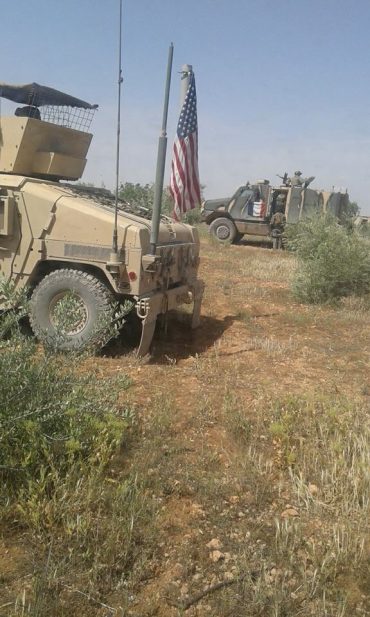 The US sent a new military convoy to the Kurdish militants’ bases in the Tal Beidar region, between the towns of Qamishli and Tal Tamr in northeastern Hasaka, the Lebanese al-Manar TV network reported.
The convoy included ten trucks full of arms and ammunition.
Local sources said that the Kurdish fighters have detained a number of civilians southwest of the town of Ra’as al-Ein in Northwestern Hasaka in order to train them in military camps.
Earlier this week, the Syrian Democratic Forces (SDF) informed Sputnik that there is a growing French military presence in the area of Manbij in Syria.
Sputnik received a photo showing two armored vehicles with military personnel in the area of the Sajur River in the territory of Manbij. One vehicle has a US flag on it, while the other has a French flag.
A senior member of the Military Council of Manbij told Sputnik that about 50 French soldiers are stationed on duty in the area. While in the north of Manbij work is currently underway to establish a French military base.
Al-Manar further confirmed the reports saying that three military vehicles under French flags had entered a Kurdish militia base in the al-Aliyeh region, south of the town of Ra’as al-Ein in northwestern Hasaka.
The network went on quoting field sources as seeing the US convoy of armored vehicles moving towards al-Shadadi from a military base north of the Khabour Dam.
Another Arabic media outlet, the Moraseloun news website, also reported today that the US Army has set up a new military base in Hasaka province, despite Donald Trump’s claims that Washington is set on withdrawing its forces from Syria.
The latest information adds to several other reports on the US’ alleged establishment of new military bases in Al-Hasakah, as well as in eastern Deir ez-Zor last month.
The US military presence in Syria has been dubbed an “aggression” by Damascus, as it has neither been approved by the government nor has it received a UN mandate.
The Warmakers
The Saker • Unz Review • May 5, 2018
Between the US strikes on Syria in April and the recent developments on the Korean Peninsula, we are in somewhat of a lull in the Empire’s search for a new war to start. The always helpful Israelis, in the person of the ineffable Bibi Netanyahu, are now beating the drums for, well, if not a war, then at least some kind of false flag or pretext to make the US strike at Iran. And then there is the always bleeding Donbass (which I won’t address in today’s analysis). So let’s see where we stand and try to guesstimate where we might be heading. To be honest, trying to guess what ignorant warmongering psychopaths might do next is by definition a futile exercise, but since there are some not negligible signs that there are at least a few rational people still left in the US White House and/or Pentagon (as shown by the mostly “pretend strikes” on Syria last month), we can assume (hope) that some residual degree of sanity is still present. At the very least Americans in uniform have to ask themselves a very basic and yet fundamental question:
Do I want to die for Israel? Do I want to lose my job for Israel? How about my pension? Maybe just my stock options? Is it worth risking a major regional war for such a “wonderful” state?
A lot depends on whether the US military leaders (and people!) will have the courage to ask themselves this question and, if they do, what their reply will be.
But, first, let’s begin with the good news:
The DPRK and ROK are in direct talks with each other.
This is indeed a truly great development for at least two reasons. First, of course, the main and objective one: anything which lowers the risks of war on the Korean Peninsula is good. But there is a second reason which we should not discount: Trump can now take all the credit for this and claim that his (empty) threats are what brought the North Koreans to the negotiating table. I say – let him. In fact, I hope that they organize a parade for Trump somewhere in the US, with confetti and millions of flags. Like for an astronaut. Let him feel triumphant, vindicated and very, very manly. MAGA, you know?!
Yeah, that will be sickening to the thinking (not to mention counter-factual), but if a little bit of intellectual nausea is the price to pay for peace, I say let’s do it. If Trump, Bolton, Haley and the rest of them can feel that they “kicked ass” and that their “invincible military” is what brought “Rocket Man” to “give up his nukes” (he never said any such thing, but never mind that) then I sincerely wish them a joyful and highly ego-pleasing celebration. Anything to stop them from looking for another war to start, at least for a now.
Now the bad news.
The Israelis are at it again
Amazing, isn’t it? The Israelis have been whining about “imminent” Iranian nukes for years [decades], and they are still at it. Not only that, but these guys have the nerve to say “Iran lied”. Seriously, even by the already unique Israeli standards, that is chutzpah elevated to a truly stratospheric level. If it were just Bibi Netanyahu, then this would be comical. But the problem is that Israel has now fully subjugated all the branches of the US government to its agents (the Neocons) and that they now run everything: from the two branches of the Uniparty to Congress, to the media and, now that Trump has abjectly caved in to all their demands, they also run the White House. They apparently also run the CIA, but there still might be some resistance to their lunacy in the Pentagon. The US is now quite literally run by a Zionist Occupation Government, no doubt about it whatsoever.
So what are these guys really up to? Listen to the one man who knows them best, and whose every single word you can take to the bank, Hezbollah General Secretary Nasrallah (ever wondered why Hezbollah, which has not committed anything even remotely looking like a terrorist attack since the 1980s is called the “A-Team of terrorists”? Just saying…):
The first event is the Israeli blatant and manifest aggression against the T-4 base or airport on the outskirts of Homs, that targeted Iranian forces from the Guardians of the Islamic Revolution of Iran who were present there, hitting them with a large number of missiles, causing 7 martyrs among its officers and soldiers and wounding others. This was a new, significant and important event. Maybe some people do not pay attention to its importance and magnitude. In this operation, Israel has deliberately killed (Iranian soldiers). This is an unprecedented event. In the past, Israel has struck us [Hezbollah] for example in Quneitra, and it turned out that coincidentally Guardians [of the Islamic Revolution] officers were with us. Israel declared hastily that they did not know it, and thought that all (targeted soldiers) were Hezbollah’s. This is an event that has no precedent since 7 years, it is unprecedented since 7 years, that Israel openly targets the Guardians of the Islamic Revolution in Syria, killing deliberately, in an operation that caused a number of martyrs and wounded (…) I want to tell the Israelis that they must know – I wrote that statement accurately and I read it to them – they must know that they have committed a historic mistake. This is not a simple blunder. They committed an act of great stupidity, and by this aggression, they entered in a direct confrontation with Iran, the Islamic Republic of Iran. And Iran, O Zionists, is not a small country, it is not a weak country, and it is not a cowardly country. And you know it very well. As a comment on this incident, I stress that it constitutes a turning point in the situation of the region. What follows will be very different from what preceded it. This is an incident that cannot be considered lightly, contrary to what happens with many incidents here. It is a turning point, a historic turning point. And when the Israelis committed this stupid act, they had some assessment (of the situation), but I tell them that their evaluation is false. And even in the future, since you have opened a new path in the confrontation, (you should ensure) not to be wrong in your evaluations. In this new path you opened and initiated, don’t be wrong in your assessment, when you are face to face, and directly (in conflict) with the Islamic Republic of Iran.
I can only agree with this evaluation. As does The Jerusalem Post, NBC News, and many others. Regardless of how crazy this notion might sound to rational people (see below), there are all the signs that the Israelis are now demanding that the US start a war against Iran, either by choice or more likely, to “stand by our Israeli allies and friends” after they attack Iran first.
Israel is truly a unique and amazing country: not only does it openly and brazenly completely ignore international law, not only is it the last overtly racist country on the planet, not only has it been perpetuating a slow-motion genocide against the Palestinians for decades, it also constantly uses its considerable propaganda resources to advocate for war. And in order to achieve these goals, it does not mind allying itself with a regime almost as despicable and evil as the Zionist one – I am talking about the Wahabi nutcases in the KSA. And all that under the high patronage of the United States. Some “Axis of Kindness” indeed!
What is their plan? Actually, it is fairly straightforward.
The Israeli plan “A” (failed)
Initially, the plan was to overthrow all the secular (Baathist) regimes in power and replace them by religious nutcases. That would not only weaken the countries infected by that spiritual rot, it would set them backwards for many decades, some of them would break up into smaller entities, Arabs and Muslims would kill each other in large numbers while the Israelis would proudly claim that they are a “western country” and the “only democracy in the Middle-East”. Even better, when the Daesh/ISIS/al-Qaeda/etc types commit atrocities on an industrial scale (and always on camera, professionally filmed, by the way), the slow-motion genocide of Palestinians would really be completely forgotten. If anything, Israel would declare itself threatened by “Islamic extremism” and, well, extend a couple of “security zones” beyond its borders (legal or otherwise), and do regular bombing runs “because Arabs only understand force” (which would get the Israelis a standing ovation from the “Christian” Zionist rednecks in the US who love the killing of any Aye-rabs and other “sand niggers”). At the end of all this, the Zionist wet dream: unleashing the Daesh forces against Hezbollah (which they fear and hate since the humiliating defeat the IDF suffered in 2006).
Now I will readily agree that this is a stupid plan. But contrary to the propaganda-induced myth, the Israelis are really not very bright. Pushy, arrogant, nasty, driven – yes. But smart? Not really. How could they not realize that overthrowing Saddam Hussein would result in Iran becoming the main player in Iraq? This is a testimony of how the Israelis always go for “quick-fix” short-term “solutions”, probably blinded by their arrogance and sense of racial superiority. Or how about their invasion of Lebanon in 2006? What in the world did they think they would achieve there? And now these folks are taking on not Hezbollah, but Iran. Hassan Nasrallah is absolutely correct, that is a truly stupid decision. But, of course, the Israelis now have a “plan B”:
The Israeli plan “B”
Step one, use your propaganda machine and infiltrated agents to re-start the myth about an Iranian military nuclear program. And never mind that the so-called “Joint Comprehensive Plan of Action” was agreed upon by all five of the UNSC Permanent Members, and Germany (P5+1) and even the European Union! And never mind that this plan places restrictions on Iran which no other country has ever had to face, especially considering that since 1970 Iran has been a member in good standing with the Nuclear Non-Proliferation Treaty (NPT) while Israel, of course, is not. But the Zionists and their Neocon groupies are, of course, quite exceptional people, so they are constrained by neither facts nor logic. If Trump says that the JCPOA is a terrible deal, then this is so. Hey, we are living in the “post-Skripal” and “post-Douma” era – if some Anglo (or Jewish) leaders say “highly likely” then it behooves everybody to show instant “solidarity” lest they are accused of “anti-Semitism” or “fringe conspiracy theories” (you know the drill). So step one is the re-ignition ex nihilo of the Iranian military nuclear program canard.
Step two is to declare that Israel is “existentially threatened” and therefore has the right to “defend itself”. But there is a problem here: the IDF simply does not have the military means to defeat the Iranians. They can strike them, hit a couple of targets, yes, but then when the Iranians (and Hezbollah) unleash a rain of missiles on Israel (and probably the KSA) the Israelis will not have the means to respond. They know that, but they also know that the Iranian counter-attack will give them the perfect pretext to scream “oy vey!! oy, gevalt!!” and let the dumb Americans fight the Iranians.
You might object that the US does not have a mutual defense treaty with Israel. You are wrong. It does, it is called AIPAC. Besides, last year the US established a permanent US military base in Israel, making it a “tripwire”: just claim that “the Ayatollahs” tried to attack the US base with “chemical weapons” and, bingo, you now have a pretext to use all your military forces in retaliation, including, by the way, your tactical nuclear forces to “disarm” the “genocidal Iranians who want to wipe Israel off the map” or some variation of this nonsense.
You might wonder what the point of all that would be if Iran does, as I say, not have any military nuclear program?
My answer would be simple: do you really think the Syrians have been using chemical weapons?!
Of course not!
All this nonsense about Saddam’s WMD, the Iranian nuclear program, the Syrian chemical weapons or, for that matter, Gaddafi’s “Viagra armed raping soldiers”, and before that the “Racak massacre” in Kosovo or the various “Markale market” atrocities in Sarajevo for that matter: these were just pretexts for aggression, nothing more.
In Iran’s case, what the Israelis fear is not that they will be “wiped off the map” (that is a mistranslation of words originally spoken by Ayatollah Khomenei) by Iranian nukes; what really freaks them out is to have a large, successful Muslim regional power like Iran openly daring to denounce Israel as an illegitimate, racist state. The Iranians are also openly denouncing the US imperialism and they are even denouncing the Wahabi dictatorship of the House of Saud. That is Iran’s real “sin”: to dare defy openly the AngloZionist Empire and be so successful at it!
So what the Israelis really want to do is:
- inflict a maximum amount of economic damage upon Iran
- punish the Iranian population for daring to support the “wrong” leaders
- overthrow the Islamic Republic (do to it what they did to Serbia)
- make an example to dissuade any other country who dares to follow in Iran’s footsteps
- prove the omnipotence of the AngloZionist Empire’s
To reach this objective, there is no need to invade Iran: a sustained cruise missile and bombing campaign will do the job (again, like in Serbia). Finally, we just have to assume that the Zionists are evil, arrogant and crazy enough to use nuclear weapons on some Iranian facilities (which they will, of course, designate as “secret military nuclear research” installations).
The Israelis hope that by making the US hit Iran really hard, they will weaken the country enough to also weaken Hezbollah and the other allies of Iran in the region sufficiently and break the so-called “Shia crescent”.
In their own way, the Israelis are not wrong when they say that Iran is an existential threat to Israel. They are just lying about the nature of this threat and why it is dangerous for them.
Consider this:
If the Islamic Republic is allowed to develop and prosper and if the Islamic Republic refuses to be terrified by Israel’s undisputed ability to massacre civilians and destroy public infrastructure, then the Islamic Republic will become an attractive alternative to the kind of repugnant Islam embodied by the House of Saud which, in turn, is the prime sponsor of all the collaborator regimes in the Middle-East from the Hariri types in Lebanon to the Palestinian Authority itself. The Israelis like their Arabs fat and corrupt to the bone, not principled and courageous. That is why Iran must, absolutely must, be hit: because Iran by its very existence threatens the linchpin upon which the survival of the Zionist entity depends: the total corruption of the Arab and Muslim leaders worldwide.
Risks with Israel’s plan “B”
Think of 2006. The Israelis had total air supremacy over Lebanon – the skies were simply uncontested. The Israelis also controlled the seas (at least until Hezbollah almost sank their Sa’ar 5-class corvette). The Israelis pounded Lebanon with everything they had, from bombs to artillery strikes, to missiles. They also engaged their very best forces, including their putatively ‘”invincible” “Golani Brigade”. And that for 33 days. And they achieved exactly *nothing*. They could not even control the town of Bint Jbeil right across the Israeli border. And now comes the best part: Hezbollah kept its most capable forces north of the Litany river so the small Hezbollah force (no more than 1,000 men) was composed of local militias supported by a much smaller number of professional cadre. That’s a 30:1 advantage in manpower for the Israelis. But the “invincible Tsahal” got it’s collective butt kicked like few have ever been kicked in history. This is why, in the Arab world, this war is since known as the “Divine Victory”.
As for Hezbollah, it continued to rain down rockets on Israel and destroy indestructible Merkava tanks right up to the last day.
There are various reports discussing the reasons for the abject failure of the IDF (see here or here), but the simple reality is this: to win a war you need capable boots on the ground, especially against an adversary who has learned how to operate without air-cover or superior firepower. Should Israel manipulate the US into attacking Iran, the exact same thing will happen: CENTCOM will establish air superiority and have an overwhelming firepower advantage over the Iranians, but other than destroying a lot of infrastructure and murdering scores of civilians, this will achieve absolutely nothing. Furthermore, Ayatollah Ali Khamenei is no Milosevic, he will not simply surrender in the hope that Uncle Sam will allow him to stay in power. The Iranians will fight, and fight, and continue to fight for weeks, and months and then possibly years. And, unlike the “Axis of Kindness” forces, the Iranians do have credible and capable “boots on the ground”, and not only in Iran, but also in Syria and Iraq and Afghanistan. And they have the missiles to reach a very large number of US military facilities across the region. And they can also not only shut down the Strait of Hormuz (which the USN would eventually be able to re-open, but only at a cost of a huge military operation on the Iranian coast), they can also strike at Saudi Arabia proper and, of course, at Israel. In fact, the Iranians have both the manpower and know-how to declare “open season” on any and all US forces in the Middle-East, and there are plenty of them, mostly very poorly defended (that imperial sense of impunity “they would not dare”).
The Iran-Iraq war lasted for eight years (1980-1988). It cost the Iranians hundreds of thousands of lives (if not more). The Iraqis had the full support of the US, the Soviet Union, France and pretty much everybody else. As for the Iranian military, it had just suffered from a traumatic revolution. The official history (meaning Wikipedia) calls the outcome a “stalemate”. Considering the odds and the circumstances, I call it a magnificent Iranian victory and a total defeat for those who wanted to overthrow the Islamic Republic (something which decades of harsh sanctions also failed to achieve, by the way).
Is there any reason at all to believe that this time around, when Iran has had almost 40 years to prepare for a full-scale AngloZionist attack the Iranians will fight less fiercely or less competently? We could also look at the actual record of the US armed forces (see Paul Craig Roberts’ superb summary here) and ask: do you think that the US, lead by the likes of Trump, Bolton or Nikki Haley will have the staying power to fight the Iranians to exhaustion (since a land invasion of Iran is out of the question)? Or this: what will happen to the world economy if the entire Middle-East blows up into a major regional war?
Now comes the scary part: both the Israelis and the Neocons always, always, double-down. The notion of cutting their losses and stopping what is a self-evidently mistaken policy is simply beyond them. Their arrogance simply cannot survive even the appearance of having made a mistake (remember how both Dubya and Olmert declared that they had won against Hezbollah in 2006?). As soon as Trump and Netanyahu realize that they did something really fantastically stupid and as soon as they run out of their usual options (missile and airstrikes first, then terrorizing the civilian population) they will have a stark and simple choice: admit defeat or use nukes.
Which one do you think they will choose?
Exactly.
Going nuclear?
Here is the paradox: in purely military terms, using nukes on Iran will serve no pragmatic purpose. Nuclear weapons can be used in one of two ways: against military assets (“counterforce”) or against civilians (“countervalue”). The point is that by the time the Neocons and their Israeli patrons come to the point of considering using tactical nuclear forces against the Iranians, there won’t be a good target to hit. Iranian forces will be dispersed and mostly in contact with allied (or even US forces) and nuking an Iranian battalion or even a division won’t fundamentally alter the military equation. As for nuking Iranian cities just out of savagery, this will only serve one purpose: to truly get Israel wiped off the map of the Middle-East. I would not put it past the Neocons and their Israeli bosses to try to use a tactical nuclear weapon to destroy some Iranian civilian nuclear facility or some underground bunker with the very mistaken hope that such a show of force and determination will force the Iranians to submit to the AngloZionist Empire. In reality, this will only infuriate the Iranians and strengthen their resolve.
As for the currently “macronesque” Europeans, they will, of course, first show “solidarity” on the basis of “highly likely”, especially Poland, the Ukies and the Baltic statelets, but if nuclear weapons start going off in the Middle-East, then the European public opinion will explode, especially in Mediterranean countries, and this might just trigger yet another major crisis. Israel wouldn’t give a damn (or, as always, blame it all on some totally mysterious resurgence of anti-Semitism), but the US most definitely does not want the Anglo grip on the continent compromised by such events.
Maybe a Korean scenario?
Is there a chance that all the huffing and puffing will result in some kind of peaceful resolution as what seems to be in the works in Korea? Alas, probably not.
A few months ago it sure looked like the US might do something irreparably stupid in Korea (see here and here) but then something most unexpected happened: the South Koreans, fully realizing the insanity of Trump’s reckless threats, took the situation in their own hands and began making overtures to the North. Plus all the rest of the regional neighbors emphatically and clearly told Trump & Co. that the consequences of a US attack on the DPRK would be apocalyptic for the entire region. Alas, there are two fundamental differences between the Korean Peninsula and the Middle-East:
- On the Korean Peninsula, the local US ally (the ROK) does not want war. In the Middle-East it is the local US ally (Israel) which pushes the hardest for a war.
- In Far-East Asia all the regional neighbors were and are categorically opposed to war. In the Middle-East most regional neighbors are sold out to the Saudis who also want the US to attack Iran.
So while the risks and consequences of a conflagration are similar between the two regions, the local geopolitical dynamics are completely different?
What about Russia in all this?
Russia will never *choose* to go to war with the US. But Russia also understands that Iran’s security and safety is absolutely crucial to her own security, especially along her southern borders. Right now there is a fragile equilibrium of sorts between the (also very powerful) Zionist lobby in Russia and the national/patriotic elements. In truth, the recent Israeli attacks in Syria have given more power to the anti-Zionist elements in Russia, hence all the talk about (finally!) delivering the S-300s to Syria. Well, we will see if/when that happens. My best guesstimate is that it might already have happened and that this is simply kept quiet to restrain both the Americans and the Israelis who have no way of knowing what equipment the Russians have already delivered, where it is located or, for that matter, who (Russians or Syrians) actually operate it. This kind of ambiguity is useful to placate the pro-Zionist forces in Russia and to complicate AngloZionist planning. But maybe this is my wishful thinking, and maybe the Russians have not delivered the S-300s yet or, if they have, maybe these are the (not very useful) S-300P early models (as opposed to the S-300PMU-2 which would present a huge risk to the Israelis).
The relationship between Russia and Israel is a very complex one (see here and here), but if Iran is attacked I fully expect the Russians, especially the military, to back Iran and provide military assistance short of overtly engaging US/Israeli/NATO/CENTCOM forces. If the Russians are directly attacked in Syria (and in the context of a wider war, they very well might be), then Russia will counter-attack regardless of who the attacker is, the US or Israel or anybody else: the Zionist lobby in Russia does not have the power to impose a “Liberty-like event” on the Russian public opinion).
Conclusion: Accursed are the warmakers, for they shall be called the children of Satan
The Israelis can eat falafel, create “Israeli kufiyeh” and fancy themselves as “orientals”, but the reality is that the creation of the state of Israel is a curse on the entire Middle-East to which has only brought untold suffering, brutality, corruption and wars, wars and more wars. And they are still at it – doing all they can to trigger a large regional war in which many tens or even hundreds of innocent people will die. The people of the US have now allowed a dangerous cabal of psychopathic Neocons to fully take control of their country and now those, who Papa Bush used to call the “crazies in the basement” have their finger on the nuclear button. So now it all boils down to the questions I opened this article with:
Dear US Americans – do you want to die for Israel? Do you want to lose your job for Israel? How about your pension? Maybe just your stock options? Because make no mistake, the US Empire will not survive a full-scale war against Iran. Why? Because all Iran needs to do to “win” is not to lose, i.e. to survive. Even bombed out and scorched by conventional or nuclear strikes, if Iran comes out of this war still as an Islamic Republic (and that is not something bombs or missiles will change) then Iran will have won. In contrast, for the Empire, the failure to bring Iran to its knees will mean the end of its status as the world Hegemon defeated not by a nuclear superpower, but by a regional conventional power. After that, it will just be a matter of time before the inevitable domino effect breaks up the entire Empire (check out Richard Greer’s excellent book “Twilight’s Last Gleaming” for a very plausible account on how that could happen)
Okay, unlike Russia, Iran cannot nuke the US or, for that matter, even reach it with conventional weapons (I don’t even think that the Iranians will successfully attack a US carrier as some pro-Iranian analysts say). But the political and economic consequences of a full-scale war in the Middle-East will be felt throughout the United States: right now the only thing “backing” the US dollar, so to speak, are USN aircraft carriers and their ability to blow to smithereens any country daring to disobey Uncle Sam. The fact that these carriers are (and, truly, have been for a long while) useless against the USSR and Russia is bad enough, but if it becomes known urbi et orbi that they are also useless against a conventional regional power like Iran, then that’s it, show over. The dollar will turn into monopoly money in a very short span of time.
Wars often have “Nietzschean consequences”: countries which wars don’t destroy often come out even stronger than before they were attacked, even if it is at a horrendous price. Both the Israelis and the Neocons are too dialectically illiterate to realize that by their actions they are just creating increasingly more powerful enemies. The old Anglo guard which ran the US since its foundation was probably wiser, possibly because it was better educated and more aware of the painful lessons learned by the British (and other) Empire(s).
Frankly, I hope that the ruling 1%ers running the US today (well, they are really much less than 1%, but never mind that) will care about their wealth and money more than they care about appeasing the Neocons and that the bad old Anglo imperialists who built this country will have enough greed in themselves to tell the Neocons and their Israeli patrons to get lost. But with the Neocons controlling both wings of the Uniparty and the media, I am not very hopeful.
Still, there is a chance that, like in Korea, somebody somewhere will say or do the right thing, and that awed by the potential magnitude of what they are about to trigger, enough people in the US military will follow the example of Admiral William Fallon and CENTCOM commander at the time who told the President “an attack on Iran will not happen on my watch”. I believe for his principled courage, the words of Christ “Blessed are the peacemakers: for they shall be called the children of God” (Matt 5:9) can be applied to Admiral Fallon and I hope that his example will inspire others.
McCain Calls on US to Retaliate With Cyberattack on Russia to Embarrass Putin
Sputnik | May 3, 2018
According to Senator John McCain, America should consider a cyberattack against President Vladimir Putin to retaliate for Moscow’s alleged interference into the 2016 US presidential election in order to send a message to Russia.
In his upcoming book, entitled “The Restless Wave,” McCain has touched upon the allegations that the Kremlin could have so-called “kompromat” [compromising material] on President Donald Trump, as well as Russia’s alleged meddling in the 2016 presidential election in the United States – an accusation, which Moscow has consistently repudiated.
“I’m of the opinion that unless [Russian President Vladimir] Putin is made to regret his decision he will return to the scene of the crime again and again,” McCain wrote, adding that in order “to make Putin deeply regret his assault on the foundation of our democracy – free and fair elections – we should seriously consider retaliating with the kinds of weapons he used. We have cyber capabilities too. They should be used to expose the epic scale of his regime’s corruption or to embarrass [Putin] in other ways.”
Senator McCain went on to call on the United States to take an offensive stance in the information war with Russia, being very critical of Trump’s perception of Moscow as a potential ally.
“[Putin] never was, he is not now and never will be our partner. He sees evidence of his success every day in our polarization and gridlock,” he elaborated.
In the meantime, he wrote that he was quite skeptical that the sitting president or his aides had colluded with the Kremlin during the 2016 election.
“And I certainly did not want to believe that the Kremlin could have acquired kompromat on an American President.”
The 81-year-old McCain has used his book to dismiss the “Russia hater” label, on a previous occasion the Kremlin described his attitude towards Moscow as a “maniacal hatred towards our country.”
McCain has consistently hurled obscenities at President Putin, coming up with such epithets as “butcher,” a “thug,” a “killer,” a “KGB agent,” an “evil man,” and even called him a greater threat to the United States than Daesh.
In March, the senator lashed out at President Trump for a phone conversation with his Russian counterpart, in which POTUS congratulated Putin following his election win. Previously, McCain had accused the Trump Administration of “playing right into the hands of Vladimir Putin.”
READ MORE:
McCain Supports Strikes on Syria, Urges New Strategy for US in Syria
US Testing Newest B61 Nuclear Gravity Bomb
Sputnik – May 2, 2018
The US Air Force has conducted more than two dozen engineering, development and guided flight tests of the new B61-12 guided nuclear gravity bomb, a US Air Force general said May 1.
The service has “already conducted 26 engineering, development and guided flight tests,” Lt. Gen. Jack Weinstein told Military.com, adding that the program was “doing extremely well.” The new version of the B61 gravity bomb is said to be more than three times more accurate than its predecessors, according to the news outlet.
The 12th version of the B61 bomb, originally designed in 1963, will have a new capability that its cousins don’t: underground penetration so it can strike fortified command and control centers. Its explosive yield is estimated at 50 kilotons, or roughly four times the power of the bomb the US used to destroy the Japanese city of Nagasaki in August 1945.
The B-2 Spirit and eventually the B-2’s companion stealth bomber, the futuristic B-21 Raider, will carry the gravity nuke.
Service officials are working to integrate the B-61 gravity bomb with the F-35 Lightning II, as documented in the latest US nuclear posture review. In 2015, the aircraft flew with a B61-12 to test how it would vibrate in the aircraft’s internal weapons bay.
The nuclear posture review also calls for modernizing the air-launched cruise missile and intercontinental ballistic missile components of the nuclear triad. Right now, the US nuclear triad consists of the submarine-launched ballistic missiles, strategic bombers — which carry both gravity bombs and cruise missiles — and land-based intercontinental ballistic missiles.
The B-52, F-16 and F-15 are also capable of carrying nuclear payloads, though it is unclear if the service will put the latest B61-12 nuclear weapon on these older legacy aircraft.
Yemen conflict: Secret documents suggest 7,000 UK personnel may be complicit in Saudi slaughter

House destroyed in airstrikes in Sanaa, Yemen, on April 19, 2018. © Mohammed Dhari / Global Look Press
RT | May 2, 2018
To what extent is the UK aiding the Saudi intervention in Yemen? A new report suggests help is more hands-on than just defense deals.
Never seen before documents published as part of a new paper titled ‘UK Personnel Supporting the Saudi Armed Forces – Risk, Knowledge and Accountability’, suggest that some of the functions carried out by British personnel and arms companies in the Gulf kingdom may be more than what the Government is willing to admit.
According to the report, British arms deals to Saudi Arabia dating back to to 1985 have contained secret support clauses for British-made aircraft which tie British contractor and government personnel to Saudi military action, even if the UK is not itself involved directly.
These aircraft, namely Panavia Tornado and Eurofighter Typhoon fighters, have been conducting continuous airstrikes against targets in Yemen since the country erupted into civil war in 2015, with strong claims made by human rights organizations that war crimes are being conducted, including the use of cluster munitions.
A recent strike, on April 23, hit a wedding party where 20 civilians were killed. Since the Saudi-led intervention began and the end of 2017, some 5,500 civilians have been killed with over 9,000 injured, according to the UN. The country’s infrastructure has completely collapsed.
In December last year, the European Parliament adopted a resolution to suspend arms sales to the country on the back of these alleged charges.
Based on two years of interviews with former staff by Mike Lewis and Karen Templar, with support from the Joseph Rowntree Charitable Trust, the paper is part of a wider ‘Brits Abroad’ project which examines the role of UK nationals operating outside the UK to contribute military and security services in armed conflicts.
While Whitehall has maintained that UK personnel currently stationed in Saudi Arabia have been away from any frontline roles including the targeting or weaponizing of British-made aircraft used in Yemen, terms contained in secret government-to-government contracts dating from 1986 still dictate British help to the Royal Saudi Air Force when the kingdom is at war.
The report puts the UK’s human ‘footprint’ at approximately 7,000 UK contractors, UK civil servants and seconded UK military personnel.
Al-Yamamah & Al-Salam
Attached to 1985’s infamous Al-Yamamah arms deal, which included the purchase of 72 Tornado fighter aircraft, a Memorandum of Understanding (MoU) signed by both nations contains assurances that London’s support of the aircraft would continue “as long as the program lasts.”
Another 48 Tornado were added in 1993, and support was extended again under the Saudi British Defence Cooperation Programme (SBDCP) from 2006 onwards.
In 2005, the Al-Salam arms deal covered the delivery of 72 Typhoon fighter aircraft – built by the Eurofighter consortium which includes British firm BAE Systems – and came with a full support package.
From the Gulf War to Yemen
During the first Gulf War in 1990, BAE employees in Dhahran – now King Abdulaziz Air Base – directly maintained and loaded weapons for both RAF and RSAF Tornado aircraft. One former BAE Crew Chief at Dhahran, quoted in the report, claimed to the UK Ministry of Defence that “it was left up to literally a handful of us experienced ex-RAF personnel to direct combat ground operations” during the conflict.
Since then, BAE have been more reluctant to give such support to Saudi military excursions that does not directly involve the British military. In 2008 it issued a “pullback” from direct handling of cluster munitions in 2008, followed in 2009/10 with resigning from directly operational roles in squadrons engaged in active combat upon the start of Riyadh’s offensive in Yemen.
However, this “pullback”, British expats who worked as armorers and technicians claim, remained incomplete and British staff were still expected to carry out armoring tasks of aircraft and support ground activities.
Others took on maintenance and weapons management functions during night-shifts and back-shifts, furthering the blurring of advisory and operational roles, while others, there to train Saudi maintenance crew, took on deep maintenance of warplanes involved in strikes against Houthi rebels when Saudi staff were too few or off shift.
As recent as February 2017, job specifications released by BAE show that its employees “continue to be responsible for coordinating maintenance for the weapons systems of all RSAF’s Tornados, both in training and operational squadrons, and including those deployed to Forward Operating Bases.”
Israel ‘only state in Middle East that actually has nukes’: Analysts denounce Bibi’s Iran WMD claim
RT | May 1, 2018
Israeli PM Benjamin Netanyahu is the wrong person to accuse Iran of seeking nuclear weapons as his country has repeatedly refused to join any non-proliferation treaties which equates it to North Korea, Middle East experts told RT.
Israel and its PM “are in no position to accuse Iran of anything, they’re not part of the nuclear deal, they’re not even a member [of the Nuclear Proliferation Treaty],” said Hamed Mousavi, Professor of Political Science at the University of Tehran.
The analyst then commented on Netanyahu’s well-rehearsed Monday show, in which he claimed Israel has incriminating evidence that Iran is pursuing a nuclear program in violation of the milestone 2015 deal. He noted the only entity in the world authorized to declare Iranian compliance or non-compliance with the 2015 nuclear deal is the UN’s International Atomic Energy Agency (IAEA).
Mousavi went further, saying Netanyahu was “a serial liar,” also citing a 2011 microphone leak incident, in which former French President Nicolas Sarkozy reportedly spoke lowly of the Israeli premier.
“I can’t stand him,” he told Barack Obama, in what was believed to be a confidential discussion. The Frenchman also accused Netanyahu of constantly lying. Obama’s reply was: “You’re fed up with him, but I have to deal with him every day!”
“And we also have to remember the timing, I mean, this is coming less than two weeks before Trump makes a decision regarding if the United States wants to stay in the deal,” the expert said, noting that “Israel is the only regime in the region that actually has nuclear weapons.”
Israel is believed to possess nuclear weapons, though its officials have never officially denied nor admitted to having weapons of mass destruction. On the latest occasion, nuclear weapon proliferation experts Robert S. Norris and Hans M. Kristensen claimed in the renowned Bulletin of the Atomic Scientists back in 2013 that the Jewish state stopped producing nuclear warheads back in 2004 once it reached around 80 projectiles.
However, the country can easily double its arsenal since it has enough fissile material to build at least another 115 munitions, experts say.
In Mousavi’s view, if Donald Trump decides to come out of the nuclear accord, it would kill the deal. Iran could not afford complying with it because of US threats to sanction any company – not only American ones – that do business with the Islamic Republic. “And I think this is what Israel wants,” he concluded.
Dr. Maged Botros, Head of Political Science department at Helwan University in Egypt, emphasized that Netanyahu “repeatedly refused to sign the Nonproliferation Treaty,” which puts it “in the same position as North Korea.”
Netanyahu’s presentation has been “a setup for [US President Donald] Trump,” Botros said, suggesting the Israeli allegations could be a solution for the US President to throw away the 2015 deal.
The Egyptian expert recalled former US State Secretary Colin Powell, who claimed back in 2003 that Iraq had weapons of mass destruction. “It proved to be false, now the history repeats itself,” he said.
North Korea accused Israel of having a nuclear arsenal last year, calling it a threat to peace in the Middle East. “Israel is the only illegal possessor of nukes in the Middle East under the patronage of the US. However, Israel vociferated about the nuclear deterrence of the DPRK, slandering it, whenever an opportunity presented itself,” the Foreign Ministry said at the time.
Read more:
‘Infamous liar’: Iran blasts Netanyahu for claims Tehran had nuclear weapons program
Featured Video
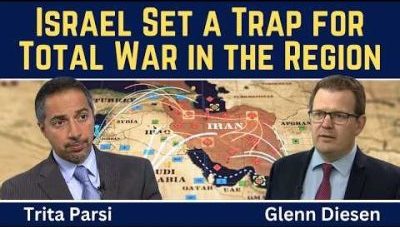
Trita Parsi: Israel Set a Trap for Total War in the Region
or go to
Aletho News Archives – Video-Images
From the Archive
Zionism’s Violent Legacy
By Donald Neff | Washington Report On Middle East Affairs | January 1996
On January 4, 1948, Jewish terrorists drove a truck loaded with explosives into the center of the all Arab city of Jaffa and detonated it, killing 26 and wounding around 100 Palestinian men, women and children.[1] The attack was the work of the Irgun Zvai Leumi – the “National Military Organization,” also known by the Hebrew letters Etzel – the largest Jewish terrorist group in Palestine. The Irgun was headed by Revisionist Zionist Menachem Begin and had been killing and maiming Arabs, Britons and even Jews for the previous ten years in its efforts to establish a Jewish state.
This terror campaign meant that at the core of Revisionist Zionism there existed a philosophical embrace of violence. … continue
Blog Roll
 Aletho News
- Trita Parsi: Israel Set a Trap for Total War in the Region
- Trump’s Iran war is on an Israeli leash
- Saudi oil boss issues global supply warning
- Riyadh Says Its Oil System Is Intact. The Numbers Say Otherwise.
- Trump and Netanyahu Want to “Finish the Job” on Iran
- US ‘one-sided dictation’ not Iran’s beliefs makes rational talks impossible: Baghaei
- Iran’s Next Strike May Not Explode. It Could Shut You Down /Col Doug Macgregor
- Iran: US political targets legitimate if assassinations return
- Iraq shuts key border crossing with Iran under US pressure: Report
- Undersea Internet cables could be targeted in retaliation for attacks on Iran: IRGC deputy chief
- If Americans Knew
- The Israel Lobby’s Changing Fortunes
- AIPAC has become such a political liability that it’s shifting to a more “nimble” approach to buying politicians
- At least 160 Israeli settler attacks in 2 weeks
- Will Gaza’s Ancient Christian Community Disappear Forever?
- Israel’s vision of regional security rests on keeping Arab states weak
- Heidi Levine recounts how Palestinian youths helped save her in settler attack
- DAILY UPDATE: Latest essential news on Palestine, Israel, & region
- Trump’s Intensifying Sabotage of the ICC, for Israel’s Sake
- Israeli military detain US and UK volunteers in West Bank including Democratic NY politician Brad Lander
- Americans at National Conservatism Conference held in Israel this year criticize Israel
- No Tricks Zone
- E-Cars Reduce CO2 Emissions By Only 41% Compared To Internal Combustion Engine Vehicles
- Predictions Made By Renowned Climate Professor Over Past Decades Have Been Proven To Be Poor
- New Study Suggests Large Regions Of The Pacific Ocean Have Been Cooling For The Last 80 Years
- Germany’s Green Energy Debacle: High Energy Costs Force Kahla Porzellan to Close After 182 Years!
- New Study: 50 Years Of The Most Aggressive ‘Net Zero’ Policies Can Only Affect The Global Climate By 0.03°C
- US September “Heat” Was No Record…Many Records Set Decades Ago
- Latest European Green Energy Debacle; Portugal’s Largest Flagship Solar Park Insolvent!
- Green Energy Debacle: German Expert Professor Fritz Vahrenholt Warns Of Severe Economic And Social Consequences
- Two More Paleo Reconstructions Affirm Meters-Higher Sea Levels Across Ireland, Brazil 7000-6000 Years Ago
- New Study: Earth And Venus Surface Warmth Largely Explained By Convection And Lapse Rate, Not CO2 Or Radiation

