New War in the Middle East? – Washington Is Dancing To the Tune Being Played by Israel
By Philip Giraldi | American Herald Tribune | February 12, 2018
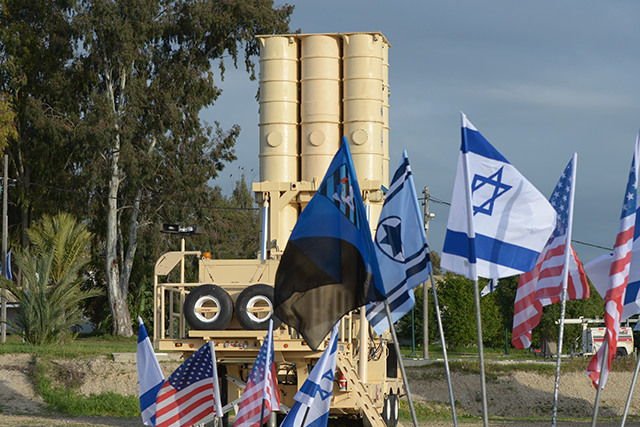
How many Americans are aware that every two years the United States military engages in large scale exercises with the Israeli Defense Forces that simulate wars against Israel’s neighbors? Three thousand American soldiers are in Israel right now involved in maneuvers that are focused on countering a missile attack from Lebanon. When the exercise, known as Juniper Cobra, was run in 2016 the U.S. commander Lt. Gen. Timothy Ray, who appeared to confuse American national security with that of a small Middle Eastern state, described it as the European Command’s “highest priority” drill that year. He then added that “this exercise increases our military readiness, but just as importantly it also signals our resolve to support Israel.”
Ironically, Lebanon has an army of its own that is in part financially and logistically supported by Washington, though not at the level that the U.S. supports Israel, which means that the U.S. is participating in war games that pit one friendly country and military aid recipient against another. Israel has warned that in any future conflict it will target the Lebanese Army equally with Hezbollah as both are “enemies.”
The truly most interesting aspects of the current exercises in Israel is that the United States has never had any formal alliance with Israel and has absolutely no national interest in becoming involved in Israel’s wars at all. The assumption that the U.S. might be called upon to help defend Israel is not based on any strategic reality, which is not to say it might not happen if Congress and the White House have their way, but it would likely be a double war of aggression, with Israel attacking the militarily much weaker Lebanese followed by the United States weighing in to finish the job after Hezbollah tries to fight back with its batteries of rockets.
That Washington is the Israeli poodle in the current situation is made clear by the recent opening of the first U.S. military base in Israel. It is described as a base within a base as it is completely contained by an Israeli air force installation and operates “under Israeli military directives.” It has no function in support of U.S. regional interests but is instead a shell headquarters with limited support facilities that can be ramped up considerably if Israel goes to war and calls for American assistance. Together with billions of dollars-worth of U.S. military equipment that is pre-positioned in Israel and can be used by the Israelis as needed, it is all about supporting Israeli war-making and has nothing to do with American security or defense interests.
Maneuvers are supposed to simulate possible future military actions, bloodless battles that provide lessons learned for future engagements, suggesting that some genius in the Pentagon who initiated these biennial exercises under George W. Bush, expects American soldiers to assist in the Israeli mission to remake the Middle East in their favor. Pentagon number two Paul Wolfowitz, who had an unseemly close relationship with Israeli military visitors, comes to mind as a possible candidate.
Israel has actually been planning to invade Lebanon. Last September it held its largest military exercise in over twenty years around the theme of a ground invasion of Lebanon. Israeli soldiers even dressed as Hezbollah militiamen as part of the training. There have been repeated warnings by Israeli government officials that there are several red lines that will bring about an Israeli attack, to include evidence that Iran is aiding the development of sophisticated “missile plants” in either Lebanon or Syria. The evidence for such plants is otherwise reported to be apocryphal or perhaps even fabricated, known only to Israeli intelligence, but they should perhaps be seen as a pretext for war and not necessarily based on fact.
Apart from having no compelling interest to get involved in the latest round of bloodletting, the U.S. would be well advised to keep its distance from Benjamin Netanyahu’s schemes to destroy Hezbollah’s power as crushing Lebanon would produce the same kind of regional catastrophe as did the U.S. led Iraq invasion of 2003. Israel’s Minister of Transportation Ysrael Katz recently warned that Lebanon will be “razed to the ground” and “returned to the stone age” if Hezbollah proves able and willing to fire any missiles at Israel.
Israel is itching for a fight and working hard to get Washington involved, not a difficult task given the belligerent proclivities of those who gather to discuss national security strategy in the White House. Viewing Israel’s recent actions relating to Gaza, Lebanon and Syria, it is clear that Netanyahu’s government is the aggressor and is both willing and able to destabilize the entire region without any regard for what happens next. It has already warned that its expected conflict with Lebanon will also involve Syria and that the ultimate target is to eliminate Iranian influence in the area.
Bombings of neighboring Syria by Israeli aircraft have also intensified, leading to the shooting down of an Israeli jet by Syrian air defense forces. The U.S. media covered the story but largely ignored the fact that Netanyahu has launched hundreds of airstrikes against a country with which it is not at war, again using the false claim that Israel is acting defensively and it is Iran that is doing the “interfering.” Of course, the United States in Syria has done much the same thing, lying about developments before setting up an ambush last week that killed 100 Syrian soldiers.
That Washington is dancing to the tune being played by Israel to dismember the Middle East makes the American government an accomplice when the war actually does break out. And it will undoubtedly also have to do much of the fighting. That the United States appears to be committed to defend Israel, even if Israel starts the war, is deplorable and is particularly so as there is no reciprocity. Israel has never fought side-by-side with the United States and if Washington actually finds itself in a situation where it needs Israeli military assistance or support don’t count on it.
*(Juniper Cobra 2016. Image credit: Israel Defense Forces/ flickr)
Seoul won’t rush to renew joint military drills with US as new intra-Korean summit solidifies
RT | February 10, 2018
South Korean President Moon Jae-in reportedly rejected a call from Japan to quickly resume joint US-Korean military drills. Moon has been invited to visit Pyongyang for what may become the first top-level summit in over a decade.
At a bilateral summit on Friday, Moon called on the Japanese Prime Minister Shinzo Abe to wait before resuming the drills, Yonhap reported, citing a government official. The drills have been paused for the duration of the Winter Olympics, as part of Seoul’s attempt to mend relations with Pyongyang. North Korea considers the drills a major threat to its national security, saying they may be used to conceal a build-up for an invasion.
According to the report, Abe argued that the time to delay exercises scheduled for spring was not right and that Pyongyang had to change its behavior before receiving concessions.
“I understand what Prime Minister Abe said is not to delay South Korea-U.S. military drills until there is progress in the denuclearization of North Korea. But the issue is about our sovereignty and intervention in our domestic affairs,” Moon told the Japanese leader, according to the unnamed official. “The president said it was not appropriate for the prime minister to directly mention the issue.”
North Korea’s successful development last year of a ballistic missile, which is apparently capable of reaching the US mainland, as well as carrying a small thermonuclear device, triggered a major security crisis on the Korean Peninsula. As US President Donald Trump threatened to use military force to destroy Pyongyang’s nuclear capabilities, a new left-wing government in Seoul took several symbolic steps to deflate the tension, including agreeing to have a joint athletic delegation with North Korea at the Olympics.
This week, Moon received an invitation from his northern counterpart, Kim Jong-un to visit Pyongyang for a top-level summit. If accepted, it would be the first diplomatic event of its kind since 2007, when the government of President Roh Moo-hyun in Seoul attempted to mend relations as part of the Sunshine Policy.
Roh’s successor, Lee Myung-bak, came from the other side of the political spectrum and took a hardline stance on intra-Korean relations, as did President Park Geun-hye, who came from the same conservative camp. After Park was impeached, Moon was elected partially on the promise of reviving the Sunshine Policy.
What’s really behind America’s objections to Trump’s military parade
By Finian Cunningham | RT | February 9, 2018
President Donald Trump’s plan to stage a mega military parade in the American capital provoked a broad swath of opposition, from conservatives and liberals alike.
Part of the objection, however, seems to stem from an unspoken embarrassment – that such a military display shatters American democratic pretensions, at home and around the world.
Surprisingly for a nation that repeatedly boasts about having the most powerful military force on the planet – and, indeed, ever in the whole of recorded history – there was scant enthusiasm this week for Trump’s reported proposal for a full-scale military parade to be held later this year along Washington DC’s Pennsylvania Avenue.
Planning details are still in the works for the proposed event, which is only being sketchily discussed at this time, and may not even materialize.
Trump is said to have been wowed by the military procession he attended in Paris last July on France’s annual Bastille Day. Ever since then the American president has been prodding his aides to stage a similar martial spectacle in the US.
America’s Independence Day on July 4 or Veterans Day on November 11 have been suggested as possible dates to hold the event, which would see columns of troops and weapons filing down the iconic avenue stretching from the Congressional government building on Capitol Hill and the president’s White House residence.
The New York Times reported with a tone of misgiving: “Tanks, jets and other killing machines painted olive-drab and tan could be rolling the routes of the nation’s capital later this year for a peacetime parade inspired by President Trump.”
But, it added: “Few lawmakers – if any – said they loved the idea of Mr Trump’s parade. Some shrugged it off. Others called it undemocratic. Many lamented the use of the military’s time and money.”
Politico reported: “Trump’s military parade draws bipartisan rebuke.” It said lawmakers on both sides of the aisle decried such an event as “a break with democratic traditions.”
Senior Democrat Representative Adam Smith is quoted as saying: “A military parade of this kind would also be a departure from the values of our constitutional democracy. A military parade like this – one that is unduly focused on a single person – is what authoritarian regimes do, not democracies.”
Other commentators focused their objections on what they said was such an event pandering to Trump’s notoriously outsized ego.
CNN pundit Chris Cillizza said: “Of course Trump wants a big shiny parade… Bigger is always better in Trump’s world. And might usually makes right. He with the biggest toys wins.”
A Washington Post commentary said that Trump’s penchant for pomp and grandiose ceremony makes him a sucker for “the sort of martial display these days more associated with single-party states and irredentist autocrats.”
Republican Senator Lindsey Graham, who is well connected to the military establishment and often espouses hawkish militarist foreign policy, seemed uncharacteristically coy about the parade idea. He said: “I’m not looking for a Soviet-style hardware display. That’s not who we are. It’s kind of cheesy. I think it shows weakness, quite frankly.”
Politico, again, added: “Two Democratic military veterans in Congress – Reps Ruben Gallego of Arizona and Ted Lieu of California – wrote Defense Secretary James Mattis in a letter Wednesday that just because authoritarian regimes like Russia and North Korea hold massive military parades does not mean that we must as well.”
Some of the public’s opposition appeared to be genuinely based on sound practical reasons.
Military Times, a US publication, cited a survey it conducted among its readers showing that nearly 90 percent of them were against Trump’s idea. They reportedly objected because, they said, it was “a waste of money” or because “our troops are too busy” to participate in such a large-scale spectacle, one which presumably would take a lot of logistical planning and funding to organize.
Nevertheless, what seems to be concerning many among the political establishment is the overt American militarism that such an event would reveal.
Reading between the lines, the stated concerns from politicians and media commentators about maintaining the form of “constitutional democracy” and not being associated with “authoritarianism” are not, one discerns, primarily motivated by genuine constitutional democratic principles. Rather the unspoken concern is the embarrassment about what such a major military display in Washington DC would reveal – the fact that the United States is a massively militarized state.
It is true that big centralized military spectacles are rather rare in the US. Commentators noted that the last event of this kind that took place in Washington DC was nearly 27 years ago, back in the summer of 1991, when then President George Bush Sr held a “victory march” following the First Gulf War against Iraq.
Nonetheless, it can be fairly remarked that military culture is rife across the US in myriad daily and weekly events, from school assemblies saluting the national flag, to veterans marching through every small town jamboree, to fighter jet flyovers at football games.
Arguably, why the military in the US does not participate in annual showpieces in the capital is for the tacit reason of trying to maintain a public appearance of a constitutional democracy amid such rampant militarism endemic to its society. A big display of the kind that Trump is proposing is an awkward demonstration of just how militarized American society is.
The irony over the past week is that while many lawmakers and media outlets were squirming over Trump’s gaudy military plans, the US Congress just voted through a Budget Bill for an extra $160 billion spend on the military. The final military budget comes to some $700 billion and represents over half of the total annual federal spend.
Republican and Democrat lawmakers are wrangling over financial cuts to public services and welfare, nearly shutting down the government again from the impasse. But, evidently, politicians of all stripes, whether conservative or liberal, have no problem whatsoever about splurging $700 billion on military. That expenditure is said to be the highest level ever – exceeding even the heights of the Cold War.
This gargantuan year-on-year allocation of economic resources by the US – greater than the combined expenditure of the world’s next 10 biggest military powers, including Russia and China – is a stupendous testimony to the hyper-militarized state that is the US.
It is a self-evident corollary that the grotesque militarization of the American economy is its permanent waging of overseas wars and bellicose foreign policy.
No other nation comes close to the record of American war-making around the planet. Currently, US forces are bombing seven countries simultaneously, including Syria, Afghanistan and Iraq. Over the past quarter decade since its “victory parade” in Washington DC for President Bush Sr, over a million people have been killed in American wars, and a litany of countries have been reduced to rubble or “failed states.”
The real reason why Trump’s plan for a military parade is causing such discomfit among the political class is this: they know the spectacle will only serve to illustrate starkly to the American public and the rest of the world that the United States is a rogue military regime.
France to spend $33bn on upgrading nukes to meet NATO commitments
Press TV – February 9, 2018
France is planning to spend $33 billion (€27bn) to upgrade its arsenal of nuclear weapons as part of a massive $370 billion (€300bn) military spending over the next few years to meet the NATO military alliance’s requirements, the French defense chief has announced.
Speaking to the media on Thursday, French Defense Minister Florence Parly said Paris wanted to increase its military budget so that it can “hold its own” as a key power in Europe.
“The government’s goal is twofold: reach the target of spending two percent of GDP on defense by 2025, while also ensuring we manage our public finances,” Parly said.
France spends $42 billion (€34bn) or 1.8 percent of its GDP for military purposes, slightly less than the two-percent threshold set by NATO.
Under the new plan, President Emmanuel Macron’s government increases overall spending by $2 billion (€1.7bn) a year starting from 2019 until 2022, when it will reach $53 billion (€44bn). Then the budget would be bumped up by $3.6 billion (€3bn) a year between 2023 and 2025.
By then, Paris is supposed to have completed the expensive revamp of its nuclear arsenal, with work on a third-generation nuclear submarine program and a new generation of airborne nuclear missiles already underway today.
“We are going to make up for past shortfalls and build a modern, sustainable, protective army” that would allow France “to hold its own,” said Parly.
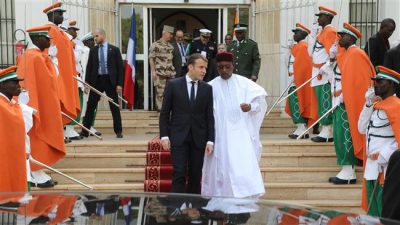 French military forces are currently deployed to West Africa on a declared mission to fight militant groups.
The French president says the country is ready to enhance its military presence in the Sahel region if needed.
The country is also a main contributor to a US-led coalition that has been targeting alleged terrorist positions in Iraq and Syria since 2015.
The years-long operations have put strain on France’s military forces and equipment.
With thousands of troops overseas, the new program allows the defense department to perform a host of upgrades on equipment, from bullet-proof vests to combat uniforms.
There will also be a 34-percent increase in spending on “modernizing weaponry,” which includes buying new Scorpion armored vehicles, four Barracuda attack submarines and three multi-mission frigates, as well as a new fleet of Griffon multi-role armored vehicles.
There are also plans to develop new spy satellites, light surveillance aircraft, new Rafale fighter jets and armed drones. Air tankers are also on the long list of upgrades.
The development is a major reversal in France’s military strategy over the past years and is expected to please US President Donald Trump, who has put NATO allies under pressure to increase their military budgets.
Afghanistan War Spending, In 2018 Alone, Could End US Homelessness—TWICE
While the United States government spends $45 billion on the 17th year of the Afghanistan War, it ignores the fact that just half of that money could be used to virtually end homelessness in the U.S. annually.
By Rachel Blevins | Free Thought Project | February 7, 2018
Defense Department officials are claiming that the cost of the United States’ longest war in history will be $45 billion in 2018, which is actually double to estimate of what it would cost to end homelessness in the U.S. annually.
Randall Schriver, the assistant secretary of Defense for Asian and Pacific security affairs, said that he expects the Afghanistan war to cost American taxpayers $45 billion this year, which in addition to logistical support, will include about $13 billion for U.S. forces, $5 billion for Afghan forces, and $780 million for economic aid.
Schriver made the announcement during the Senate Foreign Relations Committee hearing on Tuesday. Deputy Secretary of State John Sullivan also spoke, and said he believes the United States’ policy “acknowledges that there isn’t a military solution or a complete solution.”
“I understand it’s America’s longest war, but our security interests in Afghanistan, in the region are significant enough … to back the Afghan government in their struggle against the Taliban,” Sullivan said.
Over 31,000 civilian deaths have been documented in Afghanistan following the U.S. invasion. The United Nations Assistance Mission in Afghanistan began documenting civilian casualties in 2009, and the combined number of civilians who were killed and injured that year was nearly 6,000. The number has steadily increased over the years, and in 2016, it reached a record high with nearly 3,500 killed and nearly 8,000 injured.
A report from the UNAMA noted that in 2017, the death rate for children increased by 9 percent over the previous year, and the death rate for women increased by 23 percent. The report also claimed that an increase in airstrikes has led to a 43 percent increase in causalities.
The Hill reported that the Defense Department officials did receive some criticism from senators such as Jeff Merkley, a Democrat from Oregon, who questioned why the Taliban would want a political settlement now when they already “control more territory than they did since 2001” when the U.S. invaded the country—claiming the purpose was to defeat the Taliban.
Sen. Rand Paul, a Republican from Kentucky, also criticized the massive 2018 budget for the Afghanistan War, and argued that after 16 years, Afghans still “don’t seem to be able to defend themselves,” and for U.S. taxpayers, billions of dollars are “just being thrown down a hatch in Afghanistan.”
“I think there’s an argument to be made that our national security is actually made more perilous the more we spend and the longer we stay there. … We’re in an impossible situation,” Paul said. “I just don’t think there is a military solution.”
Paul has a history of criticizing the amount of money the U.S. government spends in foreign countries, especially on wars in the Middle East. After Trump vowed to continue the longest war in U.S. history in August 2017, Paul criticized the move and asked when the U.S. would start focusing on its own country.
“We spent billions of dollars—I think it’s over $100 billion—building roads in Afghanistan, blowing up roads in Afghanistan, building schools, blowing up schools, and then rebuilding all of them,” Paul said. “Sometimes we blow them up, sometimes someone else blows them up, but we always go back and rebuild them. What about rebuilding our country?”
Paul has a point, and the money that is being used to kill innocent civilians in Afghanistan is desperately needed in the United States. According to estimates from Mark Johnston, the acting assistant housing secretary for community planning and development, “homelessness could be effectively eradicated in the United States at an annual cost of about $20 billion.”
If the United States government cut its budget for the Afghanistan War in half, and put half of the money towards ending homeless in America, it could make a difference. If the government gave the entirety of the money it is using for endless proxy wars in the Middle East back to the taxpayers it was originally stolen from so that they could invest it in helping the individuals in need in their own communities, it could work wonders.
Rachel Blevins is an independent journalist from Texas, who aspires to break the false left/right paradigm in media and politics by pursuing truth and questioning existing narratives. Follow Rachel on Facebook, Twitter, YouTube, Steemit and Patreon.
US eyes partitioning of Syria, gave up on promise that fighting ISIS ‘only goal’ – Lavrov
RT | February 7, 2018
The US appears to be aiming at dividing Syria, as US troops still linger in the country even after its promise to end the mission after driving out Islamic State fighters, Russian Foreign Minister Sergey Lavrov said.
“It’s very likely that the Americans have taken a course of dividing the country. They just gave up their assurances, given to us, that the only goal of their presence in Syria – without an invitation of the legitimate government – was to defeat Islamic State (IS, formerly ISIS) and the terrorists,” Lavrov said.
Regarding pledges to keep a limited military contingent in the war-town state, Lavrov says the US is not being open about their true objectives.
“Now [the Americans] are saying that they will keep their presence till they make sure a steady process of a political settlement in Syria starts, which will result in regime change,” the minister said during a conference in Sochi.
The foreign minister claimed there are “plans of virtual division of Syria.”
“We know of [them] and we will ask our American colleagues, how they are seeing [Syria’s division].”
The US has nearly 2,000 servicemen currently stationed in Syria. In December, the Pentagon announced the troops will remain on the ground for as long as needed “to support our partners and prevent the return of terrorist groups.” Secretary of State Rex Tillerson later reiterated the plan.
Although the Syrian government regards the deployment of US troops on its sovereign territory as “illegal,” Washington justifies its presence under the pretext of fighting IS militants.
Moscow, which operates in the country on the Syrian government’s request, insists that the US has no grounds to have a military presence in the country without the permission of the Syrian government.
Washington has also been arming and funding various groups under the banners of the Free Syrian Army (FSA) and the Kurdish-dominated Syrian Democratic Forces (SDF).
“The US, flirting with various segments of Syrian society that oppose the government with arms in their hands, may lead to very dangerous consequences,” Lavrov warned.
The Turkish-backed FSA is currently engaged in fighting with parts of the SDF forces, namely the Kurdish People’s Protection Units (YPG), in Afrin. These issues have caused serious tensions between Ankara and Washington.
Meanwhile, FSA is trying to persuade the US to revive the defunct CIA program which provided cash, weapons and instructors to “moderate” rebels, a high-ranking rebel official told Reuters.
Last July, the Trump administration reportedly ended the respective program launched back in 2013 during Barack Obama’s presidency.
Moscow has consistently warned against arming the so-called moderate rebel factions in Syria, pointing out that weapons supplied to them often fall into the hands of jihadist groups.
Rights groups allege that some rebel factions might have committed war crimes against civilians. In May 2016, Amnesty International said armed groups surrounding the Sheikh Maqsoud district near Aleppo “have repeatedly carried out indiscriminate attacks that have struck civilian homes, streets, markets and mosques, killing and injuring civilians and displaying a shameful disregard for human life.”
Read more:
Your guide to top anti-Russia think tanks in US & who funds them
By Bryan MacDonald | RT | February 6, 2018
Countering Russia has become a lucrative industry in Washington. In recent years, the think tank business has exploded. But who funds these organizations, who works for them and what are the real agendas at play?
From the start, let’s be clear, the term ‘think tank’ essentially amounts to a more polite way of saying ‘lobby group.’ Bar a few exceptions, they exist to serve – and promote – the agendas of their funders.
However, particularly in the United States, the field has become increasingly shady and disingenuous, with lobbyists being given faux academic titles like ‘Senior Non-Resident Fellow’ and ‘Junior Adjunct Fellow’ and the like. And this smokescreen usually serves to cloud the real goals of these operations.
Think tanks actually originate from the Europe of the Dark Ages. That’s 9th-century France, to be precise. But the modern American movement is modeled on British organizations from around a millennium later, many of which, such as ‘RUSI (1831)’, still exist today. The concept was possibly brought to America by the Scottish-born Andrew Carnegie. And his ‘Carnegie Endowment for International Peace’ (1910) is still going strong.
Yet, the real boom in the ‘think tank’ industry came with the era of globalization. With a 200-percent rise in numbers since 1970. And in recent years, they’ve become more transnational, with foreign states and individuals sponsoring them in order to gain curry favor in Washington.
One country that largely hasn’t bothered playing this game is Russia. Instead, mostly in the foreign policy and defense sectors, Moscow frequently serves as Enemy Number One for many advocacy groups. Here are some prominent outfits in the think tank racket, which focus on hyping up threats from Russia.
- The Atlantic Council
Founded: 1961
What is it? Essentially the academic wing of NATO. The Atlantic Council serves to link people useful to the organization’s agenda across Europe and North America. However, in recent years, its recruitment has increasingly focused on employees who directly attack Russia, especially on social media. Presumably, this is to give them a guaranteed income so they can continue their activities, without needing to worry about paying the bills.
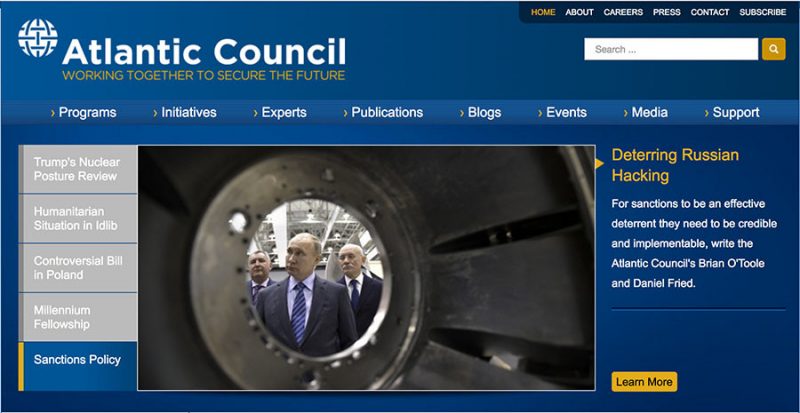
What does it do? Promotes the idea of Russia being an existential threat to Europe and the US, in order to justify NATO’s reason for being.
Who are its people? The Atlantic Council’s list of lobbyists (sorry, ‘Fellows’!) reads like a telephone directory of the Russia bashing world. For instance, Dmitri Alperovitch (of Crowdstrike, which conveniently alleges how Russia hacked the Democratic National Congress) is joined by the perennially- wrong Anders Aslund, who has predicted Russia’s impending collapse on a number of occasions and has, obviously, been off the mark. Then there’s Joe Biden’s “Russia hand,” Michael Carpenter and their recent co-authored Foreign Affairs piece suggests he actually knows very little about the country). Meanwhile, Evelyn Farkas, a fanatical Russophobe who served in Barack Obama’s administration has also found a home here. Another interesting Atlantic Council lobbyist is Eliot Higgins, a “geolocation expert” who has made a career out of spinning tales from the Ukraine and Syrian wars but is, naturally, mostly disinterested in covering Iraq and Yemen, where the US and its allies are involved, but Russia has no particular stake. Lastly, we can’t forget CNN’s Michael Weiss, the self-declared “Russia analyst” who, by all accounts, has never been to Russia and can’t speak Russian.
Who pays for it? The Atlantic Council has quite an eclectic bunch of patrons to serve. NATO itself is a big backer, along with military contractors Saab, Lockheed Martin and the Raytheon Company, all of which naturally benefit from increased tensions with Moscow. The UK Foreign Office also splashes the cash and is joined by the Ukrainian World Congress and the US Department of State. Other sugar daddies include the US military (via separate contributions from the Air Force, Navy, Army and Marine Corps), Northrop Grumman and Boeing.
- The Center for European Policy Analysis (CEPA)
Founded: 2005
What is it? Despite the name, CEPA is based in Washington, not the ‘old continent’, but it does have an outpost in Warsaw. This club specifically focusses on Central and Eastern Europe and promoting the US Army and foreign policy establishment’s agenda there. Or, in its own words, creating a “Central and Eastern Europe with close and enduring ties to the United States.”

screenshot from cepa.org
What does it do? CEPA amounts to a home for media figures who devote their careers to opposing Russia. It whips up tensions, even when they don’t really exist, presumably in order to drum up business for its sponsors, who are heavily drawn from the military industry. For example, it spent last year hyping up the ‘threat’ from Russia’s and Belarus’ joint ‘Zapad’ exercises, even running a sinister-looking countdown clock before the long-planned training commenced.
CEPA grossly overestimated the size of the event, saying it “could be the largest military exercise since the end of the Cold War” and dismissing basically all Moscow’s statements on its actual nature as “disinformation.”
Who are its people? Times of London columnist Edward Lucas has been part of CEPA for years.
Poland chooses Raytheon. Even if the missiles don’t work, America will defend its customers http://t.co/QwqrkCiosD
— Edward Lucas (@edwardlucas) April 21, 2015
The dedicated ‘Cold Warrior’ doesn’t appear to have spent much time in Russia for a long while and still seems to view the country through a prism which is very much rooted in the past. Thus, he’s more-or-less an out-of-touch dinosaur when it comes to Russia expertise. He will soon be joined by Brian Whitmore, who comes on board from RFE/RL and appears to be even more ill-informed than Lucas. His broadcasts for the US state broadcaster led to him being described as the “Lord Haw Haw of Prague,” where has been based for some years. CEPA is a pretty fluid organization and, until recently, Anne Applebaum and Peter Pomerantsev were also on its list of lobbyists. The former is a Polish-American Washington Post columnist who obsessively denigrates Russia and the latter has previously worked with the Atlantic Council’s Michael Weiss, which shows you how small and incestuous the Russia-bashing world is.
Who pays for it? While other think tanks at least try to make their funding look semi-organic, CEPA looks to have zero hang-ups about its role as a mouthpiece for defence contractors. Which is, at least, honest. FireEye, Lockheed Martin, Raytheon, Bell Helicopters and BAE systems pump funds in and they are joined by the US State Department and the Department of Defence. Another notable paymaster is the National Endowment for Democracy – ‘regime change’ experts who are surely interested in CEPA’s remit to also cover Belarus. The US Mission to NATO and NATO’s own Public Diplomacy Division also provide cash.
- German Marshall Fund of the United States
Founded: 1972
What is it? Don’t be fooled by the name, the German Marshall Fund (GMF) is a very American body these days with little input from Berlin. It was founded by a donation from Willy Brandt’s Bonn-government to celebrate the 25th anniversary of the Marshall Plan. Ironically, Brandt is today best remembered as the father of ‘Ostpolitik’, which sought a rapprochement between Germany and Russia.

What does it do? After the fall of the Soviet Union, the GMF transformed into a vehicle promoting US influence in Eastern Europe, with outreaches in Warsaw, Belgrade and Bucharest. However, in the past 12 months, it’s taken a very strange turn. Following the election of US President Donald Trump (ironically a German-American), the lobby group launched the Alliance for Securing Democracy (ASD) project. Its centerpiece is the ‘Hamilton 68 Dashboard’, which seems to classify social media users which reject the US liberal elite’s consensus as “Russian trolls.” The reaction has been highly critical, with even the secretly-funded Russian opposition website Meduza asking “how do you identify ‘pro-Russian amplifiers’ if… themes dovetail with alternative American political views?”
Who are its people? The GMF, especially through its new ASD plaything, has a high-profile bunch of lobbyists. They include Toomas Ilves, an American-raised son of Estonian emigrants who once headed the Estonian desk at erstwhile CIA cut-out Radio Free Europe and eventually became president of Estonia. Also on board is Bill Kristol, known as the ‘architect of the Iraq War’ and former CIA Director Michael Morrell. Former US Ambassador to Russia Michael McFaul, who recently announced he was partially abandoning his Russian scholarship and has “lost interest in maintaining my (sic) ability to speak/write Russian” is another team member.
And sorry that I am not responding in Russian. After being on the travel ban list to your country for 3 years, I have lost interest in maintaining my ability to speak/write Russian. You government seems to really fear me these days. странно и жалько https://t.co/8SRdSEvg5r
— Michael McFaul (@McFaul) January 20, 2018
After serving on Obama’s team, McFaul has re-invented himself as a network TV personality since 2016 with 280,000 Twitter followers, 106,000 of which are fake, according to Twitter audit.
Who pays for it? USAID are big backers, throwing in a seven-figure annual sum. This, of course, raises some questions about US taxpayers essentially funding the Hamilton 68 dashboard, which may be smearing Americans who don’t agree with their government’s policies as Russian agents. The State Department also ponies up capital, as does NATO and Latvia’s Defense Ministry. Other interesting paymasters are George Soros, Airbus and Google. While Boeing and the ubiquitous Raytheon are also involved.
- Institute for the Study of War
Founded: 2007
What is it? This lobby group could as easily be titled ‘The Institute for the Promotion of War’. Unlike the others, it doesn’t consider Russia its primary target, instead preferring to push for more conflict in the Middle East. However, Moscow’s increased influence in that region has brought the Kremlin into its crosshairs.
What does it do? The IFTSOW agitates for more and more American aggression. It supported the Iraq ‘surge’ and has encouraged more involvement in Afghanistan. IFTSOW also focuses on Syria, Libya and Iran. Just last week, one of its lobbyists, Jennifer Cafarella, called for the US military to take Damascus, which would bring Washington into direct conflict with Russia and Iran.
US occupation of Damascus – @TheStudyofWar seems to be calling for the US military to take Damascus and rebuild Syria. This seems the only “realistic” policy that could produce its demand to rid Syria of Assad’s government as well as Iranian and Russian influence. pic.twitter.com/nmSTkSzb5G
— Joshua Landis (@joshua_landis) February 3, 2018
Who are its people? Kimberly Kagan is the brains behind this operation. She’s married to Frederick Kagan, who was involved in the neocon ‘Project for the New American Century’ group along with his brother, Robert Kagan. Which makes Kimberly the sister-in-law of Victoria “f**k the EU” Nuland.
Another lobbyist is Ukrainian Natalia Bugayova, who was involved in Kiev’s 2014 EuroMaidan coup. She previously worked for the Kiev Post, a resolutely anti-Russian newspaper which promotes US interests in Ukraine. However, IFTSOW’s most notorious lobbyist was Elizabeth O’Bagy, who emerged as a ‘Syria expert’ in 2013 and called for American political leaders to send heavy weaponry to Syrian insurgent groups. She claimed to have a PhD from Georgetown University in Washington, DC, but this was fictional and once the media twigged to it, she was dismissed by the IFTSOW. Two weeks later, she was rewarded for her deception by falling up to a job with fanatical Russophobe Senator John McCain. O’Bagy has also collaborated with the Atlantic Council’s Michael Weiss, which is further evidence of how tight-knit the world of US neoconservative advocacy really is.
Who pays for it? Predictably, Raytheon has opened its wallet. Meanwhile, other US military contractors like General Dynamics and DynCorp are also involved. L3, which provides services to the US Department of Defense, Department of Homeland Security, and government intelligence agencies is another backer along with Vencore, CACI and Mantech.
Russia deploys Iskander nuclear-capable missiles to Kaliningrad: Report
Press TV – February 5, 2018
Russia has reportedly deployed advanced nuclear-capable Iskander missiles to its westernmost region of Kaliningrad that borders the Baltic countries of Poland and Lithuania, in an apparent move to counter US military buildup in the region.
RIA Novosti news agency quoted Vladimir Shamanov, head of the Russian lower house of parliament’s defense committee, as saying on Monday that Iskander missile systems had been sent to Kaliningrad, but did not say how many or for how long.
“Yes, they have been deployed,” the agency quoted Shamanov as saying. “The deployment of foreign military infrastructure automatically falls onto the priority list for targeting.”
Russia has previously deployed Iskander missiles to its Baltic enclave on a temporary basis for drills and as a response to the US military buildup near its western border.
The Iskander, a mobile ballistic missile system codenamed SS-26 Stone by NATO, has an operational range of up to 500 kilometers and can carry either conventional or nuclear warheads.
In a swift reaction to the Monday deployment, Lithuanian President Dalia Grybauskaite claimed that the missiles were being stationed for a “permanent presence,” and accused Moscow of posing a danger to “half” of Europe’s capitals.
Russia is wary of NATO’s expansion on its doorsteps where the US-led military alliance has deployed around 4,000 troops, including four battle groups, to Estonia, Lithuania, Latvia and Poland in recent years.
Realizing that security threat under its nose, Russia has held several military drills to maintain preparedness, with the NATO countries having then referred to those drills as signs that Russia has aggressive and not defensive intentions.
Moscow calls NATO’s military buildup at its doorstep a threat to its national security and accuses the alliance of fear-mongering to justify larger defense expenditure by its member states.
Meanwhile, NATO — largely made up of Western European countries — accuses Russia of having a hand in a crisis in Ukraine, which Moscow denies.
Eastern Ukraine has been the site of a conflict since 2014, when the government in Kiev started a crackdown on pro-Russia protests in the country. Earlier that same year, the Crimean Peninsula, then Ukrainian territory, voted in a referendum to separate from Ukraine and join the Russian Federation. Western countries branded the subsequent unification as an “annexation” of the territory by Russia, and Ukraine soon confronted pro-Russia protests elsewhere — in its eastern Donbass region — with a heavy hand.
The crisis in the Donbass soon turned into an armed conflict, which has so far left over 10,000 people dead and more than a million others displaced. Western countries have blamed Russia.
‘Now Is the Moment’: Russia Urges US to Resume Dialogue on Missile Defense
Sputnik – February 5, 2018
MOSCOW – Russia and the United States should resume their dialogue on missile defense in light of the growing relevance of the subject, Russian Deputy Foreign Minister Sergey Ryabkov said.
“I would like to emphasize the growing relevance of the missile defense topic. Let me remind you that an indestructible connection between strategic offensive arms and missile defense is noted in the preamble of the current Reduction of Strategic Offensive Arms Treaty. There has been no substantial dialogue with the Americans on this matter for a long time. Now is the moment when it should be resumed,” Ryabkov said in an interview with the newspaper Izvestia.
The Russian diplomat stressed that in order to overcome the impasse in Russian-US relations, it was necessary to cooperate in a number of areas, including economic and regional crises.
“This agenda, in our opinion, includes issues of maintaining and ensuring of strategic stability… It also considers the work on regional crises… as well as economic interaction,” Ryabkov noted.
At the same time, the Russian minister stressed that the Russian-US talks on the crisis in eastern Ukraine’s Donbass region had not achieved workable solutions so far. Yet, Ryabkov expressed hope that both sides would find a “scheme” that would be acceptable for both Kiev and the self-proclaimed Donetsk and Luhansk Republics.
On Friday, the US Defense Department published the country’s new Nuclear Posture Review, which devoted great attention to the development of Russia’s nuclear capability.
In 2014, relations between Russia and the United States deteriorated over Moscow’s alleged involvement in the Ukrainian conflict and Crimea’s reunification with Russia in 2014 following a referendum.
The United States, as well as the European Union, has imposed several rounds of sanctions on Russia’s energy, banking, defense and other sectors, as well as on a number of Russian officials. Moscow has responded with countermeasures against the Western countries that targeted it with sanctions.
Russia Can’t Confirm US Fulfilled Limits on Strategic Arms Within START Treaty
Sputnik | 05.02.2018
The Russian Foreign Ministry said Monday that it can’t confirm that the US fulfilled its limits on strategic arms within Strategic Arms Reduction Treaty (New START).
The ministry also reaffirmed Russia’s commitment to the treaty and urged to continue the search for solutions to the existing problems around the document.
“The Russian Federation urges the United States to continue to constructively search for mutually acceptable solutions to the problems related to the conversion and exclusion of arms from the categories provided for in the New START Treaty, as well as any other issues that may arise in the context of implementing the provisions of the New START Treaty,” the statement, issued by the ministry read.
The ministry further noted that Russia had fully fulfilled its commitments under the treaty, signed by Washington and Moscow in 2010, and would send an official notification to the US side soon.
“The Russian Federation has fully fulfilled its obligations to reduce strategic offensive arms… In the near future, the United States will receive an official notification confirming these figures,” the ministry’s statement read.
According to the ministry, Russia has reduced its strategic arms down to 527 units of deployed intercontinental ballistic missiles (ICBMs), deployed submarine-launched ballistic missile (SLBMs) and deployed heavy bombers, while the warheads on the above-mentioned arms totaled 1,444 units. At the same time, the number of deployed and non-deployed launchers of ICBMs and SLBMs, and deployed and non-deployed heavy bombers have been cut down to 779 units.
The statement by the Russian Foreign Ministry comes after US State Department spokesperson Heather Nauert said earlier in the day that the US was looking forward to continuing implementation of the Strategic Arms Reduction Treaty (New START), signed by Washington and Moscow in 2010.
Featured Video
Trita Parsi: Israel Set a Trap for Total War in the Region
or go to
Aletho News Archives – Video-Images
From the Archive
Zionism’s Violent Legacy
By Donald Neff | Washington Report On Middle East Affairs | January 1996
On January 4, 1948, Jewish terrorists drove a truck loaded with explosives into the center of the all Arab city of Jaffa and detonated it, killing 26 and wounding around 100 Palestinian men, women and children.[1] The attack was the work of the Irgun Zvai Leumi – the “National Military Organization,” also known by the Hebrew letters Etzel – the largest Jewish terrorist group in Palestine. The Irgun was headed by Revisionist Zionist Menachem Begin and had been killing and maiming Arabs, Britons and even Jews for the previous ten years in its efforts to establish a Jewish state.
This terror campaign meant that at the core of Revisionist Zionism there existed a philosophical embrace of violence. … continue
Blog Roll
 Aletho News
- Trita Parsi: Israel Set a Trap for Total War in the Region
- Trump’s Iran war is on an Israeli leash
- Saudi oil boss issues global supply warning
- Riyadh Says Its Oil System Is Intact. The Numbers Say Otherwise.
- Trump and Netanyahu Want to “Finish the Job” on Iran
- US ‘one-sided dictation’ not Iran’s beliefs makes rational talks impossible: Baghaei
- Iran’s Next Strike May Not Explode. It Could Shut You Down /Col Doug Macgregor
- Iran: US political targets legitimate if assassinations return
- Iraq shuts key border crossing with Iran under US pressure: Report
- Undersea Internet cables could be targeted in retaliation for attacks on Iran: IRGC deputy chief
- If Americans Knew
- The Israel Lobby’s Changing Fortunes
- AIPAC has become such a political liability that it’s shifting to a more “nimble” approach to buying politicians
- At least 160 Israeli settler attacks in 2 weeks
- Will Gaza’s Ancient Christian Community Disappear Forever?
- Israel’s vision of regional security rests on keeping Arab states weak
- Heidi Levine recounts how Palestinian youths helped save her in settler attack
- DAILY UPDATE: Latest essential news on Palestine, Israel, & region
- Trump’s Intensifying Sabotage of the ICC, for Israel’s Sake
- Israeli military detain US and UK volunteers in West Bank including Democratic NY politician Brad Lander
- Americans at National Conservatism Conference held in Israel this year criticize Israel
- No Tricks Zone
- E-Cars Reduce CO2 Emissions By Only 41% Compared To Internal Combustion Engine Vehicles
- Predictions Made By Renowned Climate Professor Over Past Decades Have Been Proven To Be Poor
- New Study Suggests Large Regions Of The Pacific Ocean Have Been Cooling For The Last 80 Years
- Germany’s Green Energy Debacle: High Energy Costs Force Kahla Porzellan to Close After 182 Years!
- New Study: 50 Years Of The Most Aggressive ‘Net Zero’ Policies Can Only Affect The Global Climate By 0.03°C
- US September “Heat” Was No Record…Many Records Set Decades Ago
- Latest European Green Energy Debacle; Portugal’s Largest Flagship Solar Park Insolvent!
- Green Energy Debacle: German Expert Professor Fritz Vahrenholt Warns Of Severe Economic And Social Consequences
- Two More Paleo Reconstructions Affirm Meters-Higher Sea Levels Across Ireland, Brazil 7000-6000 Years Ago
- New Study: Earth And Venus Surface Warmth Largely Explained By Convection And Lapse Rate, Not CO2 Or Radiation

