Pentagon Capitalism and Silicon Valley: Google’s Drone War Project Shows Big Data’s Military Roots
By Elliott GABRIEL | Mint Press News | April 6, 2018
Google — the advertising and search engine monolith that once touted its official commitment, “Don’t be evil” — has thrown its full weight behind the U.S. military-industrial complex’s fast-advancing unmanned drone program – and more than three thousand of its employees will have none of it.
In a letter to Google CEO Sundar Pichai, over 3,100 employees invoked the now-discarded slogan in an appeal demanding that the company not allow its artificial intelligence technology to be used to improve the targeting capabilities of the United States’ deadly drone fleet. Google’s Project Maven is an AI surveillance engine that uses footage captured by the U.S. Armed Forces’ unmanned aerial vehicles to detect and track objects such as vehicles, while combing through, organizing, and feeding the processed data to the Pentagon.
Watch | Project Maven: The Pentagon’s New Artificial Intelligence
The letter, which is fast making the rounds on Google campuses and internal communication servers, demands the cancellation of the project and the public adoption of a policy pledging that neither Google nor its contractors produce technology for warfare. The letter states:
“This plan will irreparably damage Google’s brand and its ability to compete for talent. Amid growing fears of biased and weaponized AI, Google is already struggling to keep the public’s trust. By entering into this contract, Google will join the ranks of companies like Palantir, Raytheon, and General Dynamics. The argument that other firms, like Microsoft and Amazon, are also participating doesn’t make this any less risky for Google. Google’s unique history, its motto Don’t Be Evil, and its direct reach into the lives of billions of users set it apart.”
However, journalist and author Yasha Levine has explained in his new book Surveillance Valley: The Secret Military History of the Internet that Google has long been a leading Silicon Valley vendor to the U.S. repressive state:
“Over the years, [Google] supplied mapping technology used by the U.S. Army in Iraq, hosted data for the Central Intelligence Agency, indexed the National Security Agency’s vast intelligence databases, built military robots, co-launched a spy satellite with the Pentagon, and leased its cloud computing platform to help police departments predict crime. And Google is not alone. From Amazon to eBay to Facebook … Some parts of these companies are so thoroughly intertwined with America’s security services that it is hard to tell where they end and the U.S. government begins.
The grim calculus of remote-controlled warfare
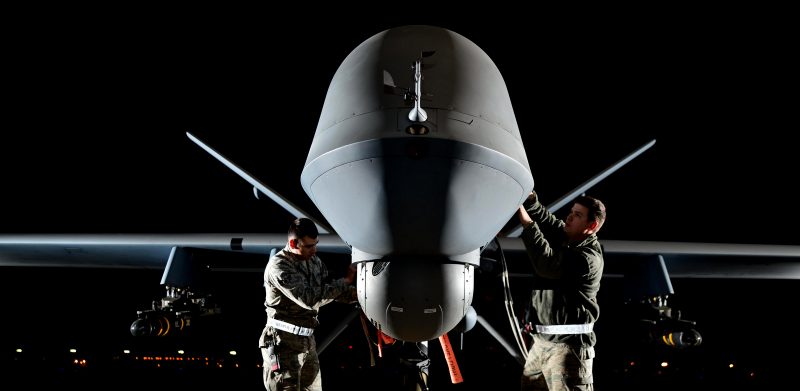
An Air Force RPA reconnaissance drone is retrofitted for use in attack squadron. (Photo: U.S. Air Force)
Thousands of alleged “combatants” have been killed in U.S. drone strikes since the start of the post-9/11 “War on Terror.” Former President Barack Obama ramped up the targeted killing program using drones in 2009, pledging that the use of unmanned aerial platforms was part of a “just war—a war waged proportionally, in last resort, and in self-defense.”
Reports have shown that the use of drones in such locales as Afghanistan, Iraq, Libya, Pakistan, Syria, Yemen and other theaters of operations have claimed a vast number of civilian lives — over 15,000 in 2017, according to surveys. According to New York Times Magazine, which surveyed 150 Coalition drone strikes carried out in Iraq over an 18-month period, one out of every five strikes kills civilians.
Watch | Suffering in Silence: a documentary about the war on terror in Pakistan
The American Civil Liberties Union has denounced the use of such tactics as contrary to international law:
“A program of targeted killing far from any battlefield, without charge or trial … violates international law, under which lethal force may be used outside armed conflict zones only as a last resort to prevent imminent threats, when non-lethal means are not available.
There is very little information available to the public about the U.S. targeting of people far from any battlefield, so we don’t know when, where and against whom targeted killing can be authorized … The secrecy and lack of standards for sentencing people to death, resulting in a startling lack of oversight and safeguards, is one of our prime concerns with this program.”
In 2007 at the height of George W. Bush’s “troop surge” in Iraq, Google enlisted in the “Global War on Terror” in a discrete partnership with Lockheed Martin. While enhanced versions of Google Earth were already at the disposal of government agencies, the tech firm helped to design a Google Earth product for the Pentagon’s National Geospatial-Intelligence Agency that displayed a visual representation of U.S. and Iraqi military bases in Iraq as well as the location of Sunni and Shiite neighborhoods in Baghdad, allowing occupation forces to oversee and manage the bloody fratricidal warfare between the groups as well as the possible location of insurgent organizations within their ranks.
It was during this same year that the development and use of Air Force drones in the Iraqi quagmire dramatically increased, nearly doubling between January and October of 2007.
Google defends its public image (and low-profile military ties)
Claiming that it values the input of its employees as an “important part” of its company culture, Google has promised to address the AI-drone issue without making specific comments on the employees’ demands. In a statement Tuesday, the company said:
“Any military use of machine learning naturally raises valid concerns. We’re actively engaged across the company in a comprehensive discussion of this important topic and also with outside experts, as we continue to develop our policies around the development and use of our machine learning technologies.”
Google has also defended its participation in the Pentagon program with the claim that its usage is specifically for non-offensive purposes and uses open-source object-recognition software based on non-classified data that’s freely available to any users of the Google Cloud, and could in fact save lives while saving labor through the use of AI.
Google’s own top corporate chiefs are quite close to the Pentagon: Google vice president Milo Medin serves on the Department of Defense’s tech advisory body, the Defense Innovation Board, which is also chaired by former Google executive chairman Eric Schmidt, who remains an executive board member at Google’s parent company, Alphabet Inc.
Google itself has long been interested in developing its own line of drone products, including private delivery drones.
The company is also a leader in AI and machine-learning technology. Its subsidiary DeepMind Technologies, Inc. has recently developed a program based on Google Street View that allows AI-based platforms to take part in long-range navigation and cross complicated urban environments. The navigator AI system is capable of steering everything from autonomous, self-driving cars to robotic vacuums and even unmanned drones.
Watch | Eric Schmidt at the Artificial Intelligence and Global Security Summit
Last November in a keynote address on artificial intelligence in warfare before Washington-based think-tank the Center for a New American Security, Schmidt pinned anxiety about his company’s acquisition of DeepMind on “a general concern in the tech community of somehow the military-industrial complex using their stuff to kill people incorrectly, if you will.”
“It comes from a, it’s essentially related to the history of the Vietnam War and the founding of the tech industry,” Schmidt added.

Indeed, Levine argues:
“In the 1960s, America was a global power overseeing an increasingly volatile world: conflicts and regional insurgencies against U.S.-allied governments from South America to Southeast Asia and the Middle East. These were not traditional wars that involved big armies but guerrilla campaigns and local rebellions, frequently fought in regions where Americans had little previous experience. Who were these people? Why were they rebelling? What could be done to stop them? In military circles, it was believed that these questions were of vital importance to America’s pacification efforts, and some argued that the only effective way to answer them was to develop and leverage computer-aided information technology.”
Surveillance capitalism’s military-industrial roots
In a 2014 essay for Monthly Review magazine titled “Surveillance Capitalism: Monopoly-Finance Capital, the Military-Industrial Complex, and the Digital Age,” authors John Bellamy Foster and Robert W. McChesney coined the phrase surveillance capitalism, tracing its origins to the inception of a post-World War II “new Pentagon capitalism” that came to be known as the military-industrial complex.
Under the model – revolutionized by then-Army Chief of Staff and later President Dwight D. Eisenhower – the U.S. technological, scientific research and industrial capacity were to become “organic parts of our military structure” in conditions of national emergency, effectively giving the civilian economy a dual-use purpose. In a 1946 memorandum, Eisenhower noted:
“The future security of the nation… demands that all those civilian resources which by conversion or redirection constitute our main support in time of emergency be associated closely with the activities of the Army in time of peace.”
The model became a permanent feature of the U.S. economy, giving birth to a sprawling military-civilian economic base Eisenhower famously criticized in his 1961 farewell address to the nation. Civilian industry, science, and academia were used alongside an exorbitant and perpetually-expanding war budget to underwrite the Defense Department’s never-ending state of conflict with Cold War enemies and unruly populations, making the world safe for the unchallenged reign of U.S. monopoly capitalism (imperialism) and “pump-priming” the economy whenever an additional surge of “military Keynesian” government spending was required.
Watch | Richard Wolff On Trump’s Defence Spending
According to the popular history of the internet’s origin, it was conceived in 1969 by scientists at the Defense Department’s Advanced Research Projects Agency (ARPA), who sought to create a means of “internetworking” Pentagon-sponsored computer mainframes belonging to government agencies, universities and defense contractors across the United States and NATO bloc. Known as Arpanet, the decentralized system allowed for military nodes – down to a battlefield level – to network and share data quickly and wirelessly. In the event of a nuclear strike or major war where swathes of the network were destroyed, the Arpanet would remain operational.
Levine posits that a primary purpose of conceiving the “information superhighway” was the need for a computerized counterinsurgency tool that could predict and check the “perceived global spread of communism” and provide real-time surveillance of potential threat groups:
“The Internet came out of this effort: an attempt to build computer systems that could collect and share intelligence, watch the world in real time, and study and analyze people and political movements with the ultimate goal of predicting and preventing social upheaval. Some even dreamed of creating a sort of early warning radar for human societies: a networked computer system that watched for social and political threats and intercepted them in much the same way that traditional radar did for hostile aircraft. In other words, the Internet was hardwired to be a surveillance tool from the start. No matter what we use the network for today — dating, directions, encrypted chat, email, or just reading the news — it always had a dual-use nature rooted in intelligence gathering and war.”
The Arpanet system formed the backbone of U.S. military communications from 1969 until 1989, when the World Wide Web was introduced to civilian consumers. The unveiling of the World Wide Web opened the floodgates to the use of the internet by users across the globe, as well as its subsequent commercialization and the resulting dot com boom of the mid-to-late 1990s, when Google was founded.
Watch | Yasha Levine on why we lost our fear of computers as tools of social control
The rapid advance of digital technology has ensured that the U.S. economy — and social life itself — is now dominated by big-data giants like Google, Apple, Facebook and Amazon (GAFA), as well as Microsoft, Intel, Cisco Systems, IBM and Hewlett-Packard. This new technology-dominated market environment, where private user info is parsed, monetized, packaged and sold, has been encapsulated by the well-worn cliché: “data is the new gold.”
Vast strides in biometrics, analytics research, AI, and deep-learning technology – perfected not only by Google but by academic researchers and technology firms across the globe – have vastly boosted the state’s ability to surveil and control populations and police dissent across the globe. Many of the technologies developed by global arms, surveillance, and data-analysis firms are supplied to countries requiring tailor-made solutions to unrest such as India, China, Myanmar, Saudi Arabia, Egypt, Bahrain, and Azerbaijan.
The extent of Silicon Valley’s integration with the U.S. government was laid bare to the public in 2013, when Edward Snowden provided evidence proving that the U.S. National Security Agency (NSA) and Federal Bureau of Investigation (FBI) had direct access to the internal servers of nine major tech firms – AOL, Apple, Facebook, Google, Microsoft, PalTalk, Skype, YouTube, and Yahoo – each of which provided direct access through major internet service providers to the NSA through its secret projects like Boundless Informant and Prism.
Foster and McChesney explained:
“These monopolistic corporate entities readily cooperate with the repressive arm of the state in the form of its military, intelligence, and police functions. The result is to enhance enormously the secret national security state, relative to the government as a whole.
Edward Snowden’s revelations of the NSA’s Prism program, together with other leaks, have shown a pattern of a tight interweaving of the military with giant computer-Internet corporations, creating what has been called a ‘military-digital complex.’ Indeed, Beatrice Edwards, the executive director of the Government Accountability Project, argues that what has emerged is a ‘government-corporate surveillance complex.”
Information superiority and the modern battlefield
At present, the digitalization of the military-industrial complex gives the United States a commanding edge in terms of military technology and high-tech warfare, which is augmented by optical spy satellites capable of capturing remarkably detailed ground-level imagery, successive generations of wireless networking technologies, pattern-recognition and machine-learning systems, and unmanned warfighting platforms.
As a matter of survival, however, all modern militaries – both regular and irregular, large and small – are being forced to adapt to the digitization of warfare. China, Russia, and even non-state actors like Lebanese resistance group Hezbollah are fast making technological advances to keep pace in the informationized battlefield.
The weaponized nature of digital technology is a pandora’s box that may prove impossible to close. Be that as it may, Google’s employees are livid about their participation in these developments:
“We cannot outsource the moral responsibility of our technologies to third parties … Building this technology to assist the U.S. Government in military surveillance – and potentially lethal outcomes – is not acceptable.”
While the tech conglomerate workers’ attempt to decouple Google from the Pentagon may be in vain, one can only applaud their efforts to protest the tech conglomerate’s complicity in the bloodshed wrought by U.S. imperialism through its array of increasingly high-tech implements of death.
Douma Chemical Attack: Another Link in the Chain of Staged Provocations
By Peter KORZUN | Strategic Culture Foundation | 09.04.2018
What happened in Syria on April 7 had been expected. While raising hue and cry over the alleged chemical attack in Douma, a rebel-held suburb of the capital, Western officials and media wasted no time to put the blame on the Assad government.
The US State Department issued a statement saying that by shielding Damascus Moscow has breached its international commitments. The administration immediately called on Russia to cease its support of Syria’s government. President Trump wants an international action. As usual, few people in the West raised their voices to emphasize the need to investigate first and make conclusions afterwards.
It strikes the eye that Moscow’s warnings about a CW provocation being prepared to dash the rising hopes for peaceful settlement in Syria appear to be forgotten! The Defense Ministry shared the information that the ringleaders of Jabhat al-Nusra and the Free Syrian Army were plotting false flag chemical attacks in areas under their control. Moscow warned but the West did not listen.
It’s the same old song and dance. Last year, the Syrian government was blamed for a sarin gas attack on Khan Sheikhun that prompted a US cruise missile strike on a Syrian air base. The American president’s approval ratings went up as a result. This time, the alleged attack occurred right after the Russia-Turkey-Iran summit that took place in Ankara on April 4 to promote the Syria conflict settlement.
As before, all “evidence” boils down to White Helmets’ report and a video going viral that does not look or sound very convincing. There was no independent verification. The White Helmets have iffy reputation, to put it mildly. The organization is known to pursue political interests of outside actors.
No explanation was given to a simple question: what does Syria’s government need this attack for? It is victorious everywhere and the operation in Eastern Ghouta has been a success. Douma is the last remaining stronghold still controlled by rebels in the area and will be liberated soon. It’s a matter of a few days. The army’s combat actions are supported by Russian aviation. What does Syria’s government stand to gain by using CW? Nothing.
Syria army units are operating in Douma. By launching an attack, the Syrian government would hit its own troops, This argument appears to be largely missing in Western media reports. President Trump has recently promised to withdraw American forces from Syria. Why would President Assad give him a pretext to renege on his word?
But the world “indignation” against Russia-supported President Assad benefits the extremists a lot. They are cornered and need time to take a breath and receive support. Actually, the ballyhoo raised in the West is their only chance to at least slow down the offensive. A government forces’ victory in Douma would deal a heavy blow to terrorist groups, sounding the death knell for the rebellion. Sounds simple but that’s what it is. There is each and every reason to believe the incident was staged by terrorists.
Right after the alleged attack, they asked for talks. The ringleaders believe that this is their chance for a negotiated truce. The militants keep their fingers crossed hoping that NATO member states which clandestinely support them will get involved one way or another. Just last February, Secretary of Defense James Mattis warned Syria of “dire consequences” if it executed chemical strikes. French President Macron said he would order strikes if CW were used. It’s worth noting that today the US president’s National Security Team is led by a person known as a trigger happy hawk advocating the use of force as a foreign policy tool.
The US and France have been harboring plans to launch a joint operation in Syria for some time. Only a few days ago, a contingent of French forces arrived in Manbij to join American allies there. Actually, a NATO operation has been launched leaving Turkey, a bloc’s member, out in the cold. It’s an open secret that the US-led coalition pursues the goal of partitioning Syria to “contain” Russia, roll back Iran, win the support of rich Persian Gulf Arab states to boost lucrative arms trade and bolster the US and France’s clout in the Middle East.
It would be naïve to think that the chemical attack in Syria and the Skripal scandal are two separate events. They are links in the same chain. With the spy poisoning case leading nowhere, the anti-Russia campaign needs a new impetus. The alleged CW attack is a good pretext to spur the efforts. But any strike in Syria would pose a risk to the lives of Russian servicemen. It could make Moscow respond. The US-led coalition is playing with fire. And as in the Skripal case, the reaction is the same – blame first, wait for the results of investigation second. It just shows that the West is not interested in the truth. It’s looking for new pretexts to damage Russia’s reputation and thus reduce its global clout.
War Deaths, and Taxes
By John Laforge | CounterPunch | April 6, 2018
Are the federal taxes coming out of your wages and due this week killing you? Sadly what’s rhetorical for US tax payers is gravely literal for people of eight countries currently on the shooting end of the US budget.
This year at least 47% of federal income taxes goes to the military (27%, or $857 billion, for today’s bombings and occupations, weapons, procurement, personnel, retiree pay & healthcare, Energy Dept. nuclear weapons, Homeland Security, etc.); and 20%, or $644 billion, for past military bills (veterans’ benefits — $197 billion; and 80% of the interest on the national debt — $447 billion).
A ceasefire, drawdown and retreat from the country’s unwinnable wars would reduce this tax burden, and didn’t the president promise to end the foreign “nation-building” that’s breaking the bank? Of course, that was a Trump promise, so:
Seven US airmen were killed on March 15 when a US Pave Hawk helicopter crashed in western Iraq, with 5,200 soldiers and as many contract mercenaries fighting there.
When VP Mike Pence visited Afghanistan last December he said with perfect meaninglessness: “we are here to see this through.” About 11,000 US soldiers are currently seeing it, and the Pentagon will be sending thousands more this spring. US bombing runs have almost tripled since the Obama/Trump handover, and Pence claimed “we’ve put the Taliban on the defensive” — but during Pentagon chief Jim Mattis’s visit the Taliban shot dozens of rockets at the Kabul airport where the general’s plane was parked.
The 16-year-old war in Afghanistan is now broadly understood to be militarily unwinnable, so a ceasefire and withdrawal would be a quick way to save billions of tax dollars. But US B-52s bombers flying from Minot Air Base in North Dakota are still creating new terrorists every day; the 3,900 US bombs and missiles exploded on the country in 2017 caused countless of civilian casualties.
In Syria, dozens of Russian soldiers were killed Feb. 7 and 8 by US-led forces fighting near Al Tabiyeh. Master Sgt. Jonathan J. Dunbar was killed by an IED blast March 29 in Manbij. The US now has about 2,000 soldiers at war in Syria, and in January then Sec. of State Rex Tillerson promised they will be there long after the war with the Islamic State is over. Although Trump said March 29, “we’ll be coming out of Syria, like, very soon,” Pentagon officials leaked news April 2 that dozens of additional troops will be sent in the coming weeks, CNN reported. The United States’ World War could hardly be more confounding or self-defeating as US ally Turkey has begun bombing US-supported Kurdish fighters inside Syria.
In Pakistan January 25, the Ministry of Foreign Affairs charged that remote-controlled US bombing had targeted an Afghan refugee camp, worsening relations with that government even beyond Trump’s cutoff of “security aid.”
Saudi Arabian aircraft, refueled en route by US tanker aircraft, have killed 4,000 civilians in Yemen, according to UN estimates. Suspending arms sales to the Saudis would end its war and begin to alleviate the Saudi-made humanitarian disaster in Yemen, and a cease-fire and stand-down would allow for the urgent relief required to prevent famine.
An end to today’s US bombing and/or military occupation of eight countries — Syria, Pakistan, Afghanistan, Iraq (all ongoing), Somalia (bombed Apr. 1), Libya (8 airstrikes since Jan. 2017), Niger (Oct. 4 battle, four dead; 500 US soldiers in country, now with armed drones), and Yemen (127 bomber & drone strikes in 2017) — would save billions, save lives, slow the wartime creation of terrorists, and reduce anti-US sentiment everywhere. In January, an extensive Gallop survey found 70% of the people interviewed in 134 countries disapprove of US foreign policy — 80% in Canada, 82% in Mexico.
To paraphrase Dr. King, who was assassinated by the FBI 50 years ago this month (“Orders to Kill: The Truth Behind the Murder of Martin Luther King,” by William F. Pepper), “The great initiative in these wars is ours. The initiative to stop them must be ours.”
John LaForge is a Co-director of Nukewatch, a peace and environmental justice group in Wisconsin, and edits its newsletter.
US lowering threshold for using nukes causes deepest concern – Lavrov
RT | April 5, 2018
Russia is worried the US could respond with nuclear weapons to a wider range of circumstances and that its priorities lie in establishing “military supremacy and upsetting parity” when it comes to “strategic stability.”
“The US policy of lowering the threshold of using nuclear weapons causes the deepest concern,” Russian Foreign Minister Sergey Lavrov said at the Moscow Conference on International Security. Washington’s latest Nuclear Posture Review expands a number of scenarios in which a nuclear response would be considered.
The US is also planning to replace outdated ballistic missiles with new, less powerful nuclear warheads to have them available and ready to give a “flexible response.”
NATO’s growing military activity near the borders of Russia and further efforts to deploy missile defense systems there is another worrisome factor for Moscow. “In the sphere of strategic stability, Washington attaches priority to gaining military supremacy and upsetting parity,” he said.
The Russian foreign minister also expressed concern over “speculations about spreading within NATO’s framework Article 5 of the Washington Treaty to the problems emerging in cyberspace.” The article states that an attack against one ally is considered an attack against all allies. NATO is working on expanding its guidelines on what could trigger its collective response to cyberattacks. Russia often called for “starting a professional discussion on confidence building measures and resistance to threats in that field ” but there were no response either from Washington or from Brussels.
Lavrov said the West should finally realize that they will no longer be able to play the “one goal game.”
“There are no prospects for them to seek to achieve unilateral advantages at our expense and that security in the Euro-Atlantics, in the Asia-Pacific region and in the world as a whole should be equal and indivisible.”
Although US President Donald Trump criticized his predecessors for being too involved with other countries rather than focusing on the US, the current administration has been embracing more and more war hawks recently.
Trump, however, says he is open for dialogue with Russia and the leaders of both countries agreed there should not be another arms race.
“[We] are not interested either in confrontation or in setting off an arms race. But Russia will safeguard purposefully and effectively its interests, its sovereignty and independence, using the entire arsenal of tools available to us,” Lavrov said.
Fifty Years Ago the United States Government Killed Dr. Martin Luther King, Jr.
A Review of The Plot to Kill King by William Pepper
By Edward Curtin | April 4, 2018
Very few Americans are aware of the truth behind the assassination of Dr. Martin Luther King, Jr. Few books have been written about it, unlike other significant assassinations, especially JFK’s. For fifty years there has been a media blackout supported by government deception to hide the truth. And few people, in a massive act of self-deception, have chosen to question the absurd official explanation, choosing, rather, to embrace a mythic fabrication intended to sugarcoat the bitter fruit that has resulted from the murder of the one man capable of leading a mass movement for revolutionary change in the United States. Today we are eating the fruit of our denial.
In order to comprehend the significance of this extraordinary book, it is first necessary to dispel a widely accepted falsehood about Dr. Martin Luther King, Jr. William Pepper does that on the first page.
To understand his death, it is essential to realize that although he is popularly depicted and perceived as a civil rights leader, he was much more than that. A non-violent revolutionary, he personified the most powerful force for the long-overdue social, political, and economic reconstruction of the nation.
In other words, Martin Luther King was a transmitter of a non-violent spiritual and political energy so plenipotent that his very existence was a threat to an established order based on violence, racism, and economic exploitation. He was a very dangerous man.
Revolutionaries are, of course, anathema to the power elites who, with all their might, resist such rebels’ efforts to transform society. If they can’t buy them off, they knock them off. Fifty years after King’s assassination, the causes he fought for – civil rights, the end to U.S. wars of aggression, and economic justice for all – remain not only unfulfilled, but have worsened in so many respects. And King’s message has been enervated by the sly trick of giving him a national holiday and urging Americans to make it “a day of service.” Needless to say, such service does not include non-violent war resistance or protesting a decadent system of economic injustice.
Because MLK repeatedly called the United States the “greatest purveyor of violence on earth,” he was universally condemned by the mass media and government that later – once he was long and safely dead – praised him to the heavens. This has continued to the present day of historical amnesia.
 But William Pepper resurrects the revolutionary MLK, and in doing so shows in striking detail why elements within the U.S. government executed him. After reading this book, no fair-minded reader can reach any other conclusion. The Plot to Kill King, the culminating volume of a trilogy that Pepper has written on the assassination, consists of slightly less text than supporting documentation in its appendices, which include numerous depositions and interviews that buttress Pepper’s thesis on the why and how of this horrible murder. It demands a close reading that should put to rest any pseudo-debates about the essentials of the case.
Pepper, an attorney who represented the King family in the 1999 trial that found U.S. officials of the federal (in particular, the FBI and Army Intelligence), state, and local governments responsible for King’s assassination, has worked on the King case since 1977. He met MLK in 1967, after King had read his Ramparts’ magazine article, “The Children of Vietnam,” that exposed the hideous effects of U.S. napalm and white phosphorous bombing on young and old Vietnamese innocents. The text and photos of that article reduced King to tears and were instrumental in his increased opposition to the war against Vietnam as articulated in his dramatic Riverside Church speech (“Beyond Vietnam: A Time to Break Silence”) on April 4, 1967, one year to the day before his execution in Memphis. That speech, in which King so powerfully and publicly linked the war with racism and economic exploitation, foretold his death at the hands of the perpetrators of those abominations.
Devastated by King’s death, and assuming the alleged assassin James Earl Ray was responsible, Pepper retreated from the fray until a 1977 conversation with the Rev. Ralph Abernathy, King’s associate, who raised the specter of Ray’s innocence. After a five hour interrogation of the imprisoned Ray in 1978, Pepper was convinced that Ray did not shoot King and set out on a forty year quest to uncover the truth.
Before examining the essentials of Pepper’s discovery, it is important to point out that MLK, Jr., his father, Rev. M. L. King, Sr., and his maternal grandfather, Rev. A.D. Williams, all pastors of Atlanta’s Ebenezer Baptist Church, were spied on by Army Intelligence and the FBI since 1917. All were considered communist sympathizers and dangerous to the reigning hegemony because of their espousal of racial and economic equality. When MLK, Jr. forcefully denounced unjust and immoral war-making as well, and announced his Poor People’s Campaign and intent to lead a massive peaceful encampment of hundreds of thousands in Washington, D.C., he set off panic in the bowels of government spies and their masters. Seventy-five years of spying on black religious leaders here found its ultimate “justification.” As Stokely Carmichael, co-chairman of the Student Non-violent Coordinating Committee, said to King in a conversation secretly recorded by Army Intelligence, “The man don’t care you call ghettos concentration camps, but when you tell him his war machine is nothing but hired killers, you got trouble.”
It is against this “trouble” that Pepper’s investigation must be set, as that “trouble” is also the background for the linked assassinations of JFK, Malcolm X, and RFK. Understanding the forces behind the military, the spies, and the gunmen who, while operating in the shadows, are actually the second layer of the onion skin, is essential. The government and mainstream corporate media form the outer layer with their collusion in disinformation, lying, and truth suppression, but Pepper correctly identifies the core as follows.
Bombastic, chauvinistic, corporate propaganda aside, where the slaughter of innocents is, and always was, justified in the name of patriotism and national security, it has always and ever been about money. Corporate and financial leaders trusted with the keys to the Republic’s treasure moved from boardrooms to senior government positions and back again. Construction, oil and gas, defense industry, and pharmaceutical corporations, their bankers, brokers, and executives thrive in a war economy. Fortunes are made and dynasties created and perpetuated and a cooperating elite permeates an entire society and ultimately contaminates the world in its drive for national resources wherever they are …. Vietnam was his [King’s] Rubicon …. Here, as never before, would he seriously challenge the interests of the power elite.
MLK was assassinated on April 4, 1968 at 6:01 PM as he stood on the balcony of the Lorraine Motel in Memphis, Tennessee. He was shot in the lower right side of his face by one rifle bullet that shattered his jaw, damaged his upper spine, and came to rest below his left shoulder blade. The U.S. government claimed the assassin was a racist loner named James Earl Ray, who had escaped from the Missouri State Penitentiary on April 23, 1967. Ray was alleged to have fired the fatal shot from a second-floor bathroom window of a rooming house above the rear of Jim’s Grill across the street. Running to his rented room, Ray allegedly gathered his belongings, including the rifle, in a bedspread-wrapped bundle, rushed out the front door onto the adjoining street, and in a panic dropped the bundle in the doorway of the Canipe Amusement Company a few doors down. He was then said to have jumped into his white Mustang and driven to Atlanta where he abandoned the car. From there he fled to Canada and then to England where he was eventually arrested at Heathrow Airport on June 8, 1968 and extradited to the U.S. The state claims that the money Ray needed to purchase the car and for all his travel was secured through various robberies and a bank heist. Ray’s alleged motive was racism and that he was a bitter and dangerous loner.
When Ray, under extraordinary pressure, coercion, and a payoff from his lawyer to take a plea, pleaded guilty (only a few days later to request a trial that was denied) and was sentenced to 99 years in prison, the case seemed to be closed, and was dismissed from public consciousness. Another hate-filled lone assassin, shades of Lee Harvey Oswald and Sirhan Sirhan, had committed a despicable deed.
In the years leading up to Pepper’s 1978 involvement, only a few lonely voices expressed doubts about the government’s case – Harold Weisberg in 1971 and Mark Lane and Dick Gregory in 1977. The rest of the country put themselves and the case to sleep. They are still sleeping, but Pepper is trying with this last book to wake them up. Meanwhile, the disinformation specialists continue with their lies.
While a review is not the place to go into every detail of Pepper’s rebuttal of the government’s shabby claims, let me say at the outset that he emphatically does so, and adds in the process some tentative claims of which he is not certain but which, if true, are stunning.
As with the assassinations of President Kennedy and his brother, Robert (two months after MLK), all evidence points to the construction of patsies to take the blame for government executions. Ray, Oswald, and Sirhan all bear striking resemblances in the ways they were chosen and moved as pawns over long periods of time into positions where their only reactions could be stunned surprise when they were accused of the murders.
It took Pepper many years to piece together the essential truths, once he and Abernathy interviewed Ray in prison in 1978. The first giveaway that something was seriously amiss came with the 1979 House Select Committee on Assassinations’ report on the King assassination. Led by Robert Blakey, suspect in his conduct of the other assassination inquiries, who had replaced Richard Sprague, who was deemed to be too independent, “this multi-million dollar investigation ignored or denied all evidence that raised the possibility that James Earl Ray was innocent,” and that government forces might be involved. Pepper lists over twenty such omissions that rival the absurdities of the magical thinking of the Warren Commission. The HSCA report became the template “for all subsequent disinformation in print and visual examinations of this case” for the past thirty-seven years.
Pepper’s decades-long investigation, not only refutes the government’s case against James Earl Ray, but definitively proves that King was killed by a government conspiracy led by the FBI, Army Intelligence, and Memphis Police, assisted by southern Mafia figures. He is right to assert that “we have probably acquired more detailed knowledge about this political assassination than we have ever had about any previous historical event.” This makes the silence around this case even more shocking. This shock is accentuated when one is reminded (or told for the first time) that in 1999 a Memphis jury, after a thirty day trial and over seventy witnesses, found the U.S. government guilty in the killing of MLK. The King family had brought the suit and William Pepper represented them. They were grateful that the truth was confirmed, but saddened by the way the findings were buried once again by a media in cahoots with the government.
The civil trial was the King family’s last resort to get a public hearing to disclose the truth of the assassination. They and Pepper knew that Ray was an innocent pawn, but Ray had died in prison in 1998 after trying for thirty years to get a trial and prove his innocence (shades of Sirhan Sirhan who still languishes in prison). During all those years, Ray had maintained that he had been manipulated by a shadowy figure named Raul, who supplied him with money and his white Mustang and coordinated all his complicated travels, including having him buy a rifle and come to Jim’s Grill and the boarding house on the day of the assassination. The government has always denied that Raul existed.
Blocked at every turn by the authorities and unable to get Ray a trial, Pepper arranged an unscripted, mock TV trial that aired on April 4, 1993, the twenty-fifth anniversary of the assassination. Jurors were selected from a pool of U.S. citizens, a former U.S. Attorney and a federal judge served as prosecutor and judge, with Pepper serving as defense attorney. He presented extensive evidence clearly showing that authorities had withdrawn all security for King; that the state’s chief witness was falling down drunk; that the alleged bathroom sniper’s nest was empty right before the shot was fired; that three eyewitnesses, including the NY Times Earl Caldwell, said that the shot came from the bushes behind the rooming house; and that two eyewitnesses saw Ray drive away in his white Mustang before the shooting, etc. The prosecution’s feeble case was rejected by the jury that found Ray not guilty.
As with all Pepper’s work on the case (including book reviews), the mainstream media responded with silence. And though this was only a TV trial, increasing evidence emerged that the owner of Jim’s Grill, Loyd Jowers, was deeply involved in the assassination. Pepper dug deeper, and on December 16, 1993, Loyd Jowers appeared on ABC’s Primetime Live that aired nationwide. Pepper writes, “Loyd Jowers cleared James Earl Ray, saying that he did not shoot MLK but that he, Jowers, had hired a shooter after he was approached by Memphis produce man Frank Liberto and paid $1,000,000 to facilitate the assassination. He also said that he had been visited by a man names Raul who delivered a rifle and asked him to hold it until arrangements were finalized …. The morning after the Primetime Live broadcast there was no coverage of the previous night’s program, not even on ABC …. Here was a confession, on prime time television, to involvement in one of the most heinous crimes in the history of the Republic, and virtually no American mass-media coverage.”
In the twenty-five years since that confession, Pepper has worked tirelessly on the case and has uncovered a plethora of additional evidence that refutes the government’s claims and indicts it and the media for a continuing cover-up. The evidence he has gathered, detailed and documented in The Plot to Kill King, proves that Martin Luther King was killed by a conspiracy masterminded by the U.S. government. Much of his evidence was presented at the 1999 trial, while other was subsequently discovered. Since the names and details involved make clear that, as with the murders of JFK and RFK, the conspiracy was very sophisticated with many moving parts organized at the highest level, I will just highlight a few of his findings in what follows. A reader should read the book to understand the full scope of the plot, its execution, and the cover-up.
- Pepper refutes the government account and proves, through multiple witnesses, telephonic, and photographic evidence, that Raul existed; that his full name is Raul Coelho; and that he was James Earl Ray’s intelligence handler, who provided him with money and instructions from their first meeting in the Neptune Bar in Montreal, where Ray had fled in 1967 after his prison escape, until the day of the assassination. It was Raul who instructed Ray to return to the U.S. (an act that makes no sense for an escaped prisoner who had fled the country), gave him money for the white Mustang, helped him attain travel documents, and moved him around the country like a pawn on a chess board. The parallels to Lee Harvey Oswald and Sirhan Sirhan are startling.
 He presents the case of Donald Wilson, a former FBI agent working out of the Atlanta office in 1968, who went with a senior colleague to check out an abandoned white Mustang with Alabama plates (Ray’s car, to which Raul had a set of keys) and opened the passenger door to find that an envelope and some papers fell out onto the ground. Thinking he may have disturbed a crime scene, the nervous Wilson pocketed them. Later, when he read them, their explosive content intuitively told him that if he gave them to his superiors they would be destroyed. One piece was a torn out page from a 1963 Dallas telephone directory with the name Raul written at the top, and the letter “J” with a Dallas telephone number for a club run by Jack Ruby, Oswald’s killer. The page was for the letter H and had numerous phone numbers for H. L. Hunt, Dallas oil billionaire and a friend of FBI Director J. Edgar Hoover. Both men hated MLK. The second sheet contained Raul’s name and a list of names and sums and dates for payment. On the third sheet was written the telephone number and extension for the Atlanta FBI office. (Read Jim Douglass’s important interview with Donald Wilson in The Assassinations, p.479-491.)
- Pepper interviewed four other witnesses who confirmed that they had seen Raul with Jack Ruby in Dallas in 1963 and that they were associated.
- Pepper shows that the alias Ray was given and used from July 1967 until April 4, 1968 – Eric Galt – was the name of a Toronto operative of U.S. Army Intelligence, Eric St. Vincent Galt, who worked for Union Carbide with Top Secret clearance. The warehouse at the Canadian Union Carbide Plant in Toronto that Galt supervised “housed a top secret munitions project funded jointly by the CIA, the U.S. Naval Surface Weapons Center, and the Army Electronics Research and Development Command …. In August 1967, Galt met with Major Robert M. Collins, a top aide to the head of the 902nd Military Intelligence Group (MIG) Colonel John Downie.” Downie selected four members for an Alpha 184 Sniper Unit that was sent to Memphis to back up the primary assassin of MLK. Meanwhile, Ray, set up as the patsy, was able to move about freely since he was protected by the pseudonymous NSA clearance for Eric Galt.
- To refute the government’s claim that Ray and his brother robbed the Alton, Illinois Bank to finance his travels and car purchase (therefore no Raul existed), Pepper “called the sheriff in Alton and the president of the bank; they gave the same statement. The Ray brothers had nothing to do with the robbery. No one from the HSCA, the FBI, or The New York Times had sought their opinion.” CNN later reiterated the media falsehood that became part of the official false story.
- Pepper proves that the fatal shot came from the bushes behind Jim’s Grill and the rooming house, not from the bathroom window. He presents overwhelming evidence for this, showing that the government’s claim, based on the testimony on a severely drunk Charlie Stephens, was absurd. His evidence includes the testimony of numerous eyewitnesses and that of Loyd Jowers, the owner of Jim’s Grill, who said he took the rifle from the shooter in the bushes and brought it into the bar where he hid it. Thus, Ray was not the assassin.
- He presents conclusive evidence that the bushes were cut down the morning after the assassination in an attempt to corrupt the crime scene. The order to do so came from Memphis Police Department Inspector Sam Evans to Maynard Stiles, a senior administrator of the Memphis Department of Public Works.
- He shows how King’s room was moved from a safe interior room, 201, to balcony room, 306, on the upper floor; how King was conveniently positioned alone on the balcony by members of his own entourage for the easy mortal head shot from the bushes across the street. (Many people only remember the iconic photograph taken after-the-fact with Jesse Jackson, Andrew Young, et al., standing over the fallen King and pointing across the street.) Pepper implicates that Reverends Billy Kyles, Jesse Jackson, and, to a lesser extent, Ralph Abernathy were involved in these machinations. He uncovers of the role of black military intelligence agent Marrell McCollough, attached to the 111th MIG, within the entourage. McCollough can be seen kneeling over the fallen King, checking to see if he’s dead.
- Pepper confirms that all of this, including the assassin in the bushes, was dutifully photographed by Army Intelligence agents situated on the nearby Fire House roof.
- He presents evidence that all security for Dr. King was withdrawn from the area by the Memphis Police Department, including a special security unit of black officers, and four tactical police units. A black detective at the nearby fire station, Ed Redditt, was withdrawn from his post on the afternoon of April 4th, allegedly because of a death threat against him. And the only two black firemen at Fire Station No.2 were transferred to another station.
- He names and confirms the presence of Alpha 184 snipers at locations high above the Lorraine Motel balcony.
- He explains the use of two white mustangs in the operation to frame Ray.
- He proves that Ray had driven off before the shooting; that Loyd Jowers took the rifle from the shooter who was in the bushes; that the Memphis police were working in close collaboration with the FBI, Army Intelligence, and the “Dixie Mafia,” particularly local produce dealer Frank Liberto and his New Orleans associate Carlos Marcello; and that every aspect of the government’s case was filled with holes that any person familiar with the details and possessing elementary logical abilities could refute.
- So importantly, Pepper shows how the mainstream media and government flacks have spent years covering up the truth of MLK’s murder through lies and disinformation, just as they have done with the Kennedy and Malcom X assassinations that are of a piece with this one.
But since this is a book review and not a book, I will stop listing Pepper’s very detailed and convincing findings. While he may not have answered every aspect of the case, and may be mistaken in some small details, he has proven beyond a shadow of a doubt the basic fact that James Earl Ray did not kill Martin Luther King, but that this great and dangerous leader was killed by a conspiracy organized at the highest levels of government.
The Plot to Kill King will mesmerize any reader seeking the truth about MLK’s assassination. Even when Pepper, towards the end of the book, offers circumstantial and non-corroborated testimony from witnesses Ronnie Lee Adkins and Johnton Shelby, the reader can’t help but be intrigued and to consider their stories highly plausible given all that Pepper has proven. Adkins claims that his father, a friend of Clyde Tolson, FBI Director J. Edgar Hoover’s deputy, and then he himself, were part of the plot to kill King. This involved politicians, the FBI, MPD, and mafia, including the aforementioned produce dealer Frank Liberto and others, making payoffs with FBI money to various people, including Jesse Jackson (whom Adkins, Jr. claims was a paid FBI informer) and working closely on the details of the assassination. Johton Shelby’s story as recounted in his deposition (2014) to Pepper (reproduced, together with Adkins’ (2009), as appendices in the book), is that his mother, who was working as an emergency room aide at St. Joseph’s Hospital when King was brought there, inadvertently witnessed men spitting on Dr. King as he lay in the emergency room and a doctor putting a pillow over his head and suffocating him to death. Pepper tends to accept these accounts, but says he isn’t completely convinced of all aspects of them. The reader is offered plenty of food for thought concerning these claims.
Besides clearly proving the government’s part in killing Martin Luther King, this book is very important for the way Pepper links the case to those of JFK and RFK, who was murdered two months after King. At the center of all these murders is a trinity of men who were devoted to ending the Vietnam War and all wars, restoring economic justice for all Americans, and eliminating racial inequality. That their goals were the same provides a motive for their murders by forces opposed to these lofty objectives. That their murders clearly involved highly sophisticated operations and cover-ups that could never have been pulled off by “crazed lone assassins” points to powerful forces with those means at their disposal. And when it comes to opportunity, when did the shadowy forces of the deep state ever lack for that?
The ramifications of the MLK assassination profoundly inform our current condition. For anyone who truly cares about peace, love, and justice, The Plot to Kill King is essential reading. William Pepper should be saluted. He has carried on Martin King’s noble legacy.
This is an updated review first published on 28 November 2016 at Global Research.
France Joins Syria Fight: Goals and Consequences
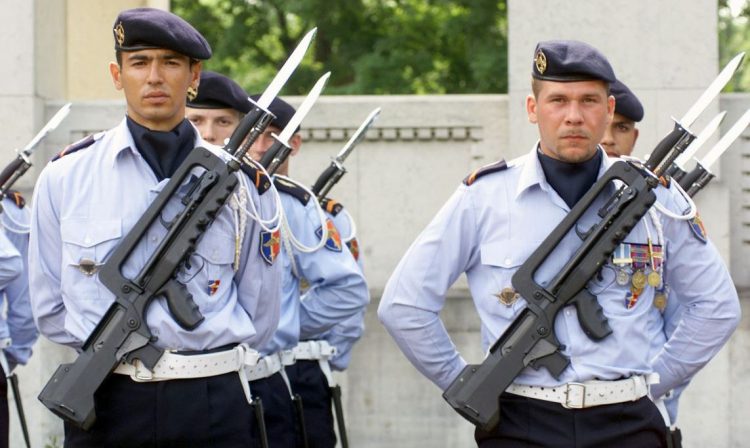
French Armed Forces, armed with FAMAS F1 assault rifles, participate in the Memorial Day ceremony at the LaFayette Escadrille Monument in Paris, France.
By Peter KORZUN | Strategic Culture Foundation | 05.04.2018
French President Emmanuel Macron kept his word. On April 1-2, French troops moved into northern Syria. This is the first time France deployed substantial forces there to turn Paris into a new actor actively involved in the war. The troops advanced toward Manbij and Remelin to join American allies and did it hastily.
The move was made at the time Ankara warned about the plans to control this territory with Russia, Turkey and Iran working together to define Syria’s future. It significantly changes the situation and makes one ask questions about the goals pursued by the US and France and the prospects for war and peace in the conflict-torn country. Summing up the recent events leads to the conclusion that the US and France have a hidden agenda to expand the conflict, wreak havoc and stymie the Russia-led peace efforts.
The news about French deployment came just before the April 4 Russia-Turkey-Iran summit in Ankara stated the goal to “speed up their efforts to ensure calm on the ground” in Syria. On April 3, US President Donald Trump said he would “decide very quickly” to remove forces from that country. The statement was made right after about 300 US Marines accompanied by armored vehicles and engineering equipment were moving toward Manbij as reinforcements to repel possible Turkish inroads. The construction of two bases in Syria’s northern Manbij region is underway.
The Marines have already launched daily patrols along the Sajur River, a tributary that feeds the Euphrates River from sources in Turkey, with observation posts built to monitor the area. This is unheard of – two leading states of the North Atlantic Alliance blocked the other NATO member’s land access to Manbij! On April 3, CNN reported that plans to send reinforcements have been discussed for several days before Trump’s remarks on leaving Syria soon.
The US also wasted no time to press Iraq into sending its 5th Army Division to Sinjar province and line the forces on the Iraqi-Syrian border to obstruct the possible advance of Turkish army from Syria into Iraq.
Obviously, the US is trying to partition Syria while creating a quasi-state on the eastern bank of the Euphrates and up to the Iraqi border. In Deir-ez-Zor, the US-led coalition resists the restoration of Syrian government institutions. It makes one think that the words about “leaving soon” may be nothing more than wishful thinking or an attempt to baffle those who are trying to predict further steps America will take.
The list of goals includes controlling the oil fields and chunks of the territory. Donald Trump wants Saudi Arabia to pay for US operations in Syria and it probably will. If the decision to leave were taken, he wouldn’t raise the question. According to the president, Saudi Arabia is interested in America staying in Syria.
That’s what the US “rocking from side to side” foreign policy is like. Rex Tillerson is fired to make the world know about it from tweets. The US wants to leave Syria but will stay if Saudi Arabia pays. Donald Trump invited the Russian leader to visit him in Washington against the background of Russia diplomats expelled and the consulate office in Seattle closed. Is it being short-sighted or far-sighted? Is this swinging back and forth a well-thought over policy or no policy at all? Is it done on purpose to keep everyone guessing with no predictions possible? You never know. Donald Trump once denounced Saudi Arabia as extremist and then sold a huge package of weapons while calling the kingdom a great friend and close ally against Iran.
The Syrian forces are preparing an offensive in the Daraa – Quneira – Suweida area in the south while denuding other fronts. The territory is huge and the terrain is hard to cross. There are at least 25 heights to fire at advancing forces from. The Free Syrian Army and other rebel groups are much more numerous than the ones being defeated in Eastern Ghuta. Their defenses are strong. Unlike in other places, the rebel forces can easily get logistical support from Jordan. That’s where the US and Saudi Arabia can contribute greatly. Israel has been involved in such activities since 2015. It took roughly six months to liberate Eastern Ghuta, with an active phase to dislodge rebel fighters launched in mid-March. It’s easy to surmise that it will take at least a year, may be much more, to liberate the area in question.
A conflict is easy to provoke. The operations of Syria’s government forces aimed at cutting off supplies coming from Jordan could be presented as an act of aggression against the Hashemite Kingdom. Chemical substances could be transported from Jordan to stage another provocation used as a pretext to attack Syria.
The operation could become a war of attrition to make Syria concentrate more and more of its forces in one place at the expense of other battlefields. They will be stuck there for a considerable period of time. That’s when the US-coalition will be in good position to attack anywhere it wants using the base of Al-Tanf as a springboard. Manbij as well as the Al-Tabka air base located to the south of Raqqa are perfect places for launching an offensive to drive Syria out from Aleppo. Then the country will plunge again into an “all-against-all” fight.
The efforts applied so far by Russia, Turkey and Syria will go down the drain. This time the US will not be alone to have substantial presence on the ground. It’s hard to imagine that the French forces arrived in Syria could be anything but the start of broader NATO presence with other members of the bloc to follow the French example. Russian military personnel and NATO soldiers will be looking at each other through the sights of guns. This scenario will be fraught with a great risk of international military conflict and a real tragedy for Syrian people but those who are provoking it don’t care.
King’s Legacy Betrayed
By Margaret Kimberley | Consortium News | April 4, 2018
Dr. Martin Luther King, Jr. was the preeminent leader of the black liberation movement in the 1950s and 1960s. Millions of people engaged in the struggle against America’s shameful apartheid system but King was the most influential. His actions are remembered, his words are quoted by activists, politicians, and pundits. His birthday is a national holiday. Only the worst and most retrograde racists dare to speak ill of King.
But the lionizing is mostly a sham. In fact there are very few people who remember the importance of what King said, what he did or why and how they should replicate his work. His legacy has been subverted and is now understood only by the most conscious students of history.
Nothing illustrated this state of affairs more clearly than the use of King’s words in a Ram truck commercial broadcast during the 2018 Super Bowl football championship. Viewers were told that Ram trucks are “built to serve.”
The voice over is provided by King himself speaking exactly 50 years earlier, on February 4, 1968. The Drum Major Instinct sermon was a call to reject the ego driven desire for attention in favor of working for more altruistic pursuits. “If you want to say that I was a drum major say that I was a drum major for justice.”
The commercial’s creators deliberately ignored the portion of the sermon in which King derided the influence of advertising. He even mentioned vehicle advertising specifically. He warned that “gentleman of massive verbal persuasion” can influence people to act against their own interests. “In order to make your neighbors envious you must drive this type of car.”
A Nation Going Backwards
Corporate interests are not alone in pretending to honor King while actually attacking him. King’s legacy is severely diminished because it has been used by cynical individuals for corrupt purposes. As we commemorate the 50th anniversary of his assassination we see a nation that has moved backwards on nearly every front. Legalized discrimination was eliminated but powerful forces undermined progress and America in 2018 is devoid of the change that King fought to make real.
Much of the blame lies at the feet of the Democratic Party, who have an undeserved reputation for enacting progressive policies. In reality, Democrats actively targeted black people for joblessness, poverty, imprisonment and disenfranchisement. Democrats became the party of corporate interests and aligned themselves with every neoliberal initiative. They forsook the union movement, working hand in hand with finance capitalists to take living wage jobs out of the country. Bill Clinton oversaw the end of public assistance as a right, destroying what Franklin Roosevelt enacted 60 years earlier. He built on the work of Ronald Reagan and massively increased the prison population.
Barack Obama offered a “grand bargain” of austerity to Republicans and continued the George W. Bush policy of tax cuts for the wealthiest. The banks which created the 2008 financial collapse were rewarded with huge bailouts of public funds. Black people ended up losing the small bit of wealth they held before the crash and now lead only in the negative measurements of quality of life.
Democrats destroy public education through charter schools and refuse to raise the minimum wage even when they control Congress and have the power to act. They were never the party of peace and they are now most outspoken in encouraging an anti-Russian resumption of the Cold War and supporting imperialist interventions.
After the legislative victories of the 1960s black Americans were ignored, subjugated or co-opted. It is true that there are thousands of black elected officials, when in King’s day there were hardly any. But this political class is a traitorous one and works for its own benefit, its patrons in corporate America and the civil rights organizations that are subsidiaries of the Democratic Party. The black political class went along with every sordid deal that Jimmy Carter, Bill Clinton and Barack Obama pursued. Their positions are secure but the rest of black America is anything but.
Prison Population Explodes
A glaring example is the enormous increase in incarceration rates. When Martin Luther King was alive there were only 300,000 incarcerated Americans. There are now more than 2 million. The exponential increase is not coincidental. Mass incarceration was a direct reaction to the freedom movement. Segregation put black people under physical control and the system devised new ways to secure the same result when it ended.
Black men became the face of drug dealing, or deadbeat fatherhood or anything else that the press and politicians told white Americans to fear and hate. The ripple effect is terrible and damages family life, the ability to earn a living and even to vote. In 48 states felons either lose the franchise permanently or are prevented from voting until all supervision is lifted. In Florida alone 1.5 million people cannot vote because of past convictions. A recent court case declared this rule unconstitutional and if a November 2018 ballot measure passes they may have their voting rights restored. That will be a happy result but there are 5 million more Americans, disproportionately black, who elsewhere lose the ability to vote due to criminal convictions.
Until incarceration becomes a mass movement, political issue, the Voting Rights Act amounts to very little. Actually the act already amounts to little because the Supreme Court nullified its most important provisions requiring southern states to seek permission before changing voting rules. The Democrats are less concerned with getting out the vote than in making their wealthy patrons happy and protecting the Senate majority and federal judiciary they claim is so important.
Of course the Democrats are in a bind. They don’t want to get out the vote because that would mean fighting for the issues that the masses need addressed. The wishes of wealthy, corporate America don’t dovetail with those of working people. Fat cat funders don’t want an increased minimum wage. Getting out the vote would mean biting the hand that feeds. So the people be damned.
King’s Challenge to Militarism Defied
King began his fight for the particular needs of black people in a uniquely oppressive system. As years went by he also opposed the economic system itself and the war in Vietnam. In 2017 the Democrats, including most Congressional Black Caucus members, went along with Donald Trump’s request for a 10% increase of an already huge military budget. They will go through the pretense of complaining when that increase inevitably restricts federal spending for social needs, but they are connivers who hope we miss their charade.

Martin Luther King Jr. with President Johnson in 1966
The liberation movement succeeded against great odds. Most black people then as now lived in the southern states and could not vote. Yet their coordinated mass action won them the franchise anyway. That lesson must not be forgotten as the juggernaut of neoliberal plots threatens everyone.
Every major American city is undergoing an onslaught of gentrification which displaces millions of black people at the whim of finance capital. The politicians who will speak in praise of King today do nothing to stop them. In fact they depend upon their largesse to stay in office.
They do nothing to stop the continued terror of billionaire rule. Instead they assist the richest in grabbing more and more. Amazon CEO Jeff Bezos this year became the richest person on the planet. His plans for a new Amazon HQ could be funded entirely by his corporation. Instead cities across the country scramble to give away property and tax dollars to help fund the race to the bottom for workers.
Hollow Admiration
Dr. Martin Luther King, Jr. should be remembered for his tremendous courage in speaking out against the power of money and the military industrial complex. The poseurs who go along to get along should be silent today. The past 50 years have been so tragic because the hard won victories were deliberately destroyed.
King inspired the people to fight for their needs. He did so when the New York Times and Washington Post vilified him. He spoke against the Vietnam war when his compatriots feared angering Lyndon Johnson. The mass action movement that he led forced LBJ to act when he didn’t want to. If politicians act on behalf of the people it is never because they have the right motives.
That is what we must remember about King. The admiration is hollow unless we do as he and millions of others did and commit ourselves to challenging the system. That will mean openly and loudly denouncing the people committed to destroying what they worked and died to achieve. The worst traitors are the most prominent and well respected. But the respect is undeserved and quite dangerous. The night before he was killed King spoke of getting to the promised land. That won’t happen until the scoundrels are named and opposed. Honoring King’s legacy demands that we do just that.
Margaret Kimberley is Editor and Senior Columnist at Black Agenda Report. Ms. Kimberley serves on the Administrative Committee of the United National Antiwar Coalition (UNAC), the Coordinating Committee of Black Alliance for Peace (BAP) and the Advisory Board of ExposeFacts.org. She is writing a book about racism and the American presidency. She is a graduate of Williams College and lives in New York City.
NATO Plotted ‘Skripal Case’ to Justify Their Defense Spendings – Moscow
Sputnik – April 3, 2018
The Russian Foreign Ministry says it can’t discern how to convene a NATO-Russia Council in the current climate, considering absurd NATO’s statements regarding a readiness for dialogue while expelling Russian diplomats.
“Yes, indeed, seven people have been declared undesirable. And they (in Brussels) have announced that they will not issue visas to three other employees,” Deputy Foreign Minister of the Russian Federation Alexander Grushko stated at the Valdai Discussion Club’s event.
According to the diplomat, the next meeting of the Russia-NATO Council (NRC) cannot be convened under the conditions of Russian diplomats being expelled.
“NATO, expelling Russian diplomats, cuts the branch on which it sits. This contradicts the numerous statements made by the Secretary-General and other representatives of the alliance about NATO being interested in a political dialogue and the convening of a regular meeting of the NRC… How can it be convened under these conditions?” the Alexander Grushko said.
Moscow does not rule out that the poisoning of former Russian intelligence officer Sergei Skripal in the United Kingdom has been designed to justify the growing defense spending of NATO among other reasons, Russian Deputy Foreign Minister Alexander Grushko stated.
“I think that all this was planned, including due to the fact that it would be necessary to explain to the public in the near future where the money is going because it is colossal spending,” Grushko said when asked whether Moscow expected NATO to increase defense spending over the so-called Skripal case.
Euro-Atlantic solidarity around Skripal case has become a direct danger to European security, according to the Russian Deputy Foreign Minister.
Moscow does not exclude that the Skripal case was plotted as the argument for NATO’s increase in defense expenditures, a great enemy is needed, the deputy minister said.
“NATO has crossed the line when it continued to expand its defense presence at Russia’s borders. Today, the situation along our borders has changed dramatically and in fact, not only in terms of politics but also in the field of military development, NATO has resorted to Cold War schemes that should have remained in the past and today cannot provide security… without Russia,” the Deputy Foreign Minister of the Russian Federation noted.
London decided to follow a provocative path to support an atmosphere of Russophobia, Grushko said.
“It is obvious that this is a provocation. The whole situation was turned upside down, an ideological campaign was built in such a way as to exclude a normal dialogue, professional, in fact, what happened. The UK refused to use legally binding instruments, which are fixed in the Convention on the Prohibition of Chemical Weapons. Therefore, these are all signs that this is a provocation chosen at a special moment in order to further aggravate the relations between Russia and the West, worsen the prospects for a return to normalcy, and prevent the transition to cooperation schemes in the areas of common interest,” Alexander Grushko stated.
Western countries, making claims over Russia on the “Skripal case”, should have understood that it is impossible to speak with Moscow in the language of ultimatums, Grushko emphasized.
“An ultimatum was delivered, which was not intended to be answered because the people who formulated this ultimatum could not fail to understand beforehand that this is not the language in which one can speak,” he said.
Moscow will answer in an asymmetric way to any unfriendly NATO move in order to protect our interests, Grushko noted.
RT, Sputnik Facing Pressure in West Due to Effective Work
“By the way, why are they closing Sputnik and Russia Today? For one simple reason – because they [media outlets] carry out their function effectively, they really influence public opinion,” Grushko said.
Tensions between Russia and Western countries began to grow after the Salisbury incident, where Sergei Skripal, former Russian intelligence officer and his daughter Yulia were harmed by a nerve agent. The UK accused Russia of orchestrating the attack and expelled 23 Russian diplomats. The move has been supported by more than 25 countries, despite of the fact that Russia has repeatedly denied the accusations and cited the lack of proof.
Featured Video
What’s the Pentagon Preparing For? Alexander Mercouris
or go to
Aletho News Archives – Video-Images
From the Archives
Arthur Silber Destroys What The Brainwashed Left Calls “Dissent”
By Saman Mohammadi | The Excavator | February 18, 2012
In his latest article, “Hardhitting, Dissenting Journalism — Without the Hardhitting, Dissenting Part,” Arthur Silber writes:
“In a recent essay, I mentioned Matt Taibbi as one of the examples of a phenomenon I call “The Obedient Dissenter,” and said I would be examining that phenomenon in further detail soon. This isn’t that lengthier analysis, but more in the nature of a sneak preview.
Taibbi posted this entry yesterday: “Another March to War?” His remarks deal with the major media’s warmongering about Iran and the distortions they rely upon. All true, and all old news to those who’ve been awake however briefly in recent years. Note what he drops into the middle of his discussion:
I’m not defending Achmedinejad, I think he’s nuts and a monstrous dick and I definitely don’t think he should be allowed to have nuclear weapons…
He shouldn’t be allowed to have nuclear weapons? Ahmadinejad is going to stock all those terrible nuclear weapons in his very own personal Closet of Worldwide Destruction? And then, some night when he’s had a few too many drinks or because he’s pissed off about not getting his favorite dessert, he’s going to haul out a missile and hurl it at some unsuspecting country? And he shouldn’t be allowed to have these weapons? Who’s going to enforce that prohibition, Taibbi — you and what military? Oh, that’s right: that would be the United States military.
In this manner, Taibbi reduces the most consequential matters of international relations to questions of personality — thus throwing open the door to all the gutter language used by every warmongering propagandist, all the talk of Ahmadinejad being the “new Hitler,” the embodiment of evil and so on. Taibbi even helpfully includes his entirely unsupported and extraordinarily dangerous opinion that Ahmadinejad is “nuts.” Way to fight the power, Taibbi!
Thus does Taibbi accept all the assumptions and premises of those he says he is criticizing. Thus does he concede the battle before the first shot is fired.”
The global 9/11 truth and justice movement has been saying this for a decade. What the brainwashed Left calls “dissent” is a big joke. They blindly accept the official government narrative of the biggest event of our lifetime – an event that launched a world war in the Middle East, and transferred trillions of dollars from funding for science, health care, infrastructure, and education to the banking-military-industrial-congressional complex.
The 9/11 Lie destroyed the American economy and the American Constitution. But both the brainwashed Left and Right are hanging onto the lie as if their very lives depended on it being true.
As Silber says, the delusional and stupid Left has conceded “the battle before the first shot is fired.” They should just get out of the way and let the real dissidents take care of business.
And if you try to educate these clueless “critics of U.S. foreign policy” about the 9/11 attacks and false flag terrorism in general they call you a nut and a conspiracy theorist. Very liberal-minded.
Blog Roll
 Aletho News
- How NATO Expansion Triggered the Ukraine War
- France Loses Position in Global Agricultural Market Due to Russian Sanctions
- The Dismantled Factory: How far has European deindustrialization progressed?
- AfD ban procedure is coming in 2027, says AfD co-leader Alice Weidel
- From Ukraine to World War III, Russia and the West – Are We Now on the Brink? Part 1
- US-China contradiction: Shenzhen peace diplomacy versus Indo-Pacific militarization
- What’s the Pentagon Preparing For? Alexander Mercouris
- USAID Files: The Georgia Model for Getting Accounts Taken Down
- Kiev hits out at YouTube over Russian-language censorship refusal
- Australia Passes Digital Duty of Care Bill, Ignoring Censorship Warnings
- If Americans Knew
- DAILY UPDATE: Latest essential news on Palestine, Israel, & region
- Iran’s Foreign Minister Slams Israel Over Chemical Weapons Claims
- Israel kills 18 in Gaza, including 3 girls, Deputy Education Minister, & his wife
- DAILY UPDATE: Latest essential news on Palestine, Israel, & region
- Ad That Calls for Cutting Off US Aid to Israel to Air on SNL Thanksgiving Special
- Tortured into confessing: Report exposes abusive Israeli interrogation of Palestinians
- Israeli Military Probing Its Own ‘Widespread’ Use of Palestinian Human Shields
- Palestinians in Gaza Are Lining Their Tents with Sandbags to Stop Israeli Bullets
- Israel’s genocidal actions are preventing births in Gaza –New Amnesty report
- ‘Unlawful de facto exemption’: US sitting on 12-year backlog of alleged Israeli gross human rights violations
- No Tricks Zone
- Alarmist Climatologists In Shock! 2026 Atlantic Hurricane Season Sees Lowest Count In 101 Years
- New Study: Modern Temps Are Among The Coldest Of The Last 10,000 Years In East Central Europe
- Germany’s Renewable Energies Lead to 1.4 Billion Euro Electric Power Trade Deficit
- Argentina’s Perito Moreno Glacier Joins Antarctica and Arctic In Defying Doomsday Melt Claims
- New Study: Barents Sea Temperatures Were Warmer And Sea Ice Less Extensive In The 1700s Than Today
- German Authorities Start Initiative To Evaluate Public Register For Climate “Disinformation” Spreaders!
- Zonal Asymmetry of Temperature Change in the Antarctic Circumpolar Current
- New Study: The Net Fossil Fuel Contribution To Rising Atmospheric CO2 Has Been Zero For 500 Years
- Germany’s Green Energy Transition Becoming Increasingly Expensive…Another 6 Trillion Euros!
- Sudden Stratospheric Warming, Powerful El Niño Combination May Lead To Extreme Europe Cold, Energy Crisis!

