Pentagon Seeking New Technologies in Preparation for Space Wars
Sputnik – January 11, 2018
WASHINGTON – The United States is seeking help from 11 unspecified organizations to develop tools and techniques to manage US military operations in outer space, the Defense Advanced Research Projects Agency (DARPA) said in a press release on Wednesday.
“To help ensure future US technological and strategic superiority, DARPA’s Hallmark program seeks to develop revolutionary tools and technologies to plan, assess, and execute US military operations in space,” the release said. “The program has completed initial research and awarded Phase 1 contracts to 11 organizations, which both augment existing commercial technologies and pursue entirely new capabilities.”
DARPA described Hallmark’s Phase 1 as one of the first instances of using “cognitive evaluation” to develop tools for U.S. military command and control in space.
Cognitive evaluation, the release explained, refers to tool-and-task combinations that quickly convey information, thereby enhancing real-time decision making.
Recently a new report revealed, that the latest version of the US’ fiscal year 2018 appropriations bill already designates more funding to a space-based ballistic missile defense capability, which includes developing a sensor layer to detect incoming intercontinental ballistic missiles as well as an interceptor to neutralize threats.
Surrounded by Neocons
They are all the news that fits
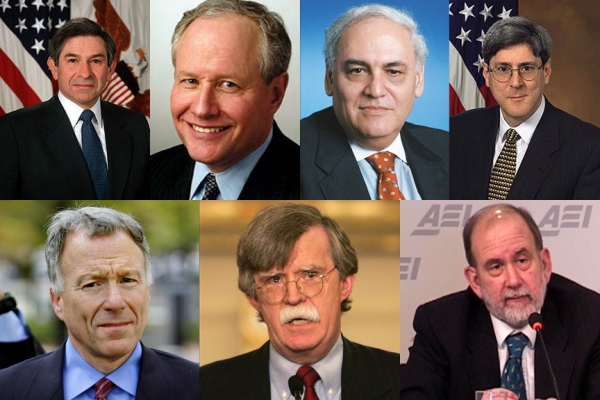
By Philip Giraldi • Unz Review • January 9, 2018
Award winning journalist James Risen has recently described in some detail his sometimes painful relationship with The New York Times. His lengthy account is well worth reading as it demonstrates how successive editors of the paper frequently cooperated with the government to suppress stories on torture and illegal activity while also self-censoring to make sure that nothing outside the framework provided by the “war on terror” should be seriously discussed. It became a faithful lap dog for an American role as global hegemon, promoting government half-truths and suppressing information that it knew to be true but which would embarrass the administration in power, be they Democrats or Republicans.
If one were to obtain a similar insider account of goings-on at the other national “newspaper of record”, The Washington Post, it is quite likely that comparable trimming of the narrative also took place. To be sure, the Post is worse than the Times, characterized by heavily editorializing in its news coverage without necessarily tipping off the reader when “facts” end and speculation begins. In both publications, stories about Iran or Russia routinely begin with an assertion that Moscow interfered in the 2016 U.S. election and that Iran is the aggressor in the Middle East, contentions that have not been demonstrated and can easily be challenged. Both publications also have endorsed every American war since 2001, including Iraq, Libya and the current mess in Syria, one indication of the quality of their reporting and analysis.
A recent op-ed in the Times by Bret Stephens is a perfect example of warmongering mischief wrapped in faux expert testimony to make it palatable. Stephens is the resident neocon at the Times. He was brought over from the Wall Street Journal when it was determined that his neocon colleague David Brooks had become overly squishy, while the resident “conservative” Russ Douthat had proven to be a bit too cautious and even rational to please the increasingly hawkish senior editors.
Stephens’ article, entitled Finding the Way Forward on Iran sparkles with throwaway gems like “Tehran’s hyperaggressive foreign policy in the wake of the 2015 nuclear deal” and “Real democracies don’t live in fear of their own people” and even “it’s not too soon to start rethinking the way we think about Iran.” Or try “A better way of describing Iran’s dictatorship is as a kleptotheocracy, driven by impulses that are by turns doctrinal and venal.”
Bret has been a hardliner on Iran for years. Early on in this op-ed he makes very clear that he wants it to be dealt with forcibly because it has “centrifuges, ballistic missiles, enriched uranium [and] fund[s] Hezbollah, assist Bashar al-Assad, arm[s] the Houthis, [and] imprison[s] the occasional British or American citizen.” He describes how Iran is a very corrupt place run by religious leaders and Revolutionary Guards and proposes that their corruption be exposed so that the Iranian people can take note and rise up in anger. And if exposure doesn’t work, they should be hammered with sanctions. He does not explain why sanctions, which disproportionately hurt the people he expects to rise up, will bring about any real change.
Stephens cites two of his buddies Ken Weinstein of the Hudson Institute and Mark Dubowitz of the Foundation for the Defense of Democracies (FDD), who are apparently experts on how to squeeze Iran. Weinstein prefers exposing the misdeeds of the Mullahs to anger the Iranian people while Dubowitz prefers punitive sanctions “for corruption.”
The article does not reveal that Weinstein and Dubowitz are long time critics of Iran, are part of the Israel Lobby and just happen to be Jewish, as is Stephens. The Hudson Institute and the FDD are leading neocon and pro-Israel fronts. So my question becomes, “Why Iran?” The often-heard Israeli complaint about its being unfairly picked on could reasonably be turned on its head in asking the same about Iran. In fact, Iran compares favorably with Israel. It has no nuclear weapons, it does not support any of the Sunni terrorist groups that are chopping heads, and it has not disenfranchised hundreds of thousands of people that it rules over. The fact is that Iran is being targeted because Israel sees it as its prime enemy in the region and has corrupted many “opinion makers” in the U.S., to include Stephens, to hammer home that point. To be sure, Iran is a very corrupt place run by people who should not be running a hot dog stand, but the same applies to the United States and Israel. And there are lots of places that are not being targeted like Iran that are far worse, including good friend and ally of both Jerusalem and Washington, Saudi Arabia.
Oddly enough Stephens, Weinstein and Dubowitz do not get into any of that back story, presumably because it would be unseemly. And, of course and unfortunately, the New York Times opinion page is not unique. An interesting recent podcast interview by Politico‘s Chief International Affairs correspondent Susan Glasser with leading neoconservatives Eliot Cohen and Max Boot, is typical of how the media selectively shapes a narrative to suit its own biases. Glasser, Cohen and Boot are all part of the establishment foreign policy consensus in the U.S. and therefore both hate and fail to understand the Trump phenomenon. Both Cohen and Booth were vociferous founding members of the #NeverTrump foreign policy resistance movement.
Boot describes the new regime’s foreign policy as “kowtow[ing] to dictators and undermin[ing] American support for freedom and democracy around the world,” typical neocon leitmotifs. Glasser appears to be in love with her interviewees and hurls softball after softball. She describes Boot as “fantastic” and Cohen receives the epithet “The Great.” The interview itself is remarkably devoid of any serious discussion of foreign policy and is essentially a sustained assault on Trump while also implicitly supporting hardline national security positions. Cohen fulminates about “a very serious Russian attack on the core of our political system. I mean, I don’t know how you get more reckless and dangerous than that,” while Boot asks what “has to be done” about Iran.
Pompous ass Cohen, who interjected in the interview that “and you know, Max and I are both intellectuals,” notably very publicly refused to have any part in a Trump foreign policy team during the campaign but later when The Donald was actually elected suggested that the new regime might approach him with humility to offer a senior position and he just might condescend to join them. They did not do so, and he wrote an angry commentary on their refusal.
Hating Trump is one thing, but I would bet that if the question of a hardline policy vis-à-vis Russia or the Jerusalem Embassy move had come up Cohen and Boot would have expressed delight. The irony is that Trump is in fact pursuing a basically neocon foreign policy which the two men would normally support, but they appear to be making room for Trump haters in the policy formulation process to push the national security consensus even farther to the right. Indeed, in another article by Boot at Foreign Policy he writes “I applaud Trump’s decisions to provide Ukraine with arms to defend itself from Russian aggression, to recognize Jerusalem as the capital of Israel, to send additional U.S. troops to Afghanistan, and to accelerate former President Barack Obama’s strategy for fighting the Islamic State.” Cohen meanwhile applauds the embassy move, though he warns that Trump’s success in so doing might embolden him to do something reckless over North Korea.
Perhaps one should not be astonished that leading neocons appearing in the mainstream media will continue to have their eyes on the ball and seek for more aggressive engagement in places like Iran and Russia. The media should be faulted because it rarely publishes any contrary viewpoint and it also consistently fails to give any space to the considerable downside to the agitprop. It must be reassuring for many Americans to know that the Center for Disease Control and Prevention (CDC) is preparing itself to deal with the aftermath of a nuclear attack on the United States and it will be sharing information on the appropriate preparations with the American people. There will be a public session on how to prepare for a nuclear explosion on January 16th.
CDC experts will consider “planning and preparation efforts” for such a strike. “While a nuclear detonation is unlikely, it would have devastating results and there would be limited time to take critical protection steps,” the Center elaborated in its press release on the event.
That the United States should be preparing for a possible nuclear future can in part be attributed to recent commentary by the “like, really smart” and “very stable genius” who is the nation’s chief executive, but the fuel being poured on the fire for war is from the very same neocons who are featured in the mainstream media as all-purpose experts and have succeeded in selling the snake oil about America’s proper role as aggressor-in-chief for the entire world. It would be an unparalleled delight to be able to open a newspaper and not see Bret Stephens, Eliot Cohen, Max Boot or even the redoubtable Bill Kristol grinning back from the editorial page, but I suppose I am only dreaming.
Philip M. Giraldi, Ph.D., is Executive Director of the Council for the National Interest, a 501(c)3 tax deductible educational foundation that seeks a more interests-based U.S. foreign policy in the Middle East. Website is http://www.councilforthenationalinterest.org, address is P.O. Box 2157, Purcellville VA 20134 and its email is inform@cnionline.org.
China to Build Second Foreign Naval Base, This Time in Pakistan
Sputnik – 05.01.2018
China is planning to build its second foreign naval base in Pakistan following the ribbon cutting ceremony for its first overseas base in Djibouti last July.
Sources close to the People’s Liberation Army have confirmed to the South China Morning Post that a Chinese naval port is being built at a strategic location on Pakistan’s southern coast.
“China needs to set up another base in Gwadar for its warships because Gwadar is now a civilian port,” Zhou Chenming, a Chinese military analyst, told the South China Morning Post on Friday. “Gwadar port can’t provide specific services for warships,” Zhou said; hence the need for a new base.
Gwadar is less than 50 miles east of the Pakistan-Iran border and sits in Balochistan Province, where fiercely independent Baloch nationalists have waged guerrilla wars against both the Pakistani and Iranian governments. “Public order there is a mess,” Zhou said.
“China and Pakistan have found common ground in terms of maritime interest in the region,” Pakistani analyst Sheikh Fahad says. “Gwadar port can be used for joint naval patrols in the Indian Ocean, further increasing the naval outreach of China and Pakistan in the region. Gwadar port will increase the countries’ naval movements and further expand defense cooperation, especially in the naval field,” Fahad noted.
In mid-December, Lawrence Sellin, a retired US Army Reserve colonel, reported for the Daily Caller that high-ranking Chinese and Pakistani officials had met in Beijing to discuss future projects.
Last June, a Pakistani diplomat said China’s help was needed as an “equalizer,” pointing to the naval base as all-but-inevitable. “Previously it was the US and Saudi Arabia… Now it’s China,” the diplomat told NBC. A Chinese Defense Ministry spokesman later dismissed the report as “pure guesswork,” but now it seems the port will, in fact, be built.
Experts have noted that India is keeping a close eye on the development of China-Pakistan relations. “China finds it very useful to use Pakistan against India and ignore India’s concerns, particularly on terrorism issues. That has created a lot of stress in the relationship between Beijing and Delhi,” Rajeev Ranan Chaturvedy, a researcher at the National University of Singapore, told SCMP.
But “Indian naval capabilities and experience in the Indian Ocean region are fairly good — much better than Pakistan and China,” Chaturvedy said.
Iraq-Raping Neocons Are Suddenly Posing As Woke Progressives To Gain Support
By Caitlin Johnstone | Medium | December 28, 2017
The invasion of Iraq was unforgivable. It remains unforgivable. It will always be unforgivable. Its architects should be tried in The Hague and imprisoned, and nobody who helped inflict that unfathomable evil upon our world should ever be employed anywhere they could do any more damage or mislead anyone else. All behaviors of the mainstream media, US intelligence agencies and US defense agencies should be viewed through the lens of those unforgivable lies and murders forevermore, and nobody should ever take them at their word about anything ever again.
Instead what has actually happened is that nothing whatsoever has changed since the invasion, Americans still take it on faith that Vladimir Putin, Bashar al-Assad and Kim Jong Un are world-threatening enemies in sore need of ousting, and bloodthirsty psychopaths like Max Boot who have been consistently wrong about everything are still hailed as experts worth listening to.
Oh yeah, and now they’re being adored as progressive heroes.
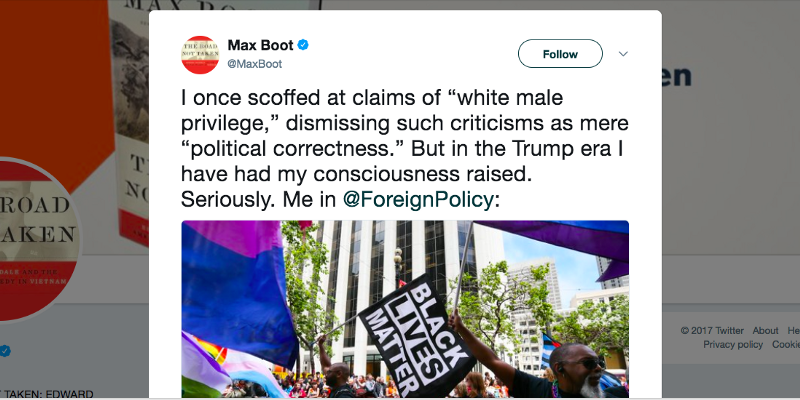
Boot, who is a PNAC signatory and senior fellow at the Council on Foreign Relations, published an article yesterday in Foreign Affairs which perfectly matches the newfound love of progressivism in his neocon soulmate Bill Kristol. The article, titled “2017 Was the Year I Learned About My White Privilege”, details in halting, equivocation-laden prose the months-long journey into awakening that this lying warmonger claims to have experienced during the Trump administration.
This spectacularly evil man, who wrote an essay titled “The Case for American Empire” just weeks after 9/11 in which he called in plain English for America to “unambiguously to embrace its imperial role,” is now seeing his latest essay shared eagerly by Democrats everywhere enthusiastically exclaiming “Look! See? This conservative gets it!”
I’m seeing some progressives arguing that Boot’s sudden public recognition of his white male privilege is intrinsically worthy of praise and acceptance, and that the proper response is to applaud him for it, not spit in his face. These people are wrong. Max Boot did not have some personal epiphany about race and gender dynamics which he felt like sharing in Foreign Policy magazine (the obvious place everyone goes for publication of their enlightening insights into privilege and inequality); Max Boot is courting Democrats because his war-hungry ideology is being increasingly rejected by Republicans.
If you want to see why neocons are courting Democrats with increasing desperation, check out the response to Boot’s latest essay by Fox’s Tucker Carlson, who has come to align with the popular anti-interventionist sentiments of Trump’s base, or Carlson’s debate with Boot on his show back in July:
Max Boot will say anything if they just let him invade Iran. https://t.co/M6MxBpr8oW
— Tucker Carlson (@TuckerCarlson) December 27, 2017
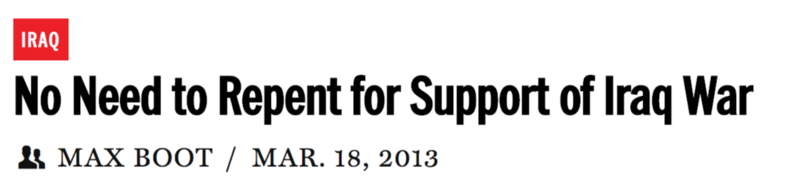
Meanwhile what have Democrats been doing? Supporting escalations with Russia based on accusations with no evidence that are reported as fact by the mainstream media in the exact sort of manic, violent, fact-free climate we saw in the lead up to the Iraq invasion (an invasion that Max Boot says nobody needs to repent for). Resistance hero Keith Olbermann says he owes George W Bush and John McCain an apology for the times he disagreed with them, and MSNBC’s Joy Reid openly admitted that she prefers people like Boot as allies instead of actual leftists and progressives:
One of the most amazing outcomes of the Trump administration is the number of neo-conservatives that are now my friends and I am aligned with. I found myself agreeing on a panel with Bill Kristol. I agree more with Jennifer Rubin, David Frum, and Max Boot than I do with some people on the far left. I am shocked at the way that Donald Trump has brought people together. [Laughs.]
~ Joy Reid
Reid’s comments are typical of the way the cult of anti-Trumpism has mainstream Democrats swooning over Bush-era neocons like they’re the Kennedys reincarnated instead of a bunch of child-butchering war profiteers. Just check out the top comments under this “Gosh I’m so woke all of a sudden!” tweet by neocon psychopath Bill Kristol.
In reality, nothing Trump has done in his administration so far is anywhere remotely close to as evil as the invasion of Iraq. The fact that hatred of the sitting president has Democrats so desperate they’re not only forgiving the crimes of vestigial Bush neocons but also helping them in their agenda to sabotage any movements toward detente with Russia shows just how brutally efficient the psychological manipulations of the establishment propaganda machine have become.
It was just in 2012 that these same Democrats were laughing along with their president at the Russia fearmongering of Mitt Romney.
Romney, who calls Russia our “No. 1 geopolitical foe,” doesn’t seem to realize it’s the 21st century. #RomneyNotReady http://t.co/xcvhOAFS
— The Democrats (@TheDemocrats) October 22, 2012
Neoconservatism first rose to prominence in the 1970s, and right off the bat one of its key principles was an opposition to detente with the USSR. This never changed. Not when neocons moved from the Democratic party to the Republican party, not when the Soviet Union fell, and not when neocons began migrating back from the Republican party to their old home in the Democratic party. Neocons have always been fixated on the world-threatening agenda of aggressively crushing Russia, and today the Democrats have picked up that flag and run with it right alongside them.
Which is why now we have depraved psychopaths like Max Boot and Bill Kristol acting out the bizarre performance of suddenly woke progressives. Their new Democratic buddies have already helped them resurrect the cold war on the same amount of evidence as was needed to manufacture support for the Iraq invasion, and with a little tweaking they hope to eventually convince them to help satiate their bloodlust in Iran and Syria as well.
The neocons don’t oppose Trump because he is evil, they oppose Trump because he isn’t evil enough. The slight bit of inertia he’s been placing on their death cult has been enough for them to pivot full-scale toward the Democratic party, which they hope to rebuild and lead into power with full sympathy for all the wars on their infernal wish list.
Don’t trust “woke Bill Kristol.” And don’t make a truce with him. https://t.co/cwE9Z7iSA4
— Vox (@voxdotcom) December 11, 2017
It’s not so accurate to say that, in 2017, Bill Kristol became a Democrat. It’s more accurate to say that in 2017, Democrats became Bill Kristol.
— Glenn Greenwald (@ggreenwald) December 26, 2017
The extremely influential neocon think tank Project for a New American Century’s most well-known publication, “Rebuilding America’s Defenses: Strategies, Forces, and Resources For a New Century”, argued extensively in the year 2000 that America’s victory in the Cold War against the USSR means the US must step into a planetary leadership role and maintain that leadership role by any means necessary, including military force.
“As the 20th century draws to a close,” PNAC’s 1997 Statement of Principles reads, “the United States stands as the world’s preeminent power. Having led the West to victory in the Cold War, America faces an opportunity and a challenge: Does the United States have the vision to build upon the achievements of past decades? Does the United States have the resolve to shape a new century favorable to American principles and interests?”
The answer to this question came after 9/11: yes, yes it does. The New American Century has seen an immense increase in military interventionism across the globe to ensure the hegemony of the US dollar and prevent Russia and China from climbing the global power ladder unchecked.
That’s all we’re seeing here in Woke Max Boot and Woke Bill Kristol. Neoconservatism has always been an ideology/military-industrial complex war profiteering scheme which advocates bullying and sabotaging all governments that could pose a threat to the planetary dominance of the US power establishment, and lately rank-and-file Republicans have been proving less useful in facilitating that agenda than rank-and-file Democrats. So they’re saying and doing whatever they need to in order to win the approval of the Dems.
The good thing to have come out of #Brexit and #Trump? Discovering new alliances with people you might once have thought only adversaries https://t.co/dDhhXGTwpB
— Peter Jukes (@peterjukes) December 28, 2017
Brave piece and thank you @MaxBoot:
“ People like me, in other words. Whether I realize it or not, I have benefitted from my skin color and my gender — and those of a different gender or sexuality or skin color have suffered because of it.” https://t.co/XqLSIinwOy— Amy Siskind (@Amy_Siskind) December 27, 2017
It’s always admirable when people evolve & have the courage to say where they were wrong. https://t.co/AfEKy07AbI
— Jill Filipovic (@JillFilipovic) December 28, 2017
And by golly, it sure looks like it’s working.
It’s not okay to be a neoconservative. In a healthy world, being a neocon would carry as much social weight as being a child molester or a serial killer. These people should not be embraced, they should be recoiled from. Always.
Until Democrats turn away from neoconservatism, the fact that they don’t should be pointed to at every opportunity. The correct response when any Democrat tries to tell you about Russia or Syria is “Get out of here with that Saddam-has-WMDs filth, neocon.”
That omnicidal death cult deserves nothing but our most sincere revulsion.
__________
Making the 2018 Elections a Struggle for Peace, Jobs and Justice
Voters’ search for political revolution continues
By Wayne Nealis | Dissident Voice | December 28, 2017
As we head into a pivotal mid-term election year, it is clear the Democratic Party establishment has not learned a key lesson from the 2016 election. That is, that many of the party’s former and current constituents reject the party’s establishment leadership and its lackluster program. These voters are looking for alternatives. In 2016, en masse they deserted the party for a new kind of politics they found in Bernie Sanders and some saw in Donald Trump.
Voters passed judgment on the leading figures of both parties. Distrust and discontent disrupted politics as usual. The opportunity to fill this void with left-of-center electoral initiatives abound. It starts with building on the momentum of Bernie Sanders’s campaign that resonated with tens of millions. In some fashion or another, ready or not, the 2018 midterm elections must become an arena of struggle for peace, economic security and racial justice.
Sanders’ leadership in 2016, and still today, falls short in two key areas to meet this challenge. First, during his campaign he did not offer Americans a bold new foreign policy. To start with, a plan to end the war on terrorism and the foreign military adventures that have made us less safe and destabilized and laid waste to a dozen nations. Secondly, after November, instead of calling for discussion on forming a new political party he and his advisors chose to form yet another 501c entity, Our Revolution, primarily as a vehicle to move the Democratic Party to the left. It would behoove Sanders to reconsider both choices. The Democratic Party’s electoral structure is certainly a vehicle for advancing progressive and even left candidates, but the party’s owners are not likely to hand over its bank accounts to Sanders, labor unions and people’s organizations.
Months after the elections the Clinton-Obama-Pelosi centrists still hold the reins and drive a shameless hubris as they scramble to blame someone for the party’s declining appeal and its 2016 losses. No, it was not Obama and Clinton’s support of the Trans Pacific Partnership (TPP) or Bill Clinton’s betrayal of labor unions on NAFTA. It was not due to Hillary’s use of the term “super predators” in 1996 to describe black youth involved in criminal activity. No, it was not the shortcomings of the bureaucratic, insurer-friendly Obamacare.
No, it was the Russian television network Russia Today brainwashing its 8 million American viewers. No, it was Russian cyber meddling in the election, for which months later we have zero evidence. Same goes for alleged Russian collusion with the Trump campaign. No, the loss was due to FBI director James Comey’s late in the game letter to congress about Clinton’s emails. No, it was WikiLeaks alleged release, in collaboration with Russia, of emails showing the Democratic National Committee (DNC) sought to derail Bernie Sanders’ campaign. Which, as we learned was the case.
After a full-court media campaign to convince Americans of Russian meddling, many remain skeptical. In a May 2017 CBS poll, 55 percent of Americans considered the allegations a distraction that “get in the way of getting things done.” In October, 41 percent still agree they were a distraction.1
Clinton again blamed Bernie Sanders in her post-election book tour, dubbed by some The Denial Tour. “His attacks caused lasting damage, making it harder to unify progressives in the general election….” Not exactly the kind of message designed to heal and unify the party going into 2018 elections. Since polls show Bernie is the most admired politician in America, topping 70 percent, to say her grumbling is a political misstep for the party is an understatement.
Yet, even as Clinton’s own poll ratings dropped to 30 percent, she continued to maintain the loss was due to something other than an uninspiring campaign and the neo-liberal, anti-working class politics the Democratic Party’s centrist leadership has pedaled for 30-plus years. Clinton even blamed the Democratic National Committee (DNC), led by a loyal Clinton supporter, Debbie Wasserman Schulz, saying it “…was on the verge of insolvency. Its data was mediocre to poor, nonexistent, wrong.”2
A crisis of legitimacy
Both Sanders and Trump’s campaigns rode on a crisis of legitimacy in the two parties. Today, only 18 percent of voters consider themselves strong Democrats. The no longer Grand Old Party is slightly worse off at 15 percent. So far, Trump maintains most of his loyal voter support, which we should keep in mind, is only around 25 percent of the total electorate.
The attendant political volatility arising from the 2016 election combined with numerous international crises, presents an opportunity for demagogic appeals to patriotism, xenophobia and racism to deepen and spread. At the same time, it is an opening to advance a working-class political and economic program to provide meaningful, concrete solutions to address people’s grievances and discontents. A program, we might call a Sanders plus program, the plus being a plan for peace.
The Sanders wing of the Democrats is hesitant, waiting. Will Sanders break with the party? Be sidelined? Clearly, Sanders is taking on the establishment, pushing his economic program of social benefits, but it appears his aim is to reform or take over the party. A tough job when those hanging on to power, did not mention Sander’s program until September, when 15 Democratic senators finally endorsed single-payer national health insurance. In the House, progressive Democrats have signed on Bernie’s program for free post-secondary education, paid parental leave and expanding social security. However, there is little evidence of serious actions being taken on the part of the leadership to rally Americans behind the legislation. After Sanders introduced his single-payer bill, Hillary Clinton and other Democratic leaders, notably Rep. Nancy Pelosi and Sen. Chuck Schumer, told voters they do not support single-payer. Again, the failure of the leadership to learn the lessons of 2016.
Understandably then, Americans give the leadership low marks when it comes to presenting alternatives to Trump’s reactionary program. A Washington Post – ABC News poll in late October this year found only 28 percent of voters thought the Democrats were offering real alternatives.3 Nearly one half of Democratic responders and 65 percent of independents said the leadership was just criticizing Trump. One attempt to launch an alternative program failed miserably.
The Democrats “Better Deal” falls flat
In July, a Pelosi–Schumer road show unveiled the party’s alternative to the Trump-GOP program: “A Better Deal: Better Jobs, Better Wages, Better Future.” In a Washington Post, Op-ed, Pelosi said the Deal, “represents a renewed Democratic commitment to the hard-working men and women across the United States who have been left out and left behind for too long.” It rained hard in Berryville, Virginia that day, the site of show. Reviews rained even harder on the Democrat’s proposal. It made no mention of Sanders’ far-reaching social benefit program that would lift up the left out. Their effort to make a splash with the working class was drowned in empty words, rhetorical promises and contrived apologies for abandoning working-class voters.
If Schumer, Pelosi, Clinton et al wanted to rebuild the party they only need reach out to the millions who responded to Sanders program for expanding social benefits at the expense of the billionaire class. Instead all we hear is Russia, Russia, Russia. Some pundits allege the Democratic leadership is tone-deaf to political reality, but their silence is due to an unwillingness to break with their corporate sponsors any more than are the masters of the once Grand Old Party. Instead both parties, and institutions in their orbits, are worried Americans are losing faith in the long-standing institutions of the limited “democracy of the few” embodied by the two-party capitalist system.
In January, Linda Chavez, a former Reagan cabinet member turned media pundit, put it this way in her New York Post column: “Democracy can only exist as long as the people trust its institutions. The greatest calamity of this election cycle has been the weakening of that trust.” Another reading of her statement is both Sanders and Trump upset the well painted façade of democratic governance. Neither candidate could be trusted to be loyal administrators of the bi-partisan imperialist foreign policy and neo-liberal economic program of capitalism.
While Chavez may lament this decline, those seeking a more just, peaceful society have an opportunity to step into this vacuum and begin building a new political party responsive to, and with, our nation’s multi-national working class, white and blue collar, youth and students. The massive discontent with politics as usual offers fertile ground. The first step is to agree on a working-class program for economic security, peace and racial justice. The next is to bring it into the 2018 mid-term election and beyond.
Resolutions at the AFL-CIO Convention in October showed emerging sentiment among labor union leaders for independence from the two parties and for renewing the idea of a Labor Party. A resolution calling for a pro-worker agenda and “an independent political voice,” stated: “The time has passed when we can passively settle for the lesser of two evils.”4
According to the People’s World reporting from the convention, 50 delegates met for a discussion on the idea of a Labor Party.5 Postal Workers President Mark Dimondstein led a convention floor discussion and roused an applause when he said: “The Democratic Party was not delivering anything even when it had control of the White House, the Congress and the Senate.” This echoed the position of another resolution on electoral politics that concluded that: “continuing to follow the same model, expecting different results, is not an effective strategy for labor.”6
Help wanted: political leaders who stand for something
Propelling the urgency for bold alternatives in 2018 and beyond is that another capitalist economic crisis is looming on the horizon. Absent an alternative such a crisis will enlarge the opening for demagogic solutions like those offered by Trump’s GOP, as well as, austerity measures authored by the corporate allies of both parties. Might it be possible that Our Revolution will find an independent political footing to meet this challenge? Might progressive labor unions unite with people’s movements and Our Revolution to meet this challenge? These possibilities deserve urgent attention if we are to prevent Trump’s new GOP from consolidating power.7
Single-payer advocates welcomed senate Democrats finally getting behind Medicare for all legislation, but there is a steep hill to climb to win over skeptical workers fed up with just about every establishment Democrat. Democratic Representative Tim Ryan of Ohio said, in a New York Times interview in June, following the loss of Jon Ossoff in Georgia, that the party had become “toxic” in much of the country as voters see Democrats as “not being able to connect with the issues they care about.”8
In the same article D. Taylor, the president of the union Unite Here, representing hospitality workers across the country said, “Millions of Americans are desperate to be led by political leaders who stand for something, are willing to take risks, and are willing to tell the truth and engage Americans where they live. That just isn’t happening.” Labor unions and people’s movements who wait for the Democratic Party to make it happen will still be waiting in 2024. Now is the time to build and organize the mass sentiments revealed by the Sanders’ campaign. It’s no time to hesitate or go slow. It is time to take bold risks with confidence and trust that people will respond.
Although the Tim Ryans of the Democratic Party are not likely to call their own foreign policy “toxic,” 2016 showed millions of voters were concerned about Hillary Clinton’s aggressive support of military interventions. Sanders’ repeated criticism of her record resonated broadly with young people, progressives and among the working class. In the fall, Trump even told his voters at rallies that a vote for Hillary would be a vote for more war.
Yet, since the election the Democratic leadership has lent tacit support to Trump’s military budget increases and his ratcheting up of aggression against Venezuela, Iran, North Korea and China. Particularly egregious is the support of both parties’ leaders, for Saudi Arabia’s murderous war against the people of Yemen. Aggression that began with support from the Obama Administration. Not a word of criticism, except for a handful of progressive Democratic officials.
An electoral counter to such dangerous jingoism requires fielding dozens of congressional candidates on a program for peace. This is the glimmer of rationality that peace-loving, oppressed and war-torn peoples around world desperately await U.S. activists to initiate in the citadel of imperialism. Left and progressive organizations that avoid this work shirk their international responsibilities.
A good place to start is to press candidates and incumbents to support a new direction in foreign policy as advanced by AFL-CIO resolution: War is not the Answer.9 It calls on the president and congress “to bring the war dollars home and make our priority as a nation rebuilding this country’s crumbling infrastructure, creating millions of living wage jobs and addressing human needs such as education, health care, housing, retirement security and jobs. Furthermore, it calls “for a foreign policy based on international solidarity of all workers, mutual respect of all nations and national sovereignty…”
If candidates won’t sign on, challenge them. Pressure them. Americans are tired of war. The AFL-CIO resolution reflects this sentiment. Make 2018 a struggle for peace. General election and primary challengers running on a plan for peace may not win, but such a presence is urgently needed to elevate the struggle for peace, economic security and racial justice.
- “Americans worried about Russian influence on elections,” October 30, 2017. SurveyMonkey poll conducted from October 23 to October 26
- CNN, Chris Cillizza, Editor-at-large. “In election blame game, it’s time for Hillary Clinton to take her share,” June 1, 2017.
- Washington Post. “Trump’s approval rating remains historically low and confidence has declined.” Washington Post-ABC News poll, October 29-November 1, 2017. November 13, 2017.
- Resolution 2: “An independent political voice.” Resolutions, 2017 AFL-CIO Convention.
- John Wojcik and Mark Gruenberg. People’s World, “AFL-CIO calls for a break with “lesser of two evils” politics,” October 25, 2017.
- Resolution 48: “Exploring new directions for labor in electoral politics.”
- See my analysis of this danger in the December 2017, Adonde Press pamphlet, “The 2016 Election: Analysis, Lessons and Task Ahead.”
- Alexander Burns and Jonathan Martin. New York Times. “Democrats Seethe After Georgia Loss: ‘Our Brand Is Worse Than Trump.’”, June 21, 2017.
- Resolution 50: “War is not the Answer.” Resolutions, 2017 AFL-CIO Convention.
All Is Not Quiet on the Syrian Front: US to Launch Another War
By Alex GORKA | Strategic Culture Foundation | 29.12.2017
This is a classic example of flip-flop policy. In November, the US promised Turkey to stop arming Kurdish militias in Syria after the Islamic State was routed. Brett McGurk, the US Special Presidential Envoy to the Global Coalition to Defeat Islamic State, explained that after the urban fighting in Raqqa was over “adjustments in the level of military support” would be made. “We had to give some equipment – and it’s limited, extremely limited – all of which was very transparent to our NATO ally, Turkey,” he said during a special briefing on December 21. In June, the US told Turkey it would take back weapons supplied to the Kurdish the People’s Protection Units (YPG) militia in northern Syria after the defeat of Islamic State.
But sophisticated weapons will continue to be sent to Syria in 2018, including thousands of anti-tank rocket launchers, heat seeking missiles and rocket launchers. The list of weaponry and equipment was prepared by US Department of Defense as part of the 2018 defense budget and signed by Trump of Dec. 12. It includes more than 300 non-tactical vehicles, 60 nonstandard vehicles, and 30 earth-moving vehicles to assist with the construction of outposts or operations staging areas. The US defense spending bill for 2018 (“Justification for FY 2018 Overseas Contingency Operations / Counter-Islamic State of Iraq and Syria Train and Equip Fund”) includes providing weapons worth $393 million to US partners in Syria. Overall, $500 million, roughly $70 million more than last year, are to be spent on Syria Train and Equip requirements. The partners are the Kurds-dominated Syria Democratic Forces (SDF). The YPG – the group that is a major concern of Turkey – is the backbone of this force.
The budget does not refer to Syrian Democratic Forces (SDF) but instead says “Vetted Syrian Opposition”. According to the budget list, there are 25,000 opposition forces supported as a part of the train and equip program in Syria. That number is planned to be increased to 30,000 in 2018. The arming of Kurdish militants with anti-tank rockets is a sensitive topic because of Turkey’s reliance on its armored Leopard tanks in northern Syria.
Talal Sillo, a former high-ranking commander and spokesperson of the US-backed SDF, who defected from the group last month to go to Turkey, divulged details of the US arming the Kurdish group.
The list does not detail which vetted Syrian groups will receive certain pieces of equipment. In northern Syria, there is the SDF, including the YPG, and the Syria Arab Coalition — a group of Arab fighters incorporated into the SDF. The Maghawir al-Thawra and Shohada al-Quartayn groups are operating in the southeastern part of Syria. They are being trained by US and British instructors at the al-Tanf border crossing between Syria and Iraq.
Besides the SDF and the groups trained at al-Tanf, the US is in the process of creating the New Syria Army to fight the Syrian government forces. The training is taking place at the Syrian Hasakah refugee camp located 70 kilometers from the border of Turkey and 50 kilometers from the border of Iraq.
Around 40 Syria opposition groups on Dec. 25 rejected to attend the planned Sochi conference on Syria scheduled to take place in January. They said Moscow, which organizes the conference, was seeking to bypass the UN-based Geneva peace process, despite the fact that UN Syria envoy Staffan de Mistura said that Russia’s plan to convene the congress should be assessed by its ability to contribute to and support the UN-led Geneva talks on ending the war in Syria. If fighting starts, these groups are likely to join the formations created by the US.
So, the United States not only maintains its illegal military presence in Syria and creates new forces to fight against the Syrian government, it appears to be preparing for a new war to follow the Islamic State’s defeat. The continuation of arming and training Kurdish militias will hardly improve Washington’s relations with Ankara, while saying one thing and doing another undermines the credibility of the United States as a partner.
Featured Video

Trita Parsi: Israel Set a Trap for Total War in the Region
or go to
Aletho News Archives – Video-Images
From the Archive
Zionism’s Violent Legacy
By Donald Neff | Washington Report On Middle East Affairs | January 1996
On January 4, 1948, Jewish terrorists drove a truck loaded with explosives into the center of the all Arab city of Jaffa and detonated it, killing 26 and wounding around 100 Palestinian men, women and children.[1] The attack was the work of the Irgun Zvai Leumi – the “National Military Organization,” also known by the Hebrew letters Etzel – the largest Jewish terrorist group in Palestine. The Irgun was headed by Revisionist Zionist Menachem Begin and had been killing and maiming Arabs, Britons and even Jews for the previous ten years in its efforts to establish a Jewish state.
This terror campaign meant that at the core of Revisionist Zionism there existed a philosophical embrace of violence. … continue
Blog Roll
 Aletho News
- Trita Parsi: Israel Set a Trap for Total War in the Region
- Trump’s Iran war is on an Israeli leash
- Saudi oil boss issues global supply warning
- Riyadh Says Its Oil System Is Intact. The Numbers Say Otherwise.
- Trump and Netanyahu Want to “Finish the Job” on Iran
- US ‘one-sided dictation’ not Iran’s beliefs makes rational talks impossible: Baghaei
- Iran’s Next Strike May Not Explode. It Could Shut You Down /Col Doug Macgregor
- Iran: US political targets legitimate if assassinations return
- Iraq shuts key border crossing with Iran under US pressure: Report
- Undersea Internet cables could be targeted in retaliation for attacks on Iran: IRGC deputy chief
- If Americans Knew
- The Israel Lobby’s Changing Fortunes
- AIPAC has become such a political liability that it’s shifting to a more “nimble” approach to buying politicians
- At least 160 Israeli settler attacks in 2 weeks
- Will Gaza’s Ancient Christian Community Disappear Forever?
- Israel’s vision of regional security rests on keeping Arab states weak
- Heidi Levine recounts how Palestinian youths helped save her in settler attack
- DAILY UPDATE: Latest essential news on Palestine, Israel, & region
- Trump’s Intensifying Sabotage of the ICC, for Israel’s Sake
- Israeli military detain US and UK volunteers in West Bank including Democratic NY politician Brad Lander
- Americans at National Conservatism Conference held in Israel this year criticize Israel
- No Tricks Zone
- E-Cars Reduce CO2 Emissions By Only 41% Compared To Internal Combustion Engine Vehicles
- Predictions Made By Renowned Climate Professor Over Past Decades Have Been Proven To Be Poor
- New Study Suggests Large Regions Of The Pacific Ocean Have Been Cooling For The Last 80 Years
- Germany’s Green Energy Debacle: High Energy Costs Force Kahla Porzellan to Close After 182 Years!
- New Study: 50 Years Of The Most Aggressive ‘Net Zero’ Policies Can Only Affect The Global Climate By 0.03°C
- US September “Heat” Was No Record…Many Records Set Decades Ago
- Latest European Green Energy Debacle; Portugal’s Largest Flagship Solar Park Insolvent!
- Green Energy Debacle: German Expert Professor Fritz Vahrenholt Warns Of Severe Economic And Social Consequences
- Two More Paleo Reconstructions Affirm Meters-Higher Sea Levels Across Ireland, Brazil 7000-6000 Years Ago
- New Study: Earth And Venus Surface Warmth Largely Explained By Convection And Lapse Rate, Not CO2 Or Radiation

