Trump – two steps forward, one step back

By Thierry Meyssan | Al-Watan | April 18, 2017
President Trump’s radical change in rhetoric concerning his foreign policy was accompanied by the bombing of an air base in Cheyrat, and that of an Afghan mountain.
The world trembled before the deployment of such force – 59 Tomahawk missiles in Syria and one GBU-4/B3 mega-bomb in Afghanistan. Yet the base in Cheyrat was already operational again the following morning, while the « Mother Of All Bombs » certainly caused the collapse of three exits of a natural tunnel, but did not destroy the kilometres of underground passages created over time by the rivers within the mountain. In short, much ado about nothing.
These two operations were clearly intended to convince the US deep state that the White House was once again supporting its imperial politics. They had the desired effect on Germany and France. Chancellor Angela Merkel and President François Hollande applauded their lord and master, and called for an end to the Syrian situation. The surprise arrived from elsewhere.
The United Kingdom did not only follow the movement. Their Minister for Foreign Affairs, Boris Johnson, proposed to levy sanctions against Russia, according to him an accomplice in the Syrian « crimes », and responsible in one way or another for the Afghan resistance and a plethora of other evils.
During the meeting of the Ministers for Foreign Affairs at the G7, Johnson announced the cancellation of his trip to Moscow, and invited all his partners to break off their political and commercial relations with Russia. However, though approving the British initiative, these partners prudently stayed in the background. Rex Tillerson, the US Secretary of State, incontrovertibly dismissed this insane proposition and maintained his trip to Moscow. Brazenly, Johnson then declared that the Europeans had appointed Tillerson to go and talk some sense into the Russians.
Although international protocol states that Ministers are to be received by their opposite numbers, and not by the Head of State, the Atlantist Press presented Tillerson’s welcome by Lavrov as a cooling of Russo-US relations. Before he had the time to salute his guest, Sergey Lavrov was interrupted by a Washington journalist who took him to task. Reminding him of the conventions of basic politeness, the Russian Minister refused to answer him and cut the presentations short.
The meeting, behind closed doors, lasted for more than 4 hours, which seems fairly long for people who have nothing to say to one another. Finally, the two men requested an audience with President Putin, who recieved them for 2 extra hours.
After these meetings, the Ministers gave a Press conference. They declared without irony that they had done little more than take note of their divergences. Sergey Lavrov warned the journalists of the danger that this rupture represented for the world.
However, the next day, the same Lavrov, addressing the Russian Press, indicated that he had concluded an agreement with his guest. Washington had agreed not to continue their attacks on the Syrian Arab Army, and the military coordination between the Pentagon and the Russian army for circulation in Syrian airspace had been re-established.
In appearance, the Trump administration is roaring its power and throwing bombs around, but in reality, it is taking great care not to cause any irreparable damage. The worst and the best are therefore possible.
Translation by Pete Kimberley
War Cries Drown Out ‘America First’
By Pat Buchanan • Unz Review • April 18, 2017
“Why would I call China a currency manipulator when they are working with us on the North Korean problem?” tweeted President Donald Trump on Easter Sunday.
Earlier, after discovering “great chemistry” with Chinese President Xi Jinping over “the most beautiful piece of chocolate cake” at Mar-a-Lago, Trump had confided, “I explained … that a trade deal with the U.S. will be far better for them if they solve the North Korean problem!”
“America First” thus takes a back seat to big-power diplomacy with Beijing. One wonders: How much will Xi end up bilking us for his squeezing of Kim Jong Un?
Trump once seemed to understand how America had been taken to the cleaners during and after the Cold War. While allies supported us diplomatically, they piled up huge trade surpluses at our expense and became virtual free-riders off the U.S. defense effort.
No nations were more successful at this than South Korea and Japan. Now Xi is playing the game — and perhaps playing Trump.
What is the “North Korean problem” Beijing will help solve in return for more indulgent consideration on future U.S.-China trade deals?
North Korea’s nuclear arsenal. As 80 percent of Pyongyang’s trade comes through China, Trump believes that Beijing can force Kim to stop testing missiles and atomic bombs before he produces an intercontinental ballistic missile that could hit the U.S.
But what is to prevent Xi from pocketing Trump’s concessions and continuing on the strategic course China has long pursued?
For in many ways, Pyongyang’s goals parallel China’s.
Neither could want an all-out war on the Korean Peninsula. For Kim, this would devastate his country, bring down his regime, and cost him his life. For China, war could mean millions of Koreans crossing the Yalu into Manchuria and a disruption of Beijing’s march to Asian hegemony.
A continuing crisis on the peninsula, however, with Trump and the U.S. relying on Beijing’s help, could leave Xi in the catbird seat.
And now that North Korea has declared its goal to be building missiles with nuclear warheads that could hit all U.S. bases in Asia — and even California — the clock is running for the White House.
“It won’t happen,” Trump has said of North Korea’s developing an ICBM that could hit the United States. “If China is not going to solve North Korea, we will.”
“The threat is upon us,” says outgoing deputy national security adviser K.T. McFarland. “This is something President Trump is going to deal with in the first year.”
Secretary of State Rex Tillerson and Vice President Mike Pence have declared that our policy of “strategic patience” with Pyonyang is at an end.
National security adviser H.R. McMaster said Sunday the U.S. has “to take action, short of armed conflict, so we can avoid the worst” in dealing with “this unpredictable regime.”
With a stunning parade of missiles in Pyongyang on Saturday, the North’s failed firing of a solid-fueled missile that same day, and the promise of new missile tests weekly, Kim is forcing our hand.
Either he backs away from building atomic bombs and long-range missiles or Trump and his generals must make good on their warnings.
How did we get to this point?
Why, 64 years after the Korean War, a quarter-century after the Cold War, are we still obliged to go to war to defend South Korea from a North with one-half the South’s population and 3 percent of its gross domestic product?
Why are we, on the far side of the Pacific, still responsible for containing North Korea when two of its neighbors — Russia and China — are nuclear powers and South Korea and Japan could field nuclear and conventional forces far superior to Kim’s?
How long into the future will containing militarist dictators in Pyongyang with nuclear missiles be America’s primary responsibility?
Another issue arises. Before the U.S. launches any pre-emptive strike on North Korea, Congress should be called back into session to authorize any act of war against the North.
Perhaps this time, Congress would follow the Constitution.
Though Korea is the crisis of the moment, it is not the only one.
Not since 9/11 have the Afghan Taliban been stronger or controlled more territory. The United States’ commanding general there is calling for thousands more U.S. troops. Russia and Iran are reportedly negotiating with the Taliban. Pakistan is said to be aiding them.
To counter Vladimir Putin’s Russia, we have moved U.S. and NATO troops into Poland, the Baltic States, Romania and Bulgaria. We have fired missiles into Syria. We are reportedly preparing to back the Saudis in the latest escalation of their war on the Houthi rebels in Yemen.
Twenty-four years after “Black Hawk Down,” the weekend brought reports of U.S. troops returning to Somalia.
The promise of a Trump presidency — that we would start looking out for our own country and own national interests first and let the rest of the world solve, or fail to solve, its own problems — appears, not 100 days in, to have been a mirage.
Will more wars make America great again?
Copyright 2017 Creators.com.
Syria: Neocons Get Almost Giddy
By Jim Lobe | LobeLog | April 9, 2017
Thirty-six hours after the pre-dawn cruise-missile strike against Syria’s al-Shayrat airfield, neoconservative hawks, many of whom beat the drums for war in Iraq 14 years ago, are feeling the warm spring breezes of renewal and rejuvenation. Suddenly hopeful that Donald Trump may yet be coming around to their worldview, neoconservatives are full of praise for the action, which they (like many liberal interventionists) insist was long overdue. Not surprisingly, neocons are pressing for more.
The strike, which marked a dramatic reversal by a president who had strongly opposed any similar action by Barack Obama in 2013, coincided with a number of reports that Steve Bannon’s influence on Trump was on the wane amid intensified infighting between Bannon’s “nationalism” and Jared Kushner and Gary Cohn’s “globalism.” The potential eclipse of Bannon has only added to the giddiness of the neocons as they anticipate what might now be possible.
For now, at least, it’s the generals—in the form of National Security Adviser H.R. McMaster and Pentagon chief James “Mad Dog” Mattis—who appear to be masters of the moment both with respect to the decision to strike and the specificity of the target. The principal justification for the strike—to uphold the international ban on chemical weapons as opposed to, say, the broader aim of “regime change”—was also narrowly drawn, reflecting the military’s determination to avoid being drawn into yet another Middle East civil war.
Nonetheless, the neocons, who have rarely met a slippery military slope they weren’t tempted to roll down, embraced wholeheartedly both the strike and its justification. They view it as a first—but absolutely necessary—step toward a new phase of U.S. interventionism of precisely the kind that Bannon and his “nationalist” and Islamophobic allies abhor. The perceived decline in Bannon’s influence gives them an opening that, until this week’s events, they thought was out of reach.
Thus, the dominant theme for neocons in the strike’s aftermath was applause for what they see as an abandonment of Obama’s post-Libya policy of military restraint and, quite possibly, the restoration of Washington’s credibility as the global hegemon newly resolved to impose its will anywhere it sees a threat to its vital interests very broadly defined.
Neocons Exult
Elliott Abrams, a top Mideast aide to Bush who Trump rejected as deputy secretary of state reportedly as a result of Bannon’s opposition, thus exulted in the Weekly Standard over Thursday’s strike with the kind of capitalized flattery that appeared as carefully targeted at Trump’s enormous ego as the most sophisticated cruise missile. No doubt, Abrams still entertains hopes of getting a top post in the administration if Bannon’s declining influence is true.
The president has been chief executive since January 20, but this week he acted also as Commander in Chief. And more: he finally accepted the role of Leader of the Free World.
… And the strike will have far wider effects [beyond Syria]. It was undertaken while Chinese president Xi was with Trump in Florida. Surely this new image of a president willing to act will affect their conversations about North Korea. Vladimir Putin will think again about his relations with the United States, and will realize that the Obama years of passivity are truly over. Allies and friends will be cheered, while enemies will realize times have changed. When next the Iranians consider swarming around an American ship in the Gulf, they may think again.
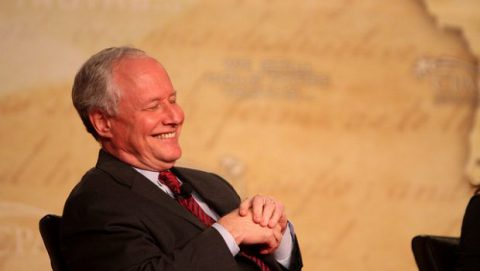
Bill Kristol—the Standard’s editor-at-large and co-founder and director of the Project for the New American Century (PNAC), which did so much to coordinate with the Bush administration in rallying elite support for the Iraq invasion— declared Abrams’s analysis a “must read” in a tweet issued Friday morning.
Indeed, prominent neocons clearly saw their opportunity after the lethal chemical attack on Khan Sheikhoun in Idlib province Tuesday to press their agenda on the administration.
None other than Paul Wolfowitz, Bush’s deputy defense secretary and a chief architect of the Iraq invasion and disastrous aftermath, suggested in a Wall Street Journal op-ed that statements by Trump’s senior officials suggesting that Washington was reconciled to Assad’s continued rule over the country may have emboldened the Syrian leader to test the limits.
Let us hope Mr. Trump will reassess the impact of recent statements by members of his administration indicating that the U.S. is prepared to live with the Assad regime. The Syrians—and their Russian and Iranian backers—might well have interpreted this as a signal that they could continue terrorizing the population.
Encouraged by Trump’s initial verbal condemnation of the gas attack, Wolfowitz made clear that action was required:
President Trump may have initially believed that he could avoid the fork in the road presented by the Assad regime’s use of chemical weapons in Syria by simply blaming the crime on Barack Obama’s failure to enforce his “red line” four years ago. Fortunately it seems he has reconsidered.
To drive the point home, the Journal editors headlined the op-ed “For Syria, Words Won’t Be Enough: Trump says attacking civilians crosses ‘many lines.’ Will he back it up?”
Meanwhile, the looniest among the neocons, former CIA director James Woolsey—who was one of the first to publicly claim a connection between Saddam Hussein and 9/11—was urging trump to do much, much more than a simple retaliatory strike.
This at least gives us an opportunity to do something that is tied to the Syrian events, and that would be to use force against the Iranian nuclear program … If we want to change the nature of the threat to us in that part of the world, what we have to do is take out the Iranian nuclear program—if we can without hitting any Russian units—and some of the Syrian capability.
Pump Up the Volume
Although most other neocons were not quite so explicit about their fondest desires, they made perfectly clear that Thursday’s cruise-missile strike should only be a first step toward a larger regional strategy designed to roll back Iranian (and Russian) influence (much as PNAC warned after 9/11 that taking out the Taliban in Afghanistan should only be a first step in the war against terror). Writing in the New York Daily News, Fred Kagan of the American Enterprise Institute (AEI) argued that
President Trump’s decision to attack the airfield from which the most recent chemical attack was launched must be the start of a new strategy. It must begin a campaign to drive the Assad regime to compromise. It must be the start of an effort to regain the confidence of Sunni Arabs in Syria and around the world that the U.S. stands with them against all those who would attack them, ISIS and Al Qaeda as well as Iran and its proxies.
Katherine Zimmerman has also echoed this theme of backing the region’s Sunni states. Like both Wolfowitz and Kagan, Zimmerman is based at AEI, the neoconservative think tank that not only led the public campaign for invading Iraq but played a critical role in planning the post-invasion occupation.
The US cruise missile strikes are the first step to restoring America’s credibility within the very population—the Sunni Arabs—that it must win over to secure its strategic interests in the Middle East. The action against the Assad regime starts to chip away at al Qaeda’s narrative that it alone is the defender of the Syrian Sunni. But an isolated response will not achieve systemic effects. It is impossible to defeat al Qaeda and ISIS without the support of the Sunni, and re-establishing America’s credibility will certainly be difficult.
(The irony of AEI’s strong backing for Sunnis throughout the region is particularly rich given its historic role in enhancing the influence of Ahmad Chalabi in the run-up to the Iraq invasion. Once re-installed in Iraq, Chalabi, a Shiite, was the principal driver of the “de-Baathification” that principally victimized Iraqi Sunnis.)
The same message was conveyed Friday by Christopher Griffin, the executive director of the Foreign Policy Initiative (FPI), PNAC’s lineal descendant, in a bulletin entitled “Syria Airstrike Necessary But Insufficient” in which he argued for reviving U.S. efforts to “empower a moderate opposition” to Assad with the larger ambition of diminishing Iran’s influence.
[I]t may now be possible for the U.S. to coordinate a meaningful coalition that brings together its Sunni Arab allies and potential partners within the Syrian opposition. Since 2014, a major constraint on that coordination has been Washington’s insistence on supporting only military operations against ISIS, and not the Assad regime. If American policy is revised, it will create new opportunities to protect the Syrian people from the Assad regime and to legitimize non-extremist alternatives to the ISIS and al Qaeda affiliates in Syria.
… If American pressure can limit Russian support while bringing together a more effective anti-Assad coalition, the United States may be able to isolate Iran and place one of its few allies in the Middle East at risk. The United States should not hesitate to seize such an opportunity.…
Neocon Overlap with Trump
Of course, this is precisely where the neocon agenda overlaps with that of Pentagon chief James Mattis who, of all the members of the Cabinet, seems to enjoy the greatest influence with Trump at the moment. Since serving as chief of the U.S. Central Command (CENTCOM), he has said on numerous occasions that Tehran poses the greatest long-term threat to U.S. interests in the Middle East, although, unlike many neocons, he strongly supports complying with the 2015 nuclear deal, the Joint Comprehensive Plan of Action (JCPOA). Late last month, the current CENTCOM commander, Army Gen. Joseph Votel, repeated that threat assessment and even suggested that he was eager to confront Iran militarily, presumably short of war. “We need to look at opportunities where we can disrupt [Iran] through military means or other means their activities,” he said.
CENTCOM, of course, has always been cozy with – and relied on — the region’s Sunni autocrats, whose seemingly insatiable appetite for sophisticated U.S. weaponry has the added benefit of profiting U.S. arms producers (on whose boards retired brass often serve). With Mattis at the Pentagon, Obama’s notion that Washington can help bring about some kind of equilibrium between the Sunni-led Gulf states to begin stabilizing the region is long gone. Washington’s clear alignment with the Emiratis and Saudis in their own catastrophic Yemen campaign since Trump took power makes that particularly clear. And, with Netanyahu publicly boasting about Israel’s growing security cooperation with the Gulfies, especially with the United Arab Emirates, out of their mutual hostility toward Iran, the convergence between the neocons and the Pentagon, at least insofar as the Middle East is concerned, is growing.
At the same time, however, the military has learned through painful experience, notably in Iraq, that indulging neocon notions such as “regime change” and “nation-building” is the road to perdition. If the neocons want to gain influence with the ascendant powers in the administration—Mattis, McMaster, and the brass—they have to proceed delicately, one step at a time. For example, Kristol’s tweet Saturday afternoon – “Punishing Assad for use of chemical weapons is good. Regime change in Iran is the prize” – is not going to help their cause. Similarly, if you’re looking for slippery slopes, look no further than the advice proffered by Kristol’s partner-in-hegemonism at PNAC and FPI, Bob Kagan, who argued for a slew of follow-up steps in a column entitled “What Must Come Next in Syria” in the Washington Post Sunday.
Griffin was one of about 150 mainly neocon national-security wonks who signed letters insisting that they would never serve in a Trump administration, an act that probably disqualifies him for consideration. Some prominent neocons— including Abrams, Fred Kagan, former Cheney national security adviser John Hannah, former Undersecretary of State Paula Dobriansky, former assistant secretary of state Stephen Rademaker, and Abram’s Mideast aide on the National Security Council Michael Doran, to name a few—decided against signing. Given the scores of senior foreign-policy positions that remain unfilled under Trump, this may be their moment.
Indeed, if Bannon and the “nationalists” are truly in eclipse, even some of those who signed those letters may now be back in consideration.
Photo of Bill Kristol by Gage Skidmore via Flickr
Russia warns US against ‘Syria-style’ actions in North Korea
RT | April 17, 2017
Mike Pence’s statement on the US running out of “strategic patience” towards Pyongyang does not contribute to resolving the crisis, Sergey Lavrov said, voicing hopes there will be no repeat of the US strike on Syria in North Korea.
“I hope that there won’t be any unilateral actions like we recently saw in Syria and that the US will follow the policies Trump repeatedly declared during his election campaign,” Russian Foreign Minister Sergey Lavrov said, regarding the statement made by US Vice President Mike Pence on Monday during his visit to South Korea.
The world has witnessed the “strength and resolve of [President Trump] in actions taken in Syria and Afghanistan,” according to Pence, who threatened North Korea “not to test” this resolve or “or the strength of the armed forces of the United States.”
The Russian foreign minister warned not to take any military actions and stressed that the “risky nuclear and missile endeavors of Pyongyang” violating UNSC resolutions could not be used as an excuse for violating international law and the UN Charter “in the same fashion” as in Syria.
The period of US policy before the current escalation could be hardly described as an “era of strategic patience,” Lavrov added.
“I cannot call the Obama administration’s period an ‘era of strategic patience,’ as the US has been quite harshly limiting North Korea’s capabilities to develop economy sectors related to nuclear or energy areas,” Lavrov said, referring to past US initiatives, many of them backed by the UN Security Council.
Harsh statements do not contribute to peace and stability in the region, Kremlin spokesman Dmitry Peskov also said, while commenting on South Korean President Hwang Kyo-ahn’s promise to “implement intensive punitive measures” on Pyongyang in case of any “provocations.”
“Our position is well known and consistent. We call on all sides to avoid any actions which might be perceived as a provocation. And we stand for the continuation of coordinated international efforts in existing formats to resolve the North Korean problem,” Peskov said.
Tensions on the Korean Peninsula are reaching boiling point again, after Pyongyang conducted a missile test amid joint US-South Korea drills in March. On April 10, the ‘USS Carl Vinson’ was part of a strike group that reportedly headed to the peninsula as a show of force and to demonstrate readiness for “various scenarios.”
North Korea has urged the US to stop its “military hysteria” and “come to its senses” – or face a merciless response if “provocations continue.” On Saturday, Pyongyang allegedly conducted yet another missile test, although it was reportedly unsuccessful.
Trump’s Easter message: “Jews rule! Happy Passover!”
By Kevin Barrett | Veterans Today | April 16, 2017
Is the President being held hostage? Was this video a cry for help? Or did his captors issue it to send a message: “We have completed our coup. We are in total control. Do not even think of f*ing with us!”
Watch the above video again. What is wrong with this picture?
Look, I LOVE religious minorities, okay? I’m Muslim myself. I love my Jewish friends. I used to practice Buddhist meditation. And I still revere the wisdom of the Tao and the Upanishads and the many wonderful Native American spiritual traditions.
But let’s face it: The United States of America is a Christian-majority country. Today is Easter. The President’s holiday message should be: “Happy Easter!”
Instead, the President of the (Christian-majority) United States has issued an Easter message that looks more like a hostage video. A professor at a major university who saw it emailed me:
Oh my God. Talk about the demeanor of a mind-controlled zombie…..
Instead of saying “happy Easter” and talking about Jesus, and maybe throwing in some eggs and rabbits as a sop to Christian-pagan syncretism, Trump begins by rambling on and on about how wonderful Jews are. He couldn’t make it any clearer that his main holiday message is “Happy Passover!” When he finally gets around to mentioning Easter, it’s almost an afterthought.
The video has abysmally poor production values, considering that it’s coming from the White House. It’s too dark. And Trump looks extremely low-energy –like a kidnapping victim in a hostage video with someone offscreen pointing a gun at his head or a knife at his foreskin.

The weirdest holiday video ever made by any sitting president?
Trump’s “Passover video” reminds me of the nationally televised speech by George W. Bush in early December, 2001. Bush gave that speech, in which he monotonously intoned the shibboleths of the Israeli-fabricated “War on Terror,” in front of an Israeli flag, not an American one.
What makes Trump’s “f*ck Easter, Happy Passover” message even weirder is the whole history between Jews and Christians. (As a Muslim, I am able to get some distance and objectivity on this very sensitive issue.)
Until around 1800, when the Rothschilds took over the financial centers of Western Europe and imposed their ideological hegemony on the West, Christians took it for granted that “the Jews killed Jesus,” as the Gospels tell us in so many words. Jews, for their part, evinced extreme loathing for Christianity in general and Jesus in particular. The Christian was “Esau,” the naive, hairy, primitive fool who needed to be swindled out of his birthright by Jacob “the heel” AKA “Israel.” And Jesus, according to the Talmud, is being boiled eternally in excrement.
Maybe it’s a good thing that the Jews and Christians are getting over their horrible history of mutual hatred. But it strikes me as odd that the way they’re getting over it is through a stealth Jewish-Zionist takeover of the West, accompanied by what can only be called the annihilation of traditional Christianity. Trump’s Easter message, coming in the wake of the ouster of Steve Bannon (Catholic) and elevation of Jared Kushner (Kosher Nostra) is a sign of the times.
How Russia Will React to Deployment of NATO Anti-Missile Systems in Norway
Sputnik – April 16, 2017
NATO is inciting Norway to deploy missile defense systems on its territory, however there is no unity in Oslo on this issue. Russian military expert Vladimir Kozin said in an interview with Radio Sputnik that the US is trying to “stuff” missile defense systems into as many European countries as possible.
Some political parties in Norway have opposed the deployment of NATO anti-missile systems in their country, contrary to preliminary agreements with the alliance, Russian Izvestia newspaper wrote. According to the article, there is still no clear position in Oslo on this issue.Russian military expert Vladimir Kozin believes that only NATO will benefit from the deployment of the systems in Norway, while for Oslo this will mean additional “headaches.”
“NATO countries, and first of all the US, want to involve Norway and thus expand the list of states that will have missile defense systems on their soil. What interest is there on the part of Norway? Of course, unless it wants to become a hostage to the global American anti-missile game. This won’t bring anything to strengthening Norway’s defense, but only additional headaches. Because it is natural that all these systems are monitored by the Russian side and our allies and friends,” Kozin said.
In his opinion, the international community is facing the beginning of the race in anti-missile weapons.
“In order to change the situation, in my opinion, it is necessary to work with the current US administration and show that nobody will benefit from this race,” the expert said.
Russian military expert Victor Litovkin, in turn, said that Russia will take steps to ensure the security of its borders in response to NATO “saber-rattling.”
“We will find a way to neutralize this system if necessary. We have an Iskander-M operational-tactical missile system and missiles on strategic aircraft, such as Tu-22M3 and Tu-160, Tu-95MS. We will take into account if Norway stations this complex, and we will change our plans in terms of the use of our Armed Forces in a critical period,” Litovkin stated.
Neocons Point Housebroken Trump at Iran
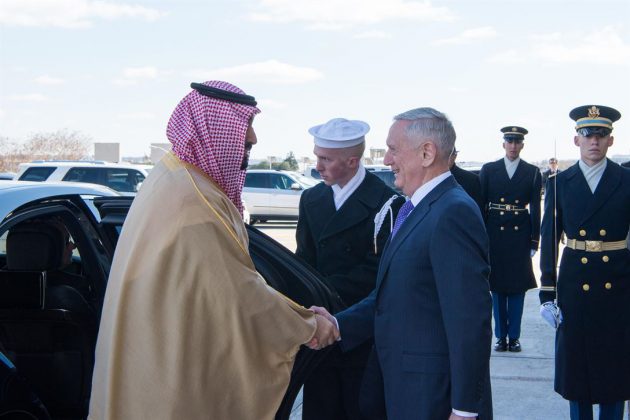
Defense Secretary Mattis welcomes Saudi Deputy Crown Prince and Defense Minister Mohammed bin Salman to the Pentagon, March 16, 2017. (DoD photo by Sgt. Amber I. Smith)
By Jonathan Marshall | Consortium News | April 15, 2017
The Trump administration’s growing use of military force in Syria, Iraq, and Yemen has neoconservative hawks rooting for armed confrontation with what they view as the root of all evil in the Middle East: Iran.
Many of these armchair warriors recently cheered President Trump’s decision to take on the Assad regime — and Moscow — by firing 59 Tomahawk cruise missile at a Syrian air base alleged to be the source of a chemical weapons attack. But they urged him to do more.
Weekly Standard editor William Kristol tweeted, “Punishing Assad for use of chemical weapons is good. Regime change in Iran is the prize.”
Kristol co-founded the infamous Project on the New American Century in 1997 to promote American “global hegemony” and “challenge regimes hostile to our interests and values.” It began lobbying for the overthrow of Saddam Hussein as early as 1998, but always kept Iran in its sights as well.
With Saddam dead and Syria’s Assad stripped of much of his power, Iran is now at the center of neocon crosshairs. Kristol linked his recent tweet to a Washington Post column by two stalwart advocates of ousting the mullahs in Tehran: Reuel Gerecht and Ray Takeyh.
Titled “How Trump Can Help Cripple the Iranian Regime,” their article called for putting the nuclear arms deal with Iran at risk in order to “stoke the volcano under Tehran and to challenge the regime.” The centerpiece of their bizarre argument was that the Iranian people would gratefully welcome the United States imposing “crippling sanctions” to destroy their economy in the name of “human rights.”
The authors were vague as to the details, but suggested that Iran’s ruling clerics would quickly succumb to a “popular rebellion” by “Iranian dissidents,” particularly if the United States sent “more American troops [to] both Syria and Iraq” to reinforce its message.
Gerecht, a died-in-the-wool neocon, was a former director of the Project for a New American Century’s Middle East Initiative. In 2001, he wrote, “Only a war against Saddam Hussein will decisively restore the awe that protects American interests abroad and citizens at home.”
In 2002, he further touted a U.S. invasion of Iraq as a way to “provoke riots in Iran — simultaneous uprisings in major cities that would simply be beyond the scope of regime-loyal specialized riot-control units.” Instead, the subsequent U.S. invasion backfired by putting a pro-Iran regime into power in Baghdad.
Iran in the Crosshairs
Today Gerecht is a senior fellow at the Foundation for Defense of Democracies, a neocon think tank dedicated to waging war against “militant Islam,” with a focus on Iran. Heavily funded by gambling magnate Sheldon Adelson, the Foundation was originally created to promote the agenda of hardline Israeli hawks.
The Foundation fought bitterly against the Iran nuclear deal, lest it open the door to a rapprochement between Washington and Tehran. Gerecht in particular demanded that the United States attack Iran rather than pursue diplomacy. “I’ve written about 25,000 words about bombing Iran,” he boasted in 2010. “Even my mom thinks I’ve gone too far.”
Gerecht’s side-kick, Ray Tayekh, is a senior fellow at the Council on Foreign Relations and was (briefly) an Iran adviser to Dennis Ross in Hillary Clinton’s State Department. A fierce critic of the nuclear deal, Tayekh joined the Iran Task Force of the right-wing Jewish Institute for National Security Affairs, which considers itself “the most influential group on the issue of U.S.-Israel military relations.” Tayekh has advocated covert support to Iranian dissidents, as well as to “Kurdish, Baluch, Arab, and other opposition groups fighting the regime.”
Regime change in Iran is the open goal of Prime Minister Netanyahu and other Israeli rightists. That’s why they consistently rejected findings by Israel’s intelligence community about the benefits to Israel’s security from the nuclear deal with Iran. By stoking opposition to the deal among their supporters in Congress, they aimed to kill any chance of cooperation between the United States and Iran.
Sen. Tom Cotton, R-Arkansas, said candidly, “the goal of our policy must be clear: regime change in Iran.”
Today the hardline Israeli/neocon agenda is still being pursued by hawks in Congress, who have introduced bills in both houses to ratchet up economic sanctions against Iran and designate a major branch of the country’s armed forces as a terrorist organization. If enacted — against the wishes of other signatories to the Iran nuclear deal — such measures could put the United States and Iran on a war footing.
Trump’s Team of Hawks
President Trump is unlikely to stand in their way. Ignoring the role of major Arab states in supporting such terrorist groups as al-Qaeda and ISIS, Trump named Iran “the number one terrorist state” and warned during his campaign that if Iranian patrol boats in the Persian Gulf continue to “make gestures that our people — that they shouldn’t be allowed to make, they will be shot out of the water.”
Trump has surrounded himself with anti-Iran hardliners who may be only too eager to give war a chance. His first national security adviser, retired Lt. Gen. Michael Flynn, co-authored a 2016 book with Michael Ledeen, a confidant of Israeli hawks and colleague of Gerecht at the Foundation for Defense of Democracy, on “How We Can Win the Global War Against Radical Islam and Its Allies.” Iran, of course, was their enemy number one.
Even with Flynn’s ouster, plenty of hawks remain. In recent congressional testimony, Army Gen. Joseph Votel, Commander of the U.S. Central Command, called Iran “the greatest long-term threat to stability” in the Middle East. He declared, “We need to look at opportunities where we can disrupt [Iran] through military means or other means their activities.”
Defense Secretary General James Mattis told a conference at the conservative Center for Strategic and International Studies in Washington last year, “Iran is not a nation-state; it’s a revolutionary cause devoted to mayhem.” The New York Times reported that Mattis “was so hawkish on Iran as head of United States Central Command from 2010 to 2013 that the Obama administration cut short his tour.”
Mattis reportedly came close to ordering an act of war against Iran in early February — the boarding of an Iranian ship to look for weapons headed for Houthi rebels in Yemen. Such an incident could escalate rapidly out of control if Iran chose to retaliate against U.S. vessels in the Persian Gulf.
Alternatives to Conflict
The United States has better policy options than continuing to treat Iran as part of the Axis of Evil. A report issued last fall by the National Iranian American Council recommended that Washington build on the success of the Iran nuclear deal by drawing Iran into regional peace settlements, deescalating our military presence in the Persian Gulf, and encouraging Iran and Saudi Arabia to resolve their differences without superpower intervention.
The report echoed the advice of a prominent neocon heretic, Zalmay Khalilzad, former U.S. ambassador to both Afghanistan and Iraq.
“As someone who has negotiated with Iran over the years perhaps more than any other U.S. diplomat,” he observed last year, “I disagree with those who argue that talks with Iran are akin to capitulation. I have seen little evidence that isolation has or will alter Tehran’s behavior in the right direction. Nor do I share the view that it is impossible to negotiate win-win deals with the Iranians.”
Noting Iran’s cooperation with the United States against Al Qaeda after 9/11, and its help brokering political compromises in Afghanistan and Iraq until the Bush administration refused further engagement, Khalilzad wrote, “Under the right conditions, which must include a hard-headed approach and tough actions to check Iran’s ambitions, Washington can benefit from bringing Iran into multilateral forums where the United States and its partners have the opportunity to narrow differences, create rules of the road and solve problems. Moreover, today we have little choice but to engage Iran on these broader issues, because no factor is shaping the order of the Middle East as much as the rivalry between Iran and its Sunni Arab neighbors.”
“If we do not undertake this work,” he warned, “the problems of the region — extremism, terrorism and regional conflict — will continue to bleed over into our part of the world, particularly if the Westphalian state system disintegrates even further into sectarian morass.”
Featured Video

New positive ivermectin evidence
or go to
Aletho News Archives – Video-Images
From the Archives
Fanatical Followers of the Covid Regime: A Jim Jones-Style Cult?
By Professor Roger Watson and Dr. Niall McCrae | The Daily Sceptic | November 15, 2021
As scholars at leading British universities over recent decades, we witnessed the replacement of critical thinking and debate by narrative: facts are discrimination and scientific method is imperialism; truth, instead, is derived from ‘progressive’ values. This educational trend may be a major contributory factor to the ease in which society has been inculcated to the Covid ‘new normal’ of masking, testing, and repeated doses of vaccines for a disease of similar risk to severe influenza.
One doesn’t need much critical reasoning to observe the flawed logic of some vaccination enthusiasts, such as people who respond to experiencing any side effects, however debilitating, by saying “at least I know it’s working”, or, after contracting the disease despite their promised inoculation (over 90% effective, according to initial drug company claims), “I’d have been worse off without the jab.” … continue
Blog Roll
 Aletho News
- The Coming GOP Bloodbath?
- Arctic Scare Stories Melt Away
- Wrong, Euronews: Climate Change Has Not Created a Food, Energy, and Economic “Meta-Crisis”
- New positive ivermectin evidence
- Met Office Caught Fabricating Daily Temperature Record Claims
- Merck Virologists Admitted to Falsely Certifying Vaccine Efficacy
- Mandatory Folic Acid for every man, woman & child
- Pro-Palestine protesters arrested outside UK’s ruling Labour Conference in Liverpool
- Mauritius denies landing permit to flight from Israel, forcing cancellation: Tour operator
- Israeli finance minister calls for genocidal war on West Bank, annexation of south Lebanon
- If Americans Knew
- Israel kills more Palestinians, amid push to resettle Gaza – Daily Update
- Israel forces Gazans to live in constant peril – Daily Update
- Deconstructing Netanyahu’s pants-on-fire UN rant – Daily Update
- Trump betrayed voters with his campaign lies and prioritized a foreign country once he took office
- Netanyahu calls Israel’s war in Gaza ‘opposite of genocide’ in UN speech to near-empty hall
- Settler Kidnappings: Torture, Sexual Abuse and Terrorisation of Palestinian Abductees as Israel Deepens Annexation of West Bank
- Gaza winter nears as 162,000 tents become unusable, raising fears of humanitarian crisis
- Netanyahu says, “It’s the opposite of genocide”; UN says Gaza economy is world’s ‘most severe crisis on record’ – Daily Update
- Israel’s US-Backed Assault on Gaza Has Created the ‘World’s Most Severe Economic Crisis on Record’: UN
- ‘Protecting U.S. Citizens’… From Israel
- No Tricks Zone
- New Study: Earth And Venus Surface Warmth Largely Explained By Convection And Lapse Rate, Not CO2 Or Radiation
- 2025 Nature Paper Claiming Worsening Global Drought Gets RETRACTED …Heavily Flawed
- New Study: ‘Global Drought Shows No Detectable Recent Acceleration Under Climate Warming’
- Economic Masterminds: German Socialists Suggest Taxing Productivity Gains Stemming From Using AI
- The South China Sea Has Not Been Cooperating With The Climate Change Narrative
- Energy Crisis: Germany Enters Heating Season With Historically Low Gas Reserve Fill Levels
- New Study: The Antarctic Ice Sheet Gained Mass From 2020-2024 Due To Staggering Snow And Ice Accumulation
- Study: Ocean Heating Rates From Thousands Of Years Ago ‘Dwarf’ Modern Ocean Heating Rates
- Climate Extremists Target, Attack Large-Scale Power Grid Infrastructure In Germany!
- New Study: Antarctic Ice Melt Has Contributed Less Than 1 Centimeter To Sea Level Rise In The Last 30 Years

