Trump’s Easter message: “Jews rule! Happy Passover!”
By Kevin Barrett | Veterans Today | April 16, 2017
Is the President being held hostage? Was this video a cry for help? Or did his captors issue it to send a message: “We have completed our coup. We are in total control. Do not even think of f*ing with us!”
Watch the above video again. What is wrong with this picture?
Look, I LOVE religious minorities, okay? I’m Muslim myself. I love my Jewish friends. I used to practice Buddhist meditation. And I still revere the wisdom of the Tao and the Upanishads and the many wonderful Native American spiritual traditions.
But let’s face it: The United States of America is a Christian-majority country. Today is Easter. The President’s holiday message should be: “Happy Easter!”
Instead, the President of the (Christian-majority) United States has issued an Easter message that looks more like a hostage video. A professor at a major university who saw it emailed me:
Oh my God. Talk about the demeanor of a mind-controlled zombie…..
Instead of saying “happy Easter” and talking about Jesus, and maybe throwing in some eggs and rabbits as a sop to Christian-pagan syncretism, Trump begins by rambling on and on about how wonderful Jews are. He couldn’t make it any clearer that his main holiday message is “Happy Passover!” When he finally gets around to mentioning Easter, it’s almost an afterthought.
The video has abysmally poor production values, considering that it’s coming from the White House. It’s too dark. And Trump looks extremely low-energy –like a kidnapping victim in a hostage video with someone offscreen pointing a gun at his head or a knife at his foreskin.

The weirdest holiday video ever made by any sitting president?
Trump’s “Passover video” reminds me of the nationally televised speech by George W. Bush in early December, 2001. Bush gave that speech, in which he monotonously intoned the shibboleths of the Israeli-fabricated “War on Terror,” in front of an Israeli flag, not an American one.
What makes Trump’s “f*ck Easter, Happy Passover” message even weirder is the whole history between Jews and Christians. (As a Muslim, I am able to get some distance and objectivity on this very sensitive issue.)
Until around 1800, when the Rothschilds took over the financial centers of Western Europe and imposed their ideological hegemony on the West, Christians took it for granted that “the Jews killed Jesus,” as the Gospels tell us in so many words. Jews, for their part, evinced extreme loathing for Christianity in general and Jesus in particular. The Christian was “Esau,” the naive, hairy, primitive fool who needed to be swindled out of his birthright by Jacob “the heel” AKA “Israel.” And Jesus, according to the Talmud, is being boiled eternally in excrement.
Maybe it’s a good thing that the Jews and Christians are getting over their horrible history of mutual hatred. But it strikes me as odd that the way they’re getting over it is through a stealth Jewish-Zionist takeover of the West, accompanied by what can only be called the annihilation of traditional Christianity. Trump’s Easter message, coming in the wake of the ouster of Steve Bannon (Catholic) and elevation of Jared Kushner (Kosher Nostra) is a sign of the times.
How Russia Will React to Deployment of NATO Anti-Missile Systems in Norway
Sputnik – April 16, 2017
NATO is inciting Norway to deploy missile defense systems on its territory, however there is no unity in Oslo on this issue. Russian military expert Vladimir Kozin said in an interview with Radio Sputnik that the US is trying to “stuff” missile defense systems into as many European countries as possible.
Some political parties in Norway have opposed the deployment of NATO anti-missile systems in their country, contrary to preliminary agreements with the alliance, Russian Izvestia newspaper wrote. According to the article, there is still no clear position in Oslo on this issue.Russian military expert Vladimir Kozin believes that only NATO will benefit from the deployment of the systems in Norway, while for Oslo this will mean additional “headaches.”
“NATO countries, and first of all the US, want to involve Norway and thus expand the list of states that will have missile defense systems on their soil. What interest is there on the part of Norway? Of course, unless it wants to become a hostage to the global American anti-missile game. This won’t bring anything to strengthening Norway’s defense, but only additional headaches. Because it is natural that all these systems are monitored by the Russian side and our allies and friends,” Kozin said.
In his opinion, the international community is facing the beginning of the race in anti-missile weapons.
“In order to change the situation, in my opinion, it is necessary to work with the current US administration and show that nobody will benefit from this race,” the expert said.
Russian military expert Victor Litovkin, in turn, said that Russia will take steps to ensure the security of its borders in response to NATO “saber-rattling.”
“We will find a way to neutralize this system if necessary. We have an Iskander-M operational-tactical missile system and missiles on strategic aircraft, such as Tu-22M3 and Tu-160, Tu-95MS. We will take into account if Norway stations this complex, and we will change our plans in terms of the use of our Armed Forces in a critical period,” Litovkin stated.
Neocons Point Housebroken Trump at Iran
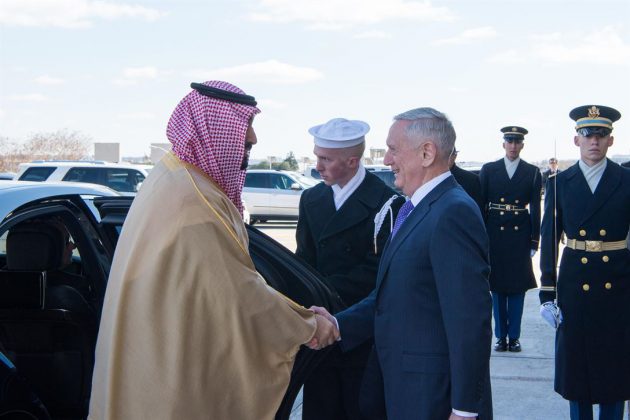
Defense Secretary Mattis welcomes Saudi Deputy Crown Prince and Defense Minister Mohammed bin Salman to the Pentagon, March 16, 2017. (DoD photo by Sgt. Amber I. Smith)
By Jonathan Marshall | Consortium News | April 15, 2017
The Trump administration’s growing use of military force in Syria, Iraq, and Yemen has neoconservative hawks rooting for armed confrontation with what they view as the root of all evil in the Middle East: Iran.
Many of these armchair warriors recently cheered President Trump’s decision to take on the Assad regime — and Moscow — by firing 59 Tomahawk cruise missile at a Syrian air base alleged to be the source of a chemical weapons attack. But they urged him to do more.
Weekly Standard editor William Kristol tweeted, “Punishing Assad for use of chemical weapons is good. Regime change in Iran is the prize.”
Kristol co-founded the infamous Project on the New American Century in 1997 to promote American “global hegemony” and “challenge regimes hostile to our interests and values.” It began lobbying for the overthrow of Saddam Hussein as early as 1998, but always kept Iran in its sights as well.
With Saddam dead and Syria’s Assad stripped of much of his power, Iran is now at the center of neocon crosshairs. Kristol linked his recent tweet to a Washington Post column by two stalwart advocates of ousting the mullahs in Tehran: Reuel Gerecht and Ray Takeyh.
Titled “How Trump Can Help Cripple the Iranian Regime,” their article called for putting the nuclear arms deal with Iran at risk in order to “stoke the volcano under Tehran and to challenge the regime.” The centerpiece of their bizarre argument was that the Iranian people would gratefully welcome the United States imposing “crippling sanctions” to destroy their economy in the name of “human rights.”
The authors were vague as to the details, but suggested that Iran’s ruling clerics would quickly succumb to a “popular rebellion” by “Iranian dissidents,” particularly if the United States sent “more American troops [to] both Syria and Iraq” to reinforce its message.
Gerecht, a died-in-the-wool neocon, was a former director of the Project for a New American Century’s Middle East Initiative. In 2001, he wrote, “Only a war against Saddam Hussein will decisively restore the awe that protects American interests abroad and citizens at home.”
In 2002, he further touted a U.S. invasion of Iraq as a way to “provoke riots in Iran — simultaneous uprisings in major cities that would simply be beyond the scope of regime-loyal specialized riot-control units.” Instead, the subsequent U.S. invasion backfired by putting a pro-Iran regime into power in Baghdad.
Iran in the Crosshairs
Today Gerecht is a senior fellow at the Foundation for Defense of Democracies, a neocon think tank dedicated to waging war against “militant Islam,” with a focus on Iran. Heavily funded by gambling magnate Sheldon Adelson, the Foundation was originally created to promote the agenda of hardline Israeli hawks.
The Foundation fought bitterly against the Iran nuclear deal, lest it open the door to a rapprochement between Washington and Tehran. Gerecht in particular demanded that the United States attack Iran rather than pursue diplomacy. “I’ve written about 25,000 words about bombing Iran,” he boasted in 2010. “Even my mom thinks I’ve gone too far.”
Gerecht’s side-kick, Ray Tayekh, is a senior fellow at the Council on Foreign Relations and was (briefly) an Iran adviser to Dennis Ross in Hillary Clinton’s State Department. A fierce critic of the nuclear deal, Tayekh joined the Iran Task Force of the right-wing Jewish Institute for National Security Affairs, which considers itself “the most influential group on the issue of U.S.-Israel military relations.” Tayekh has advocated covert support to Iranian dissidents, as well as to “Kurdish, Baluch, Arab, and other opposition groups fighting the regime.”
Regime change in Iran is the open goal of Prime Minister Netanyahu and other Israeli rightists. That’s why they consistently rejected findings by Israel’s intelligence community about the benefits to Israel’s security from the nuclear deal with Iran. By stoking opposition to the deal among their supporters in Congress, they aimed to kill any chance of cooperation between the United States and Iran.
Sen. Tom Cotton, R-Arkansas, said candidly, “the goal of our policy must be clear: regime change in Iran.”
Today the hardline Israeli/neocon agenda is still being pursued by hawks in Congress, who have introduced bills in both houses to ratchet up economic sanctions against Iran and designate a major branch of the country’s armed forces as a terrorist organization. If enacted — against the wishes of other signatories to the Iran nuclear deal — such measures could put the United States and Iran on a war footing.
Trump’s Team of Hawks
President Trump is unlikely to stand in their way. Ignoring the role of major Arab states in supporting such terrorist groups as al-Qaeda and ISIS, Trump named Iran “the number one terrorist state” and warned during his campaign that if Iranian patrol boats in the Persian Gulf continue to “make gestures that our people — that they shouldn’t be allowed to make, they will be shot out of the water.”
Trump has surrounded himself with anti-Iran hardliners who may be only too eager to give war a chance. His first national security adviser, retired Lt. Gen. Michael Flynn, co-authored a 2016 book with Michael Ledeen, a confidant of Israeli hawks and colleague of Gerecht at the Foundation for Defense of Democracy, on “How We Can Win the Global War Against Radical Islam and Its Allies.” Iran, of course, was their enemy number one.
Even with Flynn’s ouster, plenty of hawks remain. In recent congressional testimony, Army Gen. Joseph Votel, Commander of the U.S. Central Command, called Iran “the greatest long-term threat to stability” in the Middle East. He declared, “We need to look at opportunities where we can disrupt [Iran] through military means or other means their activities.”
Defense Secretary General James Mattis told a conference at the conservative Center for Strategic and International Studies in Washington last year, “Iran is not a nation-state; it’s a revolutionary cause devoted to mayhem.” The New York Times reported that Mattis “was so hawkish on Iran as head of United States Central Command from 2010 to 2013 that the Obama administration cut short his tour.”
Mattis reportedly came close to ordering an act of war against Iran in early February — the boarding of an Iranian ship to look for weapons headed for Houthi rebels in Yemen. Such an incident could escalate rapidly out of control if Iran chose to retaliate against U.S. vessels in the Persian Gulf.
Alternatives to Conflict
The United States has better policy options than continuing to treat Iran as part of the Axis of Evil. A report issued last fall by the National Iranian American Council recommended that Washington build on the success of the Iran nuclear deal by drawing Iran into regional peace settlements, deescalating our military presence in the Persian Gulf, and encouraging Iran and Saudi Arabia to resolve their differences without superpower intervention.
The report echoed the advice of a prominent neocon heretic, Zalmay Khalilzad, former U.S. ambassador to both Afghanistan and Iraq.
“As someone who has negotiated with Iran over the years perhaps more than any other U.S. diplomat,” he observed last year, “I disagree with those who argue that talks with Iran are akin to capitulation. I have seen little evidence that isolation has or will alter Tehran’s behavior in the right direction. Nor do I share the view that it is impossible to negotiate win-win deals with the Iranians.”
Noting Iran’s cooperation with the United States against Al Qaeda after 9/11, and its help brokering political compromises in Afghanistan and Iraq until the Bush administration refused further engagement, Khalilzad wrote, “Under the right conditions, which must include a hard-headed approach and tough actions to check Iran’s ambitions, Washington can benefit from bringing Iran into multilateral forums where the United States and its partners have the opportunity to narrow differences, create rules of the road and solve problems. Moreover, today we have little choice but to engage Iran on these broader issues, because no factor is shaping the order of the Middle East as much as the rivalry between Iran and its Sunni Arab neighbors.”
“If we do not undertake this work,” he warned, “the problems of the region — extremism, terrorism and regional conflict — will continue to bleed over into our part of the world, particularly if the Westphalian state system disintegrates even further into sectarian morass.”
US establishment rallies behind Trump after military strikes

Washington Post columnist Charles Krauthammer
Press TV – April 15, 2017
After US President Donald Trump ordered strikes in Syria and Afghanistan, he is receiving stronger support from a Washington establishment that sided with Democratic candidate Hillary Clinton during the 2016 election campaign.
Last week, under Trump’s orders, the US military fired 59 Tomahawk missiles at al-Shayrat airbase in Homs province in western Syria. This week, the Republican leader ordered the use of the largest non-nuclear bomb in the US arsenal on an area of eastern Afghanistan.
Trump’s these two moves, along with his war threats against North Korea, have endeared him to the people who support the agenda of the military-industrial complex and bankers, who profit from war.
MSNBC’s Joe Scarborough and Washington Post columnists David Ignatius and Charles Krauthammer, Trump’s former critics, are particularly appreciating Trump’s war efforts.
“Donald Trump is finally doing what we’ve been hoping and America has been hoping he would do,” Scarborough said on his Thursday broadcast. “You can tell, the National Security Council is not Steve Bannon’s play yard.”
Analysts are also praising Trump’s national security adviser, H.R. McMaster, and Defense Secretary James Mattis. Both officials were involved in the decisionmaking over the strike in Syria, another departure for a Republican president who previously opposed any such attack.
Krauthammer declared on Thursday that “the traditionalists are in the saddle. U.S. policy has been normalized. The world is on notice: Eight years of sleepwalking is over. America is back.”
In addition, CNN, which had viciously opposed Trump, has become a close supporter of Trump’s policies.
Following the April 7 attack on Syria, CNN host Fareed Zakaria said, “Donald Trump became president of the United States last night. I think this was actually a big moment.”
“For the first time really as president, he talked about international norms, international rules, about America’s role in enforcing justice in the world,” Zakaria said of Trump’s remarks explaining the military action.
Trump said he had ordered the strike in response to the April 4 chemical attack in the Arab country that he blamed on the Syrian government. The Syrian government has strongly denied any responsibility for the alleged gas attack.
On Thursday, a GBU-43/B Massive Ordnance Air Blast Bomb (MOAB), also known as the “mother of all bombs,” was dropped on a tunnel complex allegedly used by Daesh (ISIL) militants in Nangarhar province by an MC-130 aircraft, operated by US Air Force Special Operations Command, according to the Pentagon.
Trump praised America’s “incredible military” for dropping the bomb in Afghanistan.
“We have [an] incredible military. We are very proud of them and this was another very, very successful mission,” Trump told reporters at the White House on Thursday.
American political analyst Myles Hoenig told Press TV on Friday that with the MOAB strike in Afghanistan, President Trump has taken war to the next level.
“Hillary Clinton lost the White House but her mania for death and destruction lives on in Trump,” said Hoenig, a former Green Party candidate for Congress.
Marine Le Pen blasts Donald Trump and his new found love for NATO
By Alex Christforou | The Duran | April 15, 2017
Last week The Duran reported on the many “deplorables” turned off by Trump’s new found fancy for a US interventionist foreign policy.
Last week Trump also backtracked on much of his NATO pre-presidential stance.
He signed off on Montenegro’s membership to the alliance…which now means Serbia is completely surrounded by an aggressive military alliance, that has bombed it mercilessly in the past under false flag pretenses.
Trump also met with NATO head warmonger Stoltenberg, and reversed his NATO position from “obsolete” to, “it is not longer obsolete”.
French presidential candidate Marine Le Pen is not amused with Trump’s swiveling foreign policy.
Le Pen said in an interview with France Info radio on Friday…
“Undeniably he [Trump] is in contradiction with the commitments he had made.”
“I am coherent, I don’t change my mind in a few days. He had said he would not be the policeman of the world, that he would be the president of the United States and would not be the policeman of the world, but it seems today that he has changed his mind.”
“Will he persist, or is it a political coup which facilitates his domestic policy, I have absolutely no idea. But I am coherent in my analyses. When something favors France I say so, when it doesn’t I say so too.”
And just so there is no confusion as to where Le Pen stands on France’s NATO position should she win the election…
“I consider that France does not have to submit to the calendar of the United States, so I want France to leave the integrated command of NATO.”
Le Pen, leader of The National Front, went on to say that while she does not know if Trump would continue to abandon his “America First” approach, she herself would stick to a France first approach if elected president.
Trump and Le Pen were seen as allies during the 2016 US presidential campaign. The two shared many nationalist policy stances on immigration and globalization. The French politician had said that Trump’s presidential win “shows that people are taking their future back.”
Le Pen’s criticism comes as other nationalist politicians around the world have taken issue with Trump’s recent policy changes. Trump ally and pro-Brexit leader Nigel Farage said he was “very surprised” at Trump’s decision to strike a Syrian airbase in retaliation for the regime’s alleged chemical weapons attack against civilians.
Le Pen has been a strong critic of NATO during the French presidential campaign and has included pulling France back from NATO in her campaign platform. The leader of the National Front party, on track to make it through to the run-off election on May 7, has recently seen her momentum slowed.
US successfully tests new nuclear gravity bomb
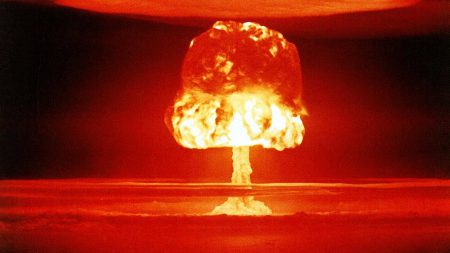
© U.S Government / CTBTO
RT | April 14, 2017
As the world’s attention was on the first combat use of the conventional “Mother Of All Bombs,” the US National Nuclear Security Administration announced the successful field test of the modernized gravity nuclear bomb in Nevada.
The NNSA and the US Air Force completed the first qualification flight test of the B61-12 gravity nuclear bomb on March 14 at the Tonopah Test Range in Nevada, the agency announced on Thursday.
The test was intended to evaluate the weapon’s “non-nuclear functions” and the capability of the F-16 fighter to successfully deploy the bomb. An F-16 fighter from Nellis Air Force Base dropped the “non-nuclear test assembly,” the NNSA said in a statement.
“The successful test provides critical qualification data to validate that the baseline design meets military requirements,” said Brigadier General Michael Lutton, NNSA’s principal assistant deputy administrator for military application. The NNSA is part of the Department of Energy, which is charged with managing US nuclear weapons.
The B61-12 is a modernized version of the B61 gravity bomb, the mainstay of the Air Force’s nuclear arsenal and one of the legs of the so-called nuclear triad, along with the intercontinental ballistic missiles deployed from either ground-based silos or oceangoing submarines.
President Donald Trump has endorsed an ambitious – and expensive – plan to modernize the US nuclear triad, begun under his predecessor. The B61-12 is intended to consolidate and replace all the B61 variants currently in service.
Three successful development flight tests of the B61-12 were conducted in 2015. The March test was the first in a series scheduled to span the next three years, with the final design review due in September 2018 and the first production unit scheduled for completion by March 2020.
On Thursday, the US attracted the world’s attention by dropping a GBU-43/B Massive Ordnance Air Blast Bomb (MOAB), also known as “Mother Of All Bombs,” on Islamic State (IS, formerly ISIS/ISIL) positions in eastern Afghanistan’s Nangarhar province. It was the first combat use of the weapon, the largest conventional bomb in the US arsenal.
US snubs 11-state Afghanistan peace conference, says Russia trying to ‘assert influence’
RT | April 14, 2017
Washington failed to attend the latest international conference hosted by Moscow, where 11 nations discussed ways of bringing peace to Afghanistan. The US branded it a “unilateral Russian attempt to assert influence in the region.”
Friday’s meeting is the latest in a series of similar events in the Russian capital that have grown from trilateral consultations between Russia, China, and Pakistan held in December of last year into talks involving the majority of the Afghan region’s powers. The latest included Russia, China, Afghanistan, India, Pakistan, Iran, Kazakhstan, Kyrgyzstan, Tajikistan, Turkmenistan and Uzbekistan. An invitation was sent to Kabul’s patron, America, but was rejected.
“I think just to end it, we just felt that these talks – it was unclear to us what the purpose was,” US State Department spokesman Mark Toner said on Tuesday, in explaining the US’ absence.
“It seemed to be a unilateral Russian attempt to assert influence in the region that we felt wasn’t constructive at this time,” he noted.
Moscow responded by saying it “could not comprehend” the US’ reason for snubbing the gathering.
Participants in the event reiterated their support for a peaceful transition in Afghanistan, while calling for Kabul to be supported in moving in that direction.
“A call has been sent to the Taliban movement to abandon its line for a military solution of the Afghan conflict in favor of direct talks with the government of the Islamic Republic of Afghanistan on the issue of national reconciliation,” the Russian Foreign Ministry said in a statement after the conference.
The statement added that more consultations in this format will follow, while noting that Moscow has offered to host them again.
Moscow and China have separately been trying to persuade the Taliban to focus less on Kabul and more on the more imminent threat – the advances of the Islamic State (IS, formerly ISIS/ISIL) terrorist group.
Washington has criticized such initiatives, citing the Taliban’s record of waging guerilla warfare against the Afghan government, while downplaying the threat posed by IS in Afghanistan. The US military reported in February that the joint efforts of Afghan troops and US-led international forces have reduced IS’ presence in the country to less than 1,000 fighters, according to Voice of America.
According to Russia’s estimate, the jihadist group has at least 3,500 fighters in Afghanistan, which Moscow says Kabul and its allies are not doing enough to eradicate.
The conference in Moscow comes a day after the US dropped its most powerful conventional bomb on a suspected IS hideout in Afghanistan, marking the first time the weapon has been used in combat. It was not immediately clear whether this signified a shift in Washington’s view of the threat posed by IS affiliates in Afghanistan.
Read more:
This is What Can Prompt China Not to Defend N Korea in the Event of War
Sputnik – April 14, 2017
Recently, there have been a growing number of suggestions by Chinese diplomatic and military commentators that Beijing is not obliged to defend Pyongyang in the event of a military attack, an article in the South China Morning Post read.
The assumption comes as senior officials in the United States have warned of a strike against North Korea.
In particular, Washington has positioned two destroyers in the region that can deploy Tomahawk missiles, according to what intelligence officials told NBC News, along with heavy bombers stationed in Guam that could provide support should such a strike take place.
“North Korea is a problem, the problem will be taken care of,” US President Donald Trump told reporters Thursday.
Chinese media outlets and even some official websites have recently published articles saying that in the current situation there are fewer options to find the peaceful solution to the North Korean nuclear issue.
For example, on March 22, website China Military, sponsored by China’s People’s Liberation Army (PLA), published an article commenting on a ground test by Pyongyang of a new type of high-thrust rocket engine.
“We believe that warfare is just a matter of time if DPRK continues its nuclear and missile program. […] Under no condition will the international community accept DPRK’s legal possession of nuclear weapons and intercontinental ballistic missiles. As Pyongyang continues with its nuclear programs, international sanctions will get tighter, and it will eventually be isolated from the rest of the world for a long time,” the article read.
It is not in Pyongyang’s interests to go against international community’s stance on nuclear weapons. In a situation when the US, Russia and China share views of North Korea’s nuclear ambitions Pyongyang has almost no room for maneuvering. On the other hand, Pyongyang’s decision to give up its nuclear ambitions would satisfy the interests of the North Korean political elite, without posing a threat to the country’s existence.
This assumption was made before President Trump and Chinese leader Xi Jinping met in Florida, which proves that Beijing toughened rhetoric towards Pyongyang not under the influence by Washington.
In formal terms, China is North Korea’s only military ally, according to the 1961 Mutual Aid and Cooperation Friendship Treaty. At the same time, many Chinese experts say that de-facto those obligations do not exist anymore. The reason is that Pyongyang’s nuclear ambitions have formed an epicenter of tensions near China’s border.
“Despite China’s support for North Korea during the 1950-1953 Korean War, in the current environment, Beijing will prioritize national security over ideology,” Andrei Karneyev, deputy director of the Institute of Asian and African Countries at Moscow State University, told Sputnik China.
According to the expert, this change of heart is not related to any pressure from Washington, but is dictated by security needs. However, the question remains: what would China do in the event of a military confrontation against North Korea?
Shanghai-based military analyst Ni Lexiong told the South China Morning Post that Beijing would need to provide military assistance to its neighbor if US troops invaded, but Pyongyang’s violation of the UN non-proliferation treaty was a “strong reason” for China not to help.
According to Zhan Debin, an expert from the Shanghai University of Foreign Trade, there is little chance of a military conflict on the Korean Peninsula.
“The US is unlikely to attack North Korea on its own initiative. It would be possible if Pyongyang endangered the key security interests of Washington and Seoul. This would be an adequate reason for the US,” he told Sputnik China.
The expert pointed out that the US military force redeployed to the Korean Peninsula is rather a warning for Pyongyang.
He added that the probability of minor conflicts between the US and North Korea is very low because any minor conflict will turn into a large-scale confrontation.
“We can’t say that the US recklessly wants to start a war. Of course, South Korea doesn’t want war. If a conflict broke out South Korea would be hit the most,” Zhan Debin said. Commenting on China’s actions during the hypothetical confrontation, the expert noted that Beijing may not get involved if Pyongyang provoked a conflict, but at the same time China cannot turn a blind eye to instability in the region.
“Of course, Beijing will try to prevent a conflict from turning into war. China will not supply weapons and provide military and combat assistance,” he said.
The expert continued: “It is not correct to speculate on the matter. This makes no sense. What we should do is to have a backup plan of actions. Of course, China would act [in the event of a confrontation], but there should be a reason for actions. On the whole, China’s goal is to maintain peace and stability in the region.”
‘We will go to war if they choose’: N. Korea warns ‘aggressive’ Trump not to provoke Pyongyang
RT | April 14, 2017
North Korea won’t hesitate to go to war if provoked, its vice foreign minister said in an interview, adding that the North has “a powerful nuclear deterrent” and “certainly will not keep arms crossed” if facing a pre-emptive strike from Washington.
“If the US comes with reckless military maneuvers, then we will confront it with the DPRK’s [the Democratic People’s Republic of Korea] pre-emptive strike,” North Korean Vice Foreign Minister Han Song Ryol told AP.
He added that Pyongyang possesses “a powerful nuclear deterrent” and the North “certainly will not keep our arms crossed in the face of a US pre-emptive strike.’’
“We will go to war if they choose,” he stated.
On Thursday, US intelligence officials told NBC News that the US has positioned two destroyers armed with Tomahawk cruise missiles some 480 kilometers from North Korea’s nuclear test site.
Washington intends to act preemptively if it becomes “convinced” that a nuclear detonation is imminent.
Han criticized current US administration, noting that Washington’s attitude towards Pyongyang is “becoming more vicious and more aggressive.”
“Trump is always making provocations with his aggressive words,” Han said, stressing “it’s not the DPRK but the US and Trump that makes trouble.”
“Whatever comes from US politicians, if their words are designed to overthrow the DPRK system and government, we will categorically reject them,” he said.
Han also dismissed the comment Trump made just after being elected suggesting that he could patch things up with North Korean leader Kim Jong Un over “a hamburger on a conference table” in the White House.
“I think that was nothing more than lip service during the campaign to make himself more popular,” Han said.
The North Korean official also slammed the joint military exercises that the US and South Korea are conducting on the peninsula.
“As long as the nuclear threats and blackmail go on with the military exercises, we will carry forward with our national defense buildup, the core of which is the nuclear arms buildup,” Han said, adding “whatever comes from the US, we will cope with it. We are fully prepared to handle it.”
Seoul and Washington are currently holding their annual Foal Eagle exercise, in which 30,000 US troops are participating. The drills, which began in early March, will last until April 30.
Addressing one the most hotly discussed topics – a possible 6th nuclear test – Han remained ambiguous.
“That is something that our headquarters decides,” Han said, adding that “at a time and at a place where the headquarters deems necessary, it will take place.”
The escalation of tensions on the Korean peninsula comes as North Korea is preparing to celebrate the anniversary of the birth of its founder, Kim Il-sung, the grandfather of the current leader. The event is a state holiday called ‘Day of the Sun’. Rumors of a possible nuclear test were fueled after officials from the North told foreign journalists to prepare for a “big and important event.”
In April of 2016, on the occasion of Kim Il-sung’s 104th birthday, Pyongyang test fired its Musudan intermediate-range missile.
On Thursday, the secretive “big event” turned out to be the opening ceremony of a new skyscraper-lined street in Pyongyang, but speculation continues that the North has scheduled more “events” for the weekend.
READ MORE: South Korea tests ballistic missile that can target entire North – report
Russia, Syria & Iran demand no further US strikes on Syria – foreign ministers

Foreign Ministers, Sergei Lavrov (C) of Russia, Walid al-Muallem (L) of Syria and Mohammad Javad Zarif of Iran attend a news conference in Moscow © Grigory Sisoev / Sputnik
RT | April 14, 2017
The US cruise missile attack on Syria was an act of international aggression, Russia, Syria and Iran have stated after a meeting of their foreign ministers in Moscow.
“We have reiterated our position and were united in stating that the attack was an act of aggression, which blatantly violated the principles of international law and the UN Charter,” Russian Foreign Minister Sergey Lavrov said.
“We call on the US and its allies to respect Syria’s sovereignty and refrain from actions similar to what happened on April 7, and which have serious ramification not only for regional, but also global security,” he added.
Lavrov was referring to the Tomahawk missile barrage fired by the US Navy at a Syrian airbase in Homs province. Washington ordered the attack after accusing Damascus of launching a chemical weapons attack at a rebel-held town in Idlib province from that airbase. Russia condemned the move, saying the US hadn’t offered any proof to pin the alleged chemical weapons incident on the Syrian Army.
Meeting with his Iranian and Syrian counterparts, Javad Zarif and Walid Muallem, on Friday, Lavrov pledged to continue Russia’s support of Damascus in fighting terrorism and restoring peace in Syria.
He added that Moscow suspects that the Idlib incident was a provocative act aimed at derailing negotiations between the Syrian government and so-called moderate rebel groups on a political transition in the country. Lavrov said the perpetrators of the deadly release of toxins must be found.
“We insist on a thorough, objective and unbiased investigation of the circumstance of the use of chemical substances in Khan Shaykhun on April 4,” he said, adding that the investigating team must include inspectors chosen from nations from different parts of the world to ensure its objectivity.
Muallem pledged full cooperation of Damascus in carrying out such a probe.
The Russian minister added that Moscow doubts the objectivity of the current mechanisms for investigating alleged use of chemical weapons in Syria, considering the difference in how the Organization for the Prohibition of Chemical Weapons (OPCW) handles reports by Damascus and by other parties.
“When accusations come against the Syrian government, the OPCW reacts in a matter of days and voices its concern. But they never go on the sites of incidents located in the regions controlled by the armed opposition, citing security issues,” he said. “We consider such analysis from a distance unacceptable.”
Lavrov also accused the US of reviving the Obama administration goal of toppling the Syrian government instead of seeking a political solution, citing the Tomahawk missile attack.
“Such acts of aggression are obviously meant to derail the peace process, which was endorsed in a unanimously adopted resolution of the UN Security Council and implies that the fate of Syria would be decided only by the Syrian people,” he said. “The action was obviously deviating from this basic concept and find new protects to aim for regime change.”
Lavrov said there is an increasing amount of evidence pointing to the conclusion that the chemical incident in Idlib province was staged to set up the Syrian government.
“Publications by professional experts, including some in the US and Britain, say there are too many inconsistencies and gaps in the version of events presented to justify the [US] aggression,” he said.
Zarif accused “certain countries” of hypocrisy, citing Iran’s history of suffering from chemical weapons attack by Saddam Hussein’s Iraq during the 1980s war. Declassified CIA files showed that the US was well aware that Saddam was using CWs against Iranians, but didn’t oppose it and even provided intelligence for such attacks.
READ MORE:
Lavrov says agreed with Tillerson no future US strikes on Syrian govt
White House claims on Syria chemical attack ‘obviously false’ – MIT professor
Featured Video
BRITAIN’S WARNING: PREPARE FOR WAR
or go to
Aletho News Archives – Video-Images
From the Archive
How Ukraine Tortured and Slaughtered Donbass
By Kit Klarenberg | Al Mayadeen | July 11, 2024
Almost immediately after the proxy war erupted, ISIS-tier footage of the torture and murder of Russians in Ukrainian custody emerged.
On July 6th, the New York Times published an astonishing investigation: In Ukraine, Killings of Surrendering Russians Divide an American-Led Unit. The article documents in grim detail how Chosen Company, an international volunteer battalion for Kiev, routinely executes Russian prisoners of war. It is the very first mainstream admission that this practice – a brazen breach of the Geneva Conventions, and a grave war crime – is widespread among Ukraine’s fighters, both foreign and homegrown. … continue
Blog Roll
 Aletho News
- Pentagon designates Chinese cultural centers national security threat
- Israel Demolishes Home Of Lebanese Journalist Whose Viral Film Exposed Pager Attack
- Record Oil, Empty Tanks: The UAE’s Miracle Recovery
- Burnham tackles Britain’s poverty with aggression in Yemen
- Peace in Ukraine: the easy way – or the hard way
- Trump & the Rrrrussians
- US taxpayer money laundered back through Ukraine – Musk
- Before COVID, an NIH lab chief proposed making a SARS-like bat virus more infectious
- Gates, Bourla on Trial in Netherlands Accused of ‘Great Reset’ Scheme at Vaccine Injury Hearing
- BRITAIN’S WARNING: PREPARE FOR WAR
- If Americans Knew
- An error has occurred; the feed is probably down. Try again later.
- No Tricks Zone
- Two New Studies Find Thwaites Glacier Melt Cannot Be Driven By Human Activity Or A Warming Ocean
- E-Cars Reduce CO2 Emissions By Only 41% Compared To Internal Combustion Engine Vehicles
- Predictions Made By Renowned Climate Professor Over Past Decades Have Been Proven To Be Poor
- New Study Suggests Large Regions Of The Pacific Ocean Have Been Cooling For The Last 80 Years
- Germany’s Green Energy Debacle: High Energy Costs Force Kahla Porzellan to Close After 182 Years!
- New Study: 50 Years Of The Most Aggressive ‘Net Zero’ Policies Can Only Affect The Global Climate By 0.03°C
- US September “Heat” Was No Record…Many Records Set Decades Ago
- Latest European Green Energy Debacle; Portugal’s Largest Flagship Solar Park Insolvent!
- Green Energy Debacle: German Expert Professor Fritz Vahrenholt Warns Of Severe Economic And Social Consequences
- Two More Paleo Reconstructions Affirm Meters-Higher Sea Levels Across Ireland, Brazil 7000-6000 Years Ago

