So what are the Clinton gang doing while Trump introduces anti-Muslim immigration discrimination? Oh, they are pushing for war with Iran, which might give pause to some who think the world would have been less awful had Hillary won.
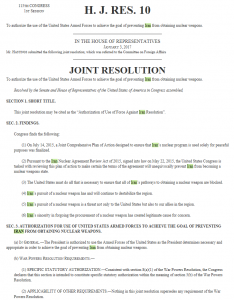 Here is the front page of the resolution introduced into the House of Representatives by Democrat Alcee L Hastings, an extremely close ally of Debbie Wasserman Schultz, who had to resign in disgrace as chair of the Democratic National Committee after WikiLeaks published emails establishing her corrupt endeavours to fix the primary elections for Hillary against Bernie Sanders.
The Resolution reads “To authorize the use of the United States Armed Forces to achieve the goal of preventing Iran from obtaining nuclear weapons.”
There is in fact no evidence that Iran is continuing a covert programme to produce nuclear weapons. British, French and Russian intelligence all assess that Iran is sticking to its agreements and – here is a key point – so do the CIA. But when did politicians ever let facts stand in their way?
Trump’s mad visa ban, which excludes Saudi Arabia and the Gulf States which are the main financiers, armers, ideologues and exporters of Salafist terrorism, turns out to be imposed on the countries which were on Obama’s watchlist. As the Hastings resolution shows, the anti-Iranian and pro-Saudi madness is bipartisan. To include Iran but exclude Saudi Arabia is further evidence of the twisting of US foreign policy to serve the interests of Saudi Arabia and its ally Israel. […]
These are dangerous times. And with the Democrats vying for “dumb patriot” support and seeking to outflank Trump to the right by roaring him on to a military attack on Iran, and seeking to push through legislation to promote that, there appear few influential voices of reason in the USA at present. – Full article
January 30, 2017
Posted by aletho |
Mainstream Media, Warmongering, Militarism, War Crimes, Wars for Israel | Alcee L Hastings, Iran, Israel, United States, Zionism |
Leave a comment
US forces have carried out a series of ground and air raids against a village in the Yemeni province of Bayda, killing a total of 57 people, among them civilians.
US paratroopers parachuted in Bayda’s Qifah district and raided the Yakla village there, with some 30 aircraft such as Apache helicopters and drones taking part in the operations.
Saudi media said 16 civilians, among them women and children, lost their lives in the US assault.
Reports said the rest of those killed were militants with the al-Qaeda terror group, including three of its ringleaders.
“The operation began at dawn when a drone bombed the home of Abdulraoof al-Dhahab and then helicopters flew up and unloaded paratroopers at his house and killed everyone inside,” an unnamed local told AFP.
The Lebanese al-Mayadeen television channel reported that a US soldier was also killed during clashes with militants.
Two years ago, US troopers conducted a similar operation in Yemen’s Hadhramaut Province to allegedly save an American reporter who was held captive by al-Qaeda. However, the operation was unsuccessful and left the correspondent dead.
Separately on Sunday, Saudi fighter jets mistakenly bombarded positions held by Riyadh’s own mercenaries in Bayda Province.
Arabic-language al-Masirah television network quoted an informed military source as saying that the Saudi warplanes had also targeted homes in Bayda’s al-Quraishyah and Sharyah neighborhoods.
Similar Saudi air raids were also carried out in the districts Harad and Nasim in Hajjah Province as well as the Sirwah neighborhood of Ma’rib Province.
The Saudi jets further targeted al-Amri district of Ta’izz Province with cluster bombs.
Elsewhere, in Shabwah Province, a large number of Saudi mercenaries were killed and injured in the Yemeni army’s rocket attacks.
Additionally, 50 Saudi mercenaries, among them foreign nationals, were killed and injured in clashes with the Yemeni army forces in the port city of Mokha and Dhubab district, both situated in Ta’izz Province.
Three rocket attacks also hit downtown Zanzibar in Abyan Province.
The Riyadh regime has been incessantly pounding Yemen since March 2015 in a bid to reinstall the country’s ex-government and crush the Houthi Ansarullah movement.
The Houthis and the Yemeni army have been defending Yemen against the Saudi offensive for almost two years.
The military aggression has claimed the lives of over 11,400 Yemenis, including women and children, according to the latest tally by a Yemeni monitoring group.
January 29, 2017
Posted by aletho |
Illegal Occupation, Militarism | Saudi Arabia, United States, Yemen |
Leave a comment
In contrast to the West, which has been intent on destroying Syria and other Middle Eastern countries, Russia and Iran are playing a constructive role in preventing the overthrow of Assad and the formation of a fundamentalist Sunni government in the country, a group of German academics have written in an open letter.
A group of German university professors have penned a joint statement criticizing the mainstream media’s portrayal of the roles of Russia and Iran in regulation of the Syrian conflict, Sputnik Deutschland reported.
Called “a statement on the Syrian war,” the declaration was written by the scientific advisory board of the German branch of Attac, an international organization that campaigns for alternatives to globalization.
“Russia and Iran exhausted all the possibilities for a diplomatic and peaceful solution to the conflict; (although) such an attempt seemed be futile at first, they have for the time being ended military attacks and the war in Aleppo. Therefore, we think the attacks on Russia in the mainstream media are absurd,” they wrote.
The statement, written by 14 German university professors, recalls a 2011 interview with former NATO Secretary-General Wesley Clark, who revealed that just weeks after 9/11, the US had plans to not only invade Iraq, but five countries in the Middle East.
The Pentagon published a memo describing “how we’re going to take out seven countries in five years, starting with Iraq and then Syria, Lebanon, Libya, Somalia, Sudan and then finishing off (with) Iran,” Clark revealed.
With that aim in mind, the US has been preparing the conditions for regime change in Syria since 2005, including a media propaganda campaign against the Assad government.
The US also co-operated with Saudi Arabia, Qatar and Israel in the training and funding of an army of Sunni jihadists who were supposed to overthrow the governments in Damascus and then Tehran, as investigative journalist Seymour Hersh reported in 2007.
The researchers agree with the assessment of Professor Gunter Meyer, director of the Center for Research on the Arab World (CERAW) at the University of Mainz, who told Germany’s Heute news program last month that the US bears the “main responsibility” for the Syrian crisis, and that Russia’s operation in support of the Syrian government has thwarted the US plan to overthrow the Syrian government.
“The West, in particular the USA, has provided the rebel jihadists with weapons and also partially trained them. The equipment, personnel and logistics were mainly handled by Turkey, while the financial support came mainly from Saudi Arabia and Qatar. Saudi Arabia has helped Salafist extremists to establish a radical Islamist government in Syria. Here the conquest of Aleppo in 2012 was an important step for the jihadists,” Meyer said.
“Without the military intervention of Russia in September 2015, not only would Aleppo have been completely conquered by the jihadists, but the Assad regime would also have collapsed long ago. The Assad opponents under the leadership of the US would have achieved their goal of the regime change. However, the strongest military forces would have seized power, and this would be Islamic extremists such as the al-Nusra Front, which is part of the Al-Qaeda network, and the Islamic State (Daesh), which is being combated by the international alliance under US leadership. Putin can say to people like the Israeli politicians who declared that a terrorist regime is better than Assad, that he prevented that.”
The evacuation of Aleppo was completed in December after Turkey and Russia brokered a ceasefire deal between government forces and the rebels who had controlled parts of the city since 2012.
The researchers wrote that the efforts of Moscow and Tehran to reach a diplomatic settlement to the conflict in Syria are in contrast to the “regime change” philosophy of the West, where politicians and the media have failed to acknowledge their crucial involvement.”
A few days after the evacuation of Aleppo was declared to have ended, Russia, Turkey and Iran held a meeting where they offered a guarantee that from now on the Syrian conflict would be resolved through diplomatic channels and negotiations.”
“Here, too, we must realize with bitterness that not one Western politician has taken Vladimir Putin, Hassan Rouhani and Recep Tayyip Erdogan at their word and accepted their guarantee as important and constructive. Western politicians do not seem to be able to react to these kinds of peaceful political signals.”
Unfortunately, some civilians lost their lives in the course of the anti-terror operation in Aleppo. However, the Western media failed to provide any sense of balance to their coverage.
“It must be remembered that 40,000 Iraqi civilians — at least four times as many as in Aleppo — have died since August 2014 at the hands of the US-led coalition alone, of whom 15,000 were in the region of Mosul. Since 1980 the US has attacked, occupied or bombed 14 Muslim countries,” the academics wrote.
“We find it very disturbing that the Western media, including the signatories of the anti-Russian declaration, don’t say anything about the fatal US policy of regime change in the Middle East, let alone criticize it. So-called ‘failed states’ are the obvious result of this policy, which are breeding grounds for the further spread of terrorism and the main reason for persistent flows of refugees. We ask, how blind do you really have to be to overlook a reality that is so difficult to deny?”
January 28, 2017
Posted by aletho |
Deception, Mainstream Media, Warmongering, Militarism | Middle East, NATO, Qatar, Saudi Arabia, Syria, United States |
Leave a comment
Introduction: During his inaugural speech, President Trump clearly and forcefully outlined the strategic political-economic policies he will pursue over the next four years. Anti-Trump journalist, editorialists, academics and experts, who appear in the Financial Times, New York Times, Washington Post and the Wall Street Journal have repeatedly distorted and lied about the President’s program as well as his critique of existing and past policies.
We will begin by seriously discussing President Trump’s critique of the contemporary political economy and proceed to elaborate on his alternatives and its weaknesses.
President Trump’s Critique of the Ruling Class
The centerpiece of Trump’s critique of the current ruling elite is the negative impact of its form of globalization on US production, trade and fiscal imbalances and on the labor market. Trump cites the fact that US industrial capitalism has drastically shifted the locus of its investments, innovations and profits overseas as an example of globalization’s negative effects. For two decades many politicians and pundits have bemoaned the loss of well-paid jobs and stable local industries as part of their campaign rhetoric or in public meetings, but none have taken any effective action against these most harmful aspects of globalization. Trump denounced them as “all talk and no action” while promising to end the empty speeches and implement major changes.
President Trump targeted importers who bring in cheap products from overseas manufacturers for the American market undermining US producers and workers. His economic strategy of prioritizing US industries is an implicit critique of the shift from productive capital to financial and speculative capital under the previous four administrations. His inaugural address attacking the elites who abandon the ‘rust belt’ for Wall Street is matched by his promise to the working class: “Hear these words! You will never be ignored again.” Trump’s own words portray the ruling class ‘as pigs at the trough’ (Financial Times, 1/23/2017, p. 11)
Trump’s Political-Economic Critique
President Trump emphasizes market negotiations with overseas partners and adversaries. He has repeatedly criticized the mass media and politicians’ mindless promotion of free markets and aggressive militarism as undermining the nation’s capacity to negotiate profitable deals.
President Trump’s immigration policy is closely related to his strategic ‘America First’ labor policy. Massive inflows of immigrant labor have been used to undermine US workers’ wages, labor rights and stable employment. This was first documented in the meat packing industry, followed by textile, poultry and construction industries. Trump’s proposal is to limit immigration to allow US workers to shift the balance of power between capital and labor and strengthen the power of organized labor to negotiate wages, conditions and benefits. Trump’s critique of mass immigration is based on the fact that skilled American workers have been available for employment in the same sectors if wages were raised and work conditions were improved to permit dignified, stable living standards for their families.
President Trump’s Political Critique
Trump points to trade agreements, which have led to huge deficits, and concludes that US negotiators have been failures. He argues that previous US presidents have signed multi-lateral agreements, to secure military alliances and bases, at the expense of negotiating job-creating economic pacts. His presidency promises to change the equation: He wants to tear up or renegotiate unfavorable economic treaties while reducing US overseas military commitments and demands NATO allies shoulder more of their own defense budgets. Immediately upon taking office Trump canceled the Trans-Pacific Partnership (TPP) and convoked a meeting with Canada and Mexico to renegotiate NAFTA.
Trump’s agenda has featured plans for hundred-billion dollar infrastructure projects, including building controversial oil and gas pipelines from Canada to the US Gulf. It is clear that these pipelines violate existing treaties with indigenous people and threaten ecological mayhem. However, by prioritizing the use of American-made construction material and insisting on hiring only US workers, his controversial policies will form the basis for developing well-paid American jobs.
The emphasis on investment and jobs in the US is a complete break with the previous Administration, where President Obama focused on waging multiple wars in the Middle East, increasing public debt and the trade deficit.
Trump’s inaugural address issued a stern promise: “The American carnage stops right now and stops right here!” This resonated with a huge sector of the working class and was spoken before an assemblage of the very architects of four decades of job-destroying globalization. ‘Carnage’ carried a double meaning: Widespread carnage resulted from Obama and other administrations’ destruction of domestic jobs resulting in decay and bankruptcy of rural, small town and urban communities. This domestic carnage was the other side of the coin of their policies of conducting endless overseas wars spreading carnage to three continents. The last fifteen years of political leadership spread domestic carnage by allowing the epidemic of drug addiction (mostly related to uncontrolled synthetic opiate prescriptions) to kill hundreds of thousands of mostly young American’s and destroy the lives of millions. Trump promised to finally address this ‘carnage’ of wasted lives. Unfortunately, he did not hold ‘Big Pharma’ and the medical community responsible for its role in spreading drug addiction into the deepest corners of the economically devastated rural America. Trump criticized previous elected officials for authorizing huge military subsidies to ‘allies’ while making it clear that his critique did not include US military procurement policies and would not contradict his promise to ‘reinforce old alliances’ (NATO).
Truth and Lies: Garbage Journalists and Arm Chair Militarists
Among the most outrageous example of the mass media’s hysteria about Trump’s New Economy is the systematic and vitriolic series of fabrications designed to obscure the grim national reality that Trump has promised to address. We will discuss and compare the accounts published by ‘garbage journalists (GJ’s)’ and present a more accurate version of the situation.
The respectable garbage journalists of the Financial Times claim that Trump wants to ‘destroy world trade’. In fact, Trumps has repeatedly stated his intention to increase international trade. What Trump proposes is to increase US world trade from the inside, rather than from overseas. He seeks to re-negotiate the terms of multilateral and bilateral trade agreements to secure greater reciprocity with trading partners. Under Obama, the US was more aggressive in imposing trade tariffs that any other country in the OECD.
Garbage journalists label Trump as a ‘protectionist’, confusing his policies to re-industrialize the economy with autarky. Trump will promote exports and imports, retain an open economy, while increasing the role of the US as a producer and exporter. The US will become more selective in its imports. Trump will favor the growth of manufacturing exporters and increase imports of primary commodities and advanced technology while reducing the import of automobiles, steel and household consumer products.
Trump’s opposition to ‘globalization’ has been conflated by the garbage journalists of the Washington Post as a dire threat to the ‘the post-Second World War economic order’. In fact, vast changes have already rendered the old order obsolete and attempts to retain it have led to crises, wars and more decay. Trump has recognized the obsolete nature of the old economic order and stated that change is necessary.
The Obsolete Old Order and the Dubious New Economy
At the end of the Second World War, most of Western Europe and Japan resorted to highly restrictive ‘protectionist’ industrial and monetary policies to rebuild their economies. Only after a period of prolonged recovery did Germany and Japan carefully and selectively liberalize their economic policies.
In recent decades, Russia was drastically transformed from a powerful collectivist economy to a capitalist vassal-gangster oligarchy and more recently to a reconstituted mixed economy and strong central state. China has been transformed from a collectivist economy, isolated from world trade, into the world’s second most powerful economy, displacing the US as Asia and Latin America’s largest trading partner.
Once controlling 50% of world trade, the US share is now less than 20%. This decline is partly due to the dismantling of its industrial economy when its manufacturers moved their factories abroad.
Despite the transformation of the world order, recent US presidents have failed to recognize the need to re-organize the American political economy. Instead of recognizing, adapting and accepting shifts in power and market relations, they sought to intensify previous patterns of dominance through war, military intervention and bloody destructive ‘regime changes’ – thus devastating, rather than creating markets for US goods. Instead of recognizing China’s immense economic power and seeking to re-negotiate trade and co-operative agreements, they have stupidly excluded China from regional and international trade pacts, to the extent of crudely bullying their junior Asian trade partners, and launching a policy of military encirclement and provocation in the South China Seas. While Trump recognized these changes and the need to renegotiate economic ties, his cabinet appointees seek to extend Obama’s militarist policies of confrontation.
Under the previous administrations, Washington ignored Russia’s resurrection, recovery and growth as a regional and world power. When reality finally took root, previous US administrations increased their meddling among the Soviet Union’s former allies and set up military bases and war exercises on Russia’s borders. Instead of deepening trade and investment with Russia, Washington spent billions on sanctions and military spending – especially fomenting the violent putchist regime in Ukraine. Obama’s policies promoting the violent seizure of power in Ukraine, Syria and Libya were motivated by his desire to overthrow governments friendly to Russia – devastating those countries and ultimately strengthening Russia’s will to consolidate and defend its borders and to form new strategic alliances.
Early in his campaign, Trump recognized the new world realities and proposed to change the substance, symbols, rhetoric and relations with adversaries and allies – adding up to a New Economy.
First and foremost, Trump looked at the disastrous wars in the Middle East and recognized the limits of US military power: The US could not engage in multiple, open-ended wars of conquest and occupation in the Middle East, North Africa and Asia without paying major domestic costs.
Secondly, Trump recognized that Russia was not a strategic military threat to the United States. Furthermore, the Russian government under Vladimir Putin was willing to cooperate with the US to defeat a mutual enemy – ISIS and its terrorist networks. Russia was also keen to re-open its markets to the US investors, who were also anxious to return after years of the Obama-Clinton-Kerry imposed sanctions. Trump, the realist, proposes to end sanctions and restore favorable market relations.
Thirdly, it is clear to Trump that the US wars in the Middle East imposed enormous costs with minimal benefits for the US economy. He wants to increase market relations with the regional economic and military powers, like Turkey, Israel and the Gulf monarchies. Trump is not interested in Palestine, Yemen, Syria or the Kurds – which do not offer much investment and trade opportunities. He ignores the enormous regional economic and military power of Iran. Nevertheless Trump has proposed to re-negotiate the recent six-nation agreement with Iran in order to improve the US side of the bargain. His hostile campaign rhetoric against Tehran may have been designed to placate Israel and its powerful domestic ‘Israel-Firsters’ fifth column. This certainly came into conflict with his ‘America First’ pronouncements. It remains to be seen whether Donald Trump will retain a ’show’ of submission to the Zionist project of an expansionist Israel while proceeding to include Iran as a part of his regional market agenda.
The Garbage Journalists claim that Trump has adopted a new bellicose stance toward China and threatens to launch a ‘protectionist agenda’, which will ultimately push the trans-Pacific countries closer to Beijing. On the contrary, Trump appears intent on renegotiating and increasing trade via bilateral agreements.
Trump will most probably maintain, but not expand, Obama’s military encirclement of China’s maritime boundaries which threaten its vital shipping routes. Nevertheless, unlike Obama, Trump will re-negotiate economic and trade relations with Beijing – viewing China as a major economic power and not a developing nation intent on protecting its ‘infant industries’. Trump’s realism reflects the new economic order: China is a mature, highly competitive, world economic power, which has been out-competing the US, in part by retaining its own state subsidies and incentives from its earlier economic phase. This has led to significant imbalances. Trump, the realist, recognizes that China offers great opportunities for trade and investment if the US can secure reciprocal agreements, which lead to a more favorable balance of trade.
Trump does not want to launch a ‘trade war’ with China, but he needs to restore the US as a major ‘exporter’ nation in order to implement his domestic economic agenda. The negotiations with the Chinese will be very difficult because the US importer-elite are against the Trump agenda and side with the Beijing’s formidable export-oriented ruling class.
Moreover, because Wall Street’s banking elite is pleading with Beijing to enter China’s financial markets, the financial sector is an unwilling and unstable ally to Trump’s pro-industrial policies.
Conclusion
Trump is not a ‘protectionist’, nor is he opposed to ‘free-trade’. These charges by the garbage journalists are baseless. Trump does not oppose US economic imperialist policies abroad. However, Trump is a market realist who recognizes that military conquest is costly and, in the contemporary world context, a losing economic proposition for the US. He recognizes that the US must turn from a predominant finance and import economy to a manufacturing and export economy.
Trump views Russia as a potential economic partner and military ally in ending the wars in Syria, Iraq, Afghanistan and Ukraine, and especially in defeating the terrorist threat of ISIS. He sees China as a powerful economic competitor, which has been taking advantage of outmoded trade privileges and wants to re-negotiate trade pacts in line with the current balance of economic power.
Trump is a capitalist-nationalist, a market-imperialist and political realist, who is willing to trample on women’s rights, climate change legislation, indigenous treaties and immigrant rights. His cabinet appointments and his Republican colleagues in Congress are motivated by a militarist ideology closer to the Obama-Clinton doctrine than to Trumps new ‘America First’ agenda. He has surrounded his Cabinet with military imperialists, territorial expansionists and delusional fanatics.
Who will win out in the short or long term remains to be seen. What is clear is that the liberals, Democratic Party hacks and advocates of Little Mussolini black shirted street thugs will be on the side of the imperialists and will find plenty of allies among and around the Trump regime.
January 28, 2017
Posted by aletho |
Economics, Militarism, Timeless or most popular | Donald Trump, NAFTA, Obama, Russia, TPP, United States |
Leave a comment
US Air Force Gen. John E. Hyten’s statement that Russia and China will soon pose a threat to American spacecraft resembles nothing so much as an attempt to justify the militarization of space by the Pentagon, Russian military expert Konstantin Sivkov told RIA Novosti.
The US continues to take steps toward the militarization of space, Konstantin Sivkov, Russian military expert and First Vice President of the Academy of Geopolitical Issues in Moscow, told RIA Novosti commenting on US Air Force Gen. John E. Hyten’s recent remarks.
Speaking at Stanford University’s Center for Security and Cooperation, the commander of US Strategic Command highlighted the importance of “deterrence in space.”
“That’s where we do our special communications, from national command-and-control communications [to]… our nuclear business,” Gen. Hyten said as quoted by DoD News.
“We have to deter bad behavior in space and we have to deter conflict in space,” the general emphasized, referring to China and Russia as potential trouble-makers.
Gen. Hyten claimed that “in the not-so-distant future” Moscow and Beijing will be able to threaten every spacecraft the US has in space.
“We have to prevent that,” Hyten said, “and the best way to prevent war is to be prepared for war. So the United States is going to do that, and we’re going to make sure that everybody knows we’re prepared for war.”
While Hyten’s claims about the threat posed by China and Russia to American spacecraft bear no relation to reality, it becomes clear that the Pentagon is pushing ahead with a new round of an arms race, Sivkov believes.
“The United States is seeking justification for a new round of the arms race. Every day we hear that the United States must be prepared for war and that’s what this general [Hyten] has repeated. He merely pumps up the war hysteria, that’s all,” the Russian expert pointed out.
According to Sivkov, the Pentagon is trying to justify the need for new research and production of more sophisticated systems of anti-satellite weapons.
“In fact this is the way to justify the beginning of a large-scale militarization of space by the United States, under the pretext of the Russian and Chinese threat,” Sivkov explained.
In its latest saber-rattling move, The Pentagon is ramping up efforts to build an space war headquarters, in order to protect US satellites from hypothetical attacks by Russia and China.
The Russian military expert has called attention to the fact that while Russia is only exploring means to tackle the threat posed by its potential adversary’s satellites, the United States has already tested systems aimed at destroying spacecraft.
“This is the sea-based missile defense system combined with command and control Aegis combat system equipped with the [RIM-161] Standard Missile 3. The Americans have repeatedly tested the system shooting down low-altitude satellites,” Sivkov pointed out, stressing that this system has already been placed on alert.
He assumed that Russia and China are apparently taking efforts to narrow the gap with the Pentagon in this field.
Sivkov recalled that the Soviet Union had developed a system to control satellites. However, the system had not been put into service.
“Now [this research] could be resumed,” the military expert suggested, “It is also possible to create a laser gun to combat satellites. The US is developing such programs actively.”
Back in October, 2016 Russian military expert and observer Viktor Baranets expressed concerns over the US developing space weapons in his interview with Radio Sputnik.
“The current situation in space is that no satellites are protected, no matter at what orbits they are. The reason is that alongside the development of space systems, the US is running on all cylinders developing space weapons,” Baranets said.
January 27, 2017
Posted by aletho |
Militarism | Russia, United States |
Leave a comment
Former Soviet leader Michael Gorbachev called on Russia and the US to join forces in ruling out a disastrous global conflict, urging Vladimir Putin and Donald Trump to draw up a UN Security Council resolution banning nuclear war.
In an Op-Ed for Time magazine published on Thursday, the first and the last President of the Soviet Union painted a grim picture of the state of the world, calling it “too dangerous.” Specifically, Gorbachev drew attention to the burgeoning defense spending which, he believes, has prompted a new round in the arms race with potentially disastrous consequences.
“No problem is more urgent today than the militarization of politics and the new arms race,” he wrote.
Gorbachev believes that defense doctrines have become “more dangerous” and that increasingly hostile rhetoric from politicians and military leaders fueled by the media indicate that the full-blown military conflict could be around the corner.
“It all looks as if the world is preparing for war,” he said.
Gorbachev believes that the responsibility to spare the world from the menace of a potential nuclear conflict should be jointly shouldered by Moscow and Washington, given that they control over 90 percent of world’s nuclear stockpiles. Russian President Putin and US President Trump must therefore push for a resolution to be passed by the UN Security Council that would clearly stipulate the inadmissibility of such a conflict, Gorbachev proposes.
“Specifically, I propose that a Security Council meeting at the level of heads of state adopt a resolution stating that nuclear war is unacceptable and must never be fought,” he wrote.
US-Russia cooperation should not merely boil down to combatting terrorism or slashing nuclear stocks, but aim to reconcile positions on wider range of military issues, Gorbachev said.
“The goal should be to agree, not just on nuclear weapons levels and ceilings, but also on missile defense and strategic stability,” Gorbachev said, adding that nuclear war should be “outlawed” as a deeply ineffective and flawed means that has long proven to be futile.
In order to avert the conflict, “we need to resume political dialogue aiming at joint decisions and joint action,” he wrote.
Citing an unprecedented military build-up in Europe, Gorbachev said it led to Russian and NATO forces that “used to be deployed at a distance” to be stationed so close so they able to “shoot point-blank” at each other. The stationing of more missile defense systems “undermine strategic stability,” he said.
Gorbachev asserted that soaring military expenses have given rise to weapons the power of which is “comparable to that of the weapons of mass destruction,” criticizing the politicians’ tendency to care more about deadly weapons than actual peoples’ needs.
“While state budgets are struggling to fund people’s essential social needs, military spending is growing,” he wrote.
Similar concerns have repeatedly been voiced by Vladimir Putin’s government, which blamed the US-led NATO alliance for exacerbating tensions with Moscow by deploying anti-missile systems close to the Russian border and starting a new arms race.
“The prerequisites for a new arms race were created after the US withdrew from the Anti-Ballistic Missile treaty. This is obvious,” Russian President Vladimir Putin said in December, referring to the decision by President George W. Bush’s administration to pull out from the treaty in 2002 that paved the way for its multiple anti-ballistic system deployments across the world. Moscow believes the move has challenged its nuclear capabilities.
Reflecting on his own and US President Ronald Reagan’s efforts to avoid nuclear war, Gorbachev said that the “nuclear threat once again seems real” as “relations between the great powers have been going from bad to worse for several years now.”
“Ridding the world of this fear means making people freer. This should become a common goal. Many other problems would then be easier to resolve,” Gorbachev wrote.
January 27, 2017
Posted by aletho |
Militarism, Timeless or most popular | NATO, Russia, United States |
Leave a comment
Goodbye President Obama! Japan is mourning your imminent departure. It is mourning because you were such a good friend, an exceptionally predictable ruler, and a truly traditional imperialist. You spoke so well, and tormented all those unruly colonies with admirable zeal and effectiveness!
What is soon coming is untested and therefore frightening. Obedient and disciplined Japan historically detests unpredictability.
It doesn’t really mind prostituting itself, but only if it brings great tangible benefits and as long as strict protocol and decorum are fully respected. The upcoming scenario could be frightening: Who knows? That new big ugly chap across the ocean could soon ruin all etiquette; calling whores and profiteers by their real names.
The Japanese government and big business are now shaking in dread, day and night. What changes are coming? How to please the new foul-speaking lord?
10 billion dollars will be spent — or should we say ‘invested’ — in the United States by Toyota car giant, in order to appease the new Emperor? Why not? Every penny of it is worth it! The Emperor has to be kept happy. Japan is ready to arm itself to the teeth, provoking both North Korea but especially China? Yes and yes again, as long as the global ‘balance of power’ so greatly in favor of Japan, South Korea and Taiwan for decades, remains intact.
The Conservative Prime Minister of the country, Shinzo Abe, doesn’t want any ‘dangerous’ developments, any deviations. As far as he is concerned, things are just fine as they were. Not perfect, but fine. Japan has been exactly where it should be: on its back, ageing, but still desirable, eating mountains of caviar and oysters.
*****
Things are, however, ‘developing’, rapidly and some would say, irreversibly. The new US president, Donald Trump, is clearly allergic to China as well as to several other Asian countries. He is preaching protectionism and an extreme form of nationalism, something that used to be synonymous with Japan’s trade and business practices of the past.
Somehow, this does not appear to be in Japan’s favor. Japan was allowed to be protectionist, in exchange for its unconditional political obedience. It thought that it was awarded almost exclusive privileges.
Now paradoxically, Japan is trying to save the Trans-Pacific Partnership (TPP), a 12-nation free trade agreement, which Donald Trump is promising to nuke. Japan’s parliament even ratified the pact at the end of 2016. Foreign Policy Magazine (FPM) declared in its report published on January 2017: “Abe Wants to Be the Last Free Trade Samurai”.
In fact, Shinzo Abe is desperately trying to preserve Japan’s prominent position, at least in Asia, and mainly against China, which is intensively negotiating its own economic partnership agreement with several Asian countries called “Regional Comprehensive Economic Partnership” (RCEP). Mr. Abe is also trying to push through his brutal neo-liberal reforms that are encountering resistance from the Japanese public.
FPM wrote:
TPP gives the government the handy excuse it now needs to take unpopular reform measures meant to give a new push to the Abenomics program. Blaming outsiders for such ‘un-Japanese’ actions is a popular political maneuver that even gets a special name ‘gai-atsu’.
*****
Japan’s desperate desire to remain the regional superpower is pushing it even closer towards the West, and particularly the United States. Since WWII, the country has been fully dependent on Washington (and its market fundamentalist dogmas), to such an extent that it almost totally abandoned its own global vision and foreign policy.
In the meantime, Japan is trying to even further penetrate and subjugate various Southeast Asian countries, literally wrestling them away from the increasing influence of China and Russia. It is a very complex, often bizarre game, as Abe’s government is habitually acting by inertia, doing what was expected of it by the earlier US administrations, not necessarily by the upcoming one.
Once totally under Western control, the Southeast Asian monolith is beginning to crack: the Philippines under President Duterte and Vietnam after some fundamental leadership changes in early 2016 are moving closer towards China and away from Washington’s orbit. Even Thailand, one of the most dependable Cold War allies of the West is quickly discovering the countless advantages that come from a stronger relationship with Beijing.
In Asia, resistance against Western imperialism is on the rise, and Japan is in panic. It collaborated for so long that it lost all memories of acting independently. In exchange for betraying Asia, it used to reap great benefits; the gap between its astronomical standards of living and those in the rest of Asia used to be exorbitant, but now, the Human Development Index (HDI) rates such countries as South Korea, even higher. Socialist and fiercely independent China is catching up, not only economically but also in terms of science, technology and standards of living.
The essential question is never openly asked, but is creeping into the subconscious thoughts of many Japanese people: ‘Was it really worth it to collaborate so shamelessly with the West, and for so long?’
The more confusing and unsettling the answers, the more aggressive the behavior of many ordinary Japanese citizens: racism towards the Chinese and Koreans is on the increase. Often it is propelled by a frustration that accompanies defeat; sometimes it comes from shame.
*****
The present is intertwined with history and its interpretation.
In Nagasaki, I discussed once again the complex intricacies related to Japan’s past, with the legendary Australian historian Geoff Gunn.
Japan never really took full responsibility for the tremendous pain it caused several Asian countries, but particularly China, where around 35 million people vanished during the brutal, genocidal occupation.
It is also silent about its role during the Korean War, and the crimes committed by its corporations in Southeast Asia and elsewhere.
However, it portrays itself as a victim, because of the atomic bombs that destroyed two of its cities – Hiroshima and Nagasaki – at the end of WWII, and because of the annexation of several of its islands by the Soviet Union.
Of course, the nuclear bombing of the Japanese cities by the US Air Force (or the fire bombing of Tokyo) was not meant to be a ‘punishment’ for the monstrous crimes Japan committed in China or Korea. It was simply a thinly disguised experiment on human beings, as well as an aggressive message and warning to the Soviet Union.
In Japan, everything is taken out of historic context. Collective memory is hazy. The occupation of several Asian and South Pacific countries, the alliance with the European fascist powers, WWII itself, the US occupation and consequent collaboration, Japan’s profiteering during the Korean War, as well as the constant siding with the imperialist policies of the West: it all has been covered by a comforting and softening duvet; by cozy make-believe pseudo reality.
While the horrendous US military and air force bases located in Okinawa and Honshu have been intimidating both China and North Korea, Japan has been distributing, hypocritically, all over the world its multi-lingual columns with “May Peace Prevail On Earth” signs, trying to feel good, and congratulating itself for its “peaceful constitution” (composed by the US after the War).
In 2016, Shinzo Abe’s close ally, Barak Obama, visited the Peace Park in Hiroshima City. He did not apologize to the victims of the nuclear blast. Instead, he posed with two traditional Japanese paper cranes, the local symbols of peace, and he spoke about the suffering of people during the wars. He wrote a message to promote the abolition of nuclear weapons, and then signed the book, putting the paper crane next to his signature.
How touching!
Servile Japanese media dutifully covered the event. Nobody died from laughter; nobody puked publicly, while recalling countless wars, deadly covert operations and coups as well as targeted killings that took place while Mr. Obama was the boss of his aggressive Empire.
A few months later, Mr. Abe visited Pearl Harbor. Like his US counterpart did in Hiroshima, he spoke about the suffering of the US servicemen based in Hawaii during the Japanese attack. He did not apologize, but he turned sentimental, even poetic.
At the end, almost everyone felt really well, at least those living in Japan and the West. Others do not matter too much, anyway!
*****
Now the old script is quickly becoming obsolete. The new director is facing the stage, shouting at the actors, hitting seats with his cane, insulting protégés of his predecessors.
Japan is terrified. It likes continuity and certainty. It plays by the rules, the older the better.
This is not looking good. It may not end well, not well at all.
China and Russia are rising, indignant and finally united. Several Asian countries are switching sides. President of the Philippines is calling Western leaders ‘sons-of-whores’. India, now the most populous country on Earth, has gritted its teeth and ‘just in case’ got itself one more chair, now sitting on two.
At least some in Japan are now (secretly and quietly) suspecting that all along they were betting on the totally wrong horse.
How can a samurai break all his allegiances without losing face? How can he save his ass, when his armor begins to burn? It is not easy; the etiquette of honor is extremely strict, even if honor consists, if stripped of its decorative layer, of brainlessness and sleaze.
One possible and very traditional escape is a ritual suicide. It seems that Japan’s leadership is committing exactly that: it is raising the banner abandoned on the battlefield by the previous warlord, it is trying to gather some scattered allies, and then lead them to the futile battle against the mightiest creature on Earth – the Dragon, and by association, against the dragon’s friend and comrade – the Bear.
It is all beginning to look like a kitschy martial art movie, or like a desperate set of irrational moves performed by a gambler before he reaches absolute bankruptcy.
All this could be, however, extremely deceiving, as Mr. Abe is actually not a fool. He is playing a very high game and he may still have some chances of winning: if the new Lord, Mr. Trump, decides to exceed all previous rulers by his brutality and aggressiveness, and re-hire the old and well-tested samurai, Japan, for his deadly onslaught against humanity.
It is worth remembering that throughout Japan’s history, not all samurais were fighting for honor. Most of them were for hire.
Andre Vltchek is a philosopher, novelist, filmmaker and investigative journalist. He has covered wars and conflicts in dozens of countries. Three of his latest books are revolutionary: novel Aurora and two bestselling works of political non-fiction: Exposing Lies Of The Empire and Fighting Against Western Imperialism.
January 27, 2017
Posted by aletho |
Economics, Militarism, Timeless or most popular | Japan, United States |
Leave a comment
In 2003, I was living in NYC. The George Bush Administration was manipulating intelligence, stating a case for the invasion of Iraq—a war in which 4500 U.S. troops died, including my nephew who was killed in 2005. No one knows the number of Iraqi casualties, but it’s estimated that this could be as high as one million.
Many journalists, most notably the New York Times’ Judith Miller, were complicit in convincing readers that Saddam Hussein was producing WMD. During 2001 and 2002, Miller wrote a series of articles based on false information. Alternative facts.
In February of 2003, I gathered with protesters to oppose the war. Several foreign media venues were present, however the event—coinciding with rallies throughout the world—was downplayed, minimized by U.S. establishment news. Instead of reporting an accurate presence, the press estimated crowd size at tens of thousands.
Recall Colin Powell’s advice to Bush, “If you break it you own it,” yet despite his misgivings, Powell spoke to the United Nations just 10 days before the antiwar march, presenting a detailed description of Iraq’s weapons program—one that didn’t exist.
Determined to remove Saddam Hussein, Bush ignored the sentiment of the people and said he wasn’t concerned with focus groups. A boneless Congress followed, fearful of being labeled weak on terror. Thus ensued an epic clusterfuck whose first campaign was named Shock and Awe.
Those who spoke out against war often were vilified. Sean Hannity’s guests who questioned war were accused of hating America. Politicians and aspiring politicians had as wardrobe staples an American flag pin.
Cut now to the January 21, 2017 Women’s March. This event was covered from start to finish by members of the U.S. press. Reporters engaged participants, interviewed, asking why they were there and what’s next.
A friend who went to D.C. to attend the march was exuberant. I asked if she’d have gone if Hillary Clinton had won the election. She said yes. I countered, “No, if Clinton had won there wouldn’t have been a protest march.”
Instead there would’ve been a celebratory assembling of vagina voters. Despite Hillary Clinton’s warmongering. Despite the blood dripping from her hands for foreign policy catastrophes in Libya, Syria, Haiti, Honduras, Iraq, and Yemen.
Meanwhile, Women’s March attendees, many of whom never raised their voice to denounce Clinton/Obama carnage, are being encouraged to utilize their energy, increase their activism, run for public office … as Democrats. Please.
This just in and let’s hope it’s faux news: Hillary Clinton has told friends she’s considering hosting a talk show to remain visible for another run in 2020. When there’s raging dissatisfaction with Trump, seems Clinton must seize an opportunity, be more than wallpaper. According to author Ed Klein, she believes she, not Obama, is the Democratic Party’s leader-in-exile.
The party’s over. Dead. Should be enclosed in yellow tape with signage stating, “CRIME SCENE DO NOT ENTER”.
One down.
Perhaps soon the Republican Party, that other head of the Military-Industrial-Complex Monstrosity, will roll.
Missy Beattie has written for National Public Radio and Nashville Life Magazine. She was an instructor of memoirs writing at Johns Hopkins’ Osher Lifelong Learning Institute in Baltimore. Email: missybeat@gmail.com
January 27, 2017
Posted by aletho |
Militarism, War Crimes | United States |
Leave a comment
Foes of War, Now Silent, Should Celebrate
On day one of Donald Trump’s presidency, he drove a stake through the heart of the Trans Pacific Partnership (TPP), as he had repeatedly promised during his campaign. Foes of war should rejoice and congratulate Trump since the TPP was the economic arm of the “Pivot to Asia”, the military/economic assault on China promoted vigorously by Hillary Clinton, Barack Obama, neocons and humanitarian interventionists of every stripe. It was a trade agreement that linked twelve Pacific Rim powers but pointedly excluded China in an effort to isolate and weaken it.
Thus in his first hours in office Trump has, in fact, made a move away from confrontation with China – and the goal of US global domination. Such a move should elicit support and congratulations for Trump from foes of war and Empire. So far there has not been much of that.
Let us be clear. If Donald Trump were lying during the campaign about the TTP, so beloved by corporate America and the neocons, he could have revived it – easily. After all he has a clear majority in both House and Senate whom he is increasingly bending to his will. And there are many Democrats pining to please their corporate masters who would have joined his effort at TPP resuscitation. But Trump did not do this. He was dead serious about his promise. Expect the same on Détente 2.0 with Russia and other policies to which he has made a solid commitment.
Trump’s first full day in office was a great day for peace on another front as well. Marco Rubio, aka “Little Marco,” announced he would vote to confirm Rex Tillerson as Trump’s Secretary of State. Tillerson, a friend of Putin and someone with a clear understanding of Russia, is associated with Trump’s oft-stated desire to “get along” with Russia. Tillerson has been the target of the neocons who hoped to stop him, and Rubio tried to pressure him into declaring Putin a “war criminal” in his confirmation hearings, something that Tillerson refused to do. Like Trump, Tillerson does not seem like the kind of person who is easily pushed around.
That was two strikes for peace on Day One of the Trump presidency.
As is well known, the TPP was opposed by many progressives and labor leaders for reasons other than a desire for peace. For these activists it was correctly seen as one more attack on democracy and sovereignty, written in secret and designed to give corporations and banks control over the terms of trade and laws of the land. Democratic Party progressives opposed it vehemently, and so it would make sense for them to hail Trump’s action.
But look at the comments at that bastion of conformist progressivism, the HuffPost, and you will find that many progressives have abruptly switched and are opposing Trump and even praising the TPP! Thankfully at least a few commenters over there are honest enough to admit the hypocrisy behind this switch. One HuffPost commenter wrote:
OK, when Bernie was talking about how bad the TPP was almost every comment here (on Huffington Post) was how they didn’t trust Hillary to get us out of the TPP. Now that Trump pulled us out, people are taking the opposite view. … At least admit that this is a good thing. Does it matter who stops TPP? 9 months ago we all agreed it was a bad thing.
This stance is all too reminiscent of Democratic “progressives” who were out in force opposing the war on Iraq under Bush but were nowhere to be seen when Obama came into office and continued the war.
But let us give credit where credit is due. Bernie Sanders announced his pleasure with Trump’s deep sixing of the TPP, according to the Guardian, which reported:
Sanders praised Trump’s decision, saying TPP is ‘dead and gone’….If President Trump is serious about a new policy to help American workers then I would be delighted to work with him.
Richard Trumka, head of the AFL-CIO also praised the termination of TPP, but unlike Bernie he did not mention Trump by name as the terminator. This is not surprising since the labor misleadership did not back Bernie, the choice of the rank and file, but instead squandered their dues on support of pro-TPP Hillary.
Sanders’s and Trumka’s concerns about TPP are economic and these concerns are the ones usually reported in the mainstream media. But the neocon hawks understand the imperial aspects of the TPP as shown by the words of the hegemonist John McCain, again according to the Guardian:
Senator John McCain criticized the move. ‘President Trump’s decision to formally withdraw from the Trans-Pacific Partnership (TPP) is a serious mistake that will have lasting consequences for the American economy and our strategic position in the Asia Pacific region,’ he said. (Emphasis, jw)
Looking abroad, TPP has been running into troubles in East Asia as well, with Vietnam, the Philippines Malaysia and possibly even the Republic of Korea (South Korea) moving toward closer ties with China and away from U.S. engineered strife between China and its neighbors. We might well regard Trump’s position and those of the East Asian countries pulling away from the U.S. as manifestations of a new view of the world and a new balance of power already in place. From that point of view President Trump, by rejecting the TPP, is simply moving to negotiate the best deal possible for the U.S. in this new developing global arrangement.
The question for liberals/progressives is will they mindlessly oppose Trump on everything he does or support what is desirable and criticize what is not. That question will come to the fore soon if Trump and Tillerson manage to fashion Détente 2.0 with Russia. The War Party, both its neocon and liberal interventionist wings, will fiercely oppose this. Will liberals/progressives support and defend Détente 2.0 – or oppose it simply because it comes from Donald J. Trump?
John V. Walsh can be reached at john.endwar@gmail.com.
January 26, 2017
Posted by aletho |
Economics, Militarism | Donald Trump, TPP, United States |
Leave a comment
War should always be an available option for Britain, according to a report initiated by murdered Labour MP Jo Cox and finished by a former military intelligence officer-turned-Tory backbencher.
Due to be launched on Thursday by former prime minister Gordon Brown at the Policy Exchange think-tank, the study titled ‘The Cost of Doing Nothing’ seeks to recondition Britain’s ability to intervene militarily in the affairs of other nations.
Although the report was first begun by the late-Jo Cox, who was murdered by a far-right extremist in June of 2016, the study was finished by Conservative MP Tom Tugendhat and Cox’s parliamentary colleague Alison McGovern.
Tugendhat was a colonel in British Army intelligence and served a number of operational tours in Afghanistan and Iraq before becoming an MP.
The report warns that the UK has become bogged down in anti-interventionism because of the unpopularity of failed wars in Afghanistan and Iraq.
It warns against a “selective reading” of history, while arguing that “successful” examples like Sierra Leone and Kosovo should be examined in more depth.
The authors also try to argue that, as the report’s title suggests, the cost of inaction in places like Rwanda, and more recently Syria, should be taken into consideration.
In an accompanying piece published in the Telegraph, Tugendhat writes that his experience as a soldier and Cox’s as an aid worker gave them particular expertise on the subject.
“The UK has at times swung towards non-intervention but the long view shows clearly that Britain has done better, both for ourselves and the wider world, when we have championed international law, human rights, the international community, and the responsibility to protect the most vulnerable,” Tugendhat argues.
He insisted that “Britain is a positive influence in the world” and that to “remain an effective ally, we must be prepared to engage, cooperate, and keep military intervention as a legitimate foreign-policy option.”
The report was quickly rubbished by the Stop the War Coalition (StWC).
“The Chilcot Report and recent Parliamentary Committee Reports on Iraq Libya and Syria have all concluded that the interventions were disastrous,” the group said in a statement.
“All of the countries recently attacked by British armed forces are now failed states,” it stressed.
The anti-war group also pointed to public opinion.
“The majority of the British public have grasped these facts and the obvious truth that bombs can under no circumstances be humanitarian instruments,” the coalition said.
“Polls show most oppose existing and future wars and wish to see a shift towards a foreign policy based on mutual respect, negotiation and diplomacy.”
January 26, 2017
Posted by aletho |
Mainstream Media, Warmongering, Militarism | Jo Cox, UK |
Leave a comment
All we have to do to highlight the enormous hypocrisy and double standards which are the hallmark of domestic and international politics is to switch the names around.
Actions taken by Western establishment approved countries and actors which are deemed to be totally uncontroversial-would be deemed to be ‘absolutely outrageous’ if done to them.
Here’s a few examples:
Just imagine… if a close Russian ally, whose forces were trained by Russia, was bombing the poorest country in the Middle East, with cluster bombs supplied by Moscow. Furthermore, in the country that was being attacked, a famine threatened the lives millions of people.
Well, the poorest country in the Middle East is Yemen, and it’s being bombed to smithereens by the one of the richest, Saudi Arabia, a close ally of Britain, using UK-made cluster bombs. And guess what, the West’s ‘something must be done brigade,’ who expressed so much ’humanitarian’ concern over the fighting to regain Aleppo from Al-Qaeda/Al Nusra terrorists, are silent. How strange.
Just imagine… if a plane carrying members of a famous French military choir had crashed on Christmas Day, killing everyone on board. And that shortly afterwards, a leading Russian ’satirical magazine’ had mocked the tragedy, drawing cartoons of the choir singing to ‘a new audience’ on the seabed and posted a caption saying that the only ‘bad news’ about the crash was that French President Francois Hollande had not been on board. There would, I’m sure, have been plenty of ‘superior’ discussion in Western media about the ‘moral depravity’ and the ‘dark soul’ of the Russian character. But the plane that crashed was carrying Russian singers. And it was the elite-approved Charlie Hebdo magazine which poked fun at the dead.
So there was no outcry in the West. And no accusations of ‘racism.’
Just imagine… if it had been NATO, and not the Warsaw Pact, which had been disbanded at the end of the old Cold War. And then Russia, breaking the promises it had made to the US President, had expanded the Warsaw Pact right up to the borders of the USA, deploying thousands of troops and dozens of tanks and other military hardware in Mexico and Canada. Would commentators in ‘respectable‘ establishment journals be calling this ‘American aggression‘? I think not.
Just imagine… if a senior political officer at the Russian Embassy in London had been caught on film talking about the ‘take down’ of a British Foreign Officer Minister deemed to be too critical of Russia and who was causing the country “a lot of problems.” That there was a group called ‘Labour Friends of Russia’ and the political officer said the Embassy had a fund of more than £1m for them? We can be sure that the revelations would have led, at the very least, to diplomatic expulsions, the announcement of a full-scale government investigation, as well as a plethora of articles on the ‘outrageous’ interference by Russia in British political affairs. But the senior political officer caught on film was working for Israel, so a potential plot about the ’take down’ of a UK minister was deemed to be not a very important news story. By more or less the same people who would have been telling us it was a very important news story if it had involved Russia.
Just imagine… if Hillary Clinton and not Donald Trump had won the US Presidential election in November and Trump’s supporters had behaved in the way that Clinton’s have. That intelligence officials had tried to de-legitimize Clinton’s victory by claiming Saudi interference in the election, and produced as proof of this a document which drew attention to Saudi TV‘s alleged pro-Clinton stance.
Then, a week before the inauguration of President-elect Clinton was due to take place, the US media publicized a dossier compiled by an ex-intelligence officer from another country claiming Saudi Arabia was blackmailing Clinton, even though the dossier was unverified and contained glaring factual errors. The papers would I’m sure be full of commentary from ’liberal’ pundits raging about a ‘coup’ and anti-democratic attempts to overturn the election result. However, Trump won on November 8th, and not Clinton, so he’s fair game for ‘Deep State’ attacks. All in the name of ‘democracy.’
Just imagine… if UK Labour Party leader Jeremy Corbyn had urged MPs to support a socialist ’Peace Rocket,’ which would cost the British taxpayer at least £31 billion and possibly as much as £205 billion, over its lifetime. That Corbyn had praised the ‘Peace Rocket’ as being ’worth every penny’ and absolutely essential for Britain and for the peace of the world. Then, after Parliament had voted in favor, it came to light that the Peace Rocket had misfired on a test and that Corbyn had kept schtum about it. That four times he had been asked by the BBC’s Andrew Marr if he had known about the misfire, and four times he had avoided answering the question.
We can be sure the calls for Corbyn to resign would have been deafening. That there would have been fearsome denunciations of the ‘enormous waste’ of taxpayers money on a ‘socialist vanity project.’ And that the vote on the ‘Peace Rocket’ would be held again. But it was the elite-approved Trident and not a socialist ‘Peace Rocket‘ that misfired, so the response has been very different.
We’re told the malfunction of Britain’s ‘independent nuclear deterrent,’ and the failure of the government to mention it before Parliament voted on renewal, is no big deal. That the misfiring Trident is still worth spending billions of pounds of taxpayers money on at a time of austerity. And of course, there is absolutely no need for Parliament to debate the issue again…
Just imagine… if Russia had spent $5 billion in trying to bring about a regime change in Canada, with neo-Nazis providing the ‘cutting edge’ of anti-government protests. That torchlight processions by neo-Nazis and ultra-nationalists -commemorating wartime SS divisions were held in the new ‘democratic’ Canada.
We could expect widespread condemnations and denunciations of Russia’s ‘links’ to the ’far right.’ But it’s happening in Ukraine. And guess what? The West’s ‘fascism is coming’ brigade are not the slightest bit interested.
Neil Clark is a journalist, writer, broadcaster and blogger. He has written for many newspapers and magazines in the UK and other countries including The Guardian, Morning Star, Daily and Sunday Express, Mail on Sunday, Daily Mail, Daily Telegraph, New Statesman, The Spectator, The Week, and The American Conservative. He is a regular pundit on RT and has also appeared on BBC TV and radio, Sky News, Press TV and the Voice of Russia. He is the co-founder of the Campaign For Public Ownership @PublicOwnership.
Follow Neil Clark on Twitter @NeilClark66
January 25, 2017
Posted by aletho |
Fake News, Mainstream Media, Warmongering, Militarism, Timeless or most popular | European Union, Hillary Clinton, Russia, UK, United States |
Leave a comment
 IPPNW welcomes the statement by Chinese President Xi Jinping that “nuclear weapons … should be completely prohibited and destroyed over time to make the world free of them.” President Xi’s remarks, made during a speech on January 18 at the United Nations in Geneva, were consistent with China’s long-standing official support for nuclear disarmament, and come as the UN is preparing to convene negotiations on a new treaty to prohibit nuclear weapons.
China gave a positive signal at the UN General Assembly last month, unlike its other P5 partners, when it abstained from, rather than voting against, a resolution authorizing negotiations for a treaty banning nuclear weapons. The resolution was carried by a majority of over three to one. China can now show real leadership by declaring its intention to participate in the negotiating conference for the ban treaty opening this March, with the goal of making the complete prohibition of nuclear weapons an unequivocal international norm. By doing so, China would not only take an important practical step toward the elimination of nuclear weapons, it would also send a strong signal to the other eight nuclear-armed states that their objections to the negotiations and their criticisms of the treaty itself are misplaced, and that their massive reinvestments in nuclear warheads, delivery systems, and infrastructure are dangerous and contradictory to the goal of a world without nuclear weapons. The obligation to achieve that goal is spelled out in Article VI of the 1970 Nuclear Nonproliferation Treaty, and the International Court of Justice has unanimously said that all States, whether or not they possess nuclear arms, have an obligation under international law to negotiate nuclear disarmament.
IPPNW urges China to act upon President Xi’s timely and important policy statement by sending a delegation to the opening session of the ban treaty negotiating conference in March, with clear instructions to participate in good faith and in cooperation with the non-nuclear-armed states leading this historic process.
January 24, 2017
Posted by aletho |
Militarism | China, NPT, Xi Jinping |
Leave a comment


 Aletho News
