Does Clinton’s Defeat Mean the Decline of US Interventionism?

Photo by The U.S. Army | CC BY 2.0
By Marwen Bouassida | CounterPunch | November 22, 2016
Carthage, Tunisia – No one knows what the future will bring. Yet, many observers have been quick to announce the decline of American interventionism and the revival of isolationism–the end of an era and the beginning of another.
Rightly or wrongly, Hillary Clinton’s defeat by Donald Trump fuels this prediction, which depresses some and delights other. The conflicted responses to Trump’s victory, based on ideological interests and values, register even within families. However, the most dramatic split reactions to Trump’s victory are exemplified by the left’s reception—liberal or socialist—in the global North versus the global South. If the North reacted to Trump’s victory with suffocated apprehension, the South experienced it as a breath of fresh air, not out of sympathy for Trump but as a rejection of Clinton.
The global South associates the name of Clinton—Bill or Hillary—with the heralds of humanitarian intervention. If the discourse of humanitarianism seduced the North, it has not been so in the South, even less in the Near and Middle East, which no longer believe in it. The patent humanitarian disasters in Kosovo, Iraq, Libya, and Syria have disillusioned them.
It is in this sense that Trump’s victory is felt as a release, a hope for change, and a rupture from the policy of Clinton, Bush, and Obama. This policy, in the name of edifying nations (“nation building”), has destroyed some of the oldest nations and civilizations on earth; in the name of delivering well-being, it has delivered misery; in the name of liberal values, it has galvanized religious zeal; in the name of democracy and human rights, it has installed autocracies and Sharia law.
Who is to blame?
Did the United States not know that intervening in “the lands of Islam” would act as a catalyst for Jihad? Was it by chance that the United States intervened only in secular states, turning them into manholes of religious extremism? Is it a coincidence that these interventions were and are often supported by regimes that sponsor political Islam? Conspiracy theory, you say? No, these are historical facts.
Can the United States not learn from history, or does it just doom itself to repeat it? Does it not pose itself the question of how al-Qaeda and Daesh originated? How did they organize themselves? Who trained them? What is their mobilizing discourse? (1) Why is the US their target? None of this seems to matter to the US: all it cares about is projecting its own idealism. (2)
The death of thousands of people in Yugoslavia, Iraq, Libya or Syria, has it contributed to the well being of these peoples? Or does the United States perhaps respond to this question in the manner of Madeleine Albright, Bill Clinton’s Secretary of State, who regretted the death of five-hundred-thousand Iraqi children, deprived of medications by the American embargo, to conclude with the infamous sentence, “[But] it was worth it “?
Was it worth it that people came to perceive humanitarian intervention as the new crusades? Was it worth it that they now perceive democracy as a pagan, pre-Islamic model, abjured by their belief? Was it worth it that they now perceive modernity as deviating believers from the “true” path? Was it worth that they now perceive human rights as human standards as contrary to the divine will? Was it worth it that people now perceive secularism as atheism whose defenders are punishable by beheading?
Have universal values become a problem rather than a solution? What then to think of making war in their name? Has humanitarian intervention become punishment rather than help?
The South has understood where the North has not: the selective nature of humanitarian interventions reflects their punitive nature; sanctions go to non-client regimes; interventions seem to be a new excuse for the hegemonic ambitions of the United States and its allies; they are a new rationale for NATO after the collapse of the Soviet Union; they are a way to suppress Russia and deprive it of its zones of influence. (3)
What a far-sighted motion was that of the coalition of the countries of the Third World (G77) at the Havana Summit in 2000! It declared its rejection of any intervention, including humanitarian, which did not respect the sovereignty of the states concerned. (4) This was nothing other than a rejection of the Clinton Doctrine, announced in 1999, in the wake of the war of Kosovo, which made “humanitarian intervention” the new bedrock, or perhaps the new facade, of the foreign policy of the United States. It was the same policy followed and developed by Hillary Clinton during her tenure as secretary of state. (5)
The end of interventionism?
But are Clinton’s defeat and Trump’s accession to power sufficient reasons to declare the decline of interventionism?
Donald Trump is a nationalist, whose rise has been the result of a coalition of anti-interventionists within the Republican Party. They profess a foreign policy that Trump has summarized in these words: “We will use military force only in cases of vital necessity to the national security of the United States. We will put an end to attempts of imposing democracy and overthrowing regimes abroad, as well as involving ourselves in situations in which we have no right to intervene.” (6)
But drawing conclusions about the foreign policy of the United States from unofficial statements seems simplistic. At the moment of this writing, any speculation as to the policy choices of Trump’s foreign policy is premature. One can’t predict his policy with regard to the Near and Middle East, since he has not yet even formed his cabinet. Moreover, presidents in office can change their tune in the course of their tenure. The case of George W. Bush provides an excellent example.
Like Donald Trump, George W. Bush was a conservative Republican non-interventionist. He advocated “America First,” called for a more subdued foreign policy and adopted Colin Powell’s realism “to attend without stress” (7) with regard to the Near and Middle East. But his policy shifted to become the most aggressive and most brutal in the history of the United States. Many international observers argue that this shift came as a response to the September 11 attacks, but they fail to note that the aggressive germs already existed within Bush’s cabinet and advisers: the neo-conservatives occupied key functions in his administration. (8)
Up until now, Trump’s links with the neo-cons remain unclear. The best-known neo-cons, Paul Wolfowitz, William Kristol, and Robert Kagan, appear to have lost their bet by supporting Hillary Clinton’s candidacy. But others, less prominent or influential, seem to have won it by supporting Trump: Dick Cheney, Norman Podhoretz, and James Woolsey, his adviser and one of the architects of the wars in the Middle East.
These indices show that nothing seems to have been gained by the South, still less by the Near and Middle East. There appears to be no guarantee that the situation will improve.
The non-interventionism promised by Trump may not necessarily equate to a policy of isolationism. A non-interventionist policy does not automatically mean that the United States will stop protecting their interests abroad, strategic or otherwise. Rather, it could mean that the United States will not intervene abroad except to defend their own interests, unilaterally–and perhaps even more aggressively. Such a potential is implied in Trump’s promise to increase the budget for the army and the military-industrial complex. Thus, it is more realistic to suppose that as long as the United States has interests in the countries of the South and the Near and Middle East, so long it will not hesitate to intervene.
In this context, Clinton’s defeat and Trump’s accession are not sufficient reasons to declare the decline of interventionism—the end of an era and the beginning of another. The political reality is too complex to be reduced to statements by a presidential candidate campaigning for election, by an elected president, or even by a president in the course of performing his office.
No one knows what the future will bring.
Marwen Bouassida is a researcher in international law at North African-European relations, University of Carthage, Tunisia. He regularly contributes to the online magazine Kapitalis.
(Translated from the French by Luciana Bohne)
Works Cited
1 The Declaration of 77 South Summit, Havana – Cuba, 10 – 14 April 2000: http://www.g77.org/summit/Declaration_G77Summit.htm
2 See : Diana Johnstone, Queen of Chaos : The misadventure of Hillary Clinton, CounterPunch, 2015.
3 Actualité : « Trump mettra fin aux ingérences US s’il est élu », Suptniknews (Novembre 04, 2016) En ligne : http://sptnkne.ws/cBzJ
4 Gilles Kepel, Fitna : Guerre au cœur de l’islam, Gallimard, 2004, p.90.
5 Ted Galen Carpenter, “Donald Trump’s foreign policy: What will he really do?” The National Interest (Novembre 12, 2016) Online: http://nationalinterest.org/blog/the-skeptics/donald-trumps-foreign-policy-what-will-he-really-do-18378
6 Sputniknews, « Trump mettra fin aux ingérences US s’il est élu », Novembre 04, 2016. http://sptnkne.ws/cBzJ (last seen: November 17, 2016)
7 Gilles Kepel, Fitna : Guerre au cœur de l’islam, Gallimard, 2004, p.90
8 Ted Galen Carpenter, “Donald Trump’s foreign policy: What will he really do?”, The National Interest, Novembre 12, 2016 http://nationalinterest.org/blog/the-skeptics/donald-trumps-foreign-policy-what-will-he-really-do-18378 (last seen: Novembre 17, 2016)
Syria militants get anti-aircraft missiles: Report
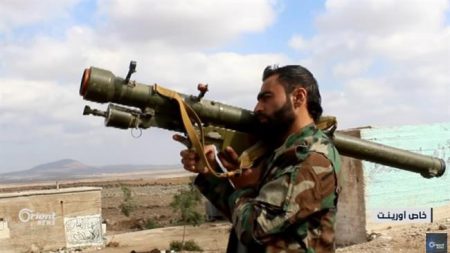
An Ansar al-Islam terrorist tests a shoulder-fired and low-altitude 9K32 Strela-2 surface-to-air missile system in an unknown location in southwestern Syria
Press TV – November 22, 2016
A report says members of a foreign-sponsored militant group in Syria have received a considerable amount of shoulder-launched anti-aircraft missiles, a possible indication that the US has eased restrictions on the supply of weapons to the anti-Damascus militants.
In a video published by the a pro-militant television network on Sunday, terrorists from the so-called Ansar al-Islam group can be seen testing low-altitude 9K32 Strela-2 missile systems in the southwestern Syrian provinces of Dara’a and Quneitra.
“We, in Ansar al-Islam Front, have distributed several points of air defense to counter any attempt by the Syrian warplanes or helicopters, which bomb points in Quneitra Province. We have a good number of these missiles,” a militant can be heard saying in the video.
A second militant says his group and the so-called Free Syrian Army are deploying munitions and forces to the towns of al-Harra, Masharah, Sandaniya and Jabata for attack against Syrian government forces within the next few days.
The report comes amid indications that the US administration has given the green light to its allies in the Middle East to send missiles to terrorist groups inside Syria through Jordan and Turkey.
A militant source said in late September that the US has agreed to the start of arms shipments from Qatar and Saudi Arabia.
A Reuters report has also hinted at the possibility that President Barack Obama would overturn the ban on the supply of missiles to extremist militants in Syria in the wake of Russian and Syrian forces’ offensives to retake the militant-held eastern part of the city of Aleppo.
Turkish airstrike kills Syrians
Meanwhile, Turkish aerial bombardment against the purported positions of Daesh terrorists near the northwestern Syrian city of al-Bab has killed seven people.
Syria’s official news agency SANA reported that ten people also sustained injuries in the Monday attack.
On August 24, the Turkish air force and special ground forces kicked off Operation Euphrates Shield inside Syria in a bid to support the so-called Free Syrian Army militants and rid the border area of Daesh terrorists and fighters from the Kurdish People’s Protection Units (YPG) and the Democratic Union Party (PYD).
The incursion drew strong condemnation from the Damascus government for violating Syrian sovereignty.
Also on Monday, ten civilians were killed when fighter jets from a US-led military coalition hit an area in the al-Salehiyah Village of the northern Syrian province of al-Raqqah.
Since September 2014, the US and some of its Arab allies have been carrying out airstrikes against what they say are Daesh positions inside Syria without any authorization from Damascus or a United Nations (UN) mandate.
The US-led coalition has done little to stop Daesh’s advances in Syria and Iraq. Some analysts have criticized the US-led military campaign, saying the strikes are only meant to benefit US weapons manufacturers.
4,000 NATO troops take part in Lithuania’s largest exercise near Russia’s border
RT | November 20, 2016
Eleven NATO countries have sent 4,000 troops to Lithuania, the largest Baltic nation, to participate in this year’s Iron Sword exercises. The war games are meant to test the country’s ability to rapidly deploy a large number of troops.
The exercise, which started on Sunday and is set to last till December 2, involves training at two separate sites in Lithuania.
“This time poses new unexpected challenges before our military. We have to prepare units and their commanders to efficiently respond to conventional military threats,” General Waldemar Rupšys, the head of Lithuania’s Land Forces, told journalists ahead of the exercise.
This year’s Iron Sword maneuver, which is the third and, by far, largest held so far, involves almost 4,000 troops from the US, the UK, Germany, Canada, Poland, Romania, Slovenia, Luxemburg, and the three Baltic states. The exercises held in the last two years had 2,500 and just over 2,000 troops participating, respectively.
The troops will train to execute offensive and defensive operations, rapid deployments, and other tasks, Lithuania’s Defense Ministry said.
Iron Sword 2016 is Lithuania’s first chance to test its new Žemaitija (Iron Wolf) brigade, which was formed earlier this year. It currently has two battalions and support units, but is to add two more battalions next year. The brigade consists of soldiers conscripted after Lithuania reinstated mandatory military service in March of 2015.
NATO is placing additional military assets in Eastern Europe and conducting intensified training there, claiming that such measures are necessary to deter what it calls “Russian aggression.” However, Moscow denies threatening its neighbors and says the alliance is using the notion as a pretext to justify increased military spending and encroach on Russia’s border.
Lithuania, like some other European NATO members, is struggling to meet its obligation to spend two percent of its GDP on defense, but the government says it will be able to meet this benchmark by 2018.
McCain warns Trump over ‘resetting’ ties with Russia
Press TV – November 16, 2016
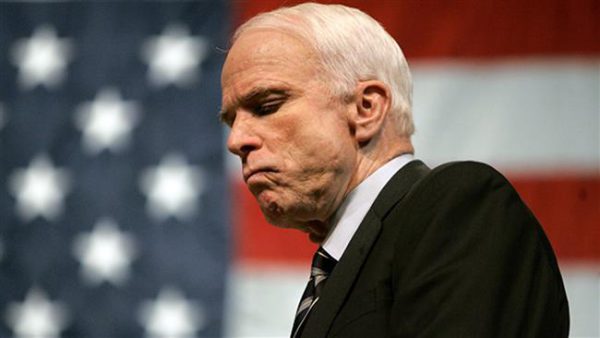
Senior US Senator John McCain has advised President-elect Donald Trump against putting “faith” in Moscow’s desire to improve relations with Washington, accusing Russian President Vladimir Putin of “tyranny” and “murder.”
Speaking after the first phone conversation between Trump and Putin, McCain said Tuesday that the Russian head of state was not to be trusted.
“With the US presidential transition underway, Vladimir Putin has said in recent days that he wants to improve relations with the United States,” the Republican senator of Arizona said in a statement.
“We should place as much faith in such statements as any other made by a former KGB agent who has plunged his country into tyranny, murdered his political opponents, invaded his neighbors, threatened America’s allies, and attempted to undermine America’s elections.”
The head of the Senate Armed Services Committee said “resetting” ties with Moscow would be too costly for Washington.
McCain’s comments were aimed at preventing Trump from following one of his most important campaign pledges, which included cooperation with Russia to solve mutual differences between the two sides.
At least that was what the Republican president-elect discussed with Putin during their phone call on Monday, according to Moscow.
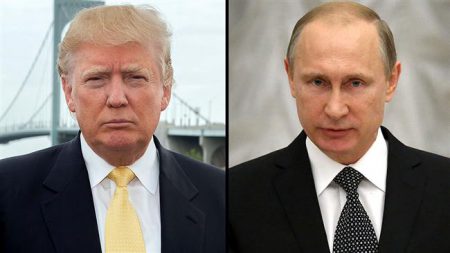
According to a statement released by the Kremlin, America’s 45th president discussed with his Russian counterpart the importance of “normalizing” ties between Moscow and Washington.
Both Putin and Trump had acknowledged “the extremely unsatisfactory state of Russian-US relations at present” and “declared the need for active joint work to normalize them.”
During the conversation, the Russian president also voiced his preparedness to “create a dialogue of partnership with the new administration on the basis of equality, mutual respect and non-intervention in each other’s domestic affairs.”
McCain did not look favorably to the contents of the discussion, warning in his statement that outgoing President Barack Obama’s plans to reduce tensions with Russia did not work either.
“The Obama Administration’s last attempt at resetting relations with Russia culminated in Putin’s invasion of Ukraine and military intervention in the Middle East,” the 2008 Republican presidential nominee alleged.
Long before Trump’s election on November 8, Putin had made it clear that his government was willing to work with the next US president regardless of the vote’s outcome.
Trump Sending ‘Good Signals’ on Syria, but the Devil Is in the Details
Sputnik – 14.11.2016
US President-elect Donald Trump has indicated that tackling Daesh will be a key priority for the incoming administration, prompting many to say that Washington will withdraw its tacit support of the Syrian rebels and work with Damascus instead. Professor Alexander Azadgan told Radio Sputnik that these are “good signals.”
“He had some interesting general policy statements, but as you know the devil is in the details. We’ll have to see how he actually implements even the generalities that he talked about,” Azadgan, Professor of Strategic Global Management and International Political Economy, said. “These are good signals. However, saying that ‘we are going to fight [Daesh]’, that’s not good enough. Everybody is fighting [Daesh], even Washington’s fighting [Daesh].”
The analyst urged policymakers in Washington to “change their vocabulary” when it comes to Syria, particularly the Syrian rebels.
“There is no such thing as a Syrian rebel. We’ve got to throw [this word combination] out of our vocabulary. There are mercenary, lunatic Wahhabis from everywhere around the world, especially Qatar, Kuwait, Saudi Arabia and the Gulf countries. They are neither Syrian, nor rebels. They are terrorists and savages.”
Trump appears to have questioned the concept last week when he said that “now we’re backing rebels against Syria and we have no idea who these people are.”
Azadgan expressed concern that Washington was not ready to listen to other countries with regard to resolving the Syrian crisis.
“I don’t think that Washington has good will to want to compromise or have some kind of fruitful negotiation. I think they are just buying time. Every time Washington says that they are going to negotiate, they create a false flag operation, like the bombing of a Syrian convoy that happened two months ago,” he said. “I don’t think they are interested in peace whatsoever. They are into prolonging this conflict. … It’s very dangerous. And war, even planned war, never goes right.”
The analyst was referring to an attack on a UN humanitarian aid convoy in mid-September, a week after a ceasefire brokered by Russian and American diplomats had entered into force. The incident took place near Aleppo, with the US swiftly blaming Moscow and Damascus. The Russian Defense Ministry provided detailed information disproving these allegations.
Azadgan suggested that Washington’s foreign policy could change once Trump is sworn in as the next US president. “We could reason that maybe Washington has realized that these policies are unsustainable and that they are going to have some face-saving change in policy. We have to talk about this potential,” he said.
The analyst further compared the present-day situation with regard to Syria to Serbia a century ago, saying that we are at a dangerous stage when global powers have taken different sides in a local conflict, which could have global implications.
Trump’s apparent willingness to limit to an extent Washington’s engagement overseas is a good sign.
“If you have cooler heads in Washington, if you have people expressing slight forms of isolationism, this is good for world peace. More importantly this is good for American taxpayers who have seen their taxes being plundered in the Middle East by policymakers, who are illiterate, imperialistic and hegemonic.”
Clinton Promotes War While US Public Opinion Speaks to Anti-Militarist Populism

By James Petras :: 11.14.2016
Introduction
Castigating the US electorate as accomplices and facilitators of wars, or, at best, dismissing the voters as ignorant sheep-people (‘sheeple’) herded by political elites, describes a partial reality. Public opinion polls, even the polls overwhelmingly slanted toward the center-right, consistently describe a citizenry opposed to militarism and wars, past and present.
Both the Right and Left have failed to grasp the contradiction that defines US political life: Namely, the profound gap between the American public and the Washington elite on questions of war and peace within an electoral process that consistently leads to more militarism.
This is an analysis of the most recent US public opinion polls with regard to outcome of the recent elections. The essay concludes with a discussion of the deep-seated contradictions and proposes several ways in which these contradictions can be resolved.
Method
A major survey of public opinion, sponsored by the Charles Koch Institute and the Center for the National Interest, conducted by the Survey Sampling International, interviewed a sample of one thousand respondents.
The Results: War or Peace
More than half of the American public oppose any increase in the US military role overseas while only 25% back military expansion.
The public has expressed its disillusionment over Obama’s foreign policy, especially his new military commitments in the Middle East, which have been heavily promoted by the state of Israel and its US domestic Zionist lobby.
The US public shows a deep historical memory with regard to the past military debacles launched by Presidents Bush and Obama. Over half of the public (51%) believe that the US has become less safe over the past 15 years (2001-2015), while one eighth (13%) feel they are more secure.
In the present period, over half of the public opposes the deployment of ground troops to Syria and Yemen and only 10% favor continued US support for the Kingdom of Saudi Arabia.
With regard to specific US wars, over half believe that Bush’s invasion of Iraq made the US homeland less secure, while only 25% believe it didn’t increase or decrease domestic security. Similar responses were expressed with regard to Afghanistan: 42% believe the Afghan War increased insecurity and about a third (34%) felt it did not affect US security.
In terms of future perspectives, three quarters (75%) of the American public want the next President to focus less on the US military operations abroad or are uncertain about its role. Only 37% are in favor of increased spending for the military.
The mass media and the powerful financial backers of the Democratic Presidential candidate have focused on demonizing Russia and China as ‘the greatest threats in our time’. In contrast, almost two thirds (63.4%) of Americans believe the greatest threat comes from terrorism both foreign and domestic. Only 18% view Russia and China as major threats to their security.
In regard to the Pentagon, 56% want to reduce or freeze current military spending while only 37% want to increase it.
Wars and Peace: The Political Elites
Contrary to the views of a majority of the public, the last four US Presidents, since the 1990’s, have increased the military budget, sending hundreds of thousands of US troops to launch wars in three Middle Eastern countries, while promoting bloody civil wars in three North African and two European countries. Despite public opinion majorities, who believe that the invasions of Afghanistan and Iraq have increased threats to the US security, Obama kept ground troops, air and sea forces and drone operations in those countries. Despite only 10% public approval for his military policies, the Obama regime has sent arms, advisors and Special Forces to support the Saudi dictatorship’s invasion of tiny Yemen.
Obama and the Democratic presidential candidate Hillary Clinton pushed a policy of encircling Russia and demonizing its President Putin as the greatest threat to the US in contrast to US opinion, which considers the threat of Islamist terrorism as five times more serious.
While the political elite and the leading Presidential candidates promise to expand the number of US troops abroad and increase military spending, over three quarters of the American public oppose or are uncertain about expanding US militarism.
While candidate Clinton campaigned for the deployment of the US Air Force jets and missiles to police a ‘no fly zone’ in Syria, even shooting down Syrian and Russian government planes, the majority of US public opposed it by 51%.
In terms of constitutional law, fully four-fifths (80%) of the US public believes the President must secure Congressional approval for additional military action abroad. Nevertheless, Presidents from both parties, Bush and Obama launched wars without Congressional approval, creating a precedent which the next president is likely to exploit.
Analysis and Perspectives
On all major foreign policy issues related to waging war abroad, the political elite is far more bellicose than the US public; they are far more likely to ignite wars that ultimately threaten domestic security; they are more likely to violate the Constitutional provisions on the declaration of war; and they are committed to increasing military spending even at the risk of defunding vital domestic social programs.
The political elites are more likely to intervene in wars in the Middle East, without domestic support and even in spite of majoritarian popular opposition to war. No doubt the executives of the oligarchical military-industrial complex, the pro-Israel power configuration and the mass media moguls are far more influential than the pro-democracy public.
The future portends a continuation of militarism by the political elites, and increase in domestic security threats and even less public representation.
Some Hypothesis on the Contradiction between Popular Opinion and Electoral Outcomes
There is clearly a substantial gap between the majority of Americans and the political elite regarding the role of the military in overseas wars, the undermining of constitutional prerogatives, the demonization of Russia, the deployment of US troops to Syria and deeper US entanglement in Middle East wars for the benefit of Israel.
Yet it is also a fact that the US electorate continue to vote for the two major political parties which have consistently supported wars, formed military alliances with warring Middle East states, especially Saudi Arabia and Israel and aggressively sanctioned Russia as the main threat to US security.
Several hypotheses regarding this contradiction should be considered:
1. Close to 50% of the eligible voters abstain from voting in Presidential and Congressional elections. This most likely includes many among the majority of Americans who oppose the expansion of the US military role overseas. In fact, the war party ‘winner’ typically claims victory with less than 25% of the electorate – and threats this as a mandate to launch more wars.
2. The fact that the mass media vehemently supports one or the other of the two war parties probably influences a minority of the electorate who decide to actually participate in the elections. However, critics have exaggerated the mass media’s influence and fail to explain why the majority of the American public disagree with the mass media and oppose the militarist propaganda.
3. Many Americans, while opposed to militarism, vote for the ‘lesser evil’ between the two war parties. They may believe that there are greater and lesser ‘degrees’ of war mongering and choose the less strident.
4. Americans, who consistently oppose militarism, may decide to vote for militarist politicians for reasons besides those of overseas wars. For example, majoritarian Americans may support a militarist politician who has secured funding for local infrastructure programs, or protected farm and dairy subsidies, or who promises jobs programs, lowers public debt or opposes corrupt incumbents.
5. Americans, opposed to militarism, may be deceived by the pronouncements of a demagogic presidential candidate from one of the war parties, whose promise of peace will give way to escalating wars.
6. Likewise, the emphasis on ‘identity politics’ can deceive anti-war voters into supporting a proven militarist because of issues related to race, ethnicity, gender, sexual preferences or loyalties to overseas states.
7. The war parties work together to block mass media access for anti-militarist parties, especially preventing their participation in national electoral debates viewed by tens of millions of voters. War parties collude to set impossible restrictions against anti-militarist party participation in national level elections, banning citizens with non-violent police records or former convicts who have served their sentences from voting. They reject poor citizens who lack photo identification, limit access to transport to voting sites, limit the number of polling places in poor or minority neighborhoods and deny time-off for workers to vote. Unlike other countries, US elections are held on a work day and many workers are unable to vote.
In other words the electoral process is ‘rigged’ and imposes ‘forced voting’ and abstention: Collusion between the two war parties limits voter choice to abstention or casting a ballot for the ‘lesser evil’ among the militarists.
Only if elections were open and democratic, where anti-militarist parties were allowed equal rights to register, participate and debate in the mass media, and where campaign financing were made equal would the contradictions between the wishes of the anti-militarist majorities and votes cast for pro-war elites be resolved.
Featured Video

Racist Seinfeld Dances for Joy as Bibi Unveils His New Map
or go to
Aletho News Archives – Video-Images
TV Drama Review
Japanese drama projects Japan’s wartime atrocities onto Chinese characters

Global Times | October 25, 2026
By portraying Chinese characters as perpetrators of ruthless violence while casting Japanese Self-Defense Forces (SDF) intelligence operatives as defenders, the season 2 of the Japanese drama Vivant has recently drawn criticism from Chinese netizens, who argue that its depiction turns historical reality on its head while ignoring Japan’s wartime atrocities.
The TBS drama series – a spy suspense story in which an alleged unofficial intelligence unit of the SDF operates across the globe — has attracted a passionate fanbase. Its currently airing season 2 opened with a household rating of 18.8 percent, the highest for a TV drama this year, according toa commentary article by Japanese media Toyo Keizai.
What draws attention is the portrayal of the enemies in the series, the article noted. Scenes in which the Chinese organization subjects kidnapped members of the SDF unit to brutal torture are repeated with unrelenting intensity.
It is rare for Japanese TV dramas to explicitly portray a real-life country as the enemy, the article noted.
Japanese Prime Minister Sanae Takaichi also made a reference to the drama, saying that she has been recording Vivant and hopes to binge-watch it over the year-end and New Year holidays, according to Japanese media outlets.
China’s CCTV News report on Sunday revealed that the drama features scenes in which Chinese personnel cut off the fingers of and stab Japanese intelligence operatives in the abdomen. Such acts bear striking similarities to the torture inflicted on Chinese nationals by invading Japanese troops during the World War II.
The drama distorts the truth by attributing these atrocities to modern Chinese characters. Beneath the surface, it subtly glorifies Japan’s cross-border overseas operations, blurs the functional boundaries of the SDF and implicitly promotes an expansionist narrative, per CCTV News. … continue
Blog Roll
 Aletho News
- EU facing trillion-euro debt hole while seeking more cash for Kiev
- How US, Europe, Persian Gulf states exhausted missile stockpiles, splurged billions to defend Israel
- Up in arms… Koreans reject U.S. empire’s plan to make South Korea the next Ukraine
- Iran, Turkey, Pakistan, Saudi Arabia could advance region-led security framework in Tehran: FM spox
- Netizens condemn Japanese drama for projecting Japan’s wartime atrocities onto Chinese characters
- Racist Seinfeld Dances for Joy as Bibi Unveils His New Map
- A West Bank War for Netanyahu’s Election Campaign, Could It Backfire?
- Yemen denounces European Parliament’s ‘hypocritical’ push to blacklist Ansarullah
- Qalibaf: UAE’s UN bid aims to ‘clear the runway’ for ‘Greater Israel’, whitewash genocide
- Pakistan reopens Iran border after boosting security: Report
- If Americans Knew
- An error has occurred; the feed is probably down. Try again later.
- No Tricks Zone
- Sudden Stratospheric Warming, Powerful El Niño Combination May Lead To Extreme Europe Cold, Energy Crisis!
- Two New Studies Find Thwaites Glacier Melt Cannot Be Driven By Human Activity Or A Warming Ocean
- E-Cars Reduce CO2 Emissions By Only 41% Compared To Internal Combustion Engine Vehicles
- Predictions Made By Renowned Climate Professor Over Past Decades Have Been Proven To Be Poor
- New Study Suggests Large Regions Of The Pacific Ocean Have Been Cooling For The Last 80 Years
- Germany’s Green Energy Debacle: High Energy Costs Force Kahla Porzellan to Close After 182 Years!
- New Study: 50 Years Of The Most Aggressive ‘Net Zero’ Policies Can Only Affect The Global Climate By 0.03°C
- US September “Heat” Was No Record…Many Records Set Decades Ago
- Latest European Green Energy Debacle; Portugal’s Largest Flagship Solar Park Insolvent!
- Green Energy Debacle: German Expert Professor Fritz Vahrenholt Warns Of Severe Economic And Social Consequences

