Australian arrested after he was ‘killed’ in Iraq
MEMO | November 25, 2016
An Australian citizen believed to be a top recruiter for Daesh is under arrest, the New York Times reported today, citing an unnamed US military official, months after Australia said he had been killed in a US airstrike in Iraq.
Australia said in May that Neil Prakash, who was linked to several Australia-based terrorist attack plans, was killed in an airstrike in Mosul, Iraq on 29 April.
The New York Times said Prakash was wounded in the attack and arrested by a Middle East government “in the last few weeks.” The Australian Broadcasting Corporation, citing Turkish and Australian officials, said he was arrested in Turkey.
Australian Attorney-General George Brandis, who announced Prakash’s death in May, declined to comment on “matters of intelligence or law enforcement operations.”
Justice Minister Michael Keenan said in an email response to Reuters that the government’s “capacity to confirm reports of deaths in either Syria or Iraq is limited.”
Melbourne-born Prakash had appeared in Daesh videos and magazines and had actively recruited Australian men, women and children and encouraged acts of terrorism.
Australia last year announced financial sanctions against Prakash, including threatening anyone giving financial assistance with punishment of up to 10 years in jail.
Kiev to hold missile-firing exercise over Crimea, where civil aviation performs flights – Moscow
RT | November 25, 2016
Ukraine has made a unilateral decision to organize missile-firing exercises over Crimea, in the sovereign airspace of the Russian Federation, Russia’s Federal Air Transport Agency Rosaviatsiya reported. Missiles will be fired in regions where civil and state aviation flights run.
Kiev’s move breaches a number of international laws and agreements, Rosaviatsiya said, adding that not only will the military exercise invade Russian territory, but the plans also had not been coordinated with Moscow.
Ukraine released an aviation notification on Thursday, activating “dangerous zones” in all flight levels near Crimea and the city of Simferopol for December 1 and 2, the agency reported. It added that the “dangerous” areas included airspace above open sea which is in Russia’s area of responsibility, and over Russian territorial waters.
The notifications released have not been coordinated with the appropriate Russian authorities, Rosaviatsiya said in its statement. It added that such unilateral moves demonstrate Ukraine’s unwillingness to work on the normalization of air traffic above the Black Sea.
Kiev has also violated annexes of the 1944 Convention on International Civil Aviation, the agency said, while demanding the immediate cancellation of the planned actions in Russia’s sovereign airspace.
The General Staff of the Ukrainian Army refused to comment on the matter, TASS reported. The head of the staff press service, Vladislav Seleznyov, told the agency it was not his department’s responsibility to “comment on this information,” and referred the outlet to other Ukrainian officials, including the Foreign Ministry, for more information.
The planned missile-launch exercises are “potentially dangerous for civil aviation,” Rosaviatsiya said in its statement, adding that it could lead to tragedies similar to those with Malaysia Airlines flight MH17 over Ukraine in 2014 and the downing of a Russian passenger plane over the Black Sea in 2001.
The investigation into the Malaysian Boeing-777 crash in eastern Ukraine, which killed all 298 people on board en route from Amsterdam to Kuala Lumpur, continues.
Another incident involving military missiles happened over the Black Sea in October 2001, when a Siberia Airlines Tu-154 en route from Tel-Aviv to Novosibirsk was downed by a missile launched by the Ukrainian military during an exercise. Seventy-eight people died.
Russia has informed both Russian and international air carriers of Kiev’s planned move, a Rosaviatsiya representative told TV channel Rossiya 24. Saying that Moscow is taking all measures to provide security for the flights, he added that Russia will be forced to ban all flights in the Crimea region should Ukraine not cancel its decision.
Philippine’s Duterte Seeks Peace
By Marjorie Cohn | Consortium News | November 25, 2016
In April 2016, Rodrigo Duterte won the Philippine presidential election by a landslide, with more than 6 million votes. He openly declared that he was the nation’s first Left president, calling himself a socialist but not a communist. So far, his regime has been controversial, to put it mildly.
The U.S. press has focused on Duterte’s vicious war on drugs that claimed upwards of 2,000 lives and led to the incarceration of tens of thousands of people. His decision to allow former Filipino dictator Ferdinand Marcos’s burial in the National Cemetery of the Heroes also has drawn the ire of those who recall Marcos’s brutal two-decade regime that killed more than 3,000, tortured tens of thousands, and stole $10 billion from the Philippines.
But, significantly, Duterte is engaging with revolutionary forces in the peace process that aims to end 47 years of armed struggle against the repressive Filipino government. And Duterte has taken actions that, for the first time, challenge the longstanding military and economic power of the United States in the Philippines.
Peace Process With Opposition
Since 1969, a civil war has been raging in the Philippines. The roots of the armed conflict can be traced to the colonial and neocolonial domination of the Philippines by the Spanish, then U.S. imperialism, feudal exploitation by big landlords and capitalist interests, as well as widespread bureaucratic corruption. After Duterte’s election, he cited peace as a top priority of his administration, vowing to engage in peace negotiations with the National Democratic Front of the Philippines (NDFP).
According to JustPeacePH, an international platform that supports the Philippine peace process and takes its name from its Internet site, “justpeace.ph,” “The daily, systematic and systemic injustice experienced by the people drive them to desire and seek fundamental changes in society through various means. But because the forces against fundamental social change use all means including the instruments and violence of the state to defend the status quo, many Filipinos over many generations have embraced armed struggle to overthrow the ruling system.”
The NDFP “is the alliance of progressive forces seeking to bring about fundamental change in the existing social system in the Philippines through armed revolution,” JustPeacePH states in its Primer on Just and Lasting Peace in the Philippines. The NDFP alliance includes trade unions, peasants, youth, women, national minorities, teachers, health workers, religious clergy, the Communist Party of the Philippines (CPP), and the New People’s Army.
Duterte’s Peace Initiative
Two rounds of peace negotiations have already occurred since Duterte took office, with a third scheduled for January 2017 in Oslo, Norway.
In May, Duterte declared he would release all political prisoners, which number more than 400, through a presidential declaration of amnesty, provided both houses of congress approve. Nineteen NDFP consultants, who have been involved in the revolutionary movement for years, have already been released.
Duterte offered four cabinet positions to the CCP, but they declined, stating there must first be a comprehensive peace agreement. The CCP, however, recommended a veteran peasant leader who was appointed Secretary of Agrarian Reform and a veteran academic activist leader who was named secretary of social welfare and development.
“These are major appointments,” Luis Jalandoni, NDFP’s Senior Adviser on the Peace Negotiating Panel, told me at a recent conference of the International Association of Democratic Lawyers in Lisbon, Portugal.
NDFP has a people’s army and organs of political power with mass organizations in 71 out of the 81 provinces in the country, Jalandoni said. He noted that landlessness and poverty afflict the 100 million people in the Philippines.
“The NDFP insists on addressing the roots of the armed conflict in order to achieve a just and lasting peace,” Jalandoni said.
The demands in the peace talks are: Release of all political prisoners; Land reform for the peasantry (70% of the population); National industrialization to develop the economy using available human and natural resources; Protect the environment and ancestral lands of the indigenous peoples; and Philippine national sovereignty and abrogation of all unequal treaties with the United States.
Challenging U.S. Power
U.S. domination and interference in the Philippines date back to 1898, when the United States annexed the Philippines. The U.S. continued to exercise colonial rule over the country until 1946, when the Philippines gained its independence although the United States retained many military installations there and the Filipino economy maintained its dependence on the U.S.
With U.S. assistance, Marcos ruled the Philippines with an iron fist from 1965 through 1986, under martial law from 1972 to 1981.
In 2002, the Gloria Macapagal-Arroyo government developed Oplan Bayanihan, a counterinsurgency program modeled on U.S. strategies. After 9/11, the Bush administration gave Arroyo $100 million to fund that campaign in the Philippines.
Oplan Bayanihan led to large numbers of extrajudicial killings, forced disappearances, torture and cruel treatment. Many civilians, including children, have been killed. Philippine military and paramilitary death squads murdered hundreds of members of progressive organizations. Communities and leaders opposed to large-scale and invasive mining have been targeted. Even ordinary people with no political affiliation have not escaped the government’s reign of terror.
From 2001 to 2010, the U.S. government provided more than $507 in military assistance to the Philippine government, facilitating tremendous repression.
Between 2010 and 2015, the Philippine police, military and paramilitary forces perpetrated extrajudicial killings, forced disappearances, torture, illegal arrests and forced evacuation, many to enable extraction by mining companies.
The 2014 Enhanced Defense Cooperation Agreement, which President Barack Obama negotiated with Duterte’s predecessor, gave U.S. troops the right to prolonged deployment in the Philippines. The agreement is widely seen in the Philippines as a threat to the country’s sovereignty.
In September 2016, Duterte declared, “I am not a fan of the Americans … Filipinos should be first before everybody else.” He added, “In our relations to the world, the Philippines will pursue an independent foreign policy. I repeat: The Philippines will pursue an independent foreign policy.”
The United States has not apologized for all the atrocities it committed against the Filipino people, Duterte said. Responding to U.S. criticism of the Philippines for its human rights violations, he stated, “Why are you Americans killing the black people there, shooting them down when they are already on the ground.”
Duterte promised to end joint military maneuvers with U.S. forces and expel the hundreds of U.S. troops currently stationed in the Philippines. He also expressed his intention to end bilateral agreements concluded by his predecessor with the United States and reverse permission for the United States’ use of five Philippine military bases.
“I will break up with America,” Duterte said. “I would rather go to Russia and to China.” He vowed to rescind joint patrols with U.S. and Filipino forces against Chinese expansion in the disputed South China Sea. Indeed, Duterte recently traveled to China and secured valuable fishing rights for Filipinos in the South China Sea.
Hope for Peace Prospects
In an unprecedented development, both the government and the opposition declared unilateral ceasefires in August. But there are still problems with the government’s ceasefire, says Jalandoni, as Duterte doesn’t have full control of the military. The military and paramilitary forces, which are protected by the military, have engaged in several violations that imperil the ceasefire, he said.
“There is high optimism that the peace talks will prosper under the presidency of Duterte,” according to JustPeacePH. “Unlike past presidents who harbor strong anti-communist bias, Duterte seems capable of rethinking the government’s peace strategy since he claims to be a socialist.”
Opposition forces are not uncritical of the excesses in Duterte’s war on drugs. The CCP declared the campaign is becoming anti-people and anti-democratic. Due process must be respected, human rights must be upheld; the drug users and small drug dealers, who come from poverty, require rehabilitation and care, the CCP maintains.
“Understandably, Duterte’s war on drugs and other crimes is given more coverage by the global media,” JustPeacePH wrote in its primer. “But Duterte’s aim to establish a lasting peace in the provinces deserves even more attention as this strikes at the root causes of the problem of illegal drugs and related crimes.”
Jalandoni said, “Duterte is not a saint but he stands for an independent foreign policy. His stand against the United States is respected and has received a lot of support.”
The NDFP, Jalandoni noted, says that “if there are threats against Duterte by U.S. imperialism, the Left will be a reliable ally to him,” adding, “He is the first president to stand up to the United States.”
Marjorie Cohn is professor emerita at Thomas Jefferson School of Law, former president of the National Lawyers Guild, and deputy secretary general of the International Association of Democratic Lawyers. She is a member of the International Legal Assistance Team that advises the National Democratic Front of the Philippines on human rights and humanitarian law in their peace negotiations. Her most recent book is Drones and Targeted Killing: Legal, Moral, and Geopolitical Issues. Visit her website at http://marjoriecohn.com/ and follow her on Twitter @marjoriecohn.
Russia Tests Train-Based Nuclear System: President Trump Can Prevent Arms Race
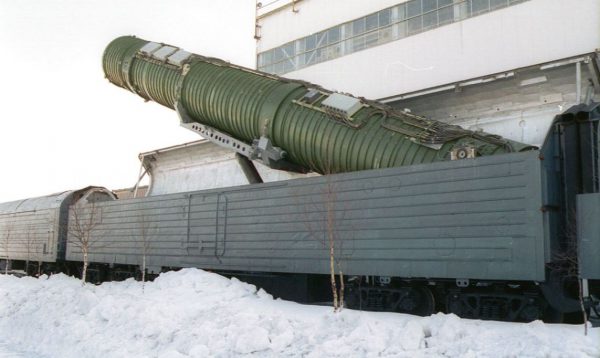
By Peter KORZUN | Strategic Culture Foundation | 24.11.2016
The US is mulling a major overhaul of its nuclear triad. The Air Force is working on a new version of the intercontinental ballistic missile (ICBM) and the Long Range Strike-Bomber (LRS-B) program. The Navy is studying the plans to replace the Ohio-class submarines. According to the Center for Strategic and Budgetary Assessments, the plans to recapitalize the nuclear triad will cost more than $700 billion over the next 25 years.
Former Secretary of Defense William Perry has warned that the US is on the «brink» of kicking off a new nuclear arms race that will elevate the risk of nuclear apocalypse to Cold War levels.
Moscow has no choice but to respond.
Russia has successfully conducted its first test of an Intercontinental Ballistic Missile (ICBM) designed for the upcoming Barguzin railway-based strategic nuclear offensive system. It was an «ejection» test with a missile leaving a container.
The launch trials were carried out at the Plesetsk spaceport two weeks ago, paving the way for further flight tests to be carried out in 2017.
Colonel-General Sergei Karakayev, commander of Russia’s Strategic Missile Forces, told reporters that the new railway-based missile system would be ready for deployment in early 2017.
Previously, Yuri Solomonov, the Chief Designer of the Moscow Institute of Thermal Technology (MITT), promised that the first ejection test will take place «in the beginning of the fourth quarter of 2016».
The first five Barguzin railroad systems may become operational by 2020 to remain in service till 2040. Moscow plans to deploy five of the Barguzin trains beginning in 2019.
Each Barguzin-armed train will carry six RS-24 Yars ICBMs ready for launch within minutes. The missile’s maximum range is 11,000 km (6,800 mi). It has at least 4 MIRVs with 150–250 kiloton warheads. The speed is over Mach 20 (24,500 km/h; 15,220 mph; 6,806 m/s). Guidance is inertial with GLONASS. Accuracy is 150-200 m.
Disguised as a freight train, the moving platform cannot be spotted either by satellite or electronic surveillance. It is worth mentioning that the Russian railways are ranked second longest globally. In general, the combat system can pass up to 1,000 kilometers daily. It is extremely difficult to locate it on route. With relatively lightweight Yars missiles on board, there will be no tell-tale signatures such as three locomotives in the old train-based systems decommissioned by 2005.
The system is created as a counterbalance to NATO’s ballistic missile defense (BMD), which is able to launch Tomahawk long-range cruise missiles, in addition to interceptors. The planned deployment of the system is also a response to the challenge posed by the US Prompt Global Strike (PGS) concept which envisions the capability to deliver a precision-guided conventional strike at any target in the world within one hour with hypersonic weapons.
Both – the BMD and the PGS – are considered as destabilizing factors by Russia. The Barguzin is an answer that does not violate the provisions of the 2010 New START Treaty.
There is another milestone event related to strengthening Russian nuclear strategic deterrent. The eighth Knyaz (Prince) Pozharsky Borei-class nuclear-powered submarine will be laid down at the Sevmash shipyard in Russia’s northern town of Severodvinsk on Dec. 23. Knyaz Pozharsky submarine will be the last of the eight Borei-class submarines and the fifth of the advanced A-batch.
The submarine carries 16 Bulava intercontinental ballistic missiles. The MIRVed missile carries 6 re-entry vehicles with a yield of 150 each. The operational range is 8,000-8,300 km (5,000 – 5,100 mi).
All these developments make one remember that Russia and the US – the two nations that account for more than 90 % of world strategic nuclear potential – have to make a very important decision about the future of arms control. The New START Treaty expires by 2021 without any prospects for a new agreement coming into force. President Putin and President Trump are the ones to rectify the situation.
There are many things that complicate the already complex problem: the future of the INF Treaty, US conventional strike superiority, NATO tactical weapons (B61-12) capable of striking Russian territory the same way strategic weapons do, the refusal of other nuclear states to join the arms control process, you name it.
Since the US withdrew from the 1972 ABM Treaty, ballistic missile defense has become the main obstacle on the way of achieving progress. BMD capability that would make the Russian deterrent less credible because the US would be able to degrade Russian second strike retaliatory capability.
The New START mentions the interaction of offensive and defense arms but contains no limitations. No doubt, Russia will raise the issue as a prerequisite for any discussions on what to do about arms control. The new US president will have to think long and hard if he wants to proceed with this highly destabilizing system that can make all future efforts to gain progress go down the drain.
The US does maintain an inactive stockpile that includes near-term hedge warheads that can be put back into operational status within six to 24 months. Extended hedge warheads can be made ready within 24 to 60 months. And it preserves some of this upload capability on its strategic delivery vehicles. This is a problem the New START does not address.
In 2002 the US pulled out of the ABM Treaty setting a precedent as it was the first time that a superpower withdrew from an arms control agreement. What if the United States decides to withdraw from the New START or any other treaty it may have with Russia? If it does, it would be able to return warheads from storage back to missiles (upload capability), and build up its strategic potential by several thousand warheads in several months at most. Russia’s apprehensions are justified. Will the new US administration be able to respect the other side’s concerns?
According to its provisions, the New START treaty can be extended for 5 years more but from Russia’s perspective there are concerns that should be taken into account before the issue hits the arms control agenda.
With Russian and US militaries maintaining no regular contacts, there is a danger of hair trigger alert – another problem for the two nations to address.
Having assumed power on January 20, Donald Trump will inherit the downturn in Russia-US relations and growing nuclear tensions and uncertain future for arms control.
Mr. Trump has said many positive things and there is each and every reason to hope for progress on such issues as Syria, for instance. It’s logical to expect that the present downturn in the bilateral relationship will be reversed. But so far, nothing has been said by Donald Trump and the members of his team about the revival of nuclear cooperation. Perhaps, binding agreements on the capabilities of BMD systems or limitations on existing and emerging long-range, precision-guided conventional offensive weapons and reductions in substrategic nuclear arms could help achieve gradual progress.
«The risk of a nuclear conflict may be higher today than at any time since the 1980s», warns Andrew Kuchins, a Russia expert at Washington’s Georgetown University and former head of Carnegie Moscow Center, in a forthcoming report on US-Russian relations. «Unfortunately, societies and political establishments … seem in large part unaware that this truly existential threat has [returned]».
There may be cooperation in some areas of mutual interest but no real reversal of the dangerous downturn in the relationship is possible without progress in arms control. With the new US administration in office, it may be expedient for the experts to take the bull by the horn and start discussions. With Mr. Trump’s victory, there is a chance that should not be missed.
EU Politicians are Convinced that Tanks are the Best Remedy for Social Disparity
By Jean Perier – New Eastern Outlook – 24.11.2016
 Following in the wake of the White House policy, European political elites have been stepping up their groundless propagandistic rhetoric about the growing military threat of Russia, Iran, China, which is aimed at achieving further militarization of Europe at the expense of the social benefits of its citizens.
In his recent speech at an event hosted by the German Marshall Fund of the United States, NATO‘s Secretary General Jens Stoltenberg announced that he expects a 3% real increase in defence spending in Europe and Canada, however, he added, other than the US, only four NATO members are currently spending 2% of GDP on defence.
Against the background of a string of upcoming election campaigns in the EU, it’s really not that hard to predict how Europeans are going to take the announcement that their governments are planning to increase their military budgets. The most likely scenario is that a number of EU states will vote for their own version of Trumpxit, which means that an outsider candidate will have more chances than those from the ruling elites. As the living conditions of an ever increasing number of Europeans continue to deteriorate, it’s highly unlikely that EU citizens are going to tolerate new military expenditures.
The data provided by the Eurostat shows that in 2015, around 25 million children, or 26.9% of the population aged 0 to 17, in the European Union were at risk of poverty or social exclusion. A total of six member states saw a third of all children being at risk of poverty or social exclusion, these are Romania (46.8%), Bulgaria (43.7%), Greece (37.8%), Hungary (36.1%), Spain (34.4%) and Italy (33.5%).
According to the Guardian, having a child while living in a rental accommodation has become unaffordable for young families in two–thirds of the UK. The most inaccessible place for those wanting to start a family was London, with a two-bedroom rental there costing 60% of the average income for someone in their 20s and 44% for someone in their 30s. This was followed by the south-east, south-west and the east. At the same time, the number of families with children living in emergency accommodations in England rose by 45% in the last 12 months, reaching the highest level in 12 years.
In turn, the Fabian Society says the Tory’s social cuts will increase the number of kids living in poverty by 75% over the next 15 years in the UK, the Daily Mirror notes. Moreover, Berlin has already announced that social disparity will be steadily growing throughout the upcoming decade in Germany.
The Finish Yle notes that the number of children living in poor families has tripled over the last two decades. What is striking is that even those families where both parents are employed full time are unable to earn an adequate revenue.
Ever since 2008, the deepening social crisis in the EU has been making local citizens feel increasingly frustrated with their elected officials. At the same time, local political elites are reluctant to address the most pressing problems of their population, instead they prefer to increase military spending and cut social benefits provided to the poor.
The chain of events, namely the Brexit and the Trumpxit shows the growing frustration of the hard-working people that are still unable to provide decent childhood for their children. And it doesn’t take a genius to know that the ruling elites are going to face a bitter electoral defeat in Germany, France, the Netherlands and Austria. There’s really no way they can win.
Trump’s Possible Path Out of Ukraine Crisis
By Jonathan Marshall | Consortium News | November 24, 2016
If Donald Trump wants to make a decisive and constructive mark on U.S. foreign policy early in his presidency, there’s no better place to start than by helping to end the brutal war in Ukraine that has claimed some 10,000 lives.
The Obama administration helped ignite that war by attempting to yank Ukraine out of Russia’s orbit and into the Western security and economic sphere. Working alongside the European Union, Washington fanned mass street protests that led to a violent putsch against Kiev’s elected government in February 2014. Moscow responded by annexing (or, depending on your point of view, reunifying with) Russian-speaking Crimea, which is also headquarters of Moscow’s Black Sea Fleet, and backing pro-Russia separatists in the eastern regions of Donetsk and Luhansk.
Since then, the two sides have fought to a bloody stalemate. Besides killing thousands of civilians, the war has sunk Ukraine’s economy and fostered rampant corruption. U.S. and E.U. sanctions have dragged down Russia’s economy and derailed cooperation between Washington and Moscow in other theaters. Rising tensions between NATO and Russia have greatly raised the odds of an accidental military confrontation between the world’s two largest nuclear powers.
The best hope for Ukraine — and renewed East-West cooperation — is the Minsk Protocol, signed by Ukrainian, Russian, and European parties in the capital of Belarus on Sept. 5, 2014. The agreement provided for a ceasefire, an exchange of prisoners, and a framework for a political settlement based on giving the Donetsk and Luhansk regions a “special status.”
That agreement broke down amid renewed fighting until the parties signed the Minsk-2 Agreement on Feb. 12, 2015. It provided for constitutional reforms, elections in the two republics, and restoration of Ukrainian sovereignty over its borders. But Kiev has made no serious move to recognize the special status of its breakaway regions, and the two sides have engaged in sporadic hostilities ever since.
Final Words
Presidents Obama and Putin exchanged what may have been their final, desultory words on the subject at the Asia-Pacific Economic Cooperation summit in Peru this month. Obama “urged President Putin to uphold Russia’s commitments under the Minsk agreements,” while a Russian spokesman said the two men “expressed regret that it was not possible to make progress in Ukraine.”
As current foreign policy messes go, however, the Ukrainian imbroglio may offer the greatest opportunities for a rewarding cleanup. Doing so will require both sides to acknowledge some fault and find creative ways to save face.
Fortunately, President-elect Trump has created an opening for such a settlement by reaching out to Putin during the election campaign and explicitly declining to bash Russia for its annexation of Crimea (which followed a hastily arranged referendum in which the official results showed that 96 percent of the voters favored leaving Ukraine and rejoining Russia).
There are also small signs of progress that give hope. A limited demilitarization accord signed in September led to a mutual retreat by the Ukrainian army and pro-Russia separatists from a small city in eastern Ukraine. The withdrawal was verified by observers from the Organization for Security and Cooperation in Europe (OSCE), a party to the Minsk accords. Meanwhile, Ukraine, Germany, France and Russia are working on a new roadmap to strengthen the ceasefire.
Conditions for Peace
In a June 2015 interview with Charlie Rose, Putin laid out clear and reasonable conditions for making the Minsk accord stick:
“Today we primarily need to comply with all the agreements reached in Minsk … At the same time, I would like to draw . . . the attention of all our partners to the fact that we cannot do it unilaterally. We keep hearing the same thing, repeated like a mantra – that Russia should influence the southeast of Ukraine. We are. However, it is impossible to resolve the problem through our influence on the southeast alone.
“There has to be influence on the current official authorities in Kiev, which is something we cannot do. This is a road our Western partners have to take – those in Europe and America. Let us work together. … We believe that to resolve the situation we need to implement the Minsk agreements, as I said. The elements of a political settlement are key here. There are several. . . .
“The first one is constitutional reform, and the Minsk agreements say clearly: to provide autonomy or, as they say, decentralization of power. . .
“The second thing that has to be done – the law passed earlier on the special status of . . . Luhansk and Donetsk, the unrecognized republics, should be enacted. It was passed, but still not acted upon. This requires a resolution of the Supreme Rada – the Ukrainian Parliament – which is also covered in the Minsk agreements. . . .
“The third thing is a law on amnesty. It is impossible to have a political dialogue with people who are threatened with criminal persecution. And finally, they need to pass a law on municipal elections on these territories and to have the elections themselves. All this is spelled out in the Minsk agreements. . . .
“I repeat, it is important now to have a direct dialogue between Luhansk, Donetsk and Kiev – this is missing.”
Future of Crimea
Any lasting settlement will also require some compromise over Crimea, which Putin has vowed never to relinquish.
As Ray McGovern, the CIA’s former chief Russia analyst, has noted, the annexation of Crimea did violate a pledge that Russia made in 1994 — along with Great Britain and the United States — “to respect the independence and sovereignty and existing borders of Ukraine,” as a precondition to Ukraine giving up its nuclear weapons. Of course, the United States and the E.U. had already violated the same pledge by supporting a coup d’état against the country’s elected government.
McGovern cited other “extenuating circumstances, including alarm among Crimeans over what the unconstitutional ouster of Ukraine’s president might mean for them, as well as Moscow’s not unfounded nightmare of NATO taking over Russia’s major, and only warm-water, naval base at Sevastopol in Crimea.”
In support of annexation, Russian and Crimean authorities also pointed to the hasty referendum that was held in Crimea in March 2014, which resulted in 96 percent support for reunification with Russia, a relationship dating back to the Eighteenth Century. Subsequent polls of Crimean opinion, conducted by Western firms, have largely confirmed support for the 2014 referendum on rejoining Russia. But the referendum did not have international observers and was not accepted by the United States and other Western nations.
Condemning the annexation in a soaring speech about the “rule of law” and America’s dedication to universal principles, President Obama contrasted Crimea with Kosovo, which NATO forcibly broke away from Serbia in 1999.
Obama said, “Kosovo only left Serbia after a referendum was organized not outside the boundaries of international law, but in careful cooperation with the United Nations and with Kosovo’s neighbors. None of that even came close to happening in Crimea.”
Actually, none of that came close to happening in Kosovo, either. Obama’s story was a myth, but it confirmed the powerful legitimacy offered by popular referenda, like those in Great Britain over Scottish independence or Brexit.
Yet, as part of a permanent settlement of the larger Ukraine crisis, the Minsk signatories could agree to hold another, binding referendum in Crimea under international supervision to decide whether it stays under Russian rule or returns to Ukraine.
To get Russia’s buy-in, the United States and its European allies should agree to lift sanctions if Moscow abides by the referendum and other terms of the Minsk accord. They should also agree to rule out the incorporation of Ukraine into NATO, the original sin that sowed the seeds of crisis between Russia and the West. Russia, in turn, could agree to demilitarize its border with Ukraine.
Obstacles to Settlement
President Putin has signaled his willingness to compromise in several ways, including firing his hardline chief of staff, Sergei Ivanov, and welcoming the presence of armed observers from OSCE to monitor the Minsk agreement.
But major obstacles still impede progress. One is President Petro Poroshenko’s stalling in the face of opposition to the Minsk accord by Ukrainian nationalists. Kiev needs to be given a firm choice: go it alone, or compromise if it wants continued economic support from the United States and Western Europe. The Obama administration has quietly urged the Poroshenko government to honor the Minsk agreement, but has never put teeth behind its entreaties.
The other major obstacle is hostility from militarist hardliners in the West who propose arming Ukraine to ratchet up conflict with Russia. Prime examples include the State Department’s chief policy maker on Ukraine, Victoria Nuland; former NATO Commander Gen. Philip Breedlove, who became infamous for issuing inflated warnings about Russian military operations; Senate Armed Services Committee Chairman John McCain; and Stephen Hadley, Raytheon board member and former national security adviser to President George W. Bush, who chairs the Orwellian-named United States Institute for Peace.
But Trump will have great leeway as commander-in-chief to reject their advice and set a new direction for NATO’s policy on Ukraine and Russia more generally. He has everything to gain by breaking the cycle of political conflict with Moscow.
An ally in the Kremlin will immeasurably improve his chances of making deals in the Middle East, finding a way out of Afghanistan, and managing China.
The next few months should tell us whether Trump has the independence, imagination, and gumption to do the right thing.
Jonathan Marshall is author or co-author of five books on international affairs, including The Lebanese Connection: Corruption, Civil War and the International Drug Traffic.
Congressional Hawks Rush to Intensify War in Syria
By Rick Sterling | Dissident Voice | November 21, 2016
Hawks pass HR5732
Late in the day Tuesday November 15, Congress convened in special session. With normal rules suspended, they passed House Resolution 5732 the “Caesar Syria Civilian Protection Act”. The resolution calls for intensifying already harsh sanctions on Syria, assessing implementation of No Fly Zone in Syria and escalating efforts to press criminal charges against Syrian officials. HR5732 claims to promote a negotiated settlement in Syria but, as analyzed by Friends Committee for National Legislation, imposes preconditions which would actually make that more difficult.
There was 40 minutes of “debate” with six representatives (Royce, Engel, Ros-Lehtinen, Kildee, Smith, and Curbelo) speaking in favor of the resolution. There were few other Congressional representatives present in Congress. The House Foreign Affairs Committee stated that the resolution was passed “unanimously” without mentioning the special conditions.
The “Non Controversial” Resolution that could lead to World War III
According to wikipedia “Suspension of the rules is a procedure generally used to quickly pass non-controversial bills in the United States House of Representatives …. such as naming Post Offices…” In this case, the resolution calls for evaluating and developing plans for a “No Fly Zone” which is an act of war. This is obviously controversial and it seems clear the resolution should have been debated and discussed under normal rules with a normal amount of Congressional presence and debate.
The motivation for bypassing normal rules and rushing the bill through without debate was articulated by the bill’s author and ranking Democrat Eliot Engel: “We cannot delay action on Syria any further…. if we don’t get this legislation across the finish line in the next few weeks, we are back to square one.” The current urgency may be related to the election results since Trump has spoken out against “regime change” foreign policy. As much as they are critical of Obama for not doing more, Congressional neoconservatives are concerned about the prospect of a President who might move toward peace and away from war.
The Caesar Fraud
HR5732 is titled the “Caesar Syria Civilian Protection Act”. Foreign Affairs Committee Chair Ed Royce (R-Ca) explained that the resolution is named after “the brave Syrian defector known to the world as Caesar, who testified to us the shocking scale of torture being carried out within the prisons of Syria.”
In reality, the Caesar story was a grand deception involving the CIA with funding from Qatar to sabotage the 2014 Geneva negotiations. The 55,000 photos which were said to show 11,000 torture victims have never been publicly revealed. Only a tiny number of photos have been publicized. However, in 2015 Human Rights Watch was granted access to view the entire set. They revealed that almost one half the photos show the opposite of what was claimed: instead of victims tortured by the Syrian government, they actually show dead Syrian soldiers and civilian victims of car bombs and other terror attacks! The “Caesar” story, replete with masked ‘defector’, was one of the early propaganda hoaxes regarding Syria.
False Claims that the US has been doing nothing
One of the big lies regarding Syria is that the US has been inactive. Royce says:
The administration has decided not to decide. And that itself, unfortunately, has set a course where here we sit and watch and the violence only worsens. Mr. Speaker, America has been sitting back and watching these atrocities for far too long. Vital U.S. national security interests are at stake.
The ranking Democrat Eliot Engel said:
Four years ago I thought we should have aided the Free Syrian Army. They came to us in Washington and begged us for help… they were simply looking for weaponry. I really believe if we had given it to them, the situation in Syria would have been different today.
This is nonsense. The US was actively coordinating, training and supplying armed opposition groups beginning in late 2011. When the Qadaffi government was toppled in Fall 2011, the CIA oversaw the theft of the Libyan armories and shipment of weapons to Syrian armed opposition as documented in the Defense Intelligence Agency report of October 2012.
These weapons transfers were secret. For the public record it was acknowledged that the US was supplying communications equipment to the armed opposition while Saudi Arabia and Qatar were supplying weaponry. This is one reason that Saudi purchases of weapons skyrocketed during this time period; they were buying weapons to replace those being shipped to the armed opposition in Syria. It was very profitable for US arms manufacturers.
Huge weapons transfers to the armed opposition in Syria have continued to the present. This past Spring, Janes Defense reported the details of a U.S. delivery of 2.2 million pounds of ammunition, rocket launchers and other weaponry to the armed opposition.
Claims that the US has been inactive are baseless. In reality the US has done everything short of a direct attack on Syria. And the US military is starting to cross that barrier. On September 17 the US air coalition did a direct attack on the Syrian Army in Deir Ezzor, killing 80 Syrian soldiers and enabling ISIS to launch an attack on the position. Claims that it was a “mistake” are highly dubious.
The claims by Congressional hawks that the US has been ‘inactive’ in the Syrian conflict are part of the false narrative suggesting the US must “do something” which leads to a No Fly Zone and full scale war. Ironically, these calls for war are masked as “humanitarian”. And never do the proponents bring up the case of Libya where the US and NATO “did something”: destroyed the government and left chaos.
Congress as a Fact-Free House of Propaganda
With only a handful of representatives present and no debate, the six Congress members engaged in unrestrained propaganda and misinformation. The leading Democrat, Eliot Engel, said “We’re going into the New Year 2017, Assad still clings to power, at the expense of killing millions of his citizens.” That number is way off anyone’s charts.
Rep Kildee said “The world has witnessed this terrible tragedy unfold before our eyes. Nearly half a million Syrians killed. Not soldiers – men, women, children killed.”
The official text of the resolution says,
It is the sense of Congress that–
(1) Bashar al-Assad’s murderous actions against the people of Syria have caused the deaths of more than 400,000 civilians…
The above accusations – from “millions of citizens” to “half a million” to “400,000 civilians” – are all preposterous lies.
Credible estimates of casualties in the Syrian conflict range from 300,000 to 420,000. The opposition supporting Syrian Observatory for Human Rights estimates the documented 2011-2016 death toll as follows:
killed pro Syrian forces – 108,000
killed anti government forces – 105,000
killed civilians – 89,000
In contrast with Congressional and media claims, civilians comprise a minority of the total death count and the largest casualty group is those fighting in defense of the the Syrian state. These facts are ignored and never mentioned because they point to the reality versus the propaganda narrative which allows the USA and allies to continue funding terrorism and a war of aggression against Syria.
The Congressional speakers were in full self-righteous mode as they accused the Syrian government of “committing crimes against humanity and war crimes against civilians including murder, torture and rape. No one has been spared from this targeting, even children.” A naive listener would never know that the Syrian government is primarily fighting the Syrian branch of Al Qaeda including thousands of foreigners supplied and paid by foreign governments.
The Congressional speakers go on to accuse the Syrian military of “targeting” hospitals, schools and markets. A critical listener might ask why they would do that instead of targeting the Al Qaeda terrorists and their allies who launch dozens and sometimes hundreds of hell cannon missiles into government held Aleppo every day.
The Congressional propaganda fest would not be complete without mention of the “White Helmets.” House Foreign Affairs Committee Chairman Ed Royce said:
We (previously) heard the testimony of Raed Saleh of the Syrian White Helmets. These are the doctors, nurses and volunteers who actually, when the bombs come, run towards the areas that have been hit in order to try to get the injured civilians medical treatment… They have lost over 600 doctors and nurses.
This is more Congressional nonsense. There are no nurses or doctors associated with the White Helmets. The organization was created by the USA and UK and heavily promoted by a “shady PR firm.” The White Helmets operate solely in areas controlled by Nusra and associated terrorist groups. They do some rescue work in the conflict zone but their main role is in the information war manipulating public opinion. The White Helmets actively promote US/NATO intervention through a No Fly Zone. Recently the White Helmets has become a major source of claims of innocent civilian victims in east Aleppo. Given the clear history of the White Helmets, these claims should be treated with skepticism. What exactly is the evidence? The same skepticism needs to be applied to video and other reports from the Aleppo Media Center. AMC is a creation of the Syrian Expatriates Organization whose address on K Street, Washington DC indicates it is a US marketing operation.
What is really going on?
The campaign to overthrow the Syrian government is failing and there is possibility of a victory for the Syrian government and allies. The previous flood of international jihadi recruits has dried up. The Syrian Army and allies are gaining ground militarily and negotiating settlements or re-locations with “rebels” who previously terrorized Homs, Darraya (outer Damascus) and elsewhere. In Aleppo the Syrian army and allies are tightening the noose around the armed opposition in east Aleppo.
This has caused alarm among neoconservative lawmakers devoted to Israel, Saudi Arabia and U.S. empire. They are desperate to prevent the Syrian government from finally eliminating the terrorist groups which the West and allies have promoted for the past 5+ years.
“Pro Israel” groups have been major campaigners for passage of HR5732. The name of Simon Wiesenthal is even invoked in the resolution. With crocodile tears fully flowing, Rabbi Lee Bycel wrote “Where is the Conscience of the World?” as he questioned why the “humanitarian” HR5732 was not passed earlier.
Israeli interests are one of the primary forces sustaining and promoting the conflict. Syria is officially at war with Israel which continues to occupy the Syrian Golan Heights; Syria has been a key ally of the Lebanese resistance; and Syria has maintained its alliance with Iran. In 2010 Secretary of State Clinton urged Syria to break relations with Hezbollah, reduce relations with Iran and come to settlement with Israel. The Syrian refusal to comply with these Washington demands was instrumental in solidifying Washington’s hostility.
Congressional proponents of HR5732 make clear the international dimension of the conflict. Royce explains “It is Russia, it is Hezbollah, that are the primary movers of death and destruction… it is the IRGC fighters from Iran.” Engel echoes the same message: “Yes, we want to go after Assad’s partners in violence… along with Iranian and Hezbollah forces”.
These statements are in contrast with the analysis of some writers who believe Israel is not deeply opposed to the Damascus government. For example, Phyllis Bennis recently wrote that belief in an “arc of resistance” has been “long debunked” and that “the Syrian regime …. often plays a useful role for US and Israeli interests.”
It’s remarkable that this faulty analysis continues to be propounded. In words and deeds Israel has made its position on Syria crystal clear. Israeli Ambassador Michael Oren explained in an interview:
We always wanted [President] Bashar Assad to go, we always preferred the bad guys who weren’t backed by Iran to the bad guys who were backed by Iran … the greatest danger to Israel is by the strategic arc that extends from Tehran, to Damascus to Beirut. And we saw the Assad regime as the keystone in that arc.
These statements have been fully backed up by Israeli actions bombing Syrian positions in southern Syria and providing medical treatment for Nusra/Al Qaeda and other armed opposition fighters.
What Will Happen Now?
If the Syrian government and allies continue to advance in Aleppo, Deir Ezzor, outer Damascus and the south, the situation will come to a head. The enemies of Syria – predominately the USA, Gulf Countries, NATO and Israel – will come to a decision point. Do they intervene directly or do they allow their regime project to collapse?
HR5732 is an effort to prepare for direct intervention and aggression.
One thing is clear from the experience of Libya: Neoconservatives do not care if they leave a country in chaos. The main objective is to destabilize and overthrow a government which is too independent. If the USA and allies cannot dominate the country, then at least they can destroy the contrary authority and leave chaos.
What is at stake in Syria is whether the USA and allies Israel, Saudi Arabia, etc. are able to destroy the last secular and independent Arab country in the region and whether the US goal of being the sole superpower in the world prevails.
The rushed passing of HR5732 without debate is indicative that:
* “regime change” proponents have not given up their war on Syria
* they seek to escalate US aggression.
* the US Congress is a venue where blatant lies are said with impunity and where violent actions are advanced behind a cynical and amoral veneer of “humanitarianism” and crocodile tears.
Rick Sterling is an investigative journalist and member of Syria Solidarity Movement. He can be reached at rsterling1@gmail.com.
Draining the Swamp at State

Photo by thierry ehrmann | CC BY 2.0
By Renee Parsons | CounterPunch | November 22, 2016
If there is one hopeful sign in the Presidency of Donald Trump, it is his pledge to ‘drain the swamp’ as it relates to those special insider interests who run the show and those outsider interests who own the show.
It is a hugely ambitious task and hardly achievable in four short years but there is a branch of the Federal government where the President-elect (PE) would find immediate results and bring the satisfaction that American foreign policy would no longer be dependent on globalization or spreading unwinnable wars on wasteful adventurism overseas. If the PE is, in fact, favorable towards a non-interventionist role, the opportunity for a thorough housecleaning and a reshape of the State Department is Now. According to current reports, the struggle is underway within the transition team for the soul of the State Department and ultimately the Trump Administration.
As HRC continued her crazed war talk about Syria and defended NATO encroachment on Russian borders while uttering unprovoked attacks on Russian President Vladimir Putin, there was every reason to believe that minutes after concluding her inaugural address, HRC would have walked off the stage and signed the order initiating a No-Fly Zone over Syria, right then and there. And bingo-bango-bongo, Putin would have responded. I knew it as sure as I know my own name. At some point it became clear, as Green Party candidate Jill Stein said so precisely, HRC would be more dangerous than Donald Trump.
Even as he talked about modernizing the US military, Trump’s campaign rhetoric about disentangling from foreign entanglements, making NATO nations pay their fair share and dialogue with Putin rather than the usual “Blame it on the Russians” bombast, struck a chord; there was reason for hope. Unlike Bernie Sanders who has proven to be just another Democrat, Trump dared to question whether there were any ‘moderate’ rebels (aka terrorists) in Syria, the mythical existence of which justified the Obama administration’s lust to overthrow the Assad government. Trump’s positions, limited elucidation though there was, were always far more reasonable than HRC’s inflammatory saber rattling and aggressive militarism that stirred justified fears of WW III. If anyone bothered to listen, Trump was voicing foreign policy concerns that not one Democrat in Congress has dared to articulate in the last eight years.
While I am in the ‘wait and see’ category of pragmatists regarding the PE, I agree with Robert Parry’s point that Trump has the opportunity to be a truly great president IF, and it’s a big IF, he uses his inner grit and a street savvy to break the globalist/neoliberal/neocon stranglehold (with its links to shadow government) on foreign policy at the State Department, a concept that President Barack Obama never understood or even aspired to. The PE appointment for Secretary of State which is currently an intense subject of debate within the transition will indicate which direction the PE will take US foreign policy.
In the early days after the election Trump communication advisor Jason Miller offered reassurance with the following:
“There will be non-traditional names, a number of people who have had wide-ranging success in a number of different fields; wide-ranging success in business … People will be excited when they see the type of leaders the President-elect brings into this administration.”
One not so non-traditional and not so exciting appointment is that of Rep. Mike Pompeo (R-KS), a member of the House Intelligence Committee and the Select Committee on Benghazi, as Director of the CIA. Pompeo, who graduated first in his class at West Point and then Harvard Law School and was a backer of Sen. Marco Rubio (R-Fl) during the primaries, would hardly qualify as anything more than the ‘same old’ school of CIA Directors that have dominated the agency for decades under the Republicrats. Pompeo, known as a rabid political ideologue, is not expected to break with the past and can be expected to continue the agency’s widespread unconstitutional violations with an unabashed torture program as if that ever revealed reliable ‘actionable intelligence’ or curtailed dedicated terrorists. So what message does that appointment send?
During their interview, it would be interesting to know if there was discussion that PE Trump’s opposition to the Iran nuclear treaty has been largely based on non-inclusive trade concerns. If, in fact, the PE’s view of foreign policy includes trade as a legitimate tool for negotiations, the House of Representatives recent party-line vote in rejection (a plum for Israel) of the sale of Boeing and Airbus commercial jets to Iran would be considered a diplomatic setback (under a Trump Administration).
Yet to be determined is whether Trump will roll over and appoint his good friend Rudy Giuliani who has no diplomatic experience whatsoever to qualify him and will inevitably be utterly lost in the State Department’s bureaucracy and political snake pit – or will the President-elect allow himself to be pressured to accept former Bush UN Ambassador, the wacky conniving John Bolton who will owe his allegiance to the professional warmongering neocons. Sen. Rand Paul (R-SC) who frequently shows some good Libertarian common sense on foreign policy issues, has announced his intention to block either nomination.
While former Presidential candidate Mitt Romney who has been recently added to the list for Secretary of State would add a certain gravitas, he is another not non-traditional name with little first hand, on the ground knowledge of today’s foreign policy complexities. More importantly, does Romney know how to clean house?
As soon as the votes were counted, certain neo-cons jumped Clinton’s sinking ship without so much as a fond adieu and, being shy, retiring types, sought to elbow their way onto the Trump Ship of State. More recently, Eliot Cohen’s attempts at a tryst soured as he expressed displeasure after having ‘made the case that young conservatives should volunteer to serve” now concluded he ‘was wrong’.
Other neo-con names floating as transition team members have been the especially slimy, Richard Perle known appropriately as the Prince of Darkness, foreign policy analyst Michael Ledeen who supports the use violence to spread democracy and noted Islamaphobe Frank Gaffney, who denied he was on the transition team and had ever been contacted.
If the PE and his closest aides are naïve enough to believe that a conciliatory gesture will engender cooperation from the foreign policy establishment, they are woefully misguided. If Trump fails to rein in the neocons and war hawk neolibs (including assistant secretaries, deputy assistant secretaries and lower level staff) with dispatch, they will quickly discover that if you get into the swamp with alligators, you had better be prepared to wrestle alligators.
At the same time, the reality is that the estimated hundreds of embedded neocons and neolibs at State have the potential, as they clean out their desks, to pilfer (an ultra serious legal violation) the last decade worth of top secret and confidential memos, notes and reports, contacts and network names and other vital information necessary for the transition of foreign policy to the Trump administration. It would not be surprising for a situation to develop similar to some months ago when fifty plus State mid level careerists ‘leaked’ an internal memo criticizing President Obama’s policy on Syria without any apparent repercussions. If the Trump Administration takes foreign policy in a new, improved direction, how will the new President deal with being subtly, or not so subtly, undermined by his own staff? There is no reason to believe that the most virulent elements of the US foreign policy establishment closely tied to Israel will ‘go quietly into that good night.’
Less than a week after the election, PE had his first phone conversation with Putin and they reportedly talked extensively about Syria and promised a face-to-face in the near future. Moscow reported that Putin told Trump he was ready for “dialogue of partnership based on principles of equality, mutual response and non-interference in the internal affairs of each other.” The Trump transition team statement said that the PE told Putin ‘he is very much looking forward to having a strong and enduring relationship with Russia and the people of Russia” which is considerably more encouraging than what HRC would have told Putin if she had been elected.
In a Wall Street Journal interview three days after the election, Trump suggested a shift from Obama’s foreign policy objectives regarding support for the Syrian opposition and its insistence on ousting Syrian president Bashar al Assad. “We’re backing rebels against Syria and we have no idea who these people are.”
Not unexpectedly, Trump named retired Lt. Gen. Michael Flynn, former director of the Defense Intelligence Agency (2012-2014), as his National Security Adviser succeeding Obama NSA Susan Rice. Flynn resigned or was pushed out of the DIA because of a public difference of opinion regarding the Obama Syria strategy which was to support those mythical ‘moderate’ Syrian rebels to oust Assad rather than focus on the destruction of ISIS. Flynn is being portrayed by the NY Times and others as ‘hotheaded’ and irresponsible with ‘poor judgment’ as well as an “alarming pick” for NSA.
In an interview with Fareed Zakaria in 2015 which was replayed on CNN since his appointment, Flynn spoke about threats from ISIS: “We are not winning, we are participating. We need to do more to defeat this problem than just go kill a couple more radical Islamists.” Flynn took the discussion beyond a military solution citing the need for an “economic transformation beyond building schools” while creating “other aspects of energy to achieve that economic transformation” and the use of “water as a means to increase the economic health of the region.”
Zakaria debunked Flynn’s thoughts with “that would require a huge transformation of the whole region” and would be “incredibly costly, laborious and generational. I think the Obama Administration would say it’s not worth the effort; not the kind of existential threat to the US that would warrant that massive expenditure of time, money and resources.” As if the US war-related $20 trillion deficit is peanuts.
Currently, Flynn is being criticized for comments referring to radical Islamists as ‘a political ideology hiding behind the notion of it being a religion” which brings to mind a discussion re the true tenets of Islam that I had with a Florida Imam. His comparison was that as certain fundamental Christians have distorted Christianity to suit their political agenda; so too have certain Moslems used their religion to justify their ideology. The fact that Flynn sees that distinction is encouraging.
Renee Parsons has been a member of the ACLU’s Florida State Board of Directors and president of the ACLU Treasure Coast Chapter. She has been an elected public official in Colorado, an environmental lobbyist and staff member of the US House of Representatives in Washington DC. She can be found on Twitter @reneedove31
Featured Video

Racist Seinfeld Dances for Joy as Bibi Unveils His New Map
or go to
Aletho News Archives – Video-Images
TV Drama Review
Japanese drama projects Japan’s wartime atrocities onto Chinese characters

Global Times | October 25, 2026
By portraying Chinese characters as perpetrators of ruthless violence while casting Japanese Self-Defense Forces (SDF) intelligence operatives as defenders, the season 2 of the Japanese drama Vivant has recently drawn criticism from Chinese netizens, who argue that its depiction turns historical reality on its head while ignoring Japan’s wartime atrocities.
The TBS drama series – a spy suspense story in which an alleged unofficial intelligence unit of the SDF operates across the globe — has attracted a passionate fanbase. Its currently airing season 2 opened with a household rating of 18.8 percent, the highest for a TV drama this year, according toa commentary article by Japanese media Toyo Keizai.
What draws attention is the portrayal of the enemies in the series, the article noted. Scenes in which the Chinese organization subjects kidnapped members of the SDF unit to brutal torture are repeated with unrelenting intensity.
It is rare for Japanese TV dramas to explicitly portray a real-life country as the enemy, the article noted.
Japanese Prime Minister Sanae Takaichi also made a reference to the drama, saying that she has been recording Vivant and hopes to binge-watch it over the year-end and New Year holidays, according to Japanese media outlets.
China’s CCTV News report on Sunday revealed that the drama features scenes in which Chinese personnel cut off the fingers of and stab Japanese intelligence operatives in the abdomen. Such acts bear striking similarities to the torture inflicted on Chinese nationals by invading Japanese troops during the World War II.
The drama distorts the truth by attributing these atrocities to modern Chinese characters. Beneath the surface, it subtly glorifies Japan’s cross-border overseas operations, blurs the functional boundaries of the SDF and implicitly promotes an expansionist narrative, per CCTV News. … continue
Blog Roll
 Aletho News
- EU facing trillion-euro debt hole while seeking more cash for Kiev
- How US, Europe, Persian Gulf states exhausted missile stockpiles, splurged billions to defend Israel
- Up in arms… Koreans reject U.S. empire’s plan to make South Korea the next Ukraine
- Iran, Turkey, Pakistan, Saudi Arabia could advance region-led security framework in Tehran: FM spox
- Netizens condemn Japanese drama for projecting Japan’s wartime atrocities onto Chinese characters
- Racist Seinfeld Dances for Joy as Bibi Unveils His New Map
- A West Bank War for Netanyahu’s Election Campaign, Could It Backfire?
- Yemen denounces European Parliament’s ‘hypocritical’ push to blacklist Ansarullah
- Qalibaf: UAE’s UN bid aims to ‘clear the runway’ for ‘Greater Israel’, whitewash genocide
- Pakistan reopens Iran border after boosting security: Report
- If Americans Knew
- An error has occurred; the feed is probably down. Try again later.
- No Tricks Zone
- Sudden Stratospheric Warming, Powerful El Niño Combination May Lead To Extreme Europe Cold, Energy Crisis!
- Two New Studies Find Thwaites Glacier Melt Cannot Be Driven By Human Activity Or A Warming Ocean
- E-Cars Reduce CO2 Emissions By Only 41% Compared To Internal Combustion Engine Vehicles
- Predictions Made By Renowned Climate Professor Over Past Decades Have Been Proven To Be Poor
- New Study Suggests Large Regions Of The Pacific Ocean Have Been Cooling For The Last 80 Years
- Germany’s Green Energy Debacle: High Energy Costs Force Kahla Porzellan to Close After 182 Years!
- New Study: 50 Years Of The Most Aggressive ‘Net Zero’ Policies Can Only Affect The Global Climate By 0.03°C
- US September “Heat” Was No Record…Many Records Set Decades Ago
- Latest European Green Energy Debacle; Portugal’s Largest Flagship Solar Park Insolvent!
- Green Energy Debacle: German Expert Professor Fritz Vahrenholt Warns Of Severe Economic And Social Consequences

