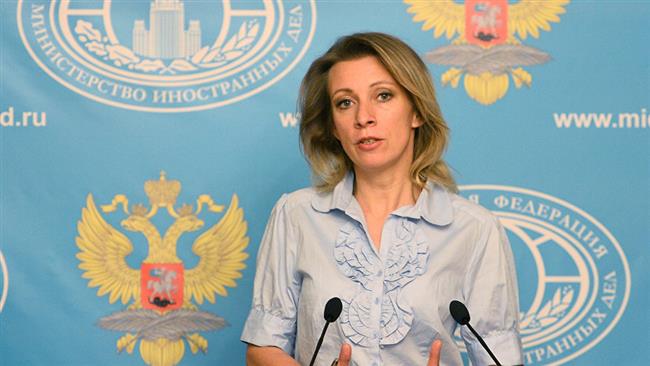
The US has recently accused Russia of bombing what it calls “US-backed rebels” in southern Syria. CBS News in their article, “Russia ignores warnings, bombs U.S.-backed Syrian rebel group,” would claim:
On Friday, Defense Secretary Ash Carter called out Russia for bombing a Syrian rebel group that’s backed by the U.S.
The attack by Russian fighter bombers on American-backed opposition forces appeared to be deliberate and to ignore repeated U.S. warnings.
More alarming is what the US claimed happened next. CBS News would further claim:
Two American F-18 jet fighters were dispatched to provide air cover for the troops on the ground as they tried to evacuate their casualties. By the time the F-18s arrived, the Russian planes were headed away, but were still close enough to see.
But when the F-18s broke away to refuel, the Russians returned for a second bombing run. Another call went out to the Russian command center in Syria, demanding that the planes wave off.
The crew of an airborne command post tried to contact the Russian pilots directly but got no response. The Su-34s conducted another bombing run, leaving a small number of opposition fighters dead on the ground.
Neither CBS News nor the US Department of Defense ever explained why the US believes it is entitled to send armed militants over the borders and into a sovereign nation, or why it believes a sovereign nation and its allies are not entitled to confront and neutralize them or why US aircraft are entitled to fly over Syrian airspace without the authorization of the Syrian government.
In other words, the US is vocally complaining about its serial violations of international law and norms finally (allegedly) being confronted and put to an end by Russian military forces.
But Did Russia Even Attack America’s Armed Invaders?
Russia however, has denied US accusations. CNN’s article, “Russia denies bombing U.S.-backed Syrian rebels near Jordan border,” states:
Russia’s Defense Ministry denied bombing U.S.-backed Syrian opposition forces in a recent military operation near the Jordanian border, according to a statement released on Sunday.
The Kremlin response comes after U.S. and Russian military officials held a video conference to discuss Thursday’s strikes.
As is characteristic of all US claims regarding its multiple, ongoing foreign acts of military aggression, the most recent row in Syria is heavy on rhetoric and light on evidence. Had Russia attacked armed militants invading Syrian territory, it would have been well within its rights to do so, however it has claimed it hasn’t. The burden of proof is on the US.
Why Would the US Lie About This?
But when one considers a recent US State Department “internal memo” calling for more direct US military action to oust the Syrian government from power, it is clear such a call cannot be answered without an accompanying justification or provocation. It appears that the US-Russian row in southern Syria conveniently constitutes just such a provocation.
CNN’s article, “State Department officials call for U.S. military action against Assad regime,” claims:
More than 50 State Department officials signed an internal memo protesting U.S. policy in Syria, calling for targeted U.S. military strikes against the regime of Bashar al-Assad and urging regime change as the only way to defeat ISIS.
Claiming that US military strikes against the Syrian government, or that “regime change” is the only way to defeat the self-proclaimed Islamic State (IS) is indeed far fetched and is in and of itself a fabricated justification for an otherwise entirely self-serving geopolitical objective the US has set for itself in Syria.
It was US-led “regime change” in Libya in 2011 that has led to the country becoming a bastion for, not against IS and other notorious terrorist groups. Libya, it should be mentioned, has existed in a perpetual state of failure since the 2011 US military intervention, triggering one half of a massive refugee crisis facing the European continent, with no signs of abating any time in the foreseeable future.
In other words, the US desire for “regime change” in Syria will create another Libya, but on a scale larger than that in North Africa, all while compounding the chaos in North Africa further.
Therefore, justifying greater military aggression by the US in Syria appears to be a “hard sell” for American policymakers, media and politicians. Militants in southern Syria were likely designated for this ploy specifically because they have the greatest chance of being separated and distinguished from US-backed militants in northern Syria.
US-backed militants in Syria’s north are described even by the US itself as “intermingled” with extremists including Al Qaeda and even IS and have become increasingly difficult to defend diplomatically and politically as Syrian and Russian forces work on rolling them back.
Undoubtedly US-backed militants in Syria’s south are likewise”intermingled” with overt terrorist groups, but because the conflict in the south has been neglected by not only US and European news agencies, but also Russian and other Eastern news services, there lingers an unwarranted “benefit of the doubt.”
Can Anything Stop US Military Escalation?
Many in America’s foreign policy circles are nostalgic for the days of NATO’s intervention in Yugoslavia where inferior Russian forces were unable to deter NATO aggression and were eventually relegated to a subordinate role in “peacekeeping operations.” At one point, NATO even contemplated striking Russian forces as a means of neutralizing any obstacle to NATO ambitions during the conflict.
It is therefore possible that these same US policymakers envision using what CNN’s article called “stand-off and air weapons” to induce a similar stand-down from Russia before proceeding with and accomplishing their much desired “regime change” in Syria.
However, the Russian military of the 1990’s is not the Russian military of today. The fact that Russia is present and operating in Syria, far beyond the confines of Eastern Europe and its traditional sphere of influence is proof enough of that.
Russia’s performance in Syria alongside Syrian forces is the primary factor in what is now clearly IS’ decline and retreat. Russian air defenses have been deployed across the country and capabilities to confront US and US-allied aggression are clear and present. Since IS had no air forces of any kind, it is clear that Russian air defenses placed in Syria were one part of deterring the sort of US aggression characterized in the recent alleged US State Department memo.
The US would have to rely entirely on the assumption that Russia would rather concede Syria in the face of US military aggression than escalate toward a direct war with the United States.
Creating the conditions both diplomatically and on the ground in Syria to deter US military commanders from following any order to essentially attempt to trigger a war with nuclear-armed Russia is now essential. Raising the stakes for any sort of escalation of US aggression in Syria is also essential.
While the UN seems content with ignoring the serial international crimes of the US as it flaunts sovereign Syrian airspace, violates its borders by sending armed militants over them intent on destabilizing, destroying and overthrowing the Syrian state and presiding over the dismemberment of not only Syria, but the region itself, other international organizations could fill this expanding void.
The Shanghai Cooperation Organisation (SCO), for example, could conceivably put together “peacekeeping” forces of its own, placed along Syria’s borders deterring the transit of armed militants and forcing the hands of both Jordan and Turkey to be exposed in the backing of some of the most toxic militant organizations engaged in Syria’s conflict.
The presence of Chinese, Russian, and even Iranian troops in this capacity could make it clear that no matter what act of aggression the US commits to, Syria’s fate would remain in the hands of its government, its people, and its allies. Tying these efforts into the distribution of aid would hamstring US attempts to hide its war-making behind “humanitarianism.”
Such a move, however, by the SCO would be unprecedented, costly and difficult to coordinate. And because of its unprecedented nature, unforeseen challenges may even make this option a complication rather than an asset toward fending off US aggression and the resolution of the costly ongoing Syrian conflict.
Regardless, it is clear that as IS and other terrorist organizations who have constituted the bulk of what the US regularly refers to as “opposition” beings to collapse, US desperation to conclude the Syrian conflict in its favor (not in favor of Syria or its people) is becoming increasingly palpable.
Another point opponents of US aggression must focus on is the ongoing chaos in Libya, a burning example of where US’s suggested “regime change” in Syria will inevitably lead. US success in Syria will essentially be an extension of Libya’s chaos, bolstering, not serving to “defeat” IS.
June 21, 2016
Posted by aletho |
Illegal Occupation, Militarism, War Crimes | NATO, Russia, Syria, United States |
Leave a comment
By Center for Citizen Initiatives
On June 16, the New York Times reported :
“More than 50 State Department diplomats have signed an internal memo sharply critical of the Obama administration’s policy in Syria, urging the United States to carry out military strikes against the government of President Bashar al-Assad to stop its persistent violations of a cease-fire in the country’s five-year-old civil war.
The memo, a draft of which was provided to The New York Times by a State Department official, says American policy has been “overwhelmed” by the unrelenting violence in Syria. It calls for “a judicious use of stand-off and air weapons, which would undergird and drive a more focused and hard-nosed U.S.-led diplomatic process.”
We are a group of concerned U.S. citizens currently visiting Russia with the goal of increasing understanding and reducing international tension and conflict. We are appalled by this call for direct U.S. aggression against Syria, and believe it points to the urgent need for open public debate on U.S. foreign policy.
We note the following:
(1) The memo is inaccurate. There is no ‘cease-fire’ in Syria. The ‘cessation of hostilities’ which was agreed to has never included the major terrorist groups fighting to overthrow the government in Syria. This includes Nusra (Al Qaeda), ISIS and their fighting allies.
(2) A U.S. attack on Syria would be an act of aggression in clear violation of the UN Charter. (Ref 1)
(3) The supplying of weapons, funding and other support to armed groups fighting the Syrian government is also a violation of international law. (Ref 2)
(4) A U.S. attack on Syria would lead to more bloodshed and risk potential military confrontation with Russia. With arsenals of nuclear weapons on both sides, the outcome could be catastrophic.
(5) It is not the right of the USA or any other foreign country to determine who should lead the Syrian government. That decision should be made by the Syrian people. A worthy goal could be internationally supervised elections with all Syrians participating to decide their national government.
(6) The memo reportedly says, “It is time that the United States, guided by our strategic interests and moral convictions, lead a global effort to put an end to this conflict once and for all.” Similar statements and promises have been made regarding Afghanistan, Iraq and Libya. In all three cases, terrorism and sectarianism have multiplied, the conflicts still rage, and huge amounts of money and lives have been wasted.
In light of the above, and the danger of escalating global conflict:
- We urge State Department officials to seek non-military solutions in conformity with the U.N. Charter and international law.
- We urge the U.S. Administration to stop funding and supplying weapons to armed ‘rebels’ in violation of international law and end the policy of forced “regime change”.
- We call for an urgent nation-wide public debate on the U.S. policy of “regime change”.
The Center for Citizens Initiative (CCI) delegation currently visiting Russia includes:
Ann Wright, retired United States Army Colonel and U.S. State Department official. Ann received the U.S. State Department Award for Heroism in 1997 after helping evacuate several thousand persons during the Sierra Leone Civil War. She was one of three U.S. State Department officials to publicly resign in direct protest to the 2003 invasion of Iraq.
Elizabeth Murray, retired Deputy National Intelligence Officer for the Near East in the National Intelligence Council. She is a member of Veteran Intelligence Professionals for Sanity (VIPS) and the Sam Adams Associates for Integrity in Intelligence.
Raymond McGovern, retired CIA analyst (1963 to 1990) who worked in the Washington, DC White House and prepared daily briefs for seven Presidents. In the 1980s Ray chaired the National Intelligence Estimates and the U.S. Presidents’ Daily Briefs. Ray is the founder of Veteran Intelligence Professionals for Sanity (VIPS).
Kathy Kelly, peace activist, pacifist and author. She is a founding members of Voices in the Wilderness and is currently a co-coordinator of Voices for Creative Nonviolence. Kathy has traveled to Iraq 26 times, notably remaining in combat zones during the early days of the US-Iraq wars. Her recent work took her to Afghanistan and Gaza.
David Hartsough, co-founder of the Nonviolent Peaceforce and the “World Beyond War.” David is a life-long peace activist, peace maker, and author “Waging Peace: Global Adventurers of a Lifelong Activist.”
William H Warrick III, retired Family Physician and 25-year member of Veterans For Peace. Former US Army Security Agency Intelligence Analyst (1968 – 1971).
Sharon Tennison, President and Founder of the Center for Citizen Initiatives. Sharon has 33 years of experience working in USSR/Russia (1983 to present).
Robert Alberts, MBA, Accountant. Bob volunteers with Voices for Creative Nonviolence.
Peter Bergel, Oregon PeaceWorks Board member and PeaceWorker news magazine editor.
Karen Chester, optometrist by vocation and a peace activist volunteer for two decades. Karen’s greatest concern has been and is the plight of Central American peoples, supporting those who come to the U.S. fleeing violence and poverty.
Alix Foster, Native Peoples Law Attorney in La Conner, WA. Alix volunteers for a number of positive causes, particularly with respect to Native America issues.
Jan Hartsough is an educator and community organizer. Jan worked for American Friends Service Committee (Quakers) for many years and currently works at the grassroots level to help African women gain access to safer water.
Paul Hartsough, Ph.D., clinical psychologist. Paul focuses on conflict resolution and how we can survive as one global family in the nuclear age.
Martha Hennessy, retired occupational therapist. Martha volunteers at the New York Catholic Worker.
Bob Spies, website developer, technical support for CCI, and activist for a number of non-violent causes. Bob previously was a participant in Beyond War.
Rick Sterling , retired aerospace engineer, Vice-Chair Mt. Diablo Peace & Justice Center, co-founder Syria Solidarity Movement, Board President Task Force on the Americas.
Hakim Young is a Singaporean medical doctor who lives in Afghanistan part of the year. He is active with Afghan Peace volunteers and is deeply concerned about US-Russia relations.
References:
(1) UN Charter Preamble: “All Members shall refrain in their international relations from the threat or use of force against the territorial integrity or political independence of any state, or in any other matter inconsistent with the Purposes of the United Nations”. The first purpose of the United Nations is “To maintain international peace and security, to take effective collective measures for the prevention and removal of threats to the peace, and for the suppression of acts of aggression or other breaches of the peace.”
(2) On June 27, 1986 the International Court at the Hague issued its legal ruling in the case of Nicaragua vs. United States. The ruling was as follows:
Decision of the International Court at the Hague
Decides that the United States of America, by training, arming, equipping, financing and supplying the “contra” forces or otherwise encouraging, supporting and aiding military and paramilitary activities in and against Nicaragua, has acted, against the Republic of Nicaragua, in breach of its obligation under customary international law not to intervene in the affairs of another State.
By “training, arming, equipping, financing and supplying” the military rebel groups waging war against the Damascus government, the US and “friends” are committing the same crime that the USA was responsible for committing against Nicaragua in the 1980’s.
June 20, 2016
Posted by aletho |
Militarism, Solidarity and Activism, Timeless or most popular, War Crimes | Syria, United States |
Leave a comment

We topple governments in the Middle East that we don’t like and we encourage movements that will help us in this – regardless of how dangerous these allies are, Karen Kwiatkowsky, retired US Air Force officer, told RT.
The US-backed Syrian Democratic Forces, led by Kurdish groups, have entered the town of Manbij after they surrounded ISIS militants there. But at the same time dozens of US State Department officials have urged Barack Obama in a memo to launch air strikes against Bashar al-Assad’s forces, something that would contradict current White House foreign policy.
RT: The memo essentially contradicts Kerry’s earlier attempts to broker peace in Syria. How do you account for this rift at the State Department?
Karen Kwiatkowsky: I think that this administration is running out of time. And it is true that Barack Obama has kind of been a barrier to some of the more aggressive policies that have been emanating from both State Department and the Pentagon. But at the same time, this administration and the life spans of these political appointees, these ambassadors, many of whom signed on to this very aggressive warmongering letter, their life span is limited, they have basically 6 months to go. Very likely they will not retain their appointments in a new administration. Certainly, if Hillary Clinton is elected, I imagine many of these war mongering State Department officials are appointees or friends of Hillary Clinton, people who agree with her approach. So, I do see this as somewhat aimed at engaging politically in the domestic events here in the US. We have an election coming. Clinton is very besieged by many things. But she is the neoconservative candidate. She is the candidate who will make this war, if this war on Assad is to be stepped up. She is the one that will do that and these are her people. And they don’t have a lot of time left.
RT: Do you think that the differences that we’ve seen in the State Department are just there or this is something that is indicative of differences throughout the administration?
KK: This release to the New York Times is a political event. This is aimed at making policy when there is very little time left to make that policy. If you read the letter, it doesn’t offer really any new strategy. And Obama has been accused of having no real strategy. This is not a new strategy; this is not a replacement strategy. This is bomb and ‘show the flag’. And it is being put forth not by the Air Force, not by the Pentagon – who you might presume might know something about fighting. Certainly, we cannot take ground from the air and this is precisely what they are advocating is airstrikes, which have long been proven to be ineffective. That is why I see it as a political thing and not an actual strategy. There is very little strategy there. What they are putting forth won’t work, is known not to work by even the advocates of violence in the Pentagon know that it won’t work. So, it is not a very good solution. Therefore, I have to conclude that it is aimed at politically communicating something. And I find it remarkable and hilarious that this letter was released and put up through the channel for dissent. These 51 warmongering diplomats are dissenters. That is just absolutely spectacular.
RT: Just a few days ago, John Kerry said the US is losing patience with Assad. Does that kind of rhetoric not undermine the peace he’s supposedly trying to broker?
KK: It is typical of John Kerry’s entire approach from the time he has been the Secretary of State. He is trying to walk two different paths and you can’t do that: threatening and negotiating. But the threats are empty. And it is well-known in the region since we have been intervening and interfering and bombing for so long now. The people in the Middle East both are allies and our enemies if you want to consider Assad and Iran as our enemies. All of them know us very well now. They know how we operate; they know to call our bluffs. Our bluffs aren’t bluffs anymore, they are just empty conversation. Kerry hasn’t changed; his policies and approaches have been the same. He is just ineffective. And he is ineffective because our own fundamental policy is not what he says. And it is not what the president says. It is what we actually do. And what we actually do has been reported for years: we topple governments in the Middle East that we don’t like and we encourage movements that will help us in this – regardless of how dangerous or how empty or how incompatible with liberty and our own value system these allies are. And this is why we find ourselves supporting ISIS and fighting with people who are doing terribly destructive things and we can’t say anything bad about them because they are our allies. We’ve got ourselves into this situation; I don’t think it is fair to blame Kerry as an individual. He is representing a system that has no credibility. And certainly you can’t believe a word that is said by an American politician when it comes to what we will and what we won’t do in the Middle East.
June 20, 2016
Posted by aletho |
Militarism | Hillary Clinton, ISIS, Middle East, Syria, United States |
Leave a comment

At this conclusive stage of the presidential campaign cycle, Foreign Affairs magazine is doing what it traditionally does, showcasing on its pages candidates for appointive office in the cabinet of the next president whom the magazine’s editorial board would like to see installed.
Thus, the current, July-August issue carries an article by Philip M. Breedlove, until recently Commander of the U.S. European Command and NATO’s Supreme Allied Commander, Europe. His piece, entitled “NATO’s Next Act” might more honestly be called “Why I Have Earned My Next Job as Secretary of Defense in the Administration of Hillary Clinton.”
During his service in Europe, General Breedlove was never bashful about being a politicking military officer who was keen to pick a fight with Russia. He met with the press often, making newsworthy pronouncements about Russia’s malevolent intentions and illegal actions that were unsupported by facts. Our European allies objected to Breedlove, stating openly that some of his allegations regarding Russian operations in Ukraine contradicted what their own intelligence services were reporting.
Indeed, on March 6, 2015, the Spiegel Online carried a story under a headline that says it all: “Breedlove’s Bellicosity: Berlin Alarmed by Aggressive NATO Stance on Ukraine.” At the time, it was believed that Breedlove was trying to sabotage the recently instituted cease-fire in Donbas and overturn the Minsk-2 Accords in favor of resumed fighting in which the U.S. would provide Kiev with lethal weapons. By this scenario, a full-blown proxy war with Russia would follow.
The purpose of the new essay in Foreign Affairs is, as I say, to spread the word on what Breedlove achieved in his three years on duty in Europe by turning NATO around and giving it a new/old calling. When he arrived, NATO was busy extricating itself from its failed campaigns out of region, in Afghanistan and Iraq, where it had faced unfamiliar challenges for which it was ill-equipped, fighting insurgencies and irregular troops.
On his watch, a new threat was seen emerging in Eastern Europe. In Breedlove’s words, this took the form of a revitalized and aggressive Russia, seeking to reclaim its great power status and sphere of influence in post-Soviet space.
With its takeover of Crimea in March 2014 and involvement in the Donbas on behalf of Russian-speaking forces rebelling against the new Maidan government in Kiev, Russia demonstrated both defiance of the American-controlled New World Order and breathtaking military prowess. It thereby became a threat worthy of NATO’s finest traditions as defender of “law and order” on the European home front.
Still more recent Russian action in Syria awakened Breedlove to the fact that Russia’s ambitions are global. In this context he now declares Russia, with its nuclear arsenal, to be an “existential threat” to the United States which must be met by superior force. After all, Breedlove tells us, force is all that the Kremlin understands.
After going through this pre-history, Breedlove explains exactly what we are doing now to strengthen NATO in Poland, the Baltic States and Romania/the Black Sea so as to be prepared to resist Russian aggression and deter its existential threat.
Upside-Down Narrative
Most everything is wrong with what Breedlove tells us in his article. It is a perfect illustration of the consequences of the monopoly control of our media and both Houses of Congress by the ideologists of the Neoconservative and Liberal Interventionist School. We see a stunning lack of rigor in argumentation in Breedlove’s article coming from absence of debate and his talking only to yes-men.
Perhaps the biggest mistakes are conceptual: urging military means to resolve what are fundamentally political issues over the proper place of Russia in the European and global security architecture. Whereas for Clausewitz war was “a continuation of politics by other means,” for Breedlove politics – in this case, diplomacy – do not exist, only war.
In this respect, Breedlove is merely perpetuating the stone deafness of American politicians dating back to Dmitry Medvedev’s proposal in 2010 to negotiate an international convention bringing Russia in from the cold. The earnest offer of Russia’s most Westernizing head of state in a hundred years was left without response.
Breedlove’s entire recounting of what NATO is doing to stop a Russian threat to the Baltics and to Poland — through additional NATO boots on the ground and pre-positioned American heavy equipment — fails to mention, let alone explain what possible reason there might be for a Russian attack.
I contend that no realistic assessment of Russian national interest could justify their taking over the territories in question. The net result of any occupation could only be heavily negative due to hostile local populations even without considering its geopolitical consequences or retaliatory military and other action by the West.
Presumably the logic behind the assumption of Russian aggressive designs is illogic: the assumption of an insane Russian leadership. Such a line of thinking would be the direct fruit of the demonization of Vladimir Putin and of Russia more generally that the U.S. media has disseminated gleefully, with encouragement from the Obama administration.
Breedlove’s would-be boss in the Oval Office, Hillary Clinton, has likened the Russian ruler to Hitler. That obviates the need to examine rational calculations of your adversary.
Then there is Breedlove’s totally wrong-headed conceptualization of what constitutes the world order that he says is under threat. In his understanding, the United State is, by definition, the sole supplier of public good to the world and everything that it initiates is selfless and right.
This self-righteousness begins with history, with the sequencing of who did what to whom, who honored and who violated international obligations, who is the aggressor and who is the victim. But this all comes down to one question: when did history start.
In Breedlove’s reading of history, the narrative that counts and is relevant to where we are today all started with the Russian “invasion” of Crimea. The controversial overthrow of the legitimately elected President of Ukraine on Feb. 22, 2014, the day after France and Germany brokered an agreement between the government and opposition (for reduced presidential powers and early elections) does not exist in Breedlove’s version of history. Nor, of course, does any other prior Western intervention in the intra-Ukrainian power struggle going back to the start of the Maidan demonstrations in December 2013.
This leaves us with the whole series of Russian reactions that he gives us without any reference to the missing actions by the U.S.-led West. There are other holes in Breedlove’s logic through which you could drive a tank, if I may use metaphors from his domain of expertise.
Reassessing Russian Might
It is in a way refreshing to see Breedlove recognize (within limits) the newfound capabilities of the Russian military, which just several years ago were mocked by Western commentators, even by the occupant of the Oval Office.
Breedlove does underestimate the skills and equipment of the Russian air force and insists on the underlying military superiority of the U.S. and its NATO allies in the European theater. But, on balance, he asserts that today Russia poses an existential military threat to the United States. It would be nice if he finished the thought and explained exactly how and why (since Russia is not the only country with nuclear weapons and the ability to deliver them but like those other countries – China, for instance – has no rational reason to do so unless directly threatened).
In any case, what is the appropriate response to an existential threat? Do you recommend the continued rapid build-up of NATO forces precisely at Russia’s Baltic and Black Sea borders to counter a perceived (though nonexistent) localized threat or do you address the existential threat by seeking to minimize tensions?
To date, and into the next five years, all of the U.S. and NATO measures which Breedlove describes and for which he takes credit have only unnerved the Russians and caused them to respond with equally provocative and dangerous counter-measures of a localized nature without in any way compromising their nuclear capability to wipe the United States off the map in any hot war.
Does this baiting the Russians near their borders make any sense? This was precisely the point that German Minister of Foreign Affairs Frank Walter Steinmeier has just called out in an interview published in Bild am Sonntag in which he speaks against any further saber-rattling by NATO in Poland or the Baltic States.
The seeming parallels between stepping up to the line today, and stepping up to the line in Berlin during the Cold War are illusory. The present line is not in a distant buffer zone which Joseph Stalin had created precisely for this purpose, to remove conflict from Russia’s borders.
It is so threatening to Russia’s survival that the Kremlin is now moving vast military resources from Central Russia into the Leningrad Oblast, within a very few miles of the new NATO presence just across the border in the Baltics. The time for either side to react to local military incidents has been shortened immensely compared to the past. This is a formula for Doomsday which Breedlove willfully ignores.
The $3.4 billion expenditure, which President Obama has allocated to bring forward depots of American heavy equipment and key personnel to Poland, Romania and the Baltic States, recognizes the logistical disadvantage of NATO forces under the remote defense perimeter that extends to Russia’s western and southern frontiers. But it cannot resolve this intractable disadvantage.
Territorial Disadvantage
It has been argued that a major factor that worked against Russian forces in World War I was logistical – the length of time it took Russia to move its men and equipment from the centers of population of the country hundreds if not thousands of kilometers away to its western borders where the fight against Germany was going on.
Today, the U.S. and NATO have placed themselves in exactly the same disadvantage by seeking to fight Russia in a conventional war right where the Russians are concentrating the bulk of their strength and where NATO can at best only position “trip wire” forces having symbolic, not actual military defensive value.
The best that NATO can propose, it would seem, is to snatch the Russian enclave of Kaliningrad (the clear mission of the Anakonda-16 games now going on in Poland) in case the Russians occupied the Baltic States (within the 60 hours or so that a recent Rand Institute study suggests is feasible).
However, as President Putin has stated clearly, such encroachment on Russian soil will unleash a nuclear response from Russia that will include missile attacks on the mainland USA, i.e. not limited to the European theater.
Finally, let’s consider another absurdity in General Breedlove’s letter setting out his candidacy for a cabinet position. He repeats, parrot-like, the position of the Obama administration and of putative Democratic candidate for President Hillary Clinton that we can selectively cooperate with Russia on issues of common interest like counter-terrorism, Pacific fishing rights (!) and the like even as we remain engaged in a life-or-death scramble for position on the ground in Europe.
In fact, the U.S. effort to totally isolate Russia by cutting off many, perhaps most of its bilateral programs of cooperation with the country have worked precisely to defeat cooperation, none more grievously so than in the area of fighting terrorism.
Meanwhile, what amounts to American encouragement of the Islamic State and Al Qaeda’s Nusra Front in Syria by pressing for the overthrow of the Russian-backed regime of Bashar al-Assad continues to this day under the guise of protecting the “moderate opposition” that happens to be embedded among the jihadist “bad guys.’’
The fairy tales coming from Washington should not fool anyone, but Breedlove passes them along to his readers in the smug expectation that they will accept whatever he utters.
By lending its valuable “real estate” to the campaign for a high-level appointment by one of the most outspoken Cold Warriors within the U.S. military, the editorial board of Foreign Affairs magazine has shown yet again that it is incapable of guarding its own neutrality or balance.
Gilbert Doctorow is the European Coordinator of The American Committee for East West Accord Ltd. His most recent book, Does Russia Have a Future? was published in August 2015.
© Gilbert Doctorow, 2016
June 19, 2016
Posted by aletho |
Militarism, Timeless or most popular | Foreign Affairs, Hillary Clinton, NATO, Obama, Philip M. Breedlove, Russia, United States |
Leave a comment
The new generation of Americans needs to be taught that US hegemony is “vital” to their well-being and global peace, and that it must be extended if world order is to be sustained, says a report by a bipartisan group of foreign policy veterans in Washington.
A working group at the Center for a New American Security (CNAS) published a 20-page pamphlet this week, articulating their vision for the next president’s foreign policy. The think-tank was established in 2007, and has worked closely with the Obama administration ever since.
Titled “Extending American Power: Strategies to Expand US Engagement in a Competitive World Order,” the report is the culmination of a year-long effort. The project was co-chaired by Dr. Robert Kagan of the Brooking Institution and James Rubin, former Assistant Secretary of State during the Clinton administration and currently a senior adviser at CNAS.
US military, economic and diplomatic power has “provided the critical architecture in which this liberal order has flourished,” the report’s authors claim, but today that order is being challenged by “powerful and ambitious authoritarian governments like Russia and China,” as well as “radical Islamic terrorist movements,” global economic shifts, and “changes in our physical environment.”
“Responsible political leaders need to explain to a new generation of Americans how important this world order is to their well-being and how vital America’s role is in sustaining it,” the group says.
The best way to ensure the survival of a system favorable to the US “is to extend American power and US leadership in Asia, Europe, and the Greater Middle East.”
The financial expenditures this would require are “well within our means,” they say, since the US economy has proven itself to be dynamic and resilient in face of global crisis.
Implementing the Trans-pacific Partnership (TPP) and Transatlantic Trade and Investment Partnership (TTIP) trade pacts will preserve US economic leadership, the authors concluded.
In Asia, Washington’s alliances with Japan and South Korea and the commitment to “maintaining open sea lanes, open trade, state sovereignty and freedom of navigation” have “made possible generations of historic peace and prosperity.” However, the report says that dominance is now being challenged by China – the authors do not explain why – and the only way to keep Beijing in check is for the US to “increase its capabilities and extend its military posture accordingly.”
Ukraine, Russia and Brexit
As far as Europe is concerned, “the transatlantic community remains both the foundation and the core of the liberal world order,” but that is now threatened by “growing Russian ambition and willingness to use force, including the invasion of neighboring countries,” the report claims.
European commitment to US hegemony is also threatened by “British strategic retrenchment, French economic weakness, and historic German strategic ambivalence in the security sphere.”
The report fully backs deploying more US and NATO troops on Russia’s borders, while getting European allies to increase their military spending.
For all of Washington’s official commitments to freedom of sovereign states to choose their own paths, the CNAS report argues that the “strategy of the United States and Europe must be to help Ukraine achieve political and economic stability, anchored in the West.”
“The United States has a particular interest in Britain remaining a strong and active player within the EU,” the authors also say.
ISIS, Syria and Iran
In the Middle East, the report’s authors argue for a military escalation against Islamic State (IS, formerly ISIS/ISIL) and regime change in Syria.
Any political solution to the Syrian civil war “must include the departure of Bashar al-Assad,” they say. To accomplish this, the US “must employ the necessary military power, including an appropriately designed no-fly zone, to create a safe space in which Syrians can relocate without fear of being killed by Assad’s forces and where moderate opposition militias can arm, train, and organize.”
While not giving up on the nuclear deal reached with Iran in July 2015, the US “must adopt as a matter of policy the goal of defeating Iran’s determined effort to dominate the Greater Middle East,” the CNAS paper said.
While accusing Iran of “demonizing” US ally Saudi Arabia, the authors do note that the Saudi elites “bear much responsibility for the growth of extremist ideologies that promote intolerance and Jihadi terrorism,” by spreading Wahhabism throughout the Islamic world.
Establishment figures
To achieve these ambitious goals, the report’s authors advocate against concentrating policymaking authority in the National Security Council and, instead recommend giving more power to “regional assistant secretaries of state,” for example, who “need to be given the power and authority necessary so that when they travel overseas they are regarded as the key administration policymakers and spokespeople for their regions.”
One of the co-chairs of the group behind the report, Robert Kagan, last made headlines in February, when he disavowed Republican front-runner Donald Trump and endorsed Hillary Clinton on the pages of the Washington Post. He is the co-author of a 1996 treatise advocating the “benevolent global hegemony” of the US, and is married to Assistant Secretary of State for European and Eurasian Affairs Victoria Nuland.
Among those who signed the report are CNAS CEO Michèle Flournoy and President Richard Fontaine; George W. Bush’s National Security Advisor Stephen Hadley; former World Bank president and Goldman Sachs executive Robert Zoellick (currently senior fellow at Harvard’s Kennedy School of Government); and James Steinberg, Dean of Syracuse University’s Maxwell School of Citizenship and Public Affairs.
June 19, 2016
Posted by aletho |
Militarism | Center for a New American Security, CNAS, Middle East, NATO, United States |
Leave a comment
Last Friday’s release of US State Dept leaked memo featuring its 51 employees presenting dissent on the US Syria policy has rocked the world of American diplomacy.
As retired US Navy Rear Admiral John Kirby, the State Dept spokesman, fielded questions and struggled to contain damage from the revelations, the ripple effect of internal rebellion has spread worldwide.
This event is without precedent as it shows the inner workings of one of the most important departments in the US federal government divided on one of its most important challenges: What to do with Assad’s Syria?
The last time there was internal disagreement in the US State Dept happened in 2003 with several resignations following the Iraq and Afghanistan wars. However, that incident failed to grab the attention of the American public and largely pro-government US media.
The current row represents internal disagreement over the Obama administration’s decision not to attack President Assad’s regime after alleged cease fire violations by Syrian military forces. The anger expressed in the memo carries over from Obama’s 2012 so-called red-line declaration, which threatened an attack on Syria’s military if the latter was to cross the threshold of chemical weapons use.
As there were several documented chemical attacks in the Syrian civil war that brought allegations against both sides, any clear indication as to what side carried out the attacks was blurred. Furthermore the idea of weakening the Assad government by military strikes as favored by the State Dept. dissenters has absolutely no relation to military reality on the ground.
The clean cut conflict between the military and paramilitary forces supporting Assad and the rebels has been transformed into a set of simultaneous proxy wars featuring US-supported rebels, Gulf States supported rebels, Syrian military, US military, Russian military, Hezbollah militia, the Kurds, Jihadists and the Islamic State, to mention a few. The outcome of weakening of the Syrian state due to US attacks as desired by the US State Dept dissenters could lead to ripple effect of consequences that guarantees to destabilize the region even further. Additionally, it could trigger a genocide of the Alawi and other minorities that would most definitely follow the fall of the Assad regime.
As all this was to be carried out in the name of ‘human rights in Syria’, the memo presents the new low in cynical exploitation of human tragedy as a ploy to win political “victory” on the ground. Following this narrative, the rule of Islamic State or Al-Nusra Front (Al-Qaeda) is considered a viable and welcome alternative by the signatories as it removes Syria from the orbit of Russia and Iran’s influence, while sacrificing Syrians on the altar of failed US policy that began with invasion of Iraq in 2003.
What is also ironic is that the part of the US federal government responsible for maintenance of external relations based on carrying out policies rooted in international treaties and laws has now, according to the memo’s signatories, been chastised for following them. It is as if the lesson from 2003 of attacking a government that posed no threat to the US was wasted.
An explanation for this phenomenon was provided in Michael J. Glennon’s 2014 book, “National Security and Double Government.”
In it, Glennon argues that the reason US foreign policy and national security policy doesn’t change regardless of comings and goings of US administrations due to what he terms the “deep state.” The author goes back to the political theory of 19th century English scholar Walter Bagehot who argued in his 1867 book, “The English Constitution” that England of the day had a double government: The official one presented to the public, and an inner one, made up of the elites that make real decisions away from constitutional processes, public scrutiny and media.
Glennon picks up on the idea and makes a thesis that national security bureaucrats, along with intelligence and military elite influenced by money and politics, make decisions regardless of constitutional process or even laws.
Until now the idea of a political class presenting different visions for the country in electoral process has been a cornerstone of US political system that calls itself a representative democracy.
The State Dept memo, together with National Security apparatus’ track record of defacto immunity from any effective oversight, has made this vision nothing more than a mirage.
June 19, 2016
Posted by aletho |
Deception, Mainstream Media, Warmongering, Militarism | Middle East, Syria, United States |
Leave a comment
In 1985, the diplomat and historian George F. Kennan published a seminal essay in Foreign Affairs magazine in which he took on the topic of “Morality and Foreign Policy.” Objecting to the habit of American policymakers to link foreign policy objectives to specific desired outcomes within the borders of sovereign nations, Kennan struck a blow for the Westphalian interstate system which had been the cornerstone of international life since 1648.
Standing against the neocon tide yelling “stop!”, Kennan decried what he called the “histrionics of moralism” that guided American policymakers into believing they were responsible – and worse still, had it in their power – to right every wrong in every corner of the globe.
The self-declared mission to remake the world in America’s image has only become more entrenched since Kennan’s essay appeared three decades ago. In fact today’s neocons – positively high on self-righteous indignation, particularly when it comes to Russia and Syria – are perhaps even worse than their ideological forbearers who at least understood the all-too-real dangers of a nuclear conflagration between the U.S. and Soviet Union.
Today’s neocons – comfortably ensconced in U.S. government- and NATO-funded think tanks, major newspapers and magazines, issue forth groundless denunciations of the Russian government; eagerly cheer on the destruction of a modern European state, Ukraine; cheer on NATO’s latest adventures on the Russian frontier; and earnestly hope that a secular Syrian government be replaced by a band of Sunni religious fanatics, all the while smugly shrugging off the possibility of a nuclear confrontation between Russia and the West. Vladimir Putin and Bashar al-Assad, you see, are “bad guys”: end of discussion.
And this brings us to the neocons who, unlike the scores of Christopher Hitchens acolytes in the Washington media world, actually wield some power. On June 7, testifying before the Senate Foreign Relations Committee, U.S. Assistant Secretary of State for European Affairs Victoria Nuland seemed pleased to report that the U.S. has already spent $600 million on “security assistance” in Ukraine, while $787 million has been requested for FY2017.
Meanwhile, efforts to undermine the legitimacy of the sovereign government of Russia, with an eye towards another “regime change,” continue apace. Nuland, in a remarkably candid response to a question from perhaps the Senate’s leading advocate of “regime change,” Sen. Ben Cardin, D-Maryland, said the State Department not only works with the Soros-funded Open Russia, it works side-by-side with Russian “journalists who have fled” Russia.
Endless ‘Regime Change’
This points to what is the de facto policy towards not only Russia, but towards any government which finds itself in America’s crosshairs: work relentlessly to undermine the legitimacy of that government, with the ultimate aim of overthrowing it.
Can there be any doubt this is so in light of the “dissent memo” which was sent by 51 State Department officials this week? According to the New York Times, the memo urged Secretary of State John Kerry and President Barack Obama “to carry out military strikes against the government of President Bashar al-Assad.”
What these American diplomats are, in effect, calling for is a policy which would lead to a war with Russia, would kill greater numbers of civilians, would sunder the Geneva peace process, and would result in greater gains for the radical Sunnis “rebels” who are the principal opponents of the Assad regime.
But these diplomats, heedless of the costs or likely ramifications of their preferred policy, feel the U.S. simply must unleash the dogs of war so that they can feel better about themselves for having done “something.”
The dual policies of isolating and provoking Russia and endless war in the Near East is the predictable yet natural outgrowth of American foreign policy as it has been pursued since 1950.
Searching for a post-World War Two rationale on which to base American policy in the aftermath of perceived Soviet aggression in Greece and Turkey, President Harry Truman’s National Security Council issued NSC-68. The brainchild of former Wall Street wunderkind turned uber-hawkish policy adviser Paul Nitze, NSC-68 might correctly be viewed at the original sin of the America’s postwar foreign policy.
According to the policy directive, the U.S. must “foster a fundamental change in the nature of the Soviet system … foster the seeds of destruction within the Soviet system … with a view to fomenting and supporting unrest and revolution in selected strategic satellite countries” all with an eye toward reducing “the power and influence in the Kremlin inside the Soviet Union.”
Sound familiar? Substitute the word “Soviet” with “Russia” or even “Syria” and we have the template for America’s more recent imperial adventures. Worryingly, as we approach the November presidential elections, there seems not an ounce of interest inside the Washington establishment for a new approach.
James W Carden is a contributing writer for The Nation and editor of The American Committee for East-West Accord’s eastwestaccord.com. He previously served as an advisor on Russia to the Special Representative for Global Inter-governmental Affairs at the US State Department.
June 18, 2016
Posted by aletho |
Militarism, Timeless or most popular | NATO, Russia, United States |
Leave a comment
Germany’s former Chancellor Gerhard Schroeder said on Saturday that NATO should remain vigilant to avoid an arms race with Russia, because it would not solve any problems on the international arena.
“Now, we [NATO members] should be careful not to start a new arms race. This will not help either mitigate the conflicts or restore good relations with Russia,” Schroeder told the German Sueddeutsche Zeitung newspaper in an interview, commenting on the Alliance’s decision to deploy four multinational battalions — around 4,000 troops — to the Baltic states and Poland to bolster their defense capabilities in the region.
The ex-chancellor said that he considered it necessary for NATO to take steps toward Russia, as “the assumption that someone in the Russian government may invade any of the bloc’s countries has nothing to do with reality.”
Speaking on the lifting of anti-Russian sanctions, Schroeder said that Germany should strive not to lose the achievements of the former Chancellor Willy Brandt, who played a significant role in the establishment of relations between the Russia and Germany. According to Schroeder, Germany should be careful not to lose the privilege of political and economic partnership with Russia.
Since 2014, relations between Russia and the European Union, including Germany, have deteriorated amid the crisis in Ukraine. Brussels, Washington and their allies have introduced several rounds of anti-Russia sanctions since the reunification of Crimea with Russia in 2014, accusing Moscow of meddling in the Ukrainian conflict.
Russia has repeatedly refuted the allegations, warning that the Western sanctions are counterproductive and undermine global stability. In response to the restrictive measures, Russia has imposed a food embargo on some products originating in countries that have targeted it with sanctions.
June 18, 2016
Posted by aletho |
Economics, Militarism | NATO, Russia |
Leave a comment
The United States-led coalition that is bombing Iraq and Syria may be under-reporting the civilian toll of that war by as much as 95 percent, according to a new report released Friday by the monitoring group Airwars.
The U.S.-led coalition, which includes nations such as Britain, France and the Netherlands, has been bombing Islamic State group targets in Iraq and Syria since 2014, carrying out more than 13,121 airstrikes, or just over 19 a day. The vast majority of the strikes are carried out by the U.S., according to Airwars—68 percent in Iraq and and 82.5 percent in Syria—with an estimated civilian death toll of at least 1,312 people.
Over the past six months it’s gotten worse, according to Airwars. “Between December and May, in both Iraq and Syria, there was a marked increase in the number of alleged casualty incidents and civilian death attributed to coalition actions,” it says. In Iraq, the group reports that between 297 and 518 civilians were killed by coalition airstrikes in this time. In Syria, between 197 and 274 civilians were killed, “a 38 percent increase in likely civilian deaths above the previous six months.
The U.S. has admitted to killing just 20 civilians. Its allies have admitted to none. “If correct, Airwars data suggests the coalition may be under-reporting civilian deaths by more than 95 percent,” the report says.
The worst incident for civilians occurred on March 19 in the Islamic State-occupied city of Mosul, when at least 25 innocents were killed when coalition airstrikes hit Mosul University in the middle of the day. As teleSUR reported at the time, such a strike on a civilian institution—confirmed by the U.S. Department of Defense—may constitute a breach of international law.
The U.S. and its coalition allies are not the only foreign governments reportedly killing civilians in the region. Of 630 alleged incidents where civilians died in Syria as a result of international airpower, 91 percent have been attributed to Russia, according to Airwars, killing between 2,792 and 3,451 civilians between December 2015 and May 2016, largely as the result of airstrikes targeting non-Islamic State forces and civilian areas, “particularly in and around Aleppo.”
The Russian government says its airstrikes have not killed any civilians since they began in Sept. 2015.
June 18, 2016
Posted by aletho |
Deception, Illegal Occupation, Militarism, War Crimes | France, Netherlands, UK, United States |
Leave a comment
The Saudi foreign minister has repeated Riyadh’s call on the US to carry out airstrikes against the Syrian government, echoing a similar request by dozens of US diplomats who broke ranks with the White House to push for military action against Damascus.
During a press briefing at the Saudi Embassy in Washington on Friday, Adel al-Jubeir said the Arab monarchy has long been pushing for a US military campaign to overthrow Syrian President Bashar al-Assad.
The Saudi minister added that from the very start of the crisis in Syria, Riyadh has strongly favored “a more robust policy, including air strikes, safe zones, a no fly zone, a no drive zone.”
He went on to say that the kingdom had called for arming Syria’s so-called “moderate opposition” with ground-to-air missiles and reiterated an offer to deploy Saudi special forces as part of any US-led operation against the Damascus government, which has been making back-to-back gains against the Daesh Takfiri group.
Jubeir’s comments came after 51 US State Department officials signed an internal document, known as the “dissent channel cable”, this week, calling for targeted military strikes against the Syrian government.
“Failure to stem Assad’s flagrant abuses will only bolster the ideological appeal of groups such as Daesh, even as they endure tactical setbacks on the battlefield,” reads the cable, critical of US President Barak Obama’s policies towards the Syrian crisis.
The State Department has acknowledged the existence of the cable as confidential diplomatic communication, but did not comment on its contents.
Russia’s reaction
Meanwhile, Russia slammed the so-called internal document and warned that such attempts to oust Assad would not “contribute to a successful fight against terrorism.”
Kremlin spokesman Dmitry Peskov further said that “this could plunge the region into complete chaos.”
Russian Deputy Foreign Minister Mikhail Bogdanov also censured the proposed attacks against Damascus, saying they would be “at odds with the UN resolutions.”
“We need to negotiate and reach a political resolution on the basis of international law, which was agreed upon at the UN Security Council,” Bogdanov added.
The United States and its allies formed a coalition that has been conducting airstrikes against what are said to be Daesh terrorists inside Syria since September 2014 without any authorization from Damascus or a UN mandate. The coalition has repeatedly been accused of targeting and killing civilians. It has also been largely incapable of fulfilling its declared aim of destroying Daesh.
Daesh Takfiri terrorists, who were initially trained by the CIA in Jordan in 2012 to destabilize the Syrian government, are engaged in crimes against humanity in the areas under their control.
Syria has been grappling with a deadly conflict it blames on certain foreign states for over five years. UN special envoy for Syria Staffan de Mistura estimates that over 400,000 people have been killed in the conflict, which has also displaced over half of the Arab country’s pre-war population of about 23 million. The militancy has also taken a heavy toll on the country’s infrastructure.
June 18, 2016
Posted by aletho |
Militarism, War Crimes | Da’esh, Saudi Arabia, Syria, United States |
Leave a comment
Sharply criticizing NATO war games in Eastern Europe, German Foreign Minister Frank-Walter Steinmeier told Bild am Sonntag newspaper that inflaming the standoff with Russia would endanger European security and increase risk of reviving an “old confrontation.”
The ongoing large-scale Anakonda-16 NATO military maneuvers in Poland, simulating the repulsion of “Russian aggression” against the country, are counterproductive, Deutsche Welle cited German Foreign Minister Frank-Walter Steinmeier as telling Bild am Sonntag newspaper, in an interview to be published Sunday.
“Whoever believes that a symbolic tank parade on the alliance’s eastern border will bring security is mistaken,” Steinmeier said ahead of the upcoming NATO summit in Warsaw beginning July 8. “We are well-advised to not create pretexts to renew an old confrontation,” he emphasized.
Rather than inflaming the situation further “through saber-rattling and warmongering,” there ought to be more space for dialogue and cooperation with Moscow, Steinmeier said.
It would be “fatal to now narrow the focus to the military, and seek a remedy solely through a policy of deterrence,” German FM said, calling to give way to diplomacy instead of military posturing.
Calling for dialogue and a diplomatic approach, Steinmeier also mentioned the necessity of maintaining military preparedness of NATO.
The alliance should also consider the possibility to “renew discussions about the benefits of disarmament and arms control for security in Europe,” he said.
The Anaconda drills have become NATO’s largest exercise in Europe since the Cold War, bringing to Poland over 31,000 troops from 24 NATO member states and “partner nations,” including the US, the UK, Germany, Canada, Spain, Sweden, Turkey and others.
Moscow has once again pointed out that augmentation of NATO military presence in Eastern Europe and Baltics is unjustified, stressing that Russia has no plans whatsoever to interfere with any country in the region.
“I am convinced that every serious and honest politician is well aware that Russia will never invade any NATO member. We have no such plans,” Russian Foreign Minister Sergey Lavrov stated.
The NATO summit in Warsaw is set to put “Russian threat” issue high on the agenda, as the gathering will be making the final decision on stationing additional NATO troops in Eastern Europe.
More NATO troops deployed to Poland will be sending “a clear signal that an attack on Poland will be considered an attack on the whole Alliance,” the bloc’s Secretary General told reporters following his meeting with Polish President Andrzej Duda in early June.
The statements made by NATO leadership put Russian diplomats in a position where they have to deny the obvious.
“During the NATO secretary general’s recent visit to Poland, officials in this country [Poland] made statements suggesting that from now on Russia would know that any attack on Poland would mean an attack on NATO as a whole. This is completely absurd because they are discussing a non-existent problem. There are no plans for any attacks on Poland,” Russian envoy to NATO Aleksandr Grushko said in an interview with TV channel Russia-24.
Speaking at the St. Petersburg International Economic Forum (SPIEF) on Friday, President Vladimir Putin said that NATO has “an absolutely slapdash attitude to our position on anything,” adding that it was the US that had unilaterally quit the missile defense treaty, which was initially signed to “provide strategic balance in the world.”
NATO “needs a foreign enemy, otherwise what would be the reason for the existence of such an organization,” said the Russian leader. The conflict in Ukraine, caused by a bloody coup supported by the US and its European NATO allies, was forced on that country “to substantiate the very existence of the North Atlantic alliance,” the Russian president concluded.
Putin assured his audience that he does not want to proceed to a new Cold War, as “no one wants it.”“However dramatic the logic of the development of international relations might seem on the outside, it’s not the logic of global confrontation,” he explained.
June 18, 2016
Posted by aletho |
Militarism | Germany, NATO, Russia |
Leave a comment
Over the past several decades, the U.S. State Department has deteriorated from a reasonably professional home for diplomacy and realism into a den of armchair warriors possessed of imperial delusions, a dangerous phenomenon underscored by the recent mass “dissent” in favor of blowing up more people in Syria.
Some 51 State Department “diplomats” signed a memo distributed through the official “dissent channel,” seeking military strikes against the Syrian government of Bashar al-Assad whose forces have been leading the pushback against Islamist extremists who are seeking control of this important Mideast nation.
The fact that such a large contingent of State Department officials would openly advocate for an expanded aggressive war in line with the neoconservative agenda, which put Syria on a hit list some two decades ago, reveals how crazy the State Department has become.
The State Department now seems to be a combination of true-believing neocons along with their liberal-interventionist followers and some careerists who realize that the smart play is to behave toward the world as global proconsuls dictating solutions or seeking “regime change” rather than as diplomats engaging foreigners respectfully and seeking genuine compromise.
Even some State Department officials, whom I personally know and who are not neocons/liberal-hawks per se, act as if they have fully swallowed the Kool-Aid. They talk tough and behave arrogantly toward inhabitants of countries under their supervision. Foreigners are treated as mindless objects to be coerced or bribed.
So, it’s not entirely surprising that several dozen U.S. “diplomats” would attack President Barack Obama’s more temperate position on Syria while positioning themselves favorably in anticipation of a Hillary Clinton administration, which is expected to authorize an illegal invasion of Syria — under the guise of establishing “no-fly zones” and “safe zones” — which will mean the slaughter of young Syrian soldiers. The “diplomats” urge the use of “stand-off and air weapons.”
These hawks are so eager for more war that they don’t mind risking a direct conflict with Russia, breezily dismissing the possibility of a clash with the nuclear power by saying they are not “advocating for a slippery slope that ends in a military confrontation with Russia.” That’s reassuring to hear.
Risking a Jihadist Victory
There’s also the danger that a direct U.S. military intervention could collapse the Syrian army and clear the way for victory by Al Qaeda’s Nusra Front or the Islamic State. The memo did not make clear how the delicate calibration of doing just enough damage to Syria’s military while avoiding an outright jihadist victory and averting a clash with Russia would be accomplished.
Presumably, whatever messes are created, the U.S. military would be left to clean up, assuming that shooting down some Russian warplanes and killing Russian military personnel wouldn’t escalate into a full-scale thermonuclear conflagration.
In short, it appears that the State Department has become a collective insane asylum where the inmates are in control. But this madness isn’t some short-term aberration that can be easily reversed. It has been a long time coming and would require a root-to-branch ripping out of today’s “diplomatic” corps to restore the State Department to its traditional role of avoiding wars rather than demanding them.
Though there have always been crazies in the State Department – usually found in the senior political ranks – the phenomenon of an institutional insanity has only evolved over the past several decades. And I have seen the change.
I have covered U.S. foreign policy since the late 1970s when there was appreciably more sanity in the diplomatic corps. There were people like Robert White and Patricia Derian (both now deceased) who stood up for justice and human rights, representing the best of America.
But the descent of the U.S. State Department into little more than well-dressed, well-spoken but thuggish enforcers of U.S. hegemony began with the Reagan administration. President Ronald Reagan and his team possessed a pathological hatred of Central American social movements seeking freedom from oppressive oligarchies and their brutal security forces.
During the 1980s, American diplomats with integrity were systematically marginalized, hounded or removed. (Human rights coordinator Derian left at the end of the Carter administration and was replaced by neocon Elliott Abrams; White was fired as U.S. ambassador to El Salvador, explaining: “I refused a demand by the secretary of state, Alexander M. Haig Jr., that I use official channels to cover up the Salvadoran military’s responsibility for the murders of four American churchwomen.”)
The Neocons Rise
As the old-guard professionals left, a new breed of aggressive neoconservatives was brought in, the likes of Paul Wolfowitz, Robert McFarlane, Robert Kagan and Abrams. After eight years of Reagan and four years of George H.W. Bush, the State Department was reshaped into a home for neocons, but some pockets of professionalism survived the onslaughts.
While one might have expected the Democrats of the Clinton administration to reverse those trends, they didn’t. Instead, Bill Clinton’s “triangulation” applied to U.S. foreign policy as much as to domestic programs. He was always searching for that politically safe “middle.”
As the 1990s wore on, the decimation of foreign policy experts in the mold of White and Derian left few on the Democratic side who had the courage or skills to challenge the deeply entrenched neocons. Many Clinton-era Democrats accommodated to the neocon dominance by reinventing themselves as “liberal interventionists,” sharing the neocons’ love for military force but justifying the killing on “humanitarian” grounds.
This approach was a way for “liberals” to protect themselves against right-wing charges that they were “weak,” a charge that had scarred Democrats deeply during the Reagan/Bush-41 years, but this Democratic “tough-guy/gal-ism” further sidelined serious diplomats favoring traditional give-and-take with foreign leaders and their people.
So, you had Democrats like then-U.S. Ambassador to the United Nations (and later Secretary of State) Madeleine Albright justifying Bill Clinton’s brutal sanctions policies toward Iraq, which the U.N. blamed for killing 500,000 Iraqi children, as “a very hard choice, but the price – we think the price is worth it.”
Bill Clinton’s eight years of “triangulation,” which included the brutal air war against Serbia, was followed by eight years of George W. Bush, which further ensconced the neocons as the U.S. foreign policy establishment.
By then, what was left of the old Republican “realists,” the likes of Henry Kissinger and Brent Scowcroft, was aging out or had been so thoroughly compromised that the neocons faced no significant opposition within Republican circles. And, Official Washington’s foreign-policy Democrats had become almost indistinguishable from the neocons, except for their use of “humanitarian” arguments to justify aggressive wars.
Media Capitulation
Before George W. Bush’s invasion of Iraq, much of the “liberal” media establishment – from The New York Times to The New Yorker – fell in line behind the war, asking few tough questions and presenting almost no obstacles. Favoring war had become the “safe” career play.
But a nascent anti-war movement among rank-and-file Democrats did emerge, propelling Barack Obama, an anti-Iraq War Democrat, to the 2008 presidential nomination over Iraq War supporter Hillary Clinton. But those peaceful sentiments among the Democratic “base” did not reach very deeply into the ranks of Democratic foreign policy mavens.
So, when Obama entered the White House, he faced a difficult challenge. The State Department needed a thorough purging of the neocons and the liberal hawks, but there were few Democratic foreign policy experts who hadn’t sold out to the neocons. An entire generation of Democratic policy-makers had been raised in the world of neocon-dominated conferences, meetings, op-eds and think tanks, where tough talk made you sound good while talk of traditional diplomacy made you sound soft.
By contrast, more of the U.S. military and even the CIA favored less belligerent approaches to the world, in part, because they had actually fought Bush’s hopeless “global war on terror.” But Bush’s hand-picked, neocon-oriented high command – the likes of General David Petraeus – remained in place and favored expanded wars in both Iraq and Afghanistan.
Obama then made one of the most fateful decisions of his presidency. Instead of cleaning house at State and at the Pentagon, he listened to some advisers who came up with the clever P.R. theme “Team of Rivals” – a reference to Abraham Lincoln’s first Civil War cabinet – and Obama kept in place Bush’s military leadership, including Robert Gates as Secretary of Defense, and reached out to hawkish Sen. Hillary Clinton to be his Secretary of State.
In other words, Obama not only didn’t take control of the foreign-policy apparatus, he strengthened the power of the neocons and liberal hawks. He then let this powerful bloc of Clinton-Gates-Petraeus steer him into a foolhardy counterinsurgency “surge” in Afghanistan that did little more than get 1,000 more U.S. soldiers killed along with many more Afghans.
Obama also let Clinton sabotage his attempted outreach to Iran in 2010 seeking constraints on its nuclear program and he succumbed to her pressure in 2011 to invade Libya under the false pretense of establishing a “no-fly zone” to protect civilians, what became a “regime change” disaster that Obama has ranked as his biggest foreign policy mistake.
The Syrian Conflict
Obama did resist Secretary Clinton’s calls for another military intervention in Syria although he authorized some limited military support to the allegedly “moderate” rebels and allowed Saudi Arabia, Qatar and Turkey to do much more in supporting jihadists connected to Al Qaeda and even the Islamic State.
Under Secretary Clinton, the neocon/liberal-hawk bloc consolidated its control of the State Department diplomatic corps. Under neocon domination, the State Department moved from one “group think” to the next. Having learned nothing from the Iraq War, the conformity continued to apply toward Libya, Syria, Afghanistan, Ukraine, Russia, China, Venezuela, etc.
Everywhere the goal was same: to impose U.S. hegemony, to force the locals to bow to American dictates, to steer them into neo-liberal “free market” solutions which were often equated with “democracy” even if most of the people of the affected countries disagreed.
Double-talk and double-think replaced reality-driven policies. “Strategic communications,” i.e., the aggressive use of propaganda to advance U.S. interests, was one watchword. “Smart power,” i.e., the application of financial sanctions, threats of arrests, limited military strikes and other forms of intimidation, was another.
Every propaganda opportunity, such as the Syrian sarin attack in 2013 or the Malaysia Airlines Flight 17 shoot-down over eastern Ukraine, was exploited to the hilt to throw adversaries on the defensive even if U.S. intelligence analysts doubted that evidence supported the accusations.
Lying at the highest levels of the U.S. government – but especially among the State Department’s senior officials – became epidemic. Perhaps even worse, U.S. “diplomats” seemed to believe their own propaganda.
Meanwhile, the mainstream U.S. news media experienced a similar drift into the gravity pull of neocon dominance and professional careerism, eliminating major news outlets as any kind of check on official falsehoods.
The Up-and-Comers
The new State Department star – expected to receive a high-level appointment from President Clinton-45 – is neocon Assistant Secretary of State for European Affairs Victoria Nuland, who orchestrated the 2014 putsch in Ukraine, toppling an elected, Russia-friendly president and replacing him with a hard-line Ukrainian nationalist regime that then launched violent military attacks against ethnic Russians in the east who resisted the coup leadership.
When Russia came to the assistance of these embattled Ukrainian citizens, including agreeing to Crimea’s request to rejoin Russia, the State Department and U.S. mass media spoke as one in decrying a “Russian invasion” and supporting NATO military maneuvers on Russia’s borders to deter “Russian aggression.”
Anyone who dares question this latest “group think” – as it plunges the world into a dangerous new Cold War – is dismissed as a “Kremlin apologist” or “Moscow stooge” just as skeptics about the Iraq War were derided as “Saddam apologists.” Virtually everyone important in Official Washington marches in lock step toward war and more war. (Victoria Nuland is married to Robert Kagan, making them one of Washington’s supreme power couples.)
So, that is the context of the latest State Department rebellion against Obama’s more tempered policies on Syria. Looking forward to a likely Hillary Clinton administration, these 51 “diplomats” have signed their name to a “dissent” that advocates bombing the Syrian military to protect Syria’s “moderate” rebels who – to the degree they even exist – fight mostly under the umbrella of Al Qaeda’s Nusra Front and its close ally, Ahrar al Sham.
The muddled thinking in this “dissent” is that by bombing the Syrian military, the U.S. government can enhance the power of the rebels and supposedly force Assad to negotiate his own removal. But there is no reason to think that this plan would work.
In early 2014, when the rebels held a relatively strong position, U.S.-arranged peace talks amounted to a rebel-dominated conference that made Assad’s departure a pre-condition and excluded Syria’s Iranian allies from attending. Not surprisingly, Assad’s representative went home and the talks collapsed.
Now, with Assad holding a relatively strong hand, backed by Russian air power and Iranian ground forces, the “dissenting” U.S. diplomats say peace is impossible because the rebels are in no position to compel Assad’s departure. Thus, the “dissenters” recommend that the U.S. expand its role in the war to again lift the rebels, but that would only mean more maximalist demands from the rebels.
Serious Risks
This proposed wider war, however, would carry some very serious risks, including the possibility that the Syrian army could collapse, opening the gates of Damascus to Al Qaeda’s Nusra Front (and its allies) or the Islamic State – a scenario that, as The New York Times noted, the “memo doesn’t address.”
Currently, the Islamic State and – to a lesser degree – the Nusra Front are in retreat, chased by the Syrian army with Russian air support and by some Kurdish forces with U.S. backing. But those gains could easily be reversed. There is also the risk of sparking a wider war with Iran and/or Russia.
But such cavalier waving aside of grave dangers is nothing new for the neocons and liberal hawks. They have consistently dreamt up schemes that may sound good at a think-tank conference or read well in an op-ed article, but fail in the face of ground truth where usually U.S. soldiers are expected to fix the mess.
We have seen this wishful thinking go awry in Iraq, Afghanistan, Libya, Ukraine and even Syria, where Obama’s acquiescence to provide arms and training for the so-called “unicorns” – the hard-to-detect “moderate” rebels – saw those combatants and their weapons absorbed into Al Qaeda’s or Islamic State’s ranks.
Yet, the neocons and liberal hawks who control the State Department – and are eagerly looking forward to a Hillary Clinton presidency – will never stop coming up with these crazy notions until a concerted effort is made to assess accountability for all the failures that that they have inflicted on U.S. foreign policy.
As long as there is no accountability – as long as the U.S. president won’t rein in these warmongers – the madness will continue and only grow more dangerous.
[For more on this topic, see Consortiumnews.com’s “Democrats Are Now the Aggressive War Party” and “Would a Clinton Win Mean More Wars?’]
Investigative reporter Robert Parry broke many of the Iran-Contra stories for The Associated Press and Newsweek in the 1980s. You can buy his latest book, America’s Stolen Narrative, either in print here or as an e-book (from Amazon and barnesandnoble.com).
June 18, 2016
Posted by aletho |
Militarism, Progressive Hypocrite, Timeless or most popular | Afghanistan, Hillary Clinton, Middle East, Obama, Robert Kagan, United States, Victoria Nuland |
Leave a comment