Silenced: Flight 800 And The Subversion Of Justice
What really happened to TWA flight 800? This documentary displays that truth concerning the mysterious crash of TWA Flight 800 on July 17, 1996. As you will see, Flight 800 was actually destroyed by a surface-to-air missile. Every allegation made in this film is backed up with facts-none more dramatic than those that come from the Federal government itself. You’ll learn what the 736 official eyewitnesses actually saw; why aviators reject the CIA “cartoon” explanation; how the Feds criminally suppressed reporting; the critical witness drawings; the rigged NTSB hearings; the damning radar data and documentation; the altered physical evidence; undeniable proof of explosive residue proving a missile strike; the stinging report from the machinist union; and much more!
Producer: pastor Don producer, host, tech., jd.consultants@live.com 206-440-1938
See also:
American Pravda: The Destruction of TWA Flight 800
By Ron Unz • Unz Review • September 26, 2016
… When naive individuals suggest that maintaining a large government conspiracy in America is simply impossible because “somebody would have talked” perhaps they should consider the implications of this incident, which occurred so close to the media capital of the world.
And if they ever decide to trust Wikipedia on any remotely controversial topic, they should consult the 10,000 word Wikipedia article on TWA Flight 800, comparing that exhaustive presentation with the simple facts provided in this article, or the wealth of additional information in the numerous books and documentaries upon which my treatment was based. … Read full article
Where Is That Wasteful Government Spending?
By Lawrence Wittner | CounterPunch | September 27, 2016
In early September 2016, Donald Trump announced his plan for a vast expansion of the U.S. military, including 90,000 new soldiers for the Army, nearly 75 new ships for the Navy, and dozens of new fighter aircraft for the Air Force. Although the cost of this increase would be substantial–about $90 billion per year–it would be covered, the GOP presidential candidate said, by cutting wasteful government spending.
But where, exactly, is the waste? In fiscal 2015, the federal government engaged in $1.1 trillion of discretionary spending, but relatively small amounts went for things like education (6 percent), veterans’ benefits (6 percent), energy and the environment (4 percent), and transportation (2 percent). The biggest item, by far, in the U.S. budget was military spending: roughly $600 billion (54 percent). If military spending were increased to $690 billion and other areas were cut to fund this increase, the military would receive roughly 63 percent of the U.S. government’s discretionary spending.
Well, you might say, maybe it’s worth it. After all, the armed forces defend the United States from enemy attack. But, in fact, the U.S. government already has far more powerful military forces than any other country. China, the world’s #2 military power, spends only about a third of what the United States does on the military. Russia spends about a ninth. There are, of course, occasional terrorist attacks within American borders. But the vast and expensive U.S. military machine–in the form of missiles, fighter planes, battleships, and bombers–is simply not effective against this kind of danger.
Furthermore, the U.S. Department of Defense certainly leads the way in wasteful behavior. As William Hartung, the director of the Arms and Security Project of the Center for International Policy, points out, “the military waste machine is running full speed ahead.” There are the helicopter gears worth $500 each purchased by the Army at $8,000 each, the $2.7 billion spent “on an air surveillance balloon that doesn’t work,” and “the accumulation of billions of dollars’ worth of weapons components that will never be used.” Private companies like Halliburton profited handsomely from Pentagon contracts for their projects in Afghanistan, such as “a multimillion-dollar `highway to nowhere,’” a $43 million gas station in nowhere, a $25 million `state of the art’ headquarters for the U.S. military in Helmand Province . . . that no one ever used, and the payment of actual salaries to countless thousands of no ones aptly labeled `ghost soldiers.’” Last year, Pro Publica created an interactive graphic revealing $17 billion in wasteful U.S. spending uncovered by the U.S. Special Inspector General for Afghan Reconstruction.
Not surprisingly, as Hartung reports, the Pentagon functions without an auditing system. Although, a quarter century ago, Congress mandated that the Pentagon audit itself, it has never managed to do so. Thus, the Defense Department doesn’t know how much equipment it has purchased, how much it has been overcharged, or how many contractors it employs. The Project on Government Oversight maintains that the Pentagon has spent about $6 billion thus far on “fixing” its audit problem. But it has done so, Hartung notes, “with no solution in sight.”
The story of the F-35 jet fighter shows how easily U.S. military spending gets out of hand. Back in 2001, when the cost of this aircraft-building program was considered astronomical, the initial estimate was $233 billion. Today, the price tag has more than quadrupled, with estimates ranging from $1.1 trillion to $1.4 trillion, making it the most expensive weapon in human history. The planes reportedly cost $135 million each, and even the pilots’ helmets run $400,000 apiece. Moreover, the planes remain unusable. Although the U.S. Marine Corps and the U.S. Air Force recently declared their versions of the F-35 combat ready, the Pentagon’s top testing official blasted that assertion in a 16-page memo, deriding them as thoroughly unsuitable for combat. The planes, he reported, had “outstanding performance deficiencies.” His assessment was reinforced in mid-September 2016, when the Air Force grounded 10 of its first F-35 fighters due to problems with their cooling lines.
U.S. wars, of course, are particularly expensive, as they require the deployment of large military forces and hardware to far-flung places, chew up very costly military equipment, and necessitate veterans’ benefits for the survivors. Taking these and other factors into account, a recent study at Brown University’s Watson Institute for International and Public Affairs put the cost to U.S. taxpayers of the U.S. wars in Iraq and Afghanistan at nearly $5 trillion thus far. According to the report’s author, Neta Crawford, this figure is “so large as to be almost incomprehensible.”
Even without war, another military expense is likely to create a U.S. budgetary crisis over the course of the next 30 years: $1 trillion for the rebuilding of the U.S. nuclear weapons complex, plus the construction of new nuclear missiles, nuclear submarines, and nuclear-armed aircraft. Aside from the vast cost, an obvious problem with this expenditure is that these weapons will either never be used or, if they are used, will destroy the world.
Wasted money, wasted lives, or maybe both. That’s the promise of increased military spending.
Wealthy Gulf states may arm Syrian rebels to ‘get the Russians to back off’ – US officials
RT | September 27, 2016
With the Syria ceasefire in tatters, there is a growing possibility that wealthy Gulf states might arm Syrian rebels, looking to shield themselves from Syrian and Russian warplanes, with shoulder-fired anti-aircraft missiles, according to a report.
One US official, speaking on condition of anonymity, told Reuters that Washington has kept high numbers of man-portable air defense systems (MANPADS), considered to be a threat to low-flying aircraft, out of Syria by uniting Western and Arab allies behind sending training and infantry weapons to moderate opposition groups while the US conducted talks with Russia.
Fed up with dancing to Washington’s tune, Gulf allies or Turkey may sooner or later silently agree to wealthy individuals supplying MANPADS to opposition groups in Syria, another US official said.
“The Saudis have always thought that the way to get the Russians to back off is what worked in Afghanistan 30 years ago – negating their air power by giving MANPADS to the Mujahideen,” an unnamed US official told Reuters.
“So far, we’ve been able to convince them that the risks of that are much higher today because we’re not dealing with a Soviet Union in retreat, but a Russian leader who’s bent on rebuilding Russian power and less likely to flinch,” the official added, referring to Russian President Vladimir Putin.
Asked if Washington planned to do “anything other than pursue a diplomatic solution” to halt the violence in Syria, State Department spokesman Mark Toner said anyone pouring more weapons into the conflict will only add more fuel to the fire.
“I think that those who may be deluded into thinking there’s a military solution also have to realize, and we’ve alluded to this before, that there are those – and not the United States – but there are those who back various groups and opposition groups within Syria who also may seek to arm them. And again, what you have as a result is just an escalation in what is already horrific fighting. As I said, things could go from bad to much worse,” Toner said.
Another administration official, who spoke on condition of anonymity to Reuters, noted, however: “The opposition has a right to defend itself and they will not be left defenseless in the face of this indiscriminate bombardment.”
The official stated that some other US “allies and partners” have been also involved in the US-Russia talks on the conflict in Syria.
“We don’t believe they will take lightly to the kind of outrages we’ve seen in the last 72 hours,” the administration official said, noting that he would not comment on “the specific capability that might be brought into the fight.”
On Monday, the German newspaper Kölner Stadt-Anzeiger published an interview with an Al-Nusra commander in Syria, identified as “Abu Al-Ezz,” who said that US allies were providing Al-Nusra with tanks and artillery.
“The Americans are on our side,” Al-Ezz reportedly said, adding that Al-Nusra has allegedly been receiving funding from Saudi Arabia, Qatar and Kuwait, and has obtained tanks and artillery from Libya via Turkey. The group especially appreciated the US-supplied TOW anti-tank missiles, he alleged.
While admitting that its allies in the region may be arming Al-Nusra militants, the US government has categorically denied that it is providing any aid to them.
“That’s complete poppycock. Whatever he’s saying, no.
“We would never provide Nusra with any kind of assistance at all,” State Department spokesman Toner told reporters on Monday.
Asked why the US has been unable to persuade the “moderate opposition” in Syria to separate itself from Al-Nusra, Toner replied that it was the rebels’ responsibility, and that they would need a seven-day ceasefire to do so.
Tensions escalated after US-led coalition jets bombed Syrian government forces’ positions near the eastern city of Deir ez-Zor, killing 62 troops on September 17. The incident dealt a serious blow to the Syrian ceasefire deal, which Moscow and Washington agreed to earlier this month, with the Syrian Army General Command saying the airstrike “paved the way” for Islamic State (IS, formerly ISIS/ISIL) militants.
The bombing was stopped only after the Russian military contacted the US side several times, saying that they were attacking the wrong targets.
Washington acknowledged the airstrike against the Syrian troops and even apologized for the mistake.
The speaker of the People’s Council of Syria said on Monday that Damascus has a recording of conversations between the American military and Islamic State terrorists ahead of the US-led coalition airstrike that hit Syrian troops near Deir ez-Zor.
“The Syrian Army intercepted the communications between the Americans and Daesh [Arabic pejorative for Islamic State] ahead of the attack on Deir ez-Zor,” Hadiya Khalaf Abbas said, as cited by Sputnik Arabic.
During his speech at the UN General Assembly over the weekend, Syrian Foreign Minister Walid Muallem also stated that the bombing of Syrian troops by the US-led coalition was a deliberate attack, not a mistake as Washington claims.
On September 19, a humanitarian convoy consisting of 31 trucks was attacked while heading to Aleppo. According to the Red Cross, 20 civilians and one aid worker died as a result. Initial reports by the organization claimed the convoy had been targeted by an airstrike. The US State Department was quick to blame Damascus and Moscow for the attack which led the UN to suspend aid deliveries to Syria. The day after the attack, the UN backtracked on its earlier claims that the convoy was hit by military planes.
The Russian Defense Ministry stated that Russian and Syrian warplanes did not launch airstrikes on the aid convoy that was attacked en route to Aleppo. The ministry added that only militants who control the area had information regarding the location of the convoy.
Read more:
‘Americans are on our side’: Al-Nusra commander says US arming jihadists via 3rd countries
US not arming Nusra, but our allies might – State Dept
RT | September 26, 2016
Al-Nusra Front is a terrorist group and the US will never provide it with any aid, said the State Department, reacting to revelations in a German newspaper – while admitting that unnamed US allies might be backing the jihadist militants in Syria.
On Monday, the German newspaper Kölner Stadt-Anzeiger published an interview with an Al-Nusra commander in Syria, identified only as “Abu Al-Ezz.” In the interview, conducted 10 days ago outside of Aleppo, Al-Ezz said that US allies were providing Al-Nusra with tanks and artillery.
“The Americans are on our side,” Al-Ezz reportedly said.
The US government has categorically denied providing any aid to Al-Nusra, while admitting awareness that its allies in the region may be arming the militants.
“That’s complete poppycock,” State Department spokesman Mark Toner told reporters at the press briefing Monday. “Whatever he’s saying, no.”
“We would never provide Nusra with any kind of assistance at all,” Toner continued, explaining that the group is a designated foreign terrorist organization.
Asked why the US has been unable to persuade the “moderate opposition” in Syria from separating itself from Al-Nusra, Toner replied it was the rebels’ responsibility, and that they would need a seven-day ceasefire to do so.
He blamed the Syrian government offensive against East Aleppo, which he said would drive “some of those forces, not all of them” into the arms of Al-Nusra. If the Syrian government continues to insist on the military solution, “there are those – not the US – who back various opposition groups in Syria, who might also seek to arm them,” and that would lead to escalation, Toner said.
Asked to clarify if that meant that US allies might be arming Al-Nusra, Toner replied that “countries that support the opposition may want to supply them with assistance.”
Al-Nusra has been receiving funding from Saudi Arabia, Qatar and Kuwait, and has obtained tanks and artillery from Libya via Turkey, according to what the commander, Al-Ezz, told the German newspaper. The group especially appreciated the US-supplied TOW anti-tank missiles.
“The missiles were given directly to us,” he said. “They were delivered to a certain group.”
The issue of Al-Nusra receiving outside aid was brought up by Russia’s ambassador to the UN, Vitaly Churkin, at the special session of the Security Council on Sunday.
“They are armed by tanks, APCs, field artillery, multiple rocket launchers… All of this has been received by them and is still being shipped to them by generous Western backers, with the US, presumably, turning a blind eye,” Churkin said.
“We have to see proof that there is a genuine desire to separate US-allied rebel groups from the Al-Nusra Front, then destroy the Al-Nusra Front and bring the opposition into a political process. Otherwise our suspicions that this was only meant to shield the Al-Nusra Front would only grow stronger,” the Russian envoy added, referring to the ceasefire agreed between Moscow and Washington that collapsed last week.
On Monday, however, the State Department talked about expecting “significant gestures” from Russia or the Syrian government to “restore their credibility” so the talks might continue, suggesting that the Syrian government should stand down its air force and cease the offensive on East Aleppo.
“The ball is somewhat in Russia’s court right now,” said Toner. However, he said the US was not ready to walk away from the talks. “If you’re asking about the legendary Plan B, we’re not there yet.”
Russian Foreign Minister Sergey Lavrov shrugged off the US rhetoric about Aleppo, however, pointing out that it was the US airstrike against the Syrian Army position besieged by Islamic State (IS, formerly ISIS/ISIL) that ended the ceasefire.
“I would like to emphasize that the Americans and their Western allies, for one thing, want to distract public attention from what had happened in Deir ez-Zor,” Lavrov told NTV on Monday.
Read more:
West still arming Al-Nusra in Syria, peace almost impossible – Russia’s UN envoy
The Hillary Clinton Presidency has Already Begun as Lame Ducks Promote Her War
By Diana Johnstone | CounterPunch | September 26, 2016
If the British Empire was built on the playing fields of Eton, United States world hegemony gets its training in Hollywood studios and advertising agencies. Selling your product, or yourself, by looking sincere is a cultivated American art. Current top U.S. leaders are expert practitioners.
In the space of a few days, Samantha Power, John Kerry, and Barack Obama all turned in war-winning performances.
Three Deadly U.S. Blows to Hopes of Peace In Syria
Last August 8, on that serious think tank the Charlie Rose show, former acting CIA director Michael Morell said that U.S. policy in Syria should be to make Iran and Russia “pay a price”. Russians and Iranians should be killed “covertly, so you don’t tell the world about it”, he said. Morell proposed that U.S. forces begin bombing Syrian government installations, in order to “scare Assad”. Probably angling for a good job next year, he is on record supporting Hillary Clinton as a “highly qualified commander in chief” and a “strong proponent of a more aggressive approach” in Syria.
Act I – An Act of War
Then, on Saturday, September 17, the U.S. Air Force did exactly what that CIA insider had called for. In sustained air strikes, four U.S. jets bombed a key Syrian Army position that had been defending the town of Deir ez-Zor from ISIS/Daech fighters. More than sixty Syrian soldiers were killed and over a hundred wounded. Daesh forces immediately took advantage of the strikes to overrun the government position. In effect, the U.S. Air Force acted as air cover for the Islamic fanatics U.S. to advance against the legitimate army of Syria.
This was not only a violation of the cease-fire painstakingly worked out by Russian foreign minister Sergei Lavrov and U.S. Secretary of State John Kerry. It was an open military aggression by the United States on the territory of a sovereign state.
The Russians immediately called an emergency session of the United Nations Security Council to respond to this deadly violation of the truce supposedly intended to facilitate peace negotiations and humanitarian aid. When Russian ambassador Vitaly Churkin took the floor to speak, his American counterpart, Samantha Power, draped in her long red mane, walked out to give a press conference that clearly illustrated the difference between Russian and U.S. diplomacy.
Churkin, like Lavrov a few days later, cited facts and analysed the situation rationally. Samantha Power put on a show of evasion and insults.
Why all the fuss? was her opening theme. After all, we halted the attack when we were informed that “it was possible we might be hitting Syrian regime personnel and vehicles”, she stated, adding that “if” we did so, “that was not our intention”. That should settle the question; who could believe that the United States might deliberately attack the regime their politicians have been saying “must go”?
The best defense is offensive, and Power can be most offensive:
“Even by Russia’s standards, tonight’s stunt – replete with moralism and grandstanding is uniquely cynical and hypocritical”, she declared.
Samantha Power, that conniving arriviste whose carefully constructed career has been built on moralism, grandstanding, cynicism and hypocrisy, had all the nerve in the world to turn these epithets against the prime target of her own habitual moralism, grandstanding, cynicism and hypocrisy.
If the air strikes hadn’t been enough to destroy Russian confidence in dealing with the United States, Samantha Power’s contemptuous reaction was sure to do the trick.
Act II – Change the Subject
Next ploy: change the subject. Our little accidental bombing is nothing, Power implied, compared to the alleged fact that “since 2011 the Assad regime has intentionally been striking civilian targets with horrifying, predictable regularity”. Here is the core of the Samantha Power fraud, containing two elements:
1/ While good-hearted bumbling America occasionally kills a few people by accident, the others do it all the time and above all intentionally.
2/ Killing civilians is what war is all about. War is not about battles between armed forces for control of territory. It is not about geopolitical power struggles. It is about “civilian victims”.
At the close of her stunt, grandstanding and scoring cheap points, Samantha Power exhorted Russia “to stop the cheap point scoring and the grandstanding and the stunts and focus on what matters, which is implementation of something we negotiated in good faith with them.” Good faith? They are supposed to believe we negotiated “in good faith” an agreement which we just flagrantly destroyed?
Lo and behold, only two days after the U.S. bombing of Deie ez-Zor, the subject was definitively changed when an international humanitarian aid convoy was attacked on its way to Aleppo. Twenty aid workers were killed and the aid mission was halted. Without waiting for any evidence, the unanimous cry went up from Washington that “the Russians did it!”
In the U.N. Security Council this time, John Kerry took the stage. Again, the critical point was the contrast between what we certainly did and what they allegedly did. Yes, we committed “a terrible accident”. But what they (allegedly) did was worse.
“I got to tell you, people running around with guns on the ground, from the air, is a very different thing from trucks in a convoy with big UN markings all over them,” Kerry declared. He was implying that the difference was between an understandable accident, whose victims were “running around with guns”, and an attack on civilians. Yes, but in war, attacking soldiers is the whole point. It can make a difference in the outcome. Hitting an aid convoy is “collateral damage”, as the U.S. calls it when the bombs are American. By bombing Deir ez-Zor, the United States was taking part in a war in which Syria is fighting for its life.
It cannot be ruled out that Syrian forces attacked the aid convoy because the truce was already broken at Deir ez-Zor and they believed it concealed weapons being transported to Daesh. Such things happen. Or the attack could have been carried out by rebels as an act of propaganda, a “false flag”, designed precisely to be used to accuse the adversary. Such things also happen.
It has already been established by careful research that the notorious Al Ghouta chemical weapons attack, attributed to Assad, was almost certainly carried out by rebels precisely in order to incite the United States to cross the “red line” set by President Obama and bomb Damascus. The War Party which by now controls the Pentagon, much of the State Department, most of Congress, as well as leading media and think tanks, has been castigating Obama ever since for not having seized that opportunity to wage a full-scale “regime change” war against Syria. The critics have never forgiven Obama for accepting the Russian proposal to use the occasion to rid Syria of its chemical arsenal, instead of overthrowing the Syrian government.
But in recent weeks, as the Hillary Clinton campaign grows more frantic, Obama himself has joined the War Party.
Act III – Wallow in Sentimentality
On September 20, President Obama used a Leaders Summit on Refugees to portray the Syrian episode in what increasingly appears to be World War III as a sentimental children’s story. Obama read the letter from 6-year-old Alex, who lives in Scarsdale, New York, expressing his wish to adopt Omran Daqneesh, the bewildered 5-year-old boy with a mop of dusty hair whose photo sitting in an orange ambulance seat was iconized across the world. The letter, provided to mass media by the White House, with its childish writing but nearly perfect spelling, was full of touching details about butterfly collections and shared toys. Obama read the letter, as people reached for Kleenexes all over the country, and then commented:
“Those are the words of a six-year-old boy – a young child you has not learned to be cynical, or suspicious, or fearful of other people because of where they come from, how they look, or how they pray. We should all be more like Alex. Imagine what the world would look like if we were.”
The little boys are very cute, very sweet. Fortunately, Omran Daneesh’s parents are alive, so there is no need to adopt him. Many other children are dead, notably in Yemen, killed by Washington’s ally Saudi Arabia with arms provided by the United States. Too late to adopt them.
“We should all be more like Alex”, Obama tells his good people. Imagine indeed, if all Americans were as innocent and naïve as six-year-old children. And indeed, that seems to be the goal of government propaganda.
This propagandistic heartstring tugging is aimed at distracting from U.S. involvement in a long-term joint criminal enterprise to overthrow a government that indeed did not discriminate against people because of “how they pray”, and replace it by fanatics who are ready to behead people because of “how they pray”.
An infantilized public will believe that “geopolitics” and “national sovereignty” are just big words that don’t mean anything. An infantilized public will believe that when the United States goes to war, it is all about protecting little children from their bad, mean dictators, whose only aspiration is to “bomb their own people”. They will believe that the world out there is Little Red Riding Hood, threatened by the Big Bad Wolf, and that there really is a Santa Claus.
It will never occur to an infantilized public that the war to destroy Syria has been planned for years – even though someone like General Wesley Clark revealed this years ago. Or that it is carried out to eliminate Israel’s enemies, keep Arabs busy killing each other, and incidentally help Saudi Arabia spread its Wahhabite fanaticism. No, that will never occur to them.
They won’t even notice that the Obama administration has now effectively given up any effort to justify the Nobel Peace Prize so foolishly bestowed on the apprentice president, and is now engaged in a scenario designed to prepare for Hillary’s next successful regime change war in Syria.
And it won’t occur to them that the photo of the little boy in the orange seat was quite deliberately iconized by Western media as part of the campaign promoting the Islamic rebel-connected “White Helmets” for the future Nobel Peace Prize.
Another subtle step in demonizing the “Assad regime” before Hillary takes over to administer the planned coup de grace. The future chuckler-in-chief is looking forward to seeing another head fall. This is called “smart power”.
 Diana Johnstone is the author of Fools’ Crusade: Yugoslavia, NATO, and Western Delusions. Her new book is Queen of Chaos: the Misadventures of Hillary Clinton. She can be reached at diana.johnstone@wanadoo.fr
Greedy Pro-war US Lobbyists are Eager to Allow the Middle-Eastern Carnage to be Carried On
By Jean Perier | New Eastern Outlook | September 26, 2016
Allegations regarding the “peace-loving nature of Saudi Arabia and its aspirations amid the so-called fight against terrorism have been recently discussed by political circles across Western countries.
Western officials have unleashed particularly harsh criticism toward Riyadh in connection with its ongoing military operations in Yemen that have claimed civilian lives by the hundreds. For instance, the UN coordinator for the delivery of humanitarian aid to Yemen, Jamie McGoldrick, announced on August 30 that the Saudi armed intervention resulted in a civilian death toll of 10,000 people in just 18 months of fighting.
British political and business circles are now questioning the approval of the sale of 3 billion pounds worth of weapons to Saudi Arabia that London approved, similarly such concerns are being voiced in France, with Paris having sold up to 13 billion euros worth of weapons to Riyadh.
This year, Saudi Arabia has been particularly busy purchasing weapons from among the largest arms exporters in the world, including the United States, Germany and Canada. The total worth of all contracts exceeds a staggering sum of 16 billion dollars. A brief analysis of the weapons purchased by the Saudis indicates modernization attempts made in a bid to prepare for a large scale ground conflict.
Last June, Saudi Arabia purchased 419 Canadian LAV-6 lightly-armored infantry fighting vehicles also known as Kodiaks. In August, the United States approved the sale of 153 M1 Abrams main battle tanks to Saudi Arabia, a contract that will earn Washington 1.15 billion dollars. Additionally, Saudi Arabia is expected to purchase 153 .50 caliber heavy machine gun, 266 M240 medium machine guns, smoke grenade launchers and an extensive amount of equipment for field repairs for their new American-made tanks.
Along with the modernization of its ground forces, Riyadh continues to strengthen its naval fleet. In the first quarter of this year Riyadh has purchased 48 patrol ships (TNC-35s and FPB-38s) built in Germany.
The drastic increase in Saudi weapons imports is closely connected with Riyadh’s intervention in Yemen, and its possible confrontation with Iran, the conflict in Syria, and Saudi aspirations to take an active part in the resolution of various geopolitical crises across the Middle East in accordance with its own interests.
According to the The Boston Globe, certain representatives of US political circles opposed vigorously continuous arms shipments to Saudi Arabia. It’s been reported that a total of sixty-four members of the House of Representatives have signed a letter warning that the deal would have ” a deeply troubling effect on civilians“ in Yemen, where Saudi Arabia is conducting a fierce military campaign.
The United Nations has estimated that the Saudi-led coalition’s bombing Yemen is responsible for “twice as many civilian casualties as all other forces put together.” Yet the Obama administration wants to sell the Saudis 153 battle tanks made by General Dynamics, some of which are to be used in Yemen.
Since taking office in 2009, President Obama has made 42 arms deals with Saudi Arabia, worth a staggering 115 billion dollars. For some members of the US Congress, the latest deal represents a breaking point, since they are reluctant to send weapons that will be used first in Yemen and then in other conflicts likely to be equally as barbaric, serving Saudi, not American interests. “There is an American imprint on every civilian life lost. in Yemen, “said Senator Chris Murphy, a Connecticut Democrat who is a co-sponsor of the resolution to block the deal. Another co-sponsor, Republican Senator Rand Paul of Kentucky, called the deal ”a recipe for disaster and an escalation of an ongoing arms race in the region.”
However, despite the attempts made by a number of American politicians to put an end to Saudi war crimes, the Senate voted 71 to 27 to kill legislation that would have stopped the 115 billion deals. The overwhelming vote stopped an effort led by Republican Senator Rand Paul and Democratic Senator Chris Murphy to block the deal over concerns including Saudi Arabia’s role in the 18-month-long war in Yemen and worries that it might fuel an ongoing regional arms race.
It is clear that Riyadh is not going to end its current campaign of regional aggression, leaving few other options other than banning United States arms sales to the Kingdom.
However, the voice of reason has been drowned out by the sheer greed by the pro-war lobby in Congress, providing Riyadh with carte blanche to carry on with its military interventions across the region, unhindered and unopposed. The US political establishment has once again shown its true face, as a willing accomplice, and approving any sort of massacre as long as it can obtain profits from it.
Yemen’s Sammad Proposes Border Truce with Saudi
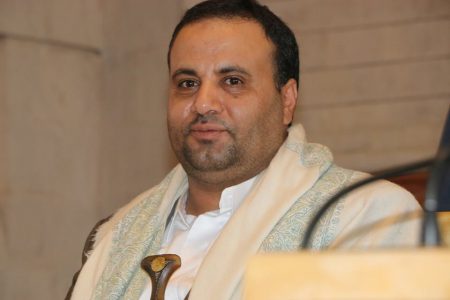
Head of Ansarullah politburo Saleh al-Sammad
Al-Manar | September 26, 2016
Head of the new Yemeni council, Salah al-Sammad, proposed on Sunday a truce on the country’s border with Saudi Arabia in an exchange for a halt in Saudi-led strikes on his country.
The proposal coincided with a surge in fighting after peace talks were suspended last month.
Sammad called on Saudi Arabia to “stop naval, air and land aggression, cease air raids and lift the blockade of our country, in exchange for an end to combat operations on the border and to missile launches into Saudi territory,” he said, in a speech published on the sabanews website.
Sammad also urged the UN and “peace-loving states” to exert pressure on the attacking Saudi regime to accept the offer.
He also suggested an amnesty for “combatants who have sided with the aggression,” a reference to fighters who back the Saudi-US assault on Yemen.
The Huthis are allied with soldiers loyal to former president Ali Abdullah Saleh.
Saudi Arabia in March 2015 formed an Arab coalition to begin air strikes on Yemen. More than 6,600 people have been killed since the coalition launched its intervention, most of them civilians, and at least three million people have been displaced, according to the United Nations.
Source: AFP
Featured Video

Racist Seinfeld Dances for Joy as Bibi Unveils His New Map
or go to
Aletho News Archives – Video-Images
TV Drama Review
Japanese drama projects Japan’s wartime atrocities onto Chinese characters

Global Times | October 25, 2026
By portraying Chinese characters as perpetrators of ruthless violence while casting Japanese Self-Defense Forces (SDF) intelligence operatives as defenders, the season 2 of the Japanese drama Vivant has recently drawn criticism from Chinese netizens, who argue that its depiction turns historical reality on its head while ignoring Japan’s wartime atrocities.
The TBS drama series – a spy suspense story in which an alleged unofficial intelligence unit of the SDF operates across the globe — has attracted a passionate fanbase. Its currently airing season 2 opened with a household rating of 18.8 percent, the highest for a TV drama this year, according toa commentary article by Japanese media Toyo Keizai.
What draws attention is the portrayal of the enemies in the series, the article noted. Scenes in which the Chinese organization subjects kidnapped members of the SDF unit to brutal torture are repeated with unrelenting intensity.
It is rare for Japanese TV dramas to explicitly portray a real-life country as the enemy, the article noted.
Japanese Prime Minister Sanae Takaichi also made a reference to the drama, saying that she has been recording Vivant and hopes to binge-watch it over the year-end and New Year holidays, according to Japanese media outlets.
China’s CCTV News report on Sunday revealed that the drama features scenes in which Chinese personnel cut off the fingers of and stab Japanese intelligence operatives in the abdomen. Such acts bear striking similarities to the torture inflicted on Chinese nationals by invading Japanese troops during the World War II.
The drama distorts the truth by attributing these atrocities to modern Chinese characters. Beneath the surface, it subtly glorifies Japan’s cross-border overseas operations, blurs the functional boundaries of the SDF and implicitly promotes an expansionist narrative, per CCTV News. … continue
Blog Roll
 Aletho News
- Iran FM Araghchi: “Hormuz Will No Longer Be the Same”
- EU facing trillion-euro debt hole while seeking more cash for Kiev
- How US, Europe, Persian Gulf states exhausted missile stockpiles, splurged billions to defend Israel
- Up in arms… Koreans reject U.S. empire’s plan to make South Korea the next Ukraine
- Iran, Turkey, Pakistan, Saudi Arabia could advance region-led security framework in Tehran: FM spox
- Netizens condemn Japanese drama for projecting Japan’s wartime atrocities onto Chinese characters
- Racist Seinfeld Dances for Joy as Bibi Unveils His New Map
- A West Bank War for Netanyahu’s Election Campaign, Could It Backfire?
- Yemen denounces European Parliament’s ‘hypocritical’ push to blacklist Ansarullah
- Qalibaf: UAE’s UN bid aims to ‘clear the runway’ for ‘Greater Israel’, whitewash genocide
- If Americans Knew
- An error has occurred; the feed is probably down. Try again later.
- No Tricks Zone
- Sudden Stratospheric Warming, Powerful El Niño Combination May Lead To Extreme Europe Cold, Energy Crisis!
- Two New Studies Find Thwaites Glacier Melt Cannot Be Driven By Human Activity Or A Warming Ocean
- E-Cars Reduce CO2 Emissions By Only 41% Compared To Internal Combustion Engine Vehicles
- Predictions Made By Renowned Climate Professor Over Past Decades Have Been Proven To Be Poor
- New Study Suggests Large Regions Of The Pacific Ocean Have Been Cooling For The Last 80 Years
- Germany’s Green Energy Debacle: High Energy Costs Force Kahla Porzellan to Close After 182 Years!
- New Study: 50 Years Of The Most Aggressive ‘Net Zero’ Policies Can Only Affect The Global Climate By 0.03°C
- US September “Heat” Was No Record…Many Records Set Decades Ago
- Latest European Green Energy Debacle; Portugal’s Largest Flagship Solar Park Insolvent!
- Green Energy Debacle: German Expert Professor Fritz Vahrenholt Warns Of Severe Economic And Social Consequences

