Duterte Says U.S. Special Forces in Philippines ‘Have to Go’
teleSUR | September 12, 2016
Philippine President Rodrigo Duterte on Monday called for the withdrawal of U.S. military from the restive Jolo and Basilan islands, marking his latest in a string of statements distancing the Filipino government from Washington.
“These special forces, they have to go,” Duterte said in a speech during an oath-taking ceremony for new officials. “I do not want a rift with America. But they have to go.”
Duterte, who was in the spotlight last week over his televised tirade against U.S. imperialism and President Barack Obama, said that the U.S. special forces now training Filipino troops were high-value targets for the Islamic State-linked Abu Sayyaf as counter-insurgency operations intensify.
“Americans, they will really kill them, they will try to kidnap them to get ransom,” Duterte added.
Duterte, a former southern mayor known for his bombastic style, said he wants an independent foreign policy has frequently accused the archipelago’s former colonizer of hypocrisy. The Philippine leader denied on Friday calling Obama a “son of a bitch” in a response to a journalist’s question about the Association of Southeast Asian Nations (ASEAN) summit.
Some U.S. special forces have been killed in the southern Philippines since 2002, when Washington deployed soldiers to train and advise local units during the so-called “Operation Enduring Freedom – Philippines.”
At the height of that operation, some 1,200 Americans were deployed to Zamboanga City and on Jolo and Basilan islands, both strongholds of Abu Sayyaf.
The U.S. program was discontinued in the Philippines in 2015, but a small troop presence has remained for logistics and technical support. Washington has shifted much of its security focus in the Philippines towards the South China Sea.
Presence of U.S. troops on the island, which has continued despite constitutional changes made following the “People’s Power” uprising that toppled U.S.-backed dictator Ferdinand Marcos, has long been a source of discontent among Filipinos.
In his speech to officials on Monday, Duterte repeated comments from last week when he accused the United States of committing atrocities against Muslims over a century ago on Jolo island.
Israeli MP: Tel Aviv aiding Takfiris in Syria
Press TV – September 12, 2016
An Israeli lawmaker has criticized the Tel Aviv regime for supporting Takfiri terrorists who are fighting in Syria to topple the government of President Bashar al-Assad.
In a Facebook post on Sunday, Akram Hasson said the Fateh al-Sham terrorist group, formerly known as al-Nusra Front, is operating in Syria with “unprecedented logistical and medical” support from Israel.
He said Israel’s recent escalation of attacks on the Syrian army positions in the Golan Heights are aimed at paving the way for the terrorist group to gain more grounds.
Golan belongs to Syria, and the international community has never recognized Israel’s occupation of around 1,200 square km (460 square miles) of the territory during the 1967 Six-Day War and its annexation later.
Scores of illegal settlements have been built in the area over the years while the Israeli regime has used the area to launch attacks against the Syrian government and its allies.
Israel has recently intensified its airstrikes on the Golan Heights, targeting the Syrian army and the Lebanese resistance movement Hezbollah, which is assisting Damascus in the fight against Takfiri terrorists.
The Israeli lawmaker further said that the Fateh al-Sham terrorist group is bombing the Syrian Druze village of Khadr, with the support of Israeli Minister of Military Affairs Avigdor Lieberman.
“This new strategy led by Lieberman since he took office has strengthened the Nusra Front and it’s raising its head to attack our brothers,” Hasson wrote.
Citing eyewitnesses, Hasson said the Takfiri terrorist group is using advanced technological equipment, adding Israel’s strategic support has been broadened over the past few months.
Syria has been gripped by foreign-backed militancy since March 2011. UN Special Envoy for Syria Staffan de Mistura estimates that over 400,000 people have been killed in the conflict.
Damascus has blamed regional players, including Saudi Arabia and Israel, for supporting Takfiri militants inside the country.
US Wants Respite, Not Ceasefire in Syria
By Finian Cunningham | Sputnik | September 11, 2016
Tough negotiations between America and Russia’s top diplomats have managed to produce a tentative ceasefire plan for Syria. But Washington doesn’t really want a ceasefire. More likely, a respite for its regime-change proxies.
After more than 13 hours of intense discussions in Geneva this weekend, on top of months of back-and-forth talks, US Secretary of State John Kerry and Russian Foreign Minister Sergey Lavrov emerged in a joint press conference to announce that a cessation in fighting would begin this week.
A previous attempt at implementing a truce back in February failed within days of that initiative because anti-government insurgents affiliated with the al-Qaeda terrorist network refused to abide by that earlier agreement.
There is no reason why this second ceasefire attempt should otherwise succeed in holding.
There may well be a temporary lull in violence simply because opposition militia will avail of the opportunity to regroup and repair. But the core of the insurgents are dominated by terrorist groups like Jabhat Fatah al Sham (formerly al-Nusra Front) and Daesh and numerous other affiliates.
These proscribed terror groups have no interest in negotiating a political transition in Syria with the incumbent government of President Bashar Assad. Their whole purpose is to overthrow the state and turn it into a so-called caliphate ruled by fear.
This gets to the kernel of why the ceasefire deal worked out by Kerry and Lavrov is fatally flawed.
Arguably, the Russian side is negotiating in good faith with the genuine intention of achieving a peaceful resolution to the nearly six-year-old conflict, which has resulted in 400,000 dead and millions displaced from their homes. But not so the American side.
We must always keep firmly in mind that the conflict in Syria was instigated in the first place by the US and other foreign powers for the objective of regime change against the Assad government – a long-time ally of Russia and Iran.
Recall that former French Foreign Minister Roland Dumas revealed in 2013 that the foreign conspiracy for regime change in Syria was hatched at least two years before the violence erupted in March 2011.
This US-led criminal agenda for regime change has not changed. When John Kerry talks about getting Russia to sign up to a “political transition” he means a process which will culminate in the ouster of the Assad government.
At the Geneva press conference this weekend, the US diplomat clearly said that he was coordinating his efforts with those of the exiled opposition group called the High Negotiations Committee. Days before, the Saudi-backed HNC unveiled yet another “vision” demanding “transition” and Assad’s departure.
On the Geneva meeting this weekend, the Washington Post reported: “Kerry acknowledged the truth of the Russian charge that some opposition groups are fighting in tandem with the [al-Nusra] Front and said it was incumbent on them to now make a choice.”
The paper also noted: “Both Kerry and Lavrov emphasized that outside supporters of all non-terrorist [sic] belligerents would have to bring their allies in line.”
Without this putative separation of “moderates” and “terrorists” then there can be no feasible premise for a substantive cessation of violence. The proposal for US and Russian forces to subsequently cooperate in carrying out air strikes against terror groups is therefore a non-starter.
The confidence for this assertion is because, as Kerry half-acknowledged, there is no distinction between “moderate rebels” and “terrorists”. They are all part of the same regime-change proxy army that the US and its NATO and regional allies orchestrated from the outset of this reprehensible conflict.
Expecting these proxies to somehow sort themselves into “good guys” and “bad guys” is a ludicrous conception of how and why the war was instigated and prosecuted.
Washington and the Western news media engage in euphemisms of how these groups are “intermingled”, “overlap” and “marbled”. But such attempts at differentiation are either deluded or deceitful. For virtually all the anti-government insurgents are integrated into the same terrorist front. That’s why months of Russian admonitions to the US to segregate its supposed moderates from the terrorists have resulted in no separation.
For John Kerry to propose at this late stage for “non-terrorist belligerents” to get onboard with the ceasefire is nothing but a cynical ruse.
So what is Washington really seeking? Part of the proposed deal involves Russian and Syrian forces calling off their offensive against eastern Aleppo – the so-called “lifting of the siege” and supplying “humanitarian aid” to insurgent-held areas.
Cynically, but realistically, those provisions are less about halting violence and humanitarian effort and more about giving the foreign-backed regime-change forces a much needed breathing space.
Ever since Russia sent its forces into Syria at the end of last year, the US-led regime-change war has turned into a losing campaign.
What Washington and its other foreign co-conspirators – Britain, France, Turkey, Israel and Saudi Arabia – badly need is to give their proxies a respite from the withering offensive of the Syrian army and its Russian, Iranian and Hezbollah allies.
A reasonable conjecture is that the Pentagon and CIA war planners – Kerry’s ultimate bosses – want a holding and reorganizing position until Hillary Clinton is elected as the new president. Lame-duck Obama has been too much of a ditherer and not sufficiently gung-ho about regime change in Syria.
Clinton, on the other hand, has vowed to step up American military intervention in Syria. She has called for setting up of no-fly zones and a tougher stance towards Assad and Russia.
But if Syrian and Russian forces continue their rate of attrition against the regime-change proxies, there may be little of these foreign assets left by the time Clinton takes office early next year. Hence, the insurgents must be salvaged from their precipitous defeat – and this is what really pertains to the “ceasefire” that Kerry has appeared so keen to accomplish.
The conjecture of a “holding, reorganizing position” also tallies with the recent invasion by Turkish military forces into northern Syria and the joint US-Turk annexation of territory. It suggests that a greater war effort for regime change is being anticipated for when Clinton takes office. (Assuming Donald Trump’s candidacy can be wrecked by the relentless US media vilification he is being subjected to.)
Which begs the question: why have Russia and the Syrian government apparently gone along with this latest ceasefire arrangement? If, that is, it is a cynical ruse for regime change?
Why don’t Syria and Russia just drive on with their very effective offensive to defeat the terrorist regime-change front?
Perhaps, Syria and Russia have their own calculations for regrouping and refining tactics for resuming even greater offensive power.
Or perhaps, Russia knows all too well, privately, that the Americans are full of claptrap. This latest ceasefire proposal has no chance of working because of the inherent flaws. But Russia’s international reputation has little to lose from “giving peace a chance”. [a likelier conjecture]
So, let Washington’s proposal for “separation” of insurgents fail, fail, and fail again, and let the world come to see the utter fallacy and criminality of American policy.
The trouble, however, is that more delay gives more leverage to a Clinton presidency and what promises to be a far more warmongering next White House administration.
Finian Cunningham is a Master’s graduate in Agricultural Chemistry and worked as a scientific editor for the Royal Society of Chemistry, Cambridge, England. For nearly 20 years, he worked as an editor and writer in major news media organisations, including The Mirror, Irish Times and Independent.
A new international control regime on armed drones led by the US? What is going on?
By Chris Cole • Drone Wars UK • September 2, 2016
The United States has begun moves to develop what amounts to a new international control regime on the proliferation and use of armed drones. US officials presented details of a ‘Proposed Joint Declaration of Principles for the Export and Subsequent Use of Armed or Strike-Enabled Unmanned Aerial Systems (UAS)’ to international export control officials during the arms trade treaty review conference in Geneva this week.
US officials told Defense News, who first revealed the initative, that the joint declaration – to be signed by as many nations as possible – is the first of a two-stage process. The declaration, official stated, would addresses “the misperceptions” about the use of armed drones, as well as “the complicated, sensitive and controversial aspects”. Although the draft joint declaration has not been made public, it appears to echo the US’ own policy guidance on the export of armed drones put in place in Spring 2015. Defense News reports that the current draft
“lays out five key principles for international norms, including the “applicability of International law” and human rights when using armed drones; a dedication to following existing arms control laws when considering the sale of armed unmanned systems; that sales of armed drone exports take “into account the potential recipient country’s history regarding adherence to international obligations and commitments”; that countries who export unmanned strike systems follow “appropriate transparency measures” when required; and a resolution to continue to “ensure these capabilities are transferred and used responsibly by all States.”
The second stage of the process is the establishment of an international working group on armed drones for those who sign the declaration, which will devise “a voluntary Code of Conduct for exporting and importing nations.”
Why is this happening?
Over the past three years, as we have written previously, there has been a real rise in the proliferation of drones by Israel, the US and in particular by China. Iraq, Nigeria, and apparently Egypt have all gone on to launch drone strikes over the past two years utilising armed drones bought from China.
On the one hand US drone industry lobbyists have long argued that their industry is hampered by the US membership of the Missile Technology Control Regime (MTCR) which controls the export of larger drones as neither China nor Israel are members (although Israel says it abides by its rules voluntarily). The drone industry has argued that the MTCR rules need to be ‘relaxed’ in order for the US to gain its fair share of the market. This new initiative seemingly therefore arises in part from drone industry lobbying to put in place a process which they want to see as levelling the playing field.
On the other hand, the outgoing Obama administration is also legacy shopping. Stung by international criticism of its use of armed drones over the past decade it wants at least the appearance of putting in place international rules to restrict the proliferation and use of such technology
It seems these two disparate and contrary ideas have come together in this new process.
Prospects for success?
Although a number of countries are working individually or jointly to develop an advanced drone industry, currently the US, Israel and China are the market leaders. While China is unlikely to be involved in this new US-led initiative, US officials apparently believe that they can persuade Israel to join. Israel has never even confirmed that it operates armed drones, so Israeli officials often refuse to talk on the record about the issue but early reports indicate a great deal of scepticism and alarm from Israel about the initiative.
Israel and China however will not be the only nations suspicious of any drone control initiative led by US, fearing that it is simply about the US promoting its own commercial and political interests. Campaigners and the human rights community too will need convincing that such an initiative is a genuine attempt to curb proliferation and use beyond the bounds of international law. After all, we have spent the last decade watching the US “interpret” (i.e. bend and break) international law in this area in its own interests.
However, despite genuine suspicions, the seeming acceptance of the need for an international control regime on the proliferation and use of armed drones is to be welcomed. Armed drones are a real and genuine danger to international peace and security. While there is a long, long way to go and many – if not most – will need to be convinced, that this is the right process, failure will also play into the hands of those who argue that there should not and cannot be such controls.
North Korea’s Understandable Fears
By James Bradley | Consortium News | September 10, 2016
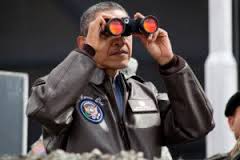
‘Near the ceasefire line’ (Photo by Pete Souza)
North Korea carried out its fifth nuclear test on Friday, drawing condemnation from President Obama and a charge from the Pentagon that the test was a “serious provocation.” Ho-hum, here we go again.
Every year, America pays its vassal-state South Korea huge sums of U.S. taxpayer money to mount 300,000-man-strong military “games” that threaten North Korea. North Koreans view images that never seem to make it to U.S. kitchen tables: hundreds of millions of dollars’ worth of U.S. armaments swarming in from the sea, hundreds of tanks and thousands of troops – their turrets and rifles pointed north – and nuclear-capable U.S. warplanes screaming overhead.
But when a young dictator straight out of central casting responds to U.S. threats with an underground test on North Korea’s founding day, it’s the number-one story on the front page of the New York Times.
Let’s connect some dots. Washington and their note takers in the American press constantly tell us that crazies in Pyongyang and Tehran are nuclear threats. The misplaced, but easily sold, fears of the “North Korean missile threat” and the “Iran missile threat” allows the Pentagon to install “defensive” missile systems in South Korea and Eastern Europe which actually amount to offensive systems targeting Beijing and Moscow (by making first strikes against China and Russia more feasible).
We need to look beyond the simplistic, race-based cartoon-like scaremongering to see that far more reality-based and frightening is the nuclear threat posed by the United States.
President Obama — the Nobel Prize winner who pledged to lead a nuclear-free world — has committed over $1 trillion dollars to modernize America’s nuclear arsenal. Almost unreported by the press, we have been spending a bundle to make nukes “usable,” by miniaturizing them. And to top it off, Obama has maintained a “first use” option for the U.S. nuclear arsenal.
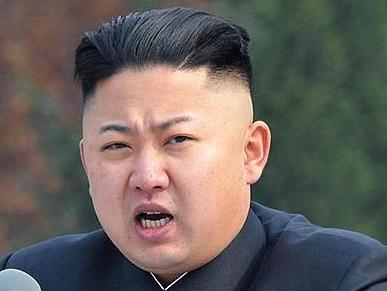
North Korean leader Kim Jong Un
Forget the tin-pot dictator with a bad crew-cut who leads an impoverished country. Here’s for some really scary reading:
Obama’s Trillion-Dollar Nuclear-Arms Train Wreck
Obama plans to retain first-use nuclear option
New U.S. Nuclear Bomb Moves Closer to Full-Scale Production
THAAD: A Major Security Risk for the ROK
James Bradley is author of several bestsellers including Flyboys and Flags of Our Fathers. His most recent book is The China Mirage: The Hidden History of American Disaster in Asia.
Demonize and Distract: Sanitizing Syria for the Masses
By Jason Hirthler | CounterPunch | September 9, 2016
Summoning the Humanitarian Pretext
The arch pragmatist Machiavelli once wrote that, “If you watch the ways of men, you will see that those who obtain great wealth and power do so either by force or fraud, and having got them they conceal under some honest name the foulness of their deeds.” You couldn’t pen a better description of the relationship between the imperial corporate state and its supplicant media. Once the coffers of vulnerable nations are ransacked by American wars of aggression, it is the media that sweeps the crimes of state beneath a carpet of piety. The truth may come out in due time, although it is always ex post facto. Thanks to the the coordination between the corporate sector, the state, and the media, the American doctrinal system is largely a self-contained narrative. It comes complete with a smooth internal logic. Corporations set priorities, the state produces a storyline that rationalizes the pursuit of those priorities, and the media distributes and reifies the storyline until it is gospel. This is no surprise, since the corporations own the politicians and the presses. Yet one way to examine the functioning of this kind of systemic propaganda is by looking at some of the keywords on which the stories hinge.
The foul deeds Machiavelli mentioned now principally occur in the Middle East, where vast resources lie and where power may be usefully projected deep into Eurasia. The Syrian proxy war between forces east and west is a nice example of how the dissimulations initiated in Washington are disseminated through the MSM. For instance, The New York Times, and its deputies in the vast clearinghouses of state propaganda, would have us believe that the White House is supporting freedom-loving rebels in Syria who are politically moderate and fighting for their lives in a civil war against a despotic regime led by an evil optometrist, Bashar al-Assad.
But we know that the entire Syrian fiasco was engineered by the CIA with cash, guns, and training, and unceasing support from the Gulf Cooperation Council (GCC) at our behest. It is a long-standing neoconservative plan to break the so-called Shia Crescent that runs from Lebanon through Syria to Iran. These are, of course, the independent-minded states that have thus far refused to accept either Israeli colonization of Palestinian land or permit Western-backed energy projects to take shape on their territory. Hence the need to dismember them into tiny, feckless statelets that pose no challenge to either Tel Aviv or Washington.
But this is hidden behind the fog of war and a domestic haze of media nuance. This entire conflict could reasonably be said to hinge on a single phrase: “moderate rebels.” The words “moderate” and “rebel” make all the difference in the telling of this fable. The truth is that we have hijacked Arab Spring discontent and festooned it with brigades of terrorist mercenaries procured from around the Middle East and Asia, all with the singular mandate to take down the Assad government. Tens of thousands of jihadists have been injected by NATO into a multi-confessional state governed by an elected leader who won a larger percentage of the electorate than our liberal messiah Barack Obama.
But this more truthful interpretation of events is unacceptable. To concede that the White House is now backing al-Qaeda terrorists in an effort to capsize a Middle Eastern democracy would implode the religion of American exceptionalism on which elite power depends. Thus the media cannot point out that the Pentagon’s recent admission of having troops in Syria violates the Nuremberg Principles on wars of aggression as well as the United Nations Charter. Omissions of this kind are what prevent average Americans from a) knowing what we’re really doing; and b) resisting it.
Demonize and Distract
But it isn’t enough to simply cloak our own crimes in the holy cloth of exceptionalism. We must defame our enemies. We must plant false flags in their soil now so that we can bury bombs in them later. It happens the same way every time. ‘Shocking’ discoveries are made about one of our most reviled enemies, usually provided by a defector with a farcical alias (think “Curveball”). Instantaneous mainstream reports issue a coordinated condemnation of the country in question. Each media outlet chooses a particular keyword to drive home the horror. Popular terms include “crimes against humanity”, “war crimes”, the words “industrial scale” in front of any noun or verb, the word “mass” in front of any noun or verb, “brutal crackdown”, “regime”, and so on. Grisly images are plastered across the front pages of the MSM. Often the images are fakes or are from unrelated incidents.
Once the reader has been stupefied, at least one columnist or politician will draw a deep breath, and then ‘draw comparisons’ to either Hitler and Auschwitz or Slobodan Milosevic and mass graves. (Recently Milosevic was declared innocent of all genocidal charges by the International Criminal Tribunal on Yugoslavia, albeit years after he died in prison after being denied medical treatment by his civilized captors. This process of posthumous exoneration is now practiced on an “industrial scale” by Obama’s drone assassination when various innocents are discovered to have been innocent after they’ve been “terminated”.)
Not only is the supposedly noble Syrian uprising a fraud, but so is our equally principled goal of wiping ISIS from the face of the earth, if the facts on the ground are of any import. Washington has gone after ISIS in a strangely half-hearted way. Why hasn’t it provided air cover for Syrian Arab Army when its helicopters were rendered useless by terrorist TOW missiles? Missiles sold by the United States to Saudi Arabia, likely for the express purpose of funneling them to al Nusrah and other rogue bandits in Syria. Why did the U.S. not immediately attack ISIS-controlled oil wells and oil trading routes–ISIS’ chief source of funding–as Russia did on its entry into the conflict? Why did the Obama administration produce a record-setting arms deal with the Saudis, the leading proselytizer of Wahhabism in the world? Why do we refuse to work with Moscow or the SAA or Iran? Why do we not share grids and intelligence and join their joint operations room in Baghdad?
Isn’t it obvious? We have different goals. We want Assad out and a daft, pliant puppet in charge, presiding over a vast arsenal of domestic police, ready to crush resistance on contact. Of course, any such resisters would be legitimate freedom fighters, as are the Palestinians. But the media takes care to call Palestinians “terrorists” and called citizens resisting the Iraqi occupation “insurgents”. Words matter. They shade the story and bring neutral readers over to the side of empire. They blame the victim for the violence that victimized them.
The dissimulation becomes even clearer when you realize that ISIS emerged from an American interrogation camp in Iraq, in a way that suggests CentCom was more than happy to release radicalized Islamists into the wild. To what purpose? The failed state in Libya and the collapsing scenery of the Syrian state provide plenty of fodder for speculation.
The Wages of Propaganda
Thanks to years of conditioning by the media, the population will do little to resist the escalation to come. Eventually the Syrian “regime” to be eventually overthrown by relentless American-backed violence. Hillary Clinton will win the election and gain control of the Oval Office. As Glen Ford wrote at Black Agenda Report, Clinton will “… ride into the White House on a warhorse”. She is the thinking man’s neocon, unlike President Bush, who represented the anti-intellectual strain of the American character, and Barack Obama, whose reluctance to pour troops into Arab prairie fires was widely predictably condemned as a sign of weakness.
Hillary is neither stupid nor soft. She will doubtless find a useful pretext by which to declare a no-fly zone in Syria, which would inhibit the efficacy of Russia’s campaign against various terrorist clans. (A House resolution is already afoot to lay the groundwork.) She will move more troops into the polder of northern Syria, violating all kinds of charters and conventions and declarations with an icy mixture of contempt and indifference. (See the UN Charter, Geneva Conventions, and the Universal Declaration of Human Rights for the bootless scraps of paper she will trample.) Perhaps most importantly, she will green light the transport of more arms, ammunition, and psychopaths into Syria to make a push for Damascus in the hopes of repeating the Libyan calamity.
Should that project succeed, Hillary will quite possibly ‘discover’ that Iran has been violating its bogus nuclear agreement with the P5 +1. Anonymous administration sources will be “troubled” by the development. This isn’t idle speculation. For lack of a better title, the long-term strategy for the “new world order,” as George H.W. Bush put it, is contingent on splitting the Shia Crescent, removing Iran as a regional antagonist, then moving farther into Eurasia to control Sino-Russian development. And we know how a confrontation with Tehran would play out. With rabid spittle cresting his white beard, Wolf Blitzer will escort numberless brigadier generals through The Situation Room to reassure Americans that the bearded mullahs in Qom are indeed a fearsome clan. Hillary will threaten, and perhaps use, tactical nuclear weapons (B-61s) on Iranian nuclear sites, backed by either a UN Security Council resolution of dubious authority or a coalition of the bullied, bought, and willing. As the mushroom cloud envelops the region in radioactive waste, Israel will be seen fastidiously colonizing more West Bank land, Benjamin Netanyahu rubbing his hands in frenzied anticipation, a dogeared copy of the Yinon plan stuffed in his jacket pocket. Saudi Arabia’s Deputy and Crown Princes will celebrate the fall of their hated rivals. Laconic onlookers in Washington and Europe will shrug and say nothing. CIA plants in D.C. will fastidiously distance Hillary’s bombs from Hiroshima’s, and Tel Aviv will move against Hezbollah in a final confrontation, since the Shia Crescent will by then be nothing more than a few shards of Mesopotamian culture atop a flaming midden.
With the Middle East finally brought “to heel,” as Hillary once proposed doing to young black boys, the ground will have been cleared for the pulse-racing showdown with Russia itself, the greatest thorn in Washington’s side. With Assad out of the way and Tehran chastened, the Kremlinologists and conspiracy theorists can be set loose to harrow the public into a state of high anxiety about the “expansionist” state to the East. NATO will inch closer to Russian borders and shout that Russia is moving closer to NATO. Destabilization will proceed apace. It will be called “democracy promotion” and will be paid for by fronts called “endowments”. Sanctions will tighten the economic screws. Verbal salvos will hit targets on either side of the water. New proxy wars will be touched off. Only a giant peace movement or stray asteroid could prevent something like this from happening. Perhaps the BRICS will halt the spread of empire with a collective stance, but Washington is agile if not artful at executing its core strategy to destabilize, divide, and rule its rivals. Until then, if you want to know what contempt looks like, look at this picture of Barack Obama and Vladimir Putin meeting at the G20 in China last week. The tenor of tomorrow is written all over their faces.
Jason Hirthler is a veteran of the communications industry and author of The Sins of Empire: Unmasking American Imperialism. He lives in New York City and can be reached at jasonhirthler@gmail.com.
Greenwashing Wars and the US Military
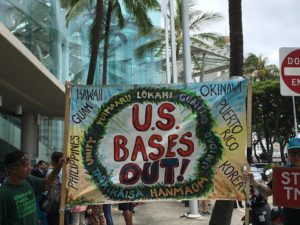
Protest sign urging global conservation meeting to address the environmental damage from U.S. military bases. (Photo by Ann Wright)
By Ann Wright | Consortium News | September 9, 2016
The International Union for the Conservation of Nature (IUCN) has come in for criticism due to its lack of attention to the detrimental effects of wars and military operations on nature. Considering the degree of harm to the environment coming from these human activities, one would think that the organization might have set aside some time at its World Conservation Congress this past week in Hawaii to specifically address these concerns.
Yet, of the more than 1,300 workshops crammed into the six-day marathon environmental meeting in Honolulu, followed by four days of discussion about internal resolutions, nothing specifically addressed the destruction of the environment by military operations and wars.
The heavy funding the IUCN gets from governments is undoubtedly the rationale for not addressing this “elephant in the room” at a conference for the protection of the endangered planet – a tragic commentary on a powerful organization that should acknowledge all anti-environmental pressures.
At a presentation at the USA Pavilion during the conference, senior representatives of the U.S. Army, U.S. Air Force and U.S. Navy regaled the IUCN audience of conservationists with tales about caring for the environment, including protecting endangered species, on hundreds of U.S. military bases in the United States.
The presenters did not mention what is done on the over 800 U.S. military bases outside of the United States. In the one-hour military style briefing, the speakers failed to mention the incredible amounts of fossil fuels used by military aircraft, ships and land vehicles that leave mammoth carbon footprints around the world. Also not mentioned were wars that kill humans, animals and plants; military exercise bombing of entire islands and large swaths of land; and the harmful effects of the burn pits which have incinerated the debris of war in Afghanistan and Iraq.
Each military service representative focused on the need for training areas to prepare the U.S. military to “keep peace in the world.” Of course, no mention was made of “keeping the peace” through wars of choice that have killed hundreds of thousands of persons, animals and plants, and the bombing of the cultural heritage in many areas around the world including Afghanistan, Iraq, Syria, Pakistan, Libya, Yemen and Somalia.
Miranda Ballentine, Air Force Assistant Secretary for Installations, the Environment and Energy, said the U.S. Air Force has over 5,000 aircraft, more than all the airlines in the United States — yet she never mentioned how many gallons of jet fuel are used by these aircraft, nor how many people, animals and cultural sites the aircraft have bombed.
To give one some idea of the scale of the footprint of U.S. military bases, Ballentine said Air Force has over 160 installations, including 70 major installation covering over 9 million square miles of land, larger than the country of Switzerland, plus 200 miles of coastland.
Incredibly, Ballentine said that due to commercial development around military bases, military bases have become “islands of conservation” — conservation takes place inside the protected base while there are larger conservation issues outside the fence lines of the bases.
Adding to the mammoth size of the military base footprint, Dr. Christine Altendorf, the regional director of the U.S. Army’s Installation Management Command of the Pacific, said U.S. Army bases have 12.4 million acres of land, including 1.3 million acres of wetlands, 82,605 archeological sites, 58,887 National Historical Landmarks and 223 endangered species on 118 installations.
The U.S. Navy’s briefer, a Navy Commander, added to the inventory of military equipment, saying the Navy has 3,700 aircraft; 276 ships, including 10 aircraft carriers; 72 submarines. Seventy naval installations in the United States have 4 million acres of land and 500 miles of coastline. The Navy presenter said the Navy has never heard of a marine mammal that has been harmed by U.S. Naval vessels or acoustic experiments in the past ten years.
Only One Question
At the end of the three presentations, there was time for only one question — and luckily, my intense hand waving paid off and I got to ask: “How can you conserve nature when you are bombing nature in wars of choice around the world, practicing military operations in areas that have endangered species like on the islands of Oahu, Big Island of Hawaii, Pagan, Tinian, Okinawa and bombing islands into wastelands like the Hawaiian island of Koho’olawe and the Puerto Rican island of Vieques and now you want to use the North Marianas ‘Pagan’ Island as a bombing target. And how does the construction of the new South Korean naval base in pristine marine areas of Jeju Island that will be used by the U.S. Navy and the proposed construction at Henoko of the runways into the pristine Oura Bay in Okinawa fit into conservation of nature?”
Interestingly, in the large audience of approximately 100 people, not one of them applauded the question indicating that either audience was composed primarily of Department of Defense employees, or that the conservationists are uneasy about confronting the U.S. government and particularly the U.S. military about its responsibility for its large role in the destruction of much of the planet’s environment.
The Navy representative was the only person to respond to my question. He reiterated the national security necessity for military exercises to practice to “defend peace around the world.” To his credit, he acknowledged the role the public has in commenting on the possible impact of military exercises. He said that over 32,000 comments from the public have been made on the Environmental Impact Assessment (EIA) of the possibility of artillery firing and aircraft bombing of the Northern Marianas island of Tinian — that has only 2,300 inhabitants.
Despite all odds, someone in Hawaii was able to get an exhibit of photographs of the cleanup of Koho’olawe placed on the third floor of the Hawaii Convention Center. There was no sign announcing the exhibition, just a series of photos with some explanation. In five days of attending the conference, I observed that 95 percent of the conference attendees who walked past the exhibition did not stop to look at it – until I stopped them and explained what it was about. Then, they were very interested.

A crater that was created on the Hawaiian island of Koho’olawe from massive explosions of TNT in 1965. (Photo from Hawaii Archive)
From 1941 to 1990, the island of Koho’olawe was used as a bombing range for U.S. military aircraft and naval vessels. One photograph in the exhibition showed the crater called “Sailor’s Hat” which was made by several massive explosions of TNT in 1965 to recreate and study the effects of large explosions on nearby ships and personnel to simulate in some manner the effects of a nuclear explosion. The crater affected the island’s fresh water aquifer and now no artesian water remains on the island.
After Hawaiians stopped the bombing through their protests and by staying on the island during bombings from the 1970s, the U.S. Navy returned Koho’olawe to the State of Hawaii in 2004 after a 10-year clean-up process. But only 66 percent of the surface has been cleared of unexploded ordnance (UXO), and only 10 percent cleared to a depth of 4 feet. Twenty-three percent of the surface remains uncleared and 100 percent of the waters surrounding the island have not been cleared of UXO, putting divers and ships at risk.
Okinawan Environmental Activists
Environmental activists from Okinawa had a booth at the IUCN at which they told about the attempt of the U.S. military and the national Japanese government to construct a runway complex into Oura Bay, a pristine marine area that that is the home of the protected species of marine mammal, the dugong.
The Deputy Governor of Okinawa and the Mayor of Nago city, Okinawa, both of whom have been key figures in the grassroots campaign to stop the construction of the runways and the lawsuits filed by the provincial government of Okinawa against the federal Japanese government, gave presentations about the citizens’ struggle against the construction of the runways.
However, there was no mention of the environmental effects on the marine environment from the construction of a huge new naval base on Jeju Island, South Korea, the site of the previous IUCN conference four years ago. At that conference, IUCN, no doubt at the request of the South Korean government, refused to allow citizen activists to have a booth inside the convention or make presentations like the Okinawans did this year. As a result, the Jeju Island campaigners were forced to stay outside the conference site.
Four years later in the 2016 WCC conference in Hawaii, the Government of Japan and the Province of Jeju Island sponsored a large multi-media pavilion about Jeju island which did not mention the construction of the new naval base and the destruction of the cultural heritage of the site nor the displacement of women divers who had dived at the location for generations.
On Sept. 3, local groups in Honolulu came to the Hawaii Convention Center with signs to remind the IUCN of the U.S. militarization of Asia and the Pacific. Signs and posters from local environmentalists cited the environmental impact from the huge 108,863-acre Pohakuloa bombing range on the Big Island of Hawaii, the largest U.S. military installation in the Pacific; the Aegis missile test center on the island of Kauai; and the four large U.S. Army, Navy, Air Force and Marine bases on the island of Oahu.
Other signs referenced the extensive number of U.S. military bases in Japan, Okinawa, South Korea, Guam and new U.S. military installations in the Philippines and Australia.
Ann Wright served 29 years in the US Army/Army Reserves and retired as a Colonel. She also served 16 years as a US diplomat in US Embassies in Nicaragua, Grenada, Somalia, Uzbekistan, Kyrgyzstan, Sierra Leone, Micronesia and Mongolia. She was on the small team that reopened the US Embassy in Kabul, Afghanistan in December 2001. She resigned from the US Department of State in March 2003 in opposition to the war on Iraq.
CrossTalk: The Trump Doctrine
RT | September 9, 2016
Donald Trump is one of the most unorthodox presidential nominees in American electoral history. He is unpolished and very brash. But some of his foreign policy ideas are intriguing – even commonsensical. This terrifies and enrages the establishment.
CrossTalking with Nomi Prins, Stephen Yates, and Alex Newman.
Obama Flinches at Renouncing Nuke First Strike
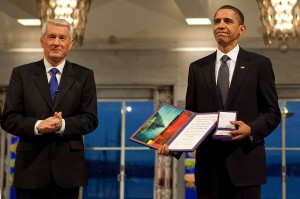
President Barack Obama uncomfortably accepting the Nobel Peace Prize, Dec. 10, 2009. (White House photo)
By Jonathan Marshall | Consortium News | September 8, 2016
Time is running short for President Obama to make good on his 2009 promise “to seek the peace and security of a world without nuclear weapons,” for which he won the Nobel Peace Prize. Yet as both the Wall Street Journal and New York Times recently reported, Obama’s advisers may have just nixed the single most important reform advocated by arms control advocates: a formal pledge that the United States will never again be the first country to use nuclear weapons in a conflict.
Ever since President Truman ordered two atomic bombs dropped on Japan in 1945, the United States has reserved the right to initiate nuclear war against an overwhelming conventional, chemical or biological attack on us or our allies. But peace advocates — and more than a few senior military officers — have long warned that resorting to nuclear weapons would ignite a global holocaust, killing hundreds of millions of people.
In a talk to the annual meeting of the Arms Control Association on June 6, Deputy National Security Advisor Benjamin Rhodes promised that President Obama would continue to review ways to achieve his grand vision of a nuclear-free world during his last months in office. Obama was reportedly considering a “series of executive actions” to that end, including a landmark shift to a “no first use” policy.
Two-thirds of adult Americans surveyed support such a policy. So do 10 U.S. senators who wrote President Obama in July, proposing a no-first-use declaration to “reduce the risk of accidental nuclear conflict” and seeking cut-backs in his trillion dollar plan for nuclear modernization over the next 30 years.
But Secretary of Defense Ashton Carter, Secretary of Energy Ernest Moniz (who oversees the nuclear stockpile), and Secretary of State John Kerry all warned during a National Security Council meeting in July that declaring a policy of “no first use” would alarm America’s allies, undercut U.S. credibility, and send a message of weakness to the Kremlin at a time of tense relations with Russia.
Yet until they took charge of giant bureaucracies whose funding depends on keeping the threat of nuclear war alive, both Carter and Moniz were on record supporting “a new strategy for reducing nuclear threats” and achieving security “at significantly lower levels of nuclear forces and with less reliance on nuclear weapons in our national security strategy.”
In a 2007 manifesto, Carter, Moniz, and other centrist Democratic foreign policy experts rejected the old claim that nuclear weapons are still needed to deter non-nuclear attacks.
“Nuclear weapons are much less credible in deterring conventional, biological, or chemical weapon attacks,” they wrote. “A more effective way of deterring and defending against such non-nuclear attacks – and giving the President a wider range of credible response options – would be to rely on a robust array of conventional strike capabilities and strong declaratory policies.”
They also gave strong implicit support to a no-first-use doctrine, stating that “nuclear weapons must be seen as a last resort, when no other options can ensure the security of the U.S. and its allies.”
Risk of Overreaction
Why does a no-first-use policy matter? In a New York Times column last month, Gen. James Cartwright, former vice chairman of the Joint Chiefs of Staff and head of the United States Strategic Command, emphasized the folly of introducing nuclear weapons into any conflict.
“Using nuclear weapons first against Russia and China would endanger our and our allies’ very survival by encouraging full-scale retaliation,” he and a colleague wrote. “Such use against North Korea would be likely to result in the blanketing of Japan and possibly South Korea with deadly radioactive fallout.”
A policy of no first use, backed up by a reconfiguration of U.S. nuclear forces to reduce their offensive capabilities, would lower the chance of a rival nuclear power rushing to launch early in a crisis and unleashing World War III. Today some nuclear powers like Russia have their forces on hair-trigger alert for fear of being wiped out by a U.S. surprise attack; as a result, the world is just one false alarm away from all-out nuclear war.
As two senior officials at the Arms Control Association observed recently in the Bulletin of the Atomic Scientists, “Among other advantages, a clear US no-first-use policy would reduce the risk of Russian or Chinese nuclear miscalculation during a crisis by alleviating concerns about a devastating US nuclear first-strike.
“Such risks could grow in the future as Washington develops cyber offensive capabilities that can confuse nuclear command and control systems, as well as new strike capabilities and strategic ballistic missile interceptors that Russia and China believe may degrade their nuclear retaliatory potential.”
They also discounted the claim that U.S. allies such as Japan or Korea would rebel against such a change of policy: “They are highly likely to accept such a decision, since no first use will in no way weaken US military preparedness to confront non-nuclear threats to their security. . . Many US allies, including NATO members Germany and the Netherlands, support the adoption of no-first-use policies by all nuclear-armed states.”
Warnings by nuclear hawks that a common-sense doctrine of no-first-use would undercut U.S. “credibility” or project “weakness” are simply business-as-usual attempts by national security bureaucrats to inflate threats and keep the war machine in high gear. If they succeed in blocking reform, America and the rest of the world will remain at real risk of annihilation through accidental nuclear escalation.
The question now is whether President Obama will listen to the fear-mongers in his cabinet, or remember what he said in May at the Hiroshima Peace Memorial: “Among those nations like my own that hold nuclear stockpiles, we must have the courage to escape the logic of fear and pursue a world without them.”
Jonathan Marshall is author or co-author of five books on international affairs, including The Lebanese Connection: Corruption, Civil War and the International Drug Traffic (Stanford University Press, 2012). Some of his previous articles for Consortiumnews were “Risky Blowback from Russian Sanctions”; “Neocons Want Regime Change in Iran”; “Saudi Cash Wins France’s Favor”; “The Saudis’ Hurt Feelings”; “Saudi Arabia’s Nuclear Bluster”; “The US Hand in the Syrian Mess”; and “Hidden Origins of Syria’s Civil War.”
Top General Warns That NATO Wants to Turn Post-Soviet Space ‘Into Another Syria’
Sputnik – 08.09.2016
A top Russian general has voiced his frustration over NATO’s lack of cooperation with a Russian-led alliance involving countries from the former Soviet space, saying that the Western alliance doesn’t seem to want countries in the former USSR to ally with one another, allowing NATO pick them off one by one at their leisure.
Speaking at a press conference in Moscow on Wednesday, Col. Gen. Nikolai Bordyuzha, secretary general of the Collective Security Treaty Organization, a military alliance involving six post-Soviet states, including Russia, Belarus, Armenia, Kazakhstan, Kyrgyzstan and Tajikistan, had some harsh words for Russia’s NATO partners.
The North Atlantic Alliance, he said, has been consistently opposed to any military integration between Russia and its partners in the CSTO, and the reason is that NATO wants to deprive these countries of their collective security guarantees.
“Why do you think NATO does not cooperate with the CSTO?” the general asked. “It’s simple – they have no need to support processes of [defense] integration. This way, things will be like in Syria, and nobody will be able to let out a peep. The country is being pounded, and there’s no one to help them, since it didn’t have any allies. And this is the situation they want to create for us as well,” Bordyuzha said, referring to the members of the CSTO.
Furthermore, the officer warned that the Western media has been engaged in what he called campaign of information warfare against the CSTO. “They will tell lies all day, every day. Everything that is being said about the CSTO is presented in a way that’s the opposite to how things are in reality,” Bordyuzha noted. “This is done, for example, in order to ensure that Tajikistan was not together with Russia,” he added.
Ultimately, Bordyuzha suggested that the Western political, media and military effort’s “most important task is to splinter our unity, to separate our nations into our own ‘national apartments’, and to dictate their terms to everyone individually.”
In this scenario, the officer emphasized that while the CSTO has absolutely no plans to fight a war of aggression against NATO, neither does it fear an attack by the Western alliance. “That’s why the CSTO exists,” Bordyuzha quipped.
The Collective Security Treaty Organization, formed in 1992, shortly after the collapse of the Soviet Union, integrates the defense capabilities of six former Soviet republics, including Russia, Belarus, Armenia, Kazakhstan, Kyrgyzstan and Tajikistan. Afghanistan and Serbia became observers to the organization in 2013. Former members include Azerbaijan, Georgia and Uzbekistan.
Signatories to the alliance are not able to join other military alliances, and aggression against one member is considered aggression against all.
The CSTO holds yearly command exercises and drills to improve coordination between its states militaries, the most recent being Cooperation-2016, which took place last month in Russia’s Pskov region.
Featured Video

Racist Seinfeld Dances for Joy as Bibi Unveils His New Map
or go to
Aletho News Archives – Video-Images
TV Drama Review
Japanese drama projects Japan’s wartime atrocities onto Chinese characters

Global Times | October 25, 2026
By portraying Chinese characters as perpetrators of ruthless violence while casting Japanese Self-Defense Forces (SDF) intelligence operatives as defenders, the season 2 of the Japanese drama Vivant has recently drawn criticism from Chinese netizens, who argue that its depiction turns historical reality on its head while ignoring Japan’s wartime atrocities.
The TBS drama series – a spy suspense story in which an alleged unofficial intelligence unit of the SDF operates across the globe — has attracted a passionate fanbase. Its currently airing season 2 opened with a household rating of 18.8 percent, the highest for a TV drama this year, according toa commentary article by Japanese media Toyo Keizai.
What draws attention is the portrayal of the enemies in the series, the article noted. Scenes in which the Chinese organization subjects kidnapped members of the SDF unit to brutal torture are repeated with unrelenting intensity.
It is rare for Japanese TV dramas to explicitly portray a real-life country as the enemy, the article noted.
Japanese Prime Minister Sanae Takaichi also made a reference to the drama, saying that she has been recording Vivant and hopes to binge-watch it over the year-end and New Year holidays, according to Japanese media outlets.
China’s CCTV News report on Sunday revealed that the drama features scenes in which Chinese personnel cut off the fingers of and stab Japanese intelligence operatives in the abdomen. Such acts bear striking similarities to the torture inflicted on Chinese nationals by invading Japanese troops during the World War II.
The drama distorts the truth by attributing these atrocities to modern Chinese characters. Beneath the surface, it subtly glorifies Japan’s cross-border overseas operations, blurs the functional boundaries of the SDF and implicitly promotes an expansionist narrative, per CCTV News. … continue
Blog Roll
 Aletho News
- Iran FM Araghchi: “Hormuz Will No Longer Be the Same”
- EU facing trillion-euro debt hole while seeking more cash for Kiev
- How US, Europe, Persian Gulf states exhausted missile stockpiles, splurged billions to defend Israel
- Up in arms… Koreans reject U.S. empire’s plan to make South Korea the next Ukraine
- Iran, Turkey, Pakistan, Saudi Arabia could advance region-led security framework in Tehran: FM spox
- Netizens condemn Japanese drama for projecting Japan’s wartime atrocities onto Chinese characters
- Racist Seinfeld Dances for Joy as Bibi Unveils His New Map
- A West Bank War for Netanyahu’s Election Campaign, Could It Backfire?
- Yemen denounces European Parliament’s ‘hypocritical’ push to blacklist Ansarullah
- Qalibaf: UAE’s UN bid aims to ‘clear the runway’ for ‘Greater Israel’, whitewash genocide
- If Americans Knew
- Israel punishes Palestinian prisoners with solitary confinement for making a cake
- US midterms: Where do candidates in key Senate races stand on Israel, Gaza, and Iran?
- Israeli forces demolish Hebron homes, displace thousands of Palestinians as raids expand
- Their Son Died in Israeli Prison. No Answers. No Body
- Biden’s Israel Catastrophe
- Why Israel’s latest assault on Hebron is so significant for the West Bank
- Israel Used “Where’s Daddy?” AI to Relentlessly Murder Palestinian Journalists and Their Families in Their Homes from October to December 2023
- DAILY UPDATE: Latest essential news on Palestine, Israel, & region
- Netanyahu Says Israel Must Prepare for Banking Sanctions, Floats Crypto as a Possible Bypass
- Latest updates from Israeli assault on West Bank
- No Tricks Zone
- Sudden Stratospheric Warming, Powerful El Niño Combination May Lead To Extreme Europe Cold, Energy Crisis!
- Two New Studies Find Thwaites Glacier Melt Cannot Be Driven By Human Activity Or A Warming Ocean
- E-Cars Reduce CO2 Emissions By Only 41% Compared To Internal Combustion Engine Vehicles
- Predictions Made By Renowned Climate Professor Over Past Decades Have Been Proven To Be Poor
- New Study Suggests Large Regions Of The Pacific Ocean Have Been Cooling For The Last 80 Years
- Germany’s Green Energy Debacle: High Energy Costs Force Kahla Porzellan to Close After 182 Years!
- New Study: 50 Years Of The Most Aggressive ‘Net Zero’ Policies Can Only Affect The Global Climate By 0.03°C
- US September “Heat” Was No Record…Many Records Set Decades Ago
- Latest European Green Energy Debacle; Portugal’s Largest Flagship Solar Park Insolvent!
- Green Energy Debacle: German Expert Professor Fritz Vahrenholt Warns Of Severe Economic And Social Consequences

