Boosting Military Capabilities Top Priority for Ukraine’s New Gov’t
Sputnik — April 14, 2016
Ukraine will never accept secession of Crimea and independence of the eastern Donbass region, new Prime Minister Volodymyr Groysman said Thursday.
The Ukrainian Parliament earlier on Thursday accepted Prime Minister Arseniy Yatsenyuk’s resignation and appointed Parliament Speaker Volodomyr Groysman to the position.
“Another question to which the new government will pay extra attention will be the range of issues related to returning Crimea and the temporarily occupied Donbass regions… I want to outline my position clearly, we shall never accept that a part of our country… non longer belongs to Ukraine,” Groysman said.
Boosting Ukraine’s military capabilities will be a top priority for the country’s new government, according to Groysman.
I wish to underline that increasing our defense capabilities in conditions of Russian aggression remains a top priority for my government. We have a clear plan on implementing our defense capabilities in accordance with NATO standards,” Groysman said.
Libyan unity government rejects British troops for anti-ISIS mission
RT | April 13, 2016
British troops may not be deployed to Libya after all because the head of the North African state’s new unity government turned down the offer of Western soldiers to help eliminate Islamic State (IS, formerly ISIS/ISIL).
The move may come as a shock to some in the British establishment who had expected a request for soldiers now that the war-ravaged state’s UN-brokered unity government has assembled in Tripoli.
A UK government source told the Times on Wednesday the request had not materialized. The source felt the force structure being floated – an Italian-led brigade of 6,000 with a 1,000-strong British component – would exacerbate internal divisions.
Its aims would have been to tackle people-trafficking and train Libyan forces to fight IS.
Another unnamed source, a British minister, told the Times it was thought the head of the unity government, Fayez al-Sarraj, may wait until he is more established before requesting foreign military help.
Al-Sarraj and his government only arrived in the country a fortnight ago amid fears their entry would spark violence among the rival militias.
“The idea that the PM is yet able to give the green light to anything is premature, he needs to make sure he has the necessary support,” the minister told the Times.
“We are in a sensitive period. Nobody has drawn any firm conclusions. We’ve got a long way to go but there is a recognition things are extremely serious.”
European Council on Foreign Relations Libya specialist Mattia Toaldo told the paper that officials in the new administration are afraid of being seen as “foreign puppets” and hope “people in Europe will stop talking about this for a few weeks.”
Some military and political figures in the UK seem to have learned one tough lesson from the ill-fated campaigns in Afghanistan and Iraq, where US-appointed governments were treated with suspicion and substantial resistance ensued.
On April 1, as Al-Sarraj arrived in Tripoli, Commons Foreign Affairs Committee chair Crispin Blunt MP warned that although the UK has a “moral obligation” to clean up the “mess” it had left in Libya, any UK troop deployment would look like an “invading force.”
On Monday, the former British Army Colonel who briefly led a mission to Libya in the wake of the 2011 war, which removed the old regime, warned that if anything could unify the competing militias it would be a foreign military intervention.
Lieutenant Colonel Rupert Wieloch also told the Telegraph he questioned the wisdom of involving Italy, a former colonial ruler, in any Libya operation.
US readies ‘Plan B’ to supply heavy weapons to militants: Report
Press TV – April 13, 2016
The United States and its regional allies have prepared plans to supply more-powerful weapons to militants fighting the Syrian government, amid concerns that a landmark ceasefire is threatening to fall apart.
US officials said the so-called Plan B is aimed at providing vetted “moderate” militant units with weapons system that would enable them to launch attacks against Syrian government aircraft and artillery positions, the Wall Street Journal reported on Tuesday.
US-backed militants carried out a series of attacks in central and southern Syria on Monday even as the Damascus government was observing a ceasefire and holding talks with opposition groups to end the years-long conflict.
A ceasefire brokered by the US and Russia went into effect on February 27 across Syria. The truce agreement does not apply to Daesh and al-Qaeda-affiliated al-Nusra Front. A new round of discussions is to resume between the two sides in Geneva this week.
Concern has been growing that the recent uptick in violence is putting intense strain on the fragile truce.
US Secretary of State John Kerry floated the idea of a “Plan B” for the first time late in February, stressing that partitioning of Syria was on the table if the ceasefire collapsed.
The preparations for the “Plan B” were discussed at a secret gathering of intelligence chiefs in the Middle East before the ceasefire went into effect and in exchanges between intelligence services, the Journal said.
During those sessions, the CIA gave assurances to allies that they would be given approval to expand arms shipments to Syria’s “moderate” militants.
Coalition members reportedly agreed to the outlines of the plan, but the White House must approve the list of proposed weapons systems before they can be sent to Syria.
“The agreement is to up the ante, if needed,” a senior US official said.
The plan for introducing more sophisticated weapons into the Syrian battlefield is perceived as being part of a broader behind-the-scenes effort by the US to counter its adversaries in the conflict.
US officials have privately warned their Russian counterparts that the armed opposition will persist in Syria and that a return to full-scale fighting could put further strain on Russian pilots there, according to the Journal.
In addition, Pentagon officials said in recent weeks that the White House was looking to “greatly increase” the number of special forces deployed in Syria. The US military also said that it had resumed training new units of militants operating in the country.
The discussions for a possible escalation of the proxy war in Syria have been fueled to a large extent by a relatively successful Russian campaign in the country.
US Nuclear Rearmament Under Guise of World Peace
By Finian CUNNINGHAM – Strategic Culture Foundation – 12.04.2016
This week US Secretary of State John Kerry visited Hiroshima, where nearly 71 years ago the US dropped the first ever atomic weapon killing 140,000 people. It was the first visit by a senior American official to the Japanese city owing to immense sensitivity surrounding that notorious event.
However, the occasion this week was said to underscore US President Obama’s vision of a nuclear weapons free world, said Kerry’s State Department.
The Japanese government of Shinzo Abe also got some good public relations value out of Kerry’s landmark visit to the Hiroshima peace memorial. As Voice of America noted, the occasion «helps to soften its global image» as Abe’s government steps up its military posture in recent years.
Obama is due to go to Japan in May to attend a G7 summit. It is being mooted that he too may pay respects to Hiroshima victims of the US atomic bombing, which occurred on August 6, 1945.
By the time Obama arrives in Japan, a shipment of Japanese radioactive plutonium is due to land on the US east coast. The highly dangerous cargo of 331 kilograms of weapons-grade plutonium reportedly left Japan on March 22 onboard an armed ship as part of an agreement with the US to act as a depository for the radioactive material. The cargo is reportedly sufficient material for the production 50 nuclear warheads.
The two-month seaborne transfer is a highly classified matter, the itinerary kept secret for security reasons. It is reportedly the first major transport of weapons-grade material from Japan since 1992. The plutonium is intended to be disembarked at a nuclear facility in Savannah, South Carolina.
The intake of plutonium from Japan by the US is supposedly part of a 2010 accord between the US and Russia which calls on both parties to begin disposal of highly enriched plutonium for the purpose of aiding weapons non-proliferation. Both sides are obligated to dispose of 34 tons of weapons-grade plutonium. Notwithstanding, on the US side the commitment has been largely unfulfilled, according to Professor Peter Kuznick, director of the Nuclear Studies Institute at American University in Washington DC.
Kuznick «estimates that on Obama’s watch little more than a ton of nuclear materials has been removed», reported the Guardian. Kuznick even went as far as accusing the American president of espousing the «height of hypocrisy» in light of his famous speech in Prague 2009 when he pledged to rid the world of nuclear weapons, and for which he was awarded the Nobel Peace Prize.
Further anomaly is in the fact that the Obama administration has committed Washington to spend $1 trillion over the next three decades in upgrading the country’s entire nuclear arsenal. A central part of the task is to replace the plutonium cores in all warheads – of which the US has roughly 1,500, on parity with Russia’s stockpile.
Therefore, it is very hard to see how Washington is implementing «Obama’s vision» of a nuclear-weapons-free world. The opposite is more to the point.
At the end of last month, Obama hosted 50 world leaders in Washington for a nuclear security summit. It was the fourth such event under his nearly eight-year presidency. Just before the gathering, Obama wrote an op-ed piece in the Washington Post which headlined: «How we can make our vision of a world without nuclear weapons a reality».
Notably, Russian President Vladimir Putin skipped the conference in Washington. The Kremlin said that was because the US side did not consult beforehand with Russian counterparts on what the agenda of the summit would be.
In his op-ed piece, Obama appeared to re-write his «Prague vision» by saying now that the «central pillar» is «preventing terrorists from obtaining and using a nuclear weapon». The president went on to say: «We’ll review our progress, such as successfully ridding more than a dozen countries of highly enriched uranium and plutonium».
So Obama deftly shifts the focus from international disarmament by nuclear powers – and his own county’s tardiness in particular to implement the nearly 50-year-old Non-Proliferation Treaty – to one of «preventing terrorists obtaining nuclear weapons».
This is where the shipment of plutonium from Japan comes into good public relations effect. As noted above, the cargo left Japan about a week before Obama’s nuclear security summit was held in Washington. That shipment tends to bolster the narrative that the US is «ridding more than a dozen countries of highly enriched uranium and plutonium» – thus ostensibly contributing to non-proliferation.
Obama also plugged the P5+1 accord with Iran in the same self-serving vein. He wrote: «We’ve succeeded in uniting the international community against the spread of nuclear weapons, notably in Iran. A nuclear-armed Iran would have constituted an unacceptable threat to our national security and that of our allies and partners. It could have triggered a nuclear arms race in the Middle East and begun to unravel the global non-proliferation regime».
Again, the intended effect is that Nobel Laureate Obama is seen to be doing his bit for world peace and nuclear disarmament. But with a trillion-dollar upgrade of the US nuclear arsenal underway, as designated by Obama, it should be evident that the exact opposite is the case.
Japan has reportedly accumulated about 50 tons of plutonium over several decades, with supplies sent there from Britain, France and the US, supposedly for the purpose of research and use as reactor fuel. There are apparently security concerns that such nuclear material could be hijacked by terror groups. And so the US has presented itself as stepping up to the plate to receive this stockpile from Japan on to its territory for «safe disposal».
But the alleged disposal of weapons-grade plutonium in the US does not stand up to scrutiny. Waste facilities in the US for nuclear storage have reached critical capacity limits. Major sites at Hanford, Washington, Lawrence Livermore, California, Rocky Flats, Colorado, and Oak Ridge, Tennessee, have been plagued for years with radioactive leakages. The main disposal facility at Savannah is straining at full capacity. South Carolina’s Governor Nikki Haley is threatening to sue the US Department of Energy in a multi-million-dollar lawsuit over delays in relieving the Savannah site from its toxic load.
Environmentalists in New Mexico state are alarmed that the federal government is now planning to shunt highly radioactive plutonium to an existing underground storage facility there as a contingency measure. The New Mexico site has been operating for 16 years and is the US’s only underground nuclear waste facility. However, the Waste Isolation Pilot Plant (WIPP) near Carlsbad is suitable solely for low-level nuclear waste.
It’s not only local environmentalists who are anxious. Former Secretary of Energy Bill Richardson has expressed concerns that the New Mexico site is being recklessly lined up to take the nuclear waste load off the site in Savannah.
«This is not a good idea for a variety of reasons, but mainly that WIPP is not suitable to be a high-level waste dump and New Mexico has done its share of accepting nuclear waste», wrote Richardson in an op-ed for the Las Cruces Sun News.
The obvious conclusion is that the US is in no position to «safely dispose» of weapons-grade plutonium from Japan, or anywhere else for that matter, since it doesn’t even have storage capacity for its own Cold War legacy of nuclear waste.
Taking in Japanese nuclear waste is dangerously adding more environmental burden to US communities. Tragically, the population of New Mexico appears to be set for a precarious experiment in disposing highly toxic nuclear material that it is not equipped to deal with.
It was 71 years ago, on July 16, 1945, that the US first tested its atomic weapon in the desert of New Mexico at the Trinity explosion site. Three weeks later the bomb was dropped on Hiroshima.
History appears to be turning full circle as New Mexico is once again being used to expand US nuclear weapons – under the guise of «disposing» plutonium. But the real reason for the «disposal» is to give the US the international image of working towards non-proliferation, when in reality it is scaling up its own nuclear arsenal – in complete violation of the Non-Proliferation Treaty that was first signed all the way back in 1968. Nearly half a century on, the US is paving the way for extending its weapons of mass destruction, not eliminating them.
Kerry’s «historic» visit to Hiroshima this week thus seems to be part of a carefully choreographed and ultimately cynical public relations exercise by the US government. Solemn words for the victims of America’s nuclear holocaust and lofty visions of disarmament jar with Washington’s conduct of rearming itself to the teeth.
Hillary Clinton Justifies her Support for 2009 Coup in Honduras
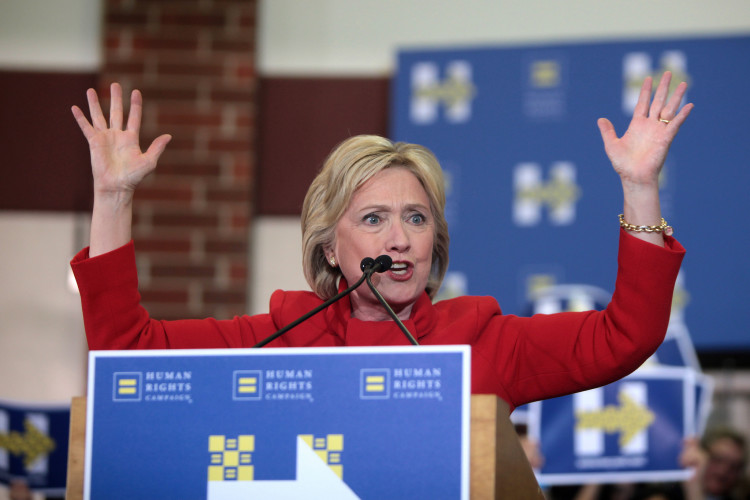 (Photo – Gage Skidmore on Flickr)
teleSUR – April 11, 2016
Democratic presidential frontrunner Hillary Clinton did not express any regret Monday about her support for the 2009 coup in Honduras, despite the deteriorating human rights situation, recently highlighted with the murder of prominent Indigenous activist Berta Caceres.
In fact, in an interview with the New York Daily News, in her opinion, the U.S. aid to military and police forces in Central America will eventually pay off just like Plan Colombia.
Plan Colombia was established under the administration of Bill Clinton in 1999 under the guise of fighting the war on drugs. The U.S. aid package, totalling almost US$2 billion, gave 78 percent of the funds to the Colombian military and police for counternarcotics and military operations against the rebel forces.
Despite a long list of studies and evidence that shows that Plan Colombia contributed to human rights abuses by security forces and the rise of paramilitary forces, Clinton took most of the credit for the current peace talks between the government and the FARC rebels, suggesting Plan Colombia brought peace to Colombia.
“I didn’t like the way it looked or the way they did it but (the coup leaders) had a very strong argument that they had followed the constitution and the legal precedence,” she said in an interview with the New York Daily News.
Democratically-elected president Manuel Zelaya was forcibly put on a plane and sent out of the country by the Honduran military in June 2009.
Clinton justified the move despite opposing advice from her top aides, who urged her to declare it a military coup, and to cut off U.S. aid, as some emails leaked in July revealed.
She admitted that the coup leaders “really undercut their argument by spiriting (Zelaya) out of the country in his pajamas, where they sent the military to take him out of his bed and get him out of the country.”
Nevertheless she strongly rejected the idea of cutting U.S. aid for Honduras, claiming this would have harmed the Honduran people, although it is mainly directed to the country’s security forces. It is used to keep the drug war within Honduran borders – as well as to keep Central American migrants running away from drug violence from reaching the United States.
‘Arrest arms dealers, not peace campaigners!’ 8 on trial over weapons fair protest

RT | April 11, 2016
Eight activists are standing trial at Stratford Magistrates Court for disrupting the world’s biggest arms fair, held in London, where deadly merchandise was marketed to repressive regimes such as Saudi Arabia, Bahrain and Azerbaijan.
The campaigners blocked the road leading to the Defence & Security Equipment International (DSEI) in Stratford, London, last September, preventing tanks and weaponry from entering.
The defendants are using a defense of necessity, insisting their actions were justified because they intended to prevent greater crimes taking place around the world.
These include: “The sale of weapons to internally repressive regimes, including Bahrain and Saudi Arabia; the sale of weapons to countries imminently at war and overtly complicit in ongoing war crimes in Yemen, Kurdistan and Palestine; the sale of weapons to regimes that have been widely accused of arming ISIS [Islamic State or IS]; the promotion for sale of weapons that are designed specifically for torture or banned under international law for their capabilities concerning the mass indiscriminate killing of civilians.”
The DSEI arms fair is held every two years in London, and is regularly attended by representatives from repressive regimes. It has also previously provided a platform for weapons dealers to illegally promote arms that are used for torture.
Last September’s event featured stalls from more than 1,500 exhibitors, including arms giants Lockheed Martin, BAE systems, Finmeccanica and others.
Protestors sought to disrupt the fair by locking their bodies together to block access roads outside the Excel Centre, where the fair was held. Several were arrested.
Some protestors, such as Vyara Gylsen – who was arrested after writing a slogan on a military vehicle with a washable marker pen – have since seen criminal charges against them dropped.
The defendants in court this week include Isa Al Aali, a Bahraini activist who was tortured during the Arab Spring uprising in Bahrain.
Green Party activists Angela Ditchfield and Tom Franklin are also among the eight appearing in court.
“The government is supporting and facilitating the sale of weapons that are being used to kill ordinary people, from the West Bank to Yemen and Sudan,” Franklin, 57, of York, said.
“This week we will put the arms trade in the dock and highlight the crimes that the government and the companies at DSEI are complicit in. Arrest arms dealers, not peace campaigners.”
The defendants will be supported by expert witnesses, including former South African MP Andrew Feinstein, who resigned from parliament in 2001 in protest at the government’s refusal to investigate a £5 billion (US$7.12 billion) arms deal.
Amnesty International UK’s Oliver Sprague, who heads up the charity’s arms Control and Policing division, will also give oral evidence, as will Bahrain Institute for Rights and Democracy director Sayed Ahmed, who seeks to improve accountability in the repressive Gulf state.
Switzerland Ready to Mediate Ukraine Crisis – Swiss Foreign Minister
Sputnik – 11.04.2016
Switzerland’s neutrality in the east Ukrainian crisis puts it in a position to mediate the conflict in order to bridge the gap between all parties involved, Swiss Foreign Minister Didier Burkhalter said Monday.
“The vision of Switzerland is not that of the Kremlin or that of Ukraine. It is the vision of the Swiss government. Switzerland believes we can play a role of the bridge, and… we are able to discuss the conflict situation with everyone,” Burkhalter said after a meeting with Russian Foreign Minister Sergei Lavrov.
Burkhalter said it was important to look for a solution instead of playing a blame game. He admitted there were differences between Moscow and Bern on the issue but underscored the importance of finding a way out of the Ukrainian crisis together.
“On Ukraine, I want to say that we do not agree on every issue with Russia, there are differences, but it does not prevent us from cooperation and looking for attempts to find a solution,” Burkhalter said.
The OSCE Special Monitoring Mission to Ukraine (SMM) said last week it had registered a spike in violence in the Donetsk region. It also continued to note the presence and use of proscribed weapons within the agreed security zone in eastern Ukraine.
Would a Clinton Win Mean More Wars?
By Robert Parry | Consortium News | April 10, 2016
The Democratic Party establishment seems determined to drag Hillary Clinton’s listless campaign across the finish line of her race with Bernie Sanders and then count on Republican divisions to give her a path to the White House. But – if she gets there – the world should hold its breath.
If Clinton becomes President, she will be surrounded by a neocon-dominated American foreign policy establishment that will press her to resume its “regime change” strategies in the Middle East and escalate its new and dangerous Cold War against Russia.
Hillary Clinton (Photo credit: AIPAC)
If Bashar al-Assad is still president of Syria, there will be demands that she finally go for the knock-out blow; there will pressure, too, for her to ratchet up sanctions on Iran pushing Tehran toward renouncing the nuclear agreement; there are already calls for deploying more U.S. troops on Russia’s border and integrating Ukraine into the NATO military structure.
President Clinton-45 would hear the clever talking points justifying these moves, the swaggering tough-guy/gal rhetoric, and the tear-jerking propaganda about evil enemies throwing babies off incubators, giving Viagra to soldiers to rape more women, and committing horrific crimes (some real but many imagined) against defenseless innocents.
Does anyone think that Hillary Clinton has the wisdom to resist these siren songs of confrontation and war, even if she were inclined to?
President Barack Obama, who – for all his faults – has a much deeper and subtler intellect than Hillary Clinton, found himself so battered by these pressures from the militaristic Washington “playbook” that he whined about his predicament to The Atlantic’s Jeffrey Goldberg, himself a neocon war hawk.
The Washington foreign policy establishment is now so profoundly in the hands of the neocons and their “liberal interventionist” sidekicks that the sitting President presumably couldn’t find anyone but a neocon to give those interviews to, even as he complained about how the U.S. capital is in the hands of warmongers.
Given this neocon domination of U.S. foreign policy – especially in the State Department bureaucracy, the major media and the big think tanks – Clinton will be buffeted by hawkish demands and plans both from outside of her administration and from within.
Already key neocons, such as the Brookings Institution’s Robert Kagan, are signaling that they expect to have substantial influence over Clinton’s foreign policy. Kagan, who has repackaged himself as a “liberal interventionist,” threw his support to Clinton, who put him on a State Department advisory board.
There is also talk in Washington that Kagan’s neocon wife, Assistant Secretary of State for European Affairs Victoria Nuland, another Clinton favorite and the architect of the “regime change” in Ukraine, would be in line for a top foreign policy job in a Clinton-45 administration.
Neocons Back in Charge
So, Clinton’s election could mean that some of the most dangerous people in American foreign policy would be whispering their schemes for war and more war directly into her ear – and her record shows that she is very susceptible to such guidance.
At every turn, as a U.S. senator and as Secretary of State, Clinton has opted for “regime change” solutions – from the Iraq invasion in 2003 to the Honduras coup in 2009 to the Libyan air war in 2011 to the Syria civil war since 2011 – or she has advocated for the escalation of conflicts, such as in Afghanistan and with Iran, rather than engaging in reasonable give-and-take negotiations.
Though her backers tout her experience as Secretary of State, the reality was that she repeatedly disdained genuine diplomacy and was constantly hectoring President Obama into adopting the most violent and confrontational options.
He sometimes did (the Afghan “surge,” the Libyan war, the Iran nuclear stand-off) but he sometimes didn’t (reversing the Afghan escalation, finally negotiating a nuclear deal with Iran after Clinton left, rejecting a direct U.S. military assault on the Syrian government, and working at times with the Russians on Iran and Syria).
In other words, Obama acted as a register or brake restraining Clinton’s hawkishness. With Clinton as the President, however, she would have no such restraints. One could expect her to endorse many if not all the harebrained neocon schemes, much as President George W. Bush did when his neocon advisers exploited his fear and fury over 9/11 to guide him into their “regime change” agenda for the Middle East.
The neocons have never given up their dreams of overthrowing Mideast governments that Israel has put on its enemies list. Iraq was only the first. To follow were Syria and Iran with the idea that by installing pro-Israeli leaders in those countries, Israel’s close-in enemies – Lebanon’s Hezbollah, Hamas and other Palestinian militant groups – could be isolated and crushed.
After Bush’s Iraq invasion in 2003, Washington’s neocons were joking about whether Iran or Syria should come next, with the punch line: “Real men go to Tehran!” But the Iraq War wasn’t the “cakewalk” that the neocons had predicted. Instead of throwing flowers at the U.S. troops, Iraqis planted IEDs.
As it turned out, a lot of “real men” and “real women” – as well as “real children” – died in Iraq, including nearly 4,500 American soldiers and hundreds of thousands of Iraqis.
So the neocon timetable took a hit but, in their view, only because of Bush’s incompetent follow-through on Iraq. If not for the botched occupation, the neocons felt they could have continued rolling up other troublesome regimes, one after another.
Professionally, the neocons also escaped the Iraq disaster largely unscathed, continuing to dominate Washington’s think tanks and the op-ed pages of major American news outlets such as The Washington Post and The New York Times. Barely missing a beat, they set about planning for the longer haul.
An Obama Mistake
Although they lost the White House in 2008, the neocons caught a break when President-elect Obama opted for a Lincoln-esque “team of rivals” on foreign policy. Instead of reaching out to Washington’s marginalized (and aging) foreign policy “realists,” Obama looked to the roster of the neocon-dominated establishment.
Obama recruited his hawkish Democratic rival, Sen. Hillary Clinton, to be Secretary of State and kept Bush’s Defense Secretary Robert Gates. Obama also left in place most of Bush’s military high command, including neocon favorite, General David Petraeus.
Obama’s naïve management strategy let the neocons and their “liberal interventionist” pals consolidate their bureaucratic control of Washington’s foreign policy bureaucracy, even though the President favored a more “realist” approach that would use America’s power more judiciously — and he was less enthralled to Israel’s right-wing government.
The behind-the-scenes neocon influence became especially pronounced at Clinton’s State Department where she tapped the likes of Nuland, a neocon ideologue and an adviser to Vice President Dick Cheney, to become the department’s spokesperson and put her on track to become Assistant Secretary of State for European Affairs (although the appointment wasn’t finalized until after Clinton left in 2013).
The neocon/liberal-hawk bias is now so strong inside the State Department that officials I know who have gone there reemerge as kind of “pod people” spouting arrogant talking points in support of U.S. intervention all over the world. By contrast, I find the CIA and the Pentagon to be places of relative realism and restraint.
Perhaps the best example of this “pod people” phenomenon was Sen. John Kerry, who replaced Clinton as Secretary of State and suddenly became the mouthpiece for the bureaucracy’s most extreme war-like rhetoric.
For instance, Kerry advocated a retaliatory bombing campaign against Syria’s military in August 2013, ignoring the intelligence community’s doubts about whether President Bashar al-Assad’s regime was responsible for a sarin-gas attack outside Damascus.
Instead of listening to the intelligence analysts, Kerry fell in line behind the neocon-driven “group think” pinning the blame on Assad, the perfect excuse for implementing the neocons’ long-delayed Syrian “regime change.” The neocons didn’t care what the facts were — and Kerry fell in line. [See Consortiumnews.com’s “What’s the Matter with John Kerry?”]
But Obama didn’t fall in line. He listened when Director of National Intelligence James Clapper told him that there was no “slam dunk” evidence implicating the Syrian military. (Ultimately, the evidence would point to a provocation carried out by Islamic extremists trying to trick the U.S. military into intervening in the war on their side.)
Obama also got help from Russian President Vladimir Putin who persuaded President Assad to surrender all his chemical weapons (while Assad still denied any role in the sarin-gas attack). Putin’s assistance infuriated the neocons who soon recognized that the Obama-Putin cooperation was a profound threat to their “regime change” enterprise.
Targeting Ukraine
Some of the smarter neocons quickly identified Ukraine as a potential wedge that could be driven between Obama and Putin. Carl Gershman, president of the National Endowment for Democracy, called Ukraine “the biggest prize” and a potential first step toward driving Putin from power in Russia.
It fell to Assistant Secretary of State Nuland to shepherd the Ukraine operation to fulfillment as she plotted with U.S. Ambassador to Ukraine Geoffrey Pyatt how to remove Ukraine’s pro-Russian President Viktor Yanukovych. Nuland and Pyatt were caught in an intercepted phone call discussing who should take over.
“Yats is the guy,” Nuland said referring to Arseniy Yatsenyuk who indeed would become the new prime minister. Nuland and Pyatt then exchanged ideas how to “glue this thing” and how to “midwife this thing.” This “thing” became the bloody Feb. 22, 2014 coup ousting elected President Yanukovych and touching off a civil war between Ukrainian “nationalists” from the west and Ukraine’s ethnic Russians in the east.
As the “nationalists,” some of them openly neo-Nazis, inflicted atrocities on ethnic Russians, Crimea voted by 96 percent to leave Ukraine and rejoin Russia. Resistance to the new Kiev regime also arose in the eastern Donbas region.
To the State Department – and the mainstream U.S. news media – this conflict was all explained as “Russian aggression” against Ukraine and a “Russian invasion” of Crimea (although Russian troops were already in Crimea as part of the Sevastopol naval base agreement). But All the Important People agreed that the Crimean referendum was a “sham” (although many polls have since confirmed the results).
When citizen Clinton weighed in on the Ukraine crisis, she compared Russian President Putin to Hitler.
So, today the neocon/liberal-hawk Washington “playbook” – as Obama would call it – calls for massing more and more U.S. troops and NATO weapons systems on Russia’s border to deter Putin’s “aggression.”
These tough guys and gals also vow to ignore Russia’s warnings against what it views as military threats to its existence. Apparently “real, real men” go to Moscow (perhaps riding a nuclear bomb like the famous seen from “Dr. Strangelove.”).
Ian Joseph Brzezinski, a State Department official under President George W. Bush and now a foreign policy expert for the Atlantic Council, a NATO think tank, has co-authored an article urging NATO to incorporate Ukrainian army units into its expansion of military operations along Russia’s border.
“High-level Ukrainian national security officials have urged the international community to be bolder in its response to Russia’s provocative military actions,” wrote Brzezinski (son of old Cold Warrior Zbigniew Brzezinski) and Ukrainian co-author Markian Bilynskyj.
“The deployment of a battle tested, Ukrainian infantry company or larger unit to reinforce the defense of NATO territory in Central Europe would be a positive contribution to the Alliance force posture in the region.”
Following the Playbook
This kind of tough-talking jargon is what the next President, whoever he or she is, can expect from Official Washington. From Obama’s interview in The Atlantic, it’s clear that he feels surrounded and embattled by these warmongering forces but takes some pride in resisting – from time to time – the Washington “playbook.”
But how would President Hillary Clinton respond? When she appeared before the American Israel Public Affairs Committee on March 21 – at a moment when it appeared she had all but nailed down the Democratic nomination – Clinton showed what you might call her true colors, fawning over how loyal she would be to Israel and promising to take the very cozy relationship between the U.S. and Israel “to the next level.”
By reviewing Clinton’s public record, one could reasonably conclude that she is herself a neocon, both in her devotion to Israel and her proclivity toward “regime change” solutions. She also follows the neocon lead in demonizing any foreign leader who gets in their way. But even if she isn’t a full-fledged neocon, she often bends to their demands.
The one possible deviation from this pattern is Clinton’s personal friendship with longtime adviser Sidney Blumenthal, who was an early critic of the neoconservatives as they emerged as a powerful force during the Reagan administration. Blumenthal and his son Max have also dared criticize Israel’s abusive treatment of the Palestinians.
However, the Israel Lobby appears to be taking no chances that Sidney Blumenthal’s voice might be heard during a Clinton-45 administration. Last month, a pro-Zionist group, The World Values Network, bought a full-page ad in The New York Times to attack Blumenthal and his son and declared that “Hillary Clinton must disavow her anti-Israel advisors.”
Though Clinton might not publicly disassociate herself from Sidney Blumenthal, the preemptive strike pushed him further toward the margins and helped clear the path for the Kagan/Nuland faction to rush to the center of Clinton’s foreign policy.
Indeed, Clinton’s primary focus if she gets elected is likely to be ensuring that she gets reelected. As a traditional politician, she would think that the way to achieve reelection is to stay on the good side of the Israeli leadership. Along those lines, she promised AIPAC that, as President, she would immediately invite Prime Minister Benjamin Netanyahu to the White House.
So, what would happen if Clinton takes the U.S.-Israeli relationship “to the next level”? Presumably that would mean taking a super-hard line against Iran over last year’s nuclear deal. Yet, already Iran is questioning whether its acceptance of extraordinary constraints on its nuclear program was worth it, given the U.S. unwillingness to grant meaningful relief on economic sanctions.
A belligerent Clinton approach – decrying Iran’s behavior and imposing new sanctions – would strengthen Iran’s hard-line faction internally and might well lead to Iran renouncing the agreement on the grounds of American bad faith. That, of course, would please the neocons and Netanyahu by putting the “bomb-bomb-bomb Iran” option back in play.
A Stunning Reversal
Clinton may have viewed her AIPAC speech as the beginning of her long-awaited “pivot to the center,” but afterwards she suffered a string of primary and caucus defeats at the hands of Sen. Bernie Sanders, most by landslide margins.
Besides those stunning defeats, Clinton’s campaign clearly has an “enthusiasm gap.” Sanders, the 74-year-old “democratic socialist” from Vermont, draws huge and excited crowds and wins younger voters by staggering percentages. Meanwhile, Clinton confronts polls showing high negatives and extraordinary public distrust.
If she gets the Democratic nomination, she may have little choice but to engage in a fiercely negative campaign since — faced with the lack of voter enthusiasm — her best chance of winning is to so demonize her Republican opponent that Democrats and independents will be driven to the polls out of fear of what the crazy GOP madman might do.
Right now, many Clinton supporters see her as the “safe” — not exciting — choice, a politician whose long résumé gives them comfort that she must know what’s she’s doing. African-American voters, who have been her most loyal constituency, apparently feel more comfortable with someone they’ve known (who has also served in the Obama administration) than Sanders who is unknown to many and is seen as someone whose ambitious programs appear less practical than Clinton’s small-bore ideas.
But a look behind Clinton’s résumé, especially her reliance on “regime change” and other interventionist schemes in the Middle East and Eastern Europe, might give all peace-loving voters pause. [See Consortiumnews.com’s “Is Hillary Clinton ‘Qualified’?”]
Savvy neocons, like Robert Kagan, have long understood that Clinton could be their Trojan Horse, pulled into the White House by Democratic voters. Kagan told The New York Times, “I feel comfortable with her on foreign policy. If she pursues a policy which we think she will pursue it’s something that might have been called neocon, but clearly her supporters are not going to call it that; they are going to call it something else.”
The same Times article noted that Clinton “remains the vessel into which many interventionists are pouring their hopes.” However, if she is that “vessel” carrying a neocon foreign policy back into the White House, this “safe” choice might prove dangerous to America and the world.
Investigative reporter Robert Parry broke many of the Iran-Contra stories for The Associated Press and Newsweek in the 1980s. You can buy his latest book, America’s Stolen Narrative, either in print here or as an e-book (from Amazon and barnesandnoble.com).
Location Location Location: The Unintended Symbolism of the White House Haft-Sîn
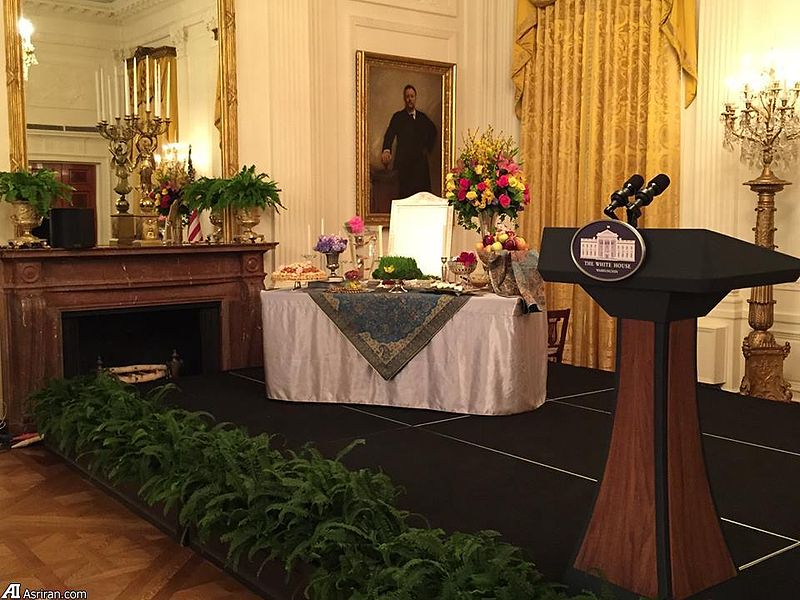
White House Nowruz, 2015
By Nima Shirazi | Wide Asleep In America | April 8, 2016
This week, Michelle Obama hosted the second annual White House Nowruz, a celebration of the Iranian New Year. Though a relatively apolitical affair, the placement of the reception’s traditional haft-sîn, however, should have raised some eyebrows.
Nowruz, which literally means “new day” in Farsi, is an ancient festival of new beginnings, deeply rooted in Zoroastrianism, celebrating the first day of Spring and the Persian calendar.
Of the myriad traditions and festivities associated with Nowruz, the most universally recognizable may be that of the haft-sîn (هفت سین), a table arrangement decorated with seven (haft) items – each beginning with the Persian letter S (sîn) – and symbolizing renewal, reconciliation, good luck, and prosperity.
The shindig, MC’ed by comedian Maz Jobrani and catered by renowned Persian chef Najmieh Batmanglij, was held on April 6 – a few days after the official holiday season (which lasts roughly 13 days) had actually ended.
The White House, naturally, had its own haft-sîn on display at its Nowruz party. However, its location in the East Room, where the celebration has been held both years, was a bit curious and (probably) unintentionally laden with symbolism all its own.
Nowruz-sevelt
The table containing such traditional items as wheat grass (sabzeh), garlic (sīr), vinegar (serkeh), apple (seeb), wheat germ pudding (samanu), sumac berries (somaq), and dried fruit (senjed) was placed – as it was last year as well – right beneath John Singer Sargent’s 1903 presidential portrait of Theodore Roosevelt.

A haft-sîn in the White House’s East Room, on April 6, 2016.
One of the principal promoters of American imperialism at the end of the 19th century and in the first decade of the 20th, Roosevelt once wrote, “I should welcome almost any war, for I think this country needs one.” It is said he carried around a list of six target nations on three continents.

In December 1904, Roosevelt issued his official Corollary to the Monroe Doctrine, declaring that the United States would not hesitate to use what he called its “international police power” to destroy and replace regimes deemed hostile to American interests. Though initially used to justify military intervention, invasion and occupation of Western Hemisphere nations such as Cuba, Nicaragua, Honduras, Haiti, and the Dominican Republic, Roosevelt sent a similar message to the entire world in late 1907, when he deployed the nation’s Great White Fleet to circumnavigate the globe in a show of power. The fleet consisted of 16 battleships and support vessels, crewed by 14,000 sailors. It sailed for 14 months, covering over 43,000 miles and made twenty port calls on six different continents.
Just as it is common practice today for U.S. presidents to deliver Nowruz remarks to the people, and sometimes leaders, of Iran, in the late 19th and early 20th centuries “American presidents were encouraged to exchange telegrams with the Shah of Iran on the occasion of the Persian New Year’s Day.”
“In 1902,” note scholars Kamran Scot Aghaie and Afshin Marashi, “President Theodore Roosevelt even presented the Shah of Iran, Muzaffar al-Din, and his brother, Zill al-Sultan, with a copy of his book, Hunting Trips of a Ranchman, recognizing that hunting was a favorite pastime of the Persian royal family as well.”
At the time, Iranian leaders saw the United States – which had no imperial presence in the Middle East at that point – as a potential non-interventionist ally against persistent Russian and British encroachment on Iranian sovereignty. Following the Iranian Constitutional Revolution in 1906, Russia and Britain both occupied Iran in 1907 in an effort to dissolve the parliament and prop up the waning Qajar dynasty, dividing the country between them until 1911. Roosevelt remained neutral, however, a position subsequently maintained by Taft and all successive U.S. administrations through World War II, when Russia and the United Kingdom again invaded and occupied Iran to secure wartime supply routes for the Allied Powers and replaced the then Shah, Reza Pahlavi, with his son, Mohammad Reza Pahlavi.
Kermit’s Coup
On August 19, 1953, Iranian Prime Minister Mohammad Mossadegh was overthrown in a military coup planned and orchestrated by the United States and Britain after nationalizing Iran’s oil industry. Pro-Shah riots were staged, hundreds were killed, newspapers supportive of Mossadegh were ransacked and shuttered, and the prime minister was arrested and tried for treason.
The main architect of the coup, executed at the behest of British petroleum interests and under the guise of pro-active anti-communism, was the chief of the CIA’s Near East and Africa division, Kermit Roosevelt, Jr. – grandson of President Teddy Roosevelt.
The ouster of Mossadegh, and the reinstallation of the Shah, by American intelligence operatives is a seminal moment in Iranian history and political consciousness, setting the stage for a quarter-century of tyrannical dictatorship propped up by torture, corruption and U.S. military aid, as well as establishing the United States as an interventionist power in the region. Popular backlash against the Shah, and his American backers, culminated in his overthrow by the Iranian Revolution, and the establishment of an Islamic Republic in 1979.
Roosevelt’s Shadow
By honoring Iranian culture with a haft-sîn table set under the watchful gaze of Teddy Roosevelt – the godfather of American military intervention and the grandfather of the man responsible for Operation Ajax in 1953 – the White House is unwittingly sending a message of continued hostility and imperial hubris toward Iran.
In his annual Nowruz message, delivered right before his historic trip to Cuba, President Obama said that, “even after decades of mistrust, it is possible for old adversaries to start down a new path.” At a time when Iran is fully upholding its end of the nuclear accord, while the residual effects of U.S. sanctions continue to cause problems for Iranians, optics remain important.
One possible step on the path to better relations would be to move the haft-sîn to the other side of the room.
Featured Video

Dan Dicks with James Corbett on Solutions Watch
or go to
Aletho News Archives – Video-Images
From the Archives
MMR (Measles, Mumps and Rubella) – Vaccine Risk Statement
MMR Vaccine (Measles, Mumps, and Rubella) Is It Safer Than Measles, Mumps and Rubella?
Physicians for Informed Consent | December 2024
… It has not been proven that the MMR vaccine is safer than measles, mumps, and rubella. The vaccine package insert raises questions about safety testing for cancer, genetic mutations, and impaired fertility. Although VAERS tracks some adverse events, it is too inaccurate to measure against the risk of measles, mumps, and rubella. Clinical trials do not have the ability to detect less common adverse reactions, and epidemiological studies are limited by the effects of chance and possible confounders. Safety studies of the MMR vaccine are particularly lacking in statistical power. A review of more than 60 MMR vaccine studies conducted for the Cochrane Library states, “The design and reporting of safety outcomes in MMR vaccine studies, both pre- and post-marketing, are largely inadequate.”19 Because permanent sequelae (aftereffects) from measles, mumps, and rubella are so rare (especially in children with normal levels of vitamin A and infected after birth),6,15-17 the level of accuracy of the research studies available is insufficient to rule out the possibility that the MMR vaccine causes greater death or permanent disability than measles, mumps, and rubella. – Read full article
Blog Roll
 Aletho News
- The fallacy of US delusions about Iran’s economic collapse
- Hezbollah denies Syria cell link, warns of Israeli plan to sow discord
- The legacy of US sanctions, war, and occupation in Iraq
- Iraqi resistance group rejects disarmament, vows to maintain support for Lebanon
- Sheikh al-Asadi warns of Iraqi government compliance with US demands
- How to MAKE THE CONSPIRATORS PAY for their crimes! Dan Dicks with James Corbett on Solutions Watch
- There’s a drought in academia: A drought in honest research on the subject of drought and other weather extremes
- Department of War Awards $20.7 Billion Contract to Raytheon for Air-to-Air Missiles
- ‘Distance yourselves from Israel’: IRGC urges US population to question govt policies
- America’s Greenland deal has a radioactive backstory
- If Americans Knew
- New Report: “Scholasticide and Genocide in Gaza: Assessment, Testimonies and Legal Analysis”
- Ex-Biden officials are desperate for a Gaza scapegoat
- Israeli “settlers” Invade Al-Aqsa; Pour Boiling Water on 75-Year-Old
- Israel Has Kidnapped Another American Teenager
- US arms sales to Israel worth $21.6 billion in 20 months
- Three Palestinians Killed in Israeli Attacks on Gaza
- Revealed: German “Anti-Semitism Expert” Driving Crackdown on Palestine Solidarity is Former Israeli Spy
- Egypt’s Warning to Israel Before Oct 7
- Israel’s siege signals another cruel winter for 1.8 million Gazans – Daily Update
- Netanyahu Asked UAE Leader to Deny Report on Oct. 7 Warning in Secret Visit, Sources Say
- No Tricks Zone
- Two More Paleo Reconstructions Affirm Meters-Higher Sea Levels Across Ireland, Brazil 7000-6000 Years Ago
- New Study: Earth And Venus Surface Warmth Largely Explained By Convection And Lapse Rate, Not CO2 Or Radiation
- 2025 Nature Paper Claiming Worsening Global Drought Gets RETRACTED …Heavily Flawed
- New Study: ‘Global Drought Shows No Detectable Recent Acceleration Under Climate Warming’
- Economic Masterminds: German Socialists Suggest Taxing Productivity Gains Stemming From Using AI
- The South China Sea Has Not Been Cooperating With The Climate Change Narrative
- Energy Crisis: Germany Enters Heating Season With Historically Low Gas Reserve Fill Levels
- New Study: The Antarctic Ice Sheet Gained Mass From 2020-2024 Due To Staggering Snow And Ice Accumulation
- Study: Ocean Heating Rates From Thousands Of Years Ago ‘Dwarf’ Modern Ocean Heating Rates
- Climate Extremists Target, Attack Large-Scale Power Grid Infrastructure In Germany!

