Georgia Joins NATO Rapid Response Force
Sputnik — 29.09.2015
TBILISI – Georgia has become the fourth nonmember state to be a member of the NATO Response Force (NRF), Georgian Prime Minister Irakli Garibashvili said Tuesday.
The NRF is a technologically-advanced high-readiness unit comprising land, air, and maritime forces within the alliance. The initiative was launched in 2002, and members created an operational group in 2014, as a response to changing security needs. Finland, Sweden and Ukraine also participate in the NRF program.
“We will be the fourth non-member country in the NFR, which indicates the high level of cooperation between the Georgian Armed Forces and the Alliance,” Garibashvili said as cited by the Georgian news portal Agenda.ge.
He added that the Georgian contribution to the NRF includes 130 soldiers.
Institutional cooperation between Georgia and NATO began in 1994, when Georgia became a member of NATO’s Partnership for Peace program. The country’s cooperation with the organization intensified in 2004 after a Rose Revolution which led to the forced resignation of President Eduard Shevardnadze.
Can Washington Get a New Military Base in Central Asia?
By Vladimir Odintsov – New Eastern Outlook – 30.09.2015
The special attention that the United States has been paying to Central Asia, while actively seeking ways to implement a strategy of global leadership in the region that is now fully recognized as the center of Eurasia, has been covered in numerous articles, including those published in NEO.
According to the geopolitical concept of the recognized American political scientist Zbigniew Brzezinski: Those who control Eurasia control the world. Therefore, Washington’s steps to strengthen American influence in the region in the long run are completely predictable. The pivotal role in this policy is played by the US military bases in the region and military cooperation ties. After all, according to the globalist logic of the White House, American influence in any region must be supported by the “adequate” military force. The 9/11 events in the US and the consequent anti-terrorist intervention in Afghanistan have become a pretext for a major military deployment of American and NATO troops in Central Asia.
By the way, the ongoing engagement of US troops in Afghanistan confirms the notion that the presence of US and NATO forces in this country has little to do with the “struggle for democracy”. The true purpose of the military intervention in Afghanistan was the creation of powerful military bases, as the geographical position of this country is pretty unique in terms of the strategic freedom it provides. From this area Washington can launch a massive attack against Russia’s Urals and Siberia, different facilities in Central Asia, Iran, Pakistan, India and China. For this reason from the very start of the US invasion of Afghanistan, Shindand and Bagram Air Bases were transformed into massive construction sites where a large number of surface and underground facilities being built.
It happens so that for Pentagon Central Asia serves as a base for applying pressure on Russia, China, Iran and the entire Eurasian continent, it also plays a pivotal role in the post-conflict settlement in Afghanistan, since it may form a joint military alliance under the banner of opposition to the Islamic state.
In an effort to strengthen its positions in Central Asia under the above mentioned pretext, the United States has sent invitations to join the anti-ISIL military coalition to both Uzbekistan and Tajikistan. To add some momentum to the matter the Deputy Assistant Secretary for Central Asia at the U.S. Department of State Daniel Rosenblum has recently visited Tashkent, while the commander of United States Central Command general John Lloyd James Austin III made a trip to Dushanbe. In the course of their visits American emissaries discussed the situation in Afghanistan, regional security, and the advantages of cooperation with the United States “in the fight against international extremism” with regional authorities. Of course, a particular emphasis was made on the “need” to stay away from integration with Russia.
It is clear that in dealing with Uzbekistan and Turkmenistan “messengers of Washington” tried to make active use of the fact that those states today are free from obligations of the Collective Security Treaty Organization, which is headed by Russia, and therefore they are free to pursue military cooperation with the US. Therefore, Washington and Tashkent signed a document that provides the latter with free shipments of military equipment in the next five years. American equipment, trucks, military vehicles for a total worth of 6.2 million dollars will be just granted to this Central Asian state. This year, the United States has handed over to Uzbekistan armored class M-ATV, as well as armored repair and recovery equipment to support them, 308 cars and 20 repairs trucks with a total cost of at least 150 million dollars.
In dealing with Uzbek authorities American envoys had to mind the fact that the country entered the international counter-terrorism coalition immediately after September 11, 2001, while establishing special relations with a number of Western countries. As a result, the territory of the Republic at the time was housing a US military base, while the German Air Force had the opportunity to use the airfield in Termez, near the border with Afghanistan. Cooperation with Germany has been prolonged recently for a couple more years, though Tashkent is stressing the fact that the airfield in Termez is not a foreign military base. There’s little wonder to this fact, since the presence of foreign military bases was prohibited by law in Uzbekistan after the Andijan events, therefore in 2005 at the request of the Uzbek authorities American soldiers had to pack and leave.
Uzbekistan, is seeking ways to retain non-aligned status, and has no plans to allow any foreign military bases on its territory, on top of that it remains reluctant to send Uzbek troops abroad. This was pretty much the answer that the President of Uzbekistan Islam Karimov has given to Washington’s offer to join a coalition against the Islamic state.
However, Washington’s attempts to strengthen its military and political influence in Central Asia are far from over. Such efforts will certainly continue, despite the apparent reluctance of regional players to burden themselves with military obligations to the United States. America has severely damaged its reputation, therefore nobody believes in its peacemaking aspirations anymore, since the wars it has been waging are only leading to the suffering and misery of the civilian population of the countries it invades.
Obama’s Self-Deceit
By Joe Lauria | Consortium News | September 29, 2015
There was stunned silence in the General Assembly Hall on Monday as U.S. President Barack Obama warned leaders against falling back to pre-United Nations days, in which strong nations imposed their will by force against the weak. There was apparent disbelief as he said it was Russia and China that wanted a “return to the rules that applied for most of human history and that pre-date this institution.”
These ancient rules included the “belief that power is a zero-sum game; that might makes right; that strong states must impose their will on weaker ones; that the rights of individuals don’t matter; and that in a time of rapid change, order must be imposed by force.”
The silence in the chamber came because everything Obama ascribed to others perfectly describes U.S. behavior from the end of the Second World War until today.
Since 1945, the U.S. has participated in dozens of documented invasions and overthrows of sovereign governments that resisted U.S. hegemony — the strongest nation imposing its will militarily on the weak. Among the best known are the 1953 and 1954 coups in Iran and Guatemala, and the invasions of Vietnam and Iraq. There were other democracies overthrown to install monarchies or dictatorships, such as Mobutu in Congo in 1961, Suharto in Indonesia in 1965 and Pinochet in Chile in 1973.
There was a setback to the American militarists with the loss in Vietnam, but a decade later Ronald Reagan was back at it, starting with a small invasion of Grenada. George H.W. Bush pounded Panama in 1989 and then devastated Iraqi forces in 1991 with an air and ground campaign, leading to his declaration that “we’ve kicked the Vietnam Syndrome once and for all.” Thirty years after the defeat in Vietnam, his son, George W. Bush, staged a full-scale 2003 invasion of Iraq, unleashing utter chaos that’s led to the most fearsome terrorist power in history.
Yet Obama on Monday was blaming Russia and China for the mess Washington has created, saying, “We see some major powers assert themselves in ways that contravene international law.” Obama cited Russia’s “annexation” of Crimea and “further aggression” in Eastern Ukraine.
He didn’t mention the documented U.S. orchestrated coup against a democratically-elected president in Kiev, which eastern Ukrainians have resisted. Russia has helped them but the U.S. with all its fancy surveillance that can find out almost any detail of your private life has yet to come up with a scrap of evidence of a Russian “invasion” of Ukraine.
At heart is either Obama’s willful ignorance of Ukraine, a clumsy attempt at disinformation, or as Vladimir Putin suggested in his U.N. speech a half hour later, a big measure of self-deception.
Obama said Ukrainians favor the West. That may be true of most western Ukrainians but not the whole country. Then, he said the U.S. has “few economic interests” in Ukraine. That’s woefully ignorant or a blatant lie. Monsanto has a big interest. Then there’s Joe Biden’s son, Hunter Biden, and a John Kerry family friend joining the board of Burisma Holdings, Ukraine’s largest private gas producer, just after the coup.
And the country’s finance minister is an American, Natalie Jaresko, who was given Ukrainian citizenship on the day she began the job. Why put an American government official in charge of the treasury of a foreign country?
Despite Russia’s “aggression,” Obama said he did not want a new Cold War — just U.S. bases encircling Russia, and China. In the South China Sea, the “U.S. makes no territorial claims,” Obama said, and only has an altruistic interest in protecting freedom of navigation and resolving disputes peacefully and not by “the law of force.” Yet, when the International Court of Justice ruled the U.S. mining of Nicaraguan harbors in the 1980s was illegal, the U.S. just ignored it.
On Syria, Obama (and his junior partners in Europe) insist that President Bashar al-Assad must leave office, as though that would make ISIS lay down its arms. “Realism … requires a managed transition away from Assad and to a new leader, and an inclusive government that recognizes there must be an end to this chaos so that the Syrian people can begin to rebuild,” the President said.
Obama’s position presupposes that the war would end as soon as a new Syrian leader calls off the fight. Instead ISIS is fighting not only to topple Assad, but to take Damascus from whoever may take Assad’s place. They want the capital. It doesn’t matter who is in charge.
Putin argues that Assad’s military is the most effective ground force (along with the Kurds) against the monstrous group and that all nations who want ISIS defeated should work with Assad. “Similar to the anti-Hitler coalition, it could unite a broad range of parties willing to stand firm against those who, just like the Nazis, sow evil and hatred of humankind,” Putin said.
While this is the most practical approach, it would be politically difficult for Western leaders, after three years of calling for Assad’s ouster, to reverse course. Instead the West blames Russian “ambition” in its military build-up in Syria rather than seeing it as a move to help Syria defeat this scourge that came about partly by the West playing around with terrorists who turned into a Frankenstein monster.
“The Islamic State itself did not come out of nowhere,” Putin told the Assembly. “It was initially developed as a weapon against undesirable secular regimes.” He added that it was irresponsible “to manipulate extremist groups and use them to achieve your political goals, hoping that later you’ll find a way to get rid of them or somehow eliminate them.”
Russia warned from three years ago that this could happen. “I’m urged to ask those who created this situation: do you at least realize now what you’ve done?” Putin asked. “But I’m afraid that this question will remain unanswered, because they have never abandoned their policy, which is based on arrogance, exceptionalism and impunity.”
Though Obama told the U.N. that he could essentially blow up the whole world if he wanted to, he’s decided to be a nice guy and seek diplomacy over confrontation with Russia and China. “I lead the strongest military that the world has ever known,” he boasted to the quiet hall, “and I will never hesitate to protect my country or our allies, unilaterally and by force where necessary.”
“I stand before you today believing in my core that we, the nations of the world, cannot return to the old ways of conflict and coercion,” Obama said. “We cannot look backwards.” Obama might try looking into a mirror instead.
Joe Lauria is a veteran foreign-affairs journalist based at the U.N. since 1990. He has written for the Boston Globe, the London Daily Telegraph, the Johannesburg Star, the Montreal Gazette, the Wall Street Journal and other newspapers. He can be reached atjoelauria@gmail.com and followed on Twitter at @unjoe.
Obama authorizes $20mn in ‘non-lethal’ military aid & training for Ukraine
RT | September 30, 2015
One day after Ukraine announced that US instructors would start training the country’s special forces, President Obama has authorized the provision of up to $20 million to Ukraine via the State Department to fund training and other similar activities.
“The authority… to direct the drawdown of up to $20 million in defense articles and services of the Department of Defense and military education and training to provide assistance for the Government of Ukraine,” the Presidential Memorandum says, specifying that another $1.5 million could be used to offer “nonlethal commodities and services.”
The announcement of additional funds allocated for the training of Ukrainian troops follows a statement by President Petro Poroshenko, who said that American instructors will start training Ukrainian special-operations troops this November.
“We have agreed that the best US instructors will finally start training the Ukrainian special forces, our special-operations troops, starting from November,” Poroshenko said in New York after meeting representatives of the Ukrainian diaspora living in the US.
The new US assistance will aid other foreign military instructors, including Americans, who are already training the Ukrainian National Guard.
“This is mutual exchange, mutual assistance. This is interesting not only to Ukrainians, to learn from American partners how to fight. This is interesting to Americans, to learn how to beat Russia,” Poroshenko said, according to Interfax.
Since the Ukrainian crisis began last year, the Obama administration has already provided Kiev authorities with more than $244 million in “non-lethal” military assistance, but despite repeated calls from Kiev, Washington has so far been reluctant to send “lethal” military aid
Is Boeing Helping the Feds Cover Up the Worst Nuke Disaster in US History?
Sputnik – 29.09.2015
Aviation giant Boeing Co. is spending money on lobbyists and court cases in an effort to cover up one of the worst nuclear disasters in American history and avoid paying millions to clean up the still-contaminated site.
In 1959, the Santa Susana Field Laboratory (SSFL) north of Los Angeles leaked more than 300 times the allowable amount of radiation into surrounding neighborhoods, according to an in-depth investigation by NBC4 Southern California. That contamination is now linked to up to a 60% increase in cancer in the area.
After a power surge occurred in one of the nuclear reactors, operators of the facility for weeks deliberately released radiation into the atmosphere to avoid a nuclear detonation similar to Chernobyl.
Boeing’s acquisition of SSFL in 1996 has prevented any proper investigation into current radiation levels at the site and stalled any cleanup efforts, according to the NBC4 investigation.
In 2007, the California legislature passed a law asserting that Boeing was obligated to clean up SSFL, even though it did not own the site at the time of the accident. A higher court invalidated the law, ruling it was too stringent.
Eventually, California’s EPA drafted agreements for the Department of Energy, NASA, and Boeing to commit to a cleanup. Boeing was the only entity that refused to sign.
A recent media report about Washington’s plans to upgrade nuclear bombs in Western Germany resulted in Russia expressing concern, but the United States denied allegations of violating the
Linda Adams, the former head of the state EPA, told NBC4 that Boeing hired “a large army of lobbyists … to do everything they could to stop a cleanup to that level.”
The lobbyists included “Peter Weiner, a former environmental aide to Gov. Jerry Brown, Winston Hickox, a former head of the California EPA, and Robert Hoffman, the former chief lawyer of the Department of Toxic Substance Control. All three left government service and have worked on behalf of Boeing to kill a full cleanup of Santa Susana.”
Boeing also gave thousands of dollars in campaign donations to Sen. Dianne Feinstein, Gov. Jerry Brown, Sen. Barbara Boxer and California Sen. Kevin De Leon.
De Leon is the Chairman of the Committee that confirmed Barbara Lee as Director of the Department of Toxic Substance Control, which is the agency tasked with forcing Boeing to conduct a cleanup.
Lee admitted to NBC4 that SSFL “has a lot of contamination,” but does not “believe there is a current exposure to communities.”
In 2012, Boeing put together a PR team with a campaign strategy to “target media” and put out the message that the “site poses no risk to human health today,” NBC4 reported.
A University of Michigan study found that rates of cancer were 60% higher in the area around SSFL than in other regions. Boeing dismissed the analysis, saying it found no proof of health side effects due to radiation.
The study’s lead author, Dr. Hal Morgenstern, accused Boeing of manipulating his work. Morgenstern wrote in a letter to California State Senator Joe Simitian, Chair of the Committee on Environmental Quality:
“I would like to make it clear to your Committee that Boeing’s claim made about the conclusion of our study is false. We did not conclude that there was no excess cancer in the communities surrounding SSFL. Furthermore, Boeing’s quotes from our report were taken out of context, and they failed to report our specific findings that contradicted their claim.”
Morgenstern noted that cancers such as thyroid, bladder, and lymph tissue were both tested for and found.
The Power of False Narrative
By Robert Parry | Consortium News | September 28, 2015
In this age of pervasive media, the primary method of social control is through the creation of narratives delivered to the public through newspapers, TV, radio, computers, cell phones and any other gadget that can convey information. This reality has given rise to an obsession among the power elite to control as much of this messaging as possible.
So, regarding U.S. relations toward the world, we see the State Department, the White House, Pentagon, NATO and other agencies pushing various narratives to sell the American people and other populations on how they should view U.S. policies, rivals and allies. The current hot phrase for this practice is “strategic communications” or Stratcom, which blends psychological operations, propaganda and P.R. into one mind-bending smoothie.
I have been following this process since the early 1980s when the Reagan administration sought to override “the Vietnam Syndrome,” a public aversion to foreign military interventions that followed the Vietnam War. To get Americans to “kick” this syndrome, Reagan’s team developed “themes” about overseas events that would push American “hot buttons.”
Tapping into the Central Intelligence Agency’s experience in psy-ops targeted at foreign audiences, President Ronald Reagan and CIA Director William J. Casey assembled a skilled team inside the White House led by CIA propaganda specialist Walter Raymond Jr.
From his new perch on the National Security Council staff, Raymond oversaw inter-agency task forces to sell interventionist policies in Central America and other trouble spots. The game, as Raymond explained it in numerous memos to his underlings, was to glue black hats on adversaries and white hats on allies, whatever the truth really was.
The fact that many of the U.S.-backed forces – from the Nicaraguan Contras to the Guatemalan military – were little more than corrupt death squads couldn’t be true, at least according to psy-ops doctrine. They had to be presented to the American public as wearing white hats. Thus, the Contras became the “moral equals of our Founding Fathers” and Guatemala’s murderous leader Efrain Rios Montt was getting a “bum rap” on human rights, according to the words scripted for President Reagan.
The scheme also required that anyone – say, a journalist, a human rights activist or a congressional investigator – who contradicted this white-hat mandate must be discredited, marginalized or destroyed, a routine of killing any honest messenger.
But it turned out that the most effective part of this propaganda strategy was to glue black hats on adversaries. Since nearly all foreign leaders have serious flaws, it proved much easier to demonize them – and work the American people into war frenzies – than it was to persuade the public that Washington’s favored foreign leaders were actually paragons of virtue.
An Unflattering Hat
Once the black hat was jammed on a foreign leader’s head, you could say whatever you wanted about him and disparage any American who questioned the extreme depiction as a “fill-in-the-blank apologist” or a “stooge” or some other ugly identifier that would either silence the dissenter or place him or her outside the bounds of acceptable debate.
Given the careerist conformity of Washington, nearly everyone fell into line, including news outlets and human rights groups. If you wanted to retain your “respectability” and “influence,” you agreed with the conventional wisdom. So, with every foreign controversy, we got a new “group think” about the new “enemy.” The permissible boundary of each debate was set mostly by the neoconservatives and their “liberal interventionist” sidekicks.
That this conformity has not served American national interests is obvious. Take, for example, the disastrous Iraq War, which has cost the U.S. taxpayers an estimated $1 trillion, led to the deaths of some 4,500 American soldiers, killed hundreds of thousands of Iraqis, and unleashed chaos across the strategic Middle East and now into Europe.
Most Americans now agree that the Iraq War “wasn’t worth it.” But it turns out that Official Washington’s catastrophic “group thinks” don’t just die well-deserved deaths. Like a mutating virus, they alter shape as the outside conditions change and survive in a new form.
So, when the public caught on to the Iraq War deceptions, the neocon/liberal-hawk pundits just came up with a new theme to justify their catastrophic Iraq strategy, i.e., “the successful surge,” the dispatch of 30,000 more U.S. troops to the war zone. This theme was as bogus as the WMD lies but the upbeat storyline was embraced as the new “group think” in 2007-2008.
The “successful surge” was a myth, in part, because many of its alleged “accomplishments” actually predated the “surge.” The program to pay off Sunnis to stop shooting at Americans and the killing of “Al Qaeda in Iraq” leader Abu Musab al-Zarqawi both occurred in 2006, before the surge even began. And its principal goal of resolving sectarian grievances between Sunni and Shiite was never accomplished.
But Official Washington wrapped the “surge” in the bloody flag of “honoring the troops,” who were credited with eventually reducing the level of Iraqi violence by carrying out the “heroic” surge strategy as ordered by President Bush and devised by the neocons. Anyone who noted the holes in this story was dismissed as disrespecting “the troops.”
The cruel irony was that the neocon pundits, who had promoted the Iraq War and then covered their failure by hailing the “surge,” had little or no regard for “the troops” who mostly came for lower socio-economic classes and were largely abstractions to the well-dressed, well-schooled and well-paid talking heads who populate the think tanks and op-ed pages.
Safely ensconced behind the “successful surge” myth, the Iraq War devotees largely escaped any accountability for the chaos and bloodshed they helped cause. Thus, the same “smart people” were in place for the Obama presidency and just as ready to buy into new interventionist “group thinks” – gluing black hats on old and new adversaries, such as Libya’s Muammar Gaddafi, Syria’s Bashar al-Assad and, most significantly, Russia’s Vladimir Putin.
Causing Chaos
In 2011, led this time by the liberal interventionists – the likes of Secretary of State Hillary Clinton and White House aide Samantha Power – the U.S. military and some NATO allies took aim at Libya, scoffing at Gaddafi’s claim that his country was threatened by Islamic terrorists. It was not until Gaddafi’s military was destroyed by Western airstrikes (and he was tortured and murdered) that it became clear that he wasn’t entirely wrong about the Islamic extremists.
The jihadists seized large swaths of Libyan territory, killed the U.S. ambassador and three other diplomatic personnel in Benghazi, and forced the closing of U.S. and other Western embassies in Tripoli. For good measure, Islamic State terrorists forced captured Coptic Christians to kneel on a Libyan beach before beheading them.
Amid this state of anarchy, Libya has been the source of hundreds of thousands of migrants trying to reach Europe by boat. Thousands have drowned in the Mediterranean. But, again, the leading U.S. interventionists faced no accountability. Clinton is the frontrunner for the Democratic presidential nomination, and Power is now U.S. Ambassador to the United Nations.
Also, in 2011, a similar uprising occurred in Syria against the secular regime headed by President Assad, with nearly identical one-sided reporting about the “white-hatted” opposition and the “black-hatted” government. Though many protesters indeed appear to have been well-meaning opponents of Assad, Sunni terrorists penetrated the opposition from the beginning.
This gray reality was almost completely ignored in the Western press, which almost universally denounced the government when it retaliated against opposition forces for killing police and soldiers. The West depicted the government response as unprovoked attacks on “peaceful protesters.” [See Consortiumnews.com’s “Hidden Origins of Syria’s Civil War.”]
This one-sided narrative nearly brought the U.S. military to the point of another intervention after Aug. 21, 2013, when a mysterious sarin gas attack killed hundreds in a suburb of Damascus. Official Washington’s neocons and the pro-interventionists in the State Department immediately blamed Assad’s forces for the atrocity and demanded a bombing campaign.
But some U.S. intelligence analysts suspected a “false-flag” provocation by Islamic terrorists seeking to get the U.S. air force to destroy Assad’s army for them. At the last minute, President Obama steered away from that cliff and – with the help of President Putin – got Assad to surrender Syria’s chemical arsenal, while Assad continued to deny a role in the sarin attack. [See Consortiumnews.com’s “The Collapsing Syria-Sarin Case.”]
Upset over Iran
Putin also assisted Obama on another front with another demonized “enemy,” Iran. In late 2013, the two leaders collaborated in getting Iran to make significant concessions on its nuclear program, clearing the way for negotiations that eventually led to stringent international controls.
These two diplomatic initiatives alarmed the neocons and their right-wing Israeli friends. Since the mid-1990s, the neocons had worked closely with Prime Minister Benjamin Netanyahu in plotting a “regime change” strategy for countries that were viewed as troublesome to Israel, with Iraq, Syria and Iran topping the list.
Putin’s interference with that agenda – by preventing U.S. bombing campaigns against Syria and Iran – was viewed as a threat to this longstanding Israeli/neocon strategy. There was also fear that the Obama-Putin teamwork could lead to renewed pressure on Israel to recognize a Palestinian state. So, that relationship had to be blown up.
The detonation occurred in early 2014 when a neocon-orchestrated coup overthrew elected Ukrainian President Viktor Yanukovych and replaced him with a fiercely anti-Russian regime which included neo-Nazi and other ultra-nationalist elements as well as free-market extremists.
Ukraine had been on the neocon radar at least since September 2013, just after Putin undercut plans for bombing Syria. Neocon Carl Gershman, president of the U.S.-government-funded National Endowment for Democracy, wrote a Washington Post op-ed deeming Ukraine “the biggest prize” and a key steppingstone toward another regime change in Moscow, removing the troublesome Putin.
Gershman’s op-ed was followed by prominent neocons, such as Sen. John McCain and Assistant Secretary of State for European Affairs Victoria Nuland, urging on violent protests that involved firebombing the police. But the State Department and the mainstream media glued white hats on the Maidan protesters and black hats on the police and the government.
Then, on Feb. 20, 2014, a mysterious sniper attack killed both police and demonstrators, leading to more clashes and the deaths of scores of people. The U.S. government and press corps blamed Yanukovych and – despite his signing an agreement for early elections on Feb. 21 – the Maidan “self-defense forces,” spearheaded by neo-Nazi goons, overran government buildings on Feb. 22 and installed a coup regime, quickly recognized by the State Department as “legitimate.”
Though the fault for the Feb. 20 sniper attack was never resolved – the new Ukrainian regime showed little interest in getting to the bottom of it – other independent investigations pointed toward a provocation by right-wing gunmen who targeted police and protesters with the goal of deepening the crisis and blaming Yanukovych, which is exactly what happened.
These field reports, including one from the BBC, indicated that the snipers likely were associated with the Maidan uprising, not the Yanukovych government. [Another worthwhile documentary on this mystery is “Maidan Massacre.”]
One-Sided Reporting
Yet, during the Ukrainian coup, The New York Times and most other mainstream media outlets played a role similar to what they had done prior to the Iraq War when they hyped false and misleading stories about WMD. By 2014, the U.S. press corps no longer seemed to even pause before undertaking its expected propaganda role.
So, after Yanukovych’s ouster, when ethnic Russians in Crimea and eastern Ukraine rose up against the new anti-Russian order in Kiev, the only acceptable frame for the U.S. media was to blame the resistance on Putin. It must be “Russian aggression” or a “Russian invasion.”
When a referendum in Crimea overwhelmingly favored secession from Ukraine and rejoining Russia, the U.S. media denounced the 96 percent vote as a “sham” imposed by Russian guns. Similarly, resistance in eastern Ukraine could not have reflected popular sentiment unless it came from mass delusions induced by “Russian propaganda.”
Meanwhile, evidence of a U.S.-backed coup, such as the intercepted phone call of a pre-coup discussion between Assistant Secretary Nuland and U.S. Ambassador Geoffrey Pyatt on how “to midwife this thing” and who to install in the new government (“Yats is the guy”), disappeared into the memory hole, not helpful for the desired narrative. [See Consortiumnews.com’s “NYT Still Pretends No Coup in Ukraine.”]
When Malaysia Airlines Flight 17 was shot down over eastern Ukraine on July 17, 2014, the blame machine immediately roared into gear again, accusing Putin and the ethnic Russian rebels. But some U.S. intelligence analysts reportedly saw the evidence going in a different direction, implicating a rogue element of the Ukrainian regime.
Again, the mainstream media showed little skepticism toward the official story blaming Putin, even though the U.S. government and other Western nations refused to make public any hard evidence supporting the Putin-did-it case, even now more than a year later. [See Consortiumnews.com’s “MH-17 Mystery: A New Tonkin Gulf Case.”]
The pattern that we have seen over and over is that once a propaganda point is scored against one of the neocon/liberal-hawk “enemies,” the failure to actually prove the allegation is not seen as suspicious, at least not inside the mainstream media, which usually just repeats the old narrative again and again, whether its casting blame on Putin for MH-17, or on Yanukovych for the sniper attack, or on Assad for the sarin gas attack.
Instead of skepticism, it’s always the same sort of “group think,” with nothing learned from the disaster of the Iraq War because there was virtually no accountability for those responsible.
Obama’s Repression
Yet, while the U.S. press corps deserves a great deal of blame for this failure to investigate important controversies independently, President Obama and his administration have been the driving force in this manipulation of public opinion over the past six-plus years. Instead of the transparent government that Obama promised, he has run one of the most opaque, if not the most secretive, administrations in American history.
Besides refusing to release the U.S. government’s evidence on pivotal events in these international crises, Obama has prosecuted more national security whistleblowers than all past presidents combined.
That repression, including a 35-year prison term for Pvt. Bradley/Chelsea Manning and the forced exile of indicted National Security Agency contractor Edward Snowden, has intimidated current intelligence analysts who know about the manipulation of public opinion but don’t dare tell the truth to reporters for fear of imprisonment.
Most of the “leaked” information that you still see in the mainstream media is what’s approved by Obama or his top aides to serve their interests. In other words, the “leaks” are part of the propaganda, made to seem more trustworthy because they’re coming from an unidentified “source” rather than a named government spokesman.
At this late stage in Obama’s presidency, his administration seems drunk on the power of “perception management” with the new hot phrase, “strategic communications” which boils psychological operations, propaganda and P.R. into one intoxicating brew.
From NATO’s Gen. Philip Breedlove to the State Department’s Under Secretary for Public Diplomacy Richard Stengel, the manipulation of information is viewed as a potent “soft power” weapon. It’s a way to isolate and damage an “enemy,” especially Russia and Putin.
This demonization of Putin makes cooperation between him and Obama difficult, such as Russia’s recent military buildup in Syria as part of a commitment to prevent a victory by the Islamic State and Al Qaeda. Though one might think that Russian help in fighting terrorism would be welcomed, Nuland’s State Department office responded with a bizarre and futile attempt to build an aerial blockade of Russian aid flying to Syria across eastern Europe.
Nuland and other neocons apparently would prefer having the black flag of Sunni terrorism flying over Damascus than to work with Putin to block such a catastrophe. The hysteria over Russia’s assistance in Syria is a textbook example of how people can begin believing their own propaganda and letting it dictate misguided actions.
On Thursday, Obama’s White House sank to a new low by having Press Secretary Josh Earnest depict Putin as “desperate” to land a meeting with Obama. Earnest then demeaned Putin’s appearance during an earlier sit-down session with Netanyahu in Moscow. “President Putin was striking a now-familiar pose of less-than-perfect posture and unbuttoned jacket and, you know, knees spread far apart to convey a particular image,’ Earnest said.
But the meeting photos actually showed both men with their suit coats open and both sitting with their legs apart at least for part of the time. Responding to Earnest’s insults, the Russians denied that Putin was “desperate” for a meeting with Obama and added that the Obama administration had proposed the meeting to coincide with Putin’s appearance at the United Nations General Assembly in New York on Monday.
“We do not refuse contacts that are proposed,” said Yuri Ushakov, a top foreign policy adviser to Putin. “We support maintaining constant dialogue at the highest level.” The Kremlin also included no insults about Obama’s appearance in the statement.
However, inside Official Washington, there appears to be little thought that the endless spinning, lying and ridiculing might dangerously corrode American democracy and erode any remaining trust the world’s public has in the word of the U.S. government. Instead, there seems to be great confidence that skilled propagandists can discredit anyone who dares note that the naked empire has wrapped itself in the sheerest of see-through deceptions.
Investigative reporter Robert Parry broke many of the Iran-Contra stories for The Associated Press and Newsweek in the 1980s. You can buy his latest book, America’s Stolen Narrative, either in print here or as an e-book (from Amazon and barnesandnoble.com).
US to escalate illegal occupation of Afghanistan
Fars News Agency | September 29, 2015
TEHRAN – There’s going to be no solution to the Afghan crisis, and it’s all Obama’s fault.
At a time when the people of Afghanistan seek the international community’s help for peace and prosperity, the United States has decided to scrap their pullout plans once again, leaving thousands of occupying troops behind through the end of President Obama’s final term in office.
The silly argument by those in favor of increasing the American troops in place is largely the same throughout the war, that the Afghan government isn’t capable of beating the Taliban on their own, and that a US pullout would add pressure to that struggling military.
Conceivably, American troops may end up being there for many decades because this is where the action is. What’s more, US generals say they need more troops. In this fallacy, their call for a bigger deployment has forced Obama to consider different options while Republicans have lambasted him for letting political motivations override the needs of commanders.
The Pentagon insists Obama’s failure to promptly back their surge could dishonor America, while corporate media say no matter what the president wants, it will be very hard to stop the army generals. And that’s exactly what Obama, mired in proverbial perplexity, is not doing right now: In Washington, the Pentagon and the warmongers have the final say.
“Avoiding another Vietnam,” says this school of thought, “requires a figurehead government – one that delegates all military decision-making power to generals and effectively strips it from elected civilians who will supposedly be too politically motivated.” This authoritarian ideology explains not only the spiteful reaction to Obama’s Afghanistan deliberations but also some of the most anti-democratic statements ever uttered by American leaders.
It explains, for instance, former Vice President Dick Cheney’s assertion that “public opinion doesn’t matter when it comes to military policy.” Nevertheless, it is the US Constitution which gives political figures in Washington the final say: Article I empowers Congress “to declare and finance wars,” and Article II states that “while the White House may require the opinion of military officers, ultimately the President shall be Commander in Chief.”
In this new world order geopolitical business, Obama and congressional leaders have however decided to defy public will – and international law – by making the terrible choice to escalate the Afghanistan War. This is while the illegal occupation has reached its sell-by date. A majority of Americans now tell presidential candidates the mission was a mistake. Regrettably, the generals who run wars, and the defense contractors who profit from them, want more troops and more war in Afghanistan. And that includes many presidential candidates.
From experience, the military buildup will only ensure more violence, attract more armed opposition, and postpone the day of reckoning among political factions in Afghanistan. It will never have a ghost of a chance of success.
Right on cue, the American people should wisely turn against such a destructive wave that will once again cost too many lives and hundreds of billions of dollars, while only making a terrible situation worse for the Afghans. The American people have the power to stop this madness and folly they know is irresponsible, inconclusive and unpopular. It falls to them to demand an exit strategy and not an escalation. They could start doing so by electing a pacifist president – if there’s any.
How To Solve The European Migrant/Refugee Crisis – 5 Simple Steps
Storm Clouds Gathering | September 25, 2015
The refugee crisis in Europe could be easily solved. The problem is that the real solution would not suit the the political establishment of the United States or Western Europe. We’ve distilled what needs to be done down to 5 simple steps.
- Stop funding and arming rebel groups attempting to overthrow the Syrian government. It’s well established that these weapons have been ending up in the hands of ISIS and its affiliates. This has caused nothing but chaos and destruction. Money being funneled into these shady operations should be immediately redirected to an intensive reconstruction effort.
- Pressure Turkey and Jordan to cut off ISIS supply routes, and impose sanctions on any country facilitating the sale of oil from IS territory or allowing funds or materials to reach them. No army can function if their supply chain is broken. It’s not an accident these routes start at the Turkish and Jordanian borders.
- Support the Syrian government. An entire year of U.S. airstrikes in Syria have utterly failed to destroy or even significantly weaken ISIS. Of course this is because the real strategy isn’t to bring ISIS down, but rather to contain them and allow them to weaken Assad gradually. If Washington really wanted to stop this group, they would take a hint from Russia and provide the Syrian government with weapons, training and logistical support to enable them to push ISIS back. This means Washington and its allies would have to officially abandon all plans for a forced regime change. They might not like Assad, but the majority of the citizens of Syria support him. In fact he has more support within his country than Obama or the U.S. congress have in America. And at various intervals he’s had more support than Congress and Obama combined. Any government installed after a U.S. backed regime change will be viewed as a puppet government, and will therefore lack the legitimacy needed to stabilize the region. If you need evidence of this, just look at Afghanistan or Iraq.
- Provide direct assistance to rebuild housing, infrastructure and businesses destroyed by the conflict. In the short term temporary refugee camps should be set up in areas outside of the conflict zone, and food and medical supplies shipped in on a regular basis. Yes this will cost money, but so has the five year regime change push that created the problem in the first place.
- Return the refugees to these stabilized regions. It is in no one’s interest to flood Europe with masses of unemployed refugees. Doing so will only lead to heightened tensions and will strengthen xenophobic movements. These people don’t need to be transplanted into the ghettos of Europe, they need their homes back.
Polish MPs approve ‘technical agreement’ on US anti-missile base
RT | September 25, 2015
Poland’s lower house of parliament has given the green light to the country’s president to ratify a technical agreement on establishing a US anti-missile base in Redzikowo. Under the NATO-backed plan, the facility should be operational by 2018.
A total of 422 members of the Polish Sejm voted in favor of the bill, with three MPs against and five abstaining.
The agreement in question is a part of a much-debated NATO-backed plan that was first agreed on by the US and Poland in 2008. At that time, it was claimed that the base was necessary to counter the risk of a possible missile attack from Iran or North Korea.
The document outlines technical conditions for the US anti-missile base’s operation on Polish soil, such as restrictions on the height of the buildings that can be built around the base, the use of devices emitting electromagnetic waves, and flights of military aircraft over and around the future facility.
Washington wants to expand the European anti-missile defense (AMD) by putting land- and sea-based radar and interceptors in the village of Redzikowo near the northern Polish town of Slupsk.
The same agreement to host anti-missile bases for of AMD has already been signed with Romania.
The deal stipulates that both countries will host some 24 vertical-launch SM-3 missiles each. The construction of AMD components in Poland is set to start next year and be completed by 2018.
Washington’s plans to install anti-missile systems in Eastern Europe have been one of the biggest stumbling blocks in US-Russia relations.
In 2009, a year after Warsaw and Washington signed the agreement, President Barack Obama assured that the deal would be canceled if the issue with Iran over its nuclear program was sorted out.
However, despite the agreement with Tehran, which curbed its controversial nuclear program in exchange for the easing of international sanctions, the NATO-backed Europe AMD plan is set to go forward.
“The deal with Tehran doesn’t include missiles, therefore the threat remains,” John A. Heffern, US Deputy Secretary of State for Europe and Eurasia, told the Polish Rzeczpospolita newspaper in July.
The Polish government has repeatedly requested that NATO establish military bases in the country, claiming that it is necessary to counter what it calls “a Russian threat.”
Since Crimea’s reunion with Russia in March 2014 and the start of the military conflict in eastern Ukraine last spring, NATO forces have significantly stepped up their military exercises along the Russian border, and frequently carried out drills in the Baltic States and Eastern Europe.
U.S. Special Ops Forces Deployed in 135 Nations
2015 Proves to Be Record-Breaking Year for the Military’s Secret Military
By Nick Turse | TomDispatch | September 24, 2015
You can find them in dusty, sunbaked badlands, moist tropical forests, and the salty spray of third-world littorals. Standing in judgement, buffeted by the rotor wash of a helicopter or sweltering beneath the relentless desert sun, they instruct, yell, and cajole as skinnier men playact under their watchful eyes. In many places, more than their particular brand of camouflage, better boots, and designer gear sets them apart. Their days are scented by stale sweat and gunpowder; their nights are spent in rustic locales or third-world bars.
These men — and they are mostly men — belong to an exclusive military fraternity that traces its heritage back to the birth of the nation. Typically, they’ve spent the better part of a decade as more conventional soldiers, sailors, marines, or airmen before making the cut. They’ve probably been deployed overseas four to 10 times. The officers are generally approaching their mid-thirties; the enlisted men, their late twenties. They’ve had more schooling than most in the military. They’re likely to be married with a couple of kids. And day after day, they carry out shadowy missions over much of the planet: sometimes covert raids, more often hush-hush training exercises from Chad to Uganda, Bahrain to Saudi Arabia, Albania to Romania, Bangladesh to Sri Lanka, Belize to Uruguay. They belong to the Special Operations forces (SOF), America’s most elite troops — Army Green Berets and Navy SEALs, among others — and odds are, if you throw a dart at a world map or stop a spinning globe with your index finger and don’t hit water, they’ve been there sometime in 2015.
The Wide World of Special Ops
This year, U.S. Special Operations forces have already deployed to 135 nations, according to Ken McGraw, a spokesman for Special Operations Command (SOCOM). That’s roughly 70% of the countries on the planet. Every day, in fact, America’s most elite troops are carrying out missions in 80 to 90 nations, practicing night raids or sometimes conducting them for real, engaging in sniper training or sometimes actually gunning down enemies from afar. As part of a global engagement strategy of endless hush-hush operations conducted on every continent but Antarctica, they have now eclipsed the number and range of special ops missions undertaken at the height of the conflicts in Iraq and Afghanistan.
In the waning days of the Bush administration, Special Operations forces (SOF) were reportedly deployed in only about 60 nations around the world. By 2010, according to the Washington Post, that number had swelled to 75. Three years later, it had jumped to 134 nations, “slipping” to 133 last year, before reaching a new record of 135 this summer. This 80% increase over the last five years is indicative of SOCOM’s exponential expansion which first shifted into high gear following the 9/11 attacks.
Special Operations Command’s funding, for example, has more than tripled from about $3 billion in 2001 to nearly $10 billion in 2014 “constant dollars,” according to the Government Accountability Office (GAO). And this doesn’t include funding from the various service branches, which SOCOM estimates at around another $8 billion annually, or other undisclosed sums that the GAO was unable to track. The average number of Special Operations forces deployed overseas has nearly tripled during these same years, while SOCOM more than doubled its personnel from about 33,000 in 2001 to nearly 70,000 now.
Each day, according to SOCOM commander General Joseph Votel, approximately 11,000 special operators are deployed or stationed outside the United States with many more on standby, ready to respond in the event of an overseas crisis. “I think a lot of our resources are focused in Iraq and in the Middle East, in Syria for right now. That’s really where our head has been,” Votel told the Aspen Security Forum in July. Still, he insisted his troops were not “doing anything on the ground in Syria” — even if they had carried out a night raid there a couple of months before and it was later revealed that they are involved in a covert campaign of drone strikes in that country.
“I think we are increasing our focus on Eastern Europe at this time,” he added. “At the same time we continue to provide some level of support on South America for Colombia and the other interests that we have down there. And then of course we’re engaged out in the Pacific with a lot of our partners, reassuring them and working those relationships and maintaining our presence out there.”
In reality, the average percentage of Special Operations forces deployed to the Greater Middle East has decreased in recent years. Back in 2006, 85% of special operators were deployed in support of Central Command or CENTCOM, the geographic combatant command (GCC) that oversees operations in the region. By last year, that number had dropped to 69%, according to GAO figures. Over that same span, Northern Command — devoted to homeland defense — held steady at 1%, European Command (EUCOM) doubled its percentage, from 3% to 6%, Pacific Command (PACOM) increased from 7% to 10%, and Southern Command, which overseas Central and South America as well as the Caribbean, inched up from 3% to 4%. The largest increase, however, was in a region conspicuously absent from Votel’s rundown of special ops deployments. In 2006, just 1% of the special operators deployed abroad were sent to Africa Command’s area of operations. Last year, it was 10%.
Globetrotting is SOCOM’s stock in trade and, not coincidentally, it’s divided into a collection of planet-girding “sub-unified commands”: the self-explanatory SOCAFRICA; SOCEUR, the European contingent; SOCCENT, the sub-unified command of CENTCOM; SOCKOR, which is devoted strictly to Korea; SOCPAC, which covers the rest of the Asia-Pacific region; SOCSOUTH, which conducts missions in Central America, South America, and the Caribbean; SOCNORTH, which is devoted to “homeland defense”; and the ever-itinerant Joint Special Operations Command or JSOC, a clandestine sub-command (formerly headed by Votel) made up of personnel from each service branch, including SEALs, Air Force special tactics airmen, and the Army’s Delta Force that specializes in tracking and killing suspected terrorists.
The elite of the elite in the special ops community, JSOC takes on covert, clandestine, and low-visibility operations in the hottest of hot spots. Some covert ops that have come to light in recent years include a host of Delta Force missions: among them, an operation in May in which members of the elite force killed an Islamic State commander known as Abu Sayyaf during a night raid in Syria; the 2014 release of long-time Taliban prisoner Army Sergeant Bowe Bergdahl; the capture of Ahmed Abu Khattala, a suspect in 2012 terror attacks in Benghazi, Libya; and the 2013 abduction of Anas al-Libi, an al-Qaeda militant, off a street in that same country. Similarly, Navy SEALs have, among other operations, carried out successful hostage rescue missions in Afghanistan and Somalia in 2012; a disastrous one in Yemen in 2014; a 2013 kidnap raid in Somalia that went awry; and — that same year — a failed evacuation mission in South Sudan in which three SEALs were wounded when their aircraft was hit by small arms fire.
SOCOM’s SOF Alphabet Soup
Most deployments have, however, been training missions designed to tutor proxies and forge stronger ties with allies. “Special Operations forces provide individual-level training, unit-level training, and formal classroom training,” explains SOCOM’s Ken McGraw. “Individual training can be in subjects like basic rifle marksmanship, land navigation, airborne operations, and first aid. They provide unit-level training in subjects like small unit tactics, counterterrorism operations and maritime operations. SOF can also provide formal classroom training in subjects like the military decision-making process or staff planning.”
From 2012 to 2014, for instance, Special Operations forces carried out 500 Joint Combined Exchange Training (JCET) missions in as many as 67 countries each year. JCETs are officially devoted to training U.S. forces, but they nonetheless serve as a key facet of SOCOM’s global engagement strategy. The missions “foster key military partnerships with foreign militaries, enhance partner-nations’ capability to provide for their own defense, and build interoperability between U.S. SOF and partner-nation forces,” according to SOCOM’s McGraw.
And JCETs are just a fraction of the story. SOCOM carries out many other multinational overseas training operations. According to data from the Office of the Under Secretary of Defense (Comptroller), for example, Special Operations forces conducted 75 training exercises in 30 countries in 2014. The numbers were projected to jump to 98 exercises in 34 countries by the end of this year.
“SOCOM places a premium on international partnerships and building their capacity. Today, SOCOM has persistent partnerships with about 60 countries through our Special Operations Forces Liaison Elements and Joint Planning and Advisory Teams,” said SOCOM’s Votel at a conference earlier this year, drawing attention to two of the many types of shadowy Special Ops entities that operate overseas. These SOFLEs and JPATs belong to a mind-bending alphabet soup of special ops entities operating around the globe, a jumble of opaque acronyms and stilted abbreviations masking a secret world of clandestine efforts often conducted in the shadows in impoverished lands ruled by problematic regimes. The proliferation of this bewildering SOCOM shorthand — SOJTFs and CJSOTFs, SOCCEs and SOLEs — mirrors the relentless expansion of the command, with its signature brand of military speak or milspeak proving as indecipherable to most Americans as its missions are secret from them.
Around the world, you can find Special Operations Joint Task Forces (SOJTFs), Combined Joint Special Operations Task Forces (CJSOTFs), and Joint Special Operations Task Forces (JSOTFs), Theater Special Operations Commands (TSOCs), as well as Special Operations Command and Control Elements (SOCCEs) and Special Operations Liaison Elements (SOLEs). And that list doesn’t even include Special Operations Command Forward (SOC FWD) elements — small teams which, according to the military, “shape and coordinate special operations forces security cooperation and engagement in support of theater special operations command, geographic combatant command, and country team goals and objectives.”
Special Operations Command will not divulge the locations or even a simple count of its SOC FWDs for “security reasons.” When asked how releasing only the number could imperil security, SOCOM’s Ken McGraw was typically opaque. “The information is classified,” he responded. “I am not the classification authority for that information so I do not know the specifics of why the information is classified.” Open source data suggests, however, that they are clustered in favored black ops stomping grounds, including SOC FWD Pakistan, SOC FWD Yemen, and SOC FWD Lebanon, as well as SOC FWD East Africa, SOC FWD Central Africa, and SOC FWD West Africa.
What’s clear is that SOCOM prefers to operate in the shadows while its personnel and missions expand globally to little notice or attention. “The key thing that SOCOM brings to the table is that we are — we think of ourselves — as a global force. We support the geographic combatant commanders, but we are not bound by the artificial boundaries that normally define the regional areas in which they operate. So what we try to do is we try to operate across those boundaries,” SOCOM’s Votel told the Aspen Security Forum.
In one particular blurring of boundaries, Special Operations liaison officers (SOLOs) are embedded in at least 14 key U.S. embassies to assist in advising the special forces of various allied nations. Already operating in Australia, Brazil, Canada, Colombia, El Salvador, France, Israel, Italy, Jordan, Kenya, Poland, Peru, Turkey, and the United Kingdom, the SOLO program is poised, according to Votel, to expand to 40 countries by 2019. The command, and especially JSOC, has also forged close ties with the Central Intelligence Agency, the Federal Bureau of Investigation, and the National Security Agency, among other outfits, through the use of liaison officers and Special Operations Support Teams (SOSTs).
“In today’s environment, our effectiveness is directly tied to our ability to operate with domestic and international partners. We, as a joint force, must continue to institutionalize interoperability, integration, and interdependence between conventional forces and special operations forces through doctrine, training, and operational deployments,” Votel told the Senate Armed Services Committee this spring. “From working with indigenous forces and local governments to improve local security, to high-risk counterterrorism operations — SOF are in vital roles performing essential tasks.”
SOCOM will not name the 135 countries in which America’s most elite forces were deployed this year, let alone disclose the nature of those operations. Most were, undoubtedly, training efforts. Documents obtained from the Pentagon via the Freedom of Information Act outlining Joint Combined Exchange Training in 2013 offer an indication of what Special Operations forces do on a daily basis and also what skills are deemed necessary for their real-world missions: combat marksmanship, patrolling, weapons training, small unit tactics, special operations in urban terrain, close quarters combat, advanced marksmanship, sniper employment, long-range shooting, deliberate attack, and heavy weapons employment, in addition to combat casualty care, human rights awareness, land navigation, and mission planning, among others.
From Joint Special Operations Task Force-Juniper Shield, which operates in Africa’s Trans-Sahara region, and Special Operations Command and Control Element-Horn of Africa, to Army Special Operations Forces Liaison Element-Korea and Combined Joint Special Operations Task Force-Arabian Peninsula, the global growth of SOF missions has been breathtaking. SEALs or Green Berets, Delta Force operators or Air Commandos, they are constantly taking on what Votel likes to call the “nation’s most complex, demanding, and high-risk challenges.”
These forces carry out operations almost entirely unknown to the American taxpayers who fund them, operations conducted far from the scrutiny of the media or meaningful outside oversight of any kind. Everyday, in around 80 or more countries that Special Operations Command will not name, they undertake missions the command refuses to talk about. They exist in a secret world of obtuse acronyms and shadowy efforts, of mystery missions kept secret from the American public, not to mention most of the citizens of the 135 nations where they’ve been deployed this year.
This summer, when Votel commented that more special ops troops are deployed to more locations and are conducting more operations than at the height of the Afghan and Iraq wars, he drew attention to two conflicts in which those forces played major roles that have not turned out well for the United States. Consider that symbolic of what the bulking up of his command has meant in these years.
“Ultimately, the best indicator of our success will be the success of the [geographic combatant commands],” says the special ops chief, but with U.S. setbacks in Africa Command’s area of operations from Mali and Nigeria to Burkina Faso and Cameroon; in Central Command’s bailiwick from Iraq and Afghanistan to Yemen and Syria; in the PACOM region vis-à-vis China; and perhaps even in the EUCOM area of operations due to Russia, it’s far from clear what successes can be attributed to the ever-expanding secret operations of America’s secret military. The special ops commander seems resigned to the very real limitations of what his secretive but much-ballyhooed, highly-trained, well-funded, heavily-armed operators can do.
“We can buy space, we can buy time,” says Votel, stressing that SOCOM can “play a very, very key role” in countering “violent extremism,” but only up to a point — and that point seems to fall strikingly short of anything resembling victory or even significant foreign policy success. “Ultimately, you know, problems like we see in Iraq and Syria,” he says, “aren’t going to be resolved by us.”
Nick Turse is the author of Tomorrow’s Battlefield: U.S. Proxy Wars and Secret Ops in Africa.
Featured Video
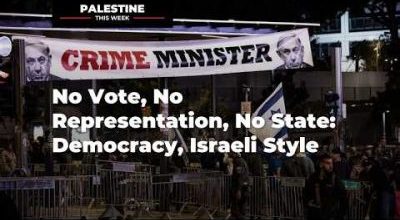
No Vote, No Representation, No State: Democracy, Israeli Style
or go to
Aletho News Archives – Video-Images
From the Archives
Sanctions, War and the Policy of Dual Containment
By SASAN FAYAZMANESH | March 17, 2008
It is now nearly three decades since the Unites States adopted the policy of dual containment of Iran and Iraq. While much has been written about the containment of Iraq, there has been very little in-depth analysis of this policy when it comes to Iran. In a book that is going to be released on March 31, 2008, entitled The United States and Iran: Sanctions, Wars and the Policy of Dual Containment (Routledge), I attempt to address this shortcoming by investigating when and why the US policy of containment of Iran came about, how it evolved, and where it stands today.[1] To the extent that Israel has been involved in US policy making, the study will also include the role that Israel has played in the containment of Iran. Also, since the fate of Iran has been inextricably linked to that of Iraq, occasionally the investigation will overlap with the containment of Iraq.
The policy of dual containment of Iran and Iraq originated during the Carter Administration, but it was not until the Clinton Administration that the expression “dual containment” became popular. … continue
Blog Roll
 Aletho News
- No Vote, No Representation, No State: Democracy, Israeli Style
- Zionist Bought Senate Blocks Information About American Citizens Killed By Israel
- While Gaza dominates the UN, these are the people keeping it alive
- New Report: “Scholasticide and Genocide in Gaza: Assessment, Testimonies and Legal Analysis”
- ‘THAAD Delusion’: Iran war exposes US missile shield limits – The Atlantic
- Moscow issues warning to NATO over Russian exclave
- Yes, the Iran war has destroyed Trump’s presidency
- The fallacy of US delusions about Iran’s economic collapse
- Hezbollah denies Syria cell link, warns of Israeli plan to sow discord
- The legacy of US sanctions, war, and occupation in Iraq
- If Americans Knew
- Mamdani releases plan to combat antisemitism and hate crimes in New York City
- Iran’s Revolutionary Guards Publish Letter to the American People
- DMFI launches $1 million ad campaign supporting Virginia’s Elaine Luria
- US Senate blocks resolution seeking report on Americans killed by Israel
- Israeli Attacks Kill Ten Palestinians in Gaza
- Massacre at Minab: The School That Became a Grave
- Israeli media: The IDF Shows It Doesn’t Turn a Blind Eye; It Actively Emboldens Settler Havoc
- As settlers ravage West Bank, Israeli forces kill 10 in Gaza – Daily Update
- New Report: “Scholasticide and Genocide in Gaza: Assessment, Testimonies and Legal Analysis”
- Ex-Biden officials are desperate for a Gaza scapegoat
- No Tricks Zone
- Green Energy Debacle: German Expert Professor Fritz Vahrenholt Warns Of Severe Economic And Social Consequences
- Two More Paleo Reconstructions Affirm Meters-Higher Sea Levels Across Ireland, Brazil 7000-6000 Years Ago
- New Study: Earth And Venus Surface Warmth Largely Explained By Convection And Lapse Rate, Not CO2 Or Radiation
- 2025 Nature Paper Claiming Worsening Global Drought Gets RETRACTED …Heavily Flawed
- New Study: ‘Global Drought Shows No Detectable Recent Acceleration Under Climate Warming’
- Economic Masterminds: German Socialists Suggest Taxing Productivity Gains Stemming From Using AI
- The South China Sea Has Not Been Cooperating With The Climate Change Narrative
- Energy Crisis: Germany Enters Heating Season With Historically Low Gas Reserve Fill Levels
- New Study: The Antarctic Ice Sheet Gained Mass From 2020-2024 Due To Staggering Snow And Ice Accumulation
- Study: Ocean Heating Rates From Thousands Of Years Ago ‘Dwarf’ Modern Ocean Heating Rates

