How the anti-war movement can stop the UK government bombing Syria
The stakes are high, but with enough pressure from below, David Cameron’s plan to bomb Syria can be defeated.
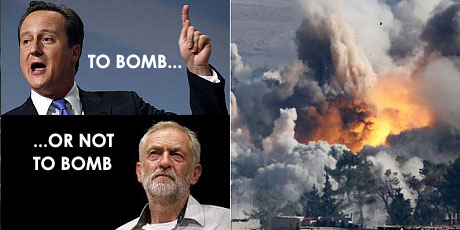
By Chris Nineham | Stop the War Coalition | September 24, 2015
WE HAVE the biggest opportunity since the start of the Iraq war to make a real change in foreign policy. The aggressive, interventionist policy that has done so much damage is now at the heart of a great contest in British society.
Jeremy Corbyn is facing a massive onslaught from all sections of the establishment. No one can envy him this experience, and the prime question is how we defend him from these attacks and build support for the policies that got him elected as Labour party leader with such a huge majority.
When the right wing is this hysterical, the establishment this panicked, and the media this vitriolic, you know there is just a chance something good might be in reach.
In the next few weeks and months there are going to be a series of stand-offs around foreign policy issues, including almost certainly a vote in parliament on bombing Syria, the outcome of the Iraq war inquiry report, and of course the madness of renewing Trident.
Few mainstream commentators have the wherewithal to understand Corbyn’s victory. They first speculated about left-wing entryism, then they focussed on his ‘style’, now they’ve decided to ignore the scale of his mandate.
Of course Jeremy is different, he wears jumpers and shockingly he tends to say what he thinks. But whatever the media would like to think, his success is not about the way he does what he does, it is about the issues he has brought to the forefront of British politics.
The real nightmare for the establishment is that millions of people agree with him about austerity, about war, and about the shocking state of official politics.
What alarms the mainstream is the energy and enthusiasm generated by his campaign to become leader of the Labour party, much of it due to the protest movements that he has supported so tirelessly over decades, including crucially the anti-war movement.
A return to protest
But if the Corbyn surge was powered partly at least by the movements, we have to make sure that what he has achieved in turn reinvigorates protest.
We know that Corbyn can’t do it alone. And we know too that there are a lot of people around him who — to put it politely — don’t agree with him. Within days of his leadership victory, there were very public briefings against him by a serving UK army general, two of his cabinet ‘colleagues’, including the shadow foreign secretary Hilary Benn, and Sadiq Khan, Labour’s newly selected candidate for London mayor.
Quite simply, Jeremy Corbyn is going to need all the help he can get.
It is clear also, that despite the disasters of the last fourteen years, the British political establishment is desperate to maintain its role as chief cheerleader for US military interventionism. And having scented rebellion against Corbyn among Labour MPs, they have a new confidence about winning a vote to bomb Syria, and at the same time damaging the party’s anti-war leader.
A plan of action: stopping the bombing of Syria
The main task must be to extend the enthusiasm and energy generated by his campaigning over the past months into every local community, workplace and college.
The more people are actively engaged in the campaign to stop the drive to war in Syria, and in the anti-austerity movement, the more we will be defending Jeremy Corbyn under such relentless attack.
How can we do this?
For the anti-war movement, we need to get onto the streets in every area and onto campuses with leaflets, petitions, posters, badges, etc, drawing people into an ever-widening network of activists for peace.
We need to re-invigorate local anti-war groups and start new groups where none exist. While organising locally, the untimate focus will be on parliament and the need to break the consensus that always takes Britain into disastrous wars on the coat tails of the United States.
In 2013, mass pressure on MPs, coupled with the memory of Tony Blair’s catastrophic war on Iraq, delivered an unprecedented defeat for the government, as David Cameron tried to bounce parliament into supporting the bombing of Syria’s Assad regime.
Now Cameron hope that by switching the target to ISIS, he can reverse that defeat and take the UK into yet another pointless war that will serve no purpose, other than to create more death and chaos, and drive more refugees to flee the war zone.
We need to implement immediately a comprehensive lobbying of MPs:
- Use the online lobby tool to contact MPs
- Send letters to MPs’ constituency offices
- Get letters in local newspapers
- Organise group visits to MPs’ regular surgeries to deliver petitions collected locally
There needs to be a particular focus on MPs who have vowed publicly to defy Jeremy Corbyn, so they understand the scale of the opposition to waging war in Syria.
War and the refugee crisis
The links between the refugee crisis and the wars our government so enthusiastically backs need to be underlined continually in our campaigning.
It is scandalous that David Cameron thinks promising to take twenty thousand refugees over five years is an adequate response to the migration or 60 million people fleeing war, conflict and poverty.
It is also outrageous that he wants to respond to people fleeing war-torn countries by intensifying the bombing of Syria — one of the main causes of the crisis.
The most effective thing that the West could do to end this misery is to de-escalate, stop arming regional dictators and aggressors and encourage a negotiated settlement in Syria. We need to develop and promote these arguments everywhere.
Isis is clearly a horrible organisation whose presence makes our arguments harder. We have to tackle the debate head on by having the most high profile possible public meetings and forums we can in each area.
A plan of action: the anti-austerity movement
Stop the War has always contrasted the vast government expenditure on the military and weapons of mass destruction, and the draconian austerity cuts to public and welfare services. Billions are spent on the UK war machine at the same time that brutal cuts in benefits are driving some desperate victims to suicide.
The protests at the Conservative Party conference from 3 October will help shape the political landscape over the next months. Tens of thousands will be protesting there, not just on the opening day – 4 October – but for the whole week. The anti-war message needs to be heard loud and clear by the movement, by the media and by the politicians.
Time is tight — the flashpoints are imminent, and we need to act now.
Within a few days of Jeremy Corbyn becoming Labour leader over 120 new members joined Stop the War Coalition, an indication that the movements that underpinned his victory are recognised as central to defending him.
The stakes are high. With enough pressure from below, David Cameron’s government’s plan to bomb Syria can be defeated for a second time, which would be a long term humiliation for the warmongers.
We also need a big campaign and protest over the scandalous delay in publishing the Iraq war inquiry report, blocked it appears by those — like Tony Blair and Jack Straw — likely to be criticised by Chilcot. With Jeremy Corbyn declaring that Tony Blair should be held to account for alleged war crimes, there is a real prospect that Blair could be driven out of public life once and for all.
Next year parliament will vote on the renewal of Trident nuclear weapons system, at a projected cost of over £100billion. The Campaign for Nuclear disarmament is already mounting a concerted campaign to get MPs to vote against. A huge protest movement before parliament votes will intensify that pressure.
The moment a vote on bombing Syria is announced, Stop the War will call a protest, but the success, the scale, and the impact of that protest depends on what we all do in the next few weeks. Its up to us.
Peace in Sight: Historic Agreement between Colombia and the FARC
By Miguel Salazar | Council on Hemispheric Affairs | September 24, 2015
On Wednesday, September 23, 2015, Colombian President Juan Manuel Santos and FARC leader Rodrigo Londoño pledged to end the country’s internal conflict by March 26, 2016.
Ever since La Violencia—Colombia’s infamous civil war lasting from 1948 to 1958—the polarization of the country’s political parties and ideological factions has led to an escalation of a deep-seated violence throughout Colombia. The Revolutionary Armed Forces of Colombia (Fuerzas Armadas Revolucionarias de Colombia, FARC) was initially formed as an armed peasant movement in 1964 that demanded comprehensive land and social reforms. Since then, the government and right-wing paramilitaries have waged a violent conflict against the FARC in rural Colombia that has resulted in a total of 220,000 deaths and over 5.7 million displacements.[i]
Negotiations between the FARC and the Colombian government have been ongoing since 2012, but Wednesday marked President Santos’ first appearance at the peace talks, and the beginning of a more visible role as a major force for concluding the peace accord. The two sides have agreed to create special tribunals to try former FARC combatants as well as government troops and rightist paramilitaries. Those found guilty of human rights violations will be required to pay reparations to their victims and will face a maximum sentence of eight years under special conditions, if they voluntarily opt to cooperate with the judicial process.[ii] Combatants who do not cooperate and are convicted could face much longer sentences. Those who sign the peace deal, accept responsibility, face charges and pay reparations will be safe from extradition if they are wanted by the United States on drug trafficking charges.[iii]
Pressured into the peace talks by the Colombian public, Bogotá has spent billions of dollars on efforts to combat the FARC (the 2015 budget for armed forces and police is $12.2 billion),[iv] while the United States has contributed over $9 billion for military operations since the birth of Plan Colombia in 2000.[v] Meanwhile, the FARC have suffered from sharply diminishing membership numbers (16,000 in 2001 to 7,000 in 2013) over the past decade and a half.[vi]
However, this momentous agreement comes with historical antecedents. The FARC recently demanded an inclusion of right-wing paramilitary groups in the current peace talks.[vii] These were agreed to by President Santos on Wednesday.[viii] Previous administrations have attempted to implement comprehensive demobilization and reinsertion programs with guerrilla groups but have failed due to the exclusion of paramilitary forces. In Colombia’s last peace agreement, the Betancur administration (1982-1986) legalized guerrilla members that accepted the amnesty as political actors in 1985, and the FARC subsequently demobilized and established the Patriotic Union (Unión Patriótica, UP), their political party. However, over 3,000 UP members paid dearly for this tactical mistake; having put down their weapons and rejoined civic life, they were later assassinated by paramilitary elements.[ix]
This changed with the election of President Álvaro Uribe (2002-2010), who refused to negotiate with the FARC and instead opted for supporting talks with the United Self-Defense Forces of Colombia (Autodefensas Unidas de Colombia, AUC), the largest paramilitary group in the country,[x] which has subsequently splintered off into several small criminal gangs.[xi] Since the demobilization of the AUC under Uribe, however, Colombian diplomats had not engaged in peace talks with the FARC until 2012.
COHA is cautiously optimistic about the shift in character of the Colombian government that has allowed for the promise of peace. However, insufficient funding, an inadequate monitoring of demobilized combatants, and a lack of consultation with host communities in the past have impeded Colombia from successfully maintaining peace. Although it has yet to be seen whether these agreements will prove to be successful in the long-term, President Santos’s government and the FARC are to be lauded for having taken a crucial step toward sustainable peace in Colombia.
[i] “World Report 2015: Colombia.” Human Rights Watch. 2015. Web.
[ii] Acosta, Nelson, and Daniel Trotta. “Colombia, FARC Rebels Vow to End 50-year War within Six Months.” Reuters. September 23, 2015. Web.
[iii] Lander, Rose. “Colombia Govt, FARC Agree to Maximum Prison Sentences for War Crimes.” Colombia Reports. September 23, 2015. Web.
[iv] Muñoz, Sara Schaefer. “Colombia Unlikely to Cut Defense Budget If FARC Deal Is Reached, Officials Say.” The Wall Street Journal. January 20, 2015. Web.
[v] Arsenault, Chris. “Did Colombia’s War on Drugs Succeed?” Al Jazeera. May 22, 2014. Web.
[vi] Renwick, Danielle, and Stephanie Hanson. “FARC, ELN: Colombia’s Left-Wing Guerrillas.” Council on Foreign Relations. December 1, 2014. Web.
[vii] Alsema, Adriaan. “The FARC’s Biggest Fear: Colombia’s Paramilitary Groups.” Colombia Reports. July 10, 2015. Web.
[viii] Acosta, Nelson, and Daniel Trotta. “Colombia, FARC Rebels Vow to End 50-year War within Six Months.” Reuters. September 23, 2015. Web.
[ix] Laplante, Lisa J, and Kimberly Theidon. “Transitional Justice in Times of Conflict: Colombia’s Ley De Justicia Y Paz.” Michigan Journal of International Law 28, no. 49 (2006): 59-61.
[x] Ibid: 61-62.
[xi] McDermott, Jeremy. “The BACRIM and Their Position in Colombia’s Underworld.” InSight Crime. May 2, 2014. Web.
Japan seeks independence through subservience to evil US ends
By Finian Cunningham | Global Times | September 22, 2015
Japanese Prime Minister Shinzo Abe may enjoy a sense of triumph in having succeeded to push through the country’s new military law. Both chambers of Tokyo’s parliament have now cleared the legislation expanding Japan’s military power, despite widespread public opposition and even scuffles among lawmakers.
For Abe and his ruling Liberal Democratic Party (LDP), the historic amendment to the constitution allowing for overseas military deployment, thus overturning the country’s 70-year-old pacifist commitments, no doubt, in their view, marks the emergence of a “strong” Japan, asserting its “independence” in the modern world.
Ardent nationalists among Abe’s party have been earnestly seeking to rewrite the country’s constitution, going back several years in their efforts. They argue that Japan must have greater freedom to use its military forces if the country is to claim equal standing among modern powers. The postwar constitution forbidding any overseas’ deployment of Japanese troops was seen by the nationalists as a demeaning constraint on Japan’s modern-day esteem.
The nationalistic LDP perceives the pacifist constitution as an insult to the country’s independence, and a humiliating fetter imposed by the victors of WWII. The constitution was largely written by the US occupying-army administration following the defeat of Imperial Japan in August 1945.
The bitter irony is, however, that the expansion of military power sought by Abe and his government is not a mark of independence, as they claim. Rather, in truth, it is a sign of Japan’s deepening subservience to the US. The new legislation is heavily conditioned by US strategic interests, albeit in a modern context where Japanese military is perceived now by Washington as bestowing an advantage.
The Abe administration claims that the new military options afforded by the amended constitution will allow Japan to better protect its people and its national interests.
The paradox is that the new military laws and posture pushed through the Japanese parliament by Abe will lead to more insecurity for Japan, and will increase the danger of future conflict.
This is because Japan’s adapted military legislation is framed by the geopolitical perspective of Washington. The deployment of Japanese troops and other military assets is said to be mandated “in defense of foreign allies.” That means Washington.
In effect, Japan is placing its military forces as hostage to Washington’s capricious geopolitics. That is hardly a hallmark of “independence” as Abe and his supporters so fervently claim.
The Japanese government supposes that the new military power is to be strictly enforced with three criteria.
First, it will only be used if Japan or an ally (most probably the US) is attacked or threatened. Second, the military option can only be used if diplomacy has been exhausted. And third, any military force used will be only at a minimum level.
Japan’s expanded military power has to be interpreted in the context of gross historical revisionism under Abe’s LDP. The Japanese leader and his ruling circle have repeatedly sought to absolve Japan from its horrendous war legacy.
The denial of Japanese aggression against China, costing up to 30 million Chinese lives, or the denial of “sex slavery” of Chinese and Korean women under Japanese colonial rule, are disturbing indicators that the present leaders in Tokyo have rekindled a militaristic mind-set.
Therefore, in the context of malleable criteria for deployment of military force and under the sway of an increasing US belligerence in the Asia-Pacific region, the Japanese security laws are cause for deep concern.
Abe’s repeated regurgitation of provocative US allegations against China, from cyber theft to territorial expansionism, only further emphasizes the cause for concern.
China’s often-stated policy is one of friendly regional dialogues to resolve disputes. Disputes should primarily be resolved by Asian neighbors, acting autonomously, independently and free from outside interference.
Japan’s newfound militarism is regrettable and does not bode well for regionally resolved peaceful relations, because Tokyo’s agenda is beset by atavistic nationalist sentiments, and more worryingly, because it is subordinate to Washington’s hegemonic geopolitics.
The people of Japan are right, and they deserve much credit, to be indignant over Abe’s pursuit of expanded military power. His claims of patriotism and to be serving to defend Japan’s interests are in fact the inverse.
Abe is actually serving the US interests and in so doing he is militating against the real interests of the Japanese people.
The author is a freelance journalist writing on international affairs based in Addis Ababa, Ethiopia. opinion@globaltimes.com.cn
Petraeus recipe for battling ISIS: US-protected rebel enclaves in Syria, surge in Iraq
RT | September 22, 2015
To achieve victory in the Middle East, the US needs to establish and protect rebel enclaves in Syria, and launch another “surge” in Iraq, former CIA director and retired US Army general David Petraeus told a Senate panel.
This was the first public appearance for the retired general and former spymaster, following his April sentencing for revealing classified information to his mistress.
Describing Syria as a “geopolitical Chernobyl… spewing instability” all over the Middle East, Petraeus urged the Senate Armed Services Committee (SASC) to endorse a policy that would “stop the Syrian air force from flying” and establish safe areas where civilians and anti-government rebels could be protected by US airpower and advisers. Meanwhile, all the elements of the surge were once again required in Iraq, but this time around the Iraqis would have to provide the ground troops, he said.
Petraeus echoed the official position of the State Department that Syrian president Bashar al-Assad was to blame for the rise of Islamic State (IS, also known as ISIS or ISIL), blaming the government’s “barrel bombs” rather than IS for most of the civilian deaths in Syria. The general pushed for the creation of US-backed protected areas where civilians and militia opposed to the government could shelter under the coalition air umbrella. Eventually, he said, US advisers could be deployed there as boots on the ground.
“This is a very complicated military activity, but it is doable,” Petraeus told lawmakers.
Petraeus resigned as director of the CIA in November 2012, following the revelations that he had shared classified information with his biographer – and lover – Paula Broadwell. As part of a plea bargain with the government, he was sentenced to two years’ probation and a $100,000 fine.
The ex-general began his testimony with an apology, calling what he did a “serious mistake” and a “violation of the trust placed in me.” The panel, chaired by Arizona Republican John McCain, repeatedly thanked Petraeus for his military service and commended him on the apology.
Without bringing up the Broadwell scandal at all, McCain praised Petraeus as a “distinguished” leader and argued his 2007 testimony was critical to securing Senate support for the ‘surge’ strategy that “defeated al-Qaeda in Iraq, brought security to the Iraqi people, and created the possibility for meaningful political reconciliation.”
Both Republicans and Democrats on the panel were eager to hear Petraeus’s prescriptions for salvaging the US war effort against Islamic State. A yearlong air campaign by the 60-nation coalition, at the cost of $4 billion, has not dislodged the self-proclaimed Caliphate, while the handful of US-trained Syrian fighters were ambushed and scattered by Al-Nusra Front, an Al-Qaeda affiliate.
Petraeus argued that the “train and equip” program was impossible to abandon, since the US strategy in the region absolutely depended on having a Sunni Arab fighting force. Asked whether there was anyone inside Syria actually available to train, he said that many moderate rebels “drifted” to Islamist groups like Al-Nusra, because they had resources and were fighting against the Assad government. Peeling off these low-ranking members could work, he said, just as it did in Iraq.
Arguing that working with the government in Damascus would damage US credibility among the Sunnis, Petraeus called for lawmakers to resist the Russian effort to “force” the US into an alliance with president Bashar al-Assad. If Russia really wanted to fight ISIS, it could have joined the US-led coalition and asked to be integrated into the air war, Petraeus said.
Russian president Vladimir Putin recently proposed a coordinated international effort against IS, but rebuffed speculation that Russian forces would engage in combat operations in Syria.
“We are providing Syria with quite strong support in terms of equipment, training of military servicemen and weapons,” Putin said. “We are considering various options, but so far what you are talking about is not on the agenda.”
Petraeus did caution against the rush to overthrow Assad, noting that Syria “could actually get worse” if there was no plan for the aftermath.
During Petraeus’s testimony before the SASC, it was reported that retired Marine General John Allen, head of the anti-IS coalition, would be stepping down in November. Sources within the Obama administration told Bloomberg that Allen made the decision out of concern for his wife’s poor health.
Ukraine and NATO sign agreements on strengthening defense and technical cooperation
RT | September 22, 2015
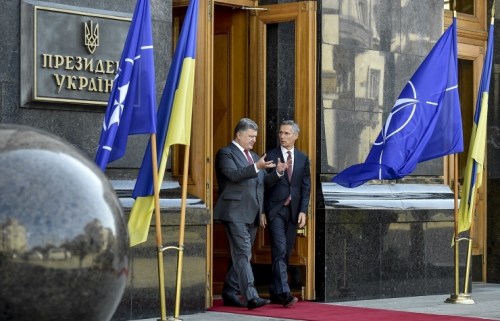
Ukraine and NATO “are more than partners,” Ukraine’s president said after a number of agreements were signed with the alliance during a visit by NATO’s Secretary General. Moscow criticized the move, saying NATO’s advance on Russia’s border is unwelcome.
“De jure, we are not a NATO member, but de facto we are more than partners. Ukraine is an eastern outpost of Euro-Atlantic civilization,” Ukrainian president Petro Poroshenko wrote on his official Twitter account.
On Tuesday, Poroshenko announced that Ukraine and NATO had signed a joint declaration on strengthening defense and technical cooperation, as well as a roadmap for a partnership between Ukraine and NATO on strategic communications. The program is aimed at supporting Kiev in counteracting “Russian propaganda” and informing the society on what’s happening in Ukraine, Interfax reported.
The North-Atlantic alliance is also ready to discuss how it can boost Kiev’s military, particularly by potentially providing aid in restoring its naval forces, RIA Novosti reported, citing NATO’s Secretary General Jens Stoltenberg. The NATO official also said that the Alliance is providing advisors to Ukraine’s defense ministry and army general staff, according to TASS.
Having chosen its “path in to the EU and NATO,” Ukraine is ready to reform its military and law enforcement forces, the Secretary of Ukraine’s National Security and Defense Council, Aleksandr Turchinov, said after his meeting with NATO’s Secretary General. Meanwhile, Ukraine’s Foreign Minister, Pavel Klimkin, announced that he and Stoltenberg had signed a bilateral document on the creation of a NATO diplomatic mission in Ukraine. NATO’s two existing offices in Ukraine have been united, and their functions and powers extended.
Partnership with NATO will also provide Kiev with the opportunity to get essential weapons, Poroshenko said on Tuesday.
“We are now exchanging information. We are partners, and it gives us an opportunity to receive protective weapons – not offensive, but defensive weapons, such as drones and electronic equipment,” the Ukrainian leader said at a joint briefing with Stoltenberg.
The Kremlin has warned that NATO’s further advance towards Russia’s borders will entail counter measures.
“We must not forget that NATO is an organization that has been created during the time of confrontation and for confrontation, that’s why it cannot change its nature,” the Russian president’s spokesman, Dmitry Peskov, told reporters in Moscow, as cited by Sputnik.
“That is why any advancement by such an organization toward our borders will force us to take adequate counter-measures to safeguard own security, our national security,” Peskov said.
He added that Moscow regrets Kiev’s plans to pursue NATO membership.
When addressing Stoltenberg on Tuesday, Poroshenko claimed that more than 60 percent of Ukrainians support the plans to join NATO, while two years ago only 16 percent supported the move. A day earlier, at another joint meeting, the Ukrainian leader stated that his country was not ready to become a NATO member, nor was the Alliance ready to accept it. Ukraine would need to change in order to achieve its goal of NATO membership, Poroshenko noted, while promising more reforms.
Petro Poroshenko signed a decree changing Ukraine’s non-aligned status last year, saying that his country would make the decision on whether to join NATO in the next five or six years. He promised to put the question up for a national referendum. NATO’s previous secretary general, Anders Fogh Rasmussen, said the process of reaching the criteria required to become an alliance member could take Ukraine a long time. Countries with outstanding territorial disputes cannot become NATO members. However, Ukraine claims rights to Crimea, which became a part of Russia following a referendum on the peninsula in 2014.
Foreign Policy by Intimidation
GOP Candidates Show How It’s Done
By Philip Giraldi • Unz Review • September 22, 2015
The media are anointing former Hewlett-Packard Chief Executive Carly Fiorina as the winner of last Wednesday’s second Republican presidential-aspirant debate. They are saying that she was the best prepared and most convincing speaker, and, indeed, maybe she was. But what is being largely ignored is the actual content of the so-called debate, which was supposed to be focused on foreign policy. Presuming that all the potential candidates had been assiduously primed on the major issues by their advisers, what might have been informed opinion was instead pathetically ignorant and, more than that, dangerous.
Note for example what Fiorina had to say about her policy towards Russia: “Having met Vladimir Putin, I wouldn’t talk to him at all. We’ve talked way too much to him. What I would do, immediately, is begin rebuilding the Sixth Fleet, I would begin rebuilding the missile defense program in Poland. I would conduct regular, aggressive military exercises in the Baltic States. I’d probably send a few thousand more troops into Germany. Vladimir Putin would get the message.”
Yes, Carly would make sure that Putin would get the message that any possible cooperation with the United States would be a non-starter, even in places and situations where there might be common interests. Carly as president promises to take steps that directly threaten Russia on its own doorstep and would lead to a return to the Cold War. And possibly worse than that. Per Fiorina, it would also mean a new budget busting arms race to show how strong we are.
And Fiorina was not winging it alone. Senator Marco Rubio had a fantasy vision that saw him personally flying around the world directly confronting the bad guys. He pledged that “It [Air Force One] would also fly to China, not just to meet with our enemies, not just to meet with those adversaries of ours that are there, but also to meet with those that aspire to freedom and liberty within China. I would even invite them to my inauguration. We would also fly into Moscow and into Russia. And not just meet with the leaders of Russia, but also meet with those who aspire to freedom and liberty in Russia.”
How Rubio would obtain use of the presidential plane before his inauguration and arrange the logistics of flying into capitals of countries that he has labeled enemies to meet with dissidents was not quite clear. And the whole concept of cultivating opposition groups has a vaguely Democratic White House smell to it, a heavy dose of democracy promotion that leads to responsibility to protect, regime change and nation building. I thought Republicans had gone off the boil on that kind of stuff, but Rubio just might be getting bad advice from his posse of neocon advisers which includes Robert Kagan, Eric Edelman and Elliott Abrams.
But the evening’s biggest brouhaha concerned someone who was not even on the stage, GOP gadfly Ann Coulter, who responded to references to Israel by tweeting to her 600,000 fans “How many (expletive) Jews do these people think there are in the United States?” Coulter may have had a point in that American Jews are a small minority of the population who vote heavily Democratic in any event, but she would have been much more accurate if she had stated “Jew” rather than “Jews” as the comments by the potential candidates were really aimed at Sheldon Adelson, casino magnate of Law Vegas, who can literally pay for the entire GOP presidential campaign if he chooses to do so. For Adelson and his Democratic counterpart Haim Saban America’s presidential election is all about Israel.
Coulter understands that talking nice about Israel appeals to evangelical Christians, who many believe to be a sine qua non for any prospective GOP candidate who actually hopes to get nominated. But piqued by the Coulter outburst and out of curiosity I downloaded a transcript of the debate and went through it for any mention of Israel or Jews or even Benjamin Netanyahu. Contrary to Coulter’s assertion, Israel was only mentioned eleven times in the three hour debate and was not cited by Rand Paul, Ben Carson, Scott Walker or Donald Trump. Jews were not discussed at all and Netanyahu only named once, by Fiorina.
But the infrequency of the commentary on Israel should not be interpreted as a suggestion that the discussion of politics as related to the Middle East was any less Israel-centric or even somehow restrained or rational. Indeed, the potential candidates demonstrated an inability to connect with reality and scrupulously avoided basing U.S. policies overseas on actual interests and available resources.
This is Carly Fiorina’s plan for the Middle East and for pressuring reluctant allies in her own words: “You have not heard a plan about Iran from any politician up here, here is my plan. On day one in the Oval Office, I will make two phone calls, the first to my good friend to Bibi Netanyahu to reassure him we will stand with the state of Israel. The second, to the supreme leader, to tell him that unless and until he opens every military and every nuclear facility to real anytime, anywhere inspections by our people, not his, we, the United States of America, will make it as difficult as possible and move money around the global financial system. We can do that, we don’t need anyone’s cooperation to do it. And every ally and every adversary we have in this world will know that the United States in America is back in the leadership business, which is how we must stand with our allies.”
Fiorina does not seem to be aware that by giving her “good friend” Benjamin Netanyahu the ability to draw the United States into a war that he chooses to start she is outsourcing our sovereignty. But perhaps that doesn’t bother her just as she doesn’t seem concerned that baiting Iran will pit the U.S. against the entire world, to include nearly all of America’s allies.
Jeb Bush also focused on the centrality of Israel to contain Iran as part of his foreign policy vision, stating that “the first thing that we need to do is to establish our commitment to Israel which has been altered by this administration. And, make sure that they have the most sophisticated weapons to send a signal to Iran that we have Israel’s back. If we do that, it’s going to create a healthier deterrent effect than anything else I can think of.”
No Jeb, it will do the opposite. It will force Iran to actually develop a nuclear weapon to defend itself. And going far beyond Bush, Mike Huckabee presented a broader nightmarish and largely fantasized view of a clash of civilizations, stating “This is really about the survival of Western civilization. This is not just a little conflict with a Middle Eastern country that we’ve just now given over $100 billion to, the equivalent in U.S. terms is $5 trillion. This threatens Israel immediately, this threatens the entire Middle East, but it threatens the United States of America. And we can’t treat a nuclear Iranian government as if it is just some government that would like to have power. This is a government for 36 years has killed Americans, they kidnapped Americans, they have maimed Americans. They have sponsored terrorist groups, Hamas and Hezbollah, and they threaten the very essence of Western civilization. At the end of my presidency I would like to believe that the world would be a safe place, and there wouldn’t be the threats. Not only to the U.S., but to Israel and our allies, because we would have the most incredible well-trained, well-equipped, well- prepared military in the history of mankind. And they would know that the commander-in-chief would never send them to a mission without all the resources necessary, but people wouldn’t bully us anymore. Because they would know that that would be an invitation to their destruction.”
Huckabee, a former Baptist preacher, presumably would “destroy” bullies just as he destroyed English grammar in his statement. One might observe that if ending international bullying were even vaguely his objective he would start with Washington, which has been abusing the rest of the world since 9/11.
Huckabee’s fellow evangelical Senator Ted Cruz also had something to say, clearly on board with reordering the world in a more muscular Christian fashion, saying “… I also want to respond to several folks up here who said we should trust this Iranian deal, see if the Iranians will comply. Anyone who is paying attention to what Khamenei says knows that they will not comply. There is a reason Khamenei refers to Israel as the little Satan, and America as the great Satan. If I’m elected president our friends and allies across the globe will know that we stand with them. The bust of Winston Churchill will be back in the Oval Office, and the American embassy in Israel will be in Jerusalem.”
Normally semi-rational John Kasich came across as the moderate in the Iran discussion by virtue of not calling for immediate bombs away, stating “Secondly, nobody’s trusting Iran. They violate the deal, we put on the sanctions, and we have the high moral ground to talk to our allies in Europe to get them to go with us. If they don’t go with us, we slap the sanctions on anyway. If they fund these radical groups that threaten Israel and all of the West, then we should rip up the deal and put the sanctions back on.”
Senator Marco Rubio piled on with another complaint, “We are eviscerating our military. And we have a president that is more respectful to the ayatollah in Iran than he is to the prime minister of Israel.” And expanding on his plan to fly around and spread good will to our friends while confounding our enemies the peripatetic presidential wannabe added that “If I’m honored with the opportunity to be president, I hope that our Air Force One will fly, first and foremost, to our allies; in Israel, in South Korea, and Japan. They know we stand with them. That America can be counted on.”
Finally, New Jersey governor Chris Christie, who was clearly out of his depth even though the discussion was not exactly cerebral, iced the cake by concluding the foreign policy debate with “And I will tell you this, around the world, I will not shake hands with, I will not meet with, and I will not agree to anything with a country that says death to us and death to Israel and holds our hostages while we sign agreements with them. It will be an America that be strong and resolute, and will once again be able to stick out its chest and say, ‘we truly are the greatest nation in the world, because we live our lives that way, each and every day.’”
Christie’s rant was a fitting conclusion for the evening, underlining the essential Republican foreign policy message, which is that basically, as the esteemed George W. Bush put it, “you are either with us or against us.” We don’t have to talk to foreign leaders we don’t like and if they persist in the error of their ways we send in the cruise missiles. Only Senator Rand Paul and John Kasich indicated clearly that they would hesitate before the bombs start to drop.
GOP-think also has an underlying racist tone to it, with the presumption that those not quite Caucasian foreign people are not really like us, don’t think like us and can be shot or droned on sight when they fail to heed our advice. It’s not about Israel per se or about anything that would make sense to any disinterested observer. It is all about having a “security zone” that is global in reach and preempts the rights of anyone else. It is coupled with superpower hubris driven by an “exceptionalism”-derived unwillingness to treat people who are not Americans with any respect or consideration. Washington reflexively turns potential friends into enemies at every opportunity and perseveres in a foreign policy based on a whole basket of false premises that has been disastrous vis-à-vis any actual United States interests. Unfortunately for the American people the likely alternative to all this blatant and dangerous nonsense is Hillary.
U.S. Will Station New Nuclear Weapons in Germany Against Russia
By Eric Zuesse | Aletho News | September 22, 2015
Germany’s ZDF public television network headlines on Tuesday September 22nd, “New U.S. Atomic Weapons to Be Stationed in Germany,” and reports that the U.S. will bring into Germany 20 new nuclear bombs, each being four times the destructive power of the one that was used on Hiroshima. Hans Kristensen, the Director of the Nuclear Information Project at the Federation of American Scientists, says, “With the new bombs the boundaries blur between tactical and strategic nuclear weapons.”
A former Parliamentary State Secretary in Germany’s Defense Ministry, Willy Wimmer, of Chancellor Merkel’s own conservative party, the Christian Democratic Union, warns that these “new attack options against Russia” constitute “a conscious provocation of our Russian neighbors.”
German Economic News also reports on Chancellor Merkel’s decision to allow these terror-weapons against Russia: “The Bundestag decided in 2009, expressing the will of most Germans, that the US should withdraw its nuclear weapons from Germany. But German Chancellor Angela Merkel did nothing.” And now she okays the U.S. to increase America’s German-based nuclear arsenal against Russia.
Maria Zakharova, of the Russian Foreign Ministry, says: “This is an infringement of Articles 1 and 2 of the Treaty on Non-Proliferation of Nuclear Weapons,” which is the treaty that provides non-nuclear states the assurance that the existing nuclear powers will not try to use their nuclear status so as to take over the world.
German Economic News says: “The federal government had demanded the exact opposite: The Bundestag decided in March 2010 by a large majority, that the federal government should ‘press for the withdrawal of US nuclear weapons from Germany.’ Even the coalition agreement between the CDU and FDP, the German government in 2009 had promised the withdrawal of nuclear weapons from Büchel. But instead there will be these new bombs.”
Investigative historian Eric Zuesse is the author, most recently, of They’re Not Even Close: The Democratic vs. Republican Economic Records, 1910-2010, and of CHRIST’S VENTRILOQUISTS: The Event that Created Christianity.
Anonymous general who predicts anti-Corbyn mutiny should be named by GCHQ – SAS veteran
RT | September 21, 2015
A former SAS soldier has blasted the anonymous British Army general who predicted a military coup if Jeremy Corbyn is elected prime minister. He said the comments threaten democracy and that the military has no excuses for declining to investigate.
Ben Griffin, who served in the Parachute Regiment and the Special Air Service in Iraq and Afghanistan and is now a member of anti-war group Veterans for Peace UK, told RT the general’s comments published in the Sunday Times are an affront to democracy.
“Why is this General cowering behind a reporter?” he said.
“He should go public with his statement. He is threatening the democratic will of the British people and he exposes the lie that the armed forces exist to protect our freedoms.”
After calls for an investigation began, the Ministry of Defence (MoD) is reported to have told the Independent newspaper it would not launch a leak investigation due to there being too many generals to investigate.
There are around one hundred generals currently serving in the British Army.
Asked if this excuse was feasible, Griffin pointed out that the government had something of a monopoly on surveillance.
“GCHQ could tell the MoD today which general it was,” he said, referring to the government’s world-leading signals intelligence agency.
“GCHQ collect the metadata of all phone calls and emails so they will have a record of which generals have been in touch with the journo who wrote the story,” he added.
The general in question, who is said to have served in Northern Ireland in the 1980s and 1990s, told the Sunday Times a Corbyn general election victory in 2020 would precipitate “mass resignations at all levels and you would face the very real prospect of an event which would effectively be a mutiny.”
“Feelings are running very high within the armed forces,” the individual said. “You would see a major break in convention with senior generals directly and publicly challenging Corbyn over vitally important policy decisions such as Trident, pulling out of NATO and any plans to emasculate and shrink the size of the armed forces.”
He appeared to pledge a military rebellion, with the army directly intervening in democracy.
“The Army just wouldn’t stand for it,” the general claimed.
“The general staff would not allow a prime minister to jeopardize the security of this country and I think people would use whatever means possible, fair or foul to prevent that.
“You can’t put a maverick in charge of a country’s security.”
British General Threatens ‘Mutiny’ Against Corbyn Leadership
Sputnik | 20.09.2015
An unnamed senior general in the British military threatened that a government headed by new Labour party leader Jeremy Corbyn would face a “mutiny” from the military.
The general said that Corbyn could face “mass resignations at all levels” if he were to become prime minister. The statement is tied to Corbyn’s views on funding the British military’s Trident submarines or leave NATO.
“The general staff would not allow a prime minister to jeopardise the security of this country and I think people would use whatever means possible, fair or foul to prevent that,” the general told the Sunday Times.
According to the Guardian, previous attempts by the military to destabilize the British government took place in the 1960s and 1970s against Prime Minister Harold Wilson.
The Labour party’s new shadow Foreign Secretary previously said that the party would not back a withdrawal from NATO or scrapping the Trident program.
The fate of aircraft carriers is less clear, however, as the Guardian noted because there are members of the military who question their usefulness in modern warfare.
Iceland Counters US Military Claims of ‘Russian Flights’
Sputnik | 20.09.2015
Iceland’s foreign ministry countered US defense department claims that Russia has increased activity around the country and that it is interested in “military cooperation.”
The US government attempted to convince Iceland to accept a higher US military presence over what it called increased Russian military flights in the region, Icelandic media reported.
Iceland’s foreign ministry released figures showing that Russian military flights anywhere near the country’s airspace have actually decreased more than five times compared to 2007. None of the flights breached Icelandic airspace.
“The Russians have long done transit flights where they pass close by Iceland, but they’ve recently made several circumnavigation flights,” US deputy defense secretary Bob Work told DefenseNews earlier in September.
However, the US military’s claims do not match up with Iceland’s own figures, which show that Russia only made two flights anywhere near the country’s airspace in 2015.
“Iceland is interested in increasing military cooperation,” Work added.
Iceland’s foreign minister Gunnar Bragi Sveinsson countered, saying that interest in NATO air defenses in Iceland is coming entirely from the side of the US.
The US has recently increased its military involvement in Northern Europe, citing what deputy defense secretary Bob Work called “a resurgent Russia.”
Russia to Add Its 203rd Air Force Base — Its First Outside Russia
By Eric Zuesse | Aletho News | September 20, 2015
According to GlobalSecurity, Russia has 202 Air Force Bases, all in Russia’s various “Military Districts”; but now there is to be a 203rd one, and it will be in Belarus. If this actually happens, it will be a historic expansion of Russia’s armed forces abroad — something that for the U.S. to do would be inconsequential since the U.S. already has 41 Air Force Bases in foreign countries, surrounding Russia, East West and South. (Belarus isn’t even anywhere near the U.S.; it’s instead bordering Russia itself.)
On September 19th at 112.international (and then on 20 September at the subscription-only Financial Times), was reported (as headlined at 112), “Russia to Establish Air Base in Belarus.” Russia’s President Vladimir Putin on Friday the 18th had signed a document, “To intrust the Ministry of Defense with the participation of the Ministry of Foreign Affairs to carry out the negotiations with the Belarusian side and upon coming to an accommodation, to sign the agreement on behalf of Russian Federation.”
The anti-Russian Financial Times pretends that this is part of Russia’s aggression encircling NATO, instead of a response to NATO’s aggression encircling Russia, by the FT’s saying: “Belarus, which borders Ukraine, Poland, Lithuania and Latvia [they don’t even mention that it borders Russia], would give Russia a new asset right on Nato’s borders. The Russian military already has a radar station and some fighter aircraft stationed in Belarus, but the new base would be the first to be built there since the end of the Soviet Union.”
The FT then says: “News that the air base would be built comes after the US and its allies were struggling to respond to what Washington says is a Russian military build-up in Syria. Russian involvement in Syria complicates existing international operations against the Islamic State of Iraq and the Levant, the jihadi group known as Isis.” This statement pretends that Russia is pro-ISIS and anti-Assad, while the U.S. is anti-ISIS and pro-Assad, but the FT thinks they’ve got lots of suckers (subscribers) and will exploit that asset for their aristocratic masters, who as advertisers are buying those suckers’ minds. The reality is that — as the people of Syria are well-aware — Assad and Russia are anti-ISIS, and the U.S. is the one that’s bombing the anti-ISIS forces (while the U.S. pretends to be focusing on bombing the pro-ISIS forces).
UPDATE: The FT’s online readership evidently isn’t as gullible as the FT’s editors expect. Though there was a bit of reader-comment in the nature of “They are building military bases around NATO, while Russia’s revenues are going down the tubes. Another stupid strategy from the Kremlin,” far more was in the nature of the following:
“How can more forces fighting ISIS be a negative?”
“Kathrin [addressing the newspaper’s Moscow correspondent, Kathrin Hille], please spare us this US propaganda drivel. We’ve really had enough. Start complaining again when Russia builds an air force base in Mexico. Until then……… shhhhh.”
“The extraordinary thing of all is that NATO, the biggest and most powerful military alliance in history with bases essential surrounding Russia, is never reported to be ‘flying close’ to Russia’s borders. They are undoubtedly the most scrupulous pilots on earth.”
“1. This is terrible news; how dare Mr Putin do this! Mr GWB must be recalled from his retirement to bomb Belarus back into the Stone Age. These Belarus guys learnt nothing from all that ‘Shock and Awe’.
2. Thank you FT/Nikkei, and the ever vigilant Ms Hille, for this timely warning.”
“The growing military and and economic relationship between Russia and China and the expansion of Russian presence, and presumably bases, in Syria is also a result of western policy, specifically American policy, that includes economic sanctions. In Ukraine and in the Middle East, neocon-Washington-driven policy has been a catastrophe.”
But, if the FT’s readers are really so smart, why do they then subscribe? Why do they subsidize propaganda, when there are a few authentic news sites (you’re reading one of them now) that are free? Readers can get the facts, and the honest and relevant context, without needing to subscribe to anything.
Investigative historian Eric Zuesse is the author, most recently, of They’re Not Even Close: The Democratic vs. Republican Economic Records, 1910-2010, and of CHRIST’S VENTRILOQUISTS: The Event that Created Christianity.
US Presidential Hopeful Fiorina Promises to Rule Out Talking With Russia
Sputnik – 17.09.2015
Republican 2016 presidential candidate Carly Fiorina claimed that she would rule out talking with the Russian leader if won the elections and would launch a huge rearmament program in the US.
Former Hewlett-Packard CEO Carly Fiorina said during the Republican presidential debate that she would refuse to talk to Russian President Vladimir Putin if elected and would engage in a massive US rearmament program.
“We’ve talked way too much to him,” Fiorina said during the debate held at the Roland Reagan Presidential Library in California on Wednesday night, adding that, if elected president, she would carry out aggressive military maneuvers in the Balkans and rebuild US missile defense forces in Poland.
“What I would do immediately, I would begin rebuilding the Sixth Fleet, I would begin rebuilding the missile defense program in Poland, I would also conduct military exercises in the Baltic states, I’d probably send a few thousand more troops to Germany,” she said.
Fiorina added that she would send weapons to arm the Kurds against Islamic State (IS) militants and would supply US bombs to Jordan.
“We could give the Jordanians what they’ve asked for, bombs and material. We have not supplied it, I will,” she added. “We could arm the Kurds; they have been asking for this for three years. This is in our control.”
Fiorina has been running with only around 3 to 4 percent support among US Republican voters in recent opinion polls.
Moscow’s relations with the United States have deteriorated dramatically since 2014 over Crimea’s reunification with Russia and the ongoing Ukraine crisis.
Russia has repeatedly expressed concerns over NATO’s recent military buildup along its borders. According to Russian Foreign Minister Sergei Lavrov, the “Cold War mindset” still prevails in the bloc, which ceased what it refers to as “practical cooperation” with Russia in April 2014, when the armed confrontation in Ukraine’s southeast began.
Featured Video
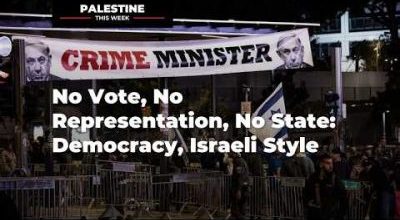
No Vote, No Representation, No State: Democracy, Israeli Style
or go to
Aletho News Archives – Video-Images
From the Archives
Sanctions, War and the Policy of Dual Containment
By SASAN FAYAZMANESH | March 17, 2008
It is now nearly three decades since the Unites States adopted the policy of dual containment of Iran and Iraq. While much has been written about the containment of Iraq, there has been very little in-depth analysis of this policy when it comes to Iran. In a book that is going to be released on March 31, 2008, entitled The United States and Iran: Sanctions, Wars and the Policy of Dual Containment (Routledge), I attempt to address this shortcoming by investigating when and why the US policy of containment of Iran came about, how it evolved, and where it stands today.[1] To the extent that Israel has been involved in US policy making, the study will also include the role that Israel has played in the containment of Iran. Also, since the fate of Iran has been inextricably linked to that of Iraq, occasionally the investigation will overlap with the containment of Iraq.
The policy of dual containment of Iran and Iraq originated during the Carter Administration, but it was not until the Clinton Administration that the expression “dual containment” became popular. … continue
Blog Roll
 Aletho News
- No Vote, No Representation, No State: Democracy, Israeli Style
- Zionist Bought Senate Blocks Information About American Citizens Killed By Israel
- While Gaza dominates the UN, these are the people keeping it alive
- New Report: “Scholasticide and Genocide in Gaza: Assessment, Testimonies and Legal Analysis”
- ‘THAAD Delusion’: Iran war exposes US missile shield limits – The Atlantic
- Moscow issues warning to NATO over Russian exclave
- Yes, the Iran war has destroyed Trump’s presidency
- The fallacy of US delusions about Iran’s economic collapse
- Hezbollah denies Syria cell link, warns of Israeli plan to sow discord
- The legacy of US sanctions, war, and occupation in Iraq
- If Americans Knew
- Mamdani releases plan to combat antisemitism and hate crimes in New York City
- Iran’s Revolutionary Guards Publish Letter to the American People
- DMFI launches $1 million ad campaign supporting Virginia’s Elaine Luria
- US Senate blocks resolution seeking report on Americans killed by Israel
- Israeli Attacks Kill Ten Palestinians in Gaza
- Massacre at Minab: The School That Became a Grave
- Israeli media: The IDF Shows It Doesn’t Turn a Blind Eye; It Actively Emboldens Settler Havoc
- As settlers ravage West Bank, Israeli forces kill 10 in Gaza – Daily Update
- New Report: “Scholasticide and Genocide in Gaza: Assessment, Testimonies and Legal Analysis”
- Ex-Biden officials are desperate for a Gaza scapegoat
- No Tricks Zone
- Green Energy Debacle: German Expert Professor Fritz Vahrenholt Warns Of Severe Economic And Social Consequences
- Two More Paleo Reconstructions Affirm Meters-Higher Sea Levels Across Ireland, Brazil 7000-6000 Years Ago
- New Study: Earth And Venus Surface Warmth Largely Explained By Convection And Lapse Rate, Not CO2 Or Radiation
- 2025 Nature Paper Claiming Worsening Global Drought Gets RETRACTED …Heavily Flawed
- New Study: ‘Global Drought Shows No Detectable Recent Acceleration Under Climate Warming’
- Economic Masterminds: German Socialists Suggest Taxing Productivity Gains Stemming From Using AI
- The South China Sea Has Not Been Cooperating With The Climate Change Narrative
- Energy Crisis: Germany Enters Heating Season With Historically Low Gas Reserve Fill Levels
- New Study: The Antarctic Ice Sheet Gained Mass From 2020-2024 Due To Staggering Snow And Ice Accumulation
- Study: Ocean Heating Rates From Thousands Of Years Ago ‘Dwarf’ Modern Ocean Heating Rates

