While I was in the midst of trying to publicize the Jewish instigation and the folly of invading Iraq in early 2003 as an occasional writer of scripts for American Dissident Voices, PBS Frontline presented a rather helpful documentary called The War Behind Closed Doors, written by Michael Kirk, and coproduced by Michael Kirk and Jim Gilmore.
The introduction to The War Behind Closed Doors is quite promising, with Frontline’s narrator stating: “Over two decades, they had served three presidents, and argued for one big idea, that the United States must project its power and influence throughout the world. This is the story of how they set out to change American foreign policy in the days immediately after the tragedy of September 11th.” Then, to be more specific about what that means, the intro includes a clip of former CIA analyst Kenneth Pollack saying: “And it does seem very clear that this group seized upon the events of September 11th to resurrect their policy of trying to go after Saddam Hussein and a regime-change in Iraq.” This was a documentary that would clarify who was responsible for the drive for war against Iraq: Neoconservatives — which meant that that the war was not fundamentally about oil.
The documentary describes the path to invasion of Iraq (which seemed imminent but had not yet occurred when the program aired on 20 February 2003) as a struggle between Neoconservatives (also calling themselves “Neo-Reaganites” or “hawks”) led by Paul Wolfowitz, and “pragmatists” or “realists” ostensibly led by Colin Powell. The Neoconservative position was that Saddam Hussein’s government must be destroyed, while the pragmatists, without disputing the Neoconservatives’ provocative claims about Saddam Hussein, advocated containment as the appropriate response.
Brent Scowcroft (a pragmatist who had been an advisor to George H.W. Bush) is shown explaining to an interviewer that George H.W. Bush had deliberately left Saddam Hussein in power in 1991, contrary to what the Neoconservatives had wanted, because it was desirable to preserve a balance of power between Iraq and Iran, and because overthrowing Saddam Hussein might lead to various negative consequences — reasons that in hindsight make excellent sense.
The interviewer, and some other Jewish commentators in the documentary — Kenneth Pollack and Richard Perle — speak as if the goal of the 1991 war had been to remove Saddam Hussein from power, but Scowcroft is adamant that it was not.
LOWELL BERGMAN: I thought we had two interests. One was to evict the Iraqi army from Kuwait, but the other really was to get Saddam out—
BRENT SCOWCROFT: No.
LOWELL BERGMAN: —of power.
BRENT SCOWCROFT: No, it wasn’t.
LOWELL BERGMAN: Well, either covertly or overtly.
BRENT SCOWCROFT: No. No, it wasn’t. That was never — you can’t find that anywhere as an objective, either in the U.N. mandate for what we did or in our declarations, that our goal was to get rid of Saddam Hussein. [PBS Frontline transcript]
The widespread belief that the goal of the 1991 war had been to eliminate Saddam Hussein was supported by the hyperbolic propaganda that had been used. The comparisons of Saddam Hussein to Adolf Hitler started in the mass-media. In late 1990 President Bush joined the trend by comparing Saddam Hussein (unfavorably) to Hitler, because of the supposed brutality of the Iraqi troops in Kuwait (AP, 2 November 1990). There was a tendency to see everything in terms of this Hitler comparison, from “He gassed his own people!” to supposedly unprovoked invasions of neighboring states. Given that President George H.W. Bush had engaged in and never repudiated that kind of crazed propaganda, the first Bush Administration would necessarily be seen as having failed to fulfill a moral imperative when, ultimately, they did the practical thing by leaving Saddam Hussein in power.
In fact, George H. W. Bush did call for the overthrow of Saddam Hussein and then refrained from supporting such an effort, as the Neocons have charged. This can be seen either as disingenuous war-rhetoric or as vacillation between the influences of the pragmatists (Scowcroft) and the Neoconservatives (Wolfowitz), or as a combination of the two.
Immediately after the 1991 war, Paul Wolfowitz (as Undersecretary of Defense for Policy) authored a set of military guidelines that would justify preventive war — in other words, war against a state that had not attacked and was not threatening to attack, but might attack someday if not attacked first. Recall that in 1981 the State of Israel had been condemned by the UN Security Council for “preventive war” in its attack on the Osirak nuclear reactor, with the Reagan Administration’s ambassador to the United Nations, Jeane Kirkpatrick, also voting to condemn. The President of the Security Council, Porfirio Muñoz Ledo, explained:
The reasons on which the Government of Israel bases its contention are as unacceptable as the act of aggression it committed. It is inadmissible to invoke the right to self-defense when no armed attack has taken place. The concept of preventive war, which for many years served as justification for the abuses of powerful States, since it left it to their discretion to define what constituted a threat to them, was definitively abolished by the Charter of the United Nations. [Security Council Official Records, S/PV.2288 19 June 1981]
Wolfowitz was now advocating that the government of the United States adopt the uninhibited belligerence of the State of Israel, using military strikes to maintain hegemony against merely suspected (or perhaps imagined) threats.
Information about the Wolfowitz Doctrine was leaked to the news media by people within the administration who opposed it, and it became a source of embarrassment. Dick Cheney was ordered to rewrite Wolfowitz’s guidelines in a way that eliminated the option of unilateral preventive war.
Neoconservative William Kristol however commends the Wolfowitz Doctrine, declaring that Wolfowitz was “ahead of his time.” The narrator explains: “One day there would be a more receptive president, and another opportunity.”
That more receptive president was not Bill Clinton.
The narrator implies that George W. Bush was chosen as the likely successor to Bill Clinton as early as 1998, and that a group of “foreign-policy wisemen” including Wolfowitz on one hand and Colin Powell on the other, attempted to groom him for that position.
This period, when the struggle for the mind of George W. Bush occurred, shows most clearly that invading Iraq was not the idea of George W. Bush. William Kristol states that Bush was not immediately supportive of the Neoconservatives’ aggressive foreign policy: “I wouldn’t say that if you read Wolfowitz’s defense policy guidelines from 1992 and read most of Bush’s campaign speeches and his statements in the debates, you would say, ‘Hey, Bush has really adopted Wolfowitz’s worldview.’” Thus the pragmatists initially prevailed over the Neoconservatives, so that George W. Bush, in the period before the election, was advocating a reduced role for American military forces in the world.
The narrator says that Bush’s foreign policy during the first few months of his administration was “stalled between the two competing forces” — stalled between the Neocons and the pragmatists. Kristol indicates that this continued until the 9-11 attacks: “I think you could make a case that on September 10th, 2001, that it’s not clear that George W. Bush was in any fundamental way going in our direction on foreign policy.”
A pivotal moment, following the attacks on the World Trade Center and Pentagon, came when Bush delivered a speech that evening that included the line: “We will make no distinction between the terrorists who committed these acts and those who harbor them.”
The War Behind Closed Doors treats this as a highly important utterance. Obviously it is important, since rumors that some government harbors or supports terrorists are easy to generate, and were in fact generated. The narrator says: “The hawks welcomed the president’s phrase, ‘those who harbor’ terrorism.” Richard Perle is quoted praising the speech.
David Frum, Bush’s Canadian-born Jewish speechwriter, also praises the speech:
Within 48 hours, he had made the two key decisions that have defined the war on terror. First, this is a war, not a crime. And second, this war is not going to be limited to just the authors of the 9/11 attack but to anyone who assisted them and helped them and made their work possible, including states. And that is a dramatic, dramatic event. And that defines everything.
What Frontline fails to mention is that it was Frum who insisted on that crucial line in Bush’s speech. One week before PBS Frontline aired its documentary, The Nation magazine had already revealed that detail:
It was not, alas, “a war speech.” It did, though, contain the line about making “no distinction between the terrorists who committed these acts and those who harbor them.” And Frum cannot resist informing us he had been the one to insert that thought into every draft of the speech. [David Corn, “Who’s in Charge?” The Nation, 13 February 2003; emphasis added]
This casts a very interesting light on another comment from Frum about the speech: “When he laid down those principles, I don’t know whether he foresaw all of their implications, how far they would take him. I don’t know if he understood fully and foresaw fully the true radicalism of what he had just said.”
Who was really making the big decisions for which Frum liked to give Bush so much credit? Frum had put words into Bush’s mouth and then said that he was not sure that Bush had understood the implications. The picture that we get, by adding just a bit of information that Frontline had omitted, is that George W. Bush was pushed into belligerent posturing by his Jewish advisors.
The pragmatists continued to push the idea of going after terrorists rather than governments; Powell for example spoke of “persuading” governments that might be harboring terrorists. But the fact that the President had already talked about going after governments had created an expectation that was difficult to oppose.
Meanwhile the false notion that Iraq was unfinished business was revived. (Obviously such an evil man must be doing evil things.) The notion that Iraq was somehow a “state sponsor of terrorism” (having been taken off the list of state sponsors of terrorism by the Reagan Administration in 1982, but reinstated amid the war-propaganda of 1990) was bandied about.
Dick Cheney is a favorite target for leftist critics of the War on Terror, and for the John Birch Society, who want a scapegoat that allows them to avoid saying anything critical of Jews. Very often, Cheney is represented as a key “Neocon.” In fact Cheney had worked with the Neoconservatives at various times since the days of “Team B” during the Ford Administration. But William Kristol described Cheney’s position at the beginning of George W. Bush’s presidency thus: “Cheney is a complicated figure and, obviously, a very cautious and reticent figure, so hard to know what he thinks in his heart of hearts. I think he had feet in both camps, so to speak.” In other words, Cheney was not initially committed to the Neoconservative position on Iraq.
George W. Bush adopted the doctrine of preventive war that had been advocated by “the brains” of the Neoconservative outfit, Paul Wolfowitz (see here, p. 41ff, for a portrait of Wolfowitz’s Jewish identity and connections). From this, given 15 years of demonization-propaganda against Saddam Hussein and a little nudging from Jews like David Frum who were positioned to influence George W. Bush, the invasion of Iraq followed.
At the time when The War Behind Closed Doors aired, the Neoconservatives were getting their way and enjoying practically unanimous support for their project, and perhaps it was overconfidence that motivated William Kristol to claim for his Neoconservative movement such unequivocal responsibility for the imminent war. There was always obfuscation about who had agitated for war, with many habitually blaming the oil industry or other economic interests, because such explanations fit their leftist theory about how the world works. It was extremely useful that PBS Frontline documented that it was in fact Neoconservatives who spent more than a decade agitating for that war, and also, if it did not explain exactly who these Neoconservatives were, at least gave some indications about who they were not.
There are however some negative aspects to The War Behind Closed Doors, the worst of them being the propaganda spouted by Jewish television-host Ted Koppel’s Jewish son-in-law, Kenneth Pollack, who also happened to be a former CIA analyst, a sometime member of the National Security Council and various think-tanks, and author of a pro-war book, The Threatening Storm, that was especially influential with liberals. (Pollack had excellent liberal credentials, having served in the Clinton administration; he was also indicted for spying on behalf of Israel, but the indictment was dropped under less than convincing circumstances.) Although supposedly giving an expert outsider’s perspective on the Neoconservatives’ agitation for war, and seeming to criticize the Neoconservatives in some ways, the most important part of what Pollack said really supported the Neoconservatives’ project. I suspected that Pollack was Jewish when I first saw the program in 2003 because of the general thrust of what he was saying, but now it is confirmed.
In the section of PBS Frontline’s The War Behind Closed Doors about Bill Clinton, Pollack promotes the idea that Saddam Hussein really was developing WMDs behind the backs of the UN’s weapons-inspectors, and tries to portray the clashes in the 1990s between Iraqi officials and the UN’s inspectors as the expression of some kind of psychological strategy on Saddam Hussein’s part for undermining “containment.” Frontline should have pointed out that there was no direct evidence for any ongoing WMD-program. It was all speculation, based, as Pollack says, on the fact that the Iraqis gave the inspectors trouble. But the friction between inspectors and Iraqi authorities was easily explained with the fact that the inspection-team, infiltrated by agents of the CIA, appeared to have been used to try to orchestrate a coup:
But one of the problems is, is that you have a situation, in June of 1996, where the United States is fomenting a coup against Saddam Hussein, a coup based upon Special Republican Guard units. At the same time, you have an UNSCOM inspection, UNSCOM 150, which is in Iraq, creating a confrontation by inspecting Special Republican Guard sites. [Scott Ritter, PBS Frontline: Spying on Saddam, 27 April 1999].
These known facts should have been brought to bear on Pollack’s statements.
The Newsweek of 24 February 2003, four days after this documentary aired, quoted Saddam Hussein’s son, General Hussein Kamel, as telling an interrogator in 1995: “All weapons — biological, chemical, missile, nuclear — were destroyed.” Pollack, with his positions in government as a supposed expert on Iraq, should have known about this.
It is the major fault of The War Behind Closed Doors that it allows Pollack’s claims in support of the WMD accusation to go undisputed. Pollack admitted after the invasion that he had been wrong (“I made a mistake based on faulty intelligence.” New York Times Magazine, 24 October 2004), but it is worse than being wrong: he was either a liar or incompetent. The failure to challenge Pollack’s statements is a crucial omission in PBS Frontline’s presentation, because the proposition that Saddam Hussein had been 100% successful in circumventing weapons-inspections was essential to the argument for war. Add the claim that weapons-inspections were not working (and probably could not work) to the premise that Saddam Hussein is “another Hitler,” and it becomes self-evident that one must go to war.
November 9, 2015
Posted by aletho |
Deception, Militarism, Timeless or most popular, Video, Wars for Israel | David Frum, Dick Cheney, Iraq, Israel, Kenneth Pollack, Paul Wolfowitz, United States, William Kristol, Zionism |
Leave a comment
In two recent articles in the Los Angeles Times and the academic studies that inspired them, the authors investigate the question of which war veterans are most likely to commit suicide or violent crimes. Remarkably, the subject of war, their role in war, their thoughts about the supposed justifications (or lack thereof) of a war, never come up.
The factors that take the blame are — apart from the unbearably obvious “prior suicidality,” “prior crime,” “weapons possession,” and “mental disorder treatment” — the following breakthrough discoveries: maleness, poverty, and “late age of enlistment.” In other words, the very same factors that would be found in the (less-suicidal and less-murderous) population at large. That is, men are more violent than women, both among veterans and non-veterans; the poor are more violent (or at least more likely to get busted for it) among veterans and non-veterans; and the same goes for “unemployed” or “dissatisfied with career” or other near-equivalents of “joined the military at a relatively old age.”
In other words, these reports tell us virtually nothing. Perhaps their goal isn’t to tell us something factual so much as to shift the conversation away from why war causes murder and suicide, to the question of what was wrong with these soldiers before they enlisted.
The reason for studying the violence of veterans, after all, is that violence, as well as PTSD, are higher than among non-veterans, and the two (PTSD and violence) are linked. They are higher (or at least most studies over many years have said so; there are exceptions) for those who’ve been in combat than for those who’ve been in the military without combat. They are even higher for those who’ve been in even more combat. They are higher for ground troops than for pilots. There are mixed reports on whether they are higher for drone pilots or traditional pilots.
The fact that war participation, which itself consists of committing murder in a manner sanctioned by authorities, increases criminal violence afterwards, in a setting where it is no longer sanctioned, ought of course to direct our attention to the problem of war, not the problem of which fraction of returning warriors to offer some modicum of reorientation into nonviolent life. But if you accept that war is necessary, and that most of the funding for it must go into profitable weaponry, then you’re going to want to both identify which troops to help and shift the blame to those troops.
The same reporter of the above linked articles also wrote one that documents what war participation does to suicide. The U.S. Department of Veterans Affairs says that out of 100,000 male veterans 32.1 commit suicide in a year, compared to 28.7 female veterans. But out of 100,000 male non-veterans, 20.9 commit suicide, compared to only 5.2 female non-veterans. And “for women ages 18 to 29, veterans kill themselves at nearly 12 times the rate of nonveterans.” Here’s how the article begins:
“New government research shows that female military veterans commit suicide at nearly six times the rate of other women, a startling finding that experts say poses disturbing questions about the backgrounds and experiences of women who serve in the armed forces.”
Does it really? Is their background really the problem? It’s not a totally crazy idea. It could be that men and women inclined toward violence are more likely to join the military as well as more likely to engage in violence afterward, and more likely to be armed when they do so. But these reports don’t focus primarily on that question. They try to distinguish which of the men and women are the (unacceptable, back home-) violence-prone ones. Yet something causes the figure for male suicides to jump from 20.9 to 32.1. Whatever it is gets absolutely disregarded, as differences between male and female military experiences are examined (specifically, the increased frequency of female troops being raped).
Suppose for a moment that what is at work in the leap in the male statistic has something to do with war. Sexism and sexual violence may indeed be an enormous factor for female (and some male) troops, and it may be far more widespread than the military says or knows. But those women who do not suffer it, probably have experiences much more like men’s in the military, than the two groups’ experiences out of the military are alike. And the word for their shared experience is war.
Looking at the youngest age group, “among men 18 to 29 years old, the annual number of suicides per 100,000 people were 83.3 for veterans and 17.6 for nonveterans. The numbers for women in that age group: 39.6 and 3.4.” Women who’ve been in the military are, in that age group, 12 times more likely to kill themselves, while men are five times more likely. But that can also be looked at this way: among non-veterans, men are 5 times as likely to kill themselves as women, while among veterans men are only 2 times as likely to kill themselves as women. When their experience is the same one — organized approved violence — men’s and women’s rates of suicide are more similar.
The same LA Times reporter also has an article simply on the fact that veteran suicides are higher than non-veteran. But he manages to brush aside the idea that war has anything to do with this:
“‘People’s natural instinct is to explain military suicide by the war-is-hell theory of the world,’ said Michael Schoenbaum, an epidemiologist and military suicide expert at the National Institute of Mental Health who was not involved in the study. ‘But it’s more complicated.'”
Judging by that article it’s not more complicated, it’s entirely something else. The impact of war on mental state is never discussed. Instead, we get this sort of enlightening finding:
“Veterans who had been enlisted in the rank-and-file committed suicide at nearly twice the rate of former officers. Keeping with patterns in the general population, being white, unmarried and male were also risk factors.”
Yes, but among veterans the rates are higher than in the general population. Why?
The answer is, I think, the same as the answer to the question of why the topic is so studiously avoided. The answer is summed up in the recent term: moral injury. You can’t kill and face death and return unchanged to a world in which you are expected to refrain from all violence and relax.
And returning to a world kept carefully oblivious to what you’re going through, and eager to blame your demographic characteristics, must make it all the more difficult.
November 9, 2015
Posted by aletho |
Militarism, Timeless or most popular | Moral injury, PTSD, United States |
Leave a comment
US military officials have proposed plans to expand the American presence in Europe in a bid to counter Russia in the event of a crisis, a new report says.
Addressing the Reagan National Defense Forum over the weekend, senior US military leaders said the Pentagon needs to send more forces to Europe on a rotating basis, allowing the presence of multiple US brigades in the continent at any given time, the Wall Street Journal reported Sunday.
General Philip Breedlove, the supreme allied commander of the North Atlantic Treaty Organization (NATO), said he wants more forces committed to Europe in a rotational manner. He said the final decisions on the proposal will be made “in the next couple of months.”
It was also declared in the forum that the US is stepping up its military drills in various European countries, preparing to counter potential Russian interference with troop transfers, should a war break out between the two sides.
General Mark Milley, the chief of staff of the US Army, said the Army is adapting its training to make sure that the US military is able to face threats posed by Russian forces.
The American troops are preparing to counter hybrid war, a blend of regular and irregular forces with propaganda and unconventional tactics to spark confusion, Milley noted.
The defense leaders slammed Russian President Vladimir Putin’s “military aggression and threats” and warned that Washington must not allow Moscow to cooperate with the West in Syria.
They said Putin’s military support for Syrian President Bashar al-Assad against Daesh Takfiri terrorists is in fact a distraction designed to take away attention from the conflict in Ukraine.
Breedlove warned that cooperating with Russia on Syria means the West has accepted Moscow’s annexation of Crimea and support for pro-Russia forces in Ukraine’s Donbas region.
Ties between Moscow and Washington hit a new low after US-backed forces ousted Ukraine’s former president Viktor Yanukovych in February 2014.
US Defense Secretary Ashton Carter issued a warning against what he called the Russian “aggression” at the same forum, saying Saturday that Moscow seems “intent to play spoiler” by “throwing gasoline” on the fire of Syria. He then went on to criticize Russia’s “nuclear saber-rattling.”
Carter said NATO is in need of a “new playbook” to deter Russia.
The US has vowed to develop military training bases in six countries on or near Russian borders, including Latvia, Estonia and Lithuania, as well as Poland, Bulgaria and Romania.
It was announced last week that the US is poised to deploy 4,000 more troops in its European military bases.
The American military is pushing to include the new plan’s necessary funding in a budget request which will be sent to the US Capitol Hill early next year.
Russian officials say there is little difference between rotational forces and a permanent military buildup. They also say that the US and NATO are the true aggressors in Europe.
November 9, 2015
Posted by aletho |
Illegal Occupation, Militarism | European Union, NATO, Russia, United States |
Leave a comment
OKINAWA, JAPAN — Around one hundred and fifty Japanese protesters gathered to stop construction trucks from entering the U.S. base Camp Schwab, after the Ministry of Land over-ruled the local Governors’ decision to revoke permission for construction plans, criticizing the “mainland-centric” Japanese Government of compromising the environmental, health and safety interests of the Islanders.
Riot police poured out of buses at six a.m., out-numbering protesters four to one, with road sitters systematically picked off in less than an hour to make way for construction vehicles.
All the mayors and government representatives of Okinawa have objected to the construction of the new coastal base, which will landfill one hundred and sixty acres of Oura Bay, for a two hundred and five hectare construction plan which will be part of a military runway.
Marine biologists describe Oura Bay as a critical habitat for the endangered dugong (a species of manatee), which feeds in the area, as well as sea turtles and unique large coral communities.
The bay is particularly special for its extreme rich ecosystem which has developed due to six inland rivers converging into the bay, making the sea levels deep, and ideal from various types of porites coral and dependent creatures.
Camp Schwab is just one of 32 U.S. bases which occupy 17% of the Island, using various areas for military exercises from jungle training to Osprey helicopter training exercises. There are on average 50 Osprey take off and landings every day, many next to housing and built up residential areas, causing disruption to everyday life with extreme noise levels, heat and diesel smell from the engines.
Two days ago there were six arrests outside the base, as well as ‘Kayactivists’ in the sea trying to disrupt the construction. A formidable line of tethered red buoys mark out the area consigned for construction, running from the land to a group of offshore rocks, Nagashima and Hirashima, described by local shamans as the place where dragons (the source of wisdom) originated.
Protesters also have a number of speed boats which take to the waters around the cordoned area; the response of the coast guard is to use the tactic of trying to board these boats after ramming them off course.
 The overwhelming feeling of the local people is that the Government on the mainland is willing to sacrifice the wishes of Okinawans in order to pursue its military defense measures against China. Bound by Article 9, Japan has not had an army since world war two, though moves by the Government suggest a desire to scrap the Article and embark on a ‘special relationship’ with the U.S., who is already securing control of the area with over 200 bases, and thus tightening the Asia pivot with control over land and sea trade routes, particularly those routes used by China.
Meanwhile, Japan is footing 75% of the bill for accommodating the U.S., with each soldier costing the Japanese Government 200 million yen per year, that’s $4.4 billion a year for the 53,082 U.S. soldiers currently in Japan, with around half (26,460) based in Okinawa. The new base at Henoko is also expected to cost the Japanese Government a tidy sum with the current price tag calculated to be at least 5 trillion yen.
Okinawa suffered devastating losses during the Second World War, with a quarter of the population killed within the 3-month-long Battle of Okinawa which claimed 200,000 lives in total. Hilltops are said to have changed shape due to the sheer bombardment of ammunition.
Local activist Hiroshi Ashitomi has been protesting at Camp Schwab since the expansion was announced 11 years ago, he said: “We want an island of peace and the ability to make our own decisions, if this doesn’t happen then maybe we might need to start talking about independence.”
Maya Evans coordinates Voices for Creative Nonviolence UK.
November 8, 2015
Posted by aletho |
Civil Liberties, Environmentalism, Illegal Occupation, Militarism | Human rights, Japan, Okinawa |
Leave a comment
Several years ago, I had the opportunity to work with Suraia Suhar, an Afghan-born woman who now lives in Toronto, Canada. At the time, Suraia was organizing with Afghans for Peace (AFP), and I was serving on the board of directors for Iraq Veterans Against the War (IVAW).
Back in 2012, NATO held their annual summit in Chicago, where thousands of antiwar protesters showed up to support AFP and IVAW, and to protest NATO’s ongoing and ever-expanding militarism. The rallies and actions culminated when members of IVAW discarded their medals, echoing the actions of Dewey Canyon III in 1971, when Vietnam Veterans Against the War threw their military mementos on the steps of the Capitol in Washington D.C.
The anti-NATO protests were the last massive antiwar demonstrations to take place in the U.S. Since then, and even in the preceding years (2008-2012), the antiwar movement has been all but absent. However, even when the antiwar movement was active and visible (2002-2007), the war in Afghanistan was a taboo topic. In short, progressives and leftists in North America have never come to terms with the fact that the war in Afghanistan was, is and will always be catastrophic and immoral.
No less than a few weeks ago, as most people know, the U.S. military bombed a civilian hospital in Kunduz, Afghanistan, killing 12 members of the health organization, Medecins Sans Frontieres, along with 10 Afghan civilians who were being treated for illnesses linked to NATO’s ongoing occupation. Without doubt, the horror continues for the Afghan people, with no end in sight, as Obama decided that he would keep 5,500 troops in Afghanistan until he departs office in January, 2017.
Recently, I had the chance to briefly speak with Suraia, who currently works with anti-racist organizations in Toronto. When asked about the bombing in Kunduz, Suraia said that the world should support Medecins Sans Frontieres’ current campaign and hopefully use this brutal event to apply political pressure, both in the U.S. and abroad. What’s needed, according to Suhar, is an independent investigation. As IVAW showed with its Winter Soldier hearings, the U.S. military will not properly investigate their own. When the military does investigate and occasionally prosecute, low level enlisted servicemen and women are the ones who face the music, not higher ranking officials.
Regarding Obama’s recent announcement concerning U.S. troop levels in Afghanistan, she said, “It’s just an extension of the ongoing occupation. Concerning the future, well, I think a lot of that will depend on who’s elected after Obama leaves office.” In other words, “Obviously Trump would have a different approach to foreign policy than Sanders. And given her reputation, I’m worried that a Clinton administration would lead to more war hawk policies abroad than Obama’s failed policies.”
But what about the Afghan women? Suraia isn’t buying it. “This is a tired and debunked orientalist argument. Given that we live in the Information Age, my hope is that those who believe and repeat these claims make the effort to read statistical reports on the quality of life for women in Afghanistan, and how much of the progress, albeit with flawed results, had little to nothing to do with military warfare.” Turns out, bombs aren’t conducive to gender equality or political rights – imagine that.
In fact, NATO’s bombs and raids have created more insecurity. “The entire occupation has been rife with corruption, escalations of violence, preventable casualties, and further disempowerment of the Afghan people. The high numbers of internally displaced people and rise in refugee populations is evident of the deteriorating security in Afghanistan.” Indeed, the situation continues to deteriorate in Afghanistan.
“Afghanistan was considered the good (legal) war, and a justified response to 9/11. Almost immediately fear-mongering was fueled with a rise in Islamophobia, xenophobia, and the media had no trouble propagating anti-terrorism rhetoric in the form of jingoism.” Further, Suhar notes that, “When the Afghanistan war was escalated at the end of 2009, a Democrat (Obama) was in power, so the anti-war movement subsequently, and cowardly I might add, dissipated. It was disappointing to say the least.”
Biting criticism? No doubt. But true nonetheless. I can personally attest to the cowardly position many antiwar organizations took with regard to the war in Afghanistan. Even on the Left, people never understood how to deal with the “good war.” Part of the problem, at least from my perspective, is that we did a poor job of educating peace and justice activists about American Empire, its history and the legacy of so-called humanitarian interventions and counterinsurgency operations.
As far as the antiwar movement is concerned, I asked Suraia what advice she would have for those seeking to rebuild the movement, or better yet, build a new movement to oppose militarism and empire. “I can’t stress enough the importance of working alongside people from Afghanistan who are well informed, experienced, and already doing community organizing. This goes for all conflict regions that the anti-war movement is involved with.”
Moreover, according to Suhar, “I also think it’s important to know how to counter and find alternative solutions to military warfare, so better understanding long-term sustainable development, restorative justice and reparations would tremendously help the peace movement.” Additionally, “The anti-war movement should be aware of the problems that can arise from certain areas of identity politics. A prime example of this is celebrating diversity in the US military, when that military is still serving the interests of the US government and corporations.”
At the end of the conversation, I asked Suraia what life has been like for her, an Afghan woman living in Toronto, who’s outspoken and public:
I think more people are becoming aware that the current climate of Islamophobia and racism has been used to support police state policies, wars abroad, and laws against civil liberties, so there’s been a growing resistance to it. To be clear, being a publicly outspoken Afghan woman living in North America in the post-9/11 world hasn’t been without its challenges.
Running into misinformed and heavily biased views aside, one thing I’ve noticed has been consistent sexist criticisms directed towards myself and the Afghan women I’ve worked with, which has come from many sources – pro-warlord Afghans who support the NATO mission, neoconservative media figures and their followers, and racists in general. Keep in mind, I’m talking about Canadians here. They’ve targeted us with vitriolic harassment and online stalking for being vocal Muslim women from Afghanistan with a political opinion, which of course differs from theirs. This reveals their hypocrisy in claiming to support women’s rights and liberation through Western wars. It’s unavoidable, so I’ve come to expect that it happens. I realize the intent is to silence dissent, but it’s a cowardly tactic. A good defense is transparency and allied support.
Suraia’s advice and reflections are very similar to the guidance and reflections I’ve heard from other Afghans and Iraqis over the years. In short, these activists need solidarity and true allies – allies who are willing to put aside petty differences in the pursuit of ending U.S. Empire abroad and Islamophobia and militarism at home. After all, we’re talking about war, so let’s get serious my friends, because our brothers and sisters abroad require our solidarity and commitment.
Vincent Emanuele can be reached at vincent.emanuele333@gmail.com
November 8, 2015
Posted by aletho |
Illegal Occupation, Militarism, Progressive Hypocrite, Solidarity and Activism, Timeless or most popular, War Crimes | Afghanistan, Canada, Human rights, NATO, United States |
Leave a comment
Newly acquired documents show the Pentagon spent nearly $400 million, or $2 million per fighter, on its failed train-and-equip program, according to USA Today. The Pentagon claims the actual cost was $30,000 per trainee.
USA Today reported the train-and-equip program was abandoned after the department had already spent $384 million on it. “Of the 180 Syrians vetted, trained and equipped, 145 fighters [remained] in the program,” the report stated. Of those 145 fighters, 95 were in Syria.
When asked to comment on the findings, the Pentagon disputed that it had spent $2 million per fighter, saying the actual cost was far lower – $30,000 per trainee. They added that the “vast majority” of the funds had gone to buying weapons, equipment, and ammunition, of which some is still in storage.
“Our investment in the Syria train and equip program should not be viewed purely in fiscal terms,” Navy Commander Elissa Smith told the news outlet in an email. Smith said some of those trained fighters had been calling in air strikes, and that ammunition designated for trainees had been given to other forces fighting the Islamic State instead.
According to the documents outlining the program’s $501 billion budget, $204 million was supposed to be spent on ammunition, $77 million on weapons, $62 million on mobility, $47 million on services, $46 million on construction, $40 million on strategic lift/shipping, $13 million on equipment, $6 million on communications, and $6 million on facilities and maintenance.
The program was intended to graduate 3,000 trained and equipped New Syrian Forces fighters in 2015, and 5,000 annually afterwards, to combat Islamic State (IS, formerly ISIS/ISIL). However, President Barack Obama abandoned the program earlier this fall.
In documents and interviews, USA Today was able to confirm that two of the four training camps designed for the program never hosted even a single recruit.
In September, it was revealed that one group of trainees had surrendered one quarter of their US-supplied weapons, ammunition, and vehicles in exchange for safe passage through territory held by another rebel group, considered to be extremist.
While the training has stopped, the US will continue to give equipment and weapons to the leaders of ‘vetted’ groups of rebels who are already fighting IS “so that over time they continue to re-claim territory,” Smith told USA Today.
The rebel training program’s $500 million budget was in addition to the $42 million the Pentagon had already spent in 2014 to set it up.
The findings come as the Obama administration announced it was set to deploy up to 50 US special operations troops in northern Syria to assist in the fight against IS. It marked the first time the administration openly said it would send ground forces into Syria.
The Associated Press reported the White House has put no timetable on how long the American forces will stay in Syria, although Obama has previously said he expects the campaign against IS to last beyond his presidency.
Obama inherited two military conflicts and will hand off a third to his successor. He recently announced plans to maintain a troop presence in Afghanistan beyond 2015.
In July, the National Priorities Project, a non-profit, non-partisan federal budget research group, reported that America’s war in Afghanistan has cost taxpayers roughly $4 million an hour. Their research found more than $700 billion has been spent on the war since the George W. Bush administration authorized the invasion in 2001, including more than $35 billion in fiscal year 2015.
The initial budget for the Afghan war was over $20 billion for 2001/02. The budget dropped to $14 billion over the next two years as spending shifted to the war in Iraq. Expenditures on the Afghan war took a back seat to Iraq war spending before ballooning to more than $100 billion in 2010, when the cost of the Iraq war began to decline. Spending in Afghanistan continued to top $100 billion annually until 2013, when it began falling by increments of $10 billion, finally reaching its current budget of $35 billion.
November 6, 2015
Posted by aletho |
Militarism, Progressive Hypocrite | Afghanistan, Obama, Syria, United States |
Leave a comment
The first to die will be US troops. Russians will be made to appear as the killers, but the agents will probably be ISIS, Al-Qaeda (aka al-Nusra), Turks, or the Americans themselves. I’m not ruling out that the Russians might actually do the job, especially if the Americans order their 50 soldiers to the most likely Russian bombing targets and then dare the Russians to hit them. But most likely, the US will do the job itself and not take a chance that the Russians might miss.
Those dead American soldiers are needed as bargaining chips so as to up the ante. Next, Russians have to die, with or without a mutual secret agreement to that effect.
The strategy is based upon the assumption that if the stakes become high enough, the other side will back down. It is called brinkmanship, and its best known example was the 1962 Cuban missile crisis. One or both sides may believe that they are bluffing, but if their bluff is called are they really going to back down? Or are they going to up the ante so much that they end up in a real war, where they are required to respond to the other’s actions with ever-escalating effect?
I do not think the Russians will blink. They have had enough of American encroachment. They will not stand for further NATO poaching of their erstwhile Warsaw Pact allies, and certainly not in Ukraine, which is to Russia roughly as Canada is to the US. Similarly, the port of Tartus in Syria is Russia’s only Mediterranean naval base, and Syria is currently its only ally in the Arab world. Russia has much more at stake than the US, and is therefore much less likely to back down. In fact, Russia has clearly made a major commitment to the preservation of Syria, and waited a long time before doing so, which is another sign that they will not shrink soon from their decision to stay the course.
On the American side, the stakes are much less well defined. Syria is part of the post-USSR assertion of US global dominance, as advocated mainly by the neoconservative strategic movement, closely allied with Israeli and Zionist interests, which benefits from the Israel Lobby clout in the US. From its base in the Congress and the National Security Agency, this movement has made inroads into the intelligence services, the State Department and the Department of Defense, mainly at the top echelons. (Elected and appointed positions are the most vulnerable to lobbyist penetration.)
Following the dissolution of the Soviet Union, the neocons argued that the US should use its military might to mold the world into US-controlled fiefdoms. Plans for such domination have been variously described in the “Clean Break” proposal, the “Project for a New American Century”, and the “New Middle East”. They begin with the destruction (aka “regime change”) of seven Middle Eastern countries, of which Iraq and Libya are considered successfully catastrophic outcomes, and a model for what is to be done to Syria.
Part of the purpose is to remove “bad examples” of nations that refuse to open their economies to U.S. exploitation and to accept US direction of their foreign policy, regardless of their own national interests. Iran and Syria are current examples of such countries, as were Libya and Iraq prior to their destruction. If these objectives happen to coincide with the Israeli policy of destroying the countries in its neighborhood, we may be forgiven for thinking that this is not mere coincidence.
Also on the American side, the stakes are ruled to a greater extent by domestic politics. Having championed the cause of regime change in Syria, Barack Obama and Hillary Clinton are loathe to appear weak or indecisive, and thus vulnerable to Republican criticism. In any case, they rely heavily on the Israel Lobby, which appears willing to sacrifice America’s fortune and youth on the altar of Israeli interests.
Despite these considerations, the American motives are not as strong as those of Russia. The problem is, neither is American leadership. There is a clear way out of this confrontation, with a face-saving agreement, if only the US will allow it to happen. It is for Russia and the US to cooperate in eliminating ISIS, al-Qaeda and their allies, cutting off US support for these terrorist organizations, forcing US allies Turkey, Saudi Arabia, Qatar, and others to do the same, and jointly convening a peace conference that brings indigenous Syrian groups together to negotiate an agreement that allows all sides to claim victory (even if it is something of a charade, as are most such agreements).
Brinkmanship is unnecessary. It is dangerous, and it is not a solution. Vladimir Putin is ready to achieve a negotiated outcome that protects Russia’s interests and ends US encroachment. Assad has never been an enemy of the US, and he is the current choice of the vast majority of the Syrian people, whether enthusiastically or reluctantly (as in most countries). The United States will be able to claim victory over its terrorist enemies as well as a compromise over the form of government in Syria, and a new positive working relationship with Russia. The Israelis will be upset that we have not done enough killing for them, but they will get over it, in the same way that they are reluctantly learning to live with the US-Iran settlement on nuclear development.
It shouldn’t be a question of who blinks first, but of having the option to continue blinking at all.
Paul Larudee is one of the founders of the Free Gaza and Free Palestine Movements and an organizer in the International Solidarity Movement.
November 6, 2015
Posted by aletho |
Ethnic Cleansing, Racism, Zionism, Militarism, Progressive Hypocrite, Wars for Israel | Iraq, Israel, Libya, Middle East, NATO, Russia, Syria, United States |
Leave a comment
Most Americans disapprove of US President Barack Obama’s approach in fighting the Daesh (ISIL) terrorist group, a new poll has found.
More than 6 in 10 people in the US reject Obama’s handling of the threat posed by the ISIL in Syria and Iraq, an Associated Press-GfK poll released on Thursday finds.
Support for his approach has dropped since Washington formed a military coalition against ISIL in late 2014. Last year, Americans were approximately even, but disapproval has risen 8 percent since January.
This is while two-thirds of the people surveyed in the poll described the threat posed by Daesh as a “very or extremely important issue.”
The poll also found that only 40 percent of Americans still approve of the president’s management of foreign policy.
Obama announced last week that 50 US special operations troops will head to northern Syria, marking the first time the US is openly sending forces into that war-torn country.
‘Afghanistan, a historic failure’
Concerns about Obama’s strategy overseas become more apparent when it comes to Afghanistan, where he has dropped his plan to pull US forces by the end of 2016. The new plan means that when he leaves office, the US will have at least 5,500 troops in Afghanistan.
The poll found that 71 percent of Americans believe history will judge the Afghanistan war as more of a failure than a success.
Roughly a third of Americans said they approve of Obama’s revamped plan in the country, while one-third opposed it.
November 5, 2015
Posted by aletho |
Illegal Occupation, Militarism, Progressive Hypocrite, War Crimes | Afghanistan, Da’esh, ISIL, Obama, Syria, United States |
Leave a comment
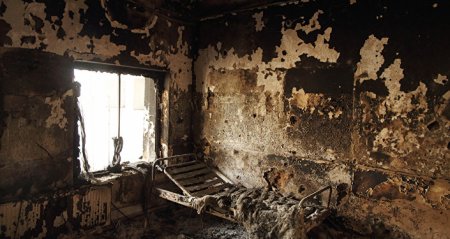
A Médecins Sans Frontières investigation into the Afghan hospital bombing by US forces has found that there were no armed combatants or weapons within the compound, and no fighting in the direct vicinity of the hospital at the time of the airstrikes.
In its report released on Thursday, Médecins Sans Frontières (MSF/Doctors Without Borders) addressed the “relentless and brutal aerial attack by US forces” which took place in Kunduz on October 3 and killed at least 30 people, including MSF staff.
“The MSF rules in the hospital were implemented and respected, including the ‘no weapon’ policy and MSF was in full control of the hospital at the time of the airstrikes,” the organization stated.
The document also said there were “no armed combatants within the hospital compound and there was no fighting from or in the direct vicinity” of the trauma center at the time of the strikes.
The hospital was “fully functioning” at the time of the airstrikes, with 105 patients admitted and surgeries taking place, according to the findings of the investigation.
In addition, MSF said the “agreement to respect the neutrality of our medical facility based on the applicable sections of International Humanitarian Law was fully in place and agreed with all parties to the conflict prior to the attack.”
Despite that neutrality, the hospital was still the target of a US airstrike, leading MSF to ask how such an attack was allowed to happen.
“The question remains as to whether our hospital lost its protected status in the eyes of the military forces engaged in this attack – and if so, why,” MSF said in its statement.
Presenting the report, MSF general director Christopher Stokes said: “From what we are seeing now, this action is illegal in the laws of war. There are still many unanswered questions, including who took the final decision, who gave the targeting instructions for the hospital.”
The MSF statement described the tragic situation at the hospital.
“Patients burned in their beds, medical staff were decapitated and lost limbs, and others were shot by the circling AC-130 gunship while fleeing the burning building. At least 30 MSF staff and patients were killed,” it states.
MSF says its demand is simple: “A functioning hospital caring for patients, such as the one in Kunduz, cannot simply lose its protection and be attacked; wounded combatants are patients and must be free from attack and treated without discrimination; medical staff should never be punished or attacked for providing treatment to wounded combatants.”
Following the aerial attack, the Pentagon initially attempted to shift responsibility onto Afghan security forces, claiming they had requested the airstrikes.
However, the commander of the US and NATO forces in Afghanistan, Gen. John Campbell, later admitted the attack was a “US decision made within the US chain of command.” He went on to say that Washington would “never intentionally target a protected medical facility.”
Read more:
US tank enters MSF hospital in Afghanistan’s Kunduz, ‘destroys potential evidence’ – reports
November 5, 2015
Posted by aletho |
Illegal Occupation, Militarism, War Crimes | Afghanistan, Human rights, MSF, NATO, United States |
Leave a comment
Israel is seeking a large increase in annual military assistance from the United States and has held preliminary talks with the Obama administration on a 10-year financial package that would provide up to $50 billion, American congressional sources say.
During unofficial talks in recent weeks, Israel has asked the US to increase its annual military assistance by 60 percent to an average of $5 billion a year over the 2018-2028 period, the congressional aides said on Wednesday, according to Reuters.
Under the existing agreement that was signed in 2007 and expires in 2017, annual military aid to Israel grew to about $3 billion a year. That deal was negotiated during the George W. Bush administration.
Israel says that it wants more money to counter threats that will arise as a result of the recent Iran nuclear agreement, which the Zionist regime has fiercely opposed.
US officials said that negotiations on the new aid package deal were still in the early stages and the proposal has not yet been formally presented to Congress, which must approve the funding.
“First they have to negotiate with the White House,” one senior congressional aide said of the Israeli regime.
Israeli Prime Minister Benjamin Netanyahu will visit Washington next week and hold talks with President Barack Obama on the aid package. Netanyahu and Obama are expected to reach an agreement on the aid deal’s broad outlines.
President Barack Obama and Prime Minister Benjamin Netanyahu of Israel hold a bilateral meeting in the Oval Office, Sept. 30, 2013.
Obama had reportedly agreed in principle with Netanyahu in a previous meeting to increase the aid package to between $4.2 billion and $4.5 billion.
The money is separate from the nearly $500 million in annual US funding for Israel’s missile system programs in recent years. It is also on top of the US warfighting material held in Israel, which is valued at $1.2 billion.
US annual aid to Israel has held steady despite cuts to a wide range of domestic and military programs in the United States, including reducing the size of the US Army to its lowest level since before World War Two.
The US government is pressured to serve Israel’s interests due to the influence of the powerful Zionist lobby in the United States. The pro-Israel pressure groups actively work to steer US foreign policy in favor of Israel.
November 5, 2015
Posted by aletho |
Ethnic Cleansing, Racism, Zionism, Militarism, Wars for Israel | Israel, Middle East, Palestine, United States, Zionism |
Leave a comment
Ahmed Chalabi, age 71, has died of a heart attack in Baghdad. As a close observer of his unique role in provoking the Iraq War – a foreign policy and strategic military disaster 12 years ago – I can’t help but look back on that time as an age of innocence. That may sound ironic, but I think it’s true given that many Americans now see that even elections don’t change much.
As painful as it was to watch the U.S. government plunge into the Iraq War based on false WMD warnings – raised in part by Chalabi and his Iraqi National Congress – there was still a sense of hope back then that the truth could be told and the culprits could be held accountable. That seems now to have been a naïve dream.
In 2003, Chalabi was on track to become the new leader of Iraq, just as soon as Paul Wolfowitz’s projected “cakewalk” was finished. Towards this end, he was using, and being used by, the neoconservative cabal of Bush/Cheney appointees in the Pentagon, the National Security Council and the State Department.
Yet, despite the fact that the “cakewalk” turned into a blood-soaked grind – and has now spread disorder across the Middle East and into Europe – many of the same men and a few women are still advising and influencing the Obama administration’s security policies toward Eastern Europe, the Mideast, Russia and China.
Now, as then, this group of neocons and their “liberal interventionist” pals lack the good sense that God gave a chicken. They still march off without a recognizable moral compass (even as they assert their moral superiority) and still without the slightest respect for either the Constitution or the soldiers and marines they gleefully send into harms’ way.
At least with Chalabi, in the early 2000s, the U.S. government had a dapper and hopeful spokesperson for what Iraq was supposed to become. Some saw Chalabi as smooth while others viewed him as oily – a conman with his own checkered past – but he was purported to be the kind of modern Iraqi who could make Iraq a better place.
Chalabi’s optimism, his delusions of grandeur, and his faith in the conspiracy of empire led him to the hubris of the neocons, those vainglorious sorcerers wielding the bureaucratic power of the Pentagon and the White House. Together, they were a perfect match. Chalabi’s fantasies for Iraq were the natural product of his fundamental criminality, but his delusions also were vital to the neocons as they spun their spell to entrance the American public.
Still, Chalabi could be understood as a character in a Edith Wharton novel, trapped in his own era, not overly complex, but certainly earnest. The same cannot be said for the American neoconservatives who used him. Even in his guile there was a sense of guilelessness. After the U.S. invasion of Iraq failed to turn up the promised WMD or confirm Saddam Hussein’s alleged links to Al Qaeda, Chalabi defended the falsehoods, calling himself “a hero in error.”
There was a time when I saw Chalabi as a big part of our foreign policy conundrum, but the past decade has shown us where the real evil lies. Today, I see Chalabi more as a victim of his bad assumptions about the neoconservatives, who privately celebrate the cost, chaos, destruction and decimation of whole countries and cultures, in the name of their twisted vision.
Unheeded Warnings
In 2003, the canaries in this dark coal mine were warning about the lies told by President George W. Bush, Vice President Dick Cheney and political appointees throughout Washington to justify an American satrapy in Iraq. While some of us could see a future far grimmer, far more dangerous, and far more destructive than the neocon promises of American soldiers being welcomed by children throwing flowers and candy – many Americans could not. Chalabi was a useful part of why that was.
The warnings from government whistleblowers, knowledgeable observers around the world, and independent-minded journalists and historians were hushed, silenced and buried until Iraq was burning and a quarter of that country’s population had been made refugees by an unwinnable war and a hated occupation.
It took years for the fraud committed by the neoconservatives, their allies in mainstream media, and the Bush administration to sink in, though many Americans still appear confused as to how they should assess what happened. The bottom line is that what occurred was a crime against the American people, the Constitution, international law, the Iraqis and their neighbors. Yet, there has been a stunning lack of accountability for the culprits who perpetrated this crime.
A dozen years after the war began, Chalabi’s promised golden age for Iraq and the Middle East has turned to dross. Today, it is common knowledge that the “word” of the United States is rarely good. Today, the world understands the ambitions of the United States as reptilian rather than republican, driven by a kind of rabid hostility and covetousness that in 2003 most did not easily perceive.
Today, to seek a partnership with the Pentagon or State Department as you try to shape your own small country’s history means you are more gambler than statesman, more fool that patriot.
The actions of the United States in places such as Iraq, Afghanistan, Georgia, Ukraine, Egypt, Libya and Syria – alliances of greed and dependency that Washington has maintained throughout this era – reveal an ugly truth. U.S. foreign policy is not about democracy and self-determination, it is not about hope. Rather, it is about crony capitalism, old-style imperialism, theft and tyranny, all wrapped up in a maelstrom of bureaucratic infighting and budget padding.
No one is trusted in the conduct of America’s never-ending “wars.” Today, when a Russian airliner crashes, the U.S. is as likely to be blamed as a terrorist group, and the terrorist groups themselves are differentiated by their degree of U.S. support and their use of U.S. weaponry – with some Sunni jihadists in Syria now firing U.S.-supplied TOW missiles and being hailed by U.S. politicians as “our guys.”
We’ve come a long way since 9/11 when President Bush said aiding or harboring a terrorist made one as guilty as the terrorist.
Since 2003, many Americans have discovered that their political leadership is addicted to arrogant mayhem. What worked to create public support for foreign wars in 2003 is now laughed at, or ignored, by a cynical citizenry. We have learned to distrust our government, on issues both foreign and domestic.
Chalabi, though his passing has been little noticed and less mourned, reminds us of how U.S. foreign policy with its military adventurism was formed and still is formed. The world that made him a celebrity now faces the cold reality of the widening chaos that is the result of the past dozen years.
We may not see another charlatan like Chalabi soon. One surely can hope that Americans would quickly spot a new Chalabi today and discount the optimistic messaging that he or she is selling. In a troubling way, that is a good thing. These days, the U.S. President no longer even attempts to sell new wars, invasions, occupations and assassinations to the war-exhausted public. He just conducts them in the shadows.
Chalabi’s passing reminds us that we live in a post-heroic world, where the U.S. war machine rumbles along on borrowed money – without a coherent strategy, vision, success or accountability and also without a soul and without heroes. That sad fact is certainly worth a moment of quiet reflection.
Karen Kwiatkowski is a retired USAF Lt Col, who publicized what she saw in the Pentagon at her final assignment in the Office of the Secretary of Defense in the run-up to the 2003 invasion of Iraq. She farms with her family in western Virginia, and writes occasionally for LewRockwell.com, and other outlets.
November 4, 2015
Posted by aletho |
Corruption, Deception, Militarism, Timeless or most popular | Ahmed Chalabi, George W. Bush, Iraq, United States |
Leave a comment
Israel has provided the United States with a list of weapons that it would like to have available as part of the US aid package, Israel’s Yedioth Ahronoth revealed yesterday.
According to the newspaper the list included a modern aircraft carrier and a squadron of F-15 aircrafts as well as material assistance to support Israel’s anti-ballistic missile system, Arrow 3.
According to the newspaper Israeli officials have asked for these weapons during closed-door meetings with US officials attended by Defence Minister Moshe Ya’alon and US Secretary of Defence Ashton Carter in Washington.
The list of arms exceeded the maximum assistance provided by the United States each year, amounting to nearly $3 billion, therefore it has been referred to US President Barack Obama before Israeli Prime Minister Benjamin Netanyahu’s visit to the White House scheduled for next week, the paper reported.
November 4, 2015
Posted by aletho |
Corruption, Ethnic Cleansing, Racism, Zionism, Militarism | Israel, United States, Zionism |
Leave a comment
 The overwhelming feeling of the local people is that the Government on the mainland is willing to sacrifice the wishes of Okinawans in order to pursue its military defense measures against China. Bound by Article 9, Japan has not had an army since world war two, though moves by the Government suggest a desire to scrap the Article and embark on a ‘special relationship’ with the U.S., who is already securing control of the area with over 200 bases, and thus tightening the Asia pivot with control over land and sea trade routes, particularly those routes used by China.

 Aletho News

