‘Bodies were shredded’: Anti-ISIS airstrikes killed hundreds of civilians, report claims
RT | August 3, 2015
Over 400 civilians have been killed in in the first year of US-led anti-ISIS airstrikes, including 58 non-combatants who were being held in an Islamic State prison for offenses such as buying cigarettes, a major study claims.
The study was carried out by the Air Wars transparency group and written by former BBC Panorama and Newsnight journalist Chris Woods.
The study cites 57 incidents where there is publicly available evidence of civilian deaths by coalition military action.
“Despite claims by the US-led coalition that its airstrikes in Iraq and Syria are ‘the most precise and disciplined in the history of aerial warfare,’ there are clear indications from the field that many hundreds of non-combatants have been killed,” Woods writes in the report’s key findings.
According to Air Wars, the largest single death toll was that of 58 non-combatants on December 28, 2014, in Al Bab, Syria, when an airstrike hit an Islamic State headquarters which doubled as a prison.
Among the dead at Al Bab are believed to be four women and a number of teenagers, with some of those killed thought to have been imprisoned for buying cigarettes.
In another incident in February 2015, Ibrahim al-Mussul, a farmer in his sixties, and his two daughters were allegedly killed in an airstrike near the town of Shadadi, Syria, close to an oilfield targeted by the coalition.
“Their bodies were shredded. We found Ibrahim’s hand next to the house, and we were still collecting bits of flesh and body parts into the early hours of the following morning,” an eyewitness said.
Writing on the challenges of collating casualty numbers, Air War’s Syria researcher Kinda Haddad explained in one section of the report: “Civilians are dying in unacceptable numbers as a result of military action by so many different actors in both Syria and Iraq.
“It’s not just the coalition, but also government troops; a large number of different opposition forces; Shia’a and Kurdish militias; and of course Islamic State or Daesh.”
The study also notes that the UK Ministry of Defence, in particular, amends and changes its reporting of incidents, making it difficult to assess what is happening on the ground.
“The Ministry of Defence has on occasion significantly amended or even removed earlier copy, making the process of accurately tracking some reports difficult,” the study found. “The UK also does not report on airstrikes in Syria carried out by British air crews embedded with allied forces.”
“The coalition has often spoken of the power of Daesh propaganda as a weapon, and how it must be countered. Yet at the same time, the coalition’s near-total denial of having caused civilian casualties continues to damage its own credibility,” the report claims.
Air Wars said the proper reporting and investigation of civilian deaths by coalition action should be undertaken and that such an initiative would make strategic sense.
“Conducting prompt and effective investigations into all credible claims of civilian casualties – and publishing those findings – would go some way towards countering such militant propaganda, while addressing the very real concerns of Iraqi and Syrian civilians on the ground,” they said.
Obama authorizes airstrikes ‘to defend’ US-trained rebels
RT | August 3, 2015
The US president has reportedly authorized the Air Force to protect Syrian rebels trained by Washington to fight against Islamic State by bombing any force attacking them, including Syrian regular troops.
Thus the US may become involved in the Syrian civil war on the rebel side.
The change was first reported by US officials speaking on condition of anonymity with the Wall Street Journal Sunday. The first airstrikes to protect American trainees in Syria have already taken place on Friday, July 31, when the US Air Force bombed unidentified militants who attacked the compound of the US-trained rebels.
So far the fighter jets of the anti-Islamic State (IS, formerly ISIS/ISIL) US-led coalition have been bombing jihadist targets in Syria’s north and the national air defense units were turning a blind eye to foreign military aircraft in their airspace.
Meanwhile, President Barack Obama’s decision reportedly involves inflicting airstrikes against any force that attacks the Syrian rebel armed force being trained by American instructors and armed using money from the US budget, with the officially-proclaimed aim of dealing with the advances of IS.
“For offensive operations, it’s ISIS only. But if attacked, we’ll defend them against anyone who’s attacking them,” a senior military official told the Wall Street Journal on Sunday. “We’re not looking to engage the regime, but we’ve made a commitment to help defend these people.”
Neither the Pentagon nor the White House officially commented on the decision about the new broader rules of engagement, Reuters reports. So far the US has been avoiding direct confrontation with the forces of President Bashar Assad.
“We won’t get into the specifics of our rules of engagement, but have said all along that we would take the steps necessary to ensure that these forces could successfully carry out their mission,” said White House National Security Council spokesman Alistair Baskey, stressing that so far only US-trained forces have being provided with a wide range of support, including “defensive fires support to protect them.”
The Kremlin said that US airstrikes against Syrian troops would further destabilize the situation.
Moscow has “repeatedly underlined that help to the Syrian opposition, moreover financial and technical assistance, leads to further destabilization of the situation in the country,” Kremlin press secretary Dmitry Peskov said, adding that IS terrorists may take advantage of this situation.
The US rebel training program launched in May implies military instruction of up to 5,400 fighters a year, Reuters reports. The program is reportedly so hard for the trainees that some candidates are being declared ineligible from the start.
According to the WSJ, the Pentagon has been planning to have 3,000 fighters trained by the end of 2015, but finding applicants without ties to hardline groups turned out to be a heavy task. Reportedly, so far fewer than 60 fighters have been trained.
There are now multiple groups taking part in the Syrian civil war, as Assad’s troops are fighting not only the rebels, but also other militant groups, such as Al-Qaeda’s Syrian wing, the so-called Al-Nusra Front, and IS. The militant groups, in turn, are fighting not only Assad’s troops, but each other too.
“We recognize, though, that many of these groups now fight on multiple fronts, including against the Assad regime, (Islamic State) and other terrorists,” said Pentagon spokeswoman Commander Elissa Smith, stressing though that “first and foremost” the US focuses on combating IS.
However, as a result the US warplanes may end up bombing government troops under the command of a legitimate president, Assad, an act of aggression against a sovereign country that only the UN Security Council could authorize.
September will mark one year that the US-led coalition has been bombing positions of the Islamic State in Iraq and Syria. Although already in November 2014 there were reports that the anti-IS campaign could be nothing else but a move to allow the US military to oust President Assad through less direct means.
In 2013, Damascus narrowly escaped a US-led invasion after Russia brokered an agreement for Syria to hand over its chemical weapons to the international community.
At the time, UK Prime Minister David Cameron lost a bid in the House of Commons to ally British forces with the US military, but now Royal Air Force is bombing positions of IS along with the Americans.
An airstrike of the anti-IS coalition on Assad troops might become a very dangerous precedent and cause a direct military conflict between Washington and Damascus, something that diplomats have managed to avoid since the beginning of the Syrian civil war.
READ MORE: UK pilots authorized to bomb Syria without democratic sanction – Reprieve
60 Minutes Provides Platform for US Military to Hype Imaginary China and Russia Threat
By Matt Peppe | Just the Facts | August 2, 2015
The CBS news program 60 Minutes on Sunday aired an extended segment titled “The Battle Above” that relayed the concerns of various US military personnel that China and Russia could pose a threat to the vast system of American satellites that are used for military purposes and for commercial use by banks, telecommunications companies, farmers and others.
“Top military and intelligence leaders are now worried those satellites are vulnerable to attack. They say China, in particular, has been actively testing anti-satellite weapons that could, in effect, knock out America’s eyes and ears,” said correspondent David Martin.
Gen. John Hyten, head of the 38,000-person Space Command unit of the US Air Force, tells all his troops that there is a “contested environment” in space with multiple countries not allied with the U.S. possessing capabilities that could potentially threaten American satellites. “It’s a competition that I wish wasn’t occurring, but it is. And if we’re threatened in space, we have the right to self-defense, and we’ll make sure we can execute that right,” Hyten says.
While the Pentagon admits spending $10 billion per year on space, 60 Minutes reports that when you add in other indirect costs the actual total reaches $25 billion. And Air Force Secretary Deborah Lee James says the Pentagon plans to spend an additional $5 billion over the next 5 years on protecting its satellites.
Hyten describes the ambitions and activities of foreign actors in space as essentially an existential threat not just to the U.S. military but to the American economy. This is a useful narrative for an agency that is seeking billions of dollars to extend its current dominance.
Without a discernible threat, it would be difficult to justify such outlandish expenditures as the X-37B space plane. The plane is able to return to earth after voyaging for 20 months into space, allowing anything included in the payload to be later retrieved. The purpose of the plane is as yet undisclosed. But Hyten’s response when asked if it will one day be used as a weapons system – that he can’t answer – is revealing.
The military officials interviewed by 60 Minutes frame the issue as one in which the U.S. is acting purely in self-defense and within international law. Martin mentions that there is a 1967 U.N. treaty that calls for the peaceful use of space, but says in practice it does not resolve much. When he asks if this means it’s every country for himself, Lee James says, “Pretty much.”
60 Minutes makes much of anti-satellite weapons tests that China conducted in 2007, nearly a decade ago. China’s foreign ministry told the news program that it has not conducted any tests since and is “committed to the peaceful use of outer space.”
Are China’s declarations just empty rhetoric to conceal their true ambitions? And what threat do Russia and other countries like North Korea actually pose?
60 Minutes fails to mention that the United Nations has actively been dealing with the threat of weapons in space, and it is the United States itself – not China or Russia – that has been most forceful in rejecting limits on weapons programs and an arms race in space.
In its most recent session, the UN General Assembly passed two resolutions directly related to the use of weapons in space – one of which the U.S. government outright opposed and the other which it abstained from voting on.
UNGA resolution 69/31, “Prevention of an arms race in outer space” passed by a margin of 178-0 with 2 abstentions (the United States and Israel). The resolution affirmed that “the exploration and use of outer space, including the Moon and other celestial bodies, shall be for peaceful purposes and shall be carried out for the benefit and in the interest of all countries” and recalled that all States must “observe the provisions of the Charter of the United Nations regarding the use or threat of use of force in their international relations, including in their space activities.”
The General Assembly also passed resolution 69/32, “No first placement of weapons in outer space,” passed by a margin of 126-4 with 26 abstentions. China, Russia, North Korea and Iran all voted in favor of this measure, while the United States, Israel and US allies Georgia and Ukraine were the only nations voting against it.
The resolution “urges an early start of substantive work based on the updated draft treaty on the prevention of the placement of weapons in outer space and of the threat or use of force against outer space” that was submitted at the Conference on Disarmament. The draft treaty was submitted by two states: China and Russia.
In their story, 60 Minutes serves the role of Pentagon PR mouthpiece, allowing US military officials to hype the threat of China and Russia by presenting a narrative based on little more than their own paranoia.
If they wanted to realistically assess the threat of an arms race in space and determine who is responsible, 60 Minutes would have examined the extensive actions and voting record of the United States, China, Russia, and other states in the diplomatic arena to deal with such a threat. This would demonstrate emphatically that the United States has stood virtually alone in the world in opposing peaceful cooperation and de-escalation of military action in space. But apparently 60 Minutes finds it easier to simply take the Pentagon’s arguments and analysis at face value.
The DoD’s scare tactics of creating an imaginary threat – in the form Washington’s familiar punching bags China and Russia – allow them to frame their space program as an imperative reaction to legitimate national security threats, rather than as a superfluous, aggressive expansion of their unchallenged hegemony that extends not just around the globe, but thousands of miles into the reaches of outer space.
The Fake War on ISIS: US and Turkey Escalate in Syria
By Eric Draitser – New Eastern Outlook – 02.08.2015
It is late July 2015, and the media is abuzz with the news that Turkey will allow US jets to use its bases to bomb Islamic State (ISIS) targets in Syria. There is much talk about how this development is a “game-changer,” and how this is a clear escalation of the much ballyhooed, but more fictional than real, US war on ISIS: the terror organization that US intelligence welcomed as a positive development in 2012 in their continued attempts to instigate regime change against the Syrian government led by Bashar al-Assad.
The western public is told that “This is a significant shift… It’s a big deal,” as a US military official told the Wall Street Journal. What the corporate media fail to mention, however, is the fact that Turkey has been, and continues to be, a central actor in the war in Syria and, consequently, in the development and maintenance of ISIS. So, while Washington waxes poetic about stepping up the fight against the terror group, and lauds the participation of its allies in Ankara, the barely concealed fact is that Turkey is merely further entrenching itself in a war that it has fomented.
Of equal importance is the simple fact that a “war on ISIS” is merely a pretext for Turkey’s military engagement in Syria and throughout the region. Not only does Turkey’s neo-Ottoman revanchist President Erdogan want to flex his military muscles in order to further the regime change agenda in Syria, he also is using recent tragic events as political and diplomatic cover for waging a new aggressive war against the region’s Kurds, especially Turkey’s longtime foe the Kurdish Workers Party (PKK).
In this way, Turkey’s recent moves should be seen as merely a new phase of its engagement in the regional war that it has helped foment. Contrary to western corporate media talking points, Turkey has not just recently become actively engaged in the conflict; Ankara has merely shifted its strategy and its tactics, moving from covert engagement to overt participation.
Same War, New Phase
The immediate justification for the launching of renewed airstrikes by Turkey and the US is the expansion of the war against ISIS. In the wake of the bombing in Turkey’s majority Kurdish town of Suruç, which killed 32 youth activists, the Turkish government has allegedly struck hard against both ISIS and PKK targets. It is against this backdrop that any analysis of the new phase of this war must be presented.
First and foremost is the fact that even if one were to accept the Turkish government’s official story – the suicide bomber was linked to the Islamic State (ISIS) – not at all a certainty, the question of ultimate responsibility becomes central. While Ankara would have the world believe that its hands are clean, and that it is the innocent victim of international terrorism, the reality is that Turkey has done everything to foster and promote the growth of ISIS from the very beginning. As such, it is the Turkish government who must shoulder much of the blame for the Suruç bombing.
Since at least 2012, Turkey has been the principal conduit for weapons flowing into Syria. In June of that year, the NY Times confirmed that the CIA was smuggling weapons to anti-Assad forces from the Turkish side of the border using agents of the Syrian Muslim Brotherhood, long-time assets of US intelligence. Also in 2012, Reuters revealed that Turkey had “set up a secret base with allies Saudi Arabia and Qatar to direct vital military and communications aid to Syria’s rebels from a city near the border… ‘It’s the Turks who are militarily controlling it. Turkey is the main coordinator/facilitator. Think of a triangle, with Turkey at the top and Saudi Arabia and Qatar at the bottom,’ said a Doha-based source.”
It is now also documented fact that Turkish intelligence (MIT) has been an active player in the ongoing campaign to arm and resupply the terror groups such as the al Nusra Front and others. The evidence of this fact was made public by the Turkish daily Cumhuriyet which published video footage along with transcripts from wiretaps confirming what many eyewitnesses have stated: Turkish security forces have been directly involved in shelling and support operations for Nusra front and other jihadi groups in and around Kassab, Syria, among other sites. Many of the very same terrorists who have been armed and supported by the Turkish government are today being held up as enemies of Turkey, and rationalization of the need for Turkish military intervention.
So, with the inescapable understanding that Turkey’s government is the primary supporter and sponsor of terrorist groups in Syria, the justification for war becomes flimsy at best. But, if it’s not about fighting terror, then what exactly is Ankara’s objective? What does it hope to gain?
At the top of Erdogan’s agenda is using ISIS as a pretext for effecting the regime change in Syria that he has failed to bring about for these past four years. Despite providing weapons and cash, training sites and political cover, Turkey’s terror proxies have been roundly defeated by the Syrian Arab Army, Hezbollah, and allied forces. As such, Erdogan now needs to provide the overwhelming military superiority required to get the job done. This means air support and a “No Fly Zone” along the Turkey-Syria border, one which ostensibly will allow Turkey to fight ISIS, but in actuality is a means of securing territory for the terrorists who otherwise have been unable to do so. It is a de facto military intervention into Syria. Perhaps not even de facto, but outright declaration of war – a clear war crime.
Secondly, the alleged war on ISIS is a politically expedient cover for Erdogan to wage a full-scale war on the Kurds, and the PKK specifically. Within hours of announcing the new phase of the war, Turkish forces were bombing Kurdish targets in Syria and Iraq, effectively declaring war on both countries, in blatant violation of international law, to whatever extent such a thing still exists. Indeed, Erdogan made his position quite clear when he stated, “It is not possible for us to continue the peace process with those who threaten our national unity and brotherhood.” Essentially, Erdogan has declared war on all Kurds of the region.
Perhaps most important, and almost never discussed in the West, is the simple fact that Turkey is perpetuating an outright myth in their supposed strategy to create “Islamic State-free zones” along the border; Turkey plans to work with “moderate opposition” and “Free Syrian Army” in this endeavor. However, the fact remains that there is really no such thing as the “moderates,” and those terrorists that had at one time been labeled such have all either gone home, fled the country, gone over to the Al Qaeda-affiliated Nusra Front, or are now fighting under the ISIS banner. And so, by stating such a plan, Erdogan is unwittingly admitting what this author has already reported numerous times – Turkey acts as military muscle for ISIS and al Qaeda in Syria and now Iraq.
But of course, were Turkey the only relevant party, these developments would not be of nearly the same global significance. Rather, it is the participation and collusion of the US and NATO that makes this troubling escalation far more dangerous.
Making Overt the Covert War
As of writing, NATO has not yet been convened to discuss Turkey’s war on Syria and the Kurds, though Ankara has called for the meeting under Article 4 of the NATO treaty which provides for consultation, but not necessarily collaborative military action. However, regardless of how the meeting proceeds, Turkey has been given overt support in its war by the US, which is, in effect, NATO.
Although the US feigns concern for the Kurds and the expansion of the war, Washington has in fact endorsed Turkey’s policy. White House spokesman Alistair Baskey noted that the US “strongly condemns” recent attacks by the PKK, reiterating the fact that Turkey is an important US and NATO ally. As Obama’s close adviser on national security matters Ben Rhodes stated, “The US, of course, recognises the PKK specifically as a terrorist organisation. And, so, again Turkey has a right to take action related to terrorist targets.”
While it would appear that Washington is taking a measured approach, cautiously supporting Turkey while trying to limit the scope of the operation, that illusion is merely for appearance’s sake. In fact, the Brookings Institution just last month issued a policy paper entitled Deconstructing Syria: Towards a regionalized strategy for a confederal country, which brazenly laid out a plan to, as political analyst Tony Cartalucci astutely pointed out, “divide, destroy, then incrementally occupy” Syria using the pretext of ISIS and terrorism. And that is precisely what we’re witnessing now.
But neither Cartalucci, nor this author, nor any other colleagues who have predicted this turn of events are clairvoyant. Rather, this development was very much expected. As noted above, those terrorists who now provide the rationale for a new war were the very same ones openly supported by the countries now waging the war. It was clear at the time that this would be their ultimate role. Sadly, the world has not effectively mobilized to stop this imperialist war thus far.
The question remains: will Syria survive? The answer depends on the continued resolve of the Syrian Arab Army and its allies, and on the global Resistance’s capacity to organize itself to effectively oppose the Empire in Syria and beyond.
UK boosts 2015 arms sales to Egypt after sinking 2013 deals
Press TV – August 1, 2015
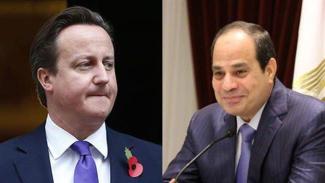
Britain has reportedly re-boosted weapon sales to the Egyptian government in 2015 following a reduction in sales put in place after the military ouster of former president Mohamed Morsi.
The US-based Newsweek magazine reported Friday that official figures released by the UK government indicated that London approved military sales licenses to Egypt for “components of military combat vehicles” worth $76.3 million in the first quarter of 2015.
According to the report, the figures point to a 3,000-percent annual increase in the value of military sales to Egypt by British weapon exporters. It added that in the first quarter of 2014 military deals between the two states stood at $2.4 million in value.
It further noted that some arms export licenses were cancelled by Britain in 2013 following a military coup against Morsi by then army chief and current President Abdel-Fattah el-Sisi.
In June, the Egyptian president received an official invitation from British Prime Minister David Cameron to pay a visit to London.
A number of British human rights organizations have censured the expanding military ties between London and Cairo.
“The UK should be condemning the appalling human rights abuses that are taking place in Egypt,” said CAAT researcher Andrew Smith.
“However, these increasing arms sales, and the forthcoming visit, suggest that the government wants to strengthen its ties [with Cairo],” he added.
Erodoğan and Netanyahu Declare War
By James Petras :: 07.31.2015
The rulers of the two most powerful authoritarian regimes in the Middle East are launching major wars to reconfigure the Middle East. Israeli Prime Minister Netanyahu has declared war by proxy on Iran, announcing full-scale military mobilization within Israel (July 27 -29) and organizing the biggest political campaign of ultra Zionist Jews in Washington.
The purpose of this two-pronged propaganda blitz is to defeat the recently signed US-Iranian agreement and start another major Middle East war. Ultimately, Netanyahu intends to take care of his ‘Palestinian Problem’ for good: complete the conquest and occupation of Palestine and expelling the Palestinian people from their homeland – the single most important foreign policy and domestic goal of the Jewish state. In order to do this, Israeli leaders have had to systematically campaign for the destruction of the Palestinians regional supporters and sympathizers – Iraq, Libya, Syria, Lebanon and Iran.
Erodogan’ s Multiple Wars
At the same time, Turkish Prime Minister Erodogan has launched a major war against the Kurdish people and their aspirations for a Kurdish state. This has followed closely on several recent incidents beginning with the bombing (with cooperation from Turkish intelligence ) of a Kurdish youth camp, killing and wounding scores of young secular activists. Within days of the massacre of Turkish-Kurdish youth, Erodogan ordered his air force to bomb and strafe Kurdish bases within the sovereign territories of Iraq and Syria and Turkish security police have assaulted and arrested thousands of Kurdish nationalists and Turkish leftist sympathizers throughout the country. This has all occurred with the support of the US and NATO who provide cover for Erodogan’s plans to seize Syrian territory, displace Kurdish civilians and fighters and colonize the northern border of Syria – under the pretext of needing a ‘buffer zone’ to protect Turkish sovereignty. Such a massive land grab of hundreds of square kilometers will end the long standing support and interaction among Syrian, Iraqi and Turkish Kurdish populations who have been among the most effective opponents of radical Islamist groups.
Erdogan’s newly declared war on the Kurds has complex domestic and regional components (Financial Times 7/28/15, p 9): Within Turkey, the repression is directed against the emerging electoral-political power of the Kurdish People’s Democratic Party. Erodogan plans to discredit or outright ban this political party, which had won a surprising number of seats in the recent parliamentary election, call for new elections, secure a ‘majority’ in Parliament and assume dictatorial ‘executive powers’.
Regionally, Erodogan’s invasion of Syria is part of his strategy to expand Turkey’s borders southward and westward and to provide a platform from which Turkey’s favorite jihadi clients can launch assaults on the secular government in Damascus and Aleppo. The bombing of Kurdish villages and camps in Iraq and Syria are designed to reverse the Kurd’s military victories against ISIS and will justify greater repression of Kurdish activists backing autonomy in southeastern Turkey.
Erodogan is counting on Turkey’s agreements with the US and NATO for overt and covert collaboration against the Kurds and against Syrian national sovereignty.
Netanyahu’s Proxy Wars
Netanyahu’s multifaceted political offensive is designed to drag the US into a war with Iran. His strategy operates at many levels and in complex complimentary ways. The immediate target is the nuclear agreement recently signed between the White House and Iran. Part of the longer-term strategy to destroy Iran includes the formation of a coalition of Middle East states, especially Gulf monarchies, to encircle, confront and provoke war with Iran. This political-military strategy is being pushed by leading Zionists within the highest circles of the US Government.
All the major Israeli political parties, and most Israeli voters support this dangerous policy against Iran. The Presidents of the 52 Major American Jewish Organizations in the US have been mobilized to bully, bribe and bludgeon the majority of Congress into following Netanyahu’s dictates. Every US Congressperson is being ‘visited’ and presented with propaganda sheets by leaders, activists and full time functionaries of AIPAC, the Jewish Confederations and their billionaire political donors. All the major US press and TV media parrot Netanyahu’s call for ‘war on the peace accord’ despite massive US public opinion against any escalation of the conflict.
At the highest levels of US Executive decision-making top Zionist officials avoid association with AIPAC’s public polemics and thuggish bluster, all the while promoting their own political-military ‘final solution’ … for eliminating Iran as an adversary to Israeli-Jewish supremacy in the Middle East. In the State Department and Departments of Commerce, Defense and Treasury, US-Israeli agents acting as special Middle East advisers, ambassadors and insiders push Netanyahu’s policies to undermine any normalization of relations between the US and Iran.
A recent proposal written by Professor Phillip Zelikow in the Financial Times (7/23/15, p. 9 ) entitled “To Balance (sic) the Nuclear Deal, Defeat ISIS and Confront Iran” is chilling.
The former ‘Executive Director of the ‘9/11 Commission Investigation Report’, uber-insider Zelikow promotes the formation of an ingenious coalition, in the name of fighting ISIS, but whose real purpose is to “confront Iranian ambitions”. Zelikow’s “coalition” includes Turkey, which will be assigned to attack Iran’s regional allies in Syria and Lebanon (Hezbollah) – all in the name of “fighting ISIS”.
The bland, bespectacled and most respectable Professor Zelikow lays out Netanyahu’s own bloody hit list down to the most minute detail – but tidied up with a thin veneer of ‘confronting ISIS’ to obscure his real agenda. This is no blustering AIPAC thug or open Neo-Con war monger beating the drums…
Zelikow’s ‘anti-ISIS coalition’ will ultimately go after the Iraqi Shia militia and their main supporters among Iran’s Revolutionary Guard – hewing closely to Netanyahu’s strategy!
Zelikow was a major inside advocate of the 2003 invasion of Iraq. Twelve years after the US invaded, occupied and destroyed Iraq, Zelikow pops up again to promote a policy of sending US combat troops to serve Israel’s regional interest. He writes, “The military side [of the ‘coalition’] will need more Americans on the ground to offer meaningful combat support among the coalition”. (FT ibid).
Zelikow is clearly aware of US public opinion in favor of diplomacy with Iran and against the US engaging in more ground wars in the Middle East, when he writes that a ‘military effort is not an alternative to diplomacy.” Zelikow and his bosses in the Israeli Foreign Office know any US military intervention with such a “coalition” would lead to the destruction of the US-Iran Agreement and another major ground war with US troops fighting for Israel once again!
Considering his position as a highly connected insider, Zelikow’s attempts to sabotage the Iran-US agreement presents a far greater danger to world peace than all the noisy lobbying by the 52 Zionist organizations active in Congress.
Zelikow has been a highly influential security adviser to the US Executive and State Department since the early 1980’s under Reagan. He was appointed ‘special adviser to the State Department’ in 2007, a position held earlier by Neo-Con operative Wendy Sherman and followed by war-monger, Victoria Nuland. In 2011 President Obama appointed him to the President’s Intelligence Advisory Board.
He came to national prominence when President Bush appointed him Executive Director of the 9/11 Commission where he directed the highly controversial (and highly censored) 9/11 Commission Report against much public opposition. The appointment was made after Bush first choice of Henry Kissinger had created a media storm – Kissinger was never a serious choice with an insider-gatekeeper like Zelikow waiting in the wings. He was a controversial choice because of his role as intimate advisor to Condaleeza Rice and his authorship of the notorious Bush national security strategy promoting pre-emptive war, published in September 2002.
Phillip Zelikow suppressed any discussion of Israel’s role as a major catalyst for US involvements in the Afghan and Iraq wars. As executive-director of the 9/11 Commission Report, Zelikow assumed the role of editor and censor. He ignored the history of Israeli Mossad operations in the US, especially in the run-up to the attack on September 11, 2001. The report made no mention the fake ‘moving’ van filled with Israeli spies arrested on September 11, 2001 while celebrating and photographing the destruction of the World Trade Center complex. Nor did he discuss the quiet ‘deportation’ of the Israeli agents. The report contains no discussion of the scores of phony Israel “art students” who operated in South Florida around US military installations and in the vicinity of the apartment of the alleged 9-11 hijackers. They too were quietly arrested and deported.
He also suppressed discussion of the Defense Department’s ‘Able Danger Project’, which showed US intelligence awareness of the hijackers presence and activities much earlier dating back to 1997.
In October 2001, the first ‘anthrax attack’ occurred – first sickening and killing a photojournalist at a scandal sheet in Florida. National news programs featured an interview with… the re-packaged ‘al Qaeda’ and ‘bioterrorism’ expert Professor Zelikow (his lack of Arabic and scientific credentials notwithstanding…) who declared the anthrax to be ‘weapons grade’ and ‘definitely from a state sponsored military lab’, implying Iraq. (He was correct in the ‘military lab’ part of his declaration – only the facility was the US Weapons Lab at Fort Detrick. Zelikow’s role in accusing the embargoed and beleaguered regime of Iraqi President Saddam Hussein of the anthrax hysteria was crucial in the public build-up for the case to invade Iraq, echoed Israeli Prime Minister Ariel Sharon’s call for the destruction of Iraq. Master-performance complete, ‘scientist’ Zelikow’s interview (among others) has disappeared from the ‘web’.
Zelikow’s ‘expertise’ (such as it is) and usefulness to Israel derives from his articles on the political usefulness of ‘false flags’ and catastrophes – events concocted or instigated by imperialist powers to push a traumatized public into unpopular wars and draconian domestic police state policies. His work has centered on the manipulation and exploitation of ‘events’ to push public policy – and include the Cuban Missile Crisis, the re-unification of Germany, policing Northern Ireland, (but not Middle East studies or bio-weaponry’). His expertise is in the historical use of the ‘public myth’- whether the Riechstag Fire or Pearl Harbor. In Foreign Affairs, November-December 1998, he co-authored an article with the current US Defense Secretary Ashton Carter, entitled Catastrophe Terrorism where a ‘watershed event’ could result in ‘horror and chaos’ pushing the US public to accept the destruction of ‘their civil liberties, wide-spread surveillance, detention and use of deadly force…’
Zelikow continues to push the “false flag” script: In 2001 with the “anthrax hysteria” and now with the “Iran threat hysteria” . . . What is not surprising is that in both instances he hews closely to Israel’s strategic goal of utterly destroying countries, which have opposed Israel’s dispossession, occupation and expulsion of Palestinians – Iraq, Syria, Libya, Lebanon and now Iran.
Zelikow is a long-term, major asset for Israel, working quietly and effectively while the AIPAC bullies break down the doors of Congress. He never held a prominent position in the Cabinet or White House post like the brazen Zion-Cons Wolfowitz, Feith, Libby, Perle, Abrams and Levey who aggressively pushed the country into war with Iraq. Wolfowitz and company have scuttled back into obscurity under the cover of lucrative private positions while Zelikow continues to work inside pushing the Iran war agenda out of the limelight.
Zelikow’s role is far more discrete and important to Israel over the long haul than the loudmouths and thugs of AIPAC and other Zionist fronts. On the surface he pursues his academic and university administrative career (an excellent cover) while repeatedly inserting himself into crucial public discussions and quietly assuming strategic positions to advise on events or policies which have ‘turning point’ consequences and where his deep ties to Israel are never discussed.
Zelikow has one asset, which his bullying and blustering Zionist comrades lack and another which he shares with them. Zelikow is a great con-man – claiming knowledge about anthrax, Middle East relations, and military strategy. He spouts …. pure unadulterated rubbish with authoritative finesse!.. Claiming legal and investigative expertise he controlled the 9/11 Commission Report and denied the American people any open and relevant discussion of the event. He even likened the Commission Report skeptics to ‘an infection’ within American public opinion – apparently relying on his ‘expertise’ in biological warfare…
What Zelikow does have in common with the raging bulls of Zionism is his constant resort to vituperation against any country or movement identified as a target by Israel. He consistently refers to the secular government of Syria (under attack by jihadi terrorists) as a “terrorist regime”. He calls the Iraqi militia fighting ISIS “Shia torture squads”. This is part of a build-up to push the US into ground war for Israel against Iran and its allies.
Unlike Turkey’s Erodogan who uses his own armed forces to launch an all-out war to dispossess, terrorize and colonize ethnic Kurdish territories in Syria, Iraq and Turkey, Israel’s Netanyahu relies on his overseas (US) high level operatives to set in motion the wheels of war. Within days of attacks of September 11, 2001, Israel’s leading mouthpiece in the US Senate, Joseph Lieberman presented the roadmap for US wars for the next decade and a half – declaring that “the US must declare war on Iraq, Syria, Libya, Lebanon and Iran”, despite the complete absence of these countries’ involvement in the event.
Is he a prophet or just a highly successful agent? Zelikow will push for a ‘coalition’ of Middle East dictators and monarchs to fulfill Israel’s dream as dictated by Joseph Lieberman in September 2001. This is a dream of waging devastating war against Iran leading to its partition, similar to the de facto partition of Iraq, Syria and Libya, resulting in a Middle East forever ravaged by sectarian strife, foreign occupations, balkanized and devoid of any possibility of regaining civilized life. Israel can then carry out its brutal final solution: the dispossession and expulsion of all Palestinians and establishment an expanded, purely Jewish state – surrounded by unspeakable destruction and destitution…
Conclusion
Erodogan expands ‘Turkoman frontier’ into Syria and Iraq – despite the fact that Turkey has never shown any interest in the Turkoman minorities. To that end, he allies with ISIS terrorists to uproot Kurds, everywhere extending into Turkey. Erodogan, like, Netanyahu, wants a ‘pure’ ethnic state – one Jewish, the other Turkish! Both brutal leaders have no regard for the sovereignty of neighboring states, let alone the security of their civilian populations. Both depend on the military support of the US. Both are in the process of igniting wider and more destructive wars in the Middle East. Netanyahu and Erodogan want to reconfigure the Middle East: Turkey seizes Kurdistan and Syria; Netanyahu expands military dominance in the Persian Gulf through the destruction of Iran.
These two leaders appear to hate each other because they are so similar in arrogance and action… But according to Professor Zelikow, the US will step in ‘god-like’ to ‘mediate’ the different power grabs among what he mindlessly refers to as the ‘partners of the coalition’.
US Arms Sales to Saudi Arabia Contributing to Conflict in Yemen
Sputnik – 01.08.2015
WASHINGTON — The United States’ weapons and logistical support for Saudi Arabia’s military campaign in Yemen signals that Washington is backing Riyadh’s goal to crush Houthi rebels despite UN calls for a political solution, experts told Sputnik on Friday.
The United States is providing intelligence and refueling support to enable a four-month-old Saudi-led air campaign against Houthi rebels and allied forces.
On Thursday, Washington decided to provide Riyadh with $500 million in ammunition to replenish stocks used up in the campaign.
“The Saudis want an extended war that leads to a Houthi defeat, and the United States is effectively backing that strategy with the arms deal,” Charles Schmitz, a specialist on Yemen at the Middle East Institute told Sputnik.
“The Saudis don’t want a political settlement; they want a Houthi surrender,” he added.
This week’s $500 million weapons deal, which includes ammunition, tracers, artillery shells and mines, is meant to resupply the Saudi military in its campaign against Houthi rebels, according to the State Department.
The sale was approved as Saudi Arabia has come under criticism for human rights abuses and violations of the international law of war by targeting and killing civilians in Yemen.
The conflict has claimed the lives of at least 1,900 civilians and has injured more than 4,000, according to the UN, while leaving 80 percent of the country in need of humanitarian assistance.
“The new sale by the United States of $500 million of munitions to Saudi Arabia is yet another example of how America is actually an active combatant in the Saudi war on the people of Yemen,” Haykal Bafana, Managing Director of Bafana Advisory, told Sputnik from Sana.
“Whether the US munitions are distributed by Riyadh for use by its Yemeni proxy forces or by the Kingdom [of Saudi Arabia] itself, the effect is similar: the United States is contributing actively to the deaths of more Yemenis,” Bafana added.
The multi-front war in Yemen pits Houthi rebels and loyalists of former President Ali Abdullah Saleh against ousted President Abd Rabbuh Mansour Hadi’s Sunni forces, tribes and south Yemen secessionists based in Aden.
Al-Qaeda in the Arab Peninsula and the ISIL have also taken advantage of the situation to strengthen their hold in Yemen.
Saudi trained Yemeni proxies loyal to former president Hadi have recently pushed Houthi forces from Aden as several humanitarian ceasefires and political talks have broken-down.
Meanwhile, Saudi Arabia has delayed a pledge to provide $274 million in humanitarian aid to Yemen as the UN and Riyadh discuss the terms of the assistance, the UN’s humanitarian chief said this week.
Why Obama’s “Safe Zone” in Syria Will Inflame the War Zone
By Shamus Cooke | CounterPunch | July 31, 2015
The road to war is paved with a thousand lies. A fresh fib was tossed on the lie-cluttered warpath to Syria, when it was announced that the U.S. and Turkey would create a “safe zone” inside of Syria — supposedly to be aimed against ISIS.
This “safe zone” is a major escalation of war, but it was described in soft tones by the media. In reality a “safe zone” is a “no-fly zone,” meaning that a nation is planning to implement military air superiority inside the boundaries of another nation. It’s long recognized by the international community and U.S. military personnel as a major act of war. In a war zone an area is made “safe” by destroying anything in it or around that appears threatening.
Turkey has been demanding this no-fly zone from Obama since the Syrian war started. It’s been discussed throughout the conflict and even in recent months, though the intended target was always the Syrian government.
And suddenly the no-fly zone is happening — right where Turkey always wanted it — but it’s being labeled an “anti-ISIS” safe zone, instead of its proper name: “Anti Kurdish and anti-Syrian government” safe zone.
The U.S. media swallowed the name change without blinking, but many international media outlets knew better.
For instance, the International Business Times reported “ [the safe zone deal]… could mark the end of [Syrian President] Assad…”
And the Middle East Eye reported:
“…[the safe zone] marks a breakthrough for Turkey in its confrontation with the Bashar al-Assad government in Syria. If the no-fly zone does come into being it will be a body blow for Assad and his supporters”
Even U.S. media outlets acknowledged that the primary goal of Obama’s safe zone ally, Turkey, was defeating the Kurdish fighters and the Syrian government, both of whom have been the most effective fighters against ISIS.
Syrian regime change is also the goal of the ground troops who will be filling the void left by ISIS, who the New York Times labeled “relatively moderate Syrian insurgents,” a telling euphemism.
The New York Times confirmed the goals of the safe zone allies:
“…both the Turks and the Syrian insurgents see defeating President Bashar al-Assad of Syria as their first priority…”
If the Syrian government wasn’t the target of the safe zone, then Syrian government troops would be the ones to control the safe zone post ISIS, as they did before ISIS. And if regime change wasn’t the target, then the Syrian government would have been consulted and coordinated with to attack ISIS, since Syria is involved with heavy fighting against ISIS in the same region that the safe zone is being carved out.
These steps weren’t taken because the “safe zone” plan is much bigger than ISIS.
Obama hasn’t detailed who the “relatively moderate” fighters are that will control the safe zone, but it’s easy to guess. We only have to look at the Syrian rebels on the ground who are effective fighters and control nearby territory.
The most powerful non-ISIS group in the region recently re-branded itself as the “Conquest Army,” a coalition of Islamic extremists led by Jabhat al-Nusra — the official al-Qaeda affiliate — and the group Ahrar al-Sham, whose leader previously stated that his group was “the real al Qaeda.” The Conquest Army actively coordinates with Turkey and Saudi Arabia, and is also populated with U.S.-trained fighters.
These groups share the ideology and tactics of ISIS, the only difference being their willingness to work with the United States and Turkey. It’s entirely likely that once the “safe zone” operation starts, many ISIS troops will simply change shirts and join Jabhat al-Nusra, since there is no principled difference.
Obama knows that the foreign ground troops controlling the “safe zone” are targeting the Syrian government; consequently, U.S. military planes will be acting as the de-facto air force for Al-Qaeda against the Syrian government.
Thus, direct military confrontation with the Syrian government is inevitable. President Assad is already attacking ISIS in the area that the U.S.-Turkey alliance wants to make “safe” via its coordinated military operation. Syrian fighter jets will eventually be targeted, since the goal is to allow extremist groups a “safe zone” to continue their attacks on the Syrian government after ISIS is dealt with.
This danger was also acknowledged by the New York Times:
“Whatever the goal, the plan [safe zone] will put American and allied warplanes closer than ever to areas that Syrian aircraft regularly bomb, raising the question of what they will do if Syrian warplanes attack their partners [“relatively moderate rebels”] on the ground.”
The answer seems obvious: U.S. and Turkish fighter jets will engage with Syrian aircraft, broadening and deepening the war until the intended aim of regime change has been accomplished.
This is exactly how events developed in Libya, when the U.S.-NATO led a “no-fly zone” that was supposedly created to allow a “humanitarian corridor,” but quickly snowballed into its real goal: regime change and assassination of Libya’s president. This epic war crime is still celebrated by Obama and Hillary Clinton as a “victory,” while Libyans drown in the Mediterranean to escape their once-modern but now obliterated country.
If Obama’s goal in Syria was actually defeating ISIS, this could have been achieved at any time, in a matter of weeks. It would simply take a serious and coordinated effort with U.S. regional allies, while coordinating with the non-allies already fighting ISIS: Syria, Iran, and Hezbollah.
If Turkey, Saudi Arabia, Israel, and Jordan were involved in the fight on ISIS it would be quickly strangled of cash, guns, and troops, and be massively out-powered. War over.
The only reason this hasn’t happened is that the U.S. and its allies have always viewed ISIS as a convenient proxy against Syria, Hezbollah, and Iran, not to mention leverage against the Iran-friendly government of Iraq.
Turkey remains the biggest obstacle to defeating ISIS, since it’s been helping it for years. ISIS has long used the Turkish border to escape Syrian government attacks, seek medical assistance, and get supplies and reinforcements. ISIS is so welcomed inside Turkey that ISIS promotes Turkey on social media as the international transit hub for jihadis wanting to join ISIS. Turkish immigration and customs looks the other way as does the Turkish border control.
In discussing the “safe zone,” the U.S. media always ignore the concept of national sovereignty — the basis for international law. The boundaries of countries are sacred from the standpoint of international law. The only just war is a defensive one. When one country implements a no-fly zone in another country, national boundaries are violated and international law is broken by an act of war.
The Obama administration is aware of the above dynamics, but has again tossed caution to the wind as he did in 2013, during the ramp up to its aborted bombing campaign against the Syrian government.
A U.S.-Turkish no-fly zone will deepen an already regional war: Iran and Hezbollah have recently ramped up direct support of the Syrian government. As Turkish and the U.S. military enter the war space for the first time, confrontation is inevitable. Confrontation is the plan.
Viet Nam a Half Century Later

By David Swanson | War Is A Crime | July 30, 2015
Jimmy Carter called a war waged in Vietnam by the United States — a war that killed 60,000 Americans and 4,000,000 Vietnamese, without burning down a single U.S. town or forest — “mutual” damage. Ronald Reagan called it a “noble” and “just cause.” Barack Obama promotes the myth of the widespread mistreatment of returning U.S. veterans, denounces the Vietnamese as “brutal,” and has launched a 13-year, $65 million propaganda program to glorify what the Vietnamese call the American War:
As we observe the 50th anniversary of the Vietnam War, we reflect with solemn reverence upon the valor of a generation that served with honor. We pay tribute to the more than 3 million servicemen and women who left their families to serve bravely, a world away . . . They pushed through jungles and rice paddies, heat and monsoon, fighting heroically to protect the ideals we hold dear as Americans.
Which ideals might those have been? Remember, this was the bad war in contrast to which World War II acquired the ridiculous label “good war.” But the Pentagon is intent on undoing any accurate memory of Vietnam. Members of the wonderful organization, Veterans For Peace, meanwhile have launched their own educational campaign to counter the Pentagon’s at VietnamFullDisclosure.org, and the Vietnam Peace Commemoration Committee has done the same at LessonsOfVietnam.com. Already, the Pentagon has been persuaded to correct some of its inaccurate statements. Evidence of the extent of the killing in Vietnam continues to emerge, and it has suddenly become universally acceptable in academia and the corporate media to acknowledge that presidential candidate Richard M. Nixon secretly sabotaged peace talks in 1968 that appeared likely to end the war until he intervened. As a result, the war raged on and Nixon won election promising to end the war, which he didn’t do. There would seem to be at work here something like a 50-year limit on caring about treason or mass-murder. Imagine what it might become acceptable to say about current wars 50 years hence!
And yet, many lies about Vietnam are still told, and many truths are too little known. After Nixon sabotaged peace negotiations, U.S. and Vietnamese students negotiated their own People’s Peace Treaty, and used it to pressure Nixon to finally make his own.
“Suppose Viet Nam had not enjoyed an international solidarity movement, particularly in the United States,” writes Madame Nguyen Thi Binh. “If so, we could not have shaken Washington’s aggressive will.”
The People’s Peace Treaty began like this:
Be it known that the American and Vietnamese peoples are not enemies. The war is carried out in the names of the people of the United States and South Vietnam but without our consent. It destroys the land and people of Vietnam. It drains America of its resources, its youth and its honor.
We hereby agree to end the war on the following terms, so that both peoples can live under the joy of independence and can devote themselves to building a society based on human equality and respect for the earth. In rejecting the war we also reject all forms of racism and discrimination against people based on color, class, sex, national origin, and ethnic grouping which form the basis of the war policies, past and present, of the United States government.
1. The Americans agree to the immediate and total withdrawal of all U.S. forces from Vietnam.
2. The Vietnamese pledge that, as soon as the U.S. government publicly sets a date for total withdrawal, they will enter discussions to secure the release of all American prisoners, including pilots captured while bombing North Vietnam.”
Nine leaders of the U.S. antiwar movement of the 1960s have put their current thoughts down in a forthcoming book called The People Make the Peace: Lessons from the Vietnam Antiwar Movement. The movement of the 1960s and early 1970s was widespread and dynamic beyond what we know today. It was part of a wider culture of resistance. It benefitted from the novelty of televised war and televised protest. It benefitted from hugely flawed but better-than-today economic security, media coverage, and election systems, the impact of the draft, and — of course — the creativity and courage and hard work of peace activists.
Those contributing to this book, and who recently returned to Vietnam together, are Rennie Davis, Judy Gumbo, Alex Hing, Doug Hostetter, Jay Craven, Becca Wilson, John McAuliff, Myra MacPherson, and Nancy Kurshan. Their insights into the war, the Vietnamese culture, and U.S. culture, and the peace movement are priceless.
This was a war that Vietnamese and Americans killed themselves to protest. This was a war in which Vietnamese learned to raise fish in bomb craters. This was a war in which U.S. peace activists illegally traveled to Vietnam to learn about the war and work for peace. This is a war in which people still die from weapons that explode these many years later or from poisons that take this long to kill. Third-generation victims with birth defects live in the most contaminated areas on earth.
Nixon recorded himself fretting about the People’s Peace Treaty with his staff. Two years later, he eventually agreed to similar terms. In the meantime, tens of thousands of people died.
And yet the Vietnamese distinguish clearly, as they always did, U.S. peace advocates from the warmongering U.S. government. They love and honor Norman Morrison who burned himself to death at the Pentagon. They carry on without bitterness, hatred, or violence. The rage still roiling the United States from the U.S. Civil War is not apparent in Vietnamese culture. Americans could learn from Vietnamese attitudes. We could also learn the lesson of the war — and not treat it as a disease called “the Vietnam syndrome” — the lesson that war is immoral and even on its own terms counter-productive. Recognizing that would be the beginning of health.
Armed US Soldiers Arrested in Vienna Airport on Their Way to Ukraine
Sputnik – 30.07.2015
The soldiers carried assault rifles in their luggage, but had no approval, Kurier reported.
A few days ago, a group of American soldiers caused a security alert at Vienna’s Schwechat airport. The men were stopped while trying to travel with army weapons to Ukraine without any necessary permits, the newspaper wrote.
The Austrian police had to intervene and remove the weapons. An investigation into the case was launched.
The nine US soldiers were on their way from Washington to Ukraine, where they were to be deployed.
“However, since there were problems with their connecting flight after a stopover in Schwechat, they had to rebook their flight and, therefore, leave the transit area,” Colonel Michael Bauer, Defense Ministry spokesman said.
M16 assault rifles and pistols were discovered in the luggage of the American soldiers at a security checkpoint. The incident caused huge shock, because the weapons were not declared and registered and, thus, carried illegally.
The soldiers had not obtained the required transit approval by Austria. In special cases, the stay or transit of foreign military forces may be officially allowed after completing the application procedure, but the US soldiers did not send any required requests.
The attempt by the American embassy to obtain the approval after the incident was rejected for legal reasons. Instead of going to Ukraine, the soldiers had to fly back home to Washington and were allowed to take the weapons with them, the newspaper reported.
N Korea Calls on US to Halt Drills With S Korea to Establish Dialogue
Sputnik – 30.07.2015
MOSCOW — Pyongyang called on Washington to halt joint military exercises with Seoul so that a dialogue can be established, a North Korean Foreign Ministry spokesperson said Thursday.
“If the U.S., not the DPRK, stops such hostile acts as joint military maneuvers and makes a decision to go the other way, it will be possible to resume dialogue and settle many issues,” the spokesperson said, quoted by the Korean Central News Agency (KCNA).
According to the foreign ministry, tensions on the Korean peninsula persist due to US hostility towards Pyongyang.
“The evil cycle of tension will persist and dialogue will not be held before the U.S. shows its much-touted sincere ‘will for dialogue’ by stopping the joint military maneuvers,” the spokesperson stated.
South Korea and the United States annually conduct joint military exercises, explaining that they are for defensive purposes only. North Korea describes the exercises as training rehearsals for a full-scale military invasion.
On Wednesday, the United States and the Republic of Korea initiated a joint military drill to increase logistical war preparedness.
North and South Koreas signed a ceasefire armistice during the 1950-1953 Korean War but have not negotiated or ratified a formal peace yet.
When you’re in a hole, the US and Britain have only one answer: keep bombing
Stop the War Coalition | July 27, 2015
WHEN you’re in a hole, keep bombing. That’s the message from the Nato forces – meeting in Brussels tomorrow to give the green light to Turkey – who seem to know no other way out of the serial military debacles and catastrophes they have launched in the past decade and a half than to continue with them.
In the past few days the prospect of even greater war in the Middle East has come closer, as Turkey escalates its attacks on the Kurdish community, under the pretext of the war against ISIS.
The deal between the US and Turkey allows US use of an airbase close to its ISIS bombing targets in Syria while giving a green light to Turkey to bomb not just ISIS but the Kurds in the PKK.
To many observers, this is in fact the key point of Turkey’s mobilisation. It is determined to crush the Kurds and seems much more concerned with the PKK than with ISIS.
The bombings have ended the ceasefire between the PKK and the Turkish state and threaten much greater conflict. Turkey is calling a meeting of its Nato allies to get endorsement for its military action and to try to create a buffer zone inside Syria, whose aim will be to further attack the Kurds.
In truth the Turkish state has aided the rise of ISIS and has repeatedly attacked the Kurds, even though they have been involved in fighting against ISIS.
Any Nato support for Turkey will further deepen the war in Syria, and will not deal with ISIS. The bombing which has already gone on for a year has not been effective in dealing with it, but has simply led to greater bloodshed and dislocation in Syria.
Bombing is not just on the Turkish government’s mind, however. Here in Britain, David Cameron has already tacitly agreed to British pilots bombing Syria under US command – in express contravention of the Commons vote two years ago. There is no military reason for British intervention, it is political, designed to show that Britain can be an effective junior partner to the US.
Now Cameron is campaigning for a further Commons vote to allow the bombing of ISIS in Syria. This is likely to be scheduled for mid September shortly after the results of the Labour leadership election.
The success so far of Jeremy Corbyn in the leadership campaign makes a strong anti war voice a much greater possibility, and makes more likely the defeat of Cameron, given the widespread support for Jeremy and the substantial bloc of SNP MPs, alongside dissent within Tory ranks.
The anti war movement must do everything it can to defeat this move. Stop the War is asking all our groups and members to organise protests, petition and lobby MPs throughout the summer to make sure they are aware of the issues and ready to vote against war in September.
Bombing and intervention have only exacerbated the problems in the Middle East. They have arguably led to the increase in terrorism we are seeing today. ISIS grew as a result of the wars in Iraq, Libya and Syria, aided by countries who now urge further war – especially Saudi Arabia and Turkey.
One of the main sources of ISIS support seems to be the destroyed state of Libya, locked in division and civil war, with rival factions claiming to be the government. Even Cameron isn’t stupid enough to call for more bombing there – after the damage he and his allies did in 2011, when more than 30,000 died. Instead he is intending to put in military ‘advisers’ there.
Meanwhile, in Eastern Europe, the US and Britain are carrying out military manouevres in Ukraine this week, in a test of strength with Russia.
Next week is the 25th anniversary of the start of the first Gulf War. War has been pretty continuous since then, in the Middle East, in the former Yugoslavia, in Afghanistan and Africa.
And every time they try to solve the problems which they created with their last interventions, they create more.
Featured Video
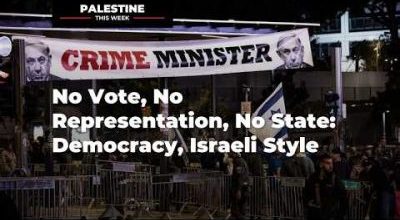
No Vote, No Representation, No State: Democracy, Israeli Style
or go to
Aletho News Archives – Video-Images
From the Archives
Sanctions, War and the Policy of Dual Containment
By SASAN FAYAZMANESH | March 17, 2008
It is now nearly three decades since the Unites States adopted the policy of dual containment of Iran and Iraq. While much has been written about the containment of Iraq, there has been very little in-depth analysis of this policy when it comes to Iran. In a book that is going to be released on March 31, 2008, entitled The United States and Iran: Sanctions, Wars and the Policy of Dual Containment (Routledge), I attempt to address this shortcoming by investigating when and why the US policy of containment of Iran came about, how it evolved, and where it stands today.[1] To the extent that Israel has been involved in US policy making, the study will also include the role that Israel has played in the containment of Iran. Also, since the fate of Iran has been inextricably linked to that of Iraq, occasionally the investigation will overlap with the containment of Iraq.
The policy of dual containment of Iran and Iraq originated during the Carter Administration, but it was not until the Clinton Administration that the expression “dual containment” became popular. … continue
Blog Roll
 Aletho News
- Europe’s Establishment Is Embracing War – and Losing Voters
- NATO chief advocates war of aggression
- No Vote, No Representation, No State: Democracy, Israeli Style
- Zionist Bought Senate Blocks Information About American Citizens Killed By Israel
- While Gaza dominates the UN, these are the people keeping it alive
- New Report: “Scholasticide and Genocide in Gaza: Assessment, Testimonies and Legal Analysis”
- ‘THAAD Delusion’: Iran war exposes US missile shield limits – The Atlantic
- Moscow issues warning to NATO over Russian exclave
- Yes, the Iran war has destroyed Trump’s presidency
- The fallacy of US delusions about Iran’s economic collapse
- If Americans Knew
- Mamdani releases plan to combat antisemitism and hate crimes in New York City
- Iran’s Revolutionary Guards Publish Letter to the American People
- DMFI launches $1 million ad campaign supporting Virginia’s Elaine Luria
- US Senate blocks resolution seeking report on Americans killed by Israel
- Israeli Attacks Kill Ten Palestinians in Gaza
- Massacre at Minab: The School That Became a Grave
- Israeli media: The IDF Shows It Doesn’t Turn a Blind Eye; It Actively Emboldens Settler Havoc
- As settlers ravage West Bank, Israeli forces kill 10 in Gaza – Daily Update
- New Report: “Scholasticide and Genocide in Gaza: Assessment, Testimonies and Legal Analysis”
- Ex-Biden officials are desperate for a Gaza scapegoat
- No Tricks Zone
- Green Energy Debacle: German Expert Professor Fritz Vahrenholt Warns Of Severe Economic And Social Consequences
- Two More Paleo Reconstructions Affirm Meters-Higher Sea Levels Across Ireland, Brazil 7000-6000 Years Ago
- New Study: Earth And Venus Surface Warmth Largely Explained By Convection And Lapse Rate, Not CO2 Or Radiation
- 2025 Nature Paper Claiming Worsening Global Drought Gets RETRACTED …Heavily Flawed
- New Study: ‘Global Drought Shows No Detectable Recent Acceleration Under Climate Warming’
- Economic Masterminds: German Socialists Suggest Taxing Productivity Gains Stemming From Using AI
- The South China Sea Has Not Been Cooperating With The Climate Change Narrative
- Energy Crisis: Germany Enters Heating Season With Historically Low Gas Reserve Fill Levels
- New Study: The Antarctic Ice Sheet Gained Mass From 2020-2024 Due To Staggering Snow And Ice Accumulation
- Study: Ocean Heating Rates From Thousands Of Years Ago ‘Dwarf’ Modern Ocean Heating Rates

