Another Iranian Non-Threat
By Sheldon Richman | Free Association | July 28, 2015
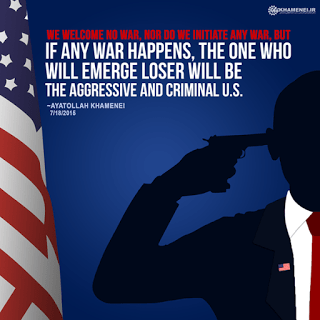 This image tweeted by Iran Supreme Leader Ayatollah Ali Khamenei has a lot of people upset. Is it supposed to be Barack Obama holding a gun to his own head?
What if it is? The picture is hardly threatening or aggressive in any way. After all, it’s not a picture of Khamenei holding a gun to Obama’s head.
And look at the text:
We welcome no war, nor do we initiate any war, but if any war happens, the one who will emerge loser will be the aggressive and criminal U.S.
That is not aggressive in the least. On the contrary, it rejects war. Who’s been threatening war against whom? The U.S. government (along with Israel) has been threatening war against Iran. Even after the nuclear agreement was signed, Secretary of War Ash Carter reiterated that war against Iran is still an option. So all Khamenei is saying is that if the U.S. government starts a war, it will lose. It will be as though Obama had pointed a gun at himself and pulled the trigger.
In the past, Iran’s pledges to retaliate if attacked have always been presented by the news media and politicians as though they were threats to initiate war. This is happening again.
When will the media and the hack politicians be straight with the public? Iran has threatened to attack no one, but the U.S. and Israeli governments, both with nuclear weapons, routinely threaten to attack Iran. Who is the criminal?
US, Russia Should Overcome Tensions, Cooperate – Presidential Candidate
Sputnik – 29.07.2015
WASHINGTON — Restoring US relations with Russia should be among the top priorities for the newly elected president, US Democratic presidential candidate Lincoln Chafee told Sputnik.
“I would make it one of my top priorities to do everything possible to find common ground, areas where we can build on and reestablish relationships with Russia, make them better,” Chafee said in an interview.
The presidential candidate noted that there are areas where Russia and the United States still agree and cooperate, including on the Iran nuclear issue.
“I know we worked on the Iran deal together, but just keep building on that, areas where we both agree as countries, and then broaden those out, areas where we somewhat agree, and then tackle those areas where we have disagreements and work together,” Chafee said.
“There is just no room for escalation of military options in this world we live in today,” Chafee said when asked to comment on mutual accusations by Washington and Moscow of violating the INF Treaty.
Chafee noted that cooperation between the United States and Russia should be concentrated on more important issues rather than bashing Russia.
“There are many other challenges we should be tackling rather than the Russians in the West, a saber rattling,” he added.
The United States and Russia signed the INF Treaty in 1987, banning nuclear and conventional ground-based cruise and ballistic missiles with a range of 500-5,500 kilometers (300-3,400 miles).
Last summer, Washington accused Moscow of not complying with the treaty by testing a ground-launched cruise missile. Russia dismissed the claims, stating that the United States had violated the deal earlier by placing missile defense launchers in Poland and Romania.
According to recent media reports, US authorities are considering the deployment of missiles to Europe to defend against supposed advantages gained by Russia’s alleged treaty violation, or the possibility of a more aggressive “counterforce” of ground-based strategic weapons or cruise missiles.
Chafee also underscored that Washington and Moscow should cooperate in resolving the Ukrainian crisis, and ensure the European markets continue to receive Russian energy.
“The immediate area that we [US, Russia] should be finding areas to resolve is, of course, Ukraine, and…with the sanctions, and how we can get the Ukrainian situation resolved, and get the European markets and the Russian energy working together,” Chafee said in an interview.
Chafee added that US-Russia cooperation is “in everybody’s best interest.”
Moscow should participate in international discussion on all world issues, the candidate continued.
“That strong country, energy-rich country, such as Russia, should be part of all our global discussions,” Chafee said in an interview.
The presidential candidate stressed that there are many areas where Russia and the West could cooperate, including the Iran nuclear program and space industry.
Putin blames US for ‘spiral of arms race’
Press TV – July 28, 2015
 Russian President Vladimir Putin has blamed the United States for the current round of arms race in the world.
“This new spiral of the arms race was prompted by the United States’ unilateral withdrawal from the Anti-Ballistic Missile Treaty,” Putin said in an interview with Swiss broadcaster RTS on Monday.
On December 13, 2001, Washington withdrew from the treaty, which had been signed in 1972 between the US and the Soviet Union, on the limitation of the anti-ballistic missile systems used in defending areas against ballistic missile-delivered nuclear weapons.
“This treaty was a cornerstone of the entire system of international security,” he said.
According to a report by the International Institute for Strategic Studies, a leading think-tank focusing on international security, Washington in 2014 spent USD 581 billion, the highest amount of military expenditure last year.
China, Saudi Arabia and Russia are the countries coming after the US with USD 129, 81 and 70 billion in military expenditure respectively, the British institute’s report said.
Putin also said that US officials should rethink their policies and stop “acting in a way ‘who-in-not-with-us-is-against-us.’”
“Undoubtedly, the United States is a great power. But it doesn’t mean that the current US authorities have any right to move around the world, seizing people and taking them to their prisons,” he added.
Elsewhere in the interview, the Russian president said that Moscow is ready to negotiate with the US and Europe on a host of issues including the situation in Ukraine.
“Russia takes no interest in seeking confrontation with other countries. But sometimes we simply have to defend our interests. And we will undoubtedly do it, but not in a confrontational manner but through finding compromises and mutually acceptable solutions,” he said.
The US and its European allies have imposed economic sanctions on Russia, accusing Moscow of being involved in the Ukrainian conflict that broke out last year. Russia has repeatedly denied the accusation and has imposed retaliatory sanctions against many Western countries.
UK government spent 13 times more bombing Libya than securing peace
‘UK Govt priorities were wrong over Libya’
Scottish National Party | July 26, 2015
The UK government spent 13 times more bombing Libya than securing peace in the years afterwards, it has been revealed.
The House of Commons library has released information which shows the UK government spent around £320 million in a bombing campaign against Libya, and just £25 million in re-building programmes following the conflict.
The revelations follows serious concerns raised by the SNP over the UK’s current involvement in Syria -which had been taken forward despite a vote against bombing Syria in the House of Commons two years ago.
Stephen Gethins MP said:
“These figures are eye-watering. The amount of money the UK government will spend bombing a country dwarves the re-building programme thirteen to one.
“The lessons of Libya, like Iraq, is that you cannot just bomb somewhere and move on. The figures are especially alarming given the UK government’s current involvement in Syria.
“The case for bombing in Syria has simply not been made – and the involvement of British service personnel in bombing without the approval of Parliament clearly flouts the democratic decision taken by the House of Commons.
“We urgently need honesty and transparency about the UK intentions in Syria- and a strong commitment to the country following the conflict.”
Commenting on UK intervention in Syria on the Marr show this morning, SNP Foreign Affairs spokesperson Alex Salmond said:
“Parliament has to be consulted and Parliament would have to be persuaded. And I’ve heard nothing yet from the Prime Minister that would persuade me that there’s an integrated strategy that would justify a bombing campaign.
“Spending £320m on a bombing campaign and £25m to help restore the country is one reason perhaps that we have a failed state in Libya.”
Poll: Overwhelming US Majority Says Israel Should Receive No Aid Boost due to US / Iran “Deal”

By Robert Barsocchini | Empire Slayer | July 27, 2015
67.8% of respondents to a Google Consumer Survey said Israel should receive no compensation for the US finalizing a deal with Iran over its civilian nuclear program, which was begun at the behest of the US when Washington’s puppet, the Shah, one of the world’s worst human rights violators, ruled over Iran.
Obama is currently offering Israel increased aid to compensate for the agreement. Israel is the biggest recipient of US aid at over $3 billion per year, and Obama has increased aid to Israel after each of Israel’s major massacres in the Gaza refugee camp since Obama assumed power.
The major study of the issue of citizen impact on US government policy, conducted in 2014 by research teams out of Princeton and Northwestern universities, looked at nearly 2,000 policies and found that average-income US citizens have “near zero, statistically non-significant” impact on them, while the most affluent citizens essentially dictate policy. This dynamic has been illustrated by previous research, such as by Larry Bartels of Vanderbilt.
Another issue to watch for: the “world’s most influential” think tank, the Washington-based Brookings Institute, has suggested (among other options), as a way for the US to gain dominance over Iran, making it appear that Iran has rejected a “great” deal, then using Israel to attack Iran. (Note the above poll asks if Israel should be given long-range bombers and “bunker-buster” explosives.)
The US and Israel have both continued to make threats of force, criminal acts under the UN charter adopted by both countries, against Iran since the agreement, and Obama’s anti-democratic offering of increased aid to Israel could possibly signal that the “leave it to Bibi” strategy is still being entertained, along with any number of other goals.
Author is a US-based researcher focusing on force dynamics, national and global. @_DirtyTruths
Do We Need to Bring Back Internment Camps?
By Ron Paul | July 27, 2015
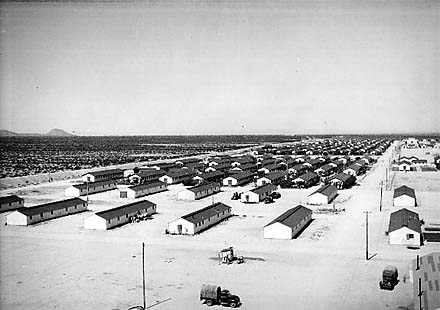
Last week, Retired General Wesley Clark, who was NATO commander during the US bombing of Serbia, proposed that “disloyal Americans” be sent to internment camps for the “duration of the conflict.” Discussing the recent military base shootings in Chattanooga, TN, in which five US service members were killed, Clark recalled the internment of American citizens during World War II who were merely suspected of having Nazi sympathies. He said: “back then we didn’t say ‘that was freedom of speech,’ we put him in a camp.”
He called for the government to identify people most likely to be radicalized so we can “cut this off at the beginning.” That sounds like “pre-crime”!
Gen. Clark ran for president in 2004 and it’s probably a good thing he didn’t win considering what seems to be his disregard for the Constitution. Unfortunately in the current presidential race Donald Trump even one-upped Clark, stating recently that NSA whistleblower Edward Snowden is a traitor and should be treated like one, implying that the government should kill him.
These statements and others like them most likely reflect the frustration felt in Washington over a 15 year war on terror where there has been no victory and where we actually seem worse off than when we started. The real problem is they will argue and bicker over changing tactics but their interventionist strategy remains the same.
Retired Army Gen. Mike Flynn, who was head of the Defense Intelligence Agency during the US wars in Afghanistan and Iraq, told al-Jazeera this week that US drones create more terrorists than they kill. He said: “The more weapons we give, the more bombs we drop, that just … fuels the conflict.”
Still Washington pursues the same strategy while expecting different results.
It is probably almost inevitable that the warhawks will turn their anger inward, toward Americans who are sick of the endless and costly wars. The US loss of the Vietnam war is still blamed by many on the protesters at home rather than on the foolishness of the war based on a lie in the first place.
Let’s hope these threats from Clark and Trump are not a trial balloon leading to a clampdown on our liberties. There are a few reasons we should be concerned. Last week the US House passed a bill that would allow the Secretary of State to unilaterally cancel an American citizen’s passport if he determines that person has “aided” or “abetted” a terrorist organization. And as of this writing, the Senate is debating a highway funding bill that would allow the Secretary of State to cancel the passport of any American who owes too much money to the IRS.
Canceling a passport means removing the right to travel, which is a kind of virtual internment camp. The person would find his movements restricted, either being prevented from leaving or entering the United States. Neither of these measures involves any due process or possibility of appeal, and the government’s evidence supporting the action can be kept secret.
We should demand an end to these foolish wars that even the experts admit are making matters worse. Of course we need a strong defense, but we should not provoke the hatred of others through drones, bombs, or pushing regime change overseas. And we must protect our civil liberties here at home from government elites who increasingly view us as the enemy.
The marketing of perpetual war

By BlackCatte | offGuardian | July 10, 2015
… The war is not meant to be won – it is meant to be continuous.…” – George Orwell, 1984
David Kilcullen has a message for us over at the Guardian, and this is it:
We’re living in an era of persistent conflict…”
Which is sadly, true. You might think the next thing to be discussed on that topic would be – why? Why are we now living in an era of endless war? What forces are behind this development? Who, if anyone, is profiting from the same? But, no, David doesn’t think any of this is worthy of our attention. He simply wants us to understand that “perpetual conflict” is absolutely and inescapably the new reality.
… you can read it in the latest concept documents of half a dozen western militaries. But it doesn’t seem to have hit home, for the public or some policymakers, that the notion that this can all end, that we can get back to some pre-9/ 11 “normal,” is a fantasy.
Do we get that? Is it hitting home? Peace is now a “fantasy”. It’s official. And in case you are still harbouring some smidgen of doubt, Dave is going to say it again in different words:
This – this instability, this regional conflict surrounded by networked global violence, this convergence of war and crime, of domestic and international threats, this rise of a new aggressive totalitarian state from the rubble of the last war – is the new normal, and it’s not going to change for a very, very long time. There are no quick solutions: we need to settle in for the long haul.
Ergo….
That being the case, we have to figure out methods of dealing with persistent conflict.
and…
I see no alternative to a larger, more intense, conventional war against Isis than the one currently being contemplated…
Do you see that children? That’s called “paradigm-creation.” The topic for discussion is evidently intended to be “how do we deal with persistent conflict?” The question of why the persistent conflict is happening, or who is funding these “aggressive new totalitarian states” is NOT part of the agenda, and is being excised from our collective conscious. All we need to know is:
Isis is an escalating threat that’s growing and worsening.
We do not need to worry our little heads about what this entity called “ISIS” actually is, how plausible the clownish stories of its super-villain powers are. Nor are we supposed to waste a single moment asking who is picking up its not inconsiderable tab. What matters is that Syria and Iraq are “problems” (never mind why or how) and that “greater western involvement would mitigate all these problems” (because that is what western involvement does – ask Libya). Most importantly, the US needs to get over its scruples and do more:
…US passivity and reluctance to target Assad (though his regime kills more people than Isis) makes many Syrians wary of joining the “moderate” rebels.
“US passivity and reluctance”? Really, Dave? What about the article in the Washington Times claiming the US state department lied about Syrian chemical attacks in order to fabricate a reason for attacking Assad? And what about this article at Global Research which alleges the US is actually targeting the Syrian government- not ISIS – with its current air strikes.
I’m left wondering – is Assad really any worse than the dreadful and medieval Saudis? He certainly seems to be pretty popular in Syria, where they apparently have a different take on things (but Dave doesn’t bother to tell us that). If we in the west have no problem with murderous tyrants, why do we have a problem with Assad? Is it because he isn’t our murderous tyrant?
Is the US really out there in Syria trying (but inexplicably failing) to defeat ISIS? Or is it happy to aid and abet ISIS in doing the dirty work it tried and failed to do itself? If Dave gets his way and we launch a “more intense conventional war” in Syria, will our soldiers’ lives and our taxes really be spent on defeating ISIS or is that just a shallow ruse to enable the US to finally go in and get Assad?
Is “perpetual conflict” really something we should all just accept as inevitable and leave it to people like Dave to sort out? Or is it something we should be resisting and interrogating at every level and at every opportunity?
Nah. Never mind. None of this matters. Let’s just keep it simple. The message is:
1. Persistent conflict is the new normal
2. There is no need to ask why.
Everyone got that?
(Un)solving Ukraine’s conflict
What is exactly stopping a solution to the crisis in eastern Ukraine?
By Mikhail Molchanov | Open Democracy | July 16 2015
By this time, it should be obvious that the west does not want a conflict in Ukraine to be resolved any time soon. If that were the case, it would apply pressure to both parties of the conflict: the government in Kiev and the separatists in Donbas. Instead, the west applies pressure to the third party: the Russian government, admittedly the separatists’ best friend and supplier, but not the one that has direct stakes in the conflict at hand.
Let us recount those stakes. For Kiev: territorial integrity, full sovereignty over Donbas, and the right to determine its foreign policies independently from external influences (or so the government spokespersons in Kiev say).
For Donbas: linguistic and cultural autonomy, elements of a robust home rule, the right to preserve a privileged relationship with the Russian Federation, and amnesty to the local separatist leaders and militiamen.
Does Russia have stakes separate from any of these? Not that I know of. Putin keeps repeating the separatists’ demands: an amnesty, local autonomy; full implementation of the Minsk agreements. In spite of what we hear so often in the west, there are no separate demands presumably infringing on Ukraine’s sovereignty; Russia says nothing about whether Ukraine should or should not join the EU, should or should not claim Donbas as its own, should or should not be friendly with Russia itself. Yes, the Kremlin would be extremely disappointed were Ukraine to join NATO. Even so, the Kremlin has more than once assured the world it did not claim to have a veto over Ukraine’s foreign policy choices.
All the same, demanding that Russia seal the border and stop the influx of volunteers into the conflict zone is extremely unrealistic. Putin staked his reputation on support of Russia’s so-called compatriots in the near abroad; his abandoning those compatriots to the gallows would sink his presidency.
What is, then, the solution and is it even possible?
It seems the solution is possible, and it has been clearly defined in the Minsk agreements. The problem is, Kiev does not want to implement them, and therefore protracts the conflict.
Firstly, the promised amnesty to the separatists has never been announced. Ukraine’s pundits are musing over who should be pardoned and who should not. Those with blood on their hands should not be pardoned, seems to be the common wisdom. Not a word about the blood of civilians in Donbas killed in the process of carrying out Kiev’s so-called Anti-Terrorist Operation. With such an attitude, the choice facing the Donbas militia leaders seems to be simple: continue fighting or face imprisonment (or worse) at the hand of the Ukrainian authorities. Why are we surprised they keep fighting?
Secondly, the Minsk agreements called for extensive home rule provisions for Donbas, and for a requisite change in the Constitution of Ukraine.
None of this seems to be in the works. The latest proposal on changes to the Constitution of Ukraine, dated July 1, 2015, has nothing about a special status for the affected regions of Donbas beyond a fuzzy promise – in the law, not in the Constitution itself – that the ‘special modalities of local governance in separate regions of Donetsk and Luhansk oblasti will be determined by a separate law’. This is not what the Government of Ukraine promised its partners when talking about the implementation of the Minsk Agreements.
Thirdly, the Minsk Agreements call for the ‘linguistic self-definition’ of the affected regions or, in short, the right to continue using Russian as the language of daily communication and local governance. Official Kiev keeps quiet on the issue.
Finally, according to the Minsk agreements, Ukraine should support social and economic development of the affected regions of Donetsk and Luhansk regions. In the meantime, since November 2014, no pensions have been paid to the retired Ukrainian citizens living in the self-proclaimed Donetsk and Luhansk People’s Republics.
Although Kiev has not begun implementing even the first basic point of the Minsk agreements (the ‘immediate and comprehensive cease-fire’ in Donbas), the west seems to be fully okay with that. Well, the separatists fire on Ukraine’s positions, the Ukrainian army should return fire, so goes the conventional explanation.
What if the Ukrainian army didn’t return fire? Would it risk losing an inch more territory? The answer is far from obvious, yet the the regular army continues using heavy artillery in densely populated civilian areas in Donbas (and killing unarmed civilians in the process). This fact alone should have moved Ukraine’s western sponsors to an obvious course of action: press the Ukrainian government to stop abusing human rights of its own citizens in eastern Ukraine.
It is almost exactly a year since Human Rights Watch, in an open communication to President Poroshenko, lamented the actions of the Ukrainian army and the pro-government militias, in particular the shelling of a hospital in Krasny Liman and air strikes in the villages of Luhanskaya and Kondrashevka.
In January and February 2015, government forces (and the separatists) used widely banned cluster munitions to attack rebels; earlier, the use of incendiary weapons in densely populated areas was documented. By July 2015, more than 6,500 people have died as a result of the conflict; close to 3,500 of them civilians. More than 16,000 have been wounded; close to 1.4 million people internally displaced. At least 660,000 Ukrainian refugees came to Russia.
The civil war in Ukraine has generated a humanitarian catastrophe that can only be resolved with the joint efforts of all parties concerned, the USA and the EU included. It goes without saying, Kiev should be prepared to sit together at the same table with separatist leaders and offer them some concessions before any deal can be reached.
Instead, Kiev promises an amnesty after the elections, and a law on the status of territories after Ukraine’s full control over its eastern borders is restored. To many an observer inside and outside, this must look like deceiving one’s opponent and negotiating in bad faith. Yet western powers stand firm in their resolve to lay all the blame for the failure of the Minsk agreement at Russia’s feet.
Last month, at the G-7 meeting in Garmisch-Partenkirchen, Germany, western powers agreed to keep sanctions against Russia in place until the Minsk agreements are implemented in full. The Canadian government went further than the rest of the G-7 nations, having decided not only to keep, but to expand the sanctions with the blacklisting of Gazprom, its oil subsidiary Gazprom Neft, Russia’s state-owned Transneft and a major oil producer Surgutneftegaz. In addition, Canada decided to sanction a conservative nationalist philosopher Alexander Dugin and Eurasian Youth Union, a non-governmental organization known for its pro-Putin views.
All of this looks more than somewhat one-sided given a recent revelation that Canada’s embassy in Kiev was used as a base for anti-government protesters to re-group and re-cuperate during the Maidan uprising that toppled former president Viktor Yanukovych.
As for Canada’s big brother, the United States, it has publicly admitted spending $5.1 billion to support democracy-building programs in Ukraine since 1992. While western champions of democracy have proudly claimed their right to interfere in internal affairs of a sovereign country for the sake of a regime change when it suited their interests, they do surprisingly little to stop continuing human rights abuses committed by Ukraine government troops and far-right militias in the pro-Russian Donbas.
If the Minsk agreements are ever to be implemented in full, there is no other way but for all sides to follow the agreed-upon commitments.
This includes, first and foremost, the immediate cessation of artillery barrages targeting Donbas cities and villages; further, the unequivocal and unconditional declaration of an amnesty for the Donbas fighters; and finally, a provision for Donbas autonomy enshrined into the Constitution of Ukraine before – not after – any local elections will be allowed to happen.
Only such a range of measures will ensure full withdrawal of Russian volunteers from Donbas, and Russian regular forces from the Russo-Ukrainian borderlands.
Only such a gambit will restore peace and a hope of prosperity to the whole of Ukraine. It is not Moscow, or Donetsk, or Luhansk that should make a first move. It is fully up to Kiev to choose between war and peace in Ukraine’s south east.
Colombia’s President Orders Halt to Bombing of Rebel Positions
Sputnik – 26.07.2015
Colombian President Juan Manuel Santos ordered to suspend air strikes on positions of the Revolutionary Armed Forces of Colombia (FARC), he said via his Twitter microblog.
On Monday, FARC ordered all their units to observe a ceasefire and released a Colombian soldier it had captured earlier this month as a gesture of goodwill.
“I have ordered to suspend airstrikes on FARC camps starting today. They will be carried out only in the case of an explicit order of the president,” Santos said Saturday.
He added that the sides were able to revive the peace talks and “are closer than ever to put an end to the war.”
Colombian armed forces have been fighting FARC, the country’s largest rebel group, since 1964. The two sides have been holding peace talks in Cuba since 2012.
Recent progress in peace talks between FARC and the government was achieved in June with an agreement on the creation of a joint Truth Commission.
The commission is tasked with gathering testimony from victims and witnesses of Colombia’s civil war. However, it is unable to use the information to bring up criminal charges against FARC members, government troops or other fighters.
As many as 220,000 people have been killed as a result of the armed conflict in Colombia.
US to sell Saudis 355 missiles amid war on Yemen
Press TV – July 25, 2015
The US Defense Department has awarded major weapons maker Raytheon to provide the Persian Gulf Kingdom of Saudi Arabia with 355 air-to-ground missiles amid its persisting campaign of aerial strikes against civilian and economic targets in neighboring Yemen.
According to a Pentagon announcement cited Saturday by the Russia-based Sputnik News, in a $180-million contract assigned to the arms manufacturer, Raytheon is to deliver the AGM-154 series missiles to the Saudi regime in a move clearly regarded as a bid to support the aerial strikes against Yemen.
The AGM-154 is described as a Global Positioning System and infrared guided air-to-ground missile with stand-off capability.
The contract, the report adds, also includes the delivery of 200 AGM-154C-1 missiles to the US Navy.
Washington, the report adds, has justified the missile sales to Riyadh as part of an agreement by Persian Gulf Arab dictatorships to expand their military cooperation with Washington amid “concerns” over the recent nuclear talks conclusion with Iran as well as the Islamic Republic’s persisting influence as a major power and the most stable nation in the strategic region.
Meanwhile, the oil-rich Saudi Arabia, widely regarded as a US client in the Persian Gulf region, has been among the world’s largest importers of lethal weaponry over the years and has significantly expanded its purchase of armaments in recent months, becoming the world’s top importer in 2015 so far.
This is while Riyadh signed major arms deals worth billions of dollars with France last month for the purchase of patrol ships, border guard helicopters and aircraft as it escalated its war effort against Yemen.
The announcement of the deals came during a visit by Saudi Deputy Crown Prince and Defense Minister Mohammed bin Salman bin Abdul Aziz Al Saud to Paris.
French Foreign Minister Laurent Fabius defended the selling of French patrol boats to Riyadh, claiming that they are meant “to enhance the capability of the Saudi Coast Guard, which is today facing growing threats.”
Saudi Arabia has been carrying out airstrikes against Yemen since March 26 without a UN mandate. The strikes are meant to undermine the Houthi Ansarullah movement and restore power to fugitive former President Abd Rabbuh Mansour Hadi, a staunch ally of the Al Saud regime.
Thousands have been killed and at least 11,000 more injured in the airstrikes.
US expands training mission in Ukraine as part of long-term military partnership
RT | July 25, 2015
US military instructors are expanding their mission in Ukraine beyond the National Guard and will boost the army’s “defense capabilities” as part of a security partnership which has been going on for the “last 20 years,” the US State Department said.
“The United States intends to continue training Ukrainian security forces this fall in western Ukraine,” State Department spokesman Mark Toner has announced. He labeled the training part of a long-running defense cooperation with Ukraine.
The US instructors are to focus on small unit training aimed at bolstering Ukraine’s “internal defense capabilities” as conflict in the Donbass region continues for over a year. The new program would increase Washington’s military assistance provided to Ukraine by more than $244 million.
“This is going be small unit training conducted by US Army Europe for the Ukrainian Ministry of Defense personnel,” Toner told reporters Friday. “It’s similar quite frankly to our ongoing training of the National Guard which we announced last March.”
Some 300 US troops are already training the country’s National Guard, which is a semi-official Ukrainian military force hastily created in 2014 to legalize groups of volunteers, patriots and activists following the coup and protests on Maidan. Earlier this month, Lt. Gen. Ben Hodges said that US was considering the expansion of its military training to Ukrainian army soldiers.
“We have been providing this kind of assistance training program to Ukraine, over the last 20 years,” Toner stated, adding the new program is not unique and is in line with the US’ “ongoing partnership” with Ukraine.
Meanwhile Washington has stepped up military exercises in Eastern Europe to “reassure” NATO allies in the face of a perceived “Russian threat.” NATO’s Saber Guardian/Rapid Trident 2015 military drills have been seeing almost 2,000 soldiers from 18 different countries displaying their military might this week near the city of Lvov in western Ukraine, inching further towards the Russian border.
The US-led drills are fueling “revanchist moods among the ‘party of war’ in Kiev, which jeopardizes the outlined progress in the peaceful settlement of a deep internal crisis in Ukraine,” the Russian Foreign ministry said in a statement, earlier this week.
The ministry called the drills “a clear manifestation of NATO’s course of unconditional support for the current policy of the Kiev authorities in the south-east of Ukraine, which leads to civilians dying on a daily basis in the region.”
NATO drills will continue until the end of July, but Ukrainian President Petro Poroshenko has already called for more cooperation in the defense sector since meeting the Supreme Allied Commander Europe US General Philip Breedlove in Kiev.
“We’ve got an effective military and technical cooperation,” he said. “There are also good prospects for cooperation in terms of military exercises.”
Kiev is also pushing for Washington to provide lethal military aid to Ukraine, which the US has so far been reluctant to do.
“We expect to get additional support from the United States,” Ukrainian Prime Minister Arseniy Yatsenyuk told AP, less than 10 days ago. “We do understand that some NATO allies are a little bit reluctant in the decision to supply defensive weapons to Ukraine. But this is not just about Ukraine. This is about the security of the world.”
Commenting on the possibility of sending non-lethal aid to Ukraine, Toner stated on Friday that he had nothing to announce, assuring that for now Washington’s focus is on providing non-lethal aid.
“There’s no plan to change that,” Toner said.
Nevertheless Washington said last month that more heavy equipment, including artillery and tanks, will be moved closer to the Russian borders and stationed on a rotating basis in a number of Eastern European NATO countries. Amid the “Russian threat” hysteria, NATO is also tripling the size of its Response Force, recently reinforced with a new Very High Readiness Joint Task Force.
READ MORE: 1,800 troops from 18 states: NATO launches biggest ever drill in Ukraine
Featured Video
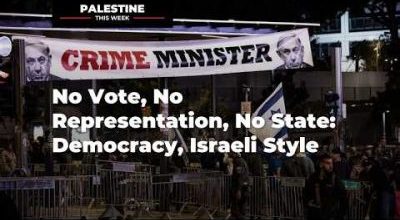
No Vote, No Representation, No State: Democracy, Israeli Style
or go to
Aletho News Archives – Video-Images
From the Archives
Sanctions, War and the Policy of Dual Containment
By SASAN FAYAZMANESH | March 17, 2008
It is now nearly three decades since the Unites States adopted the policy of dual containment of Iran and Iraq. While much has been written about the containment of Iraq, there has been very little in-depth analysis of this policy when it comes to Iran. In a book that is going to be released on March 31, 2008, entitled The United States and Iran: Sanctions, Wars and the Policy of Dual Containment (Routledge), I attempt to address this shortcoming by investigating when and why the US policy of containment of Iran came about, how it evolved, and where it stands today.[1] To the extent that Israel has been involved in US policy making, the study will also include the role that Israel has played in the containment of Iran. Also, since the fate of Iran has been inextricably linked to that of Iraq, occasionally the investigation will overlap with the containment of Iraq.
The policy of dual containment of Iran and Iraq originated during the Carter Administration, but it was not until the Clinton Administration that the expression “dual containment” became popular. … continue
Blog Roll
 Aletho News
- Europe’s Establishment Is Embracing War – and Losing Voters
- NATO chief advocates war of aggression
- No Vote, No Representation, No State: Democracy, Israeli Style
- Zionist Bought Senate Blocks Information About American Citizens Killed By Israel
- While Gaza dominates the UN, these are the people keeping it alive
- New Report: “Scholasticide and Genocide in Gaza: Assessment, Testimonies and Legal Analysis”
- ‘THAAD Delusion’: Iran war exposes US missile shield limits – The Atlantic
- Moscow issues warning to NATO over Russian exclave
- Yes, the Iran war has destroyed Trump’s presidency
- The fallacy of US delusions about Iran’s economic collapse
- If Americans Knew
- Inside Lebanon’s 200-page dossier on Israeli war crimes
- Flydubai, genocide, settler violence, Trump abuse of power to deport – Daily Update
- Counting Antisemitic Incidents: What the ADL Audit Reveals — and Obscures
- Mamdani releases plan to combat antisemitism and hate crimes in New York City
- Iran’s Revolutionary Guards Publish Letter to the American People
- DMFI launches $1 million ad campaign supporting Virginia’s Elaine Luria
- US Senate blocks resolution seeking report on Americans killed by Israel
- Israeli Attacks Kill Ten Palestinians in Gaza
- Massacre at Minab: The School That Became a Grave
- Israeli media: The IDF Shows It Doesn’t Turn a Blind Eye; It Actively Emboldens Settler Havoc
- No Tricks Zone
- Green Energy Debacle: German Expert Professor Fritz Vahrenholt Warns Of Severe Economic And Social Consequences
- Two More Paleo Reconstructions Affirm Meters-Higher Sea Levels Across Ireland, Brazil 7000-6000 Years Ago
- New Study: Earth And Venus Surface Warmth Largely Explained By Convection And Lapse Rate, Not CO2 Or Radiation
- 2025 Nature Paper Claiming Worsening Global Drought Gets RETRACTED …Heavily Flawed
- New Study: ‘Global Drought Shows No Detectable Recent Acceleration Under Climate Warming’
- Economic Masterminds: German Socialists Suggest Taxing Productivity Gains Stemming From Using AI
- The South China Sea Has Not Been Cooperating With The Climate Change Narrative
- Energy Crisis: Germany Enters Heating Season With Historically Low Gas Reserve Fill Levels
- New Study: The Antarctic Ice Sheet Gained Mass From 2020-2024 Due To Staggering Snow And Ice Accumulation
- Study: Ocean Heating Rates From Thousands Of Years Ago ‘Dwarf’ Modern Ocean Heating Rates

