If a Genocide Falls in the Forest
By David Swanson | War is a Crime | August 7, 2014
There’s a wide and mysterious chasm between the stated intentions of the Israeli government as depicted by the U.S. media and what the Israeli government has been doing in Gaza, even as recounted in the U.S. media.
With the morgues full, Gazans are packing freezers with their dead children. Meanwhile, the worst images to be found in Israel depict fear, not death and suffering. Why the contrast? If the Israeli intent is defensive, why are 97% of the deaths Gazan, not Israeli? If the targets are fighters, why are whole families being slaughtered and their houses leveled? Why are schools and hospitals and children playing on the beach targeted? Why target water and electricity if the goal is not to attack an entire population?
The mystery melts away if you look at the stated intentions of the Israeli government as not depicted by the U.S. media but readily available in Israeli media and online.
On August 1st, the Deputy Speaker of Israel’s Parliament posted on his FaceBook page a plan for the complete destruction of the people of Gaza using concentration camps. He had laid out a somewhat similar plan in a July 15th column.
Another member of the Israeli Parliament, Ayelet Shaked, called for genocide in Gaza at the start of the current war, writing: “Behind every terrorist stand dozens of men and women, without whom he could not engage in terrorism. They are all enemy combatants, and their blood shall be on all their heads. Now this also includes the mothers of the martyrs, who send them to hell with flowers and kisses. They should follow their sons, nothing would be more just. They should go, as should the physical homes in which they raised the snakes. Otherwise, more little snakes will be raised there.”
Taking a slightly different approach, Middle East scholar Dr. Mordechai Kedar of Bar-Ilan University has been widely quoted in Israeli media saying, “The only thing that can deter [Gazans] is the knowledge that their sister or their mother will be raped.”
The Times of Israel published a column on August 1st, and later unpublished it, with the headline “When Genocide Is Permissible.” The answer turned out to be: now.
On August 5th, Giora Eiland, former head of Israel’s National Security Council, published a column with the headline “In Gaza, There Is No Such Thing as ‘Innocent Civilians’.” Eiland wrote: “We should have declared war against the state of Gaza (rather than against the Hamas organization). . . . [T]he right thing to do is to shut down the crossings, prevent the entry of any goods, including food, and definitely prevent the supply of gas and electricity.”
It’s all part of putting Gaza “on a diet,” in the grotesque wording of an advisor to a former Israeli Prime Minister.
If it were common among members of the Iranian or Russian government to speak in favor of genocide, you’d better believe the U.S. media would notice. Why does this phenomenon go unremarked in the case of Israel? Noticing it is bound to get you called an anti-Semite, but that’s hardly a concern worthy of notice while children are being killed by the hundreds.
Another explanation is U.S. complicity. The weapons Israel is using are given to it, free-of-charge, by the U.S. government, which also leads efforts to provide Israel immunity for its crimes. Check out this revealing map of which nations recognize the nation of Palestine.
A third explanation is that looking too closely at what Israel’s doing could lead to someone looking closely at what the U.S. has done and is doing. Roughly 97% of the deaths in the 2003-2011 war on Iraq were Iraqi. Things U.S. soldiers and military leaders said about Iraqis were shameful and genocidal.
War is the biggest U.S. investment, and contemporary war is almost always a one-sided slaughter of civilians. If seeing the horror of it in Israeli actions allow us to begin seeing the same in U.S. actions, an important step will have been taken toward war’s elimination.
Yes, how many times can a man turn his head
Pretending he just doesn’t see?
The answer my friend is blowin’ in the wind
The answer is blowin’ in the wind.
US missile cruiser enters Black Sea again ‘to promote peace’
RT | August 7, 2014
US missile cruiser Vella Gulf has entered the Black Sea in what the American Navy described as a move to “to promote peace and stability in the region.” Moscow has considered any such acts as “offensive.”
The Ticonderoga-class guided-missile cruiser USS Vella Gulf (CG 72) entered the Black Sea on Wednesday as part of the effort to “strengthen the collective security of NATO allies and partners in the region,” according to a statement by the US 6th Fleet.
“The US Navy’s forward presence in Europe allows us to work with our allies and partners to develop and improve ready maritime forces capable of maintaining regional security,” the statement reads.
The multi-mission cruiser Vella Gulf is 173 meters long, carries up to 400 crewmembers aboard and can achieve a speed of over 30 knots. The vessel’s weapons include SM-2 surface-to-air missiles, Harpoon anti-ship missiles, Tomahawk cruise missiles, torpedoes, Phalanx Close-in Weapons Systems for self-defense against aircraft and missiles, and five-inch, rapid fire guns.
It’s not the first time this year that Vella Gulf is sent on a mission in the Black Sea. It was moored in the port of Constanta, Romania from late May till mid-June.
In July, the US missile cruiser spent a week in the Black Sea, joining six other vessels for NATO’s naval drills.
The vessel can’t stay in the area for long and has to come and go instead, as the Montreux Convention, a US-authorized treaty from 1936, bars outside countries from keeping warships in the Black Sea for more than 21 days.
Despite the limits set by the convention, NATO has managed to increase its presence in the region in the wake of the Ukrainian crisis by constantly rotating warships there. Moscow has never approved of what it sees as the military alliance’s muscle-flexing in its backyard.
Vladimir Putin has promised Russia will respond to NATO’s expansion towards its borders.
“No matter what our Western counterparts tell us, we can see what’s going on,” Putin said at an emergency Security Council meeting in late July. “As it stands, NATO is blatantly building up its forces in Eastern Europe, including the Black Sea and the Baltic Sea areas. Its operational and combat training activities are gaining in scale.”
Putin stated that NATO’s military build-up near Russia’s border is not just for defense, but is an “offensive weapon” and an “element of the US offensive system deployed outside the mainland.”
Earlier, Russia responded to NATO’s military drill in the Black sea by launching its own war games in the region on the same day.
As part of the NATO build-up at the Russian border, the alliances warships have also intensified patrols in the Baltic Sea, and jet fighters have likewise stepped up their air patrols.
Thousands of NATO troops held exercises in Latvia in June.
In July, NATO’s Europe commander General Philip Breedlove, reportedly, came up with the idea of stockpiling a base in Poland with enough weapons, ammunition and other supplies to support, if needed, a rapid deployment of thousands of troops against Russia.
UN: ‘Scared of the way Kiev conducts military operation in E. Ukraine’
RT | August 6, 2014
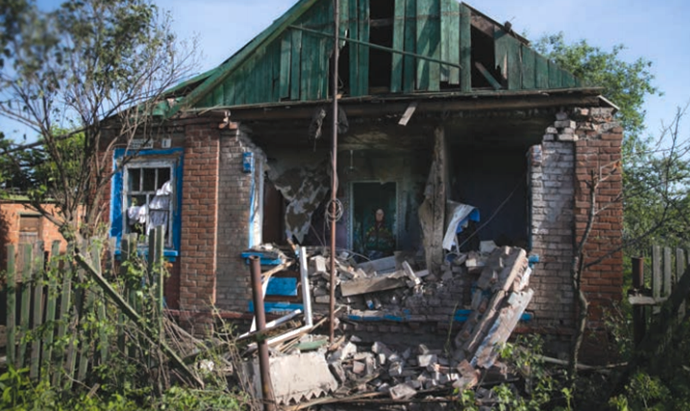
The UN has expressed its major concern over the plight of the eastern Ukrainian territories and their soaring numbers of refugees. There are 118,000 internally displaced people, and 740,000 have fled to Russia during the crisis.
“What we are scared about is the way the military operations are conducted. What will happen if we have intense fighting inside the big urban centers of Lugansk and Donetsk? Fighting in highly intensified urban areas could lead to massive exodus and massive destruction,” UN High Commissioner for Refugees Vincent Cochetel stated on Tuesday.
Almost 4 million people live in a region that has been the hardest-hit by violence, and “face imminent security threats from the fighting,” which has also led to massive damage to infrastructure and the interruption of power and water supplies, John Ging, the head of UN’s Office for Coordination of Humanitarian Affairs, stated.
Donetsk and Lugansk are home to 1.5 million people, and the water supply there has diminished to being only available for a few hours a day. Medical supplies also dangerously low.
Another major concern is that around 70 percent of medics have fled the area.
Currently, 118,000 internally displaced people are registered in Ukraine, with 87 percent of them having fled the east of the country, according to UN data. Over 1,000 people are reportedly leaving the conflict zone each day.
Those numbers can’t be viewed as comprehensive, as “many Ukrainians left their homes without officially registering with the Ukrainian authorities or not addressing them directly.”
740,000 refugees have arrived in Russia since the beginning of this year, according to Russian and UN estimates.
At least 1,367 people, civilians and military, have been killed and 4,087 people wounded by fighting in eastern Ukraine since mid-April.
Ging drew attention to the issue of civilian evacuation from areas affected by the military conflict.
Humanitarian corridors are “open for several hours each day, but these are regularly blocked by combatants, and the evacuation of people through these channels is impeded.”
The UN also demanded that Kiev stops taking customs fees from the humanitarian aid that arrives in the country, and also simplify UN employees’ access into Ukraine.
Moreover, “a unified system is necessary to register the internally displaced persons, a system that will allow to fully analyze and understand the people’s needs,” Ging stated.
“Humanitarian aid should be free of customs payments. Apart from that, it is necessary to accelerate the process of signing and ratifying the agreement between the UN and the government about the simplification of the entry to the country for humanitarian workers and the import of loads,” the official added.
The key component of UN plans to provide humanitarian aid is preparation for the winter when freezing temperatures will prevail.
“We need to assure that all the necessary efforts are taken to address the consequences of the coming winter – which is expected to be severe – for the forcibly displaced people,” Ging stressed.
Why Won’t Obama Just Leave Ukraine Alone?
By Ron Paul | August 3, 2014
President Obama announced last week that he was imposing yet another round of sanctions on Russia, this time targeting financial, arms, and energy sectors. The European Union, as it has done each time, quickly followed suit.
These sanctions will not produce the results Washington demands, but they will hurt the economies of the US and EU, as well as Russia.
These sanctions are, according to the Obama administration, punishment for what it claims is Russia’s role in the crash of Malaysia Airlines Flight 17, and for what the president claims is Russia’s continued arming of separatists in eastern Ukraine. Neither of these reasons makes much sense because neither case has been proven.
The administration began blaming Russia for the downing of the plane just hours after the crash, before an investigation had even begun. The administration claimed it had evidence of Russia’s involvement but refused to show it. Later, the Obama administration arranged a briefing by “senior intelligence officials” who told the media that “we don’t know a name, we don’t know a rank and we’re not even 100 percent sure of a nationality,” of who brought down the aircraft.
So Obama then claimed Russian culpability because Russia’s “support” for the separatists in east Ukraine “created the conditions” for the shoot-down of the aircraft. That is a dangerous measure of culpability considering US support for separatist groups in Syria and elsewhere.
Similarly, the US government claimed that Russia is providing weapons, including heavy weapons, to the rebels in Ukraine and shooting across the border into Ukrainian territory. It may be true, but again the US refuses to provide any evidence and the Russian government denies the charge. It’s like Iraq’s WMDs all over again.
Obama has argued that the Ukrainians should solve this problem themselves and therefore Russia should butt out.
I agree with the president on this. Outside countries should leave Ukraine to resolve the conflict itself. However, even as the US demands that the Russians de-escalate, the United States is busy escalating!
In June, Washington sent a team of military advisors to help Ukraine fight the separatists in the eastern part of the country. Such teams of “advisors” often include special forces and are usually a slippery slope to direct US military involvement.
On Friday, President Obama requested Congressional approval to send US troops into Ukraine to train and equip its national guard. This even though in March, the president promised no US boots on the ground in Ukraine. The deployment will be funded with $19 million from a fund designated to fight global terrorism, signaling that the US considers the secessionists in Ukraine to be “terrorists.”
Are US drone strikes against these “terrorists” and the “associated forces” who support them that far off?
The US has already provided the Ukrainian military with $23 million for defense security, $5 million in body armor, $8 million to help secure Ukraine’s borders, several hundred thousand ready-to-eat meals as well as an array of communications equipment. Congress is urging the president to send lethal military aid and the administration is reportedly considering sending real-time intelligence to help target rebel positions.
But let’s not forget that this whole crisis started with the US-sponsored coup against Ukraine’s elected president back in February. The US escalates while it demands that Russia de-escalate. How about all sides de-escalate?
Even when the goals are clear, sanctions have a lousy track record. Sanctions are acts of war. These sanctions will most definitely have a negative effect on the US economy as well as the Russian economy. Why is “winning” Ukraine so important to Washington? Why are they risking a major war with Russia to deny people in Ukraine the right to self-determination? Let’s just leave Ukraine alone!
The American Aggression Enablement Act and the US’ Eurasian Thrust (II)
By Andrew KORYBKO | Oriental Review | August 1, 2014
Part II: Destabilization by Design
The second thrust of the US’ aggression in Eurasia is the purposeful destabilization of Russia’s interests in the Near Abroad. Specifically, the AAEA’s provisions would lead to an endangered security situation for Belarus, mayhem in Moldova, and an aggravation of the Nagorno-Karabakh situation between Azerbaijan and Armenia. All of these work against Russian interests and place Moscow on the strategic defensive.
Bunkering in Belarus:
One of the US’ designs is to bunker Belarus in and surround it with offensive NATO military capabilities. American aggression against Belarus is old news, going back most sensationally to the mid-2000s when Condoleeza Rice declared the country to be the “last dictatorship in Europe”, thereby putting its head on the chopping block for regime change. Although unsuccessful in overthrowing the government via a Color Revolution, Washington still pumps millions of dollars into the country to support “democracy” (likely in the same vein and with the same intended result as it did in Ukraine with its $5 billion investment). If the AAEA’s goal of placing permanent NATO bases in Poland and the Baltics comes to fruition, as well as the goal of Shadow NATO integration of Ukraine, Belarus could very well find itself almost surrounded by hostile forces pressuring it to accede to their demands. Making the situation even more high-risk, Belarus and Russia have a mutual security agreement via the CSTO, meaning that any act of force against Belarus will be treated as an act against Russia itself. This remarkably raises the stakes of NATO’s power play and increases the chance of direct conflict with Russia.
Moldovan Meltdown:

Flying largely under the radar of most analysts, Moldova is prime for a full-scale meltdown as it is rushed into Western institutions. First and foremost, the country already signed the EU Association Agreement in late June and, for the first time in its history, will be sending a representative to the upcoming NATO summit in September. Although nominal neutrality is a hallmark of the country’s constitution, this does not mean that it cannot enter Shadow NATO via major non-NATO ally designation or potentially enact a ‘referendum’ to change this statute.
What is critical here is that there are two ticking time bombs in Moldova that will likely go off as Western ‘integration’ proceeds at record speed; Transnistria and the lesser-known Gagauzia. The former is the renowned frozen conflict from the 1990s where Russia still has over a thousand troops stationed. It voted to join the Russian Federation in 2006 but to no avail. In May, Deputy PM Dmitry Rogozin was harassed by Moldovan security after he visited Transnistria to collect signatures in favor of reunification with Russia. His plane was forced to land in Chisinau after Ukrainian and Moldovan authorities restricted their airspace to him, creating a diplomatic incident which would be unthinkable to do to a Western politician, let alone of such stature. Moreover, the territory is currently experiencing a blockade by both Moldova and Ukraine. Transnistria does not accept the authority of Chisinau and sees no attraction to the EU, instead preferring the Russian-led Eurasian Union. These radically divergent paths, coupled with NATO’s ambitions and Russia’s existing military position, place Moldova on the brink of destabilization.
Not only that, but Gagauzia is also a simmering issue waiting to boil over. Ari Rusila conducted research on this relatively unknown entity back in April and found that, just like Transnistria, it too is moving closer to Russia. Just as fast as Moldova is moving westward, Gagauzia appears to be moving eastward, and it is asserting its self-determination with every step of the way. He writes that it held a February 2014 referendum to join the Customs Union and that it also voted to place independence on the table if Moldova loses or surrenders its sovereignty. These two options could be taken to mean joining the EU or merging with Romania, and if Gagauzia officially moves away from the centralized Moldovan state, it could lead to military reprisals by Chisinau. All that it takes to set off the two Transnistrian and Gagauzian time bombs is to shove Moldova into the EU and NATO, both of which are already being fast-tracked by the West.
Asphyxiating Armenia:
Lost in the mix of the more headline-grabbing aspects of the AAEA, the legislation also mandates that the US increase its military cooperation with Azerbaijan and provide the same amount of security assistance to it, in league with NATO, as it would to the major non-NATO allies and Balkan states. This is an exceptionally important detail that mustn’t be overlooked by any observer. Armenia, Azerbaijan’s bitter rival, made the fateful decision to turn its back on the EU and move towards the Eurasian Union, much to the ire of Brussels. Hillary Clinton, speaking on behalf of the State Department in late-2012, made known her country’s intention to “figure out effective ways to slow down or prevent” Eurasian integration, signaling that Armenia, after having made its decision to move in this direction, will now be targeted just like Ukraine was.
 Azerbaijan and Armenia are locked in the Nagorno-Karabakh conflict which, although frozen, threatens to heat up at any moment. By throwing its hat squarely behind Azerbaijan, the US is showing that it is not a neutral party to the conflict and cannot be trusted within the OSCE Minsk Group. The move for a more clearly defined and open US-Azeri military alliance has been a long time in coming, however. The US has been using Azerbaijan as a geostrategic energy outpost between Russia and Iran since the 1990s, and the creation of the BTC pipeline only increased its significance in the eyes of Western decision makers. Baku is also close friends with Israel, supplying about 40% of its oil, and it has been rumored to host Israeli drone bases for use against Iran. The Jerusalem Post also reports that Israel sells “hundreds of millions of dollars worth of arms” to the country, further cementing their military-strategic relationship.
Armenia, on the other hand, has a mutual security guarantee with Russia through the CSTO, just like Belarus does. It is a traditional Russia ally and even hosts the 102nd military base outside the capital of Yerevan. Armenia has been blockaded by both Turkey and Azerbaijan since the early 1990s, and the vast majority of its foreign trade must move through Georgia before going to Russia or to other countries via port. With Georgia trying to join the EU, the scenario could arise where costly tariffs are enacted against outside (Armenian) goods entering the Union, even if they are only transiting through, further strangling the already weakened Armenian economy and promoting social unrest. To put things into perspective, Azerbaijan’s defense budget is larger than the entire state budget of Armenia, and Azeri President Aliyev has a track record of threatening military force to retake Nagorno Karabkah.
In sum, any renewed outbreak of war between Azerbaijan (now close to becoming a US military ally) and Armenia (protected under Russia’s defense umbrella) would be a de-facto US-Russian proxy war that could quickly draw in both powers. What’s more, Azerbaijan closely cooperates with Turkey, with whom it has close ethnic, cultural, and linguistic ties, and Ankara’s involvement in any future conflict could quickly draw in the entire NATO alliance. By cozying up so closely with Azerbaijan and working to asphyxiate Armenia, the US is pushing itself closer to a direct conflict with Russia.
Concluding Thoughts
It has been definitively established that the US’ so-called ‘Russian Aggression Prevention Act’ is nothing more than Orwellian Doublespeak for an American Aggression Enablement Act. Aside from the more well-known aspects of the proposal, the lesser-known ones are just as significant in throwing America and its NATO clique closer to war with Russia. By rabidly expanding NATO at all costs via indirect means, the US is plainly showing that it does not care whatsoever for Russia’s security concerns. In fact, it wants to push the envelope and expand NATO in as many simultaneous directions as it can. The swallowing of the Balkans, the staging ground of Russia’s strategic South Stream project, and the movement to incorporate Sweden and Finland into NATO are Washington’s way of imposing full dominance over the continent’s last nominally neutral areas, a move which will surely lead to a determined Russian push back, especially as regards the defense of Serbia and NATO expansion into Finland.
Furthermore, the AAEA aims to threaten Russian interests in Belarus, Moldova, and Armenia, three countries where Moscow has deployed troops and two of which are mutual security partners. This is a calculated attempt at weakening Russia’s position in the Near Abroad and continuing to place it on the strategic defense. All together, everything within the American Aggression Enablement Act clearly shows that the US has strapped up its boots and is eager to go on the offensive against Russia. The ‘Reset’ was nothing more than an underhanded way to buy the necessary time to organize this campaign against all of Russia’s interests on its western flank, and it appears to be in full swing. If it passes into law, the bill will be seen in hindsight as the one action which single-handedly ushered in the ‘New Cold War’ and could quite possibly revert Europe back to the powder keg that it once was 100 years ago.
The American Aggression Enablement Act and the US’ Eurasian Thrust (I)
By Andrew KORYBKO | Oriental Review | August 1, 2014
Congressional Hawks have been peddling the idea of a “Russian Aggression Prevention Act” since the beginning of May, but it has only been during the recent media-inspired hysteria that it began to gain traction. If passed into law, it would amount to a sweeping NATO offensive across all of Russia’s former soviet western periphery and would be the first official act of the ‘New Cold War’. Much has been written about the overall thematic consequences for US-Russian relations by Paul Craig Roberts and Patrick Buchanan illustrating how the US plans to use the legislation to subvert the Russian government from within via its support for ‘NGOs’ (and the prioritized ‘refugee’ status for journalists, ‘dissidents’, and various activists that is included in the document). What has not been explored, however, are some of the finer, yet no less important, aspects of the Act’s implementation. Whether it be NATO expansion into the Balkans or the destabilization of the Caucasus, bill S. 2277 more accurately could be described as the American Aggression Enablement Act (AAEA), as it represents a surge of US offensive military capability against Russian interests in its western flank.
Part I: The NATO Tumor Grows
The AAEA represents the cancerous growth of NATO throughout all of its targeted territories. Some of its most important details are that the EU and NATO are working hand-in-hand, NATO aims to swallow the Balkans, and the Missile Defense Shield (MDS) is to proceed at full speed ahead, with all of the resultant consequences thereof.
Good Cop, Bad Cop:
Although not explicitly stated in the AAEA itself, if one steps back and examines the overall context of the document, it is obvious that the EU and NATO have been working in lockstep to advance each other’s goals. In fact, an overall pattern can be ascertained:
(1) The EU makes some form of outreach to the targeted state(s) (e.g. The Eastern Partnership)
(2) Economic links between the EU and the target are nominally institutionalized (e.g. an EU Association Agreement)
(3) Shadow NATO (via major non-NATO ally status) moves in to defend the economic integration process
The EU presents the friendly, ‘humanitarian’ face to disarm the targeted state’s population while Shadow NATO inconspicuously attempts to absorb the country. This is the tried-and-tested technique of ‘good cop, bad cop’.
The Balkans or Bust:
The US is aggressively promoting its Armed Forces and NATO’s expansion into the Balkans as part of the AAEA. It stipulates that Obama must increase military cooperation with Bosnia, Montenegro, Kosovo, Macedonia, and Serbia, besides Azerbaijan and prescribed major non-NATO allies Ukraine, Georgia, and Moldova. Although it is unlikely that Serbia will be integrated into the fold (it is a strong Russian ally and vividly remembers the bloody bombings of 1999), the move still represents a major expansion of US military influence in Europe. One must keep in mind that the formerly forgotten-about Balkans are now at the forefront of this ‘New Cold War’, with the US and some European actors trying to sabotage Russia’s South Stream gas project which, ironically, certain EU members had agreed to in the first place. Bosnia, Montenegro, Kosovo, and Macedonia are all entities abutting Serbia, which is planned to be one of the hubs of South Stream, so their inclusion into the enhanced NATO security framework suggested by the AAEA can be seen as surrounding Serbia prior to destabilizing it once more. In the context of bitter energy geopolitics, the US’ seemingly unexpected push into the Balkans makes absolute sense.
Missile Defense and NATO’s Northern Expansion:
Included in the AAEA is the directive to accelerate the rollout of the Missile Defense Shield (MDS). This was already envisioned to have land, sea, and space components per the phased adaptive approach framework. What makes the AAEA different, however, is that it wants to ‘poke Russia in the eyes’ and go forward with something that Moscow has already stated would certainly be a red line. Russia holds this stance because it believes that a MDS would neutralize its nuclear second-strike capability, thereby giving the US a monopoly on carrying out a nuclear first strike and shattering the mutual assured destruction concept that kept the peace between the two nuclear titans for decades.
Russia’s response thus far has been to deploy Iskander missiles to the Baltic enclave of Kaliningrad. One of the dual purposes of the US’ MDS is to goad Russia into taking more such defensive actions that could then be propagandized as ‘offensive’, thereby exaggerating ‘the Russian threat’ and contributing to fear mongering among the Swedish and Finnish citizenry. The end result is to push these countries deeper into the NATO apparatus. Finland has already said that it could hold a referendum on joining as early as April 2015 after the next round of parliamentary elections, with its Defense Minister already actively lobbying for this to happen. Sweden, on the other hand, already engages in such close cooperation with NATO that it’s already a shadow member in its own right, and Foreign Minister Carl Bildt is one of the most prominent Russophobic policy makers on the continent. Because of a joint agreement on military security, Finland can only join NATO together with Sweden, meaning that if any move is made, it would likely be a ‘double whammy’ to get the two states in at once. It goes without saying that if Russia would not allow NATO to be deployed in Georgia or Ukraine, it most definitely would not allow it to be deployed along the Russo-Finnish border, further increasing the chances of yet another crisis in NATO-Russian relations sometime down the line.
To be continued… Part II
California and Ukraine National Guard gear up for military collaboration in 2015
RT | August 2, 2014
In the latest step by Washington to increase the pressure on Russia’s border with Ukraine, the Obama administration has informed Congress that the US will train and arm the Ukrainian National Guard next year, the Pentagon said.
“The Defense Department and State Department have notified Congress of our intent to use $19 million in global security contingency fund authority to train and equip four companies and one tactical headquarters of the Ukrainian National Guard as part of their efforts to build their capacity for internal defense,” Reuters quoted Pentagon spokesman Rear Admiral John Kirby as saying Friday.
The joint military training would take place at a facility inside Ukraine that is capable of hosting multilateral exercises, Kirby said. The advisors would be provided by US Army Europe and by the California National Guard, he added.
Also Friday, the United States pledged about $8 million in new aid to bolster the Ukrainian Border Guard Service.
The plan requires Congressional approval, but judging by the level of anti-Russian rhetoric coming from US legislators, this is expected to be forthcoming.
The California National Guard’s military partnership with the Ukraine military has existed since the collapse of the Soviet Union.
California partnered with Ukraine in 1993 to assist the country develop its military capacity, with the two sides participating in numerous military exercises over the years, including Operation Peace Shield and Operation Sea Breeze, which has particularly irked Moscow since the exercise is occasionally held in Crimea, the home of Russia’s Black Sea fleet.
The California-Ukraine partnership is expected to transition to Operation Saber Guardian – a multinational exercise involving 12 nations, including Ukraine.
It may come as a surprise to many American taxpayers that the US National Guard has nearly two dozen state partnerships with foreign countries, most of which were once part of the Soviet Union.
According to the Embassy of the United States in Ukraine, “the California–Ukraine partnership directly supports both the goals of the US Ambassador to Ukraine and Commander, US European Command.” However, the embassy provides no further details as to exactly what those specific “goals” may be.
Bad timing for California National Guardsmen?
Although the Pentagon spokesperson failed to mention Washington’s worsening diplomatic relations with Russia over the deteriorating situation in Ukraine, the announcement comes on the heels of a string of anti-Russian actions, which include a series of sanctions that target Russian businesses and banks.
The marked deterioration in Russia-US relations began late last year after former Ukrainian President Viktor Yanukovich signaled his preference for forging economic ties with Russia – which was prepared to provide a loan bailout to Kiev, something the IMF had been hoping to do – as opposed to the so-called EU association agreement.
This decision, which proved to be politically fateful for Yanukovich, triggered a harsh response from Western governments and politicians, some of whom, including Republican presidential candidate John McCain, appeared in the Ukrainian capital of Kiev to agitate Ukrainians against Russia.
The level of Western meddling in Ukrainian politics became startlingly clear in January when assistant US Secretary of State Viktoria Nuland was recorded in telephone conversation with US Ambassador to Ukraine Geoffrey Pyatt, where the two officials are heard discussing their preferences as to whom should take over power in the country.
The icing on the cake came when Nuland was heard to bluntly declare, “F**k the EU” with regards to the European bloc’s opinion in the matter.
The latest setback in Russia-US relations came with the July 17 downing of a Malaysian airliner over eastern Ukraine. Western countries, following in the footsteps of the United States, have been quick to cast blame on Russia for the incident, saying it has supplied the rebels with missiles.
Moscow has emphatically rejected the accusations, while at the same time presenting Kiev with a series of questions concerning the crash, including about why Ukrainian air traffic controllers allowed Malaysian Airlines flight MH17 “to deviate from the regular route to the north, toward ‘the anti-terrorist operation zone.’”
EU ‘quietly’ lifts ban on supplying Kiev with weapons and technology – Russia
RT | August 2, 2014
The European Union has “quietly” agreed to lift restrictions supplying Kiev with military technology and equipment which can be used for the “repression” in the country, the Russian Foreign Ministry said.
“During a recent meeting of the Council of Europe in Brussels, leaders of EU member states agreed ‘on the quiet’ to remove restrictions on exports to Kiev of equipment that could be used for internal repression,” the ministry said in a statement on its website. “Exports of military technologies and equipment were also allowed.”
Moscow slammed the move as “contradicting the rules of military technologies and ammunition exports which have been earlier applied by the EU” and also “pierced” by double standards.
The EU approved its rules for controlling the export of weapons and ammunition on December 8, 2008. Criterion #3 calls on the EU member countries to stop issuing export licenses for military equipment and technologies that can provoke or prolong conflict.
The decision to restart issuing licenses for special military equipment exports came despite the continuing “anti-terrorist operation” in eastern Ukraine, the ministry said.
“It is obvious why the EU is ignoring indisputable facts of shelling of Russian territory [in the southwest Russian region of Rostov] from the Ukrainian side: the perspective of feeling your own involvement in such actions creates certain discomfort in Brussels,” the statement said.
The ministry called upon its European counterparts “to follow logic,” not the “prodding” from Washington.
“The decision to limit the supply of ammunition and weaponry to Ukraine should have been introduced after the launch of the so-called ‘anti-terrorist operation’ in the Donbas and Lugansk Regions. It is not too late to restore the ban,” the ministry said.
Donbas, a historical, economic and cultural part of eastern Ukraine, includes the northern part of the Donetsk Region and the south of the Lugansk region.
The restrictions were introduced by the EU Council in February 2013 when Viktor Yanukovich was the country’s president and there was a severe confrontation between Maidan protesters and police.
“Then the EU decided that it was ‘wrong’ to supply ‘Yanukovich regime’ with weapons,” Moscow pointed out.
The restrictions were first introduced by the European Council in February 2014 when Viktor Yanukovich was the country’s president and there were violent clashes between Maidan protesters and police. “Then the EU decided that it was ‘wrong’ to supply ‘Yanukovich regime’ with weapons,” the ministry said.
Kiev’s so-called “anti-terrorist operation” in the eastern regions of Ukraine has intensified lately. The most recent crackdown was in the village of Gorlovka, in the Donetsk Region. It resulted in 31 civilians being killed there.
According to UN figures, at least 1,129 people have been killed and nearly 3,500 wounded in eastern Ukraine since the start of the operation in April. Also, 100,000 people have been forcibly displaced.
The UN report said that the cause of the rising death toll is intensified artillery shelling of civilian residential areas and so-called “collateral damage” in heavily-populated areas.
See also: Over 30 civilians killed during two days of shelling in Gorlovka, E. Ukraine (VIDEO)
US Senate passes emergency funding for Israel’s Iron Dome
RT | August 1, 2014
The Senate overwhelmingly approved an emergency measure early Friday that could give $225 million in additional revenue to Israel for the country’s Iron Dome missile defense system.
Senate Majority Leader Harry Reid (D-Nevada) received unanimous consent from his colleagues Friday morning when he asked them to consider approving the measure, The Hill reported.
Next, the House of Representatives will be tasked with weighing the request, which if passed will put nearly a quarter of a billion dollars towards Israel’s missile defense system as that country continues its campaign at Hamas in Gaza City.
“They’re running out of Iron Dome missiles to protect themselves,” Sen. Lindsey Graham (R-South Carolina) said at the hearing, according to The Hill. “We are with you. Here are the missiles.”
“We are with the Israelis, because if they don’t have the Iron Dome, they can’t defend themselves,” added Sen. John McCain (R-Arizona).
Earlier in the day, a previously agreed upon ceasefire agreement between the Israeli Defense Forces and Hamas fell apart barely two hours after it began. Israel has been waging a campaign on Gaza for nearly one month now, and says the ongoing strikes are needed to retaliate against missiles being launched by Hamas into territory claimed by Israel.
Earlier this week, an IDF-attributed strike on Gaza resulted in the shelling of a United Nations-run school inside of a Palestinian refugee camp. The White House condemned the attack, but that same day the Pentagon reportedly approved an Israeli-made request for additional rounds of ammunition from the US.
What’s Really at Stake in the Impasse Over Centrifuges
Hillary Mann Leverett on the Iran Nuclear Talks
Earlier this week, Hillary appeared on CCTV’s The Heat to discuss the Iran nuclear talks; click on video above or see here. In her segment, she focused on what really drives the divide between Tehran and the Western members of the P5+1 (the United States, Britain, and France) over Iranian enrichment—namely, the clash between the Islamic Republic’s commitment to strategic independence and Western powers’ determination that Tehran must accept their directives regarding implementation of the Nuclear Non-Proliferation Treaty (NPT) and the dynamics of Middle Eastern power politics. As Hillary notes,
“There has been progress on some significant issues—but this fundamental issue about enrichment is critically important. It gets to not just the number of centrifuges…The issue is really a question of independence.
Iran is fiercely devoted to its independence. That’s what the Islamic Revolution was all about—for Iran to be independent of foreign powers—and it wants this civilian nuclear program as part of its program for independence. So it needs to not dismantle any of its current infrastructure—which includes about 10,000 operating centrifuges—and to increase it, to a have full-fledged civilian nuclear power program.
The United States wants just the opposite. The United States has finally come around, after more than ten years of pounding its fist on the table, to admitting that maybe Iran could have a symbolic program—but that Iran needs to remain dependent on other countries…Not only does this go against the very principles of the revolution in Iran, for independence, but, in fact, Iran tried that. They bought fuel from Argentina, until the United States got angry and forced Argentina to cut it off. And they were part of a project called Eurodif, where Iran bought ten percent of that project, and then they were cut off.
So that’s the fundamental divide—whether to keep Iran dependent on the international community, or to allow them to be independent. That is going to be a very difficult bridge to cross…It’s not a matter of time; it’s a matter of mentality.”
Of course, official Washington’s hegemonic mentality—and its accompanying pretensions—are increasingly at odds with the actual distribution of power in an evolving international order. In part, this reflects the declining utility of America’s military might; to paraphrase a line from that timeless study in the exercise of power (and classic Hollywood blockbuster film), The Godfather, “the United States doesn’t even have that kind of muscle anymore—and can’t really use that much of what it still has.” As Hillary elaborates, that’s an important reason the United States is negotiating, however reluctantly, with Iran:
“It’s interesting that President Obama has refrained…since January of this year, from saying that all options are on the table, for two reasons. One, I think, in terms of allowing the negotiations to go forward, is to take the military option off the table as an offensive rhetorical device against the Iranians.
But part of this is real. This is something that, from all my trips to Iran, I understood. The Supreme Leader there, security and political analysts there, realized a few years ago that after America’s failed interventions in Iraq, Afghanistan, Libya, and Syria, we don’t have the military option on the table, and that gives room for negotiations.
So, even though I’m not optimistic there’s going to be a deal, a comprehensive deal either today or in four months (the new deadline), I do think that there’s enough incentive on both sides to continue negotiations for a very long time. And you may see in September, when the United Nations convenes in New York, you may see not only continued intensive negotiations of high-level officials, but potentially even a President Obama-President Rohani meeting—not to actually seal the deal, but to inject enough momentum to keep things going past the November congressional elections and continue to kick this can down the road.”
Hillary is similarly skeptical about the prospects for a unilateral Israeli attack against Iran:
“Even though a tragically high number of Palestinians have been killed in this current conflict [in Gaza], there is a bit of exposure of the emperor wearing no clothes, that the Israelis are not able to defeat HAMAS in Gaza. And the Iranians certainly see the Israelis having no clothes, that they don’t have the technical capability to bomb Iran’s nuclear facilities. With that, there is, again, more time for negotiations.”
Beyond the purely military dimension of America’s relative decline, the rising influence of non-Western powers—China, Russia, and, in the Middle East itself, Iran—has also helped push the United States into multilateral nuclear talks with the Islamic Republic. As Hillary explains, that’s an important reason the P5+1 is negotiating with Iran:
“The world has changed in the past ten years. Ten years ago, when the United States would say that the U.S., Israel, France, and Britain were ‘the international community,’ nobody really made that much noise. Today, they do. So today, the United States has to take the views of, particularly, Russia and China very squarely into account. They have to be at the table, and they have to buy into what the political and security order is going to look like in the Middle East—not just how many centrifuges Iran is going to have. That’s why we have the negotiations.”
Yet, even though it has been pushed into multilateral nuclear negotiations with Iran, the United States continues to take hegemonically assertive positions in the talks. Take Washington’s positions on the duration of a prospective final agreement, the number of centrifuges Iran should be “allowed” to operate under a final agreement, and limiting Iran’s alleged “breakout” capability. As Hillary describes,
“The United States wants at least a ten-year, and they’re gunning really for a twenty-year deal. That has nothing to do with proliferation. That has to do with their wanting to outwait the Supreme Leader, the Supreme Leader’s life…so that the Islamic Republic has, in their view, a prospect of collapsing into a more pro-American political order.
The Iranians are not buying into that…they’re focused more on what their practical needs are, based on when they have contracts or prospective contracts for nuclear plants, when they need the fuel, and how much fuel they need.
That gets into the number of centrifuges—and, again, this is where the Supreme Leader has spoken about numbers that are much greater than the Americans are willing to consider at this point. But he’s focused on what are the practical needs—the practical needs as told to him by the head of Iran’s atomic energy agency, who (guess what) has his Ph.D. from MIT here in the United States, and who knows what he’s doing.
So [the Iranians] are really talking about a practical needs-based approach, based on a sovereign country pursuing a technical, practical program. The United States is focused on power and influence, and on maintaining a pro-American political and security order in the Middle East…
The so-called ‘breakout issue’ is also a lot of smoke and mirrors. Again, it’s aimed at limiting Iran’s domestic, indigenous, sovereign capacity to pursue this program.
If the United States and its so-called partners were really interested in proliferation, they would accept the Iranian deal, which is to convert all—not some, but all—their enriched uranium into oxide, into powder to make into fuel. All of it. You’d solve the proliferation issue overnight, but the United States isn’t interested in that…We’re interested in constraining capacity, to constrain Iran’s power—its rising power, particularly in the Middle East—at a very volatile time for the United States.”
Hillary goes on to discuss the strategic imperative for the United States to pursue “Nixon-to-China”-style rapprochement with the Islamic Republic—and, in the process, “to change America’s strategy from one of dominance and hegemony in the Middle East to one that is a balance of power, that recognizes and deals with all the critical powers as they are, not as we would like to transform the Middle East.”
–Flynt Leverett and Hillary Mann Leverett
The US’ H17 End Game: Shadow NATO in Ukraine and Russia as a ‘State Sponsor of Terrorism’
By Andrew KORYBKO | Oriental Review | July 28, 2014
The Ukrainian Civil War took a violent and headline-grabbing international turn for the worst on 17 July following the downing of Flight MH17. Although it appears more and more likely that it was the Ukrainian Army that shot it down and not the anti-Kiev Resistance, pro-Western media has been aggressively pushing the narrative that Russia, specifically President Putin, was involved and has been suppressing evidence to the contrary. It has even gone as far as to infer that “Russian-backed separatists” carried out a “terrorist attack”, further upping the propaganda ante. The reason behind this massive information war is that the US wants to “isolate Russia” and expand NATO into Ukraine, something which it has largely been unable to successfully do up until this point. In fact, it appears as though the US is now readying to play its trump card – granting Ukraine major non-NATO ally status and declaring Russia as a “state sponsor of terrorism”, both of which would in turn advance NATO interests and threateningly force the EU to choose whether its destiny lies with the Atlantic or the Continent.
“Operation: Isolation” before Flight MH17
Prior to the downing of MH17, US-led sanctions against Russia were unsuccessful in isolating Moscow. The EU refused to enact any meaningful sanctions that would endanger its $330 billion yearly trade with Russia, thereby mitigating the US’ economic bullying efforts. In fact, the verbal threat of sanctions was actually beneficial for Russia since it motivated the country to look outside the West for future economic prospects. An historic gas deal with China was signed in May that was worth nearly half a trillion dollars, and in the same month, the Eurasian Economic Union was officially formed. Then, right before 17 July, Putin attended the BRICS conference in Brazil where he met with leaders representing nearly half of the world’s population, and they committed to creating the alternative BRICS Development Bank. Clearly, Russia wasn’t going to be isolated by the West.
All while this was happening, the US kept trying to find a backdoor way for incorporating Kiev’s armed forces into NATO, and it found it through its local lackey, Poland. A plan was concocted by Ukraine to create a joint brigade between it, Lithuania, and Poland, with Poland being the key NATO partner involved (Lithuania on its own is almost insignificant in international and military affairs of any kind). The importance here is that Kiev has been institutionalizing the relationship it has with its new strategic partner, Poland, also inviting its former overlord and mercenary-in-arms into the east to assist with “creating new jobs” (read: plundering) in Donbass. What is happening here is that even if the West was unsuccessful in isolating Russia, it could at the very least move as much of its influence eastward to the Russian frontier as it can in order to enact maximum pressure on Moscow.
The “Terrorist” Label and Shadow NATO
Almost immediately after it happened, the MH17 catastrophe was seized upon by Western political opportunists as valuable capital for their geostrategic game. As was mentioned in the first paragraph, pro-Western media outlets immediately laid the blame squarely at Putin’s feet, and this wasn’t coincidental. The objective in doing so has been to generate enough anti-Russian sentiment in Europe so as to justify mutually disadvantageous sanctions (more so for the socially and politically fractured EU, many of whose members are still in recession, than for the economically resolute Russia). The EU, and especially Germany, will only “shoot itself in the kneecaps” as either an emotional or forced response, as to do so under any normal circumstances would be absolutely unreasonable.
Thus, the “terrorist” label entered the discourse.
 It has now become popular for Western opinion makers to repeat the Kiev slur that the anti-coup Resistance are “terrorists”, emphasizing that they are “Russian-backed” and “supported by Putin”. It doesn’t matter that none of this is true – what is important is that it is repeated as loudly and as often as can be. The result is to acclimate the public into believing that Russia under Putin is a pariah state, much as Newsweek magazine tried to convince their audience with its last hate piece. Poroshenko has taken things even further, likening MH17 to Lockerbie and 9/11 and trying to get Donetsk and Lugansk’s governments on the international terrorist list.
It is only a short leap of “logic” to see the connection between Russia and Putin as terrorist sponsors and the US’ designation of state-sponsor-of-terrorism status onto the country. Such a step would lead to immediate US sanctions and intense pressure on the EU to cut off its major non-energy trade contacts with Russia and fiendishly move towards diversifying away from Russian gas (to say nothing of killing the South Stream project). The US will only take this extreme step if it is sure that it has more influence over Europe than Russia does and that Europe can be convinced to sacrifice its economic well-being for ideological and political reasons (which is not that far-off of a possibility for such an indoctrinated leadership).
Just as before the tragedy, it must be noted that the US is still pursuing the goal of shadow NATO integration with Ukraine parallel to isolating Russia. It is reported that it may be on the cusp of granting Ukraine major non-NATO ally status and even providing pinpoint precision intelligence for attacking anti-Kiev SAM sites. This could rapidly creep into something much more, per the Libya model, especially since US military advisors will be on the ground. Thus, in one fell swoop, by evoking the “terrorist” label, the US can ‘kill two birds with one stone’ – guilt/force the EU into “isolating Russia” (thereby isolating and harming itself as well) and swallow Ukraine into Shadow NATO.
Concluding Thoughts
The US has plainly demonstrated that it is salivating for a Cold War redux with Russia, and once more, Europe is caught in the middle. It is completely contrary to any of its interests for it to participate in this needless and aggressive geopolitical struggle, but as the EU seems wont to do nowadays, it may easily get sucked into it out of misguided ideological and political reasons dictated by the US. In fact, it may have little choice: the US could unilaterally declare Russia as a state sponsor of terrorism and then force the EU, whose largest export market is the US and with whom it is negotiating the Trans-Atlantic Trade and Investment Partnership (which European political elite naively believe will benefit them), into acquiescing to its military occupier’s demands. This wouldn’t “isolate” Russia, which has already made a strong push into the non-Western world since April, as much as it would isolate the EU, but ironically, this may even work in Washington’s favor by crippling its friendly economic rival and keeping it under its thumb for at least another decade.
Moreover, Russia as a “state sponsor of terrorism” would create a clear dividing line between the West and Russia and could give a renewed hybrid purpose to NATO. Whereas in the Cold War it was an anti-Russian organization and then in the “Global War on Terror” it nominally became an anti-terrorist organization, it may soon carry the new hybrid mission of containing a “terrorist-supporting” Russia. This would also provide enhanced justification to European populations for the deployment of even more US and NATO personnel in Eastern Europe, as well as deeper and faster Shadow NATO integration for Ukraine, Georgia, and Moldova, thereby laying the framework for a Western battering ram into Russia’s Near Abroad. All of this would rightfully alarm Russia, which would then defensively ramp up its multivector cooperation with ‘The Rest’ and BRICS. This would be especially so for its prized strategic partner and fellow Western target, China, potentially creating an eventual de-facto alliance between the two giants out of shared security concerns and transforming the Eurasian strategic landscape.
Andrew Korybko is the American political correspondent of Voice of Russia who currently lives and studies in Moscow, exclusively for ORIENTAL REVIEW.
Featured Video
10K More U.S. Troops Deploy as Trump Weighs New Iran Strikes
or go to
Aletho News Archives – Video-Images
From the Archives
Genetic baloney in thick slices
MAYBE COULD BE INC.
By Jon Rappoport | No More Fake News | July 8, 2021
Gene research companies tend to come and go. They start out banging and popping like fireworks in the sky, and then they fade out—selling themselves to larger outfits who’ve hired better liars…
Once upon a time, it sounded easy. Start with a disease, find the gene responsible for the disease, and correct the problem.
Then, researchers wondered, was disease the result of one gene or a group of genes acting together?
Either way, the proof would be in devising cures for diseases using gene therapy. “Not yet, but soon…”
And regardless, the major need was: money. Lots and lots of money.
This need required good PR people. “We have to pump up the idea that we’re on the edge of tremendous breakthroughs. We’re always on that edge…”
This hype also needed to obscure the fact that there wasn’t (and isn’t) ANY gene cure for ANY disease. … continue
Blog Roll
 Aletho News
- US military withdrawal from Iraq and the collapse of US-Israeli hegemonic project in West Asia
- What does Europe want – a war with Russia?
- She Followed the Actual Data on COVID Vaccines and Masks — Her Career Took a Huge Hit
- Florida AG Sues Pfizer, Bourla Over Deceptive Marketing of COVID Vaccines
- Von der Leyen gifts her spin doctor a job for life
- 10K More U.S. Troops Deploy as Trump Weighs New Iran Strikes /Suliaman Ahmed
- Iranian crew declared Dena training vessel ‘unarmed’ to US warship before deadly torpedo strike: Report
- Iran’s NPT debate moves beyond parliament
- Houthis condemn Saudi claims of attack on Medina
- Fatuous False Flags
- If Americans Knew
- Israel is squeezing the life out of Palestinians – Daily Update
- The Israeli Right Portrays Islam as Murderous. It Serves a Political Purpose
- Jordan Has Had Enough: King Abdullah’s Scathing Warning to Israel
- Israeli Colonizers (i.e. Settlers) Kill Palestinian Man Near Salfit
- New Google Maps images reveal massive scale of devastation in Gaza
- Jewish supremacy, anti-Palestinian bigotry on display in Israel – Daily Update
- Israeli Soldiers Abduct At Least 22 Across Occupied West Bank
- Eight Palestinians Killed in Israeli Attacks on Gaza
- Israeli former leaders and security chiefs threaten legal action over ‘Jewish terrorism’
- Israel map in LA Times ad includes all land from the river to the sea
- No Tricks Zone
- Green Energy Debacle: German Expert Professor Fritz Vahrenholt Warns Of Severe Economic And Social Consequences
- Two More Paleo Reconstructions Affirm Meters-Higher Sea Levels Across Ireland, Brazil 7000-6000 Years Ago
- New Study: Earth And Venus Surface Warmth Largely Explained By Convection And Lapse Rate, Not CO2 Or Radiation
- 2025 Nature Paper Claiming Worsening Global Drought Gets RETRACTED …Heavily Flawed
- New Study: ‘Global Drought Shows No Detectable Recent Acceleration Under Climate Warming’
- Economic Masterminds: German Socialists Suggest Taxing Productivity Gains Stemming From Using AI
- The South China Sea Has Not Been Cooperating With The Climate Change Narrative
- Energy Crisis: Germany Enters Heating Season With Historically Low Gas Reserve Fill Levels
- New Study: The Antarctic Ice Sheet Gained Mass From 2020-2024 Due To Staggering Snow And Ice Accumulation
- Study: Ocean Heating Rates From Thousands Of Years Ago ‘Dwarf’ Modern Ocean Heating Rates


