Pentagon: Missile defense ‘kill vehicle’ still plagued with problems after years of failure
RT | September 9, 2014
A Pentagon investigation of the “kill vehicle” warhead, part of a weapons system plagued with years of failed tests, found dozens of quality control problems, according to a new report.
The Pentagon’s inspector general said in the report released Monday that the “kill vehicle,” a warhead meant to intercept missiles, fell short of quality standards in 48 specific cases, including issues with software testing, supply chain demands, and design changes, making the kill vehicle “susceptible to quality assurance failures.”
The warhead, known as the Exoatmospheric Kill Vehicle (EKV) is built by Raytheon Co. and is part of the Ground-based Midcourse Defense (GMD) system led by Boeing Co. EKVs are launched by a Ground Based Interceptor (GBI), “which is designed to engage high-speed ballistic missile warheads in space,” according to Raytheon. The current procurement cost for each GBI is around $75 million, said Missile Defense Agency Director Vice Admiral James Syring in July 2013.
The inspector general report, the first of two on the EKV, said the US Missile Defense Agency has agreed with concerns over the interceptor warhead and has started to address 44 of the 48 issues identified.
The GMD missile defense system was deployed in 2004 even before it completed testing to be able to counter what the George W. Bush administration claimed was a looming missile threat from North Korea.
The EKV finally conducted its first successful missile intercept in June after years of failed attempts.
“A combination of cost constraints and failure-driven program restructures has kept the program in a state of change. Schedule and cost priorities drove a culture of ‘use-as-is’ leaving the EKV as a manufacturing challenge,” the report said.
“With more than 1,800 unique parts, 10,000 pages of work instructions, and 130,000 process steps for the current configuration, EKV repairs and refurbishments are considered by the program to be costly and problematic and make the EKV susceptible to quality assurance failures,” it added.
The Pentagon inspector general wrote that most quality management systems on the weapons program were in compliance, but problems were evident. The report found 15 major and 25 minor quality problems with Raytheon’s EKV work. Boeing’s work on the entire system had six major and one minor problem.
Most of the issues identified in the report have been corrected, the inspector general said, but Raytheon is still working on four issues.
Raytheon has a $636 million development and sustainment contract to produce the EKV, though the Pentagon is seeking one of the major defense contracting firms to develop a more reliable, second generation EKV, Reuters reported. Weapons giants Boeing, Raytheon and Lockheed Martin Corp. are all in the running.
Hillary Clinton’s Friends and the Kissinger of Death
By Nima Shirazi | Wide Asleep in America | September 8, 2014
In Hillary Clinton’s predictable, self-serving, overlong, boilerplate garbage review of Henry Kissinger’s new book, published last week in the Washington Post, she – well, the communications grunt who actually wrote the review – praises a man who should be serving life in prison for war crimes.
While there is no point addressing the majority of the article, nauseating and noxious as it is, a few things stick out. The first is that Hillary Clinton is friends with a whole lot of absolutely despicable people. This is unsurprising, but still gross.
“Kissinger is a friend, and I relied on his counsel when I served as secretary of state. He checked in with me regularly, sharing astute observations about foreign leaders and sending me written reports on his travels,” Clinton writes in the review, echoing a passage from her own recent pre-presidential campaign manifesto, “Hard Choices.”
That book contains myriad references to Clinton’s “valued” and “invaluable friends,” most of whom are rich, powerful or famous public figures – often all three.
Included among these are war criminals Benjamin Netanyahu and Shimon Peres. Clinton writes that she and Netanyahu “worked together as partners and friends.” Peres, she notes in the book, is an “old friend.”
In her role as Secretary of State, Clinton routinely referred to former Israeli Prime Minister and then-current Defense Minister Ehud Barak as her “friend,” “old friend,” and “longtime friend and colleague.” In April 2010, Clinton remarked, “I have known the defense minister for more years than I care to remember. We were both very young, Ehud.”
Barak endearingly replied, “Immediately after your bat mitzvah.” A hearty chuckle was had by all.
Hillary, Hosni and Shimon
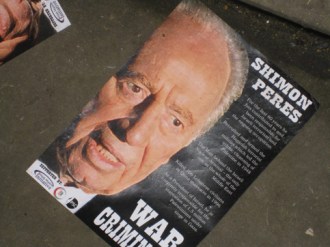 While Netanyahu has, at times, called Clinton “a great friend and a great champion of peace,” Clinton and Shimon Peres have a history of gushing over one another. In early March 2009, Clinton meet with Peres in Jerusalem, describing him as “my dear and old friend” and thanking him “for the extraordinary example that your life sets, as someone who has devoted yourself to the state of Israel, to its security, and to the cause of peace.”
Shimon Peres – who was born Szymon Perski in 1923 in what is now Belarus and immigrated to Palestine in 1934 – procured weaponry for the Haganah during Israel’s ethnic cleansing of Palestine in 1947-48. He was the architect of Israel’s illicit nuclear weapons program and forged close ties with the Apartheid regime in South Africa.
In November 1974, after visiting the leadership in Pretoria, then-Israeli Defense Minister Shimon Peres emphasized to the Knesset the “vitally important” economic, political and military ties between the South Africa and Israel, explaining that “this cooperation is based not only on common interests and on the determination to resist equally our enemies, but also on the unshakeable foundations of our common hatred of injustice and out refusal to submit to it.”
Years later, Peres was acting prime minister during the Israeli bombardment of Lebanon in 1996, including the Qana massacre, in which Israeli warplanes shelled a UN compound sheltering hundreds of displaced civilians, killing 106.
Nevertheless, Hillary Clinton fawned, “I always come away from my times with you both inspired and encouraged to think more deeply and more broadly. And I also am silently challenged by your ceaseless optimism about the future.” In earlier remarks, Clinton said to Peres, “You are an inspiration to me personally, as a person who has dedicated your entire adult life to the State of Israel.” She hailed her presence in Israel as “truly a visit among friends.”
The feelings were mutual. Peres addressed her as “our very dear Hillary,” and expressed sincere gratitude for her “understanding and sympathy and friendship.”
When she returned to Israel 18 months later, Peres hailed “her wisdom, her friendship, her carefulness and caring.” Clinton, again, described Peres as “my friend,” saying it was “a personal pleasure, privilege, and honor to be here with you.”
When the two shared a stage at the Israeli-obsessed Saban Center for Middle East Policy at the Brookings Institute in June 2012, Hillary called Peres her “longtime friend” whom she “so greatly” admires, while Peres expressed his “personal admiration, which is really tremendous” for Clinton.
Back in Jerusalem the following month, Clinton made sure to “be the first friend to wish [Peres] a very happy birthday,” and expressed “such great gratitude how much I appreciate you, our friendship, the work we have done together and the work that we will do together in the future.”
A day before Clinton’s first official visit to Israel as Secretary of State in 2009, she was in Sharm el-Sheik, Egypt. In an interview with Al Arabiya, Clinton effectively dismissed the State Department’s annual report on Egyptian human rights abuses as constructive criticism amongst chums, and declared, “I really consider President and Mrs. Mubarak to be friends of my family.”
In this context, her respect, admiration, and friendship with Kissinger makes a lot more sense.
Kissinger’s Democratic Values and Love of Legitimacy
In her sad stump speech/review of Kissinger’s book, Clinton assures readers that – though they have their differences -she, President Barack Obama, and Kissinger all share the “belief in the indispensability of continued American leadership in service of a just and liberal order.”
Justice. Liberal. Clinton. Obama. Kissinger. Right. Gotcha. But that’s not all.
The review sheds some light on these supposed “shared values” and the politically powerful’s collective view of American imperialism:
During the Cold War, America’s bipartisan commitment to protecting and expanding a community of nations devoted to freedom, market economies and cooperation eventually proved successful for us and the world. Kissinger’s summary of that vision sounds pertinent today: “an inexorably expanding cooperative order of states observing common rules and norms, embracing liberal economic systems, forswearing territorial conquest, respecting national sovereignty, and adopting participatory and democratic systems of governance.”
This system, advanced by U.S. military and diplomatic power and our alliances with like-minded nations, helped us defeat fascism and communism and brought enormous benefits to Americans and billions of others. Nonetheless, many people around the world today — especially millions of young people — don’t know these success stories, so it becomes our responsibility to show as well as tell what American leadership looks like.
Feel free to continue reading once you’ve stopped laughing and caught your breath.
Later, Clinton makes sure to note – in a glowing review of a book by Henry Kissinger, mind you – that “our devotion to human rights and democratic values” are an integral part of what “make[s] us who we are as a nation.” Adhering to such values, Kissinger apparently suggests in his new swag bag doorstop, is what leads to success.
Ok, I’ll wait.
One would be hard pressed to figure out where exactly respecting national sovereignty, an abiding commitment to democratic governance, and standing up for human rights fell into the policy prescriptions of the either the Nixon/Kissinger or Obama/Clinton administrations.
As David Corn succinctly wrote in Mother Jones, outside of Clinton’s twisted mind, Kissinger is best remembered for engaging “in underhanded and covert diplomacy that led to massacres around the globe, as he pursued his version of foreign policy realism. This is no secret.” Corn continues:
- Chile: Nixon and Kissinger plotted to thwart the democratic election of a socialist president. The eventual outcome: a military coup and a military dictatorship that killed thousands of Chileans.
- Argentina: Kissinger gave a “green light” to the military junta’s dirty war against political opponents that led to the deaths of an estimated 30,000.
- East Timor: Another “green light” from Kissinger, this one for the Indonesian military dictatorship’s bloody invasion of East Timor that yielded up to 200,000 deaths.
- Cambodia: The secret bombing there during the Nixon phase of the Vietnam War killed between 150,000 and 500,000 civilians.
- Bangladesh: Kissinger and Nixon turned a blind eye to—arguably, they tacitly approved—Pakistan’s genocidal slaughter of 300,000 Bengalis, most of them Hindus.
And there’s more. Kissinger’s mendacity has been chronicled for years. See Gary Bass’ recent and damning book on the Bangladesh tragedy, The Blood Telegram. There’s Seymour Hersh’s classic, The Price of Power. In The Trial of Henry Kissinger, Christopher Hitchens presented the case against Kissinger in his full polemical style. As secretary of state, Kissinger made common cause with—and encouraged—tyrants who repressed and massacred many. He did not serve the American values of democracy, free expression, and human rights. He shredded them.
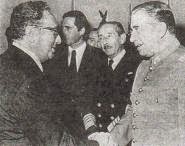
Kissinger and Pinochet
Documents declassified a year ago, upon the 40th anniversary of Salvador Allende’s overthrow in Chile (the other September 11th), “spotlight Kissinger’s role as the principal policy architect of U.S. efforts to oust the Chilean leader, and assist in the consolidation of the Pinochet dictatorship in Chile,” according to the National Security Archive at George Washington University.
Peter Kornbluh, who directs the archive’s Chile Documentation Project, has said, “These documents provide the verdict of history on Kissinger’s singular contribution to the denouement of democracy and rise of dictatorship in Chile.”
In her review, Clinton writes:
For an international order to take hold and last, Kissinger argues, it must relate “power to legitimacy.” To that end, Kissinger, the famous realist, sounds surprisingly idealistic. Even when there are tensions between our values and other objectives, America, he reminds us, succeeds by standing up for our values, not shirking them, and leads by engaging peoples and societies, the sources of legitimacy, not governments alone.
What Clinton of course doesn’t mention is that Kissinger despised legitimate, popular governments, as they too often undermined American domination and exploitation.
After Allende’s inauguration in November 1970, despite prior covert U.S. operations to derail it, Kissinger sent a memorandum to President Nixon warning of “the insidious model effect” of his democratic election.
Kissinger was convinced that the “consolidation of Allende in power in Chile… would pose some very serious threats to our interests and position in the hemisphere” and that “a successful elected Marxist government in Chile would surely have an impact on — and even precedent value for — other parts of the world” that could “significantly affect the world balance and our own position in it.”
He was particularly frustrated that “Allende was elected legally” and “has legitimacy in the eyes of Chileans and most of the world; there is nothing we can do to deny him that legitimacy of claim he does not have it.” Furthermore, Kissinger lamented, “We are strongly on record in support of self-determination and respect for free election” and that Nixon himself was “firmly on record for non-intervention in the internal affairs of this hemisphere.”
“It would thereby be very costly for us to act in ways that appear to violate those principles, and Latin Americans and others in the world will view our policy as a test of the credibility of our rhetoric,” he wrote.
Kissinger immediately outlined a strategy to topple the Allende government.
Following the successful coup and Pinochet’s installation as Chile’s dictator, Kissinger maintained that “however unpleasant they act, this government is better for us than Allende was.” Ignoring appeals to address the severe human rights abuses in Chile, he later told Pinochet himself, “In the United States, as you know, we are sympathetic with what you are trying to do here. We want to help, not undermine you. You did a great service to the West in overthrowing Allende.”
When Nixon complained that “liberal” press was giving him “crap” about the coup, Kissinger was indignant. “In the Eisenhower period, we would be heroes,” he said.
Kissinger knew this would strike chord with his audience of one. Nixon was Vice President when Eisenhower authorized the 1953 CIA-organized coup that overthrew popular Iranian Prime Minister Mohammad Mossadegh for the crime of nationalizing the nation’s oil industry and not buckling to British and American diktat. The coup consolidated U.S.-backed dictatorial power under Mohammad Reza Pahlavi, the Shah, who ruled Iran for the next quarter century.
“By restoring the Shah to power,” Nixon recalled years later, “it meant that the United States had a friend in Iran, a very strong friend, and for 25 years Iran played a role as a peace-keeper in the Persian Gulf area.”
Always valuing imperial interests over democratic and humanitarian values, Nixon made an official pilgrimage to visit the Shah in Iran shortly after the coup. Fifteen years later, as president, Nixon provided weapons systems and military assistance to the Iran on a massive scale, effectively bankrolling the Shah’s prospective $20 billion military build-up. At the time, Massachusetts Congressman Gerry E. Studds called the arms transfers “the most rapid buildup of military power under peacetime conditions of any nation in the history of the world.”
Kissinger himself mused, “[W]e adopted a policy which provides, in effect, that we will accede to any of the Shah’s requests for arms purchases from us (other than some sophisticated advanced technology armaments and with the very important exception, of course, of any nuclear weapons capability).”
In a private meeting with Kissinger on July 27, 1973 at Blair House, the Shah confirmed as much. “I have a friend in the U. S. that is ready to provide anything I need – short of atomic weapons and they are not an issue,” he said during a conversation about acquiring American fighter jets, tanks, and battleships and agreeing to arm Pakistan against India.
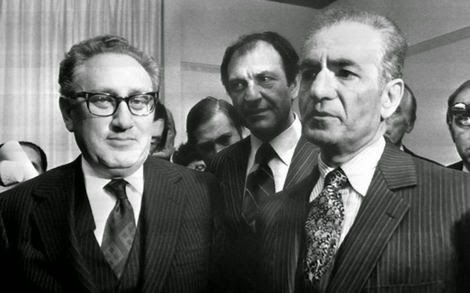
The Nixon White House – and Kissinger in particular – maintained very close relations with the Shah, in turn gaining a dutiful puppet in the region. This was especially beneficial during the 1973 OPEC oil embargo, when Arab members of the petroleum exporting consortium “cut production and stopped oil shipments to the United States and other countries that were backing Israel in the Yom Kippur War.” With the Shah in power, Iran continued production and export to the United States and its allies, including Apartheid South Africa, throughout the embargo and was rewarded handsomely by reaping the windfall of the oil shock.
When the Iranian Revolution finally forced the Shah to flee Iran, it was Kissinger and a cohort of other “influential friends” like Chase Manhattan Bank’s David Rockefeller, former statesman and World Bank president John McCloy, and National Security Adviser Zbigniew Brzezinski who intensively lobbied the Carter administration to eventually admit the Shah to the United States. Carter’s begrudging acquiescence was the main catalyst for the November 4, 1979 takeover of the U.S. Embassy in Tehran.
A month after the seizure of the embassy, Kissinger gave an interview to People Magazine. He had already visited the Shah twice since his arrival. He also insisted that Iranians had no legitimate reason to resent American foreign policy. Admitting that the Shah was “certainly authoritarian,” Kissinger praised his “reforming government” for its supposed economic, education, environmental, and medical advances.
“Not everybody who attacks us is doing so because we supplied a just grievance,” he said, adding that “it must be made clear that challenging the U.S. is not for free. There has to be some penalty for opposing us and some reward for being friendly. Unless we can reestablish that balance, this trend will continue.”
Regarding his belief that the United States was indebted to its former quisling, Kissinger told People, “I have held the position all along that the Shah was a friend of the U.S. for 37 years. Every President, starting with Truman, lauded the Shah’s friendship and his modernizing tendencies and spoke of the gratitude we owed him.” Such a partner deserved “private humanitarian asylum,” Kissinger said. “In light of the Shah’s help to our nation, I felt a duty to help.”
Despite all this, in her review of “World Order,” Clinton remarks that “Kissinger’s analyses of the Asia-Pacific and the Middle East are particularly valuable.”
Atomic Drop
While writing about Kissinger’s diplomatic philosophies and policy prescriptions, Clinton manages to praise herself a lot for her own work as Secretary of State, including what she terms taking “decisive action on challenges such as Iran’s nuclear program.”
As one might expect, this “decisive action” was actually just issuing threats, ultimatums, and imposing “crippling” sanctions upon a country over its refusal to abandon its inalienable right to a domestic nuclear energy program. It wasn’t until she left the administration that the current negotiations got underway.
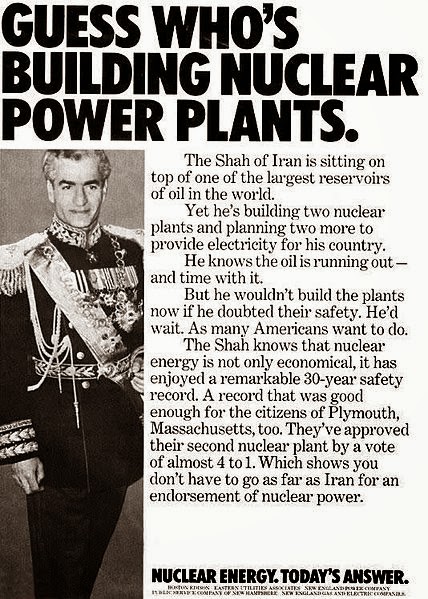
Yet bringing up such a topic in an article about Henry Kissinger is itself ironic as Iran may never have had a nuclear program to begin with were it not for him.
In 1975, during his tenure as Gerald Ford’s Secretary of State, “Kissinger signed and circulated National Security Decision Memorandum 292, titled ‘U.S.-Iran Nuclear Cooperation,’ which laid out the administration’s negotiating strategy for the sale of nuclear energy equipment projected to bring U.S. corporations more than $6 billion in revenue,” reported the Washington Post‘s Danfa Linzer in 2005.
The strategy paper, Linzer wrote, “commended Iran’s decision to build a massive nuclear energy industry,” and argued that Iran needed to “prepare against the time — about 15 years in the future — when Iranian oil production is expected to decline sharply.”
Working alongside other Ford administration officials like Donald Rumsfeld, Dick Cheney and Paul Wolfowitz, Kissinger engaged in “intense efforts to supply Iran with U.S. nuclear technology” and even “tried to accommodate Iranian demands for plutonium reprocessing.” A directive signed by Ford in 1976 offered access to “a complete ‘nuclear fuel cycle’ — reactors powered by and regenerating fissile materials on a self-sustaining basis.”
When asked by Linzer about the potential consequences and hypocrisy of such a deal in light of more recent punitive and preventive policies, Kissinger shrugged. “I don’t think the issue of proliferation came up,” he said, eventually adding, “They were an allied country, and this was a commercial transaction. We didn’t address the question of them one day moving toward nuclear weapons.”
Diplomatic Double Standards
In mid-1969, when he was Nixon’s National Security Adviser, Kissinger outlined what would soon become official American policy regarding Israel’s clandestine nuclear arsenal. Once Israeli nuclear capability came to light – outside of the Nuclear Non-Proliferation Treaty, which Israel refused to sign – the Nixon administration attempted to devise a strategy to deal with it.
A National Security Study delivered to Kissinger in May 1969 by Deputy Assistant Secretary of State for Near Eastern and South Asian Affairs Rodger Davies noted, “Israel has committed to us that it will not be ‘the first to introduce nuclear weapons into the area’, but there are grounds for believing that Israel does not construe production of a weapon to constitute ‘introduction.'” It further stated:
If the possession of nuclear weapons offered an ultimate deterrent for Israel we would perhaps be prepared to conclude that, whatever other disadvantages this development might have, its contribution to Israel’s security, especially with the prospect of continuing Arab hostility, was in the US interest.
Israel wants nuclear weapons, as was both explicit and implicit in our conversations with Rabin, for two reasons: first, to deter the Arabs from striking Israel, and second, if deterrence fails and Israel were about to be overrun, to destroy the Arabs in a nuclear Armageddon.
In a July 19, 1969 memo to the president, Kissinger introduced a new policy option, wring that “while we might ideally like to halt actual Israeli possession, what we really want at a minimum may be just to keep Israeli possession from becoming an established international fact.”
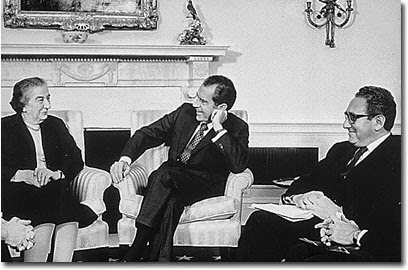
Despite the efforts of Nixon officials to place curbs on the program, they eventually “withdrew step after step from an ambitious plan to block Israeli nuclearization, until they finally acceded, in internal correspondence – the content of the conversation between Nixon and Meir is still classified – to recognition of Israel as a threshold nuclear state,” wrote Amir Oren recently in Ha’aretz, basing his report on newly-declassified documents.
The Nixon advisers concluded that, all things considered, “we cannot force the Israelis to destroy design data and components, much less the technical knowledge in people’s minds, nor the existing talent for rapid improvisation.” Thus, Davies wrote in July, two months before the Nixon-Meir meeting, the lesser evil would be to agree for Israel to “retain its ‘technical option'” to produce nuclear weapons.
“If the Israelis show a disposition to meet us on the nuclear issue but are adamant on the Jericho missiles, we can drop back to a position of insisting on non-deployment of missiles and an undertaking by the Israelis to keep any further production secret,” Davies added.
Such “nuclear ambiguity” has been both official Israeli and U.S. policy ever since President Richard Nixon meeting with Israeli Prime Minister Golda Meir in September 1969. Accordingly, Nixon formally suspended all American inspection of and visitation to Israel’s Dimona nuclear plant in 1970 and ceased demands that Israel join the Nuclear Non-Proliferation Treaty.
When President Obama first met with Netanyahu in May 2009, he confirmed the continuity of the secret agreement, a stance one Senate staffer reportedly described as “call[ing] into question virtually every part of the president’s nonproliferation agenda” by giving “Israel an NPT treaty get out of jail free card.”
The Clinton Doctrine
Hillary Clinton’s review of Henry Kissinger’s new book provided her and her public relations team an opportunity to set the stage for what seems like another inevitable run for president. It affirmed her fealty to American imperialism and hegemony, her reliance on the advice of predecessors, colleagues and friends with demonstrably more appalling records than her own, and her firm commitment to continue the failed and dangerous policies of past administrations, all while standing on the same sanctimony and entitlement that got her where she is today.
From hailing Henry Kissinger as a gritty, truth-telling idealist to her role in the Obama administration’s expansion of the American surveillance state and drone program, the question remains: is there anything about Hillary Clinton that isn’t absolutely terrible?
CrossTalk: Reinventing NATO?
RT | September 8, 2014
A military alliance in search of an identity: For over two decades NATO has had branding issues. To justify its existence, it absolutely needs an enemy. In the wake of the Ukraine crisis, Russia now fits that bill.
CrossTalking with Mark Sleboda, Alexander Mercouris and Brian Becker.
Arms firms implicated in illegal US drone strikes ‘bought influence’ at NATO summit – Reprieve UK
RT | September 8, 2014
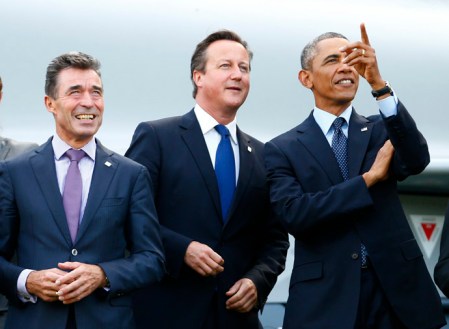
Arms firms that provide core military components for drones deployed by the US to conduct covert strikes in violation of international law allegedly bought access to NATO’s summit in Wales last week, a British human rights charity says.
The defense companies concerned doled out up to £300,000 to ‘exhibit’ their military wares at the conference in Newport. Among the firms present were General Dynamics, Raytheon, Lockheed Martin and MBDA, according to a British government press release.
General Dynamics manufacture Hellfire missiles utilized in most US drone strikes, while Raytheon make the targeting system for the Reaper drone deployed by the CIA and other actors to conduct strikes across the globe. Lockheed Martin operates as a contractor to provide select support services for both the Reaper and Predator, and MBDA is a European company that manufactures the unmanned aerial vehicle (UAV) Brimstone – a variant of the Hellfire missile.
The US drone program has received widespread public criticism both at home and abroad. Critics say attacks carried out in foreign countries, including Yemen and Pakistan, are in violation of both international and US law.
Although US drone strikes have culminated in hundreds of civilian casualties, they are subject to little oversight, according to Reprieve. President Barack Obama has refused to formally acknowledge the program’s existence.
Reprieve’s Legal Director Kat Craig said it’s “deeply worrying” that a group of firms who potentially profit most from this breach of international law were able to buy access into an international global summit like NATO.
“It is unacceptable that the US’ drone campaign, and the UK’s support for it, has been allowed to remain in the shadows for so long”, he added.
“President Obama must be far more open about it – as must his European allies, especially the UK and Germany, about the support they provide.”
Craig suggested the drone manufacturers’ presence at NATO signaled their inherent capacity to buy political influence “behind closed doors,” highlighting the opaque, illicit and legally questionable nature of much of the global arms trade.
US to supply arms to Ukraine, hold joint military drills in Black Sea
RT | September 7, 2014
The Ukrainian and US navies will take part in a joint exercise called “Sea Breeze 2014” on September 8-10 in the northwestern part of the Black Sea, Ukraine’s Ministry of Defense said.
Around 280 US servicemen will participate in the drills, according to a statement by US European Command spokesman Navy Capt. Greg Hicks, director of Communication and Engagement.
The exercises will include representatives from five countries – including Georgia, Romania and Turkey – as well as the Standing NATO Maritime Group TWO Task Unit 02 (including Canadian, Spanish, and Romanian ships).
The planned military exercises are said to be focused on how interdiction operations could enhance maritime security.
Also, the US – along with France, Italy, Poland and Norway – will supply modern weapons to Ukraine, according to President Petro Poroshenko’s aide, Yury Lutsenko. The agreements were reached at the NATO summit in Wales, he wrote on Sunday on Facebook. The West will also send military advisers to Ukraine, he added.
Meanwhile, NATO is in the midst of its seven-day military exercises in Latvia. The organization says the drills are aimed at showing its commitment to Baltic member states in the face of an “assertive” Russia.
Exercise Steadfast Javelin 2 kicked off on September 2. It simulates the deployment of NATO soldiers and equipment during a crisis situation. A total of around 2,000 soldiers from nine different countries are taking part in the maneuvers, which will carry on until Monday.
The exercises in Latvia will be followed by other drills in Germany, Norway, Ukraine, and Poland later this autumn.
Moreover, following the NATO summit in Wales, a plan to create a new rapid reaction force in Eastern Europe was announced, likely numbering at least 4,000 and ready to be deployed within 48 hours.
The Baltic states and Romania have already offered to host the force.
NATO to give Ukraine 15mn euros, lethal and non-lethal military supplies from members
RT | September 4, 2014
NATO has pledged some 15 million euros to Ukraine, with several of the bloc’s member states pledging separate bilateral support and military cooperation, involving medical supplies as well as lethal and nonlethal military equipment.
NATO Secretary General Anders Fogh Rasmussen announced a “comprehensive and tailored package of measures” including the donation of 15 million euros “through NATO” at a joint news conference with the Ukrainian president on Thursday on the first day of the NATO summit in Wales.
He said that this would be in addition to other measures such as advising Ukraine on defense reforms and further bilateral aid.
“This is about improvement of logistics, the improvement of command and control, the improvement of communications, and cyber defense,” Ukrainian President Petro Poroshenko said.
He added that bilateral aid would include the provision of “high precision weapons” as well as medical equipment.
Poroshenko made careful statements regarding Ukraine’s potential induction into NATO, saying that membership criteria need to be met first.
“The new parliamentary election will help us a lot to accelerate the reform process,” Poroshenko said, adding that the most significant reforms to be made would be to the economy, and ensuring the rule of law and anti-corruption.
He said that he had some optimism for Friday’s peace talks in Minsk, Belarus, after which a ceasefire is expected to commence.
Rasmussen expressed caution: “If recent statements from President Putin represent a genuine effort to find a political solution, I would welcome it,” Rasmussen told reporters. He said that recent offers had been a “smokescreen” for further destabilization on the ground.
‘Promoting peace and stability’: NATO warships enter Black Sea
RT | September 4, 2014
A US Navy destroyer and, reportedly, a French frigate have entered the Black Sea, as NATO builds up its presence in the region while tensions remain high in Ukraine. Another two warships are expected to arrive in the area by the end of the week.
The US Navy 6th Fleet official command has confirmed on its official Twitter account that the destroyer USS Ross, (DDG 71), an Arleigh Burke-class guided-missile destroyer, is now in the Black Sea.
“USS Ross enters Black Sea, promoting peace and stability while working with NATO allies and partners,” a statement said.
The US Navy has stressed that “the Ross’ presence in the Black Sea serves to demonstrate the United States’ commitment to strengthening the collective security of NATO allies and partners in the region.”
“The US Navy maintains an enduring commitment to forward-presence throughout the region in order to have ready-forces available if a crisis were to occur,” the statement said.
Another NATO warship, France’s Commandant Birot, also arrived in Black Sea waters on Wednesday night, according to a military diplomatic source cited by the Itar-Tass news agency.
“Both ships have passed through the Bosphorus and entered the Black Sea between 21:00 and 22:00 Moscow time,” the source was quoted as saying.
Commandant Birot has joined another French warship, the Dupuy le Lome, a surveillance ship designed to collect signals and communications from beyond enemy lines. Up until September 4, the Dupuy le Lome was the only NATO ship in the region. The vessel is scheduled to leave the area on September 5.
A total of four NATO warships are expected to enter the Black Sea before September 7. The USS Ross and Commandant Birot will be joined by Canada’s HMCS Toronto, a Halifax-class frigate, and a Spanish frigate, the Almirante Juan de Borbon.
Under the Montreux Convention of 1936, warships of non-Black Sea states can stay in the Black Sea for no more than 21 days. It also stipulates that the maximum deadweight of a non-regional warship in the area should not exceed 45,000 tons.
NATO warships have been operating in the area since this spring, when tensions started escalating between Kiev forces and rebels in southeastern Ukraine.
Despite the three-week limit, the alliance has managed to secure its presence in the area by constantly rotating warships there.
Deployed to the region in mid-May, the Dupuy le Lome was preceded by the destroyer USS Donald Cook, sent to the Black Sea in early April.
In July this year, NATO deployed a total of nine vessels, setting a record for the post-Soviet period.
On August 7, the US missile cruiser Vella Gulf entered the Black Sea and left the region at the end of the month.
NATO has been discussing its “more visible” presence in Eastern Europe, referring to the three Baltic States – Latvia, Lithuania and Estonia – as there has been little progress in resolving the conflict in Ukraine. The issue is now being discussed in Wales, where the military alliance is meeting on Thursday and Friday.
The US and the international community have accused Russia of supporting opposition forces in southeastern Ukraine, accusations that have been denied by Moscow.
Russia has condemned NATO’s activities in the Black Sea and branded them a provocation that hinders the normalization of the situation in Ukraine.
Scottish independence to spark nuke debate
Press TV – September 4, 2014
A yes vote in the upcoming referendum on Scottish independence is expected to pose challenges over the future of the UK’s strategic nuclear Trident program.
Keeping the nuclear base in Scotland for a least a number of years would be part of the independence negotiations, says Professor Malcolm Chalmers, a research director at the Royal United Services Institute (Rusi) and co-author of a recent report on relocating the Trident base.
According to the report, cited Thursday in The Guardian newspaper, while any relocation could not be completed by the 2020 target date currently proposed by the Scottish government, it could be put off – under a specific UK-Scotland basing agreement – perhaps until 2028, the date a new fleet of Trident submarines is due to start entering service.
The relocation would add up to £3.5bn to the cost of retaining Britain’s nuclear forces, a program estimated to cost £80bn over 25 years.
Yet, as the Rusi report concedes, negotiations following a yes vote in the Scottish referendum this month would trigger a wider debate in the rest of the UK about whether or not the strategic benefits of retaining nuclear weapons exceed the costs involved.
Chalmers adds that the debate over British nuclear weapons has always been politically driven and the military is divided over the issue.
The US, in particular, which wants its major British NATO ally to retain nuclear weapons, has made it clear that it would not welcome such a debate.
However, Colin Fleming, a Scottish defense and security academic, put it this way in a recent edition of the Chatham House think tank Journal of International Affairs : “There is no reason why Scotland would not provide a modern, flexible, defence force capable of securing Scottish territory and playing its part in the broader security of the British Isles as a whole.”
Featured Video

Thomas Fazi: NATO’s Hybrid Warfare – Deception & Permanent War
or go to
Aletho News Archives – Video-Images
Book Review
The Zeolite Book — First Edition, 2026, Paperback
The volcanic mineral medicine will not patent — for the toxic burden medicine will not name
Lies are Unbekoming – October 30, 2026
 Zeolite is old. It is in Roman concrete that has held for two thousand years. It’s in the water filters of ancient cisterns. It’s in the stomachs of Pacific livestock whose keepers knew, somehow, that this grey crumbling rock made the animals healthier. It’s in Soviet clinical protocols from the 1960s. It’s in the standard emergency response to the Chernobyl explosion.
In 1986, after the Chernobyl reactor failure, the Soviet Union manufactured and distributed natural zeolite at industrial scale — for soil remediation, for livestock feed, for human consumption, for the cleanup itself. Karl Hecht, who had been director of the Institute for Experimental and Clinical Pathophysiology at the Charité of Humboldt University Berlin, spent the six decades after that building the clinical research base — on silicon’s role in human health, on zeolite’s clinical safety, on its applications in ageing. In 2018, Pavelić and colleagues published a comprehensive clinical safety review of natural clinoptilolite in Frontiers in Pharmacology. In 2019, Mastinu analysed its binding affinities. In the Western medical literature, these works sit largely uncited.
What has not been treated at book length, until now, is how a volcanic mineral with six decades of Soviet clinical work behind it, two major peer-reviewed Western reviews, and ongoing clinical use across the former Eastern Bloc, remains almost entirely absent from Western medical practice — and what the toxic burden it’s meant to address actually is.
The Zeolite Book gathers the Soviet clinical record, the Western peer-reviewed studies, three contemporary practitioner voices, and three serious counterviews into one honest treatment. That’s why the book runs to seven appendices. 288 pages, four parts, three practitioner voices, three counterviews, seven appendices. The honest treatment is the argument.
Blog Roll
 Aletho News
- They Compared the Spice to the Drug. The Spice Won — Again. (Part 2)
- Thomas Fazi: NATO’s Hybrid Warfare – Deception & Permanent War
- Wrong, AP and NPR: Europe’s 50,000 Heat Deaths Are a Computer-Model Estimate, Not a Real Body Count
- Questioning Your Doctor Is Now Considered A Psychological Problem (Seriously)
- London tourism expo promotes Israeli agency linked to theft of Palestinian land
- Dockworkers launch global strike against Israeli and US military shipments
- Europe facing gas price shock – Gazprom chief
- Ukraine continues recruiting people with disabilities
- Weaponized Journalism: 2021 Sayer Ji Interview with NPR
- Beyond Netanyahu: what Israel’s election means for Palestinians
- If Americans Knew
- 1,300 will gather in Palo Alto on Nov. 1 for Z3 Conference on Zionism
- DAILY UPDATE: Latest essential news on Palestine, Israel, & region
- The Long Arm of AIPAC
- Genocidal intent behind Hebron assault, rights group says
- This week, Israel killed 8-year-old who survived bombing that wiped out her family
- DAILY UPDATE: Latest essential news on Palestine, Israel, & region
- Israeli soldier poses at damaged Lebanon church, sparking anger
- New Report. Manufacturing the Great Replacement: Is Israel behind one of the largest racist influence campaigns ever documented?
- ‘Arab voice doesn’t count’: Jewish Israeli blocs reject Palestinian support
- Whether Bibi Stays or Goes, the ‘Special Relationship’ Must End
- No Tricks Zone
- Germany’s Green Energy Transition Becoming Increasingly Expensive…Another 6 Trillion Euros!
- Sudden Stratospheric Warming, Powerful El Niño Combination May Lead To Extreme Europe Cold, Energy Crisis!
- Two New Studies Find Thwaites Glacier Melt Cannot Be Driven By Human Activity Or A Warming Ocean
- E-Cars Reduce CO2 Emissions By Only 41% Compared To Internal Combustion Engine Vehicles
- Predictions Made By Renowned Climate Professor Over Past Decades Have Been Proven To Be Poor
- New Study Suggests Large Regions Of The Pacific Ocean Have Been Cooling For The Last 80 Years
- Germany’s Green Energy Debacle: High Energy Costs Force Kahla Porzellan to Close After 182 Years!
- New Study: 50 Years Of The Most Aggressive ‘Net Zero’ Policies Can Only Affect The Global Climate By 0.03°C
- US September “Heat” Was No Record…Many Records Set Decades Ago
- Latest European Green Energy Debacle; Portugal’s Largest Flagship Solar Park Insolvent!

